The Untold Story Behind the $20 Million Lawsuit and Backstage Chaos That Destroyed TV’s Number One Sitcom
The Untold Story Behind the $20 Million Lawsuit and Backstage Chaos That Destroyed TV’s Number One Sitcom
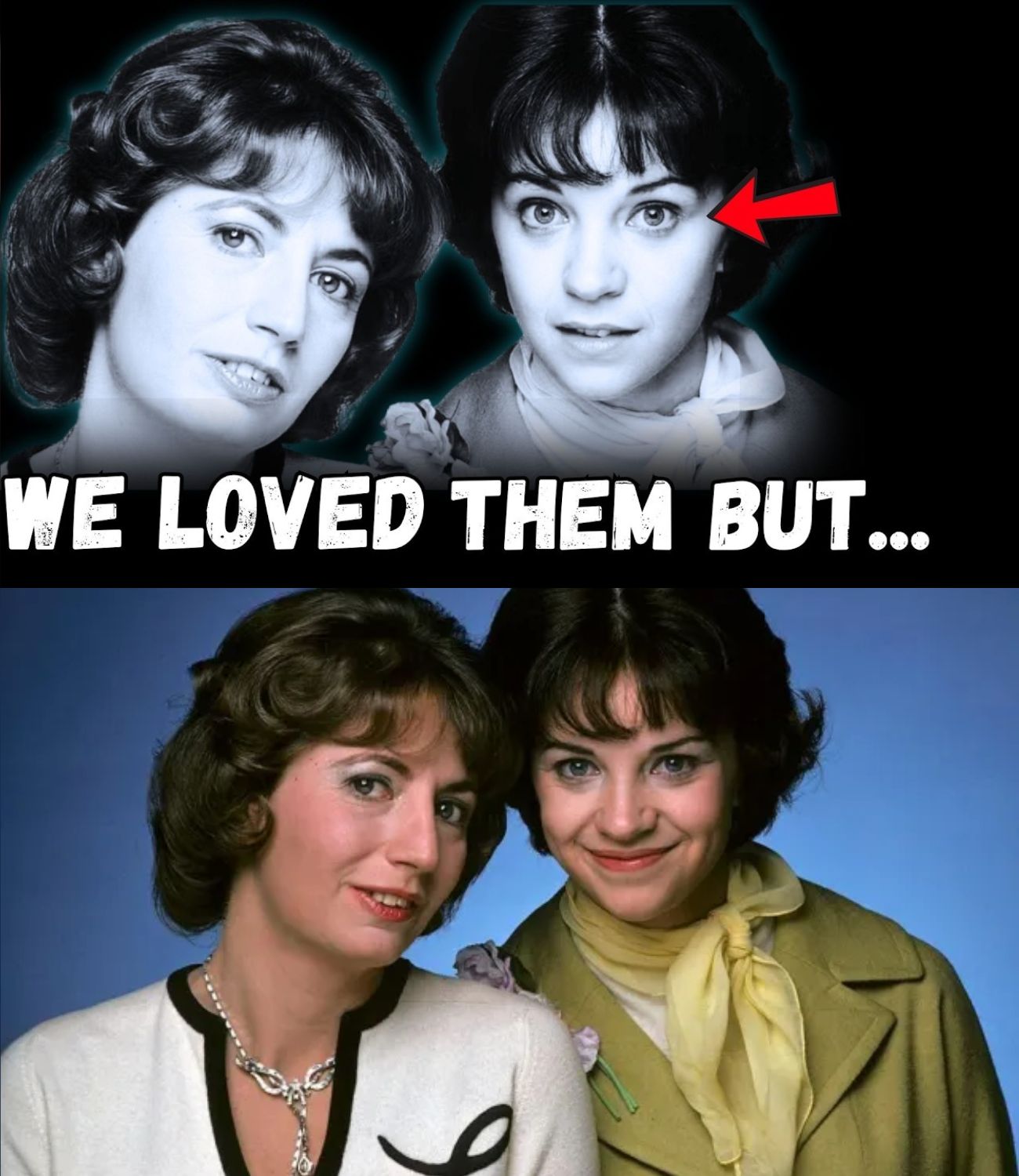
The television landscape of the 1970s was defined by massive sitcom hits, but few reached the stratospheric heights—or suffered as dramatic a backstage collapse—as Laverne & Shirley. Running for eight seasons on ABC, the series spent three consecutive years as the single most-watched program on American television, even outranking its parent powerhouse, Happy Days. Yet beneath the glossy veneer of studio laughter and physical comedy lay a tumultuous environment shaped by accidental casting, political blacklisting, disastrous scheduling choices, and a career-altering legal battle that ended in a multi-million-dollar lawsuit.
Humble Beginnings and Accidental Origins
The phenomenon almost never happened. Laverne DeFazio and Shirley Feeney were not originally conceived as headliners; they were introduced in November 1975 as minor characters on a Happy Days episode titled “A Date with Fonzie,” serving as double-date companions for Fonzie and Richie Cunningham. The audience response was so immediate and overwhelming that ABC rushed a spin-off into production just over two months later, premiering on January 27, 1976.
Even the casting of its iconic lead was born out of persistence rather than a traditional audition process. Creator Garry Marshall did not initially plan to cast his sister, Penny Marshall, as Laverne. There was no exhaustive screen test or competitive cattle call; rather, it was the result of a mother who simply would not stop advocating for her daughter. Marshall later admitted flat-out that his mother drove him until he gave in, landing Penny Marshall the role that would define her career.
Pop Culture Milestones and Hidden Shadows
The series quickly established a distinct identity, largely thanks to unscripted authenticity brought by its stars. The show’s signature opening hopscotch chant—featuring the famous “1, 2, 3, 4, 5, 6, 7, 8, Schlemiel, Schlamazel, Hasenpfeffer Incorporated”—was not penned by a writer’s room. Penny Marshall brought the chant directly from her own childhood sidewalk games in the Bronx, turning a simple playground rhyme into one of the most recognizable television openings of the decade.
However, the production also brushed against the darker historical currents of Hollywood. Betty Garrett, who played landlady Edna Babish, had her major career momentum abruptly halted decades earlier when the red scare swept through the entertainment industry. Her husband, actor Larry Parks, was blacklisted in 1951 after testifying before the House Un-American Activities Committee regarding his past Communist Party membership. Garrett spent years rebuilding her career in nightclubs and touring theater before television eventually welcomed her back, first in All in the Family and subsequently on Laverne & Shirley.
The Beginning of the End: Scheduling and Cast Disruption
By its third season, the show was an undisputed juggernaut. But network overconfidence soon led to self-inflicted wounds. In August 1979, ABC made the fateful decision to move Laverne & Shirley to Thursday nights at 8:00 p.m., pitting it directly against heavy hitters like CBS’s The Waltons and NBC’s Buck Rogers in the 25th Century. Viewership plummeted rapidly, forcing the network to reverse course and shift the show to Mondays in an attempt to salvage its ratings.
Additional strain came during the final season when Michael McKean, who played Lenny opposite David Landers’ Squiggy, was demoted from the main cast. The demotion occurred because McKean stepped away to film This Is Spinal Tap, the mockumentary that would eventually evolve into a landmark comedy classic.
The $20 Million Lawsuit and Cindy Williams’s Exit
The most devastating blow to the series, however, happened behind closed doors during the transition into the final seasons. In the season eight premiere, Shirley Feeney married a character named Walter Meenie, resulting in the awkward moniker “Shirley Feeney Meenie”. Just two episodes later, the character was written off entirely.
The on-screen departure masked a bitter real-world conflict. Cindy Williams’s exit was triggered by a severe contract dispute during her pregnancy. According to Williams, studio producers expected her to continue working right up to her due date without making any adjustments to the rigorous shooting calendar. In interviews, she noted that she was not asking for special treatment, only basic fairness and adequate time off to have a child.
Public court reporting from the era, cited by United Press International (UPI), revealed that Williams’s salary was approximately $75,000 per episode plus another $37,500 for reruns—figures that became public knowledge precisely because of how contentious the legal battle grew. Refusing to compromise under the studio’s terms, Williams filed a $20 million breach of contract lawsuit against Paramount.
While the case was ultimately settled privately, Williams never returned to the series in any meaningful capacity. The bitter fallout strained her decades-long real-life friendship with co-star Penny Marshall for years, leaving a profound silence that Williams later described as deeply painful. Fortunately, the two friends eventually reconciled and remained close until Marshall’s passing in 2018.
Ultimately, Laverne & Shirley remains a towering achievement of television history—a testament to brilliant comedic chemistry whose off-screen drama proved just as compelling as any script Hollywood could write.

