I came home early: my mother was holding a red-hot iron, and my wife—seven months pregnant—was trembling beneath a blue throw. She hadn’t left the bed in three months and would flinch the moment I touched her. My mother kept telling me, “She’s hiding something from you.” I believed her—until the moment I lifted that throw and finally saw who the real monster was.
I came home early: my mother was holding a red-hot iron, and my wife—seven months pregnant—was trembling beneath a blue throw. She hadn’t left the bed in three months and would flinch the moment I touched her. My mother kept telling me, “She’s hiding something from you.” I believed her—until the moment I lifted that throw and finally saw who the real monster was.
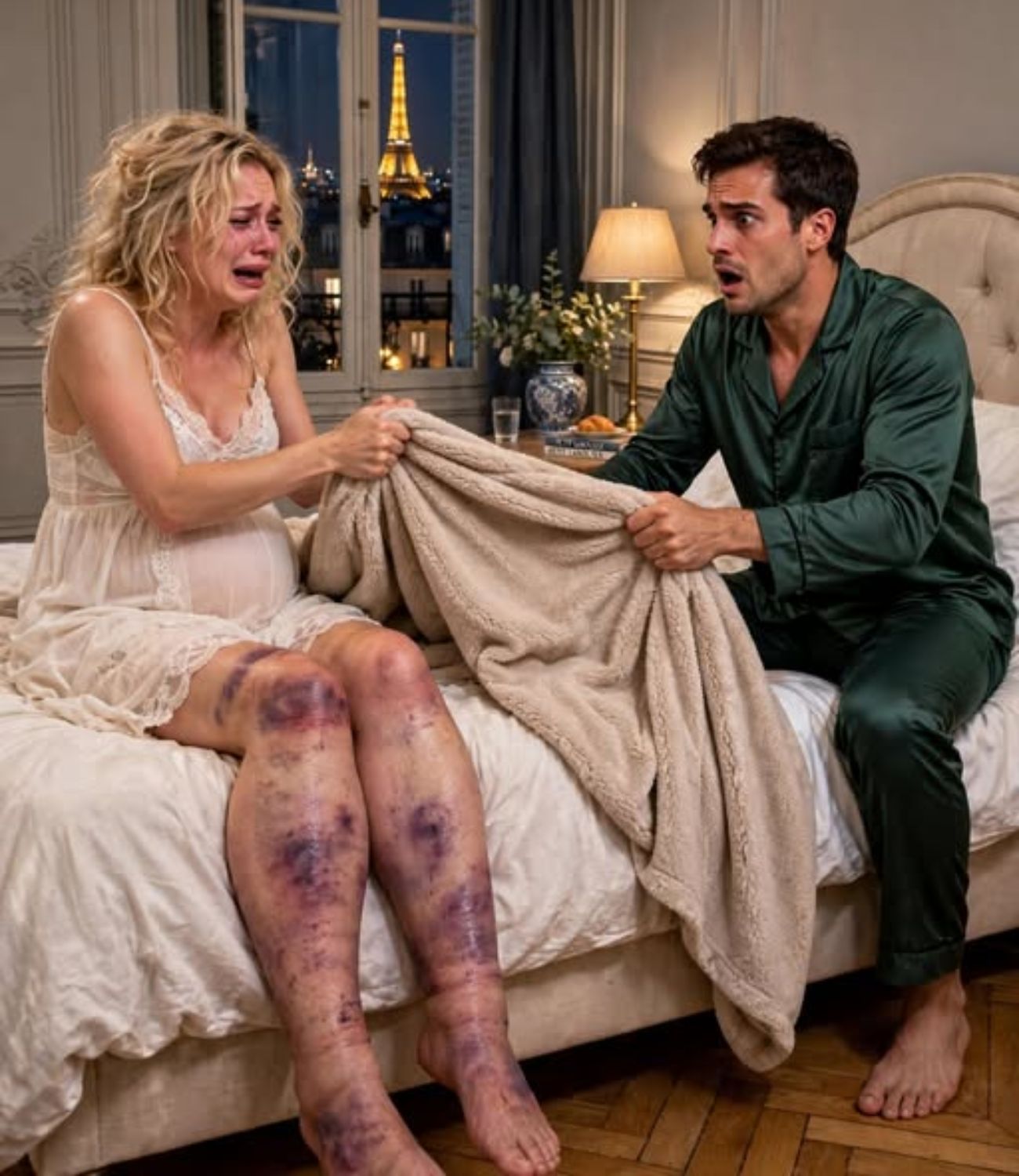
Seven months pregnant, Anna has been living under a blue blanket for weeks, while Romain still believes his mother’s reassuring explanations. An unexpected return to their Nantes apartment reveals a hot iron, hidden markings, and a sheet of paper Anna was supposed to sign. From that moment on, Romain must learn to distinguish truth from truth, while Anna gradually regains control of her home, her voice, and the impending birth.
Part 1: Iron
I came home early: my mother, a hot iron in her hand, my wife, seven months pregnant, shivering under a blue blanket. She hadn’t left that bed for three months. Mother whispered, “She’s hiding something from you.” I believed her—until the moment I lifted that blanket.
Seven months pregnant, the vibrant woman I had married was fading into a terrified ghost. I told myself it was normal: pregnancy, fatigue. Our two-room apartment in Nantes, my ten-hour days on construction sites—she just needed rest, I wanted to believe.
Since the pregnancy, I managed everything: her vitamins on the nightstand, the locks checked, sometimes a post-it note on the fridge — Rest, my love.
But Anna withdrew into herself: hours curled up under her midnight blue blanket pulled up to her chin, even in the stifling heat. Whenever I tried to help her, her body stiffened—as if my touch would hurt.
“It’s okay, Romain, I’m just clumsy, I keep bumping into things,” she murmured without looking at me.
I wanted to believe her. I really did.
But Véronique came by every day to “help,” planting her seed of doubt: “This woman is behaving strangely, Romain. A pregnant woman doesn’t live under a blanket. She hides things when I come in. She’s trying to isolate you, I’m sure of it.”
I hated hearing her, I kept telling myself she was wrong — but I ended up in the hallway, staring at our door: why was Anna more scared every time I approached?
One afternoon, the meeting had ended two hours earlier. Without warning, I opened the door quietly, expecting to find her asleep. But something was off: too much lavender in the air, and underneath, something acrid, metallic.
Then a stifled sob came from the bedroom. I froze—and I heard my mother. Not her gentle voice: something colder.
“Just one sound when he comes home, and I swear to you, Anna, I’ll finish right then and there.”
My blood ran cold.
I pushed open the door. Mom whirled around—a split second of pure panic, then the mask: “Oh, Romain! Thank God! She’s having another fit, I don’t know what to do!”
But I wasn’t looking at her face: I was staring at what she was hiding behind her back—and the smoking iron by the bed.
Then Anna, pressed against the headboard, the sheets gripping so tightly that her knuckles were turning white.
“Romain, no, please… if you see, everything will break,” she sobbed.
My hands were trembling. “I need to know.”
A terrible second of silence. Her tears. And my mother behind me, waiting.
I reached for the blanket. Anna closed her eyes. I lifted it—and all my lies crumbled.
On his thigh, near the knee and higher up on his side, old and new marks overlapped. Some were already yellowing. Others were still red. It wasn’t the mark of a single fall, nor that of a random, repeated clumsiness.
I didn’t need to be a doctor to understand that they weren’t all the same age.
Anna pulled the blanket close to her, not to hide something shameful, but like closing a door after a break-in.
No affair. No madness. She suffered in silence to protect our child, and the person responsible stood behind me, always seemingly innocent.
I positioned myself between the bed and my mother.
“Get out of the room.”
Véronique’s eyes opened wide.
“You’re not going to believe that instead of me, are you?”
That sentence hurt me more than I could have imagined. She wasn’t asking what had happened to Anna. She was only asking who I was going to believe.
Anna grabbed my wrist.
“Romain… before you ask me anything, ask her why she never wanted you to come home early.”
I turned back to my mother.
She did not reply.
Then Anna added, in a voice so faint that I had to lean forward to hear her:
“And ask her what she wanted me to sign.”
Part 2: The sheet under the mattress
Véronique was the first to get her voice back.
“She’s making it up. She’s exhausted, she doesn’t even know what she’s saying anymore.”
I pointed out the corridor to her. She refused to move.
For the first time in my life, I put my hand on the door in front of my mother and said, “Out. Now.”
Her face had changed. Not much. Just enough for me to see the anger beneath the maternal concern.
She stepped back, then I closed the door and turned the key.
Anna was breathing too fast. I sat down on the floor, away from the bed.
I had a thousand questions, but only one still seemed legitimate to me.
“What do you want me to do?”
She looked at me as if that sentence was foreign to her.
“Under the mattress,” she whispered.
I didn’t understand.
She pointed to the side of the bed. I lifted the mattress and found a sheet of paper folded in four.
The handwriting was not Anna’s.
The text stated that she was going through a period of psychological fragility, that she wished to distance herself after the birth, and that she acknowledged sometimes having “irrational” reactions towards my family.
Below, a space awaited a signature.
Hers.
“Who wrote this?”
Anna closed her eyes.
“Your mother.”
In the hallway, Véronique knocked.
“Romain! Open it! This sheet of paper means nothing, I only wanted to protect you!”
I hadn’t said the word “leaf”.
I froze.
Anna too.
The silence that followed was more accusatory than any scream.
“Since when?”
“Several weeks. At first, she said it was just to avoid arguments after the birth. Then she started saying that if I refused, she would tell everyone I was unstable.”
I wanted to ask why Anna hadn’t told me anything. The question rose up into my throat.
I swallowed it.
Because I already knew part of the answer: every time she had tried to set a limit for my mother, I had explained, excused, and stalled.
“Mom wants to help.”
“She’s clumsy.”
“You know what she’s like.”
All these phrases came back to me with unbearable precision.
Behind the door, Véronique was still knocking.
“She’s trying to turn you against me!”
Anna took a step back.
I got up, but not to open the door.
I took my phone and photographed the front and back of the sheet.
Then I slipped it into a pouch with our administrative papers.
“She’s not taking it back.”
Anna stared at me for a long time.
“Do you believe me?”
I didn’t answer too quickly.
“I believe what I see. And I believe I should have looked sooner.”
Her eyes filled with tears, but she did not cry.
She simply placed one hand on her stomach.
“She always said the same thing when I refused to sign.”
” What ? “
Anna hesitated.
“My son will not lose his child like his father lost his.”
I straightened up.
My father, Alain, had never lost a child. Not to my knowledge.
My parents had separated when I was a teenager, but no story like this had ever been part of our family.
“Who was she talking about?”
Anna shook her head.
“I don’t know. She never explained it to me.”
The blows stopped in the corridor.
Then my mother’s voice came through the door, calm again.
“Romain, give me back that document.”
This time, I knew she was no longer trying to save Anna from a supposed crisis.
She was trying to retrieve evidence.
Part 3: Obstetric Emergencies
I didn’t leave Anna alone for a second while we were leaving the apartment.
Véronique was standing near the entrance, her bag against her chest. She tried to touch my arm.
I stepped aside.
“Where are you taking him?”
“To the emergency room.”
“For a few bruises? You’re going to stress her out even more. Think of the baby.”
Anna squeezed my hand.
That sentence, precisely, decided the rest.
We left without replying.
At the Nantes University Hospital, the wait seemed endless. Anna was examined in obstetrics, then a doctor asked to speak to her alone.
I accepted immediately.
Sitting in the hallway, I discovered what it meant to no longer be at the center of the story. I didn’t have to hear every word. I didn’t have to control every explanation. My presence gave me no right over what Anna wanted to say.
When she came out, her eyes were red.
“The baby is fine,” she told me.
I felt my legs weaken.
The relief lasted a second.
The doctor explained to us, with Anna’s consent, that several injuries had been observed. Some were old, others more recent. Their distribution did not simply correspond to a series of minor household bumps and knocks.
He did not make any accusations.
He documented it.
That difference mattered.
Anna agreed to have the findings included in her medical file.
Then a nurse asked him directly:
“Do you feel safe at home?”
Anna looked at her hands.
” No. “
I thought she was talking about my mother.
The nurse explained:
“Does the person who scares you live with you?”
” No. “
“So why don’t you feel safe?”
Anna turned her head towards me.
“Because she can come in whenever she wants.”
I didn’t understand right away.
“Mom only has one spare key.”
Anna shook her head.
“I took the key back from her two months ago. She came back the next day while you were at work.”
My stomach knotted.
” How ? “
“With someone else.”
I remembered all the times Véronique had told me that Anna was exaggerating, that she was barricading herself in, that she wanted to cut ties.
It wasn’t Anna who controlled access.
She was the one who no longer controlled any of them.
As soon as I left, I called a locksmith before I even started the car.
Anna asked me not to tell my mother.
” All right. “
The word looked tiny.
Yet, for months, no one had let him decide on something so simple.
In the parking lot, my phone was vibrating constantly.
Seventeen missed calls from Véronique.
Three messages.
The last one said: “If you change the locks, you’ll prove that she managed to isolate you.”
I showed it to Anna.
She turned pale.
I didn’t reply.
I was thinking about the caregiver’s comment.
Are you safe at home?
On the way back, we drove along the banks of the Loire without speaking. The traffic lights punctuated the journey with short pauses where I saw Anna checking the rearview mirror. She wasn’t looking for my mother. She was simply checking that no one was following us. I had never noticed this reflex before.
At the apartment, the locksmith asked us how many spare keys we wanted. I almost mechanically replied, “One for my mother.” The word stuck in my throat. Anna heard me inhale. She said nothing. This tiny automatic response showed me how natural Véronique’s access to our lives had been considered.
That evening, I put the medical file in a folder. Anna asked me not to leave it in the usual drawer. Véronique knew the apartment too well. We chose a spot together, then photographed the documents. It wasn’t paranoia. It was a way of regaining control over what concerned us.
Before going to sleep, Anna asked me if I still thought she was bumping into everything. I said no. She closed her eyes, and I understood that a correct answer might come much too late to be comforting.
For the first time, I understood that our apartment was no longer just a place to live.
It was a place whose borders someone had confiscated.
Part 4: The Three Keys
The locksmith arrived before us.
Anna waited in the car while I got in. I didn’t want to decide for her anymore, so I asked her what she preferred.
“Change everything,” she had replied.
The cylinder was replaced in less than an hour.
Three new keys.
One for Anna.
One for me.
The third one was placed in an envelope which we decided to leave with Elodie, Anna’s sister.
None at my mother’s house.
When Anna went back upstairs, she tested the lock herself.
Once.
Twice.
Three times.
Then she pressed her forehead against the door.
“I had forgotten what it felt like to know who could come in.”
I couldn’t think of anything to say in response.
In the evening, we revisited our old messages, not to conduct a spectacular investigation, but to understand.
Two months earlier, Anna had written to me: “I took the key back from your mother. I’d prefer she call before coming.”
I replied, “Of course. I’ll talk to him.”
I had never spoken to him.
The next day, Véronique sent me a photo of her new keychain, a gift from a friend. All I could see was a small red pom-pom.
Anna enlarged the image.
Three identical keys appeared behind the pompom.
I felt sick.
“She had done doubles.”
Anna did not triumph.
She simply whispered, “I knew it.”
My phone rang.
This time, Véronique left a voicemail.
Her voice was gentle.
“My darling, I understand you’re upset. I only want to protect my grandson. Anna is putting you in a bad way because she’s scared. Call me.”
Anna stopped the recording.
“Your grandson?”
I watched it.
We had asked the ultrasound technician not to announce the sex in front of anyone. We had chosen to keep it to ourselves.
Even Elodie didn’t know that.
“Did you tell him?”
” No. “
” Me neither. “
We remained silent.
Then Anna put a hand to her stomach.
“She already knew that when she started talking about rights after birth.”
This time, it wasn’t just a question of keys.
Someone had obtained medical or personal information that we had voluntarily kept private.
I remembered a visit a few weeks earlier. My mother had brought pastries after an ultrasound appointment.
She knew the exact time.
I had assumed that Anna had told him.
Anna had assumed it was me.
We understood at the same time.
We also changed the intercom code and warned the building manager that no relatives should be allowed to come up without calling. I dreaded his look, as if protecting our door were a public confession. He simply replied, “Very well, Mr. Le Goff.” The world didn’t end.
Anna held her new key in her palm for several minutes. There was nothing special about it: new metal, still-sharp edges, a small silver ring. Yet, she looked at it as if it were an object being returned to her after a long confiscation.
I remembered that Véronique had often joked about our lock: “Luckily your mother always has something to save you.” I had laughed. Now, that phrase took on a different meaning, not because it proved anything, but because it revealed what we had normalized.
That night, no key clicked. Anna woke up twice nonetheless. Security could be installed in an hour. But the feeling of security wasn’t something that followed any locksmith’s estimate.
The next question was not how Véronique got into the apartment.
It was how long she had been following our lives closely enough to know things we had never confided in her.
Part 5: The date she knew
We started with what could be verified.
Not by intentions.
Not through the most painful memories.
The dates.
Anna opened the maternity app. I went back to my construction schedule. We lined up the appointments, Véronique’s messages, and my hours.
The appointment where we learned the sex of the baby took place on a Tuesday at 4:20 p.m.
At 5:03 PM, my mother wrote to Anna: “Did everything go well?”
At 5:11 PM: “You could at least show me a picture.”
At 6:02 PM, I had sent Anna: “Meeting extended, sorry.”
So she was alone.
Anna put down her phone.
“She came.”
His voice had changed.
“That evening?”
“Yes. She said a grandmother has the right to see her grandson. I asked her how she knew. She replied that she knew her son and that she could read your face.”
But I hadn’t seen my mother that day.
Anna had finally shown her an ultrasound image to get her to leave.
It was also the evening when she asked me, for the first time, not to let Véronique in without warning.
I remembered my answer.
“She’s enthusiastic. She’ll get over it.”
Anna didn’t need to remind me.
I did it myself.
“I downplayed it.”
She looked at the wall.
” Yes. “
The word was calm.
It hurt me more than a reproach.
She explained to me that after that meeting, Véronique had started using a different threat.
Not only that: “Romain will believe me.”
But: “If you continue to keep him away from his family, everyone will see what you’re doing.”
Every attempt by Anna to gain space became proof that she was trying to isolate me.
Every silence became proof that she was hiding something.
Every fear became proof that she was unstable.
The trap worked because it turned all her reactions into arguments against her.
“Why is she talking about your father and a lost child?” I asked.
Anna rubbed her hands together.
“I don’t know. Once, she said a first name. Claire.”
I froze.
Clear.
I knew that first name.
Not like knowing an aunt or a family friend. Like knowing a word overheard in a room where the adults fall silent as soon as a child enters.
Claire had been my father’s first wife.
I only knew that she had left before my parents actually met.
At least, that was the version I had always been given.
I called Alain.
He answered after four rings.
“Dad, I need you to answer me honestly. Who was Claire?”
The silence at the other end of the line lasted long enough to give me the most disturbing answer possible.
We continued going back in time. Whenever a memory seemed too hazy, we left it aside. Anna insisted: she didn’t want to fabricate a perfect story after the fact. She only wanted to distinguish what she knew from what she suspected.
In a previous exchange, Véronique asked what time I finished a job in Rezé. At the time, I thought it was thoughtful. That same day, Anna stopped replying for three hours. Nothing on its own proved what had happened, but the coincidence explained why she had started to dread my long days.
When I dialed my father’s number, my first instinct was to go out onto the balcony so Anna wouldn’t hear. I stopped. It was another old family habit: keeping conversations separate, protecting one side of the story. I asked Anna if she preferred to stay. She said yes.
The name Claire then ceased to be a detail of the past. It became a door. But we still didn’t know if it opened onto a useful explanation or a new way to divert our attention from Anna.
Then my father said:
“Why did your mother tell you about her?”
Part 6: Claire
Alain did not want to talk on the phone.
He offered to come the next morning.
My father lived about forty minutes from Nantes and had been avoiding my mother since their separation. I thought it was just the wear and tear of an ordinary divorce.
When he entered our apartment, he immediately noticed the new lock.
He didn’t ask any questions.
Anna had chosen to stay in the room. She didn’t want to tell her story to a man she barely knew.
I respected him.
In the kitchen, I placed the unsigned sheet of paper in front of Alain.
He read slowly.
His face closed off.
“Did she ever mention a child you might have lost?”
He looked up.
“Not mine. Not exactly.”
Then he told me something he had never told anyone before.
Before Véronique, he had been married to Claire.
Claire was pregnant when she left.
The pregnancy had not come to term, but Alain still didn’t know the exact circumstances. After she left, their contact with her ceased very quickly.
“Your mother always told me that Claire wanted nothing more to do with me.”
“Was Mom already there?”
He lowered his eyes.
“Within our circle of friends. Yes.”
I felt my anger rising, but Alain stopped me.
“Don’t make this a simple story. Claire and I already had problems. I made mistakes.”
This nuance surprised me.
He wasn’t trying to shift all his blame onto Véronique.
“So why does she say you lost a child?”
“Because that’s how she always told the story. As if someone had taken it from me.”
Alain rubbed his forehead.
Then he took an envelope out of his bag.
Yellowed paper. Old stamp. My father had written the name Claire in pencil on the front.
“She sent me this after she left. I never opened it.”
I looked at it in disbelief.
“Thirty-five years old?”
“I was twenty-six years old and very proud. Véronique said that opening up would only allow me to be manipulated again. Afterwards, the more years passed, the more ashamed I was to open up.”
He pushed the envelope towards me.
I did not extend my hand.
“It’s not mine.”
Alain nodded.
For the first time, I saw in his silence not a romantic mystery, but an old decision whose weight he still carried.
He opened the envelope himself.
Her hands were trembling.
After a few lines, he stopped.
Then he whispered:
“I should have read this thirty-five years ago.”
I did not immediately ask what was written.
I was thinking about Anna, behind the bedroom door.
At every instance where refusing to listen had been presented as a way to preserve peace.
Alain took a coffee, barely drinking it. He kept glancing at the bedroom door, as if to reassure himself that Anna could remain out of the conversation without being excluded. This belated respect contrasted sharply with what he was about to reveal about his own past.
He explained to me that after Claire left, the family had adopted a simple explanation: she had left, she had refused to come back, they had to move on. Over the years, this simplification had become a certainty. No one had asked what was missing anymore.
When he took out the envelope, I noticed it had been passed from apartment to apartment. The corners were worn. So Alain had chosen not to read the letter, but never to throw it away. Part of him perhaps knew the story wasn’t over.
Anna only joined us when my father asked if she wanted to hear the rest. He didn’t assume. She agreed. That simple gesture gave the conversation a quality unlike any my mother ever imposed.
My father resumed his reading.
And the first detail he gave me concerned a laundry room.
Part 7: The Unsealed Letter
Claire wrote that she was not running away from Alain.
She was fleeing “the environment that had become unbreathable around him.”
The letter did not name Véronique.
She was talking about a young woman in the group who decided who was loyal, who was ungrateful, who had the right to enter the family and who had to be kept at a distance.
Alain read aloud in fragments.
He stopped often.
I could see the past changing shape on her face.
Claire’s main complaint was that he had never wanted to check.
When she said that people were going through her things, he replied that she was nervous.
When she asked that they stop coming unannounced, he replied that she wanted to isolate him.
When she was afraid, he called it jealousy.
I closed my eyes.
The same words.
Not exactly the same facts.
But the same words.
Alain put down the letter.
“I chose the version that required the least effort.”
I didn’t try to console him.
The letter then mentioned an incident in a laundry room.
Claire said that after this episode, she understood that she would never be safe as long as others could enter her home and then rewrite what had happened there.
A noise rang out behind me.
Anna was standing in the doorway.
She had heard.
His face had turned white.
“What is it?”
She leaned against the wall.
“The laundry room.”
Alain stood up, worried, but Anna raised her hand.
“No. Stay.”
She came and sat down at the table.
For a few seconds, no one spoke.
Then Anna looked at the letter.
“What did she do to you?” I asked.
Anna did not respond to this formulation.
She said:
“That’s where your mother first showed me the iron.”
I felt myself falling without moving.
She explained that a month earlier, she had asked Véronique not to come every afternoon anymore.
They were near the small communal laundry room on the landing, where Anna had brought down some laundry.
Véronique was ironing a shirt she had brought for me.
When Anna had repeated that she wanted privacy, Véronique had placed the iron upright between them.
Not on Anna.
Not yet.
Close enough to feel the heat.
“She told me that some women destroy families simply by pretending to set boundaries.”
Alain closed his eyes.
Anna continued.
“After that, I started recording some of the visits. Not always. I was afraid that if she found my phone, it would be worse.”
She turned towards me.
“Perhaps one still exists.”
” Or ? “
“On my old phone. The one with the broken screen.”
I knew exactly where he was.
Claire’s letter contained no dramatic revelations. That was precisely what made it believable. She spoke of exhaustion, doors being opened without warning, repeated remarks, a husband who preferred to avoid arguments, and a growing feeling of no longer having her own space.
Alain recognized certain scenes even before reaching the end. He remembered calling Claire excessive when she asked the friends to stop coming in without knocking. He had forgotten the exact words, but not his annoyance.
Anna didn’t try to compare her injuries to Claire’s. She simply asked Alain if Véronique had ever used the word “isolate.” He answered yes. We all understood that this vocabulary had a history.
That evening, I put the letter back in its envelope and gave it to my father. It wasn’t our proof. It belonged to Claire and him. What we could take from it was a warning against how easily a boundary can be described as an attack.
In a drawer in the living room.
For the first time since my return, we perhaps had something other than a memory for a memory.
Part 8: What Anna had never told
The old phone took twenty minutes to restart.
Twenty minutes during which Anna told me what had happened after the laundry.
Not all at once.
In pieces.
At first, Véronique mainly used the presence of the iron, the heat, the proximity. She placed it near Anna, repeating that a reasonable woman would have nothing to fear.
Then she brought the statement.
Anna had refused to sign.
The first real mark appeared a few days later, when Véronique briefly pressed the hot edge of the iron against the thick fabric of the blanket placed on her leg.
Not long enough to cause a spectacular burn.
Enough to cause pain.
Enough to leave a mark.
“Why the blanket?” I asked.
Anna gave a joyless smile.
“Because afterwards, she said that if you saw anything, I could say I’d burned myself while ironing.”
Every detail made the method clearer.
Not an uncontrolled explosion.
A series of gestures ambiguous enough to be denied.
Pressure.
A threat.
Then a step back.
Anna had started wearing the blanket even when it was hot, because she didn’t want me to see the marks.
And because Véronique kept telling her that if I saw them, she would say that Anna had done it to herself in order to accuse her.
“She knew I would believe her,” I whispered.
Anna looked at me.
“She thought you would believe her.”
The difference was small, but important.
She did not exonerate me.
Nor did it condemn me to remain the man I had been.
The phone finally displayed the home screen.
We found a file of recordings.
Most were mundane voice notes: a shopping list, a name suggestion, a message that was never sent.
Then a forty-seven second file.
Anna did not press play.
“I want you to understand something first.”
I waited.
“I didn’t record it to trap her. I recorded it because I was afraid I’d end up thinking I was exaggerating.”
That sentence broke me in a different way.
I had offered her so little certainty that she needed a machine to remind her of her own reality.
Anna started the recording.
First, a rustling sound was heard.
Then Véronique’s voice.
Clear.
Placed.
Almost tender.
“If he has to choose between you and his son, you know very well who he’ll believe.”
Silence.
Anna’s voice: “Get out of my house.”
Then a metallic noise.
And, just before the end, another woman’s voice.
“Véronique, that’s enough.”
Anna described the first time the iron had actually left a mark. Her voice was almost clinical. She paused when her breath changed. I didn’t ask for further details. I had long confused knowing with helping; I was beginning to understand that knowing everything wasn’t necessary to believe what was already clear.
She also told me about the little things that preceded the visits: the sound of the elevator, the scent of lavender, the door handle moving. Her body had learned the sequence before her mind accepted to name it as fear.
The broken phone had been replaced because Véronique had deemed it “dangerous for the baby” after seeing Anna record a voice note. Anna had thought she’d lost all her data. However, a local backup had preserved some files.
When the recording started, I found myself hoping it wouldn’t contain anything. This desire made me ashamed. A part of me was still searching for a way out, a way in which my mother hadn’t done what Anna described. The forty-seven seconds closed that way.
I knew that voice.
My aunt Sylvie.

