Three Deputies Mocked a Quiet Black Man in a Food Court—Then He Revealed His FBI Badge
Three Deputies Mocked a Quiet Black Man in a Food Court—Then He Revealed His FBI Badge
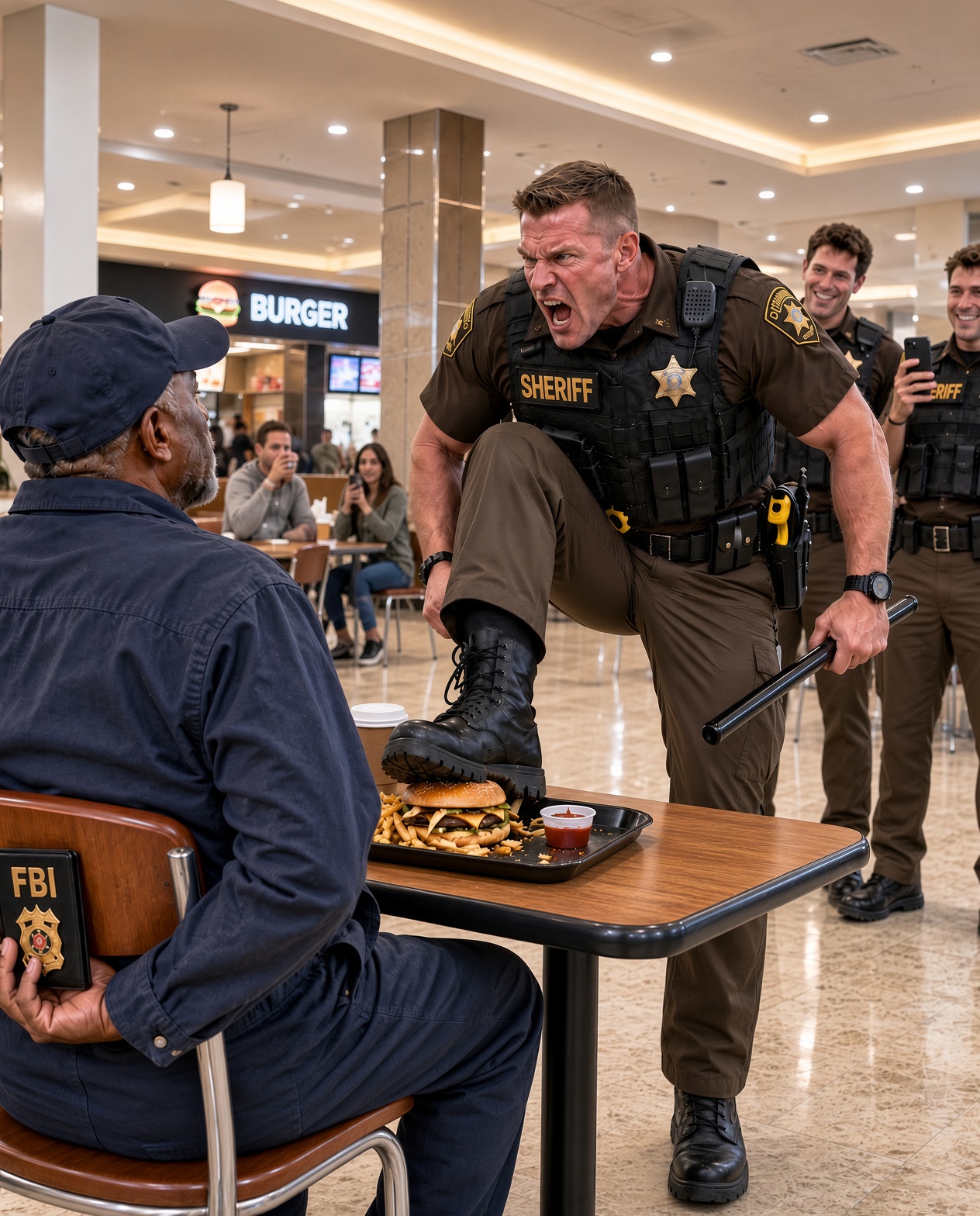
The first deputy laughed when the quiet Black man refused to leave the table.
The second deputy knocked his coffee sideways.
The third leaned down until his face was only inches away and spoke quietly enough that most of the food court could not hear him.
“People like you need to learn what happens when authority tells you to move.”
The man did not raise his voice.
He did not stand.
He did not reach for his phone.
He simply watched the coffee spread slowly across the white plastic table.
A few drops reached the edge and fell onto the polished tile floor.
Around them, conversations began to fade.
Forks stopped halfway to mouths.
A teenager at a nearby table quietly lifted his phone and started recording.
The three deputies noticed the attention.
And strangely, they seemed to enjoy it.
What none of them noticed was the black leather wallet partially hidden between the quiet man’s jacket and the back of his chair.
They also had no idea why he had chosen that particular table.
It faced the mall’s eastern entrance.
From his seat, he could see the escalators reflected in a stainless-steel column.
The mirrored window of a closed jewelry store gave him a partial view of the western corridor.
And if anyone approached from behind, their reflection appeared in the glass display of the burger restaurant across from him.
The man had not chosen the table because it was convenient.
He had chosen it because it gave him visibility.
And in his profession, visibility could mean survival.
Less than fifteen minutes later, a gold FBI badge would be lying on that same table.
The laughter would be gone.
One of the deputies would be struggling to explain himself.
And the quiet man they had decided to humiliate would discover that the confrontation had never been random at all.
His name was Marcus Hail.
He was forty-six years old, six feet two inches tall, broad through the shoulders, and possessed the kind of controlled stillness that made people underestimate him.
That was usually useful.
For almost two decades, Marcus had built a career around entering rooms without becoming the most interesting person inside them.
He knew how to dress like a businessman, a construction supervisor, a delivery driver, a tired commuter, or an ordinary father waiting for his family.
Today, he looked deliberately forgettable.
A navy baseball cap.
A faded dark work jacket.
Charcoal trousers.
Cheap brown boots.
No watch.
No jewelry.
No expensive phone sitting on the table.
Nothing about him suggested federal law enforcement.
That was exactly the point.
At 1:17 p.m., Marcus lifted his paper coffee cup and took a small sip.
His eyes never stopped moving.
Westbridge Galleria was crowded with the usual lunchtime chaos.
Children hurried between tables while exhausted parents called after them.
Employees shouted order numbers over the noise.
A blender screamed from a smoothie counter.
Music played softly through ceiling speakers.
Shopping bags brushed against chairs.
A security guard near the entrance looked bored enough to fall asleep standing up.
Marcus appeared to be another middle-aged man killing time over a half-finished burger.
But inside his head, he was counting.
Seven minutes late.
Ethan Cole was seven minutes late.
That was unusual.
Ethan was frightened.
Frightened people tended to arrive early.
Marcus resisted the urge to check his phone.
Instead, he shifted his chair slightly.
The movement appeared casual, but it allowed him to see the eastern entrance through the reflection in the metal pillar.
Nothing.
He took another sip of coffee.
Eight months.
That was how long the investigation had lasted.
It had started with stolen electronics.
At first, the case seemed almost boring.
High-value phones, tablets, computer processors, and other electronics had been disappearing from commercial warehouses before reaching retail stores.
The thieves were organized.
Very organized.
They knew delivery schedules.
They knew which loading bays had broken cameras.
They knew which shipments carried the most valuable products.
And somehow, they always seemed to disappear shortly before law enforcement arrived.
Then the case changed.
Three separate investigative operations collapsed within hours of authorization.
A suspect who had been under surveillance suddenly abandoned his apartment.
Two vehicles connected to the operation disappeared from a storage facility.
Phones were destroyed.
A warehouse was emptied overnight.
Someone was warning them.
The task force began examining who had access to confidential information.
The list was uncomfortable.
Warehouse executives.
Private security personnel.
Transportation contractors.
And law enforcement.
That was when Ethan Cole contacted them.
Ethan was a logistics supervisor at one of the warehouses.
He claimed he had seen something.
Something serious.
But he refused to enter an FBI office.
“I’m being watched,” he had told Marcus during a short encrypted call.
“By whom?”
“I don’t know.”
“Then how do you know you’re being watched?”
There had been silence.
Then Ethan whispered:
“Because they knew where my daughter goes to school.”
That changed everything.
Marcus had offered protection.
Ethan refused.
He was terrified that visible federal protection would tell the conspirators exactly what he was doing.
Instead, he chose Westbridge Galleria.
Hundreds of people.
Dozens of cameras.
Multiple exits.
He believed no one would risk confronting him there.
Marcus was not convinced.
But frightened witnesses sometimes needed to feel they still controlled one small part of their lives.
So Marcus agreed.
At 1:21 p.m., three sheriff’s deputies entered the food court.
Marcus noticed them immediately.
The first was Deputy Ryan Mercer.
Early forties.
Muscular.
Close-cropped hair.
Confident posture.
The second was Tyler Boon, younger, perhaps thirty.
The third was Kyle Harris, who looked barely old enough to have been wearing the uniform for more than a few years.
Marcus knew none of them personally.
Officially, they were responding to a minor argument near a jewelry kiosk.
By the time they arrived, mall security had already resolved it.
They could have left.
They did not.
Mercer purchased a soda.
Boon said something to him.
Then Boon looked directly at Marcus.
And laughed.
Marcus pretended not to notice.
Mercer followed Boon’s gaze.
For several seconds, he studied Marcus.
Then he changed direction.
Marcus felt the shift before the deputy reached him.
There was a particular rhythm to an officer approaching someone casually.
This was different.
Mercer stopped beside the table.
“You waiting for somebody?”
Marcus slowly looked up.
“Possibly.”
Mercer smiled.
“Possibly?”
Marcus took another sip of coffee.
“A friend.”
“Got a name?”
Marcus looked at the badge on Mercer’s chest.
Then at Mercer.
“Is there a problem, Deputy?”
Boon laughed.
“He answers questions with questions.”
Harris smiled faintly.
Marcus ignored both of them.
“I’m having lunch.”
Mercer looked at the empty chair opposite Marcus.
“You’ve been sitting here a while.”
That sentence immediately sharpened Marcus’s attention.
“How long?”
Mercer’s smile weakened.
“What?”
“You said I’ve been sitting here a while. How long?”
Mercer shrugged.
“Nearly an hour.”
Marcus had been there thirty-eight minutes.
Maybe Mercer was exaggerating.
Police officers did that during casual questioning sometimes.
They made broad statements and watched reactions.
But something about Mercer’s delivery bothered him.
Marcus leaned back.
“Is sitting here against mall policy?”
“No.”
“Then I’m confused about the problem.”
Mercer’s expression changed.
“Identification.”
Marcus paused.
He could reach inside his jacket.
He could open the leather wallet.
He could end this conversation in five seconds.
But doing that could destroy the operation.
If Ethan was nearby watching, three uniformed deputies suddenly reacting to an FBI credential would tell him something was wrong.
Worse, if someone else was watching Ethan, Marcus would expose himself.
So Marcus kept his hands visible.
“Am I being detained?”
Harris chuckled.
“Listen to the lawyer.”
Marcus looked only at Mercer.
“Am I being detained?”
“I asked you for identification.”
“And I asked whether I’m legally required to provide it in this situation.”
Mercer stepped closer.
People at nearby tables were beginning to look over.
A woman pulled her young son closer.
The teenager with the phone adjusted his camera.
Boon noticed him and smirked.
“Maybe our friend here thinks he’s important.”
Marcus spoke calmly.
“Deputy, if you have a lawful reason to detain me, tell me what it is. If you don’t, I’d like to finish my lunch.”
Mercer pulled out the chair opposite Marcus.
He sat down.
Without permission.
“Here’s what I see.”
Marcus waited.
“A guy sitting alone. Watching the doors. Watching security. Watching everyone who walks in.”
Marcus felt something cold settle in his stomach.
That was different.
Those observations were specific.
Too specific.
“Who told you that?”
Mercer blinked.
Then smiled.
“Nobody told me anything.”
“You just walked in.”
“So?”
“So you couldn’t know what I’ve been watching unless someone was watching me before you arrived.”
Boon’s smile faded for half a second.
Mercer leaned forward.
“You’re pretty interested in how police do their jobs.”
Marcus said nothing.
Mercer continued.
“Maybe you should worry about yourself.”
“I am.”
Boon moved beside Marcus.
“Stand up.”
Marcus looked at him.
“Why?”
“Because we asked you.”
“That isn’t an answer.”
Now several people were openly recording.
Marcus could hear whispers.
He hated this.
Not because he was embarrassed.
He had been screamed at, threatened, followed, and assaulted during investigations.
Public humiliation was insignificant compared with what he had experienced.
What bothered him was Ethan.
Every second this continued made the meeting more dangerous.
Mercer stood.
“Maybe we need to see what you’re carrying.”
“You don’t have my consent to search me or my belongings.”
The atmosphere changed instantly.
Mercer’s jaw tightened.
He reached for Marcus’s coffee.
Marcus watched him.
Mercer pushed it sharply sideways.
Coffee spilled across the table.
Some splashed onto Marcus’s sleeve.
“Oops.”
Boon laughed.
Harris smiled too, but his expression was less certain now.
Marcus stared at the coffee.
Then at Mercer.
“Deputy.”
His voice remained quiet.
“I strongly suggest you reconsider what you’re doing.”
Mercer leaned forward.
“Was that a threat?”
“No.”
Marcus held his gaze.
“It was professional courtesy.”
Boon laughed loudly.
“Professional?”
He looked Marcus up and down.
“What are you, some kind of security guard?”
Marcus said nothing.
Mercer pointed toward Marcus’s hands.
“Keep those where I can see them.”
Marcus placed both palms flat on the table.
He could end it now.
He probably should.
But Mercer’s knowledge kept bothering him.
Watching doors.
Watching security.
Sitting there for an extended period.
Either Mercer had spoken with someone inside the mall…
or someone had directed him toward Marcus.
And Marcus had learned long ago that people revealed the most when they believed they had control.
So he waited.
Mercer’s eyes moved toward the back of Marcus’s chair.
“What’s that?”
Marcus already knew what he had seen.
The edge of the black leather credential wallet.
“Personal property.”
Mercer smiled.
“Then you won’t mind showing me.”
“I do mind.”
Boon stepped closer.
Mercer pointed.
“Hand it over.”
“No.”
“Why not?”
“Because you have no lawful reason to take it.”
Mercer’s face hardened.
“I’m getting tired of your attitude.”
Marcus almost smiled.
“My attitude?”
“Yeah.”
Mercer leaned closer.
“Your attitude.”
For the first time, Harris looked uncomfortable.
“Ryan,” he said quietly.
Mercer ignored him.
Boon reached toward the chair.
Marcus moved first.
Not quickly.
Not aggressively.
He simply picked up the wallet.
Mercer grabbed his wrist.
Several people gasped.
The teenager recording whispered, “Whoa.”
Harris reached toward his handcuffs.
Marcus did not resist.
He stared directly into Mercer’s eyes.
“You really want to continue?”
Mercer tightened his grip.
“Put it down.”
Marcus placed the wallet on the table.
Mercer released him.
Then he snatched the wallet and tossed it beside the spilled coffee.
It landed closed.
“Open it.”
Marcus did not move.
“Open it.”
Marcus’s attention suddenly shifted past Mercer.
A man had appeared near the escalator.
Thin.
Gray hoodie.
Nervous posture.
Ethan Cole.
Their eyes met.
Only for a second.
Ethan immediately looked away.
Good.
The meeting could still be recovered.
Then Ethan looked toward the deputies.
His face changed.
He froze.
Marcus noticed immediately.
It was not the normal anxiety of a frightened civilian seeing police.
It was recognition.
Specifically, recognition of Mercer.
Ethan took one step backward.
Then another.
Marcus felt every piece snap together.
Mercer’s oddly specific information.
Ethan’s fear.
The delayed arrival.
The warehouse leaks.
Mercer approaching the exact table where Marcus was waiting.
This was not harassment anymore.
This was evidence.
Ethan turned and walked quickly toward the east corridor.
Marcus looked at Mercer.
“Step away from the table.”
Mercer laughed.
“Or what?”
Marcus reached for the wallet.
Boon moved.
“Hey—”
Marcus opened it.
The gold badge caught the fluorescent light.
For a second, nobody spoke.
Boon’s mouth opened.
Harris’s hand stopped halfway toward his cuffs.
Mercer stared at the badge.
Then at the identification card beneath it.
His face lost color.
“FBI?”
Boon’s voice was barely audible.
Marcus stood.
Something about him changed.
Not his expression.
Not his voice.
But the relaxed anonymity disappeared.
The man standing in front of them was no longer an ordinary customer.
“Special Agent Marcus Hail.”
Harris stepped backward immediately.
Boon stared at Mercer.
Mercer released a breath.
“We didn’t know.”
Marcus closed the credential wallet.
“That isn’t the part you should be worried about.”
Mercer frowned.
“What does that mean?”
Marcus touched the concealed microphone under his collar.
“Subject moving east. Gray hoodie. Do not approach until identification is confirmed.”
Mercer’s eyes widened.
“You’re running an operation?”
Marcus ignored him.
Across the food court, a woman in jeans and a green jacket stood from her table.
At another table, a man who had appeared to be working on a laptop closed it and walked toward the escalator.
Near the smoothie counter, another casually dressed man touched his earpiece.
Boon looked around.
Only then did the deputies understand.
Marcus had never been alone.
The food court had federal agents positioned throughout it.
Mercer took a step backward.
“We received a suspicious-person report.”
Marcus turned toward him.
“From whom?”
“Mall security.”
“Name.”
Mercer hesitated.
“What?”
“Which security officer reported me?”
“I’d have to check.”
Marcus stared at him.
“Do that.”
His earpiece crackled.
“Hail, we have Cole. East service corridor. He’s safe.”
Marcus relaxed by perhaps one percent.
Then the voice continued.
“He says he recognized one of the deputies.”
Marcus looked at Mercer.
Mercer could not hear the words.
But he understood the expression.
“What?”
Marcus slipped his credentials back into his jacket.
“Deputy Mercer, I need you and your colleagues to remain here.”
Mercer’s defensive confidence returned.
“You can’t just order us around.”
“No.”
Marcus glanced toward the mall cameras.
“But your department can. And they’re being contacted now.”
Harris swallowed.
Boon stopped smiling entirely.
Twenty minutes later, Ethan Cole sat inside a private mall management office.
His hands were shaking so badly that Marcus pushed a bottle of water toward him.
Ethan stared at it.
“I almost left.”
“I noticed.”
“I thought they knew.”
“Who?”
Ethan looked toward the closed door.
“All of them.”
Marcus sat opposite him.
“Start with Mercer.”
Ethan’s eyes lifted.
“You know his name?”
“I do now.”
Ethan rubbed his palms against his jeans.
“I saw him at the warehouse.”
“When?”
“Three months ago.”
Marcus remained still.
“What exactly did you see?”
Ethan closed his eyes.
“When you work logistics long enough, you know what belongs and what doesn’t. Trucks have schedules. Drivers have manifests. Every pallet has a scan.”
He paused.
“One night I was working late. Loading Bay Fourteen opened.”
“What time?”
“After eleven.”
“Scheduled shipment?”
“No.”
Ethan shook his head.
“That’s why I noticed.”
He explained that an unmarked truck had backed into the loading bay.
Several men began moving boxes containing unreleased electronics.
Nothing was scanned.
No inventory records were updated.
At first Ethan assumed it was an emergency transfer.
Then he saw the deputy.
“Mercer?”
Ethan nodded.
“He was talking to one of the men.”
“You’re certain?”
“I’m certain.”
“Did he see you?”
“I don’t think so.”
“What did you do?”
“I took pictures.”
Marcus leaned forward.
“You have them?”
Ethan hesitated.
Then he reached inside his jacket.
Not into the pocket.
Into the lining.
He pulled apart a small section of fabric and removed a memory card no larger than a fingernail.
“Everything’s there.”
Marcus accepted it carefully.
“How many photographs?”
“Twenty-three. Maybe twenty-four.”
“Anyone else visible?”
Ethan nodded.
“That’s why I got scared.”
“Who?”
“Our regional logistics director.”
Marcus knew the name.
Daniel Voss.
Voss had access to shipping records.
More importantly, he knew when federal investigators requested warehouse documentation.
Marcus felt the case expanding in front of him.
“Why didn’t you come forward immediately?”
Ethan laughed once.
There was no humor in it.
“Because two days later, Mercer came back.”
Marcus said nothing.
“He didn’t talk to me. He just walked through the warehouse.”
Ethan’s eyes became wet.
“Then somebody sent me a picture of my daughter leaving school.”
Marcus’s jaw tightened.
“No message?”
“Just the picture.”
That was enough.
Outside the office, Mercer was making phone calls.
Federal agents documented each one.
One call lasted eleven seconds.
Another lasted forty-three.
The third went to a number already loosely connected to Daniel Voss.
Marcus would not learn that until later.
For now, he returned to the food court.
Mercer, Boon, and Harris had been moved away from the crowd.
A sheriff’s supervisor had arrived.
Mercer was angry.
“This is ridiculous.”
Marcus approached.
Mercer pointed toward him.
“I was doing my job.”
Marcus stopped several feet away.
“Then you’ll have documentation.”
“For what?”
“The report that brought you to my table.”
Mercer hesitated.
“I already told you. Mall security.”
The mall’s security director stood nearby.
Marcus looked at him.
“Did your team report me?”
The director shook his head.
“No.”
Mercer’s expression changed.
“We received something.”
“From whom?”
“I don’t remember.”
Marcus nodded slowly.
“That’s going to be a problem.”
Boon looked toward Mercer.
“You said security called it in.”
Mercer snapped:
“Shut up, Tyler.”
The words came too quickly.
Everyone noticed.
Marcus did not react.
But Harris did.
His eyes moved from Mercer to Marcus.
For the first time that afternoon, fear appeared on the young deputy’s face.
Not fear of the FBI.
Fear of the possibility that he had followed someone into something he did not understand.
Marcus knew that look.
He had seen it in witnesses.
He had seen it in junior employees.
He had seen it in officers who suddenly realized loyalty and obedience were not the same thing.
Marcus turned to the sheriff’s supervisor.
“Separate them.”
Mercer protested immediately.
“For what?”
Marcus looked at him.
“You wanted to know why I was sitting here watching the doors.”
He paused.
“Now I want to know why you already knew I was doing it.”
Mercer had no answer.
The investigation accelerated that evening.
Mall surveillance showed the three deputies entering at 1:21 p.m.
There was no conversation with mall security before Mercer approached Marcus.
No employee pointed toward him.
No call had been made reporting Marcus as suspicious.
Then investigators obtained communication records through the appropriate legal process.
A message had reached Mercer’s phone shortly before he entered Westbridge Galleria.
The message was short.
NAVY CAP. BURGER PLACE. POSSIBLE MEET WITH COLE.
Marcus read it twice.
Then a third time.
There it was.
The confrontation had never been random.
Someone knew Ethan intended to meet somebody.
They apparently did not know that somebody was an FBI agent.
Mercer had approached Marcus to disrupt the meeting.
Perhaps he intended to intimidate him.
Perhaps he intended to identify him.
Perhaps he simply wanted Ethan to see law enforcement surrounding the contact and flee.
Whatever the exact intention, investigators would need evidence before drawing conclusions.
Marcus insisted on that distinction.
Boon and Harris presented a different problem.
There was no immediate evidence that either deputy knew about the warehouse operation.
They had behaved badly.
They had mocked Marcus.
They had joined Mercer’s intimidation.
Boon had laughed when the coffee was spilled.
Harris had reached toward his handcuffs without understanding why the situation had escalated.
But bad conduct was not automatically conspiracy.
At the task-force meeting the next morning, one investigator said:
“We should treat all three as compromised.”
Marcus shook his head.
“No.”
The room became quiet.
“They were all there.”
“Yes.”
“They all participated.”
“In the confrontation. That doesn’t prove they all knew why Mercer approached me.”
The investigator leaned back.
“So what do you suggest?”
Marcus placed his pen on the table.
“We follow evidence.”
“And if they’re all dirty?”
“Then the evidence will show that.”
“And if they aren’t?”
Marcus looked around the room.
“Then we don’t destroy two careers because it makes our theory cleaner.”
Nobody argued.
Marcus continued.
“Accountability only means something when it’s accurate. Don’t turn stupidity, arrogance, or bad judgment into conspiracy unless you can prove conspiracy.”
That distinction mattered.
Kyle Harris cooperated almost immediately.
He admitted Mercer had redirected them toward Marcus without explaining why.
“He just said the guy looked wrong,” Harris explained.
“What does ‘wrong’ mean?”
Harris stared at the floor.
“I don’t know.”
“You followed him anyway.”
“Yes.”
“You laughed.”
Harris’s face tightened.
“Yes.”
“You reached for your handcuffs.”
“Yes.”
“Why?”
Harris took a long time to answer.
“Because Mercer was acting like something serious was happening.”
“Did you know something serious was happening?”
“No.”
“Then why didn’t you ask?”
Harris looked at Marcus.
“I should have.”
It was not an excuse.
But it was an answer.
Boon was more defensive.
He initially claimed Marcus had been hostile.
Then investigators showed him phone footage recorded by six different shoppers.
Marcus’s voice was calm in every recording.
Boon claimed Marcus made a threatening movement.
Video showed otherwise.
He claimed the deputies had received a direct report from mall security.
No such report existed.
His story gradually collapsed.
But investigators still found no evidence that Boon knew about the warehouse scheme.
Mercer was different.
Financial records raised questions.
Communications raised more.
Then Ethan’s photographs were examined.
One showed Mercer clearly.
Another showed Daniel Voss.
A third showed Mercer standing near an unmarked truck while boxes were moved behind him.
Mercer denied wrongdoing.
He claimed he had been at the warehouse on legitimate police business.
Investigators requested the corresponding reports.
None were found.
He claimed he had spoken with warehouse employees about theft prevention.
No employee could confirm the meeting.
Then investigators discovered the call Mercer made immediately after Marcus revealed his FBI badge.
It went to a prepaid number.
That number had communicated repeatedly with Voss.
A week later, search warrants were executed.
Records were seized.
Phones were collected.
Financial transactions were traced.
Several suspects were arrested on allegations connected to the theft operation and corruption scheme.
Marcus did not celebrate.
He had been in law enforcement too long for that.
An arrest was not a conviction.
Suspicion was not proof.
Evidence would be challenged.
Defense lawyers would examine the government’s case.
Witnesses would be questioned.
A court would ultimately determine responsibility.
Marcus respected that process.
But strangely, the part of the case that stayed with him most had nothing to do with the warehouse.
It happened several days later.
Marcus returned to Westbridge Galleria.
He was not working.
At least not officially.
He ordered a coffee from the same restaurant.
Then he sat at almost the same table.
The food court looked completely ordinary again.
Children laughed.
Employees called numbers.
Shopping bags filled the floor around tables.
Nobody would have guessed that federal agents had conducted an operation there days earlier.
Marcus was halfway through his coffee when an elderly woman approached him.
She hesitated.
“Excuse me.”
Marcus looked up.
“Yes, ma’am?”
“I was here the other day.”
He recognized her.
She had been sitting three tables away during the confrontation.
“I remember.”
She looked embarrassed.
“I hope you don’t mind me asking something.”
“Go ahead.”
“Why didn’t you just show them your badge?”
Marcus looked down at his coffee.
There were several answers.
Operational security.
Protecting Ethan.
Testing Mercer’s behavior.
Avoiding exposure.
All were true.
But none felt like the most important answer.
He looked back at her.
“Because it shouldn’t have been necessary.”
The woman frowned slightly.
Marcus continued.
“I shouldn’t need a federal badge for someone to speak to me with basic dignity.”
She became quiet.
Marcus looked toward the table where Mercer had spilled his coffee.
“If respect only begins after someone discovers your title, your job, your money, or your connections, then that isn’t really respect.”
“What is it?”
“Fear of consequences.”
The woman stared at him for several seconds.
Then she nodded.
“I wish more people understood that.”
“So do I.”
She thanked him and walked away.
Marcus finished his coffee alone.
Months passed.
The investigation continued.
Departmental reviews examined the conduct of all three deputies.
Mercer’s alleged connections to the warehouse network became part of a broader legal case.
Boon faced scrutiny for his conduct and for inconsistencies in his initial account.
Harris cooperated.
Then one afternoon, Marcus received an envelope.
No official letterhead.
No attorney.
No department insignia.
Inside was a handwritten letter from Kyle Harris.
Marcus read it alone.
Harris did not ask for forgiveness.
That surprised him.
Instead, he described the moment Mercer approached Marcus’s table.
He admitted he had felt uncomfortable almost immediately.
But Mercer was senior.
Mercer seemed confident.
Boon was laughing.
People were watching.
So Harris went along with it.
Then came the sentence Marcus read twice.
I let another man’s confidence replace my own judgment.
Harris wrote that he had replayed the incident hundreds of times.
The spilled coffee.
The laughter.
Marcus asking calmly whether he was detained.
The badge appearing on the table.
But the badge was not the part that bothered him anymore.
What bothered him was realizing that Marcus’s identity had changed his behavior instantly.
Before the badge, Harris saw a suspicious Black man refusing to cooperate.
After the badge, he saw a respected federal agent.
Marcus had not changed.
Only Harris’s knowledge had.
That realization had kept him awake.
Marcus folded the letter.
He did not share it publicly.
He did not send it to reporters.
He did not use it to humiliate Harris.
Instead, he wrote two sentences.
Learn from it.
Then make sure the next person you meet never has to reveal who they are before you decide they deserve respect.
He placed the response in an envelope.
And mailed it.
The public remembered the dramatic version of what happened at Westbridge Galleria.
Three deputies surrounding a quiet Black man.
A coffee knocked across a table.
Mocking laughter.
Phones recording.
A leather wallet opening.
A gold FBI badge catching the light.
And three expressions changing in seconds.
But Marcus remembered something else.
He remembered how easily authority could become performance when nobody questioned it.
How quickly an audience could encourage humiliation.
How dangerous assumptions became when combined with power.
And how one person’s willingness to remain silent could allow another person’s bad judgment to grow.
Mercer had believed Marcus was powerless.
That belief gave him confidence.
The FBI badge destroyed that confidence instantly.
But Marcus knew something Mercer seemed to have forgotten.
Millions of people would never have a badge to place on the table.
They would never have federal agents sitting nearby.
They would never have investigators who could pull surveillance footage, obtain records, and reconstruct what happened.
They would simply have their word.
Their dignity.
And the expectation that the person standing across from them would remember they were human.
That was why, whenever people later asked Marcus about the moment he revealed his badge, he rarely talked about the shock on the deputies’ faces.
The badge was not the lesson.
The moment before the badge was.
Because the true measure of someone’s character is not how they treat a person after discovering that person has power.
It is how they treat that person when they believe they have none.

