A Cop Cuffed a Black Grandpa Over His Own Home—Then the Police Chief Stormed In Calling Him “Dad”
A Cop Cuffed a Black Grandpa Over His Own Home—Then the Police Chief Stormed In Calling Him “Dad”
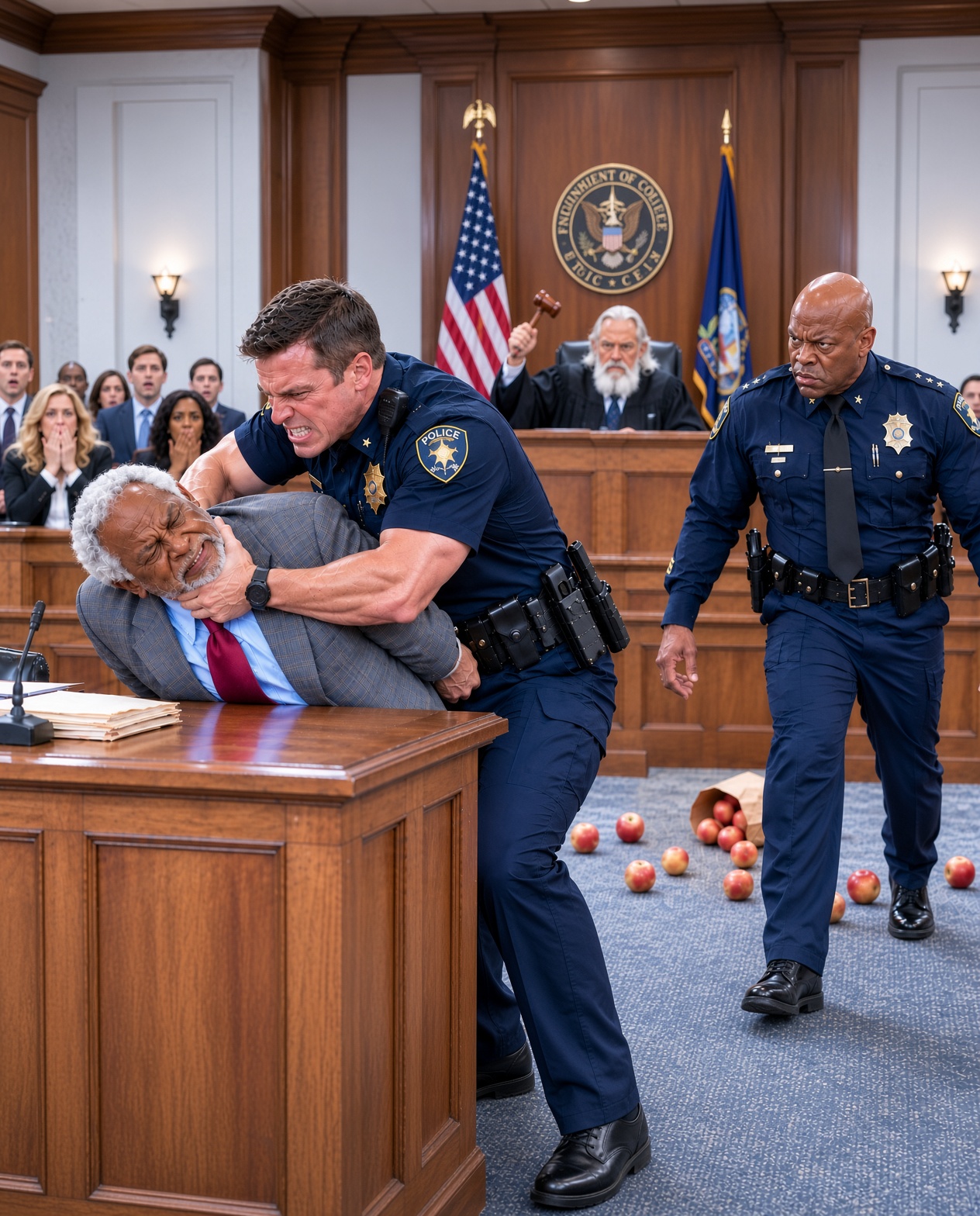
Men like you don’t own houses on Lynen Ridge. You clean them. Officer Brody Stall said it loud enough for the whole courtroom. Elroy Pedaway didn’t look at him. He opened his folder and spoke to the bench. My name is on the deed, your honor. Judge Conrad Ashcom didn’t open the file. Officer, if he touches that folder again, he’s yours.
Elroy slid the deed out anyway. Stall kicked the cane across the floor. A paper sack tipped over and 11 peaches rolled across the marble. He couldn’t slam the old man face down over the table. Steel snapped shut around his wrists. Please, my heart. Ashcom signed the contempt order without reading it and slid it to the officer.
Let’s go, old man. Trash goes downstairs. Some of you know that feeling. You walk into a room you helped build and the people inside look straight through you. This is the story of one quiet old man who decided his own name should be enough. 3 hours earlier, Elroy Pedawa signed his discharge papers at St.
Ansom’s Hospital with a hand that still shook a little from the anesthesia. 6 days before a surgeon had opened his chest and rerouted three arteries around his heart. The man said the same thing twice at the door, the way doctors do when they already know you won’t listen. Rest. Walk slowly.
No stress on the heart. Elroy nodded both times. He was 71 years old, and he had spent most of those years nodding at people who were telling him what to do. His son had offered to pick him up. Everett had said it twice on the phone the night before, the same way the surgeon had. Elroy told him not to trouble himself.
A man with that much on his desk did not need to leave it for a ride his father could take alone. So he took a cab home to the small brick house on Lynen Ridge, the one with green shutters and a porch swing that squeaked on the left side. In the backyard stood the peach tree his wife had planted the spring they moved in.
Marlla put it in the ground herself on her knees in the dirt 14 years ago. She used to say a house wasn’t a home until something in the yard was older than your grudges. For 13 summers, that tree gave them more peaches than two people could ever eat. So Marlla baked cobblers for the whole block, even for the people who never said hello.
She had been gone 3 years now, and the tree was dying. The leaves went yellow in June, then brown and brittle. A man from the county extension office dug around the roots and found herbicide. Industrial concentrate soaked into the soil along the fence line right where the roots reached into the yard next door. The yard next door belonged to Diaor.
She had complained about that tree for 6 years. Leaves in her gutters, fruit on her lawn, wasps near her patio. She wrote two letters to the homeowners association and one to the city. And when none of them worked, the tree started dying. Elroy never raised his voice about it. He never once knocked on her door.
Instead, he went down to the Hollister County Courthouse, filled out a small claims form in careful block letters, and asked for $2,400, which was what the arborist said the tree was worth. He didn’t want the money. He wanted a judge to look at what she had done and write down in an official record that it was wrong. He had spent his whole life being wronged quietly.
Just this once, he wanted it written down. The hearing was set for 10:00 this morning. The surgery had been set 6 days ago. He had not asked to move either one. Before he left the house, he stood under the tree for a long time. Then he reached up and picked the last peaches it had, 11 of them, small and a little bruised, hanging from the only branch that still held green leaves.
He put them in a brown paper sack and folded the top over twice. Tomorrow would have been his 45th wedding anniversary. Marlla always baked the first cobbler of the season on their anniversary. He had no idea how to make one. He was going to try anyway. Then he put on his charcoal suit, the good one, and the gold watch his son had given him two years earlier.
On the back of the watch in small engraved letters, were four words, “Never invisible again.” E. He fastened it on his wrist, picked up his cane, and called another cab. The Hollister County Courthouse was a gray stone building with six columns out front and a copper dome that leaked every March.
Elroy knew about the dome because he had spent 31 years putting buckets under it. He started on the night crew in 1984, the year Everett turned two. By day, he loaded trucks at a lumber yard on the east side. By night, 10 to 6, he mopped the marble floors of this building, emptied the waste baskets in the judge’s chambers, scrubbed the jury room bathrooms, and polished the brass rail beside every staircase until he could see his own face in it.
Nobody else ever looked at that face. The night crew was supposed to be invisible. If you did the work right, the only proof you had ever existed was a building that looked like nobody had touched it. He did the work right for 31 years. He came home at 6:30 every morning with his knees aching and his hands cracked from the cleaning solution.
And more often than not, he found his son asleep at the kitchen table with his cheek on a textbook. Elroy would carry the boy to bed, then sit down in the same chair and sleep for 2 hours before the lumberyard. He used to bring home the newspapers the judges threw away. On Sunday mornings, he and Everett worked the crosswords together, the ones some judge upstairs had started and abandoned halfway.
Everett learned half his vocabulary from the unfinished puzzles of men who never knew his father’s name. That boy grew up and went to law school on scholarships, loans, and the money Elroy kept in a coffee can above the refrigerator. Elroy retired the year Everett passed the bar. He had set foot in this building exactly once since then.
just once two years ago. Now he climbed the front steps slowly, one hand on the cane and the other on the rail and stopped at the top to catch his breath. His chest felt tight under the stitches. He waited for the feeling to pass and it mostly did. Inside the lobby smelled exactly the same.
Floor wax, old paper, and burnt coffee from the vending machine on the left. There was a crack in the marble near the security desk that he had filled with epoxy twice, and it had come back both times. It was still there. He found a wooden bench outside courtroom 3B and sat down to wait. It was 9:40. He folded his hands over the head of his cane and looked at the brass rail along the stairwell, and he wondered whether anybody had polished it since he left.
That was when Dior came down the hallway. She was in her 50s, blonde, in a navy blazer with a gold pin on the lapel, and she walked like a woman who had never stood in a line she didn’t consider beneath her. Dileia saw Elroy on the bench and stopped walking. She looked at the charcoal suit. She looked at the gold watch catching the light from the window.
She looked at the paper sack on the bench beside him, and her mouth pressed into a thin, flat line. Elroy nodded at her politely. He had nodded at her politely for 14 years. She didn’t nod back. She turned on her heel and walked to the end of the hall where a uniformed police officer leaned against the wall outside courtroom 3B, scrolling through his phone.
Officer Brody Stall was 31, 6 years on patrol with the Hollister County Police Department, and passed over twice for detective. The second rejection memo said he lacked sound judgment and he had read that line so many times he could recite it. Every Tuesday morning he sat in this courthouse to testify in Judge Ashcom’s traffic cases.
In 6 years, Ashcom had never once ruled against him. He was also Dia Ror’s nephew. Dileia leaned in close to him and lowered her voice. That’s him, Brody. The one I told you about. He threatened me in the parking lot this morning. He said I’d pay. And look at that bag. Every word of it was a lie. Elroy had come by cab.
He had never been near the parking lot. He had not spoken to her in 6 years except to say good morning, and even that had stopped when she stopped answering. But Stallheard threatened, and something inside him lit up like a switch. Last week, after his aunt’s phone call, he had driven his cruiser slowly past the house on Lynen Ridge and seen this same old man on the porch swing rocking like he owned the place.
He hadn’t liked it then. He liked it even less now. He looked down the hallway at the old black man on the bench, the expensive suit, the gold watch, the hand resting on that paper sack, gentle and protective, like whatever was inside it mattered more than anything else in the building. Stall had a victim now. He had a threat.
All he needed was a reason. He didn’t key his radio and he didn’t write a report. Instead, he walked straight down the corridor to the judge’s chambers and knocked twice. the way a man knocks on a door he has walked through many times before. A young court security deputy named Tessa Marorrow stood post beside that door.
She was 24, 8 months into the job, and the small camera clipped to her vest blinked a steady green. Neither man looked at her. People rarely did. Ashcom opened the door with his robe halfon and a coffee cup in his hand. Stall kept his voice low, but not quite low enough. Judge, the old guy in my aunt’s case threatened her in the lot this morning.
If he gets mouthy in there, I want something to hold him on. Ashcom glanced down the hallway at the old man on the bench. He took in the suit, the watch, and the cane. Get him mouthy, and I’ll give you the paper. The door closed. Tessa Marorrow kept her eyes fixed on the opposite wall and told herself she hadn’t heard a thing.
Stall walked back up the hall and planted himself 4 feet from the bench, close enough to be felt. Elroy looked up. The officer’s eyes were locked on the paper sack. He had seen that look before. The first time he was 9 years old, standing outside a diner in Mon, Georgia, asking a man in a uniform if he could please use the restroom.
He had seen it a hundred times since on clerks, on bank tellers, on lawyers who stepped around his mop bucket without breaking stride. It was the look of a man who had already decided what you were. Elroy moved his hand off the sack and folded both hands back over the cane where the officer could see them clearly. He didn’t say anything either.
At 9:58, the door of courtroom 3B swung open and the clerk read the next case from her list. Paway versus Ror. Courtroom 3B was the smallest room on the third floor. Six rows of wooden benches, a jury box. nobody ever used for small claims and a camera mounted high on the back wall with a tiny red light beneath it.
Since 2020, Hollister County had streamed every public hearing online. On most Tuesday mornings, the small claims calendar drew about 11 viewers, retired lawyers, a few law students, and somebody’s bored cousin. This morning, the gallery held maybe 15 people waiting on their own cases. A young public defender named Mateo Ariyaga sat in the second row with a stack of files on his knees early for an 11:00 arraignment.
Two rows behind him sat Otis Greer, a retired bus driver in a gray kangle cap. There to fight a parking ticket he was fairly sure he deserved. Elroy leaned his cane against the plaintiff’s table and set the paper sack beside his chair. He laid out his papers in order. the arborist’s report, the soil test, photographs of the tree, and a copy of his deed.
Then he squared the edges with his fingertips, the way he used to square the clerk’s files at 3:00 in the morning. Dileia sat at the other table. Deputy Marorrow took her post beside the door. Stall didn’t bother with the gallery. He took up a position against the wall directly behind Elroyy’s chair, as if the room belonged to him. All rise.
Judge Conrad Ashkcom came in through the side door eight minutes late, robe unzipped, a coffee cup in one hand. He was 58, silver-haired and heavy through the jaw, and he carried himself like a man who believed small claims court was a punishment someone had handed him personally. For 22 years, he had run the Tuesday traffic docket like an assembly line.
Police testimony went in, guilty verdicts came out, and the officers of Hollister County loved him for it. Then last year, the new county police chief ordered an audit of body camera footage from traffic stops. Three of Ashkcom’s convictions were quietly overturned. He had not taken it well. This morning, he was covering the small claims calendar for a colleague, and he resented every minute of it.
He sat down, set his coffee beside the file, and did not open it. Let’s go. I’ve got 40 of these. Elroy stood, one hand on the table for balance, and began to explain about the tree. He spoke slowly and carefully, the way a man speaks when he has rehearsed every word in his kitchen. He got three sentences in before Daor stood up and talked right over him.
She told the judge she had been threatened in the parking lot that very morning. She said the plaintiff had told her she would pay and that she was frightened for her safety. Then she said the thing she had clearly been saving. And honestly, your honor, I don’t believe he even owns that house. He’s some kind of caretaker.
The real owners live out of state. He has no standing to sue anyone. Ashkcom turned toward the wall. Officer Stall, you took a report on this. Yes, your honor. A threat against the complainant this morning. The department’s also looking into whether he’s squatting in that house. Neither statement was true.
There was no report and no investigation, but it was spoken by a police officer in Conrad Ashcom’s courtroom. And in that room, it had never needed to be true. A murmur rolled through the gallery. Elroy turned and looked at Dileia. He didn’t say a word. He simply looked at her for a long moment.
The way you look at someone you have lived beside for 14 years and are only now seeing clearly. Ashkcom leaned back in his chair and studied Elroy over the rim of his coffee cup. He took in the suit, then the watch, and then for a long time the cane. Whose house is it, Mr. Paway? Mine, your honor. My son bought it for his mother and me. On Lynen Ridge.
Ashkam let the words hang in the air. And what exactly does your son do? Elroyy’s hand tightened slightly on the edge of the table. He could end this with one sentence. He knew it, and part of him wanted to say it more than he had ever wanted anything. Every back in this room would straighten. The officer behind him would drift back to the wall.
The judge would open the file and read it very carefully. He works hard, your honor. Ashkcom glanced down at the case caption and for the first time something like amusement crossed his face. Pet away. Any relation to our brilliant new police chief? Stall laughed loudest. A few people in the gallery laughed with him. Not cruy, most of them.
It was just the reflex of a room following the man with the gavl. Elroy stood very still. Today, your honor, I’d like to be judged as just Elroy. Didn’t think so. As far as Ashkcom was concerned, that settled it. Against the wall, Stall pushed himself upright, took one step forward, and let his voice carry across the whole room.
Men like you don’t own houses on Lynen Ridge. You clean them. The laughter stopped. Elroy didn’t look at the officer. He opened his folder with one careful hand and spoke to the bench. My name is on the deed, your honor. Ashkcom didn’t even open the file. Officer, if he touches that folder again, he’s yours. Elroy reached down for the deed anyway.
Don’t reach. Stall came off the wall so fast his boots squealled on the marble. He grabbed Elroyy’s arm above the elbow and wrenched it back, and the sudden twist sent a white bolt of pain straight through the stitches in the old man’s chest. It’s my deed. It’s only paper. Ashkam didn’t look up from his coffee. Officer, the witness says he’s armed.
Check him. Elroy was already on his feet. He put both hands flat on the table because he didn’t know what else to do with them. Stall kicked the cane away from the table’s edge and it clattered across the floor, spun once, and slid under the empty jury box. Without it, Elroyy’s left knee buckled. He caught himself on his forearms, and the hard edge of the table pressed into the fresh incision beneath his shirt.
I had heart surgery 6 days ago. Please, I can’t stand without my cane. Everybody’s got a surgery. Matteo Ariyaga was on his feet in the second row. Your honor, the man is 70 years old. Just open the file. Ashkam finally looked up, but not at Elroy. Sit down, Mr. Ariyaga, or you can join him.
Matteo stayed standing for three more seconds. Then he sat down. He hated himself for it almost immediately. On the back wall, the little red light kept glowing. Stall twisted the old man’s right arm behind his back, then the left. He did it hard and fast, the way they had trained him to handle men half Elroyy’s age.
And when Elroy gasped in pain, Stall said it loud enough for the entire room and the microphone above the bench. Stop resisting. Elroy was not resisting. He was bent over a table, fighting not to fall. But anybody who watched the footage later would hear those two words and wonder just for a second whether maybe he had. That’s what those two words are for.
The first cuff closed, the second ratcheted three clicks past where it needed to be, and the steel bit into the thin skin over the bone. A narrow line of blood crept down into Elroyy’s palm. Stall knocked the paper sack over with his boot while he dug through the old man’s bag. The peaches rolled out onto the marble one at a time, spreading slowly across the floor Elroy had mopped for 31 years, toward the feet of people who stepped back so they wouldn’t have to touch them.
In the bag, Stall found a pill bottle from St. Anselm’s pharmacy, a folded handkerchief, a pair of reading glasses, and a bus schedule. There was no weapon. There had never been a weapon. Then, in the struggle, the folder slid off the edge of the table. The papers fanned out across the floor, and one of them landed face up right between Stall’s boots.
It was the deed with the county seal in the corner and the Lynen Ridge address beneath it, and the owner’s name printed in clean black type. Elroy Lucius Paway. Matteo saw it from the second row. His name’s right there, officer. It’s at your feet. Stall looked down. For one long second, he had a choice.
He could pick it up and read it. He could feel that cold drop in the stomach that comes when a man realizes he has made a terrible mistake, and he could begin, however clumsily, to set it right. Instead, he moved his boot and slid the paper under the table into the shadow the same way the cane had gone. Paper proves nothing.
Anybody can print a deed. Somebody in the back row laughed. It was a short, careless sound, and Elroy heard it more clearly than anything else in the room. He turned his head, his cheek still pressed against the table, and looked up at the bench. “You don’t know my life, officer.” Stall leaned down close to his ear. “I know your type.
” “My type?” Elroy said it slowly, turning the words over like something he had found on the floor. “And what type is that?” Stall didn’t answer. He looked up at the bench instead, and Ashcom picked up his pen exactly as promised. “Mr. pet away. You’ve disrupted these proceedings, defied a lawful order from a police officer, and according to the witness, threatened her this morning.
I’m holding you in direct contempt. 48 hours. You’re remanded to the custody of Officer Stall. He signed the order without reading a single page of the file, then slid it across to the officer. Let’s go, old man. Trash goes downstairs. Stall hauled Elroy upright by the chain between the cuffs. “Walk!” Elroy tried.
He made it two steps toward the side door. On the third, his knees simply gave out, and because his hands were chained behind him, he couldn’t catch himself. He went down hard onto both knees on the marble, and the sound of it echoed off the woodpanled walls. A small high cry came out of him, the kind of sound he would be ashamed of for a long time afterward.
Dileia Ror sat perfectly still at the defense table, but at the corner of her mouth there was the smallest smile. In the fourth row, Otis Greer stared at the old man on his knees. He was 65, and he knew exactly what he was watching. He had watched it before in 1978 from the back of a city bus in Birmingham.
He had looked out the window that time, too. He looked down at his hands, then at the floor, then he looked away. Stall and Deputy Marorrow hauled Elroy to his feet and steered him into the rear corridor toward the service elevator. For 31 years, he had ridden that elevator down to the basement at 6 every morning with a mop bucket and a cart full of trash bags.
Now he rode it down in handcuffs with blood drying on his palm, and nobody said a single word the whole way. The holding cells sat at the far end of a basement corridor that ran past the boiler room. In January, that corridor had been the warmest place in the building. In September, it was an oven.
The air conditioning had died in July. The work order was still sitting in a queue, and the cells had no windows at all. Stall sat him on the steel bench and left the cuffs on behind his back. Booking takes a while. Get comfortable, boy. Tessa Marorrow flinched at the word. She didn’t say anything. The door clanged shut.
Elroy leaned back against the warm cinder block and tried to breathe the way the nurses had shown him. Within a minute, sweat was running into his eyes, and he had no way to wipe it away. His wrists throbbed where the steel bit in, and his knees throbbed where they had struck the marble. Beneath all of it, beneath the stitches, a new feeling was spreading through his chest. It wasn’t sharp.
It was slow, a steady tightening, like a hand closing into a fist somewhere behind his ribs. He knew exactly what it was. He had felt it once before, 6 days ago, on his kitchen floor before the ambulance came. Out in the corridor, Tessa Marorrow stood beside the door with her arms folded, watching him through the small window in the steel.
Her father had been a deputy in another county for 26 years, and she had grown up believing the uniform meant you ran toward trouble, not away from it. She watched the old man’s face slowly turn from brown to gray. Brody, his color’s wrong. He said he just had surgery. Stall didn’t look up from the booking tablet.
They all say that he’s sweating through his jacket. We should at least Marorrow, my arrest, my prisoner. Court security doesn’t tell the police department how to handle its prisoners. Stand down. And she did. That was the part she would lie awake over for a long time, staring at the ceiling of her apartment at 2:00 in the morning.
She had felt it, the wrongness sitting cold in her stomach. And when the moment came to act on it, she folded her hands and stood down because a louder man told her to. Inside the cell, Elroy closed his eyes. He didn’t pray for rescue. He had stopped expecting rescue from strangers a long time ago.
Instead, he did what he always did when a room tried to make him small. He remembered who he was. He remembered his wife at the kitchen table, laughing at the radio with flour dusted up to her elbows. He remembered the night Everett called from law school to say he’d made law review and how Elroy had to go sit in his truck for 20 minutes so the boy wouldn’t hear him cry.
And he remembered the one time he had come back to this building two years ago wearing this same charcoal suit to watch his son take the oath as chief of the Hollister County Police Department up in the ceremonial courtroom on the fourth floor. Everett had saved him a seat in the front row with a little card that had his name printed on it. Elroy didn’t sit there.
He stood in the back instead beside the door where the night crew always used to stand. He told himself it was because of his knees. It wasn’t. After the ceremony, Everett found him by that door and fastened the gold watch onto his wrist himself. He said that his father had spent 31 years in this building and nobody ever learned his name.
and that it would never happen again. Never invisible again. Elroy had believed him. He had wanted to believe him so badly. That was why he hadn’t said the name upstairs. He wanted to walk into that courtroom as a man, not as somebody’s father. He needed to know whether the words on the back of that watch held true for a man carrying nothing but his own name. Now he knew.
The fist in his chest closed tighter. His left arm grew heavy, then numb. A gray fog crept in at the edges of his sight, soft and patient, exactly the way it had on his kitchen floor 6 days ago. He opened his eyes. Deputy. Nobody answered. He tried again louder, and this time his voice cracked in the middle.
Deputy, I want my phone call. Stall’s voice came through the door flat and bored. You’ll get it at booking. I may not make it to booking. He said it plainly with no drama at all. That was exactly what made Tessa Marorrow unfold her arms. I’m owed one call. I know my rights. I spent 31 years in this building listening to judges read them.
Stall opened his mouth to argue, but Tessa was already moving. She keyed the door, stepped inside, and crouched in front of the old man so their eyes were level. Up close, there was no doubting any of it. The gray skin, the shallow rapid breathing, the sweat soaking through the collar of that good charcoal suit. Sir, is there somebody I can call for you? Elroy looked at her for a moment.
Yes, ma’am, there is. He gave her 10 digits slowly and clearly. She dialed them on her own phone because his hands were still chained and held it to his ear. It rang four times, then went to voicemail. A recorded voice, clipped and professional, invited the caller to leave a message. Tessa started to lower the phone. Try again.
Elroyy’s voice was barely there. He always picks up the second time, ever since he was a boy. She dialed again. Three miles away at county police headquarters, in a corner office with a brass name plate beside the door, a phone lay face down on a conference table between a cold cup of coffee and a thick budget binder. Across the table sat Deputy Chief Rhett Callaway halfway through a complaint about overtime costs.
The phone buzzed once, twice, three times. Then a hand turned it over. Peta away. Down in the basement, Elroy closed his eyes and for the first time all day, his voice broke completely. Everett, son, it’s your daddy. I’m downstairs. I need you to come. Tessa Marorrow’s face went white. She knew that name.
Anybody who wore a uniform in this county knew it. It was the name at the top of the department Stall worked for, and it had been on the evening news for a year. It was also on the booking tablet in Stall’s hands where nobody had looked at it twice. She turned slowly toward the open cell door, still holding the phone against the old man’s ear.
Brody, what did you say his last name was? Stall didn’t look up. There’s a hundred Paways in this county, but his thumb had stopped moving on the screen. Across the conference table, Deputy Chief Rhett Callaway watched the chief listen for maybe 6 seconds. Then the man’s face did something Callaway had never seen a face do.
It didn’t turn angry. It went empty as if something inside it had dropped straight through the floor. Everett Pedawway stood up so fast his chair tipped over backward. He didn’t pick it up. He said four words. Courthouse. My father now. And he was through the door with the phone still pressed to his ear.
Callaway grabbed his keys and ran after him. By the time they cleared the gate, two patrol units had fallen in behind them. Lights on, sirens climbing. Three miles of downtown traffic parted in front of them. Everett kept the phone against his ear the whole way, listening to his father breathe, saying the same thing over and over.
I’m coming, Daddy. I’m coming. Stay with me. The three vehicles swung into the courthouse loading dock and stopped in a tight arc. Doors opened. Officers stepped out, but they didn’t move like men answering a call. They moved like an escort, fanning out, clearing space, their eyes sweeping for one thing only. Everett was already inside.
He knew that loading dock. On the nights the babysitter canled when he was 6 and 7 years old, his father used to sneak him in through those doors after midnight. He slept on a pile of droploths in the basement supply room while Elroy mopped the floors above him. And every so often he’d wake to find his father standing in the doorway just checking.
So he didn’t need directions. He took the basement stairs three at a time and hit the corridor running. Four silver stars flashing on the collar of his dark blue uniform. Stall was standing outside the cell with the booking tablet when the door at the far end banged open. He turned irritated, ready to tell whoever it was that this was a secure area.
Then he saw the uniform. Then the stars. Then the face he had seen on every roll call screen and every department memo for a year. Every word he had ready died in his throat. Everett didn’t even glance at him. He walked past the officer as if he weren’t there and stepped into the open cell.
For one second, he did not move at all. He saw his father slumped against the cinder block wall, gray-faced and soaked in sweat. He saw the charcoal suit from the swearing in creased and stained with dust from the courtroom floor. He saw the arms wrenched behind the old man’s back. And when he stepped closer, he saw the blood dried dark across his father’s palm and fresh where the steel was still cutting.
Dad. The word came out cracked and small, a sound nobody in that corridor would have expected from a man like him. Then he was on his knees, both of them, on the dirty concrete of a holding cell. He took his father’s face in both hands as though it were made of glass. Dad. Dad, I’m here. Look at me.
I’m right here. Elroy opened his eyes. It took him a moment to find his son’s face. You came? Of course I came. Everett’s voice was shaking. Who did this to you? He reached behind his father for the cuffs, and his hands stopped. They were far too tight. He could feel how deep they had cut.
When he spoke again, his voice had changed completely. It was flat and cold, and it carried down that corridor like a blade. Key. Nobody moved. Whose prisoner is this? I want the key now. Stall fumbled at his belt. His hands were shaking so badly he couldn’t fit the key into the lock. Tessa Marorrow took it out of his fingers without a word, knelt down, and opened the cuffs herself.
They came away from Elroyy’s wrists, and the marks underneath were deep and red and beaded with blood. Everett caught his father’s hands in his own and held them gently. Then the chief of the Hollister County Police bowed his head and pressed his lips to his father’s wounded wrists. First one and then the other, and he stayed there. Nobody in that corridor spoke.
Rhett Callaway, standing in the doorway, slowly took off his cap. Then Callaway got on his radio and called for paramedics and his voice sounded nothing like it had upstairs in the conference room. 71-year-old male, postcardiac surgery, chest pain, courthouse holding. I want them here in 4 minutes, not five. Everett rose slowly from the floor and turned around.
The officer’s face had gone the color of paper. Chief, I the complainant said he was armed. Judge Ashkam signed the order. I was just following the your weapon and your badge. Hand them to Deputy Chief Callaway. You’re relieved of duty effective right now. Stall’s hands shook as he unclipped the holster. And understand something, Everett went on.
I won’t be the one investigating you. The state police will. I want this so clean that no lawyer alive can ever say I did it for my father. Chief, please. I’ve got two kids. This is going to end me. He studied the officer for a long moment. The way you study something you are trying very hard to understand. You keep saying that.
You said it to Callaway. Now you’re saying it to me. His voice was very quiet. You never said a word to him. Stall opened his mouth, but nothing came out. What did you call him? The silence stretched. Tessamaro stared at the floor, and that was answer enough. He is 71 years old. He mopped the floor you walk on every Tuesday.
He is nobody’s boy. Behind him, Elroy said his son’s name. Everett. Everett turned at once and went back down onto his knees. The chief vanished and the son came back in the space of a single word. Don’t, Elroy said softly. Don’t let me see you become him. Everett’s jaw worked. He breathed out slowly and something in his shoulders let go.
Okay, Dad. Okay. And go get my peaches. The corner of Elroyy’s mouth moved in something close to a smile. They’re all over that judge’s floor. The paramedics arrived in 3 and 1/2 minutes with oxygen and a heart monitor. And the lead medic’s jaw tightened when he read the numbers. Not a heart attack, not yet, but a heart pushed far too hard far too soon.
And they wanted him stable before they moved him an inch. 10 minutes, the medic said. Then we go. Go on. I’ve been waiting on that judge all morning. Go see him for me. Upstairs, courtroom 3B had moved on as though nothing had happened. Ashcom was three cases further down his list, arguing with a landlord about a security deposit.
Dileia Ror had not left. She was sitting in the front row now, legs crossed, waiting to collect her paperwork. But something had changed that Ashcom couldn’t see. In the second row, Matteo Ariyaga had his phone out low between his knees. He had pulled up the county’s stream, saved the timestamp, and posted the clip with one sentence underneath it.
Watch what just happened in Hollister County Small Claims Court. That was 40 minutes ago. The live counter beneath the stream, which had read 11 that morning, now read 14,000. The side door opened. The clerk saw who it was first and she stood up so quickly her chair rolled back into the wall. Then the landlord stood.
Then one row at a time without anybody saying all rise, the whole gallery got to its feet. Ashcom looked up irritated and saw the uniform. He knew that face. He had watched it on the evening news for a year, standing at a podium beside the words body camera audit. Then he saw the blood on the cuff of that uniform sleeve and the color began to leave his face.
Everett didn’t go to the bench. He walked to the plaintiff’s table, got down on one knee, and reached into the shadow underneath it. He came back up holding a single sheet of paper with a bootprint across one corner. He read it aloud slowly so the microphone above the bench would pick up every word. Grand Troy Lucius Pedaway recorded March 2012.
Hollister County Registar of Deeds. He lowered the paper. It took me 4 seconds. How long did your officer stand on it, judge? Ashkam said nothing. Matteo stepped out of the second row, holding the cane he had fished out from under the jury box, and he handed it to Everett without a word. Everett held it for a moment.
It was lighter than he remembered. My father used to tell me about you. You clerked in this building for 11 years. Judge Chambers 2C, second floor. His voice was almost gentle, which was the most frightening thing about it. Every night after you went home, a man came into your office. He emptied your trash. He wiped the coffee rings off your desk.
The winter of 98, he stayed 3 hours past his shift to fix your radiator. Ashkam’s hand had gone very still on his pen. He wore a gray uniform. His name was sewn on the chest in red thread right about here. Everett touched his own chest just above the heart. 11 years. You walked past that name every single night and you never once read it.
Something moved behind Ashkcom’s eyes. A memory surfacing slowly from very deep. A gray shirt, red thread. A man who always stepped aside with his mop card and said, “Good evening, judge.” Ashkcom had never said it back. His name is Elroy Pedaway, and this morning you put him in chains on the floor. He mopped for you. The courtroom was completely silent.
14,000 people were watching, and the comments under the stream had slowed, then stopped, and then filled all at once with the same stunned horror. Everett set the deed down on the plaintiff’s table and squared its edges with his fingertips. I’m a police officer, judge. I have no authority over your bench and I won’t pretend I do today.
I’m not even here as a chief. I’m here as his son. By the door, Tessa Marorrow took one step forward. Her voice shook, but she didn’t stop. Chief, I was posted outside the judge’s chambers at 9:45 this morning. My camera was on. She held up her phone, opened the footage, and turned the volume all the way up.
In the silent courtroom, two voices came through the small speaker. The first was stalls. If he gets mouthy in there, I want something to hold him on. The second belonged to the man on the bench. Get him mouthy and I’ll give you the paper. Nobody moved. 14,000 people heard it at the same moment. Everett looked up at the bench.
That recording goes to the district attorney and the judicial conduct commission tonight. You can vacate that order yourself on the record while that camera is still running. or you can explain to them why you didn’t. Ashkcom looked at the camera, then at the gallery, then at the man in front of him, the police chief, whose audit he had cursed over a glass of scotch every Saturday for a year.
He picked up the pen, his hand shook so badly the first signature tore through the paper, and he had to sign it twice. The order of contempt in Paway versus Ror is vacated in its entirety. Thank you, Everett said, and nothing more. At the front row, Diaor had risen and was edging toward the aisle with her purse clutched against her chest.
Matteo saw her first. Chief, the witness. Everett didn’t raise his voice. Mrs. Ror, you testified under oath that my father threatened you in the parking lot. He came by cab. There are four cameras on that lot. The state police are going to pull every one of them and then they’re going to take your statement. Dileia opened her mouth.
I thought I really did think he might. No, Everett said quietly. You didn’t. She sat back down in the front row and began to cry loud and frightened like someone who had never expected a single consequence in her life. Everett didn’t watch her. He had already turned away. He got down on his knees in the middle of courtroom 3B in his dress uniform on the marble and began picking up the peaches.
One by one, bruised and dusty, some of them split open where they had been stepped on. He picked up every one of them and set it gently back into the brown paper sack, and not one person in that room said a word while he did it. He counted nine. Two were missing. Then a pair of old brown hands reached down beside him.
Otis Greer had gotten down on his bad knee in the aisle and he was holding out the last two peaches. They had rolled under his bench right up against his shoes. Otis’s voice was rough. I saw all of it and I looked away. Everett took the peaches and looked at him for a long moment. He’s in the basement for about six more minutes. Tell him yourself. Otis did.
He rode the service elevator down with the chief and in the corridor outside the cell with his kangle cap in his hands, he told the old man the truth. He had been looking away since 1978. He had looked away this morning. He was sorry. Elroy reached out from the gurnie and took his hand. Then stop today, brother. Otis nodded. He couldn’t speak.
They wheeled Elroy out through the loading dock, the same doors he had pushed trash carts through for 31 years. His son walked beside him the whole way, one hand on the rail of the gurnie and the other holding a brown paper sack of bruised peaches like it was the most important evidence in the world. Elroy spent 3 days back at St. Anselms.
His heart, the cardiologist said, had been pushed dangerously hard, but it held. He was tougher than his chart suggested, and he always had been. The video spread the way these things do. By the second morning, it had been viewed 9 million times. News vans parked across from the courthouse steps.
People who had never heard of Hollister County were typing its name into search bars, and a lot of them were very angry. On the third evening, Everett came to the hospital straight from work and sat in the plastic chair beside the bed. The same way he used to sit at the kitchen table as a boy. He hadn’t slept much. It showed.
They want me to throw everything at them, Dad. Asham, stall, ro, all of it. And I want to. God help me. I want to burn the whole thing down. Elroy didn’t answer right away. He watched the light go orange in the window for a long while. You want to know why I didn’t say your name up there? Everett looked at him. If I’d said it, I’d have been out of that room in 5 minutes with a handshake and an apology.
And the next old man who walks in there with nothing but his own name, they’d have done it to him anyway, and nobody would ever have known. He turned his head on the pillow. I needed to know what they do to a man who’s just himself. And I found out, son, I almost died finding out. Everett looked down at his hands for a long time.
“So don’t burn it down,” Elroy said. “Fix it. Burning it down just teaches the next Ashcom to be careful who he picks. Fixing it is slower. It’s harder, but it’s the only thing that helps the man who doesn’t have a number to call.” So that was what they did. It took longer than either of them wanted. The county adopted what the newspapers ended up calling the Paway rule.
No officer could arrest anyone on a private citizen’s complaint without first verifying identity, property, and the claim itself. Body cameras stayed on inside every courthouse, and every public hearing was archived permanently. No self-represented person over 65 could be held for contempt without a medical check and a lawyer present, and a court navigator desk opened on the first floor for anyone who walked in without a lawyer.
Matteo Ariyaga was the first person hired to run it. He kept a photograph of 11 peaches taped to the side of his monitor. Not everything came out the way it should have. The state supreme court suspended Conrad Ashcom 2 weeks later. He filed for early retirement before the judicial conduct commission could finish its review. He left with his full pension.
Everett was furious for a week straight. Elroy only shrugged. Some men always get to leave by the front door. That’s the world. What matters is who comes in behind him. Diaor pleaded no contest to a misdemeanor charge of making a false statement. She got probation, not jail. Judge Harriet Soulberg reheard the small claims case and awarded the full $2,400.
Dileia paid it by certified check and a month later, a moving truck pulled up to the house next door. Brody Stall was fired, charged with official misconduct, and pleaded guilty to a lesser count. He would never wear a badge again. Eight months later, a three-page letter arrived at the house on Lynen Ridge.
Elroy read it twice and put it in the drawer with Marlla’s recipe cards. He never said what was in it, and he never wrote back. Not yet, anyway. Tessa Marorrow handed over her footage and testified before the state police and the commission, including the part about standing down. Afterward, she found a card in her locker in careful block letters.
It said, “You open the door, that counts.” EP. A year later, Elroy Pedaway stood at the front of courtroom 3B one more time. Not at the plaintiff’s table this time, but at a lectturn, facing 40 new police recruits and court deputies. Every new officer in Hollister County now heard his story on the first day in his own voice.
He showed them a photograph of a deed with a bootprint across the corner, and he asked them one question. What would you have done? Then he told them to go and read every name they walked past, especially the ones sewn on a shirt. That evening, he went home to Lynen Ridge. The old peach tree was gone, but beside the fence where it once stood, a thin sapling reached about knee high.
Everett had planted it from the pit of one of those 11 bruised peaches, and against every odd, it had taken root. It was their anniversary. Elroy tried to bake the cobbler again, the way he had tried the year before. It came out dry on top and burnt on the bottom, and he ate every bite of it on the porch swing with the left side squeaking while the sun went down behind the little tree.
Elroy could have said one sentence in that courtroom and walked out untouched. He didn’t. He wanted to know how the world treats a man who has nothing but his own name. He found out. And most people never get a son with a badge. So, the real question isn’t what the police chief did. It’s what you’d do sitting in that fourth row watching an old man go down on his knees.
Tell me honestly in the comments, have you ever been treated like you were invisible at work or watched it happen to somebody else and stayed quiet? And if this story stayed with you, share it with someone who needs it and subscribe for more stories like Elroys.

