The judge tried to teach him a harsh lesson in court… Then he revealed who was actually in charge of the law.
The judge tried to teach him a harsh lesson in court… Then he revealed who was actually in charge of the law.
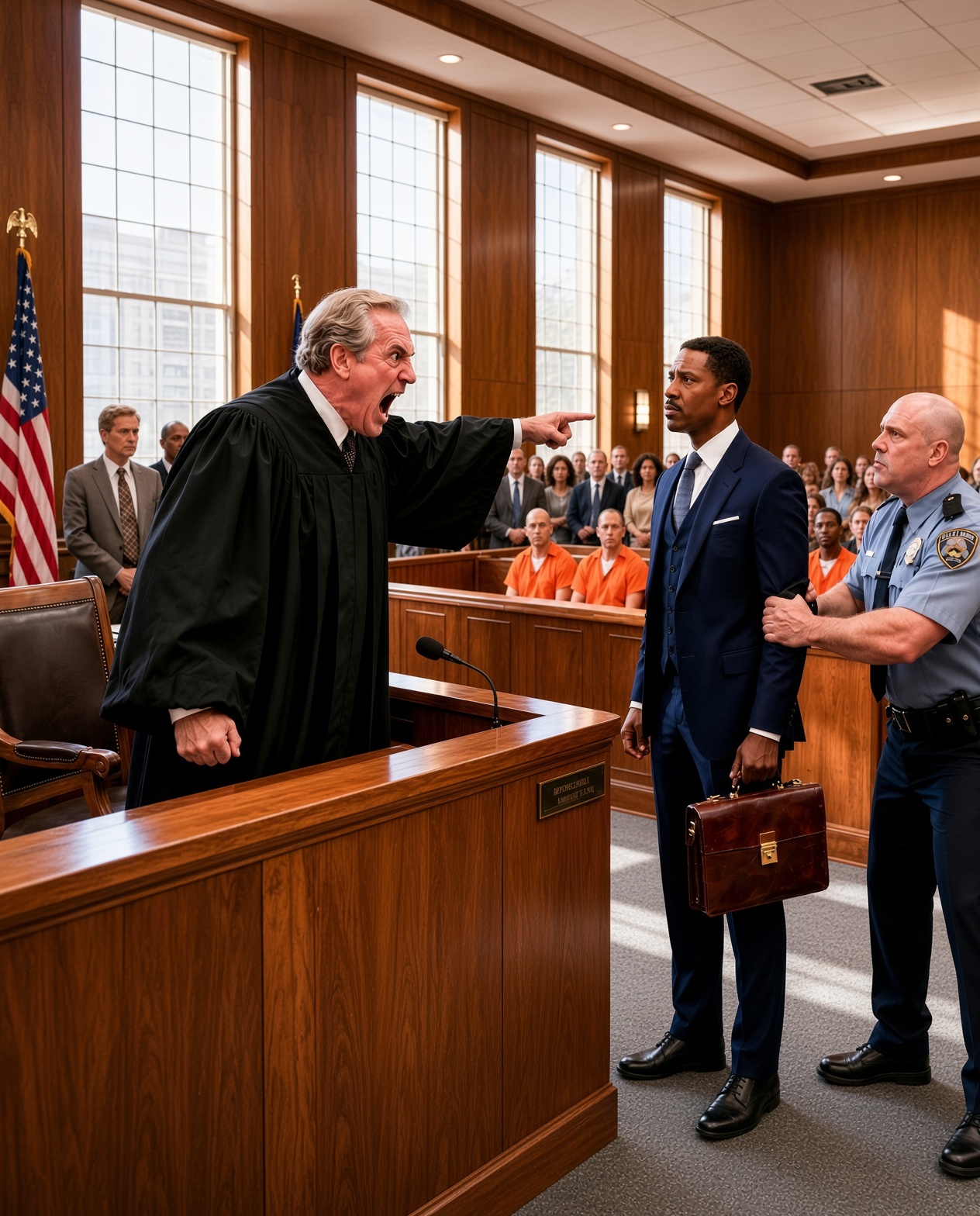
Get up. You’re in the wrong seat, boy. Your honor, I’M I SAID GET UP. Defendants don’t sit with lawyers. I’m not a defendant. No. Then who let this dog off its leash? The baleiff grabbed Malcolm’s arm, shoved him toward the gallery, but Malcolm didn’t leave. Malcolm stood up. Slow, deliberate. You called me a dog in front of 40 people and now you’re asking why I’m still here.
Everything you just did is on the record, your honor. Hollister’s face went red. 22 years on the bench. BALEIFF, DRAG HIM OVER THERE. Make him STAND WITH THE CRIMINALS. THAT’S WHERE HIS KIND BELONGS. What none of them knew was that the man Hollister just broke every rule to humiliate held the power to end his career with a single phone call.
6 hours earlier, Malcolm Stafford’s morning started with cold coffee and cardboard boxes. He stood in the kitchen of a rental house on Birch Lane, a quiet street blocks from the Ridgemont County Courthouse. The countertops were bare except for a coffee maker and a stack of case files. Moving boxes lined the hallway, labels in his wife’s handwriting, kitchen, books, Malcolm’s stuff. Do not lose.
Naomi walked in, still in her robe. She looked at the boxes, then at him, already dressed in a dark suit. You know, most people unpack before they go back to work. Malcolm smiled. Most people didn’t just get handed a county to run. Handed? Naomi shook her head. You applied, interviewed, survived three rounds of vetting by the governor’s office, and got appointed to clean up a district nobody else wanted.
Handed is generous. She wasn’t wrong. 10 days ago, Malcolm Stafford had been sworn in as the district attorney of Ridgemont County, Virginia. Private ceremony, no cameras, no press conference. That was scheduled for next week. The previous DA had retired suddenly for health reasons, and the governor fast-tracked Malcolm’s appointment to avoid a leadership gap.
12 years as a federal prosecutor in DC, complex public corruption cases, the kind that took years to build and minutes to win. He was good at it, very good. But when the Ridgemont position opened, he didn’t hesitate. This was home. He grew up here, son of a postal worker and a school nurse. Rode his bike past the courthouse every day as a kid.
Watched men in suits walk through those heavy oak doors and wondered what happened inside. Now he knew. And what he’d heard since coming back wasn’t good. Whispers in the hallways, conversations that stopped when he walked into a room. staff attorneys who’d lower their voices and say things like, “Courtroom 3 is different.
” Different how? Nobody would say, “Not directly.” So Malcolm made a decision. Before he sat in his office, before he held a press conference, before anyone knew his face, he would walk into every courtroom in the building and watch. No badge, no title, just a black man in a suit seeing the system exactly as a civilian would.
He’d visited two courtrooms already. Nothing unusual. Routine dockets, professional judges, standard procedure. Today was courtroom 3. Judge Eugene Hollister. Malcolm pulled into the courthouse parking lot at 8:15. The building rose in front of him. A century old stone structure with tall columns and wide marble steps, grand from the outside.
Inside, the grandeur cracked at the edges. Fluorescent lights buzzed overhead. The marble floors were scuffed from decades of foot traffic. A faint smell of old coffee and floor wax hung in the air. He passed through the metal detector at the front entrance, emptied his pockets, placed his briefcase on the belt.
The security guard, a heavy set man with reading glasses, glanced at him, nodded, waved him through. No recognition, no second look, just another visitor. Malcolm walked down the main corridor. His shoes squeaked on the marble. Voices echoed from behind closed doors, muffled arguments, a judge’s gave command, someone crying, the sounds of a courthouse doing what courouses do.
He passed a hallway near the back stairwell. Portraits hung on the wall. Old men in black robes painted in oils, gilded frames. Confederate era judges. They’d been moved from the main lobby last year after community pressure. Not removed, just relocated. Still watching, Malcolm stopped in front of courtroom 3.
The heavy wooden door was propped open. Inside the room was packed. Monday morning docket. Attorneys shuffled papers at the council tables. Defendants sat in rows with their families. A baleiff, tall, thicknecked, arms crossed, stood near the bench like a statue. And up on the bench sat Judge Eugene Hollister, silver hair, wire rimmed glasses, pressed black robe.
22 years in that chair. His family’s name was carved into the courthouse cornerstone. Grandfather was a judge in the same building. Father was a state senator. Hollister owned this room. Everyone in it knew that. Malcolm stepped inside. He moved toward the council tables to read the docket board posted on the wall.
He didn’t sit, didn’t announce himself, just stood there, briefcase in hand, scanning the day’s schedule. That’s when Hollister looked up. What happened next took less than 60 seconds, but it changed everything. Hollister’s eyes landed on Malcolm the way a hawk spots movement in a field. Not curiosity. Identification.
A black man standing where black men in Hollister’s courtroom did not stand. You there. Malcolm looked up from the docket board. Step away from the council tables. Defendants sit in the gallery. Malcolm’s voice was calm. Your honor, I’m not a defendant. Hollister didn’t blink. I didn’t ask what you are. I told you where to go.
I’m here in a professional. Baleiff. One word. That’s all it took. Deputy Vance Trotder moved like he’d been waiting for the signal. 62 240. Arms thick as fence posts. He crossed the courtroom in four strides and placed his hand on Malcolm’s elbow. Not rough, not yet, but firm enough to say, “This isn’t a request.
” “Sir, step this way.” Malcolm looked at Troder’s hand on his arm, then at Hollister, then at the 40 faces in the gallery. attorneys, defendants, family members, all watching, all silent. He didn’t resist. Troder guided him away from the council tables toward the gallery seating. Malcolm sat down in the third row.
Briefcase on his lap, back straight, eyes forward. But he didn’t leave. Hollister returned to the morning docket. First case, a DUI plea. He handled it in 4 minutes. Second case, a property dispute. 6 minutes. His voice was clipped, efficient, bored. The machine of his courtroom grinding forward like nothing had happened.
But between cases, his eyes drifted. Malcolm was still there. Third row, suit, briefcase, sitting perfectly still, not looking at his phone, not fidgeting, not whispering to the person next to him, just watching, hands folded, eyes steady. It bothered Hollister. You could see it in the small things.
The way he adjusted his glasses twice in 30 seconds. The way his fingers drumed the bench once, then stopped like he’d caught himself. The way he leaned toward the baiff between cases, and murmured something too low for the gallery to hear. Trotter walked over to Malcolm, stood over him close enough that Malcolm could smell the coffee on his breath.
Name: Malcolm Stafford. You on the docket today? No. you council of record on any case this morning? No. Then what are you doing here? Malcolm looked up at him. Observing, which is my right. Troder’s jaw shifted. He didn’t like the answer, but it was an answer, and there wasn’t much he could do with it. He walked back to the bench, leaned in close to Hollister, one hand on the edge of the desk.
Not on the docket, your honor. Not counsel on anything. says his name is Malcolm Stafford. Says he’s observing. Hollister’s jaw tightened. A muscle twitched near his left ear. He didn’t look at Malcolm when he spoke next. He looked at Trotter. Talked about Malcolm the way you talk about a stain on the carpet.
Something that shouldn’t be there and needed to be dealt with. Then what exactly is he doing in my courtroom? He said it loud enough for every person in the room to hear. Not a whisper, not a murmur, a full volume sentence designed to travel. Heads turned toward Malcolm. A woman in the front row looked at him with something between pity and fear.
A young attorney at the council tables stared at his notepad like it contained the secrets of the universe. Nobody said a word. Hollister let the silence sit for three beats. Then he turned. Mr. Stafford, approach. Malcolm stood, buttoned his jacket, walked to the front of the courtroom with the kind of posture that comes from years of standing in front of federal judges.
Shoulders level, chin neutral, hands at his sides. He stopped at the appropriate distance from the bench. Not too close, not too far. The exact distance that said, “I’ve done this before.” Hollister noticed. You could see it. a flicker of something crossing his face. Not recognition, recalculation. This man moved like a lawyer, stood like a lawyer.
But Hollister had already decided what he was. And men like Hollister didn’t reverse decisions. You’re not on my docket. You’re not representing anyone in this courtroom. You have no case before me. So, I’m going to ask you one simple question. Hollister leaned forward. His glasses slid down his nose. He didn’t push them back. What are you doing in my courtroom? Your honor, I’m here in a professional capacity.
If you’d allow me to explain, professional capacity. Hollister repeated the words slowly like he was turning them over in his mouth and finding them rotten. I’ve been on this bench for 22 years, Mr. Stafford. I know every attorney who practices in this county. every single one. Their names, their firms, their bar numbers. He paused. Let the weight of it land.
I don’t know you. The subtext wasn’t subtle. It wasn’t meant to be. I know everyone who belongs here. You’re not one of them. I recently relocated to Ridgemont County, your honor. I’m relocated from where? Washington, DC. DC Hollister said it the way someone might say cockroach. He leaned back in his chair, fingers laced together, the posture of a man settling in for entertainment.
So, let me paint the picture. Things dried up in the big city. Couldn’t cut it with the real lawyers up there. So, you drove your little suit down to Virginia, hoping to scrape together a practice in my county. Maybe hang around courtrooms, pick up a client or two. Am I getting warm? A few people in the gallery shifted. Someone coughed.
The kind of cough that isn’t really a cough. It’s the sound people make when they’re uncomfortable but don’t want to be noticed. One attorney, a woman in her 40s with auburn hair and a navy blazer, opened her mouth slightly, then closed it. Her pen hovered above her notepad. Her name was Gail Everett, public defender, 15 years in Hollister’s courtroom.
She knew exactly what she was watching. She’d seen it before. Different man, same script. Malcolm’s expression didn’t change. Not a flinch, not a tightened jaw. Nothing Hollister could use. Your honor, I’m not soliciting clients. I’m here to You’re here because I allow you to be here. Hollister’s voice hardened. The entertainment was over.
This is my courtroom, Mr. Stafford. Not a public park, not a waiting room, not a bus station. He pointed at the gallery. Mine. Every chair, every table, every square foot of air in this room exists under my authority. And right now, my authority says you have two options. Sit down in the gallery and be silent.
Or leave. Choose. Your honor, with respect. If you’d let me finish a single sentence, I could explain exactly why I’m here.” The room held its breath. Nobody talked to Hollister like that. Not the prosecutors who’d worked under him for years. Not the defense attorneys who negotiated plea deals in his chambers. Not the clerks who’d typed his orders for two decades.
You answered his questions. You followed his instructions. You said yes, your honor, and no, your honor. and you kept your head down and your mouth shut. You did not ask Eugene Hollister to let you finish. The gavel was in his hand before anyone saw him reach for it. He didn’t bang it. He held it, squeezed it.
The wood creaked under his grip. Are you telling me how to run my courtroom? I’m asking to be heard, your honor. Nothing more. You’ve been heard, and my ruling is this. He set the gavvel down carefully like a man putting down a weapon he wasn’t finished with. Sit down or I hold you in contempt. Baleiff, be ready. Trotter took a step forward.
His right hand moved to the cuffs on his belt. Didn’t draw them. Just rested his fingers there. Steel catching the fluorescent light, making sure Malcolm saw. Malcolm looked at the cuffs. looked at Trotter’s hand, looked at the 40 faces in the gallery. Attorneys, defendants, mothers, sons. Not a single one of them meeting his eyes. Every head was turned.
Every gaze was pointed somewhere else. The floor, the ceiling, a notepad, a phone screen. Anywhere but at the man standing alone in front of a judge who had just threatened to chain him. He looked at Gail Everett. She was staring at the table in front of her, jaw locked. Pen gripped so hard her knuckles were white. She knew.
She knew exactly what this was. And she couldn’t move. Malcolm made a calculation, the same kind he’d made a thousand times as a federal prosecutor. Read the room. Assess the threat. Measure the cost. Choose the move that wins the war, not the battle. He turned back to Hollister. Understood, your honor. He walks back to the gallery.
Third row, same seat, same posture, briefcase on his lap, back straight, hands folded. He sat down, but he didn’t leave, and Hollister noticed. The judge stared at him for a long moment. 5 seconds, 10, 15. The courtroom waited. Nobody moved. Something flickered behind those wire- rimmed glasses. Not anger. That would come later. Something worse.
Something that a man like Hollister had never felt in his own courtroom. Doubt. The doubt that comes when you give an order and the person obeys. But you can feel in your bones that they aren’t afraid of you. that they sat down not because you told them to, but because they chose to, and that the difference between those two things is everything.
Hollister looked away first, adjusted his glasses, straightened his robe, cleared his throat. Next case, but the air in courtroom 3 had changed. Everyone felt it. the attorneys at the council tables, the defendants in the gallery, the baiff by the bench, the court reporter whose fingers hadn’t stopped moving since the moment Malcolm said, “I’m not a defendant.
” Something was sitting in the third row that hadn’t been there before. resistance, quiet, patient, immovable. And Judge Eugene Hollister, a man who had controlled every breath taken in this room for 22 years, had no idea what to do with it. 20 minutes passed. Hollister worked through the docket like a machine.
Case after case, plea deals, sentencing, continuences. His voice never wavered. His rhythm never broke. To anyone walking in, it looked like business as usual. But Malcolm saw the cracks. Every few minutes, Hollister’s eyes would slide to the third row, quick, almost involuntary, like checking a wound. Malcolm was still there, still sitting, still watching.
And every time Hollister looked, Malcolm was already looking back. It was driving him insane. Hollister called a recess. 5 minutes. The gallery stirred. People stretching, whispering, checking phones. Attorneys huddled at the council tables. Trotter stood by the bench like a gargoyle. When court resumed, Hollister didn’t call the next case.
Instead, he looked directly at the third row. Mr. Stafford. Malcolm raised his head. You’re still here? Yes, your honor. I gave you two options. Sit quietly or leave. You’ve been sitting there for 20 minutes, staring at me like I owe you something. Hollister’s voice carried across the room. So, let me ask again. What exactly are you staring at? Malcolm didn’t answer immediately.
He let the silence hang. 1 second, 2 seconds, three. long enough for every person in that room to feel the weight of what was about to happen. Then he stood up. Not fast, not aggressive, the way a man stands when he’s done being patient. Your honor, since I walked into this courtroom, you’ve called me boy.
You’ve asked who let the dog off its leash. You’ve had your baiff put hands on me. You’ve threatened me with contempt. He paused. You’ve done all of that without once letting me tell you who I am. The courtroom went dead silent. Not quiet. Dead. The kind of silence where you can hear the fluorescent lights buzzing overhead. Hollister stared at him.
His right hand gripped the gavvel, knuckles white. Excuse me, I said. You never let me tell you who I am. Not once. You decided who I was the second I walked through that door. Malcolm’s voice didn’t rise. It didn’t need to. And I think everyone in this room knows why. A sound came from the gallery. A sharp inhale.
Someone’s hand covered their mouth. Gail Everett looked up from her table. Her pen had stopped moving. Hollister leaned forward so far his robe bunched against the bench. Are you in my courtroom in front of these people accusing me of being a racist? I’m describing what happened, your honor. The record speaks for itself.
The record?” Hollister almost laughed. You want to talk about the record? Fine. The record shows a man with no case, no client, no business in this courtroom who has been given every opportunity to leave and has chosen to stay and disrupt proceedings. That’s what the record shows. The record also shows you called me a dog. The words landed like a slap.
Nobody moved. Nobody breathed. The court reporter’s fingers froze above the keys, then started again, faster. Hollister’s face changed. The calm, practiced mask he’d worn for 22 years, the one that said, “I am the law in this room,” cracked. “Not a lot, but enough.” His lips pressed into a thin line.
A vein surfaced on the left side of his forehead. His breath came through his nose in short, hard pulls. He’d been challenged before. Attorneys pushed back on rulings. defendants mouthed off. That was noise. He could handle noise. This was different. This was a black man standing in the middle of his courtroom, looking him in the eye and telling him in front of everyone that what he’d done was on the record.
And the worst part, it was true. Every word transcribed, documented, permanent. Hollister stood up. He never stood up. In 22 years, attorneys had seen him lean forward, lean back, slam a gavvel, raise a finger, but stand. Never. The bench was his throne. He ruled from it. He didn’t leave it. He left it now.
You, his finger pointed at Malcolm like a weapon. You come into my courtroom. You refuse to identify yourself. You refused to leave and now you stand there and lecture me.” His voice cracked on the last word, not with emotion, but with rage. Pure, unfiltered 22 years of unchallenged authority. Rage. You think because you put on a suit and carry a briefcase, you belong here? You don’t. You never did.
Malcolm didn’t flinch. I belong here, your honor. more than you know. Something broke behind Hollister’s eyes. Baleiff. Trotder stepped forward. Contempt of court formal on the record. Hollister signed the order without sitting down. His hand was shaking. He didn’t care. And Baleiff. He pointed past the council tables, past the gallery, to the row of benches along the far wall where defendants in orange jumpsuits sat shackled, waiting for their cases to be called. Drag him over there.
Make him stand with the criminals. His voice dropped to something barely human. That’s where his kind belongs. Troder grabbed Malcolm by the arm. Not the elbow this time, the arm, full grip, and pulled him across the courtroom. Malcolm didn’t resist. His shoes scraped against the marble floor. His briefcase swung at his side.
Trotter shoved him into the row of defendants. Malcolm Stafford in a three-piece suit, leather briefcase, polished shoes, stood between a 19-year-old kid in an orange jumpsuit, and a man with his hands cuffed to a chain around his waist. The gallery watched. 40 people, attorneys, family members, clerks. Not one stood up. Not one said, “Stop.
” Gail Everett’s hands were shaking. She pushed back her chair, halfway to standing. Then she looked at Hollister, still on his feet, face crimson, chest heaving, and she sat back down. The 19-year-old kid looked at Malcolm, whispered so low only Malcolm could hear. “This happens all the time, sir.” Malcolm looked at him, then up at the security camera mounted in the corner of the ceiling.
Small black, steady red light. It was recording. Malcolm nodded barely, almost to himself. Then Trotter grabbed his arm again. Holding room. Let’s go. Malcolm was led out of courtroom 3 through a side door down a concrete stairwell into a room with a metal bench, bare walls, and a single phone mounted on the wall. The door closed behind him.
He was alone. The fluorescent light above him flickered once, then held steady. The room smelled like sweat and disinfectant. From somewhere down the hall, a man was singing low, tuneless, more rhythm than melody. Malcolm sat down on the metal bench, set his briefcase beside him, straightened his tie.
Then he picked up the phone. The phone rang twice. Office of the district attorney, Ridgemont County. Connie, it’s Malcolm. Connie Preston’s chair creaked. He could hear her sit up straight through the phone. Malcolm, where are you? You were supposed to check in an hour ago. I’m in a holding room, basement level, Ridgemont County Courthouse.
Silence. 3 seconds of it. You’re what? Judge Eugene Hollister, courtroom 3. He ordered me held in contempt and had me detained. Malcolm’s voice was the same voice he’d used in a 100 federal courtrooms. flat, precise, every word chosen. He refused to let me identify myself three times. He didn’t let you tell him you’re the DA. He didn’t want to know.
Connie exhaled, sharp, the sound of someone recalculating everything. What do you need? Call the chief clerk of the circuit court, Margaret Bowen. Tell her who I am and where I am. She’ll handle it from there. Malcolm, are you okay? He looked at the concrete wall, the flickering light, the metal bench bolted to the floor. I’m fine.
Make the call. He hung up. 3 minutes later, Margaret Bowen, chief clerk of the Ridgemont County Circuit Court for 11 years, picked up her phone. She listened. She asked Connie to repeat herself. Then she asked again. Then she stood up from her desk, walked down the hall, and pushed open the door to courtroom 3. Hollister was mid-sentence.
Something about a bail modification. He stopped when he saw Bowen walking toward the bench. She never came to the courtroom, not during proceedings. In 11 years, she had never once interrupted a sitting judge. The gallery noticed, attorneys turned, the court reporter looked up. Bowen reached the bench. She didn’t speak.
She placed a folded note on the edge of the desk directly in front of Hollister’s right hand. Hollister glanced at her, annoyed. He picked up the note the way a man picks up a parking ticket, already dismissing it. He unfolded it. He read it. The courtroom was quiet, but the silence that followed was a different species of quiet.
Hollister’s eyes moved across the note once, twice. His lips parted slightly. No sound came out. The note read, “The man you are currently holding in contempt is Malcolm Stafford, District Attorney of Ridgemont County, appointed by Governor Ellison, sworn in on May 19th. His credentials have been verified with the governor’s office.” Hollister’s hand, the same hand that had signed the contempt order, the same hand that had pointed at Malcolm like a weapon, lowered to the bench slowly.
The note crumpled slightly under his fingers. He didn’t move for 5 seconds. The gallery watched. They couldn’t see the note, but they could see his face, and his face told them everything. The color didn’t drain out of it. It collapsed like a building losing its foundation floor by floor. First the forehead went slack, then the jaw, then the corners of his mouth, which had been set in that permanent thin lipped authority for 22 years sagged.
He looked at Bowen. She looked back. Her expression said nothing and everything. Hollister swallowed. Court is in recess. 30 minutes. His voice was barely above a whisper. No gavvel, no authority, just words falling out of a man who just realized what he’d done. The gallery murmured. Attorneys exchanged glances.
Someone in the back row pulled out a phone. Bowen walked to the side door, picked up the wall phone, dialed the holding room. Mr. Stafford, you’re free to go immediately. Two minutes later, Malcolm Stafford walked back into courtroom 3. Same suit, same briefcase, same shoes that had scraped across the marble when the baoiff dragged him to stand with the criminals.
He entered through the side door, the same door he’d been taken out of. The gallery saw him first. Heads turned, whispers died. Someone in the second row grabbed the arm of the person next to them. Hollister was still on the bench. He hadn’t moved. He hadn’t retreated to his chambers.
He was sitting there like a man who’d been told to wait for his own sentencing. Malcolm walked to the center of the courtroom. He didn’t stop at the gallery. He didn’t stop at the council tables. He walked to the front 3 ft from the bench and looked up at the man who’d ordered him to stand with the criminals.
“Your honor,” his voice filled the room. “For the record, my name is Malcolm Stafford. I am the district attorney of Ridgemont County, appointed by Governor Ellison and sworn in on May 19th. He paused, let the words settle into every corner. I was present in your courtroom today in my official capacity, observing proceedings. You refused to allow me to identify myself. You referred to me as a dog.
You ordered me to stand with criminal defendants and you had me detained without legal basis. He turned to the court reporter. She was frozen, fingers hovering above the keys, eyes wide. I trust every word of that is on the record. She nodded once. Malcolm turned back to Hollister. The judge’s mouth opened. Nothing came out.
Malcolm adjusted his briefcase, straightened his tie, and walked out of courtroom 3 without looking back. Behind him, the courtroom erupted. Voices, movement, chairs scraping, and one sound that cut through all of it. Gail Everett pushing back her chair and standing up. This time, she didn’t sit back down.
It took Hollister 41 minutes to call Margaret Bowen to his chambers. 41 minutes. That’s how long he sat on the bench after Malcolm walked out. The courtroom had emptied. Attorneys left midcase. Defendants were shuffled back to holding. The gallery cleared like a theater after the lights come on. Trotter stood by the bench, waiting.
He’d been waiting for 22 years. That was his job. But for the first time, the man he was waiting for had nothing to say. When Hollister finally spoke, his voice was eten. Bowen entered the chambers 4 minutes later. She didn’t sit. Hollister didn’t offer. I need the contempt order vacated. Hollister’s hands were flat on his desk, fingers spread like he was holding the surface down.
It was a procedural misunderstanding. He didn’t identify himself. I had no way of knowing. Bowen stood very still. Your honor, he attempted to identify himself multiple times. He never said the words district attorney because you didn’t let him finish a sentence. Bowen’s voice was careful, measured, the voice of someone who had worked under this man for 11 years and understood exactly how much she was risking.
The transcript reflects that. Hollister’s fingers curled. The transcript. Every word, your honor, from boy to dog to stand with the criminals. The court reporter has already filed her copy. The room went quiet. Not courtroom quiet. A different kind. The kind where a man realizes that the thing he thought protected him, the record, the formality, the procedure, is the thing that will destroy him.
I want to speak with Stafford. Hollister stood privately. I can explain. I wouldn’t recommend that, your honor. Hollister looked at her. Bowen looked back, and in that look was everything she’d never said in 11 years. Every time she’d seen something wrong from that bench and swallowed it. Every case that didn’t sit right.
Every defendant who’d been treated differently and she’d told herself it wasn’t her place. She didn’t blink. The DA’s office has the transcript and the security footage. Anything you say to Mr. Stafford now becomes part of the record. Hollister sat back down. Three miles away, Gail Everett sat in the parking lot of the county courthouse, engine running, hands on the wheel, going nowhere.
She’d been a public defender in Ridgemont County for 15 years. Hollister’s courtroom for most of them. She knew his patterns the way a sailor knows weather. Not because she studied them, but because surviving them required it. She’d seen things, small things that added up to something big. The way Hollister’s tone shifted when a defendant was black.
The way sentences for similar crimes came back heavier, always heavier when the face on the other side of the bench was brown. The way he called white defendants son and black defendants you. She never reported it. Nobody did. You didn’t cross Hollister if you wanted to keep practicing in Ridgemont County. That was the rule.
Unwritten, unspoken, absolute. But today, she’d watched a man in a suit get dragged across a courtroom and ordered to stand with criminals because of the color of his skin. And that man turned out to be the district attorney, which meant for the first time there was someone in this county with the power to do something about it and the authority to protect anyone who helped.
Gail turned off the engine, walked back into the courthouse, took the elevator to the third floor. The brass name plate on the door still read District Attorney, Ridgemont County. No name underneath. Not yet. Connie Preston opened the door. I need to speak with DA Stafford. Gail’s voice was steady, but her hands weren’t.
I was in courtroom 3 this morning. I saw everything, and I She stopped, swallowed. I need to tell him this wasn’t the first time. Connie looked at her for a long moment, then stepped aside. come in. Over the next 40 minutes, Gail described three separate incidents. Different dates, different defendants, same pattern.
A black attorney mistaken for a defendant. A black social worker barred from sitting in the gallery. A black pastor in the courtroom to support a congregant told to wait outside with the others. None of them had been reported. Why not? Connie asked. Gail looked at her hands. Because he’d destroy your career. And until today, nobody could stop him.
That evening, Malcolm Stafford and Connie Preston drafted a formal complaint to the Virginia Judicial Conduct Commission. Attached the full courtroom transcript, security camera footage from courtroom 3, and Gail Everett’s sworn statement. Malcolm signed it at 9:47 p.m. Naomi brought him coffee. He didn’t drink it. She looked at the complaint on his desk.
You okay? Malcolm stared at the page. “He called me a dog, Naomi, in front of 40 people. Made me stand with men in chains.” He paused. And the worst part, that kid in the jumpsuit, he whispered to me, “This happens all the time.” He wasn’t even surprised. Malcolm picked up the pen, added one sentence to the cover letter.
“This complaint is filed not on behalf of the district attorney, but on behalf of every person who stood in that courtroom, and was never allowed to say their name.” He sealed the envelope. The story broke on a Tuesday. Owen Bradshaw had been a reporter for the Ridgemont County Register for 6 years. Smallpaper, local crimes, schoolboard meetings, city council recaps.
The kind of journalism that paid in coffee and community, not money. He got the tip at 7 a.m. Anonymous call. No name, no call back number, just a voice, calm female professional that said, “Pull the transcript from courtroom 3, Monday morning session. Read every word.” Bradshaw almost ignored it. He got tips like this twice a month, usually noise.
Disgruntled defendants, bitter ex-spouses, people with grudges. But something about the voice stopped him. It wasn’t angry. It wasn’t emotional. It was the voice of someone who had waited a long time to make a phone call and had finally found a reason. He pulled the transcript at 8:15 a.m. By 8:40, he’d read it three times.
By 9, he was on the phone with his editor. By noon, the story was live. The headline, “Judge orders new DA to stand with the criminals in racially charged courtroom incident.” The transcript excerpts did the rest. Who let this dog off its leash? You people always got an attitude, don’t you. Make him stand with the criminals.
That’s where his kind belongs. Bradshaw didn’t editorialize. He didn’t need to. He printed the quotes. He printed the timeline. He printed the fact that Malcolm Stafford had attempted to identify himself three separate times and had been interrupted each time. The local paper published at noon. By 300 p.m., the Richmond Times Dispatch picked it up. By 6:00 p.m.
, it was on CNN’s website. By midnight, the hashtag #standwiththecriminals was trending nationally. The comments poured in. Thousands, then tens of thousands. lawyers sharing their own stories. Black professionals describing the same experience in courtrooms, in hospitals, in boardrooms, being assumed to be the help, the defendant, the suspect, never the authority.
Malcolm didn’t make a public statement. Connie handled the press inquiries. The DA’s office released one line. A formal complaint has been filed with the Virginia Judicial Conduct Commission. We have no further comment at this time. That single line did more damage than a press conference ever could. It told the world, “This isn’t theater.
This is a legal proceeding, and it’s already in motion.” Hollister responded the next day, a written statement released through his attorney. I have served Ridgemont County with integrity for over 22 years. The events of Monday morning were a procedural misunderstanding that has been taken out of context and weaponized for political purposes.
I look forward to the opportunity to present the full facts. It didn’t help because the full facts were already public. Every word timestamped, transcribed on the record, the same record Hollister had always relied on to protect him. 5 days after the story broke, Chief Justice Irene Weaver of the Virginia Supreme Court convened the Judicial Conduct Commission for an emergency session.
Weaver was 63, appointed by a Republican governor, confirmed unanimously. She had a reputation for being methodical, apolitical, and absolutely merciless when it came to judicial misconduct. She didn’t give speeches. She read transcripts. She read this one twice. Hollister was suspended from the bench effective immediately.
Full pay, standard procedure during investigation. His name plate was removed from courtroom 3. A visiting judge from Henriiko County was assigned to cover his docket. The investigation expanded fast. Gail Everett’s testimony opened the door. She named three incidents she’d personally witnessed. The commission investigators pulled the threads and found four more, seven total.
A black attorney from a neighboring county who’d been stopped at the courtroom door and asked to show his bar card before being allowed to sit at the council tables. No white attorney had ever been asked. A black social worker who’d been ordered out of the gallery during a custody hearing she was required to attend. Hollister told her the gallery was full.
It wasn’t. a black pastor who’d been told to wait outside with the others when he came to support a congregant at sentencing. The others like there was a separate waiting area for people who looked like him. A black parallegal who’d been publicly bered for sitting in the attorneys only section.
A section that had no sign, no rope, no formal designation, just an understanding. Hollister’s understanding. Each incident alone could be explained away. Miscommunication, overcrowding, strict courtroom management. But together, seven incidents, same judge, same pattern, same skin color on the receiving end. The explanation collapsed.
The commission also subpoenaed Hollister’s sentencing records. 10 years of data. Connie Preston had suggested it. Malcolm approved it. The numbers were devastating. For drug possession cases with similar criminal histories, black defendants received sentences averaging 43% longer than white defendants. For assault charges, 38%. For property crimes, 29%.
Hollister’s attorney argued the data was misleading without context. The commission’s statistical analyst responded with a single sentence in her report. After controlling for all relevant variables, the racial disparity in sentencing remains statistically significant at every level of analysis. The formal hearing took place on a Thursday, 9 weeks after the incident.
woodpaneled room, long table, five commission members, court reporter, no cameras, but a packed observation gallery. Malcolm did not testify. He didn’t need to. The transcript testified. The security footage testified. Gail Everett testified. Four other witnesses testified. The sentencing data testified.
Hollister’s attorney made his case. Judge Hollister was maintaining courtroom order. He had no way of knowing Mr. Stafford’s identity. This was an unfortunate misunderstanding, not judicial misconduct. Chief Justice Weaver responded. Her voice was flat, almost bored. The transcript shows Mr. Stafford attempted to identify himself on three separate occasions.
Judge Hollister interrupted him each time. The contempt order had no legal basis. The language used, boy, dog, his kind, reflects a pattern of bias that is corroborated by seven independent witnesses and a decade of sentencing data. She paused. This was not a misunderstanding. The vote was unanimous. Judge Eugene Hollister was removed from the bench.
Permanent, effective immediately. No retirement benefits. His law license was referred to the Virginia State Bar for further review and potential disbarment proceedings. Hollister’s attorney asked for a private exit. The commission granted it. Hollister left through a service door down a back stairwell into a parking garage.
No cameras, no questions, but someone in the observation gallery had already texted Owen Bradshaw. The story was live before Hollister’s car left the garage. That evening, a crowd gathered outside the Ridgemont County Courthouse. Not a protest, not a celebration, something in between. People holding phones, reading the decision, some crying, some just standing there looking at the building like they were seeing it for the first time.
Malcolm watched from his office window on the third floor. Connie stood beside him. “What now?” she asked. Malcolm didn’t answer right away. He looked at the crowd at the courthouse steps, at the stone columns that had stood there for a century. Now we open every case he ever touched. The next morning, the DA’s office announced a comprehensive review of all criminal cases adjudicated by Judge Eugene Hollister during his 22-year tenure.
Priority: cases involving defendants of color with sentences exceeding county averages for comparable offenses. 123 cases were flagged in the first week. It wasn’t revenge. It was the job. 6 months later, Malcolm Stafford stood in the lobby of the Ridgemont County Courthouse. Same marble floors, same fluorescent lights buzzing overhead, same heavy wooden doors leading to courtrooms on either side.
But something was different. You could feel it before you could see it. The hallway near the back stairwell, the one where Confederate era portraits had hung in gilded frames for decades, was bare. Clean rectangles on the wall where the frames had been. The portraits had been relocated to the county historical archive.
No ceremony, no announcement, just gone one Monday morning like they’d never been there at all. Malcolm stood behind a podium, his first press conference as district attorney. 6 months in and this was the first time he’d faced cameras. He’d wanted the work to speak first. Now it had. The room was full. Local press, state press, two national outlets.
Owen Bradshaw sat in the front row. Same notebook, same pen, same quiet intensity. Naomi sat three rows back. She’d taken the day off from her legal clinic in DC. She didn’t need to be here. She wanted to be. Gail Everett stood along the sidewall. She wasn’t a public defender anymore. Two months ago, Malcolm had appointed her to lead a newly created public defender mentorship program funded by the county, designed to train young attorneys in courtroom advocacy and civil rights law.
Her first class of eight mentees had started 3 weeks ago. Malcolm looked out at the room, took a breath. Six months ago, I walked into courtroom 3 to observe a Monday morning docket. I was called boy. I was called a dog. I was ordered to stand with criminal defendants because of the color of my skin. He paused.
That experience could have made me angry. It did make me angry, but anger isn’t a policy. So, here’s what we’ve built instead. He outlined three initiatives. First, mandatory implicit bias training for all county court personnel, judges, baiffs, clerks, administrative staff, not optional, not voluntary, written into the county code.
Quarterly sessions, external facilitators, anonymous reporting channels for courthouse staff who witnessed misconduct. Second, the sentencing review. 123 cases flagged, 41 appeals already filed, 14 sentences reduced, three convictions overturned entirely. Defendants who had served time they should never have served in front of a judge who should never have sentenced them.
Third, a transparency dashboard, public, online, updated monthly. Sentencing data broken down by judge, by offense, by demographic. Anyone in Ridgemont County could look up the numbers and see for themselves. Sunlight, Malcolm said, is the best disinfectant, and this office will never again allow a courtroom to operate in the dark. The questions came.
He answered them. 30 minutes, direct, specific, no deflection. When Bradshaw asked about Hollister, Malcolm’s answer was three sentences. Judge Hollister was removed from the bench by the Judicial Conduct Commission. His law licenses under review by the State Bar. The system worked once it was forced to. He didn’t say more. He didn’t need to.
Hollister hadn’t been seen publicly since his removal. His wife had filed for divorce 5 weeks after the decision. His son, also an attorney practicing in Norfolk, had released a one-line statement distancing himself from his father. The Hollister name, which had been carved into the courthouse cornerstone for three generations, now carried a weight no one in the family wanted. No one removed the cornerstone.
It was still there. But people walked past it differently now. They noticed it. They read it. And they remembered. After the press conference, the room cleared. Cameras packed up. Reporters filed out. Naomi waited by the door. Malcolm stood alone in the lobby for a moment. He looked down the hallway, past the bare walls where the portraits used to hang, past the courtroom doors, past the security checkpoint where a guard had waved him through 6 months ago without a second glance.
He thought about the 19-year-old kid in the orange jumpsuit, the one who’d whispered, “This happens all the time, sir.” He wondered where that kid was now. Whether anyone had ever let him say his name. Malcolm Stafer didn’t need to shout to prove who he was. He didn’t need to flash a badge or slam a fist on the table.
He let the record speak. And sometimes, sometimes that’s the most powerful thing a person can do. Stay calm when someone expects you to crumble. Stand still when someone wants you to run. And let the truth do what the truth does. It waits and then it moves. Has someone ever looked at you and decided who you were before you opened your mouth? Have you ever been told where you belong by someone who had no idea who they were talking to? Drop your story in the comments because every story like that deserves to be heard and every person who lived it
deserves to know they’re not alone. If this one stayed with you, share it with someone who needs to hear it. Like, subscribe, and I’ll see you in the next one. 22 years on that bench and one man standing still say nothing brought it on now not with a speech with a record but still what I can let go is not pol when he read that note is that kid 19 or jumpsuit five words it happened all time sir he wasn’t so he was used to it Malcolm staffer had a title he had on foot hall that made the whole system listen that kids had nothing, no title,
no phone call, no one coming and that the truth we don’t talk about is that this doesn’t start the day someone powerful finally see it is that every quiet morning when someone without power stand alone and no one look so yourself if Mumm had no title that day would anything have changed and how many court rooms right now have no M walking through the Drop your story in the comments.
Everyone deser to be heard. Share this with someone who need to hear it. Subscribe and remember the truth doesn’t need volume. Is the knees the breaker?

