Single Dad Saved a Waitress From a Fiery Crash—Then Her CEO Father Showed Up at His Factory.
Single Dad Saved a Waitress From a Fiery Crash—Then Her CEO Father Showed Up at His Factory.
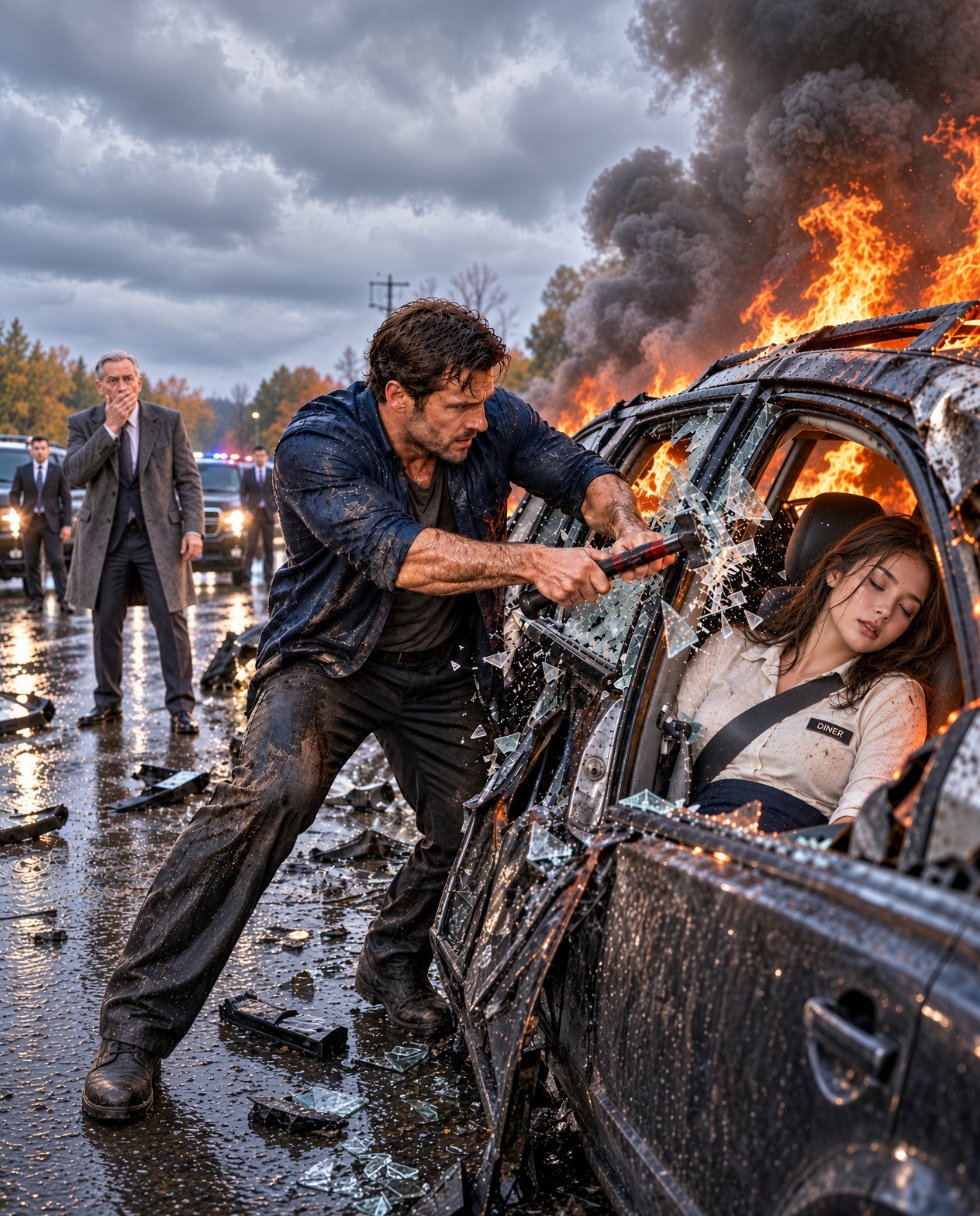
My name is Calder Hayes and I was driving home from the night shift when the car ahead of me slid sideways, punched through the guardrail into the ditch. I did not know the woman trapped inside was Rowan Vale, the waitress who poured my coffee every night at the diner passed the plant. I broke the glass and pulled her out before the engine caught fire.
The next morning, while I was clocking in, three black vehicles stopped at the gate. The man who stepped out was not only her father. He owned the company that signed my paycheck. If you like stories about kindness, buried secrets, and a sharp turn nobody saw coming, subscribe and stay with this. I was 39 years old, and I lived in a two-bedroom house on Pallister Street with a porch that leaned a half inch toward the driveway.
My wife had died 4 years earlier in the spring, and the house had never entirely stopped arranging itself around her absence. My daughter Marin was 17 and had reached the age where she corrected my grammar and made her own lunches and pretended she did not still leave the hallway light on when I worked nights.
I made enough money that we were never hungry and never safe. The mortgage took one week of every month. The truck payment took another and the third week disappeared into groceries and the electric bill and the small emergencies that arrive on a schedule of their own. The fourth week was supposed to be college.
It had been supposed to be college for 3 years and the account still held less than what one semester would cost. Marin had started saying she might take a year off first in the light voice teenagers use when they are trying to make a sacrifice sound like a preference. I did not argue with her because arguing would have meant admitting I had heard what she was really saying.
Instead, I picked up overtime when it was clean and refused it when it was not, which is where my trouble with management began. Sterling Carrington ran Brier Ridge the way a man runs a stopwatch. And the difference between us was simple. He believed a machine was safe until it broke. I believed a machine was broken from the moment it stopped being safe.
Carrington asked my crew to sign inspection sheets in advance on a Friday for work that would not be completed until the following week. He called it getting ahead of the paperwork. I called it what it was and refused. And after that, my request moved more slowly through his office than anyone else’s. I had reported the safety interlocks on the number four press being bypassed with a jumper wire so the line could run with the guard up.
I had reported a lift that was 240 days past its inspection date. Still hauling pallets of steel blanks across a floor where men walked. I had reported aftermarket bearings installed where the manufacturer specified a certified part. and I had reported that three of my own maintenance writeups had come back into my hands with their language softened and my findings turned into recommendations.
After the night shift, the only place still open on that stretch of highway was the Lantern Creek Diner, a low brick building with a handpainted sign and a parking lot that flooded whenever it rained hard. I went there because the coffee was hot and because going straight home meant sitting alone in a kitchen at half midnight.
The woman who worked the late shift was named Rowan. She drove a sedan older than my truck, she wore the same two pairs of shoes in rotation, and she had a memory that I found genuinely unusual. She never wrote down an order. She knew that I took my coffee black, that the trucker who came in on Thursdays wanted his eggs turned once, and that the retired school teacher in the corner booth liked her check brought before she asked for it.
One Tuesday, I was in the end booth with Denny Puit from Second Shift, and I was tired enough to say out loud what I usually only wrote down. I told him that a company cannot save money on maintenance forever, that the savings are not real, that they are simply being stored somewhere until they come due. I said that one day somebody would get hurt if Brier Ridge kept economizing the way it was economizing.
Rowan was two tables away refilling a sugar caddy and she stopped. Not dramatically. She just stopped for a second longer than a person stops and then she finished pouring and carried the caddy back behind the counter without looking at me. I noticed it and I filed it away under nothing because I had no reason yet to keep it.
That Thursday, the rain started around 10:00 in the evening and never turned into a real storm, which is the worst kind of rain on county roads. It was enough to lift the oil off the asphalt and not enough to wash it away. My shift ran 20 minutes long because the conveyor on line 2 through a belt and Carrington supervisor wanted it running before the morning crew arrived.
I signed out at 11:41. Rowan closed the diner at 11:30 that night alone and pulled out onto the same stretch of highway I was about to drive. We were 4 minutes apart in the dark on the same wet road and neither of us knew the other was there. I saw it happen from perhaps 200 yd back. The tail lights ahead of me were steady and then they were rotating, describing a slow quarter circle that my mind refused to accept as real.
The car left the road at the bend past the culvert, went through the guardrail as though the guardrail were a suggestion, and dropped out of sight. What remained was a pair of headlight beams pointing up into the rain at an angle no vehicle on a road has ever pointed. I break hard and put my truck across the lane with the flashers on because the second thing that kills people in a wreck is the car that comes next.
I called for help before I moved and I stayed on the line long enough to give the mile marker, the description, and the fact that the vehicle was down an embankment and inverted. Then I got the small canvas bag from behind my seat. Industrial first aid had been part of my certification for 9 years, and I had never been the kind of man who let a certificate expire.
In that bag were a seat belt cutter, a window punch, nitro gloves, gauze, and a flashlight with a magnet on the base. I had bought it after a co-orker degloded his hand on a shear in the summer of the year my wife died, and I had carried it every day since, without once thinking of it as anything more than insurance. The embankment was steeper than it looked from the road and slick as glass.
I went down it, mostly sitting, with one hand on the wet grass, and I could smell the wreck before I reached it. that mix of hot coolant and gasoline and torn earth. The sedan lay on its side in the drainage ditch with perhaps 6 in of running water beneath it. The hood was folded into a shape that made the engine compartment shorter than it had been built to be, and there was smoke coming from the seam of it, thin and gray and steady.
I got the flashlight on the interior and found her hanging sideways in the harness, her hair down across her face, one arm moving. It took me a moment to recognize her. Then I did and something in my chest went cold in a way that fear alone does not explain. I said her name and she answered which told me more than any examination could have.
She was conscious and oriented and frightened and her voice was thin because the belt had her weight across her ribs. The driver’s side was against the ground. So I climbed onto the frame of the car and got the passenger door open by standing on it and hauling upward. I told her I was going to keep talking to her the entire time and that if she stopped answering me, I was going to become extremely annoying about it, and she laughed, which cost her something.
I braced her shoulder with my forearm, cut the shoulder strap, and then the lap belt, and took her weight as she came down against me with a small sound I still hear sometimes. Her right ankle would not bear anything, and there was blood at her hairline from the glass. Getting her up through the passenger door took longer than everything else combined.
I had to go out first and then reach back down for her and she had to help and she did with her jaw set and her eyes on mine. Halfway out, she stopped, gripped my wrist hard enough to leave marks and said something I did not understand at all. She said, “Do not call my father.” She said it twice and the second time she was not asking.
I told her, “All right, and I meant it the way you mean anything you say to a person who is bleeding.” and I filed it under family, under the thousand private wars that people carry around and do not explain to the man who happens to be holding them. We were maybe 40 ft up the embankment, both of us on the ground when the engine compartment caught.
It was not an explosion. It was a soft orange bloom under the crumpled hood that grew into something taller than the car in under a minute, and it turned the rain visible, every drop of it, in a wide, bright column. Rowan did not look at it. She looked at me. I remember thinking that a person who has just come out of a burning car should look at the car and that the fact she did not meant she was already thinking about something else entirely.
Then the first sheriff’s unit came over the rise and everything became radios and light bars and questions. The medics took her in the ambulance with her ankle splinted and a collar on for the ride. And one of them told me her injuries were not life-threatening. A deputy wanted a statement and I gave one. And when a photographer from the county paper showed up and asked if I would say a few words about what it felt like, I told him I had to work in the morning.
I did not put anything anywhere. I did not tell anyone but Maron and I told her only because I came home with mud to the knees and blood on my jacket cuff and she was awake in the kitchen. Before I left the scene, a deputy asked whether I knew the driver. Just a waitress from the place I stopped at.
I said it was true and it was the last hour of my life in which it was true. At the hospital, a night clerk entered a name into a system that was connected to other systems, and a policy that had been written years earlier by people Rowan had never met went into effect exactly as designed. Somewhere in a house 400 m away, a phone rang on a private line that rang perhaps three times a year.
I did not know any of that. I drove home, slept 4 hours, and clocked in at 6:55 the next morning with my hand still sore from the glass. At 7:20, three black sport utility vehicles came up the access road and stopped in the visitor row, and Sterling Carrington came down the front stairs so fast he took them two at a time in a suit.
I had seen the face before in the front matter of an annual report that had been left in the breakroom and used as a coaster until somebody threw it out. Gideon Vale was 61, silver at the temples, built narrow, and he wore a gray top coat over a suit that had clearly been made for him and not bought by him. He did not look around the parking lot the way visitors do.
Veale Dominion Industries held a controlling interest in something like 30 operating companies, and Brier Ridge Components was one of the smaller ones, the kind of asset that appears on a page as a number rather than a place. In 11 years, no one at that level had ever set foot on our floor.
Carrington reached him with his hand already extended. Gideon did not take it. He asked a question I could not hear, and Carrington turned and pointed toward the maintenance bay, where I was standing with a torque wrench in my hand, like a man caught holding evidence. Then Carrington called my name in a tone he had never once used on me, warm and proprietary, and introduced me as one of our maintenance people.
He said it the way you described furniture that came with the building. Gideon walked past him without appearing to notice that he had been spoken to, crossed 40 ft of oil stained concrete in shoes that had no business on it and stopped in front of me. He looked at my hands first and then at my face. You are the man who pulled my daughter out of that car, he said.
I did not answer immediately because my mind had gone somewhere very quiet and was busy rearranging 11 months of small moments. the woman who never spoke about her family, the old sedan, the precision of her attention when I talked about the plant. The instruction gripped into my wrist in the rain not to call her father.
I had assumed she was hiding from something. It had not occurred to me that she might be hiding from a name and that the name might be printed on the top of the pastub folded in my back pocket. I said yes and I said her name out loud for the first time with the hole of it attached and Gideon nodded once. He asked to speak with me privately, and Carrington offered his own office with a speed that would have been funny on any other morning.
We sat in it, and Gideon thanked me in plain language without ornament, the way a man thanks you when he has already decided what he intends to do about it. He told me that he had been informed his daughter would have died inside a burning vehicle if the driver behind her had continued past the guard rail, and that he was aware most people do continue past. Then he offered me money.
He did not name a figure first. He asked what amount would matter to my life, which is a far more dangerous question. And for perhaps 2 seconds, I let myself imagine the college account with a real number in it. I said, “No, I have gone over the reason many times since, and it was not pride, and it was not some principle I had prepared in advance.
It was simply that I had not stopped on that road for a veil. I had stopped for a woman who brought me coffee and never asked me about my dead wife. And the moment I accepted payment, the thing I had done would become something I had been compensated for and it would stop belonging to either of us. I told him that.
I said I did not pull her out because I knew who she was and that taking a check would make it look like I would have driven on if she had been nobody. Gideon was silent for a long moment and something in the set of his shoulders changed. There was a fourth man in the room and he had not been introduced. He was in his early 50s, silver cufflinks, the most relaxed person present.
When Gideon paused, he leaned forward and began to speak, and his voice was pleasant in a way I recognized from Carrington, but refined several grades higher. His name was Preston Blackwell, and he was chief operating officer over the entire manufacturing group. He asked how long I had known Rowan. 11 months, I said. He asked whether I had been aware of her identity prior to the accident. No.
He asked whether I had ever discussed Veil Dominion with her, whether I had ever asked her about corporate matters, whether I had known her schedule that evening, and whether I had been driving that route by habit or by choice. “If you will not take money,” he said, “Tell me what you want.” I looked at Carrington, who had positioned himself near the door with his hands folded.
I thought about the jumper wire on number four and about the lift with an inspection date from the previous year and about three reports that had come back to me with my own findings softened into suggestions. I said that I wanted someone with actual authority to read the safety reports coming out of this plant, not the summaries, I said.
The originals with the dates on them. The room went completely quiet. Blackwell’s face did not move at all, which was somehow worse than if it had. Gideon looked at me for a long moment and said only that he would remember it. And then the three vehicles were gone and the shift went on as though nothing had happened.
At 4 that afternoon, human resources handed me a letter placing me on administrative suspension pending investigation. The letter listed four findings. Unauthorized retention of internal company documents. Insubordination toward site management. Conduct creating a disruptive work environment. and phrased with a delicacy that told me a lawyer had been in the room.
An apparent attempt to leverage a personal incident involving a member of the ownership family for professional advantage. Carrington signed it. Blackwell’s name did not appear anywhere on it, which is how that kind of man operates, and I understood the message perfectly. I might have pulled the owner’s daughter out of a ditch, but the owner did not walk this floor every day, and the man who did had woken up that morning with a problem named Calder Hayes.
They took my badge in the lobby in front of the second shift coming in and a security contractor walked me to my truck with a box holding my coffee mug and a photograph of Marin at 14. I sat in the driveway for a while before going in. Marin came out anyway in her socks and sat on the step with her arms around her knees and I told her the truth because she was old enough and because lying to her had never once worked.
She asked whether I regretted saying the thing about the reports. I told her I did not know yet. That night I lay awake doing the worst kind of math, the kind where you count months of savings against months of silence. And I arrived at three 3 months. And then we would begin losing things in an order I could already see.
400 m away, Rowan checked herself out of the hospital against the advice of a doctor who did not have the authority to stop her. She had a fractured ankle, 11 stitches at the hairline, and a bruise across her collar bone in the exact width of a shoulder belt. She heard about my suspension from a dishwasher at the diner whose cousin worked our loading dock, which is how information actually travels in a town that size.
Then she called her father and by every account I later received, spoke to him in a way that no executive at Veil Dominion would have survived. She told him that a man had lost his job for telling him the truth in a room where he had asked for the truth. Gideon did not reinstate me. He told her no and he told her why.
And it is the moment in this story where I had to revise my opinion of a man I had decided I understood. He said that if the technician was right, then being right had to be proven by evidence that did not depend on gratitude. If he simply protected the person who had saved his daughter, then Blackwell would spend the next year describing the entire matter as a wealthy man’s sentimentality, every finding would be discredited by association, and nothing at any plant would change.
He needed the audit to arrive at me on its own. What I experienced as abandonment was the first week of a quiet internal review that had already been authorized with instructions that no site leadership be notified. For 8 days, my badge did not work. My calls to corporate ethics produced nothing but an automated acknowledgement, and men I had worked beside for a decade became very busy when they saw me at the hardware store.
On the ninth day, I went to the Lantern Creek Diner in the middle of the afternoon because a man without a shift does not know where to put the hours, and Rowan was in the last booth with her ankle in a walking boot and a cup of tea she had not touched. She had been coming in each afternoon for 3 days, waiting for me to do exactly that.
She told me the rest of it herself without being asked, which I respected more than any apology. She had spent six years inside Veil Dominion in corporate strategy, building models that closed facilities and consolidated lines. She had been good at it. She had also grown up in a house where her father missed every recital and every graduation and every hospital visit of her mother’s final illness because there was always an acquisition.
And at 26 she reached a morning where she could not tell the difference between her father’s priorities and her own. So she left not to punish him, she said, but to find out whether she was a person or a surname, and she picked a town where nobody read the business pages and took a job where nobody could promote her because of her father.
That was why she never spoke about family. That was why she drove a sedan with 140,000 mi on it. I did not hold it against her. And I said so because I had spent 4 years learning that people are entitled to carry their grief in whatever container they can lift. Then she said something that changed the shape of my situation entirely. She told me that in 11 months of late shifts, she had listened to a great many men from Brier Ridge talk over coffee at midnight and that I was not the first of them to say something was wrong at that plant. She had heard it from at least
six. She had heard it about the lift and about the guard on the number four press and about a supervisor who told a crew to keep running. I had believed for 2 years that I was the only one. That belief had been useful to the people who benefited from it, and it had never occurred to me that it might have been arranged.
Rowan asked whether any of the others had put their complaints in writing, and I said I had no idea because we had never compared notes because men who are afraid do not compare notes. That evening, while I was replacing the float valve in our toilet because it was the only problem in my life I could solve, my phone rang from a number in a neighboring county.
The man on the other end said his name was EMTT Bradock, that he had been a senior technician at Brier Ridge until the previous March, and that he had filed a written report about a bypassed interlock 19 days before he was terminated for cause. EMTT Bradock met me in the parking lot of a hardware store because he did not want me at his house.
He was 62, retired now in the way men are retired when nobody will hire them. And he had kept his copies in a plastic bin in his garage, which told me everything about the kind of career he had finished. His report from the previous February described the same jumper wire on the same press that I had written up 8 months later.
Under the plant’s own procedure, a bypass safety interlock triggers an immediate work stoppage and notification to corporate compliance within 24 hours. Neither had happened either time. In both cases, the finding was reclassified as a maintenance observation, which required no notification at all. Every serious finding I had filed had been downgraded within three business days.
Two of them had returned to the network drive with my language altered and my name still attached, which meant that somewhere in the system there existed a document that claimed I had written a sentence I had not written. The reclassifications clustered in the two weeks before the close of each fiscal quarter, and every one of them concerned a repair that would have required taking a line out of production for more than 4 hours.
Rowan looked at that last column for a long time and said that she had built models with that exact shape, and that what I was looking at was not carelessness. Carelessness is random. This was aimed. While I was learning that in a kitchen on Pallister Street, three auditors who had been retained through outside council were learning it at a far larger scale.
Blackwell had reduced maintenance and compliance budgets across 11 facilities over three fiscal years in increments small enough that no single line item drew attention. The reductions were presented internally as efficiency gains and disciplined asset management. Combined, they moved the manufacturing group’s operating margin above a threshold defined in an executive incentive agreement.
And the difference between falling just short of that threshold and clearing it was a performance award of something close to $4 million paid in two installments. Carrington had been promoted twice during the same period both times by Blackwell. There had been incidents, not catastrophes, which is precisely why no one outside those buildings ever heard of them.
A man at a plant in another state lost most of the use of two fingers in a machine whose light curtain had been out of service for 5 weeks. A forklift with an expired inspection put a pallet through a rack and missed a crew by roughly 6 ft. Both events had been classified as first aid cases and near misses rather than recordable incidents which kept them below the line that triggers a regional investigation.
Every one of those reclassifications had been made at the site level by a plant director. and every one of those plant directors reported to Preston Blackwell. Here is the part I did not grasp until much later, and it is the true shape of what happened to me. There was no conspiracy on that highway.
Rowan hit standing water on an oiled road at 52 mph and lost the rear of a car with tires should been replaced in the fall. It was an ordinary accident, the kind that happens 900 times a night in this country. It carried no meaning at all. But it dragged a man from the bottom of a system into a room with the man at the top of it.
And for 4 minutes that morning, I had the one thing Blackwell had spent 2 years making sure no maintenance technician would ever have. Attention. I was never dangerous because I saved Rowan Vale. I became dangerous because saving her made Gideon Vale look directly at me while I was still holding a wrench and still angry.
Blackwell understood that before I did. On a Tuesday, a lawyer I had never met left a message asking whether I would be willing to discuss a resolution. We met in a conference room at a hotel by the interstate, and the offer was laid on the table with real courtesy. Voluntary separation with a clean record, 2 years of salary, which came to a figure I had never seen in one place, continued health coverage for 18 months, a neutral reference, and a small consulting arrangement so the payment would not appear as a settlement. in exchange a
confidentiality agreement covering all matters relating to my employment and withdrawal of every complaint I had filed. I want to be honest about what happened in that room. I did not refuse immediately. I sat there and did the arithmetic in front of them because that money was 4 years of college for Marin with a cushion left over and a roof that had needed replacing since the year before my wife got sick and sleep.
I had been awake at 3:00 in the morning for 9 days doing math with negative numbers in it, and a man was offering to delete all of them with a pen. The lawyer was smart enough to say nothing at all while I thought. What stopped me was not courage. It was the light curtain in another state and a man with two fingers that do not close.
I thought about the fact that somebody had written that man’s injury down as a first aid case and that somebody else had approved it and that no one had ever told him a report existed from a year earlier warning about the same machine. If I signed that page, then every repair that did not happen afterward would be a repair I had been paid to be quiet about, and the next man on the floor would have nobody to blame but me.
I said that out loud, more or less, and then I said the simplest version of it. If I take the money, the next person who gets hurt has only me to blame. I left the folder on the table. Nine days later, a courier delivered an envelope to my house that was not from Brier Ridge. It was from Veil Dominion Industries, and it instructed me to appear at corporate headquarters on the following Thursday at 10:00 in the morning before a review panel of the executive committee with any documentation I wish to present. It did
not say what the panel was for. It did not say whether I was a witness or the subject. I stood in my own driveway holding it, and I honestly could not tell whether I was being called in to be cleared or to be finished. The Veil Dominion Tower had 46 floors and a lobby with a stone floor so polished that I could see my own shoes coming toward me.
I wore the suit I had bought for my wife’s funeral, and I had let it out at the waist the night before with a needle while Maron pretended not to watch from the hallway. The conference room on the 42nd floor had glass on three sides and a table long enough that the people at the far end were genuinely far away. There were 14 of them, two lawyers standing rather than sitting.
A court reporter and a picture of water that nobody touched for 2 hours. Blackwell presented first and he was better at it than I expected, which is how men like him survive so long. He did not attack me. He praised me. He described a competent long service technician with a real safety consciousness and an unfortunate pattern of friction with local leadership.
A man who had experienced a traumatic event and had since been encouraged perhaps by people with their own history with this family to interpret ordinary operational decisions as misconduct. He noted my refusal of a personal gift and framed it as the behavior of someone holding out for something larger.
Then he put up three years of margin improvement across the manufacturing group and let the numbers speak for a discipline that a maintenance technician could not reasonably be expected to understand. So I did. On the 14th of September, I tagged the number four press out of service because the interlock had been bypassed with a jumper wire and I photographed the wire and I have the photograph with the time on it.
On the 16th, the tag was removed and the press ran two shifts. On the 22nd, my finding appeared in the system reclassified as a maintenance observation with a sentence I did not write. I requested the lift be pulled from service on the 8th of November, 240 days past inspection, and I was told by a supervisor, whose name is in this email, to return it to the floor before the morning count.
I filed 19 findings in 2 years. Four survived in their original form. I laid each document down as I named it one at a time, and the sound of paper on that table was the only sound in the room. Blackwell watched me with an expression of patient regret, and I understood exactly why he was not worried. Everything I had was local, a technician cannot see across 11 facilities.
He cannot see an incentive agreement or a budget line in a consolidated statement, or what a plant director in another state wrote down about a man’s fingers. Blackwell had spent the entire presentation making sure the panel saw me as a single window in a very large building, and by the standard of what I could prove alone, he was right.
Then Gideon Vale, who had not spoken once, leaned forward and set a bound document on the table with both hands. It was perhaps 4 in thick. He said that the firm that had prepared it had been engaged by outside council 11 days before the accident on the county road for reasons unrelated to it, and that the board’s audit committee had been aware. copies went down the table.
I did not get one and I did not need one because the third lawyer read the summary findings aloud and I could hear my own dates coming back to me in someone else’s language. 19 findings filed. 15 downgraded. 11 of those downgrades executed from a single administrative account after the close of business.
It was not only Brier Ridge. The same reclassification pattern appeared at seven other facilities. in the same weeks of the fiscal calendar under directors who had been placed by the same man. The auditors had reconstructed the incentive threshold and found that without the deferred maintenance, the margin target would have been missed in two of the three years.
They had also located in a file at a plant in another state a warning written 13 months before a man lost the use of two fingers describing the exact light curtain that was not functioning on the day it happened. When they read that part, one of the outside directors took off his glasses and set them on the table and did not put them back on.
I had imagined this moment many times in my truck, and in my imagination there was shouting. There was none. Gideon enclosed the report, looked down the length of that table at the man who had built him three years of excellent numbers, and spoke in a voice so level it was almost conversational. You did not increase our profit, he said.
You borrowed it against the safety of people who will never be allowed into this room, and you did not intend to pay it back. Blackwell began to answer, and Gideon simply waited, and the answer did not arrive. Two floors of lawyers had already made certain that it could not. What followed was procedure rather than vengeance, and I have come to believe that is the only kind of justice that actually holds.
Blackwell was suspended immediately pending the conclusion of an independent investigation, his access revoked before he left the floor, and every matter touching his compensation referred to the board’s audit committee and to outside counsel for determination. Carrington was removed from his position that afternoon, with the question of cause left to the legal department rather than decided by a man in a chair.
My suspension was voided as improperly founded with back pay and a note entered that the findings against me were withdrawn in full. The court reporter typed all of it and then people began standing up and gathering their papers as though the morning had been a normal morning. We sat in a smaller room with no glass walls, just the two of us and a pot of coffee he poured himself.
He thanked me again for his daughter and then he did something I had not expected from a man like him. He separated the two things out loud and refused to let them touch. Pulling Rowan out of that car, he said, was a decency he could acknowledge, but not reward because any reward would reduce it. What had happened in that conference room was a separate matter entirely, and it was not decency.
It was 19 findings, a photographed jumper wire, and a documented refusal of a very large check, and those were professional qualifications. He did not offer to make me a vice president, and if he had, I would have known the whole thing was theater. What he offered was a position inside a program that did not yet exist and would be built in the following quarter.
Veil Dominion was establishing a manufacturing safety operations function with its own reporting line, and he wanted me as regional safety operations lead across the nine facilities in our division. The salary was slightly more than double what Brier Ridge had paid me. It came with a management training track and certification funded by the company because he pointed out accurately that I had never once supervised anyone.
It reported to corporate compliance and not to any plant director. The piece that mattered most was the last one, and he offered it before I could ask. The position carried line stop authority. If I found an imminent serious hazard at any of those nine plants, I could shut the line down that hour and no sight leader could restart it, and no one could require me to justify it in advance. I sat with that for a while.
Then I told him it was not enough, and I watched a man who is told that perhaps twice a decade decide to be curious instead of offended. I said that authority given to one man is only a better version of the same problem because the next Blackwell will simply wait for that man to retire. What I wanted was for every technician on every floor to be able to report a hazard without it costing them anything with the original document preserved somewhere their plant director could not reach. I told him about EMTT Bradock and
his plastic bin in a garage and about six men at a diner counter who had said the same thing I had said and had never once said it to each other. Gideon listened without interrupting for four full minutes, which I am told is not a thing he does. Then he said he would put it to the board with his own name on it.
Before I left, I said the thing I had been carrying since the courier came to my door. I told him I understood that Rowan had asked him to look after me, and that I was grateful, and that I hoped it would not follow me around the company like a smell. Gideon sat down his cup and told me flatly that his daughter had never asked him for anything of the kind.
She had not requested my reinstatement or the job or the audit. According to him, the only thing she said in the hospital before she was fully out of the fog with her ankle immobilized and a nurse in the doorway was this. If you really want to thank that man, listen to him when he talks. That is the sentence I think about.
Not the boardroom, not the report, not the money I turned down twice. A woman who had spent 11 months making sure nobody knew her name, lying in a bed with 11 stitches in her scalp, spent her one piece of influence not on rescuing me, but on instructing the most powerful person she knew to do the one thing no one at Brier Ridge had ever done. Listen to him.
Everything that happened afterward came out of those seven words, and she said them before she knew whether she would be able to walk without a boot. Gideon and Rowan did not repair 8 years in an afternoon, and I would not believe it if they had. They began having dinner once a month, and I understand that the first three were difficult, and the fourth was not.
She did not move back into that world, and she kept working at the Lantern Creek Diner through the spring, which her father found genuinely maddening, and which she found enormously satisfying. As for the two of us, there was no scene where I said something profound in the rain. I went back to the diner on a Tuesday in March after my first week in a job with my own name on an identification card that opened doors at nine plants.
Rowan came over with the pot before I sat down, poured coffee I had never once had to ask for, and put the cup exactly where she always put it, a half inch from my right hand. I looked up at her. “So, when were you planning to tell me your father owns the company I work for?” I said. She thought about it for a second with the pot still in her hand and the boot still on her ankle.
Probably right after you told me you were planning to save my life, she said. I laughed out loud in an empty diner at 11:00 at night, which I had not done in longer than I care to count. She sat down across from me for 11 minutes, which was the whole of her break, and we talked about nothing of any importance at all.
When I drove home that night, the roads were dry and the light was on in the hallway. And for the first time in two years, I did not have the sensation of my entire future sitting on a desk somewhere in a building I had never been inside in front of a person who did not know my name. Brier Ridge shut down for 9 days that summer. The number four press was replaced entirely rather than repaired.
Both lifts were pulled and sold for scrap, and the aftermarket bearings came out of 41 assemblies across the floor. The new policy went out across all 31 operating companies in October. Any critical safety finding submitted by a technician is now stored simultaneously at the site and the no local manager can edit, delete or reclassify, and the original text is preserved with the original name on it.
The men on second shift started calling it the Hayes rule. Nobody in corporate calls it that, and I have never corrected anyone in either direction. EMTT Bradock came back as a contract inspector for two of the nine plants which he needed and which I did not arrange. Though I did make a phone call I would make again. Six of the technicians Rowan had listened to at midnight filed findings in the first 3 months under the new archive and four of those findings were acted on within the week.
That number is the only trophy from any of this that I have ever wanted. I did not become a wealthy man. I drove the same truck for another two years because it ran and because the transmission had one more winter in it and because I had gotten used to it. I still come home and eat dinner with Marin who is at the state university now 40 minutes away.
Close enough that she comes back on Sundays with her laundry and opinions about my cooking. The account has money in it. The roof is new. What changed is not the size of my life but the fact that I can now see 3 years ahead of me instead of 3 weeks. and did not know until I had it how much of a man’s exhaustion is simply not being able to see.
Gideon Veil began showing up at plants without announcing himself, standing in a stamping bay in that top coat, asking people what was broken and waiting for the real answer instead of the first one. He told me once that he had run those companies for 19 years by reading margins, and that a margin is a description of a place written by someone who wants you to stop asking about it.
Rowan eventually agreed to take on a role with the employee hardship and education fund on the condition that she report to the board and not to her father which he accepted with an expression I would have paid money to photograph. She and I have taken our time. That is the honest word for it. There was a dinner and then several months and then another dinner and neither of us is the kind of person who mistakes gratitude for anything else or wants to find out the hard way.
On a rainy evening in the fall, I came out of the Lantern Creek Diner and she called my name from the doorway behind me. I turned around and she threw something underhand across the wet lot and I caught it. It was a key on a plain ring. There was a sedan parked under the light at the edge of the lot, new dark blue with paper tags still in the window.
And I looked at it and then back at her with an expression she enjoyed far too much. “Relax,” she said. “I just want you to check the brakes.” I shook my head and started laughing in the rain, and so did she, and there was nothing frightening left in it at all. That is what I understand now, standing here at the end of all of it.
I stopped on a road for a woman whose last name I did not know. And it was precisely because I did not know it.

