Racist Cop Pulled Gun—Then the General’s Staff Walked Straight Toward Him
Racist Cop Pulled Gun—Then the General’s Staff Walked Straight Toward Him
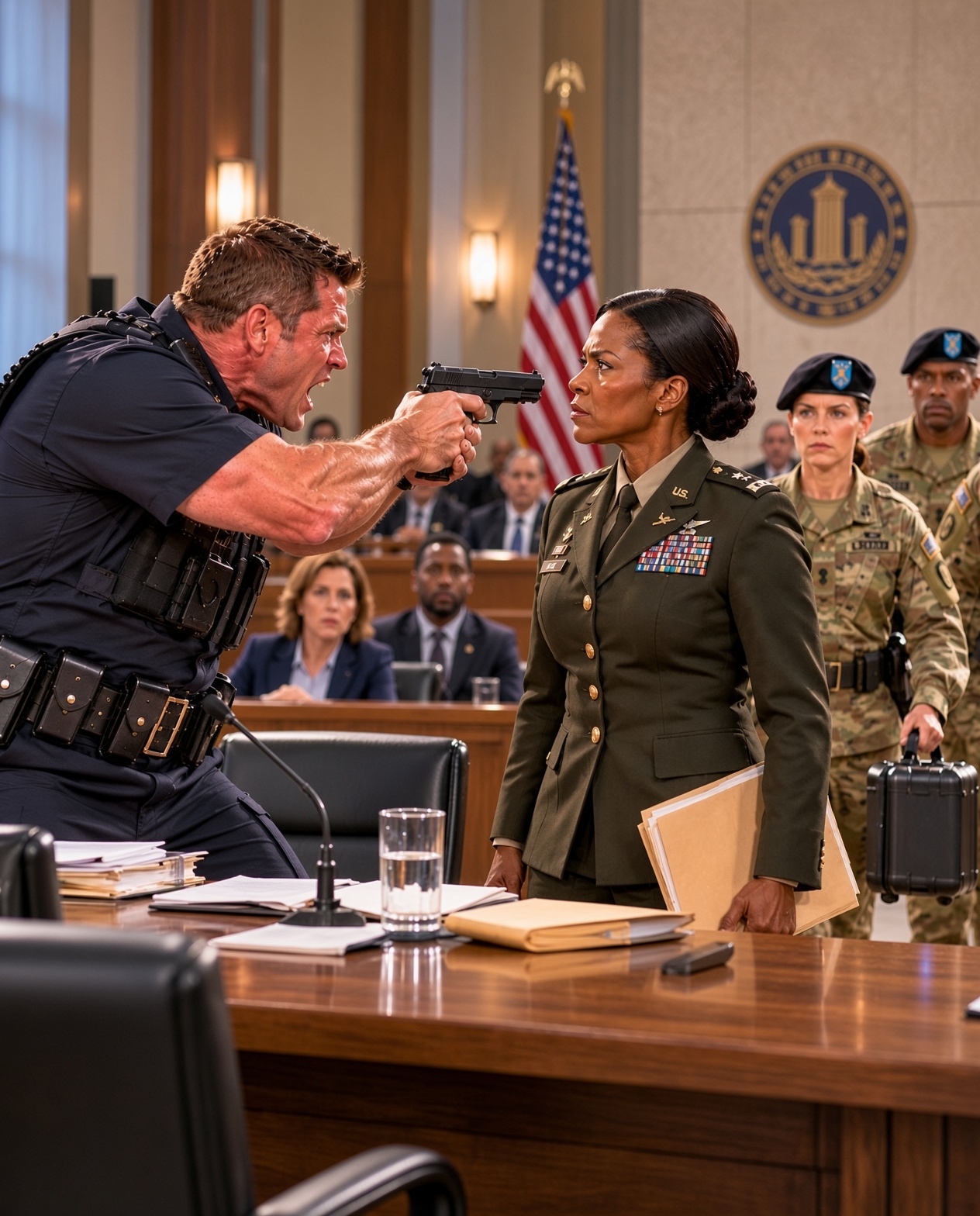
Take one more step and I’ll make sure you never wear that uniform again. The suspended police officer snatched a folder from an Army witness in the hallway. He threatened to ruin her career in front of the municipal auditor. He himself had summoned her to that hearing. Three members of General Adrian Cole’s staff continued walking towards him.
They stopped at the testing table, right in front of their seat, where the municipal employee was waiting to receive the folder. The first question they would answer was why he had requested them, and then he tried to prevent them from reaching the table. “Stay away from the witness.” The court official said.
He loosened his grip, but didn’t move until a security officer entered the hallway. “Remain in this hearing. The first document is already under dispute.” The woman whose folder Wade Chandler had caught did not pull it against his hand. He waited for his fingers to release the cover and then placed it in front of the employee.
A second member of the group placed a narrow envelope next to him. The third one stayed one step behind them, close enough to answer a question and far enough away not to give them another excuse to claim that they had surrounded him. It was a preliminary personnel review in a municipal meeting room , not a courtroom or the police station where Kessler had confronted them weeks earlier.
That distinction mattered to everyone, except Kessler. He had filed a written complaint describing his visit to the police station as an attempt to intimidate civilian officers into handing over police records. His lawyer had asked the city to bring the people involved to this session to test his account.
The city had requested a limited response from the army unit. His council had approved an appearance limited to the timeline, the paperwork, and what his own staff had done. Kessler sat down alone after the security officer moved to the side of the wall. His lawyer leaned towards him. Whatever she said made his jaw clench.
He turned his chair to the side so he could observe the three staff members instead of the person leading the session. “Their request brought these witnesses here.” The court official said . “You will be heard through this desk. If you approach them again, I will end the session and make a separate report.
” “Then make sure the registration is complete.” Kessler replied. “Start with the way they stormed into my police station.” He had been suspended without pay since the roadside arrest involving Adrienne and her niece Maya. He was wearing a civilian jacket and was not carrying his department’s weapon. He had once been able to order people to back away from a car window with his hand on his holster.
In this room, he only had his voice, a pile of papers, and the belief that he could still decide which person seemed dangerous. Adrienne was not sitting with her staff. Kessler had told anyone who would listen that a general intended to fill the audience with soldiers. The empty chair at the end of his table denied him the photograph he wanted.
His staff had arrived without training, without armed escorts, and without requesting to touch a single municipal file. Even so, Kessler had already turned his walk to the testing table into another accusation. The secretary began with the impression that Kessler had provided. It showed the police station lobby shortly before, the three staff members at the security entrance, and Kessler holding his phone up while challenging them.
It ended at the point where the receptionist began to turn towards an interior door. In Kessler’s copy, the receptionist’s hand and part of the door had been cut out. “They walked past the desk after I told them to stop,” Kessler said. He pushed his copy toward the center of the table. “That ‘s what his own image shows.” The personnel officer responsible for scheduling waited for the hearings officer to nod.
Then she handed the secretary a dated appointment confirmation from the police station. The reception time was prior to the arrival of the staff that morning. The person at the desk knew they were coming. “This sets a date,” Kessler’s lawyer said. “It doesn’t establish what happened once they entered.” “Okay,” the hearing officer replied.
” We’ll ask about that separately.” Kessler’s mouth opened as if he had expected the paper alone to end the discussion. He watched the secretary align the two sheets, one showing a still image, the other showing a time. His own image had been useful for the seconds he didn’t show. Now those seconds were the question.
The records custodian for Adrienne’s unit said the group had reported to the desk, waited for instructions, and followed a civilian employee to the meeting room that had been assigned to them. She did not say that the police station had welcomed them warmly. She did not say that all the officers present had approved it.
Her response was brief enough that Kessler couldn’t force her to cover up all the suspicions he had raised. “Do you want us to believe that three staff officers needed directions in a police lobby?” he asked . “Yes,” she said. He lifted the printout onto the table and then dropped it at his feet. “Collect your test.
” The paper slid against his shoe. She remained motionless. The secretary walked around the table, picked up the sheet by its clean edge, and placed it in a transparent sleeve. Kessler wanted the staff member to be on the floor in front of him. Instead, the secretary marked the position where the paper fell and asked if the copy was the same one that had been submitted with the complaint.
His lawyer looked at him. Kessler stared at the case. “It is,” he said. The incident was included in the meeting record. The employee gave no explanation. She simply refocused on the appointment receipt and described the route from the security desk to the administrative room. Each answer eliminated a part of Kessler’s claim that they had entered the compound on their own.
None of them required that their word be taken at face value regarding what had happened outside the frame of the lobby impression. At the end of the first sequence of the morning, the hearing officer established the limit of what had been confirmed. The staff had arrived for a scheduled appointment . A civilian employee had guided them.
The group had authenticated records belonging to its own unit. That account weakened Kessler’s description of an unauthorized entry. But he did not answer who had placed an Army Hold tag on the index of an unrelated motorist’s body camera file . “The label is the reason they were there,” Kessler said.
“That’s one reason why the city accepted the appointment,” the hearing officer replied. “That’s not the same as saying they planted it.” Kessler slid another sheet of paper toward his attorney. The document bore the motorist’s case number and a location outside the city’s regular record system. He had treated that location as a secondary storage location for the images.
The city records supervisor asked the clerk to enlarge the bottom portion of the original request form, which had arrived that morning with a column heading missing from previously circulated copies. The heading read “Reception Desk .” There was no storage vault under that address. It was a contractor’s reception office across the county line, where inquiries and service requests first entered the contractor’s system.
A line below the address read, “Request Received.” The separate line for “File Accessed ” was blank. Kessler snatched the sheet before the clerk finished reading it. “A blank box doesn’t tell you they kept it off the file.” “That’s correct,” said the city supervisor. It tells me that the application form does not register an access.
I’m going to get the service record before I say anything else. The city supervisor asked the contractor’s representative to come forward with the entry logbook. The representative placed a sealed package on the secretary’s desk . Kessler followed it with his eyes as if the paper might contain the name he was looking for.
Did the army contact your office? His lawyer asked. The form has a motorist case number , a time, and a route location, the representative said. The part of this record that I can confirm is a request for information about the location of the case. A name needs to be verified against our underlying registry.
So you can’t rule out the army. I cannot identify the applicant from the page they gave me. That was not the answer Kessler was expecting. He tried again, more firmly, but the hearing officer stopped him before he could turn a hidden name into an accusation. The city then presented Paul Mercer’s service ticket .
Mercer had retained some technical administrative tasks after being removed from citizen complaints. His ticket arrived after the recovery of the sealed equipment case from Adrian’s vehicle. He requested that the contractor open the motorist’s file index. He did not ask that the video be played, copied, or edited.
The missing 9 minutes had already been documented in the city’s materials prior to Mercer’s request. Kessler tapped the ticket with a finger. “He opened it after the army passed through the city . He requested an index service after the equipment case was recovered,” the supervisor said . “Those words are doing a lot of work for him.
They’re the words that appear on the ticket.” Adrian’s staff records custody then verified the specific point for which he had come. His unit had not issued any hold instructions under his name for that motorist case number. I had compared the printed city label with the unit’s exit log . He couldn’t tell the city who had entered his tag, and he did n’t pretend that the lack of instruction from his unit explained the damaged images.
Kessler leaned over his lawyer’s shoulder. So , the army says someone stole the video. No, the custodian replied. Someone used his name. The city index shows words that our unit did not issue. I can’t tell you from our records how those words got there. The hearing officer repeated his last sentence in the record.
Kessler had built a claim about soldiers removing municipal evidence. His response set a more limited problem: an unverified army retention tag in a city index. It could have been entered by mistake, copied from a different instruction, or placed deliberately. Each possibility required a different record.
Outside the meeting room, Adrienne received a brief update from the advisor assigned to her staff. He told her that the proof of the quote had been accepted and that the question about the index was still open. She asked if the motorist had been forced to attend. I hadn’t done it. She asked if the original video from Maya’s phone had been requested for this procedure. It hadn’t been.
” Keep her file where it belongs,” Adrienne said. “Maya’s recording showed a different event. Kessler’s gun was next to Adrienne’s stopped car with Maya close enough to be threatened.” An 11-second gap in a processed version of that recording was under review while Maya retained the original.
The motorist’s missing 9 minutes belonged to another camera, another encounter, and another question . Adrienne would not let Kessler borrow fear from one case to make the evidence in the other seem stronger than it was. He ended the call and left the phone next to the written account he had prepared about his own arrest.
I could still feel the delay between seeing the gun spin and hearing Maya move. He pushed that memory aside just long enough to read his story again. She had to say what she saw, not what she learned later about Kessler. At the hearing , the contractor’s representative referred to the oldest request from the receiving office.
It predated Mercer’s fine. His stated purpose was to ask if the motorist’s case could be located, not to instruct anyone to open the video. The original had entered a separate review because the applicant field was incomplete on the circulated copy. ” Who wrote that purpose?” Kessler demanded. “The person who took the consultation wrote a summary,” the representative said.
“We have not established that these are the exact words of the caller.” “Then stop presenting it as the purpose of the one who called.” His point was fair enough for the hearing officer to flag the sentence as an admission summary. Kessler took the small correction as an opportunity. He asked why a military witness could sit within reach of the documents while he couldn’t see the name hidden on the contractor’s work package.
His lawyer pressed for the underlying call log and the opportunity to question his custodian before anyone assigned blame. The hearing officer ordered a brief recess so that the parties could identify what the preliminary session could actually decide. Kessler immediately stood up, forcing the three Army personnel to wait while security cleared the corridor.
He smiled when the scheduling officer stopped. Then he moved aside just enough to let them pass without further incident. The motorist whose recording had the 9-minute gap was not in the room. A city interviewer had met with him separately that morning and recorded a correction to his earlier statement. He still remembered his car stopping and the long wait that followed.
He no longer claimed that he could identify a particular officer near the car during the missing interval. He had once said it angrily after learning that part of the recording had disappeared. Now he wanted the uncertainty to be written next to his own name. The motorist signed the correction to be shared with the personnel evaluators.
He refused to give permission for a public release of his interview. By the time the session resumed, Kessler was aware of the correction. Her lawyer had received it as part of the limited hearing package. He began calling it a retraction even before the interviewer arrived at the table. “It changed his story,” Kessler said.
“You were ready to blame a man because a stranger guessed wrong.” “He corrected an ID,” the supervisor replied. “He did not remove the fact that his file contains a 9- minute gap.” Kessler looked at the three staff members as if they had personally hidden the interval. His lawyer touched his sleeve. He leaned back, but his eyes remained on them until the hearing officer asked the interviewer to confirm the wording chosen by the motorist.
The revised sentence was read exactly. It didn’t have the name of any officer on it. No one in the room could honestly use it to place Kessler, Mercer, or anyone else in the motorist’s car during the missing interval. The absence of a name also meant that the city could not close that line of investigation by dismissing the motorist as being mistaken.
Someone still had to account for a recording with 9 minutes missing. The cautious correction made it more difficult to discredit the motorist. He had relinquished the claim he could not defend while maintaining the part he could. During the next break, Kessler found reporters waiting beyond the marked assembly area.
His lawyer followed him, carrying a copy of the day’s witness list. He told reporters that the army had admitted it did not know who had touched a video of the city. “They entered a police building and now they can’t account for the file,” he said. ” Ask why a general can send her staff here to say almost nothing.
” The programming officer heard it from the hallway. He took two steps toward the voices before the unit’s lawyer called his attention. “Our statement is in the courtroom,” he said. She looked towards the door. A reporter had turned a phone towards her. He came in without saying anything. Kessler had wanted a discussion in front of the camera.
His silence gave him nothing that could be taken out of context. It did not prevent his complaint from being made public, but the clerk’s record contained his full response and the reason he had come. “Notice what void Kessler is trying to connect with this audience.” The hearing officer then called Kessler’s lawyer.
She requested the portion of the contractor’s material that identified who had submitted the old external request. The city had provided a summary and an incomplete page, but not the call log from which the receiving office had created it. She could not verify the caller, the wording, or the service action with what was on the table.
“If you want this document to be considered against my client,” he said, “let me question the person who can explain it.” “Otherwise , leave him out of this stage.” The city supervisor said the outside request could help distinguish events that had been repeatedly merged into a single story. The hearing officer agreed that the distinction was important.
He also agreed that the unverified application could not be used to decide who interfered with the motorist’s file. Kessler leaned forward. For the first time that day, he didn’t need to interrupt. Her lawyer had found a limit that applied to both parties. “I’m going to pause the contractor matter,” the hearing officer said.
“The scheduled roadside check review will remain on the calendar. The account of the precinct visit and today’s conduct will remain on this record. No conclusions will be drawn about the applicant from the incomplete package.” Kessler had won a real delay. The name on the outside application wouldn’t be read at this preliminary session. He stood up slowly, giving the impression that the entire case against him had stalled, even though the roadside check file and his handwriting report in a witness binder were still moving forward. His attorney put the
contractor’s pages into a separate pile. She knew a pause wasn’t a ruling in his favor. The reporters outside would hear the word “delay” before anyone else. At the reception desk, a messenger from the contractor arrived for a package scheduled to be returned to the outside office. The original intake sheet was in the package.
The messenger held out a transfer envelope already marked with a routing number. The city supervisor stopped the clerk’s hand before the sheet went in. “I need a certified copy first. The original has to go out on this trip,” the messenger said. “Then we’ll record it.” the delay in the trip. The messenger looked at his watch and reached for the edge of the sheet above the clerk.
The clerk held a palm over the package. Security approached, and the messenger withdrew his hand. The gesture had lasted less than a second . Recording it would take longer. The supervisor asked the clerk to note the interruption, the position of the sheet, and the time before making the copy. Kessler watched from the entrance to the hallway.
He had only caught the words “certified copy.” His lawyer told him not to go back into the room. He stayed where he was, close enough to see the clerk flatten the original under the copier glass. The first copy made the crucial columns legible. The incoming call lasted one hour and one minute. The requested information contained the motorist’s case number.
Authorized access was marked as no. The open file was blank . The reception clerk’s initials were next to the last two fields. The city supervisor asked for the separate service log, which would show if another employee had subsequently acted on the inquiry. Until it arrived, she would only say that This entry hadn’t granted access.
She wouldn’t allow Kessler’s lawyer to call it proof that the entire system was clean. And she wouldn’t allow her own team to call it proof that the caller earlier had damaged a video. There was another field, written in the clerk’s compact handwriting. It summarized what the person had requested: a prior police safety incident linked to the motorist’s case.
Those two words had run through Kessler’s defense since the day he pointed his gun at Adrian’s car. He’d said Adrian’s movements made him fear for his safety. But police safety was a phrase used in law enforcement by more people than just Kessler. It suggested an address, not a name. The supervisor saw Kessler at the door, but didn’t confront him.
A familiar phrase wasn’t identification. And the question about the contractor had been paused. The unit’s records custodian arrived to retrieve his copy of his own authentication statement. He saw the city supervisor cover the entry log and understood that no one would share their identity with her. from the contractor who called.
Her unit had answered the question it could. The tag in the municipal index remained for the city to track. “Is there anything else you need us to verify?” she asked. “Just the version number in your outgoing log,” the supervisor said. They checked it together. The number matched the copy received that morning.
The custodian signed for the delivery and returned to his colleagues. It was a quiet exchange, but it avoided a later dispute that the Army had inserted a new denial after seeing the city log. Kessler returned to the table as the hearing officer called the participants for a final scheduling note. Her shoulder struck the chair nearest the test station with enough force to push it into the path of the personnel officer.
Security righted the chair before she reached it. Kessler said she had turned too quickly. The officer who moved the chair noted the contact without guessing whether it had been planned. The hearing officer set a date for the contractor’s custodian to explain the outside request. She asked the city to preserve the original intake slip and any associated call logs; Kessler’s attorney reiterated that preserving a call was not an admission that his client had made one.
The hearing official agreed and noted it in the record. Adrian received the afternoon update after the staff had left the courtroom. The city had acknowledged the citation at the police station. The Army hold tag still hadn’t been authenticated by her unit. Mercer’s subsequent citation still pointed to an index request, not a video edit.
The older inquiry had a receiving address, but no verified applicant available for that day’s hearing. Kessler had gotten a postponement on that one matter only. “And the motorist?” she asked. He corrected the identification. He did n’t remove the gap. Adrian listened to the rest and then told the attorney that neither her staff nor Maya should answer reporters about the man’s recording.
She would attend the separate review of her own roadside stop when called. She wouldn’t let the person who had pointed a gun at his niece and used a dispute over another man’s video to dictate where his witnesses spoke. Back in the city records room, the contractor sent the requested duty log. The entry linked to the oldest entry had no access grant or delivery number.
The motorist’s file hadn’t been opened. Mercer’s later ticket had its own number and its own index action. Regardless of what had happened to 9 minutes of footage, the first entry wasn’t the duty event that opened that index. The supervisor placed the two sheets separately. For days, people had talked as if an old request, a later ticket, and an Army retention tag formed a single chain.
The document showed at least two routes. It offered no evidence that either route had removed a minute of video. The reception clerk in the contractor’s office called again while the supervisor was still reading. She had found a second filed memo with the old inquiry. On the day the question came in, someone at the desk had called the number provided by the requester.
The call had connected. The memo carried The same motorist case number , a matching timeframe, and a brief handwritten reason for wanting material from that case . For my own hearing. The supervisor had the clerk read those words twice. They were the intake worker’s summary, not a recording of the caller’s exact sentence .
The caller could have been a police officer, a representative, or someone else with a pending hearing. The reason narrowed the field of possibilities . It didn’t identify a person. Wait for the call log. A familiar phrase still not a name. The clerk said there was a recording on file, but the front desk hadn’t yet linked it to the callback note.
The supervisor asked him to keep the original note, the route log, and the recording together, with each transfer noted. She didn’t ask to hear a loose audio file over the phone. A second sheet of the city index arrived before the clerk finished. It showed the internal approval code that had been attached to the Army hold tag .
The line where the approving person’s name should have appeared was on There was a blank space on the copy they had. The code belonged to a city workflow, not the contractors’ front desk. No one in Adrian’s unit had issued the hold under the unit’s name. No line on the initial intake form allowed the caller to enter that tag.
The supervisor placed the callback note in one sleeve and the hold approval in another. Someone had requested information from an outside desk to prepare for a hearing. Someone, through a different route, had placed an Army tag in a city index. They might have met. They might never have met . She had no evidence to tie their hands.
Her phone rang again. The front desk clerk had located the call filed under the callback time. She could forward a verified copy to the city custodian once the release and receipt were logged. The supervisor looked through the door into the hearing room, now empty except for a clerk collecting chairs. Kessler was gone.
The three people he had threatened had returned to their unit. “Bring in the custodian and log the transfer,” the supervisor said. She kept her finger on the callback note while the clerk went to make the arrangements. Before anyone revealed the caller’s name, she wanted the correct voice, the correct number, and the correct file in the same room.
The custodian came in carrying an empty evidence sleeve. The city supervisor didn’t give him the caller’s name because she didn’t have one. She gave him the time of the callback and watched him compare it to the contractor’s transfer receipt. The file number on the recording matched the number on the receipt. A second check showed that the recording hadn’t been opened or replaced since it was stored.
Only then did she seal the copy in the sleeve and sign for it. The initial listener was limited to the city supervisor, the custodian, and the official reviewing the contractor’s material . Adrian’s staff didn’t enter the room. His unit had already answered the question about their own outgoing records. A caller asking a private contractor about city footage was one question. of the city.
The first voice belonged to a receptionist. She asked for the motorist’s case number. A man provided it and then said he was looking for a previous incident involving an officer’s safety. The line crackled when she asked who had authorized him to view the material. ” I’m asking if it exists,” the man replied.
“I need to know if an officer’s review is being handled the same way mine is.” There was a pause. The clerk told him that an inquiry wouldn’t give him access. He asked her to call back when she knew which office had the index. The voice was deep and compressed by the line. It was familiar enough to make the supervisor look up, but not clear enough to put a name on the report.
She stopped the recording before the return call and asked the custodian for the original switchboard entry. “Don’t write down who he looks like,” she said. “Write down what he asked and what he was told.” The clerk had told her that no file would be opened about that call. The duty log confirmed that no file had been turned over .
Those facts could be verified. An assumption about a distorted voice, no. At the resumed city council meeting, Kessler arrived with his attorney before the contractor’s records custodian. He found a chair facing the aisle, the same position from which he had watched the three Army personnel approach. This time, they sat beyond the testing table, waiting only to confirm their unit’s version of the statement if asked.
Kessler glanced at them, then at the empty chair reserved for the city supervisor. Outside the room, the motorist had come to sign the final copy of his amended statement. He had declined a public interview but wanted the city to stop circulating the earlier sentence that claimed he could identify an officer. The interviewer guided him down the marked aisle to a private desk.
Kessler turned away from his attorney and stood in the man’s way. “Keep changing your story and no one will believe a word you say,” Kessler told him . The man stopped. He didn’t look toward the phones across the hall. hallway. I changed the part I couldn’t prove. Kessler moved closer. Do you have any idea what people lose when you make assumptions? Security stepped between them before the motorist could respond.
The interviewer led him through the private door. Kessler’s attorney took his arm and led him back toward the meeting room. An officer recorded where the two men had been, who had spoken, and the fact that there had been no contact. The motorist signed the amended statement exactly as written. He did not reinstate the discarded ID to make Kessler leave.
Notice what survives after the witness corrects himself. Inside, the contractor custodian identified the file number and the two separate entries: the inquiry at the outside reception desk and the subsequent service ticket that Mercer had filed for an index action. Kessler’s attorney asked to hear the entire first call, including the return call.
The city offered a brief segment of the initial inquiry. Their reviewer had removed a section while checking if it contained someone else’s information.” “They can’t use half a conversation to tell us what the man requested,” the attorney said. The hearing officer listened to the proposed segment privately with the custodian.
She allowed the portion where the clerk said access had not been granted. She excluded the city’s abridged passage about the caller’s purpose until the full recording and return note could be compared in the presence of both parties. The city supervisor had been right to preserve the recording. His office had moved too quickly in making a shortened extract for the resumed session.
Kessler glanced toward the city table. “ You cut the evidence and call my picture incomplete?” “The excluded passage will not be used against you today,” the hearing officer said. The contrast stung the city team. Kessler’s lobby printout had omitted part of the scene, while his own extract had been prepared before the contractor had finished checking its boundaries.
The omissions were not necessarily equal in motive or effect. Still, both had to be treated as omissions. The hearing officer wouldn’t remedy a weak presentation by pretending the other didn’t exist. Adrian received that account through his attorney after the session had adjourned. He asked if anyone from his unit had been invited to interpret the contractor’s audio . No one had been.
He told his staff to only answer questions about their documents and to leave at the scheduled end of their clearance. His rank couldn’t cure the city’s incomplete extract, and he had no interest in giving Kessler another complaint that a general had conducted a personnel hearing. The contractor then provided the full switchboard entry .
The callback had gone to a number with only its final digits visible on the approved copy for the personnel packet. Another note from the contractor described the caller as an officer involved in a pending review. That was the caller’s description of themselves, not an identity check. The city compared the visible digits to a sealed personnel contact log.
They appeared as one number on that log, but several digits remained hidden in the packet. Kessler and his attorney had received it. “ That sounds like an indictment behind a black bar,” his attorney said. “It’s not a conclusion,” the hearing official replied. “If the city wants to rely on the number, it must show your side the full record under the agreed-upon conditions .
” Kessler was still arguing as the custodian placed the unredacted call receipt in the restricted review envelope . His attorney requested a recess. She examined the full number first, then the date Kessler had provided it as a contact for his personnel file. She led him to an adjoining room. The hearing did not follow. The city supervisor waited with the undisturbed recording.
Through the door came no confession, no raised voices, only the sound of a chair being moved. She knew the number could have been used by someone else. A statement from the person controlling it would answer more than any assumption she had made about the voice. When Kessler returned, his attorney told the hearing official that he would answer the question himself. consultation.
She asked that her response be entered alongside the “no access” record, so the city wouldn’t present the former without the latter. “I called the front desk,” Kessler said, ” before Mercer’s notice. I wanted to know if there was an older officer safety case I could compare to how they judged my intervention.
He looked at the city supervisor, not the Army desk. I didn’t ask for the video to be cut. I didn’t get any video. The woman told me she couldn’t open anything for me. The custodian contractor confirmed the last point from the duty log. The consultation received no access grant or delivery number.” Kessler had sought precedent to defend the time he pointed his gun at a Black woman and her niece.
He had also spent weeks suggesting that Adrian’s personnel had come to seize the motorist’s file . The earlier consultation was his. The Army visit had been scheduled to authenticate the unit’s records. Those two acts had never been the same event. The hearing official did not He characterized his phone inquiry as a video tampering.
She asked why his written complaint described the outside contact as a possible Army route when he knew he had made contact there himself. “I knew about my call,” Kessler said. “I didn’t know if anyone else called afterward.” “Your complaint didn’t mention your call.” “ Because I was denied access.
I figured it was n’t going anywhere.” His attorney added that an incomplete account wasn’t proof he had fabricated the city tag. The hearing official agreed the tag remained a separate issue. She also flagged the omission for review in the personnel review. The first part of Kessler’s story had changed. The missing 9 minutes hadn’t returned.
The contractor custodian pointed to the remaining field in the index. The Army hold tag arrived via a municipal authorization route the receptionist couldn’t contact or complete. Kessler’s investigation had a phone record. Mercer’s subsequent index request had a service number. The tag had an internal approval code whose approving name It wasn’t listed on the copy before them.
Combining the three would result in a convincing accusation and a falsified record. “You found my call,” Kessler said. “You didn’t find me in that field.” “That’s correct,” the city supervisor replied. He seemed surprised to hear the concession aloud. It gave him enough room to strike again. Then, any officer trying to defend himself can look like a criminal for asking a question.
His attorney asked the hearing officer to establish the permitted finding carefully. Kessler had made an inquiry and omitted it from his account of the outside request. He hadn’t obtained the motorist’s video through that inquiry . The hearing officer recorded all three facts. She wouldn’t turn one suspicious omission into the conclusion that he deleted the footage.
The call answers who asked. It doesn’t answer who changed the index. Adrian was called in for a different review later that week, the one concerning her car stop. She went without the three staff members who had testified about the appointment at the station. The reviewer asked her to start before she She showed no military identification.
She described Kessler approaching her window, the position of his gun, the order to keep her hands where he could see them, and the instant the barrel moved toward Maya. “What did you think he was responding to?” Kessler’s attorney asked. “I can’t tell you what he thought,” Adrian said. “I can tell you where his gun was pointed.
” The attorney asked if Adrian had moved her hand toward the center console. Adrian replied that she had raised it where Kessler could see it. She didn’t try to win the question by invoking her rank. The reviewer had her statement from the day of the arrest, and Maya’s original phone recording could be examined against her.
Adrian had to be as accurate about her own movements as she expected the city to be about Kessler’s. “When did he know who you were?” the reviewer asked. “After he had drawn his gun.” “Did his attitude change?” Adrian paused . Her words changed. “The gun had already been pointed at us.” I had spent weeks listening to the story told as if the shocking thing was that a general had been arrested.
A woman by the side of the road had heard Kessler speak as if her calm replies were a challenge. Maya had heard him giving orders while looking at her aunt through the car window. The subsequent discovery of Adrian’s range could change a supervisor’s reaction . He couldn’t change what the two women had faced before he knew about it.
The reviewer reverted to the original sequence, where the record could show actions instead of retrieving a motif from someone’s memory. When the session was paused, Maya went with the adult accompanying her to the separate witness area. She had agreed to identify the original file she had saved, not to recount the entire encounter to a hallway full of phones.
Kessler left carrying a thin folder of photographs. She opened it so that the image of Adrian’s car was in front of Maya as she approached. “Look what your aunt says happened,” he said. Security put a hand between the open folder and the walkway. Kessler didn’t touch Maya. She held the page a moment longer, then closed it when the officer signaled her to back away.
Her lawyer arrived and took the folder. The encounter was written down before either party could improve it in the recount. Maya didn’t look at the picture. She asked where to turn in her file, and the reviewer directed her to the assigned custodian. Adrian watched her walk by. For a moment, he wanted to tell Maya to leave the building.
Maya had already decided to bring the original. Adrian walked beside her alone to the witness door. The custodian compared the original phone file to the processed copy the city had circulated. An 11-second stretch was missing from the processed version. The original preserved what Maya recorded. The reviewer still needed to establish how the processed copy lost those seconds and who handled that export.
The city created a trace for that question and another for the separate 9- minute interval of the motorist. A match in the missing word didn’t make the files related. The first entry in the processing log identified when the shorter version had been produced . A second entry named the office that received it, but the field for the person who had approved the circulation was left for a later signature.
The custodian didn’t fill it out, either out of habit or an assumption about which desk usually handled exports. She attached a request for the source transfer log. Maya watched her do it. It was the first time a city employee had pointed to an empty field in front of her without trying to make the blank space sound harmless.
“Will they use mine now?” “Maya asked, looking at her phone.” We will keep the original available for comparison. “said the custodian.” I cannot tell you what the reviewer will decide about it. “Maya accepted the receipt.” Her willingness to preserve the video did not give the city permission to make her a witness to every recording lost in the city.
Kessler’s lawyer had the opportunity to question the dates , the device, and how the copies had been stored. The reviewer did not ask Maya to guess who eliminated the 11 seconds. She didn’t know. Her useful evidence was that she still possessed the file from which the processed copy had been made. At the next staff status session , the hearing officer compiled the specific findings without merging the investigations.
The army personnel had arrived at the police station by appointment and had remained within the agreed purpose of authenticating their units’ records. Kessler had contacted the contractors’ external front desk before Mercer submitted his subsequent ticket. That first consultation had not opened or delivered the motorist’s video.
The way Kessler described the visit and omitted his own investigation would be considered during the ongoing review, with his lawyer able to respond. No final discipline was announced. The report of his hand in the witness folder, the paper dropped at his feet, his approach to the motorist, and the photograph shown to Maya were added as separately described incidents .
The hearing officer did not call every move an assault. He also refused to delete them because they had taken place outside the original stop on the side of the road. The city supervisor shut down the service route that allowed new applications under the disputed Army retention code, while an independent records reviewer traced its origin.
The contractor could preserve existing material and respond to authorized preservation requests, but would not treat the questionable label as a new order from Adrian’s unit. Mercer was still unable to request the contractor’s services in these matters. Vail remained on administrative leave. Broom’s restrictions continued.
Kessler remained suspended without pay while his own trial proceeded. The motorist learned what had been established about his inquiry only through the limited report he agreed to receive. He allowed his corrected statement to remain on file. He declined an invitation to appear before the press.
His traffic stop had already taken up enough of his life. The missing 9 minutes did not entitle everyone else to the rest of it. He also requested that the previous overconfidence phrase remain in the record with a dated correction next to it. Deleting it completely would make it seem as if she never made the mistake.
Leaving it uncorrected would allow the mistake to speak for itself forever. The city interviewer signed the page under his review and handed him a copy . That modest document did not restore confidence in the record, but it gave him control over a sentence that bore his name. Adrian’s three staff members crossed the meeting room one last time to collect the certified copy of their unit’s verification.
Kessler was near the hallway again. Security was by the door, but no one asked the staff to wait. They walked directly past their table. He had a piece of paper in his hand and nothing he could use to stop them . The unit council gave Adrian his final receipt. He confirmed that his office had not issued a hold on the motorist’s case under his own name.
She read the receipt once and placed it next to her statement about the roadside stop. The two papers pertained to different matters. She would answer for what she had seen in the car. The city would be responsible for the label in its index. Keep watching for the approval code. The caller never had access to him.
At the city records office , the independent reviewer put Kessler’s confirmed call in one folder and the unexplained approval code in another. She compared the code to the city’s previous service sequence. Its first appearance was in a roadmap dated before Kessler called the outside office. That sheet also did not contain a clear approval signature .
A later employee had copied the code forward onto the line that eventually carried the army retention label. The discovery ruled out a simple explanation. Kessler had not invented that code during his external call. It did not establish who had entered it first, why it had been copied, or whether its subsequent use was a mistake or an attempt to conceal another action.
Nor did he recover the 9 minutes lost by the motorist. The reviewer flagged the oldest sheet for separate investigation and requested the original route book, not a new printout. When the employee returned, the space where that book should have been was empty. The exit log contained a date, a municipal office designation, and an illegible signature.
The inspector didn’t call anyone a thief. She placed a preservation request in the registry, then looked at the two folders again. A voice had finally acquired a name. The oldest approval didn’t have any yet. Wade Kessler remained suspended without pay, and the call he omitted in his complaint was finally his to explain.
The review was still open. Had no one established who put the army detention on the city’s index, or what happened to the motorist’s lost 9 minutes? But Kessler could no longer accuse Adrian Cole’s staff of secretly pursuing that file without answering for their own investigation. Adrian was a general.
Maya had kept the original recording. Neither a degree nor a camera should have been necessary for a black woman and her niece to be treated as human beings when an officer pointed a gun at their car. What about people who don’t have that title, that camera, or someone powerful enough to listen to them? If you had seen Kessler blocking those witnesses, would you have spoken up before knowing who they were serving? Tell us what you would have done in the comments.
Share this story, like it , subscribe, and turn on notifications. Each story on this channel is about one thing. The moment when the truth finally reaches everyone. And he always does.

