Racist Cop Attacks Black Navy SEAL in Court — Then Instantly Realizes His Mistake
Racist Cop Attacks Black Navy SEAL in Court — Then Instantly Realizes His Mistake
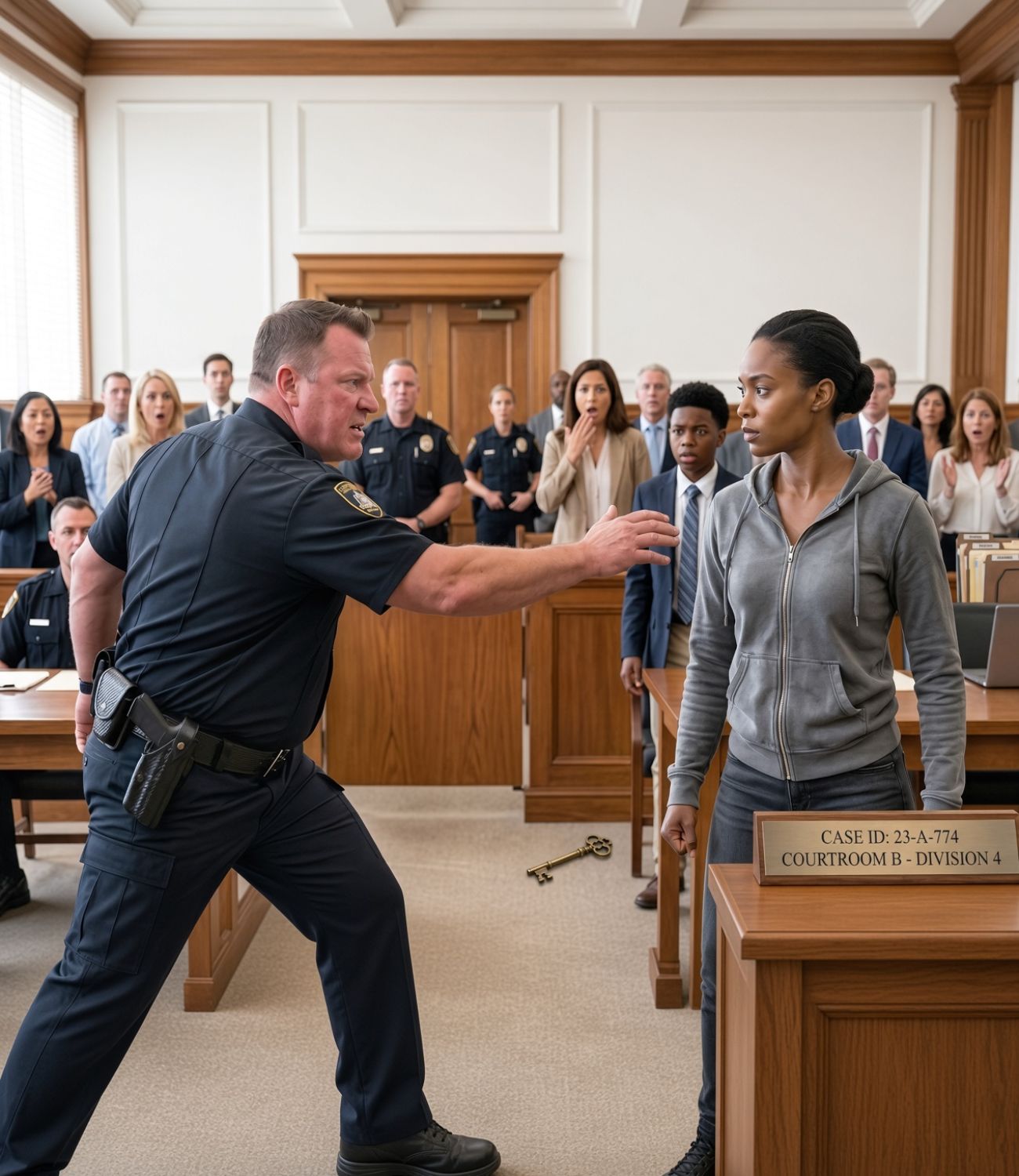
County courtroom like a stone dropping into still water. Quiet, perfectly controlled, and carrying enormous weight underneath the surface. Deputy Carol laughed, actually laughed, his thick hand wrapped around the grip of his collapsible steel baton, and the look on his face was the look of a man who had never once in his adult life encountered a consequence he couldn’t talk, threaten, or badge his way past.
I run this room, sweetheart, and you’re about 30 seconds away from finding out exactly what that means. Then he lunged, £250 of unchecked authority and deeply embedded contempt launching itself at a woman he had already written off as easy. What Deputy Raymond Carroll did not know. What the accumulated arrogance of 17 years behind a badge had blinded him completely to was that the woman sitting perfectly still on that hard wooden bench in front of him had spent the last decade doing things in places he would never be cleared to visit that made his
little courthouse look like a children’s playground. He had picked the single worst possible target in the room. And he was about to understand that in the most immediate, irreversible, publicly documented way imaginable. In the next 4 seconds, the man who thought he was the predator was going to be introduced forcibly and permanently to the concept of consequences.
The Riverside County Superior Courthouse sits on the corner of Maine and 10th in a part of downtown that smells perpetually of vehicle exhaust, fast food, and low-grade institutional anxiety. The building itself is the architectural language of bureaucratic permanence. heavy stone facade, narrow windows, the kind of structure designed by someone who wanted the people walking through its doors to feel the full gravitational weight of the state before they even sat down.
Inside, the air is recycled and faintly metallic, carrying the particular tang of nervous people who’ve been sitting in the same plastic chairs for too long. For most of the civilians who filter through the metal detectors each morning, the courthouse is intimidating by design. The maze of corridors and clerk windows and posted regulations and uniformed personnel all serves the same psychological function to remind the civilian that they are operating in someone else’s territory by someone else’s rules at someone else’s discretion. For 34year-old Maya Donovan,
it was Tuesday. Maya had been in environments that made this building look like a resort spa. She had conducted operations in active urban combat zones where the rules of engagement were printed on laminated cards she kept in her left breast pocket because there was no margin for forgetting them.
She had been extracted by helicopter from a rooftop in a city whose name she was still not legally permitted to say out loud. She had sat completely motionless in concealment for 11 hours in conditions that would have broken most people physically and mentally by hour three. A fluorescent lit courtroom in Southern California was not a stressful environment.
It was, by comparison, almost restful. She was here today for one reason only. Her younger brother, Darius, 21 years old, a premed sophomore at UC Riverside, was contesting a citation for failure to yield that had been issued by a patrol officer who had pulled him over for no discernable reason other than the fact that he was driving a newer model car in a neighborhood.
The officer apparently didn’t feel he belonged in. The citation itself was almost laughably weak. Maya had reviewed the dash cam footage herself the night before. Darius had yielded completely correctly. The stop was textbook pretextual. She had attended today in plain clothes, dark fitted slacks, a simple charcoal button-down clean sneakers specifically to avoid drawing any unnecessary attention.
She was not here to be noticed. She was here to make sure Darius got a fair hearing and that if the system attempted to grind him up, she was positioned to make that considerably more difficult than the system was expecting. Deputy Raymond Carroll had been assigned to courtroom duty for the past 3 years following an internal affairs investigation that had, through the particular institutional alchemy of Union representation and departmental loyalty, produced exactly zero formal discipline and a very quiet transfer away from patrol. The
investigation had concerned his conduct during a traffic stop in 2019. The body camera footage had been reviewed. Statements had been collected. And then, in the way these things tend to go, the file had been placed in a drawer, and Carol had been placed in a courthouse. He was not a man who had learned anything from the experience.
If anything, the absence of consequence had reinforced the central narrative he had constructed about himself, that he was simply a man who operated by a different standard than what the bureaucrats and the oversight committees and the community activists wanted to impose on him. He was old school.
He believed in authority. He believed in presence. He believed that the primary function of a uniform was to remind certain categories of people that there was an order to things and they were near the bottom of it. He had noticed Maya and Darius the moment they came through the security checkpoint.
He noticed the way Darius was dressed carefully, deliberately, the way young black men dress when they know they’re going to be evaluated before they open their mouths. He noticed Mia’s posture, which was different from most civilians. Too straight, too settled, too unbothered. It irritated him immediately.
He spent the first hour of the morning session finding [clears throat] reasons to walk past their bench. Each pass was accompanied by the deliberate sound of his gear, the creek of the belt, the rattle of the baton ring, the heavy tread of his boots against the floor. It was a performance, a territorial display. Darius felt it, his hands tightened on the folder of documents in his lap, his jaw set.
Maya placed her hand briefly on his forearm. Don’t. He’s trying to manufacture something. Stay exactly where you are. And let him run out of ideas. Her voice was barely a sound at all, but it was a sentence that contained a complete operational briefing in seven words. At 11:20 in the morning, Judge Patricia Okafer recessed the proceedings for 15 minutes to handle a scheduling conflict in chambers.
Darius exhaled and stepped out to find a water fountain, his neck stiff from the rigid posture he’d been maintaining all morning. Maya remained on the bench. She pulled out her phone to check an encrypted communication from her unit regarding a logistics update on her upcoming rotation. The phone, as always, was silenced.
Carol saw the phone, or rather Carol decided that the phone was going to be useful to him. He crossed the courtroom in long, deliberate strides, stopped 3 ft in front of Mia’s bench, and squared his shoulders. The physical positioning was calculated standing while she was seated, close enough to require her to look up at an uncomfortable angle, close enough that she could smell the coffee and the particular synthetic musk of his aftershave.
“Hey, you! No phones in the gallery. Maya looked up from the screen. Not quickly, not startled. She looked up the way someone looks up from a book when they’ve already finished the paragraph. She looked at him the way a geologist looks at a piece of rock, not with feeling, just with assessment. The regulation posted at the gallery entrance requires that devices be silenced during active proceedings, she said. Court is currently in recess.
My phone is silenced. Carol’s face shifted, not because she was wrong, because she was right and she knew it. And she said it without a single note of apology or deference in her voice. That was the part that lit something dangerous in him. The attitude, he said. That’s what I’m talking about.
You got a serious attitude problem. I’ll need you to step outside. On what basis? Maya asked. The question was completely neutral, procedurally genuine. What specific regulation have I violated that requires me to exit the courtroom during a scheduled recess? Carol leaned in. Not a lot, just enough to make his size relevant.
The basis is I’m telling you to. You want to keep pushing this? We can do it the hard way. Maya’s eyes did not change. Her pulse did not change. What Carol interpreted as stubbornness was something else entirely. It was a trained operator conducting a realtime threat assessment and determining that she was dealing with an unstable individual operating well outside his sanctioned authority whose ego had been sufficiently activated that he was now making decisions that were going to be very difficult for him to walk back.
She made one final attempt. I’d strongly encourage you to step back and allow the recess to conclude normally. Whatever you’re considering doing right now, I promise you you do not want to follow through on it. Carol heard the calm and mistook it for an invitation. He moved. His hands reached for the front of her collar, the grab and yank motion that had, in his experience, been extremely effective at reminding people who was in charge.
What happened next required less than 4 seconds and left everyone in the courtroom, including two attorneys who had seen a great deal in their combined careers, in a state of absolute physical disbelief. Mia did not retreat. She did not flinch. She did not make any of the sounds that people make when they’re frightened.
She stood, not in the panicked, scrambling way of someone caught off guard, but with the fluid, economical motion of a person for whom physical action is a language they are completely fluent in. Her left forearm intercepted his reaching hands at the wrist joint, redirecting rather than blocking, using the commitment of his own forward momentum as the foundation of everything that followed.
Her right hand found his elbow. A precise application of force to the joint angle he had left, exposed by overextending. His arm did not do what arms are supposed to do. He stumbled forward, already off balance, his center of gravity suddenly somewhere it wasn’t supposed to be. She stepped into the space he’d created, planted, and rotated.
The throw was textbook, rear leg sweep, full rotation gravity doing most of the work once you’d arranged the geometry correctly. Deputy Carol, 250 lbs of him, left the floor. He was airborne for a moment that felt much longer to everyone watching than the physics actually permitted. He landed on the hardwood floor of the center aisle with a sound that nobody in that room was going to forget quickly.
The impact shook the row of bolted benches. His baton skidded 6 ft to the left. The breath left his body in one involuntary explosion. Before he’d processed what had happened, Mia was already kneeling beside him, not in a helpful way, but in the precise weight distributed joint controlling way of someone who has been trained to neutralize a downed combatant who still has a loaded weapon on their hip.
Her knee found the space between his shoulder blades. Her hand located his sidearm retention holster and pressed the lock mechanism firmly into engagement. The gun was not going anywhere. Her other hand controlled his right arm at the wrist and elbow in a lock that was judging by the sounds he was making, communicating information about pain with considerable efficiency.
She had not struck him. She had not escalated to his weapon. She had not done anything that was not directly responsive to his initiated aggression. Every decision in that 4-second sequence had been made correctly, legally, and with the kind of technical precision that comes from 10 years of training at the absolute apex of military close quarters discipline.
“Do not move,” Maya said. Her voice had the same quality it had carried the entire morning, level, controlled, and carrying about a,000 lb of genuine capability underneath the surface calm. “Any movement you make right now will be your choice and your injury. Are we clear?” The courtroom had achieved a silence so complete you could hear the ventilation system.
Three civilians had their phones pointed directly at the center aisle. They had been recording since Carol had first raised his voice. Two attorneys sat motionless at their respective tables. The court reporter’s fingers hovered above her keys. Carol wheezed against the floor, half rage and half pain, making sounds that were trying to become words, but weren’t quite managing it yet.
The double doors at the rear of the courtroom came open. Two other deputies entered at a run, read the scene in about half a second, and immediately reached for their tasers. Stop. Get away from him. Hands now. Maya calculated the situation with the same rapid assessment clarity she brought to every highstakes environment she’d ever operated in.
She understood the numbers. She understood what the optics looked like to two deputies who had walked in during the second half of the story. She released her hold, rose to her full height, and raised both hands wide, fingers open, palms forward, stepping deliberately backward to create distance. I am not armed.
I am in full compliance with your instructions. She spoke loudly enough for the recording phones to capture clearly. The individual on the floor initiated an unprovoked physical assault. Everything that occurred was defensive response. I am cooperating completely. Carol got himself to his feet, clutching his shoulder. His face a color that didn’t exist in the standard crayon box. She attacked me. He managed.
Unprovoked. She was resisting. She assaulted a peace officer. Arrest her. The deputies looked at Carol. They looked at Maya. They looked at the halfozen phone cameras. The math of the visual was not working in Carol’s favor, but rank and institutional reflex carried the moment. Mia was handcuffed. She allowed it without resistance.
She had already identified the camera dome positioned directly above the spot where Carol had grabbed her. She already knew what it had recorded. She simply needed the next few minutes to unfold. Judge Patricia Okafor had heard the impact from her chambers. She had in 31 years on the bench never heard a sound quite like it coming from her courtroom during a recess.
She emerged to find her gallery in disarray, her baiff disheveled and loudly narrating a version of events that bore the structural hallmarks of rapid improvisation, and a handcuffed woman standing at the center of the room, looking like she was waiting for a bus. What happened here? The judge’s voice had the kind of authority that filled a room without needing volume.
Carol launched immediately into his account. The tone was urgent and wounded and carefully constructed. The woman had been belligerent from the moment she arrived. She had refused a lawful order to exit the courtroom. When he had attempted to escort her out physically, she had attacked him without warning using some kind of fighting technique, and he had only barely managed to avoid serious injury. He was visibly in pain.
He needed medical attention. The woman was dangerous and needed to be reminded immediately. Judge Okafur listened to all of it. Then she looked at Mia. The judge had been looking at defendants and litigants and officers of the court for three decades. She had developed extremely accurate calibration for what genuine composure looked like versus the performed version.
The woman in handcuffs was displaying the former. Your side, she said. Mia stood straight, met the judge’s eyes directly. Your honor, my name is Lieutenant Commander Maya Donovan. I am an active duty operator currently assigned to Naval Special Warfare Command. I am on approved leave accompanying my brother for a traffic citation hearing.
Deputy Carol approached me during the recess, demanded I leave on grounds that I can only describe as pretextual invaded my personal space in a manner consistent with established intimidation patterns I’ve been trained to recognize and then initiated physical contact by reaching for my collar and clothing. What followed was a proportionate defensive response.
I would respectfully request that you review the courtroom security footage before taking any further action as I believe it will resolve the factual question completely. The words Naval Special Warfare Command produced a visible physiological response in Carol. The specific shade of red his face had been wearing for the past 10 minutes shifted into something closer to gray.
His eyes found the black dome camera mounted in the corner above the gallery. He swallowed. The courtroom already quiet somehow became quieter. The footage took eight minutes to pull. Judge Okafur watched it alone at the bench monitor. Her expression moving through a sequence that the people in the gallery could track even without sound.
Focused attention, recognition, deepening displeasure. And then something that looked a great deal like barely controlled fury. She set the tablet down with a precision that suggested she was making a deliberate choice not to put it down harder. Remove the handcuffs from Lieutenant Commander Donovan. Immediately the deputy moved fast. The cuffs came off.
Maya brought her hands forward, rubbed her wrists once, and resumed standing at exactly the same posture as before. Deputy Carol Judge Okaffor said her voice had gone very quiet, which in the specific acoustic grammar of her courtroom, everyone present understood to be considerably worse than loud. I have just watched you approach a civilian who was engaged in no disruptive behavior.
Insert yourself into her personal space, deliver what I can hear clearly on the audio as a racially contemptuous comment, and then physically grab her without lawful cause. I watched all of that on highdefin video with clear audio. I then listened to you stand in my courtroom and give me an account of events that bore no relationship whatsoever to what that footage shows.
You attempted to have an innocent person arrested for defending herself against your assault, and you did it by lying to my face. Carol opened his mouth. Judge Okafor raised one finger, the mouth closed. I’ve been aware of complaints about your conduct in this building for 2 years, she said. I have been, I will acknowledge, insufficiently motivated to address them through formal channels.
That ends today. She looked at the senior deputy. You will take his weapon, his taser, and his badge. You will advise him of his rights. Deputy Raymond Carroll, you are being placed under arrest in my courtroom for assault under color of authority, civil rights violations, and perjury. The last of which I will note for the record.
you committed directly in front of me, which I take personally. The handcuffs that went onto Carol’s thick wrists made a sound that seemed disproportionately loud in the silence. He stood there while they were applied and said nothing. There was nothing left to say. Maya watched it happen without expression.
When Carol was led out past her, she did not react. She simply noted his passage, the way you note the departure of a thing that is no longer a relevant factor. Darius, who had returned from the water fountain to find the courtroom, rearranged around an event he had missed entirely, stood at the gallery entrance with an expression that cycled through confusion, shock, and then a quiet, aed pride as the deputy walked his sister through what had happened.
His case, when Judge Okafur called it 40 minutes later, was dismissed in under 6 minutes. The dash cam footage, as Meia had noted the night before, made the original stop impossible to justify. Okafur issued a notation in the case file specifically flagging the stop as pretextual and recommending supervisory review of the issuing officer’s recent citation history.
It was in the architecture of consequences a small thing, but small things have a way of accumulating. The courtroom footage pulled from three civilian phones and the security system was in the hands of two separate local news outlets by that evening. By the following morning, the compilation, Carol’s approach, his posturing, the recorded audio of his comments, the 4-second sequence that followed his grab and then the footage of him being handcuffed and led from his own courtroom had been viewed 11 million times across platforms and was climbing.
The comments were a phenomenon unto themselves. The clip of Mia’s throw was being analyzed in martial arts communities worldwide. Former military personnel were identifying her stance, her positioning, the specific technique, a modified outer reaping throw integrated into a fluid control sequence, and explaining what level of training it represented.
The consensus among people who knew what they were looking at was unambiguous. What she had executed in those 4 seconds was not a lucky defensive reaction. It was a trained response delivered by someone operating at a genuinely exceptional level of physical capability. The image of a woman in handcuffs standing at perfect attention, calm and unbroken, while a disheveled, shouting man who had assaulted her attempted to construct an alternate reality.
That image landed on something real in the millions of people who watched it. It named something they recognized, and recognition when it is shared at sufficient scale becomes something else entirely. The Riverside County Sheriff’s Department issued a statement within 36 hours. Carol was formally suspended pending investigation.
The Police Oversight Commission announced it would conduct an independent review. The District Attorney’s Office, facing a case in which the assault had been captured on multiple HD cameras with clear audio in front of a courtroom full of witnesses, one of whom was a sitting judge who had personally observed the perjury, and another of whom was a decorated active duty naval officer, declined to express any uncertainty about how the prosecution would proceed.
Carol’s union representation attempted, as union representations in these circumstances typically do, to contextualize. The attempts were not wellreceived. The Department of Justice, noting that Carol had a previous internal affairs file, and that the assault had involved documented racial comments directed at a black woman in a formal legal setting, opened a parallel civil rights investigation under 18 USC section 242.
That statute does not negotiate gently. The federal charge carries mandatory minimums that the local charge does not. Carol’s attorneys, who had initially been moderately confident about the local case, were significantly less confident about the federal one. Mera’s commanding officer, a woman who had led combat operations on two continents and was not an individual who expressed opinions she did not hold, issued a statement through Naval Special Warfare public affairs that described Lieutenant Commander Donovan as one of the most
disciplined, capable, and professionally decorated operators currently serving in her command and noted that her conduct in the courthouse had been in the command’s assessment entirely consistent with her training and her character. The statement was brief. It did not need to be long.
The federal trial convened 8 months after the incident. Carol sat at the defense table in civilian clothes. The uniform was gone along with the badge, the pension, and the 17-year identity he had built around both. He looked smaller than the footage made him appear. People often do once the architecture of institutional authority has been removed from around them.
The prosecution’s case was built on a foundation so solid that the defense’s primary strategy was essentially to ask the jury to disbelieve what they were watching with their own eyes. This is not historically speaking a successful approach. Maya testified on the third day. She was in dress uniform. She answered every question directly, without embellishment, without visible emotion, with the precision of someone who has been trained to deliver accurate information under high stress conditions and does not find testifying in federal
court particularly high stress by comparison. She described Carol’s approach. She described his verbal conduct and the specific language he used. She described the physical contact he initiated. She described in clinical and technically accurate detail the defensive response she executed and the specific reasoning behind each element of it.
Why she had controlled the weapon holster. Why she had maintained the joint lock rather than simply releasing and retreating. Why she had immediately complied when the other deputies arrived despite the fact that she was not the aggressor. It was not emotional testimony. It was devastating testimony precisely because of how completely it wasn’t emotional.
The jury, who had also watched the footage repeatedly from four angles, deliberated for less than 3 hours, guilty on all counts. The federal judge, reviewing Carol’s prior internal affairs file, his conduct in the courtroom, and his sustained attempt to perure his way to the destruction of an innocent person’s life, sentenced him to 6 years in federal custody.
He would serve that sentence without his badge, without his pension, without the identity he had mistaken for permanent, and without access to the specific kind of unchecked authority he had used as both a weapon and a shield for 17 years. The cell would not be large, the days would not be brief, and the footage would not stop circulating.
On the day the verdict came down, Maya Donovan was not in the courtroom to hear it. She was in a different time zone in a location that does not appear in news coverage doing work that does not get described in press releases. Darius texted her the single word guilty. She read it between mission segments, registered it, and moved on to the next thing that needed her attention.
That is the specific discipline of the kind of person Carol had so catastrophically underestimated. Not the ability to be dramatic about justice, but the ability to be completely finished with a thing once it has been properly resolved, and to redirect that attention to whatever actually requires it. Now, Carol would spend the next several years with considerable uninterrupted time to revisit the decision he had made in that courtroom on a Tuesday morning.
The decision to look at a composed, unbothered woman on a bench, and conclude that her composure was a performance, that her calm was weakness, that her refusal to perform fear was an invitation to manufacture a reason to inflict it. He had spent 17 years in an environment that rewarded that misreading.
He had encountered in 4 seconds its consequence. There is a particular quality that exceptional people share across disciplines, soldiers, surgeons, athletes, artists, and it has nothing to do with aggression or volume or the visible display of capability. It is the opposite. It is the internal density of someone who has been genuinely tested, genuinely shaped, genuinely built by something harder than most people are ever required to do.
It reads as stillness to people who have never encountered it. And to people like Carol who have built their entire operating model on the premise that stillness means yielding. It reads as an opportunity. It is the last misreading many of them ever make. The Riverside County Courthouse installed three additional camera positions in its main gallery within 60 days of the incident.
The notation in Darius Donovan’s traffic case remains in the record. The officer who issued the original citation was transferred. The case file for Carol’s prior internal affairs investigation, which had spent 3 years in a draw, was formally reviewed, and two other individuals who had filed complaints during that period were contacted by the county. None of these things are large.
All of them are permanent. And that is ultimately how accountability actually works. Not in single dramatic moments, but in the durable accumulating record of what happened, what was documented, and what could not be walked back. Maya Donovan didn’t need to be in the room for any of it.
She had already moved on to something that mattered more. She always does. If this story hit you somewhere real, if it reminded you that real strength doesn’t perform itself, that composure is its own power and that the people who underestimate quiet competence tend to learn that lesson in the hardest way available. Hit like right now and help this channel keep telling stories worth telling.
Subscribe if you want more and drop a comment below. What was the moment in this story that stopped you cold? We’ll see you in the next

