Prisoner Ripped the Female Police Officer’s Shirt– What He Saw Froze the Whole Jail
Prisoner Ripped the Female Police Officer’s Shirt– What He Saw Froze the Whole Jail
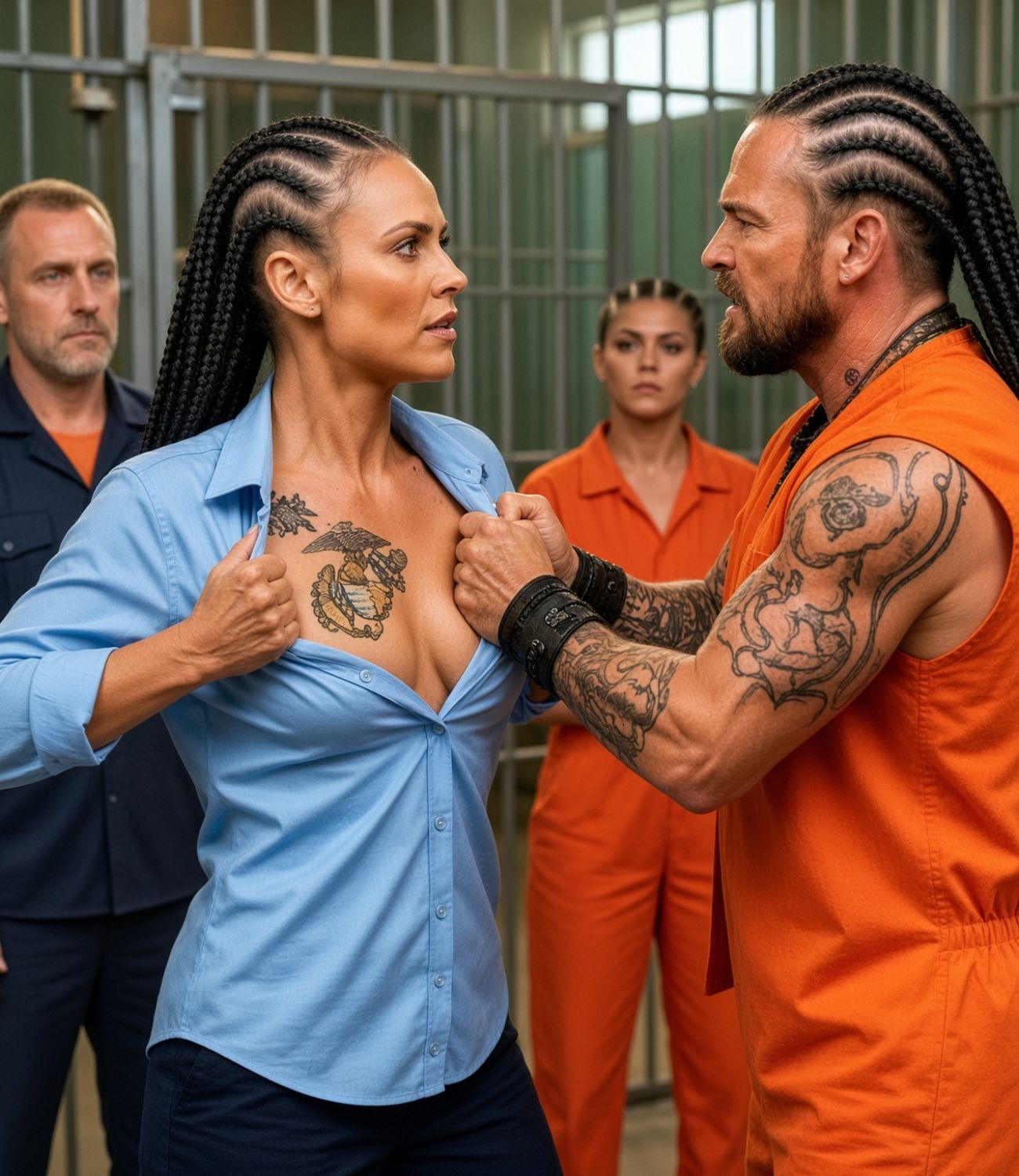
Have you ever seen a place full of the toughest men suddenly go quiet? Not because of a fight, not because of fear, but because one moment revealed a truth so shocking it froze the whole yard. That’s what happened inside Evergreen County Correctional Facility. One prisoner thought he was about to embarrass a female officer in front of 200 men, but when he ripped her shirt, what he saw made him stumble back in terror.
and the whole prison, guards, gang leaders, lifers stopped breathing. Stay with me because by the end, you’ll understand why that single moment changed not only the officer and the inmate, but everyone who saw it. It was a Tuesday morning. The prison yard looked normal. A cold sun hung over the razor wire fences. Guards stood at their posts.
Radios cracked with routine updates. Basketballs thutdded on concrete. But beneath the noise, there was tension. The kind of tension only prison veterans could feel. Men whispered in small circles. Groups formed and broke apart quickly. Even the guards felt it, that heavy air like the moment before a storm. Among the officers on duty was officer Emily Carter.
She had worked in a correctional center for almost 9 years. She wasn’t loud. She wasn’t flashy, but she was respected. She treated inmates fairly, and that made her stand out. At 31, Emily had already seen her share of danger. But nothing could prepare her for what was about to unfold. Among the 200 inmates on the yard that day was Derek Johnson.
He was 34 years old, serving time for armed robbery. In prison, Derek was known for his swagger. He had a quick temper, a sharp tongue, and a way of making others either follow him or avoid him. He hated authority, and lately his eyes had been locked on Officer Carter. He’d been studying her, her steps, her posture, her voice.
To him, she wasn’t just another guard. She was a symbol of the system he despised. And in his mind, she was the perfect target. That morning, officer Carter was called over to break up a minor argument near the weights. Two inmates were jawing at each other, puffing their chests. Emily stepped in, clipboard ready. Professional.
That’s when Derek saw his chance. He knew the guards were too far away. He knew where the cameras had blind spots. He wanted to humiliate her, to tear down her image in front of the whole prison. He moved fast. Before anyone could stop him, he reached out, grabbed her shirt, and ripped it open. The sound of fabric tearing ripped through the yard like thunder.
The basketballs stopped bouncing. Conversations died midward. Even the guards in the towers froze. All eyes turned toward them. Derek stepped back, smiling wide. This was his moment. He expected laughter. He expected cheers. He expected to see her crumble. Maybe she’d cry. Maybe she’d cower. Either way, he thought he had won.
But then his smile disappeared. Underneath the torn shirt, the yard saw something nobody expected. Not weakness, not embarrassment, but scars. Deep, jagged, terrifying scars. Burns, bullet marks, shrapnel wounds. It looked like a map of pain carved into her skin. But she wasn’t ashamed. She wasn’t hiding. She stood tall, head high, eyes locked on Derek. And then she spoke.
United States Army. 100 First Airborne Division. Three tours in Afghanistan. Her voice was steady. The yard went silent. 200 inmates. Men who had seen fights, blood, knives, riots. Men who thought they understood toughness. Every single one of them stood frozen. Because in that moment, they realized this woman wasn’t just a guard.
She was a soldier, a survivor, a warrior. The scars weren’t ugly. They were proof. Proof she had faced death and walked away. Derek stumbled back, his face pale, his hands shaking. The swagger, the grin, the confidence, the he had expected to break her, but what he revealed broke him instead. She looked him dead in the eyes. “You think ripping my shirt makes me weak?” she said. “I’ve survived mortar attacks.
I’ve carried wounded soldiers under fire. I’ve held brothers while they bled out. You think this compares?” Her words cut through the air like a blade. Derek couldn’t answer. The crowd shifted. Some looked down, ashamed. Others stepped forward, not with aggression, but with respect. One older inmate, James Rodriguez, a veteran of the army himself, spoke up.
“Ma’am, some of us serve, too. We know what those scars mean, and we don’t take kindly to punks who disrespect soldiers.” He glared at Derek. Around him, other men nodded. Derek’s followers, once loyal, backed away. The prison hierarchy was cracking. Emily’s voice carried again. You think you’re strong? You’re not.
You pray on the weak. That’s not strength. That’s cowardice. The word echoed through the yard. Coward. In prison, no insult is worse. Dererick flinched. He looked smaller than ever. The respect he had built for years evaporated in seconds. But Dererick wasn’t done. His pride roared back. His voice shook with rage. I don’t care what those scars mean.
You’re still just a woman in a uniform. This is my house. The wrong words. Rodriguez snarled back. Your house? You just disrespected every man who’s ever fought and died. You ain’t tough. You’re trash. The crowd moved closer. The yard was seconds away from erupting. And then Emily raised her hand.
Stand down, she commanded. The inmates froze. Even in chaos, her authority was absolute. She stepped toward Derek, each footfall steady. My house, she said, was a base in Afghanistan. Mortars raining every night. 19-year-old soldiers bleeding out in my arms, carrying them through enemy fire. She stood just inches from him.
You think tearing my shirt compares to that? Dererick’s mouth opened. No words came out. Then she gave him the choice. You can apologize right here, right now. Not just to me, but to every man who served, or you can stay silent and watch how fast every ounce of respect slips away. The yard waited.
200 men held their breath. Dererick’s face twisted with pride and shame. Finally, his voice cracked. I was wrong. I thought you were weak, but I see now I was wrong about everything. You’re stronger than I’ll ever be. The words dropped heavy into the silence. And just like that, the prison’s toughest man became the smallest.
The apology hung in the air like smoke after an explosion. The yard was silent. 200 pairs of eyes were fixed on Derek, the man who had ruled with swagger and fists, now trembling, broken, admitting defeat. Officer Emily Carter didn’t move. She just stared at him, calm and steady, as if daring him to take back his words. But he didn’t.
He couldn’t. For the first time, Derek wasn’t feared. He was pitted. Then something strange happened. From the back of the crowd, a young inmate lifted his voice. “His name was Troy Bennett, barely 22, his arms covered in gang tattoos.” “My brother died in Afghanistan,” he said quietly. “Roadside bomb.” Marines tried to save him.
“Probably soldiers like you.” His voice cracked. “Thank you, Officer Carter.” The words rippled through the crowd like electricity. Another inmate spoke up. William Harris, 40 years old, serving time for armed robbery. He had once been a US Army medic. I served two tours in Iraq, he said, his voice carrying.
I know what those scars mean. Respect, ma’am. Heads nodded. Some men even put their hands over their hearts, something unheard of in a prison yard. Emily’s scars weren’t weakness. They were symbols. symbols of sacrifice, of courage, of a strength none of them could deny. Meanwhile, Derek stood alone.
The same men who once looked up to him now stepped away. His circle was gone. No one wanted to be near him. In prison, respect is everything. And he had lost it in one swing of arrogance. He lowered his eyes. For once, he didn’t look tough. He looked scared. Emily’s voice carried again. You think strength is about scaring people.
But strength is about sacrifice. Real strength is standing when you want to fall, carrying others when you can barely stand yourself. She pointed at Derek. What have you ever carried for anyone other than yourself? The question cut deep. He had no answer. And in that silence, the men realized this woman had just redefined what toughness meant inside those walls.
Then came Rodriguez, the older veteran inmate who had spoken earlier. He walked to the front standing beside Emily. “You see this woman?” he asked, his voice low but strong. “She’s faced real enemies, men with guns, bombs, fire, and she’s still standing. That’s strength.” He turned to Derek. You’re just a bully, and bullies always fall. The inmates murmured in agreement.
It was no longer Emily versus Derek. It was the yard versus cowardice. But not everyone agreed. From the far side of the yard, another voice rose. “Don’t tell me you all buying this,” sneered Rico James, a 22-year-old gang member known for his sharp tongue. “She’s just a guard. She ain’t one of us.” “What? Now we all supposed to bow down because she got some scars.
” The yard tensed again. Rico had a following too. Younger inmates who still believed in the old prison code. Never respect authority, never show weakness, never bend. He smirked at Derek. Look at you. Used to be the man. Now you apologizing to a female guard like some school boy. Pathetic. The silence cracked. Tension surged. The prison was divided.
Everyone turned to Derek. This was his moment of truth. Would he crawl back to his old ways? Would he reclaim his tough guy image? Or would he stand by the truth he had just spoken? His jaw tightened, his eyes darted between Rico and Emily. And then slowly he shook his head. “You don’t get it, Rico,” Derek said, his voice shaky, but growing stronger.
“She’s not just some guard. She’s a soldier, a warrior. And compared to her, we ain’t tough at all.” The words hit like a hammer. Rico’s sneer faltered. The yard gasped. Derek, the man who had once been the loudest, proudest bully, had chosen to defend Emily. But Rico wasn’t done. He shouted back, “That’s weakness. You just rolled over.
You lost your edge. You’re nothing now.” Derek surprised everyone. No, he said firmly. For the first time, I might be something real. Real strength isn’t hurting people, it’s protecting them. She showed me that. The yard erupted in murmurss. Some sided with Rico, others nodded at Derek. The divide was clear.
Half still clung to fear and intimidation. Half were opening their eyes to a new kind of respect. Emily lifted her voice once more. “You know what I learned in combat?” she asked. “The strongest people aren’t the ones who never fall. They’re the ones who fall, get back up, and keep moving. She scanned the crowd. Every one of you has scars.
Maybe not on your skin, but in your heart. The question is, will those scars make you bitter, or will they make you better? The words hung in the air. Men who had never shown weakness now blinked back tears. Even Rico looked unsettled. Then something eerie happened. A gust of wind swept across the yard, rattling the fences.
For a moment, it felt like time itself had paused. Some inmates swore later that they saw a shimmer of light on Emily’s scars, like they were glowing. Others whispered that the spirits of fallen soldiers were present that day, watching. Was it real? Was it imagination? Nobody could prove it, but everyone agreed. That moment felt bigger than life, like the prison yard had become sacred ground.
Emily’s scars had revealed more than survival. They had revealed sacrifice. And sacrifice carries weight. Derek felt it. Rico felt it. Every inmate felt it. It was no longer about prison politics. It was about what it truly meant to be strong. And for men who had built their whole lives around intimidation, that truth was heavy. From that day, Derek changed.
He stopped swaggering, stopped barking orders. He walked with quieter steps, keeping mostly to himself. But when he did speak, his words carried more weight than before, not because of fear, but because of respect. And though some inmates mocked him for softening, many others listened, because they had seen him face the truth.
And that kind of honesty is rare inside prison walls. That night, in the cell blocks, the story spread like wildfire. Young inmates whispered about the scars. Veterans nodded with quiet respect. Even guards talked among themselves, stunned by what had happened. One officer said, “I’ve worked here 15 years. I’ve never seen 200 men silenced by respect.
The prison had changed. Maybe not forever, maybe not completely, but something had shifted.” Later in her quarters, Emily sat quietly staring at her reflection in the mirror. Her new uniform covered her scars again, but she thought of the moment they were revealed. For years, she had carried shame.
She had hidden those scars from the world, afraid of the questions, the stairs. But that day, they had become her greatest strength. For the first time, she felt free. The next morning, Evergreen County Correctional Facility didn’t feel the same. Whispers traveled through the halls faster than guards could silence them.
Inmates leaned on bunks, telling and retelling the story. Some added details. Some exaggerated, but the heart of it stayed the same. Derek Johnson ripped Officer Emily Carter’s shirt, and what he saw ended him. Men who normally argued over food trays were debating what scars meant. Was strength about fists, gangs, dominance, or was it about surviving battles that would have killed most men? For once, the talk wasn’t about drugs or smuggled contraband.
It was about respect. But not everyone agreed. In cell block, a Rico had gathered his followers. They sat around the metal tables, leaning in close. His voice dripped with poison. You all falling for a show, Rico sneered. She ain’t no hero. She’s a guard. You think she cares about us? Those scars just make her another tool they use to keep us in line.
His words stirred nods from some younger inmates, men who had grown up believing that showing respect was weakness. Rico pressed harder. Dererick bowed to her. You saw it. He used to be top dog. Now he’s nothing. And if we all start bowing, we’ll be nothing, too. The men grumbled. But deep down, doubt lingered.
Because no matter what Rico said, they couldn’t forget the silence, the glow of respect, the way even hardened lifers lowered their heads when Emily stood tall. Meanwhile, Derek sat alone in his cell. His cellmate avoided him, afraid of being caught in the fallout. He replayed the moment over and over in his head. The the scars, her voice.
For years, he had built his identity on fear, on making others feel small. But when Emily’s shirt tore, he realized he was the small one. And for the first time, he felt something he hadn’t felt since he was a boy. Shame. That evening, Rodriguez, the older veteran, stopped by Derek’s cell. He leaned on the bars, arms crossed. “You did something hard today,” he said.
Derek looked up, confused. “Hard? I humiliated myself. Lost everything. Rodriguez shook his head. No, you admitted you were wrong in here. That’s harder than any fight. Derek frowned. And what did it get me? Nothing. No one respects me anymore. The old man sighed. Respect built on fear ain’t respect. It’s survival.
You want real respect? earn it the way she did, by standing for something bigger than yourself.” Derek stared at him, silent. The words planted a seed. Two nights later, something happened that had never happened before. The deputy warden announced a full assembly. Every inmate, every guard mandatory, whispers filled the air.
Some thought it was lockdown prep. Others feared punishment for the yard incident. But when the gymnasium filled with 2,000 inmates, the truth became clear. Officer Emily Carter stepped onto the stage. She wore a fresh uniform, crisp and neat. But every man there remembered what lay beneath. The scars they could not unsee.
She took the microphone. Her voice was calm, but it carried. My name is Emily Carter. I’ve been your corrections officer for 9 years. But before that, I was Sergeant Carter. US Army 101st Airborne Division. I served three combat tours. The room fell silent. She looked across the sea of faces.
This week, one of you tried to humiliate me. But what he revealed wasn’t shame. It was truth. These scars are proof that I’ve fought for something bigger than myself. Proof that I’ve survived what should have killed me. She paused. But here’s the thing. Every single one of you has scars, too. Maybe not on the outside, maybe in here. She tapped her chest.
You carry wounds from choices you’ve made, from pain you’ve caused or suffered, from things this world threw at you. The question isn’t whether you have scars. The question is what you’re going to do with them. A heavy silence filled the gym. Men who had never cried wiped their eyes with tattooed hands.
Even guards stood straighter listening. From the back, Rico shouted, “Scars don’t change nothing. We’re convicts. This is who we are.” Emily didn’t flinch. She looked directly at him. Convicts maybe, but also men, fathers, brothers, sons. You decide whether your scars make you bitter or better. Nobody else can decide that for you.
Rico scowlled, but he didn’t answer because deep down her words burned. Then, unexpectedly, Derek rose to his feet. 2,000 eyes turned. He stood tall, shoulders squared, and spoke. “She’s right. I’ve spent years pretending to be tough, hurting people, controlling people. But that ain’t strength. It’s cowardice.” The room gasped. He glanced at Emily.
When I ripped her shirt, I thought I’d break her, but instead, she showed me what real strength looks like, and I’ll never be the same. The gym buzzed with whispers. Some men looked shocked, others nodded. And in that moment, Derek, once hated, once feared, began his path toward redemption. Emily stepped closer to the crowd.
You don’t have to stay trapped in who you were yesterday. You can choose today to change, to grow, to rise. Her voice grew stronger. The strongest people aren’t the ones who never fall. They’re the ones who fall and get back up again over and over until they become better than their worst moment. She let the words sink in.
Then she left the stage and the gym erupted not in chaos, not in violence, but in applause. Applause. Inside a prison gymnasium, something nobody thought they’d ever hear. In the weeks that followed, Evergreen County wasn’t perfect. There were still fights, still gangs, still anger. But there was also something new. Conversations about scars, about strength, about respect.
Some inmates softened. They wrote letters to families they hadn’t spoken to in years. Others started joining counseling groups, curious about what better might look like. Even Derek changed. He no longer walked like a king. But when younger inmates mocked him, he didn’t fight. He told them the truth. Fear dies fast.
Respect built on truth lasts. And slowly they listened. One night, after a long shift, Emily sat at her desk. She looked at her scars in the mirror. For years, she had hidden them. For years, she had seen them as marks of shame. But now, she smiled because those scars had spoken louder than any weapon, louder than any uniform. They had silenced a prison.
They had changed men who had thought they were unchangeable. They had turned humiliation into honor. So, what’s the lesson? Strength isn’t about how loud you shout. It’s not about how many people fear you. It’s not about fists or knives or intimidation. Real strength is about sacrifice, about scars that tell stories of survival, about standing when you want to fall.
That day, officer Emily Carter showed a prison what strength truly looks like. And it wasn’t in fear, it was in courage. Now, I want to hear from you. Do you think Derek’s apology was real? Can a man who lived by fear truly change? Drop your thoughts in the comments below. And if this story moved you, hit the like button, subscribe to the channel, and share this with a friend who needs to hear about real strength today.
Because sometimes the scars we hide are the very things that set us

