Police Accused a Single Dad of Theft—Then Learned He Was a Federal Agent
Police Accused a Single Dad of Theft—Then Learned He Was a Federal Agent
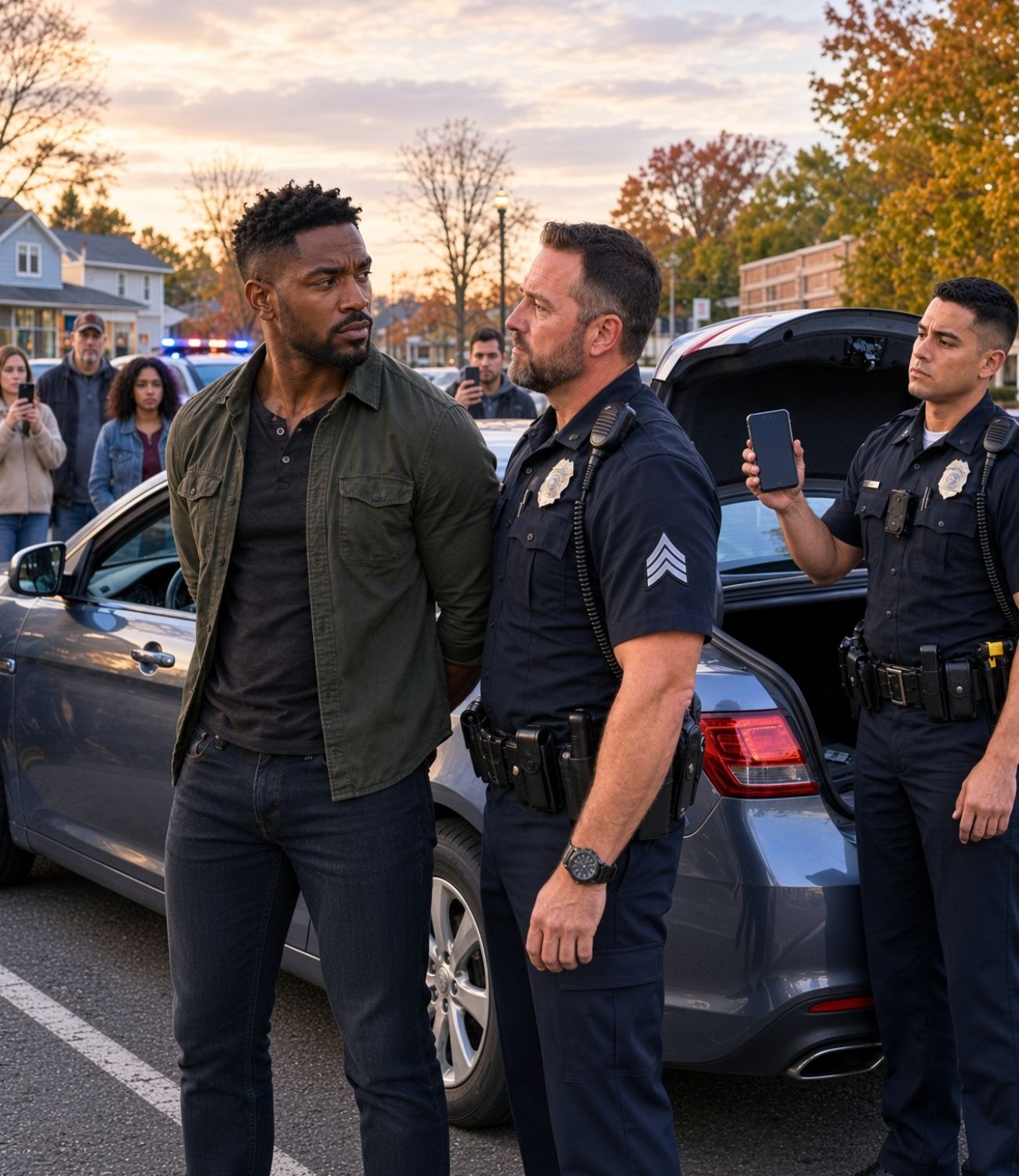
Hands on the vehicle. You thought you could talk to me like that in front of everyone and nothing would happen? I didn’t do anything. Wrong. Found it. Serial number matches. $9,800 in stolen property. That’s a long time in a cell. Nobody’s coming for you. Travis Mercer had built a career on knowing when a man was broken.
He could read the moment someone gave up the slump, the silence, the slow collapse behind the eyes. Standing on that curb, watching Daniel Reeds get loaded into the back of the patrol car, Travis saw every sign he expected to see. What he missed was the difference between a man who had nothing left to fight with and a man who had already decided the fight was over on his own terms.
The question was what Daniel had been quietly doing in Lakeshore for 14 months, and who exactly had been watching whom. Before we go any further, if you’ve ever watched someone take a hit they didn’t deserve and wondered whether justice would ever catch up, this story is for you. Subscribe to the channel before we keep going.
You are not going to want to miss how this one ends. Daniel Reeves woke every morning at 5:15 without an alarm. It was a habit he had carried for years through the academy, through 14-hour surveillance shifts, through nights spent in unmarked cars parked outside buildings where dangerous men held quiet meetings. His body had learned long ago that sleep was a resource, not a comfort, and it rationed accordingly. By 5:45, coffee was made.
By 6, he was at the kitchen table with his laptop open and his daughter still asleep down the hall. The window above the sink framed a pale strip of Tennessee sky, and the neighborhood of Lakeshore was still quiet, the kind of quiet that belonged only to working people in the hour before the day demanded something of them.
He used that hour carefully. To anyone passing by, Daniel Reeves was a straightforward figure, a black man in his early 40s, single father owner of a small phone repair shop called Reeves Tech on the corner of Alderman and Fifth. He was the kind of man people trusted instinctively, unhurried, capable, the sort who would hold a door open and mean it.
Neighbors brought him cracked screens and dead batteries, and sometimes more than that. Mrs. Patterson from across the street had once brought him a box of her late husband’s old tools because she thought someone should use them. He kept them in the back of the shop and actually did. Nobody in Lakeshore knew what Daniel had spent 15 years doing before he arrived.
Nobody knew about the federal credentials folded inside a hidden compartment of his laptop bag. Nobody knew about the encrypted drive backed up every 48 hours and transmitted to a secured server in Washington. And nobody, not one person in this town knew that for the past 14 months, Daniel Reeves had been operating as a senior field agent for the Office of Federal Law Enforcement Integrity, a division of the Department of Justice that specialized in investigating police misconduct from the inside out.
The assignment had come through quietly. Lakeshore PD had developed a pattern that the federal office had been tracking for years. A pattern of evidence manipulation, coerced confessions, and selective prosecution that disproportionately targeted black residents in the city’s lowerincome districts. The complaints had piled up.
The internal investigations had gone nowhere. Three previous attempts to place an undercover agent in the city had failed before the subjects could get close enough to anything that mattered. Daniel had volunteered. He had his reasons. Some of them were professional. Some of them were the kind that a man keeps to himself and examines only in the early morning when the coffee is hot and the house is still and no one is watching.
His daughter Maya was 10 years old and knew nothing about any of it. She knew her father fixed phones. She knew he made good pancakes on Saturday mornings and that he always showed up to her school events even when she told him he didn’t have to. She knew that he had a way of being calm in situations where other adults got loud and that this quality, whatever it was, made her feel safe in a way she couldn’t fully articulate, but also didn’t need to.
What she didn’t know was that her mother, Clare, had died in a car accident when Maya was four, not because Daniel had kept it from her, but because Maya knew it simply as a fact of her life rather than a wound. Clare’s absence was a shape in the house, not a ghost. Daniel had made sure of that. It was, in his estimation, the most important work he had ever done.
He was in the middle of that ordinary life, holding it together with both hands, when the first crack appeared. It was a Monday afternoon in late October when Daniel stopped at Oakidge Market on his way home from the shop. He needed eggs and two cans of soup. Maya had a history project due Friday and had specifically requested tomato soup and grilled cheese for dinner.
her thinking food, she called it, and Daniel had promised. He was standing in the second aisle, reading the label on a can of chicken broth he had picked up by mistake when he heard it. The voice came from the front of the store near the registers. It was the kind of voice that didn’t ask, it announced, flat, certain, and pitched to carry.
I said, “Empty your pockets. You going to make me ask twice?” Daniel set the can back on the shelf. Two officers had a young man backed against the front counter. The young man, mid-20s black, wearing a green store apron, had both hands raised to about shoulder height, not fully up the posture of someone trying to appear cooperative without fully surrendering to something he knew was wrong.
The taller officer was Travis Mercer. Daniel knew the name from his files. 14-year veteran. Three internal complaints, none sustained. the kind of record that told you more about the department than the officer. The shorter one was Ethan Row, two years on the force, recently transferred to Mercer’s unit, still learning which corners could be cut.
They were accusing the young man, his name tag read Caleb, of skimming from the register during his shift. No receipt discrepancy had been shown. No supervisor had been called. No process of any kind was being followed. What was being followed was a script accusation. First evidence optional. I didn’t take anything, Caleb said.
His voice was steady but thin. He was holding it together. That’s what they all say, Mercer replied. Right up until we checked the tape. He stepped in closer. You know what I think? I think you’ve been doing this for weeks and you thought nobody would notice. I think you’re exactly what you look like. There were four other people in the store.
Three of them found something to look at in the opposite direction. The fourth, an older woman near the bread rack, took a small step backward. Daniel walked to the front of the store. He didn’t rush. He carried the can of soup he’d been holding because setting it down would have felt like a performance, and he wasn’t here to perform. He stopped at a distance close enough to be clearly part of the situation, but far enough that no one could read it as physical aggression.
“This young man is at work,” Daniel said. “Has a manager been contacted?” Mercer turned slowly, the way men do when they’ve decided the interruption isn’t worth their full attention. “He looked Daniel over.” “This doesn’t concern you. He hasn’t been given a reason and evidence number or a supervisor present.” Daniel said that standard procedure even for an informal inquiry.
The specificity of that sentence landed strangely in the room. Mercer’s expression shifted. Not much, just a degree. Who are you? Someone who just watched a man get told to empty his pockets without cause. Daniel held the officer’s gaze. A badge doesn’t change the requirement. The store was silent. Caleb Turner was looking at Daniel the way people look at something they’re afraid to trust.
Mercer stared at Daniel for a long moment. Then he smiled, the small, cold kind, and stepped back. He said something to Ethan that Daniel couldn’t hear, and the two of them left without another word to Caleb. The front door swung shut behind them. Caleb exhaled. His hands came down slowly. “You didn’t have to do that,” he said.
“I know,” Daniel said. He put the soup can in his basket. You have a manager you can report this to? Caleb nodded, still looking at Daniel like he was trying to figure something out. Daniel nodded back and went to find the eggs. He didn’t see Mercer’s face as the officer walked to his patrol car. He didn’t need to.
He had spent 15 years learning to read the architecture of wounded pride in men who had never been told no by someone they’d already decided didn’t matter. He knew exactly what that expression looked like from the outside. He had cataloged it in reports, in testimony, in the quiet aftermath of situations just like this one.
What Daniel could not afford to do was act on that knowledge. His assignment required distance. It required patience. It required that no one, not Travis Mercer, not Robert Concincaid, not anyone in the Lakeshore PD, develop any reason to look at him closely before the evidence was complete. He had 6 weeks left, maybe eight.
The financial records were almost fully traced. The chain between Qincaid and the two businesses he was protecting was three links away from being airtight. 6 weeks. He just needed 6 weeks. He paid for the eggs and the soup at the register. Caleb bagged them and said thank you again quietly while the woman behind the counter pretended to count change.
Daniel told him to take care of himself. He drove home. Maya was at the kitchen table working on her project, a poster about the civil rights movement, photographs and dates arranged in careful rows. She looked up when he came in and said, “Did you get the tomato soup?” And he said he did, and she went back to her poster. He stood in the kitchen for a moment and watched her.
Then he started making dinner. 4 days later, Daniel was pulling out of the alley behind Reeves Tech at just after 6:00 in the evening when the patrol car appeared in his rear view mirror. Its lights came on immediately. He pulled over to the curb on Alderman Street, three blocks from his shop and waited. His hands rested on the steering wheel at 10 and two.
In the back seat, Maya was wearing her headphones and looking out the window. He had picked her up from her after school program 40 minutes ago. Today was Friday, the day her history project was due, the day she had been working toward all week. She hadn’t noticed the lights yet. In the side mirror, he watched Travis Mercer get out of the car.
Daniel felt the particular stillness that comes not from the absence of feeling, but from a decision made before the moment arrives. He had made this decision 4 days ago, standing in Oakidge Market. He had confirmed it last night, reviewing the case files and recalculating the timeline. If they came for him, he would not break cover.
Not for this. He pressed the crown of his watch twice. The recording unit, concealed inside it, no larger than a watch battery, clicked silently to life. Whatever happened next, was going on the record. Mercer reached the driver’s side window. Behind him, Ro was already moving toward the back of the vehicle. Step out of the car, sir,” Mercer said.
“We have a report that this vehicle is connected to a theft.” Daniel looked at him without expression. “Sir,” Mercer said again, not a question. In the back seat, Mia pulled one headphone off her ear. “Dad, it’s fine, Maya.” His voice was level. “Stay in your seat, sweetheart. Put your music back on.” She looked at him for a second, that careful look she had reading his face the way she always had, and then she put the headphone back.
Daniel opened the door and stepped out. He kept his hands visible and his movement slow and deliberate. He said nothing that wasn’t asked of him. He gave nothing that wasn’t required. He did not reach for the badge that would end this in 30 seconds because ending it would mean ending everything else. Mercer met his eyes across the roof of the car, and for just a moment, something passed between them.
Not communication exactly, but recognition. Mercer knew Daniel had identified what was happening, and Mercer wanted him to know that it didn’t matter. From inside the trunk, Ethan Row called out, “Got something?” The device Ro held up was small and flat, a portable data transfer unit, the kind used in high-end audio and video production.
Its casing was matte black and unmarked except for a serial number along the bottom edge. Ro read it aloud. Then he read it again slower for the benefit of the small crowd that had already begun to gather on the sidewalk. Reported stolen 3 days ago, he said. $9,800. Travis Mercer walked around the car deliberately giving the gathering onlookers time to process what they were seeing. He understood crowds.
He understood that most people would believe what they saw first and that what they were seeing first was a black man standing next to a car that contained stolen property. “We’re going to need you to put your hands behind your back,” Mercer said. Daniel did not argue. He did not explain. He turned slowly and placed his hands behind his back.
And when the cuffs clicked into place, he kept his eyes forward. From the backseat of the car, Maya had seen everything. She had watched the officer walk to the trunk. She had seen him reach inside and come back with something. She had seen her father turn around and put his hands behind his back. And the particular stillness of that image her father, a man she had never seen flinch at anything, standing rigid while metal closed around his wrists, broke something loose in her chest. She pushed the door open and ran.
That’s my dad. Her voice was high and jagged. Stop. That’s my dad. He didn’t do anything. A woman on the sidewalk, Sandra Okafor, a neighbor from three houses down, who had been walking home from the bus stop when the lights first came on, moved toward her quickly, catching Maya by the shoulders before she got any closer to the officers.
Maya struggled for a moment, then stopped, not because she had calmed down, but because she had looked at her father’s face, and his face was telling her something. Don’t. His expression was controlled and deliberate. the same expression he used when he needed her to trust him without explanation. Maya had seen it before, never in a situation like this, but she recognized it the way you recognize a word in a language you’re still learning.
She stopped fighting. Sandra kept her arms around Mia’s shoulders, and Mia stood there on the sidewalk and watched. Daniel was placed in the back of the patrol car, the door shut. Mercer rounded the hood without a backward glance. Someone nearby had a phone out. Then two people, then four. The footage, the car, the uniformed officers, the crying girl reaching for her father would be on three local Facebook pages within an hour.
By morning, it would have been shared 47 times, picked up by two local news aggregators, and commented on by people who had never met Daniel Reeves, and were certain they understood exactly what had happened. The car pulled away from the curb. In the back seat, Daniel sat with his hands cuffed behind him and his breathing even. And he counted.
He counted what he had. He counted what they didn’t know. He counted the weeks of work that lived on an encrypted drive in a compartment behind the false back panel of his shop’s storage room. The recording unit in his watch was running. Every word spoken near him from this point forward was going onto that drive.
And the access credentials for that drive, along with the location data and footage access for every surveillance unit he had installed across Lakeshore had been included in his last encrypted upload to Washington 3 days before his arrest. The count was not reassuring, but it was not empty either. The interrogation room at Lakeshore PD was the same beige on beige as every interrogation room Daniel had ever sat in, which was many.
The table was bolted to the floor. The camera in the upper corner had a small red light that blinked every 4 seconds. The mirror on the far wall was the standard one-way glass. Though in a department this size, it was more likely that no one was behind it. He had been sitting for 22 minutes when Mercer and Row came in. Mercer sat across from him.
Ro took up position near the door. Mercer set a thin folder on the table and opened it without looking up. You want to tell me where you got the device? It was in my vehicle, Daniel said. I don’t know how. You don’t know how? Mercer repeated it without inflection, the way experienced interrogators do when they want a statement to sound foolish on playback.
It was in your trunk and you don’t know how it got there. That’s correct. Mercer looked up. You work on electronics, phones, computers. I repair phones. Right. So, you know what something like that is worth? I do. And you’re telling me you have no idea how a $9,800 piece of equipment ended up in the back of your car? That’s what I’m telling you.
Mercer sat back and studied him for a moment. Then he smiled. the same small cold expression from Oakidge Market. You know what I think about guys like you? Daniel waited. I think you’re smart enough to be careful and dumb enough to think careful is the same as invisible. He leaned forward. We’ve had our eye on you for a while.
That little shop of yours cash business. Irregular hours. Customers who don’t always match the neighborhood. It was a lie and not a particularly sophisticated one. Daniel had been watching Mercer long enough to know the man had not been watching him until 4 days ago. But the lie told him something important. This was not improvised. This had been prepared.
The language was too consistent. The framing too clean. Someone had coached this narrative before Mercer walked into the room. Conincaid. Daniel filed that thought and kept his expression neutral. I’d like to speak with an attorney, he said. That’s your right, Mercer said. He closed the folder and stood.
We’ll get that process started. He moved toward the door, then stopped as if something had occurred to him. The girl, he said, “Maya, that’s her name.” Daniel said nothing. “She’s with a neighbor right now.” Mercer’s voice was even conversational. “We’ll need to contact child services if this goes the way I think it’s going to go.
Long process, lot of moving parts.” He tilted his head slightly. Could go faster if there’s cooperation on your end. Just something to think about. He left. Ro followed without looking at Daniel. The door closed. Daniel sat in the silence of the room and let the full weight of what had just been said settle around him.
It was not the first time someone had used a child as leverage in a room like this. It was, however, the first time it had been his child. He breathed through it. Then he focused on what mattered. The recording unit in his watch had been running since the moment he pressed the crown on Alderman Street. Everything Mercer had just said, the threat about Maya, the coached language, the reference to concaid was captured when the unit’s battery depleted after its set recording window.
It would automatically transmit a burst signal to the duty desk in Washington. That signal also carried a pre-arranged distress code. It told the office one thing. Field agent Reeves had gone dark and the 48-hour escalation protocol was now active. The office would move. RobertQincaid arrived at Lakeshore PD at 9:47 that evening.
He was a broad, deliberate man who moved through spaces as though they had been arranged for him specifically. He had run Lakeshore PD for 11 years. Before that, he had been a deputy chief in a larger department two states north, where he had left under circumstances that his current employment file did not mention.
He had a reputation in Lakeshore for efficiency, for quiet problem resolution, and for an absolute intolerance of what he called unnecessary complications. Daniel Reeves had become an unnecessary complication. Concincaid reviewed the situation in Mercer’s office for 12 minutes. He did not visit the interrogation room.
He did not speak to Daniel directly. He made two phone calls from a personal cell phone he kept in his jacket’s inner pocket. And when he was done, he spoke to the duty prosecutor who had been called in for the evening. The conversation lasted 6 minutes. By 11 that night, Daniel had been formally charged with three counts, theft of property valued above $5,000, possession of stolen property, and obstruction of a police investigation.
His request for an attorney had been logged and acknowledged, but the attorney assigned through the public defender’s office would not be available until the following morning. In the meantime, Daniel was transferred to a holding cell. He sat on the narrow bench and thought about Maya. He thought about the way she had looked on the sidewalk, not collapsed, not hysterical, but standing with her arms at her sides after she’d stopped struggling, watching him go with that careful expression she had inherited from no one he could name. It
was entirely her own. He thought about what she would do tonight in Sandra’s house, knowing that her history project had been due today, and that the tomato soup and grilled cheese he had promised had not happened. He thought about whether she had eaten. He thought about whether Sandra would think to tell Maya it would be okay and whether Maya would believe it if she heard it.
He let himself think about all of it for exactly as long as he needed to. Then he put it in a compartment and closed the door. He had a job to finish. The preliminary hearing was held two mornings later in courtroom 4 of the Lakeshore County Courthouse. The room was small and institutional woodpaneled walls that had darkened with decades of recirculated air fluorescent lighting that flattened everything it touched.
The gallery held 30 people and most of those seats were filled. Word had traveled. The footage had done its work. Daniel sat at the defense table in the clothes he had been wearing when he was arrested. His attorney, a public defender named Michael Hadley, had been able to speak with him for 23 minutes the previous morning.
Hadley was competent and overworked, and he had made clear, without saying it directly, that the case, as presented, was not favorable. The prosecution’s evidence package was thorough. Too thorough. The footage from Oakidge Market’s exterior camera had been obtained as part of the case file, but it covered only the parking lot, not the interior of the store, and it had been trimmed to begin at the moment Daniel’s car arrived, cutting the 47 minutes before it in which Travis Mercer and Ethan Row had been inside. There was a
written statement from the individual who had reported the device stolen. The statement was clean and detailed in a way that written statements rarely were when produced under duress. It had been prepared. Ethan Row testified briefly. He described the traffic stop as routine initiated after a tip from a confidential informant.
He described the discovery of the device as unambiguous. He used the word unambiguous twice, which was once more than the word typically needed to be used. The prosecutor, a mid-level county attorney named Donna Graves, who had worked withQincaid’s department for six years, described Daniel to the court as a man who had constructed a facade of normaly in order to conceal ongoing criminal activity.
She used the phrase premeditated concealment three times. Daniel listened to all of it. He noted each overreach, each piece of language that had been chosen rather than observed, each timeline that had been smoothed where real timelines were rough. He had spent 15 years reading the texture of fabricated evidence, and this had the same quality as everything else Travis Mercer had ever touched, confident on the surface, hollow underneath, built to withstand a casual look, but not a careful one.
The problem was that a careful look required the right person to be doing the looking. And in courtroom 4 of the Lakeshore County Courthouse, that person was not yet present. Caleb Turner was not present either. Daniel had noticed that immediately. He had half expected it. After Mercer left Oakidge Market that afternoon, Caleb would have been told in one way or another, explicitly or not, what cooperation looked like and what it cost.
Caleb was 24 years old and worked a retail job in a city where the people he’d need to oppose had 11 years of infrastructure behind them. Daniel did not blame him. After the preliminary arguments, Hadley leaned close. They’re moving for expedited trial. Quincaid’s office made a call to the DA. This is being fast-tracked. I know, Daniel said.
Hadley looked at him. It was the look of a man who had been a public defender long enough to develop specific categories for his clients and who could not quite find the one that fit Daniel Reeves. Is there anything you’re not telling me? Daniel looked at the prosecution table where Donna Graves was arranging papers with the organized efficiency of someone who had already decided how this ended.
“Yes,” he said. Hadley waited. But not yet, Daniel said. I need two more days. Hadley stared at him. For what? Daniel turned back toward the front of the courtroom where the judge was returning to the bench. To make sure what I have is enough, he said. That evening, Sandra Okafor brought Mia back to her house after a quiet afternoon.
Mia had asked twice to go home and get her history project. Sandra said it could wait. Maya said the project had been due today and wasn’t finished, and that her father had promised her tomato soup and grilled cheese, which she still hadn’t had. Sandra made her tomato soup from a can she found in her own pantry.
She wasn’t sure it was the right brand. She sat at the table while Maya ate, and after a while, Maya looked up and said, “My dad isn’t a thief.” It wasn’t said defensively. It wasn’t said with the urgency of someone trying to convince. It was stated the way Maya stated most things with the calm of someone who had looked at the available information and reached a conclusion.
I know, Sandra said, though she didn’t quite. Maya finished her soup and went back to her project. She worked until 10:00 placing photographs in careful rows on a poster board while her father sat in a holding cell 3 mi away with the case he had spent 14 months building still intact, waiting on a server in Washington for the right moment to arrive.
By the time Maya turned off the light and pulled the blanket up, her poster was finished. She had centered it around a quote she had found in her research printed neatly in block letters at the top of the board. Injustice anywhere is a threat to justice everywhere. She wasn’t sure at 10 years old what all of it meant, but she thought she was beginning to understand.
The morning of the formal trial, courtroom 4 filled faster than it had for the preliminary hearing. Word had continued to move through Lakeshore the way it always did in a city this size, through barber shops and church parking lots and the comment sections of local news pages and the back booths of diners where people who had known each other for 30 years still met for coffee on weekdays.
Most of what circulated was incomplete. Some of it was wrong. But the image at the center of all of it, a man in handcuffs, a girl on the sidewalk, had lodged itself in the city’s memory with the particular permanence of things that confirm what people already suspected. People came to the courthouse because they wanted to see what happened next.
Travis Mercer was already seated in the witness preparation area when the gallery began filling. He was dressed in his service uniform, pressed and polished, and he held himself with the posture of a man who had done this before, and understood that confidence was its own form of testimony. He had given his statement three times across two days, and each version had been more refined than the last.
He knew the weak points. He had practiced talking past them. Ethan Row sat nearby, less composed. His right knee moved in a small repetitive bounce that he didn’t seem aware of. Robert Quincaid did not attend. He had sent word through the department’s public affairs liaison that the chief’s presence at individual criminal proceedings was reserved for cases of significant departmental concern.
He was, his office said, available by phone if needed. Donna Graves reviewed her materials at the prosecution table with the focused calm of a woman who expected to be done by noon. Michael Hadley sat next to Daniel and said nothing. He had tried twice more in the past 48 hours to extract information from his client. Daniel had told him each time that what was coming would be self-explanatory and that the most useful thing Hadley could do was ensure that when an evidence package was introduced from an unexpected source, the proper procedural ground had been
prepared to receive it. Hadley had spent those 48 hours doing exactly that without fully understanding why. Daniel sat with his hands folded on the table in front of him. He had been permitted a change of clothes, pressed dark slacks, a gray button-down. He looked as he always had in Lakeshore, like a man who was comfortable taking up a reasonable amount of space and no more.
The judge entered. The room stood and settled. Donna Graves began. Her opening was tight and well constructed. She described a pattern of behavior, a man embedded in a community for the purpose of concealing activity, a discovery made during a lawful traffic stop, and a mountain of corroborating evidence that would demonstrate beyond reasonable doubt that Daniel Reeves was precisely what the charges described.
She spoke for 14 minutes, then Michael Hadley stood up. He was not a tall man and he was not a dramatic one and nothing about his bearing suggested that the next 60 seconds would alter the trajectory of every person in the room. He adjusted his glasses, looked down at the single sheet of paper he had carried to the podium and spoke.
“Your honor, before we proceed, the defense requests a brief recess to allow the introduction of a witness and an evidence package from an external federal authority.” Graves looked up from her table. The judge looked at Hadley over the rim of his glasses. What authority. The courtroom door opened.
The man who entered was tall and gay-haired, wearing a dark suit that was not the kind purchased at a department store. He carried a leather briefcase and a federal court credential that he held open toward the baoiff as he walked down the center aisle without breaking stride. His name was Gregory Nash. He was senior legal counsel to the Office of Federal Law Enforcement Integrity, United States Department of Justice.
He had flown from Washington the previous evening, dispatched the moment the duty desk received the burst signal from Daniel’s recording unit and used the encrypted credentials in Daniel’s last Washington upload to confirm that an active field agent was in custody with a live operation at risk. He reached the front of the courtroom, acknowledged the judge with a precise nod, and set his briefcase on the defense table beside Daniel Reeves. “Your honor,” Nash said.
“I apologize for the timing of this appearance. The federal interest in this proceeding was deliberately withheld until this moment for evidentiary and operational reasons that will become clear immediately.” He reached into the briefcase. I am entering into evidence a classified federal operations file under case designation OLEI2249tn along with supplementary recordings and documentation obtained in the course of that operation.
He set a sealed evidence packet on the judge’s bench. Then he turned to face the courtroom. The individual currently on trial as a theft suspect, Nash said, is senior field agent Daniel Reeves, United States Department of Justice, Office of Federal Law Enforcement Integrity. He has been operating undercover in Lakeshore, Tennessee for the past 14 months under authorized federal investigation of the Lakeshore Police Department.
The room went very still. It was not the silence of a crowd waiting. It was the silence of a room full of people whose understanding of what they were witnessing had just been completely restructured and who had not yet caught up to the new shape of it. At the witness preparation table, Travis Mercer had stopped moving.
He was looking at the man he had arrested on Alderman Street, the man he had cuffed in front of a crowd, the man he had left in a holding cell while he went home and slept without difficulty. and something was happening behind his eyes that had not happened to Travis Mercer in a long time. He was realizing he had made a mistake.
Not the kind of mistake that could be explained. Not the kind that could be framed differently in a follow-up statement or absorbed into departmental paperwork. The kind that arrives fully formed without mercy and announces itself by the sound of a federal attorney’s voice in a county courtroom. Ethan Rose’s knee had stopped bouncing. Donna Graves was very still.
The judge examined the sealed packet for a long moment, then looked at Nash over his glasses. “Counselor, you understand the severity of what you are introducing here.” “I do, your honor,” Nash said. “The federal government is prepared to defend this evidence package in its entirety.” The judge nodded slowly.
He looked at the prosecution table. “M Graves?” Graves said nothing. There was nothing to say yet. The judge called a 45-minute recess. What Nash presented when the court reconvened did not require elaboration. It was the kind of evidence that spoke in its own voice, organized, sourced, and cross-referenced with the particular thoroughess that characterized 14 months of patient careful work.
The first item was an audio recording. 41 minutes of unbroken audio from the interior of Lakeshore PD’s interrogation room B captured from the moment Daniel pressed the crown of his watch twice in the back of the patrol car on Alderman Street. In those 41 minutes, Travis Mercer’s voice appeared 11 times. In four of those appearances, he referenced the device planted in Daniel’s trunk by name, not as discovered property, but as a resource.
In two of those appearances, he mentioned Q directly. In one, he described the process of obtaining a compliant witness statement as something he had done before and would do again. The second item was video footage, not from the Oakidge Market exterior camera that had been submitted by the prosecution. This footage came from a fixed surveillance unit that Daniel had installed 6 months earlier at a residential property two blocks from the PD’s evidence lockup.
its remote access credentials included in the encrypted upload Daniel had transmitted to Washington 3 days before his arrest. The footage showed with timestamp and unbroken continuity that Ethan Row removing a flat black device from a sealed property bag, placing it in a cloth bag and carrying it to his personal vehicle on the evening before Daniel’s arrest.
The third item was a case file. 23 documented incidents spanning four years, names, dates, charge records, and where available, the corroborating accounts of individuals who had been approached by the federal office after Daniel’s initial groundwork identified them as potential witnesses. men and women who had been told by their public defenders that the evidence against them was too strong, who had accepted plea deals for crimes they did not commit, who had never spoken publicly because no one had given them reason to believe it would matter. The
fourth item was a financial record. Three accounts, two offshore, one domestic under a holding company name connected through a chain of four transactions to RobertQincaid. The accounts had received regular deposits over a 30-month period from two Lakeshore businesses, separately under federal investigation for money laundering.
The Federal Financial Crimes Unit had been building this strand in parallel with Daniel’s operational file, waiting for the right moment to connect them. The moment had arrived earlier than planned. Nash presented each item methodically without theatrical emphasis. He did not need to editorialize. The evidence was its own argument.
When he was finished, the courtroom was so quiet that the ventilation system above the ceiling was audible. The judge looked at the prosecution table. Donna Graves was looking at the evidence manifest in front of her with the expression of a person who had picked up a document, expecting it to be one thing and was now reading something else entirely.
Ms. Graves, the judge said, “Does the prosecution wish to respond to the evidentiary introduction at this time?” Graves looked up. She looked at the judge and then briefly involuntarily at Daniel Reeves. “No, your honor,” she said. “The prosecution requests a continuence pending review.” The arrest of Travis Mercer happened in the courtroom.
Two federal marshals had been positioned in the gallery since Nash’s arrival, and when the judge issued the relevant order, they moved with the quiet efficiency of people who had done this in rooms like this before. Mercer stood when they approached him. Whether this was composure or reflex, no one could say afterward.
He stood and they came to him, and the handcuffs that went on his wrists were federal issue. He did not look at Daniel as he was walked out. Ethan Row was detained in the hallway outside the courtroom by a third marshall who had been waiting there. His attorney, who had not been present for the session, was contacted immediately.
Robert Conincaid was reached by phone at 11:43 that morning while he was in a meeting at the Lakeshore Chamber of Commerce. He was informed that a federal arrest warrant had been issued in his name and that he was advised to present himself voluntarily to federal authorities within the hour. He arrived at the Federal Field Office 40 minutes later with his personal attorney and said nothing beyond his name.
His resignation from the Lakeshore Police Department was received by the city manager’s office the following morning. It was accepted without comment. Caleb Turner had been in the courthouse that day. He had not been in the courtroom. He had been sitting in the lobby on the ground floor on one of the long wooden benches near the information desk wearing his work uniform because his shift started at 2:00 and he had told himself he would only stay for an hour.
He had stayed for 3. When the news began moving through the building through the clerks at the front desk and the people coming and going from the other courtrooms and the security officer near the entrance who had his phone out. By noon, Caleb heard it the same way everyone else in that lobby did. in pieces, incomplete at first, then clarifying, then suddenly sharply whole.
The officers who had come to Oakidge Market and put their hands on him and told him he was a thief and a liar, they had been arrested. The man who had stepped out of the grocery aisle and told them a badge didn’t change the requirement. He was a federal agent who had spent more than a year building the case that put them in those cuffs.
Caleb sat on the bench and thought about that for a long time. Later that afternoon, he contacted the federal office through the number Nash had released to the public as the case’s point of contact. He identified himself. He said he had been at Oakidge Market on a Monday afternoon in late October and that he had witnessed something he wanted to formally describe.
The office scheduled his statement for the following week. When he gave it, he said many things. He described what the two officers had said to him, what they had implied, and what they had threatened. He described the store’s other customers looking away. He described the moment when a man he didn’t know had stepped out of the second aisle carrying a can of soup and said something that stopped everything.
At the end of his statement, when the federal interviewer asked if there was anything he wanted to add, Caleb was quiet for a moment. Then he said when everybody else went quiet, he didn’t. I just want that to be on record. It was Daniel walked out of the Lakeshore County Courthouse at 217 in the afternoon.
The sky above Lakeshore was the particular pale blue of late autumn in Tennessee, clear and cool and indifferent to everything that had happened beneath it. The maple trees along the courthouse steps had gone deep orange and were beginning to drop, and the sidewalk was covered in a loose, dry layer that shifted when the wind came through.
Maya was standing at the bottom of the steps. Sandra Okafor had brought her the same woman who had held Mia back on Alderman Street the week before, and she was standing just behind Maya now, with her hand on the girl’s shoulder, in the way of someone who understood that her role was to take up very little space.
Maya had her backpack on and her coat unzipped and her hair in the two braids she always did herself, because she had decided at age 8 that she was capable of it. When she saw her father come through the door, she ran. She hit him at full speed and wrapped her arms around his ribs and did not say anything. Daniel crouched down to her level and held on one hand across her back, the other behind her head, and he stayed there for a long moment with his eyes closed.
The wind moved through the maple trees. When Maya pulled back, she looked at his face with the careful assessing look she had reading him the way she always did. “Are you okay?” she asked. “Yes,” he said. I’m okay. She studied him for another second, decided it was true, and then said, “My history project was due Friday. Mrs.
Callaway gave me an extension.” “That was good of her.” She said it was under the circumstances. Maya tilted her head slightly. She also said she’d seen the news. Daniel looked at her. “What did you think about that?” Maya considered the question seriously, the way she considered most things. I think a lot of people are going to have opinions about something they weren’t actually there for, she said.
Daniel almost smiled. That’s probably right. Maya looked at the courthouse behind him, then back. Sandra told me you work for the government. I do. Like the FBI, a different part, but similar. She absorbed this. Were you investigating those police officers the whole time we lived here? Yes. Another pause. Did you know something bad was going to happen to you? I knew it was a possibility, he said.
It’s part of the job. Maya looked at him for a long, quiet moment. Then she said with complete gravity. You should have told me. Daniel nodded slowly. You’re probably right. I would have worried less, she said, if I had understood what was happening instead of just seeing it. He looked at his daughter, this 10-year-old person who had somewhere in the past week crossed a threshold he hadn’t seen coming.
And he felt something shift in him. Not collapse, something more like a door being walked through by someone who lived in the house and had simply never been shown that room before. When we get home, he said, “I’ll explain as much as I can.” Maya nodded. It was the nod of someone who had already decided this was the minimum acceptable outcome and was prepared to negotiate further.
She zipped up her coat, took his hand, and looked down the steps toward the sidewalk. “Can we have the tomato soup tonight?” she said. “I never got it.” “Yes,” he said. “We can have the soup. In the months that followed, Lakeshore moved through its reckoning the way cities do unevenly with resistance in some quarters and exhaustion in others, and with the slow emergence of a new shape from the wreckage of the old one.
The Lakeshore Police Department was placed under a federal consent decree that mandated an independent oversight board, a revised evidence handling protocol, and a complete audit of every arrest made by officers in Mercer’s unit over the previous four years. The audit took 11 months. Its findings were not comfortable reading.
23 cases were formally reopened. Of those, 16 produced new outcomes. Seven individuals who had served time on coerced or fabricated evidence were released and had their records expuned. Nine received civil settlements from the city. The settlement process was long and imperfect and did not give anyone back the years they had lost, but it was something.
In this context, something was not nothing. Travis Mercer was convicted on eight federal counts, including evidence- tampering civil rights violations and conspiracy. He received a sentence of 14 years. Ethan Row entered a plea agreement and received a reduced sentence of 4 years in exchange for full cooperation with the federal investigation.
He cooperated fully. RobertQincaid’s trial lasted 3 weeks. The financial evidence was airtight. He was convicted on six counts and sentenced to 9 years. Donna Graves was not charged. She had been a vector, the investigation determined, rather than a knowing participant in the larger scheme. She resigned from the county prosecutor’s office and relocated out of state.
Caleb Turner was offered a position with a new community legal advocacy program established in Lakeshore following the case funded in part by the federal consent decrees community investment requirement. He took the job. He had, it turned out, a particular talent for talking to people who had been told the system had nothing for them and helping them understand that the system had changed.
He thought about Daniel Reeves often. Daniel reopened Reeves Tech 6 days after the trial. There was a small article about it in the local paper one column buried on page 9, noting that the shop had resumed normal hours. He hadn’t asked anyone to write it. Someone had done it anyway. The first week back, he had more customers than usual.
Some of them had broken screens. Some of them came in and stood at the counter and said they were glad he was still there. And he thanked them and meant it. And when they left, he went back to work. One evening in late January, Maya was at the kitchen table doing homework while Daniel made dinner.
The kitchen window was fogged from the cold outside, and the overhead light gave the room the warmth of enclosed spaces in winter. Maya had her pencil case spread out and her notebook opened to a page covered in her precise, slightly overlarge handwriting. Daniel was at the stove when Maya said without looking up. Dad. Yeah.
At school today, someone asked me if I was scared when I saw the police arrest you. Daniel turned from the stove. What did you say? Maya considered her notebook for a moment. I said I was, but then I said that you weren’t. She looked up. You weren’t, were you? He thought about it honestly. I was worried about you, he said.
About what you were seeing. But not about yourself. Not the way they expected me to be. Maya absorbed this. Why not? He turned the burner down and leaned against the counter. Because being afraid of them would have meant they had more power than they actually had, and I knew what they had. She thought about this for a long moment, tapping her pencil against the edge of her notebook.
“Is that something you learn?” she said, “Or is it something you just know?” “Both,” he said. “You learn it until you know it.” She nodded slowly. Then she went back to her homework. Daniel went back to the soup. After a minute without looking up, Maya said, “The day you stepped up in that store, when you didn’t know any of that was going to happen, you did it anyway.
” “Yes, that was the real one,” she said. He looked at her. She had her head down, pencil moving. She wasn’t looking for a response. She had simply stated something she had concluded the way she did when she was certain. Daniel turned back to the stove. He stirred the soup slowly and listened to the sound of his daughter working at the kitchen table.
And outside the window the January sky was fully dark and lakeshore was quiet in the way of a place still learning what it wanted to be. He thought about a Monday afternoon in late October, a store, a young man with his hands raised, the decision that had taken approximately 3 seconds and had not in the moment felt like a decision at all.
He thought about what Maya had said. That was the real one. He decided she was right. Daniel never asked anyone to notice what he did. He just did it on a Monday afternoon in a grocery store when he was nobody’s hero and nobody was watching. And that one quiet choice set off a chain that changed an entire city.
That’s the thing about courage. It doesn’t always look like a cape and a spotlight. Sometimes it looks like a man carrying a can of soup deciding that silence isn’t something he’s willing to offer. If this story stayed with you, share it with someone who needs to hear it today.
And if you haven’t subscribed yet, join this community because there are more stories like Daniels out there. Stories about ordinary people who chose to do the right thing. Not because someone was watching, but because that’s who they decided to be. Those stories deserve to be told and we’re going to keep telling

