On Your Knees! — Racist Cop Beats Black Woman Not Knowing She Is An FBI Agent
On Your Knees! — Racist Cop Beats Black Woman Not Knowing She Is An FBI Agent
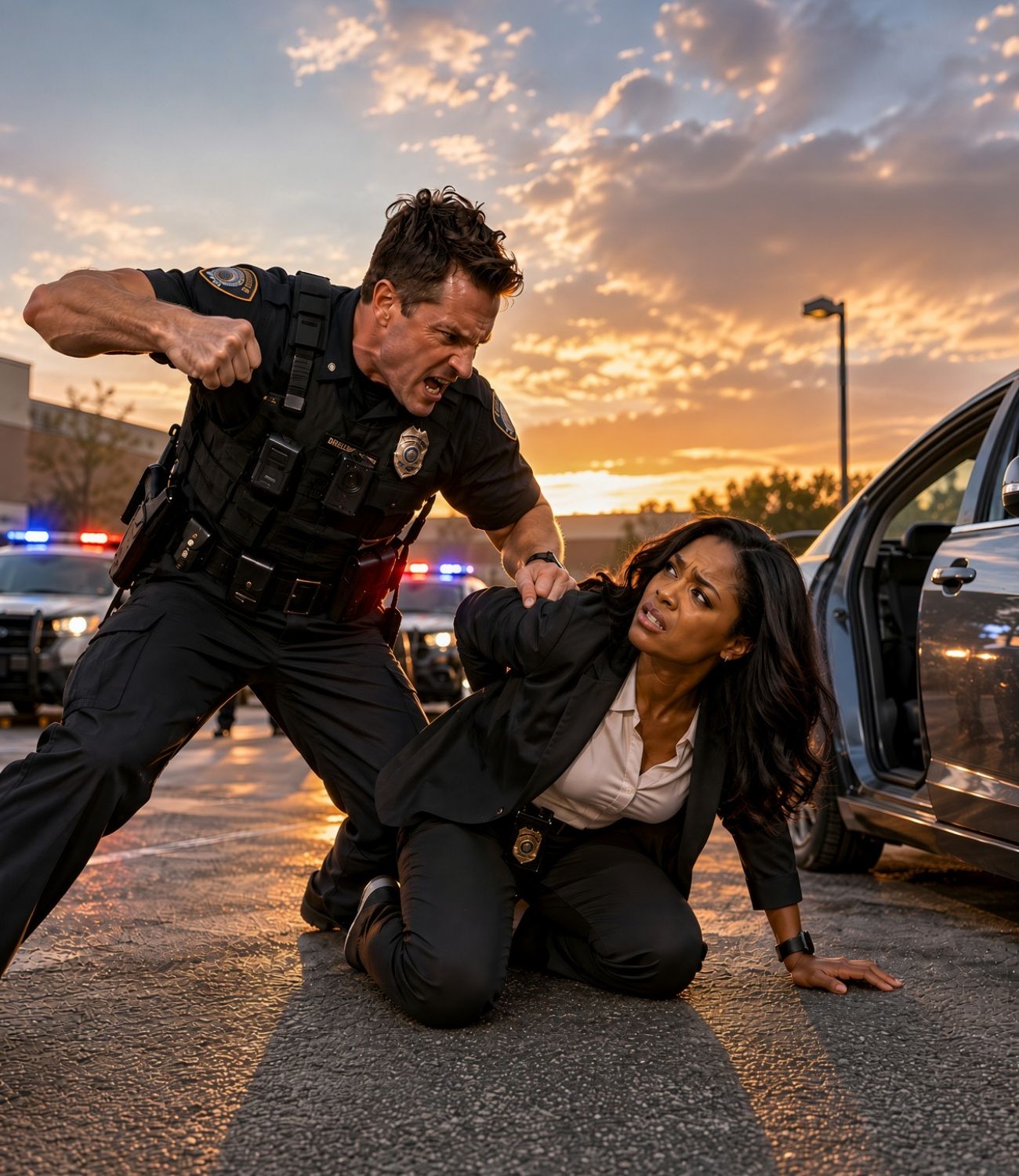
“On your knees.” The gun was pointed straight at her face in an empty parking lot on the edge of town, the last of the daylight fading behind a row of dark storefronts. Mara Ellison, a 34year-old black woman, lowered herself to her knees without a word, her palms open, her breathing controlled even as gravel bit into her skin.
The white officer standing over her had no idea who she really was. He had no idea that the plain black watch on her wrist was recording every second that passed between them, feeding it somewhere far beyond that parking lot. He had no idea that a federal badge sat folded inside her jacket pocket, untouched, waiting. And he certainly had no idea that behind the chainlink fence at the edge of the lot, a federal surveillance team was already watching everything unfold through a long lens.
“You think you have rights here?” the officer barked, his voice cracking with something closer to panic than authority. Mara lifted her chin and looked him dead in the eye, unbothered, unbroken. “You just made the biggest mistake of your life,” she said quietly. “And somewhere behind that fence, a recorder kept running.
” “It was a Tuesday evening in late September, the kind of ordinary evening that never announces the moment it’s about to become historic. Mara Ellison had spent the day the way she spent most days, moving quietly through a life built entirely on appearing unremarkable. She had stopped at a strip mall on the outskirts of the city to pick up dinner after a long shift that no one at that plaza could have guessed was federal work.
She drove an unremarkable gray sedan, the kind that blended into every parking lot in America, the kind no one ever remembers seeing. She wore plain office clothes that night. No badge, no bureau jacket, nothing that marked her as anything other than a tired woman heading home after a long day. The only thing unusual about her was that watch, sleek and understated, the sort of accessory nobody looks at twice.
As she pulled out of the lot, red and blue lights flared to life behind her, and she did exactly what she had trained a hundred other people to do in that exact situation. She signaled. She slowed. She pulled to the curb and placed both hands on the wheel where they could be seen. Officer Derek Voss approached her car the way he approached most things in his life, with the swagger of a man who had never once faced consequences for his temper.
He was 42 years old, built like someone who spent more time at the gym than on patrol, and he carried himself as though the street itself answered to him personally. He ordered Mara out of the vehicle before he had even asked to see her license, a detail that would matter a great deal later. Mara asked calmly, evenly, “What’s the reason for the stop?” Derek’s jaw tightened at the question, as though simply being asked to explain himself, “Was itself an act of defiance?” He demanded her identification instead of answering, his hand resting a little too deliberately
near his hip. She handed over her license without argument, watching his eyes move from the card to her face and back again, searching for something to justify what he had already decided to do. There was no violation on record, no broken tail light, no erratic driving, nothing that could reasonably explain what was happening.
But Derek kepts issuing commands anyway, each one sharper and more unreasonable than the last, as if testing exactly how far he could push before she pushed back. Mara stayed still because she had learned a long time ago that calm was not the same thing as weakness, and that patience could be its own kind of armor against a man looking for an excuse.
But her composure only seemed to agitate him further, as though her refusal to flinch was itself the provocation he’d been waiting for. A few yards away, his partner, Officer Trent Maddox, watched the exchange grow tighter with every passing second, his hand hovering near his radio, but never lifting it. Trent could see exactly where this was heading, the way a man watches weather roll in from a long distance.
He said nothing and did nothing and let it happen. Dererick reached through the open window and snatched the phone out of Mara’s hand before she could pull it back. The screen still lit from where she’d been checking a message moments earlier. She asked him evenly to give it back. Her voice never once rising above a level tone.
Instead, he barked the four words that would define the rest of that night and everything that came after it. On your knees. Mara didn’t move immediately, and that half second of hesitation was all the excuse Derek needed. He shoved her hard against the side of the car, then down onto the pavement, and the sound of her knee hitting concrete carried across the empty lot.
As she fell, a small light on the underside of her watch shifted from a soft standby glow into an active pulse. One word appearing faintly across its surface. Recording. Dererick struck her once across the side of the face, and she did not fight back, did not scream, did not give him anything to write into a report later. She simply turned her face toward the small body camera clipped to his chest and let it capture every angle of what was happening to her, every second, every word.
He leaned down over her, breathing hard, his voice shaking with an adrenaline that had nothing to do with real danger. “You think you’re something special?” he demanded, spit flying from his mouth in the cold night air. Mara looked up at him from the ground, blood at the corner of her lip, and something in her expression made even Trent take a step back without realizing why.
“Do you really want to know?” she asked, and the scene cut away on that unanswered question, leaving the parking lot behind in the dark. They loaded her into the back of the patrol car with her wrists cuffed behind her, charging her on the spot with resisting arrest and obstruction, though nothing anyone had witnessed supported either word.
Derek wrote his report exactly the way he needed it written, sitting alone in the front seat while the ink was still fresh in his memory. He described her as aggressive, uncooperative, combative, and physically threatening, painting the portrait of a woman who had forced his hand at every turn. Everything the cameras had already captured said the opposite frame for frame.
But paperwork gets filed long before anyone bothers to check the footage against it. At the station, Mara asked for a lawyer the moment she was seated in the interview room, her voice calm and direct despite the cuffs still biting into her wrists. Dererick laughed at the request from the doorway, arms crossed, certain he’d already won.
“You think this is going somewhere?” he said, convinced her silence meant fear rather than strategy. He had badly misread the silence. Mara wasn’t afraid. She was cataloging everything around her with the precision of someone trained to notice what other people missed. She memorized his badge number from the tag on his chest, his partner’s name from the roster posted near the entrance, the time stamped on the clock above the door, and the exact location of every camera lining the hallway outside.
A younger officer named Nadia Price was assigned to take her formal statement and something about the entire scene felt wrong to her the moment she stepped into the room. Nadia asked carefully whether there was anything Mara wanted on record before the paperwork went any further. Mara looked at her for a long moment before answering that there was.
When Nadia asked what, Mara told her simply not to let anyone erase the footage from the parking lot camera. Nadia’s expression shifted from professional detachment into something closer to unease. “What camera?” she asked, and Mara only tilted her head toward the hallway, toward the lot outside toward everything already recorded twice over from two different angles.
Down the corridor, Dererick slipped into a back office and asked a colleague whether anyone had run the woman’s background through the system yet. The colleague told him there was nothing unusual, nothing flagged, nothing that suggested she was anyone worth worrying about. Dererick smiled at that, leaning back in his chair, telling the other man she’d vanish from the story within a few days, like every other complaint he’d shrugged off before her.
He had no way of knowing that at that exact moment, an emergency alert was already blinking silently across a federal database three states away, triggered the instant her watch had begun, transmitting from the ground of that parking lot. Somewhere behind that alert sat a man whose entire evening was about to change, though he didn’t know it yet either.
In a windowless federal office downtown, Special Agent Caleb Mercer received the alert on his terminal and sat up straight in his chair. The coffee beside him already gone cold. He asked whether she had been taken into custody and the analyst beside him confirmed it without hesitation. He asked whether she had activated the emergency protocol and the answer came back negative which told him more than a positive answer would have.
Caleb stared at the screen for a long moment before her file populated fully in front of him. A name he had worked alongside for three years, appearing under a header that never got easier to see. Mara Ellison, federal agent. It read, “And for the first time, the shape of the entire night began to make sense to him in a way it never would for the man who had put her on the ground.
Mara hadn’t been working a routine assignment that night, not by any stretch of the word. She had spent nearly eight months undercover investigating a corruption network stretching through local law enforcement, private security contractors, and city officials who had learned over years exactly how to make inconvenient evidence disappear on command.
Derek Voss had never been her intended target, not even a footnote in her original case file. He was a minor irritant in a much larger machine. A man whose ego and temper had accidentally kicked open a door leading somewhere far more dangerous than either of them yet understood. Caleb wanted to move in immediately to pull her out of that station and shut the entire operation down before it went any further than it already had.
Mara sent back a single encrypted message. Four words, no explanation attached. Do not intervene. Caleb understood exactly what she meant because he had seen her work like this before. She wanted to see precisely how far Derek Voss would go while he still believed with total confidence that no one on earth was watching him.
Back in the interrogation room, Dererick slid a prepared statement across the table and told her that confessing now would make everything easier later. Mara read through it slowly, line by line, her eyes catching on a discrepancy buried in the second paragraph that most people would have skimmed right past. The timeline written in his report didn’t match the timestamp visible on his own body camera footage, a small inconsistency that would eventually grow into something enormous.
She allowed herself a faint smile, and Dererick demanded to know exactly what she found so funny about any of this. “Nothing,” she said simply. and he had no idea she was quietly counting how many times he’d already lied to her face in under an hour. On her wrist, the tiny indicator light shifted from red to a steadier, deeper red, signaling that everything gathered so far had already left the building entirely.
She whispered to herself, almost too quiet for the microphone in the corner to catch. Now it begins. Dererick’s contempt for her only deepened as the night wore on, and he eventually stopped bothering to disguise it at all. He used language meant to strip away her dignity, words chosen with the kind of ugly precision that comes from long practice rather than a single bad night.
Trent never raised a hand against her himself, but he stood in that doorway and let it happen, which made him no less responsible for a system that had rewarded silence for years on end. Mara understood, watching him, that this had never been about one man losing his temper on one unlucky evening. It was a pattern worn smooth by repetition, protected quietly by people who had learned long ago exactly how to look the other way.
She asked Derek plainly how many times he had done something like this before tonight. He froze for half a second, caught off guard by the directness of the question. What are you talking about? He snapped and she answered only nothing. Letting the silence that followed stretch longer than any accusation ever could have. Nadia couldn’t shake the feeling that something in Dererick’s paperwork didn’t add up, so she went looking for the parking lot footage herself during a quiet moment between tasks.
When she pulled up the file on her terminal, the system returned an error message instead of a video thumbnail. Missing file, the screen read in flat gray letters. And when she called down to the technical department to ask why, they told her someone had manually deleted it barely an hour earlier, she turned and found Derek in the hallway.
And his reaction to her question was immediate and sharp enough to make two other officers glance over. Stay out of my business, he told her, his voice pitched low enough that only she could hear it clearly. Mara, seated just beyond the glass partition down the hall, heard every word of it anyway, her expression giving away nothing.
She understood now that she wasn’t looking at one bad arrest anymore. She was looking at the outline of an evidence coverup that had likely been running quietly for years before she ever pulled into that parking lot. An unmarked email arrived in Nadia’s inbox less than an hour later. The sender field listed only as an unknown federal domain with no further identifying information.
The message contained a single line of text and nothing else. Do not trust Voss’s report. Nadia looked up through the glass partition toward the room where Mara still sat, wrists cuffed, posture composed, watching everything unfold with the patience of someone who already knew exactly how this story ended. Mara gave her the smallest possible nod, barely a movement at all, but more than enough.
It was the first quiet alliance formed that night between two women who had never spoken more than a few sentences to each other, and it would not be the last decision Nadia made that mattered. Dererick decided the safest path forward was to manufacture additional support for his version of the night’s events. So, he pulled Trent into a side office and told him exactly what they needed to say if anyone came asking.
The two men worked out a story together in low voices. Mara had resisted first. Mara had struck first. Mara had left Derek no choice but to use the force he’d used. Neither of them realized they were building an elaborate lie directly in front of the one person in the entire building, capable of tearing it apart with a single phone call.
Mara had anticipated exactly this move days before it happened, which was precisely why she had kept her real identity hidden long enough to see how far the fabrication would stretch. Meanwhile, across town, Caleb Mercer had already begun quietly pulling every scrap of data connected to Derek Voss that the bureau’s systems could reach. traffic camera footage, GPS logs, years of phone records, archived body camera files going back nearly a decade, and a long uncomfortable history of citizen complaints that had all somehow gone nowhere at all. A pattern began to
surface almost immediately, one that turned Caleb’s stomach a little more with every file he opened. There were other cases buried in those archives, other names, other nights that looked disturbingly similar to what had happened to Mara in that parking lot. Every single victim had been described using nearly identical language in the official writeups.
The same accusations of aggression and resistance copied almost word for word across years of separate incidents. And every one of those reports, without exception, had been signed off either directly by Derek or indirectly by someone sitting above him in the department’s chain of command. Mara asked Nadia gently during a quiet moment in the breakroom, whether she had ever wondered why every complaint file in that building read almost exactly the same way.
Nadia said nothing for a long moment, the full weight of the questions settling over her slowly. And in that silence, something in her understanding of the department she worked for, quietly shifted for good. Eventually, two officers came to move Mara out of the interview room and down the hall toward booking, one of them informing her flatly that she’d be standing in front of a judge first thing in the morning.
Mara turned back toward them with a calm that unsettled both men far more than any outburst could have managed. No, she said simply, the single word landing heavier than either officer expected. When one of them asked what exactly she meant by that, she told him plainly that it wouldn’t be her standing in front of a judge come morning. It would be them.
Before either man could form a response, the door at the end of the corridor swung open, and a man in a plain dark suit stepped through it, carrying no visible weapon and displaying no obvious authority. Yet somehow commanding the attention of the entire hallway the moment he crossed the threshold, he said only two words, “Agent Ellison.
” The hallway went completely, utterly silent. Dererick heard the title from across the room and felt something cold settle low in his stomach, a feeling he hadn’t experienced in years of coasting through complaints and closed cases. agent,” he repeated. As though saying the word a second time might somehow make it untrue, Caleb Mercer held up federal credentials for the entire room to see, and Mara rose from her chair, her whole posture transforming in the space of a single breath.
She was no longer the woman who had been forced to her knees in that parking lot hours earlier. She was now, unmistakably and completely, the person running the investigation into everyone standing around her. Derek Voss,” she said, her voice carrying easily across the room without needing to rise in volume at all. “You are currently under federal investigation.
” Derek attempted a laugh that came out thin, unconvincing, already cracking at the edges before it finished leaving his mouth. “Investigation for what?” he managed, though the question sounded more like a plea than a challenge. Mara answered without a moment’s hesitation. abuse of authority.
A pause, deliberate and heavy, falsifying official reports. Another pause, longer this time, long enough for the silence to do its own work in the room. And then finally, the word that drained every last bit of color from his face. Conspiracy. Derek turned instinctively toward Trent, looking for backup, looking for someone willing to share even a fraction of the weight now settling onto his shoulders.
Trent stepped back instead, both hands raised slightly, already putting distance between himself and every decision the two of them had made together that night. “I don’t know anything,” he said quickly, far too quickly for it to sound convincing to anyone in the room. Mara looked at him without any particular malice, simply stating a fact, as though reading it off a clipboard.
“Then you’ll have the opportunity to say that under oath.” Dererick’s composure finally cracked open completely, and he grabbed for his phone, calling his supervisor first, then a union representative, then anyone else his contacts list offered who might somehow make all of this disappear. No one picked up.
Caleb stepped forward and handed Mara a thick folder that had clearly been assembled over a long stretch of time, and inside it sat a name that reshaped the entire scope of the investigation instantly. Deputy Chief Roland Keane. Derek had never been the architect of any of this. He was simply the loudest, clumsiest piece of a much larger and much older machine.
Word of what had happened inside that station spread through the department within hours, moving in whispers between officers who had spent years pretending not to notice things like this happening around them. Some of them felt a quiet relief they didn’t dare say out loud, the kind that comes from finally watching something long overdue finally arrive.
Others felt something closer to dread. Aware that the same careful silence protecting Derek had in one form or another protected them too at some point in their own careers. A young officer named Sam Ridley, barely two years into the job, found himself thinking back on a night he had never reported. a stop he had let slide because reporting it would have meant reporting a colleague.
He didn’t come forward that week and he wouldn’t for months, but the seed of something uncomfortable had already been planted in him and it would not leave easily. Mara knew even as she sat in that interview room that the ripples of this single night would travel further than the walls of one precinct, and she had built her entire approach around exactly that fact.
Roland Keane arrived at the station less than an hour later, and he did not walk in like a man who feared anything waiting for him inside. He walked in like a man who had spent 20 years believing nothing could ever truly touch him, because for 20 years, nothing had, he looked at Mara with an expression sitting somewhere between mild amusement and open contempt, unbothered by the room full of officers watching him closely.
“You think a federal badge changes anything here?” he asked her directly. his tone almost conversational, almost bored. “No,” Mara replied evenly, setting the thick folder down on the table between them with a quiet, deliberate finality that seemed to echo louder than it should have. But the evidence inside it does.
Roland glanced down at the folder without opening it, his expression flickering for just a fraction of a second before he composed himself again. Roland Keane had spent nearly two decades climbing steadily through the department’s ranks. And somewhere along that long climb, he had built something far more dangerous than a simple career for himself.
He had built a system, quiet and efficient, one that Mara had already mapped out clearly in her mind after reading through every file Caleb had handed her that night. A complaint would be filed against an officer. An internal review would open with great fanfare. Key evidence would somehow vanish within days and the case would quietly close without any real consequence for anyone involved.
Victims almost never won under that arrangement because the entire process had been engineered from its foundation to guarantee exactly that outcome every single time. Roland tried a different approach now, appealing to a sense of institutional loyalty that had clearly stopped meaning anything real inside these walls a long time ago.
You’re destroying the careers of people who have served this city for years. He told her, his voice hardening at last into something closer to a real threat. Mara didn’t flinch, didn’t blink, didn’t give him even a flicker of the reaction he seemed to be hoping for. “No,” she said. “You destroyed it a long time ago.
I’m just the one writing it down now.” Roland tried arguing that the bureau was overstepping its jurisdiction, that this entire situation amounted to federal overreach into a purely local matter that had nothing to do with Washington. Caleb produced a signed federal warrant that ended that particular argument before it could gather any real momentum in the room.
For the first time all night, Roland Keane stopped smiling entirely, and something in his shoulders seemed to drop a fraction of an inch. It was Nadia who ultimately became the case’s most critical witness, walking into a small conference room days later with a plain storage drive clutched tightly in one hand. On it sat backup copies of the very videos that had supposedly vanished from the department’s system without a trace.
Files she had quietly preserved on her own without telling a single soul unsure at the time exactly why she felt so compelled to save them. Mara thanked her sincerely, fully aware of just how much quiet courage that decision must have required from someone still early in her career.
Nadia shrugged the thanks off almost immediately, saying only that she had done what felt right to her at the time. Mara looked at her for a long moment before answering. Sometimes doing what’s right is the most dangerous thing a person can do in a place like this. Buried within that same drive was a video far older than the incident from the parking lot.
one showing Derek striking a different woman entirely inside a separate precinct years earlier. Worse still, standing in the background of that same recording was Roland Keane himself, watching the assault unfold without lifting a single finger to stop it. His voice audible on the tape, delivering one short, chilling instruction. Handle it.
Federal agents executed coordinated search warrants across multiple precincts within days, seizing filing cabinets full of paperwork that had clearly never been meant to see daylight again. Derek’s personal phone was pulled apart digitally by a team of analysts, revealing a long, uncomfortable thread of messages in which he had repeatedly received direct instructions on exactly how to word his reports and which uncomfortable details to leave out entirely.
Roland still believed even then that he held one final advantage over everyone circling him. He insisted publicly through a lawyer that no evidence anywhere directly proved he had personally ordered anything at all. Mara knew he was technically right about one narrow point. Direct evidence alone might not be enough on its own to secure everything they ultimately needed against him.
Sensing the walls closing in tighter by the day, Derek began quietly altering his own account of events, shifting nearly all the blame onto Roland in a last desperate attempt to save what remained of himself. Roland responded in kind almost immediately, throwing every ounce of responsibility back onto Derek without hesitation. And within days, the two men who had once protected each other without question were tearing each other apart in a frantic bid for self-preservation.
Mara watched the entire collapse unfold from a careful, deliberate distance, refusing to intervene in something she had spent months quietly anticipating. Caleb asked her one evening what her plan actually was for the coming days. Genuinely curious, she told him simply to give the two men a little more time. He understood immediately what she meant by that.
She wanted them to keep making mistakes on their own until those mistakes became impossible for anyone to hide or explain away. Sure enough, Derek made a desperate late night call to Roland that federal agents were already perfectly positioned to intercept and record in full. “You promised to protect me,” Derek said, his voice cracking audibly with fear on the recording.
Roland’s response came back cold and immediate, almost mechanical in its lack of warmth. “You need to stay quiet.” Derek refused outright. “No, I’m going to tell them everything.” Roland’s voice dropped even lower on the line, threatening in its sheer restraint. You have no idea what I’m capable of. The call ended abruptly moments later, the line going dead mid-sentence.
Mara listened to the recording twice through before finally allowing herself a small, satisfied smile in the quiet of the office. That’s enough, she said softly. And for the first time since the entire investigation had begun months earlier, she allowed herself to believe the case was finally closing in on both men at once.
From two directions, they couldn’t escape simultaneously. The courtroom filled well past capacity on the morning the trial finally began. Every seat taken, every hallway outside, crowded with people who had followed the story for weeks through local news coverage. Dererick and Roland sat on opposite ends of the same defense table.
Now, unable to look at each other, directly after everything that had passed between them in recent weeks of mutual betrayal, Mara entered the room as both a witness and the lead investigating agent, dressed now in a plain black suit that bore no resemblance at all to the ordinary clothes she had worn the night this entire story began.
She didn’t need any theatrics to command the room’s attention. Her presence alone did that work quietly and completely. Defense council tried early to undermine her credibility in front of the jury, asking pointedly whether she had deliberately concealed her true identity from the officers who first detained her. “Yes,” Mara answered without a moment’s hesitation, her voice perfectly level.
When pressed on why, her answer came just as simply and just as unshaken to see what the defendants would do once they believed no one on earth could stop them. The lawyer pressed further, demanding to know what evidence, if any, actually supported her account of that night’s events. Mara turned toward the large screen mounted at the front of the courtroom and answered with a single word that seemed to fill the entire room. Plenty.
The footage began to play a moment later, starting with Derek striking her in that dark parking lot. The sharp sound of impact echoing uncomfortably through the packed and silent room. Then came the mismatched timestamps pulled from his own body camera footage laid side by side with his written report for the entire jury to compare for themselves in real time.
Then the older video from years earlier, the one showing Roland standing calmly behind the camera, issuing his quiet, damning instruction. And finally, the recorded phone call between the two men, their voices turning sharply on each other as the recording played out in full. Layer after layer of evidence stacked on top of the last, each one significantly harder to explain away than the one before it had been.
Dererick lowered his head slowly and did not lift it again for the remainder of that session. Roland’s composure, held together for so long by sheer force of will, finally broke apart entirely, his hands visibly trembling as the recordings continued to play. At one point, Roland turned toward Mara from across the crowded courtroom.
His voice low but still perfectly audible to everyone seated nearby. “You planned all of this,” he said, the words landing somewhere between an accusation and a quiet admission of defeat. “No,” Mara replied evenly without a trace of anger in her voice. “You did. You just never imagined anyone would ever look back at it closely enough to see all of it laid out at once.
” The courtroom fell into a silence so complete that the only sound remaining was the faint hum of the air conditioning working overhead. The presiding judge began preparing to move the proceedings toward closing arguments. But before she could speak another word, the double doors at the back of the courtroom swung open, and a man neither Derek nor Roland had ever expected to see again walked slowly down the center aisle toward the front of the room.
The new witness was a retired officer named Walter Briggs, a man who had once served directly under Roland Keane many years earlier before quietly resigning from the department without any real explanation at the time. He carried with him a set of original documents that had somehow survived every attempt made over the years to bury them for good in some forgotten storage room.
These files proved in careful and undeniable detail that the pattern Mara had uncovered wasn’t new at all. It had existed quietly for the better part of a decade, hidden beneath layer after layer of falsified paperwork and quiet, effective intimidation. Derek and Roland could no longer deny what those documents made, unmistakably, unavoidably clear to the entire courtroom.
The charges against both men expanded that same afternoon to reflect the full and staggering scope of what investigators had finally uncovered. Derek now faced formal charges of abuse of power, assault, falsification of official records, and obstruction of justice, each one carrying its own weight of consequence. Roland faced charges that ran even deeper and darker, tied directly to conspiracy and the systematic, yearslong concealment of evidence, spanning multiple separate cases and multiple separate victims who had never gotten their own day in court.
Walter Briggs stayed seated in the gallery long after his testimony ended, watching the two men he had once called colleagues sit in stunned silence at the defense table. He had carried those documents for years, moving them from one hiding place to another, waiting for a moment when someone with real authority might finally be willing to listen.
He told a reporter outside the courthouse later that week that he hadn’t come forward sooner because he genuinely believed no one would care that the system protected its own too well for a single retired officer’s word to matter against it. Mara sought him out privately before the trial concluded, thanking him quietly in a hallway, away from the cameras and the noise.
He told her only that he was glad someone had finally proven him wrong about what one person willing to look closely enough could accomplish. She didn’t have much to say back to that, only a small nod, but it seemed to be enough for both of them. When the proceedings finally ended for the day, Mara walked out of the courthouse into the cool evening air.
Caleb falling into step quietly beside her without a word passing between them at first. He asked if she was okay and she took a long moment before answering him honestly. “Yeah,” she said at last, her eyes drifting toward the parking lot across the street, the same kind of ordinary lot where all of this had first begun months earlier under a different sky.
Caleb asked whether she had ever felt truly afraid at any point during the investigation, and again, she paused before answering with complete honesty. Yes, she admitted, the word costing her something small but real. He asked the obvious follow-up question, the one that had clearly been sitting with him for a while.
Then why did you stay? Mara looked straight ahead down the quiet street, her voice steady and certain despite everything the past few months had put her through. Because fear doesn’t mean you have to kneel. She walked toward her car in silence, the weight of the past several months, finally beginning to settle into something that resembled real closure for the first time.
On her wrist sat the same watch that had recorded everything from that very first night, the small, unremarkable device that had quietly changed the outcome of an entire case built on lies. The screen glowed briefly with two words before fading back to black. Case closed. She unclasped it slowly and held it in her open palm for a moment, feeling the full weight of everything it had silently witnessed on her behalf without ever asking for anything in return.
Just as she reached for the car door, her phone buzzed once in her jacket pocket, a new message appearing on the screen, only seconds after Caleb had already driven off ahead of her into the night. New assignment, it read, nothing more attached to it. Mara read the two words twice, then allowed herself a small, tired smile before slipping the phone away and climbing into the driver’s seat of her car.
Word of the verdict reached the department before the sun had fully set that evening, spreading through precincts far beyond the one where it had all started months earlier. Nadia heard it standing at her own desk, and for the first time in a long while, she let herself exhale fully. the tension she’d carried since that first missing file, finally loosening in her shoulders.
She had been transferred to a different unit during the trial, a quiet reassignment that everyone understood without anyone saying it plainly, and she had accepted it without complaint, knowing exactly what she had traded and exactly what she had gained instead. Walter Briggs went home that night to a small house on the edge of the county, poured himself a drink he’d been putting off for years, and finally allowed himself to feel like the decision he’d made long ago had meant something after all.
Somewhere in a holding cell, Derek Voss sat alone with nothing left to bargain and no one left willing to answer his calls. The silence around him louder than anything he had ever shouted at another person. Roland Keane, for his part, said almost nothing for the rest of that day. the practice control that had carried him through two decades, finally giving way to something smaller and quieter than anger.
A city council member who had once accepted campaign donations tied loosely to Roland’s allies, quietly withdrew from a re-election race the following week, citing personal reasons that fooled almost no one who had followed the case closely. Local news ran the story for several nights afterward. Though Mara declined every interview request that came her way, preferring to let the paperwork and the verdict speak for themselves rather than her own voice on a screen.
She had never wanted the attention in the first place, only the outcome. And once the outcome had arrived, the attention felt like something that belonged to other people now. The car pulled slowly out of the lot, its tail lights fading gradually into the evening traffic, leaving behind the same stretch of pavement where a man had once forced her to her knees without ever knowing who she truly was underneath that plain jacket.
They had believed in that moment that a badge alone could make someone powerful, that authority was simply a matter of who held the weapon and who was ordered to kneel before it. They were wrong and they would spend years understanding exactly how wrong. What made Mara Ellison stronger than any of them was never the badge tucked quietly inside her jacket pocket, nor the small watch that had recorded silently on her wrist through it all.
It was the simple, unshakable fact that she always knew exactly which side of the line she stood on, and she never once forgot it, no matter how many people tried again and again to force her to her knees.

