Karen Locked My Gate—Then the Fire Chief Asked Who Owned the Access Road
Karen Locked My Gate—Then the Fire Chief Asked Who Owned the Access Road
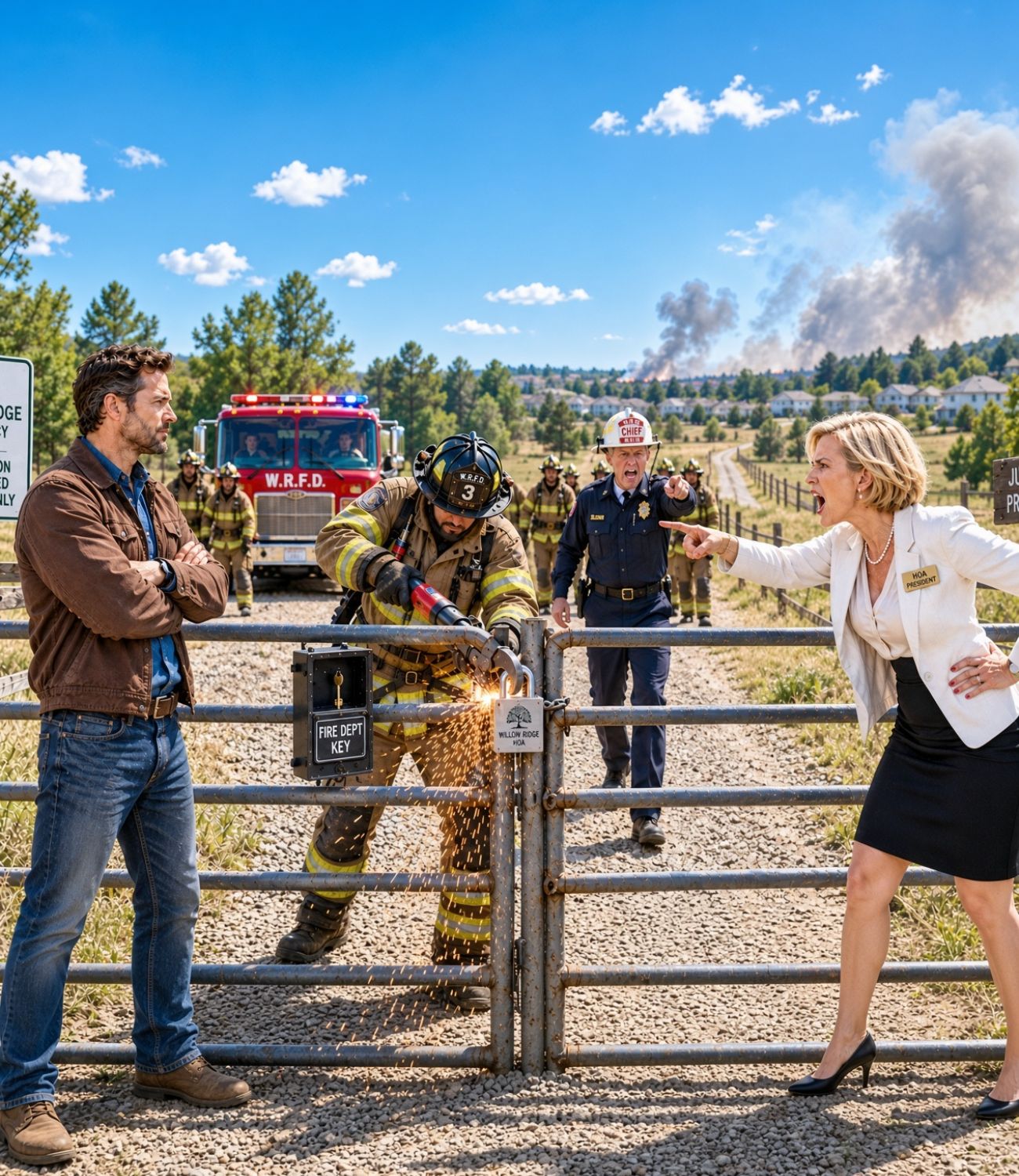
That morning, I stood at the gate of a road I had graded and patched for 11 years. And Cynthia Vale stood beside a padlock that was not mine. Arms folded, smiling the way people smile at a delivery driver. She said, “A man like me should learn how a community works.” I did not argue with her.
I photographed the lock and made one phone call. 3 hours later, smoke climbed off the western ridge. And when the engines rolled up, >> the fire chief looked at that gate and asked a question that drained the color from her face. If you enjoy watching a board overreach until it traps itself on paper, subscribe now and stay with this story.
I bought my land 11 years ago in the middle of a wet march. 34 acres of hillside pasture with a barn that leaned, a farmhouse with wiring from another era, and a gravel road running down the spine of it. The seller was an old man named Ward Trellis, who had lived there since before the county paved anything out that way, and he walked me over every foot of it with a coffee cup in his hand.
He showed me the culvert that always clogged, the spot where the grade wanted to slide after heavy rain, and the fence line where his father had once run cattle. I was a road and utility inspector then. Still I’m in the ways that matter and I could read a hillside the way some people read a paragraph.
When we got to the bottom of the property, I saw the big houses on the far side of the treeine. All of them new, all of them the same warm gray. Ward said the developers had come through a few years earlier and that they had wanted more from him than he had been willing to give. That development is called Willow Ridge Estates.
It has a stone entrance sign lit from below, a gate house nobody staffs, matching mailbox posts, and a rule about what shade of white you may paint your trim. About 180 households live there. From my porch at night, it looks like a small even grid of light, and I have never once resented it because people are entitled to live however they like as long as they leave my fence alone.
My side of the treeine has a tractor with a cracked seat, a burn pile, a stack of culvert pipe I keep for jobs, and a truck that has needed a tailgate since the spring my father died. I am 44. I live alone, and I take small contracts now, grading, drainage, private road maintenance, the work nobody photographs. The road is called Juniper Cut.
It comes off the county highway, drops through my pasture, bends around the base of the hill, and comes out near the rear boundary of Willow Ridge. Because of that last 100 yards, a lot of people over there assume it belongs to them. I understood how the mistake happened. There is no toll booth on a gravel road, and no sign in the world stops a person from believing whatever is convenient.
So for 11 years, I did what Ward had done before me. I hauled crushed rock every other spring. Cut back the elderberry that likes to swallow the ditch line and pulled a limb off the surface after every storm without waiting to be asked. Nobody paid me for that. Nobody thanked me either, and I did not expect it.
The road was mine the way a roof is yours. An expense that only becomes visible when it fails. Twice I dragged a stalled sedan out of the low spot with a chain and a tractor. And both times the driver lived over the treeine. And both times they told me they would tell somebody. Nothing ever came of it, which was fine.
I remember thinking on one of those evenings, standing in the dark with mud to my knees, that if this ever turned into an argument, at least the receipts had my name on them. Near the gate at the top of the road, there is a small black steel box bolted to a post older than my deed, weathered down to a chalky gray. Ward had pointed at it that first March and said the fire department kept a key in it and that I should never touch it.
I never did. I mowed around it. I painted the post twice and taped the box off both times so I would not get a single drop on the hinge. Some things on a property are like that. a little piece of somebody else’s system living quietly on your dirt and you learn to leave it alone.
I did not think about that box again for almost a decade. Cynthia Vale came into my life the way weather does gradually and then all at once. She became president of the Willow Ridge board about 2 years ago. I first met her on the lower stretch of Juniper Cut on an August afternoon while I was shoveling wash out back into the shoulder. A white sedan stopped.
The window came down and a woman in sunglasses with a linen blazer folded on the passenger seat looked at my truck, then at my boots, then at my face in that order. She asked whether I was the man who maintained the road. I said I owned it. She smiled a small polite smile and said she was asking about the person responsible for maintenance.
I said it was still me. She said thank you. in the tone people use to end a conversation they consider finished. And she drove on down through my pasture and out the far end without slowing at the culvert. And I watched her go and went back to shoveling. That was the whole of it.
It lasted maybe 40 seconds, but I have replayed those 40 seconds more times than I care to admit because everything that came afterward was already in them. In late September, an envelope showed up in my mailbox with the Willow Ridge crest printed in dark green. Inside was a single page in a formal type face, and across the top it read, “Notice of road compliance violation.
” It cited article 9, section 4 of the Willow Ridge Estates Covenants, conditions, and restrictions, a subsection concerning the appearance and upkeep of community access corridors. It listed a compliance deadline of 30 days. It was addressed to Nolan Pike at my address, my actual address, spelled correctly, which somehow made it worse than a mistake would have been.
I read it standing up, still holding my keys, and then I read it again in the kitchen with the light on. I checked the return address twice. I checked whether some previous owner had ever joined the association. And I knew before I checked that Ward never had because Willow Ridge did not exist when this farm was platted. I am not a member.
I do not pay their dues. I do not use their pool. I have never voted in one of their elections and could not have if I wanted to. There is no clause anywhere on this earth that lets 180 households old themselves vote themselves authority over a stranger’s pasture. That was what I believed on that Tuesday night with the letter flat on my counter.
And I was right about it. And being right turned out to be about a third of what I would need. The notice ran four items. First, that agricultural equipment must be screened from view of the community access corridor. Second, that the gate at the head of the road be repainted to a conforming finish. Third, that the sign reading private road be replaced with association standard signage.
Fourth, that I remit an annual road maintenance assessment of $480. Retroactive for 2 years. There was a payment stub at the bottom, perforated with a scissors icon. I sat with that stub for a long time. A man will absorb a lot of insult before the perforated line finally gets him. I drove over the following Thursday.
The Willow Ridge management office sits in a small brick building at the front of the development with a bell on the door and a bowl of wrapped mints on the counter. Cynthia was in the back conference room with two board members, a nervous man named Dale Pedigrew and a woman with a laptop who did not look up.
I set the notice on the table and said they had sent it to the wrong person. Cynthia glanced at it without picking it up and said, “No, they had sent it to exactly the right one.” She explained calmly and at length that Juniper Cut is a community access road, that the association carries responsibility for the safety and appearance of all access corridors serving the community and that responsibility necessarily implies authority.
She used the word necessarily twice. I said that a right of passage and a right of ownership are two different things. That one lets you drive across a man’s land, and the other lets you tell him what to do with it. She let a silence run just long enough to make her point, then said, reading a few numbers off a plat map does not make you an attorney.
I did not take the bait, though I had a sentence in my mouth about how she had never once in her life shot a grade line. Instead, I asked her to send me whatever document showed the association owned that road. She said she would have council provide a summary. I said I did not want a summary. I wanted the instrument. Dale Pedigrew looked at the ceiling.
Cynthia closed her folder and told me that this was precisely the difficulty of having an outside property adjacent to a community with standards. I drove home along my own road with the windows down and the dust coming up behind me and somewhere around the culvert I understood that this was never going to be about a sign.
She did not want a repainted gate. She wanted a record. She wanted a stack of paper that showed the association issuing directions and a neighbor complying with them because that is how authority is manufactured in places like Willow Ridge. One uncontested letter at a time. Once a pattern exists, the pattern becomes the argument.
I had inspected enough public work to know that a habit maintained long enough starts to look exactly like a right. Two weeks later, I came down at first light and my sign was gone. The four bolts were still in the post. The outlines of the old plate still ghosted in the paint, and in its place hung a fresh aluminum panel with the Willow Ridge crest across the top.
It read Willow Ridge Emergency Access Association authorized vehicles only. Somebody had used my post, my bolt holes, and my paint. I stood there in the cold with the engine still running and my breath going sideways in the headlights. I did not take it down. That surprised me more than anything because 10 years earlier, I would have had it in the bed of the truck before the coffee cooled.
Instead, I photographed it from four angles with the timestamp on, wrote the date in the notebook I keep in the glove box for job logs, and drove to work. That notebook is a habit from my inspection years when a disputed poor or a bad subgrade could cost somebody a quarter of a million dollars. And the only thing that ever saved anyone was a page written the same day.
If Cynthia Vale wanted to build a record, then I would build one, too. only mine would have photographs in it. The following Saturday, I found a man in a marked van standing at my gate with a tape measure, running it across the frame and writing on a clipboard. He was polite about it. I asked who had hired him, and he handed me the work order without hesitation, which told me he had no idea he was standing on private ground.
The customer line read Willow Ridge Homeowners Association. The scope line printed in the same flat font as everything else that autumn read gate security conversion. I sent a formal email that night, short and flat, no adjectives. I stated that the parcel and the roaded of Juniper Cut were my property, that no contractor was authorized to enter or alter any structure on it, and that any work performed would be treated as trespass and damage.
I copied the management company and the two board members whose addresses were published on the association letter head. I did not threaten anything. I have watched men lose good cases by writing one angry sentence and I had already decided that whatever else happened, nothing I wrote was ever going to be the exhibit that hurt me.
The reply arrived 4 days later on association stationary headed final notice of access control. It said the board was exercising its duty to ensure the reliability of secondary emergency access serving Willow Ridge Estates pursuant to article 11 section 2 of the covenants and that hardware upgrades to the corridor gate would proceed as scheduled.
Then came the paragraph I had to read three times. Beginning the following week, it said any commercial vehicle access along the corridor would require advanced coordination with the association office during posted business hours. My tractor, my dump trailer, my own driveway essentially, subject to an appointment. I called her. She picked up on the second ring and said my name in that clipped pleasant way, Mr.
Pike, as though I were a vendor calling about an invoice. I said the letter had to be a drafting error. She said it was not. She said heavy equipment cannot simply come and go across an emergency route without coordination. I said Cynthia that is the road to my house. There was a pause of maybe 2 seconds and then she said that is one way of looking at it.
I have thought about that line more than any other thing she ever said to me. Not the insults which were plain enough, but that little phrase, that is one way of looking at it, offered as though ownership were a matter of taste. Deeds are opinions, surveys are opinions, and the truth is whatever the person with letterhead types. I said nothing back.
I hung up, sat in the truck in my own yard for a while, and then went inside and pulled the fireproof box off the shelf in the hall closet. I had not opened that box since the closing. Inside was the warranty deed, the plat of survey with the surveyor’s stamp, still crisp, the old title commitment, a folded copy of the county assessor’s parcel map, and a thin stack of recorded documents from Ward’s era.
I laid the plat on the kitchen table under the good light, and traced the boundary with my finger. The disputed stretch of juniper cut, the whole run from the county highway down through the pasture and around the toe of the hill, sits entirely inside my parcel, not adjacent to it, not straddling it, inside it, with the nearest willow ridge line, more than 60 ft away at the closest point.
That should have settled things in my mind. And mostly it did, except for one line on the title commitment under the heading of exceptions. It read subject to emergency access agreement instrument number 2008-4176. I had seen that line before back at closing and the closing agent had waved a hand and said it just lets the fire department come through.
Everybody out here has something like it for 11 years. That had been my entire understanding of it. A courtesy for the fire department. A sentence in a stack of sentences. Now, the line looked different because Cynthia kept using the phrase emergency access like a key that fit a lock somewhere. I did not have the full instrument.
What I had was a reference to it, which is exactly the kind of thing that ruins people. So that night, I went to the county recorder site, filled out the request form for a certified copy of the full document and any attached exhibits, paid the fee with a card, and got an automated message saying the retrieval would take up to five business days for records of that vintage.
Then I went out on the porch in the cold and looked down at the dark line of my road and wondered what exactly Ward Trellis had signed his name to in 2008 and why he had never once mentioned it in 3 hours of walking me over that land. The association held an open meeting the following Tuesday in the clubhouse. I went because it was posted as open and because I have found that people say things in rooms they would never put in a letter.
There were maybe 50 residents in folding chairs, a table at the front with four board members, and a woman taking minutes whose name I learned later was Laurel Beck. Cynthia ran it the way a good chair runs a meeting. Agenda in order, motions clean, nobody talking over anybody. That is the part people never believe when I tell this story.
She was not a lunatic. She was competent, and competence is what made her dangerous. She reached an agenda item titled corridor safety and stood up to speak to it. She said the board had spent months addressing a persistent obstacle to the community’s secondary emergency route. She said no single individual’s personal preferences could be permitted to outrank the safety of 180 families.
She never used my name. She did not have to. Three people turned around and looked at me before she finished the sentence. And a man near the window shook his head slowly like he was hearing about a tax increase. I stood up. I said without raising my voice that I owned the road she was describing, that I had maintained it at my own expense for 11 years, and that I had never once denied access to anybody in an emergency.
Cynthia looked at me over her reading glasses and said, “Mr. Pike, you are not a member of this association and you do not have speaking privileges at a member meeting.” I said, “But you are holding a meeting about my property.” And for the first time, the room made a sound, a low shifting, chairs moving, two people saying something to each other in the back row.
Cynthia moved on. But something had changed in that room, and she felt it before I did. Afterward, in the parking lot, a woman I did not know stopped me by the tailgate of my truck and asked quietly whether that road was really mine. I said it was, she said. Then why does the newsletter keep calling it ours? I told her that was an excellent question and that I had been asking it since September.
She looked at the clubhouse for a second and then said she had to get her son and left. I did not know it then, but that was the first crack. The next Monday, I drove down at 6 to meet a client on a culvert job over in the next valley. I came around the last bend with the frost still on the pasture, and the gate was closed.
I got out and put my key in, and it did not go. My padlock, the brass one with the yellow paint mark on the shackle, was gone. In its place hung a heavy steel lock body, powdercoated with a small enameled crest on the face, and under the crest in tidy capital letters the words Willow Ridge Homeowners Association.
I stood there with my own key in my hand and my breath going up into the flood light. I have been locked out of a job site before by a general contractor in a dispute, and I have been locked out of an office by a landlord, and neither of those did what this did. There is something specific about walking to the top of your own driveway and finding that a stranger has decided you need permission.
My phone said 16 minutes until I was due at the culvert. I called the client and pushed him to 9. Then I called the association office, got a voicemail greeting listing business hours, and then I called Cynthia’s published board number and she answered. She arrived 11 minutes later in the white sedan in a wool coat with a travel mug. She did not apologize.
She did not even pretend surprise. She said the hardware upgrade had been completed over the weekend and that she had intended to inform me by letter, which was at least a kind of honesty. Then she took a card out of her coat pocket and held it out and said that going forward when I needed the corridor opened outside of ordinary hours, I should call the number on that card.
And the management company would dispatch someone. I did not take the card. I asked her plainly whether she had just locked me out of my own land. She corrected me the way a teacher corrects a spelling error. We have secured an access point, she said. I said, “On my property.” She said, “You keep returning to that phrase as though it resolves everything.
” Then she looked at my jacket, the reflective one with the torn cuff, and at my boots, and she said, “Nolan, I understand that you are accustomed to moving equipment whenever and however you like. A residential community operates differently.” There it was, the whole thing in two sentences delivered without heat. Not you are wrong, not we disagree, just a quiet placement of me on a lower shelf.
A man with a truck who had wandered into a conversation meant for people who understand documents. I felt the old response come up my throat, the one about how I had spent 19 years signing off on the roads her groceries came in on. I swallowed it. I have learned that the sentence you do not say is often the only asset you keep.
What I did instead was take out my phone and start recording. I told her I was recording. I filmed the gate, the new lock, the crest, the sign with the association name on my post, and then I turned the camera on her and asked, “Is it correct that the association replaced the lock on this gate?” She looked straight into the lens with her chin slightly up, the way a person looks when she believes she is on the winning side of a recording and she said, “Absolutely.
” Then she said the board had acted within its duty to the community and she got into her car and she drove down my road and I let her. I broke nothing. I cut nothing. I stood there for another minute and then I went and got the bolt cutters out of the shed and I looked at them for a long moment and I put them back on the hook.
If I had cut that lock, the next letter would have been about a man who destroys community property and every single person who read it would have believed her. So, I drove out the back way through the field track, which takes 20 minutes longer, and tears up a pasture I had receded in the spring, and I made my 9:00 with 2 minutes to spare.
The recorder’s copy came into my email that afternoon at 10 1. Instrument number 2008-4176 scanned at an angle. The county stamp bleeding slightly at the corner. The first page listed the parties. Ward Trellis as owner, the Willow Ridge Development Company as applicant, and a third party I had not expected to see there at all listed as a beneficiary of the grant, the County Fire Protection District.
I read the opening recital slowly. Then I stopped on a phrase in the second paragraph, non-exclusive emergency apparatus access, non-exclusive, not ownership, not control, not management. a permission to bring an engine down a private road when something is burning. I sat back in the chair and let out a breath I had been holding since September.
And then I noticed the page counter at the bottom of the scan and saw that the instrument ran 22 pages with an exhibit schedule attached. Seven pages of it under the heading conditions of approval. I had gotten through maybe four pages when my phone buzzed on the table with a county alert. brush fire reported west of Willow Ridge Estates.
I stood, walked out onto the porch, and saw a column of gray lifting slowly behind the shoulder of the hill. The fire started in dry grass along the western power corridor, the kind of thing that happens every fall out here and usually ends with a scorched halfacre and a crew drinking water off the tailboard. This one had wind behind it.
By the time I got to the head of juniper cut, the smoke had gone from gray to a dirty tan, and it was leaning east toward the treeine toward the back rows of Willow Ridge where the houses sit closest to open ground. I could hear sirens on the highway. I could also hear somewhere over the hill the flat thump of a helicopter that had not gotten there yet.
Cynthia was already at the gate. She had the management company’s man with her, a young guy named Trevor in a polo shirt with the crest on the chest. And she was standing in the middle of my road giving directions with her hand, the way a person does at a school pickup line. She had a clipboard in the middle of a wind-driven grass fire in a wool coat with a clipboard.
I parked on the shoulder and got out and did not say a word to her because there was nothing left to say that would matter in the next 10 minutes. The first engine came up the county highway and turned in. A captain swung down before it fully stopped, walked to the gate and reached straight for that small black steel box on the post.
The one ward had told me never to touch. He worked the key in it and the box opened and he pulled out a brass key on a ring. And then he turned and looked at the gate and I watched the shape of the problem arrive on his face about half a second before it arrived on mine. The key in his hand had been cut for a padlock that no longer existed.
The lock on my gate was a hardened steel body with an entirely different keyway hung there by a contractor over a weekend. Cynthia stepped forward and said, “I am the association president. I have access authorization.” The captain asked her for a key. She turned to Trevor. Trevor said he had the code.
The captain said there was no keypad. Trevor began paging through his phone for the installer’s contact and said the new system was mechanical keyed and the keys were at the management office and the management office was 11 minutes away in traffic that was currently being stopped for apparatus. Cynthia said in a tighter voice than I had ever heard from her that this was a temporary administrative gap.
It was 4 minutes. I want to be honest about that because I have no interest in inflating this into something it was not. Nobody died. No house burned. The delay at that gate was 4 minutes and change and the crews had other angles and used them. But 4 minutes is a long time to stand on a gravel road watching a hillside go.
And it was long enough for a second unit to arrive and long enough for a command vehicle to pull in behind it. And out of that vehicle came a man of about 58 in a white helmet who did not hurry and did not raise his voice and that was Everett Sloan. Sloan walked the last 20 ft and stopped at the gate.
He looked at the lock and he took his time about it. He looked at the little black box hanging open with the useless brass key still in the captain’s hand. He looked up at the aluminum sign bolted to my post with the Willow Ridge crest across the top. He looked at me in my work jacket, standing off to the side with my hands in my pockets.
Then he looked at Cynthia in her coat with her clipboard, and I saw him do arithmetic behind his eyes that I could not follow yet. Cynthia got there first, the way she always did. We recently upgraded this gate, she said, because the adjacent landowner has created ongoing problems with the corridor. She said it smoothly and she said it to a man in a white helmet with a fire burning 900 yardd away.
And I think she genuinely believed it was the right thing to say. I said nothing at all. I had learned by then that when Cynthia Vale had the floor, the best thing I could do was hand her more of it. Sloan asked, “Who is the landowner?” I raised my hand about waist high and said, “That is me.” Cynthia said, “The road serves the association.
” Sloan did not respond to that. He did not ask who the road served or who maintained it or who had upgraded what. He turned his head slightly, looked once more at the lock body with the crest on it, and asked the question that has been in my head ever since. “Who owns this access road?” I said, “I do.” Cynthia made a small sound, not quite a laugh.
He disputes that,” she said, which was strange because I was not disputing anything. I was answering a question. I took out my phone and pulled up the scan deed and the plat and I held it out and Sloan took the phone and looked at the plat for about 6 seconds, which is roughly 5 seconds longer than he needed. He handed it back.
Then he asked who replaced the lock. Cynthia, still entirely confident, still standing on what she believed was solid ground, said the association did. Sloan was quiet for a moment. Behind us, a pump was running and somebody was calling for a line off the second engine, and the air smelled like burnt fence post.
When he spoke again, he did not sound angry, which somehow made it worse. he said who authorized the association to change hardware on a designated emergency apparatus access and for the first time in 3 months Cynthia Vale did not have a sentence ready. They took the gate. Two men with a hydraulic cutter had the lock body off in under a minute and swung the leaves back against the fence, and the engines went down my road one after another with their compartments rattling, and the last one clipped the elderberry I had been meaning to cut
since August. I stood there with the smell of hot metal in the cold. Somebody flagged the opening with tape. It was, I remember thinking, the least dramatic destruction of property I had ever witnessed and the only one that ever helped me. Before the command vehicle pulled out, Sloan came over with a small notebook and asked me for four things.
The recorded deed, the access agreement of record by instrument number, the association’s registered contact and management company, and the name of the individual who directed the hardware change. He wrote as I spoke and did not editorialize. Cynthia came over and said that this was an administrative misunderstanding and that she would be happy to provide clarification through counsel.
Sloan said that would be fine and thanked her and I noticed that he wrote her name down too. He got as far as his door then stopped and looked back at me the way people do when they have decided to give away one free thing. he asked. Do you know why Willow Ridge was allowed to build its third phase? I said, “No.
” He looked down the length of my road at the dust still hanging where the engines had gone and said, “You probably ought to find out.” Then he got in and drove down my pasture into the smoke. And I went back to the house and printed all 22 pages of instrument 2008-4176 plus the 7-page exhibit and put them on the kitchen table where I could not avoid them.
Grant Hollis is a land attorney in the county seat, 61 years old with an office above a hardware store and a filing system that predates the internet. I had used him once years back on a boundary question and he had charged me for 40 minutes and solved it in 20. When I called him, he asked me to bring everything including the envelopes the letters had come in, which is the kind of instruction that tells you a man has done this before.
We spent the better part of a Thursday morning at his conference table with the pages spread out end to end. Here is what the 2008 documents actually said. And it took Grant about an hour to make me understand the whole shape of it. Back then, the development company wanted approval for a third phase, roughly 40 additional lots on the western side up against the open ground.
The county fire district objected. Under the applicable fire code standards for that many dwellings in that terrain, the phase could not be approved with a single point of apparatus access and the geography left exactly one workable second route. It ran through Ward Trellis’s pasture. It was already there. It was called Juniper Cut.
So the developer went to Ward. and Ward, who had no interest in the whole enterprise and every interest in not having the county come after him about the culvert, signed an agreement. Grant read the operative clauses out loud in the flat voice attorneys use when they want you to hear the words instead of the drama.
The fee title to the roaded remains at all times with the owner of the burdened parcel. The grant conveys a non-exclusive right of emergency apparatus access to the fire protection district. The association is expressly named as a beneficiary of continued access, not as a holder of any possessory interest.
Then he turned to page 19 and put his finger on a clause in the exhibit and said, “This is the one.” It read in substance that any gate, barrier, or locking device installed on the corridor must remain compatible with the fire district’s approved access system, and that no modification affecting the corridor or its access hardware may be made without prior written consent of both the owner of the burden parcel and the fire protection district.
Grant took his glasses off and said, “Do you understand what she did?” I did, but I said it out loud anyway because I needed to hear it in my own voice. For 3 months, I had been carrying that emergency access agreement around in my chest like a weakness. Every time Cynthia said the words emergency access, I had felt a little bad ground under me, because I had never read the thing, and I had half assumed it gave the association some sliver of a claim on my road.
That was backward. The agreement was not the leash on my land. It was the reason Willow Ridge Estates has 40 houses in its third phase and every one of those houses stands on the county’s belief that a fire engine can come down my pasture. Grant said it plainly. She did not strengthen the association’s position.
She created documentary proof that the association interfered with an emergency access route it does not own on land it does not own without the consent of either party whose consent the instrument requires. He tapped the page and she said so on camera he added in her own words to your phone with her title.
I asked him the question that had been sitting under all of this. Why now? The association had ignored that road for years. Ward had never gotten a letter. I had gone nine years without so much as a phone call. And then in the space of one autumn, there were violations. A sign, a contractor, a lock, and a woman standing in my road with a clipboard.
Boards get petty, Grant said. But they do not usually get expensive. Something started this. Find out what happened in the spring. The answer came 4 days later at 11 at night from an address I did not recognize with no greeting and no signature. It said only, “You need to ask what Cynthia told the insurance inspector in May.
” It was signed at the bottom with two initials and a line that said, “Please do not forward this. The name.” Attached to the account was Laurel Beck, the woman who took the minutes. Attached was a PDF, six pages, a carrier questionnaire for the association’s general liability renewal, completed and certified by the president of the board.
I went through it slowly. Most of it was ordinary roofing ages, pool fencing, sidewalk inspections. Then on the fourth page under a section headed emergency access and egress in response to a question asking whether the association held secured legal access for its secondary emergency route. There was a typed sentence.
Willow Ridge Homeowners Association maintains exclusive operational control of the Juniper Cut Emergency Access Corridor. I read it twice, then a third time. exclusive operational control, not partial, not conditional, not dependent on a private landowner she had never spoken to at the time she wrote it. Cynthia had not made a clerical slip in a hurry.
The sentence was too wellb built for that. She had written down a thing that was not true in May. in a document that carried her certification. And then over the following months, she had gone out and tried to make the world match the sentence, the sign, the violations, the minutes, the contractor, the lock. She had not been trying to win an argument with me at all.
She had been trying to turn her own words into history. I met Laurel Beck in a coffee place two towns over, which was her idea. And she arrived in a raincoat with her keys already in her hand like she intended to leave at any moment. She is about 46, a school administrator, the sort of person who volunteers for the thankless job on a board because somebody has to keep the record straight.
She told me she had believed Cynthia at first. Everybody did. When the president of your association says a corridor is a safety liability, you do not go pull a plat map. You say thank you for handling it. What changed for her was the minutes. In August, Cynthia had asked her to revise a set of draft minutes before circulation, not to correct an error, but to add a clause.
The draft had said the board discussed maintenance concerns regarding the Juniper Cut corridor. The revision Cynthia wanted said the board reaffirmed its continued long-standing operational control of the Juniper Cut corridor. Laurel said she had typed it, hated it, sent it, and then because she is who she is, saved the original draft in a folder on her own machine with the date on it.
She asked me not to name her yet. I said I would not and I did not. Then she said the thing that filled in the last gap. The insurance renewal in May had come in with a premium increase and a list of deficiencies, and one of the flagged items was uncertainty about the secondary emergency route. Cynthia had told the board she would handle the response personally.
Laurel had never seen the completed questionnaire until she went looking for it in October. After a fire chief in a white helmet started asking who owned a road, so that was the machinery of it. A carrier asks a hard question. A president who prides herself on running a tight community does not want to answer that her second fire route runs across private ground under an old agreement she has never read because that answer invites underwriting scrutiny and a rider and a conversation with 180 households about why. So she writes a cleaner sentence,
exclusive operational control, and then she is stuck with it because a certification is not a conversation. And the only way to make it retroactively honest is to actually take control of the corridor. Everything I had experienced since September rearranged itself around that. The violation notice was not about my tractor.
It was a paper trail. The aluminum sign was not signage. It was evidence bolted to my own post so that any photograph taken from the road afterward would show the association’s name on the corridor. The contractor’s work order was not a security upgrade. It was the physical act that turns a claim into a fact. And the lock was not a lock.
It was the last piece she needed. The one that would let her say truthfully that the association controlled who passed. She had to make it true. That is why she could not simply leave me alone. Everett Sloan called me on a Wednesday. He was careful in the way officials are careful when they intend to do something and do not intend to be quoted about it.
He told me the matter had been referred to the fire marshal because a gate on a mapped apparatus access route had been modified without approval and had in fact delayed an engine during an active incident. He said the district was pulling the corridor file, the 2008 approval conditions, and the third phase sign off.
Then he said something I wrote in my notebook that night. Word for word, he said, “What interests me is not your dispute with a homeowners association. What interests me is that a route recorded in our access plan had its hardware changed by a party that does not own it. That is a mapped route with a known condition and somebody moved a condition without telling us.
That is what I have to fix. That was the sentence that ended any hope Cynthia had of framing this as neighbors quarreling. It was never going to be her against a man in work boots. It was going to be a fire district asking a board why the approved access to 40 houses was hanging on a padlock.
Nobody in the county had authorized. She came back once more. Hard the way people do right before they understand. 10 days after the fire, a letter arrived at my house from a firm in the city on heavy stock. It demanded that I refrain from altering the corridor gate, refrain from restricting association access, and cease any conduct threatening the community’s emergency access rights.
It suggested that continued interference could expose me to liability for damages arising from impaired emergency response. Reading it, I understood she believed I would fold. A letter from a firm with three names on the door is meant to be a wall and most people walk into it. Grant answered it in one page. He did not argue.
He did not narrate the fire and he did not mention Cynthia at all. He requested two items. First, any recorded instrument establishing the association’s ownership of or possessory interest in the Juniper Cut roaded. Second, the written approval of the fire protection district for the modification of access hardware on the corridor as required by the exhibit to instrument 2008-4176 with the date of issuance.
He closed by stating that upon receipt of both, his client would revisit his position. There was no first item. There has never been a first item. And there was no second item either. And the absence of the second item was worse for her than the absence of the first. Because the first was a mistake of belief and the second was a violation of a recorded condition.
The firm’s reply took 19 days and ran three sentences, none of which contained a document. Three days after that, an envelope went out from the county that was not addressed to me. It went to the board of directors of Willow Ridge Estates at the management office, copied to the fire district, and the heading on it read notice of fire access deficiency.
I only know what it said because within a week half the development knew what it said. That is the thing about a community with standards. Nothing travels faster in a place like that than the news that the board has received a letter. The next regular meeting was moved to the clubhouse main room and still ran out of chairs.
I counted 70some people standing along the back wall. I came as an interested landowner in a clean shirt with a folder and I sat in the second row where Cynthia would have to look past me all evening. Grant had told me one thing before I left. Do not perform, he said. Let the paper perform.
Cynthia opened by attempting to set the frame. And I have to give her this much. She never once looked frightened. She said the board had been placed in a difficult position by an adjacent landowner exploiting a fire incident to pursue a personal grievance against the community. Somebody in the back said, “Is that the road thing?” She said the matter was under review by council and suggested the board move to the landscaping bid.
Laurel Beck sitting at the end of the table with her laptop open said, “Before we do that, the notice from the fire marshall should be read into the record.” Cynthia said the notice was a routine administrative correspondence. Laurel said it was addressed to the board and the board had not seen it. There was a pause that went on about 3 seconds too long.
And then Dale Pedigrew, the nervous man from the office in September, picked up the page in front of him and started reading it aloud in a voice that got steadier as he went. The notice required four things of the association. Restore the approved emergency access method on the corridor within 15 days.
Refrain from installing, altering, or removing access hardware on the corridor absent written consent of the underlying property owner and the fire protection district. Produce records identifying the individual or body that directed the hardware change, including work orders and invoices, and submit an updated emergency access plan for the third phase for district review.
He got to the end and set the page down and did not look at Cynthia. A woman near the aisle raised her hand and did not wait to be called on. “Hold on,” she said. “Does the association own that road or not?” Cynthia said, “Ownership out there is more complicated than that.” I stood up and this time nobody told me I lacked speaking privileges.
I opened my folder and set my recorded deed on the table in front of the board and said, “No, that part is fairly simple.” Then I did what Grant had told me to do, which was to go in order and say almost nothing. The deed recorded 11 years ago with the legal description, the plat of survey with the stamp, the corridor lying wholly within my parcel, 62 ft from the nearest association boundary at its closest point.
Instrument 2008-4176 with page 19 flagged and the consent clause underlined in pencil. A photograph of the aluminum sign bolted to my post. The contractor’s work order naming the association as customer and describing the scope as gate security conversion. The invoice from the management company that Grant had obtained.
And then I set my phone on the table and played 11 seconds of video in a silent room in which a woman in a wool coat looks into the camera and is asked whether the association replaced the lock on this gate and says absolutely. Nobody said anything for a moment. Then Cynthia said that I was playing a technical legal game, that I had been hostile to the community from the beginning, and that a man who parks farm equipment where families can see it, was not the appropriate custodian of a safety corridor.
I looked at her, and I had every sentence I had swallowed since August lined up behind my teeth, and I used none of them. I said, “You put a lock on my gate, Cynthia.” All I did was read the paper that says whose name is on the land. Laurel spoke niksh and she did it without drama which is the only reason it landed as hard as it did.
She said that in August she had been directed to revise the minutes of a board meeting to state that the association reaffirmed longstanding operational control of the corridor and that this language did not reflect anything that had occurred at the meeting. She said she still had the original draft with its file date.
She turned her laptop around so the board could see the two versions side by side. I watched five people at that table stop thinking about me entirely. Up to that point, the worst case in their minds was that their president had been overzealous about a boundary and had gotten the association a letter from the county. Now the picture was different.
Now, there was a pattern with dates on it. A sign, a work order, a lock, a rewritten record, and somewhere behind all of it, a certification to an insurance carrier that none of them had read. Near the end, a board member I did not know asked the association’s attorney a question directly. If Mr. Pike really owns that road, he said, “Can he close it to us?” The attorney, who had been quiet all evening and looked like a man doing arithmetic on a napkin, glanced at me and then answered honestly. As to residents using it as a
convenience route, he said, “Very likely yes.” As to the fire district, no. And that is precisely what the recorded agreement has said since 2008. The room turned and looked at Cynthia. She did not say anything at all. I want to be clear about what I did with that because there was a version of the next month where I burned the whole place down on paper and it would have been legal.
I could have gated the corridor to residents entirely, which the attorney had just conceded on the record. 40 houses in the third phase would still have had their fire access, but a lot of people who had gotten used to cutting through my pasture on their way to the highway would have had to drive around the long way for the rest of their lives.
I thought about it for one evening on the porch. Then I thought about the woman in the parking lot who had asked me quietly whether the road was really mine. I thought about Dale Pedigrew reading a notice out loud in a room where his president wanted silence. I thought about Laurel Beck saving a draft on her own laptop in August, months before anybody could have told her it would matter.
Cynthia Vale was one person punishing 180 households for her would have made me exactly the man. She had been describing to them all autumn and it would have handed her the last thing she wanted which was a story where she was right about me. So Grant and I put together a proposal instead and we delivered it before the board asked for one which I think mattered more than the contents.
It ran eight points. The fire protection district retains full emergency apparatus access day or night without notice forever exactly as the recorded instrument provides. An approved key box and a district compatible lock are restored at the gate specified and inspected by the district, not by me and not by the association.
The association installs, alters, or removes nothing on the corridor ever without written consent from both me and the district. Residents may not use Juniper Cut as a shortcut because a mapped apparadus route carrying daily commuter traffic across a private pasture is how you end up with a blind bend and a child on a bicycle. The association removes its signage from my post and pays the cost of restoring the gate hardware it converted, which came to $2,140.
The association withdraws every violation notice issued to me and voids the retroactive assessment. The association issues a written statement in the newsletter and in the minutes confirming that my parcel is not subject to association jurisdiction and any future concern about the corridor comes to me directly in writing and I answer in writing.
That was the whole of my revenge. It fits on two pages. Grant said it was the least vindictive settlement demand he had drafted in 30 years and then he said that is why they will sign it. Cynthia fought it anyway right up to the end and she never once changed her tone. At the special session where the proposal was presented, she said I was leveraging an administrative error to make myself important.
She said it in that same even voice in front of a board that by then had read the fire marshall’s notice twice and the insurance questionnaire once. I answered her plainly. And it is the only thing I said all autumn that I had actually rehearsed. I said, “No, Cynthia. I just want you to stop behaving as though I need your permission to drive home.
” She looked at me for a second and I saw something pass across her face that was not anger. I think it was the arrival of the fact that the room was no longer hers. She had built her whole position on the idea that a man like me would eventually be tired or embarrassed or outspent and would sign whatever she put in front of him, because that is what men with dump trailers do when faced with letterhead.
It had never occurred to her that I had spent 19 years reading approval conditions for a living, and that the one document she had never bothered to open was the one holding up her third phase. The board went into closed session with council for 50 minutes. When they came out, they voted on four motions, resigned all notices of violation issued to me, and void the assessment, unanimous.
Accept the access terms as proposed, unanimous. Reimburse the gate restoration cost and my recording and legal fees, $760 of which were mine to begin with, passed with one abstension, and open a review of the president’s conduct concerning representations made to the insurance carrier and to the board.
passed with Cynthia recusing herself, which she did with perfect procedural correctness, because whatever else she was, she was never sloppy about the gavl. The last motion of the night removed her from any role representing the association in matters concerning Juniper Cut. She sat in the same chair where she had told me I did not have speaking privileges, and listened to five neighbors decide that she would not be the one to speak for them anymore.
Nobody shouted. There was no scene. The chair thanked her for her service on the item and moved to ajourn. I went out into the parking lot afterward with my folder under my arm and my ears ringing a little and Everett Sloan was leaning against the front fender of a district pickup in a fleece jacket off duty waiting for me.
He said there was something I ought to know. I braced for another problem. He said if she had not changed that lock, nobody would have pulled the corer file for another 20 years. I asked him what he meant. He said the third phase approval conditions had been signed off in 2008 and filed and files like that get reviewed when something forces a review.
The district had a key in a box on a post and the box had worked every time anyone tested it, which was not often. The plan said secondary access. The box said the access was real and nobody had reason to walk the chain of it back to a private deed. It was a working arrangement held together by a brass key and a landowner who kept the gravel in good shape.
He said you were the reason it worked and none of us knew your name. That is the part I keep coming back to more than the meeting, more than the video, more than the moment at the gate. For 11 years, I had been quietly holding up a condition of approval. For 40 houses I have never set foot in, and the only two parties who might have noticed, the association and the district both assumed somebody else was handling it.
Cynthia Vale did not discover a problem with Juniper Cut. She manufactured one and in manufacturing it she made a fire chief ask a question and that question pulled a thread that had been lying loose since before she moved in. Think about what she would have kept if she had done nothing. The association would have had its emergency access permanently at no cost.
I would have gone on grading the road and clearing the ditch and pulling limbs off the surface after storms for free indefinitely. the district would have had its route. Nobody would have opened a 2008 instrument or read page 19. Her sentence to the insurance carrier, that inaccurate, overconfident sentence, would have sat in a file for years and very likely never been tested by anyone. She lost all of it.
And she lost it not because she was greedy. Exactly. and not because she was cruel, but because she could not stand the existence of a man in muddy boots who did not treat her authority as real. Every step of the escalations was a step toward making me say the words, “Yes, ma’am.” The lock was the last one available to her.
It was also the only one that touched something the county cared about. She resigned in February, about 3 weeks before the recall vote was scheduled. in a two paragraph letter citing personal commitments and the demands of her family. The board accepted it and thanked her for four years of service, which I thought was the right thing to do, and I said so to Laurel when she asked.
There was no prosecution and no ruin. The association’s council sent a corrected statement to the insurance carrier and a corrected access description to the county and the renewal came back with a higher premium and a rider about documented secondary access and 180 households paid an extra $11 a month for it.
In March, on a Saturday, a young guy from the management company came out and took the aluminum sign off my post. And he did it carefully, and he asked if I wanted the bolts back. I said I did. Then I put up the sign I had made at a shop in town, white on a green ground, three lines, the same three lines Ward Trellis had on that post before I ever owned it.
Juniper Cut Road, private property, emergency access authorized. Next to it, at the height the district specified, is a new key box, red now instead of black, installed by the fire district with their own hardware and their own key. Tested by a captain in front of me on the day it went in. The old box came off the post after 12 years and left four rust rings in the wood.
I did not fill them. They are still there under the new one, and I look at them sometimes. That was the whole point in the end. I never wanted the road closed. I wanted the sign to be true. Spring came the way it does out here, all at once and mostly sideways. I receeded the field track I had torn up driving around my own gate in October, hauled 11 tons of crushed rock onto the low stretch in April, and cut back the elderberry that the engine had clipped, which turned out to have been doing me a favor. The wash
out at the culvert behaved for the first year in memory. Nobody from Willow Ridge drove down through my pasture, and nobody had any reason to, and the quiet took a while to stop feeling like something about to end. There were no more envelopes with a dark green crest in my mailbox. No violation notices, no assessments, no final notice of anything.
There was one letter in April on association stationary signed by the new president, a retired shop teacher named Otis Marlo, thanking me for the corridor terms and asking whether the association might contribute toward gravel in exchange for nothing at all. I wrote back and said, “No, thank you.” And then I thought about it for 2 weeks and wrote again and said, “Actually, yes, half.
” And they have paid half every spring since. I saw her once in the fall at the hardware store under Grant’s office. She was in line with a paint sample card and I was buying a chain. She saw me and I saw her and neither of us said anything. And I did not feel the thing I expected to feel. I had spent a whole autumn waiting to be vindicated in front of her.
And when the moment came, it turned out I did not want it because the person I had needed to convince had never been Cynthia Vale. It had been the version of me who almost paid $480 in September just to make an envelope go away. Late that October, almost a year to the week, Everett Sloan came up Juniper Cut in a district pickup on a routine access verification.
He walked to the post, opened the red box, took out the key and put it in the lock, and the gate swung. He closed it again and locked it and put the key back and shut the box. And the whole thing took 11 seconds. Then he stood there a moment looking down the length of the road with his hands in his pockets.
He said, “This is all it was ever supposed to be.” I stood next to him and looked at the same road. 11 years of my own gravel under it. The bend at the toe of the hill. The culvert I have rebuilt twice. The treeine where the big gray houses start. For a long time I had believed Cynthia wanted a gate. That was wrong.
Gates were never interesting to her. What she wanted, what the whole apparatus of notices and signage and revised minutes was built to produce was the standing to decide who has to ask her for something. She could have had almost anything else. A conversation on the shoulder of the road would have gotten her a copy of the deed in a week.
A phone call would have gotten her the instrument number. Instead, she needed me to acknowledge on paper in a pattern over time that a man like me operates by and the paper would not cooperate because paper does not care who speaks with more authority in a folding chair meeting. A fire chief does not care who holds the gavl.
A road does not change owners because somebody bolts a new sign to your post. Sloan drove off and I stayed at the gate a while in the cold. Then I closed it, turned the district approved lock until it seated, put my own key in my pocket, and walked back to the truck across the frost. Cynthia Vale once told me that a man like me should learn how a community works.
In the end, Willow Ridge Estates had to learn something considerably simpler. A right to cross my land was never the same thing as owning

