Karen Filled My Water Tank With Concrete — Then Every Faucet in the Neighborhood Went Dry
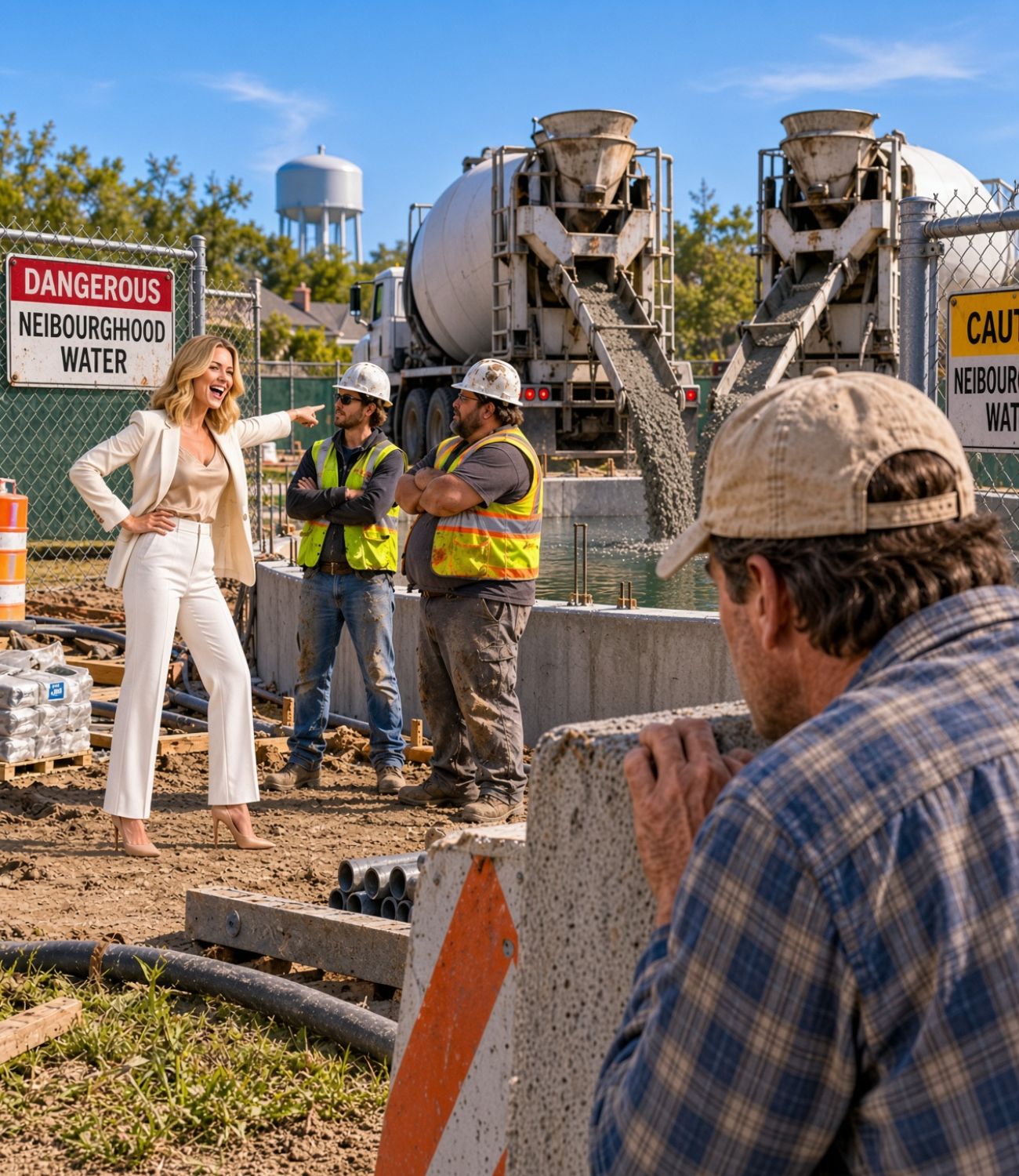
That ugly thing has been ruining this neighborhood long enough. That’s what the president shouted as a concrete truck backed up to my family’s water tank and started pouring. She was the kind of beautiful that makes you look twice [music] and the kind of cruel that makes you wish you hadn’t. 29 years old designer everything and a smile that could sell you a house or steal one.
I was 60 m away by the time I pulled into my driveway 47 minutes later. 4 cubic yards of quickset had sealed the pump, buried the intake pipe, and destroyed a supply system my grandfather installed in 1971. 53 years of infrastructure, three generations of my family killed in 2 hours [music] by a woman who spent more on her outfit that morning than my grandfather spent drilling the well.
She thought the tank was an eyes sore. She thought it was hers to remove. She was wrong on both counts. That tank fed sprinklers, pool water, and fire suppression to 142 homes, including hers, and she just filled it with concrete during the worst drought in 5 years. Drop a comment. Would you have let her finish? Have you ever watched someone so convinced of their own perfection walk straight into a disaster they built with their own manicured hands because you are about to? So, drop a comment below, smash that like, and
let me take you all the way back to the very beginning. My name is Cole Dawson. I’m 44 years old, and I fix wells for a living. That might not sound glamorous to people who measure their worth in followers and sponsored content, but out here in the Hill Country west of Austin, a good wellman is the difference between a working ranch and a pile of dry dirt.
I drive a white Ford F250 with a toolbox bolted into the bed. And most mornings I’m on someone’s property by 7 pulling pumps, testing pressure, and making sure water comes out when people turn the handle. My grandfather, Hank Dawson, started this. He moved to Lonear Bluffs in 1971 when it was nothing but cedar brush and limestone outcrops.
He bought 80 acres with savings from 20 years of pipeline work. And the first thing he did was drill a well, hit clean water at 380 ft, cold, clear, and steady. He installed a 12,000galon steel storage tank on a concrete pad next to the pump house, painted it dark green so it blended with the cedars, and ran supply lines to the house and the stock troughs.
For 30 years, that well and tank were just ours. We watered cattle, we irrigated hay, we filled troughs for the horses. Then in 2003, a developer named Garrett Quinn approached my father about buying some of the land. Austin was booming and the Hill Country was the next frontier. My dad sold 62 acres, kept the homestead on four, and negotiated a development agreement that would define the next two decades of this neighborhood.
The agreement was 23 pages long, and recorded with the county clerk. Quinn would build his subdivision around our property. Our well and tank would provide supplemental water irrigation for common areas, pool filling, fire suppression for the clubhouse, and emergency backup during drought restrictions. The would pay $600 annually.
A permanent easement guaranteed our access to the tank, the pump house, and the underground supply lines. My father signed it, Quinn signed it, the county recorded it, and for the next 20 years, it worked exactly as designed. Lonear Bluffs grew into 142 homes spread across gentle hills with mature live oaks and limestone garden walls.
Nice houses, good families. Most of them had no idea where their irrigation water came from. They turned on their sprinklers and the grass stayed green. They never thought about the fire suppression loop that kept the clubhouse safe during brush fire season. because of my tank. Every morning before I left for a job, I walked out to check the pressure gauge, inspect the filtration housing, and log the reading in a notebook I kept in the pump house.
Same notebook my father used. Same pump house my grandfather built. Nobody asked me to do this. I did it because my grandfather told my father and my father told me, “You take care of the water and the water takes care of everyone.” The old-timers knew. Roy Gutierrez next door would see me out there at dawn and give me a wave.
Frank and Patty Odum down the hill would drop off peach cobbler in July and say, “Thank you for keeping the water running, Cole.” They understood what that tank meant. They’d lived through the drought of 2011 when the municipal supply got rationed to 2 days a week, and my well was the only reason the neighborhood didn’t lose every piece of landscaping the had ever paid for.
But most of the newer residents had no idea. To them, I was just the guy with the old ranch house and the big green tank behind the chainlink fence. They didn’t know that tank was the reason their grass was green and their pool was full. And to one of them, the newest, the youngest, and by far the most dangerous, I was an aesthetic problem that needed to be corrected.
Debbie Prescott moved into Lonear Bluffs in the spring of 2023. She was 29 years old and looked like she’d been assembled by an algorithm designed to maximize Instagram engagement. Honey blonde hair that fell in perfect waves past her shoulders, cheekbones that could cut glass, skin so flawless it made the Hill Country sun looked like it needed a better filter.
She drove a white Porsche Cayenne with personalized plates that read DBPRCT, which I assume stood for something other than Debbie Prescott in her mind. Probably Debbie Perfect. She came from an uptown Dallas high-rise where she’d worked as a lifestyle brand strategist, which as far as anyone in Lonear Bluffs could determine meant she took photographs of scented candles for companies that charged $48 for wax in a jar.
She’d moved to the Hill Country to curate a more authentic living experience, which she announced at her first neighborhood mixer while holding a glass of rosé that cost more than my monthly water test. Within 6 months, Debbie ran for president on a community elevation platform. She won by 11 votes, mostly because the people who’d been running things were tired and nobody else wanted the job.
That’s the pipeline. Exhaustion creates a vacuum and the vacuum sucks in whoever has the most opinions and the least self-awareness. The first 3 months were what you’d expect. New mailbox standards, approved color pallets for front doors, a ban on visually disruptive garden ornaments, which eliminated every ceramic frog and bird bath in the subdivision in a single vote. Annoying, but survivable.
Then she noticed my tank. I was washing down the pump house one Saturday morning when a white Porsche pulled up to my fence line. Debbie got out wearing a cream linen blazer over a silk chamisole, high-waisted trousers, and a pair of Lbouton heels that cost more than my truck’s transmission. She was holding a monogrammed clipboard, the kind of woman who monograms a clipboard and a retractable measuring tape in rose gold.
She stood there looking at the tank the way a surgeon looks at a tumor on an MRI. “That thing is hideous,” she said. “Not to me, to her clipboard as if it were taking notes.” I walked over and introduced myself, told her my name, told her my family had been here since 71.
Told her the tank supplied water to the community. She didn’t look up. She was examining the surface rust through Chanel sunglasses that probably had better magnification than my reading glasses. It needs to come down, she said. Or at the very least, it needs to be screened, repainted, and brought into alignment with our community’s visual identity.
Visual identity for a subdivision in cattle country. I told her it was already painted, dark green, had been for 50 years, and it wasn’t subject to aesthetic review because it sat on a recorded utility easement. She looked at me like I just told her the Earth was flat, except she would have found Flat Earth more believable because at least Flat Earth was trending on social media.
“Everything in this community is subject to my review,” she said. “I’ll send you the paperwork.” The first violation letter arrived on a Tuesday. pink envelope scented. I’m not making that up. It smelled like pianies and entitlement certified mail. It cited section 4.2 of the CCNRs unapproved structures and demanded I either remove the tank and close it in a curated screening structure or face escalating fines.
I pulled out the development agreement section 11 paragraph 3. The water storage and distribution system located on the Dawson parcel shall not be subject to aesthetic review modification requirements or removal orders. I photocopied it, highlighted the paragraph, and mailed it back with a handwritten note. Ms. Prescott, please review the attached.
The tank is not subject to authority. Respectfully, Cole Dawson. A week later, a second violation notice arrived. Same pink envelope, same perfume. She’d added a sticky note in handwriting so perfect it looked computerenerated. Easements don’t override community standards. Remove it or pay. I saved the sticky note, put it in the file, and I went back to work.
That was my first mistake, thinking facts would stop a woman who treated legal documents like suggestions and her own reflection like a constitutional amendment. Two weeks later, the fine started. $250 a day. The assessed my property for maintaining an unapproved structure in violation of community aesthetic standards.
The first invoice arrived in another scented pink envelope, running total $7,500 by month’s end. I called the management company. The woman who answered said the fines had been approved by the board in a closed session. My options: comply, appeal at the next open meeting, or retain an attorney. I chose all three. My attorney, Sandra Reeves, 30 years of water and land disputes in the Hill Country, sent a cease and desist within 48 hours.
It cited the recorded easement, the development agreement, and three Texas statutes governing utility infrastructure on residential property. Any fines against protected utility infrastructure would be void. Continued harassment would result in a civil claim. Debbie’s response was to hold a special homeowners meeting. I wasn’t invited, but Roy was and he told me everything.
She stood at the front of the clubhouse in a white sheath dress and nude stilettos because nothing says community water safety like cocktail attire with a full PowerPoint presentation titled community water safety concerns. She’d even had the title slide professionally designed. The font was Playfair display. There was a watermark. This woman had brand guidelines for her vendetta.
She told 112 residents my tank was corroded, unregulated, and a potential contamination source. She showed telephoto photos of surface rust that had been there since before she was born. She said the tank hadn’t been inspected in years. Lie had the certificate from 4 months ago. She said the water quality was unknown. Lie had lab results from every quarter since 2009.
She said the tank sat on common property, the biggest lie of all. But she said it beautifully. She said it with animated transitions and the unshakable confidence of a woman who’d never been wrong about anything because she’d never bothered to check. The newer residents, the ones who’d never met my father, who’d never thought about where their irrigation water came from, they believed the gorgeous woman with the gorgeous slides.
43 signed a petition demanding the county investigate. The county sent an inspector named Mike Salazar, 22 years in environmental health. He tested at four points, inspected every component, checked the filtration, the flow rate, the sediment levels. Every result came back clean, not just acceptable, cleaner than the municipal supply feeding the rest of the subdivision.
Debbie never shared that report with the neighborhood. She buried it the way she buried every fact that didn’t match her curated version of reality. She’d spent two weeks building a narrative with professionally designed slides and a perfectly tailored dress. And one county inspector with a clipboard and mud on his boots had dismantled it in an afternoon. That must have stung.
It must have stung the way reality always stings when you’ve spent your entire life treating it as optional. 3 weeks later, I came home to find a landscaping crew on my property. Four men with post hole diggers building a privacy fence around my tank on my land inside my easement. The foreman said a lady named Prescott hired them, told them to get it done before the owner came home.
I showed him my license, the survey stakes, and the recorded plat. You’re standing on my land. Nobody authorized this. Her Porsche arrived 20 minutes later. She got out in a silk blouse and leather ankle boots dressed for a gallery opening standing on ranch gravel. The fence stays. Community improvement. The board can’t approve construction on private property.
She turned to the foreman. Keep building. I told him calmly that if those posts went in, I’d file trespass and destruction charges. He’d be named in both. He set down his post hole digger. Debbie’s face went through three shades of red no amount of Fenty foundation could cover. She pointed at me with a nail so precisely manicured it could have been registered as a weapon. This is not over, Mr.
Dawson. That tank is coming down one way or another. She left tire marks on my gravel. The foreman and his crew filled in the two post holes, loaded their equipment, and apologized on the way out. Good men caught doing someone else’s dirty work. The following week, a condemnation petition appeared in every mailbox.
Community Safety Initiative condemnation of the Dawson tank. 61 signatures, mostly newer residents who’d never seen the inside of the pump house. The county denied it in four business days. Current permits past inspection protected easement, administratively closed. A woman who couldn’t tell the difference between an easement and an rule had just tried to use a state condemnation process as a personal errand service and the county had thrown it out like junk mail. I added the denial to my file.
The file was getting thick and Debbie was getting dangerous. When the county denied her condemnation petition, something shifted behind those perfect green eyes. She stopped trying to use the system. She started building her own. The access road to my tank runs along the eastern edge of the subdivision, a narrow gravel path just wide enough for my truck, connecting my property to the county road.
My grandfather built it when he drilled the well. The easement grants permanent unrestricted access. On a Monday morning in late August, I found a steel chain stretched across the road between two metal posts cemented into the ground overnight. Padlocked with a laminated sign laminated because even her obstructions had production value that read property authorized access only. Violators will be towed.
I sat in my truck staring at that sign. The lamination was flawless. She’d probably had it done at the same print shop that made her business cards. Sandra Reeves had a letter to the board by noon. She cited the easement by book and page number. She cited Texas Property Code section 5.001 on easement interference.
She gave them 72 hours to remove the chain or face an emergency injunction. Debbie’s response was a letter on letterhead, not from an attorney, from her personally. It stated that the access road had been reclassified as common area by a board resolution passed in a closed session and that my easement was no longer recognized by the current board.
She signed it with a little heart after her name. A heart on a document attempting to void a recorded county easement. I read that letter three times, not because I didn’t understand it, but because I needed to confirm that a grown woman with a college degree had just sent me a legal document decorated like a high school yearbook signature.
An board cannot unilaterally void a recorded easement. That’s not a gray area. That’s not an Instagram poll where the most likes wins. A recorded easement is a property right attached to the land itself. It survives board elections, ownership changes, and the personal opinions of social media professionals who think a clipboard makes them a city planner.
Debbie either didn’t know that or didn’t care. With her, those two things had become indistinguishable. The chain came down 48 hours later. Sandra’s letter did what Debbie’s ego couldn’t. It acknowledged reality. But the cement-filled posts stayed in the ground for another week, like headstones marking the spot where her authority died, and she refused to attend the funeral.
The same week, the stopped paying the annual utility fee. $600 a year, barely enough to cover the pump’s electricity, but it had been paid without interruption for 20 years. Debbie struck it from the budget. She told the treasurer, Bill Munoz it was an unauthorized expenditure benefiting a non-compliant property owner. Bill called me that night.
She said the water system doesn’t exist. Cole, I’m not exaggerating. She looked me in the eye and let me tell you that woman’s eye contact could freeze a campfire. And said there is no agreement. I showed her last year’s budget line. She said it was a mistake. I thanked Bill, added his statement to the file.
Then I did what I should have done months earlier. I drove out to the tank, spent three hours doing a full maintenance check, and documented every component with photographs. I cleaned the filtration housing, replaced the pressure gauge, tested the flow rate at every junction. I photographed the serial numbers on the pump, the TCEQ permit sticker, the maintenance logs, the water sample collection kit.
If Debbie was building a case to destroy my tank, I was going to make sure every piece of evidence showed it was in perfect working condition the day she decided to act. I just didn’t know how soon that day would come. But I should have known because the week after she chained off the road, she did something that told me exactly what kind of person I was dealing with.
She posted a photo to her Instagram which had 14,000 followers, most of whom she’d bought, standing in front of the subdivision entrance sign with the caption, “Sometimes leadership means making the hard decisions nobody else will. This community deserves better than rust and neglect. Stay tuned.” 312 likes, 47 comments, all from people who had never set foot in Lonear Bluffs.
That post stayed up for 6 weeks. I screenshotted it, added it to the file because when a woman who treats a neighborhood like a content calendar announces that she’s about to make a hard decision, you’d better believe she means it. And you’d better believe she’s already picked out the outfit she’ll wear while she does it.
September 14th, the date I’ll never forget. I left the house at 5:30 for a well job on a ranch outside Lano about 60 mi northwest. The rancher had a submersible pump pulling air. Big job. I told Roy I’d be gone most of the day. At 2:13, my phone rang. Royy’s name on the screen. Cole, you need to come home right now. What happened? There’s a concrete truck at your tank. A big one.
The drum is turning. And that woman is standing out there directing the whole thing like she’s shooting a commercial. She was in fact wearing white. a white silk blouse, white linen widelegg pants, and white leather mules that had no business being within a hundred yards of a concrete pore. She’d dressed for the occasion the way a bride dresses for a wedding because in her mind this was a ceremony, the burial of something she’d decided was unworthy of her world.
I told Roy to call the sheriff. Then I drove. 60 mi and 47 minutes. When I came around the bend, I could see the mixer from 300 yards away. Full-size truck drum still turning. Two workers in hard hats near the access hatch with a flexible poreshoot feeding directly into the opening. They were almost done. I jumped out and ran.
The access hatch, 24 in of steel I opened every week for inspection, was swung wide open. The poreshoot fed directly into it. I could hear wet concrete dropping inside, hitting the water, sloshing against the steel walls like something alive being suffocated. “Stop!” I shouted. “Stop the pour. That’s a live water system.
” The driver looked confused. One worker stepped back, but Debbie was already walking toward me, white mules crunching on the gravel, a monogrammed clipboard pressed against her chest, her lips freshly glossed like she was about to pose for a photo. And honestly, she probably was. “It’s done, Mr. Dawson,” she said.
“The board voted to decommission the tank. It’s been filled. It’s over.” I looked past her. The flow had slowed to a trickle. The last of the mix dribbled into the hatch. Four cubic yards of quickset concrete. It had filled the bottom third, buried the intake pipe, encased the submersible pump, and sealed the supply line like a plug in a drain.
The tank was destroyed. Not damaged, not impaired, destroyed. 53 years of infrastructure, drilled, built, and maintained by three generations of my family killed in 2 hours by a 29year-old woman in white linen who thought a water tank clashed with her vision board. The concrete crew looked like they wanted to disappear into the limestone.
The driver told me Debbie hired them. directly told them she was the property owner, showed them a document she called a board authorization for sistern decommissioning. She never mentioned it was a functioning water system. He said if he’d known, he never would have taken the job. I believed him.
He was a working man doing what he was told. The person who told him was the problem. I didn’t yell. I didn’t touch anyone. I didn’t say a word to Debbie. I looked at the concrete truck, memorized the company name and plate number, and pulled out my phone. I called the sheriff’s department first, then Sandra Reeves. Then I took 47 photographs from every angle.
The hatch, the chute, the hardening concrete, visible through the opening, the truck, the workers, and Debbie’s face. She was smiling in every single frame. That perfect practiced camera ready smile she used for her sponsored content posts. She had just committed a felony in a silk blouse and she was posing for the evidence photos like they were lifestyle content.
I didn’t sleep that night, not because I was angry, though fury was burning a hole through my chest. Not because I was scared. I didn’t sleep because I had work to do. I sat at my kitchen table with the file I’d been building for months. every violation letter, every scented pink envelope, every photograph, the cease and desist, the county health report, the easement documents, the development agreement, the TCEQ well permit, 15 years of quarterly water quality lab results, the maintenance logs handwritten, one entry per visit dating back to my father’s
time, the Instagram screenshot. I laid it all out like a blueprint and I started building my case the way my grandfather built his well, one piece at a time, from the ground up. Sandra Reeves answered her phone at 9:15 that night. She poured concrete into a permitted registered active water supply system, Sandra said.
Four cubic yards quick set through the access hatch and the supply line feeds 142 homes. irrigation, pool fire suppression, and emergency backup. All of it. Cole, that’s not property destruction. That’s tampering with a utility. Under the Texas Water Code, that’s a felony. I know. I’ll file the civil complaint tomorrow morning, but you need to call the county water authority first thing and file a formal criminal complaint, not just with the sheriff, the county prosecutor’s office.
I wrote it all down. Then I made my list. At 7 the next morning, I called Hayes County Water Authority and reported the destruction of a registered well system. The intake officer asked me to repeat the part about the concrete twice. She said in 12 years she’d never heard of anything like it.
At 8:15, I drove to the county prosecutor’s office and filed a formal criminal complaint for destruction of property, criminal trespass, and tampering with a registered water system. The clerk asked if I had documentation. I handed her the file, the whole file tabbed and labeled. She looked at it, looked at me, and said, “You’ve been keeping records.
” “My family has been keeping records since 1971,” I said. At 9:00, I called KXN, the NBC affiliate in Austin. I told the tipline what happened. “A 29-year-old president poured concrete into a community water tank during the worst drought in 5 years because it didn’t match her aesthetic.” The assignment editor called me back in 11 minutes.
They wanted to send a crew. At 10:30, I called Mike Salazar at the county health department. The same inspector who’d tested the water and given it a clean bill of health 4 months earlier. I told him the system he’d certified was now filled with 4 cubic yards of hardened concrete. 5 seconds of silence.
Then she did what? Hired a concrete truck. poured it through the access hatch while I was on a job. The pump is encased. The supply line is blocked. The system is dead. Cole, that system feeds the fire suppression loop. The clubhouse is technically non-compliant with the fire code now. I have to notify the fire marshal. I figured you would.
By noon, I had filed reports with five separate agencies, retained an attorney for criminal and civil action, contacted the media, and documented every piece of evidence. I hadn’t raised my voice once. I hadn’t sent a single angry text. I hadn’t knocked on Debbie’s door. I didn’t need to. Here’s a piece of practical advice for anyone facing someone like Debbie.
Never fight a person who has already set themselves on fire. Just document the flames. Under Texas law, there are three things that turn property destruction from a misdemeanor into a felony. First, the value of the damage exceeds $30,000. Second, the property serves a public or community function. Third, the destruction interferes with a permitted utility or registered water system.
Debbie had checked all three boxes in a single afternoon. She’d also committed criminal trespass by entering my property without authorization and filed a false instrument by signing a work order that identified her as the property owner of land she never owned. Each charge carried its own consequences.
Stacked together, they were catastrophic. She had spent months trying to destroy my tank. She finally succeeded. And in doing so, she had destroyed her own water supply, her neighbors water supply, the community pool, the fire safety system, and very soon, the Instagram perfect life she’d built on a foundation of lip gloss and audacity.
Every cubic foot of concrete she poured was another brick in the case against her. She just didn’t know it yet. She was probably at home filming an unboxing video. By 6:00 that evening, the first call started coming in. Roy called. His sprinklers didn’t turn on. Frank Odum called.
The decorative fountain at the entrance had stopped flowing. The pool maintenance company called the to report the community pools refill line had lost pressure completely. By the next morning, 142 homes had lost their supplemental water supply. Every drop of it. It took exactly 72 hours for Lonear Bluffs to start falling apart. The common area irrigation ran entirely on my tank.
Without it, the medians went brown in 3 days. The entrance landscaping, $4,000 of native plants and ornamental grasses, wilted within 48 hours and was dead by the end of the week. The community that Debbie had spent months trying to elevate suddenly looked like an abandoned parking lot with mailboxes. The pool was next. The automated refill system pulled from my supply line.
With the line dead, the pool dropped an inch a day. By week’s end, the pump was cavitating, pulling air instead of water, and the motor burned out. The pool company drained what was left and padlocked the gate. Repair estimate: $14,000 for the pump, plus $800 a month for municipal water. The same pool Debbie had photographed for her Summer at the Bluffs Instagram series, was now a concrete hole with a chain on the gate.
Then came Fire Marshal Ellen Reyes. She inspected the fire suppression loop, confirmed it was completely offline, and issued a 30-day compliance notice. If the system wasn’t restored, the clubhouse would be shut down. No meetings, no events, no rentals. The clubhouse where Debbie held her board meetings, where she’d delivered her PowerPoint with the animated transitions, where she’d stood in cocktail attire and lied about my water quality to 112 people.
That clubhouse was about to be padlocked because of her. The irony was so thick you could pour it through an access hatch. The woman who’d made community elevation her personal brand had just dropped every metric in the neighborhood. Property values, safety ratings, livability scores into the dirt. If her life were an Instagram post, the caption would read that moment when your aesthetic vision destroys actual infrastructure.
# blessed. But the worst part, the part that still makes me sick, was the families who needed that water most. Harold and June Kepler lived on the south end. Harold was 81 on home oxygen. His concentrator ran 24 hours a day, and the humidifier attached to it needed a steady water supply. Their whole house humidification system was connected to a secondary line from my tank.
When the line died, the humidifier stopped. Harold’s oxygen became dry and harsh. He started coughing through the night. June called me in tears. Coal. Harold can’t breathe right. What happened to the water? I drove over that afternoon, rigged a garden hose from their municipal line to the humidifier, and helped June order a portable unit.
$1,100 out of pocket for an 81-year-old man on a fixed income because a 29-year-old influencer decided his water supply was aesthetically unacceptable. Two more families had similar situations. A child with severe eczema whose dermatologist had prescribed daily therapeutic baths from the filtered secondary system.
The mother called the office and was told, “We’re looking into it.” They were not looking into it. They were panicking. The board, what was left of it, held an emergency session 5 days after the poor. Three of seven members attended. Two had resigned that morning. The remaining two refused to attend while Debbie was present.
Debbie showed up anyway. She sat at the head of the table in a cashmere wrap dress and gold jewelry, looking like she was hosting a charity gala instead of facing the consequences of a felony. She told the three remaining members that the water situation was Cole Dawson’s fault for failing to maintain his equipment.
Bill Munoz stood up. Debbie, you hired a concrete truck and filled a working water system with 4 cubic yards of quickset. Every person in this room knows that. Every person in this neighborhood knows that. And the county knows it because I told them myself. Debbie told Bill he was out of order. Bill told Debbie she was out of her mind. Then he walked out.
The meeting collapsed. No quorum, no action, no plan. Just a beautiful woman in a $2,000 dress sitting alone at the head of a table in a room that was about to be condemned in a neighborhood that was dying of thirst because of a decision she’d made between a facial appointment and a sponsored post. The next morning, the county issued Debbie Prescott a personal citation for destruction of a registered water source and interference with a permitted utility system. fine up to $25,000.
Her homeowner’s insurance carrier sent a letter denying coverage for any claims arising from the incident. She was starting to understand what she’d done, but the rest of the world was about to understand it, too. KXN sent a twoerson crew, reporter named Amanda Torres. She brought a cameraman and a drone.
They filmed the tank, the concrete spilling out of the access hatch where it had overflowed and hardened on the rim like a gray scar. They filmed the dead medians and the brown crackling landscaping. They filmed the empty pool with the padlocked gate. They filmed the fire marshall’s notice taped to the clubhouse door. They filmed the chain Debbie had strung across my easement road, her laminated sign still swinging in the hot wind.
Then Amanda sat down with me in my kitchen. She asked how long my family had maintained the system. Since 1971, how many homes it served? 142. What happened on September 14th? I showed her the inspection report, the development agreement, the easement, the maintenance logs, and a photograph of the access hatch with concrete hardened inside it like a tumor in the chest of something that used to be alive.
The president hired a concrete truck and filled a functioning community water system. I said she did it without legal authority, without board authorization, without notifying a single homeowner, and without any understanding of what that system does for a thousand people. The story aired at 6. Amanda Torres stood in front of my tank and said, “A Central Texas president is accused of destroying a 53-year-old water system that supplied supplemental water to nearly 150 homes by filling it with concrete during the worst drought in 5
years.” Social media picked it up by 9. By morning, 42,000 shares. People from every state were posting about it. Karen fills community water tank with concrete during drought became a trending phrase on three platforms. Debbie fought back or tried to in the way that a person with no self-awareness and full Wi-Fi access always tries to fight back.
She posted a statement on the neighborhood Facebook group claiming the tank was abandoned, nonfunctional, and a safety hazard. She included the same telephoto photo from her PowerPoint, rust circled in red marker with the caption, “I did what the board wouldn’t. You’re welcome.” “You’re welcome.” She said, “You’re welcome.” after committing a felony.
Let that settle for a moment. It backfired instantly. Six neighbors posted photos of their working sprinklers from the week before the poor. Two posted screenshots from the ‘s own management company confirming the Dawson system was the primary supplemental source. Roy posted a video from 3 days before standing next to the tank pressure gauge reading normal clean water flowing through the test valve.
400,000 views by the weekend. Debbie deleted her post within an hour, but screenshots had been saved by a dozen people. The internet doesn’t forget, and neither did her neighbors. The county prosecutor opened a formal criminal investigation that Monday. Detective Carolyn Webb came with a forensic team. They photographed, sampled, documented.
They subpoenaed Debbie’s credit card records and confirmed she’d personally paid the concrete company $3,200. She hadn’t used funds. she’d paid from her personal account, the same one linked to her Nordstrom card and her Equinox membership. This wasn’t a misguided board decision. It was a personal vendetta funded with personal money executed in personal lubboutons.
Detective Web interviewed the concrete driver who confirmed Debbie had identified herself as the property owner and never mentioned a well, a water system, or an active utility. He provided the work order she’d signed, filling an abandoned sistern on residential property. It wasn’t abandoned. It wasn’t a sistern.
She wasn’t the owner, and the property wasn’t hers. Three board members resigned that week. Two wrote public letters. They’d never voted to decommission the tank, never authorized the poor, never been consulted. Debbie had acted entirely alone. The third just wrote, “I’m done. I’m sorry. I should have spoken up sooner.
Debbie hired a criminal defense attorney. His first statement was that his client would have no further comment at this time, which if you’ve been paying attention, was the first smart decision anyone on her side had made since this whole disaster began. The first sign that someone near Debbie Prescott had finally Googled the word consequences.
The emergency homeowners meeting was held on a Wednesday evening in early October. 137 homeowners showed up. The clubhouse only held 90, so they set up folding chairs on the patio and propped the doors open. It was the largest gathering in the history of Lonear Bluffs. People who hadn’t attended an meeting in a decade were standing three deep along the walls. Debbie was there.
Of course, she was there. And she dressed for the occasion the way she dressed for everything, like it was happening for her benefit. She wore a fitted pearl gay blazer, slim black trousers, and heels that made her 3 in taller than the reality she was standing in. Her hair was salon fresh. Her makeup was flawless.
She sat in the front row next to her attorney, back straight, chin lifted, legs crossed at the ankle, the posture of a woman who still believed she was the main character in a story where everyone else was background. The attorney spoke briefly. He said his client was cooperating fully with all ongoing investigations and had acted in what she believed was the best interest of the community’s aesthetic standards and property values.
Nobody believed him, not even the six people who’d signed her petitions. Frank Odum stood up from the back. He was 72 years old, had lived in the neighborhood for 19 years, and had never made a public speech in his life. His voice was steady. Miss Prescott, I watched you stand at this podium three months ago and lie to our faces about that water system.
I watched you show us slides of a tank you called dangerous while knowing it had passed every inspection the county requires. I watched you turn neighbor against neighbor because you didn’t like the way something looked from your driveway. And then I watched you pour concrete into the only water system keeping this neighborhood alive while a man who has spent his entire life taking care of us was 60 mi away doing honest work. He paused.
The room was silent. You’re 29 years old. You’ve lived here for 18 months and you’ve done more damage to this community than anything nature, the economy, or the state of Texas has managed in 53 years. I am ashamed that I didn’t stop you sooner. Applause. Real applause. The kind that starts slow and builds until it fills every corner of the room.
Debbie sat perfectly still. Her face didn’t change, but I could see her hands. Those perfectly manicured hands were trembling against the armrests of her chair. And the gel manicure she’d gotten that morning suddenly looked like it was gripping the edge of a world that was sliding out from under her. The vote to remove Debbie Prescott as president was 131-6.
The six who voted to keep her were from her Tuesday book club. 131 to6. The number hung in the air like a gavl. As the count was read, I watched her face. That perfect curated camera ready face. And for the first time since I’d met her, the mask cracked. Not dramatically, not with tears or shouting.
Just a single moment a flicker behind her eyes where the confidence collapsed and something real showed through. Fear. Genuine fear. The kind you can’t filter. She stood up, smoothed her blazer with both hands, one long controlled motion, the way she’d probably practiced in front of a mirror, adjusted her bag on her shoulder, and walked out of the clubhouse without saying a word.
Her heels clicked on the concrete pathway, each step echoing in the silence like a countdown. 137 people watched her go. Not a single one said goodbye. Not a single one looked away. They watched until the tail lights of her white Porsche disappeared around the curve. And then someone in the back, I never found out who, said, “Well, that’s that.
” And people started breathing again. The new interim president was David Chen, retired civil engineer, 12 years in the neighborhood, never said more than 20 words at a meeting. His first act was to formally reinstate the development agreement, restore the annual utility payment, and issue a written apology to the Dawson family.
His second act was to hire a licensed contractor to assess the damage. The estimate $214,000. New well bore the original 380 ft shaft had been contaminated by concrete seepage. New 12,000gal tank. New submersible pump. New filtration system. New supply line connections. Pool pump and motor replacement. Fire suppression restoration. Landscaping replacement.
$214,000. That’s what one woman’s ego cost a thousand people. She spent $3,200 on concrete. To destroy something, it would cost $214,000 to rebuild. The return on investment was negative6,000%. Even by influencer accounting standards, that’s a bad deal. The criminal case moved faster than anyone expected.
The county prosecutor charged Debbie with felony criminal mischief destruction exceeding $30,000 and tampering with a community water supply, a separate felony under the Texas Water Code, plus criminal trespass and filing a false instrument the work order listing herself as the property owner. Her attorney tried to negotiate a plea that would keep the felonies off her record.
The prosecutor wasn’t interested. The case had aired in four Texas markets. Two state legislators and TCEQ had sent inquiries asking how an president could destroy a registered water system in broad daylight. Debbie pleaded no contest to felony criminal mischief. The tampering charge was held in obeyance for 3 years.
The court ordered her to pay $214,000 to the restoration fund plus a $15,000 fine plus court costs. three years of supervised probation, a permanent order prohibiting her from holding any position of authority in a Texas homeowners association. For a woman who’d built her entire identity around authority and aesthetics, that last part was the real punishment.
She could never again be in charge of anything with a mailbox. On the civil side, Sandra Reeves filed suit for property destruction, easement violation, trespass, harassment, interference with a utility, breach of the development agreement, and intentional infliction of emotional distress. It never went to trial. Debbie’s attorney took one look at my file, the file I’ve been building since the first scented pink envelope, and told his client to settle before a jury saw it. $340,000.
It covered the destruction of the original system, the harassment, the illegal fines, the trespassing, the blocked easement, the withheld payments, Sandra’s fees, and a permanent injunction. Debbie Prescott could not contact me, enter my property, or come within 500 ft of the water system for the rest of her life.
Total financial consequences, $554,000, plus a felony record, plus the end of her career, plus the end of whatever credibility lifestyle brand strategist had ever carried. The new tank went in that December, 15,000 gall, 3,000 more than the original, a new 400 ft well boore drilled 30 ft west of my grandfather’s hole.
A new variable speed pump with digital monitoring. A new filtration system exceeding every TCEQ standard. The county inspector signed off with a handshake. I hung my father’s maintenance log notebook on the same nail in the new pump house. Then I opened a fresh notebook and wrote the first entry. David Chen and the new board passed a CCNR amendment permanently classifying the Dawson water system as essential community infrastructure exempt from aesthetic review.
not subject to modification, interference, or removal by the association or any individual board member in perpetuity. The vote was unanimous, 136 to zero. On a cold Saturday morning in January, Roy helped me bolt a small bronze plaque to the base of the new tank, Dawson Water Supply. serving this community since 1971 in memory of Hank Dawson who always said, “Take care of the water and the water takes care of everyone.
” Roy stood back and looked at it. Your grandpa would have liked that. He would have hated the new tank, I said. Too fancy. First time I’d heard Roy laugh in months. Debbie Prescott’s house went on the market in February. It sold in late March at $42,000 below asking price. I heard she moved back to Dallas to a high-rise without a homeowners association, without a yard, and without a water tank anywhere in sight.
A place where everything is curated, everything is aesthetic, and nothing she does will ever affect anyone who depends on something real. The buyer was a young couple from San Antonio with a 2-year-old and a baby on the way. I introduced myself the day they moved in. Brought a case of bottled water and a peach cobbler, Patty Odum’s recipe.
The wife stood on her porch, looked down the street at the big green tank behind the fence, and said, “What’s that big green thing at the end of the road?” I smiled. That’s the thing that keeps everything running. So, let me break this down. A 29 years old lifestyly as she used the truth, decided a 53year-old water tank was ruining her Instagram aesthetic.
She spent 18 months filing fake violations, pushing board votes and mingling sent pink envelopes to a man who maintained a tank every single morning for 20 years. When none of that work, she hired a concrete truck, fight a fragulent work order, and poured four cookie jars a quick set into the only water supply feeding 142 homes including her own.
Here’s the practical takeaway. document everything. Cold Dawson didn’t win because he were angry. He won because he had every permit, every expectation report, every maintain lock and every light dead press squad ever put in writing. That five was the difference between a shouting match and a $554,000 segment.
The neighborhood got a new tank, a new board, and a permanent infrastructure protection course. They be got a felony appropriation officials and a high-rise apartment in Dallas with no yard and no way to terrorize. Drop your worst a story in the comments. I know you got one. Subscribe so you don’t miss the next one.
And trust me the next one even

