He locked her up for ‘attitude’… Then his phone rang, and his entire world came crashing down.
He locked her up for ‘attitude’… Then his phone rang, and his entire world came crashing down.
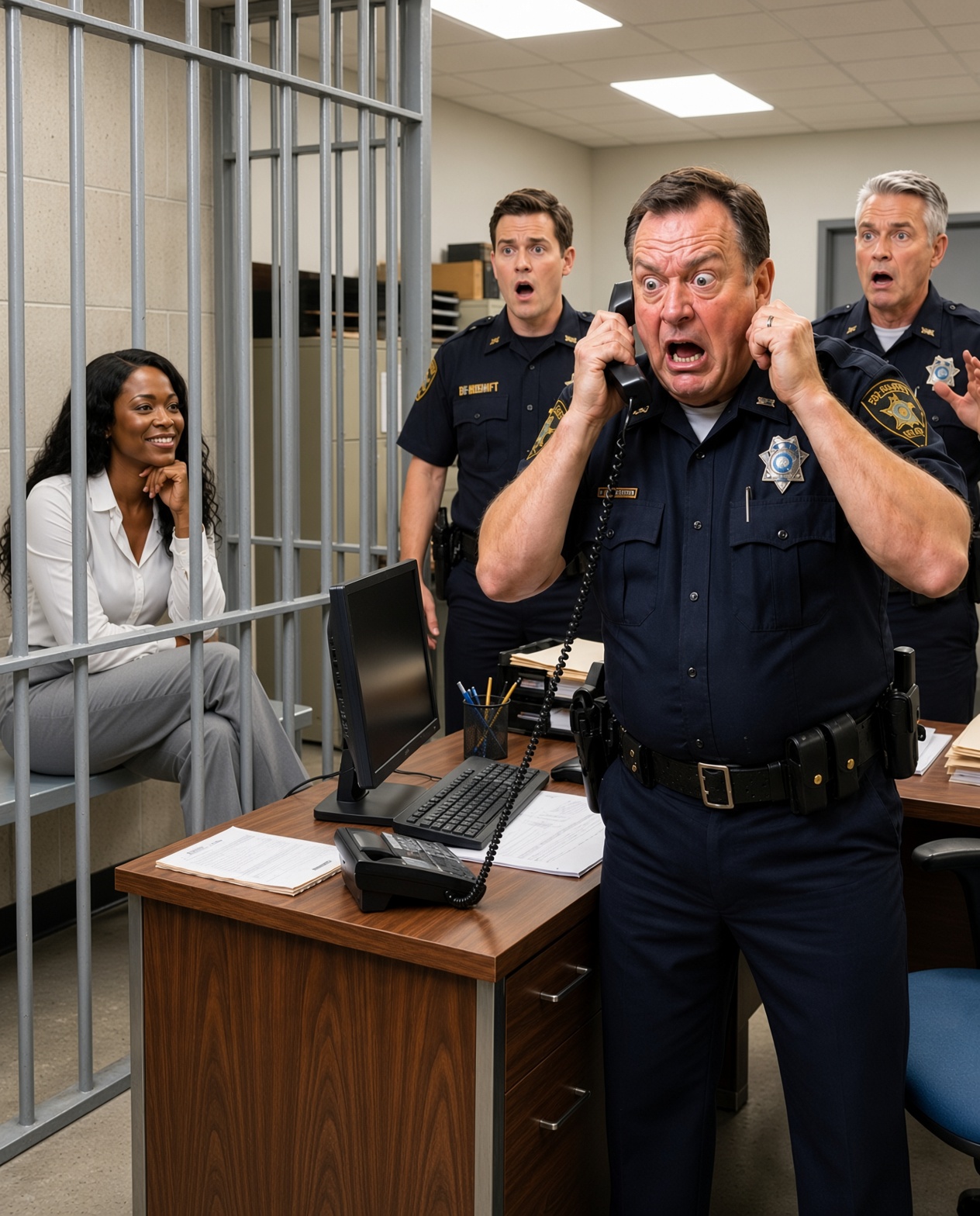
He arrested her for asking one too many questions. 90 minutes later, a satellite line from the White House situation room was ringing on his desk. And what came after that call didn’t just end his easy answers. It brought two black SUVs through his front gate before the hour was out. A phone doesn’t usually decide a man’s career, but at 4:52 on a Tuesday afternoon in the county, one phone call did exactly that.
And by the time this story is over, you’ll understand something most people never learn about how power actually moves in this country. quietly through channels you never see until suddenly you do. The sheriff had run the county for 11 years the way his father used to run a hardware store. By feel, by habit, and by the conviction that he knew his town better than any rule book did.
The county wasn’t big. just under 9,000 people, one stoplight that actually mattered, and a courthouse square with an old oak tree the town council argued about every few years, whether it needed trimming, whether the roots were cracking the sidewalk, whether it should come down entirely. The sheriff liked things predictable.
He liked knowing who belonged where, and he liked it when Tuesdays looked like every other Tuesday. At 12:15 that afternoon, a woman walked into the county records office to request a certified copy of a property deed. She was 41, wore a charcoal blazer, carried a slim leather folio under one arm, and spoke the way people speak when they have spent years in rooms where imprecision cost people money and sometimes their freedom.
She did not raise her voice. She did not need to. Her voice already carried the flat, unhurried authority of someone used to being listened to the first time. The clerk behind the counter told her the deed request needed a supervisor’s signature because the property in question, a 12 acre parcel on the county’s eastern edge, tucked against a stand of pine along Route 9, had a title dispute flag attached to it.
The attorney asked reasonably what the flag meant and how long resolving it would take. The clerk didn’t know. She paged the office supervisor. The supervisor was at lunch. 15 minutes passed. The attorney asked again, this time noting politely but plainly that she had a flight to catch that evening out of the regional airport 40 minutes away and she needed the document today, not tomorrow.
That detail is worth remembering because it’s the hinge the whole story turns on. In property law, a title dispute flag isn’t decoration. It means a lean, a boundary claim, or as it would later turn out, a federal interest attached to the land. Clerks are trained to escalate those, not release the records without sign off.
The clerk was doing her job correctly. The problem was what happened next. The young deputy, 26 years old, 2 years on the job, was posted near the front lobby that afternoon on general duty, the kind of shift that mostly meant standing near the flag pole and nodding at people he half recognized. He heard the attorney’s voice rise, not into a shout, just into the firmer register of someone repeating a request for the third time, and he walked over.
He asked her to lower her voice. She said she wasn’t being loud. She was being clear and she would like to speak to whoever was in charge. The deputy later told investigators he felt she was escalating and not cooperating with instructions. He asked for her ID. She provided it without hesitation. He ran her name.
Nothing came back except a valid driver’s license. District of Columbia. No wants, no warrants, no flags of any kind on the system he had access to. Here is where the county’s own paperwork becomes useful because it is not a distraction from the real story. It is the real story. Under the county’s disorderly conduct ordinance, an officer can detain someone for disruptive behavior in a public building, a vague standard that hands enormous discretion to whoever happens to be holding the badge that day. The deputy used it. He told the
attorney she was under arrest for being uncooperative and creating a disturbance. She asked him calmly, almost clinically, to state exactly which law she had broken. He didn’t answer. He didn’t have an answer because the ordinance was written broadly enough that no one had ever needed to write down the actual elements of the offense before.
She was cuffed in front of six other people waiting in line, walked out through the lobby, and booked into the county jail by 3:40 p.m. Her folio never made it into the property log. Nobody thought to ask what was in it. The sheriff wasn’t there for the arrest. He heard about it the way he heard about most bookings, a name on a log he glanced at during his afternoon rounds, one line among a dozen others.
He saw the booking name and the charge, disorderly conduct, disruptive behavior, and didn’t think twice. In 11 years, he’d approved bookings like this without a second look, maybe 400 times. This one would be different. And the reason had nothing to do with sympathy or apology or anything the sheriff could have anticipated from a glance at a booking sheet.
It had to do with something the sheriff didn’t know yet. Neither did the deputy. Neither did the clerk at the front counter. The attorney worked for the office of the White House counsel, not as a political appointee whose name showed up in press releases, but as career counsel embedded with the National Security Council’s legal staff.
The kind of job where your name never appears anywhere public, but your signature ends up on documents that quietly hold the architecture of the country together. The 12 acre parcel she had come to check wasn’t personal business. It was tied to a federal easement review connected to a communications relay site the government had used quietly for decades.
The stand of pine trees 8 mi outside town that most of the county’s residents assumed was nothing more than an old radio tower with a chainlink fence around it. It was not an old radio tower. It was one of a small number of hardened encrypted relay nodes in a strategic communications backbone. A facility so unremarkable looking from the county road that the government had spent decades making sure it stayed that way.
The 12 acre parcel sat directly over the buried fiber conduit that fed it. A boundary dispute on that parcel wasn’t a nuisance. It was a question of who could legally set foot on the ground above a piece of national infrastructure most of Washington had never heard of and never would.
The attorney had told no one at the records office who she worked for. She hadn’t been protecting a secret so much as following a habit. In her experience, flashing a title rarely gets you better treatment from a records clerk. It gets you slower treatment out of caution or resentment or simple bureaucratic self-preservation. She wanted the deed copy.
She did not want a scene. But when the deputy cuffed her, her first move once inside the jail wasn’t to demand release. It was to ask quietly whether she could make one phone call and to state the time out loud for the record, the way people trained in law are trained to do almost reflexively, the way another person might glance at a clock without thinking about it.
She used that call to reach her office’s duty desk, a rotating administrative line that exists for exactly one purpose. So that when someone on NSC legal staff is detained or otherwise unable to perform official functions, someone finds out fast. It is not a hotline for personal favors. It is a compliance mechanism, dry and procedural, built to be boring on purpose.
If federal personnel connected to protected infrastructure are detained, that detention itself becomes something the government needs to understand quickly because it could mean anything from a local misunderstanding to something considerably worse. The duty officer who picked up didn’t know the attorney personally, but she knew the protocol cold.
She logged the call, the time, the location, and the nature of the attorney’s work that day. Then she did something the protocol also required. And this is where the county’s Tuesday afternoon stopped being a small story. At 12:15, the attorney had checked in with her office before entering the records building, as federal personnel working near flagged infrastructure sites are required to do.
At 3:40, she had missed her scheduled 3:30 check-in. By 3:55, with no response to two follow-up calls to her cell, which, unbeknownst to her, had been powered off and placed in an evidence locker along with her folio. The duty desk escalated. Not to a shrug, not yet to a crisis, but high enough that a security tier 3 protocol quietly activated.
Unaccounted for federal personnel, last known location adjacent to protected infrastructure, no confirmed contact. The kind of designation built to cover the space between probably nothing and possibly very bad. kidnapping, coercion, compromise of sensitive material, or simply a very bad afternoon. 99 times out of a 100, Tier 3 resolves in under an hour with an apologetic phone call and a closed file.
This wasn’t going to be the hundth time exactly. But it also wasn’t going to be a shrug. By 4:15, the flag had reached the situation room’s watch team. Not because the attorney was famous, not because anyone believed this was sabotage, but because any incident touching a federal easement site with an unaccounted for staff member gets triaged fast as a matter of routine caution.
The same way a bank flags an unusual transaction before anyone knows if it’s fraud or just a large purchase. At 4:52 p.m., the phone rang on the sheriff’s desk. His assistant picked it up, listened for three full seconds, and went very still in a way the sheriff noticed from clear across the room. The particular stillness of someone realizing the call in her hand is not the kind she is used to fielding.
She put the caller on hold and said in a voice pitched lower than usual, “Sheriff, it’s the White House. They’re asking for you by name.” The sheriff laughed, assuming it was a prank one of the deputies was running. the kind of stunt more than one of them had pulled before. He picked up anyway, mostly to enjoy calling their bluff.
The voice on the other end didn’t shout. It didn’t threaten. It was calm in a way that made the hair go up on the back of his neck faster than shouting would have. It asked three questions evenly, one after another. Did the county currently have a woman matching that description in custody? What was she charged with? And had anyone informed her of her right to counsel and to a phone call within a reasonable time of booking? The sheriff answered the first two without hesitation.
Yes, disorderly conduct. On the third question, he hesitated because he genuinely didn’t know, and the silence on his end lasted maybe two seconds too long. That hesitation told the caller something important before the sheriff said a single word out loud. “Sheriff,” the woman on the line said, and he would remember afterward that her tone never changed, not once through the entire call.
I’m going to need you to treat the next 90 minutes very carefully. I’m not asking you to release anyone. I’m asking you to get me accurate answers. And I’m asking you to preserve every document connected to this booking exactly as it exists right now. Nothing gets shredded, nothing gets rewritten, nothing gets cleaned up.
Do you understand? The sheriff said he understood. He did not yet fully understand what he was agreeing to. That’s where we’ll leave it for a moment because what the sheriff did in the next 90 minutes would either save his career or end it. And the answer wasn’t obvious to anyone in that building, including him. The sheriff hung up the phone and did something his father, the hardware store owner, used to tell him mattered more than instinct ever did.
He asked for the paperwork before he asked for opinions. He pulled the booking sheet, the deputy’s arrest narrative, and the front desk log from the records office. three documents, three different accounts of the same 20 minutes, and none of them lined up cleanly. Which, if you’ve ever worked in any kind of oversight role, is usually the first sign that something got mishandled, not that something sinister happened.
Sinister and sloppy look almost identical from a distance. They are not the same thing, and figuring out which one you’re dealing with is the entire job. The deputy’s narrative said the attorney had repeatedly refused verbal instruction and raised her voice in a manner deemed disruptive to office operations.
The clerk’s front desk log, which nobody had thought to pull until the sheriff asked for it directly, told a planer story. A customer asking three times with increasing but restrained firmness why a routine deed request was being delayed. and a deputy who intervened before the office supervisor, the person actually authorized to resolve the holdup, had even returned from lunch.
There was no record of the attorney threatening anyone, touching anyone, or refusing to comply with a lawful order because no lawful order had actually been given. She’d been arrested for asking a question a fourth time. The sheriff walked back to the holding area himself, which he almost never did. That was normally a job for the shift sergeant.
He found the attorney sitting upright on the bench. Folio still nowhere near her because it had gone into evidence. Watch still on her wrist because nobody had thought to take that too. Calm in the specific way people are calm when they’ve decided that outrage would cost them more than patience would. He introduced himself. She didn’t stand.
Sheriff, she said, “Before you say anything else, I’d like to know the exact statute I was arrested under. I’d like it in writing.” It was a simple request. It was also, the sheriff realized, standing there, a request nobody in his department had ever needed to answer precisely before, because the ordinance they’d used was so broadly worded that no one had ever needed to write down its actual elements.
Here’s the twist worth sitting with, because it isn’t the twist the premise implies. The situation room hadn’t called to threaten the sheriff or to spring the attorney loose through raw political muscle. That’s not how the system is built to work, and pretending otherwise would be lying to you.
The call existed because federal personnel connected to protected infrastructure sites are required by policy to have their detentions reviewed quickly, not to override local law enforcement, but to determine whether an incident was ordinary police business or something that touched national security. The duty officer on the other end of the sheriff’s first call wasn’t there to intimidate a small town sheriff.
She was there to ask pointed procedural questions and document the answers. Because that documentation itself becomes part of a record that protects everyone, the officer, the county, and the person detained if this ever became a bigger problem than a single mishandled arrest. That’s the useful thing to understand if you’ve never thought about it before.
When someone with a federal role gets swept into a local incident, the government’s first move usually isn’t a rescue mission. It’s a records check. The sheriff’s hesitation on the phone, not knowing whether the attorney had been read her rights to counsel and a phone call within a reasonable time of booking, was the detail that mattered most because it wasn’t about who she was.
It would have mattered exactly as much if she’d been a school teacher or a mechanic. The situation room’s call didn’t create a double standard. It exposed one that was already sitting quietly inside the county’s booking procedures, waiting for nobody outside the building to be watching. The sheriff was three sentences into telling the attorney he intended to sort this out personally when the assistant appeared in the doorway of the holding area.
And this time, she didn’t bother lowering her voice. Sheriff, you need to come to the front now. At 5:15 p.m. exactly, the sheriff would check the wall clock later and confirm the time down to the minute because it was the kind of detail a man remembers about the worst afternoon of his professional life.
Two black SUVs came through the gate at the front of the county sheriff’s office and stopped at angles across the visitor parking, blocking both exits without appearing to try particularly hard to do it. Six agents came out. windbreakers, no county markings. The kind of calm, unhurried efficiency that comes from people who have done this before and expect to do it again.
The lead agent, a woman in her 40s with silver threading through dark hair, walked in first and said a federal credential on the front counter without breaking stride. A federal credential? Homeland Security Investigations. I’m looking for whoever’s in command of this facility, she said. not loud. She didn’t need to be.
The sheriff came out from the holding hallway at a near jog. The assistant a half step behind him and found his lobby, the same lobby where the attorney had been cuffed in front of six strangers 3 hours earlier, now occupied by four federal agents in a loose perimeter around the front desk with two more posted at the exits. I’m the sheriff. This is my department.
Homeland Security Investigations. We have a report of unaccounted for federal personnel with a last confirmed location inside this building adjacent to a designated infrastructure site. Until I have eyes on confirmation and a full chain of custody for her personal effects, I need this facility’s booking and evidence areas secured.
That’s not a request, Sheriff. That’s protocol, and I’d rather do it politely than not. It’s worth pausing here because this is the part of the story people tend to imagine wrong. The federal agents team hadn’t come to arrest anyone, hadn’t come to seize the building, hadn’t come waving anything resembling the kind of blanket authority true crime shows like to invent for federal agencies.
What they had was a narrow specific mandate. Confirm the attorney was alive, unharmed, and in possession of her faculties. Confirm the chain of custody on anything she’d been carrying. and determine fast whether the county was dealing with an unlucky misunderstanding or something that needed to go a great deal further up the chain.
The sheriff, to his credit, didn’t posture. He’d been a sheriff long enough to know the difference between a fight worth having and one that would only make a bad afternoon catastrophically worse. “She’s here. She’s fine. I was walking back to speak with her when my assistant came to get me.
Then let’s go see her together,” the federal agent said. and sheriff, I’ll need every document connected to this booking within reach. Nothing leaves this building. Nothing gets copied off site. Nothing gets corrected before I’ve seen the original. It was the second time in 25 minutes someone had told the sheriff in almost identical language to touch nothing.
He was starting to understand that the instruction wasn’t paranoia. It was procedure. The same instinct that made the attorney announce the time out loud when she made her one phone call. In a system like this, the paper trail wasn’t a formality. It was the entire point. They walked back together. The attorney stood when she saw the federal agent, and something in her shoulders, held rigid and controlled for 3 hours, eased by perhaps 10°.
You’re later than I expected, the attorney said, dry, and the federal agent allowed herself something close to a smile. Traffic on the interstate. I’ll file a complaint. Then, professional again. Talk to me. Are you hurt? Coerced? Anyone touch you beyond the arrest itself? I’m fine. Frustrated, but fine.
The sheriff has been reviewing the arrest report against the front counter log. I think he was about 2 minutes from agreeing with me that this was a mistake. I was 3 minutes from that, the sheriff said. I’d gotten to two of three questions. The federal agents eyes moved to him, assessing, and something in her posture shifted from confrontational to merely watchful.
Then let’s finish the third. The third question was the one that turned a bad afternoon into something closer to a genuine crisis, and it started with a filing cabinet in the evidence room. When the deputy had processed the attorney’s arrest, he had by procedure inventoried her personal effects, phone, keys, wallet, and the slim leather folio she’d been carrying since 1215.
What the deputy didn’t know, what nobody at the county sheriff’s office had any way of knowing, was that the folio wasn’t an ordinary document case. It was a secured federal courier case, the kind issued to personnel who occasionally need to physically transport material too sensitive to send digitally, even over classified channels.
It carried a biometric anti-tamper mechanism built into the lock. Open it with the correct thumbrint in the correct sequence and nothing happened. force it, pry it, or run it through anything other than its intended release procedure, and it silently transmitted a tamper alert to a monitoring system 3,000 m away. No siren, no flashing light, nothing a person standing next to it would ever notice.
The deputy, young, embarrassed, and increasingly aware over the course of the afternoon that he’d made a serious mistake, had gone looking for a way to quietly make the whole situation smaller before his sergeant found out how badly he’d handled it. He’d pulled the folio from the evidence locker at 4:40, 12 minutes before the first situation room call reached the sheriff’s desk, meaning to log its exact contents properly, in his words later, so the paperwork would look cleaner if anyone asked.
He didn’t know what he was holding. He tried the clasp. It didn’t open the way a normal folio would. He tugged harder. At the exact moment the federal agents team was pulling through the front gate, 3,000 mi away, a monitoring terminal lit up with an anti-tamper alert on a courier case assigned to NSC legal staff at a location already flagged tier 3 for an unaccounted for staff member.
To the systems reading that signal, it didn’t look like a nervous deputy trying to cover his own mistake. It looked like exactly what the protocol existed to catch. possible attempted access to sensitive material connected to a person who was, as far as anyone 3,000 mi away knew, still unaccounted for.
The federal agents phone buzzed while she was still standing in the holding area with the attorney and the sheriff. She read it once and her expression didn’t change, which was somehow worse than if it had. Sheriff, she said, who else besides your booking officer had physical access to the evidence locker in the last 20 minutes? The sheriff felt something cold settle in his stomach before he even had the answer.
The deputy processed the booking. “I need him in this room in the next 60 seconds,” the federal agent said. “And I need to know exactly what he did with a leather document case that was logged into your evidence locker at 3:45 this afternoon.” The deputy came into the holding area white-faced, having clearly understood in the last 5 minutes that his afternoon had gone somewhere far beyond a disciplinary writeup.
He was holding the folio clasp still stubbornly shut in both hands like something that might go off. “I didn’t take anything,” he said before anyone asked. “I was I was trying to inventory it. I couldn’t get it open.” “You tried to force the lock,” the federal agent said. “It wasn’t a question. I tried the clasp. It wouldn’t. It’s not a clasp, Deputy.
It’s a biometric release and forcing it just told a federal monitoring system in real time that someone was attempting unauthorized access to a secured courier case connected to an unaccounted for federal employee at a site adjacent to protected infrastructure. The federal agents voice hadn’t risen at all.
And that more than shouting ever could have was what made the deputy’s hands start visibly shaking. Put it down on the table now. Don’t touch it again. He did. The sheriff watched the young deputy’s career flash across his own face in real time and felt something that was not quite sympathy and not quite anger. Something closer to recognizing all at once exactly how far one afternoon’s shortcut had traveled.
It was at that moment 5:32 p.m. that the sheriff’s desk phone rang for the second time. The assistant answered it in the hallway and came half running to the holding area doorway, phone in hand, face pale. Sheriff, it’s them again. Same office. They’re asking for you and they specifically asked that you put it on speaker. They said, she swallowed.
They said the federal agent needs to hear this, too. The sheriff took the phone. His hand, he would admit much later, was not entirely steady. He hit the speaker button and set the phone on the evidence table next to the folio no one was touching. This is the sheriff. I have the federal agent with Homeland Security Investigations here with me along with the attorney.
The voice on the line was different this time. A man older, unhurried in a way that somehow carried more weight than volume ever could. Sheriff, this is the White House situation room. I’m going to speak plainly because I understand your evening has gotten complicated in the last 20 minutes. We have a confirmed tamper alert on a secured item belonging to the attorney originating from your facility 12 minutes before your first contact with our office.
I need three things confirmed on this line right now for the record. Everyone in the room went still. First, is the attorney present, unharmed, and speaking freely? I am, the attorney said, leaning toward the phone, unharmed, speaking entirely freely. Second, has the item in question been opened by anyone at any point since it entered your custody? The sheriff looked at the deputy.
The deputy looked at the floor. “No,” the sheriff said. “It has not been opened.” A deputy attempted to access the clasp without authorization and triggered what I now understand was a tamper alert. The case itself remains closed and unopened. A pause on the line, not long, but long enough that the sheriff understood someone was writing that answer down verbatim.
Third, sheriff, I need you to understand this clearly because what you do in the next few minutes determines which direction this evening goes. You currently have an agent from Homeland Security Investigations in your building conducting a welfare and custody verification. That is a courtesy extension of cooperation between agencies, not a seizure of your facility.
But the attempted access to a secured federal item inside your evidence locker is a separate matter, and it is serious enough that it will be reviewed independently of the underlying arrest, regardless of how the arrest itself gets resolved. Do you understand the distinction I’m drawing? I do, the sheriff said, and he did with a clarity that made his stomach turn over.
The attorney’s arrest could still potentially be walked back as a bad judgment call by a young deputy. What the deputy had just done to that case was a different animal entirely, one that didn’t care about anyone’s intentions. Good, the voice said. Then here is what happens next. You have 10 minutes, sheriff.
In 10 minutes, I need the attorney released from any restraint, her personal effects, including the item in the evidence locker unopened and untouched. returned to her directly and a complete unaltered copy of every document connected to this booking handed to the federal agent for the record. Not summarized, not explained, handed over as it exists right now before anyone in that building has time to reconsider what any of it should say.
The sheriff’s eyes went to the wall clock 534. 10 minutes, the voice repeated. After that, Sheriff, this stops being a conversation between your office and mine, and it becomes a formal review that I promise you will take a great deal longer than 10 minutes to close. I’d rather it not come to that. I suspect you would, too.
The line went quiet, waiting. The sheriff looked at the clock, then at the deputy, still staring at the floor, then at the attorney watching him with an expression that wasn’t triumph. It was something closer to patience. the specific patience of someone who has seen this exact 10 minutes play out before and already knows roughly how it ends.
Then at the booking sheet, still sitting on the counter where he’d left it 20 minutes ago, three documents that didn’t line up cleanly, and the plain unglamorous truth sitting underneath all of it. There had never been a crime here. There had been a records clerk following procedure, a supervisor who’ taken too long at lunch and a deputy who had mistaken persistence for defiance.
And then, in trying to cover that mistake, had turned a bad afternoon into something that would follow him for years. The sheriff turned to the assistant, “Get me the release forms, all of them.” Now, the clock on the wall read 5:35. He had 9 minutes left and for the first time since 4:52 that afternoon, the sheriff understood exactly what he needed to do with them.
The assistant was back inside 90 seconds with a clipboard, and the sheriff signed the top line before he’d even finished reading it, a decision his father would have called reckless. And his 11 years as sheriff told him was exactly right. Some documents you read twice, some you sign because every second you spend rereading them is a second you don’t have. He turned to the federal agent.
I want you photographing every page before it leaves this room. Booking sheet, the deputy’s narrative, the front counter log, the evidence intake form for the folio. All of it exactly as it exists right now before I touch a single line of it. The federal agent was already moving, a small camera out of her jacket pocket, working fast and methodical down the counter. Good instinct, Sheriff.
It’s not instinct. Somebody on the phone twice now has told me not to let anyone in this building clean up the paperwork. I’m starting to understand why. Behind him, the deputy made a small sound that wasn’t quite words. The sheriff turned. Deputy, step outside the holding area. You’re relieved of duty for the remainder of the shift, effective now.
Don’t touch anything else. Don’t talk to anyone about what happened here today until I’ve spoken with you directly. Do you understand me? Sheriff, I didn’t mean to. I know you didn’t mean to. That’s not the same as it not mattering. Outside now, the deputy went. The sheriff watched him go with the particular ache of a man who remembered being 26 himself and remembered too that remembering it didn’t fix anything.
He turned back to the table where the folio sat exactly where the deputy had set it down. Still closed. Still, as far as anyone could tell, unopened. The attorney hadn’t taken her eyes off it since the second phone call ended. “6 minutes,” the federal agent said quietly, not looking up from her camera. The sheriff pulled the release order from the clipboard, walked it to the small holding cell at the end of the hallway, though by then the attorney had never actually been locked back inside it, having spent the last hour in the open holding area
rather than behind bars, a detail the sheriff would later be grateful his own procedures had allowed for, and signed the second and third lines. Charges dismissed, property to be returned in full, chain of custody documented. He didn’t ask anyone’s permission because for the first time all afternoon, permission wasn’t the thing standing in the way. Paperwork was.
And paperwork, unlike everything else that had happened that day, was something he actually knew how to move fast. He turned to the attorney. Your effects are yours the moment the federal agent has finished documenting them. I’m not going to pretend the last 3 hours didn’t happen.
And I’m not going to pretend an apology fixes it, but you’re free to go effective now. And I intend to make sure the record shows exactly why. The attorney studied him for a long moment, long enough that the sheriff understood she was deciding something about him. Weighing 11 years of easy assumptions against 9 minutes of scrambling paperwork and hadn’t yet reached a verdict.
4 minutes, the federal agent said. Then let’s not waste them, the attorney said. And for the first time since 3:40 that afternoon, something like the beginning of a truce moved across her face. The phone on the counter rang a third time at exactly 5:43 p.m. 1 minute to spare.
The sheriff didn’t wait for the assistant. He crossed the room himself and hit the speaker button. This is the sheriff. The attorney has been released. Her personal effects, including the item from evidence, are being returned to her directly and documented in real time by the federal agent. Every original document connected to this booking is being photographed before anything is copied or altered.
The deputy involved has been relieved of duty pending a full review. There was a pause on the line, brief and unreadable. Sheriff, the voice said finally. That’s noted and appreciated. For what it’s worth, and I understand it may not feel like much right now. Most of the calls I make on this line don’t go this well. Most sheriffs spend their 10 minutes arguing with me about jurisdiction instead of pulling paperwork.
With respect, the sheriff said, “I didn’t do this because you called. I did it because when I actually read what my own department wrote down, there wasn’t a crime here. There was a records clerk following procedure, a supervisor who took too long at lunch, and a deputy who mistook persistence for defiance.
” That would have been true whether your office ever called or not. Another pause, and this one, the sheriff thought, sounded almost like respect. Understood, sheriff. The federal agent will remain on site to complete the verification and take a full statement regarding the evidence room incident. That part isn’t over.
But the part involving the attorney’s detention, that part you handled correctly eventually, and I want that on the record, too. The line went dead. The sheriff set the phone down and looked at the clock. 5:44 p.m. 92 minutes, almost to the second since it had first rung. The attorney stood in the middle of the holding area. her folio back in her own hands, unopened, its clasp still sealed exactly the way it had left the vault that morning.
Her phone powered back on and already buzzing with the backlog of a very bad afternoon, and looked at the sheriff with an expression that wasn’t quite forgiveness, but wasn’t nothing either. “I still have a flight to catch,” she said. “Then let’s get you that deed copy,” the sheriff said. “And let’s get it right this time.
” Behind them through the front windows, the two black SUVs still sat angled across the parking lot, engines idling, waiting. Not to take anything further from the county, the sheriff understood now, but simply to make sure that what needed to be documented got documented before the evening was over. It was, he thought, a strange kind of mercy.
The government hadn’t come to punish him. It had come to make sure the paperwork couldn’t quietly disappear. That thought would stay with him long after the SUVs pulled away because the harder conversation, the one about what the young deputies 90 seconds with a locked folio had actually triggered, was only just beginning.
The federal agent didn’t leave when the SUV’s engines kept idling in the lot. She moved her operation into the small conference room off the booking hallway, spread three folders across the table, and asked the sheriff to sit down across from her the moment the attorney had stepped outside to finally return the string of missed calls on her phone.
I want to be straight with you about something, sheriff, because you handled the last 90 minutes better than most people in your position would have, and you’ve earned a straight answer. The federal agent opened the thinnest of the three folders, and inside was a single page, mostly redacted, with a diagram of a rectangular parcel bordered in red.
That 12acre lot on the county’s eastern edge. You’ve driven past it. Everyone in this town has driven past it. It’s not an old radio relay. I gathered that much in the last hour. The sheriff said, “It’s a hardened node in a strategic communications backbone. encrypted relay infrastructure, buried conduit, redundant power, the kind of site that’s boring on purpose.
Because boring is what keeps people from asking questions about it. The attorney’s office has been quietly running an easement review on that parcel for the better part of 8 months because the title history has a gap in it from the 1980s that nobody’s managed to fully resolve. A gap that matters a great deal more than it would on an ordinary 12 acres of pine trees.
The sheriff sat with that for a moment. So when my deputy arrested a federal attorney doing due diligence on a piece of land next to a classified facility and then tried to force open a locked case she was carrying an hour later. You understand the shape of it now? The federal agent said, “I’ll be honest, sheriff.
For about 4 minutes this afternoon, before I had eyes on the attorney and before I understood your deputy was simply panicking and trying to cover a bad arrest, my team was operating under the working assumption that we might be looking at an attempted compromise of that folio’s contents. Not a wild assumption given the timing. It just happened to be wrong.
What was actually in it? The federal agents mouth twitched. Not quite a smile. That’s above both our paygrades, Sheriff. and it’s going to stay that way. What I can tell you is that the case’s contents are intact. Its seal is intact, and the only thing your deputy actually managed to trigger was an alert, not a breach.
He’s very lucky about that distinction, though I don’t imagine it’ll feel lucky to him for a while. It won’t, the sheriff said it shouldn’t. He looked at the second folder on the table, still closed, and found himself asking the question he suspected he wasn’t supposed to ask and asked it anyway. How close did this actually come to going somewhere worse? Realistically, not the version you’d put in a press release.
The federal agent considered him for a moment, the way a person weighs how much honesty a stranger has actually earned in the space of 2 hours. Realistically, for about 4 minutes, from the second that tamper signal hit our monitoring desk to the second I had eyes on the attorney standing upright and speaking in full sentences, my team was working three parallel theories at once.
One, that a hostile actor had used the arrest as cover to get physical access to the case. Two, that the attorney herself had been compromised and the arrest was incidental. Three, the boring one, the one that turned out to be correct, that a scared kid panicked and reached for the wrong locker at the wrong moment.
She tapped the folder without opening it. We don’t get to skip the first two theories just because the third one feels more likely. That’s not how this works. You run all three until the evidence rules two of them out. And today, the evidence did that fast. That’s the system functioning exactly as it should.
Not because nothing went wrong, but because when something did, the wrong assumption got killed off in minutes instead of hours. And if it had taken hours instead of minutes, then you’d have had considerably more than two SUVs in your parking lot tonight, Sheriff, and considerably less patience on the other end of that phone line.
You should know that. Not to frighten you, it’s over. And it resolved the right way. but because I don’t think you should walk away from tonight believing this was ever going to be a formality. No matter what your department did, it wasn’t. The next 90 minutes could have gone a lot of different directions. And the reason they went this one is that you kept reading the actual paperwork instead of arguing with me about jurisdiction.
The sheriff sat with that for a long moment, turning the empty folder over in his hands, even though there was nothing left inside it to read. The young deputy sat in the small interview room down the hall for 40 minutes before anyone came in to talk to him. And every one of those 40 minutes felt to him exactly as long as it was designed to feel.
When the sheriff finally sat down across from him, he brought nothing with him but a legal pad and 11 years of having done this exact conversation with other young officers. For smaller reasons, more times than he liked to count. Walk me through it, the sheriff said. Not the version you’d want in the report, the real one.
The deputy’s hands were still shaking a little. I heard her voice getting sharper. I thought, I don’t know what I thought. I thought she was about to make a scene, and I didn’t want it to turn into something bigger, so I stepped in before it could. Did she raise a fist at anyone, touch anyone, threaten anyone? No.
Did she refuse a direct lawful order? A long pause. She refused to lower her voice when I told her to, but she wasn’t she wasn’t shouting. I know that now. I think I knew it then, too, if I’m honest. And the ordinance you arrested her under. Can you tell me right now the specific elements of disorderly conduct under county code that her behavior satisfied? The deputy opened his mouth and then closed it again because he didn’t have an answer.
And both of them understood at the same moment that this this exact gap, the space between a law existing and a law being specific enough to actually apply, was the entire reason the afternoon had happened at all. I’m not going to pretend this is small. The sheriff said, “You arrested a woman for being persistent, not disruptive, and there’s a difference the law is supposed to protect, even when it’s inconvenient for the person holding the badge.
” That’s the first mistake, and it’s serious enough on its own. I know the second mistake is worse, and I want you to understand exactly why, because it’s not the kind of thing a writeup fixes. You went into an evidence locker alone, off the books, trying to make a bad afternoon look smaller before your sergeant saw it.
And in doing that, you triggered a federal tamper alert on a secured item connected to national infrastructure. For about four minutes this evening, a federal team was operating on the working theory that the county might have an attempted espionage incident on its hands. Because of you, because you panicked and reached for a shortcut instead of calling your sergeant and telling the truth.
The deputy’s face had gone the color of old paper. I didn’t know what it was. I swear to God, sheriff, I had no idea. I believe you. That’s not the point. The point is that not knowing what something is is exactly the reason you don’t touch it. That’s not a rule someone invented to make your life difficult. That’s the whole rule.
Full stop. And it exists precisely for afternoons like this one. The sheriff set the legal pad down. You’re suspended effective today, 5 days unpaid, pending a full review by both this department and Homeland Security Investigations regarding the evidence room incident specifically. That review is separate from anything involving the attorney’s arrest, and it isn’t mine to close.
Depending on what they find, it could end with nothing more than a formal reprimand in your file, or it could end considerably worse. I can’t tell you which, and neither can they yet. Am I going to lose my job? The sheriff considered the question honestly, the way he owed the kid an honest answer, even though the honest answer was that he didn’t know.
I don’t think what happened at the counter should end your career. People make that mistake. Assuming firm is the same as disruptive. More often than this county wants to admit, and firing you for it would make for a cleaner headline and a worse outcome. A young deputy would learn that mistakes end careers instead of learning that mistakes get corrected.
I’d rather you learn the second thing. He paused. The evidence locker though, that one isn’t mine to promise you anything about. That one’s real and it’s out of my hands. Now, what happens to it? The review, I mean, realistically. Realistically, it depends entirely on what their forensics say about your intent.
If they read it the way you just told it to me, panic, poor judgment, no plan beyond making your own report look cleaner before your sergeant saw it, that’s a serious personnel matter, and it’ll follow you. but it’s survivable. If they read it any other way, if there’s anything in that locker’s access log or your own history that makes them think this was something other than panic.
The sheriff stopped himself there because he didn’t think finishing the sentence would help either of them. That’s not something I control. That’s the honest answer, and I think you’d rather have the honest one than a comfortable one right now. The deputy nodded slowly, the shaking in his hands finally starting to still, less from relief than from the particular exhaustion of a person who has run out of ways to hope the last few hours might not be as bad as they clearly were.
I keep thinking about how fast it happened. Like there wasn’t a moment where I decided to do something wrong. It just happened one step at a time. And every single step felt small when I took it. That’s the part I need you to actually sit with. More than the suspension, more than the review. Every officer who’s ever done something they regretted tells me some version of that same sentence.
Nobody wakes up planning to make the mistake that ends their career. It’s always small steps that each felt reasonable in the moment. The only real defense against it isn’t better instincts. It’s slowing down enough to ask somebody else before you act. your sergeant, your training, the actual written policy instead of trusting the version of the situation you’ve built in your own head under pressure.
You didn’t do that today twice. The federal agents team spent the better part of 2 hours going through the evidence intake procedure, the locker’s access log, and the tamper alerts technical readout before she was willing to say out loud and on the record what the sheriff had already begun to suspect. This had been panic, not intent.
The forensic read is unambiguous, she told the sheriff and separately in a call placed directly to the situation room duty desk at 7:20 that evening. Attempted manual force on the clasp, consistent with someone trying to pry it open without understanding the mechanism. No indication of any tool more sophisticated than his own hands.
No prior contact between this deputy and anyone connected to the parcel’s title dispute. No financial irregularities in his background that would suggest anything beyond exactly what he told the sheriff. A young officer trying to cover up a bad arrest before his shift ended. So no espionage review.
The voice on the other end of the line said he wasn’t quite a question. No espionage review recommended from this office. I’d classify this as an unauthorized access incident stemming from procedural ignorance and poor judgment under pressure, not malicious intent or any connection to a hostile actor. My recommendation is that it gets handled to the county’s own disciplinary process with a formal note in the federal incident log closing out the tamper alert as resolved.
No further action required from this office. There was a brief pause. Understood. Thank you for the fast turnaround. I know it’s been a long evening for everyone in that building. It had been, but it was, the sheriff understood as he listened to that call end, exactly the outcome the entire process had been built to produce.
Not punishment for its own sake, not federal overreach into a county sheriff’s business, but a fast, careful sorting of panic from threat, so that a scared 26-year-old’s worst afternoon didn’t metastasize into something that followed him or the county for years on the strength of an assumption nobody had bothered to check.
By 7:45, the two black SUVs pulled out of the lot as quietly as they had arrived. The federal agent shook the sheriff’s hand at the door. For what it’s worth, sheriff, most of my calls end with a lot more shouting than this one did. You did the paperwork right, even under pressure. That matters more than people think.
It shouldn’t have taken a call from the White House to get me to actually read what my own department wrote down. The sheriff said, “No,” the federal agent agreed. “It shouldn’t have, but it did today, and today you did it anyway. That’s not nothing. She paused at the doorway, one hand on the frame, and looked back at him with something that had shifted over the last three hours from professional weariness into something closer to plain respect.
For what it’s worth, most of the sheriffs I meet on the worst day of their career spend the whole time trying to make the paperwork say what they wish had happened instead of what actually did. You didn’t do that. You let it say what it said, even when what it said made you look bad. That’s rarer than you’d think, and it’s the only reason tonight ends the way it’s ending instead of the way it could have.
Then she was gone, and the lot outside the front windows was empty, except for the ordinary shapes of the county at 8:00 on a Tuesday night. A scatter of parked cruisers, the flag hanging still in windless air, the old oak on the courthouse square somewhere beyond the glow of the parking lot lights, exactly where it had stood the whole time, indifferent to how close the afternoon had come to becoming something the county would still be talking about years later.
The attorney didn’t leave the county that evening without her deed copy. The sheriff walked her back to the records office himself at 6:20, found the supervisor, finally back from what had turned into a very long lunch, and visibly aware by then of exactly how long, and stood at the counter while the certified copy was printed, signed, and stamped cleanly, correctly, the way it should have happened 5 hours and one federal incident earlier.
The title dispute itself didn’t resolve on the spot. That would take another week, moving through the ordinary legal channels. It should have gone through from the start once the attorney’s office and the county’s own title records division sat down and untangled the decades old gap in the parcel’s history properly without an arrest or a tamper alert complicating anything further.
But before the attorney left for her flight, she said one more thing to the sheriff, standing in the parking lot with her folio, still sealed, still exactly as it had left the vault that morning, tucked under one arm. You did the right thing tonight eventually. I want to be fair about that, but I’d like you to sit with a question before you file this away as a strange Tuesday and move on. Go ahead.
How many people who walked into that records office before me asked the fourth question a little too firmly and didn’t have a duty desk at the National Security Council to call? How many of them just went home with a record now and no White House situation room ever dialed your number to check the paperwork? The sheriff didn’t have a clean answer for that.
To his credit, he didn’t reach for one. I don’t know. Neither do I, the attorney said. But I’d start finding out if I were you. She caught her flight with 11 minutes to spare. The sheriff spent the following morning doing something that made for a far less dramatic story than SUVs in the parking lot, but mattered considerably more in the long run.
He sat down with the county attorney and rewrote the disorderly conduct ordinance from scratch. The old language, disruptive behavior in a public building, had given the deputy and every deputy before him enough discretion to arrest almost anyone for almost anything, provided they could argue afterward that the person’s tone had crossed some line nobody had ever bothered to define.
The new language required a specific observable act. raised fists, property damage, a direct and credible threat, physical interference with another person’s ability to conduct business, a raised voice on its own, a repeated question on its own. Neither would satisfy the ordinance anymore, no matter how a deputy chose to characterize it in his report afterward.
It was a small bureaucratic fix. It was also the kind of fix that would quietly protect far more people than any single apology ever could because policies outlive sheriffs, and habits don’t change until the paperwork forces them to. The county attorney, a careful woman who had drafted half the ordinances the sheriff had spent 11 years enforcing without ever once questioning their wording, pushed back on him once during the rewrite.
And it was the push back that stayed with him longer than anything the federal agent or the situation room had said the night before. “You understand this cuts both ways,” the county attorney said, sliding the draft language back across the table. “Tighten the definition this much and you’re going to have deputies calling me in 6 months complaining that they can’t make an arrest they used to be able to make on a gut feeling.
” “That’s the trade you’re making. That’s the trade I want to make.” The sheriff said, “A gut feeling isn’t supposed to be enough to put someone in a cell. It shouldn’t have been enough yesterday, and it’s not going to be enough going forward, even when it’s inconvenient for whoever’s wearing the badge that day.
” You know, this doesn’t undo yesterday. I know it’s not supposed to undo it. It’s supposed to make sure the next version of yesterday needs an actual reason instead of an available excuse. He tapped the new draft’s second paragraph, the one requiring a specific observable act spelled out in language deliberately narrow enough that no deputy could stretch it to cover a raised voice or a repeated firmly worded question. Write it exactly like that.
If a deputy comes to you in 6 months upset that the law won’t let him arrest someone for being persistent, I want you to tell him that’s the point. The county attorney signed off on the final language 2 days later. It went into effect the following Monday, posted publicly on the county’s website alongside a short, plainly worded explanation of why it had changed.
No mention of the attorney by name. No mention of the SUVs or the folio or the 90minute countdown. Just a single sentence that the sheriff had insisted on including himself. This department is revising its disorderly conduct policy to ensure that firm, persistent, or repeated questioning by a member of the public is never on its own treated as grounds for arrest.
The records office got its own fix within the week. The clerk, still shaken by having watched a customer get arrested 6 ft from her counter for the crime of waiting too patiently, worked with her supervisor to draft a simple laminated card now posted at every window. standard processing times, what to expect when a document carries a flag, and who to ask for if a supervisor isn’t immediately available.
Nothing dramatic, just a future customer knowing what to expect instead of guessing in silence, and a future clerk having something firm to point to instead of an apologetic shrug. The clerk herself never quite shook the memory of that Tuesday afternoon, though she rarely spoke about it unprompted. Weeks later, training a new hire at the same counter, she found herself repeating something close to a rule of her own, one nobody had ever formally written down, but that she’d earned the hard way. If somebody’s getting
frustrated because we’re taking too long, that’s not them being difficult. That’s us being slow. Write down the time they started waiting so nobody has to guess later whether they were patient or not. It wasn’t policy. It didn’t need to be. It was the kind of thing that gets passed from one clerk to the next quietly, the way the real lessons from a bad day usually travel.
The young deputy suspension ran its full 5 days. The county’s internal review, running in parallel with, but formally separate from, the closed out federal incident, concluded that his conduct in the arrest itself constituted a serious lapse in judgment, warranting a permanent note in his personnel file and a mandatory deescalation and constitutional law refresher course before he could return to full duty.
The evidence locker incident, per the federal agents recommendation, closed with a formal written reprimand and a requirement that he complete a specific training module on the handling of items flagged as federally sensitive, a category the sheriff noted dryly in the closing memo that the county had exactly one deputy who now understood better than anyone else in the building.
The deputy wasn’t fired. The sheriff made a point in the small meeting where he delivered the outcome of explaining exactly why firing you would make for a cleaner headline. He said it would also make for a worse outcome. You’d learn that mistakes in careers instead of learning that mistakes get corrected and the next deputy who makes a version of your mistake wouldn’t have this file to look back on as a reason to slow down first.
He slid the closing memo across the desk. You come back in 5 days. You come back knowing exactly why the ordinance changed and exactly why that locker isn’t yours to open without asking. No matter how scared you are of what your sergeant’s going to say. Whether you actually learned that lesson for good, nobody can promise that, including you.
But the system around you just got a little less forgiving of the shortcut itself. and that more than any one person’s character is usually what actually keeps the next mistake from happening. The deputy sat through the review, admitted on the record that he jumped to an arrest instead of waiting for the supervisor, and admitted separately that he’d gone into the evidence locker alone specifically to make his own report look better before anyone else read it.
He came back to work 5 days later under a policy that no longer gave him the same shortcut to reach for in either direction. The federal side closed formally nine days after that with a two paragraph letter addressed to the sheriff’s office confirming that the tamper incident had been resolved as procedural error, no further federal action pending, and thanking the department for its cooperation in language so flat and bureaucratic that the sheriff read it three times before he let himself believe it actually said what it said.
He filed it in the deputy’s personnel folder himself behind the suspension notice in the training certificate from the deescalation course so that anyone who opened that file years later would see the whole shape of it, the mistake, the consequence, and the closing in that order, exactly as it had happened.
On the deputy’s first morning back, the sheriff found him at his locker before shift, going through his gear with a slowness that hadn’t been there before, checking his radio twice, reading the day’s briefing sheet all the way through instead of skimming it the way he used to. The sheriff didn’t say anything about it. He didn’t need to.
Some lessons show up in a person’s hands before they ever show up in what they say out loud. The attorney never spoke publicly about what happened in the county when a reporter from the regional paper caught wind of unusual activity at the sheriff’s office that Tuesday evening. Someone had inevitably mentioned the SUVs to someone else and tried to turn it into a bigger story than it was.
She declined the interview with a single line that the sheriff later found himself repeating to his own deputies during training sessions months after the fact. I don’t need anyone to be embarrassed. I need the next person to have an easier afternoon than I did. That’s the whole lesson really. Not that power protects the powerful.
The story would be a much simpler, much less honest one if that were the point. The point is that clear rules, honest paperwork, and someone willing to doublech checkck their own department’s work protect everyone. Whether or not a satellite line to the White House situation room ever rings on their desk on their behalf.
99 times out of 100, nobody’s watching. The clerk follows procedure or she doesn’t. The deputy waits for the supervisor or he doesn’t. The sheriff reads the actual report against the actual log before he signs off or he glances at a name on a page for the 400th time and moves on to the next line. Most people who get arrested for asking a question one time too many don’t have a duty desk at the National Security Council to call.
Most sheriffs never get a call at 4:52 on a Tuesday afternoon that forces them to actually check their own department’s work before it’s too late to matter. The system worked this time not because it’s designed to reach everyone. it isn’t. And pretending otherwise would be its own kind of lie. But because for 90 minutes on one particular Tuesday in one particular county, the paperwork happened to be fast enough and honest enough and preserved carefully enough to catch a mistake before it hardened into something permanent. The 12 acre
parcel’s title dispute resolved 11 days later through channels far less dramatic than the ones that had briefly put two black SUVs in a county parking lot. The attorney’s office and the county’s title records division sat down together, untangled the 1980s filing gap that had started the entire afternoon, and closed the file with nothing more dramatic than a corrected deed and a formal notation that no further boundary claims existed on the parcel.
The relay site behind the pine trees kept doing whatever quiet, boring, essential thing it had been doing for decades, unnoticed by nearly everyone who drove past the chainlink fence on Route 9, exactly as it was designed to be. The sheriff thought about that sometimes in the months afterward, how the most consequential afternoon of his career had ultimately protected nothing more dramatic than a buried conduit in a fence line.
And how easily it could have gone differently if he’d made a different choice in any one of a dozen small moments. If he’d waved off the first phone call as a prank and hung up. If he’d let the deputy quietly refile his report before anyone else read it. If he’d spent his 10 minutes arguing about jurisdiction instead of pulling paperwork, none of those choices would have felt in the moment like the kind of decision that ends a career or saves one.
They rarely do. That was the part that stuck with him longest. Not the SUVs, not the countdown, not even the voice on the speaker phone. just how ordinary every single decision point had actually looked, right up until it wasn’t. And in a small office at the county sheriff’s department, a new laminated procedure card sat clipped to the inside of the evidence room door, right at eye level, where nobody working a rushed booking on a Tuesday afternoon could claim they hadn’t seen it.
Before opening any secured or unidentified item taken into evidence, confirm ownership, confirm authorization, and when in doubt, ask first. It wasn’t a dramatic fix. It never made the news. But it was the actual lesson underneath the whole afternoon, the one that outlasted the SUVs and the countdown and the sealed folio that never once had to be open to prove exactly how much had been riding on it staying that way.
Most injustice doesn’t come from a villain twirling a mustache. It comes from vague rules, rushed judgment, and nobody bothering to check the paperwork until it’s almost too late to matter. Or if a county is lucky, until someone with exactly the right phone number checks it just in time. Officer Wesley Tener never roll handcuff.
He resign before the review can do. keep his pension, keep his certification and work away enough to try again in another countries. Serian Julian or say mood to a debt far from any checkpoint neither once confess what how it usually end and he just underneath the church sabrina lock one become a tenican open a fire a triangle bro his silent uh supervisor keep a note and lawyer send one letter to one at your agency pun and fony home.
So ask yourself what happened the person kiss to the floor when there no for camera when the party c miss the moment the story get clean and no trainer step forward most people do not get for angel and time st more people guess the report if this story matter to you sh so the next person in It’s like a little harder to bury every story on the channel if I wanting the moment just finally catch up and it’s always done.

