Flight Attendant Strikes a Black CEO—Then Discovers She Owns the Entire Airline and Loses Everything
Flight Attendant Strikes a Black CEO—Then Discovers She Owns the Entire Airline and Loses Everything
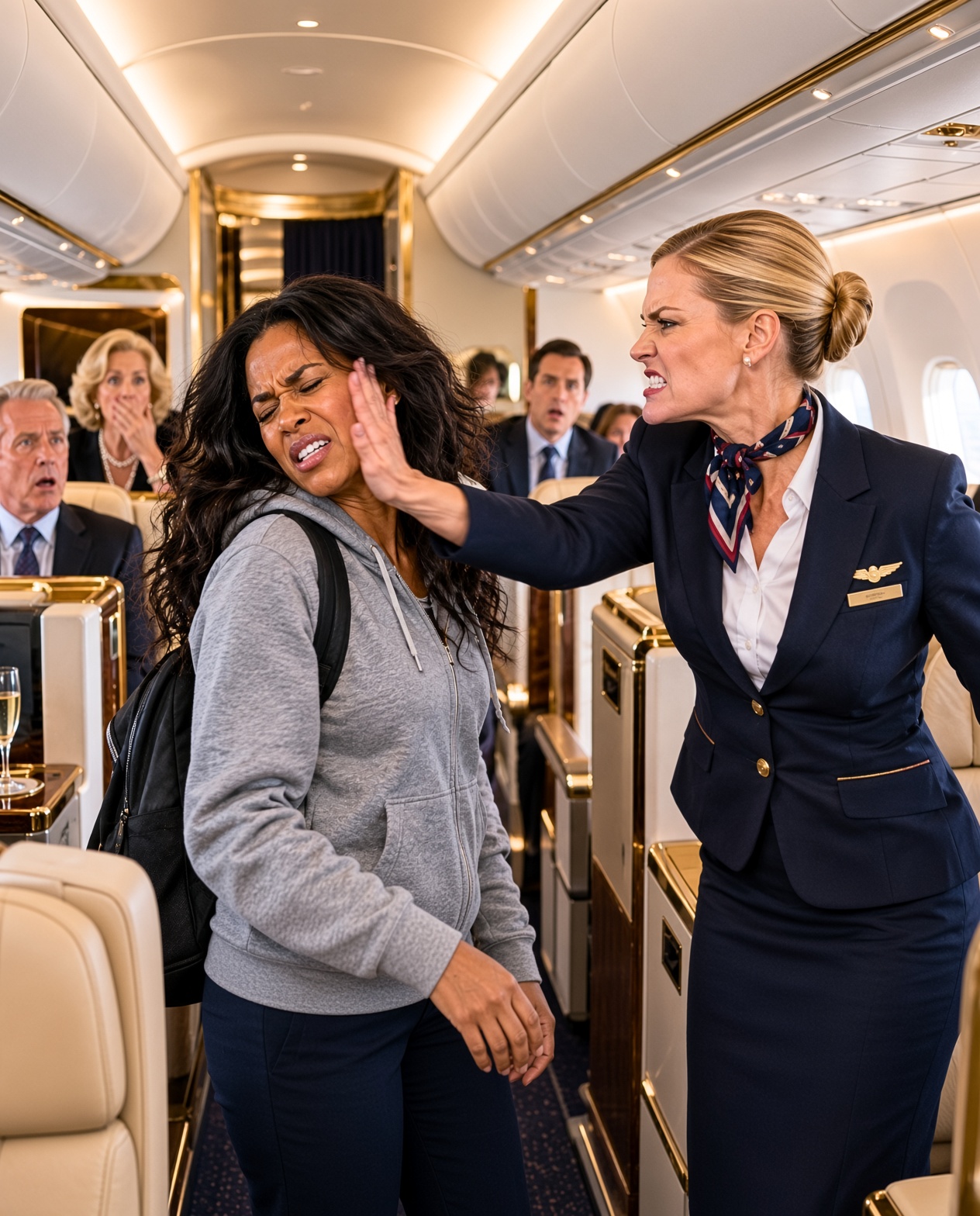
She didn’t look like someone who owned anything. That was the idea. Naomi Carter stood in the middle of Terminal 5 at O’Hare International Airport. A gray hoodie pulled over her ears, a worn canvas backpack slung over one shoulder, thick-rimmed glasses she technically didn’t need, perched on her nose. Around her, the terminal lived its usual life: a faint panic masked by efficiency, the smell of coffee in the air, the technical aftertaste of carpet cleaner, and that special kind of exhausting impatience that only comes from
airports. She looked like a graduate student or maybe a school teacher—someone completely unremarkable in the truest sense of the word. In reality, she was the sole owner of an airline whose logo was on every gate, every boarding pass, and every paper cup in the coffee shop 20 feet to her left. Six months ago, Naomi Carter completed the takeover of Skyreach Airlines—a legacy carrier that had been losing money for most of a decade—through a leveraged buyout that shocked the aviation industry.
At 40, she became the youngest CEO in Skyreach’s 60-year history. She also became the first black woman in this position. Headlines in the press called it a historic event, a success story, a bold step. She read them all and then went right back to work. Today’s work looked like this: flight SR 722 to Los Angeles, seat 24B, middle seat.
She chose it intentionally not because she liked discomfort, but because you can’t diagnose an illness from the outside. It was necessary to be inside. The flight was delayed. It’s been 40 minutes and it’s not over yet. The gate attendants—a young man named Danny and a woman whose badge she couldn’t read— looked nervous, like people who had been answering the same question to hundreds of different passengers for the past hour.
Their smiles were strained. Their answers were polite but devoid of any sincerity. Naomi watched them and took notes on her phone, on a regular app, nothing official. Understaffed at the exit, low morale, no support. She added a timestamp. Then she saw the stewardess. She emerged from the teletrap with the posture of someone who owned this entire corridor.
The blond hair was combed so tightly that it seemed part of the structure . Her Skyreach uniform was ironed out with such clarity that it looked almost aggressive. She moved like someone who had long ago decided that the fastest way to get through any room was to make everyone else give way. Her name tag, pinned on with the precision of a medal, read: Diane Hargrove, Senior Flight Attendant.
Naomi watched as she headed for the boarding gate. She was n’t going there to help. She went there to complain. “That’s just ridiculous,” she said to Danny. Her voice sounded low but confident, like that of someone used to being listened to. —The landing was supposed to start 12 minutes ago. We won’t make our connecting flight in Los Angeles unless these people start moving.
Danny shuddered slightly. —We are waiting for permission from technical service, Diane. He just arrived. We are starting the landing now. “Finally,” Diane muttered. She returned to the waiting area and her face completely changed. It was amazing to watch the irritation disappear , the jaws relax, and in their place a smile appears, so warm it could melt glass.
— Good morning, everyone. —she announced, her voice now sounding honeyed and bright. —We will begin the boarding process in a moment. Thank you very much for your patience today. Naomi didn’t look away. She watched this switch and classified it as what it was—a performance, calculated and rehearsed. The mask was put on and taken off with the ease of someone who had been doing it for decades.
The landing has begun. Diane took a seat at the entrance to the telegate, scanning her boarding passes. The first to approach was a man in a Tom Ford suit. “Mr. Dunbar,” she heard the agent at the exit confirm, “is a Platinum Medallion member, flying in seat 2A.” Diane’s smile reached her eyes. —Good morning, Mr. Dunbar.
Nice to see you on board again. Champagne will be waiting for you once you settle in. Dunbar was stunned. Diane beamed in response. A Latino family of four was next to the counter. Mother, father and two small children. The younger child was in a stroller that the father was folding with the barely noticeable panicked dexterity of a person folding a stroller in a thousand awkward places.
They were in the fourth group. They had their boarding passes ready. Diane’s smile evaporated. “ Group four,” she said dryly. You must wait your turn. You are blocking the passage. “I’m sorry,” said the mother, her English softened by an accent. We are with the child. “And everyone has their own circumstances,” Diane said, her voice devoid of any warmth, just the sharp efficiency of someone removing an obstacle.
Please step aside until your group is announced. The family moved back. The mother’s face had a special expression: not anger, not even surprise, but simply a calm recognition of something familiar. Naomi’s jaw clenched. She typed another note. Diane Hargrove, SR 722. Selective Service. Discriminatory behavior during boarding.
Hostility towards a family with a baby. Fourth group. Too kind to the first class. The time is fixed. The fifth group was called in 20 minutes later. Naomi joined the queue. Approaching Diane, she held out her boarding pass. Diane scanned him without looking up . Squeak. 24B, said Diane. Not as information, but as a verdict.
Middle chair . Make sure your carry-on luggage fits completely under the seat in front of you. We don’t have time to move things on the upper shelves today. ” Of course,” Naomi replied. Her voice was even. Collaborative. The voice of a person who has long learned to remain calm, even when his blood is boiling. Diane was already looking through it.
Naomi walked down the telescoping ladder onto the plane. She walked past the business class, the leather seats, the wide windows, the smell of fresh coffee already being poured, and continued on. Through the curtain, into economy class. She found seat 24B between a young woman in headphones, Lily Chen, a student in 24A, and a stocky man in a wrinkled shirt who had already taken up both armrests before the plane even pushed off . Gary Mitchell.
He looked like a man whose usual state was mild irritation. Naomi sat down, her knees close to the chair in front of her. The armrests are occupied on both sides, the top shelf above her row is already full. She took out a tattered paperback and opened it to a page she had no intention of reading. Outside the oval porthole window, the runway shimmered in the summer heat.
Ground services efficiently moved the equipment. One of the new narrow-body aircraft she had approved for lease in March was taxiing slowly to the far runway. It all belonged to her: the planes, the routes, the exits, the logo on the tail. She was also responsible for the problem she had just observed in action: landing with a smile that could light up a room or freeze it, depending on who was standing in front of it.
The cabin doors closed with a click under pressure. Flight SR 722 departed on a Chicago morning, and Naomi Carter turned a page she had n’t read and waited. After an hour of flight, a cart appeared. It was approaching from the front of the plane—a clanking aluminum tower of miniature bottles and plastic cups, pushed by Diane, followed by Kevin Walsh, the junior flight attendant, who moved with the careful, alert energy of a man who had figured out that the best way to survive working alongside Diane Hargrove was to stay half a
step behind her at all times. Naomi heard the cart before she saw it. A familiar clatter, the soft tinkle of ice, the hiss of a soda can opening, the rhythmic creak of one wheel needing lubrication. She put down her book and began to watch. Diane worked in the aisle with the focused efficiency of a surgeon . Exactly, quickly.
Her service in the rows ahead of Naomi was correct, though not warm. She filled the cups without spilling the liquid. She served things without waiting to be asked twice. She saved all her attention, eye contact, small jokes , and sincere smiles for the passengers she thought were worth it. A man in a Patagonia vest who mentioned his frequent flyer status, a woman in her 60s who addressed Diane by her first name.
These people received full service. Everyone else received only a formality. Diane reached the 24th row. She turned back to Gary Mitchell at the seat by the aisle. What can I bring you, sir? Gary didn’t take his eyes off his laptop. Diet Coke. A full can? Of course. Diane pulled out a can and a glass of ice with the smoothness that comes with years of practice.
Then she turned around, and her eyes didn’t stop at 24V at all. She looked straight at Lily Chen in seat 24A. And you, dear? Lily shivered slightly as she pulled out one earbud. Oh, just water, please. Thank you. Diane poured water, handed it to her, and began pushing the cart further. Naomi called out, Diane stopped.
She turned slowly, the way a person turns when they are already preparing a rebuttal before they hear a question. She had the expression of someone who had been interrupted in the middle of something important. “You missed me,” said Naomi. It wasn’t an accusation. It was an observation, expressed directly, in the same way that one might notice that a door was left open or a light was left on.
Diane looked at her for a long time, with that long pause that says, “I heard you and I’m deciding how much of my time this is worth.” What do you need? The word ” need” fell like a small weight on the table . Black coffee, please . Diane’s eyes moved to the cart, then back to Naomi. The coffee is over. Not anymore.
Can I offer a ginger ale, or… Naomi glanced at the cart. On the bottom shelf, in a prominent place, stood a full stainless steel carafe, the kind usually used for hot drinks. Its walls were still slightly fogged from the heat. “You have a full carafe there,” Naomi said. She pointed it out, not to be aggressive, but simply to state a fact.
Something changed on Diane’s face. A blush crept up from the collar, but it wasn’t embarrassment. Something much harder than him. Something closer to anger. She hated being corrected. She hated it with the deep intensity of someone who had spent 22 years building an authority that was not to be questioned. “That’s reserved for another salon,” Diane said, lowering her voice slightly, which was supposed to signal the end of the conversation.
It’s already distributed. Naomi paused. She let the words hang between them for a moment. Distributed. That’s right . “It’s just a coffee pot,” Naomi said. Her voice remained even. Curious, almost like the voice you hear when something doesn’t add up and you’re sincerely trying to understand why. I am the passenger who paid for this flight.
I would like a cup of coffee. The passengers in rows 23 and 25 fell silent. Not that they were openly looking. It was that cautious “non-look ” of people who have noticed something and pretend not to see anything. Diane leaned forward slightly, adopting the tone she used when she wanted to get her way without making a scene.
“I’m not going to argue with you ,” she said. The words were measured, but there was anger in their sound that contradicted every syllable. Do you want ginger ale or not? “No ,” Naomi replied. I do n’t want to. Perfectly. Diane pushed the cart forward sharply. Miniature bottles of alcohol shook and rang in a bright chaos of sounds, putting an end to this conversation, to which no one subscribed.
The cart moved on. Kevin Walsh, who had been standing two steps behind Diane the whole time, kept his eyes on the floor and remained silent. Naomi watched the cart disappear down the aisle. She leaned back in her chair and sighed. The paperback still lay open in her lap, on the same page she hadn’t finished reading. She picked up her phone and opened her notes.
Diane Hargrove, SR722, intentionally ignored passenger 24B during service. When this was pointed out to her, she stated that the full carafe was “distributed” . A blatant lie. Conflictive behavior in response to comments. The junior steward, Kevin Walsh, was present, silent. The time is fixed. She put the phone on her lap.
The coffee, which she never got, was the least interesting part of it all . What was really interesting was the architecture of this phenomenon. Accuracy in who was served and who was ignored. The speed of lies. The quality of anger when this lie was exposed. It wasn’t just a bad day. It wasn’t inattention or forgetfulness. It was a system.
And somewhere at 31,000 feet between Chicago and Los Angeles, this system has just made a very specific and very expensive decision about who Naomi Carter is. She closed the notes app. She turned a page in her book. She was waiting. An hour later she needed to go to the bathroom. First she turned to Gary Mitchell.
Excuse me, sir. Do you mind letting me out? Gary didn’t take his eyes off his laptop. He spread his knees slightly, creating an opening about the width of a paperback book laid on its side. Impossible passage for a human. “Sir,” Naomi said, her voice still patient, “you need to get up.” Gary exhaled through his nose—the characteristic sound of someone who has decided in advance that everything that happens to him is a burden.
He closed his laptop with a loud bang. Are you serious now? he said, addressing no one in particular . I’m in the middle of work. “Uh,” Naomi said, “ I just need to go to the bathroom.” “This is why I hate the middle seat,” Gary muttered, but began the slow, theatrical process of gathering his things: his laptop, his headphones, which he threw across his lap as if preparing to exit at an airport rather than just stand in the aisle for 30 seconds; Diana appeared from the aft galley.
She moved down the aisle with purpose, her heels striking a rhythm too deliberate to be random. She did not go to the scene. She walked towards him. And when she reached row 24, she turned exclusively to Naomi. What’s the problem here? ” No problem,” said Naomi. I ask that you please let me out to use the restroom.
Diana’s hands were on her hips. I ask you to remain in your place. We expect turbulence. Naomi looked at the “ fasten your seatbelt” indicator above her row. It was turned off. She looked out the window. The sky outside was cloudless, bright, and completely calm. A shade of blue that doesn’t exist anywhere except 31,000 feet above the center of the country.
The scoreboard is off, Naomi said, and the flight is completely calm. “As a crew member, I am advising you that turbulence is expected,” Diane said. Her voice took on a new tone—the official, dry tone of someone reading a text she had written herself. “That’s not true,” Naomi said quietly. And I think you know that’s true.
She returned to Izn’t. Sir, please stand up. Diane took a small step forward—not enough to seem threatening, just enough to make her presence felt. I asked you to stay where you are . If you choose to ignore a crew member’s instructions, you are violating FAA regulations. I want this to be clear. There was a pause.
Gary Mitchell, still holding his laptop, froze, looking from one woman to the other with the expression of someone who had been thrown into a situation they had n’t expected . Naomi looked at Diane. She held that gaze, calm, unflinching, not responding with anger to the fire in the other woman’s eyes. “You gave me the wrong direction,” said Naomi.
Her voice was low, not aggressive, just clear. The scoreboard is turned off. There is no turbulence . And this is not a federal matter. It’s just a restroom. Diane’s jaw clenched. A muscle twitched in his cheek. She had worked in this position for 22 years and in that time she had rarely met passengers who resisted with such quiet persistence.
Most people retreated. Most counted the cost of the argument and decided it wasn’t worth it. This woman didn’t count. “Like you,” Diane said. She said it quietly. She said it in the tone of someone who had said something like this before—not shouting, not mocking, but with a certain tired confidence, as if she were finishing a sentence she had started in her head long ago .
She said it the way one speaks of what one considers to be a simple truth. People like you are always looking for a reason to quarrel. You always make a problem out of nothing. You think the rules don’t apply to you . You want to make a scandal for any reason. These words were spoken, and then spread, as is often the case with certain words, filling all the free space in the cabin.
Lily Chen froze in place 24A. The couple in row 23 no longer pretended to read. Gary Mitchell’s face changed. He was still holding his laptop. He forgot he was holding it. Naomi felt it. Something that cooled and then froze inside her, like a room seconds before a storm began. She had felt it before. At 23, in a boardroom, when a managing partner told her she was surprisingly eloquent for someone of her background.
At 27, in the parking lot, when a security guard followed her through three rows before asking her to prove she worked in that building. At 34, at a fund dinner in Manhattan, when a venture partner asked who she came with, not who she was . She was 40 years old, and for 40 years she had been collecting these moments like small pebbles in her pocket, carrying them, weighing them, and deciding what to do with that weight.
She looked at Diane Hargrove. “This conversation is over,” Naomi said. Every word was clear and distinct. I’m going to the restroom. When I get back, I’ll ask for your full name and employee identification number. I will file a formal complaint. Diane’s eyes narrowed. You have no right to threaten me.
“It’s not a threat,” Naomi replied. This is a procedure. She turned to Gary Mitchell. The look she gave him was not filled with anger. He was simply final. Gary Mitchell, like a man who suddenly realized where he really was and what this was all about, put his laptop on the seat, stood up, and silently walked out into the aisle.
Naomi walked past him. She found herself face to face with Diane Hargrove for a moment in the narrow passage. Diane was trembling slightly. The controlled trembling of a person holding back immense power. Naomi was completely still. ” You created a hostile atmosphere on board this plane, Miss Hargrove,” Naomi said, without raising her voice.
She did n’t need volume for this. You do this from the boarding gate. I will make sure this stops. She headed for the tail of the plane. She didn’t see what was happening behind her . She didn’t need to. She felt it. The rush of air, that special silence that comes after someone says out loud what everyone already knew.
Behind, in row 24, Gary Mitchell sat back. Lily Chen’s hands rested on her knees . The couple in row 23 exchanged glances that said the same thing without a word. In the rear galley, Diane Hargrove stared at the back in a gray hoodie disappearing down the aisle. Her hands were now shaking in a way she couldn’t fully control.
Flight attendants have faced similar challenges in their careers before. Difficult passengers are part of the job. She had already dealt with difficult passengers. She knew how to deal with them . She won. This was different. This woman called her name in front of everyone, quietly and clearly, without raising her voice, without losing her composure.
She named her, promised revenge, and then walked away as if everything had already been resolved. This was not the behavior of a difficult passenger. This was the behavior of a person who knew what he was doing. By the time Naomi returned from the restroom, something had changed in row 24. The air became different, heavier, electrified— that’s what happens when something inevitable happens .
Gary Mitchell did not get up. He spread his knees, forcing Naomi to awkwardly climb over him. He didn’t look her in the eye. Naomi settled back into seat 24B. Diane appeared. She was not alone. Kevin Walsh walked two steps behind, pale as a hotel sheet, moving with the posture of a soldier just drafted into a war he had not chosen and from which he had no way out.
Diane stopped near Naomi’s row and spoke at a volume calculated to be heard not only by Naomi but also by everyone within a five-row radius. ” Madam, I am officially informing you that due to your continued destructive behavior and aggression towards the crew of this flight, this is your final warning .
” If there is even one more incident, the captain will be notified and you will be detained after landing.” These words fell into the salon like stones into still water. Naomi looked at her. She didn’t move. She didn’t blush. Her expression was hard to read: it wasn’t fear, nor indignation, nor the despair that Diane had seen in other passengers when she resorted to such words.
It was something different, something calm and evaluative. “What exactly is destructive behavior?” Naomi asked. Her voice was even and unhurried. “You mean the time I asked for coffee and you said there was none?” “The one when I used the restroom despite your made-up turbulence warning?” ” She’s lying.” Diane responded instantly.
She turned, addressing the passengers around her with the practiced instinct of a person who knows: the narrative must be controlled before it takes hold. “This passenger behaved aggressively towards me. She raised her voice. Yes, she threatened me. You all heard it.” Naomi was silent for a moment. She looked at Diane.
She recalled 22 years of work. She remembered the family with the stroller at the boarding gate. She thought about the coffee pot. She remembered the words that people like you say in that same flat tone, as if stating an obvious truth. Then she reached into the front pocket of her hoodie and pulled out her smartphone.
It was an older model, a little beat up—that’s the kind of phone she carried because it didn’t attract attention. She held it up with the screen facing out and pressed “record.” A small red indicator light lit up in the recycled air of the plane’s cabin. “Diane Hargrove,” Naomi said. Her voice was now formal, clear, and calm—the voice of someone making a recording.
—I am documenting this interaction for my own safety. You denied me service for no reason. You made a false statement regarding federal regulations. You publicly accused me of something I didn’t do . I am a passenger on this plane and have the legal right to document the incident in which I am being harassed. Diana looked at her phone.
What was reflected on her face at that moment was extraordinary. The professional endurance, the iron structure of twenty-two years of experience working in the salon and managing people, cracked. Not gradually, but instantly. The sight of the camera, the red light, the inevitability of recording everything that happened, struck her in the way certain things strike certain people.
Like something that can no longer be fixed. “You have no right to record me,” Diana said. Her voice became high and shaky. —This is illegal. You are violating my right to privacy. “This is a public place,” Naomi replied calmly. —And you are a uniformed worker who is performing her professional duties. This is legal. Give me this phone.
Diana rushed forward. She didn’t think about the consequences. Twenty-two years of being obeyed, of making the rules, of being in charge in every room of this plane—all of it condensed into one impulse that pushed aside any reflection. Her hand shot up in a sharp sweeping motion. She was aiming at the phone.
She didn’t think about what would happen next. The phone was returned to her. Its edge ended up between Diana’s palm and Naomi’s face. The blow was inaccurate. Diana’s open palm hit the hard edge of the device and drove it full force straight into Naomi’s cheekbone and mouth . It sounded like a crack. Sharp, solid, expressive sound.
The plane’s cabin absorbed him. Lily Chen cried out. It was a real scream: involuntary, frightened. Gary Mitchell made a sound that wasn’t a word. The pair in seats 23 made a sound together—a shared gasp of horror. Somewhere further back, someone dropped something. Naomi’s head jerked to the side. A bright metallic taste filled his mouth.
The phone fell from her hand and hit the floor, the screen shattering into a constellation of cracks. The pain came half a second after the impact—hot pressure spreading across her left cheekbone, and on her lip—a moist warmth she had felt even before she touched it. She put two fingers to her mouth.
I took them away, they were covered in blood. She was bleeding. There was complete silence in the cabin, such a heavy silence that it pressed on the ears. Diana stood in the aisle, her arm still slightly outstretched, her palm tingling from the echo of the blow. She looked at her hand. Then she looked at Naomi: at the blood, at the slight redness that appeared on her cheekbone, at the absolute stillness of the woman in gray, who didn’t scream or do any of the things people usually do in such a situation.
Only Finn sat there , looking at her. Panic flashed in Diana’s eyes . Short, real, animalistic, and then it was drowned out by something much older and much more familiar. Her brain was already working at full capacity. He had been working from the moment her arm left her body. She attacked me. Diana’s voice broke the silence.
She turned to the salon, pointing at Naomi. Did you all see this? She shoved the phone in my face. She tried to hit me. Thomas, Kevin, you saw it. She completely lost control. Kevin Walsh turned as pale as old paper. I…She…She was recording. That’s right. Diana grabbed it . Illegal recording. Direct act of aggression against a crew member.
She needs to be isolated. Kevin, call the cockpit. Tell Captain Briggs we have a level two threat in the main cabin. We need it removed. Kevin began to fumble for the office phone on the front panel. Naomi bent down and picked up her broken phone from the floor. The screen was no longer there .
The glass turned into a web of destruction. She picked him up. The recording light was still blinking. The camera didn’t stop. She looked at the red light. Then she looked at Diana. You attacked me. Naomi spoke, her voice trembling, but only slightly. Not out of fear. She recognized that tremor from the past, from other moments—it was a specific quiver of anger, so deep that it breaks through the very careful structure you’ve spent your whole life building to hide it.
You hit me. And I have it on video. You are finished. said Diana. She no longer looked at Naomi. She looked at Kevin, at the phone, at the ceiling, at the luggage racks, anywhere but the blood on the face of the woman she had just hit. Kevin , call. Now. After 20 seconds, the captain’s voice came over the loudspeaker.
Ladies and gentlemen, this is Captain Briggs. We have a situation in the main salon that requires your attention and cooperation. All passengers are asked to remain in their seats with their seat belts fastened. Flight attendants, please prepare the cabin and take your seats. She adjusted her collar. She glanced at Naomi again, and the expression on her face before the professional mask reappeared was unequivocal.
It was a triumph. She escalated the situation. She called the captain. She had a witness. She had her own story. She did what she always did when challenged. She made the other person a problem. Naomi sat in seat 24B with a broken lip and a smashed phone, with 2 hours left on the flight , and she said nothing.
Here, on board, there was nothing more to say. The conversation will take place on the ground. 2 hours. For so long, the cabin of flight SR 722 remained under the pressure of restrained breathing and averted gazes. The rows around 24th place were no longer serviced . Diane and Kevin retreated to the back kitchen, where they could be seen through a crack in the curtain.
Heads bowed, speaking too quietly to be heard, they moved with the secret haste of people correcting their version of events while they still have time. Naomi sat completely still. She carefully placed the folded napkin against her lower lip. When the bleeding didn’t stop, she sat with her back straight, her hands on her knees, and her smashed phone on the folding table in front of her.
She didn’t read. She wasn’t looking at the screen in the back of the chair. She looked into the distance, into that undefined area behind the headrest of the chair in front of her, and allowed herself to be in that silence the way she had learned to be in difficult moments of silence: completely, without flinching, without trying to fill it with anything.
Lily Chen put the earphone back in place, but didn’t listen to anything . Naomi saw it. The young woman was tense, her hands folded in her lap, she glanced away from time to time with an expression that was a mixture of horror and helplessness. Gary Mitchell opened his laptop but hadn’t typed a single character in the past 90 minutes.
He stared at the screen. They knew what they saw. Every person in rows 21 through 27 knew exactly what they saw. The question of what they would do with it was a separate and more complicated matter. The landing at Los Angeles Airport began quietly, the plane dipping its nose toward the brown landscape of Southern California.
Urban sprawl stretched below, like a microcircuit under glass. Captain Briggs made the standard approach announcement and then fell silent. Ladies and gentlemen, we have arrived at Los Angeles International Airport. For your safety and in accordance with airline regulations, we ask all passengers to remain in their seats with their seat belts fastened upon arrival until the gate.
Local law enforcement officers will board to address the security issue. Thank you in advance for your patience and cooperation. These words echoed through the salon with the weight of something official. The effect was instant. 40 rows of backs straightened, 40 rows of eyes opened wide, searching for an answer, a low hum of whispers swept between the chairs like a current.
Naomi didn’t look up . Diana emerged from the rear compartment as the wheels touched the runway . Her hair was still perfectly styled. The collar was even. She spent 2 hours restoring her appearance, and it was noticeable. Despite the fatigue , the panic was hidden, and its place was taken by a cautious, polished calm .
She looked like she was playing her part: a professional, a victim, a senior crew member who had endured a difficult passenger and was now waiting for the incident to be properly resolved. She stopped at the beginning of Naomi’s row and crossed her arms. The door opened. Two Los Angeles Airport Police officers stepped aboard .
The first, Officer Torres, was broad-shouldered and leisurely, with the look of a man who had already flown hundreds of planes, handled hundreds of situations, and learned not to jump to conclusions until he understood what he was dealing with. The second, Officer Banks, was younger, with a sharp gaze, he was already scanning the cabin.
Diana walked towards them as soon as they crossed the threshold. ” Thank you very much for coming,” she said. Her voice sounded professionally concerned, with controlled emotions—the voice of a woman trying to hold on. I’m Diana Hargrove, the senior flight attendant on this flight. We have a female passenger in seat 24B who was becoming increasingly aggressive, ignoring the crew’s instructions, and when I tried to defuse the situation, she physically assaulted me.
Torres’s eyes ran along the length of the cabin. He found location 24B. He saw a gray hoodie. He saw broken glasses. He saw the dark skin of a woman sitting quietly with her arms folded on a folding table. He noticed a napkin on the table next to the smashed phone. He saw a faint blush on her left cheek and a dry crack on her lower lip.
He turned to Diane. Did she attack you? “Yes,” Diane replied. She shoved the phone in my face. She behaved aggressively. She screamed. “I didn’t scream,” said Naomi from seat 24B. She said this without raising her voice. She said it the way a person states a fact about the weather. Torres walked down the aisle to her row.
He was an experienced officer and had a sense of the situation, and this situation had a specific flavor of something complicated. The passenger had a cut lip and a bruise appearing on her cheekbone. There wasn’t a single scratch on the stewardess. “ Madam,” he said, “ I need you to come with me.” “I’m ready to cooperate,” said Naomi.
I want you to know: I am the person who was attacked. The flight attendant hit me in the face. I have video evidence, and at least six passengers in the adjacent rows saw this incident. Torres’s expression didn’t change, but something in his gaze did. Let’s solve this outside the plane. Please gather your things. Naomi picked up her backpack.
She picked up her shattered phone. She stood up, adjusted her pants, and walked down the aisle. She did n’t even glance at Diane as she passed her. Diane watched her with the quiet satisfaction of a woman who had played this game many times and knew its rules. You control the story from the very beginning. You are the first to contact the police.
You set the framework. Once the framework is established, it is very difficult to break it. “We’ll be right there,” Diane called after Torres. Kevin and I only need a moment to get the salon ready. Torres nodded and continued off the plane, with Banks accompanying Naomi. Lilly Chen, still sitting in seat 24A, watched Naomi walk down the aisle.
Her hands were on her knees. The phone in her pocket was still recording the video she had turned on from the window 11 minutes ago. She had 17 seconds of recording where the sound of the impact was captured. She captured Diane’s face before and after. She had it all at an angle that a camera in the aisle couldn’t give .
She has n’t told anyone yet. She was 21 years old , and her hands were shaking. But the video was there, saved. It won’t go anywhere. From the outside, the tarmac of LAX Airport was bright, vast, and indifferent. Just like airports are always indifferent to everything that happens inside them. Naomi Carter descended the gangway and walked through the terminal past strangers who did n’t know her name.
She held her broken phone with both hands the way one would hold something that still matters, even after being damaged. She walked to the police station with the confident, unhurried gait of someone who already knows how it will end. The police station at LAX was a small room with brick walls the color of old treasury chambers, a folding table, two chairs, and a camera in the corner that saw everything twice.
Officer Torres sat down across from Naomi and opened his notebook. Let’s start with your name. “Naomi Carter,” she replied. Okay, Mrs. Carter. The flight crew stated that you behaved destructively during the flight, repeatedly ignored the crew’s instructions, and assaulted a flight attendant. These are federal aviation charges, and I want you to understand how serious they are.
I also see that you have a split lip and a bruise on your left cheek. Tell me how it happened. Diane Hargrove punched me in the face,” Naomi said. She tried to grab my phone while I was recording her, and her open palm slammed the phone into my face. “I have video of the moment of impact ,” Torres wrote. And why did you record it ? Because she spent about two hours pursuing me.
She let me through while delivering the drinks, and then lied to my face that she was out of coffee. She made up a turbulence warning to keep me from going to the restroom. She publicly accused me of aggression in front of other passengers to create a false version of events. When I took out my phone to document our conversation for my own protection, she attacked me.
Torres looked at her intently. The dissection on the lip was real. The bruise was real. These were not details made up by someone who fabricated the incident. You said you had a video. The recording was in progress when she hit me. My phone is damaged, but the files should survive. She placed the broken phone on the table between them.
You mentioned witnesses: a student from 24A , a couple from row 23, probably someone else. Passengers from at least six rows around me saw the entire incident. She fell silent . I also want to ask you to remove the recordings from the video surveillance cameras in the aircraft cabin. Skyreach aircraft in this configuration have cameras in the aisles.
The recording will show everything as it is. Torres looked up. Do you know the location of the cameras on Skyreach aircraft? “Yes,” said Naomi. She hasn’t said anything else yet. Two minutes later, Diane and Kevin were ushered into the station, directed to another room across a narrow hallway. Through the open door, Naomi heard Diane’s voice— raised, somewhat theatrical, with the intonations of a woman acting out her suffering for an audience.
I have never, in 22 years in this industry, seen such an attitude as on this flight. I am trembling. I might have to take a vacation due to stress. She was inadequate from the very beginning. She was looking for conflict, and when I tried to calm her down, she stuck that phone right in my face. “I need to make one call,” she said, “not to the lawyer, but to the office.
” “You’re not under arrest,” he said, “you can call.” Naomi pulled a second phone from her backpack, an older one, a spare one, and dialed the number she knew by heart. Two beeps sounded. Marcus, this is Naomi. Pause. I’m fine. I’m at the LAX airport police station , terminal six. Flight SR 722. I was beaten by a flight attendant, Diane Hargrove.
I have a broken lip, a bruise on my cheek, and I captured it all on video. She listened a little. No, don’t call the press . Call Raymond Cole. Tell him I’m at the LAX station filing an assault and battery report. Then call Patricia Webb. And then connect me to David Pierce. Tell him I need the unedited surveillance footage from the rear galley and main aisle of flight SR 722 urgently.
I need him in this room in the next 10 minutes. She listened again. He has my authority. Yes. That’s all. She put the phone on the table. Torres stopped writing. He looked at her with an expression she recognized—the expression of a cautious person whose situation model had just been confronted with new information.
Raymond Cole is not a name you often hear at airport police stations. Raymond Cole is a name that rings in federal courts. Patricia Webb ran the entire airport. David Pierce was…Torres moved forward slightly. David Pierce is the head of operations for Skyreach at LAX. “Yes,” said Naomi. You said “our” Skyreach operations department. Silence.
In the hallway, Diane’s voice fell silent. She heard it too. Through the open door, through the short distance of the narrow corridor, the word reached her. Ours. ” Miss Carter,” Torres said. His voice had the cautious intonation of a person constructing a new sentence from different materials than the ones he started with.
” Who are you really?” In another room, Naomi experienced the moment it happened. She couldn’t see Diane’s face, but she could feel the trajectory of her awareness, how it must have started at the periphery and then moved inward, gaining momentum. This name is Naomi Carter. Not an ordinary name, not the name of an average passenger .
A specific name, associated with a specific face and a specific story, that has been printed in every aviation publication, business magazine and LinkedIn feed for the past six months. A new CEO, a company buyout, a profile in Forbes, an internal welcome video that, if Diane had watched it, would have etched that face in her memory.
An email from the corporation with the subject line “Message from our new CEO” Naomi Carter, which Diane deleted without reading that morning because she was already late for check-in and was never interested in corporate mailings from people she did n’t know. Naomi looked at Torres. “I own Skyreach Airlines,” she said.
“I was on this flight to personally evaluate the quality of our service. I have been doing this periodically since the company was acquired .” The room froze for a moment, taking in what they had heard. There is silence from the corridor. Then a sound, a quiet, barely audible sound. The distinctive sound of legs that have decided they no longer want to support the weight of the person leaning on them .
The sound of the wall they were leaning against. The sound of the world shaking. Diane Hargrove had just heard the name she had seen in every note, every letter, every advertisement since February, and her brain had finally connected it to the woman in the gray hoodie sitting 20 feet away from her with blood on her lip.
Torres stood up from his chair. “I need to make a call,” he said quietly. The doors to the substation opened after 6 minutes. David Pearce entered first. David Pearce was a stout man in a gray suit that had been ironed that morning but had by now lost its appearance. He flew into the substation door almost at a run, holding the iPad under his arm, with the expression on his face of a man who had received a phone call and completely canceled his entire daily routine.
He saw Naomi and stopped. He looked at her cheek. He looked at her lip. “Mrs. Carter,” he said, breathing heavily. “I got a call 6 minutes ago. I came immediately.” ” Your face…I’m fine, David.” — She said without recording. Yes. Both cameras. In the aisle and in the aft galley. Everything is very clear.
He handed the tablet to Torres without asking. Everything is there. Torres picked up the tablet and started looking. His partner, Banks, came over to look over his shoulder. The room froze in anticipation. Raymond Cole arrived 90 seconds later with two colleagues who were 30 years younger than him and moved like people who had learned to keep up with him or find other work.
Cole was 64 and had the look of a man who had spent 40 years entering rooms where the outcome had already been decided and renegotiating terms. He was not the kind of person who made small talk in airport police stations. Naomi, he looked at her face, and his expression froze into something that had nothing to do with compassion, but only with the cold practical arithmetic of a person calculating how much it would cost others.
He kissed her on her uninjured cheek. We are handling the case simultaneously in criminal and civil proceedings. He returned to Torres without waiting for an introduction. Officer, my client , Ms. Carter, has been assaulted. You have video evidence, physical evidence on my client’s body, and I’m told there are many witnesses who have not yet been questioned.
We will press charges of assault, defamation, and filing a false police report. Patricia Webb came from the airport director’s office with the head of security behind her and an expression on her face that indicated she had already been briefed and was not thrilled with what she had heard. Naomi, she said, “at my airport, on one of our planes.
” She looked around. “What do you need?” “A solution,” Naomi said. Torres looked up from his tablet. He silently handed it to Banks. Banks looked at him for a moment, then turned him back, and the officers exchanged a look that had a very specific meaning. In the hallway opposite, Diana Hargrove was listening to all this.
She listened for arrivals, footsteps, names, voices, and each arrival peeled away another layer of the structure she had spent two hours rebuilding. She leaned against the wall in the other room, Kevin Walsh standing two feet away, staring at the floor. She walked to the doorway. Miss Carter. – She said. Her voice changed. The performance is over.
It was replaced by something real, with a touch of awe. The voice of a woman who had just realized the full extent of what had happened and was looking for at least some way out. I didn’t know. I did n’t recognize you. If I knew who you were. Naomi turned her whole body around. Slow. Just like a person returns who has waited a long time for this moment and decided that it has come.
She walked out of the interrogation room into the hallway and stopped right in front of Diane Hargrove. Up close, Diane seemed smaller than she had been on the plane. She was still in her uniform, with the Skyreach logo on her chest and the “Diane Hargrove, Senior Flight Attendant” badge pinned in its usual place. She looked at Naomi with an expression that looked very much like fear.
“That’s the problem, ” Naomi said. Her voice wasn’t cold, it was quieter than cold, it was the voice of something that had already crossed the temperature limit. You didn’t know who I was. You are right. You saw a black woman in a hoodie and decided what I was worth before I even opened my mouth. You decided that I didn’t deserve a cup of coffee.
You decided that I am “ people like you”; a phrase that I advise you to think about, because you know perfectly well what was meant , and every passenger in those rows knew it too. You decided that when I recorded your behavior to defend myself, it was an act of aggression that justified the use of force. Diane opened her mouth.
“ You were going to say it was n’t about race,” Naomi interrupted . Diane covered her mouth. Your actions suggest otherwise. You made a decision about me as soon as you scanned my boarding pass. You made a different decision regarding Mr. Dunbar at location 2A. You made a different decision regarding the family with the stroller.
These decisions did not concern maintenance. They concerned the division of people into categories: worthy and unworthy. I was put in the wrong category, and when I refused to accept it, you hit me. Diane’s eyes filled with tears . Now these were real tears, not feigned despair in the station lobby; real tears from a woman who had been aware for the last few minutes that this would not end well for her .
“I’m not a bad person,” she said. The words came quietly. “I don’t know what kind of person you are, ” said Naomi. “I know what you did. ” It’s not the same thing, but right now, the only thing that matters is what has legal consequences.” She turned to Torres. “Mr. Torres,” she said. —I want to press charges.
Torres was already standing in the hallway. “ Ftulin,” he stopped her in front of Diane Hargrove and reached for her belt. —Diane. “Hargrove,” he said. —You are under arrest for assault and battery based on video evidence reviewed by this unit. Reasonable suspicion has been established. You have the right to remain silent.
Anything you say can and will be used against you in court. You have the right to a lawyer. The shackles clicked shut. The sound was pure and final, like a period at the end of a very long sentence. Diane stood with her hands behind her back, the Skyreach logo on her chest and a badge perfectly aligned .
Her face expressed something for which there were no words: a mixture of shame, disbelief, and that special despair of a person who sees 22 years of life dissolve in a single moment that cannot be changed. Kevin Walsh stood in the doorway of another room. He was not in chains, but he was not free either. Naomi looked at him. “You had a choice,” she said.
— Every moment of that flight you had a choice. You chose to protect her, not the truth. You filed a false report. This also has its consequences . Kevin was silent. He just nodded once and looked at the floor, and that was the end of it. Diane was led through the substation into the corridor of Terminal Six, still in her uniform, her hands behind her back, and Officer Banks by her side .
The terminal was packed with people in the middle of the day. People noticed them. Some stopped. Some people took out their phones. Naomi didn’t look after her. She sat down again at the folding table, and Raymond Cole sat down next to her and began to speak in the precise, measured tone of a man who had already begun to lay the legal groundwork for everything that was to happen next.
This arrest was the end of one stage. That wasn’t the end of the matter. In a broader sense, this was just the beginning. The legal machine moved quickly when Raymond Cole was at its helm. Within 48 hours, the Los Angeles District Attorney received a package of evidence that included a recording from Naomi’s phone, recovered intact from the damaged device, unedited footage from surveillance cameras in the plane’s cabin, both in the aisle and in the rear galley, sworn testimony from five passengers in rows 21 through 27, and an
official statement from Lily Chen, a student in seat 24A, who provided additional window footage that captured the incident from a different angle. The prosecutor added a charge of filing a false report with the police. The evidence, as her court-appointed lawyer eventually told her with the doomed integrity of someone reporting the news she had hoped to avoid , was irrefutable .
She admitted her guilt. The sentence was announced after 6 weeks: 30 days of suspended imprisonment with a probation period of 2 years, 500 hours of community service, mandatory courses in anger management and overcoming racial prejudice. A criminal record that will accompany her name in every background check throughout her professional life.
Naomi was not in the courtroom. She didn’t need to be. Raymond Cole, on behalf of SkyReach Airlines, simultaneously filed a civil lawsuit. The complaint alleged breach of employment contract, gross negligence, and damage to reputation. The compensation amount was $1.5 million . Dayan’s union, the National Coalition of Flight Attendants, requested the case files before providing a response.
They watched the video. They made a statement. The employee’s actions are unjustified, and the union will not provide representation in this matter. Diane had no way to fight this. She didn’t have the resources to fight. The court ruling in the civil case also awarded just under a million. The court initiated the recovery procedure.
Her condominium in the Chicago suburbs, purchased in 2012 with the capital accumulated over 20 successful years, was seized for debts. Her car was confiscated. Her savings account had been depleted to barely enough for a month’s rent on the studio she moved into next—a small, dark apartment in a part of Milwaukee she had previously only seen from above, a geometric pattern of rooftops she looked down on from 32,000 feet without a second thought.
The Federal Aviation Administration was active during the same period. Naomi’s legal team filed an official report of the incident, supplementing it with a court ruling. The FAA’s response was clear and definitive. Diane Hargrove’s certificate of professional fitness as a flight attendant has been permanently revoked.
Not suspended, but canceled. Additionally, her conviction for assault on an airplane placed her on the federal no- fly list—a legal provision that meant she could not board a commercial flight in the United States as a passenger, let alone as a crew member. 22 years in heaven. End. Kevin Walsh lost his license for filing a false report.
He was released before the civil suit began. He was not charged with any criminal offenses, but the revocation of his FAA license closed all doors for him in the country’s aviation industry. He found a job as a logistics coordinator for a shipping company. He told no one about what happened on flight SR 722. The story became public before any legal proceedings began.
Lily Chen uploaded her video to TikTok on the day of her arrest, before she even checked in at the police station. She added a simple caption to it . A flight attendant attacks a passenger for filming her. Look at the window. The video lasted 17 seconds. It gained 5 million views overnight. By the next morning, it had been picked up by aviation forums, news aggregators, and the social media pages of three cable TV channels .
The sequel emerged 48 hours later, when a source at the airport leaked a report of the arrest. The document indicated the passenger’s identity. Flight attendant arrested for assaulting SkyReach CEO Naomi Carter. This news appeared on Tuesday. By Wednesday evening, it had already been on CNN, BBC, Forbes, the Los Angeles Times and aviation publications read by industry professionals.
Diane Hargrove’s name became searchable within hours. Her photo, taken from the SkyReach internal directory, was everywhere. She became the face of this story. She was discussed on morning shows, dissected in articles, and denounced in comments on every platform. On the third day, she deleted her social media accounts when the number of messages became so high that checking her phone physically hurt.
It was already too late. Screenshots have already spread everywhere. Her airline friends, whom Asha had known for 15 years, with whom she had dined in hotel restaurants from Atlanta to Anchorage, disappeared with a silence that was more frightening than any confrontation. No calls, no messages, just a gradual complete silence, as if she had ceased to be the person they knew.
She wasn’t who they wanted to know. The video made her a symbol, and it was a symbol that no one in the industry wanted to be around. She was 48 years old, unemployed in the only industry she had ever worked in, with the sky barred from her professional essence, and living in a tiny apartment above a liquor store in the neighborhood she had flown over her entire adult life.
The mechanism of consequences operated without cruelty or pity. It happened the way consequences always happen when someone accumulates debts for twenty years and then at one point has to pay it all back at once. The same week that the civil decision in Diane’s case was made, Naomi Carter was in Chicago preparing for a meeting.
This was not a small meeting. The stock price fell by 12% in one session. $430 million in market capitalization disappeared in a single trading day . Financial analysts called this an event that undermined consumer confidence. Aviation blogs called it payback. The cable news headlines were constantly changing for 72 hours.
Attack on Skyreach CEO. Skyreach shares are in free fall. Skyreach’s corporate culture is under close scrutiny. Naomi read all of this. She read it the way one reads something they already know well. Not for information, but to confirm that you understand the scale of what you are dealing with. Then she called a general meeting.
It was mandatory. Every Skyreach employee in the country was supposed to log in at 9:00 a.m. on Thursday. 40,000 people: from pilots on overnight layovers in Tokyo and London to gate agents starting their shifts at Des Moines and Albuquerque airports to corporate accountants at headquarters in Chicago who sat in conference rooms around their laptops 10 minutes before the start, afraid their unpreparedness would be noticed.
The virtual audience was filled with a special silence of people who don’t know what to expect and are afraid of what it means. No introductions, music, or a human resources manager to warm up the audience. The company logo hung on the screen for 30 seconds, and then Naomi Carter came out from behind the scenes of the audience stage.
She wasn’t wearing a business suit. She was wearing a black turtleneck and gray pants, neat and simple, as if she had decided not to dress up for the occasion, but rather the opposite—not to contrast herself with it. She had no jewelry on. She wasn’t wearing makeup. The bruise on her left cheekbone had faded to a yellowish- purple color.
The cut on his lip had healed, but was still visible as a thin red line. She put the gray hoodie on the podium before the broadcast even started. She did n’t touch it. She took the microphone, stood center stage, looked into the main camera, and let 40,000 people see her face. “Good morning.” she said.
The chat, which had previously been quiet, with morning greetings and nervous jokes, had completely stopped. “Two days ago I was on flight SR 722 from Chicago to Los Angeles. I was sitting in seat 24B. I had this on.” She pointed to the hood. “I was a passenger, and during that flight I was denied service for no reason, a flight attendant lied about the drinks available, I was physically prevented from using the restroom, a safety threat was made up, I was publicly accused of aggression that I did not exhibit, and then a
senior flight attendant punched me in the face in an attempt to stop me from videotaping her behavior. She paused to let those words sink in. Most of you have seen this video. You have seen the arrest. You know the headlines, and I know what some of you are thinking. This was one bad employee. This was an isolated incident.
Diana Hargrove is a monster, she was caught, she was fired, and now the monster is gone.” She shook her head slowly. You are wrong. Diana Hargrove was not a monster. She was a symptom. She was a predictable and inevitable result of the culture that this company allowed to exist, and in some places and actively defended for over 20 years.
A culture of indifference. A culture of turning a blind eye to problems. A culture that decided that some passengers were worth serving and others were a problem to be “solved, ” and that how those two categories of people were treated was a personal judgment that no one in that organization was going to question.
She started going back and forth. Diana Hargrove didn’t become the person she was on that flight in one day. She had been that way for 22 years. She became that way because her managers turned a blind eye to her actions. She became that way because her colleagues were either too scared or too indifferent to file a complaint when they saw her treat passengers the way I saw her do to her family at the gate before boarding.
She became that way because passengers who complained were given a $50 voucher and a standard letter, and then forgotten about. She stopped. And Kevin Walsh,” she said, “the junior flight attendant who stood in the aisle and kept quiet while I was being harassed, who then went to the police and filed a false report to protect the man who had just thrown up his hands.
Kevin Walsh was not a bully. He was something I want you to think very carefully about, because that’s something that every person in this company is capable of . He was an observer who chose the easy lie over the hard truth. In this company, starting today, that is no longer a neutral act. Silence is complicity, and complicity will be considered complicity.
” She stared straight into the camera for a long moment. To our pilots: How many of you have taken advantage of your position at the gate? How many of you have treated a gate agent, a flight attendant, or a passenger as inferior because you have four stripes on your shoulders? The cockpit door does not exempt you from basic human decency.
No more firings. Our gate agents, how many of you have decided who is worthy of a smile and who is a burden before they even open their mouths? You are the first people many of our passengers interact with. Your bias is the first wound they receive. And to my executive team: every passenger complaint resolved with a voucher instead of an investigation was a missed opportunity .
Every problem employee reassigned instead of punished was a landmine you failed to defuse. Diane Hargrove’s personnel file should be a document of 20 years of systematic behavior. She was almost pristine. This is a failure of management. This is a failure of leadership. This is on your conscience. She returned to the podium and picked up a gray hoodie.
This hoodie represents every passenger who is not a Platinum member , every person who boards a plane in the middle seat with a worn-out bag and plain clothes and just want to get from one city to another, to be treated like a human being. For 20 years, this company has shown these passengers, through its actions, inactions, and culture, that they are less important.
That ends today. She put the hoodie back on. From now on, every SkyReach employee, without exception, will undergo a mandatory 3-day in-person recertification, starting within 30 days. I will be in the first group. My executive team will be in the first group. We are launching SkyVoice, an anonymous external reporting system run by an independent ethics firm, directly linked to the supervisory board, which includes a member of my personal office.
Every report will be read. Every report will be investigated. Anyone found to have engaged in discriminatory behavior, retaliation, or willful inaction when violations are discovered will face immediate disciplinary action. She paused. Anyone who will not recertify, will no longer work at SkyReach. In the executive conference room, off the main broadcast , Richard Lawson, the chief operating officer , raised his hand.
He was 60 years old, 30 of them in aviation. He spoke in the measured tone of a man who considered himself the voice of reason. Naomi, just training alone is billions in lost man- hours. The shareholders— Naomi swung the camera around to turn it on. The shareholders saw $430 million disappear in one session. Richard,” she said in a perfectly even voice, “that number is the price of what we have built here.
This training is the price of who we are to become. I signed the budget order this morning. You are in the first group on Monday. I advise you to prepare yourself.” Lawson did not respond. Three months after the general meeting, a report came in on SkyVoice. Captain Douglas Holt, the senior pilot at the Dallas hub, skipped the line to the gate and told the gate agent, a 23- year-old who had only been on the job for two months, that he was n’t expecting children.
The old SkyReach would have simply given him a heads-up and moved on. Naomi suspended him from flying for two weeks without pay. He took a full three-day recertification. His pilots’ union filed a grievance. Raymond Cole’s team took up the grievance. It was dismissed within a week. The news went through the company like an electric current.
No one was immune. Not captains, not managers, not those who had been there the longest. The culture that had given birth to Diane Hargrove didn’t seem easy, but it was fading. A year had passed. The training program had completed its first full cycle. 412 employees had failed it . Some had quit before the deadline, some had failed, some had decided to to present their dismissal as their own decision, not one made for them.
They left. Those who stayed went through three days of simulations, confrontations, and frank, difficult conversations about bias, power, and the small, everyday decisions that shape culture over the years. Some came out of the training defensive , some changed. Most ended up somewhere in the difficult middle ground where real learning usually happens.
The stock price rose again, not completely, not yet , but the vector had changed, and analysts who had predicted total collapse were now writing articles about Naomi Carter’s unexpected resilience and success, surprised by the tone of people who had made a mistake and were now trying to present their mistake as nuance.
In its first year, SkyVoice received more than 1,200 reports. Most were minor. The tone of voice, the way someone looked at someone, a joke that turned out to be no joke. 42 cases led to formal disciplinary proceedings. 11 ended in dismissal. All 11 of the dismissals were justified, documented, and lawful. The independent ethics board published a report quarterly.
Naomi read each report personally. She was on a Tuesday morning flight in September, Dallas-Los Angeles, seat 19C. This time, it was near the aisle. She began to move around deliberately , noting different positions, different sections, and different crew compositions. She was wearing a blue dress. The flight attendants knew who she was.
That was normal. Today she was unmasked. She had come here to see what an airline looks like when it’s trying, not when it thinks no one is looking. Her name was Chloe Bennett. She was 27, with dark eyes and a warmth that didn’t feel like a mask. It felt like a real person. She had been working in the back third of the cabin on this flight, and Naomi had been watching her for a while. 40 minutes.
A young guy in row 20, in his twenties with a small frame, wearing noise-canceling headphones, reached for his glass of dark soda, which tipped over in an arc across the aisle and onto the pants of the man in the seat next to him. The man in the pants was in his fifties, stocky, and had the look of someone who had been in a bad mood since before the flight and was waiting for an excuse to vent it.
This moment had all the makings of a small disaster . Chloe was there before it happened. She didn’t sigh. She didn’t close her eyes for half a second, the way people do when they’re assessing the awkwardness of a situation. She acted with the ease of someone who had already decided what to be in this moment before it happened.
” “Oh, just a little,” she said in a warm, businesslike voice, already retrieving a stack of tissues and a small bottle of soda from the side cart. That’s the worst, isn’t it? A full glass always lets you down. She handed the tissue to the young man, who was turning pale. Here, don’t worry. It happens. Then she knelt down next to the man with the wet pants—a conscious choice to get on his level, not above him.
Sir, let me help. Soda water removes soda stains instantly, and what ‘s a flight if someone has n’t spruced up the carpet a little. The man, who was about to explode, stopped. Something inside him let go. “Yes,” he said, almost to himself. “Yes, okay. You know what,” Chloe said, rising with the easy grace of someone who has just resolved a conflict without drawing attention to it, “the next drink is on me.
Or three, if necessary.” He did laugh—short, involuntary, for real. Chloe cleaned up the spill quickly and professionally, as efficiently as if she had done it before and had no desire to make a big deal of it . She thanked both passengers for their patience. She really meant it. You could hear it in her voice.
She moved up the aisle. She reached row 19. “ Hello,” she said to Naomi, smiling the same way she did to everyone else: neither wider nor narrower, without pretense. “Can I get you something ? We just made a fresh pot of coffee.” “Coffee, black,” Naomi said. “Thank you , Chloe.” Chloe nodded, remembered the name, and went to get the coffee.
She returned with a full , still steaming cup and handed it to her without ceremony. Naomi wrapped her arms around it and took a slow sip. She was hot. It was strong. It tasted like coffee tastes when someone brings it to you because it’s their job , and they’ve decided to do it as if it matters—and that’s the only way a job can matter at all .
She looked out the window. At 33,000 feet below, the brown geometry of Nevada stretched out to the horizon—desert in its eternal patience, indifferent to the little human dramas that played out in the sealed aluminum tube above it. The sky outside was clear and vast and very blue. Naomi Carter owned this plane. She owned this route.
She owned the logo on the tail, the cups in the galley, and the training program that had prepared the woman who had just served her coffee as if she were worthy of being served. She also owned the chair she was sitting in, which cost $240 and barely reclined. And she was comfortable in it . A mile away, at the same height of memory, Diana Hargrove was no longer here .
What was left of her lived in Milwaukee, in a one-bedroom apartment above a liquor store on a street she hadn’t chosen. She had found a job the previous October after seven months of rejections. A job as a hotel concierge that ended when a manager typed her name into a search engine while checking references. A job as a department store clerk that ended when a background check flagged a conviction for assault as a risk to customers.
And finally a job as a cashier at a 24-hour gas station on the highway, nights and early mornings— $14 an hour. A plastic badge that said simply “Brenda” because she had given a middle name on her application. At 3 a.m. on a Tuesday morning, the same Tuesday that Naomi Carter had slept in the hotel in In Dallas before an early flight, a travel blogger named Derek stopped at a gas station to get coffee and a receipt for an expense report.
He had been on the road for six weeks, documenting the new realities of American hospitality, and he ran an email list with 400,000 subscribers. The cashier had sunken eyes and the face of someone who had carried a heavy burden for a very long time . She was probably in her early forties, though she looked closer to sixty. Her hands worked quickly at the register.
The truck driver in front of Derek in line loudly set his goods on the counter. “Quick, woman.” Derek stared into the cashier’s eyes . He saw something flash in them—a fleeting and recognizable glimmer of something that had once been very much alive. The instinct, the drive for power, the sharpness of a woman who had known for 22 years that she was the boss in any room she entered.
He saw her mouth open . He saw her close it. She needed this job. There was no other way out. She looked at the counter. “You’re 11:40, sir,” she said. Her voice was flat, not hostile, not warm, just indifferent—the voice of someone who had used up all the energy needed for hostility and had none left. Derek paid for his coffee and lingered in the car for a long moment.
He recognized her from the viral photo. He recognized her from the video. Anyone who followed aviation or cultural news had seen the photo. Later that morning he posted—not to be cruel, as he told himself, but because it was the truth, and the truth, he thought, was worth telling. “Karma at 3 a.m.,” he wrote.
That was it. By noon, the post had been seen by 2 million people. The photo showed a woman in a gas station uniform under fluorescent lights, and while her face was blurry, it was enough. The context was enough. Enough for people to understand what had happened to the woman who had once decided who to serve and who to ignore at 32,000 feet.
And what that control had become when it was applied to the wrong person. At Site 19C, somewhere above Nevada, Naomi Carter finished her coffee. She set her cup on a drop-down table and looked down at her hands for a moment. The hands of a woman who had built something, destroyed something, and was in the process of building something better from the wreckage of the past.
She didn’t know about that gas station. She wouldn’t find out until the next morning. When she did, she would feel something complicated: not pleasure, not regret, but something the middle between them—a special burden of consequences seen from afar. For now, she just sat in her chair in the middle, with her coffee at 33,000 feet in the silence of the cabin, which smelled of recirculated air, thin altitude, and the faint aroma of hot coffee.
And she thought about how she was still here, that she had always been here, and no one could take that away from her, no matter how hard they tried. Outside the window, the sky stretched on, endless, without limits. If you believe that how you treat people matters, that it accumulates, that it has consequences, that it eventually comes back.

