Crooked Cop Demands Money from a Single Mom—Unaware She’s the New Police Chief
Crooked Cop Demands Money from a Single Mom—Unaware She’s the New Police Chief
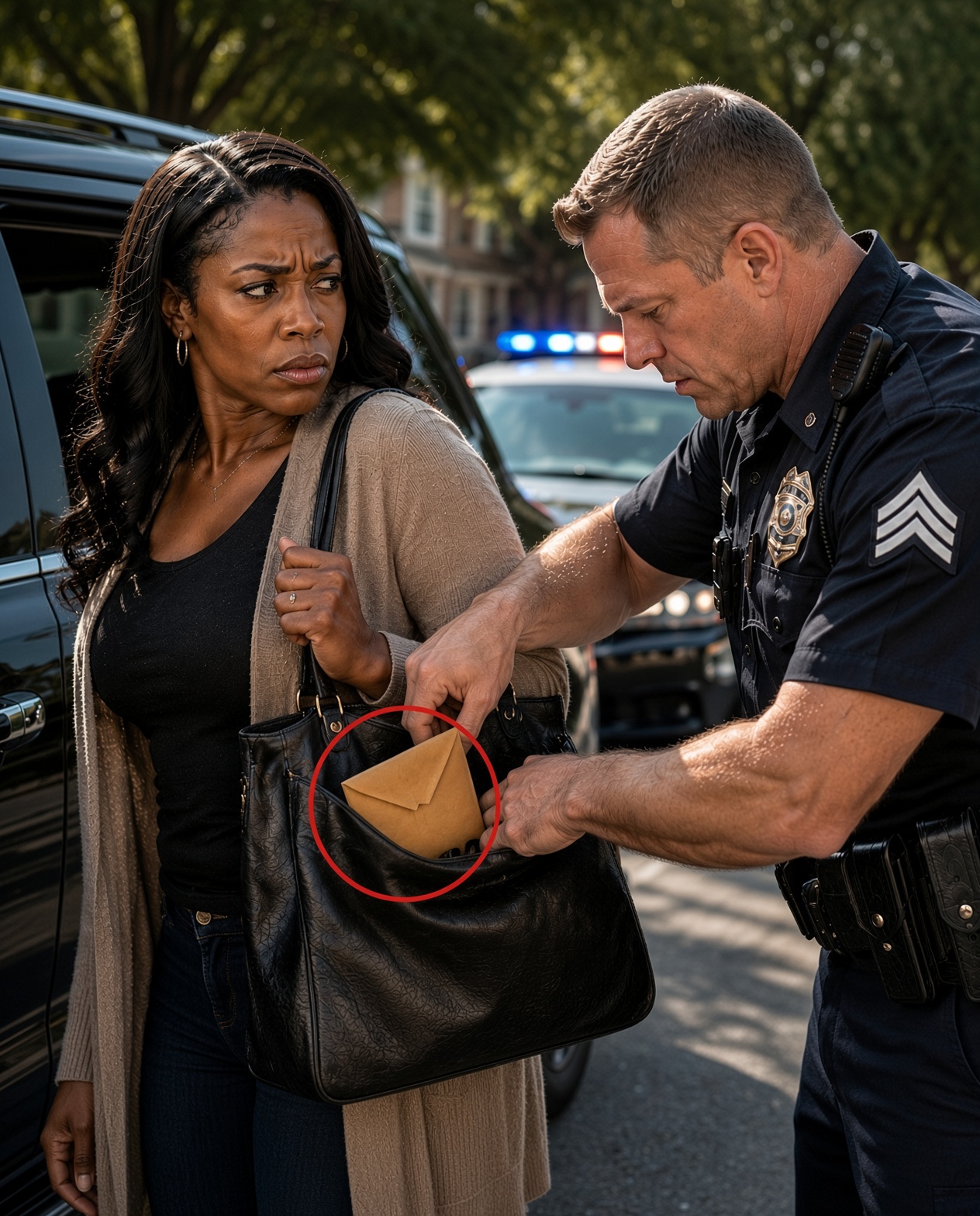
By the end of the month, Sergeant Cole Draper would lose his badge, his pension, and his freedom, and it would all trace back to one envelope he never should have opened. But standing on the curb of Lark Avenue with her handbag pinned under a stranger’s hand, Renata Cole didn’t know any of that. All she knew was that a police sergeant had just called her son’s school enrollment money suspicious, and that his fingers were already closing around the envelope.
>> Ma’am, I need you to stay still. I am still,” Renata said. He didn’t look up. He crouched beside her car, one hand braced against her open bag and searched it with the unhurried confidence of a man who had done this so many times. It no longer felt like a decision. Behind him, his cruiser’s lights turned lazily against the trunks of the oak trees lining the street.
Blue, then red, then blue, throwing color across his shoulder patch. Three stripes. a sergeant then,” and judging by the confidence in his hands, he’d been wearing them a long time. “Out of state plates,” he said, mostly to himself. “New in town? 5 days? That explains it.” She didn’t ask what it was.
She had learned a long time ago that men like this weren’t actually asking questions. They were narrating a story they’d already finished writing, and the only thing left to do was watch them read it aloud. His fingers found the envelope. He’d already run her license before he ever reached the bag. She’d handed it over the moment he approached the window, the way she’d done countless times before.
He pulled the envelope free now and held it up between two fingers like evidence at a crime scene. Though nothing about a folded Manila envelope with asshmentary enrollment written across the front in her own handwriting suggested a crime, he thumbmed it open anyway, looked at the bills inside, did the math with his eyes.
That’s a lot of cash to be carrying around, ma’am. It’s for my son’s school. They don’t take cards for the initial fee, and it’s just the two of us handling this move. So, I’ve been carrying cash for everything. H, he said it the way a man says something he has already decided not to believe. See, this is where it gets complicated for you.
Unmarked cash, out of state plates, no local address on your license yet. That’s three flags on a form I really don’t want to fill out today. A second officer stood a few feet back near the cruiser’s rear panel, arms folded, watching the street more than watching Renata, young, 25, maybe 26. His name tag caught the light, Malik, and every few seconds his eyes drifted to the envelope in Draper’s hand and then away again, like something too bright to look at directly.
“There a form I can fill out,” Renata said. “Or a receipt for whatever this is,” Draper finally looked at her. There’s no form, he said. There’s my rule. He said it simply the way another man might state his address. Not a threat. A fact he’d stated so many times it had smoothed into something closer to policy. My rule is I don’t write up cash discrepancies.
I settle them right here. Saves us both a trip downtown. Saves you a toe. Saves your kid from starting school with his mother in processing. Instead of picking him up from the bus stop, he folded the envelope closed again. unhurried. 240 keeps it under the number that gets a second look if anybody ever asks. You walk away with the rest.
I forget I ever opened this. Ranata looked at him for a long moment. Not with fear, with the particular stillness of someone doing careful arithmetic behind an unreadable face. That’s extortion, she said quietly, almost gently, the way you’d correct a child’s grammar rather than accuse them of a crime. Something shifted in Draper’s jaw. a small thing.
The kind of flicker that happens when a man hears the truth, said plainly by someone who was supposed to be too frightened to say it at all. That’s a big word for a woman who doesn’t know how things work here yet, he said. He stepped half a foot closer, close enough that she could smell coffee and cheap cologne.
This is my rule, not the department, not the states, mine. And out here on this street, my rule is the only one that matters. He peeled $240 from the envelope, folded it once, and slid it into his breast pocket without looking down. The motion so practiced it, barely interrupted the rhythm of his sentence.
He held the emptied envelope back out to her, Officer Malik’s arms had come uncrossed. He was staring now, not at the money, but at Renata’s face, at the stillness there, at an expression he didn’t have a name for yet, but would spend the next several weeks unable to stop thinking about. Renata took the envelope.
She didn’t count what was left. She didn’t need to. What’s your name? She said, “Not a question, an inventory.” Draper smiled, the particular smile of a man who had been asked that exact thing by exact people before and had never once been made to answer for it. Sergeant Cole Draper, he said, tapping the name plate on his chest like he was proud of it. Ashford Heights PD.
And you are? She held his gaze for exactly 1 second longer than was comfortable. You’ll find out Monday, she said. She got in her car. She did not slam the door. She pulled away from the curb at the exact speed limit, checked her mirror once, and watched Sergeant Draper shrink in the frame until the road curved and he was gone.
4 days later, the Ashford Heights City Council would swear in their new chief of police. Draper would be standing in the third row when they called her name. Ever had someone in power decide how things would go before you even spoke? You already know how Renata felt. What would you have done? Tell me in the comments. subscribe because in 4 days Draper is going to find out exactly who he was talking to.
Renata didn’t tell her son what happened on Luxer Avenue. She unpacked groceries, made dinner, and answered his questions about the new school with the same steady voice she’d used every night since his father left them for someone with fewer complications. It was just the two of them now, had been for 3 years, and she’d learned early that the version of herself her son needed at the kitchen table was not the version who’d stood on that curb doing arithmetic behind a still face.
Only after he was asleep did she open her laptop. The appointment letter was still sitting in her inbox. Six council members had approved it, but no one in Asheford Heights had announced it yet. Chief of Police effective Monday. No press release yet. No photograph on file. To Sergeant Cole Draper, she had been nothing but an outofstate plate and a bag worth searching.
In four days, she would be the person he reported to. That was what stayed with her longest. Not the money. $240 was replaceable, and she’d replace it before her son ever needed the difference. What bothered her was how Draper had done it. The way he’d already run her license before he touched the bag. The exact figure calculated to stay under whatever threshold made a supervisor look twice.
The way Officer Malik had stood there with his arms uncrossing, watching, saying nothing. None of that was improvisation. That was a system practiced enough to feel invisible from the inside. She’d spent 16 years learning what happened to complaints filed by people with no leverage.
She wasn’t going to become another one of those files. If she walked into that precinct Monday and mentioned Larker, the story stopped being about Draper. The moment her name attached to it, it became about her. New chief settles a score before she’s even sworn in. True or not, that framing would protect him. So, she didn’t call the department.
She called someone outside it. Elena Voss ran the county’s office of professional conduct independent of any single precincts chain of command. A position built specifically to catch what internal review buried. Renata had met her twice during the vetting process. Voss asked questions like she already suspected the answer and only wanted to hear it said aloud.
She typed the message at 11:40 p.m. Attached nothing yet, just a question. Are you available for something confidential off the record before Monday? The reply came in 9 minutes. Call now. Renata told her everything. the stop, the search, the exact figure, the line about my rule. She kept her voice flat, factual, a witness, not a victim.
When she finished, Voss went quiet long enough that Ranata checked to see if the call had dropped. Send me what you have, Voss said finally. Badge number, unit, time, location, everything. I don’t have footage. My dash cam wasn’t running. I wasn’t driving when it happened. I’d already parked. Doesn’t matter yet. A pause.
Renata, do you know how long Draper’s been at that precinct? No. Neither do I. Not off the top of my head. But I know his name. Something in Voss’s voice shifted. More careful now. It’s come up before. Renata sat up straighter. Come up how? Two complaints. Both closed. Both filed by people who didn’t have anywhere to go with it after.
Voss exhaled. And for a moment the professional distance in her voice thinned into something closer to tired. I need you to send me what you have tonight. And then I need you to prepare yourself for the possibility that Lark Avenue wasn’t a bad night. Meaning what? Meaning it might be Tuesday. Renata didn’t answer right away.
Through the wall, she could hear the faint hum of her son’s ceiling fan running the way it ran every night now, regardless of the weather. a habit that had started the year his world got smaller and never quite stopped. She thought about the four days she had left before her name stopped being a line in a memo nobody had read closely.
She thought about how many other envelopes there might have been. Send me the file, she said. Everything you have on those two complaints. You sure you want to see it before Monday? I’m sure I can’t afford not to. She hung up, sent what she had, and sat at the table a long time after. The laptop’s glow the only light in the kitchen.
Somewhere in a filing system she hadn’t seen yet, were two names that had tried this exact thing before her and been told there was nothing to corroborate their story. She intended to find out exactly how many names there really were. The two closed complaints arrived in Renata’s inbox at 6:14 the next morning. Both were thin.
Both had been processed at the precinct level and never reached the county. The first was filed 11 months earlier by a delivery driver named Marcus Webb, who claimed Sergeant Draper had taken $190 from him and called it a towing fee for a truck that was never towed. The files closing note read, “Officer’s account differs from complainants.
No corroborating evidence. Matter considered resolved.” The second complaint had been filed by a woman who’d since moved out of state and never followed up. Same closing language, almost word for word, like a template someone had learned to reuse. Renata read both files twice before she called Voss back.
These read like they were written by someone who already knew how the story would end before it started. She said that’s because they were. Boss’ voice had the flatness of someone who’d seen this pattern before and hated being right about it. I pulled the patrol logs overnight. Draper and a partner named Sykes have worked the same rotation for 3 years.
I cross- referenced their sector against stops that ended without a citation or documented follow-up. The kind that’s supposed to be routine and forgettable. How many? Six more. Eight total counting yours. 13 months. Renata sat with the number for a moment. Eight wasn’t a bad night. Eight was a business.
Any of them still local? Web is the delivery driver. I have an address. I want to talk to him. Renata, not as chief. As a witness who wants to hear it from someone who isn’t reading it off a closed file. Voss didn’t argue further. She gave her the address. Marcus Webb lived above a laundry mat on the east side in an apartment that smelled like fabric softener and old carpet.
He was younger than Renata expected, 26, maybe 27. And when she introduced herself only as someone looking into a pattern of complaints, something in his face closed like a door. I already told them what happened. He said, “They told me I was wrong. I’m not here to tell you you’re wrong.” He studied her the way someone studies a person who might cost him something the second time.
Then he told her anyway, “The stop on a low lit street, the invented towing fee, the way the officer had counted the bills out loud, unhurried, like he had all the time in the world and Marcus had none. Same rhythm, same performance of unbothered authority. He didn’t even seem worried I’d report it,” Marcus said like he already knew what would happen if I did.
Renartha thanked him and left before her voice could give away how closely his story matched her own. In the car, she sat a minute without starting the engine. He didn’t even seem worried I’d report it,” Marcus said, uneasy, quietly shaken, like he already knew what would happen if I did. Renata thanked him and left before her voice could give away how closely his story matched her own, holding back emotion.
In the car, she sat a minute without starting the engine. He already knew what would happen if I did. That sentence stayed with her the whole drive back. Haunting, thoughtful. Officer Trevor Malik hadn’t slept well in four nights. Tired, troubled. He’d never touched a dollar of it. Not once in 3 years riding with Draper.
And for a long time he’d told himself that not taking the money was different from letting it happen. Guilty, conflicted, that distinction stopped working the night he stood on Larksburg Avenue and watched a woman get quietly robbed while Draper counted out her son’s tuition money like pocket change.
Disgusted, ashamed, he knew what was in Draper’s personal notebook, the one he kept zipped inside his gym bag, dates and dollar amounts in a shorthand Draper thought was clever. Malik had glimpsed it more than once, closing a locker a beat too slow. Th cautious, nervous, on the fourth sleepless night, he made a decision. Firm, resolved, he photographed six pages of it while Draper was in the shower room, his hands shaking badly enough that the first two shots came out blurred. Panicked, tense.
Then he needed somewhere to send them. He didn’t trust the precinct’s internal complaint system. Everyone knew Draper had friends in records. suspicious, fearful. So he did the only thing that felt safe. He emailed the photos to Renee Ashby’s personal account. Ashb was a supervisor to ranks up, someone Malik believed on nothing but instinct and a few off-hand comments over the years might actually do something with it.
Hopeful but uncertain. What Malik didn’t know was that Renee Ashb and Cole Draper had been close for a decade. Ominous fishing trips, kids birthday parties, family dinners. Ashb had known Draper long enough to recognize his voice before he even said his name. Ashb read the email twice at her kitchen table that night, her stomach tightening with every photograph. Alarmed, disturbed. Perfect.
Then she picked up her phone and called the one person she was certain would want to know before anyone else did. “Cole,” she said when he answered. “Serious, urgent. We need to talk tonight. Somebody’s been in your notebook. Draper didn’t sleep after Ashby’s call. Angry, unsettled. She hadn’t told him who’d sent the photos, only that someone had them, and that whoever it was clearly understood what the notebook meant.
He spent the next two days doing what he always did when a situation threatened to slip, narrowing it, controlling it, making it smaller than it actually was, cold, calculating. He shredded what remained of the notebook himself. standing over the machine in the equipment room and feeding the pages through one at a time, telling himself the copies didn’t matter if there was nothing left to compare them to.
Controlled panic, denial, he called an attorney he’d used once before, a man who specialized in defending officers and build by the hour for exactly this kind of panic. He told Sykes to keep his head down and say nothing to anyone about anything until further notice. commanding, tense. What he didn’t do was consider that he might actually be wrong. Dark, ominous.
By Wednesday night, his attorney had a working theory built entirely on secondhand rumor. The incoming chief had a reputation for reopening cases other departments considered closed. That was all anyone at the precinct actually knew about her. Not her name attached to a face. Not a photograph, just a professional summary and a description that made men like Draper nervous in a way they couldn’t quite name.
Growing dread. If she starts digging, the attorney told him over the phone. We get ahead of it. We frame any investigation as personal before it becomes procedural. Calculated, cautious, Draper agreed without asking what that meant. He didn’t know yet that there would be nothing to get ahead of, that the story was already personal in a way neither of them understood.
Slow, ominous, suspenseful. Thursday morning arrived gray, the kind of cold that smelled like rain that had already happened. Cold, ominous. The precinct’s main hall had been arranged for the ceremony. Rows of folding chairs, city council members in the front row, officers from every shift filling the seats behind them in dress uniform they rarely wore.
Draper sat in the third row, left side pressed uniform, working to look at ease, controlled, uneasy. He run through his logic enough times in the last two days to half believe it. Whatever this new chief found, she’d find nothing that traced back to him on paper. He’d built that nothing carefully. He trusted it the way a man trusts a wall he built himself.
Quiet confidence with underlying tension. The council chair stepped to the podium and began the language that precedes an oath. Service, community, obligation. Draper had heard it before at other ceremonies, and had long since stopped registering it as anything but noise. Detached, indifferent, the side door opened.
A woman walked in wearing the chief’s insignia, and Draper’s mind did the thing minds do when a fact arrives faster than the ability to process it. Not gradually, but all at once. the pieces snapping into place before the question had finished forming. Sudden shock, the face, the walk, the stillness he remembered from a curb on Larks Avenue, the woman who’ looked at him and said, “That’s extortion.
” Like she was correcting his grammar. Recognition, disbelief. Beside him, two seats down, Officer Malik went pale and didn’t turn his head. Fear, stunned, silence. Please welcome the new chief of police,” the council chair said. Chief Renata Cole, the room applauded. Draper did not move. Frozen, horrified, Renata walked to the front without searching the crowd for any particular face.
She took the oath in a level voice, accepted the badge, and turned to address the room. What she said was brief, and it wasn’t about Draper, and it wasn’t about Larks Avenue. Power isn’t given to us to find out how much people will tolerate, she said. It’s given to us to find out whether we have the discipline not to abuse it.
Torm, authoritative, deliberate. She stepped back from the podium. The ceremony ended. People began moving toward the refreshment tables. Draper sat in his chair for a long moment. He did not reach for his coffee. He did not speak to the officer beside him. Whatever was coming had already been in motion since before he ever saw her walk through that door, and he had been the last person in the building to know it. Slow realization, dread.
The letter arrived at the city manager’s office the next morning, four pages written in the aggressive, careful language of an attorney told to move fast. The argument was straightforward. The newly sworn chief had a documented personal grievance against Sergeant Cole Draper predating her appointment, which meant any investigation conducted under her authority or launched at her direction carried an inherent conflict of interest, legal pressure, rising tension. It named Larks Avenue.
It named the date. And it argued that a chief who had personally been searched and extorted by a subordinate could not be considered neutral in that subordinate’s case. serious, threatening. The letter wasn’t wrong about the appearance of a conflict. That was what made it dangerous, grave, ominous. Ranata read it once at her desk, then looked out at the parking lot for a long time, quietly troubled.
If the case turned into a story about a chief settling a score instead of a story about what Draper did, he walked not on innocence, but on a witness whose credibility could be picked apart simply because of who she now was. stroed up restrained. She called Voss before noon. I’m removing myself, she said. Firm controlled counsel, not from the department, from the investigation itself.
No charging recommendation goes through me. No decision about what the evidence means goes through me. If this case is going to survive, it can’t need me to hold it together. Voss was quiet for a moment. That’s the right call, she said finally. It’s also the harder one. I know, Ranata said. Make it count.
Determined, quietly powerful. She hung up and sat at her desk a while longer, looking at a badge that had been hers for less than 24 hours, wondering whether the case Voss was about to run without her would be enough, and whether Draper, somehow in that same building, already understood how much worse this was about to get for him, precisely because she’d stepped back. reflective, tense, ominous.
Draper didn’t sleep after Ashby’s call. She hadn’t told him who’d sent the photos, only that someone had them, and that whoever it was clearly understood what the notebook meant. He spent the next two days doing what he always did when a situation threatened to slip, narrowing it, controlling it, making it smaller than it actually was.
He shredded what remained of the notebook himself, standing over the machine in the equipment room and feeding the pages through one at a time, telling himself the copies didn’t matter if there was nothing left to compare them to. He called an attorney he’d used once before, a man who specialized in defending officers and build by the hour for exactly this kind of panic.
He told Sykes to keep his head down and say nothing to anyone about anything until further notice. What he didn’t do was consider that he might actually be wrong. By Wednesday night, his attorney had a working theory built entirely on secondhand rumor. The incoming chief had a reputation for reopening cases other departments considered closed.
That was all anyone at the precinct actually knew about her. Not her name attached to a face, not a photograph, just a professional summary and a description that made men like Draper nervous in a way they couldn’t quite name. If she starts digging, the attorney told him over the phone, “We get ahead of it. We frame any investigation as personal before it becomes procedural.
” Draper agreed without asking what that meant. He didn’t know yet that there would be nothing to get ahead of, that the story was already personal in a way neither of them understood. Thursday morning arrived gray, the kind of cold that smelled like rain that had already happened.
The precinct’s main hall had been arranged for the ceremony. Rows of folding chairs, city council members in the front row, officers from every shift filling the seats behind them in dress uniform they rarely wore. Draper sat in the third row, left side pressed uniform, working to look at ease. He’d run through his logic enough times in the last two days to half believe it.
Whatever this new chief found, she’d find nothing that traced back to him on paper. He built that nothing carefully. He trusted it the way a man trusts a wall he built himself. The council chair stepped to the podium and began the language that precedes an oath. Service, community, obligation.
Draper had heard it before at other ceremonies, and had long since stopped registering it as anything but noise. The side door opened. A woman walked in wearing the chief’s insignia, and Draper’s mind did the thing minds do when a fact arrives faster than the ability to process it. Not gradually, but all at once. The pieces snapping into place before the question had finished forming.
The face, the walk, the stillness he remembered from a curb on Lark Avenue, the woman who’ looked at him and said, “That’s extortion.” Like she was correcting his grammar. Beside him, two seats down, officer Malik went pale and didn’t turn his head. “Please welcome the new chief of police,” the council chair said. “Chief Renata Cole.” The room applauded.
Draper did not move. Renata walked to the front without searching the crowd for any particular face. She took the oath in a level voice, accepted the badge, and turned to address the room. What she said was brief and it wasn’t about Draper and it wasn’t about Lark Avenue. Power isn’t given to us to find out how much people will tolerate.
She said, “It’s given to us to find out whether we have the discipline not to abuse it.” She stepped back from the podium. The ceremony ended. People began moving toward the refreshment tables. Draper sat in his chair for a long moment. He did not reach for his coffee. He did not speak to the officer beside him.
whatever was coming had already been in motion since before he ever saw her walk through that door, and he had been the last person in the building to know it. The letter arrived at the city manager’s office the next morning. Four pages written in the aggressive, careful language of an attorney told to move fast. The argument was straightforward.
The newly sworn chief had a documented personal grievance against Sergeant Cole Draper predating her appointment, which meant any investigation conducted under her authority or launched at her direction carried an inherent conflict of interest. It named Larks Avenue. It named the date, and it argued that a chief who had personally been searched and extorted by a subordinate could not be considered neutral in that subordinate’s case.
The letter wasn’t wrong about the appearance of a conflict. That was what made it dangerous. Renata read it once at her desk, then looked out at the parking lot for a long time. If the case turned into a story about a chief settling a score instead of a story about what Draper did, he walked not on innocence, but on a witness whose credibility could be picked apart simply because of who she now was. She called Voss before noon.
I’m removing myself, she said, not from the department, from the investigation itself. No charging recommendation goes through me. No decision about what the evidence means goes through me. If this case is going to survive, it can’t need me to hold it together. Boss was quiet for a moment.
That’s the right call, she said finally. It’s also the harder one. I know, Renata said. Make it count. She hung up and sat at her desk a while longer, looking at a badge that had been hers for less than 24 hours, wondering whether the case Voss was about to run without her would be enough, and whether Draper, somewhere in that same building, already understood how much worse this was about to get for him, precisely because she’d stepped back.
Voss built the case exactly the way she’d promised, without Renata’s name anywhere near a charging decision. Mik’s photographs, damaged as they were by shaking hands, matched precisely against the patrol logs Voss had already pulled. Dates lining up with unexplained gaps and Sykes’s body cam. Dollar figures lining up with the eight stops that had generated no paperwork.
Marcus Webb’s account matched the pattern down to the rhythm of it, the counted bills, the unhurried voice, the certainty that no one would push back. None of it depended on who Renata was about to become. It depended on what had already happened before she arrived. Renee Ashby was the piece nobody expected.
She’d warned Draper the night Malik’s email landed in her inbox. That part was true, and she never denied it. But she hadn’t warned him because she believed him innocent. She’d warned him because 10 years of friendship made silence feel like loyalty, right up until the moment Voss showed her the eighth file and asked whether she still believed that.
Ashb sat in the interview room a long time before she said anything. Then she told Voss everything she knew about the call, word for word, and asked what she needed to do to make it right. It wasn’t enough to undo what she’d given Draper. Two extra days to destroy a notebook. It was enough to close the last gap in the timeline.
The indictment came before winter. Extortion under color of law, theft, falsification of records, obstruction. Sykes was charged separately as an accessory for the camera. The trial lasted 6 days. Draper’s attorney argued voluntary payment, that people had simply offered him money, that no explicit threat had ever been made.
That argument held for exactly as long as it took the prosecutor to play the recovered notebook photographs beside Marcus Webb’s testimony, side by side, matching entry to memory, date to date. It held until Webb on the stand repeated the sentence he’d said to Renata in his apartment above the laundromat. He didn’t even seem worried I’d report it like he already knew what would happen if I did.
Draper was convicted on all counts. He lost his badge, his pension, and 11 years of service that would now read permanently as the record of exactly how long he’d gotten away with it. Ranata heard the verdict from Voss’s office, not a courtroom. She had testified once as a witness. answered every question asked of her and left when she was excused.
She hadn’t watched the sentencing. That wasn’t the ending she’d been working toward. What she asked for afterward wasn’t coverage, and it wasn’t a statement. She asked that all eight cases be formally reopened. She asked that every person on that list be contacted directly and told plainly that they had been telling the truth the entire time.
She asked that whatever money could be traced be returned and that the closed file language, no corroborating evidence, matter considered resolved, be replaced with something honest. That last part took the longest. Records don’t like admitting they were wrong, but by winter all eight files carried new language, and eight people who had spent months or years being quietly disbelieved now had something in writing that said otherwise.
Marcus Webb got his $190 back in January, delivered with a short letter confirming his account had been accurate all along. He read it standing in the doorway of his apartment, then folded it and put it in the drawer where he kept things that mattered. The department changed its policy on cash during field stops.
Body cams could no longer be manually disabled without triggering an automatic alert. Every complaint involving money now went to the county’s office directly without the option to stay inside the precinct that employed the officer being accused.

