Corrupt Sheriff Pulled Over a Black Woman—Then Her FBI ID Turned His World Upside Down
Corrupt Sheriff Pulled Over a Black Woman—Then Her FBI ID Turned His World Upside Down
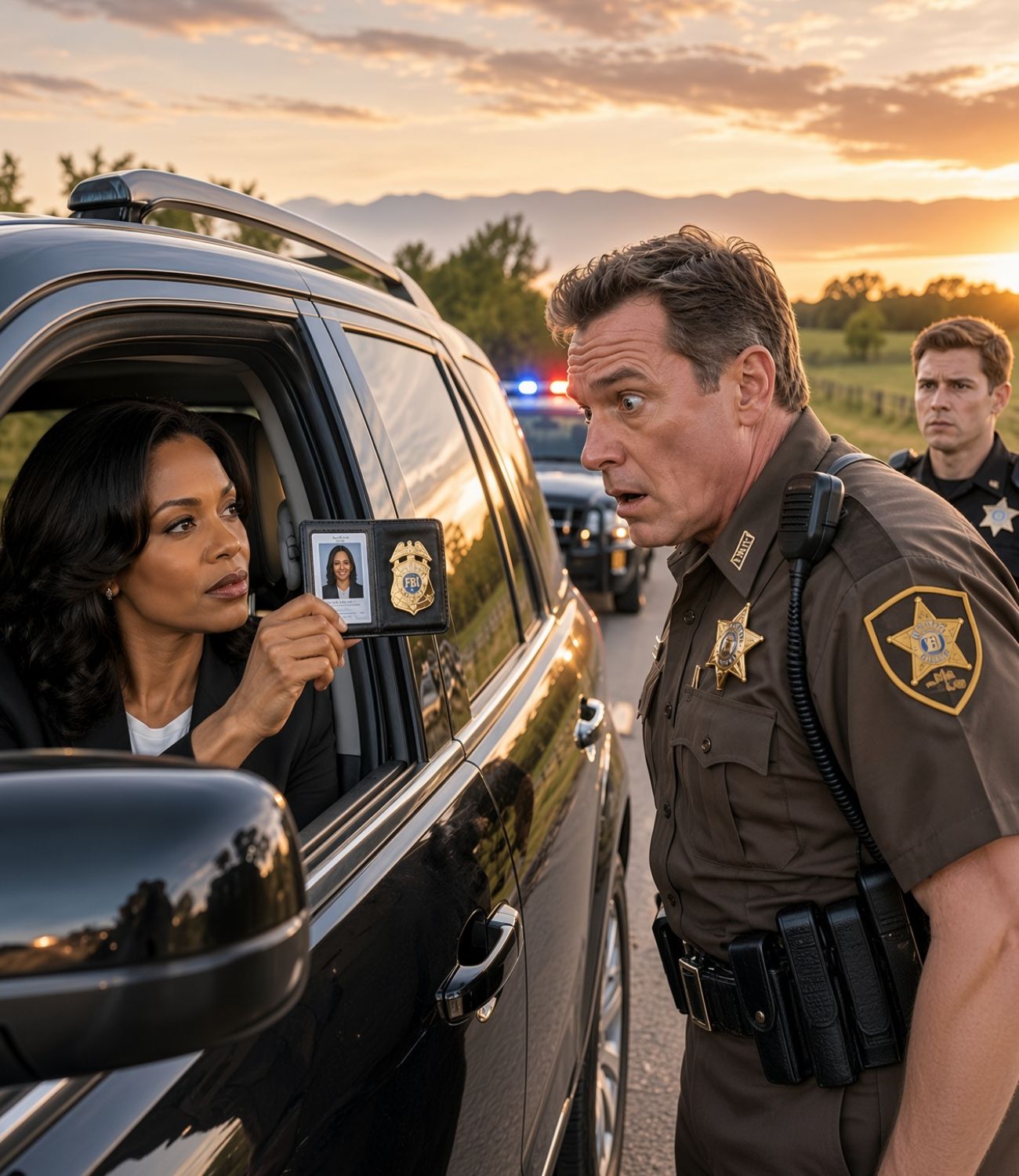
The black SUV had barely crossed the speed limit sign when the siren erupted behind it, slicing through the quiet of the late afternoon like a blade through still water. Sheriff Malcolm Voss stepped out of his cruiser with his hand resting lazily on his holster, a smirk already forming on his face, the kind of smirk that had opened doors and closed mouths for years.
He was a man accustomed to silence, the kind of silence people offered when a badge and a gun walked toward them without hesitation. But when the tinted window rolled down, that smirk vanished in an instant, replaced by something unfamiliar to him. Behind the wheel sat a black woman, calm, unshaken, her eyes meeting his without a trace of fear or apology. She did not plead.
She did not stammer. She simply extended a small card toward him. And the moment his eyes landed on it, the color drained from his face as though someone had pulled a plug somewhere deep inside him. The woman behind the wheel was not an ordinary driver passing through his territory. She was the director of the Federal Bureau of Investigation.
The road through Redstone County stretched long and empty that late afternoon, flanked by dry fields and leaning fences that had not seen fresh paint in years. The kind of landscape that seemed to swallow sound whole. Doctor Amara Sterling drove alone, her hands steady on the wheel, her expression unreadable behind a pair of simple sunglasses that gave away nothing about the world she came from.
She wore no uniform, carried no entourage, and nothing about her appearance suggested she held one of the most powerful positions in federal law enforcement in the entire country. She had just closed out a quiet, unofficial visit to the region, the kind of trip that never appeared on any public schedule, and existed only in a handful of secured calendars.
She was making her way back toward Washington before nightfall, the radio humming low, more static than melody, the fields blurring past in shades of gold and rust that seemed to stretch on without end. It was the kind of afternoon that asked for nothing, the kind that made a person forget, if only for a moment, the weight of everything they carried behind their eyes.
Then the flashing lights appeared in her rearview mirror, red and blue slicing across the dashboard, and the quiet afternoon shifted into something else entirely. Sheriff Malcolm Voss had built a reputation in Redstone County that stretched far beyond the boundaries of his jurisdiction. A reputation built less on justice and more on fear, carefully cultivated over two decades in office.
He was 51 years old, broad-shouldered, with a voice trained to intimidate before it ever needed to persuade anyone of anything. Deputies followed him, not out of respect, but out of self-preservation, and towns folk had long learned that questioning him came at a cost few were willing to pay twice.
When his cruiser fell in behind the black SUV, he did not hesitate for even a moment, he flicked on his lights and gestured for the vehicle to pull over, already certain of how the next few minutes would unfold. already rehearsing in his mind the small performance of power he intended to deliver. Amara slowed without protest, signaled properly, and eased the SUV onto the gravel shoulder exactly as the law required of any careful driver.
She did everything right, and still she watched Voss approach her window with the gate of a man who had never once been told no and truly meant it. His first words were not a greeting. They were an accusation disguised loosely as a question delivered with the practiced ease of someone who had said them a hundred times before.
“What are you doing out here?” he asked, his tone already laced with suspicion, as if her mere presence on that road was itself some kind of violation worth investigating. Amara answered simply, “That she was driving, nothing more and nothing less, her voice carrying no defensiveness whatsoever. The plainness of her response seemed to irritate him more than any excuse could have, as though he had expected fear or fumbling, and received neither in return.
He demanded her license, registration, and proof of insurance. And she handed each document over without hesitation, her movements unhurried and precise, betraying nothing. Voss studied the papers far longer than necessary, flipping them over, holding them up to the fading light, stretching silence into a weapon of its own, the way he had learned to do over years of small, cruel encounters.
He asked where the SUV had come from, and she gave him a brief, factual answer that offered nothing further to work with. It was not enough for him. He began hinting carefully at first that a vehicle like hers driven by a woman like her on a road like this one might not be entirely legitimate. Amara understood immediately that this had stopped being a routine traffic stop the moment his questions veered away from anything resembling procedure.
There was a pattern to his words, a rhythm designed not to investigate but to provoke, to draw out some reaction he could later use to justify whatever came next in his mind. She kept her voice level, her posture composed, refusing to give him the confrontation he seemed to be hunting for with every passing second.
Voss leaned down toward the open window, his shadow falling across her lap, blocking what little breeze had been drifting through the cabin, and delivered the words that would set the entire encounter into motion. Step out of the vehicle. Now, Amara did not argue, but she did not comply blindly either, her calm refusing to bend under the weight of his tone.
She asked him evenly and directly what legal justification he had for ordering her out of the car on a stop that had produced nothing but clean paperwork. The question landed like a slap, though her tone carried none of the venom he might have expected from someone in her position. Voss shifted immediately into a harsher register, his voice rising just enough to suggest that her simple request for clarity was itself an act of defiance against his authority.
He wanted witnesses, real or imagined, to believe she was resisting a lawful officer, that her calm was somehow a threat rather than the simple absence of guilt. Amara remained still, her expression cold and professional, refusing to hand him the narrative he was so clearly trying to construct, piece by piece.
His eyes drifted past her shoulder into the cabin of the SUV, where a black leather document case sat closed on the passenger seat. unremarkable to anyone who did not know what it contained. “What’s in there?” he asked, nodding toward it with sudden and sharpened interest. “Work documents?” she replied, her tone flat, offering nothing more than the bare minimum required.
He told her to open it immediately. She declined, explaining without hostility that he had no legal basis to search her belongings without cause or consent. His patience, thin from the start of the encounter, evaporated entirely within seconds. He radioed for backup, and within minutes, a second deputy arrived on the scene. A younger man named Deputy Cole Ashworth, who approached with visible discomfort etched across his face, as if some part of him already sensed this was not a normal stop unfolding before him.
As the minutes dragged on, small details accumulated, painting a picture the audience could piece together long before Voss himself would ever admit to any of it. There were the questions that made no procedural sense whatsoever. There was the way he searched her vehicle without cause, the way he threatened rather than explained his reasoning, the way he seemed to treat every citizen who crossed his path as either an obstacle to be removed or a resource to be extracted from.
Whispers around Redstone County had long spoken of Voss fabricating charges against those who defied him in any small way, of fines levied not for justice, but for simple compliance, of a local police apparatus quietly reshaped over years to serve interests far removed from public safety.
Amara absorbed every second of it, filing each detail away behind a calm exterior, revealing nothing of who she truly was or why she had come. Do you know who I am? Voss finally demanded, his voice thick with self-importance and the beginning of frustration. Amara turned her gaze on him, steady and unblinking, and let the silence stretch just long enough to matter.
I think that question should be directed at you. The words seemed to strike a nerve. Neither of them fully understood in that moment. Voss reached into the SUV without warning and snatched her phone from the console, his jaw tight, his composure fraying visibly at the edges for the first time. “From now on,” he said, holding the device up as though it were some kind of trophy he had earned. “You don’t call anyone.
” Deputy Ashworth ran the plates through the system while Voss paced beside the cruiser, arms folded, eyes fixed on Amara as though daring her to break under the pressure he was so carefully applying. The results came back within moments and they told a story entirely different from the one Voss had been constructing in his head since the moment he first turned on his lights.
The vehicle was registered, insured, and entirely legitimate in every visible way. There was no outstanding warrant, no report of theft, nothing resembling the grounds for detention he had implied from the very beginning of the stop. Still, Voss refused to let her go. Unwilling to relinquish whatever control he believed, he still held over the situation.
He invoked the phrase, “Every corrupt authority figure eventually reaches for when facts fail to support their actions.” “Reasonable suspicion?” he said, “As if the words themselves carried legal weight simply by being spoken aloud with enough confidence.” “Suspicion of what?” Amara asked, her voice calm, but pointed enough to cut through his bluster.
Voss offered no specific answer, only a vague gesture toward the open road and a mutter about unusual circumstances that satisfied no one, least of all himself. It was in that moment that a detail slipped past unnoticed by everyone except Amara, who missed very little. Voss’s font tail buzzed against his hip, and he stepped a few paces away to answer it, his voice dropping into something quieter, more careful than the tone he had used with her.
On the other end was a man named Gideon Ror, a prominent local contractor whose name appeared on nearly every county project awarded over the past decade without meaningful competition. Amara caught only fragments of the conversation carried on the evening air, but one phrase reached her clearly enough to matter. I’ve got it handled, Voss murmured before ending the call and turning back toward her with a tightness in his shoulders that hadn’t been there moments before.
The seed of doubt had been planted firmly now. This was not a random stop on an empty road. Something about her presence there at this particular hour had triggered a response that went beyond ordinary policing into something far more deliberate. Voss returned to the window and demanded she open the trunk of the vehicle. She refused again calmly without raising her voice even slightly.
He threatened to arrest her for non-compliance. his words growing sharper, more desperate to reclaim control of a situation that was slipping through his fingers in ways he could not yet fully articulate to himself. Amara remained unmoved by the threat, her composure, a wall he could not seem to find a way around.
She asked for his full name and badge number, a simple lawful request that any citizen was entitled to make of an officer. Voss sneered, leaning in close enough that she could smell the coffee on his breath and the faint trace of cigarettes beneath it. going to file a complaint?” he asked, mockery dripping from every syllable he spoke.
“Maybe,” she said, her tone giving nothing away. His face hardened and the moment stretched thin, taut as a wire pulled far past its limit. “Cuff her,” two deputies moved toward the SUV, their boots crunching against the loose gravel shoulder of the road. Amara extended her wrists without resistance, but her voice remained steady as she asked them to state clearly and specifically the grounds for her arrest before they proceeded any further.
One of the younger officers hesitated visibly, his eyes flicking toward Voss, as though searching for an answer he himself did not actually have. Voss, sensing the crack forming in his own authority, grew louder, more forceful, layering accusation upon accusation without ever landing on anything concrete. He called her uncooperative.
He called her an obstruction to a lawful investigation that did not exist. He called her suspicious, though he could never quite say of what exactly. Amara did not fight back against any of it. She simply repeated the same quiet request over and over, unshaken. Follow the correct procedure. Deputy Ashworth studied her closely throughout all of this, noting something the others seemed to miss entirely in their haste.
This was not the demeanor of someone caught in wrongdoing, someone with something to hide from the law. There was no panic in her eyes, no desperate scramble for excuses or explanations, only a stillness that felt almost rehearsed, almost professional in a way that unsettled him more than any outburst could have managed.
Vos, still convinced that his badge alone could dictate the outcome of any encounter he chose to escalate, turned his attention back to the open car door and the black document case resting inside on the passenger seat. He reached for it without asking. Don’t touch that case, Amara said, her voice cutting through the evening air with a sharpness it had not carried until that exact moment, giving me orders now.
Voss shot back, his hand still hovering near the case, uncertain for the first time. I’m warning you, she replied simply. The temperature of the moment shifted instantly, though Voss, blinded by pride and years of unchecked power, failed to notice the change settling over the scene. He unzipped the case anyway, expecting cash, expecting contraband, expecting anything that would retroactively justify the arrest he had already decided to make, regardless of evidence.
Instead, he found classified documents bound in dark folders stamped with markings he did not immediately recognize, a secured communication device unlike anything issued to local law enforcement anywhere in the county, and a single identification card resting face down at the very bottom of the case. Voss turned the card over slowly.
He read the first line. The smirk was gone completely now, replaced by something closer to dread. The card confirmed in plain federal lettering that left no room for doubt or misinterpretation. A name and title that would alter the entire trajectory of the encounter unfolding on that quiet road. Dr. Amara Sterling.
Director, Federal Bureau of Investigation. Voss stood frozen in place, the card trembling slightly in his fingers, the color draining from his face in a slow, visible wave that even his deputies could see clearly. Deputy Ashworth and the second deputy exchanged a glance loaded with disbelief, their earlier confidence collapsing into stunned silence within seconds.
Amara said nothing at all in that moment. She did not need to. The silence surrounding them spoke with far more authority than any words could have offered. Voss removed his sunglasses with an unsteady hand, staring at the card as though willing the letters to rearrange themselves into something less catastrophic than what they actually spelled out.
“Director of the FBI,” he repeated, his voice barely above a whisper now, all bravado drained out of it entirely. “That’s correct,” Amara said. “I didn’t know,” he stammered, reaching for the only defense a man like him had ever truly needed before this moment. “That’s not the issue,” she replied. her tone still measured, still devoid of anger, which somehow made the moment weigh even heavier on him than shouting ever could have.
He began apologizing in a rush of broken half-formed sentences. But Amara did not accept the apology. Not yet. Not without answers, first laid out plainly between them. “Why did you detain me?” she asked. “Why did you want to search my vehicle without cause?” “Why did you confiscate my phone the moment I asked a simple question? Why did you order your deputies to place me in handcuffs on an empty road? Voss opened his mouth several times, but no coherent answer emerged from him at all.
He fell back on the only word men like him ever reach for when caught without any real justification to offer. “A misunderstanding,” he said weakly, barely able to meet her eyes. Amara looked at him with an expression that carried more weight than any raised voice or accusation ever could have managed.
A misunderstanding doesn’t come with a script. The words landed hard and Voss fell silent, his earlier bravado nowhere to be found anywhere in his posture now. Amara reached into the document case and withdrew the secured communication device, turning it over once in her hand before speaking again, her voice quiet but unmistakably deliberate in its intent.
I think it’s time you understood why I’m actually here in Redstone County. Amara made it clear in careful measured words chosen with obvious precision that her presence on that road had never been accidental in any sense of the word. For several months the bureau had been quietly examining Redstone County from a distance, tracing a pattern of behavior too consistent across too many cases to dismiss as simple coincidence.
The investigation centered on allegations of bribery, manipulated contract bidding, coercion of witnesses into silence, and the troubling repeated use of local law enforcement to shield evidence from any outside scrutiny. Gideon Ror’s name surfaced repeatedly throughout the inquiry, a businessman whose influence over county contracts had grown far beyond what legitimate competition could ever reasonably explain on its own.
And at the center of that web, tightening every knot that needed tightening to keep the operation hidden, stood Sheriff Malcolm Voss. She did not reveal how much the bureau already knew, keeping her cards close even as his lay exposed on the seat between them. Instead, she allowed Voss to believe the investigation remained in its early stages, a suspicion rather than a certainty, a door only partially opened rather than one already broken through.
What do you know?” he asked, his voice tight with a dread that had settled deep into his chest. “Enough to know you just made a very serious mistake,” she answered without hesitation. There was no theatrical reveal in her delivery, no dramatic unveiling of evidence meant to shock or humiliate him further.
“Just quiet, controlled truth delivered the way a scalpel delivers precision, clean and exact.” In the weeks leading up to that afternoon, the bureau had received numerous complaints about Voss from residents scattered across the county, filed by people who later withdrew their statements under mysterious circumstances that no one had ever fully explained.
Case files vanished from evidence rooms without explanation, their absence noted only in passing until the pattern became impossible to ignore. Witnesses who once spoke openly grew suddenly silent, their fear palpable, even through the flat language of official transcripts sitting in federal files. Investigations that should have proceeded through proper channels were closed abruptly.
Instead, buried beneath paperwork that never quite added up under closer examination. Amara had come to Redstone County not merely to observe from a comfortable distance, but to confirm in person one final piece of a puzzle that had taken months to assemble. And Voss, without realizing it in the slightest, had handed her exactly what she needed through his own actions on that stretch of road that afternoon.
“I don’t need you to confess,” she told him, her voice steady, almost gentle in its coldness. “I just need you to keep doing what you always do. It became clear to everyone present that the traffic stop had never been a random encounter at all, but part of a carefully constructed test designed to reveal exactly this kind of behavior.
Unbeknownst to Voss, an independent recording system carried discreetly within Amara’s vehicle had captured every word, every gesture, every command he issued throughout the entire confrontation from beginning to end. Panic began creeping into his expression as the implications of that fact settled over him fully for the first time.
He reached for his phone and dialed Gideon Ror again, his hands unsteady, his voice cracking as he tried to explain the unfolding disaster in fragments that made little sense even to himself. What he did not know was that the very line he called through had already fallen under federal surveillance days earlier.
Every word waiting to be logged. What’s going on? Rook demanded on the other end, his tone sharp with irritation rather than genuine concern, as though this were merely another inconvenience for someone else to manage quietly. “She’s FBI,” Voss said, his voice barely audible now, stripped of the confidence that had defined him only an hour earlier.
Silence stretched across the line, heavy and suffocating, as Ror absorbed the magnitude of what had just occurred on that road. He understood immediately that this was no longer a matter. He could quietly smooth over with a phone call or a well-placed favor to the right person. “Say nothing else,” he instructed Voss firmly, his own composure fracturing beneath the surface of his words. “Sign nothing.
Make sure no files leave that office tonight.” Amara had heard enough of the conversation relayed to her through the secured device to know exactly where this was heading next. She watched as Voss, in his desperation, had inadvertently pulled Ror directly into the unfolding investigation, connecting the two men through a single panicked phone call that would later serve as critical evidence in the case being built against them both.
Meanwhile, Deputy Ashworth made a decision of his own that evening, one that would separate him permanently from the corruption surrounding him for years. He approached Amara quietly, away from Voss’s line of sight and hearing, and revealed the existence of a storage room within the sheriff’s office that Voss had long forbidden anyone else from entering without his direct permission.
Is there surveillance footage of that room? Amara asked. There is, Ashworth confirmed, his voice low. Then that’s where we begin tonight, she said. Before they moved toward the sheriff’s office, Amara paused beside her vehicle and studied the darkening tree line for a long moment, allowing herself a single breath before the next phase of the operation began in earnest.
She had planned for many outcomes when she agreed to drive this stretch of road herself instead of sending a team ahead of her, but she had not expected the confirmation to arrive so quickly or so plainly. Years of federal work had taught her that corruption rarely announced itself with grand gestures. It revealed itself in small, ordinary cruelties, repeated so often that the people enforcing them forgot anyone was keeping count.
Voss had shown her everything she needed within the span of a single traffic stop. And now the harder work of proving it to a courtroom would begin. She signaled to her agents, and the small convoy moved quietly toward the county building where Voss had ruled for over two decades without meaningful challenge. The door to the restricted storage room creaked open under Deputy Ashworth’s hand hours later, revealing rows of file boxes stacked haphazardly against the walls in the dim light.
Each one labeled with names that told their own quiet story of intimidation and forced silence stretching back years. Amara stepped into the room accompanied by two agents who had arrived quietly in unmarked vehicles once her identity was confirmed over secured lines earlier that evening. The storage space, dimly lit and layered with years of undisturbed dust, told a story far more damning than any single confrontation on the highway ever could have on its own.
Box after box contained files bearing the names of residents who had once spoken out against Sheriff Voss in one form or another, each case revealing an unmistakable and troubling pattern. Citizens who questioned his authority were fined without any real cause behind it. Others were detained under vague pretenses, eerily similar to what Amara herself had just experienced firsthand on that same road.
Some had their legal paperwork mysteriously altered or lost entirely somewhere in the system. Their complaints buried beneath bureaucratic delay until they simply gave up pursuing justice altogether. Several documents bore Voss’s own signature. undeniable and damning in black ink, tying him directly to decisions that had quietly ruined lives and silenced descent throughout the county for years.
Financial records intertwined with these files as well, revealing payments traced back to shell companies controlled by Gideon Ror. Each transaction carefully timed to coincide with contracts awarded under increasingly questionable circumstances. Yet, the most significant piece of evidence had not yet revealed itself to anyone in that room.
Tucked deep within a locked drawer, concealed beneath false paperwork designed to discourage casual searching, Amara discovered a hidden storage drive that agents quickly connected to a secured laptop brought along for precisely this kind of scenario. The data it contained painted a picture far more extensive than a single corrupt sheriff quietly accepting bribes on the side of his official duties.
Recurring transfers meticulously timed and carefully disguised within legitimate looking transactions revealed that Voss had been funneling public funds toward private interests for years without detection. He had not simply been accepting money quietly and looking the other way when convenient. He had actively used his position and his authority to enrich a small circle of people benefiting from the arrangement at the direct expense of the county he had sworn to protect and serve.
Amara realized, studying the numbers scrolling steadily across the screen in front of her, that this investigation had expanded far beyond its original scope in ways that would take months to fully untangle. This was no longer simply the story of one sheriff abusing his authority on a quiet stretch of county road.
This was a network deliberately built over years and carefully maintained through fear and dangerously effective at evading scrutiny for far too long already. Ror, watching the situation unravel from a distance, attempted to remotely wipe critical files from a separate server linked to his broader operations across the region.
But the bureau’s cyber security team had anticipated exactly this kind of desperate response and had already locked down external access hours earlier that same evening. He just confirmed his own guilt. Amara said quietly to the agents beside her, watching the failed deletion attempts, log themselves automatically into the growing case file being assembled in real time.
One of the younger agents, a woman named Special Agent Ranata Callaway, moved carefully through the boxes, cataloging each file with methodical precision, pausing occasionally to read a name aloud when it matched something already flagged in the bureau’s earlier research. Several names matched complaints filed years earlier that had gone nowhere.
Their outcomes buried the moment they crossed Voss’s desk. One folder in particular caught her attention. belonging to a young father who had once challenged a citation. Voss issued without cause, only to find himself arrested twice more within the following year on charges that never held up in court. His case had been quietly closed, the paperwork stamped and shelved as though the matter had simply resolved itself.
Callaway set the folder aside for further review, marking it among dozens of others that told a similar story of quiet, repeated punishment disguised as routine policing. Amara moved through the room slowly, absorbing the scale of what years of unchecked authority had produced in a county most of the country had never heard of.
Her phone buzzed against the table beside her, breaking the momentary stillness that had settled over the room full of dusty boxes and hidden secrets. One of her senior agents spoke on the other end, his voice carrying an urgency she recognized instantly from years of working together on difficult cases. Director, we just found another name.
The name that followed brought a heaviness into the room that even the discovery of the storage drive had not managed to produce fully on its own. And for a moment, Amara said nothing at all, simply staring at the screen in front of her. The newly uncovered name belonged to a senior state official whose ties extended into several federal contracting relationships far beyond the modest borders of Redstone County itself.
Amara understood immediately that the scale of this investigation now threatened to ripple outward in ways few had anticipated when the operation first began months earlier in careful, quiet planning. Yet she made a deliberate choice in that moment not to let the story spiral into something unmanageably vast, something that would blur the very accountability she had come here specifically to establish and protect.
The heart of the matter remained clear and unchanged despite the widening scope of what they had uncovered. Local power entrusted to protect ordinary citizens going about their lives had been twisted instead into a private instrument serving the narrow ambitions of a select few.
Word of the arrests spread through Redstone County within hours, carried less by official statements and more by the quiet murmur of a town that had waited years for something to finally break loose. Shop owners who had paid quiet fines rather than risk Voss’s attention, spoke to reporters for the first time, their voices steady now, that the man who once controlled their silence sat in a holding cell instead of behind a desk of unchecked authority.
A woman who had lost her small trucking business after refusing to pay for a permit that never should have existed in the first place stood outside the courthouse and wept not from grief but from something closer to relief finally allowed to surface. None of it undid the years already lost.
And Amara understood that better than anyone standing among the agents that night. Restoring what corruption had taken was rarely as simple as an arrest. No matter how clean the evidence or how swift the collapse of the network responsible, Voss was brought in for formal questioning that evening, stripped of the bravado that had defined him only hours earlier on that empty stretch of road.
Under the weight of mounting evidence laid out plainly before him, he finally admitted to accepting payments from Ror over an extended period stretching back years, his voice hollow, drained of the arrogance that had once colored every single word he spoke to anyone beneath him. Still, even in confession, he reached instinctively for justification.
The last defense of a man unwilling to fully accept the weight of his own choices. “I was just doing what others told me to do,” he muttered, refusing to meet Amara’s steady eyes across the table between them. “You had a badge,” she replied, her tone neither raised nor softened in the slightest. “You had a choice. Every single day you wore it.
It was the moral center of the entire encounter, spoken plainly without theatrics or raised voices, carrying more weight than any courtroom verdict could have delivered in that exact moment. Deputy Ashworth, who had remained largely silent through so much of the unfolding crisis around him, chose that evening to provide a full and detailed statement corroborating months of buried complaints with firstirhand testimony.
No one in the department could easily dismiss or explain away. Evidence collected throughout the day was carefully sealed and cataloged by the arriving agents, forming the backbone of a case that would extend far beyond Redstone County’s modest courthouse in the months to come. Ror was apprehended later that night, attempting to leave the region entirely in a hurry, his vehicle intercepted along a service road he had clearly hoped would go unnoticed by anyone watching.
Voss, stripped of his badge and every shred of authority he once carried, was placed under arrest before the sun fully set behind the county line that same evening. There was no celebration in Amara’s demeanor as the operation concluded around her late into the night. She offered only a single quiet observation to the agents gathered nearby, her voice tired but steady.
A badge doesn’t make a person good. She turned and walked back toward the SUV that had started this entire sequence of events hours earlier. The vehicle now surrounded by federal agents rather than a single hostile sheriff demanding answers. One of her agents approached as she reached for the door handle, curiosity evident in his expression as he studied her.
Director, why did you drive through here yourself? Amara looked out at the empty road stretching ahead of her in the darkness. The same road that had nearly cost her hours of unnecessary confrontation earlier that day. The same road that had ultimately delivered exactly the truth she came searching for in the first place because I wanted to know what they would do when they thought no one was watching.
The agent nodded slowly, understanding settling over him as he glanced back toward the courthouse where lights still burned well past midnight. agents and prosecutors working through the mountain of evidence that had surfaced in a single day. It was a method Amara had used before in smaller ways throughout her career, though rarely with this much personal risk attached to it.
She could have sent a team ahead, could have coordinated the operation from behind a desk in Washington, surrounded by monitors and secure communications, but patterns of abuse rarely revealed themselves fully through paperwork alone. They revealed themselves in the small unguarded moments when a person in power believed no oversight existed above them.
When the badge on their chest felt less like a responsibility and more like a shield against consequence. Voss had given her exactly that moment on an empty stretch of road, never suspecting the woman he pulled over carried the very authority he had spent years believing himself immune to. Dawn began creeping over the horizon the following morning as Amara sat alone inside the black SUV.
the events of the previous day settling slowly into something quieter, more reflective than the chaos that had defined the hours before. She turned the small identification badge over in her hand once more, studying it beneath the pale morning light filtering through the windshield, feeling none of the triumph one might expect after dismantling a corrupt network that had operated unchecked for years across an entire county.
There was no dramatic celebration waiting for her, no gathering of cameras or congratulatory speeches from officials eager to claim credit. Only the steady, unglamorous work that justice so often demanded behind closed doors. Work that rarely announced itself, the way fear and abuse of power had so loudly announced themselves throughout Redstone County for years.
The message beneath the entire ordeal remained clear throughout every moment that followed in the days after. Power was never meant to function as a private privilege, granted freely to some and denied entirely to others based on convenience or personal connection. The law could not bend differently depending on who stood behind the badge or who stood in front of it, regardless of rank or reputation.
A person could wear a uniform, carry real authority, and still remain entirely accountable to the very system they were sworn to protect and serve faithfully. The investigation into Redstone County continued expanding in the weeks that followed her departure. Each buried file slowly restored to the light of day.
Each silenced complaint finally given the weight and attention it had always deserved from the very beginning. Residents who had once been pressured into silence found themselves approached again in the following months. This time by agents committed to hearing them fully without the fear that had once kept their stories locked away in silence for so long.
Deputy Ashworth’s formal testimony became a cornerstone of the prosecution’s case as it moved forward through the courts. His willingness to speak the truth, standing in sharp contrast to the culture of silence. Voss had spent years carefully cultivating throughout the department. Redstone County began the slow, difficult process of rebuilding its local law enforcement structure from the ground up, guided by federal oversight that had been entirely absent before that fateful afternoon on the highway changed everything. A temporary
oversight board staffed jointly by state officials and federal monitors took over daily operations of the sheriff’s department while new leadership was carefully vetted and installed. Several deputies who had quietly known about Voss’s conduct for years, but said nothing, were reassigned or dismissed, their silence treated as its own form of complicity, even where no direct crime could be charged against them.
Deputy Ashworth, by contrast, was promoted temporarily to oversee the transition, his cooperation and testimony having earned him a measure of trust that would have seemed impossible only weeks earlier. The courthouse itself, once a symbol of quiet fear for so many residents, slowly began to feel like something else entirely, a place where complaints might actually be heard rather than buried beneath convenient paperwork.
Amara eventually returned to Washington once her part in the operation concluded. The case now firmly in the hands of prosecutors and federal attorneys equipped to see it through to its final conclusion in court. Before she left Redstone County behind for good, she allowed herself one final look at the stretch of road where she had once been ordered out of her own vehicle without cause, where handcuffs had nearly closed around her wrists on a quiet evening, where a badge had briefly mistaken itself for something beyond the reach of consequence or accountability.
She did not look back at Sheriff Voss, now facing the full weight of federal charges, with hatred, or any need for personal vindication over what had happened. There was only the quiet, unshaken composure of someone who understood, long before that afternoon ever began, that justice rarely needed to raise its voice in order to be heard clearly by everyone watching.
In the months that followed, Amara rarely spoke publicly about what had happened on that stretch of road in Redstone County, preferring to let the case proceed through the courts without her presence looming over every headline. Prosecutors built their case methodically, drawing on the recovered files, the financial records, the recorded confrontation, and the testimony of a deputy who had chosen truth over loyalty to a broken system.
Ror’s network unraveled further as investigators traced his payments through a chain of shell companies stretching into two neighboring counties, revealing an operation far more entrenched than anyone outside the bureau had initially suspected. Voss, facing charges that would keep him from ever wearing a badge again, offered no further defense beyond the excuses he had already exhausted in that first interrogation room.
The senior state official whose name had surfaced during the investigation resigned quietly before formal charges were filed. A resolution Amara found unsatisfying but not unfamiliar. After years spent working cases where full justice rarely arrived all at once. He once believed his badge made him untouchable, immune to the very laws he was sworn to uphold every single day.
But that morning, standing on an empty county road with his career and his freedom collapsing around him, he discovered something far stronger than any badge could ever be. Accountability.

