Cops Handcuffed a Black Federal Judge for Impersonation—Then Black DOJ SUVs Locked Down the Precinct
Cops Handcuffed a Black Federal Judge for Impersonation—Then Black DOJ SUVs Locked Down the Precinct
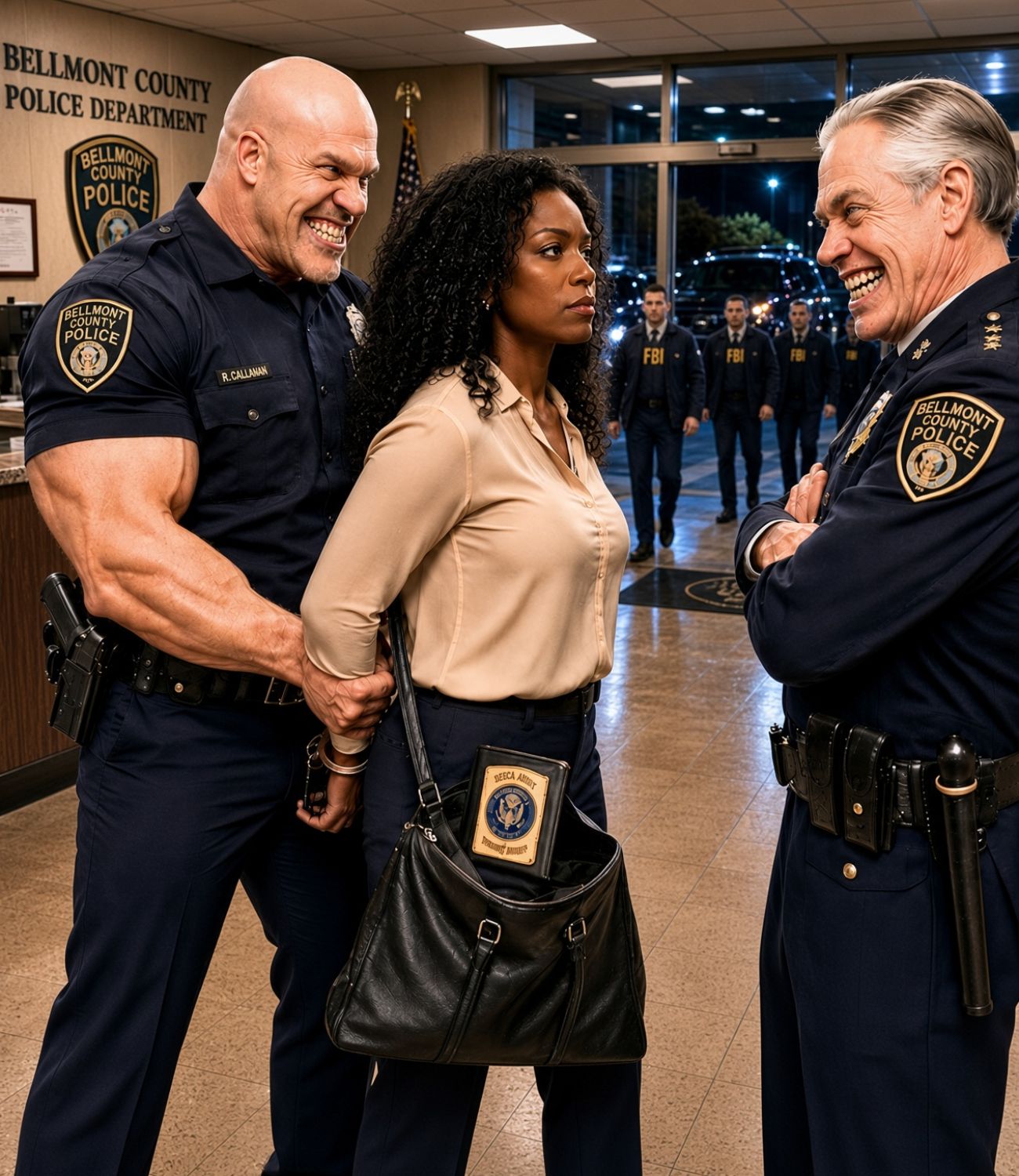
Maya Williams was driving through Belmont County when a patrol car began following her. A few seconds later, its red and blue lights came on. She slowed down, signaled, and pulled onto the shoulder. As soon as the patrol car stopped behind her, the signal bars on Maya’s governmentissued phone disappeared.
The screen changed to no service. She checked the rear view mirror and noticed a radio interference device operating inside the police cruiser. A voice came through the patrol car’s external speaker. Keep both hands on the steering wheel. Do not touch your phone. Maya remained still until officer Ryan Keller approached the driver’s side window and knocked on the glass.
Driver’s license. She lowered the window and handed it to him. Keller checked the name and date of birth, then looked at Maya again. She was 30 years old and dressed in regular business clothes. Registration. Maya opened her wallet. As she reached for the registration card, Keller noticed another identification card behind it.
U S, Federal Judiciary Identification. He pointed at it. What’s that? I’m United States District Judge Maya Williams. Keller took the card and examined it. He looked at Maya again, then laughed. You want to try that answer again? You can call Dispatch and verify my identity right now. Keller did not use his radio.
Instead, he returned to his patrol car and checked the computer mounted near the dashboard. A warning was displayed on the screen. High priority possible assist to wanted subject. He walked back to Mia’s window. Your vehicle is flagged for possible assistance to a high priority wanted subject. Maya looked toward his patrol car.
Who entered the alert? That information doesn’t concern you. The alert is attached to my license plate. It concerns me directly. Keller’s expression changed. Step out of the vehicle. Am I being detained? I told you to step out. Maya opened the door and got out. Keller ordered her to turn around. She complied and he placed handcuffs on her wrists.
You have my driver’s license and my federal identification. Maya said, “You haven’t made a single attempt to verify either one. I’m detaining a 30-year-old woman who is claiming to be a federal judge. I’m not claiming to be one. I am one. Keller adjusted the handcuffs. >> We’ll determine that. Maya looked directly at him.
Then you’d better hope you’re right. Keller did not respond. He placed Maya in the rear of his patrol car and returned to her sedan. From where she sat, Mia could see him open the rear passenger door and begin checking the interior. She reviewed what had happened since the stop began. Her phone had lost service immediately after Keller parked behind her.
a radio interference device was active inside his cruiser. He had refused to verify her identification, even after she gave him a direct way to do it. The warning attached to her vehicle also raised an obvious question that Keller had avoided answering. Keller lifted a stack of court documents from the rear seat. Underneath them was a sealed brown envelope marked in red.
Department of Justice sealed. He stopped moving. Maya watched him study the envelope. He did not open it. Instead of using the police radio, Keller took out his personal phone and made a call. Chief, it’s Keller. Maya could hear his side of the conversation through the partially open front window of the cruiser.
I stopped a 30-year-old woman who says she’s a federal judge. She has federal judiciary identification. There was a brief pause. Killer looked back at Maya’s sedan. There’s something else. I found a sealed Justice Department file in the back seat. He listened. Yes, sir. Another pause followed. Understood. Keller ended the call.
Maya watched him place the court documents and the sealed envelope together. His attitude had changed since the call. He was no longer treating the situation as a simple case of someone carrying suspicious identification. When he returned to the patrol car, Maya asked, “Did your chief tell you to verify my identity?” Keller opened the driver’s door.
“We’re going to the station.” That wasn’t my question. He got behind the wheel without answering. Maya continued. You contacted your chief before contacting dispatch or federal judicial security. Keller started the engine. You can ask your questions at the station. I’m asking because your procedure changed after you found that envelope.
Keller looked at her through the rear view mirror. You’re not conducting a hearing. No, I’m identifying the decisions you’re making. He looked forward again. Maya did not continue arguing. There was no benefit in repeating her position. Keller already had enough information to verify who she was, and he had chosen not to use it.
That decision now mattered more than his original suspicion. The patrol car pulled away from the shoulder and headed toward Belmont County Police Department. Maya watched the location of her sedan disappear behind them. Her government phone remained inside, still without service. Her identification was in Keller’s possession along with the sealed Justice Department envelope.
She focused on the sequence of events. Keller had stopped a vehicle carrying an unusual alert. He had seen federal identification and refused to verify it. He had found a sealed Justice Department file and immediately called Chief Robert Harlland on a private phone. The response from Harlland had also been immediate.
There had been no request to confirm Mia’s identity and no instruction to contact the federal judiciary. He had ordered Keller to bring her and the documents to the station. Mia looked toward the front of the patrol car. At first, Keller had believed she was lying because she was 30 years old. That was no longer the main problem.
Someone at Belmont County Police Department was more concerned about the sealed Justice Department envelope than about whether Maya Williams was actually a federal judge. The drive to Belmont County Police Department took less than 20 minutes. Keller said almost nothing. Maya watched the road through the side window and kept track of each turn.
Not because she expected to escape, but because she wanted the sequence of events fixed clearly in her mind. Keller had still made no effort to confirm her identity. When they reached the station, he parked near a side entrance instead of the public entrance facing the street. Maya noticed another detail immediately. There was no attempt to bring her through a normal booking area where other officers or visitors might see her identification and ask questions.
Keller opened the rear door. Step out. Maya did so carefully with her hands still cuffed behind her. Are you booking me? We’re sorting that out then. Who authorized my continued detention? Keller closed the car door harder than necessary. Chief Harlon will speak with you. That answer confirmed something Maya had already suspected.
Keller was no longer making decisions on his own. Inside, the station was quiet. A television mounted near the front desk played a local news program with the volume low. A coffee machine sat beside a vending machine along one wall. An American flag stood behind the reception counter. Keller moved Mia through the hallway without stopping at the front desk.
Sergeant Evan Cole stepped out of an office as they passed. He looked first at Keller, then at Mia’s handcuffs. What’s going on? Traffic stop turned into something else, Keller said. Cole glanced at the evidence bag in Keller’s hand. Maya’s federal judiciary identification was clearly visible inside.
Cole looked back at Maya. Has her identity been confirmed? Chief is handling it. That wasn’t what I asked. Keller lowered his voice. Talk to Haron. Before Cole could respond, a door opened farther down the hallway. Robert Harlland entered. He was a broad-shouldered man in his late 50s with gray at his temples and a controlled expression.
He did not approach Maya first. His attention went directly to the sealed brown envelope Keller was carrying. “Bring everything into the interview room,” Harlon said. Keller nodded. Cole remained where he was. “Chief, do you want judicial security contacted?” Harlon looked at him. “Not yet. If she’s claiming federal judicial status, that would settle it quickly. I said, “Not yet.
” Cole said nothing more, but Maya noticed his expression. Keller brought her into a small interview room and removed one cuff long enough to secure her to a fixed restraint point beside the table. Haron entered a few moments later, carrying the evidence bag and the sealed Justice Department envelope. He placed both on the table.
Then he sat across from her. “So Har said, you’re telling my officer, you’re a federal judge.” I told him who I am. Harlon looked at her identification through the clear plastic evidence bag. You’re 30 years old. That information is correct. And you expect me to believe you’re a United States District Judge? Maya met his eyes.
I’m not asking you to believe me. I’m asking you to verify me. If you sympathize with Maya handcuffed and detained, yet still calmly asking them to verify the truth, please give this video a like. Tell us in the comments where you’re watching from because someone near you may be watching this story with you right now.
And subscribe to the channel so you don’t miss the compelling stories still to come. Harlon leaned back. People carry fake government identification everyday. Then verification should be your first step. We’ll decide what our first step is. Maya looked at the phone mounted on the wall outside the interview room, visible through the narrow window in the door.
You have several ways to confirm my identity. You haven’t used any of them. Harlland’s face remained neutral. >> You seem very interested in telling us how to conduct an investigation. I’m interested in understanding why you’re refusing the easiest way to resolve it. Harlon did not answer. His eyes shifted briefly toward the sealed envelope.
Maya caught it. The change was small, but it was enough. What exactly did Officer Keller tell you when he called? You can ask him later. I heard his side of the call. Harlon looked at her again. He told you my age. He told you I identified myself as a federal judge. Then he told you about that envelope. Harlon placed one hand on the table.
You should be more concerned about your own situation. I am good. That’s why I’m paying attention to yours. Harlland’s expression hardened slightly. He picked up the brown envelope but did not break the seal. Why was this in your vehicle? It is sealed federal material. That doesn’t answer the question.
It answers the part I’m authorized to answer. Harland studied the warning printed across the envelope. Department of Justice sealed. Where were you taking it? To an authorized federal destination. Which one? I’m not discussing sealed material with someone who has not established authority to receive it.
Harlon put the envelope back on the table. For the first time, Maya saw irritation replace his earlier skepticism. He was not trying to determine whether she was a judge. He was trying to determine what she knew. You understand how this looks? Harlon said, “No, I understand how you want it to look. You’re 30 years old, traveling alone, carrying federal identification and sealed Justice Department material while your vehicle is connected to a wanted person alert.” Maya nodded once.
“Then verify each item.” Harlon said nothing. “Verify my identity. Verify the alert. Verify the chain of custody on the envelope. You can do all three without asking me another question. Harlon’s gaze remained on her. Maya continued, “But you haven’t verified any of them.” The door opened. Keller stepped in.
“Chief, [clears throat] you wanted the property sheet?” “Yes.” Keller handed him a form. Harlon reviewed it, then looked toward the hallway. Cole was standing several yards away. He could see the judiciary identification in the evidence bag. “Chief,” Cole said. I can make the federal confirmation call if Keller’s tied up.
Harlland’s response came immediately. No. The single word changed the room. Cole looked at Haron for a moment, then at Maya. Understood. He walked away. Haron closed the door. Maya waited until he sat again. You’re not worried that I’m lying anymore, are you? Harlon looked at her. What makes you say that? Because if you believed I was lying, you would want confirmation.
He remained silent. Maya looked at the brown envelope between them. You stopped trying to prove I was fake as soon as that arrived. I didn’t stop anything. For the last several minutes, “You’ve barely looked at me,” Harlon’s eyes narrowed. Maya continued in the same calm tone. “You’ve been looking at that envelope.
” For several seconds, neither of them spoke. Then Haron picked up the Justice Department file, stood, and walked toward the door. “Stay here.” Mia watched him leave with the envelope. Keller followed the door closed behind them. Mia listened to their footsteps move down the hallway and understood that her age was no longer the reason she remained in custody.
Keller might still believe she was an impostor. But Robert Haron was dealing with a different concern. He had been given a simple way to confirm who she was and had refused to use it. Whatever Haron believed was inside the sealed Justice Department envelope. He was more afraid of confirming Maya Williams than he was of detaining the wrong person.
Haron carried the sealed justice department envelope into the evidence processing room and closed the door behind him. Keller followed, still holding the property sheet from the traffic stop. Cole was at a workstation farther down the hall. He appeared to be reviewing an incident report, but he could hear part of the conversation through the door.
Harlon placed the envelope on a table. Tell me exactly what you entered. Keller opened the electronic report on a terminal. Vehicle alert, suspected connection to a wanted subject, questionable federal identification, and her claim that she’s a federal judge. Did you submit it? Not completely. I saved the initial entry, but the property section is still open.
Harlon looked at him. Any supervisor review? Not yet. Any automatic copy sent outside the department? Keller shook his head. No. Harlon turned toward the evidence bag containing Mia’s identification. Good. Keller watched him. Chief, we can still call judicial security. If she’s lying, we’ll know.
If she isn’t, we’ll know that, too. Haron picked up the evidence bag. You stopped her because the vehicle was flagged. Yes. You found suspicious identification. [clears throat] I found federal identification. I said it looked suspicious because she’s 30 and then write what you observed, not what you felt. Keller paused.
What exactly do you want changed? Haron moved to the computer. The report needs to reflect the situation we actually have. Keller frowned. The situation we have is that we haven’t verified her. Haron looked at him. And we’re not going to create a report that assumes her story is true. He instructed Keller to replace several entries in the draft.
The original wording that Maya had presented federal judiciary identification became a statement that she had presented identification of questionable authenticity. The notation that she had requested immediate verification was removed. The property entry for the sealed Justice Department envelope was changed to unidentified federal material pending review.
Keller stared at the screen. She asked me to verify her more than once. That isn’t relevant to why you detained her. It’s relevant to what happened. Harlon’s voice state. Even Ryan, [clears throat] you made a lawful stop based on an active alert. You encountered a person claiming federal authority and carrying restricted material.
That is what the record needs to show. Keller looked toward the evidence bag. What about her real ID? Harlon did not answer immediately. He opened a locked storage cabinet used for temporary property review and removed a separate evidence sleeve. He placed Maya’s original judiciary card inside it along with her driver’s license and the first handwritten property receipt Keller had completed at the roadside.
Then he took another identification card from a folder already on the table. Keller looked at it. What is that? A document being held for examination. That’s not what she gave me. Harlon inserted it into the evidence bag assigned to Maya’s case. Keller stepped back from the table. Chief Harlon sealed the bag. If she really is a judge, this turns into something else. Haron faced him.
Tomorrow, nobody is going to argue about what she says she is. They’ll argue about what the record says she is. Cole stopped typing at the workstation outside. He remained in his chair and listened. Keller lowered his voice. You’re asking me to sign this. You’re the arresting officer. You told me to bring her here.
Harlland’s expression did not change and you made the stop. Keller said nothing. Haron pushed the revised property sheet toward him. [clears throat] Finish your report. Back in the interview room, Maya had no view of what was happening. She could hear occasional movement in the hallway, but no clear conversation.
She checked the wall clock and fixed the time in her memory. When the door finally opened, Haron returned with Keller. The sealed Justice Department envelope was no longer with them. Harlon placed a clear evidence bag on the table in front of Maya. “Take a look.” Maya leaned forward. Inside was an identification card carrying her name and photograph, but the format was wrong.
The seal was wrong. The identification number was not hers. She looked up. “That isn’t my card.” Harlon sat across from her. “It was recovered from your vehicle.” No, it wasn’t. That’s what Officer Keller documented. Maya turned toward Keller. You saw my judiciary identification at the roadside. Keller avoided her eyes.
You held it in your hand, Maya continued. You read it, Harlon interrupted. You’re not questioning my officer. I’m identifying a discrepancy. There is no discrepancy. Maya looked at the evidence bag again. >> [clears throat] >> My actual card had a different identification number, a different issue code, and a different security layout.
This one was never in my wallet. Haron folded his hands on the table. You can make that argument later. The first property receipt will show what Keller took from me. Harlon did not respond. Maya watched him carefully. Where [clears throat] is the original receipt? You don’t control evidence procedure here. That wasn’t my question.
Harlon stood. You are being investigated for impersonating a federal official, presenting false government identification, and possessing restricted federal material without verified authority. Maya remained seated. Who signed the report? Keller. She looked at Keller again. Who ordered me brought to this station? Neither man answered.
Mia continued, “Who ordered the Justice Department envelope removed from my vehicle?” Harlon’s expression hardened. who decided my identification should not be verified. Keller shifted his weight. Harlon said, “We’re done.” Maya looked from Keller to Haron. One man had made the stop. One man’s name was being placed on the report.
One man was being positioned as the source of every official decision. Harlland’s name was missing from all of it. As he reached for the door, Maya spoke again. “You’re keeping yourself out of the record.” Harlon stopped for a moment, but did not turn around. Then he opened the door and left. Keller followed him. Maya watched the door close and looked once more at the false identification left on the table.
The problem was no longer whether Belmont County believed her. Someone inside the department had decided to create a version of events in which the truth would be harder to prove. Keller returned to the report room and closed the door behind him. Harlon was already standing beside the terminal, reviewing the revised incident report.
“Sit down and finish it,” Harlon said. Keller took the chair but did not begin typing. He read the report from the beginning instead. The language was different from what he had entered at the roadside. Maya’s request for verification was gone. The identification he had physically examined was now described as suspected fraudulent federal identification.
The sealed Justice Department envelope had been listed as restricted material of uncertain origin. Keller scrolled farther down. His name appeared beside nearly every decision. Officer Keller observed suspicious identification. Officer Keller determined the subject’s federal status could not be confirmed. Officer Keller seized restricted materials.
Officer Keller initiated detention. He looked up. Chief, why does this say I made every determination? Haron did not turn around. Because you made the stop. I didn’t decide to bring her here. You detained her. You told me to bring her in. Haron finally faced him. Did I? Keller stared at him. You called me. Harlon continued. You described the situation.
I told you to preserve the scene and transport the subject for further review. That’s not how you said it. Then tell me exactly how I said it. Keller opened his mouth but stopped. The call had been made on his personal phone. There was no official radio recording attached to the incident. Harlon watched him understand that you need to be careful about confusing memory with documentation.
Harlon said. Keller leaned back in the chair. You said to bring her and everything in. And you did. That’s my point. No, Ryan. Your point is that you’re nervous. Keller looked at the screen again. Haron stepped closer. You had an active vehicle alert. You had a woman presenting federal credentials you believed were suspicious.
You found sealed federal material in the car. Everything you did can be explained. If the credentials were actually hers, that changes things. Only if somebody proves they were hers. Keller’s eyes moved toward the hallway. Haron lowered his voice. Finish the report. Keller did not answer, but he placed his hands on the keyboard.
In the interview room, Ma sat with one wrist still secured beside the table. Haron had taken the false identification with him, leaving the room empty, except for a paper cup of water. Keller had placed there earlier. She checked the clock again. She was no longer thinking about convincing anyone that she was a judge. That part could eventually be verified.
What concerned her was the record being created before the verification happened when Harlon returned several minutes later. He carried no papers. Maya looked at him. Where is the original property receipt? You already asked me that and you didn’t answer. Harlon pulled out the chair across from her. You seem to believe repetition makes a question more important.
No, I believe unanswered questions remain unanswered. He sat down. You’ve probably spent a lot of time in courtrooms where people wait for you to speak. He said Maya kept her voice even. My age has nothing to do with your evidence procedure. I didn’t mention your age. You were about to. Haron gave her a brief look. 30 is young for the position you claim to hold.
My age is not a verification procedure. This isn’t your courtroom. Then use the procedure that applies here. Harlon’s expression tightened. Maya continued. Confirm the identification number. Confirm my commission. Confirm the sealed material through the appropriate federal contact. If I’m lying, you’ll know. If I’m not, you’ll know that, too.
You don’t give instructions in this building. I’m not giving instructions. I’m identifying the step you keep refusing to take. Harlon stood. Maya watched him move toward the door. Authority becomes dangerous when suspicion is treated as proof. He stopped but did not turn around. You’re in no position to lecture me about authority. I’m not lecturing you.
I’m telling you what your record will have to explain later. Harlon opened the door and left. Outside, Cole was standing near the evidence workstation with a clipboard in his hand. Harlon noticed him. Something you need? Just checking a property entry. What entry? The Williams. Stop. Harlland’s voice became firmer. Keller has it. Cole nodded.
The bag number on the updated property sheet doesn’t match the first intake notation. Harlon looked at him for several seconds. Clerical issue probably. Then correct it. Cole glanced toward the evidence room. I’d rather verify which entry is accurate before I change anything. Haron stepped closer. Sergeant, I said it’s a clerical issue.
Cole held his gaze briefly, then nodded. Understood. Harlon walked away. Cole waited until he disappeared around the corner before looking down at the clipboard again. The mismatch was simple. The first entry referenced a bag containing Ma’s driver’s license, federal judiciary identification, and personal property.
The new report referenced a different bag number for the federal identification. Two evidence numbers now appeared to describe the same item. Cole entered the evidence processing room. He checked the shelf assigned to temporary intake. One clear bag contained the identification Harlon had shown Maya.
Cole examined it without opening the seal. The card looked wrong even before he compared the number. He checked the original intake location. A second bag sat behind a stack of forms. Inside was Maya Williams’ driver’s license. Beside it was another card, U S, Federal Judiciary Identification. Cole read the name, Maya. Williams.
He looked back at the first bag. Two identification cards, two evidence entries, two different versions of the same stop. Cole did not remove either card. He checked the original handwritten property sheet lying beneath the second bag. Keller’s handwriting listed the judiciary identification at the roadside.
Along with the sealed Justice Department envelope, the newer report no longer described it that way. Cole stood still for a moment, then put the property sheet back exactly where he had found it. A few minutes earlier, Harlon had called the discrepancy a clerical issue. Cole now knew it was not. Someone had created a second version of the evidence and the first version had been left where very few people were supposed to see it.
Cole left the evidence processing room without touching either identification card. He returned to the hallway, checked that no one was watching him and headed toward Harlland’s office. The chief was standing near the doorway when Cole approached. Got a minute? Harlon looked at him. What is it? Cole kept his tone neutral.
I found the original intake bag from the William stop. Haron did not react. There’s a federal judiciary card in it. Cole continued. There’s also another card in the updated evidence bag. Haron stepped into his office and motioned for Cole to follow. When the door closed, he remained standing. What exactly are you asking me? I’m asking which card is supposed to be in the file.
There is no original card. Cole studied him. I saw it when Keller brought her in. You saw a piece of identification. I saw a federal judiciary credential with her name on it. Harlland’s voice remained calm. And now you’ve seen the item that was formally entered into evidence. That doesn’t answer the question. Harlon moved closer to the desk.
You’re spending a lot of time on a paperwork issue that doesn’t belong to you. I’m a sergeant. Evidence. Integrity belongs to me when I see a problem. Harlon looked at him for several seconds. There is no problem. Cole waited. Haron continued. The original intake was incomplete. Keller was working from an active alert and a subject claiming federal authority.
The final report reflects what can actually be supported. Cole nodded slowly. Then what happens to the first card? Harlon’s expression changed just enough for Cole to notice. What first card? Cole did not answer. Harlon stepped closer. There is no first card, Evan. I saw it. No, you saw something before the evidence review was complete.
Cole kept his voice low. That’s not the same thing. It is when the report is finalized. Harlon paused, then added, “Tomorrow, you’ll remember what the report tells you to remember.” Cole said nothing. Harlon opened the office door. Go back to work. Cole left without arguing. Inside the interview room, Maya was still reviewing the sequence of events in her mind.
She had stopped thinking about the false identification itself. The more important issue was why Harlon needed it. If he believed she was an impostor, he should have wanted confirmation immediately. A single call to federal judicial security would have settled the matter. Instead, he had refused every opportunity to verify her.
That meant uncertainty was useful to him. Maya looked at the empty section of table where the sealed Justice Department envelope had been. When Harlon returned, he carried nothing. Maya watched him take the chair across from her. You’ve been busy. Harlon ignored the comment. You’ll remain here while we review the material recovered from your vehicle. Recovered. Seized.
Those are different words. They lead to the same place, not in a report. Harlon leaned back. You seem very concerned with wording. I’m concerned with accuracy. You’re in custody. You should be concerned with your own position. I am. Maya looked at him directly. That’s why I want to know what you think is inside the Justice Department envelope.
Harlon’s expression remained controlled. You’re not in a position to question me. I didn’t say I was. Then stop. You still haven’t answered. Harlon stood. Maya continued before he reached the door. If the envelope has nothing to do with Belmont, then you’re taking an extraordinary risk over material that has nothing to do with you.
Harlon stopped. Maya waited until he turned back. And if it does have something to do with Belmont, she said, “Then keeping me here makes your problem worse. You don’t know what’s in that envelope.” “No,” Harlon’s eyes narrowed, Maya added. “Neither do you. For the first time since he entered,” Harlon had no immediate response.
Maya watched him carefully. That’s why you haven’t opened it. You have no idea what I’ve done with it. You haven’t opened it. Because if the seal is broken, you create a record you can’t explain. Harlon walked back toward the table. You think because you sit on a federal bench, you understand every decision made in a police station.
My position has nothing to do with this question. It has everything to do with why you think you can sit there and tell me what I know. Maya remained calm. Then verify me. Harlon stared at her. Call [clears throat] the federal judiciary. Confirm my name, my commission, my identification number.
If I’m lying, your problem gets easier. He said nothing. If I’m telling the truth, your problem changes. Harlland’s jaw tightened. Maya continued. That is why you won’t make the call. He turned toward the door. Maya spoke again. You don’t need me to be guilty. You need me to remain unverified long enough for your paperwork to become the official version. Haron opened the door and left.
In the hallway, Keller was standing at the report terminal. He had finished most of the revised incident report, but had not signed it. Harlon stopped beside him. Why isn’t that done? Keller lowered his voice. I want to see the original property sheet. You don’t need it. I wrote it and you replaced it.
Keller looked toward the interview room. She knew the ID number was wrong. That doesn’t prove anything. She knew immediately. Harlon moved closer. Ryan, you need to decide whether you’re going to finish the report or become part of the problem. Keller looked at the screen. What happens if federal security calls here? We deal with it.
What happens if they already know where she is? Haron did not answer directly. Sign the report. Keller remained still. Across the hall, Cole watched from his desk. He now understood why Harlon had insisted the discrepancy was clerical and why the original evidence had been separated from the official file.
There were two versions of the same stop inside the building. One had Ma’s real identification, Keller’s first property sheet, and the sealed Justice Department envelope as it had actually been recovered. The other had a false credential and a report that removed Ma’s repeated requests for verification. Cole looked toward Harlland’s office, then toward the interview room, he could no longer treat the difference as a mistake.
At the same time, several miles away, special agent Marcus Reed was reviewing a federal systems alert connected to Maya Williams. Her government device had stopped transmitting. Her judiciary credential had been queried through a local system. A sealed Justice Department package scheduled for federal delivery had not arrived.
Then another entry appeared on his screen. Maya’s license plate had been placed under a Belmont County high priority vehicle alert. Marcus looked at the timestamp. Preserve the logs, he said. A colleague asked whether Belmont should be contacted. Marcus shook his head. Not yet. Why? Because first I want to know who created the alert at Belmont. Maya watched the clock.
Cole looked at the two evidence entries. Keller stared at the unsigned report. None of them had spoken to the others, but each had reached the same conclusion. The official version of what happened on that road was already being changed. Maya stopped asking to be released. The change was small enough that Harlon did not notice it immediately.
For most of the evening, every conversation had returned to the same issue. Her identity, her detention, the refusal to verify her federal credentials. Now, she let those questions go. When Harlon entered the interview room again, Maya was sitting upright with the paper cup of water untouched beside her. He closed the door. You’ve gotten quiet.
I’ve already told you who I am. And we’re still reviewing that. Maya nodded. What time was the vehicle alert entered? Harlon looked at her. What? The alert attached to my license plate. What time was it entered? That’s part of the investigation. Who authorized the evidence transfer from my vehicle? Harlon did not answer.
Maya continued, “Who logged the sealed Justice Department envelope into property?” His expression tightened. “Are you questioning me now?” “No, I’m remembering.” Harlon took the chair across from her. “You think you’re going to reconstruct the entire evening from that room? I don’t need the entire evening.
I only need the decisions that affected me. You’re assuming there’s something improper to reconstruct. I’m identifying things that should already be documented. Harlon leaned back. You’re 30 years old. I imagine people have spent a long time telling you how exceptional you are. Maya did not respond to the insult. You probably reached the bench faster than people who spent decades waiting for the same opportunity.
He continued, “That kind of success can make someone believe every room works the way she expects it to. My age has nothing to do with the missing property receipt. It has something to do with how quickly you think people should accept your authority. I never asked Officer Keller to accept my authority. I asked him to verify my identity.
Harlon studied her. Maya continued. The same request applies to you. You’re still here because verification is not the only issue. Then tell me the other issue. You were traveling in a vehicle connected to a wanted person alert while carrying questionable federal identification and sealed material. That description depends entirely on the report your department is creating.
It depends on the evidence. Then preserve the original evidence. Harlon said nothing. Maya watched his face. That should be easy to agree with. You’re in no position to tell this department how to preserve anything. I’m not telling you how. I’m telling you that the original evidence should still exist. Harlon stood and walked toward the door.
Before he reached it, Maya said, “A reputation can be damaged by a lie. That does not make the lie true.” Harlon turned back. “You should be thinking about your reputation,” he said. A federal judge detained with suspicious credentials and sealed Justice Department material is not a small story.
Maya understood what he was doing. He wanted her attention on what she could lose. public trust, professional standing, the credibility attached to her office. You’re hoping I’ll become afraid of the accusation. She said, “You should be. I’m more interested in the documentation behind it.” Harlon opened the door. “You keep talking like everything has to satisfy you.” “No, it has to survive review.
” He left without responding. Outside the room, Keller was still at the report terminal. He had signed part of the incident file, but left several sections incomplete. Harlon stopped beside him. Why are you still working on that? Keller kept his voice low. Because some of the times don’t match. Fix them. That’s what I’m trying to do.
Harlon leaned toward the screen. Then do it. Keller pointed to one entry. The vehicle stop was recorded before the alert appears in the updated system summary. Harlon looked at him. Then [clears throat] the summary is wrong or the time is wrong. Ryan Keller stopped. Harlon lowered his voice. You are making this more complicated than it needs to be. Keller looked at the report.
It already is complicated. A few desks away, Cole heard the exchange without turning toward them. He had spent the last several minutes comparing the original evidence number with the revised property log. The mismatch remained. Maya’s real judiciary identification still existed in the first intake bag, and the false credential remained in the official evidence package.
Cole closed the screen before Harlon could see what he was reviewing. Harlon walked away with Keller following him. Cole waited until they turned the corner, then reopened the record. The first property sheet showed the real identification. The revised report described something else. The difference was no longer a paperwork problem.
Someone was trying to make the first version disappear from official view. Cole looked toward the interview room. Maya could not see the evidence files or the computer logs. She could not know what Cole had found, but she was asking the right questions. Who entered the alert? Who authorized the transfer? Who handled the sealed envelope? Who changed the record? Cole realized that if Harlon controlled every written answer, Maya’s memory might become one of the few things inside the station he could not edit.
That thought stayed with him as he returned to the evidence room. He checked the original intake bag again, then looked at the ceiling mounted camera covering the processing area. Its status light was on, but he did not know how long the recording would remain available if Harlon decided it should not. For the first time that night, Cole considered a different problem.
Seeing the truth was not enough. He needed a way to preserve it. Back in the interview room, Harlon returned one more time. Maya looked at him. Who entered the vehicle alert? You’ve asked enough questions. No, you’ve avoided enough answers. Harlon stepped closer to the table. This ends when I decide it ends. Maya met his eyes.
No, it ends when something leaves this building that you can’t rewrite. Harlon’s expression changed, but Maya did not look away. She had no idea that only a few rooms away. Evan Cole was beginning to think the same thing. Cole waited until Harlon and Keller were both occupied before leaving the main work area. He went to a small equipment locker used for internal investigations and administrative reviews.
Inside was a compact bodywn recording unit that could operate independently from the department’s normal evidence system. He took it, checked the battery, and secured it beneath the edge of his shirt so the lens remained exposed without drawing attention. Cole looked at himself in the locker room mirror for a moment. “Okay,” that was all he said.
He returned to the hallway and walked toward Harlland’s office. The chief was reviewing paperwork when Cole appeared at the door. “What now?” Harlon asked. “I want to make sure I understand what we’re doing with Williams’ property.” Harlon looked up. Keller is handling the report.
I’m asking about the physical evidence. What about it? Cole stepped inside. The judiciary identification that came in with her. The first one. Harlon put down his pen. We already discussed this. I know. Then why are we discussing it again? Because it’s still in evidence processing. Harlland’s face remained controlled. There is no original identification.
Cole paused. I saw it when Keller brought her in. You saw a card. I saw her name and federal judiciary identification on it. Harlon leaned back in his chair. There is what gets entered into evidence, Evan. And there is everything else. People think they remember. Cole kept his expression neutral.
So the card in the first bag doesn’t count. What first bag? The one with her driver’s license and Keller’s original property sheet. Harlon looked at him more carefully now. Cole could feel the camera recording against his shirt. There is no real ID, Harlon said. There was Harlon’s voice lowered. There is what gets entered.
And there is everything else. Cole did not challenge him further. Understood. He turned toward the door. Evan. Cole stopped. Harlon watched him. You seem unusually interested in this. I saw a discrepancy and I explained it. You did? Then let it go. Cole nodded and left. He did not look down at the camera until he had reached the far end of the hallway.
The recording was still active. Keller was in the report room when Cole passed by. He was sitting in front of the terminal with an untouched cup of black coffee beside the keyboard. Cole stopped at the doorway. You all right? Keller looked at him. Why? You look like you haven’t moved in 20 minutes.
Keller glanced at the screen. I’m trying to make the report make sense. That usually helps. Keller gave him a tired look. You think this is funny? No. Cole stepped inside. Keller lowered his voice. The more Harlon changes, the more my name ends up attached to it. Cole did not answer immediately. Keller continued, “The detention is mine. The seizure is mine.
The identification issue is mine. The property entry is mine. You made the stop. I know that. Then what are you worried about?” Keller pushed the coffee aside. I called Haron before I brought her in. He told me to transport her and the documents. Cole watched him. Was that call recorded? No. Department phone? My personal phone? Keller looked frustrated with himself.
Cole said, “Then write down what you remember.” Haron told me, “Memory isn’t documentation.” “That sounds like Haron.” Keller looked toward the hallway to make sure they were alone. If this goes federal, he’ll say, “I made every call.” Cole kept his voice calm. “Did [clears throat] you?” “No.” “Then don’t forget that.
” Keller stared at the report. “What happens if she really is a judge?” Cole answered carefully. “Then being wrong is the smaller problem.” Keller looked up. “What’s the bigger one?” Cole glanced toward Harlland’s office. “What people do after they realize they’re wrong?” Keller did not respond. Cole left the room before the conversation went further.
He returned to evidence processing. The camera was still running. He positioned himself so both evidence bags were visible in front of him without moving either one. The first bag contained Maya’s real judiciary identification, her driver’s license, and the original property receipt. The second contained the replacement card now listed in the active report.
Cole stayed there long enough for the camera to capture both items clearly. He also recorded the evidence numbers. Then he stepped back. For several seconds, he simply looked at the two bags. One reflected what Keller had actually taken from Mia’s wallet. The other reflected what the department now claimed he had taken.
Cole turned off the camera only after leaving the room. He did not yet know what he was going to do with the recording. Keeping it inside the station carried its own risk, and confronting Harlon directly would give him time to explain or destroy whatever remained. For now, Cole needed more than proof that the evidence had changed.
He needed proof of who ordered it. At the far end of the hallway, Harlon came out of his office carrying two fresh cups of coffee. He handed one to Keller. Keller accepted it but did not drink. Harlon leaned against the desk beside him. You’re overthinking this. Keller looked at the screen. I’m thinking about my name being on everything. It should be.
You were the officer on the scene. You were the one who told me to bring her here. Haron took a sip of coffee. We’ve been through this. No, you’ve [clears throat] explained what you want the report to say. Harlon’s expression changed. Cole remained out of sight near the evidence room doorway and listened. Keller continued.
If this becomes a federal matter, I’m not taking responsibility for decisions I didn’t make. Harlland sat down his coffee. If this becomes a federal matter, Ryan, the worst thing you can do is start changing your story because you got nervous. I’m not changing anything. Good. Then sign the report. Keller looked at him. Haron returned to his office.
Cole waited until the door closed. Keller still had not signed. That hesitation confirmed something Cole had already begun to understand. Keller was afraid of being blamed. Harlon was afraid of the evidence. And somewhere between those two fears, the truth was still sitting in an evidence room where it could be changed again.
Cole touched the small camera beneath his shirt. The first recording was enough to show that Harlon knew the real identification existed. It was not enough to prove the full cover up. Cole needed Harlon to say more. Cole waited until Harlon returned to his office before going back to the main terminal. The original property discrepancy was important, but it only showed that evidence had been changed after Maya arrived at the station.
He wanted to know whether anything unusual had happened before Keller stopped her. He signed into the department system with his regular sergeant credentials and opened the vehicle alert history. Belmont kept an administrative log showing when alerts were created, modified, or removed. Cole entered Maya’s license plate.
The result appeared almost immediately. High priority possible assist to wanted subject. Cole checked the timestamp. The alert had been created only minutes before Keller stopped Maya. He opened the entry details. It was not an automatic state or federal notification. Someone inside Belmont County Police Department had entered it manually.
Cole checked the administrator field. Robert Har. He read the name twice. Until that moment, Cole had believed Harlland’s misconduct began after Keller called about the sealed Justice Department envelope. The record in front of him showed something different. Haron had acted before Keller knew who was driving the car.
Cole checked the access history again to make sure he had not misunderstood it. The alert had been entered through Harlland’s administrative account and attached directly to Mia’s plate. There was no linked warrant number and no outside agency request attached to it. Cole did not alter the file. He memorized the timestamp and closed the screen before anyone walked past.
Keller entered the room a few moments later. Cole looked at him. When did you first know Williams was supposed to be stopped? Keller frowned. When the alert came up, you weren’t told before that. No. Haron didn’t call you. No. Why? Cole kept his tone casual, just checking the timeline. Keller studied him.
You found something? I found an alert. We already knew there was an alert. Cole looked toward Harlland’s closed office door. Do you know who entered it? Keller shook his head. Cole did not answer. Keller lowered his voice. Evan, not here. That was enough for Keller to understand there was more. Inside the interview room, Maya had reached the same issue from a different direction.
Keller had told her the vehicle alert was already active when he checked his computer. That meant the alert existed before he saw her federal identification. It existed before he learned she was a judge. It also existed before he discovered the sealed Justice Department envelope. Maya reviewed the order again. The patrol car had followed her.
The interference device had activated when Keller stopped behind her. The alert was already waiting in his system. Keller had refused to verify her identity. After finding the sealed envelope, he called Haron privately. The sequence did not support Harlland’s version of a routine stop that had become complicated.
The stop itself had been arranged. When Haron returned, Maya was ready. He remained near the door instead of sitting. You requested something? No. Then why did Keller say you were asking for me? I told him I wanted the person responsible for my continued detention identified. That would be me. Maya nodded. Good. Then I can ask you directly. Harlon waited.
“You knew my vehicle before Officer Keller knew who was driving it.” His expression remained neutral. Maya continued, “The alert existed before he saw my identification. So, my age and my federal credentials cannot be the reason the vehicle was flagged.” Harlon crossed his arms. “You’re making assumptions about a system you haven’t seen.
I’m using the sequence your officer gave me. You don’t know when the alert was entered. That’s easy to establish. You don’t have access to the log. No, but someone eventually will. Harlon looked at her for several seconds. Maya continued. Officer Keller believed I was an impostor. I believe that part.
He looked at my age and made a bad decision. Harlland’s eyes narrowed slightly, but Keller didn’t create the reason to stop my car. Careful with what? Accusing people without evidence. Maya almost smiled, but she did not. I’m glad we agree evidence matters. Harlon took a step toward the table. You have no idea why that vehicle appeared in the system.
Then [clears throat] tell me, I don’t owe you an explanation of an active police alert. Was the alert based on a warrant? No answer. An outside agency request? No answer. A confirmed wanted person? Harlon remained silent. Maya watched his face. Or did someone in this department enter it manually for the first time? Harlon looked away. It lasted less than a second. Maya saw it.
You knew the car. She said, “You didn’t know me.” Harlon moved toward the door. Maya continued before he reached it. That means whatever you wanted was connected to the vehicle or something you expected it to be carrying. He stopped. Maya looked at him. The envelope. Haron turned. You keep coming back to that. So do you.
You think you understand this because you ask questions for a living. I understand when someone refuses to answer the simplest one. What question is that? Why was my car targeted before anyone knew I was inside it? Harlon opened the door. This conversation is over. Maya spoke before he left. No, you just don’t have an answer you can safely give me.
Harlon closed the door behind him. In the hallway, he found Cole standing near the report terminal. What are you working on? Vehicle records. Which vehicle? Cole looked at him. Williams. Harlon’s face hardened. Why? The timeline still doesn’t match. Leave it alone. Cole nodded once. Harlon walked away, but Cole waited until he disappeared before looking back at the terminal.
He now had two facts Harlon could not explain honestly. The evidence had been altered after Maya arrived, and the vehicle alert had been created before Keller stopped her. Cole quietly restarted the hidden camera beneath his shirt. The situation had changed again. He no longer needed to prove that Harlon was covering up Keller’s mistake.
He needed to prove that Haron had been involved before the mistake ever happened. Haron returned to his office and shut the door. He stayed there for several minutes, reviewing the records connected to Mia’s detention. The problem had become larger than the original stop. Mia had identified the missing verification steps.
Cole had started checking the evidence logs and Keller was questioning why his name appeared on nearly every decision. Harlon opened the vehicle alert record and looked at the entry tied to Maya’s license plate. His administrator account was still attached to it. He closed the screen. Keeping the paperwork under control was no longer enough.
The original material had to be removed before someone outside Belmont demanded access to it. He called Keller into the office. Close the door. Keller did. Harlon placed the revised incident report on the desk. Is this signed? Not yet. Why? Because the timeline is still wrong. Harlon looked at him. We’ve already been through this.
The stop time doesn’t match the alert history and the original property sheet doesn’t match the current evidence list. Then the earlier records need to be corrected. Keller stared at him. Corrected or removed. Harlland’s expression changed. You need to decide how involved you want to be in questions that aren’t yours.
My name is on the report. That makes them mine. Haron stood. Your job is to document the stop you made. My job isn’t to explain why records changed after I got back here. Then stop trying to explain things nobody has asked you to explain. Keller did not respond. Harlon continued, “The original property sheet is no longer part of the active record.
The first evidence bag was incomplete. The vehicle alert contains administrative information that does not belong in your narrative. What happens to the originals? They’re handled. Keller looked toward the door. Handled how? Harlon did not answer. A few minutes later, he entered the interview room. Maya had not changed her position.
She was still watching the clock and keeping track of every time someone entered or left. Harlon sat across from her. You’ve had plenty of time to think. I’ve been thinking since Officer Keller stopped me. That may be part of your problem. Maya waited. Haron said, “You keep assuming every inconsistency means misconduct.
No, I assume inconsistencies should be explained. You’re not entitled to an explanation of an active investigation. I’m entitled to know why evidence taken from me has been replaced.” Harlon’s face remained neutral. You keep saying that as if repetition makes it true. The original identification exists. You can’t prove that. Keller can. Harland said nothing.
So, Consurgent Cole, that caught his attention. Maya noticed. You’re watching the wrong person, she continued. You keep treating me as the threat because I know what happened. But other people inside this station saw pieces of it, too. Harlon leaned forward. Be careful about involving my officers in accusations you can’t support.
I don’t need to involve them. You already did. His jaw tightened. Maya continued in the same calm tone. You had one bad stop. Keller could have corrected it with one phone call. It wasn’t a bad stop. Then why are you changing the paperwork? Haron remained silent. Maya nodded once. That’s the problem.
What is a lie? Never asks to be left alone. It always needs another lie standing beside it. Harlon looked at her for several seconds. You think you understand what’s happening here? I understand that the first problem was whether Keller believed my identification now. The problem is why the real identification is no longer in the official evidence bag.
You have no idea where your property is. Then produce it. Harlon stood. Maya continued before he reached the door. The longer this goes on, the harder it becomes to call it a mistake. He opened the door without answering. outside. Cole was walking toward the evidence area when he saw Harlon approach Keller.
Both of you, Haron said. Evidence processing. Cole followed without asking why. Inside the room, Harlon pointed toward the original intake materials. The first property sheet is being removed from active circulation. The original identification goes with it. Cole looked at him. Removed where? Secure disposal. Cole kept his expression controlled, Harlon continued.
The vehicle alert record will also be corrected. Any preliminary printouts that don’t match the final entry are to be destroyed. Keller looked at the sealed Justice Department envelope on the table. What about that? Harlon paused. That too. Keller stared at him. You want to destroy a sealed federal document? I want material that was improperly introduced into this department removed from our custody.
That same sounds different from destroying it. Harlon stepped closer. Then don’t use the wrong word. Cole listened without interrupting. Keller lowered his voice. What happens if federal agents show up and ask for it? Haron looked directly at him. Then make sure they don’t find something that should never have been here.
Keller did not move. Haron added, “If this goes wrong, the first question will be why you detained her. I suggest you remember that before you decide where your loyalties are. Keller’s face changed. The warning was clear. Haron was not promising to protect him. He was reminding Keller that his name was already on the stop.
Haron turned to Cole. Move the materials downstairs. Cole nodded. He gathered the original property sheet. Maya’s real judiciary identification and the sealed envelope without altering their condition. As he carried them through the hallway, the hidden camera beneath his shirt continued recording. The secure disposal area was located in the rear section of the building.
Cole entered and placed the documents in a holding container designated for materials awaiting destruction. He did not move them any farther. The sealed brown envelope remained visible at the top. Department of Justice sealed. Cole checked the wall clock. It was getting late. He now understood Harlon’s plan. The false record would remain in the system while the documents capable of disproving it would disappear.
Cole looked at the sealed envelope, then at Mia’s real identification beside it. Until that moment, he had been collecting evidence of a cover up. Now he was watching Harlon prepared to destroy the evidence itself. Cole left the secure disposal area and returned to the main hallway. He did not tell Keller that the original identification and the Justice Department envelope were still intact.
Haron had ordered the materials destroyed, but Cole had placed them only in the holding container for the moment. That gave him time. The clock above the report desk showed 9:42. Keller was still seated at the terminal reviewing the incident report. Haron stood nearby. Finish it, Haron said. Keller did not look up.
I’m reading the property section. You’ve read it enough. The original sheet says I collected a judiciary credential. The new one says suspected fraudulent identification. That has already been addressed. Keller turned toward him. Not [clears throat] by me. Harlon’s expression remained controlled. You’re starting to sound uncertain about your own stop.
I was uncertain when I made it. That’s why she should have been verified. Haron stepped closer and yet you detained her. Keller looked back at the screen. Cole kept walking. He did not want either man to know how closely he was listening. At 10:15, Maya was given a turkey sandwich, a bag of chips, and a bottle of water.
Keller placed them on the interview room table. You should eat something. Maya looked at him. How long do you intend to keep me here? That’s up to the chief. You arrested me. Your name is on the report. Keller’s face changed slightly. You’ve seen the report. I’ve seen enough of it. He started toward the door.
Maya opened the sandwich. Officer Keller. He stopped. When you first saw my identification, did you believe it was fake? Keller turned back. Yes, that was your mistake. He said [clears throat] nothing. What happens next is a separate decision. Keller looked toward the hallway, Mia continued. You can be wrong once without deciding to be wrong again.
Keller opened the door and left. Maya ate a few bites of the sandwich and drank some water. She was tired, but she knew fatigue could make small details disappear. She reviewed the evening again and kept the sequence simple. The stop, the lost phone signal, the warning on the patrol computer, Keller’s refusal to verify her identity, [music] the sealed envelope, Harlland’s arrival, the replacement identification, the missing original property sheet, someone outside Belmont would eventually ask what happened. She intended to remember
exactly what she could. At 10:47, Haron entered the evidence processing room and told Cole to bring the disposal container downstairs. Cole kept the hidden camera running. Keller followed. Inside the secure disposal area, Harlon checked the contents himself. Maya’s original judiciary identification was still there.
The first property sheet lay beneath it. The sealed Justice Department envelope remained unopened. Harlon pointed to the identification. This goes first. Neither Keller nor Cole moved. Haron then pointed to the sealed envelope. That goes next. Keller looked at him. You’re sure about this? Haron turned. I gave you an instruction.
I’m asking because that’s sealed federal material. I know what it is. No, you know what the label says. Harlland’s face tightened. Keller continued. What if federal agents show up and ask where it went? Harlon answered without hesitation. When they get here, they’ll [clears throat] have a 30-year-old woman saying she’s a judge.
We’ll have the record. Cole kept his breathing steady. The camera was recording Harlland’s face, his voice, the original identification, and the sealed envelope in the same frame. It was the clearest evidence Cole had obtained all night. Keller looked at the container. And if the record gets compared to the original intake, there won’t be an original intake.
Cole asked, “What about the server copy?” Harlon looked at him. That gets corrected. Cole nodded, but Haron continued watching him. “What? Nothing. You’ve had a lot of questions tonight. I’m trying to understand what you want. Documented. I want one accurate report. Cole looked at the two versions of Maya’s evidence in the holding container.
Haron noticed where he was looking. He removed the baton from his duty belt and placed it on the metal table between them. He did not raise it or threaten anyone with it. But the gesture changed the conversation. Tonight we protect each other. Harlon said. Cole kept his voice. “Is that what we’re doing?” Haron looked directly at him.
Cole added, “Protecting the department?” Harlon waited a moment before answering. “Same thing.” Cole said nothing. That answer confirmed what had been developing since Maya arrived. Harlon no longer separated his own interests from the department’s interests. If protecting himself required changing evidence, then he called it protecting the department.
if it required destroying evidence. The justification remained the same. Keller looked at the baton and then at Harlon. What happens to me when this is over? Harlon seemed irritated by the question. What do you mean? My name is on the stop. My name is on the seizure. My name is on the detention because you did those things.
You told me to bring her here. We’ve discussed this. That’s not an answer. Harlon stepped closer to Keller. Your problem started when you stopped a woman carrying questionable federal credentials. Your best option now is to make sure the documentation supports what you did. Keller stared at him. So if this falls apart, “It’s mine.” Harlon did not answer.
He picked up the baton and returned it to his belt. “Get the report finished.” Keller left the room without responding. Cole remained beside the holding container. Harlon pointed at the documents. Before midnight, Cole nodded. Harlon walked out, the door closed. Cole checked the wall clock. 11:03.
He looked down at the hidden camera. The recording contained Harlland’s direct order, the original evidence, and his statement about controlling the record, but the camera was still inside Belmont County Police Department. As long as the recording remained inside the building, Harland could still find it, seize it, or destroy it.
Cole turned off the camera and removed it from his shirt. He now had the evidence he had been waiting for. The next problem was getting it outside Harlland’s control before midnight. Cole slipped the recording unit into his pocket and left the disposal area. He needed a connection outside the department’s internal network and he could not risk using a station computer.
Haron had already shown that he was willing to alter official records if Cole transferred the video through a system Harlon controlled. There was no guarantee the file would remain intact. He walked toward the rear administrative entrance and told Keller, “I’m checking the exterior evidence access.” Keller barely looked up from the report terminal now.
Before Harlon asks why the disposal log isn’t complete, Keller gave a tired nod and returned to the screen. Cole stepped outside. The rear parking area was quiet and the station’s interference did not fully cover the far end of the lot. His phone showed a weak cellular signal. He took out the camera.
The complete recording was too large to transfer quickly. Cole reviewed the most important section and selected a short clip. Harlon pointed to Maya’s original judiciary identification. This goes first. Then he pointed to the sealed Justice Department envelope. That goes next. Keller’s voice followed. What if federal agents show up and ask where it went? Harlon answered.
When they get here, they’ll have a 30-year-old woman saying she’s a judge. We’ll have the record. The clip continued long enough to capture Harlon ordering the material destroyed before midnight. Cole attached the video to a message addressed to the federal contact associated with the preservation inquiry that had appeared in Belmont’s system earlier that evening. He pressed send.
The signal weakened. The screen showed the file attempting to transfer, but Cole did not get a clear confirmation before the connection dropped. He tried once more. Nothing. Someone opened the rear door of the station. Cole put the phone away. Keller stepped outside. Harlon’s looking for you. I was checking the access door.
Keller looked around the empty parking lot. For what? Anything unusual? Keller gave him a skeptical look, but did not press the issue. They went back inside. Several miles away. Special agent Marcus Reed was still reviewing the Belmont records when a new message reached the secure device on his desk.
He opened the video. The first viewing lasted less than a minute. Marcus watched it again. Harlon was clearly visible. The Justice Department seal was visible. Maya Williams’ identification could be seen beside the envelope. Most important, Harlon’s instructions were direct. Destroy the original identification. Destroy the sealed material.
Do it before midnight. Marcus paused the video and checked the metadata associated with the message. He picked up his phone. I need the Belmont preservation package moved to execution status. The person on the other end asked a question. Marcus looked at the frozen image of Harland standing beside the evidence container.
We have direct evidence of imminent destruction. He listened. Yes. Include the server logs, communications records, the Williams property file, all related video, the vehicle alert history, and the sealed DOJ package. Another pause. The judge’s identity has already been confirmed.
Marcus checked the federal return on his screen. Yes. United States District Judge Maya Williams. Confirmed. [clears throat] He ended the call and stood. The legal work had already been developing from the earlier alerts. Maya’s government device had stopped communicating. Her judiciary credential had been queried through Belmont and the sealed package had failed to arrive at its authorized destination.
The video from Cole changed the urgency. There was now evidence that the material might not exist much longer. Marcus collected the warrant packet and left the office. Outside, several black Chevrolet Suburbans were being prepared for departure. The team carried evidence containers, digital forensic equipment, and documentation required to secure the Belmont records.
Marcus approached the lead vehicle. No unnecessary contact. We preserve the building, the servers, and the evidence. Nothing gets moved once we arrive. The driver nodded. Marcus got into the front passenger seat. The convoy pulled out. Back at Belmont, Haron entered the disposal area and found the container untouched. He looked at Cole.
Why is this still here? You said before midnight. I changed the schedule. Cole kept his face neutral. to when now Keller stood near the doorway. Chief, maybe we should hold off. Haron turned toward him. On what basis? The Federal File. We’ve discussed the Federal File. I know. That’s why I’m saying we should wait. Haron walked closer.
You spent the first half of the night telling me you had reason to detain her. Now you suddenly want to protect her property. I want to know where this ends. It ends when the evidence matches the report. Keller looked toward Cole. Harlon pointed at the disposal system. Started. Cole did not move. Harlon repeated. Start the disposal cycle.
Cole stepped toward the control panel and activated the machine without placing any document inside it. A low mechanical sound began behind the secured compartment. Haron checked the container. Identification first. Cole reached toward the document slowly. In the interview room, Maya heard the machine somewhere deeper in the building.
She checked the clock again. The station had become quieter over the last hour, but the activity beyond her door had increased. Keller entered a few minutes later. Maya looked at him. What are they destroying? His expression changed. I didn’t say anything was being destroyed. You didn’t need to. Keller turned toward the door. Maya continued.
If my original identification disappears, your first property sheet still existed. Killer stopped. If the property sheet disappears, the system still has timestamps. He looked back at her. And if those disappear, too, Mia said, “Someone will ask why so many records connected to one traffic stop disappeared on the same night.
” Keller said nothing. Mia added, “You still have a choice about what your name means when that question is asked.” Keller left without replying. At the disposal area, Harlon checked the time and became impatient. Enough waiting. Cole looked toward the hallway. Then toward the front windows at the far end of the station. Light moved across the glass.
A black Chevrolet Suburban entered the parking lot. Another followed. Then a third. Keller stepped out of the report room and saw them. Haron turned toward the windows. The first SUV stopped near the main entrance. The second continued toward the side access. The third moved toward the rear of the building.
Cole looked at the sealed Justice Department envelope still inside the container. He had no confirmation that his video had reached anyone. He did not need one anymore. Harlon stared through the glass as more dark vehicles entered the lot. Cole spoke quietly. Too late. The first black Chevrolet Suburban stopped directly across from the main entrance of Belmont County Police Department.
A second vehicle moved toward the side access road while a third continued toward the rear parking area near evidence processing. More federal vehicles followed and positioned themselves around the building. There were no sirens. No one rushed toward the doors. The vehicles simply stopped and remained in place.
Harlon stood near the front windows and watched. Keller came out of the report room. Who are they? Harlon did not answer. Cole already knew. The lead suburban opened and Marcus Reed stepped out carrying a dark folder. Two other federal personnel followed with evidence cases and digital forensic equipment. Harlon turned away from the window.
Lock the exterior doors. Keller looked at him. Chief, you heard me. Cole watched Harlon walk toward the front desk. Haron. Cole said, “If that’s a federal team, locking them out isn’t going to solve anything.” Harlon stopped. Nobody enters this building until I know exactly what authority they’re claiming. Keller remained near the report terminal.
Haron looked at him. Lock the side entrance. Keller hesitated. Now Keller moved toward the control panel and secured the side door. Cole said nothing. The hidden camera was back beneath his shirt and recording. Outside, Marcus approached the front entrance and stopped several feet from the glass.
He did not attempt to force the door. Harlon picked up the desk phone connected to the exterior intercom. This is Chief Robert Har. State your purpose. Marcus opened the folder. Special Agent Marcus Reed. We are here pursuant to a federal evidence preservation and seizure order. Harlland looked toward Cole. What evidence? Marcus answered without hesitation.
All records associated with the detention of United States District Judge Maya Williams, including vehicle alert data, communications logs, evidence intake records, electronic devices, relevant video, the sealed Department of Justice package, and the departmental servers associated with those records. Keller’s face changed when he heard Mia’s title.
Haron kept the phone near his ear. You’re assuming the person in our custody is Judge Williams. That issue has been resolved. Harlon said nothing. Marcus continued, “Uned States District Judge Maya Williams has been positively identified and verified.” The words carried through the station’s front speaker.
Keller looked down at the floor. Cole watched Haron. For the first time that night, Harlon could no longer control whether Maya was considered genuine. Inside the interview room, Mia heard the announcement through the hallway speaker. She sat still for a moment. Her identity had finally been verified, but the relief lasted only seconds.
The false identification was still inside the building. Her real credential was near the disposal area. The original property sheet was there as well along with the sealed justice department envelope. Mia stood as far as the restraint allowed and called toward the door, “Preserve the file.” Keller heard her from the hallway. He turned toward the interview room.
Mia repeated it louder this time. Do not let anyone destroy the original evidence. Harlon looked toward Keller. Ignore her. Marcus spoke again through the intercom. Chief Harlon, nothing in that building is to be moved, modified, deleted, destroyed, transferred, or removed from its current location. Haron replied.
I need to verify the order. You may verify it. Marcus’ tone remained calm, but nothing moves while you do. Harlon lowered the phone. Cole said. That seems clear. Harlon turned sharply. I didn’t ask for your opinion. You don’t need my opinion. He just told us what the order requires. Harlon stepped closer.
And I told you no one enters until I verify it. Cole nodded. Then verify it. The direct answer irritated Harlon more than an argument would have. He walked toward his office. Keller followed him halfway. Chief. Haron turned. if she’s actually a federal judge. We need to stop. Stop what? Keller looked toward the rear of the station.
Harlland’s expression hardened. Choose your words carefully. The disposal. Cole watched both men. Keller continued. The order specifically says not to destroy anything. Harlon lowered his voice. You seem to have forgotten who runs this department. No, I’m starting to remember whose name is on the report. Harlon stared at him. Keller did not look away this time.
Before Harlon could respond, Marcus spoke again through the intercom. We are also preserving all local communications related to the Williams stop. That includes administrative activity involving the vehicle alert. Cole saw the effect immediately. Harlon looked toward the report room, then toward his office, then toward the rear hallway.
The alert. They were coming for the alert log, too. Cole understood what Harlon was calculating. Even if the false identification remained in the official evidence bag, the server could show who created the vehicle alert. And when it was entered, Harlon walked quickly toward his office. Cole followed at a distance. Keller came after them.
Inside the office, Haron opened the department system and tried to access the administrative records. The screen displayed a restriction notice. Federal preservation hold record modification disabled. Haron tried another menu. The same message appeared. Keller stood behind him. You can’t change it. Haron looked over his shoulder. Get out.
Keller remained where he was. Harlon repeated. Out. Keller left. Cole followed him into the hallway behind them. Harlon shut his office door. Keller looked at Cole. They already locked the system. Looks like it. What happens now? Cole looked toward the secure disposal area. That depends on whether Harland decides to follow the order.
They both knew the answer was uncertain. Marcus remained outside with the federal team while the preservation process continued. No one attempted to enter prematurely. The legal authority was in place. But Belmont still controlled the interior doors. That gave Haron one thing he still valued. Time. A minute later, his office door opened.
He came out and looked toward the rear hallway. Cole saw the decision on his face before Harlon said anything. Keller. Keller turned. “Come with me. Where evidence?” Cole moved after them. Harlon looked back. “Not you.” Cole stopped. Harlon and Keller continued toward the secure disposal area. Cole waited until they disappeared around the corner, then followed at a distance.
In the interview room, Maya heard several doors open and close. Outside, the federal vehicles remained in position. Inside, Harlon was moving toward the only evidence that could still be physically destroyed. The sealed Justice Department envelope had survived the night so far. Now the people outside the station knew exactly where to look for it, and Harlland knew exactly how little time he had left.
Harlon reached the secure disposal area first. Keller followed him inside, and Cole entered several seconds later. Despite Harlland’s earlier instruction to stay away, the disposal system was still running. Maya’s original judiciary identification, the first property sheet, and the sealed Justice Department envelope, remained inside the holding container. Harlon looked at Keller.
Close the door. Keller did not move immediately. Ryan. Keller shut it. Harlon turned toward the control panel. We finish this now. Cole stepped closer. There’s a federal preservation order in effect. I heard the announcement. Then you know nothing in this room can be destroyed. Harlon looked at him. You suddenly have an opinion about federal procedure.
I have an opinion about ignoring a direct order. Harlon reached for the controls. Cole moved to the panel first and activated the safety hold. The machine stopped. Haron stared at the display. What did you do? Put it on hold. Remove it. No. Keller [clears throat] looked between them. Harlon stepped toward Cole. This is not a discussion.
Cole remained beside the panel. Federal agents are outside. The server is already locked. Maya Williams has been positively identified. What exactly do you think destroying this is going to accomplish? Harlon entered his administrator code. The system accepted it and cleared the hold. The machine started again. Cole immediately activated the secondary safety function.
An error tone sounded. Harlon turned toward him. Move away from the panel. Cole did not move. Harlon looked at Keller. Keep him away from it. Keller hesitated. Do it. Keller removed the baton from his belt and held it horizontally in front of his body. He did not raise it or step toward Cole. Cole looked at him. Read your report.
Keller frowned. What? Read your report again. Evan. This isn’t the time. It’s exactly the time. Harlon interrupted. Stop talking to him. Cole ignored the order. Every decision is listed under your name. The stop, the detention, the seizure, the identification. Where is Haron? Keller’s grip on the baton loosened.
Haron said, “Ryan, do your job.” Cole continued. “If those doors open and the original evidence is gone, “Whose name is on the official record?” Keller did not answer. “Not his.” Harlon stepped closer. “That’s enough.” Cole looked directly at Keller. He already wrote the version where you take the fall. Keller’s eyes moved toward Haron.
Harlon said, “You made the stop. Nobody forced you to do that. You told me to bring her here. We’ve discussed this. You told me to bring the documents, too. You had evidence in your custody.” Keller lowered the baton slightly. And after that, Harlland’s voice became firmer. After that, you followed department procedure.
Cole said, “No, he followed your instructions. Haron turned on him. You’re finished. Cole remained where he was. Harlon pointed at Keller. Move him away from the controls. Keller looked at the baton in his hand. Then he put it back on his belt. Harlon stared at him. What are you doing? Keller stepped to the side.
I’m done making decisions for you. Harlland’s expression changed. You think stepping aside protects you? No. Keller looked at the holding container. But I’m not adding this to the list. For several seconds, nobody spoke. Then Harlon moved toward the control panel himself. Cole blocked his access without touching him. Step aside. No. This is my station.
There’s a federal preservation order. You don’t determine what applies in this building. Cole looked toward the hallway. Neither do you anymore. Haron stepped closer until the edge of the metal table limited Cole’s movement. Give me the camera. Cole’s expression remained neutral. What camera? Harlon reached toward the front of Cole’s shirt.
Cole moved back just enough to prevent him from touching it. Keller watched closely. Harlon pointed at Cole’s chest. You’ve been recording. Cole did not deny it. Give it to me. No. Haron looked toward Keller again. Take it. Keller remained beside the wall. Harlland’s voice rose slightly. That is an order. Keller shook his head. Not this one.
Outside the building. Marcus Reed received confirmation that the access procedure had been completed. He moved toward the main entrance with the federal order in hand. Inside the disposal room, the system sounded another warning tone. The safety hold had reached its limit. Cole checked the display.
The machine was preparing to resume. Harlon noticed. He moved around the table and reached for the control panel. Cole entered the hold command again. The panel rejected it. Harlon looked at the sealed envelope. He grabbed the holding container and pulled it closer to the disposal intake. Keller stepped forward. Chief, stop. Harlon ignored him.
Cole moved toward the panel and tried another safety function. The machine stopped briefly, then restarted. The sealed envelope was now only a few feet from the disposal opening. Harlon placed both hands on the container. Cole looked toward the door. Outside the room, a mechanical lock disengaged somewhere in the building.
Harlon heard it, too. He turned his head. The front entrance had opened. Cole used the moment to activate the final safety lock available on the disposal system. The machine stopped. Harlon looked back at the control panel. Unlock it. Cole shook his head. Footsteps entered the main hallway. Harlon moved toward the container again.
Keller stepped between him and the evidence. He did not touch Haron. He simply stood there. Harlon looked at him. Move. Keller stayed in place. No. The word came quietly. It was the first direct refusal Keller had given him all night. Footsteps grew closer. Harlon looked toward the doorway. Marcus Reed appeared at the end of the hall with the federal order in his hand.
Cole kept one hand near the control panel. Keller remained between Harlon and the evidence. The sealed Justice Department envelope was still intact. For the first time since Maya had been brought into Belmont, Robert Harlland no longer controlled the room. Marcus Reed entered the secure disposal area with the federal order open in his hand.
Two members of the federal evidence team remained behind him while another group began securing the hallway and the station’s digital systems. Marcus looked first at the holding container, then at Haron. Step away from the evidence. Harlon did not move. This is my police department. Marcus kept his voice level.
No, you were entrusted to manage it. Management is not ownership. Harlon looked toward Keller, but Keller stayed where he was. Marcus placed the order on the metal table. The building is under an active federal preservation and seizure order. Nothing in this room is to be moved until it has been documented. Harlon pointed toward Cole.
He interfered with department equipment. That can be reviewed later. He was recording without authorization. That can be reviewed, too. Marcus looked at Harlon. Right now, you are going to step away from the container. Harlon finally moved back. The federal team took control of the disposal area. One agent documented the sealed Justice Department envelope exactly where it had been found.
Another secured Ma’s original judiciary identification and the first property sheet. The replacement identification was collected separately from the active evidence file. Cole watched each item receive a new evidence seal. For the first time that night, the original and altered records were being preserved by people Harlon could not direct. Marcus turned to Cole.
You sent the video? Cole nodded. A short section. I have the full recording. Where? Cole removed the camera from beneath his shirt and handed it over. Harlon stared at him. You recorded me? Cole looked at him. I recorded what happened. Marcus passed the device to a federal technician. Preserve the original. No edits. The technician nodded.
Keller remained near the wall. Marcus looked at him. Officer Keller. Yes. You were the arresting officer. Keller hesitated. I made the stop. Did you recover Judge Williams’s original federal identification? Keller looked toward Haron, then back at Marcus. Yes. Haron interrupted. Ryan, you need to think very carefully before Marcus raised one hand.
Chief Harlon, do not instruct a witness. Haron stopped. Marcus returned his attention to Keller. Was the identification now marked as suspicious the same card you took from her wallet? No. [clears throat] The answer came quietly, but it was clear. Marcus asked, “Did Judge Williams request verification at the roadside?” “Yes.
” “Did you verify her?” “No.” “Why not?” Keller looked down for a moment. I believed she was impersonating a federal judge because of the vehicle alert partly. What else? Keller took a breath. She was 30. She didn’t look like what I expected a federal judge to look like. Marcus did not comment on that. Who told you to bring her and the sealed material to the station? Keller looked at Harlon.
Chief Harlon. Haron stepped forward. That is not an accurate characterization of the call. Marcus looked at him. You will have an opportunity to provide a formal statement. Haron said nothing more. The technician returned with the camera. The footage is intact. Marcus watched several sections.
Harlon’s voice came through clearly. There is no real ID. Then another section. Tomorrow. You’ll remember what the report tells you to remember. The recording advanced. This goes first. Harlon pointed to Maya’s original identification. That goes next. His hand moved toward the sealed Justice Department envelope.
Keller’s question followed. What if federal agents show up and ask where it went? Harlland’s answer filled the room. When they get here, they’ll have a 30-year-old woman saying she’s a judge. We’ll have the record. No one spoke when the video stopped. Marcus handed the device back to the technician. Preserve everything.
He left the disposal area and walked toward the interview room. Maya heard the lock release before the door opened. Marcus entered. Judge Williams. >> Yes, I’m special agent Marcus Reed. Maya recognized the name from the federal task force handling the Belmont review. Marcus continued, “Your identity has been confirmed.
Your original credentials have been located and preserved. You are free to leave.” Maya stood slowly. Is the sealed package intact? Yes. The original property record also intact. Only then did she step toward the door. Keller was standing in the hallway when Mia came out. He moved aside. She looked at him briefly but said nothing.
There was no apology that could simplify what had happened and Mia had no interest in pretending otherwise. Haron stood near the evidence room entrance. When Maya approached, he said, “You think this ends because federal agents walked through the door?” “No, you’ll use the bench to destroy me.” Maya shook her head.
I will have nothing to do with charging you, prosecuting you, or judging you, Harlon seemed surprised. Why? Because that is what power looks like when it has limits. His expression hardened. You think justice is fair? Justice isn’t automatically fair. Maya looked toward the evidence room. That [clears throat] is why evidence matters. Haron said nothing.
Keller could have corrected his mistake with one phone call. Mia continued, “So could you. You don’t know what I was protecting. You chose a lie. Harlon’s jaw tightened. Then you needed another lie to protect the first one. You changed the identification. You changed the report. You tried to remove the original record. Maya looked at him directly.
By the end, you weren’t protecting this department. You were protecting a story. Harlon looked toward the hallway where federal evidence seals now covered several doors. Maya continued. >> Justice does not become fair because powerful people promise to be fair. It becomes fairer when powerful people can be checked. Marcus approached.
Judge Williams. We have what we need from the station tonight. Maya nodded. Behind them, Haron was informed that he was being suspended from operational authority pending further investigation. No final judgment was announced. No one pretended the legal process had already finished. Keller was told that his cooperation would be documented, but that cooperation did not remove responsibility for his decisions.
Cole was identified as a material witness and instructed not to discuss the case outside formal channels. Near dawn, Maya finally stepped outside. Her sedan had been secured and returned to federal custody. When her government phone was brought back to her, the screen lit up. The signal bars appeared again.
Service restored. Maya looked once toward the Belmont station where federal personnel were still cataloging records. Then she got into the waiting vehicle and left without looking back. Several weeks later, Maya Williams stood in her chambers at the federal courthouse and adjusted the sleeves of her judicial robe.
The Belmont investigation was still active. Federal reviewers had preserved the server logs, authenticated Cole’s recording, and confirmed that the vehicle alert connected to Mia’s sedan had been entered through Robert Harlland’s administrative account. Haron remained suspended while investigators examined the evidence.
Keller had agreed to cooperate, but no one had promised that cooperation would erase his role in Mia’s detention. Cole had been formally identified as a material witness. Mia had taken one additional step of her own. She had removed herself from every proceeding connected to Belmont. She would not decide whether Harland should be charged.
She would not review Keller’s conduct. She would not hear motions related to the seizure of the department’s records. That responsibility belonged to other judges. She had told Harlon that power required limits. She intended to follow the same rule. A court clerk knocked lightly on the open door. They’re ready for you, Judge Williams. Thank you.
Maya walked toward the ceremonial courtroom. The doors were open. Daylight came through the tall windows and rows of adults waiting to become American citizens filled the benches. Near the rear of the room sat a small group of young police officers attending a civic education program on public service and constitutional responsibility.
There were no locked interview rooms, no sealed evidence bags on the table. No one controlled who could hear what was being said. Maya entered and everyone rose. Please be seated. She took her place behind the bench. For the next several minutes, the ceremony followed the standard order. Names were confirmed. Documents were reviewed.
The candidates stood together and completed the oath of allegiance. Maya watched them returned to their seats. Then she closed the folder in front of her. Before we finish, I’d like to say a few words. The room became quiet. A strong institution is not one that never makes mistakes. Maya said, “People make mistakes. Officers make mistakes.
Judges make mistakes. Government agencies make mistakes.” She paused. “What matters is what happens after the mistake is discovered.” Several of the police officers in the back row looked toward her. Maya continued. An institution becomes dangerous when protecting its reputation becomes more important than correcting what actually happened.
She rested her hands on the bench. Trust takes years to build and minutes to damage. That is true between neighbors. It is true in families and it is true between citizens and the institutions that serve them. No one moved. A badge does not place a person above the law. Her gaze moved toward the officers. Then Maya touched the sleeve of her robe.
Neither does this. One of the new citizens in the front row nodded slowly. Maya continued, “Age can mislead us. Appearance can mislead us. First impressions can be wrong. A person can look at another human being and make an incorrect assumption in a matter of seconds.” She did not mention Belmont. She did not need to.
That is why procedure exists. Verification exists. Documentation exists. Review exists. Those protections are not inconveniences. They are what prevent one person’s assumption from becoming another person’s reality. The officers in the rear remained attentive. Maya thought briefly about Keller standing beside her sedan, looking at her federal identification and deciding that a 30-year-old woman could not possibly hold the position written on the card.
Keller’s original mistake had been serious, but it had also been correctable. One phone call could have ended it. The greater damage had come later. Maya looked across the courtroom. A mistake is not automatically corruption, she said. Refusing to correct a mistake can become corruption. Changing the record to protect the mistake can become something worse.
Her voice remained calm. Loyalty matters in public service, but loyalty to an institution is not the same thing as loyalty to the person who happens to control it. Several officers shifted slightly in their seats. Sometimes the most loyal thing an employee can do is refuse to help an institution hide what it did wrong.
Maya did not say Evan Cole’s name. His action did not need public recognition to have value. He had seen two versions of the same evidence and decided that silence would make him part of the second version. He [clears throat] had recorded what happened. He had preserved what another person wanted destroyed. That had been enough.
Maya continued, “Transparency does not weaken authority. It makes authority worthy of trust.” The sentence remained in the room for several seconds. She looked toward the new citizens again. You are becoming citizens of a country built around the idea that government power must have limits. That principle does not mean government is weak.
It means government must be accountable. Maya leaned forward slightly. A strong system should never depend entirely on whether the person in charge decides to be fair. Her tone became firmer. Justice is not fair simply because powerful people promise fairness. >> Justice becomes fairer when powerful people can be checked. No one applauded.
Maya had not asked for applause, she continued. When we are wrong, the question should never be, can I make this disappear? The question should be, who has the authority to make me correct it? She looked around the courtroom once more. That question protects the citizen. It protects the officer. It protects the judge and ultimately it protects the institution itself.
Maya opened the citizenship documents again. Today, you leave this room with new legal rights and new responsibilities. I hope you remember that the law does not belong to the person wearing a badge, a uniform or a robe. She looked directly at the new citizens. It belongs to all of us and all of us are responsible for protecting its integrity.
The ceremony continued one by one. The new citizens came forward to receive their certificates. The officers remained in the room until the end. Afterward, Maya returned to her chambers and removed her robe. Her government phone rested on the desk beside a stack of routine court filings. The signal was strong. She picked it up, saw several ordinary messages waiting for her, and set it back down.
There was nothing dramatic left to do. Belmont would now be handled through evidence, testimony, review, and due process. That was how it should be. Power had put Maya Williams in handcuffs. But in the end, power was never the strongest thing in Belmont that night. The strongest thing was a truth that someone had refused to erase. This story reminds us that mistakes can happen in any institution, but the true test of character begins when those mistakes are discovered.
Power should never be used to hide the truth and loyalty should never require someone to protect wrongdoing. Real justice depends on accountability, honest records, and people who are willing to speak up when silence would make them part of the problem. Thank you so much for staying with us and listening all the way to the end of this story.
Your time and attention truly mean a great deal to this channel. We would also love to hear your thoughts. Did you enjoy the way this story was told? Was the pacing clear and engaging? Is there anything you think we could improve in the narration, emotion, or storytelling style? Please share your feedback in the comments.
And if you have a meaningful, unusual, or powerful story of your own that you believe deserves to be heard, feel free to share it with our channel. Your story may inspire a future episode and give others something important to think about. This video is a work of fiction created with the assistance of artificial intelligence.
All characters, events, and situations are not real and do not represent any actual people or true stories. The content is intended for storytelling and emotional illustration

