Cop Tore Up the Black Woman’s Federal Agent ID—Then the FBI Called the Police Chief Directly
Cop Tore Up the Black Woman’s Federal Agent ID—Then the FBI Called the Police Chief Directly
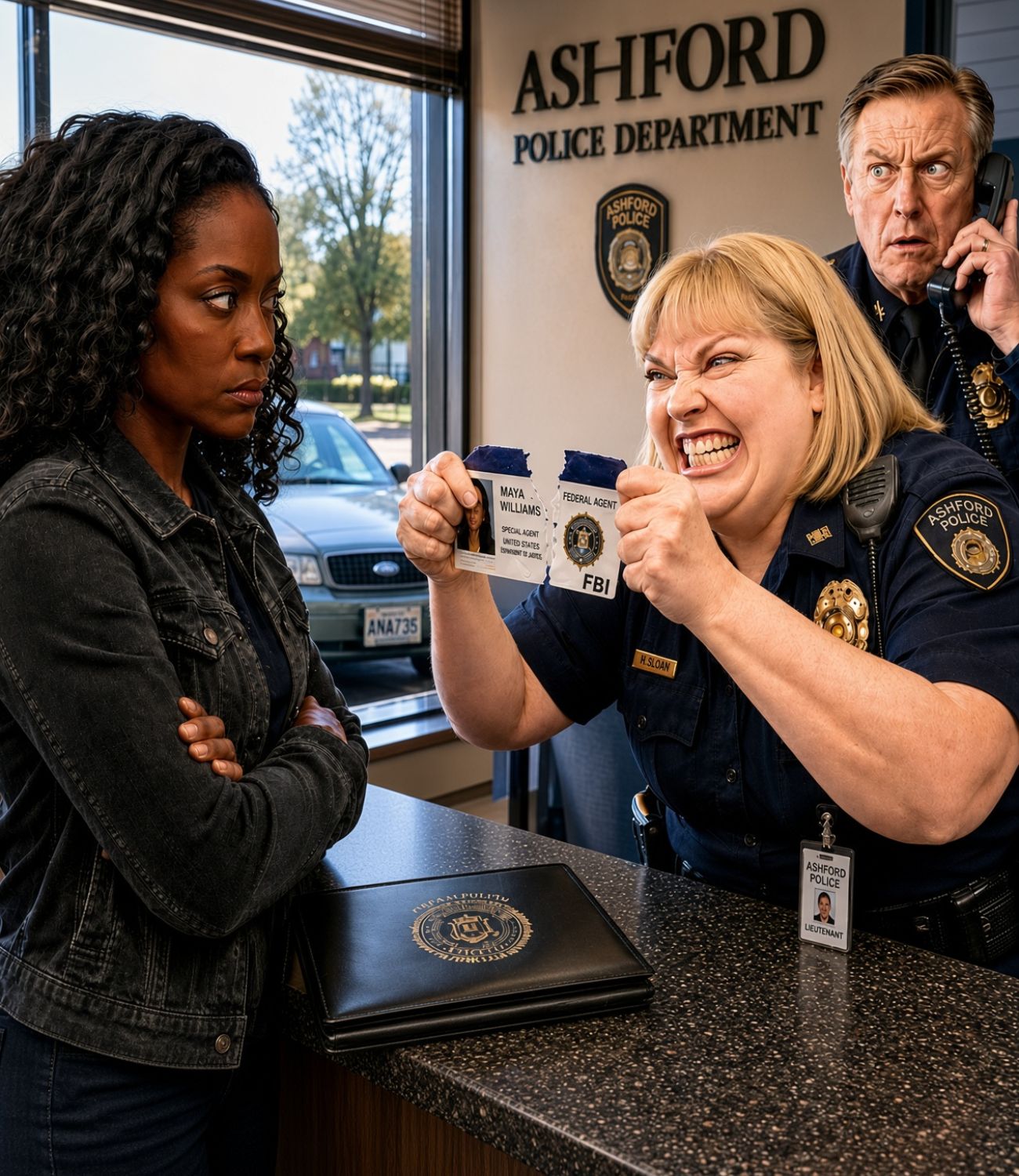
Ben Carter swiped the card through the reader at the front desk of the Asheford Police Department. The computer monitor displayed a green message. Federal authority verified special access active. Ben looked at the woman standing across from him. She wore a dark coat and had placed a coated black case on the counter.
Through the front windows, an older Ford sedan was parked in the visitor lot. Lieutenant Rebecca Sloan approached the desk and motioned for Ben to move aside. She checked the screen, examined the credential, and then looked at the woman. “What agency are you with?” “The system verified my authority,” the woman replied. “That doesn’t answer my question.
It gives you the information required to follow the access procedure.” Rebecca placed the card on the counter. “What do you need access to?” “The digital evidence archive, administrative access records, and sealed property logs. For what purpose?” The authorization attached to the credential covers that Rebecca looked at the coded case.
You arrived without an appointment. You won’t identify your agency and you want access to restricted evidence while carrying a locked case. I need more than a computer message. The woman remained calm. >> You’re allowed to verify the credential. You’re not allowed to ignore the result because you don’t like it.
Rebecca turned to Ben. Close the verification screen. Ben hesitated. Lieutenant It says federal authority verified. I saw it. Closed the screen. Ben clicked the window shut. Rebecca then pointed to the black case. We’re holding that until we determine who you are and what you brought into this station. The woman placed one hand on the handle.
If you seize the case without completing the validation process, the remote document seal protocol will activate. Rebecca studied her. Is that a threat? No, it’s a warning about the security system. Take your hand off the case, the woman complied. Rebecca picked up the credential again. You expect me to let an unidentified person into our evidence system because a scanner returned a green message? I expect you to use the validation procedure.
Rebecca tore the credential in half. Ben stared at the two pieces in her hand. At the same moment, the indicator on the coded case changed from green to red. The internal mechanism engaged, locking both latches. Rebecca looked at the case. The woman looked at the torn credential and said, “Now you’ve created a custody event.
What does that mean? It means the seizure and destruction event has been recorded remotely.” Rebecca placed the two pieces of the credential on the counter. Name: Maya Williams. Employer. Use the validation line. Rebecca’s expression tightened. You’re refusing to identify your agency while asking for access to restricted police evidence.
The credential identified my authority. Your next step was to call the validation number. Ben glanced at the torn pieces. Lieutenant, we should probably make the call. Rebecca ignored him. She addressed Maya. You’ll remain here until we determine whether that credential was legitimate and whether this case contains equipment intended to compromise our network. Maya nodded.
Then you’ll separate me from the case. Rebecca turned toward the hallway. Interview room two. Maya walked with her without resisting. Before entering the room, she said, “After this, you’ll run an internal verification because you no longer trust the first return.” Rebecca stopped but did not answer. Maya continued, “When the internal system confirms the same thing, you’ll decide the systems may have been compromised.
” Rebecca opened the door. >> Sit down. Maya entered the interview room and took a seat at the table. Rebecca returned to the front desk and stood beside Ben. Run the credential through our internal access system. Ben entered the identification sequence from the damaged card. A few seconds later, the result appeared on the monitor.
Valid federal access event. Ben checked the information again. It’s valid. Rebecca read the screen without speaking. Ben turned toward her. That’s two separate confirmations. We should call the validation number. No, Lieutenant. If this really is federal access, I said no. Rebecca walked back toward interview room 2.
Inside, Maya sat with her hands on the table. Rebecca entered and closed the door. You knew what the internal check would show. Yes. How? Because the credential is legitimate. Then tell me who you work for. Complete the validation procedure. Rebecca remained standing. You don’t control the procedure in this building. Mia looked at her.
I’m not asking you to let me control anything. I’m asking you to follow the procedure your department already has. Rebecca said nothing. Maya continued. The first system verified me. The internal system verified me. You still haven’t called the validation line. Rebecca left the room without answering. At the front desk, Ben [clears throat] was still looking at the internal verification result.
He glanced toward the locked case, then toward the hallway. “Lieutenant,” he said as Rebecca approached. “We need to make that call.” Rebecca lowered her voice. “Until I know whether the system itself has been compromised, nothing leaves this station, and nobody gets access to evidence.” Ben looked at the two torn pieces of the credential.
What if the system isn’t compromised? Rebecca did not respond. Upstairs, inside Chief Daniel Mercer’s administrative office, the secure telephone began to ring. Mercer checked the display and answered, “Chief Mercer.” A man spoke from the other end. This is the Federal Bureau of Investigation, Charlotte Field Office. We need special agent Maya Williams.
Placed on a secure line immediately, Mercer remained silent. The caller continued, “Her Federal Access credential registered a destruction event at your facility.” Mercer stood and looked through the interior window toward the front desk below. He could see Ben at the computer, Rebecca near the hallway, the coated case with its red indicator and the two torn pieces of the credential on the counter.
He looked back at the telephone. “Special agent Williams is here.” “Yes, Chief. And you need to put her on the line.” Mercer set the receiver against his shoulder and left his office. Downstairs, Rebecca still believed she was investigating a possible federal impersonator. Chief Mercer now knew she had detained an FBI agent.
Chief Daniel Mercer came down the stairs with the secure phone still in his hand. He did not hurry, but Ben noticed the change in his expression before Rebecca did. Chief, Ben [clears throat] said. Mercer raised one hand and looked at the front desk. Nobody touches the case. Nobody touches the credential. Rebecca turned toward him.
[clears throat] I’ve already secured both. I can see that. She watched him carefully. What’s going on? Mercer looked at the torn credential on the counter, then at the red indicator on the coded case. Tell me exactly what happened. From the moment she entered the building, Rebecca crossed her arms. She came in without an appointment and asked for access to restricted evidence systems.
She refused to identify her agency and brought in a locked electronic case. The credential verified, but given the circumstances, I believed the system could have been compromised. Ben looked at Mercer. It verified twice. Rebecca turned toward him. I was explaining. Mercer kept his attention on Ben. Twice? Yes, sir. The front desk reader returned federal authority verified.
Then Lieutenant Sloan had me run the internal access check. That came back valid, too. Mercer looked at Rebecca again, and after the first verification, I ordered the screen closed while we investigated. You detained her? I placed her in interview, too, until we could determine who she was. And the credential? Rebecca hesitated.
I destroyed it because I believed it could be fraudulent. Mercer’s face remained controlled. After the system verified it, I believed the system might have been compromised. Mercer glanced at the secure phone in his hand. Did you call the validation number? No. Why not? Rebecca’s answer came quickly. Because I wasn’t going to call a number printed on a credential I suspected was fake, Ben said quietly.
The internal system verified it, too. Rebecca looked at him. That doesn’t mean someone couldn’t have found a way into the system. Mercer did not respond immediately. He picked up one half of the torn credential without disturbing its position more than necessary. Did she resist? No.
Did she threaten anyone? No. Did she attempt to access a terminal after you denied entry? No. Mercer placed the piece back where he had found it. Rebecca lowered her voice. Chief, you don’t know what she brought into this building. Mercer looked at the coded case. Neither do you. That’s the problem. No, Lieutenant. Right now, the problem is that you made several decisions before completing the verification process.
Rebecca’s expression changed. What did they tell you on that call? Mercer looked toward the hallway leading to interview room 2. They asked for Maya Williams. Rebecca said nothing. Mercer continued by name. Ben’s eyes moved toward the interview room. Rebecca asked, “Who called?” Mercer did not answer her immediately.
Stay here. He walked down the hallway and stopped outside interview room 2. Through the narrow window, Maya was still seated at the table. She had not moved the chair and had not touched anything in the room. Mercer opened the door. Maya looked up. Miss Williams, Chief Mercer. The fact that she knew him made him pause. You know who I am? Yes.
Mercer entered and closed the door behind him, leaving it unlocked. I just received a call concerning you. Maya waited. Federal Bureau of Investigation, Charlotte Field Office. Her expression did not change. They want you placed on a secure line. Then you should do that. Mercer pulled out the chair across from her but remained standing.
Before I do, I need to understand what happened downstairs. You have cameras. I’m asking you. Maya nodded once. Your officer scanned my credential. It returned verified. Lieutenant Sloan asked for information outside the access instructions. I directed her to the validation procedure. She ordered the verification screen closed, attempted to seize my secured case, destroyed my credential, and detained me.
Mercer said she believed you might be attempting unauthorized access. That was a reasonable question before the verification, and after she had two ways to resolve it. She used neither. Mercer studied her. Why didn’t you simply tell her you were FBI? Because I was not authorized to disclose the agency unless operational conditions required it.
You could have prevented this. Mia looked directly at him. Your lieutenant could have prevented it by following the procedure on her screen. Mercer sat down. What exactly are you doing in Asheford? Mia did not answer. He leaned forward slightly. You’re in my police station under circumstances that are already becoming difficult.
I need to know whether this is an investigation. You need to place me on the secure line. Mercer considered pushing further, then decided against it. When they returned to the front desk, Rebecca was waiting. Her confidence had not disappeared, but it was no longer automatic. Mercer handed Mia the phone.
She took it and turned slightly away from the desk. Williams. The voice on the other end spoke long enough for Ben to hear nothing but silence from Maya. Then she said, “Credential destroyed. Secure case locked under automatic seal. No breach of contents. Two local verification returns completed before detention.” Rebecca’s eyes moved toward Mercer.
Maya continued. “Yes.” Front desk video should cover the entire event. She listened again. [clears throat] Understood. She handed the phone back to Mercer. Rebecca finally asked, “Are you actually FBI?” Maya looked at her. Mercer answered first. Special Agent Maya Williams, Federal Bureau of Investigation.
Ben slowly lowered his eyes to the desk. Rebecca stared at the two torn pieces of the credential. After several seconds, she said she refused to identify herself. Maya replied, “I followed the access instructions attached to the credential.” Rebecca’s voice became sharper. You let this happen? No, >> I let you make your own decisions.
If you sympathize with Maya, who stayed calm, followed every procedure, and was still detained and blamed for someone else’s decisions, please like this video. Tell us in the comments where you’re watching from. Because someone near you may be following Maya’s story, too. Subscribe to the channel so you don’t miss the next powerful stories.
Mercer stepped between the argument before it could grow. Enough. We handle this professionally from this point forward. Maya looked at him. Then start by preserving the front desk video, the access logs, the internal verification record, and every administrative action tied to that case. Mercer frowned.
We can have our IT staff prepare copies. No. The answer came immediately. Maya continued. No one prepares anything. No one deletes anything. No one exports anything until the original systems are preserved. Rebecca said, “You don’t have authority to take control of our entire network because of a credential dispute.” Maya looked at her.
This was never a credential dispute. That stopped both Rebecca and Mercer. A woman standing near the entrance to the records office had been listening. She was in her early 50s. with an employee badge identifying her as Lena Ortiz, digital evidence administrator. She approached carefully. Agent Williams. Maya turned. Lena lowered her voice.
If you’re here to preserve the evidence archive, you need to start before anyone changes anything else. Mercer looked at her. Lena, what are you talking about? She kept her eyes on Maya. The administrative logs are being overwritten automatically. Maya asked. Since when? about 3 weeks. Who changed the retention settings? Lena paused.
That’s part of the problem. Mercer stepped closer. What problem? Lena finally looked at him. The record showing who changed them is already gone. Maya turned to Lena. Show me the system. Chief Mercer stepped forward. Before anybody starts moving through restricted areas, I need to understand the scope of this. Maya faced him.
The scope is preservation. Your department keeps operating. Your officers keep answering calls. And no one changes anything connected to digital evidence, contractor access, or system administration. Mercer glanced toward the front desk where several employees had begun watching the conversation. We can move this upstairs.
We can, Maya said. After the evidence is protected, Rebecca crossed her arms. You’re treating the entire department like a crime scene. No, I’m treating the records like records. Lena led Maya toward the secured digital evidence office. Mercer followed with Rebecca a few steps behind. Ben remained at the front desk under instructions not to touch the verification terminal or the torn credential.
The digital evidence room contained three workstations, two equipment cabinets, and a secured door leading to the main server area. Lena used her access card, then entered a personal code. Maya stopped before crossing the threshold. Who has administrator privileges? Chief Mercer has executive level access. I have evidence administration.
Lieutenant Sloan has security and limited evidence permissions. Sloan Integrated Systems has contractor level certificates for maintenance. Maya looked at Rebecca. Sloan Integrated Systems. My brother owns the company. Rebecca said that isn’t a secret. Was the relationship disclosed? Yes, Mercer answered before Rebecca could add anything.
The contract went through city procurement. It was reviewed and approved. Maya did not challenge him. Then the records should confirm that. Lena sat at the nearest workstation and opened the audit console. This is what I was trying to explain. A series of administrator events appeared on the screen. The newest records were detailed, showing account names, access levels, system changes, and timestamps.
Older entries became noticeably less complete. Maya leaned closer. How long did the system retain administrative history before the change? 6 months in the primary audit layer with archived copies beyond that. And now, Lena opened the current configuration. It cycles much faster. New events overwrite older ones. Mercer said that could be part of a storage optimization. Lena looked at him.
Not one I approved. Could the vendor have done it during maintenance? They could have. But changes at that level should create an administrator record. Maya asked. And that record gone, Rebecca said. If the log was overwritten automatically, you can’t claim someone deliberately deleted it. I didn’t. Maya replied. Rebecca paused. Maya continued.
I asked what changed. The distinction ended the argument. A knock came from the outer door. Two FBI technical specialists had arrived, followed by another agent carrying sealed evidence containers. Maya met them in the hallway and gave brief instructions. No shutdown unless I authorize it. Preserve live configuration first. Mirror active logs.
Document every administrator certificate. Normal police operations. Stay online. One of the technicians nodded. Understood. Mercer followed them back inside. Agent Williams, this department handles active calls through systems connected to this network. I won’t have emergency operations disrupted. Neither will I.
You’re bringing federal technicians into an operational police network. To preserve specific systems, Mercer lowered his voice. You arrived here under restricted notification. Your presence triggered a confrontation. And now you’re expanding into our internal infrastructure. I need something more specific than general concerns about a grant.
Maya held his gaze. Then give us a system that matches the grant records. Mercer did not answer. Lena opened a storage report and turned the monitor toward Maya. This is another problem. The report listed the department’s contracted capacity and redundancy status. The numbers did not match the physical storage visible on the network. Maya asked.
How large is the difference? Large enough that the equipment we have online cannot provide what the city certified. Rebecca moved closer. You’re sure? I’ve been sure for months. Then why didn’t you report it? I did. To whom? Lena looked toward Mercer. He responded immediately. You reported storage irregularities, not missing infrastructure.
I reported that the backup architecture didn’t match the contract. Mercer’s expression remained controlled. and it told us the vendor was completing remote configuration. Lena opened another page. Remote configuration doesn’t create physical storage that isn’t here. No one spoke for a moment. Maya asked the federal technician to record the screen, capture the contract capacity, active capacity, backup status, and current certificates.
The technician began imaging the configuration. Rebecca looked at Maya. You came here because of the storage system? Partly. What else? Maya did not answer. Lena pulled a yellow legal pad from beside her keyboard. Several pages were filled with handwritten dates, account names, and brief notes. Maya looked at it.
What’s that? My own record. You kept separate notes. After the system started losing history, Mercer looked irritated. Lena, you maintained unofficial audit records. I wrote down what I saw on the department’s own system. That isn’t the same thing as an official record. No, Lena said, “But it still exists.” Maya took the point without commenting on the dispute.
Show me the first event that made you start writing things down. Lena turned back several pages. There were small inconsistencies before this. storage errors, contractor sessions at strange hours, files appearing in indexes after they had supposedly been removed, but this was the first one I couldn’t explain. She entered a case number into the evidence database.
A file opened. The name at the top read Nathan Cole. Maya studied the screen. Age 25. What happened? He was detained after officers said they found a restricted municipal access card in his belongings. Rebecca said, “I remember the case. He had temporary access to a city facility.” Lena nodded. He also said the card wasn’t his.
That’s what people say when they’re caught with restricted property. Maya turned to Rebecca. >> Was the search recorded? Yes. Lena answered at the same time. “Not [clears throat] all of it.” Rebecca looked at her. Lena opened the body camera entry. The file showed a recorded search, but the source information was incomplete.
One segment ended, another began later. A third had been exported separately and labeled as original evidence. Maya asked. Where is the uninterrupted source file? Lena shook her head. It should be there. It isn’t. Mercer stepped closer to the monitor. A missing file doesn’t mean evidence was altered. Maya nodded. Correct. His expression showed brief surprise, she continued.
>> Which means we don’t assume anything. We find the original record. Lena looked at her notes. That’s why I contacted the federal office. Rebecca turned sharply. You did what? Lena did not look away. I reported what the system was doing. Maya closed the case window and addressed the technicians.
Preserve Nathan Cole’s entire evidence chain. every version, every export, every administrator event tied to it. One technician asked, “Priority over the procurement files? Same priority?” Maya looked at the screen again. The investigation had begun with missing money and a system that could not account for its own history.
Now there was a 25-year-old man whose detention depended on a video record that no longer existed in its original form. She turned to Lena, “Show me what Ashford paid for.” The red indicator on Maya’s coded case changed to green after the FBI technical team completed remote authentication. One of the internal locks released with a quiet click.
Rebecca watched from the doorway as Maya opened the case for the first time. Inside were sealed preservation orders, clean storage drives, tamper evident bags, chain of custody forms, and several authorization packets. There was no equipment that could be used to enter Ashford’s network. Maya removed one preservation order and handed it to Chief Mercer.
This covers the systems and records identified in the federal review. Your department remains operational. We are preserving evidence, not taking over police functions. Mercer read the first page carefully and the case, federal evidence material. Rebecca looked at its contents and said nothing. Maya closed the case and turned back to Lena.
You said the installed system doesn’t match what the city paid for. Lena returned to her workstation and opened the procurement database. The project was approved in phases. Body cameras first, then encrypted evidence, storage, off-site backup, and dispatch redundancy. How much was paid? Lena entered another menu. The total appeared on the monitor.
The project had cost several million dollars, combining city funds with federal grant money. Mercer stepped closer. That figure covers equipment, software, licensing, installation, support, and long-term maintenance. It isn’t just hardware. Maya nodded. I understand. She looked at Lena. What was certified is complete. Everything.
Lena opened the final acceptance document. The file stated that the new equipment had been installed, tested, integrated with the department’s evidence platform, and placed into active service. The acceptance line carried Daniel Mercer’s electronic signature. A second certification confirmed that the restricted work areas had been secured during installation.
That document carried Rebecca Sloan’s name. Rebecca read it over Lena’s shoulder. My signature confirms contractor access and site security. I didn’t certify the technical work. Maya looked at the wording. That’s what the document says. Rebecca seemed prepared to argue, but Maya had already moved on. Who certified the installation itself? Lena opened the contractor file.
Sloan Integrated Systems. The company president was listed as Calvin Sloan. Maya looked at Rebecca. My brother, Rebecca said. The city knew that when the contract was awarded, was the relationship disclosed in writing? Yes, Mercer added. City procurement reviewed the conflict disclosure before the bid was approved. Maya said, “Then we’ll preserve that file with the rest.
” Again, she made no accusation. Rebecca appeared more unsettled by the lack of one. A federal technician working at the second station turned around. Agent Williams, the active storage environment, is significantly smaller than the accepted configuration. How significant? The contract describes three separate retention layers.
I can confirm the local layer and part of the redundant storage. I don’t see evidence that the full off-site architecture was ever brought online. Mercer said, “Some services are vendor hosted. Then there should be service endpoints, authentication records, and transfer history.” The technician replied, “I’m not seeing enough of that to support the certification.
” Maya asked Lena, “Where are the installation inventories?” “In the procurement archive, original receiving records, too.” “Yes, open them.” Lena brought up a list of equipment delivered to the city several months earlier. The quantities matched the federal invoices, body camera units, storage appliances, encryption modules, backup systems, network hardware, and replacement components.
Maya compared the delivery records with the active equipment list. Where is the hardware that isn’t installed? Lena hesitated. I don’t know. Rebecca looked at her. You manage digital evidence. How do you not know where department equipment is? Because I don’t control municipal receiving. Mercer said, “Large technology deliveries often go through central storage before installation.
” Maya turned to him. Then central storage should have transfer records. It should. Let’s see them. Lena searched the city inventory system. Several entries showed that equipment had been received at the municipal storage annex behind the police complex. According to the next set of records, most of it had later been transferred to Sloan Integrated Systems for installation, but the transfer documentation was incomplete.
Some entries listed quantities without serial numbers. Others showed equipment moved into service without naming the employee who accepted it. One line caught Maya’s attention. “Open that.” Lena selected a storage record from 3 months earlier. The equipment status read, “Project complete. Remaining inventory closed.” Maya asked.
“What does inventory closed mean?” Lena shook her head. “It usually means everything assigned to the project has either been installed, returned, or formally disposed of.” “Do you have disposal records?” “No, return records? Not that I can see, Rebecca said. >> That still doesn’t prove anything is missing.
The vendor may have completed the transfer under a different work order. Maya looked at her. Then we’ll find the work order. Mercer checked the time on the wall clock, but made no comment about it. Agent Williams, I have command staff waiting for direction. If [clears throat] your team is going to begin searching city storage facilities, I need to know whether you have specific cause.
Maya handed him the acceptance record. Your department certified millions of dollars in technology as installed and operational. Your active network does not show that capacity and your inventory system cannot account for the difference. That is specific enough to inspect equipment purchased under the grant. Mercer read the document again.
He did not object further. Maya turned to one of the federal agents. Get a city representative and a camera. Nothing moves until it’s photographed where it sits. The agent nodded and left. Lena remained at the computer. Maya noticed her looking at the Nathan Cole file still open in a minimized window. You think this is connected? Lena answered carefully.
I think the problems started around the same period. What problems? The storage inconsistencies. Contractor access after hours. Nathan’s missing source footage. They all began after the new system was supposed to be fully active. Maya asked. Did you ever see Calvin Sloan working here personally? A few times during normal maintenance hours sometimes and the other times.
Lena looked toward Rebecca before answering. Late evenings, usually after most administrative staff had gone home. Rebecca immediately said, “Contractors were approved for off hours work because the system couldn’t be interrupted during normal operations.” Maya nodded. Who approved that access? I did. When it was on the authorized schedule, Maya turned back to Lena.
Preserve every contractor entry record you still have. The federal technician raised a hand from the second workstation. Agent Williams, one more thing, he pointed to the certificate list. Sloan Integrated Systems still has active administrator credentials. Mercer frowned. That contract includes maintenance, the technician replied.
These aren’t limited maintenance credentials. At least one certificate has broader privileges than the documentation describes. Maya looked at the screen. Can it alter retention settings? Yes. Can it modify evidence metadata with the permissions I’m seeing? Potentially. Maya gave the technician a clear instruction.
Do not revoke it yet. Mirror every action and every connection it makes. Rebecca stared at her. If you think the credential is dangerous, why leave it active? because I want to know who is using it. A city facilities employee arrived a few minutes later with keys to the municipal storage annex. Maya picked up her coded case and the federal photographer followed her toward the rear exit.
The paperwork said Ashford had already installed everything it bought. [clears throat] Now they were going to see what was still sitting in the boxes. The municipal storage annex stood behind the police complex beside the vehicle maintenance building. A city facility supervisor named Frank Holloway unlocked the side entrance and signed the federal entry sheet before Maya allowed anyone inside.
“Nothing gets moved until it’s photographed,” Maya said. Frank nodded. “Understood,” Agent Williams. The overhead lights came on one row at a time. Stacks of equipment filled the rear half of the building. The federal photographer began documenting the room from the doorway while another agent compared serial numbers against the procurement list Lena had printed.
Maya stopped beside the first pallet. The boxes were marked with the same manufacturer listed in Ashford’s technology contract. Body cameras, charging stations, encrypted storage modules, network appliances. Most of the manufacturer seals were still intact. Frank looked at the paperwork in his hand. These have been here for months.
Chief Mercer turned toward him. Why weren’t they released to the contractor? They were. Mercer frowned. Then why are they still here? Frank pointed to a receiving sticker on one of the boxes. Sloan Integrated Systems signed them out for installation, then returned them to this bay under temporary storage. Nobody ever submitted another release request.
Rebecca stepped closer. Who signed the return? Frank checked the inventory sheet. There’s no individual signature, just the contractor account, Maya asked. How many pallets? Seven in this section. There may be more in the locked cage. Open it. Frank unlocked a wire mesh storage enclosure at the back of the annex. More equipment sat inside.
One federal agent began reading serial numbers while another checked them against the invoices. After several minutes, the pattern became clear. The city had paid for equipment that its own records described as installed and operational, but a substantial portion of that equipment had never left storage long enough to enter service.
Mercer studied the sealed boxes. There could be a legitimate explanation. The vendor may have replaced units with equivalent equipment. Maya looked at him. Then there will be substitution records. And if there aren’t, then we document that, too. Rebecca folded her arms. You keep saying document.
At some point, you’re going to have to tell us what you think happened. No, Maya said, “At some point, the evidence will tell us.” A federal agent opened the procurement folder. Agent Williams. >> The final payment was released after the completion certification signed by Chief Mercer for departmental acceptance. Vendor certification by Calvin Sloan.
Rebecca spoke before Mercer could respond. My brother handled the company. I didn’t handle billing. Maya looked at the security certification attached to the project. You signed that contractor access to the restricted installation areas was completed according to schedule. That’s right. Were you present for every installation period? No.
My staff handled some of them. Then we’ll need the duty roster. Rebecca’s jaw tightened, but she nodded. Maya turned to Frank. Was any of this equipment ever taken out of its packaging here? Not that I saw. How long have you worked municipal facilities? 22 years. And you’re certain? Frank looked at the sealed pallets again.
I know what opened shipping bands look like. Those haven’t been cut. Maya asked the photographer to capture the seals in close detail. A single body camera was visible through clear packaging near the top of one carton. The contract said hundreds of similar units had already been placed in service.
Maya checked the serial number against the delivery list. It appeared on the city’s completed installation inventory. She handed the sheet to Mercer. This unit is listed as active. Mercer examined the number twice. That may be a clerical error. One could be. Maya pointed toward the rest of the pallet. We’re going to find out whether all of them are. No one answered.
By the time the federal team finished the preliminary inventory, enough serial numbers had been matched to establish that the discrepancy was not limited to one box or one shipment. Maya did not announce fraud. She ordered the annex sealed for controlled access, assigned an agent to remain with the inventory, and returned to the police building with Mercer and Rebecca.
Lena was waiting in the digital evidence office. You need to see something from the Cole file. Maya removed her coat and placed it over the back of a chair. What did you find? Lena opened Nathan Cole’s case and placed two video records side by side. The official evidence archive treats this one as the original body camera sequence.
A video showed Nathan standing near a municipal service entrance while an Ashford officer checked his identification and belongings. Nathan appeared frustrated but cooperative. The video stopped. A second segment began later. An officer held up a restricted municipal access card and identified it as having been found among Nathan’s possessions.
Maya watched both clips without interrupting. What’s missing the source continuity? Lena enlarged the file information. A body camera generates identifiers through the entire recording session. This first section has the correct source information. The second one doesn’t, Rebecca stood behind them. That doesn’t mean the evidence was planted, Maya answered without turning around.
No, it doesn’t. Rebecca seemed surprised by the agreement, Lena continued. The second clip was exported later, then placed back into the case archive. The system labels it as original, but the file history doesn’t support that. Mercer moved closer to the screen. Could normal processing cause that? Not this way.
Could a software migration? We didn’t migrate the system during that period. Maya asked. Where is the uninterrupted source recording? Lena shook her head. Not in the visible archive. Was it ever there? Yes. How do you know? I saw the original entry before it disappeared. Maya looked at her when shortly after Nathan was detained.
And what did the original show? Lena chose her words carefully. I didn’t watch the entire recording. I checked it because Nathan filed a complaint about the missing section. At that point, the continuous file existed. Rebecca said, “A complaint doesn’t make him right.” “No,” Maya replied. But an original file disappearing after the complaint makes the file important.
She asked Lena to open Nathan’s detention report. Nathan Cole was 25 years old and had worked temporarily for a subcontractor servicing a municipal building. According to the report, he had been questioned after a restricted city access card was found among his belongings. He was held for several hours while officers investigated possible unauthorized access.
No physical injury was reported. No violent confrontation was recorded. The entire detention depended on the access card. Maya read Nathan’s statement. He had denied possessing it from the beginning. He also claimed that several days before his detention, he had noticed repeated searches of city surveillance records that had nothing to do with his assigned work, vehicle locations, traffic cameras, municipal access histories.
Maya looked at Lena. Is this why you contacted the federal office? Lena nodded. It was the first time I realized the storage problem might be affecting people, not [clears throat] just invoices. Maya returned to the video. If the access card had been planted and the body camera record altered afterward, Ashford was no longer dealing only with missing equipment or questionable grant money.
A citizen had lost his freedom, even temporarily, because a digital record said something happened. Maya closed the report. A false file can hold a man just as effectively as a locked door, Mercer said. We still don’t know that the file is false. You’re right. Maya turned to Lena. Preserve every version of Nathan Cole’s body camera evidence, every export, every administrator session, and every access record tied to his case already started.
Good. Now find me the original source. Lena looked at the monitor. if it still exists. It isn’t where the department says it should be. Maya glanced toward the equipment list from the storage annex. Millions of dollars had been paid for a system that did not physically exist as certified. Nathan Cole’s original recording had disappeared from the system that was supposed to protect it.
Those two facts were now part of the same investigation. Maya looked at the federal technician. Map the actual storage architecture. I want to know where Ashford’s evidence is really going. The federal technician began by comparing Ashford’s active network inventory with the equipment records recovered from the storage annex. Within 20 minutes, he had identified enough matching serial numbers to confirm that the discrepancy extended well beyond Nathan Cole’s case.
Maya stood beside Lena’s workstation while the technician entered each serial number into the procurement database. This storage module is listed as installed in the primary evidence array. he said. Where is it physically? Maya asked. In the annex, he entered another number. This encryption appliance is listed as active in the redundant backup system.
Also in storage? Yes. A third device produced the same result. Chief Mercer remained near the doorway. If equipment was reassigned or replaced, the inventory system may not have been updated correctly. Maya turned to him. Then we need the replacement records. I already told you the vendor handled installation and the department accepted the work.
Mercer did not argue with that. Maya asked Lena to open the payment file for the technology project. The contract had been funded through city appropriations and a federal technology grant. Payments were released in stages. The first covered equipment purchases. The second covered installation and integration.
The final payment was authorized after the department certified that the project had been completed and tested. Lena opened the last payment record. The status read paid in full. Maya checked the amount. More than $2 million had been released across the project. Who approved the final payment? She asked. Lena opened the supporting documents.
City finance processed it after the department submitted the completion package. Who signed the departmental acceptance? Chief Mercer. Mercer stepped closer. I signed based on the technical completion documents provided to my office. Maya nodded. Who provided them? Sloan Integrated Systems. Did anyone from the department independently verify the equipment? Our IT staff worked with the contractor. Lena looked at him.
I wasn’t asked to verify the final installation. Mercer turned toward her. You weren’t the project manager. No, but I was responsible for the evidence system they said they upgraded. Rebecca standing near the second workstation, interrupted. >> That still doesn’t mean the chief knew the equipment was sitting in storage.
Maya replied, “No one has said he did.” Rebecca appeared frustrated. Then what exactly are you suggesting? I’m not suggesting. I’m establishing who certified what. Maya asked the technician to create a list of every device found in storage that was simultaneously recorded as active. The list grew steadily.
By the time the technician stopped, it contained dozens of serial numbers. Maya looked at Mercer. These aren’t paperwork errors affecting one shipment. Mercer studied the screen. Then I want Calvin Sloan contacted. No, he was the contractor. He can explain the installation. He can explain it after we preserve his records. Mercer’s expression tightened.
You intend to investigate the vendor without giving him an opportunity to respond. I intend to prevent anyone connected to this contract from changing records before we know what exists. Rebecca said, “You’re talking about my brother. I’m talking about the contractor.” Maya asked Lena for the project work orders.
Several listed overnight installation periods inside restricted areas of the department. Each work order showed the task as completed. Rebecca’s name appeared on the security approvals. Maya pointed to one entry. This says the contractor had access from late evening until early morning. Rebecca nodded. That was normal.
We scheduled technical work after administrative hours, so the evidence office could keep functioning during the day. Were you here sometimes? And when you weren’t, a shift supervisor handled access. Do the records identify the supervisor? They should. Lena searched. Some did, others did not. Several overnight entries showed the contractor credential entering the building, but there was no corresponding employee name attached to the access event.
Maya asked, “Would that normally happen?” Lena shook her head. Someone from the department should have been assigned to the restricted area. Rebecca said, “The logs are incomplete. We already know that, which is why we preserve everything that remains,” Maya replied. One of the FBI technicians called Maya over to another workstation.
I found something in the contractor certificate history. He displayed a list of authentication events connected to Sloan Integrated Systems. The contractor certificate had accessed the network well outside the dates listed on the maintenance schedule. How often? [clears throat] Maya asked. Regularly. From inside the building? Not always.
Some sessions appear remote. Mercer frowned. Remote support was included in the contract. The technician nodded. Limited remote maintenance was included. These sessions reached more than the documented maintenance environment. What kind of access? Evidence indexes, system configuration, retention controls, and portions of the vehicle data interface.
Rebecca stepped forward. Calvin’s company supported multiple city systems. That may be normal. The technician looked at Maya. It might be if there’s documentation authorizing it. Maya asked Lena. Is there? Not that I’ve found. Maya told the technician to preserve the certificate activity but not disable the credential. Mercer looked at her.
You’re leaving an account active that you believe may have exceeded its authority. I want to see whether it connects again. Rebecca [clears throat] shook her head. You’re waiting for someone to make a mistake. I’m preserving evidence of what the account does on its own. The distinction ended the discussion. Lena opened another folder containing the project’s testing reports.
Each document stated that backup systems had passed verification before final acceptance. Maya noticed that the test reports shared the same digital author. Calvin Sloan. Lena nodded. And who witnessed the tests? Lena searched the forms. The witness field was blank on several reports. On others, the entry simply read APD authorized personnel.
No individual was named. Maya asked Mercer, “Did you personally witness the final system test?” “No.” “Did Rebecca?” Mercer looked toward her. Rebecca answered for herself. “No.” “My responsibility was physical security.” Maya turned back to Lena. “Then find whoever did.” Lena searched the project calendar, staff assignments, and IT records.
After several minutes, she stopped. I can’t find anyone. Maya looked at the paid in full authorization again. The city had released millions of dollars for equipment recorded as installed, tested, and operating. Much of that equipment remained sealed in storage. The final testing reports did not identify a departmental witness, and the contractor retained system access broader than the written agreement described.
She gave the federal team its next instructions. Preserve every invoice, every acceptance certificate, every payment authorization, and every Sloan administrator session. Keep the police systems running, but mirror all contractor activity. Lena nodded. Maya then looked at the active network diagram on the wall monitor. Now compare this diagram with the building’s physical infrastructure.
The technician began loading the plans. If Ashford’s official system could not account for its equipment, Maya wanted to know whether another system was operating where the record said nothing should be. By early afternoon, the federal team had built a document chain that connected the technology project from purchase to final payment.
Each record answered one question and raised another. Maya stood beside a conference table where the files had been arranged in order, purchase authorization, delivery [clears throat] records, contractor work orders, security approvals, completion certifications, and payment releases. One of the FBI agents pointed to the first document, equipment purchased with federal and municipal funds.
The next file showed delivery to Asheford. The third showed the equipment transferred for installation. The fourth certified the work as complete. The fifth released final payment. Maya looked at the signatures. Calvin Sloan had certified the technical work. Chief Daniel Mercer had accepted the completed project on behalf of the department.
Rebecca Sloan had approved restricted area access during multiple installation periods. Rebecca stood across the table. We’ve already covered my signature. It certifies access. It does not certify installation. Maya nodded. Correct. Rebecca seemed prepared for an argument that never came. Mercer asked. What exactly are you trying to establish? Whether the written process matches what actually happened.
You already found equipment in storage. And now we determine who knew that. Mercer folded his hands. I signed the completion package because the contractor submitted technical certification and the [clears throat] project had moved through city procurement. Who told you the system had passed testing, the vendor, and the project documentation? Did anyone on your command staff independently verify that? Mercer looked toward Lena.
That would have been an IT function. Lena remained seated at the end of the table. I wasn’t asked to sign off on it. Rebecca said, “You weren’t managing the project.” “No, but the project was changing the evidence system I manage.” Mercer’s voice stayed controlled. There were several departments involved. Nobody is saying the process was perfect.
Maya closed the folder in front of her. Perfection isn’t the standard. Accuracy is. A federal agent entered and spoke quietly to Mia. Officer Carter is ready for his statement. Mia left the conference room and found Ben in a smaller office near records. A federal interviewer sat across from him with an audio recorder on the table.
Ben looked more uncomfortable than he had at the front desk that morning. Maya remained near the door. The interviewer asked when Miss Williams presented the credential. What did the scanner show? Federal authority verified. Special access active. Did you believe the credential was valid at that point? Ben hesitated. Yes.
When did Lieutenant Sloan see the result? Right away. What did she tell you to do? Close the screen. Did you tell her the credential had verified? Yes. What happened after that? Ben described the attempt to seize Maya’s case, the warning about the remote seal, the credential being torn, and the second internal verification. The interviewer asked, “When the internal system confirmed the access event, what did Lieutenant Sloan do?” She said the systems could have been compromised.
Did she call the validation number? No. Did you suggest it? Yes, more than once. Ben looked down. Yes. The interviewer paused. Why did you follow the order to close the first verification screen if you believed the credential was real? Ben took a moment before answering. Because she was my lieutenant. That explains the order.
I’m asking why you followed it. Ben rubbed his palms against his uniform trousers. I’m still on probation. She writes part of my review. No one spoke for several seconds. Maya finally asked. When did you know the credential was real? Ben looked at her. The first scan. Then that’s where your statement begins. Ben nodded.
Rebecca had reached the doorway behind Mia without being noticed. So now he’s your witness. Maya turned. He’s describing what he saw. Rebecca looked at Ben. You could have told them you were following a security instruction. I did. You make it sound like I ordered you to hide something. Ben’s voice became quieter. You told me to close a verified screen. Rebecca stared at him.
[clears throat] Watch how you characterize my orders. Maya stepped between the conversation before it became personal. His statement belongs to him. Rebecca looked at her. He works for this department. That doesn’t make his memory department property. Rebecca’s expression hardened. People depend on each other here.
Maya answered. They should. Rebecca waited. Maya continued. >> But loyalty that asks someone to erase what they know is only fear. Wearing a uniform. Rebecca said nothing else and walked away. Ben exhaled slowly. Maya turned back to him. Finish your statement. Don’t improve it and don’t protect anyone.
Just tell them what happened. She returned to the main work area. Despite the federal investigation, Asheford Police Department was still functioning. An older couple waited at the front desk to report checks taken from their mailbox. A city employee dropped off permit envelopes. Two patrol officers reviewed paperwork before leaving on another call.
Maya watched for a moment. She had already told her team that the department was not to be treated as a single guilty unit. Most of the people in the building had nothing to do with the technology contract. The investigation would follow decisions, not uniforms. Lena called her back into the evidence office. I found something.
On one monitor was the department’s building plan. On another was a utility report. What am I looking at? Maya asked. Electrical consumption. Mercer and Rebecca joined them a moment later. Lena pointed to the basement section of the plan. According to this drawing, the main server room and the evidence office should account for almost all continuous technology load in this part of the building. And they don’t. No.
She opened a second chart. There’s another steady draw from the basement utility corridor. Mercer leaned closer. HVAC? I checked. Emergency equipment also checked. Rebecca asked. How much power are we talking about? Enough for equipment that isn’t shown on this plan. Maya looked at the building diagram. Any network connections in that section.
Lena brought up another record. One. She enlarged the image. A fiber line left the official server room and continued toward the basement corridor on the department’s approved network diagram. The line ended before reaching any listed device. Maya asked, “Where does it physically go?” Lena looked toward the hallway. “I don’t know.
” Maya picked up the preservation folder. Then we stopped reading diagrams and follow the cable. Maya followed Lena and one of the FBI technicians down the basement stairs while Chief Mercer and Rebecca came behind them. The utility corridor was narrower than the rest of the station and lined with electrical panels, network conduits, and maintenance access doors.
The technician used a handheld fiber tracer on the cable identified upstairs. It continues past the official server room, he said. Lena checked the building plan on her tablet. There’s no listed network equipment beyond this point. Mercer looked along the corridor. This section has electrical and environmental systems. There may be older infrastructure that never made it onto the current drawing.
Then we document that first. Maya said they moved slowly along the wall until the tracer indicated the fiber was turning behind a large utility panel. The technician examined the screws. These have been removed recently. Rebecca stepped closer. How can you tell? The paint around the heads is worn and the panel has fresh tool marks.
Mercer said, “Maintenance opens these panels all the time.” Lena shook her head. “Not this one. Facilities handles electrical access here.” Maya called the city facilities supervisor who had assisted at the storage annex. Frank Holloway arrived several minutes later, carrying a ring of keys and a maintenance log. He looked at the panel.
“I don’t recognize this as one of ours.” Mercer frowned. It’s inside a city building. That doesn’t mean facilities installed it. Maya asked. Do you have any record of work behind this wall? Frank checked his log, then the building plan. [clears throat] No. Mia turned to the federal technician. Photograph it before opening.
The panel was documented from several angles. Frank then removed the screws under federal observation. Behind it was a narrow access space with a fiber line and a power conduit running toward a reinforced door set farther into the wall. Lena stared at it. That room isn’t on the plan. Rebecca said, “There used to be mechanical storage down here.” Frank looked at her.
Not behind this wall. Maya asked him, “Do you have a key?” “No.” The federal technician examined the access hardware beside the door. “It’s electronic.” Rebecca moved closer. that could belong to Sloan Integrated Systems. They installed network equipment throughout the building. Maya looked at her. Do you remember authorizing this room? No.
Do you remember authorizing your brother’s company to build a separate secured space in the basement? I said, “No, Mercer stepped in.” “Agent Williams, before anyone forces entry into a locked technical area, I want the city attorney notified.” Maya handed him the preservation order she had been carrying.
The federal order covers infrastructure tied to the grant and evidence systems. This cable originates from the department network and the room is not listed in the city inventory. We’re opening it under documented authority. Mercer read the order but did not argue again. The technician connected a diagnostic device to the access reader. There’s still power.
Can you identify the credential system? Maya asked. Yes, it’s using the same contractor certificate family we saw upstairs. Sloan, he nodded. Rebecca looked at Mercer. That doesn’t mean Calvin built the room. Maya replied, “No one said it does.” Frank stepped aside while the FBI technician disabled the local lock without altering the network beyond what was necessary to open the door.
When the door released, Mia stopped everyone before entry. Camera first. The federal photographer documented the threshold, walls, wiring, and visible equipment. Then Maya entered. The room contained a full server rack, a dedicated cooling unit, battery backup, and several network appliances. Every device was powered. There were no city asset tags on the rack, no municipal inventory stickers, no equipment numbers matching the department’s official server list.
Lena stood in the doorway. I’ve never been in here. Mercer looked at the equipment. Neither have I. Maya did not respond. The technician moved to the rack and examined the active connections. This isn’t abandoned equipment. What is it doing? Maya asked. I need to preserve the live state before I answer that. Do it read only.
He nodded and connected a forensic interface. Rebecca remained near the door. If that equipment belongs to the contractor, you may be looking at a remote support environment. Lena said, “A remote support environment shouldn’t be hidden behind a wall.” Rebecca looked at her. “You don’t know why it was installed. Neither do you.
” Maya raised one hand. “Enough. We deal with what we can prove.” The technician began identifying mounted volumes and active services. After several minutes, he turned one monitor toward Maya. There are indexed directories here that don’t exist in the official storage map. What kind? Raw body cam files, deleted media, traffic camera feeds, license plate records, municipal access events, Mercer looked at him.
Those could all be backup categories. They could, the technician said. But this environment isn’t reporting itself as a backup node to the official system, Maya asked. What is it reporting as? Nothing. It’s effectively invisible from the documented architecture. That changed the room. Maya looked at Lena. Can you tell whether this system receives body cam material before or after the official archive? Lena moved beside the technician and reviewed the directory structure.
Some of these source files appear older than the versions in evidence management. Maya said, “Find Nathan Cole.” The technician searched the index. Several results appeared. One was the official exported clip already preserved upstairs. Another carried the original camera source identifier. Lena leaned closer to the screen. That’s it.
Rebecca asked. You sure? Yes, the original. The identifier matches the continuous session. Maya looked at the technician. Do not play it from the live server. I’ll image the file first, preserve the source, hash the copy, and work from that. He began the process. Mercer remained near the entrance. Agent Williams, if the original exists here, that may mean this system was designed as an internal recovery layer.
Maya looked around the hidden room. Then there should be a contract describing it. Mercer did not answer. The technician, finished the forensic copy, and opened the recovered file. Nathan Cole appeared on the body cam recording beside the municipal service entrance. The footage continued past the point where the official version had stopped.
An officer checked his belongings. Wallet, keys, phone, work badge. No restricted access card. The search ended. Lena looked at Maya. The card isn’t there. Maya kept watching until the recording finished. The official case file said the card had been found during that search. The original recording showed otherwise.
She turned to the technician. Preserve every version connected to Nathan Cole. then map every directory on this server,” he nodded. Maya looked at Mercer and Rebecca. “We’re no longer dealing only with missing equipment.” Neither responded. On the monitor behind them, the hidden server continued indexing records Ashford’s official system did not admit it had, and somewhere inside those directories was an answer to a larger question.
Who had been using this system? And what else had they kept outside the record? The federal team moved the recovered body camera file to an isolated forensic workstation and compared it with the version stored in Asheford’s official evidence archive. Maya stood beside the technician while Lena reviewed the file history. The original recording showed the entire search of Nathan Cole’s belongings.
The officer removed his wallet, keys, phone, temporary work badge, and several personal items. No restricted municipal access card appeared at any point. The official evidence version contained an additional segment recorded later. In that clip, an officer held up the missing access card and stated that it had been recovered from Nathan’s property.
Maya asked, “Are these two segments from the same recording session?” The technician shook his head. “No, the official archive presents them that way, but the source identifiers are different. Could that happen during a normal export? Not without leaving a conversion record? I don’t see one. Lena opened the evidence history.
The second segment entered the case archive after Nathan had already been detained. Chief Mercer stood several feet away. That still doesn’t establish who placed the card there. Mia looked at him. Correct. Rebecca seemed surprised again by Maya’s refusal to go further than the evidence. Maya continued, “What it establishes is that the record used to support the detention was not the original recording.
The technician compared timestamps, export logs, and file signatures. The official version was assembled after the fact. Whoever created it kept the visible case timestamp, but the compression signature changed.” Mercer asked, “Could software maintenance account for that?” Not selectively on one segment. Rebecca looked at Lena.
Who had permission to modify body camera evidence? Normal users couldn’t change source files. Lena said it required elevated access. How many people had that? Very few. Maya asked for the list. Lena opened the administrator permissions table. Her own evidence administrator account appeared first. Rebecca had security privileges with limited evidence management functions.
Chief Mercer held executive level administrative authority. Sloan Integrated Systems had several contractor certificates, including one with broader permissions than the written maintenance agreement described. Maya asked, “Could the Sloan certificate alter file metadata?” The federal technician checked the permission set. Yes.
Could it replace a visible file while keeping the case entry intact? Yes, Rebecca stepped forward. That does not mean Calvin did it. No, Maya said it means the account could. Mercer looked at the hidden server and the original file stayed here. Which raises another question, Maya replied. Why preserve the real recording on an undocumented server while placing a different version in the official archive? No one answered.
Maya asked the technician to build a complete timeline for Nathan’s case, starting with the body camera upload and ending with the final evidence entry. The sequence took several minutes to reconstruct. The original body camera file reached the hidden server shortly after the encounter with Nathan. A different file appeared in the official evidence archive later.
Nathan’s detention report was finalized after that second file existed. Lena checked her handwritten notes. I remember his complaint coming in the next day. He said the card had never been in his belongings. Maya asked, “What happened to the complaint? It was logged and sent to command review. Who received it?” Lena searched the departmental records.
The complaint had been routed through internal administration, but the final disposition field contained only a short entry stating that the video evidence supported the officer’s account. Maya read it. Who closed the complaint? Lena opened the authorization history. The entry had been approved using a command level account.
Mercer looked at the screen. Those approvals can be processed by staff under delegated authority. Then we identify the person who used it. Maya said. Mercer did not respond. Maya asked Lena for Nathan’s contact information. He has an attorney now. Lena said, “Good. Contact council first.” A federal agent placed the call from the evidence office.
Mia waited while Nathan’s attorney confirmed that Nathan was willing to speak with federal investigators. Several minutes later, Maya took the secure line. Nathan, this is Special Agent Maya Williams with the FBI. There was a pause. I’ve already told Ashford what happened. I know they didn’t believe me. I’m not calling to ask you to repeat everything right now.
Then why are you calling? We recovered a source body camera file connected to your detention. Nathan was silent. Maya continued. I need you to understand that the file is being preserved under federal custody. Does it show the search? Yes. And the card, it does not appear during the original search. Nathan did not answer immediately.
When he spoke again, his voice was quieter. So, somebody finally found it. We found a record. [clears throat] The investigation still has to determine who changed the official evidence and why. You believe me now? Maya chose her words carefully. I believe the original recording does not match the version used to support your detention.
That’s not the same thing. No, it isn’t. And I’m not going to tell you more than the evidence proves. Nathan let out a slow breath. At least that’s more than they gave me. Maya asked whether he would come to a federal interview location later that day, not the Asheford station. No. Why? Because the systems connected to your case are under investigation.
Nathan agreed to meet federal personnel. Before ending the call, he said, “Agent Williams, when they found that card, everybody stopped listening to anything I said.” Maya looked at the original video frozen on the workstation. “A false file can hold a man just as effectively as a locked door. Nathan was quiet,” Maya continued. “Your original record is preserved now.
Nobody alters it again.” After the call, Lena returned to the server index. “There’s something else.” She opened a network activity panel associated with the hidden system. At first, the entries looked like ordinary backup traffic, but the destination addresses did not match any municipal or contracted disaster recovery service.
The federal technician moved closer. These are outbound transfers, Mercer said. Sloan handled remote backup. The technician shook his head. These aren’t backup packages. What are they? He opened one transfer manifest. The file categories included license plate histories, traffic camera locations, municipal access events, and vehicle location records.
Maya looked at the destination field. Who owns that endpoint? I don’t know yet. Find out. A second transfer showed the same pattern. Then a third. These were organized exports, not accidental transmissions. Rebecca looked at the screen. Calvin’s company supported analytic systems for the city. There could be a legitimate reason.
Maya asked, “Is there a contract authorizing external distribution of this data?” Lena answered, “Not one I’ve ever seen.” Maya turned back to the technician. “Preserve every transfer record before the retention cycle reaches it.” He began copying the logs. Nathan Cole’s case had already established that Ashford’s official evidence could be changed.
The hidden server now showed that the same undisclosed system was sending city surveillance data outside the department. Maya looked at the growing list of destination addresses. Trace where those files went. The federal technician opened the first outbound transfer record and isolated the destination address from the rest of the network traffic.
This endpoint doesn’t belong to the city, the county, or the contracted disaster recovery provider, he said. Maya stood beside him. Can you identify the owner? Not from the address alone. I can trace the hosting account and preserve the routing information. Do that before anything changes. Lena opened Ashford’s approved technology agreements on a second monitor.
She searched for outside data processing services while the federal team examined additional transfers. The pattern repeated. Vehicle locations had been exported in batches. License plate histories were organized by date and geographic area. Traffic camera records had been grouped around specific intersections and municipal buildings.
Some packages contained repeated location histories connected to the same vehicles over several weeks. Rebecca moved closer to the screen. Calvin’s company handled traffic analytics. That could explain some of this. Maya looked at Lena. Does the contract authorize Sloan Integrated Systems to send raw surveillance data to outside parties? No.
Any subcontractor agreement? Not in the records I have. Mercer spoke from behind them. [clears throat] There may be vendor services that aren’t described at this level of the contract. Maya turned toward him. Then the vendor invoices should identify them. Mercer did not respond. Lena searched the payment records and found recurring charges from Sloan integrated systems labeled analytics support system optimization and infrastructure maintenance.
None listed an outside data recipient. The federal technician opened another transfer manifest. This one contains plate searches tied to individual vehicles. Maya asked. Requested by Asheford personnel. I’m checking. He compared the search records against departmental case numbers. Several legitimate law enforcement queries matched active cases.
Others did not. There are searches with no case reference, no incident number, and no user request from Ashford. Rebecca frowned. Could Calvin’s technicians have run test queries? Testing would not require weeks of location history for the same plate. Maya asked him to preserve the examples without drawing conclusions about the purpose.
Another agent entered the hidden server room carrying a preliminary ownership report. We traced two of the external endpoints. They’re commercial data services registered outside the municipal network. Neither appears on Asheford’s approved vendor list. Mercer looked at the report. Commercial data services could mean anything.
That’s why we keep investigating, Mia said. Rebecca crossed her arms. You’re making it sound like my brother was selling police records. Maya faced her. I haven’t said that. You don’t have to. No, Lieutenant. I do have to. If I accuse someone, I need evidence that supports the accusation. Rebecca stopped. Maya pointed to the monitor.
Right now, we know city surveillance data left an undocumented server and went to third party commercial endpoints. We know the transfers are not listed in the approved contracts we’ve reviewed. That is what we can prove. Lena opened a folder containing administrative notes connected to the traffic camera system.
I remember asking about some of these exports. When Maya asked a few months ago, I saw unusually large network traffic overnight. Who did you ask? Calvin first. He said it was system optimization. And after that, I asked the chief’s office whether we had added an off-site analytics provider. Mercer looked at her.
I don’t remember that conversation. It was an email. Then find it. Lena searched her archived mail. The message appeared. She had written that external traffic volume from the surveillance environment was higher than expected and asked whether a new outside service had been approved. The reply came from an administrative account in Mercer’s office.
Authorized vendor activity. No action required. Maya asked. Did you write this? Mercer examined it. That mailbox is used by command administration. Several employees can send routine responses. Then we preserve the mailbox history and identify who sent it. Mercer nodded once. The technician called Maya back to the transfer logs.
I found another pattern. The data isn’t leaving as complete backups. It’s being selected. He displayed several export categories. One package contained repeated vehicle movements between a courthouse parking structure and a residential neighborhood. Another tracked vehicles entering a municipal garage. A third contained access events from public buildings combined with nearby traffic camera records.
Lena stared at the screen. That’s not maintenance. Rebecca looked increasingly uncomfortable. Calvin told the city his system could identify traffic patterns. City traffic patterns are one thing. Mia said individual movement histories are another. She turned to Lena. Did residents receive any notice that their location information could be distributed outside the city’s systems? Not that I know of, Mercer said.
License plate readers and traffic cameras are public safety tools. Maya nodded. That’s how they were funded. Lena looked at the transfer list. People agreed to cameras because they were told the cameras were for safety. Maya answered, “Consent to safety is not consent to being sold. No one spoke for several seconds.
” The federal team continued mapping the external destinations. Not every transfer could yet be tied to a buyer, and Maya refused to speculate about identities they had not confirmed. What mattered was already serious enough. Ashford’s public surveillance infrastructure had been feeding an undocumented system that packaged and transmitted information outside approved municipal channels.
A technician at the rear workstation raised his hand. We have another problem. Maya walked over. He showed her the administrative audit queue. Several older events visible earlier were no longer available. The retention cycle is still running, he said. New activity is replacing old history. Can we stop it without shutting down the operational systems? Not safely yet.
We can continue mirroring what remains. Then keep mirroring, Mercer asked. Why not disconnect the shadow server right now because I want the outbound activity preserved, including whoever still has access. Rebecca looked at her. You’re leaving the door open. I’m watching the door. Lena glanced toward the hallway. Her expression changed.
Where’s Lieutenant Sloan? Maya turned. Rebecca had been standing near the entrance only moments earlier. Now the doorway was empty. Ben Carter appeared at the far end of the corridor and looked from Maya to the vacant space where Rebecca had been. “I saw her go upstairs,” he said. Toward the secondary admin terminals, Mia picked up the preservation folder. Ben, show me.
Ben led Maya and two federal technicians upstairs to a secondary administrative room near the command offices. The door was partly open. Rebecca Sloan stood at a workstation with the administrator console displayed on the screen. She turned when they entered, “What are you doing here?” Maya asked. Rebecca kept one hand near the keyboard.
Preparing a clean export of the audit records before your people change anything else. One technician moved to the adjacent terminal. Don’t touch that workstation, Maya said. Rebecca stepped away. I’m helping preserve the system. The technician opened the administrator action history from the second terminal. There’s no export running.
Rebecca looked at him. I hadn’t started it yet. He continued reading. Archive selection overwrite Q assignment. Purge preparation. Rebecca’s [clears throat] expression changed. Maya asked, “Were you attempting to delete these records?” “No.” Then explain the purge request. I was isolating compromised data. Under whose authority? My administrative responsibilities include evidence security. Maya looked at the screen.
A federal preservation order has been active since this morning. I know. And you still initiated a purge. Rebecca shook her head. You’re interpreting a technical function as intentional deletion. The technician clicked into the authentication history. This action requires biometric confirmation. Rebecca said nothing.
He opened the verification record. Fingerprint accepted under Lieutenant Rebecca Sloan. Maya waited before speaking. Did anyone else use your hand to authorize the command? Rebecca looked at her. No. Then don’t tell me the system misunderstood what happened. Rebecca crossed her arms. Those logs may already be contaminated. Your team has been inside the network for hours. The technician answered.
The authentication occurred after the federal mirror was established. We captured the action independently. Chief Mercer entered the room. What happened? Maya looked at him. Lieutenant Sloan initiated a purge request against preserved administrative records. Rebecca turned to Mercer. I was protecting the system from corrupted data. Mercer’s response came quickly.
Why were you using an administrative console after being told not to modify anything? Rebecca stared at him. You’re asking me that now? I’m asking because federal agents are standing in my command area documenting an attempted deletion. You knew I had access. That doesn’t mean I authorized this. Rebecca let out a short breath.
So that’s where we are. Mercer’s voice remained controlled. Where we are is an active federal investigation. You should have followed the preservation instruction. Rebecca looked at Maya, then back at Mercer. Ask him who approved the shadow. environment. Mercer’s expression tightened. There is no shadow environment.
Maya turned toward the federal technician. Show him. The technician opened the certificate list recovered from the hidden server. Several administrator identities appeared. One belonged to Sloan Integrated Systems. Another carried an executive certificate registered to Daniel Mercer. Mercer stepped closer to the monitor.
That certificate could have been installed as part of general system administration. Maya asked. Did you know it was installed on the hidden server? No. Did you know the hidden server existed? No. Rebecca looked at him. Careful, Chief. Mercer turned toward her. What is that supposed to mean? You approved Calvin’s access. I approved contractor maintenance through the regular system.
You [clears throat] approved more than that. Mercer lowered his voice. Rebecca, she ignored the warning. You wanted the outside reviews delayed until the technology project was closed. You wanted Calvin’s access left active. You knew the basement system was being used. Mercer stepped toward her, but his tone remained measured.
You’re making allegations because you were caught trying to erase records. Rebecca laughed once. And you’re pretending you never knew the room existed because you think I’m going to carry this alone? Maya raised a hand. Stop. Both looked at her. You’ll give separate statements. Neither of you is going to turn this room into a negotiation.
Rebecca looked away first. Maya addressed the technician. Preserve the purge attempt. The biometric confirmation and every administrator certificate tied to the hidden server already copying. Maya turned to Mercer. Your executive certificate remains active for the moment, but every action is being mirrored. Mercer frowned.
You’re monitoring my account. We’re preserving activity connected to a system under federal review. He understood the difference and did not challenge it further. A federal agent appeared at the doorway. Agent Williams, Nathan Cole, is here. Maya looked at the time but said nothing about it. Bring him to the federal interview room.
The agent hesitated. Given what we found downstairs, the team recommends moving him off site. Maya considered it. The station’s evidence systems were compromised. Its contractor still had remote access. Rebecca had just attempted to purge records and Mercer’s certificate was installed on a server he claimed not to know existed. Agreed.
Use the secure federal location outside Ashford. Nathan was told the reason for the transfer without unnecessary detail. He was not restrained. He entered a federal transport vehicle accompanied by two personnel and a driver. Before the vehicle left, Maya spoke to him briefly near the rear entrance.
We’re moving the interview. Nathan looked toward the station. Because of what you found? Because I want your statement taken on a system we control. He nodded. Am I in danger? Not from anything we’ve established. Nathan studied her. That sounds carefully worded. It is. He accepted the answer and entered the vehicle.
The transport route was entered through the secure system and the vehicle left Ashford. Maya returned to the digital evidence office. Lena was watching the network activity. Something just touched the transport module. Maya moved beside her. From where I’m tracing it, the vehicle route changed on the screen. The new path left the main county highway and redirected toward a series of rural roads east of the city.
Maya asked, “Did dispatch authorize that?” Lena checked. No. A technician opened the remote session history. The request came through a Sloan administrator channel. Maya looked at the map. The new route moved away from municipal traffic cameras. Cellular coverage became weaker farther east and the city’s relay network ended before the final section.
She picked up the secure phone. Call the transport driver. Tell him not to accept any new navigation instruction until it is confirmed by voice. Lena continued watching the route. The system is still trying to update him. Maya [clears throat] looked at the administrator session. Someone with access to Sloan Integrated Systems was no longer trying only to change a record.
They were trying to change where a federal witness was going. Maya moved the transport operation away from Asheford’s municipal navigation system and onto direct voice coordination. Get the driver on a secure line, she told Lena. No more automated routing. Lena connected the call through the county communications network. The driver answered from the federal transport vehicle. Transport one.
This is Agent Williams. Ignore the route on your navigation display. Do not accept any electronic rerouting unless dispatch confirms it by voice. Understood. The system has already tried to send us off the highway twice. Where are you now? Eastbound on County Route 14. We’re approaching the agricultural district. Maya looked at the county map beside Lena’s monitor.
The route still displayed on the vehicle system led away from the highway and toward smaller roads outside Ashford’s normal communication coverage. Stay on 14 until you receive new instructions. Nathan’s voice came faintly through the background. Is something wrong? The driver answered him before Maya could. We correcting a navigation problem.
Mia did not add anything. Nathan needed accurate information, not speculation. A federal technician at the shadow server called from the next workstation. The Sloan administrator session is still active. Can you isolate the source? Not yet. It’s moving through the contractor environment. Keep recording it.
We can cut the connection now. Maya looked from the live network capture to the transport map. If they disconnected every Sloan channel immediately, the remote commands would stop, but they could also lose the evidence showing who was issuing them. Not yet. Restrict right access everywhere except the channel we’re monitoring.
Mirror every command. The technician nodded. Chief Mercer stood near the entrance to the digital evidence office. You’re deliberately leaving a compromised connection open while a witness is on the road. I’m limiting the connection while we identify the source. If that vehicle loses communication, you’ll have no control over it.
Maya turned toward him. The driver has control of the vehicle. were taking control away from the software. Mercer said nothing further. On Lena’s screen, the transport icon moved east. The municipal camera markers became less frequent. Ashford’s traffic network covered the main routes well, but several county roads beyond the city limits had no connected cameras at all. Lena enlarged the map.
The route the system is pushing leads toward Mil Creek Road. What’s out there? mostly farms, older county roads, and a few industrial properties, cellular service drops in parts of that area. Ben Carter had entered the room quietly. I know Mil Creek. My uncle has a repair shop out that way. Maya looked at him.
Can you identify a route that keeps them closer to county communication coverage? Ben moved toward the map, but stopped before touching the workst route 14 to State Road 8, then south near the old feed store. If they stay on that road, they should pick up County Relay most of the way.
Lena checked the infrastructure map. He’s right. There’s a relay site near the volunteer fire station. Maya told the county dispatcher to verify the route independently. A woman answered from county communications. Her voice was calm and experienced. 14 to state 8 is clear. Tell your driver to ignore the Mil Creek turn.
There’s a white church on the north side of the intersection and a feed store across from it. If he sees those, he’s in the right place. Maya relayed the instructions. The driver confirmed on the vehicle map. The automated system immediately tried to recalculate. A new instruction appeared. Turn left Mill Creek Road. The driver ignored it.
The Sloan session issued another update, then another. The federal technician watched the commands arrive. It’s persistent. Same administrator certificate. Yes. source still masked behind Sloan’s remote environment. Maya looked at Mercer. Does your department normally allow a contractor to change routes on government vehicles? No.
Did you know Sloan had that capability? No. Rebecca was no longer in the room. She had been moved to a separate office after the purge attempt with instructions not to access department systems. Maya turned back to the monitor. The transport continued toward State Road 8. Then the location update paused. Lena waited. Another update did not appear.
Signal dropped. Maya picked up the secure phone. Transport one. Status. Static answered first. Then the driver’s voice returned. We’re still on 14. Signal is weak. Do you see the church? Not yet. The connection broke again. Nobody in the room spoke. Maya did not ask how long the signal might remain unavailable.
There was no useful answer to that question. The county dispatcher came back on the line. We have another relay farther south. If they stay on 14, we should catch them again before state 8. Maya nodded even though the dispatcher could not see her. Keep the channel open at the shadow server. The technician raised his hand. Agent Williams.
Someone just tried to push another route package to the vehicle. Yes, it’s more aggressive this time. It’s replacing the local navigation cache instead of just sending a recommendation. Can you block that function without closing the entire session? I think so. Do it. He restricted the navigation control permission while preserving the live connection in readonly capture.
The outbound command failed. A system message appeared. Remote write denied. The Sloan session remained connected. Maya looked at the technician. Good. Now it can talk, but it can’t change anything. Mercer moved closer. And if whoever is behind it disconnects, then we keep what they already sent. Several moments later, the county dispatcher spoke again. I have your transport.
Lena’s map refreshed. The vehicle icon reappeared near State Road 8. The driver came back over the secure channel. We see the church. Feed store on the opposite side. Take State 8 South, Maya said. Continue by voice instructions only. Nathan spoke from inside the vehicle. Agent Williams. Yes. Was somebody trying to send us somewhere else? Maya paused before answering.
The navigation system received unauthorized instructions from Ashford. We’re still determining the source. Nathan was silent for a moment. Do you still want my statement? Yes. Then get me somewhere. The computers don’t decide where I go. We’re doing that. The vehicle turned south. Its route no longer followed the path being generated by the Sloan system.
Maya looked back at the shadow server activity. The contractor session remained open, but its control privileges were now blocked. For the first time since Nathan left the station, the federal team could watch the interference without allowing it to direct the vehicle. Then, every monitor in the digital evidence office changed at once.
A red security banner appeared across the screens. External cyber intrusion response active. Lena looked at the alert. I didn’t trigger that. The federal technician checked the command origin. Neither did we. Mia turned toward Mercer. He was standing beside the command terminal. His executive account had just activated the department’s emergency cyber protocol.
Mia crossed the room and stopped beside the command terminal. Chief Mercer, step away from the workstation. Mercer removed his hand from the keyboard. The department is responding to a cyber intrusion. That protocol exists for exactly this situation. Lena checked the system status. Several active sessions were being terminated automatically.
Other records were changing classification from verified administrative events to potentially compromised data. Maya turned to the federal technician. What is the protocol doing? I’m checking the sequence now. Mercer spoke before the technician could finish. It isolates affected systems, resets access sessions, and protects operational data from outside interference.
That’s what it’s supposed to do, Lena said. Mercer looked at her. What does that mean? She opened the protocol configuration. It’s doing more than isolation. The technician moved to the adjacent terminal and examined the same file. Administrator histories are being reclassified. Some session relationships are being removed from the active audit chain. Maya asked.
Removed or deleted? Not fully deleted. The protocol separates them from their original authentication context. If it completes, we may still have the events, but lose the direct link between an action and the administrator account that initiated it. Mercer pointed toward the network display, which is exactly why we need to contain the breach.
You already confirmed someone remotely manipulated a federal transport route. We confirmed unauthorized commands came through a Sloan administrator channel, Maya said. We have not confirmed an outside attack. What else would you call it? Evidence. Mercer stared at her. Maya continued. Until we know who issued those commands.
You don’t get to classify the entire system as externally compromised. Mercer looked toward Ben, who had entered with a message from dispatch. Officer Carter shut down the routing terminal and disconnected from the network. Ben stopped. Maya did not speak. Mercer repeated himself. Close the terminal. Ben looked at the screen.
It was preserving the transport routing history, including the unauthorized instructions sent toward Nathan’s vehicle. Sir, federal technicians are using that terminal. I know what they’re doing. Shut it down. Ben kept his hands at his sides. Mercer’s voice became firmer. Officer Carter. Ben looked directly at him.
Put the order in writing, sir. The room became quiet. Mercer took a step toward him. I gave you a lawful command during a cyber incident. Then put it in writing. You’re [clears throat] refusing an order from your chief. I’m asking you to document it. Mercer’s expression changed. Do you understand what this can do to your career? Ben swallowed before answering.
Yes, sir. then shut it down. Ben did not move. Maya stepped between the command area and the terminal. The routing system is under federal evidence preservation. Officer Carter will not disconnected. Mercer looked at her. You cannot expect me to leave a compromised system running inside my own department. I expect you to stop changing evidence while we determine whether it’s compromised. I’m protecting it.
Then why is your protection protocol removing administrator relationships from the audit chain? Mercer did not answer. Maya turned to Lena. Who built this cyber response package? Sloan integrated systems. Who has authority to activate it? The chief, the designated emergency administrator and the city’s external disaster recovery administrator.
Who activated this one? The federal technician checked the command signature. Chief Mercer’s executive certificate. Mercer said, “I’ve never denied activating it.” Maya nodded. “Good. Preserve that statement.” One of the agents began taking notes. Mercer shook his head. “You’re turning an emergency response into an accusation.
” “No, I’m preserving the order in which things happened.” The federal technician raised his hand. Agent Williams, I can separate dispatch operations from the Sloan administrative environment. Will County Communications stay online? Yes. Can we maintain a readonly mirror of the hidden server? Yes, but I need to cut external right permissions first. Do it.
He began isolating the systems. Maya gave the next instructions carefully. Keep dispatch operational. Keep the transport voice relay active. Block all outside administrative rights. Preserve existing sessions in the forensic mirror. Mercer said, “You’re changing department infrastructure without command approval.” Maya looked at him.
Federal evidence and a federal witness are both being affected by the same contractor environment. We’re stopping additional modification while preserving public safety operations. The technician confirmed the first separation. External right channel blocked. Lena checked the dispatch screen.
County relay is still live. Transport still connected intermittently, but the route is no longer accepting remote changes. Maya nodded. Good. Another technician examined the cyber response configuration more closely. There’s a function here I don’t like. What function? He enlarged the menu. Sanitize event chain. Maya moved beside him.
What does it do? It strips selected session relationships from the active incident history when the system enters emergency mode. Lena looked at Mercer. That isn’t necessary for network isolation. Mercer said, “I didn’t design the software.” “No,” Mia replied. Calvin Sloan did. Mercer crossed his arms.
“Then asked him why it exists.” “We will.” The technician opened the command history. “Agent Williams, there’s more.” He displayed Mercer’s activity from immediately before the cyber protocol had been activated. Mercer had opened an administrator configuration document. Then he had accessed the emergency response section.
Then he had searched within the document. The search term appeared on the monitor. Sanitize event chain. Maya read the sequence twice. When did he open this? Before the external intrusion protocol was activated. Mercer stepped toward the workstation. I was reviewing emergency procedures because we had already identified suspicious network behavior.
Maya asked, “Why did you search specifically for the function that removes administrator relationships? I was trying to understand the protocol before declaring the attack. I was responding to a developing incident.” Maya turned to the technician. Preserve the configuration file, the search history, and the activation command separately. Already doing it.
Mercer said, “You’re building a theory around routine emergency preparation.” Maya looked at him. Then the record will support you. He did not respond. She continued, “Justice stops being fair when the people who control the record also control what disappears from it.” Ben remained near the routing terminal. His screen was still active.
Maya looked at him briefly, then returned her attention to Mercer. The first screen Ben had been ordered to close that day had verified a federal credential. This one was recording who had tried to make Ashford’s evidence unreliable. This time it stayed open. The county dispatcher kept Nathan Cole’s transport on voice guidance while the federal team monitored the remaining communication links. Transport one.
Confirm State Road 8. The driver answered through light static. Confirmed southbound. A few seconds later, the location icon disappeared from Asheford’s municipal map. Lena checked the county relay. We lost the city signal. Maya kept her attention on the secure channel. County dispatch, do you still have voice contact? Negative for the moment.
There’s a weak section ahead of the relay site. No one tried to guess how long the gap would last. The driver had already been instructed to stay on the verified road and ignore every navigation command from the vehicle system. At the forensic workstation, the federal technician continued preserving Chief Mercer’s cyber response activity.
His protocol is contained, he said. External rights are blocked and the readonly mirror is stable. Keep it that way, Maya replied. Mercer stood near the command area with another federal agent beside him. His executive account remained active only for observation. Any new command would be captured immediately.
Rebecca had been brought back from the separate office. After federal investigators secured the administrative consoles, she stood near the doorway and looked from Mercer to the screen showing the search history for sanitize event chain. Mercer spoke first. You’re treating a response procedure like proof of intent. Maya turned toward him.
We’re treating the sequence as evidence. You reviewed the function, searched for it, and then activated the protocol because we had unauthorized remote activity. Then the investigation will determine whether your actions were justified. Rebecca looked at Mercer. That’s not why you used it. He turned toward her. You should be very careful.
I was careful for years. Rebecca, you were going to let them put all of this on Calvin and me. Mercer’s voice dropped. This is not the place. Maya intervened. If you have information relevant to the investigation, you’ll provide it formally. Rebecca looked at her. I have emails. Mercer shook his head. She’s trying to protect herself.
I have meeting records, too. Rebecca continued. And access instructions, Maya [clears throat] called another agent over. Take Lieutenant Sloan to a separate room. Preserve her phone and any records she identifies. No deletions, no forwarding, no edits. Rebecca nodded once before leaving. She looked at Mercer.
You told me to keep outside technical reviews away from the basement until Calvin finished cleaning up the system. Mercer said, “That is not what happened.” Rebecca stopped at the door. Then your messages should help you. The agent escorted her out. Lena’s console signaled a connection update. I have the transport again. The [clears throat and snorts] county map refreshed.
Nathan’s vehicle appeared south of the weak signal area. Still on the route, confirmed by county dispatch. Maya picked up the secure phone. Transport one status. The driver answered clearly. We’re good. We stayed on state 8. No electronic routing accepted. Nathan, he’s fine. Nathan’s voice came through from the rear of the vehicle. I’m still here, Agent Williams.
Maya allowed herself a brief nod. Continue to the federal location. voice guidance only until arrival. Understood, the immediate transport problem was over. Maya turned back to the investigation. The forensic technician had completed a timeline of Mercer’s actions. He placed the sequence on the main monitor.
First, Mercer opened a configuration file sent through a Sloan integrated systems administrator account. Next, he searched the document for the emergency response functions. Then he opened the section describing event chain sanitation. Only after that did he activate the external cyber intrusion protocol. Maya faced him. You said you activated the protocol because you believed the department was under outside attack. That’s correct.
Then why were you reading instructions for removing administrator relationships before you declared the attack? Mercer kept his voice steady. I was reviewing the emergency tools available to me. You searched for one specific function. I needed to understand what the protocol would do. Maya did not argue further. The record will show the sequence.
A second federal agent entered carrying copies of the first records Rebecca had identified. Agent Williams. Lieutenant Sloan provided command emails directing staff to delay external review of the technology project. There are also messages instructing personnel not to change Sloan integrated systems remote access until after project closeout.
Who sent them? Chief Mercer’s command account. Mercer answered immediately. Command accounts are used by administrative staff. The agent continued. Several messages are also linked to your personal authentication. Mercer stopped speaking. Maya looked at the technician. We have enough preserved to revoke the contractor certificates.
Yes, we can remove Sloan integrated systems without affecting normal dispatch. Do it. The technician opened the administrator panel and disabled each Sloan certificate. The final status changed to remote administrator access revoked. Lena watched the network traffic. Outbound transfers stopped. Any root control activity? None.
Shadow server still stable and read only. Maya nodded. Keep the forensic image running. At the federal interview location, Nathan’s transport arrived without further interference. An agent called to confirm he was inside and ready to give a statement. Maya asked to speak with him briefly. We recovered more of the original evidence.
She told him, “Does it prove the card was planted? The original recording shows it was not in your belongings during the first search.” The later evidence file came from a different source sequence. Nathan was silent, so the official video was changed. The evidence supports that conclusion. We still have to establish who changed it and who introduced the card.
Nathan asked, “What happens to my case? It gets reviewed from the original record, not [clears throat] the altered one. That’s all I wanted from the beginning.” Maya answered. Now the truth has a record again. She ended the call and returned to the command area. Mercer had been moved away from the terminals. His operational authority was suspended pending further review.
Rebecca remained separated while investigators collected her communications. Ashford Police Department continued answering calls. County dispatch remained active. Officers unrelated to the investigation continued their work. Maya had never intended to treat the entire department as corrupt. Ben had told the truth. Lena had preserved what she could.
County employees had helped protect Nathan’s transport. The investigation was narrowing around specific decisions, specific accounts, and specific people. A federal supervisor handed Maya the preliminary referral list. It included suspected grant fraud, falsified certifications, obstruction, attempted evidence destruction, unauthorized disclosure of surveillance data, fabrication of evidence, and unlawful detention. Maya read it once.
Send it for legal review. No one in the station was declared guilty that afternoon. That decision belonged to the process now supported by preserved evidence. For the first time since Maya had entered Asheford, the people who had controlled the records no longer controlled what could disappear from them.
The afternoon light had softened across the Asheford Police Department parking lot by the time Rebecca Sloan was taken to a small administrative office near Records. A city representative waited inside with a federal investigator. Rebecca had already been informed that her access privileges were suspended pending review.
The investigator spoke in a neutral tone. Lieutenant Sloan, we need your departmentisssued equipment. Rebecca removed her access card first and placed it on the desk. Her radio followed. Then she unclipped the standard baton from her duty belt and set it beside them. She kept the badge for last. For several seconds, she held it in her palm before placing it on the desk. No one outside the room applauded.
No employee came to watch her leave. The process remained administrative and quiet. Rebecca looked through the open doorway and saw Maya standing near the evidence office. Agent Williams. Maya turned. Rebecca walked toward her. You came here expecting us to fail. No. Then what did you expect? A system that could survive being verified.
Rebecca studied her. You could have told me who you were at the front desk. The inspection was restricted notification. You knew I would be suspicious. I expected you to verify me. I did. Ben verified me twice. Rebecca looked toward the front desk. You let me keep going. Maya’s voice remained calm. You were given a validation procedure.
You chose not to use it. Rebecca glanced toward the evidence room where federal technicians were still imaging the hidden server. Does this feel like power? Maya followed her gaze. Power is deciding what people are allowed to see. Integrity is leaving the record intact when it can be used against you. Rebecca did not answer.
She collected her coat from a chair near the command office and walked toward the exit without speaking to Mercer. Chief Daniel Mercer remained in a conference room with federal investigators and the city administrator. His authority had been suspended and his system privileges were being removed one by one.
At the main administrative console, a technician opened Mercer’s account. The screen showed full control. The technician changed the status. Disabled. Mercer watched from several feet away. This is temporary pending review. The city administrator told him. Mercer nodded. For most of the day, he had relied on procedures to control what could be accessed, classified, or questioned.
Now, the same process required him to step away while other people examined his decisions. No one declared him guilty. The preserved material would be reviewed by federal prosecutors and the appropriate oversight offices. The records now included the grant certifications, contractor access, hidden server architecture, surveillance transfers, Rebecca’s purge attempt, Mercer’s cyber response activity, and the administrative actions connected to Nathan Cole.
At the secure federal location, Nathan had completed the first portion of his statement. His original body camera recording was preserved under federal custody. The recovered video showed that the restricted access card was not among his belongings during the initial search. The later file used to support his detention came from a different source sequence.
That did not repair everything that had happened to him. It did change one important fact. His account no longer stood alone against Ashford’s official record. The record itself now supported him. Near the front desk, Ben Carter waited until Maya finished speaking with one of the federal supervisors. Agent Williams.
She turned. Ben glanced at the same computer he had used that morning. I knew your credential was real. Yes. I closed the screen anyway. Yes. He took a breath. Do you think I should still be doing this job? Mia did not answer immediately. That’s not a decision I can make for you. Ben looked disappointed. Mia continued.
The next time someone tells you to hide what you already know, decide whether your job is to protect the person giving the order or the record of what happened. Ben nodded. He did not ask her to forgive him again. At the evidence office, Lena Ortiz remained beside the federal technicians. Her yellow legal pad was open next to the digital forensic logs.
A younger technician looked at it. You really wrote all of that by hand? Lena smiled slightly. Computers are faster. She tapped the pad. This never forgot anything unless I did. Maya came into the room carrying the coded case that Rebecca had tried to seize that morning. The security restriction had been fully released. She opened it.
Inside were sealed preservation orders, evidence bags, clean forensic drives, authorization packets, chain of custody forms, and tamper seals. Nothing inside had been designed to penetrate Ashford’s network. Everything had been brought to preserve what the network contained. On a nearby evidence table rested another item.
The two halves of Maya’s federal credential had been placed together inside a clear evidence sleeve. The tear passed directly through the words federal authority. Mia looked at it briefly. She did not ask to keep it. The card was evidence now. Outside her older Ford remained in the same visitor space where she had parked it that morning. There was no press conference waiting for her.
No federal convoy had gathered at the curb. Maya put the coated case in the passenger seat and started the car. When she reached the exit barrier, Ben was back at the front desk. He pressed the release control. The barrier rose. Maya lifted one hand through the windshield. Ben returned the gesture behind her. The hidden server continued being copied under federal supervision.
Sloan Integrated Systems no longer had remote administrator access. Nathan’s original body camera file was secured. The false route sent to his transport had been preserved. Mercer’s cyber protocol had been documented, and Rebecca’s attempted purge remained tied to her biometric authentication. Ashford had not been repaired in a single day.
The investigation had only reached the point where the facts could no longer be changed quietly. A system could survive an error. What it could not survive with honor was giving powerful people the ability to erase the proof that the error had ever happened. The lesson from this story is simple.
Justice depends on truth. And truth only survives when people have the courage to protect the record even when doing so is uncomfortable. Power can influence people, procedures, and institutions. But integrity is shown by those who refuse to hide what really happened. A mistake can be corrected, but once someone chooses to erase the evidence, that mistake becomes something far more serious.
Thank you for staying with us and listening all the way to the end of this story. We truly appreciate your time and your support. We would also love to hear your thoughts. Was the story easy to follow? Did the pacing and the way the events were told keep you interested? Your feedback helps us improve the way we tell future stories. And if you have a powerful, unusual, or meaningful story of your own that you think deserves to be heard, please share it with our channel.
Your story may inspire a future episode and help remind others that truth, courage, and justice still matter. This video is a work of fiction created with the assistance of artificial intelligence. All characters, events, and situations are not real and do not represent any actual people or true stories.
The content is intended for storytelling and emotional illustration

