Cop Stops Black Dad Near ER as His Daughter Can’t Breathe—Then Learns He’s a Combat Medic
Cop Stops Black Dad Near ER as His Daughter Can’t Breathe—Then Learns He’s a Combat Medic
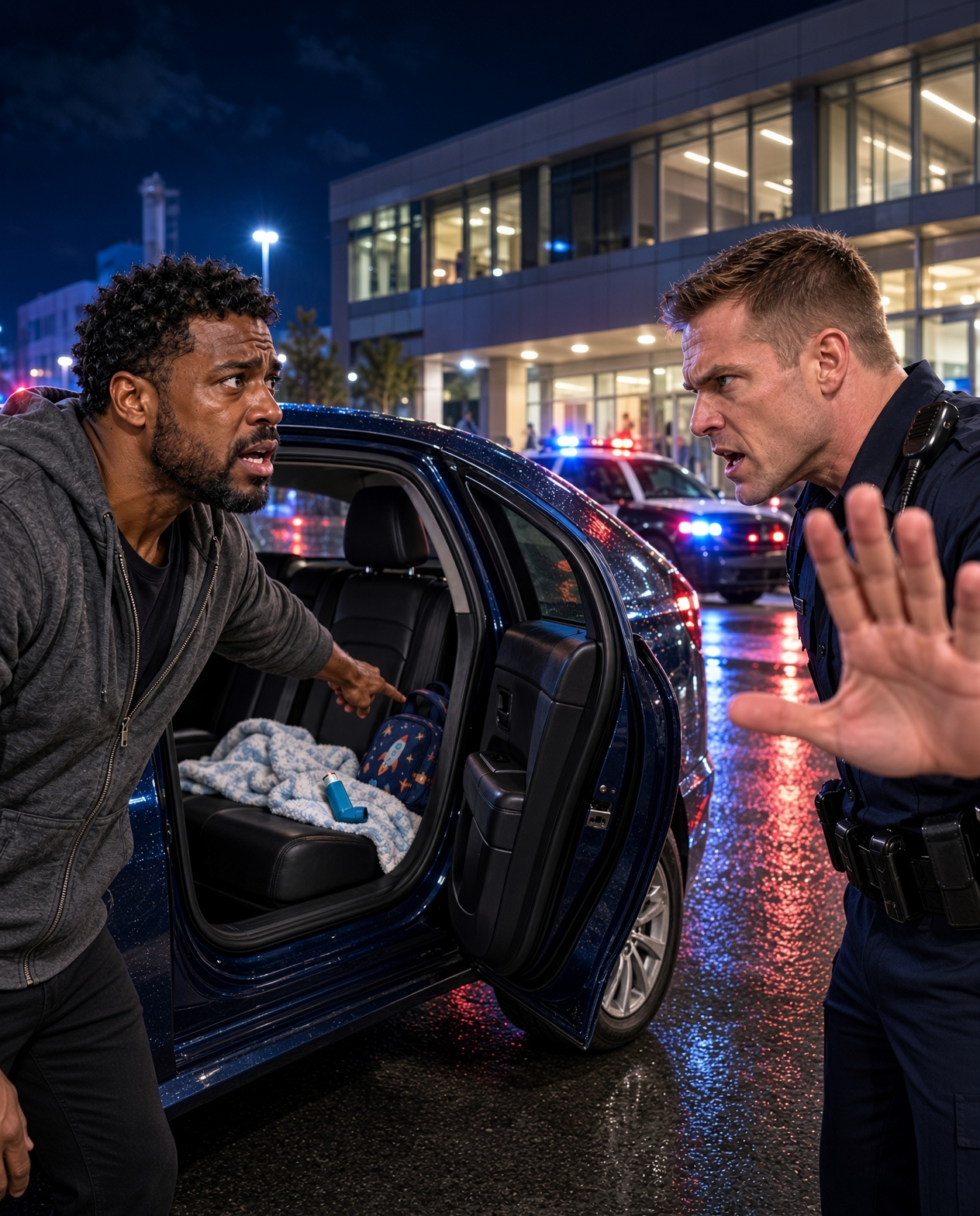
Officer, my daughter is having an asthma attack. She’s 8 years old. The hospital is four blocks away. Please step out of the vehicle. She can’t breathe. I’m a paramedic. Just let me get her there. Four blocks. That’s all I’m asking. I said, “Step out now.” He stepped out, hands up in the rain, the way his father taught him to do it when he was 15 years old.
Slowly, no sudden movement, palms open. They pressed him against the hood. Behind him, through the open door, his little girl’s breathing was getting thinner, and the inhaler that could help her was sitting in the cup holder 3 ft away, and no one would touch it. Then the radio came through. The suspect description had changed. He never matched. They didn’t let him go.
Imagine you are driving your 8-year-old daughter to the hospital at 11 at night. Her lungs are closing. You can hear it in every breath she takes. that thin whistling pull like air being dragged through a straw that is slowly being pinched shut. Now imagine that before you reach the emergency room, a man with a badge decides that the color of your skin matters more than the sound of your child fighting to breathe.
This is the story of Marcus Bell. Remember his name because by the end of tonight, a great many powerful people will wish they had never made him say it out loud. Marcus Bell was 39 years old and for most of the people who passed him on the street, he was invisible. He wore a gray hooded sweatshirt and old work boots.
He drove a dark blue sedan with a dent in the rear panel he had never bothered to fix. He worked long shifts as a paramedic technician for Westbrook County EMS. And when he wasn’t working, he was raising his daughter alone. Her name was Zoe. She was small for her age with two careful braids her father learned to do from watching videos on his phone at 2:00 in the morning.
And she had asthma severe enough that Marcus kept a rescue inhaler in every jacket, every bag, and the glove box of the car. That night, the inhaler in the glove box was almost empty. Zoe had woken up coughing. By the time Marcus reached her room, she was sitting up in bed with both hands pressed flat against the mattress, shoulders rising toward her ears, her whole body working just to move air.
He knew that posture. He had seen it in field tents and emergency rooms and on the faces of men much larger than his daughter. It was the posture of a person whose lungs were losing. He did not panic. Marcus Bell had trained himself over many years and in places he did not talk about never to let panic reach his hands.
He gave Zoe two puffs from the inhaler, counted her breaths, watched the color of her lips, and made the decision in under a minute. The nebulizer at home wasn’t cutting it. She needed the hospital. He carried her to the car wrapped in her blanket, buckled her into the back seat, put the near empty inhaler in the cup holder where he could reach it, and pulled out onto the wet street toward Hion General.
He was four blocks from the hospital when the lights came up behind him. Red and blue flashing across the rain sllicked road, filling the inside of the car with color. Marcus checked his speed. He was doing 26 in a 30. He signaled, slowed, and pulled to the curb the way he had taught himself to pull over years ago.
Slowly, hands visible, no sudden movement, interior light on. He had rehearsed this a 100 times in his head, the way a black father in America learns to rehearse it because he understood something that the man walking up to his window did not yet understand about himself. The officer’s name was Grant Doyle.
He was in his early 30s, thick through the shoulders, and he approached the driver’s side with one hand resting on his belt. He shined his flashlight into the car, across Marcus’ face into the back seat where a small girl sat gasping. “License and registration,” Doyle said. “Officer, my daughter is having an asthma attack.” Marcus kept both hands on the wheel.
“I’m a paramedic. I’m taking her to Hion General. It’s four blocks. Please. license and registration,” Doyle repeated as if Marcus had said nothing at all. Marcus moved slowly toward the glove box. Behind him, Zoe made a sound that was not quite a word. “Keep your hands where I can see them,” Doyle snapped.
“You just asked for my registration. It’s in the glove box. I’ll tell you when to move.” In the back seat, Zoe’s breathing hitched and stuttered. Marcus felt every second of it land somewhere in his chest. He turned his head just slightly. Baby, look at me in the mirror. Slow breath in. Hold it. Let it go. You’re okay. Daddy’s right here.
Doyle leaned closer to the window. Vehicle matches a description. Dark sedan. This area. Step out of the car. Officer, I understand you have a job to do. My daughter cannot breathe. Let me get her to the hospital and I will follow you there. I will do anything you want, but she needs to move now. I said, “Step out of the vehicle.
There is a moment in these stories where a reasonable man calculates the cost of every possible choice, and none of them are good.” Marcus knew that if he refused, it would escalate. He knew that if he complied, he would be pulled away from his daughter at the exact moment she needed him most.
He looked in the rearview mirror at Zoe’s small face, at the way her lips were beginning to take on a color he did not like, and he made the only choice a father like him could make. He stayed calm, and he chose his daughter. “Her inhaler is in the cup holder,” Marcus said very evenly. “I am going to step out, but someone needs to give her that inhaler.
She’s 8 years old. She is in respiratory distress. That is a medical emergency and it is being recorded on your body camera right now. Doyle opened the door. Out now. Marcus stepped out into the rain with his hands raised. A second patrol car pulled up across the street, its lights joining the strobe of the first. A younger officer got out of it, hanging back near the curb.
His name tag read Whitaker. He looked at the man standing in the rain with his hands up, then at the child visible through the back window, and something in his posture went still. Doyle turned Marcus toward the car and pressed him against the wet metal. You got weapons on you? Drugs? No, I have a hospital badge and a set of keys. My daughter needs her medication.
You’re being awfully mouthy for a guy who matches a robbery description. I match nothing except a man driving a dark car at night, Marcus said. And in a few seconds, your radio is going to tell you that. Doyle pushed him harder against the car. And it was then, as Marcus’ forearm slid across the hood, that the sleeve of his gray sweatshirt rode up.
Whitaker, standing closer now, saw the edge of an old tattoo and a long riged scar that disappeared up under the fabric. He didn’t say anything, but he noticed. Inside the car, Zoe had stopped making the whistling sound, and that terrified him because a quiet airway is not a healed one. When it narrows far enough, the whistle disappears since there is no longer enough air moving to make any sound at all. Marcus knew that.
He turned his head against the hood. Officer, listen to me. She’s gone quiet. That is not good. That means she is moving almost no air. If she loses consciousness, this stops being a traffic stop and starts being the worst day of your entire life. I am asking you, one human being to another, give my daughter the inhaler in the cup holder and then exactly as Marcus had predicted. The radio crackled.
All units be advised. Suspect description updated. Robbery suspect now described as a light colored pickup truck. Single male, red jacket. Repeat, light pickup, red jacket. Marcus was wearing a gray hoodie. He was driving a dark blue sedan. He had an 8-year-old in the back seat. Whitaker heard it. Doyle heard it. For one long second, nobody moved.
“You heard that,” Marcus said quietly. “I don’t match. I never matched. Let me help my daughter.” Doyle’s jaw worked. He did not like being wrong, and he liked even less being told he was wrong by the man he had pinned against a car. He keyed his radio. This is Doyle. I’ve got a subject detained. I’m going to hold him while I confirm.
Confirm what? Marcus said, “You just heard the description change. Descriptions get revised. Doesn’t mean you’re clear.” It was at that moment that a third figure arrived. Sergeant Frank Kesler had been two blocks away and had rolled up when he heard Doyle call in a detention. Kesler was a heavy set man in his 50s with the calm, unbothered face of someone who had spent decades learning exactly how much he could get away with.
He stepped out of his cruiser, looked at the scene, looked at the child in the back seat, and looked at Marcus pressed against the hood in the rain. “What do we have?” “Subject matching a description, refused commands,” Doyle said. The description was updated 30 seconds ago, and I no longer match it,” Marcus said.
“Sergeant, my daughter is 8 and she is in respiratory arrest in that back seat. Every second you stand here having this conversation is a second she is not breathing. I am a paramedic. Let me treat my child. Kesler looked at him for a long, unhurried moment. And here is the thing you must understand about men like Frank Kesler.
He was not stupid. He heard the radio update. He saw the little girl. He knew in that moment that the smart and decent thing to do was to open the back door and hand a father his child’s inhaler. But somewhere in Kesler’s mind, a different calculation was already running. If Doyle had detained an innocent man and that man’s child had a medical emergency and it was all on camera, then the department had a problem.
And Frank Kesler had spent 30 years learning that problems could be managed if you controlled the story before anyone else did. Let her get the inhaler, Kesler said finally, nodding at the car. But his eyes stayed on Marcus. And keep him where he is. Whitaker moved fast. He opened the back door and Marcus’s voice cut across the rain, calm and precise.
The voice of a man who had done this in far worse conditions than a suburban street. Cup holder, blue inhaler. Shake it twice. Zoe, sweetheart, I need you to look at the officer. He’s going to help you. Lips on the mouthpiece. When he presses it, breathe in slow, as deep as you can, and hold it.
Officer, one press. Wait for her to inhale. Hold 10 seconds, then a second press. Whitaker followed every instruction exactly. Zoe took the medication. Her small chest heaved, caught, and then slowly began to move a little more freely. The whistle came back, which sounded terrible, but which Marcus knew was the sound of air returning.
Her lips began to lose their gray tinge. Marcus closed his eyes for one second against the hood of the car. Just one. Then he opened them again because he was not done. She needs the hospital. He said that inhaler bought her minutes, not hours. She needs a nebulizer and a doctor. Four blocks. I will follow behind you in handcuffs if that’s what it takes.
But my daughter goes to Hely in general now. Kesler crouched by the open door, looked at Zoey, and then did something that told Marcus everything about the kind of man he was dealing with. He looked not at the child but at the camera on Doyle’s chest and he said in a warm reasonable voice designed for a recording. Let’s get this little girl to the hospital.
Whitaker, you ride with her in the ambulance. Doyle, call for a bus. It was the right decision. But he had made it. Marcus realized for exactly the wrong reason. An ambulance took Zoe the four blocks she could have driven in 90 seconds. Whitaker rode with her and Marcus Bell was placed in handcuffs on the side of the road.
In the rain for the crime of trying to save his daughter’s life, but before they put him in the car, Kesler noticed the sleeve. He reached out and pushed the wet fabric up Marcus’s forearm, revealing the long surgical scars and above them, a faded tattoo, a bird in flight over a set of numbers, and beneath it, three words: Fleet Marine Force.
You military? Kesler asked. I was. What’s this? Kesler tapped the ink. Raven six. Marcus looked at him. It’s a call sign. Who’s mine? Kesler studied the scars a moment longer and then he pulled the sleeve back down almost gently. And something crossed his face that Marcus could not read. It was not respect. It was calculation.
Because Frank Kesler had just realized that the innocent man he had detained was not just any innocent man. He was a decorated combat medic with a spotless record and a sympathetic story. And that made him a very large problem. And large problems in Frank Kesler’s experience had to be buried before they could grow.
They put Marcus in the back of the cruiser. Through the window, he watched the ambulance carrying his daughter disappear toward the lights of the hospital. And he understood with the cold clarity that had kept him alive in places far more dangerous than this street that whatever happened next would not be decided by what had actually happened tonight.
It would be decided by what someone chose to write down. The interview room at the Westbrook Police Department was cold and gray and Marcus Bell sat in it for 2 hours while his daughter was treated four blocks away without him. They had removed the handcuffs. A paper cup of water sat untouched by his elbow. He did not drink it. He did not pace.
He sat with his hands folded on the metal table and his back straight. And he waited because waiting was a thing Marcus knew how to do. He had waited in worse rooms than this. When the door finally opened, Sergeant Kesler came in with a thin folder followed by Doyle. “How’s my daughter?” Marcus said. It was not a question. It was a demand.
“She’s being treated,” Kesler said, sitting. “She’s fine. I want to hear that from a doctor. I want to see her. I am a single parent and she is 8 years old and she has been through a terrifying night. You have no reason to keep me from her. We have a few things to clear up first. Kesler opened the folder.
You refused a lawful command to exit your vehicle. I told you why you resisted. I put my hands on the hood exactly the way your officer positioned them. There was no resistance. It’s on the camera. Kesler made a small note. You interfered with an active stop. I informed you of a medical emergency involving a child. On the camera, you’ll hear me predict the description change before it came over the radio.
You’ll hear me tell you she’d gone quiet. You’ll hear me stay calm while your officer pressed me into a car. Marcus leaned forward just slightly. Sergeant, I have been polite to you all night because I understand how these things go and because I want to get home to my daughter, but let’s both be honest about what happened out there.
You detained a man who did not match a description and his kid nearly died on your body camera. That is the truth. Everything else is decoration. Doyle’s face reened. You think you’re smart? I think I know what happened. Marcus said there’s a difference. Kesler closed the folder slowly. Then he leaned back and looked at Marcus with an expression that was almost friendly.
And that was when the story began to change. Here’s my concern, Mr. Bell. A man drives erratically at night, gets pulled over, and refuses to comply. There’s a child in the car, unrestrained, perhaps clearly in distress. Now, a reasonable person might ask, why was that child in that condition in the first place? Why was a man with a history, a combat history, some trauma, maybe driving around agitated with a sick kid at 11 at night? These are questions a concerned officer has to ask. And there it was.
Marcus felt it land, cold and precise. They were not going to charge him with resisting. That would be too easy to disprove. Instead, they were going to turn a father who saved his daughter into a father who endangered her. They were going to take the scars on his arm, the record he had earned bleeding for other people, and twist it into evidence of a damaged, dangerous man.
And if they could make that story stick, they would not just avoid embarrassment, they would have a reason for everything they had done. “You’re going to file a report to child services,” Marcus said quietly. “We’re required to flag any incident involving a minor in potential danger. The danger was your officer keeping me from her medication.
” “That’s your interpretation. That’s the timeline. Marcus’s voice never rose, but something in it hardened into iron. And the timeline is on the camera. Kesler smiled and it was a very small smile. We’ll see what the camera says. The door opened again. It was Whitaker. He had come from the hospital and he looked like a man who had seen something he could not unsee.
He caught Marcus’s eye for half a second, then looked away. Sergeant, the girl stable. They’re keeping her for observation. Grandmother’s on her way to sit with her. Marcus closed his eyes briefly. Ada, his mother. Someone had at least called his mother. It was the first decent thing to happen in 3 hours. Good, Kesler said.
Whitaker, get started on the incident report. Whitaker hesitated. It was a small hesitation. Half a second. The kind of thing most people would never notice, but Marcus noticed. And Kesler noticed, too. Something on your mind, officer? No, sergeant. Then write the report the way we discussed. Whitaker left, and Marcus sat in the cold gray room and understood that somewhere in this building on a printer he could not see, a version of tonight was being manufactured.
A version in which he was not a father who had done everything right, but a threat who had done everything wrong. And the only thing standing between him and that version was a young officer who had just been told exactly what to write. They released Marcus at 4 in the morning without charging him.
That should have been a relief. It wasn’t because a man who understands how these systems work knows that not being charged and being cleared are two very different things. They had not decided he was innocent. They had decided to wait and to build. He went straight to the hospital, still in his rain damp hoodie, and he found Zoe asleep in a pediatric bed with a nebulizer mask, fogging gently over her face, and his mother sitting beside her, holding her small hand.
Adabel looked up at her son, and she did not have to ask what had happened. She had raised him. She knew the look on his face. “They took you in,” she said. “They took me in for helping my grandbaby breathe.” Marcus sat down heavily in the chair on the other side of the bed and looked at his daughter’s sleeping face, the small chest rising and falling now in an easy, even rhythm. It’s worse than that, mama.
He said they’re building something. I can feel it. Adabel was 71 years old. She had buried a husband, raised a son through a war, and worked 40 years as a lunch lady in a school that never once got her name right. She reached across the bed and put her hand over her sons. “Then you do what your grandfather taught you,” she said.
“You stay quiet, you stay clean, and you let the truth do the heavy lifting. Truth is patient, baby. It’ll outlast any lie a scared man can tell.” Marcus looked down at his daughter and then at the old scars on his own arm, and for the first time in many years, he thought about the man he used to be, Raven. Six.
the name they had called him in places where names were the only things that survived. He had left that man behind when he came home to raise his little girl. He had put away the jacket and the tags and the version of himself that ran toward the sound of dying. But some men do not get to leave the past behind. Some men find that the world reaches back and pulls it out of them whether they are ready or not.
The next morning, before the sun was fully up, Marcus’ phone rang. while he was pouring coffee he had no intention of drinking. It was Dela Monroe. Dela was a former Navy nurse who had served two tours before Marcus ever put on a uniform and who now ran the trauma floor at a hospital across town. She was the closest thing Marcus had to family outside of Ada and Zoey.
And she was the person he called when he needed someone who would tell him the truth and not the comfortable version of it. You sound like death, she said. It’s been a night. I heard. Word travels. You want to tell me why one of my old corman got detained for treating his own kid? Marcus told her.
Dela listened without interrupting, which was one of the things he valued about her. When he finished, there was a pause on the line. They’re going to make you the problem. She said, “You know that. I know that. You need a lawyer. A real one, not the guy who did your car accident. I don’t want to turn this into a circus.” Dela Marcus.
Her voice was gentle and completely immovable. They are trying to take your daughter and your name in one move. It is already a circus. The only question is whether you show up with a ring master or you get eaten by the clowns. Call Renee Alvarez. I’ll text you the number. Call her before you say another word to anyone with a badge.
He called Renee Alvarez that afternoon. She was a civil rights attorney who had spent 15 years suing police departments, and she had a reputation for being calm right up until the moment she was not. She listened to Marcus’ account the way a surgeon listens to a set of symptoms. And when he was done, she asked him four questions.
Did you ever refuse to identify yourself? No. Did you at any point touch an officer or refuse to place your hands where directed? No. I complied with every physical instruction. The only thing I refused was to stop talking about my daughter’s medical emergency. Was the entire stop recorded on body camera? Doyles. Yes. And there was a second cruiser, Whitaker’s, and a dash camera on at least one of them. Good.
Then here is what we do. Rene’s voice was crisp. From this moment, you do not speak to anyone at that department without me present. We request every recording, every log, every dispatch transmission, and the complete chain of custody for anything they took from your vehicle. And we do it fast, Mr.
Belle, because I have seen this exact play a hundred times. The evidence that proves you innocent is the same evidence that proves them wrong, which means from their perspective, that evidence is now a liability. And liabilities have a way of developing technical problems. She was more right than she knew. 2 days later, Marcus got a call from the hospital, not about Zoe’s health, about her chart.
A woman from Hion General’s compliance office, careful and polite, explained that Zoe Bell’s emergency medical record had been accessed and modified after Marcus had already left the building and the modification had been made using Marcus’ own EMS system credentials. Marcus sat down his coffee very slowly.
That’s not possible, he said. I don’t have privileges at Hion, and I was in a police interview room at the time you’re describing. We know, the compliance officer said, “That’s why we’re calling. Your credentials were used, but the access didn’t originate from any hospital workstation you’d normally use. We’re trying to determine where it came from. But Mr.
Bell, I have to be honest with you. As it stands, the record shows that someone using your login altered your daughter’s intake notes. Specifically, someone changed the recorded oxygen saturation and removed the notation of severe respiratory distress on arrival.” Marcus closed his eyes, and in the darkness behind them, the whole shape of it became clear.
If the record said Zoe arrived in only mild distress, then there was no emergency, no reason he needed to reach her, only an agitated man with a combat history refusing lawful commands. They weren’t going to say he endangered his daughter. They were going to erase the proof that anyone else had. It was almost airtight.
Almost. Because Marcus was a paramedic and he knew something that whoever sat down at that terminal did not. He knew that the chart was not the only thing that had watched Zoe breathe that night. He held on to that thought and said nothing about it to anyone. Marcus called Renee Alvarez and told her about the chart.
There was a silence on the line that lasted several seconds. Mr. Bell, she said finally. Do you understand what they just did? They tried to erase the emergency. They tried to erase the emergency and in doing so they turned an obstruction question into an evidence- tampering conspiracy and they hung it around your neck. This is no longer about a traffic stop.
Her voice sharpened into something almost hungry. This is about who reached into a hospital’s computer system using stolen credentials. And people who do that leave footprints. Get me the name of that compliance officer. We’re going to find the machine that touched your daughter’s chart. The next two weeks were a war fought in records.
Marcus went back to work because he had to, because bills did not pause for injustice, and because if he sat still in his apartment, he would go somewhere dark. But child protective services had opened a case. A case worker came to inspect his home to interview Zoey to ask a small girl gentle questions about whether her daddy ever scared her.
Zoe, bless her, sat up straight in her chair and told the woman that her daddy taught her the slow breathing game and that he had never once, not ever, made her feel scared and that the scary part was the man who wouldn’t let him help her. The case worker wrote that down. Marcus saw her write it down.
It was the first small thing that gave him hope. But hope is not evidence, and the department was moving. Renee Alvarez filed formal demands for the body camera footage, and the department responded 10 days later with a two-line letter. The primary body camera file from Officer Doyle’s unit had been flagged as corrupted due to a technical malfunction and was undergoing review.
It was not available for release. Marcus read the letter standing in his kitchen and he laughed. It was not a happy sound. A technical malfunction, he said to Dela on the phone. The one camera that recorded everything and it’s the one that broke. You don’t believe it. I’ve worn a body camera on ride alongs. You know how many times I’ve seen one corrupt the exact footage somebody didn’t want seen? The files don’t just vanish, Dela.
They upload. There’s a record of the upload. There’s a fingerprint on the file. If Doyle’s camera recorded that night and uploaded it, then that file exists somewhere and corrupted is a story, not a fact. He was right. But proving it would require someone on the inside. And the only person on the inside who had looked at Marcus with anything other than contempt was a young officer named Ray Whitaker, who had been ordered to write a report that was not true.
Whitaker, it turned out, was not sleeping well. He had ridden in the ambulance with Zoe Bell. He had watched an 8-year-old girl come back from the edge of something terrible because a man in handcuffs had talked her through it from the side of the road. He had heard the dispatch update with his own ears, and he had watched his sergeant decide to keep an innocent man detained anyway.
And every night since, when he closed his eyes, he saw the little girl’s gray lips and heard the calm, exhausted voice of her father saying, “Give my daughter the inhaler.” Whitaker had been raised to believe in the badge. His father had worn one. He believed genuinely that most officers were good people doing an impossible job.
But he was learning the hardest lesson a decent person in a corrupt system can learn. That the pressure to stay silent does not come from monsters. It comes from men you respect in reasonable voices asking you to be a team player. It comes wrapped in words like loyalty and brotherhood. And don’t throw away your career over one bad night.
Kesler had put a supplemental statement on Whitaker’s desk. It described Marcus Bell as agitated and non-compliant. It described the child as a factor that Marcus had used to manipulate the scene. It did not mention the dispatch update. It did not mention the gray lips and it had a signature line at the bottom with Whitaker’s name typed beneath it.
Whitaker stared at that signature line for 3 days and then something happened that made his decision for him. He was in the evidence room dropping off an unrelated file when he overheard the clerk, an older man named Perez, muttering at his computer. “What’s wrong?” Whitaker asked. “Property log on the bell stop,” Perez said, not looking up.
“The inhaler they bagged from the car. Chain of custodies got a gap in it. Thing wasn’t logged into the system until almost 2 hours after the stop. And there’s a note here from Sergeant Kesler putting the whole thing under supervisory review before it was even entered. Perez frowned. That’s backwards.
You don’t review something into evidence before you log it. That’s not how it works. Whitaker went very still because he understood what Perez was looking at. Even if Perez did not, somebody had taken Zoe’s inhaler. the physical proof that this child had a genuine ongoing medical condition, that the emergency was real, and held it outside the official record for two hours before quietly slotting it in under a supervisor’s control.
2 hours during which a great many things could happen to an object that nobody had officially seen yet. Perez, Whitaker said carefully, “Can you preserve that log exactly as it is right now? Don’t touch it. Just make sure it can’t change.” Perez looked at him. Official request, call it a personal one. Perez studied the young officer for a long moment.
And then he did a decent thing, the way ordinary people sometimes do in the middle of extraordinary corruption. He nodded. I’ll preserve it. Marcus met Whitaker in the parking lot of a diner on the edge of town. At Renee Alvarez’s insistence, and with Renee present. I’m not comfortable with this, Whitaker said, standing by his car.
He was out of uniform. He looked younger than he had on the street. If anyone knew I was talking to you, then let’s make it quick. Renee said, “You’re not here to give us evidence, officer. My client and I can’t take anything from you directly. It would compromise both of us. You’re here because you’re a witness and because I think you already know that.
I just need to know one thing. When the time comes, and it will come, are you going to tell the truth about what happened on that street?” Whitaker looked at Marcus and Marcus looked back at him and did not say anything because Marcus Bell had learned long ago that you cannot argue a man into his own conscience.
You can only stand still and let him see it. Can I ask you something? Whitaker said suddenly to Marcus. Your tattoo Raven six and the scars he swallowed. You were a corman fleet marine force overseas. I was what years? Marcus told him. Whitaker’s face changed. It drained slow of color and his hand came up and gripped the top of his car door as if he needed it to stay standing. “My brother,” he said. “Cole.
” Cole Whitaker. He was a Marine. He got hit by an IED outside a village whose name I can never remember. They medevaced him. He lost a lot of blood. He came home. Whitaker’s voice was shaking now. He came home because a corman kept him alive on a bird for 40 minutes when everyone said he wasn’t going to make it.
Cole never knew the guy’s name, but he said the corman promised him something. He kept Cole was out of his head from the blood loss he kept, asking about a kite, a yellow kite he’d promised his daughter he’d fly with her when he got home. And the corman promised him, told him he’d make it home to fly that kite.
And Cole held on because of it. The parking lot was very quiet. Somewhere inside the diner, a bell rang as a door opened. Marcus Bell looked at the young officer for a long moment and then he said quietly, “Did he fly the kite?” Whitaker made a sound that was half a sob. Every spring, he whispered. “Every single spring.” “She’s 14 now.
” “Good,” Marcus said. “That’s good.” Neither of them said anything else. They did not need to. Whitaker had asked a question he had no ordinary reason to ask, and Marcus had answered it. And in the space between the question and the answer, a young officer had finally understood exactly who it was he had been asked to lie about.
“I’m not going to sign the statement,” Whitaker said. His voice was steadier now. “And when they call me to testify, I’m going to tell them everything. The dispatch update, the gray lips, all of it.” He looked at Renee. “But you should know my body camera recorded that night, too. Mine didn’t corrupt and I never turned it in as evidence because nobody asked me to because nobody thought I mattered.
He almost laughed. The invisible ones never do. Renee Alvarez went very still. Officer Whitaker, she said, I want you to go to your union representative right now, tonight. And I want you to formally preserve that recording through the proper channels. Do not give it to me. Do not give it to my client.
log it, preserve it, and make it impossible to lose. Because I promise you, the moment the wrong people learn it exists, it will develop a technical problem, too.” Whitaker nodded. And then he got in his car and drove to his union rep’s house at 10:00 at night, and he did exactly that.
The evidentiary hearing was held 5 weeks after the traffic stop. It was not a criminal trial. Marcus had never been charged with a crime the department had been too careful for that. It was a hearing on Renee Alvarez’s motion filed on Marcus’ behalf alleging misconduct, unlawful detention, and evidence tampering, and requesting that the Child Protective Services referral built on that misconduct be dismissed.
But everyone in that room understood that the real question on trial was much larger than any single motion. The question was whether a father who did everything right could be destroyed by men who wrote down a lie. Marcus sat beside Renee in a dark suit. Across the room sat Sergeant Frank Kesler and Officer Grant Doyle beside a department attorney in an expensive tie.
Kesler looked calm, relaxed, even. He had been in rooms like this before, and he had always walked out of them. Adabel sat in the second row in her Sunday hat with her back straight and beside her sat Zoe, 8 years old, in a small blue jacket that had once belonged to her father. The sleeves rolled up three times so her hands could poke out.
On the shoulder of that jacket was a faded patch, a bird in flight. Marcus had not asked her to wear it. She had found it in his closet that morning and put it on herself and said, “I want to look like you.” He had not been able to say no. The first witness was the compliance officer from Hion General who explained the two access events on Zoe’s chart.
Both had used Marcus’ credentials. Neither had originated from a workstation Marcus could physically reach. Where did the access come from? Renee asked. A restricted administrative terminal, the compliance officer said. Located in a corridor adjacent to our police liaison office. The credentials weren’t entered fresh. They were already cashed on that terminal.
Someone with physical access to that machine opened your client’s daughter’s chart and altered it. And who has access to that corridor? Hospital administrators, security, and authorized police personnel present for liaison matters. A murmur went through the room. Renee let it sit for exactly the right amount of time before she asked her next question.
Now, the chart was altered to reduce the recorded severity of Zoe Bell’s condition. But there’s a second record of that condition, isn’t there? One that no human being typed. And yes, the automated pulse occimmetry telemetry. Renee turned to the screen and displayed it. A simple jagged line. Zoe Bell’s blood oxygen level. From the moment the ambulance doors opened, it started dangerously low.
And then several minutes in, it began to climb slowly, steadily back towards safety. When did it start to climb? Renee asked. Approximately 4 minutes after intake, consistent with the timing of a second nebulizer treatment. So, this data confirms that Zoe Bell arrived at the hospital in severe respiratory distress. Yes.
Independent of any note her father may or may not have written. Completely independent. It’s machine generated. Nobody with your client’s access level can alter it. Renee looked at the jagged line on the screen. And then she looked at Frank Kesler. Someone changed what a nurse typed, she said. But nobody in this room can change what a machine remembers.
The emergency was real, which means the only person who tried to make it disappear was whoever sat down at that terminal and typed a lie. The department attorney objected. The hearing officer allowed the telemetry into evidence and told Renee to continue. She called the forensic specialist next who walked the room through the chain of custody on Zoe’s inhaler. The 2-hour gap.
The note from Sergeant Kesler placing it under supervisory review before it had ever been logged. The clerk Perez called to the stand, confirmed the record, confirmed he had preserved it, and confirmed in his flat and honest way that in 30 years he had never once seen a piece of evidence placed under review before it was entered into the system.
“Is that normal?” Renee asked. “No, ma’am,” Perez said. “That’s backwards.” And then Renee turned to the matter of Officer Doyle’s body camera. She called the department’s own digital evidence administrator, a nervous man named Hail, and she asked him one simple question. When Officer Doyle’s body camera uploaded its footage on the night of the stop, did the file upload successfully? Hail hesitated.
He looked at the department attorney. Then he looked at the hearing officer who was watching him steadily, and he seemed to remember that he was under oath. Yes, he said. The file uploaded successfully. There’s an upload record and every file when it uploads generates a digital fingerprint, a check sum. Correct.
Correct. Does the file currently sitting in your archive, the one your department says is corrupted, does it have the same check sum as the file that uploaded that night? Hail was quiet for a long moment. Yes, he said finally. It does. So, the file didn’t change. No, it’s the same file that recorded on the street. Intact. Yes.
Then why? Renee asked very softly. Does your department call it corrupted? Hail looked down at his hands. It was flagged, he said. For review, quarantined. By whom? The department attorney was on his feet, objecting before the question finished. But the hearing officer overruled him. because the hearing officer had been doing this a long time and had begun over the last hour to understand exactly what kind of room she was sitting in.
Answer the question, Mr. Hail, she said. Who authorized the quarantine of that file? Hail looked at Frank Kesler and then he said the name Sergeant Kesler. The room was silent and for the first time all afternoon, Frank Kesler’s calm, relaxed face was not quite so calm anymore. But Renee Alvarez was not finished because there was one more thing.
One thing the department did not know existed. Your honor, she said, the defense has represented that no clear video record of this stop exists due to the corruption of officer Doyle’s camera. I would like to call officer Ray Whitaker. The department attorney turned in his seat. Doyle turned and Frank Kesler, who had spent 30 years managing problems, turned too and looked at the young officer walking up the aisle with an expression that Whitaker would remember for the rest of his life.
It was not anger. It was the look of a man watching a door close that he had always assumed would stay open. Whitaker took the oath. His voice did not shake. Officer Whitaker, Renee said, were you present at the traffic stop of Marcus Bell? I was. Was your body camera recording? It was. Did your footage corrupt? No, ma’am. It’s intact.
I preserved it through my union representative the same night I learned Officer Doyles had been flagged. The department attorney was on his feet again, but the hearing officer waved him down. Officer Whitaker, Renee said, I want you to tell the room what you saw, not what was written in any report. What you saw. And Ray Whitaker told them.
He told them about the dispatch update that cleared Marcus of matching any suspect and how it came over the radio while Marcus was still pressed against the car. He told them about Sergeant Kesler hearing that update and choosing to keep Marcus detained anyway. He told them about the little girl in the back seat whose lips had gone gray and about the man in handcuffs who talked her back from the edge in a calm and steady voice.
He told them that he had ridden in the ambulance and that the paramedics had confirmed the child was in genuine severe distress. And then Renee played the audio from his camera, the street noise. And then cutting clean through it, Sergeant Frank Kesler’s voice, warm and unhurried, saying to Doyle, “Lo, not meant for the recording.
Keep him detained. We’ll figure out the description later. and do me a favor. Leave that inhaler off the property sheet until we know what we’re dealing with here. The room did not move. The hearing officer had the recording played a second time and on the second time, everyone in that room watched Frank Kesler and they saw it happen.
They saw the color drain out of his face. They saw his hand resting on the table begin to tremble. He reached for the glass of water in front of him and could not quite hold it steady, and he set it back down without drinking. The hearing officer turned to him. “Sergeant Kesler, did you say those words?” Kesler stood slowly.
He was a man who had talked his way out of 30 years of rooms, and you could see him reaching one last time for the thing that had always saved him. Your honor, that was a chaotic scene. Statements made in the middle of a fastmoving, “Did you say those words?” The department attorney reached for his arm. Kesler shook it off.
He stood there and the whole room watched a story that had been built to bury a good man collapse in real time, sentence by sentence until there was nothing left of it to hide behind. Yes, Frank Kesler said, “I said them.” Marcus Bell did not smile. He did not stand up. He did not say anything at all. He sat with his hands folded on the table exactly as he had sat in the cold gray interview room.
And he let the truth do the heavy lifting the way his grandfather had taught him. and his mother had reminded him and the way he had known all along that it eventually would. The hearing officer ordered the full body camera footage Doyle’s intact file and Whitaker’s released and preserved as evidence.
She dismissed the child protective services referral against Marcus Bell as unfounded and built on falsified records. and she referred the conduct of Sergeant Frank Kesler and Officer Grant Doyle and the alteration of a child’s medical chart through stolen credentials to both internal affairs and the federal authorities for criminal investigation.
Behind Marcus in the second row, Adah Bell put her arm around her granddaughter, and Zoe, 8 years old, in her father’s jacket with the bird on the shoulder, looked up at the front of the room where her daddy sat and she did not fully understand everything that had happened. But she understood that the men who would not let her breathe were the ones in trouble now and that her father was not.
She sat up a little straighter in his jacket. The investigation that followed was not quiet. The terminal in the hospital corridor was traced through its access logs to the department’s evidence liaison unit and from there to Kesler’s instruction. Frank Kesler and Grant Doyle were both indicted on charges of evidence tampering and official misconduct. Neither man kept his badge.
Kesler, who had spent 30 years learning exactly how much he could get away with, learned at last that the answer was not infinite. The department, facing a civil suit and a federal review, settled with Marcus Bell. A lesser man might have taken the money and disappeared, and no one would have blamed him.
Marcus had earned that right twice over. He did not take it. He used the settlement to start something instead. He called it the Raven program. after the call sign he had spent so many years trying to leave behind. It put dispatchers, patrol officers, and paramedics in the same room to learn one thing that a citizen who says someone cannot breathe is not resisting authority.
They are reporting a fact a machine will later confirm whether anyone believes it in the moment or not. Dela Monroe designed the medical curriculum and Ray Whitaker spoke to every new class about the night he learned that loyalty to a person is not the same thing as loyalty to the truth. Whitaker faced consequences for his own conduct that night for hesitating for the report he had almost signed.
He accepted them without complaint. And when he stood in front of that first class of officers and told them what it had cost him and what it had almost cost a little girl, more than one young officer in that room, understood something that no rule book had ever quite managed to teach them. Cole Whitaker came to the first graduation.
He shook Marcus Bell’s hand and held it a long time and could not find any words at all. So he did not try. He just held on. and his daughter, 14 years old, gave Marcus a small folded thing wrapped in tissue paper. When Marcus opened it later alone, it was a photograph of a yellow kite against a blue spring sky.
Marcus keeps it on the wall of the Raven program’s front office next to a shadow box. And in that shadow box, behind glass, where every person who walks through the door can see it, are two things. a set of dog tags and beneath them a faded shoulder patch of a bird in flight over three words and a number raven. Six.
For years, Marcus Bell had hidden that patch under a sleeve. He had pulled the fabric down over the scars the way a man does when he has decided that the world has not earned the right to see what he survived. He does not hide it anymore. He mounted it on a wall in the light where it belongs because he finally understood something that took him almost 40 years and one terrible night to learn.
The scars were never the shameful part. The scars were the proof. The proof that he had spent his life running toward the people the world had given up on and keeping them alive and asking nothing in return. And no scared man with a badge in a story could ever take that away from him, no matter what they chose to write down.
Zoe Bell is nine now. Her asthma is well-managed. She flies a kite sometimes on windy spring afternoons in a park not far from home with her father standing beside her, one hand shading his eyes against the sun. And when strangers see them there, a black man and his daughter, an ordinary father and an ordinary child, invisible to almost everyone who passes, not one of them has any idea who that man used to be or what he did or how close the whole world came to erasing it. He prefers it that way.
The lesson in Marcus Bell’s story is not a complicated one. So, let’s say it plainly. A lie can move fast. A lie can wear a uniform and speak in a calm, reasonable voice and put your name on a document you never signed. But the truth does not need to be loud. And it does not need to be fast. It only needs to survive.
And truth has a way of surviving every single attempt to bury it. Because unlike a lie, the truth does not require anyone to keep protecting it. It just sits there in a machine’s memory, in a preserved recording, in the steady voice of one young man who finally decided to stop being afraid and it waits.
Marcus never once demanded respect because of the scars on his arm or the call sign on his skin. He simply stood still and stayed calm and refused to let a manufactured story replace what had actually happened to his daughter on a rainy street. And we are reminded watching him that loyalty to a person is never the same as loyalty to the truth.
That the bravest thing a person can do is not to run toward danger. Though Marcus did that, too. The bravest thing is to tell the truth out loud when telling it will cost you something. Ray Whitaker learned that. It cost him. He told it anyway. So here is the question and I want you to sit with it before you scroll away.
If you had been standing on that street that night watching a man in handcuffs beg for his daughter’s inhaler while your sergeant told you to stay quiet, what would you have done? Would you have preserved the recording? Would you have refused to sign the lie? Would you have walked up that aisle and taken the oath knowing what it would cost you? Most of us would like to believe we would.
The truth is, we don’t know until the moment finds us. But maybe the point of a story like this is to decide who you want to be before that moment arrives. Because dignity isn’t something people hand you when you’re on your knees in the rain. You either know your own worth or you let someone else write it down for you. Know your worth.
Say it out loud. And never ever let a scared man with a pen tell your story for you. If this story moved you, we would truly love to hear your thoughts. How did you feel about the way it was told? Was there anything you would change, add, or want more of? Your feedback shapes every story we tell next.
And if you have a powerful, true-to-life story of your own about dignity, about justice, about the quiet people the world underestimates, share it with us. Your story might be the one that gives someone else the courage to stand up when their moment finally comes. This video is a work of fiction created with the assistance of artificial intelligence.
All characters, events, and situations are entirely fictional and do not represent any real people or actual events. The content is intended for storytelling and emotional reflection.

