Cop Stopped a Black Girl Driving an Ambulance—Then Froze When the Back Doors Opened
Cop Stopped a Black Girl Driving an Ambulance—Then Froze When the Back Doors Opened
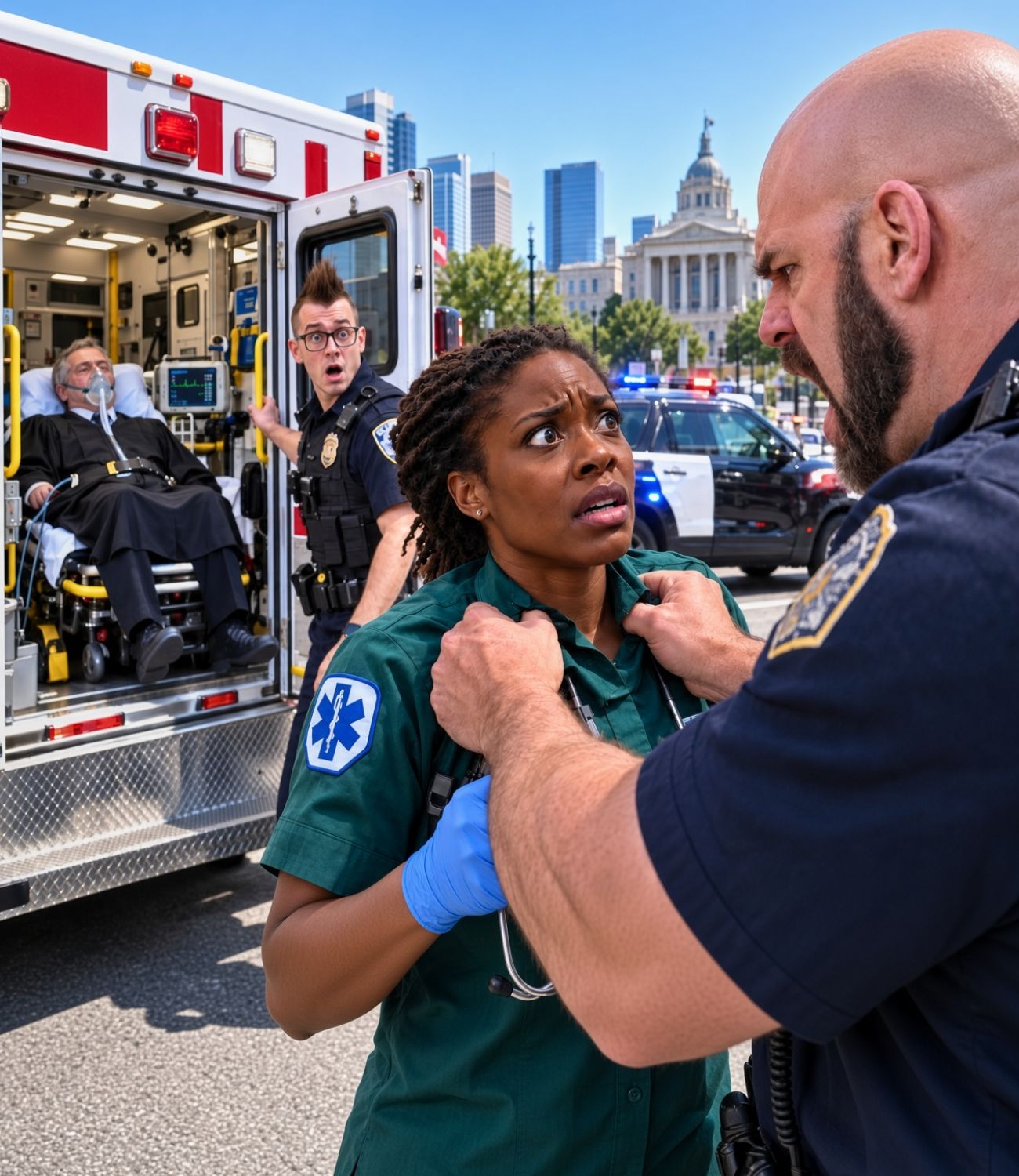
The patrol cruiser sat sideways across the road, blocking County Medic 381. Officer Grant Keller stepped out, one hand resting on the baton at his hip. He approached the driver’s window and shown his flashlight directly into Maya Williams’s face. Keep your hands on the wheel. Turn off the engine immediately.
Maya did not turn it off. Her medical gloved hands tightened around the steering wheel. She looked Keller directly in the eye and spoke with unwavering authority. There’s a critical patient on board. Clear the road immediately. Step out of the vehicle. We’re verifying a report that this ambulance was unlawfully taken.
I’m conducting a legitimate emergency transport through the EMS system. Any interference at this point directly threatens my patients life. About 10 minutes earlier, the GPS network at the EMS dispatch center near the courthouse had experienced signal interference. The data transmitted to police dispatch falsely indicated that an emergency vehicle had been taken unlawfully.
Keller received the alert through the patrol network. The moment he saw a county medic 381 leaving the courthouse area with a black sedan with tinted windows following closely behind, he immediately concluded that it was a hostage situation and ordered a roadblock. The younger officer, Noah Bennett, walked around to the passenger side and examined the documents Maya handed him through the partially lowered window.
Her EMS employee ID, county credentials, and dispatch order all match. Noah said quietly to Keller. The GPS system could be malfunctioning. Keller looked at Maya. His personal prejudice led him to dismiss every document in his hands. Credentials and uniforms can be stolen. I need to verify the operator. Maya lowered the window, [clears throat] her gaze direct and unwavering.
I am the lead paramedic assigned to this vehicle. You have valid documentation and the authorized driver is standing right in front of you. Someone pounded hard against the partition behind her. Elena Ruiz’s urgent voice came from the rear compartment. Maya, the patients blood pressure is dropping fast. His heart rhythm is out of control.
Keller moved closer to the driver’s door. He struck the metal door frame twice with his baton and issued his command in an overbearing tone. Turn off the engine and step out of the vehicle now. No one moves this ambulance without my authorization. Maya opened the door and stepped out. She stood across from Keller, maintaining the proper distance required by professional protocol.
You’ve checked the documents. You’ve received confirmation. You’re using your authority to obstruct emergency medical care. A woman like you driving a county ambulance is something I need to examine carefully,” Keller replied, disguising his suspicion as standard procedure. “Everyone stays exactly where they are until I determine what that black sedan is doing here.
” Noah raised his radio and urgently requested confirmation from dispatch. The dispatcher’s voice came over the radio. County Medic 381 confirmed as an authorized county EMS unit transporting a cardiac patient. Do not interrupt emergency transport. Noah immediately intervened. Grant dispatch confirmed that the ambulance is authorized. We have to let them go.
Keller looked at the black sedan parked several yards away, then back at Maya. He refused to back down because he did not want to lose his command of the scene. Hold the scene. We haven’t identified the people inside that vehicle. Maya stepped closer. Escort us to the hospital immediately. That is the only safe option for the patient right now. Keller shook his head.
Nothing moves from this scene. Your actions are no longer about public safety. You are deliberately interfering with life-saving care. Elena could no longer wait. The ambulance’s rear doors suddenly swung wide open. Every officer immediately turned toward the back of the ambulance. Elena Ruiz appeared, gripping an emergency defibrillator with both gloved hands.
Behind her, the monitor showed the patients vital signs deteriorating rapidly. An older man lay unconscious on the stretcher. You wanted proof there’s a patient? He’s right here, Elena said angrily. At that moment, the door of the black sedan opened. A man stepped out and held up his courthouse security badge for Keller and Noah to see.
I’m with the court protective detail, the man said sternly. The man on that stretcher is North Carolina Supreme Court Justice Robert Caldwell. Keller froze. The baton in his hand dropped to his side. His face changed as the truth was revealed. Maya turned away, climbed straight back into the driver’s seat, started the engine, and switched on the emergency lights.
“Clear the road,” she said through the window, fully in command of the situation. Noah reacted first. He hurried toward the patrol cruiser and signaled for the second unit to clear the lane. Within moments, the barricade that had trapped county medic 381 was being dismantled. Keller remained near the shoulder.
For the first time since the stop began, he had nothing to say. Maya did not look at him again. Her attention returned to the road, the route to the hospital, and Elena’s voice from the rear compartment. Whatever Keller believed about her no longer mattered inside that ambulance. The patient did. The protective detail sedan fell in behind them as county medic 381 moved through the cleared intersection.
A patrol unit went ahead to help open traffic. Inside the rear compartment, Elena kept her focus entirely on Caldwell. She called out updated readings to Maya. Her voice controlled now that the ambulance was finally moving again. We’re still unstable back here. I hear you, Maya answered. >> I’m taking the fastest clear route.
There was no celebration in her voice. No satisfaction. No remark about Keller being wrong, only work. Back at the roadblock, Noah watched the ambulance disappear between the morning traffic and the glass fronted buildings of downtown Raleigh. Keller finally spoke. We followed the alert. Noah turned toward him. The alert changed.
Keller’s expression hardened. We didn’t know who was in the back. Noah looked down at the radio still in his hand. That was the part he could not shake. They had not known who the patient was. They had not needed to. Dispatch had already confirmed the ambulance was legitimate before Elena opened those doors. The documents had matched.
Maya had offered an escort as a compromise. The medical crew had repeatedly warned them that the patient was deteriorating. All of that had been true before anyone said the name Robert Caldwell. Noah looked toward the empty stretch of road where the ambulance had vanished. The judge’s identity had not changed the facts. It had only changed how quickly everyone was willing to believe them.
And as the remaining patrol cars began returning to service, Noah understood that the roadblock might be over. But the questions it had created were only beginning. County Medic 381 reached the emergency entrance of Wake Regional Medical Center with a patrol unit clearing traffic ahead and the black courthouse sedan following at a distance.
Maya brought the ambulance beneath the covered receiving bay and the hospital cardiac team was already waiting when Elena opened the rear doors. Mia climbed down from the driver’s seat and moved immediately to the back. Whatever had happened on the road had been pushed aside by training. There would be time for questions later. Right now, there was only the patient.
Elena gave the receiving physician a rapid report while the stretcher was transferred into the hospital. Blood pressure continued to fall during transport. Rhythm remained unstable. We had an unexpected roadside delay, but treatment continued the entire time. The physician glanced toward Maya. How long was the delay? Longer than it should have been, Maya said.
She offered nothing more. Robert Caldwell disappeared through the emergency doors, surrounded by nurses, technicians, and the cardiac team. The courthouse security officer followed after confirming his credentials with hospital staff. Within minutes, the receiving bay returned to its ordinary rhythm. As if a justice of the state’s highest court had not just arrived unconscious in the back of an ambulance, Maya preferred it that way.
She and Elena began restoring the unit. Equipment was checked, supplies replaced, surfaces cleaned, and the patient care report completed. While the details were still precise, Maya entered the road delay into the official documentation exactly as it had happened. She did not add adjectives. She did not accuse anyone of racism. She wrote down what Keller had ordered, what dispatch had confirmed, and what happened before Medic 381 was permitted to continue.
Elena watched her from across the work counter. That’s all you’re writing? That’s what happened. You’re leaving out the part where he looked at you like you had stolen the uniform off somebody’s back. Maya kept typing. I can document actions. I’m not documenting what I think was inside his head. He told you a woman like you driving a county ambulance needed extra checking.
Maya stopped for a moment, then added the statement to the report. That she said I can document. Elena leaned against the counter and folded her arms. He didn’t move until he found out who Caldwell was. Mia saved the report. The road got cleared. Caldwell got here. That isn’t the same thing as saying nothing happened. Before Maya could answer, their EMS supervisor, Thomas Reynolds, entered the room.
He was in his late 50s, broad-shouldered, gray, beginning to show around his temples, and had spent enough years in emergency services to know when two paramedics had returned from something that would not fit neatly into a standard incident form. How’s the unit? Ready to go, Maya said. And you? Ready to go.
Reynolds looked at Elena, who gave him an expression that made clear she did not share Mia’s answer. I’ve already been contacted by county administration. He said police are reviewing the stop. Court security has filed its own report. I need both of you to complete supplemental statements before the end of shift. We will. Reynolds remained where he was.
Maya, you also have the right to file a formal complaint. I know you want the paperwork. No. Elena turned toward her. Maya. Maya met Reynolds’s eyes. I don’t need an apology. I need to finish my shift. Reynolds studied her for a few seconds. He did not lecture her or try to change her mind. All right, but don’t confuse choosing not to file today with losing the right to speak tomorrow.
Maya nodded. When he left, Elena picked up a sealed package of medical supplies and placed it more firmly than necessary into the cabinet. You know what bothers me? a lot of things that he suddenly understood urgency when somebody told him Caldwell’s name. Maya looked through the open ambulance doors toward the hospital. The patient is alive.
That’s what mattered medically. Maya turned back. Elena’s expression softened. But you and I both know that isn’t the only thing that happened out there. For once, Maya did not answer. By the end of the shift, Caldwell had been stabilized enough that hospital staff no longer considered his condition immediately life-threatening.
The medical team made no dramatic promises. They only confirmed that he had reached definitive cardiac care and that the roadside delay had added unnecessary risk to an already unstable situation. That was enough for Maya. She changed out of her duty jacket, poured out a cup of coffee that had gone cold, and drove home through the early Raleigh evening in the crossover she had owned for years.
Traffic moved past grocery stores, gas stations, churches, and neighborhoods where porch lights were beginning to come on. After a day filled with uniforms, radios, legal titles, and emergency lights, the ordinary streets felt almost protective. The house she shared with her father stood on a quiet residential block outside downtown.
Isaiah Williams had left the porch light on. When Maya entered, the smell of meatloaf and green beans still lingered in the kitchen. Cornbread sat beneath a clean dish towel beside the stove. Isaiah’s old firehouse mug rested next to a folded local newspaper and an unfinished crossword puzzle. He was sitting at the kitchen table.
“Long day?” he asked. Maya placed her keys on the counter. long enough. Isaiah had been a fire captain long enough to recognize the answer of someone who did not want to talk. He waited. Maya warmed a plate and sat across from him. Neither of them turned on the television. That was one of Isaiah’s rules.
When they managed to eat together after a few quiet minutes, he folded his newspaper. I saw the roadblock on the evening news. Maya kept her eyes on her plate. I figured you would. They said the man in the ambulance was Justice Caldwell. He was. And the officer stopped you after dispatch confirmed the unit.
Maya looked up. News works fast. Old firefighters work faster. That almost earned a smile. Isaiah took a sip of coffee. You filing a complaint? No. Why not? Because Caldwell made it to the hospital. Because I have another shift. Because I don’t want my face on television for the next week while strangers argue about something they weren’t there to see.
Isaiah nodded slowly. He did not tell her she was wrong. He only asked if those rear doors had never opened. What do you think that officer’s report would say happened? Maya stopped eating. Across the table, the faded emblem on Isaiah’s firehouse mug faced her. For the first time since leaving the hospital, the question of what happened on that road felt less important than the question of who would be allowed to define it.
If you understand why Maya refused to let prejudice define her story, please like this video. Tell us in the comments where you are watching from because someone near you may be watching with you right now. Subscribe to the channel so you do not miss the next powerful story. Noah Bennett arrived at the Wake County EMS station just after Maya had finished checking the morning inventory on Medic 381.
He was off duty, wearing plain clothes instead of his uniform, and he looked uncomfortable standing beneath the fluorescent lights near the vending machines. Maya noticed him before he approached. For a moment, neither of them spoke. Then Noah said, “I was hoping I could talk to you.” Maya set the clipboard on the counter.
“If this is about yesterday, your department already has my report.” “It is about yesterday.” She waited. Noah glanced toward the hallway, making sure no one was close enough to overhear. The hijacking alert was real when Keller received it. “I know that. That’s not why I came.” Maya’s expression changed slightly. Noah lowered his voice.
Dispatch started getting corrected information before Grant finished holding the scene. They were already seeing signs that the GPS network near the courthouse had malfunctioned. Maya studied him carefully. How certain were they? Not completely certain at first, but the original warning was no longer reliable. That part matters.
It mattered yesterday. I know there was no defensiveness in his answer. Maya crossed her arms. You checked my identification. Yes, you told him it matched. Yes, you heard dispatch confirm the ambulance. Noah looked down for a moment. Yes, and he still kept us there. Noah nodded. The admission settled between them more heavily than any apology could have.
Maya asked, “Why are you telling me this now?” “Because there may be a recording.” “What kind?” “The dash cam in the patrol unit. It records more than just the road. Depending on how the system captured the audio, it may have picked up what Keller and I said before the ambulance was released. Maya’s face remained composed, but her attention sharpened.
May have? I haven’t reviewed it. Then how do you know it matters? Because I remember what I said. Maya waited. Noah took a breath. I told him we had enough information to let you continue under escort. And what did he say? That he wasn’t satisfied. Maya looked toward medic 381 through the open bay door.
The ambulance sat exactly where it belonged, cleaned, stocked, and ready for the next call. In daylight, it looked ordinary again. Nothing about it suggested the confusion, suspicion, or authority that had surrounded it the day before. She turned back to Noah. You could have pushed harder. I could have. You could have told him he was wrong.
I did tell him we should let you go. That isn’t the same thing. Noah did not argue. No, it isn’t. That answer caught Maya offguard. She had expected an explanation about rank, command structure, or how quickly everything had happened. Instead, Noah simply accepted the weight of what he had failed to do. After a moment, he said, “I’m not asking you to forgive me.” “Good.
I just thought you should know the record may be more complete than what ends up in the first report.” Maya’s eyes narrowed. What does that mean? It means reports are written after people have had time to explain themselves. And cameras, they don’t explain. Noah looked toward the ambulance bay.
They just remember, Ma said nothing. A dispatcher called another crew over the station speaker. Footsteps crossed the hallway. Somewhere in the garage, a cabinet door closed. The ordinary sounds of the station made Noah’s presence feel even more unusual. Before leaving, he said, “If you decide to file something, ask them to preserve the full dash cam and radio traffic.
Not excerpts, everything.” Maya looked directly at him. “Why don’t you ask them?” Noah hesitated. “I may. May?” His jaw tightened. “There are procedures.” Mia gave him a long look. There always are. Noah accepted that, too. I thought you deserved to know. Then he left. That evening, Maya found Isaiah at the kitchen table with his reading glasses low on his nose and the sports section of the newspaper folded beside his firehouse mug.
A pot of chicken and rice sat on the stove. He had already eaten, but he had left enough for her. You’re home before dark. He said, “Don’t get used to it.” Isaiah smiled and moved the newspaper aside. Maya filled a bowl, sat down, and ate several bites before speaking. One of the officers came to see me today. That got Isaiah’s attention.
The younger one, Noah Bennett. What did he want? He said dispatch was already correcting the alert before Keller finally let us leave. Isaiah leaned back and there may be dash cam audio. Maybe he hasn’t reviewed it. Isaiah nodded slowly. Maya continued. He told me that if I file a complaint, I should ask them to preserve everything. Sounds sensible.
Maya put down her fork. I still don’t want to turn this into some campaign. Then don’t. I don’t want a man losing his career because I decided I was angry. Isaiah looked at her across the table. You think your complaint decides his career? It could start something. That wasn’t my question. Maya was silent. Isaiah picked up his mug.
Your complaint doesn’t decide what happens to him. His actions do. Maya looked away. I just want the truth on paper. then make sure that’s what gets there. He took a sip of coffee. When I was a young firefighter, we had a saying. If it wasn’t in the report, after a few years, everybody remembered whatever version made them most comfortable.
Maya glanced back at him. That sounds convenient. It was. Isaiah set the mug down. That’s why records matter. Mia folded her hands on the table. The patient made it. Caldwell is recovering. I did my job. Isaiah nodded. You did. So why does this still feel unfinished? Maybe because the ambulance only moved after they found out who was inside. Maya said nothing.
Isaiah leaned forward slightly. Let me ask you something. If the man behind those doors had been somebody nobody knew. Do you think the city would be asking the same questions today? The room became very still. Maya looked at the faded fire department emblem on his mug. a teacher, a mechanic, a retiree, someone without security detail, someone whose name would never appear on television.
She stood, carried her bowl to the sink, and reached for her phone. Isaiah did not ask what she was doing. Maya called internal affairs. When the investigator answered, she introduced herself and kept her voice level. I’m not calling to demand discipline. She said, “I want the full record from that stop preserved. body camera, dash camera, dispatch traffic, EMS communications, everything.
The investigator asked whether she wanted to file a formal complaint. Maya looked across the kitchen at her father. “Yes,” she said. “I do.” When the call ended, Isaiah returned to his newspaper without congratulating her. Maya appreciated that she had not declared war on anyone. She had simply decided that whatever happened next would begin with the complete record, not the version that was easiest for someone to defend.
By midm morning, Maya Williams was sitting across from two internal affairs investigators in a plain conference room at police headquarters. The room had no windows, only a long table, a picture of water, and a wall clock that seemed louder than it should have been. Investigator Dana Whitmore placed a digital recorder near the center of the table.
For the record, you requested that all materials connected to the stop involving County Medic 381 be preserved. Is that correct? Yes. And you’re also filing a formal complaint regarding Officer Grant Keller’s conduct. Yes. Whitmore nodded. Tell us what happened in your own words. Start wherever you think the incident began.
Maya did not start with Keller’s comment about a woman like her driving a county ambulance. She did not start with the judge’s identity or with Elena opening the rear doors. She began with the roadblock. She described the patrol cruiser across the lane, Keller’s order to shut down the ambulance, Noah checking her credentials, and the medical warnings coming from the rear compartment.
She repeated the dispatch confirmation as closely as she could remember it. When she reached the moment Keller refused her request for a police escort, Whitmore stopped her. Did you believe Officer Keller had no legitimate reason to investigate the ambulance at all? Maya considered the question. No. The second investigator, Marcus Hail, looked up from his notes.
No, there was an alert. If police received information saying an emergency vehicle might have been taken unlawfully. I understand why they would want to verify it. Whitmore studied her. So, what are you alleging? That verification happened. Maya leaned forward slightly. My credentials matched. The county documents matched.
Dispatch confirmed the ambulance was authorized and transporting a cardiac patient. I offered to let them escort us to the hospital. After all of that, Officer Keller still decided the ambulance would not move. Hail asked. Do you believe race affected his decision? Maya paused. I believe, he said. A woman like you driving a county ambulance is something I need to examine carefully.
I can tell you exactly what he said. I’m not going to pretend I can tell you everything he was thinking. Whitmore made a note. That’s fair. Maya continued through the rest of the stop, including the moment Elena opened the doors and the courthouse security officer identified Robert Caldwell. When Witmore asked whether Keller apologized, >> Mia shook her head. No.
Did you ask him to? >> No. Why not? Because I had a patient to transport. The interview lasted longer than Maya expected. By the end, internal affairs had formally requested body camera footage from both officers, the patrol dash cam, police dispatch traffic, EMS radio communications, GPS diagnostic records, hospital intake documentation, Elena Ruiz’s statement, and the report from Caldwell’s protective detail.
Before Maya left, Whitmore said, “This may take time. I’m not asking you to make it fast. What are you asking?” Maya stood and picked up her bag. Make it complete. Across the city, Keller was answering many of the same questions. He sat with his union representative beside him and described the incident in precise professional language.
He called the stop a protective intervention based on a possible unauthorized emergency vehicle takeover. He emphasized the black sedan, corrupted GPS data, uncertainty about the ambulance crew, and the possibility that someone inside the vehicle could have been under coercion. “I had a duty to control the scene,” Keller said.
The investigator interviewing him asked, “Even after dispatch confirmed Medic 381 was a legitimate county unit, the scene was still unresolved. In what way? The accompanying sedan had not been identified. Could another officer have checked the sedan while the ambulance was escorted to the hospital? Keller shifted slightly in his chair.
That is one option. Why didn’t you choose it? Because I was the senior officer on scene and I believed maintaining control was safer. The investigator turned a page. How would you describe Miss Williams’ behavior? Confrontational. Did she threaten you? No. Attempt to flee? No. Refuse to identify herself? No. Then what do you mean by confrontational? Keller took a breath.
She repeatedly challenged instructions. She was fixated on leaving. The investigator looked at him for a moment. She was operating an ambulance carrying an unstable cardiac patient. Wouldn’t leaving be consistent with her job. Keller’s expression hardened. My job was not to diagnose the patient.
The answer went into the record exactly as he said it. By afternoon, the roadside footage had begun circulating more widely. A driver, several cars behind the barricade had recorded part of the encounter through a windshield. The video did not show everything, but it showed enough to generate argument. At a diner near downtown Raleigh, three retired first responders watched the local news replay the clip on a television mounted above the counter.
One of them, a former sheriff’s deputy in his 60s, shook his head. If dispatch sends a possible hijacking alert, you don’t ignore it. A retired nurse beside him stirred cream into her coffee. No one said he should ignore it. He had to verify and according to the radio, he did. The former deputy frowned.
That sedan complicated things. The nurse looked back at the screen, then checked the sedan. Their disagreement stayed civil. That mattered. The story was not dividing Raleigh into people who supported police and people who did not. Many understood why Keller had reacted to the first alert. The harder question was why his judgment had not changed after the information changed.
At Wake Regional Medical Center, Caldwell remained under observation. His office released a short statement later that day. Justice Caldwell is grateful to the emergency medical professionals who provided his care. Any review of the roadside incident should proceed through the appropriate process. Nothing about punishment, nothing about Keller, nothing about Caldwell’s title making the case more important.
Maya heard the statement on a radio in the EMS supply room while checking medication seals. Elena stood beside her. At least he isn’t calling the police chief. Good. You really mean that? Yes. Maya placed another sealed package into the cabinet. If this only matters because Caldwell is a justice, then we learned nothing. Elena considered that and nodded.
Near the end of the shift, Maya walked past medic 381 and ran one hand along the edge of the open driver’s door before climbing inside to check the equipment log. The ambulance looked exactly as it had before the roadblock. Same dashboard, same radio, same county seal, same assigned driver. Nothing about the vehicle had changed.
Only the story around it had. At police headquarters, Keller understood that, too. He knew the first reports were already being written, witnesses were being contacted, and recordings were being collected. He also knew that investigations rarely turned on one dramatic moment. They turned on language, sequence, and which facts were emphasized first.
Before the day was over, Keller contacted his union representative again. if Maya’s version of the roadblock was going to become part of the official record, he intended to make certain his version arrived there just as forcefully. The first sign that the investigation had changed direction came before Ma’s morning briefing was over.
Thomas Reynolds appeared at the EMS station carrying a thin folder and asked her to step into his office. He closed the door but remained standing. County administration received additional material from Officer Keller’s representative. Maya took the chair across from his desk. What material? An audio excerpt from the roadside stop.
Reynolds slid a printed notice toward her. They’re saying it raises questions about your compliance with police instructions. Maya looked up. What does the recording say? Reynolds hesitated just long enough to make her uneasy. You need to hear it yourself. He turned his computer monitor slightly and played the clip. Maya’s own voice came through the speakers.
I’m not stopping for police. A brief gap followed, then another sentence. I decide when this vehicle moves. The recording ended. Maya stared at the screen. Reynolds said nothing. Play it again. He did. The same two statements came back in her voice. Stripped of everything around them. Maya leaned back slowly. I said those words.
I figured you would tell me that, but not like that. Reynolds folded his arms. What was the context? The first sentence was about patient care. I said I wasn’t stopping patient care because of a system error. The second was part of a conversation about whether the patient was stable enough to remain on the roadside, so the clip is incomplete.
It’s more than incomplete. Maya looked at the frozen audio window on the screen. It changes what I was saying. Reynolds exhaled. Internal affairs will have to determine that. But because the clip involves operation of a county emergency vehicle, EMS has to conduct its own safety review. Maya’s eyes moved back to him.
What exactly does that mean? For now, you stay on duty, but you won’t drive emergency transports until the review is complete. For the first time that morning, Maya’s composure slipped. You’re taking me out of the driver’s seat. Temporarily. I’ve been cleared to operate emergency units for years. I know. I had a cardiac patient in the back.
Dispatch confirmed the ambulance and Keller refused an escort. Now I’m the one being reviewed. Reynolds sat down. I’m not telling you the decision makes me comfortable. I’m telling you what policy requires when a question like this is raised. Maya looked through the office window toward the ambulance bay. Medic 381 was parked outside ready for service.
Someone else would drive it. That fact unsettled her more than she wanted to admit. Reynolds lowered his voice. This is not discipline, Maya. It feels close enough. I know, she stood. When do they interview me? This afternoon, Maya picked up the notice. I’ll be there. When she stepped back into the hallway, Elena was waiting.
What happened? Maya handed her the paper. Elena read the first paragraph and looked up sharply. They’re investigating you. They’re reviewing the recording. No, they’re reviewing you. Maya took the notice back. Don’t turn this into something it isn’t. Elena followed her toward the equipment room. I was in that ambulance. I heard everything.
Then tell them exactly what you heard. I will. Nothing more. Elena stopped. You think I’m going to exaggerate. I think you’re angry. I am angry. So am I. The admission surprised both of them. Maya opened a storage cabinet and began checking sealed airway kits. Elena’s voice softened. He made you prove you belonged in the driver’s seat.
Now his lawyer sends out a recording that makes it sound like you were reckless. And suddenly the county wants to know whether you belong there at all. Maya closed the cabinet. That’s why we stick to the record. By early afternoon, the excerpt had reached local media. No one publicly identified who had provided it, and Maya refused to speculate.
A radio host played the two statements and asked whether emergency personnel should ever disregard police commands. Another commentator noted that the original hijacking alert gave Keller a legitimate reason to investigate. The public argument shifted almost immediately. The question was no longer only why Keller had delayed the ambulance.
Now people were asking whether Maya had contributed to the confrontation. At the EMS review, Maya faced three administrators and answered each question carefully. Did officer Keller order you to shut down the vehicle? Yes. Did you refuse? Yes. Why? because my partner was treating an unstable cardiac patient and shutting down the transport served no medical purpose.
Did you state that you would not stop for police? Maya held the reviewer’s gaze. I said I would not stop patient care because of a system error. Did you say you decided when the ambulance moved? No. I said I was responsible for determining whether my patient was medically stable enough to remain there. He was not. One administrator made a note.
Do you dispute that the voice on the recording is yours? No. Then what do you dispute? The part they removed. That evening, Maya came home later than usual. Isaiah had made tomato soup and grilled cheese. The television was off. His newspaper sat folded beside the familiar Firehouse mug.
He looked at her face before she even removed her jacket. What happened? They pulled me from emergency driving until the review is finished. Isaiah’s expression hardened. Because of the roadblock? Because of an audio clip? Maya sat and told him what it contained. When she finished, Isaiah asked, “Did you say those words?” “Yes.” “Did you mean what they make it sound like you meant?” “No,” he nodded.
Then the problem isn’t your voice. Maya looked at him. “It’s what they cut out.” Isaiah lifted the mug, then set it down without drinking. People trust a recording because they think a machine can’t lie. The machine didn’t. No. He looked toward her. Someone decided which part of the truth people were allowed to hear.
Maya rubbed her forehead. I filed the complaint because I wanted the record preserved. Now the record is being used against me. Isaiah shook his head. Not the record. He tapped one finger lightly against the table. A piece of it. Maya looked toward her EMS jacket hanging by the door. For years, that uniform had meant responsibility, competence, and service.
Now, two sentences from one roadside confrontation were being used to question whether she had exercised any of those things. She had believed asking for an investigation meant putting the truth into official hands. Now, she understood something harder. The truth could exist in a file and still lose ground if someone reached the public with a cleaner, shorter story first.
and somewhere inside a police evidence system. The rest of that conversation was still waiting to be heard. Noah Bennett listened to the audio excerpt twice before he said anything. He was sitting alone in a small report room at the precinct. His uniform jacket draped over the back of the chair and a paper cup of coffee cooling beside the keyboard.
The clip had already been attached to the preliminary case file labeled as supporting material from Keller’s legal representative. Maya’s voice came through the speakers. I’m not stopping for police. Then after a short break, I decide when this vehicle moves. Noah stared at the screen. That was not how he remembered it.
He remembered Elena calling from the back of the ambulance. He remembered Maya asking for an escort. He remembered dispatch confirming medic 381. Most of all, he remembered the order in which those things happened. The excerpt had removed all of it. Noah opened the patrol evidence index and searched for the dash cam file from the roadblock. The recording still existed.
Its duration was much longer than the excerpt attached to the complaint response. He checked the retention status. The file had been captured automatically but had not yet been moved into a permanent evidentiary category. Noah sat back. If nobody formally preserved it, routine data management could eventually place it at risk of being overwritten or archived without easy access.
He submitted an evidence preservation request. The form asked for justification. Noah typed active internal affairs inquiry. Potentially relevant full audio and video context. He read the sentence twice before sending it. An hour later, Lieutenant Eric Mason called him into his office. Mason was in his early 50s. A career supervisor with a reputation for keeping problems contained before they spread through the department.
He closed the office door after Noah entered. Sit down. Noah [clears throat] remained standing for a moment, then took the chair across from the desk. Mason turned his monitor slightly. You filed a preservation request on Keller’s dash cam. [clears throat] Yes, sir. Internal Affairs already has an open case. I know.
Then why are you doing their work? I’m not investigating anything. I’m preserving a file. Mason leaned back. The records unit has procedures. The file wasn’t under a permanent hold. That doesn’t mean it was about to disappear. No, sir. But it means it could. Mason’s expression tightened. You’re a patrol officer, Bennett. Not an evidence technician. Not internal affairs.
Stay in your lane. Noah looked at him carefully. I was in that patrol car. That gives you the right to give a statement. It also means I know the recording may contain something relevant. Mason folded his hands. This department is already dealing with a difficult situation. There’s an officer under review, an EMS employee under review, a Supreme Court justice involved, and the media is waiting for anyone to say the wrong thing.
I haven’t spoken to the media. I didn’t say you had. Then what exactly is the problem with preserving the recording? Mason was silent for a moment. The problem is people deciding what evidence means before the proper people review it. Noah nodded. I agree. Good. That’s why the whole recording should still exist when they review it. Mason’s eyes narrowed.
You have a future here, Noah. The use of his first name made the warning feel more personal. I hope I do. Then don’t build it by turning every procedural question into a scandal. Noah kept his voice even. I’m not calling it a scandal. What are you calling it? evidence. The room went quiet. Mason looked toward the window in his office door, then back at Noah.
Your request is already in the system. Leave it there. Do not start pulling files, contacting analysts, or acting like you’re running a parallel investigation. I wasn’t planning to. Good. Noah stood. As he reached the door, Mason added, “Loyalty matters in this job.” Noah turned. So does the record. Mason did not answer. Across town, Maya was spending the same morning nowhere near the driver’s seat.
Wake County EMS had assigned her to inventory and equipment verification while the internal safety review remained open. It was necessary work, but every time the bay doors opened and another unit rolled out, Maya felt the absence of motion in her own day. She checked airway kits, sealed medication boxes, replacement pads, and oxygen supplies.
Everything had a number, a location, a signature line. There was something almost comforting about that. A thing was either present or it was not. A seal was either intact or broken. No [clears throat] one could edit a supply count into meaning something else. An older EMT named Harold Jenkins came into the storage room carrying two coffees.
He had been with a county for more than 20 years and had long ago learned when not to ask questions. He placed one cup beside Maya. Black, no sugar. She looked at it. You remembered? I remember important things. Maya gave him a faint smile. Harold picked up a clipboard. You want company? I’m counting respiratory kits. I’ve had worse mornings.
They worked in silence for several minutes. Finally, Harold said, “You know, nobody in this building thinks you forgot how to drive.” Maya kept checking seals. This isn’t about what people in the building think. I know. He did not offer reassurance beyond that. For Maya, the restraint meant more than a speech would have. Later during lunch, Elena sat across from her in the break room.
Any news? No. From internal affairs? No. From EMS review? No. Elena looked frustrated. Maya opened a container of leftover chicken and rice. You’re going to wear a hole in the table if you keep staring at me like that. I hate this. I noticed you should be in the ambulance. I will be when the review is finished.
You sound very sure. Maya looked down at her food. I have to be. For a brief moment, the thought came without invitation. All she had wanted was to get one patient to a hospital. Somehow the roadblock had followed her into the station, into her personnel file, into her father’s kitchen, and now into every conversation people had around her.
She pushed the thought aside. I’m not giving them anger they can document instead of facts. Elena leaned back. That sounds exhausting. It is. Near the end of the shift. Noah checked the evidence system again. The dash cam file was still there. The preservation request had been acknowledged, but not yet elevated to a permanent casehold.
He stared at the status line longer than he intended. For now, the recording was safe, but safe was not the same as secure. And somewhere between the patrol car, the records office, and internal affairs, Noah was beginning to understand that protecting the truth could require more than remembering what happened. Sometimes it required making sure no one had the opportunity to forget it for you.
The county’s forensic audio analyst began with the simplest question, whether the recording submitted by Keller’s legal representative was authentic. The answer came quickly. The voice belonged to Maya Williams. There was no indication that words had been generated, altered, or replaced. The sentences themselves were real, but that was not the same as saying the recording told the truth.
Dana Whitmore sat across from audio analyst Rebecca Sloan in a small technical review room while a waveform stretched across two computer monitors. Sloan had spent more than 15 years working with recorded evidence for law enforcement agencies and civil investigations. She rarely used dramatic language because recordings usually became less mysterious once someone examined their timestamps.
“This file is an excerpt,” Sloan said. “We already knew it was short.” “I don’t mean only short,” she pointed to the screen. “These [clears throat] statements weren’t spoken back to back. There are discontinuities in the timeline. Radio traffic is missing between them, and the metadata associated with the original recording sequence shows additional conversation.” Whitmore leaned closer.
How much? Enough that I wouldn’t treat this clip as a chronological representation of the encounter. Can you tell whether Officer Keller edited it? No. Sloan shook her head. I can tell you material was selected from a longer recording. I cannot tell you who made the selection or why without more information. Whitmore nodded.
That distinction matters. It usually does. Internal Affairs requested the complete source audio. When the longer recording arrived, the meaning changed almost immediately. Maya’s first statement had not been, “I’m not stopping for police.” Her complete sentence was clear. I’m not stopping patient care for a system error.
Before she said it, Elena could be heard warning that the patients condition was worsening. Noah had already said the identification matched. Maya had been arguing that medical care could not be suspended, while officers debated a malfunctioning alert. The second excerpt had been changed by omission in the [clears throat] same way.
Maya had not simply declared, “I decide when this vehicle moves.” The fuller exchange showed Keller challenging her insistence that the ambulance needed to continue. Maya responded, “I don’t decide when the law applies. I decide whether my patient is stable enough to sit here, and he isn’t.” Whitmore listened to the sequence twice.
Sloan paused the recording. “The words in the excerpt are hers,” she said. The impression created by the excerpt is not the same as the impression created by the complete conversation. That’s going to matter. It should. But the discovery did not end the investigation. Keller’s attorney responded that the clip had never been presented as a complete transcript.
It had been prepared as a working excerpt to highlight moments the defense considered relevant to Mia’s compliance with instructions. No one fabricated her words. The attorney told internal affairs, “The underlying issue remains unchanged.” Officer Keller received a possible emergency vehicle takeover alert and encountered circumstances that appeared consistent with that warning.
He listed them carefully. Corrupted GPS data, an ambulance leaving the courthouse area, a dark sedan following it, incomplete information about the people inside the second vehicle, and a driver refusing to shut down the ambulance. The explanation was not meaningless. That was what frustrated Maya most.
Keller still had somewhere to stand. The original warning had existed. The sedan had existed. Maya had refused to turn off the engine. Nothing about restoring the audio context erased those facts. It only changed what they meant. That evening, Maya came home to find Isaiah at the kitchen table working on a crossword puzzle.
His old firehouse mug sat near his elbow. The station emblem faded from years of washing. A plate covered with foil waited for her beside the stove. “You ate?” she asked. “Hours ago. You’re drinking coffee this late. I’m retired. I can make bad decisions on my own schedule.” Maya smiled despite herself and sat across from him.
Isaiah removed his reading glasses. “You got news? How do you know? You only sit down without getting food when something’s bothering you.” Maya looked toward the covered plate, then back at him. They found the full recording and the clip was cut out of context. Isaiah waited. They left out Elena warning about the patient.
They left out part of the radio traffic. They cut my sentences down so they sounded like something else. Isaiah’s expression remained calm. Does that clear you? Not completely. Why not? Because Keller’s attorney says nobody claimed it was the whole recording. He says it was just an excerpt. Isaiah gave a quiet breath through his nose.
That’s a lawyer’s sentence. He’s not wrong about everything either. Isaiah raised an eyebrow. Maya continued. There was a bad alert. The sedan looked suspicious from the outside. I did refuse to shut the ambulance down. You’re defending him now. No. [clears throat] She leaned back. I’m trying not to lie to myself.
Just because I’m angry at him. Isaiah nodded slowly. That sounds more like you. Maya looked at the table. I’m tired, Dad. I know. I’m tired of hearing my own voice on television. I’m tired of explaining why I said something that made perfect sense when I said it. I’m tired of wondering what sentence somebody is going to pull apart next.
You can stop. Maya looked up. Isaiah was serious. You can withdraw the complaint. You can tell them you’ve said what you needed to say and go back to your life. She studied him. I thought you wanted me to keep going. I want you to decide why you’re going. That’s not the same thing. No. He reached for his mug.
You’re grown. I don’t get to hand you courage like a set of car keys. Maya looked toward the EMS jacket hanging near the kitchen doorway. If I stop now, the official story could end up saying both sides made mistakes. Isaiah took a sip of coffee. Would that be true? She did not answer. He set the mug back down. The faded firehouse emblem faced her.
“When I was coming up, men used to tell each other that dignity meant keeping your mouth shut and doing the job.” Maya listened. “Sometimes that was wisdom,” Isaiah continued. “Sometimes it was just a convenient way of making sure the person with less power stayed quiet.” He tapped one finger beside the mug.
“Honor isn’t always silence, Maya. Sometimes honor is signing your name under your statement and standing there when people wish you’d move. Maya looked at him for a long moment. What if the whole thing gets uglier? It probably will. That’s encouraging. I’m too old to lie just to make dinner pleasant.
This time she laughed softly. Then she finally uncovered her plate. The next morning, Maya informed internal affairs that she was not withdrawing anything. She wanted the complete recording entered into the case file and reviewed alongside the original dispatch traffic. Whitmore assured her it would be. For Maya, that was enough for the moment.
For Noah Bennett, it was not. At the precinct, he checked the status of the patrol dash cam preservation request. Again, the file still existed, but the permanent evidentary hold had not been completed. Noah stared at the screen. Someone had restored the missing context from Maya’s audio.
Now he had to make sure the camera that remembered the rest of the roadblock survived long enough for someone to hear that, too. Noah Bennett checked the preservation request again before his shift began. The dash cam file was still listed in the department system, but the status beside it had not changed. His request had been acknowledged, yet the recording had not been placed under a permanent evidentiary hold.
He stared at the screen longer than he should have. The distinction sounded administrative. In practice, it mattered. Files captured automatically by patrol systems were not preserved forever unless someone formally connected them to an investigation. If the recording remained in the ordinary retention cycle, it could eventually be overwritten or [clears throat] moved beyond immediate access.
Noah opened the original request and read his own justification again. active internal affairs inquiry. Potentially relevant full audio and video context. That should have been enough. Apparently, it was not. He created a second notice and sent it through the department’s approved channels. This time directing copies to internal affairs, the records division, and department council.
He included the case number and identified the roadblock involving county medic 381. He did not accuse anyone of trying to destroy evidence. He did not claim misconduct. He wrote only that the file could contain material relevant to an active investigation and should not be subject to routine deletion or overwrite. When he submitted it, he knew exactly what would happen next.
Lieutenant Mason called him in before lunch. The office door closed behind Noah. Mason remained standing beside his desk. I thought we discussed this. We did. Then why did records, internal affairs, and legal all receive another preservation notice from you this morning? because the original hold still wasn’t permanent.
Mason’s face tightened. That is not your determination to make. The system showed the status. And the system is managed by people whose job is to manage it. Noah kept his voice calm. I’m not questioning their job. It looks very much like you are. I’m saying the recording should still exist when internal affairs decides whether it matters.
Mason walked behind his desk but did not sit. You’re treating this like somebody is trying to bury evidence. I never said that. You don’t have to say it. The implication is there. Noah shook his head. There doesn’t have to be a conspiracy for a file to disappear. A retention schedule is enough. Mason stared at him.
You have a future here, Bennett. You’re young. Your evaluations are good, and people have noticed that. Noah understood the offer hidden inside the warning. I appreciate that. Then stop acting like your future depends on proving the department wrong. It doesn’t. What does it depend on? Noah thought about the roadblock.
Maya standing beside the ambulance. Dispatch confirming the unit. Keller refusing to move. Being able to live with the reports I sign. Mason’s expression hardened. This job requires loyalty. Yes, sir. You don’t sound convinced. I am. Noah met his eyes. I just don’t think loyalty means letting evidence expire because the evidence might be inconvenient.
For several seconds, Mason said nothing. Then he sat down. Your notice has been received. You will not personally access, copy, distribute, or review that dash cam unless you are authorized. I understand. You will not contact an outside analyst. I understand. and you will stop trying to become the investigator in a case where you are a witness. Noah stood.
I’m not trying to investigate it. Mason looked at him. What are you trying to do? Make sure the people who are investigating still have something to investigate. Noah left before the conversation could go any further. Across Raleigh, Maya spent the afternoon checking replacement equipment in the EMS supply area.
She had developed a rhythm to the temporary assignment. Open the case. Verify the seal. Record the number. Place it back on the shelf. It was useful work. It was not the work she wanted. Harold Jenkins walked past carrying a box of medical supplies and nodded toward a small radio on the counter. Your judge is on the news.
Maya looked up. He isn’t my judge. Harold smiled. You know what I mean. A reporter was asking Robert Caldwell about the roadblock. His voice sounded weaker than it had in the courtroom recordings people were used to hearing. But his words were measured. Justice Caldwell, do you believe Officer Keller should be fired? There was a pause before Caldwell answered.
My position does not entitle me to a different standard of care or a different standard of justice. The reporter tried again. Do you believe the officer treated the situation improperly? That is for the review process to determine from the evidence. Will you personally request disciplinary action? No. Caldwell continued before another question could be asked.
What happened should be evaluated because of what occurred, not because of the title of the patient in the ambulance. Maya stopped working. Harold glanced at her. He could make a lot of phone calls if he wanted. Yes, but he isn’t. No. Maya looked toward the radio. Something about that mattered.
If Caldwell had demanded Keller’s badge, every decision afterward could be dismissed by someone as pressure from a powerful judge. Instead, he was refusing the easiest kind of power available to him. He was leaving the record to carry its own weight. Harold picked up the box again. Old-fashioned man. Mia looked at him. What does that mean? Means some people still believe a process should be strong enough to work without somebody important leaning on it.
Mia gave a faint smile. Sounds like something my father would say. Your father sounds smart. He’d agree with you. At the courthouse, Caldwell’s statement drew criticism from people who wanted him to condemn Keller more strongly and praise from others who viewed his restraint as respect for due process.
He responded to neither group. For Maya, that restraint reinforced something she had been trying to hold on to since the investigation began. This could not become a contest over who had the more powerful allies. If the case mattered only because Robert Caldwell had been on the stretcher, then the lesson of the roadblock would disappear the moment the next patient had no title.
Near the end of Noah’s shift, he checked the evidence system one more time. The status had changed. Permanent preservation hold. He leaned back in his chair and released a breath he had not realized he was holding. There was no victory in the words on the screen. No proof that Keller had acted from bias.
No guarantee that Maya would be cleared. No evidence yet that anyone in the department had deliberately tried to let the file disappear. There was only one certainty. The dash cam would still be there when internal affairs asked to see it. And sometimes Noah was beginning to understand. Quiet justice began with something that small.
Making sure the truth survived long enough to be examined. Internal affairs did not begin reviewing Grant Keller’s old complaints because Maya asked them to. The decision came from the investigation itself. Once the dash cam was formally preserved and the full audio context had been restored, investigator Dana Whitmore requested a broader personnel review.
She was not looking for proof that every accusation made against Keller had been true. She was looking for repetition. The first stack of records seemed ordinary enough. A complaint from a driver who believed Keller had been unnecessarily suspicious during a traffic stop. Another from a contractor who said Keller had questioned whether he was authorized to use a municipal vehicle.
A third involved a visitor at a secured office complex who said Keller kept demanding identification after building security had already confirmed his access. Several complaints had been closed as unsubstantiated. A few had no supporting video. Others had explanations that seemed reasonable when examined alone.
Whitmore read them anyway. Then she began placing similar cases beside each other. The pattern did not announce itself dramatically. It emerged through small details. A black businessman asked repeatedly whether the luxury SUV he was driving actually belonged to him. A Latino contractor made to verify access to a city vehicle after his employer had already confirmed his assignment.
A black physician questioned inside a hospital parking structure about whether he was authorized to be there. In each case, Keller had some initial reason for contact. That was not the issue. The concern was what happened after documentation appeared. Whitmore called Marcus Hail into her office and spread the reports across the table.
Tell me what you see. Hail read silently for several minutes. No sustained excessive force complaints. No. No unlawful arrests. No. He looked at another report, but he keeps questioning whether people belong where they say they belong. Whitmore nodded, especially after they’ve already shown documentation. Hail leaned back.
That doesn’t prove bias. I know. What does it prove? That nobody has ever asked whether these complaints are describing the same decision-making pattern. One name appeared twice in the supporting records. Dr. Leonard Price. Whitmore contacted him that afternoon. Price agreed to meet the following morning. He arrived at internal affairs wearing a dark sport coat over an open collar shirt, carrying a small storage drive in one hand.
At 58, he had spent most of his adult life in cardiology and had the calm manner of someone accustomed to explaining serious things without raising his voice. Whitmore offered him a seat. You filed a complaint involving Officer Keller 3 years ago. I did. Do you remember the incident? Price gave a dry smile. I remember all the parts I wish I didn’t.
He explained that he had been leaving the hospital after a long shift. His Porsche was parked in the physician structure where he had parked for years. Keller stopped him before he exited the garage. What reason did he give? He said the vehicle matched the general description of cars frequently stolen in that area. Did he ask for registration? Yes.
And you provided it? Yes. Price paused. He looked at the registration then asked whether the car was really mine. Whitmore glanced at Hail. What happened next? He asked for my hospital identification. Then he wanted to know whether I was actually on staff. Was that confirmed? Hospital security confirmed it. And after that, he kept asking questions.
Price did not sound angry. That made the account more difficult to dismiss. Whitmore asked, “Why did you file the complaint?” Price looked toward the window. “Because I had worked at that hospital for 15 years. I had spent most of my adult life walking into rooms where families trusted me to tell them whether someone they loved would survive the night.
He looked back at her and in that garage I suddenly had to prove I belonged there. He placed the storage drive on the table. My dash cam recorded part of it. The footage was not explosive. There was no violence, no arrest, no shouting. That was precisely why the original complaint had gone nowhere.
Keller could be heard asking, “This vehicle is actually registered to you?” Price answered calmly that it was. Later, after hospital security confirmed his physician credentials, Keller asked another question. “Who gave you access to this garage?” Whitmore stopped the video. Price watched her. I know what you’re thinking.
What’s that? That each question can be explained. She did not deny it. Price nodded. That’s what they told me, too. He stood to leave, then paused near the door. I don’t need you to prove Officer Keller is a terrible man. Whitmore said nothing. Price continued, “I need you to decide whether the same kind of suspicion keeps landing on the same kind of people.
” Later that week, Maya was asked to come in and review several complaint summaries as part of the expanding inquiry. She read them slowly. When she reached Price’s case, her eyes stayed on the page longer than the others. Whitmore said, We have to be careful. None of these complaints by themselves proves what happened in your case. I understand.
Some were never sustained. I understand that, too. Mia turned another page. What I don’t understand is why nobody ever put them together. Whitmore leaned back. That is becoming part of the investigation. For Maya, that changed something. Until then, she had thought of the case as one roadblock, one officer, one ambulance. Now she saw how easily an institution could lose the shape of a problem by filing every piece in a different drawer. Later, Dr.
Price agreed to meet her briefly in the hospital cafeteria. He drank plain coffee. Maya had tea she barely touched. I’m sorry you got pulled into this, she said. Price shook his head. I was already in it. I just didn’t know the story had continued. Maya looked at him. I don’t want this becoming a collection of people trying to destroy Keller.
Then don’t make it that. What should it be? Price considered the question. Not me, not you. He tapped one finger against the table. The pattern. That evening, Maya brought copies of the public portions of the records home. Isaiah read quietly while she reheated leftovers. After several minutes, he said, “People like to call things isolated incidents.
” Maya set a plate on the table. Sometimes they are, “Of course.” Isaiah closed the folder. But how many isolated incidents do you stack on top of each other before somebody admits they form a line? Maya sat across from him. That was now the question she could no longer ignore. The case was no longer about proving Grant Keller had treated one black paramedic unfairly.
It was about whether the department had repeatedly seen the same warning signs and mistaken separation for innocence. The preserved dash cam file reached internal affairs early the next morning. Dana Whitmore watched it first without notes. Then she watched it again with the dispatch log open beside her.
On the third review, she asked Marcus Hail to join her. The camera had captured the patrol cruiser approaching County Medic 381, the black sedan following behind and Keller directing the second unit into position. Nothing in those opening minutes contradicted Keller’s explanation that he had responded to a legitimate warning. The important part came afterward.
Whitmore synchronized the dash cam audio with the police radio record. Keller and Noah were standing near the ambulance when the dispatcher’s voice entered the recording. Correction on the possible vehicle takeover. EMS reports possible GPS interference. Vehicle crew credentials appear valid. Noah looked toward Keller.
We should escort them instead of holding them. Keller did not answer immediately. The camera showed Maya beside the driver’s door. Her hands visible, her posture controlled. She was not approaching the officers aggressively. She was not trying to get around them. Elena’s voice could be heard from inside the ambulance warning that the patients condition was continuing to worsen.
Noah [clears throat] spoke again. Grant dispatch is backing away from the alert. We can send a unit with them and check the sedan separately. Keller looked toward the black car. Not yet. Why? A pause followed. Then Keller said, “Something about her doesn’t fit.” Hail stopped the recording. Whitmore looked at him. “Play that again.” He did.
The word sounded no different the second time. Hail folded his arms. “That’s going to be a problem.” Whitmore shook her head slightly. It’s going to be a question. You don’t think it shows bias? I think we ask him what he meant before we decide what it proves. She restarted the footage.
The sequence became more important the longer they watched. Maya offered a police escort. Keller refused. Another officer was already available to investigate the sedan. Dispatch had downgraded the reliability of the original warning. Noah had suggested the same compromise Maya did. Yet the ambulance remained blocked. Whitmore made a note.
By itself, Keller’s sentence did not establish motive. People used vague language all the time under stress. But the video removed several explanations his defense had depended on. Maya had not been trying to flee. The sedan could have been investigated independently. An escort was available and Keller knew that the initial warning might be wrong.
Later that afternoon, Noah sat in the same conference room where Maya had given her first statement. Whitmore placed a transcript in front of him. Do you recognize this exchange? Noah read it. Yes. Is it accurate? As far as I remember, you told officer Keller the ambulance should be escorted. Yes. Why? Because dispatch had corrected the alert.
Her credentials matched and we had a patient who needed to move. Did officer Keller have enough information at that point to know the ambulance was probably legitimate? Noah hesitated. Whitmore noticed. You can take your time. I think we had enough information to stop treating it like a stolen vehicle. That isn’t quite what I asked. Noah looked at the transcript again.
Yes, I think we had enough. Then why did the ambulance remain stopped? Grant was still focused on the sedan. Were other officers present who could investigate the sedan? Yes. Could the ambulance have been escorted? Yes. Whitmore turned to Paige. Why didn’t you intervene more forcefully? Noah’s expression changed.
I told him we should let them go. You recommended it. Yes. I’m asking why you didn’t push harder when he refused. Noah looked toward the tabletop. He was the senior officer. Did that prevent you from speaking? No. Did it prevent you from telling dispatch there was a medical delay? No. [clears throat] Then what prevented you? Noah took a slow breath.
I didn’t want to challenge him in front of the scene. Whitmore waited. Noah continued. I thought if I said what I thought and he made the final decision, that meant the decision belonged to him. And now he looked up. Now I’m not as sure. Whitmore did not offer comfort. That’s something you’ll have to answer for yourself. Noah nodded.
Before the interview ended, Whitmore returned to Keller’s statement on the dash cam when he said something about Miss Williams didn’t fit. Did you understand what he meant? No. Did you ask? I asked why we were still holding the ambulance. That’s not the same question. No. Had he made comments like that before? Noah hesitated again. Comments about people not matching a car or a neighborhood or a job.
Whitmore’s eyes stayed on him. How often? Not every day. That wasn’t my question. Noah rubbed one hand across his jaw. Enough that I noticed. Whitmore wrote that down without reacting. By evening, Mia was called to the EMS administrative office. Reynolds was there with an internal affairs liaison.
Maya sat across from them while the relevant section of the dash cam was played. She listened without interrupting. First came the dispatch correction. Then Noah proposing an escort, then Keller refusing, then the sentence. Something about her doesn’t fit. Maya’s face remained still. Reynolds looked at her. You want to hear it again? No. The liaison said.
We haven’t made a final determination about what he meant by that statement. You shouldn’t. The answer surprised him, Maya continued. Ask him, “We will.” Then ask him why valid credentials didn’t fit. Ask him why dispatch confirmation didn’t fit. Ask him why an escort didn’t fit. Her voice remained controlled.
Because at some point, the question stopped being whether the system was wrong and became why he needed me to be wrong. The liaison closed his folder. This does materially change the investigation. Maya looked at him. Then please stop calling it a misunderstanding. The room became quiet. Reynolds gave the smallest nod.
For Maya, there was no satisfaction in hearing Keller’s own voice weaken his defense. The recording did not give her back the days she had spent off emergency driving duty. It did not erase the roadside delay or the public argument that followed. It did something more useful. It established what Keller knew before he chose to continue.
And once internal affairs had that answer, the next question became unavoidable. If this was truly only one bad judgment on one difficult morning, why did other complaints in Keller’s file sound so familiar? The answer was waiting in a memorandum nearly everyone had forgotten. The memorandum was buried inside an administrative review file that had not been opened in more than 2 years.
Dana Whitmore found it while comparing Grant Keller’s prior complaints with supervisory records. The document was only a few pages long, written in dry departmental language and signed by a former watch commander who had since transferred to another division. The subject line referred to recurring concerns in citizen contacts. Whitmore read it twice.
The memorandum did not accuse Keller of racial discrimination. It did not recommend suspension or discipline. Instead, it noted that several complaints involved similar allegations, prolonged questioning after identification had been confirmed, repeated challenges to vehicle ownership or professional access, and an unusual dependence on what Keller described as instinct.
Near the end was a recommendation, consider supervisory monitoring for recurring decision-making patterns during discretionary stops. Underneath it, stamped months later, was the final disposition. No further action required. Marcus Hail stood beside Whitmore’s desk, reading over her shoulder. Who closed it? Captain at the time.
Reason? Whitmore turned the page. No sustained violations in the individual complaints. Hail frowned. So, because each case was weak by itself, nobody looked at them together. That appears to be what happened. Was the recommendation ever sent to internal affairs? Not formally. Hail sat down. That’s not exactly a cover up. No. Whitmore closed the file.
It may be something more ordinary, which is a system built to review incidents one at a time. Hail looked at the stack of complaints spread across the desk, and nobody responsible for seeing the pattern. That’s what we need to determine. The distinction mattered. Whitmore had no interest in turning poor management into a conspiracy simply because conspiracy made a cleaner story.
Institutions often failed in less dramatic ways. One supervisor assumed another would follow up. A complaint did not meet the threshold for discipline. A recommendation was marked for monitoring but never assigned. Years passed. Personnel changed and the same concern returned under a different case number. The result could be serious even when no single person had decided to hide anything.
Later that afternoon, Keller returned for another interview with his attorney present. Whitmore placed the old memorandum on the table. Have you seen this before? Keller read the first page. No, it recommends supervisory monitoring of recurring complaint themes involving your discretionary stops. My supervisors never told me I was under monitoring. That isn’t what I asked.
Keller looked at the document again. No, I haven’t seen it. Whitmore moved to another question. You’ve stated repeatedly that your actions at the ambulance roadblock were based on professional instinct. They were. What does that mean? Keller sat straighter. 14 years on patrol teaches you when something isn’t right.
You learn patterns. You learn when a story doesn’t match what you’re seeing. Even when documentation matches, documentation is part of the picture. Even when dispatch corrects the alert, dispatch sits behind a console. I was standing on the street. Whitmore watched him. Does that make your judgment more reliable than verified information? It means I had information they didn’t.
What information? The sedan, the driver’s resistance, the overall circumstances. Maya Williams offered you an escort solution. Keller’s jaw tightened. I still had an unresolved scene. You [clears throat] had multiple officers available. I made the decision I believed was safest. Whitmore leaned slightly forward.
Safest for whom? Keller did not answer immediately. His attorney stepped in. My client has already explained that he believed there might be a hostage situation. Whitmore nodded. And we are reviewing that explanation. We are also reviewing why the explanation remained unchanged after the evidence changed. Keller looked directly at her.
If you start secondguessing officers every time new information comes in, you’re going to make people afraid to act. Whitmore’s voice stayed calm. Updating a decision when new information comes in is part of acting. The interview ended without resolution, but Keller’s position had become clear.
He did not see instinct as the beginning of an inquiry. He saw it as something that could survive the inquiry. That evening, Maya came home carrying a folder she had been allowed to review through the complaint process. Isaiah was at the kitchen table with a plate of baked chicken, green beans, and a slice of cornbread.
His firehouse mug sat beside him, half full. You’re late. internal affairs called me back. Isaiah slid the serving dish toward her. Eat first. Explain after. Maya sat for several minutes. They did exactly that. Then she placed the folder on the table. They found an old supervisory memo. Isaiah looked at it but did not reach for it.
What kind? Someone had already noticed similar complaints against Keller years ago. And they recommended monitoring. Isaiah waited. No followup. Why? Because none of the individual cases was strong enough by itself. Isaiah leaned back. Maya looked tired. I thought this was one officer making a bad decision. Then I thought maybe it was a pattern.
Now I’m wondering how many people had pieces of the same problem and never realized they were holding pieces of the same thing. Isaiah took a slow drink from his mug. Organizations can be good at filing things away. That isn’t an excuse. No, it feels worse because nobody even had to decide to ignore it. Isaiah nodded. That’s usually how these things last.
Maya studied him. You make that sound almost normal. It is normal. That’s depressing. Normal doesn’t mean acceptable. Maya looked down at the folder. I don’t know if I want to be the person pulling all of this into the open. Isaiah glanced at the paperwork. You’re not pulling it out. She looked up. It was already there.
The room stayed quiet for a moment. Then Maya said, “They’re scheduling a formal disciplinary hearing.” Isaiah’s expression changed only slightly. “You have to testify.” “Yes.” “Noah, too.” “Yes.” “And Keller with counsel.” Isaiah nodded. “That means everybody’s words go on the same record.” Maya gave a tired smile. “You really like records.
I spent 30 years in public service. Records are what people read when everyone’s memory gets convenient. She laughed softly. Then her expression grew serious again. What if the hearing becomes about race and nothing else? Isaiah considered the question. It is about race. I know, but not only race, Maya waited.
It’s about power, judgment, loyalty, whether the truth still matters when it embarrasses the people responsible for protecting it. He rested one hand around the mug. Justice isn’t fair because the right person wins. Maya, justice is fair only when the same truth matters no matter whose name is on the file.
She looked at him for a long moment. That sentence stayed with her. At the precinct the next morning, Noah received formal notice that he would testify. Keller received the same. So did Maya. The investigation was moving out of interviews and internal reviews and into an official proceeding where every statement, every recording, and every decision could be challenged in order.
On the roadside, Keller had controlled the scene because he held senior authority. At the hearing, authority would matter less. What mattered now was sequence. What had been known, when it had been known, and what each person chose to do after the truth changed. The disciplinary hearing began on a gray Raleigh morning inside an administrative conference room at police headquarters.
It was smaller than a courtroom and deliberately less ceremonial. There was no jury box, no raised bench, and no spectators filling wooden pews. A three-member review panel sat at the far end of a long table with department council, internal affairs investigators, and a recording clerk positioned nearby. Grant Keller arrived in uniform.
His badge was still pinned to his chest. He sat beside his attorney with a folder of reports placed neatly in front of him. His posture was controlled. And to anyone who had never seen the roadside footage, he might have looked like an experienced officer attending an ordinary personnel review. Noah Bennett sat several chairs away in uniform.
Maya Williams wore a charcoal suit and carried nothing except the copy of her statement she had already reviewed the night before. She had considered bringing notes, then decided against it. She had repeated the sequence enough times that she no longer needed paper to remember what happened. Dana Whitmore sat behind the internal affairs files before testimony began.
The panel chair, Deputy Chief Margaret Ellis, addressed everyone in the room. This proceeding is not about public opinion. It is not about the title of the patient involved. It is about whether department policy, professional judgment, and public safety obligations were followed based on the information available at each stage of the incident.
Maya appreciated the wording. Keller’s attorney was given the opportunity to outline his position first. He did not defend every decision Keller had made. Instead, he returned to the beginning. The GPS [clears throat] system near the courthouse had malfunctioned. Police dispatch had issued a warning concerning a possible unauthorized takeover of an emergency vehicle.
County Medic 381 appeared in the area identified by that warning. A dark sedan with tinted windows followed it closely. The identity of the people in that sedan had not initially been known. Maya had refused to turn off the ambulance when ordered. You cannot evaluate officer Keller’s actions. The attorney said, “By starting at the moment, everyone learned the patient was a Supreme Court justice.
You have to begin with what the officer knew when he saw a potentially compromised emergency vehicle leaving an area covered by an active alert. Several panel members took notes. The argument was effective because part of it was true.” The attorney continued, “If the alert had been genuine and Officer Keller had simply waved the ambulance through, [snorts] we would be sitting here asking why an experienced officer ignored obvious warning signs.
Law enforcement officers are required to make decisions before every uncertainty has been resolved.” When Maya was called, she sat at the witness table and stated her name and position for the record. Department council began with routine questions. “You were the lead paramedic assigned to County Medic 381?” Yes. You were transporting a cardiac patient? Yes.
At the time of the roadblock. Did you know that patient was Associate Justice Robert Caldwell? I knew his name from the paperwork and protective detail, but his position had no bearing on how we treated him. Council nodded. Let me ask the central question directly. Do you believe Officer Keller had absolutely no legitimate reason to investigate the ambulance when he first received the alert? No. Keller’s attorney looked up.
So did one member of the panel? Council asked. You believe the initial stop could have been justified? The alert gave him a reason to ask questions. Maya kept her voice calm. It did not give him a reason to ignore the answers. No one interrupted her. She continued, “My credentials were checked. The vehicle assignment matched.
” Dispatch confirmed the ambulance was a legitimate county unit. My partner told them our patient was unstable. I offered to let police escort us to the hospital. Another officer suggested the same thing. And after that, officer Keller still refused to let the ambulance move. Council asked, “What did you want him to do? Verify us?” Which he did. Yes.
And then [clears throat] act on the verification. Keller’s attorney stood when his turn came. Miss Williams, Officer Keller instructed you to turn off the engine, correct? Yes. You refused. Yes. You were aware he was a police officer acting under an active emergency alert? Yes. You told him you would not stop for police. Maya looked at him. No.
The attorney reached for a document. Your voice is recorded saying those words. My voice is recorded saying I would not stop patient care for a system error. He paused. You acknowledged that you resisted his instruction. I acknowledged that I told him shutting down an active medical transport was dangerous.
You also said you decided when the ambulance moved. No, I said I was responsible for deciding whether my patient was medically stable enough to remain sitting on that road. The attorney walked slowly toward the end of the table. You’re a paramedic, Miss Williams. You’re not a police officer. No.
So, you were not in a position to evaluate whether there was a hostage threat. No. [clears throat] Yet, you repeatedly challenged the officer responsible for evaluating that threat. I repeatedly gave him information relevant to that evaluation. The attorney stopped. Would you agree that an authentic EMS badge could be stolen? Yes. A uniform could be stolen? Yes.
An ambulance could be taken? Yes. So, documentation alone does not eliminate every possible threat. No. The attorney turned slightly toward the panel. Then, Officer Keller’s caution was not irrational. Maya answered before he could move on. Caution wasn’t the problem. He looked back at her. What was refusing to update his decision, the room went quiet.
Maya continued in the same controlled tone. If my badge was the only thing he had, verify it. If the ambulance assignment was the only thing he had, verify that, too. If the sedan concerned him, have another officer investigate it. But once dispatch confirmed the unit, once my credentials matched, once we offered an escort, and once my partner told him the patient was deteriorating, he had more information than the alert that started the stop, the attorney asked.
Are you suggesting an officer must abandon his judgment whenever dispatch gives him conflicting information? No. What are you suggesting? That professional judgment includes recognizing when the facts have changed. Deputy Chief Ellis looked toward Maya. One final question from the panel. Were you asking for special treatment because you were operating an ambulance? No.
Because of who the patient was? No. Then what were you asking for? Maya glanced briefly toward Keller before returning her attention to the panel. I was asking him to believe the verification process he had demanded. When Mia returned to her seat, Keller did not look at her. The hearing moved into a short recess before the technical evidence would be presented.
Noah remained silent across the room. Whitmore closed one folder and placed another on top of it. The next evidence would not depend on anyone’s memory, interpretation, or professional reputation. The panel was about to hear the entire roadside conversation in the order it had actually happened. When the hearing resumed, the room felt different. The arguments had been heard.
The positions were clear. Keller’s attorney had explained why the original alert mattered, and Maya had acknowledged that the first decision to investigate was not unreasonable. Now, the panel would hear what happened after that decision. Dana Whitmore asked the technical analyst to identify the original audio source and confirmed that the recording had been preserved in chronological order.
The analyst explained that the material combined police radio traffic, patrol dash cam audio, body camera recordings, and EMS communications synchronized by timestamp. Deputy Chief Ellis looked toward both sides. We will hear the full relevant sequence. No excerpts. The first portion played. Elena’s voice came from inside the ambulance, warning Maya that the patients blood pressure was falling and the heart rhythm was becoming unstable. Then Noah’s voice.
The EMS identification matches, county badge matches, dispatch order matches. Keller responded that credentials could be stolen. A few moments later came Maya’s voice. Steady but urgent. I am the lead paramedic assigned to this vehicle. You have valid documentation and the authorized driver is standing right in front of you.
No one in the hearing room moved. The recording continued. Police dispatch confirmed that county medic 381 was an authorized county EMS unit transporting a cardiac patient and instructed officers not to interrupt the transport. Noah’s voice followed almost immediately. Grant dispatch confirmed that the ambulance is authorized. We have to let them go.
Then Keller, hold the scene. We haven’t identified the people inside that vehicle. Maya’s answer came next. escort us to the hospital immediately. That is the only safe option for the patient right now. Keller refused. The analyst paused the recording. Whitmore looked toward the panel. That is the sequence before the rear doors were opened.
Ellis nodded. Continue. The next segment contained the later correction from dispatch. EM’s reports possible GPS interference. Vehicle crew credentials appear valid. Noah again suggested an escort. Keller responded. Not yet. Noah asked why. Then came the sentence that had already appeared in the investigation.
Something about her doesn’t fit. The room remained quiet after the recording stopped. Ellis turned toward Keller. Officer Keller, I want to give you the opportunity to explain that statement. Keller sat straighter. It referred to the totality of the circumstances. What circumstances? the driver’s behavior, the sedan, the alert, the urgency of the scene. Ellis glanced at the transcript.
Her credentials had matched. Yes, dispatch had confirmed the vehicle. Yes, dispatch had also warned that the original GPS information might [clears throat] be incorrect. Yes, another officer had suggested an escort. Yes. And Miss Williams had suggested the same solution. Yes. Ellis folded her hands.
What specific fact about Miss Williams did not fit? Keller took a moment before answering. Her demeanor was unusually confrontational for someone claiming to be cooperating. Maya did not react. Department council stepped in. Did she threaten you? No. [clears throat] Attempt to leave on foot? No. Attempt to drive around the barricade? No.
Refuse to identify herself? No. Then what behavior made her demeanor suspicious? She challenged instructions repeatedly. Council looked down at the transcript. She was operating an ambulance carrying an unstable patient. Keller said nothing. Council continued. Your defense has relied heavily on professional instinct. Yes.
What did your instinct tell you at that point? That the situation still wasn’t right? What factual evidence supported that conclusion? After dispatch corrected the alert, the sedan remained unidentified. Were additional officers available to investigate the sedan? Yes. Could the ambulance have been escorted while that happened? Yes. Did Miss Williams offer that option? Yes.
Did Officer Bennett offer that option? Yes. Then why was the ambulance still held? Keller’s jaw tightened. Because I was responsible for the scene. That tells us who made the decision. It does not tell us why the decision remained necessary. Keller leaned toward the microphone. Experience matters. 14 years on patrol teaches you to recognize when something feels wrong.
Council held his gaze. Professional instinct may tell an officer where to begin looking. It does not permit him to stop looking at evidence. Keller’s attorney objected to the phrasing, arguing that instinct was being treated as misconduct rather than one component of judgment. Ellis allowed the objection to be noted, but directed counsel to continue.
The forensic analyst was called next. She explained that the audio excerpt previously submitted by Keller’s legal representative contained authentic words spoken by Maya, but they had been removed from their original context. No words were fabricated, she said. However, the excerpt did not preserve the chronological sequence of the conversation.
She played the full version of Maya’s first statement. I’m not stopping patient care for a system error. Then the second, I don’t decide when the law applies. I decide whether my patient is stable enough to sit here and he isn’t. The shortened version had made Maya sound as though she believed her medical role placed her above police authority.
The complete version showed something different. She had been explaining medical responsibility. Keller’s attorney stood. Are you claiming my client personally edited the excerpt? No. Do you know who selected the portions used? No. So, the recording itself does not prove Officer Keller manipulated evidence. That is correct. The attorney nodded, satisfied with the distinction, but the distinction did not restore the excerpts credibility.
The panel now had the full sequence, the words that had made Maya appear defiant, no longer carried the same meaning. More importantly, the recording established that Keller had received correction after correction, and had continued to hold the ambulance. During the next recess, Noah remained seated.
He looked toward Keller once, then away. For years, he had understood professional loyalty as standing beside another officer when that officer’s judgment came under attack. Now he was beginning to understand something harder. Loyalty could not require pretending that evidence said less than it did. When the panel returned, Whitmore placed a new set of files on the table.
Keller’s defense had one argument left. Perhaps this had still been only one difficult decision made under pressure. The next witnesses would determine whether that explanation could survive the rest of his record. Dr. Leonard Price took the witness seat without looking toward Grant Keller.
He wore a dark suit and no tie, carrying only a thin folder and the same measured expression Maya remembered from their conversation at the hospital. Deputy Chief Ellis reminded him that the hearing was not reopening his old complaint as a separate disciplinary case. We understand, Price said. Department council began carefully. Dr. Price, you filed a complaint involving Officer Keller several years ago. Yes.
Was that complaint sustained? No. Were you arrested? No. Were you physically harmed? No. Then why did you believe the encounter was important enough to report? Price rested his hands on the table. Because after I provided my registration, my hospital identification, and confirmation from security, officer Keller continued questioning whether I belonged there.
Council asked, “Where were you in the physician parking structure at the hospital where I worked and how long had you worked there?” “1 years at the time.” Price glanced briefly toward the panel. I did not need the department to believe me because I was a doctor. I needed them to examine what happened because I was the person it happened to.
Keller’s attorney stood. Doctor, you agree Officer Keller had the legal authority to investigate a suspicious vehicle? Yes. And expensive vehicles are sometimes stolen? Yes. So, the fact that he asked about your Porsche did not by itself prove racial bias. No. The attorney seemed almost surprised by the answer.
Price continued before another question came. That was never my complaint. What was that the questions did not end when the answers arrived. Maya lowered her eyes for a moment. The sentence sounded painfully familiar. Price’s old dash cam footage was entered as a supporting exhibit, not as proof of misconduct in the present case. The panel watched only the relevant section.
Keller could be heard asking whether the vehicle was actually registered to Price and later asking who had authorized his access to the physician parking structure after hospital security had already confirmed it. Nothing in the recording was explosive. That was precisely the point internal affairs had made.
Taken alone, the incident could be described as excessive caution. Placed beside Maya’s stop and the other complaints, it raised a different question. Why did Keller’s doubt repeatedly survive verification when Price stepped down? Noah Bennett was called next. He sat straight in the witness chair, but Maya could see the tension in his shoulders.
Council began with the roadblock. You checked Miss Williams’ credentials. Yes, they matched. Yes, you heard dispatch confirm County Medic 381. Yes, you recommended allowing the ambulance to continue under escort. Yes. Officer Keller refused. Yes. Council paused. Did you believe at that point that the ambulance should have been allowed to continue? Noah swallowed. Yes.
Then why did you not intervene more strongly? Noah looked toward Keller for the first time. Keller did not meet his eyes. He was the senior officer. Was that enough? No. What do you mean? Noah took a slow breath. I thought telling him my recommendation was enough. I thought if he made the final decision then [clears throat] the responsibility belonged to him.
Council waited and now Noah looked back at the panel. I was wrong. The room remained quiet. I thought not joining the decision meant I wasn’t responsible for it. But I was standing there. I had information. I had a radio. I had a duty too. Keller’s attorney approached. Officer Bennett. Did Officer Keller order you to falsify a report? No.
Did he order you to delete evidence? No. Did he threaten you? No. So, when you describe pressure from supervisors regarding the dash cam, no one explicitly ordered destruction of evidence. That’s correct. What happened then? I was told to stop pushing preservation because the case was already being handled.
That can be ordinary chain of command management, can’t it? It can. The attorney nodded. Then why are you treating it as something improper? Noah looked at him because the file was still subject to retention rules and I knew it might contain relevant evidence. You assumed it did. I knew I was there. The attorney paused. Noah continued.
I wasn’t asking anyone to agree with me. I was asking them to make sure the recording still existed when the investigators decided. That answer ended the exchange more effectively than an argument would have. The hearing then turned to Caldwell. He entered wearing a dark civilian suit. No judicial robe, no staff standing behind him.
He took the witness seat as Robert Caldwell. Patient council asked what he remembered about the transport. Very little from the road itself. Were you aware the ambulance had stopped? I remember enough to know the medical team was concerned. Did you know why? No. Did your position as an associate justice affect the treatment you received inside the ambulance? Not from the paramedics.
Caldwell glanced toward Maya and Elena. They were treating a cardiac patient. Nothing more, council asked. When did your title become relevant to the roadside incident? After the rear doors opened, Caldwell looked toward the panel. My title became important only when people outside that ambulance learned it. He paused.
That is exactly why it should not have mattered. No one wrote for several seconds. When Maya was recalled for a final statement, she walked back to the witness table without notes. Ellis asked, “Miss Williams, what outcome are you asking this panel to reach?” Maya answered carefully. I’m not asking for a different rule because Justice Caldwell was in the back of my ambulance.
What are you asking for? The same rule if the patient is a teacher, a mechanic, a janitor, a retiree, or somebody whose name never reaches television. She looked toward Keller. But there was no anger in her face. The moment his title changed how seriously people treated that ambulance. We learned what the real problem was. Ellis asked.
Do you believe Officer Keller should be fired? That decision belongs to this process. Then what belongs to you? The truth about what happened. The panel recessed to review the full record. When they returned, Ellis read the findings slowly. Keller had possessed a legitimate basis to investigate the initial alert. That basis weakened as verification accumulated once dispatch confirmed the county ambulance, identified possible GPS interference, and an escort was available, continued immobilization of the emergency transport, no longer had sufficient factual support. The panel
also found that Keller had relied too heavily on subjective assumptions after verified information contradicted them and that the pattern visible in prior complaints should have prompted supervisory review years earlier. His employment was terminated through departmental disciplinary process. The question of his law enforcement certification would be referred separately to the appropriate state authority. Keller sat motionless.
No one applauded. Maya felt no victory. She only felt the strange heaviness of watching a decision finally catch up to a record that had been building long before she ever met Grant Keller. Outside the hearing room, Isaiah was waiting near the elevators. He did not ask whether she had won. Not yet. There was still one question Maya cared about more than Keller’s badge.
What would the department change before the next emergency vehicle reached a roadblock with someone ordinary lying behind its doors? In the weeks after the hearing, the department’s review did not end with Grant Keller’s termination. The disciplinary panel forwarded its findings to state authorities for a separate certification review, while county leadership opened an administrative examination of how the roadblock had been handled from the first GPS alert to the final release of County Medic 381.
The larger question was no longer whether one officer had made a bad decision. The question was why several safeguards had failed to correct that decision before a patient was placed at greater risk. The first change involved emergency medical vehicles. Under the new verification protocol, officers receiving an uncertain alert involving an ambulance were required to confirm the unit directly through EMS dispatch.
If the vehicle was carrying an active patient and there was no specific evidence of an immediate threat, officers were expected to use an escort whenever possible rather than immobilize the ambulance. The second change concerned complaints. For years, reports had been evaluated separately.
Under the revised system, similar allegations involving repeated questions about ownership, workplace access, professional status, or vehicle authority could be flagged for pattern review. The third change focused on evidence preservation and intervention. Records connected to an active misconduct investigation could no longer remain vulnerable to ordinary retention schedules.
Officers who believed relevant evidence might be lost were given a protected method to request preservation. The department also strengthened its duty to intervene policy. For Noah Bennett, that part was personal. His preservation request was formally recognized as the reason the full dash cam remained available. But the review did not praise him without qualification.
He had known the ambulance should move. He had spoken. He had not done enough. When his supervisor delivered the findings, Noah read the page without protest. You understand why this is here? The supervisor asked. Yes, you preserved the evidence. That matters. I know. You also had an opportunity to intervene more clearly at the scene. I know that, too.
Noah folded the report. He was not promoted. He was not publicly celebrated. He remained on duty under enhanced supervision and later volunteered for departmental training, focused on intervention and evidence responsibility. For the first time, he seemed comfortable with an outcome that did not make him either a hero or a villain.
It simply made him accountable. Maya learned about the reforms through Thomas Reynolds. He found her in the ambulance bay one afternoon checking equipment inside medic 381. They approved the new emergency transport policy, he said. Maya closed a cabinet. All of it. Most of it. And complaint review being rebuilt, she nodded.
Reynolds watched her for a moment. You know people are going to give you credit for this. I filed a complaint. You did more than that. I told the truth. That can be more than enough. Maya looked around the ambulance. What I want is for the next crew not to need a Supreme Court justice in the back before somebody takes them seriously. Reynolds smiled faintly.
I think everybody finally heard that part. That evening, Maya came home to find Isaiah sitting at the kitchen table with takeout containers between them. His firehouse mug sat beside a folded newspaper, as familiar as ever. She put her keys down. You didn’t cook. I’m retired. Not obligated. Maya laughed and opened one of the containers.
They ate for several minutes before Isaiah asked. “Feel like you won?” Maya looked at him. “No, good,” she frowned. “Why is that good?” Isaiah leaned back in his chair. “Because winning would mean it never happened.” Maya was quiet. “Then what was today?” He looked at her over the rim of his mug, making it harder to happen again.
The answer [clears throat] stayed with her longer than anything said at the hearing. A few weeks later, Robert Caldwell arrived at the EMS station without reporters, courthouse staff, or ceremony. He looked healthier than the man Maya remembered from the stretcher. Elena met him beside medic 381. Caldwell shook her hand first. Thank you. Elena smiled.
You gave us enough trouble. I’ve been told. Then he turned to Maya. You saved my life. Maya shook her head. We did our job. That doesn’t make it smaller. We would have done the same for anyone. Caldwell studied her for a moment. That’s the part worth protecting. Before leaving, he asked if there was anything he could do publicly. Maya answered immediately.
No speeches about me. Caldwell smiled. I suspected you’d say that. Months later, Wake County EMS installed a small plaque near the ambulance bay. Maya had refused to let anyone put her name on it. There was no mention of Caldwell, no reference to Keller, only one sentence. Every life deserves the same urgency.
One cool autumn morning, Maya arrived before sunrise and found Medic 381 waiting in its usual position. Her phone rang before she climbed inside. Isaiah, dinner tonight, if the city cooperates. It never does. That’s what you always say because I’m always right. Maya smiled. I’ll call when I can. Do your job. Come home when it’s done.
She ended the call as a new emergency assignment came through. Another paramedic approached the driver’s side. You want me to drive? Maya looked toward the open bay doors. I’ve got it. She climbed behind the wheel. County medic 381 pulled away from the station and into the waking streets of Raleigh. Somewhere across the city, a stranger was waiting for help.
No courthouse security detail, no important title, no name that would appear on the evening news. Maya did not know whether the person was a teacher, a mechanic, a retiree, or someone whose life had passed quietly beyond public attention. It did not matter. Someone needed the ambulance. That was enough. The lesson from Maya Williams’ story is simple.
Authority means nothing when it refuses to listen to truth. Real justice does not depend on a person’s title, race, job, or social status. It depends on whether the same facts are treated with the same seriousness for everyone. Maya did not seek revenge. She asked for the truth to be preserved, examined, and allowed to speak for itself.
Sometimes courage is not loud. Sometimes it is simply refusing to let an unfair moment be rewritten into something convenient. Thank you for staying with us until the very end of this story. Your time and attention mean more to us than you may realize. We would also love to hear your thoughts.
What did you think about the way this story was told? Was there a moment that stayed with you or anything you believe we could improve in the pacing, emotion, or narration? Your feedback helps us make each story better. And if you have a powerful, meaningful, or unforgettable story of your own that you believe deserves to be heard, please consider sharing it with our channel.
Your story may become the one that gives someone else hope, courage, or a reason to believe that truth still matters. This video is a work of fiction created with the assistance of artificial intelligence. All characters, events, and situations are not real and do not represent any actual people or true stories. The content is intended for storytelling and emotional illustration

