Cop Rips Black Woman’s Keys From Her Hand at Gas Station — His Step Away Dies When Chief Steps O
Cop Rips Black Woman’s Keys From Her Hand at Gas Station — His Step Away Dies When Chief Steps O
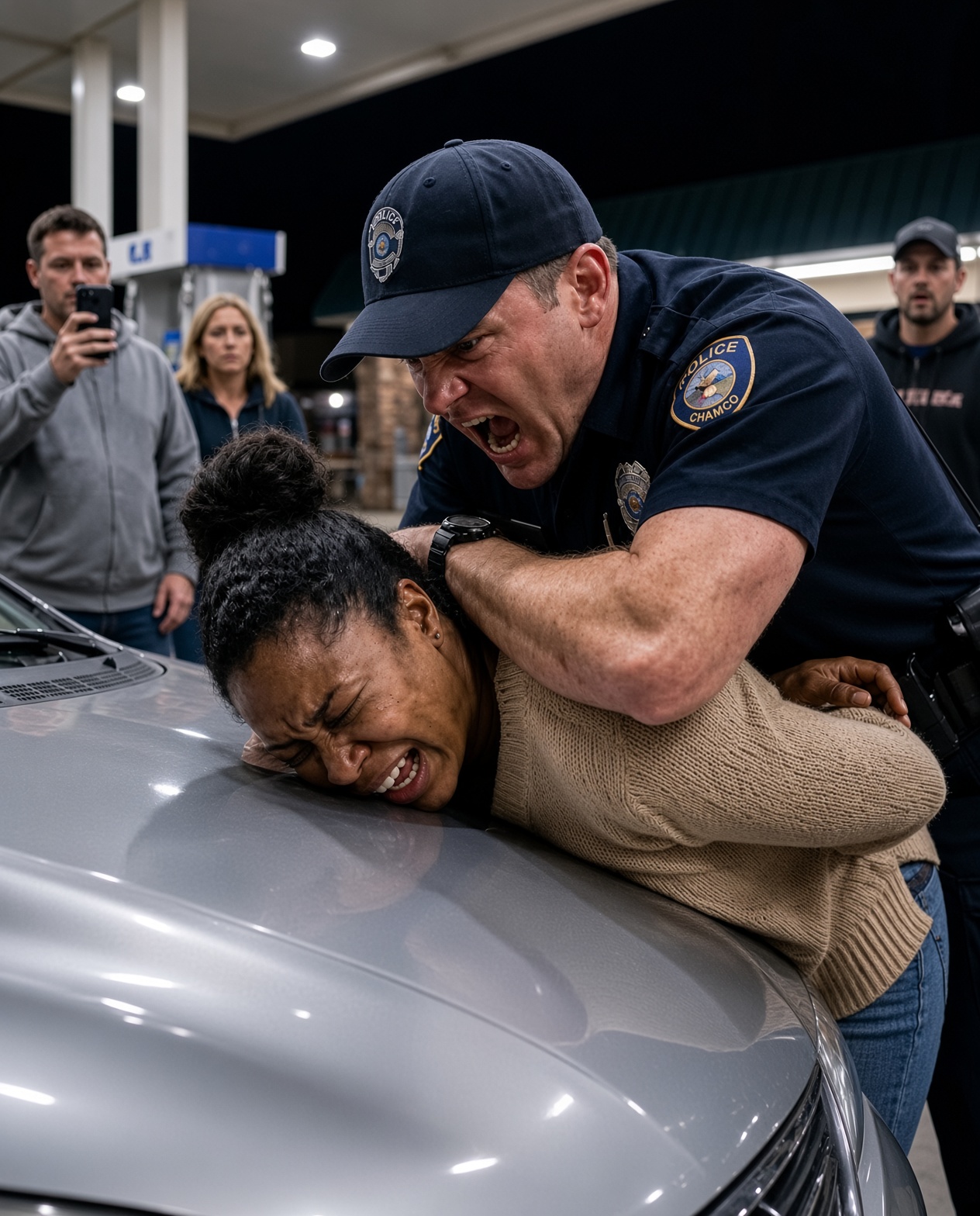
Hey, you step away from the vehicle now. Officer, I didn’t tell him that. Shut your mouth. Hand just pumping gas. You die. Trash like you doesn’t pump gas at this station. Sir, don’t sir me. Girl, you loitering disgusting hand over the keys. He ripped them from her fingers. Metal hit concrete. Your kind shows up, things go missing.
It’s a gas station. It’s mine when I’m on patrol. Faith Holloway placed her palms on the hood. Her keys lay 6 ft away. Her 9-year-old niece watched from the back seat. At pump 4, a black SUV sat in shadow, engine off, tinted glass. Nobody had looked at it yet. In 90 seconds, a door would open at pump 4 and his step away would die in his throat.
90 minutes earlier, the file lay closed on her desk. The label on the cover read Milbrook PD, Civil Rights Inquiry, 14 complaints, 24 months. Faith Holloway slid the file into her bag. The FBI field office, region 4, was quiet at end of shift. She locked her drawer. She locked her credentials inside it on purpose. This meeting was supposed to look like nothing.
Two women, coffee, a small town diner. No press, no cameras, no badges. That was the plan. Her phone buzzed. Chief Eleanor Brooks. Lake View Fuel 8:30 the diner side. Civilian. Civilian. We need to talk about Whitaker. I’ll be there. Faith drove a silver 2018 Honda Civic. Nothing federal about it. She wore jeans, a black wool coat, no shield, no badge.
Her service weapon stayed locked in the glove box. Tonight she was not a special agent. Tonight she was a black woman in a small car on Route Nine. It was a distinction the law did not always make. She stopped at her sister Rene’s house off Elm Street. Auntie Faith. Dana came running. 9 years old, two braids, sneakers untied.
On her shirt rode the paper badge Faith had given her last Christmas. Junior Detective Dana Holloway. Faith had laminated it herself. You ready for a ride, Detective? Where are we going? Quick stop, then milkshake. Renee leaned in the doorway. Hour, Max. Hour. Drive safe. Faith buckled Dana into the back seat. Two clicks.
She always checked twice. They pulled on to Route 9. Forest on one side, fields on the other, street lights every quarter mile. Dana hummed along to a song on the radio. Faith’s mind ran the file in the background. 14 complaints, 12 dismissed, two settled quietly, all black motorists, all the same precinct. One name appeared on six of those 14.
Officer Bradley Whitaker, badge 218, two years on patrol, transferred in from New Haven PD 18 months ago. New Haven had dismissed three complaints against him before letting him go. That was how it usually went. Quiet transfers, sealed files. A bad officer became someone else’s problem, and the paperwork followed three counties behind. The pattern was not subtle.
The pattern was a fingerprint. Lake View fuel came up on the right. Six pumps under fluorescent light. The diner attached. Windows fogged from the fryer. A red sign blinked. Coffee pie. Open 24. Faith pulled to pump three. Killed the engine. Stay buckled, sweetheart. 5 minutes. Then milkshake. Then milkshake. She stepped out.
Cold air, the smell of gasoline and frying oil. She slid her personal Visa into the reader, selected regular, unscrewed the cap. The pump kicked on. At pump 4, a black Chevy Tahoe sat with parking lights low, tinted glass. Inside, a woman in a wool coat held a phone to her ear, finishing a call. Chief Eleanor Brooks was waiting for the line to disconnect before she stepped out.
At pump two, an older black man in a corduroy jacket lifted the nozzle from his Ford pickup. He glanced toward the diner. He glanced toward the Civic. He glanced toward the patrol cruiser, easing in behind the building. Reginald Pierce had taught middle school civics for 38 years. He noticed things. He had a granddaughter, Faith’s age. He had once been pulled over for looking confused, two miles from the house he had owned for 40 years.
He never went anywhere without filming the road in front of him. His phone was already in his hand. Behind the diner, the cruiser parked nose out. Two officers inside. The driver had been talking for a minute. B from Tuesday. Dark sedan, black female, mid-30s. Bolo was a Nissan. Whitaker plate ending in three. Civic Nissan. Close enough.
Brad, that’s not how. Black sedan, black driver. I’m calling it. Officer Bradley Whitaker opened his door. His body camera ran on his vest. He always left it running. He was that kind of confident. His partner, Officer Cody Tate, sat a second longer than he should have. 24 years old, 11 months on patrol. He had seen this happen once before with a different black motorist and a different stop, and he had stayed quiet.
He had not slept well for a week afterward. He stepped out, too. Both car doors swung shut at the same time. Inside the Civic, Dana looked up from the radio. The pump at lane three kept clicking. Faith watched the meter climb. She did not see Whitaker yet. She would in 7 seconds. He came up behind her.
Ma’am, step away from the vehicle. Faith turned slowly, hands visible. Is there a problem, officer? I asked you to step back. His right hand rested on his belt, 2 in from the grip of his sidearm. I’m pumping gas. My receipt’s right there. Don’t talk. He took two steps closer. Tate hung back a foot behind him, eyes scanning the lot. Faith spoke evenly.
Officer, my driver’s license is in my back left pocket. I can show you. Don’t reach. Don’t move. Don’t anything. He stepped forward and reached for her hand. Her right hand. The hand holding the keys to her own car. He ripped them out of her fingers. The keys hit the concrete and skittered 6 ft under the pump frame.
The metal scraped, then went still. Officer, Faith said, “Please pick those up and return them to me. You’ll get them back when I’m satisfied.” Hands on the hood. She placed her palms flat on the warm metal of her Honda Civic. The pump kept clicking behind her, gallons climbing. Officer, she said, “What is the basis of this stop? Suspected vehicle theft.
This vehicle is registered to me. My registration is in the glove box. Would you like me to retrieve it?” I told you not to move. Pump four. The Tahoe sat dark. Inside, Chief Brooks’s call ended. She lowered the phone. She watched pump two. Reginald Pierce had stopped pumping his own gas. His phone was up. Camera on.
He kept his voice low when he spoke into the device. Recording at Lake View Fuel, Route 9. Timestamp 8:42 p.m. Officer is making a stop at pump 3. The driver appears compliant. Whitaker leaned in close behind Faith, 6 in between his chest and her back. His body camera framed every word he spoke onto her shoulder blade.
“You know what’s funny?” he said. “Your kind always shows up at gas stations like this. Always at night. Always with a story.” “I don’t have a story, officer. I have a receipt.” “You have a mouth?” He laughed once. A short ugly bark. Tate did not laugh. You think because you got a Pennsylvania plate, you’re somebody? You’re a body in a coat. You’re a description.
That’s all you are tonight. Tate spoke up. Bradley, what are we calling here? A stolen vehicle? Suspected on what? Bolo. Bolo was a Nissan. Bolo was a sedan. Black female driver. Close enough. I’m calling it in. He did not call it in. Faith inhaled slow. She had been trained for this stop a h 100 times from the other side of it.
She knew the breathing exercise by heart. Four counts in, six counts out. Keep the voice even. Use the officer’s name if you can read it. Comply on the record with no acknowledgement of the underlying disrespect. She remembered her instructor at Quanico, a 60-year-old retired marshal.
He had told the recruits, “When a bad officer is the one with the cuffs, your job is to live long enough to file the report.” She read his name tag, Whitaker, badge 218. The same number on six of the 14 files in her bag inside the car. Officer Whitaker, she said. He twitched just slightly. How did she know his name? She had said it before he had said it.
How do you know my It is on your tag, officer. May I show you my driver’s license now? No. He stepped back. Tate stepped sideways, putting himself between Faith and the road, but also between Faith and the back seat. From inside the Civic, Dana watched. 9 years old, two braids, the junior detective badge pinned to her sweatshirt.
Her hands were over her mouth. She was not crying. Not yet. Faith caught her niece’s eyes in the side mirror. She mouthed, “Okay, stay there.” Dana nodded. She did not move. Inside the diner behind the register, Margaret Sullivan stood very still. She watched through the glass. 52 years old, white, 40 years living in this county, 15 of them as a 911 dispatcher before she retired.
She knew every patrol cruiser by sound. She knew which officers ran heavy and which ran clean. She watched Whitaker for 3 seconds, then picked up the diner’s wall phone. She did not dial 911. She dialed the direct line to the Millbrook Chief’s office. A number she had not let herself forget. Marge Sullivan at Lake View Fuel.
There’s an officer making a stop here. I think your chief needs to know what’s happening. Pump three right now. The dispatcher said, “Chief is already on scene, Miss Sullivan.” Marge looked up through the glass toward pump 4 where the Tahoe sat. She had not noticed it earlier. “Oh,” she said.
Whitaker said, “I’m going to search your pockets, ma’am, for officer safety.” Faith said, “On what basis?” “Officer safety? I’m not armed. My hands are on the hood. My niece is in the car. Don’t move. He reached around her waist and lifted her wool coat. His hand padded down her hip pockets. Front. Back. He padded lower than he needed to. Once. Twice.
Faith’s jaw tightened a single millimeter. She did not speak. She did not move. He pulled out her wallet. He opened it. He pushed past three credit cards and a coffee shop punch card. He did not flip to the inner panel where a black laminated card sat sleeved with a federal seal embossed on it. He stopped at her Pennsylvania driver’s license.
Faith Holloway. He read it aloud. Civic registered out of state. Pennsylvania. Yes. What are you doing in this county? Meeting a friend at this diner. Don’t lie to me, girl. Tate said, “Bradley, what license says she’s clean? No warrants. Let me run her plate. I already ran the plate in my head.” Tate stared at his partner.
He had 11 months on patrol and he was about to use them. Brad, you did not run the plate. You said it out loud. There is a recording. Cuffer. Faith said very quietly. Officer Whitaker. Before you do that, I would advise you to contact your supervising chief tonight about this stop. Whitaker turned, the cuffs already in his hand.
You don’t tell me who to call, girl. It is advice, not an order. It sounds like an order. It is a suggestion, officer. He pulled her wrists off the hood and twisted them behind her back. Metal closed around them. Click. Click. The pressure was tighter than necessary. He pushed her forward against the Civic, so the buckle of her belt scraped the paint.
His knee made contact with the back of her thigh and held there. A small detail nobody could prove later except his body camera framing the angle knee to leg in clean daylight under the pump fluoresence. Behind them, Reginald Pierce kept recording. He said into the phone calmly, “Officer is now placing the driver in handcuffs.
The driver has not resisted. The driver has remained compliant. Timestamp 8:46 p.m. In the back of the Civic, Dana started to cry. Not loud, just two long tears sliding down both cheeks at once. She kept her hands over her mouth so no one would hear. At pump five, an older couple had been staring for a full minute.
The husband leaned over to his wife. Edith, this isn’t right. His wife already had her phone up. Two cameras now, three with pierces. Margaret Sullivan stepped out the diner door holding a paper cup of water. She walked slow but direct to the back window of the civic, knelt down, and held it up to the glass. She mouthed, “Sweetheart, it’s okay. Drink.
” Dana lowered her hands and accepted the cup through the cracked window. Whitaker at pump 3 did not see this. He was preoccupied. He was talking to Tate. He was telling Tate to call dispatch and request a transport unit. Suspected vehicle theft. Female suspect in custody. Pump three, Lake View Fuel. Tate keyed his radio. He spoke slowly.
Dispatch, Officer Tate, badge 256. 1095 in progress. Pump 3, Lake View Fuel. Subject detained. Pending verification. Be advised, bolo match is unconfirmed. There was a pause on the radio. Then the dispatcher’s voice, slow and very clear. Copy 256. Chief Brooks is on scene. Stand by. Whitaker’s head snapped up.
Chief is what? On scene, Officer Whitaker, stand by. Whitaker spun around, looked at the lot, the diner, the pumps. Pump one, empty. Pump two, Pierce still filming, eyes steady. Pump three, Faith, his hand still on the cuffs. Pump four, a black Chevy Tahoe, tinted glass. The driver’s door cracked open just a few inches.
A pair of polished black shoes sat down onto the concrete. The pump at lane three kept clicking. Whitaker shoved Faith into the open back seat of the cruiser. Sit. Stay. Faith said nothing. She sat with her cuffed wrists behind her, spine straight, eyes forward. The seat smelled like disinfectant and old vinyl.
The cruiser door stood half open. The pump at lane three was still clicking. Her own gas tank slowly filling. The meter spinning past $40 while nobody finished it. A crowd had formed without anyone announcing it. A man from pump six, two teenagers from the diner, a woman with a stroller who had pulled her cart back, the older couple at pump 5, both holding their phones. Pierce had pumped two.
Six cameras now, maybe seven. Somebody, the man from pump six, said it loud enough to carry. She wasn’t even arguing. another voice. Woman with the stroller. He ripped the keys out of her hand. I saw it. Whitaker turned toward the crowd. He saw the cameras. His shoulders came up an inch. Folks, step back. This is an active scene. Nobody stepped back.
I said step back. Pierce lowered his phone for a second, spoke softly but clearly. Officer, citizens are allowed to record in a public place. We are not interfering. You are interfering with my line of sight. I’m at pump two, sir. Your line of sight is on the lady you just put in cuffs. Whitaker’s jaw clenched.
He could feel the cameras on him now. Each one. He counted three on his left, three on his right, and that was before he looked at the diner windows. He had never been recorded like this. Not by strangers, not from this many angles. He turned back to the cruiser. From the back seat, Faith said, “Officer, what? My niece is in that car.
She is nine. She is alone. May I tell her that I am all right?” Should have thought of that before you mouththed off. I did not mouth off. Don’t make it worse. Margaret Sullivan was already at the civic’s back window. Dana had her hands flat against the glass now. Margaret crouched to her level. She did not look at Whitaker.
She talked to Dana like a grandmother. Sweetheart, your aunt sees you. Look, she’s looking at you right now. Dana looked. Faith met her eyes through the open cruiser door. Faith did not nod. She did not have to. The look that passed between them said, “I am here. I am okay. Breathe.” Dana breathed. Her shoulders dropped half an inch.
From inside the diner doorway, two more people had stepped out. A cook in a white apron holding tongs in one hand and a young woman in a Lake View fuel vest with her phone already in record. Tate stood by the front bumper of the cruiser, radio in hand. He was not looking at Whitaker. He was looking at the lot at the dispatch chatter on his hip.
At the slow, deliberate way the door of the black Tahoe at pump 4 had opened and then stopped and then opened a little wider. He spoke into his shoulder mic. Dispatch, confirm Chief Brooks on scene. Visual. Dispatch came back dry. 256. Affirmative. Visual confirmed. Pump four. Chief’s vehicle. Chief’s plate. Standby means standby. Officer.
Copy. Whitaker walked back to Tate. Why is Chief here, Cody? I don’t know. Why is Chief at this gas station on patrol night in plain clothes? I do not know, Brad. The dispatcher told us to stand by. We are going to stand by. This is a routine stop. This is patrol work. Brad, what? This stopped being routine when you ripped the keys out of her hand.
Whitaker stared at his partner. His mouth opened. Nothing came out. Behind them, the polished black shoes had walked the length of pump 4, then turned, then begun to walk unhurried toward the cruiser. Faith, in the back seat, closed her eyes for one full second. Inside her head, she counted footsteps. 8 feet between pumps, six steps, five, four.
The footsteps were even confident. They knew exactly where they were going. In her bag, on the floor of the Civic, the file labeled Milbrook PD, Civil Rights Inquiry, pressed up against the side of the seat. Inside that file was a tab with Whitaker’s name on it, and another tab with the name of the person now walking across the lot toward him.
Whitaker had not turned around yet. He was still facing Tate, still trying to assemble a sentence. The footsteps stopped. About 12 ft behind him, a woman’s voice, low, even, completely calm, said, “Officer Whitaker.” The whole gas station went silent. The pump at lane three was the only thing that kept clicking.
Even Pierce stopped narrating. Even the older couple at pump five lowered their phones an inch. Whitaker did not move for two full seconds. Then slowly he turned around. The first thing his eyes processed was the wool coat. Black, well cut, worn open. The second thing was the chain around her neck. Silver, plain at first, then heavier where it disappeared into the lining.
The third thing was the golden blue shield clipped to the chain and lifted now into the pump’s fluorescent light in clear view of every camera in the lot. The fourth thing was the woman herself. Chief Eleanor Brooks, 50 years old, 24 years on the force, black, 5’8. Looking at him the way a senior officer looks at the worst minute of a junior officer’s life.
Whitaker’s mouth opened. Stepa. The word died there. It died in his throat. He felt it die. His tongue had already started forming the second syllable when his eyes caught up to his brain and his brain caught up to the badge and the badge said, “Chief of police, Milbrook County, and his voice stopped working.
” The pump at lane three kept clicking. Chief Brooks did not raise her voice. She did not need to. Officer Whitaker. Chief. Ma’am, I stand down. Chief, this this is a vehicle theft. Stand down, officer. Whitaker’s right hand left his belt. His left hand was still holding the empty space where Faith’s wrist had been 30 seconds ago.
He looked at the hand like it belonged to someone else. He let it fall. Chief Brooks took three more steps. She stopped 6 feet from Whitaker. She did not look at him. She looked at Faith, still cuffed in the back of the cruiser. “Special agent Holloway.” Faith answered evenly. “Chief Brooks.” My apologies for the delay.
Acknowledged. Chief. Chief Brooks turned her head slowly half an inch toward Tate. Officer Tate. Yes, Chief. Remove the cuffs from Agent Holloway now. Tate moved fast. He did not look at Whitaker. He stepped past him, leaned into the back of the cruiser, found Faith’s wrists, and worked the key. Two clicks. The cuffs came open.
Faith stepped out. She rubbed her wrists once. She did not raise her voice. She did not look at Whitaker. Tate said quietly. “Ma’am, I am I am so sorry.” Faith said. “You said the B didn’t match. That goes in my report. Stay here.” He nodded. He stayed. Chief Brooks now turned to Whitaker. She turned the way an iceberg turns.
slowly, fully, with the entire weight of the iceberg behind her. Officer Whitaker, she said, “I want you to look around this lot.” He looked. He saw the cameras. He saw Pierce. He saw the older couple at pump 5. He saw Margaret Sullivan standing beside the Civic, one hand on the door handle, the other holding the empty paper cup.
He saw Dana in the back seat, face wet, eyes wide. “How many cameras?” Chief Brooks said, “Chief, please count them.” He could not. “Yours included,” she said. “I count nine. Your body camera. Officer Tate’s body camera. The Pump Island security feed. I called for it 90 minutes ago. The diner’s interior camera. Mr. Pierce at pump two.
The couple at pump five. Both phones. The young woman at the diner door. And me. She tapped the small lens clipped to her own coat. I have been recording since I parked. Whitaker swallowed. The sound was loud. Pierce at pump two was still recording. He did not lower the phone. He understood that what he was filming was now evidence in a federal case.
Chief Brooks turned to address the entire lot. Her voice was conversational, but it carried. This is Special Agent Faith Holloway, United States Federal Bureau of Investigation, Civil Rights Division, Region 4. She is the lead federal investigator on a six-month inquiry into a pattern of unlawful stops conducted by this department.
I requested this meeting tonight at this gas station in plain clothes on my own time. Officer Whitaker stopped his own department’s federal investigator in a parking lot where I was sitting 6 m away. Whitaker did not speak. Faith stepped forward, picked her keys up from where they lay 6 feet under the pump frame, her fingers closed around the metal.
It was still cold. It was also finally hers again. She walked past Whitaker without looking at him. She did not say a word. She opened the back door of the civic. She unbuckled Dana. Auntie Faith, it’s okay, baby. Why did he We will talk about that later. Right now, I need you to hold my hand. Dana held it hard.
Faith carried her to where Chief Brooks was standing. Chief Brooks looked down at Dana, crouched a little, smiled. The kind of small, tired smile that takes 20 years of policing to learn. Detective Holloway, Chief Brookke said, reading the laminated paper badge on Dana’s sweatshirt. I think your aunt could use a milkshake. Dana very seriously nodded.
Chief Brookke straightened. She looked at Tate. Officer Tate, walked to the cruiser. Retrieve both body cameras, yours and Officer Whitaker’s. Hand them directly to me. No power cycling. No deletions, no edits. If the chain of custody breaks tonight, it breaks on your watch. Do you understand? Yes, Chief. He moved.
Chief Brooks then turned to Whitaker. Her voice dropped a register. Officer Bradley Whitaker, badge 218. Surrender your service weapon. Surrender your badge. Surrender your taser. You are placed on administrative leave effective this moment. You will not approach your locker. You will not approach your patrol vehicle.
You will not log in to the department network. You will be escorted off this lot by officer Tate in a separate cruiser. And you will report to the internal affairs division at 0800 tomorrow morning. Are we clear? Whitaker’s hands shook as he unholstered the sidearm. He laid it on the trunk of the cruiser.
He unclipped the badge from his chest. He set it down beside the gun. He unclipped the taser. He set that down, too. Three small objects on the trunk lid. 24 months of patrol career in a row. He looked at them. Then he looked at his open hand, which had been resting on the grip of a department firearm 30 seconds ago, and was now empty.
His body camera was still recording. Chief Brooks lifted it from his vest with two fingers, looked at the lens, and said into it calmly. 8:53 p.m. Chain of Custody. Chief Eleanor Brooks. Internal affairs case file opens tonight. She handed the camera to Tate. Then she turned back to Faith and Dana and her voice softened. Not much, but enough.
Agent Holloway. Detective Holloway. Let’s get out of this parking lot. The pump at lane three clicked off. The tank was full. 36 hours later, Faith Holloway sat at the head of a conference table in the internal affairs division of Milbrook County Sheriff’s headquarters. The room was small, pale walls, fluorescent lighting, a single window with vertical blinds half closed.
On the wall, a black monitor. On the table, three closed folders, a glass of water, and a digital audio recorder blinking red. Chief Eleanor Brooks sat to Faith’s right. Across from them sat Officer Bradley Whitaker in a plain gray sweatshirt. No badge, no belt, no service weapon. Beside him sat his union representative, a man in his 50s named Doug Larkin, eyes tired, briefcase open, prepared for a long morning.
On the monitor, Captain Howard Reeves of the United States Department of Justice Civil Rights Division attended remotely from Washington. His tie was nodded to the throat. His expression was neutral. Faith pressed a single key on her laptop. The body camera footage began to play. The opening frame was Whitaker’s chest patch walking, then the door of the cruiser.
Then Faith Holloway in profile at pump three refueling her Honda Civic. The room watched for 14 minutes and 21 seconds. The body camera played without commentary. Every word Whitaker had spoken, every word Faith had answered, the keys hitting the concrete, the cuffs, the knee, the phrase body in a coat, a description.
That’s all you are tonight. When the time stamp reached 8:53 and the audio caught Chief Brooks’s voice saying 8:53 p.m. chain of custody, Faith pressed pause. The room was silent. Whitaker had not lifted his eyes from the table during the playback. Larkin had. Larkin had watched the screen the way a defense attorney watches a verdict come in.
By minute 11, he had stopped taking notes. By minute 14, he had closed his pen and laid it flat. Doug Larkin, the union rep, cleared his throat. Agent Holloway, we are prepared to acknowledge that the language used by Officer Whitaker was inappropriate. Mr. Larkin, Faith said, I am not here to discuss tone.
Of course, I I am here to discuss facts on the record. Officer Whitaker, do you recognize the recording you just watched as accurate? Whitaker did not look up. Yes. Speak into the recorder, please. Yes, I recognize the recording. Thank you. At time stamp 834 and 12 seconds, you reference a bolo. Can you cite the bolo number? a pause. I I don’t recall the exact Faith slid a single sheet of paper across the table.
B2026- MB-1144 issued Tuesday morning 0715 hours by your dispatch. Vehicle described as silver Nissan Ultima plate ending in three. Suspect described as black female, 5’2 in, braided hair, mid20s. Take a moment to read it. He read it. My height, Faith said, 5’8. Yes. My hair at the time of the stop, unbraided. Yes. My vehicle, Honda Civic. Yes.
License plate ending in Nine. Do any of those features match the bolo? No. Officer Tate on the recording told you the bolo did not match. Yes. Yes. You answered him and I am quoting from the audio. Civic Nissan. Close enough. Is that an accurate quote? Yes. And later, black sedan, black driver. I’m calling it in.
Is that an accurate quote? Yes. For the record, did you ever call it in? A longer pause. No. Did dispatch ever confirm a bolo match on my vehicle or my person? No. Officer Whitaker, on the body camera audio, you address me as girl on three separate occasions. 8:36, 8:41, 8:45. Do you commonly address adult female motorists as girl regardless of race? A long pause.
Larkin shifted in his seat. “Officer,” Faith said. “Answer the question.” “No,” Whitaker said. “No, you do not.” or no, you do not commonly do this with non-black motorists. He did not answer. Let me make this easier, Faith said. She opened the second folder. She slid three more sheets of paper across the table. Three prior complaints filed against you, all from your previous precinct in New Haven.
2024, 2025. Complaintant A, Mr. Devon Whitfield, retired postal worker, pulled over for quote, “Suspicious lane changes. No citation issued. Stop duration 28 minutes.” Complaintant B, Miss Yolanda Ash, school nurse, stopped for quote, “Expired registration. Registration was current. Stop duration 31 minutes.” Complaintant C, Mr.
Eli Bennett Cole, city councilman of New Haven Ward 4, stopped for quote fitting the description. No description was on file at the time of the stop. All three complaintants are black. All three complaints were closed by New Haven Internal Affairs as unfounded. All three closures were signed by the same supervisor who 6 months later retired with a pension. Larkin.
Agent Holloway. These are unrelated. Mr. Larkin, they form a pattern. Officer Whitaker, do you dispute that you were the involved officer in each of these three stops? No. In the 18 months since you transferred to Millbrook County, my office has logged 11 additional complaints in this jurisdiction. Two of those name you specifically.
The other nine name two of your prior partners, both of whom have been deposed by my division in the past 60 days. They have corroborated the pattern. Whitaker’s head came up. They they testified about me. They testified about the calls you made. They did not have to mention your name. The bolo logs already due. He sat back.
His hands were trembling on the surface of the table. Faith pressed another key on the laptop. A second video began to play. Officer Cody Tate in his interview from yesterday morning in this same room. He looked tired. He sat with his hands folded. His statement was on the record. Officer Whitaker had a pattern.
I noticed it about two months in. He would call any black driver suspicious. He would stretch Boss’s. He would skip the verification step. He would invoke officer safety to search vehicles or pockets. I told him twice. The first time he laughed. The second time he told me to mine my own 10-month-old career. I should have reported it. I did not.
I am reporting it now. The video ended. Faith pressed two more keys. The next sequence was audio only. A string of recorded depositions Faith had taken over the previous 60 days. Officer Carl Eastston, retired New Haven patrol. Officer Wendell Marsh, retired New Haven patrol. Each described the same pattern in different sentences.
He stretched the bellows. He invoked officer safety. He skipped verification. He called everything close enough. Faith let 2 minutes of audio play. She stopped it. She did not need the room to hear the rest. She looked at Whitaker. Officer Whitaker, do you have a response? He stared at the table, his mouth opened. Closed. Opened.
I I made a mistake. Officer Faith said, “A mistake is forgetting a turn signal. What you did is the active deprivation of a federal civil right under color of state authority. It has a federal statute. Title 18, United States Code section 242. Maximum sentence 10 years. Larkin. Agent Holloway. My client is willing to Mr.
Larkin, your client statements today have been recorded. The recordings are now in federal evidentiary chain of custody. Whether your client is willing to do anything is no longer in your control. Larkin closed his mouth. Captain Reeves spoke from the monitor for the first time. Officer Whitaker, United States Department of Justice.
Be advised, as of 0900 this morning, the United States Attorney for this district has opened a grand jury inquiry into your conduct under section 242 and into the pattern across this department under section 241, conspiracy against rights. Indictments are expected within 30 days. Whitaker closed his eyes, Reeves continued.
In addition, Chief Brooks has placed three other Milbrook officers on administrative leave pending review. Two of them, my office understands, have already retained counsel. One of them has offered to cooperate in exchange for a plea agreement. Whitaker’s eyes opened. He looked at Larkin. Larkin did not look back. The math was simple.
Two officers had retained counsel. One officer was cooperating. Three complaints prior, 11 complaints in this jurisdiction, a federal grand jury, a body camera that had not been turned off. Doug Larkin had defended police officers for 26 years. He had read the wind by minute four of the playback. Chief Brooks spoke.
Her voice was steady. Officer Whitaker, effective immediately. You are recommended for termination from the Milbrook County Police Department. The chief’s office will submit a referral for descertification to the state police officer standards and training commission. If post agrees, your certification to serve as a sworn officer anywhere in this state will be revoked.
If federal indictment proceeds, you will face the federal court. None of these processes are concurrent. They will compound. Whitaker said nothing. Officer Chief Brookke said, “Is there anything you would like to enter into the record?” He looked up. His eyes were wet. He looked at Faith for the first time since he had ripped the keys out of her hand at pump three. He looked at her face.
“Agent Holloway, I am sorry.” Faith said, “I appreciate the statement, officer. It does not undo the stop. It does not undo the cuffs. It does not undo the camera footage, but I will note it in the file.” She closed the folder. Margaret Sullivan had given her witness statement that morning before the hearing.
She had told it without raising her voice. She had told it in detail. She had given dispatch the exact second she dialed the direct line and the dispatcher had confirmed the call log. Regginald Pierce had also been deposed. His phone with original recording metadata intact had been entered into evidence. He had asked politely whether his granddaughter could observe the deposition.
Faith had said yes. By midnight that night, Reginald Pierce’s footage had passed 3 million views on social media. By the end of the next day, it had passed 30 million. National desks had picked it up. The Millbrook County Sheriff’s Department had issued a statement acknowledging an active federal investigation.
The DOJ Civil Rights Division had issued a statement confirming the case. By Friday, the department had received a formal letter from the United States Attorney’s Office requesting a consent decree negotiation. A consent decree is a court supervised reform agreement. It puts a federal monitor inside the department for a fixed period of years.
It is not optional. The letter did not arrive alone. It arrived with a preliminary findings memorandum, six pages, single spaced, citing pattern or practice violations of the fourth and 14th amendments. Page four named officer Bradley Whitaker, badge 218, as the most frequently cited officer in the underlying complaints.
Page five listed the three New Haven cases by name. By Saturday morning, Doug Larkin had filed a motion to dismiss all charges, citing procedural objections to federal jurisdiction. The motion landed on the desk of a senior district judge. The judge read it twice. The judge made a note in the margin. The motion would not work.
6 weeks later, the internal affairs board convened in the largest public room in the county courthouse. The hearing was livereamed. Reginald Pierce’s full 14minute recording was played to the room and to the cameras and to the country. The board’s vote was unanimous. Officer Bradley Whitaker’s termination was upheld.
The recommendation went on to the state police officer standards and training commission within 24 hours. Within 7 days, Post revoked his certification. Bradley Whitaker, aged 28, would not serve as a sworn officer in any United States jurisdiction for the remainder of his life. 4 days after that, the federal grand jury returned indictments.
Title 18, United States Code, section 242, deprivation of rights under color of law. Section 241, conspiracy against rights applied to the broader pattern. Maximum combined exposure, 10 years federal prison. Whitaker entered a plea of not guilty at his initial appearance and was released on a bond conditioned on no contact with witnesses.
The case was assigned to the senior district judge who weeks earlier had read the union motion in his chambers and made a note in the margin. Three additional Milbrook officers were terminated by the department review board. Two of them accepted federal plea agreements in exchange for testimony about the culture inside their unit.
About how bolo stretches got laughed off. about how complaints filed by black motorists were rerouted into a folder labeled internally civilian friction. Both men would later say it was the easiest, hardest decision of their careers. The Department of Justice’s Civil Rights Division published its findings letter on a Thursday.
The Millbrook County Police Department entered into a federal consent decree the following Monday. A federal monitor, a retired black appellet judge from Atlanta, was appointed for a term of 5 years. Chief Eleanor Brooks stood at the press conference podium the next morning. She did not smile.
She read from a single sheet of paper. Effective today, this department implements four reforms. One, mandatory deescalation training semianual for every sworn officer. Two, bolo verification protocol. No stop based on a bolo without dispatch confirmation of vehicle plate and physical description. Three, body camera audit every 30 days randomized conducted by a non-dep departmental reviewer.
Four, a civilian review board with subpoena power. The first three reforms are policy. The fourth requires a vote of the county commissioners. I expect that vote to pass. I expect it to pass because the people of this county have already watched the same 14 minutes of footage I have. She folded the sheet. She left the podium.
She did not take questions. The FBI director’s commenation arrived at Faith’s field office in a brown envelope. She did not open it for two days. When she did, she put the certificate in a drawer. She did not display it. She put a different document on her wall instead, a copy of Reginald Pierce’s witness statement, framed, signed at the bottom, with thanks from the Civil Rights Division of the United States Department of Justice.
The Milbrook City Council voted to honor Reginald Pierce at their next session. He spoke for 90 seconds. He said, “I taught civics for 38 years. That night, I was a student again. I just remembered the lesson.” Margaret Sullivan was offered a formal commenation by the chief’s office. She declined. “I called the right person,” she said. “That’s all.
” Officer Cody Tate completed a 4-week corrective training program. He requested transfer to the department’s community policing unit. The transfer was approved. He took a pay cut. He did not appeal it. Officer Bradley Whitaker in his county jailhouse interview with the local paper declined to comment.
He declined every follow-up request. His silence began to make a different kind of statement. But the story was not over because there was still one person whose night six weeks earlier had never been told from her own perspective. Faith Holloway had not given a single interview. She had not posted a single statement.
She had returned to her field office, closed the Milbrook file, opened the next file, and continued the work. But on the eighth weekend after the gas station, on a Sunday afternoon, when the light was gold and the air smelled like late autumn, Faith Holloway pulled her silver Honda Civic off Route 9, and turned again into the lot at Lake View Fuel.
The lot looked smaller in daylight. Faith pulled the Civic to pump three, killed the engine. The sun was low, and the light was honeyccoled. Dana sat in the passenger seat, hair braided fresh, the laminated junior detective badge still pinned to her sweatshirt, dogeared now, but still hers. 5 minutes, sweetheart. Then milkshake.
Then milkshake. Faith stepped out. At pump two, an officer in a different uniform was filling up a department sedan. The patch on his shoulder read Milbrook PD Community Policing Unit. He looked up, set down the nozzle, walked over. Agent Holloway, Officer Tate. He stood 3 ft away. He did not crowd her.
I just I wanted to say I should have stepped harder that night. I’m trying. Faith looked at him. You said the bolo didn’t match. That mattered. Keep saying it. He nodded. He stepped back. He went back to pumping his gas. From the diner window, Margaret Sullivan waved with one hand, the other holding a coffee carff. Faith returned the wave.
At pump 5, an older black man in a corduroy jacket, the same one, lifted a paper cup in salute. Faith lifted her chin. Pierce dipped his head. Faith slid her visa, selected regular, unscrewed the cap. The pump kicked on. Cool metal. The faint smell of gasoline. Dana spoke up. Auntie Faith, the bad policeman.
Is he gone? He’s gone, baby. For good. For good. a pause. Auntie, why didn’t you tell him that you were FBI? Faith watched the meter climb. She thought about it because I shouldn’t have to. Nobody should. Dana thought about that. Her face was serious. Even me. Even you, baby. Especially you. The pump clicked off. Tank full.
Faith replaced the nozzle, screwed the cap, closed the lid. The keys in her palm were warm now from the sun. She closed her hand around them. Most stories don’t end like this. Most end with the cuffs that don’t come off. Most end with the cameras that didn’t run. Most end with the witnesses who walked away.
Most never reach a chief who refused to look away. This one did. Three things lined up. A body camera that recorded its own evidence. A stranger named Reginald Pierce who knew his rights and pressed record. And a chief at Pump 4 who heard a wrong call and refused to let it stand. The system corrected itself that night, not because it always does, because at that gas station on that piece of concrete, every person who could have stayed silent chose not to.
If you had been at pump two that night, would you have pressed record or would you have looked away? Drop your answer in the comments. Share this story so the next person treated like a suspect for the crime of standing where she paid to stand knows somebody somewhere will press record. Subscribe for more stories where the system worked.
Faith opened the driver’s door. Dana waved through the windshield. Pump 4 was empty now, just a quiet square of concrete where eight weeks ago a chief had stepped out. The Civic pulled on to Route 9. The light was gold.

