Cop Forced a Black General to His Knees—Then 40 Soldiers Surrounded the Police Station.
Cop Forced a Black General to His Knees—Then 40 Soldiers Surrounded the Police Station.
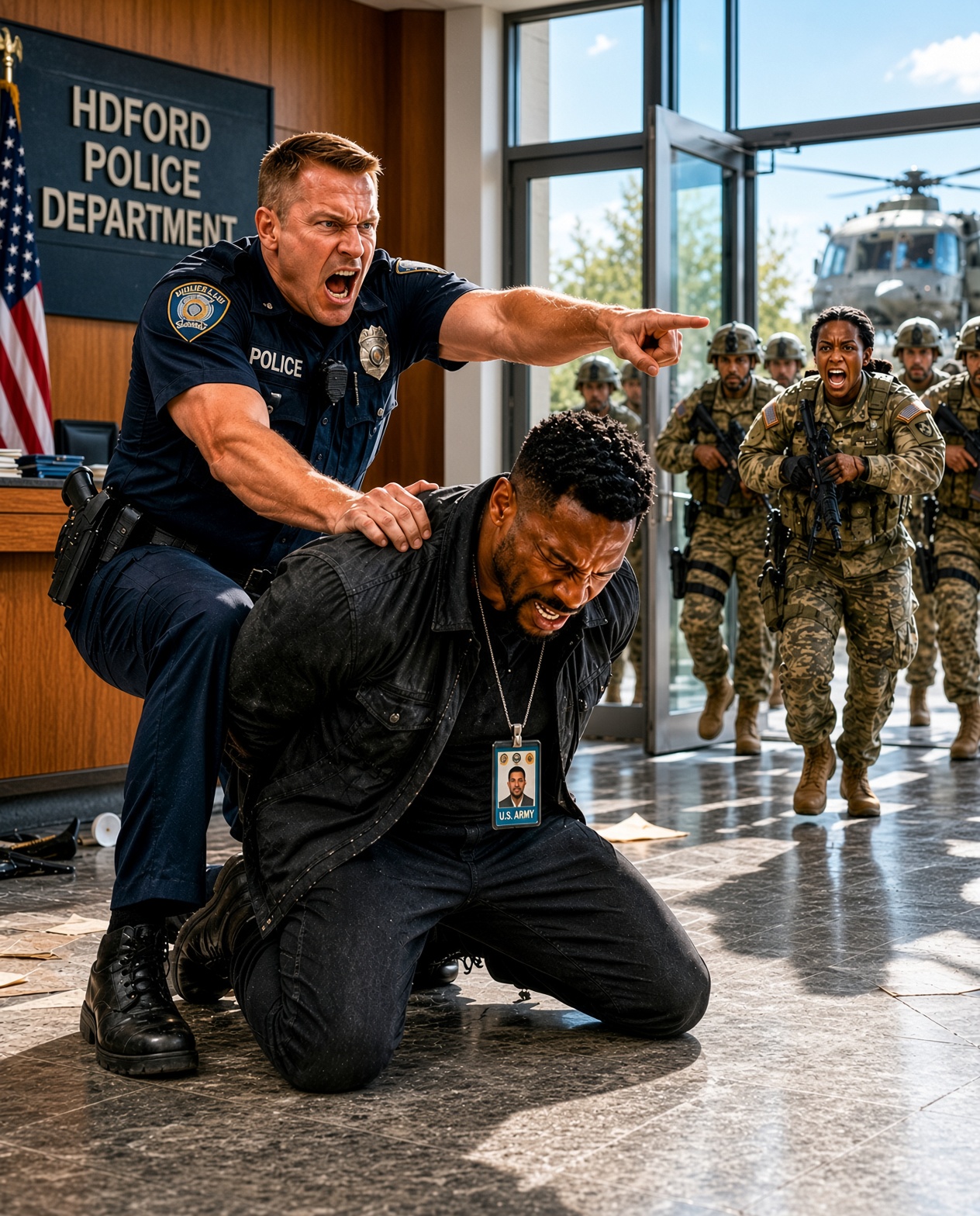
Officer Nolan Pike pressed his knee into the back of a black man in a plain field jacket, forcing him down onto the station floor while laughter rippled through the room behind him. Nobody believed the military identification card in his wallet was real. Nobody knew that the man in handcuffs was General Isaiah Rowan, a four-star officer of the United States Army, carrying a sealed case toward a base called Fort Hawthorne.
Just as the desk sergeant prepared to charge him with resisting an officer, the ground outside began to tremble. 10 military vehicles rolled to a stop, sealing every side of the building. 40 soldiers stepped down in perfect formation, and the room went silent before a single word was spoken. If you want to see the moment an entire police station freezes in place, tap subscribe now and stay with this story until the very end.
The story begins earlier that morning, hours before anyone in Ashford, Virginia had heard the name Rowan. General Isaiah Rowan left a secured testing facility carrying a black case that held the results of an investigation into military body armor that had failed under conditions it was never supposed to fail under.
The findings showed that a defense contractor called Vandergate Defense Systems had substituted cheaper materials while falsifying the certification numbers, securing a contract worth hundreds of millions of dollars through fraud that had gone undetected for more than a year. Isaiah was due at Fort Hawthorne within hours to hand the encrypted drive to a team of military inspectors and a federal prosecutor waiting to open a formal case.
To avoid drawing attention, he drove alone in an unmarked government vehicle, a plain black sport utility vehicle with no insignia, while his usual security escort trailed several minutes behind on a separate secured channel. Isaiah had spent more than 30 years earning the rank stitched onto his uniform, rising from a modest upbringing in a working-class household where nobody had ever worn a uniform of any kind before him.
He carried himself the way he always had, without the need for anyone to address him by his title in order to feel the weight of what he had built. That quiet confidence was precisely the trait that made men like Nolan Pike underestimate him within seconds, mistaking calm for weakness and plain clothing for insignificance.
Near the outskirts of Ashford, a temporary detour sign forced Isaiah off the main highway and onto a quiet secondary road. Though he had no way of knowing that sign had been placed there deliberately on the orders of someone working inside the local police department. Nolan Pike spotted the unmarked vehicle from the opposite lane and rather than running the plate through dispatch as procedure required, spun his patrol car around, flipped on his lights, and pulled Isaiah over on a stretch of road with no witnesses in
sight. The moment Isaiah lowered his window, Nolan’s eyes moved over him with open suspicion, taking in the plain jacket, the quiet demeanor, the absence of anything flashy. He demanded to know who the vehicle belonged to and when Isaiah calmly explained it was a federal vehicle assigned to his duties, Nolan let out a short dismissive laugh.
Isaiah handed over his driver’s license and his military identification without complaint, but Nolan barely glanced at either before declaring that the card looked like something ordered off the internet. Isaiah asked him without raising his voice to call Fort Hawthorne and confirm his identity before anything else happened.
Nolan ignored the request entirely, ordering Isaiah out of the vehicle, hands on the hood, and telling him not to ask another question. Isaiah understood almost immediately that this had stopped being a routine traffic stop and that whatever was happening now had very little to do with or a broken taillight. He complied without resistance, keeping his voice level, watching Nolan’s hands and posture with the practiced attention of a man who had spent three decades reading danger before it arrived.
When Nolan’s eyes drifted to the locked case visible on the back seat, something in his expression sharpened and he asked almost too quickly, “What exactly was inside it?” Isaiah told him plainly that the case was federal property and that Nolan had no authority to open it without someone qualified present to authorize it.
That answer, delivered without hostility, seemed to strike Nolan as a challenge rather than a simple statement of fact. He spun Isaiah around, forced his legs apart, and began a rough search despite there being no visible sign of any crime while Isaiah repeated calmly and steadily that Nolan should activate his body camera and call the base.
Nolan reached up and switched the camera off, unaware that the footage recorded up to that point had already synced automatically to the department’s server, preserving everything that had happened before the screen went dark. He pulled the identification card free and read the name printed across it out loud, mocking the idea that a real general would be driving alone through a stretch of road like this one.
Isaiah answered that rank had never determined how a person dressed or how they chose to travel, but the words did nothing to soften Nolan’s expression. Nolan told him to come up with a better story, his voice dripping with contempt, and for a moment a passing driver slowed to watch the scene unfold from across the road.
Nolan immediately threatened to arrest the bystander if a phone came out, and though the frightened driver pulled away without confrontation, a short clip had already been captured before they left. Nolan radioed the station and reported that he had detained a man impersonating a military officer, driving a vehicle that might be stolen, and carrying an unidentified locked case that refused explanation.
Tessa Monroe, a young dispatcher only 29 years old, took the call, and when she ran the plate through the system, a rare alert appeared on her screen warning that the vehicle was federal property requiring direct contact with Fort Hawthorne. Before she could relay that information back to Nolan, Chief Conrad Whitmore appeared behind her without warning and asked to take the call himself, his tone casual but his eyes fixed intently on her monitor.
Whitmore listened as Nolan described the driver and the black case sitting on the back seat, and something in his expression shifted for just a moment, a flicker Tessa would later describe as recognition rather than surprise. Instead of ordering Isaiah released, Whitmore instructed Nolan to bring both the man and the case directly to the station without delay, offering no explanation and asking no further questions about identity.
Tessa found it strange that her chief, faced with a possible case of mistaken identity involving a federal vehicle, showed no interest whatsoever in verifying who the man actually was. Before he was placed in the patrol car, Isaiah looked directly at Nolan and told him there was still time to make the call to the base before this went further than Nolan could control.
Nolan laughed the warning off as a desperate bluff from a man with nothing left to threaten him with, certain that the balance of power in that moment belonged entirely to him. Back at the station, Whitmore stepped into his office, closed the door, and dialed a private number telling whoever answered that they now had possession of the case.
His voice low and steady in a way that suggested this was not the first time he had made a call like it. Isaiah was brought in through a back entrance, away from any cameras that might have caught the arrival from the street. Nolan refused to let him sit in the holding area reserved for detainees and instead forced him to stand facing a wall for an extended period, ignoring every request for basic procedure.
A handful of officers in the room watched with curiosity as Nolan loudly announced that he had caught someone pretending to be a four-star general, drawing a few laughs and a few uncomfortable glances that nobody chose to voice aloud. Isaiah said nothing in his own defense, choosing instead to quietly note the position of every camera in the room, the names on a few visible badges, and the layout of the exits.
The same instincts that had kept him alive through three decades of service now working in a very different kind of environment. Tessa quietly asked Whitmore whether they should simply call Fort Hawthorne to clear up the confusion, and he told her that the military had no authority to interfere in a local investigation, a claim that made little sense given that verifying a military identification card typically took only a few minutes.
Whitmore stepped into the interview room, adopting a tone of polite curiosity as he asked Isaiah about the contents of the case, but Isaiah replied only that he would answer questions once someone from military legal counsel or a federal prosecutor was present. Whitmore offered what he framed as a reasonable deal, suggesting that if Isaiah simply provided the access code, the department might consider releasing him without pressing formal charges.
That offer told Isaiah everything he needed to know, confirming that the true target of this entire encounter had never been the vehicle or even his identity, but whatever sat locked inside that case. He asked Whitmore how he happened to know the case required an access code at all, since Nolan had never mentioned that detail over the open radio channel.
Whitmore had spent years cultivating the image of a steady, dependable chief, the kind of man a small town trusted without question. And that image had made him useful to people who needed a quiet town and a cooperative department far more than they needed a loud one. He had never planned for the day someone with real authority would end up sitting across the table from him, and the longer Isaiah refused to break, the more Whitmore felt his careful arrangement slipping through his fingers.
Whitmore hesitated for a long moment before shifting abruptly into threats, warning that Isaiah could be charged with impersonating a military officer, resisting arrest, and transporting property under suspicious circumstances. Isaiah simply repeated the same quiet request, asking once more that someone call Fort Hawthorne, his composure unshaken by the growing list of accusations stacked against him.
Whitmore left the room and ordered Nolan to prepare for a full search of everything Isaiah had been carrying, including the sealed case still sitting untouched in evidence storage. Tessa, working quietly at her station, secretly captured a screenshot of the plate verification and backed up the recorded call into a private folder on her own device, sensing that something about this entire situation did not add up.
She noticed, with a growing sense of unease, that portions of the system logs were being deleted piece by piece even as she watched. Tessa had worked at the department for nearly 4 years, long enough to recognize the particular pattern of a supervisor moving through the system with practiced ease, careful to touch only the files that would matter later.
She said nothing to anyone at that moment, choosing instead to quietly copy what she could before the deletions caught up with her own access. Meanwhile, Isaiah’s security escort arrived at the planned meeting point only to find no sign of him anywhere. And when they tried to trace his vehicle’s location, they discovered the tracking signal had been deliberately disabled from inside the patrol car that had pulled him over.
Colonel Mara Ellison, 46 years old and in command of the security detail at Fort Hawthorne, began to suspect that something had gone seriously wrong, far beyond a simple delay or a misturn. Back at the station, Whitmore carried a pair of metal cutters into the evidence room and ordered Nolan to force the lock on the case, dismissing any concern about federal protocol as unnecessary caution.
Nolan pulled Isaiah out of the interview room under the pretense of additional processing and photographs, and when Isaiah asked to make a phone call as any detainee was entitled to, Nolan refused, telling him that men who impersonated soldiers did not get to set conditions. When Isaiah turned his head toward the direction of the evidence room, Nolan accused him of failing to comply with a lawful order, twisting his arm behind his back and forcing him down onto the floor.
Isaiah did not resist, stating clearly and without anger that the hallway camera was almost certainly recording everything happening in that moment. Nolan glanced up at the camera, then called over another officer who used a stack of paperwork to block the lens, ensuring that whatever came next would leave no visual trace behind. He pressed Isaiah down onto his knees in the middle of the station floor in full view of several officers and administrative staff who happened to be passing through at that exact moment.
Nolan placed his knee against Isaiah’s back, not with enough force to cause serious injury, but with exactly enough to humiliate him and demonstrate, for anyone watching, precisely where the power in the room resided. He asked in a mocking tone whether an imaginary general could summon an army to come rescue him now, clearly enjoying the sound of his own voice.
Isaiah did not respond to the taunt directly, choosing instead to say only that Nolan was mistaking his silence for weakness, a distinction that would matter a great deal before the day was finished. Tessa watched the entire scene unfold from across the room, her hands trembling as she quietly activated the recording function on her personal phone, capturing audio even though the camera view remained blocked.
Whitmore emerged from his office and rather than intervening, ordered that Isaiah be placed in a holding cell to increase the pressure on him, showing no concern whatsoever for what had just taken place in plain view of half the station. Before he was pulled away, Isaiah caught sight of Whitmore approaching the case with the metal cutters already in hand, and he called out a warning that the case was protected by a security mechanism known as a sentinel lock, one that would trigger an automatic emergency signal to military authorities
if tampered with by anyone unauthorized. Whitmore dismissed the warning as an empty threat meant to stall for time, certain that nothing on the other end of that lock could reach him inside his own station. The moment the cutting blade made contact with the reinforced casing, a small red light on the handle of the case flared to life, sending a priority alert directly to the security systems monitoring Fort Hawthorne.
At the base, the signal arrived tagged with the exact coordinates of the Ashford Police Station, and Colonel Mara Ellison, already on edge from the missing convoy, mobilized the security detail that had been preparing for the General’s scheduled arrival. 10 military vehicles carrying a combined total of 40 soldiers departed the base within minutes, accompanied by military police, a legal adviser, and a small unit responsible for the protection of classified materials.
Mara gave clear and firm instructions before they left, making certain that no weapon would be raised and no confrontation initiated against local law enforcement under any circumstances, since their objective was to secure the area, protect the General, and recover federal property, nothing more. Back inside the station, nobody had the faintest idea that a convoy of that size was already closing in on their location, and Whitmore continued insisting that the flashing red light meant nothing at all.
Tessa glanced out through the front window and felt her stomach drop as she saw a column of military vehicles turning onto the street, moving with a discipline that left no doubt about their purpose. The low rumble of heavy engines rolled through the street outside, growing steadily louder until 10 military vehicles came to a stop in a coordinated ring around all four sides of the station.
40 soldiers stepped out in disciplined formation, weapons secured and holstered. Their presence commanding without a hint of aggression directed at the ordinary citizens watching from nearby storefronts. Word spread quickly along the block, and people began stepping outside their shops just to see what could possibly have drawn such a response to a small town police station.
Nolan walked to the front window, and the color drained slowly from his face as he recognized the Fort Hawthorne insignia painted across the sides of the vehicles now surrounding the building. He tried to project confidence anyway, declaring loudly that the military had no jurisdiction inside a civilian police station, though his voice carried far less certainty than his words suggested.
Colonel Mara Ellison approached the front entrance flanked by two military police officers and the legal adviser, and Nolan stepped in front of them demanding to see a search warrant before allowing anyone further inside. Mara did not argue the point at all, asking instead a single direct question about whether General Isaiah Rowan was currently being held somewhere inside that building.
Nolan forced a laugh, insisting they were simply holding a man who had been caught pretending to be someone important. But before he could finish the sentence, Isaiah was led out into the hallway, hands still restrained behind his back. The moment Mara saw him, she straightened instantly. And outside, all 40 soldiers turned as one toward the entrance, their attention locking onto the doorway in perfect unison.
Mara raised her hand in a formal salute and addressed him with unmistakable respect, telling him they had finally found him. And for a long moment, the entire station fell completely silent. Nolan turned to look at Isaiah, then down at the identification card still resting on the counter nearby, and it seemed to dawn on him all at once that every detail he had mocked only an hour earlier had been true the entire time.
Several officers who had laughed along with Nolan earlier now straightened their posture, some of them lowering their eyes to avoid meeting the general’s gaze directly. Isaiah did not use this moment to humiliate Nolan in return, or to demand any form of immediate retribution, choosing instead to ask Mara to keep the soldiers positioned outside, avoid alarming the public, and allow the proper legal process to unfold without interference.
He then turned to face Whitmore directly and asked him one final time whether he had ever actually called Fort Hawthorne as requested. Whitmore attempted to regain control of the situation, claiming that the military was now attempting to intimidate a civilian agency operating well within its legal rights. The legal adviser accompanying Mara announced that the vehicle and the case were confirmed federal property, and that any unauthorized attempt to breach classified materials could constitute both obstruction of a federal investigation and a threat to national
security. Whitmore still refused to release the case, arguing weakly that it now qualified as evidence in a local investigation opened on his own authority. Tessa stepped forward at that point and stated plainly that the system had already verified Isaiah’s identity while he was still standing beside his vehicle out on the road, long before any of this had escalated further.
Nolan looked toward Whitmore, slowly beginning to understand that his chief had known the truth long before ordering Isaiah brought back to the station in the first place. A second convoy arrived not long after, this one bringing federal prosecutor Evelyn Shaw and a formal order to seal every piece of data stored within the Ashford Police Department.
Evelyn Shaw arrived with a small team of investigators and immediately instructed everyone in the building to remain exactly where they were, forbidding anyone from deleting files or contacting outside parties until further notice. Nolan’s composure began to crack almost immediately and he tried to explain that Isaiah had failed to comply with instructions, behaved suspiciously, and refused to disclose the contents of the case in question.
Isaiah offered no verbal rebuttal requesting instead that the camera footage simply be reviewed from the beginning. Nolan claimed that his body camera had malfunctioned shortly before the arrest took place, though Tessa quickly provided evidence showing it had been manually switched off only after Nolan noticed the military identification card for himself.
The cloud storage system had already preserved everything recorded up until the moment the camera was disabled, capturing footage that told a very different story than the one Nolan had reported. That footage showed Isaiah fully cooperative throughout the encounter, repeatedly requesting identity verification, and never once displaying any threatening behavior toward the officer questioning him.
It also captured Nolan clearly stating that a man dressed the way Isaiah was could not possibly be a four-star general, a remark that carried very different weight now that everyone in the room understood exactly who he had been speaking to. Investigators moved on to review footage from the hallway camera as well, and although the lens itself had been physically blocked, the audio track had continued recording without interruption.
It captured Nolan ordering Isaiah to kneel and mocking his rank in vivid detail, leaving no ambiguity about what had actually taken place in that hallway. The mood in the room shifted entirely at that point, transforming what might have been dismissed as a simple error in judgment into clear evidence of intentional humiliation and abuse of authority.
Whitmore attempted immediately to shift all responsibility onto Nolan, insisting that he had relied entirely on his subordinate’s account and had no way of knowing Isaiah’s true identity beforehand. Tessa produced the screenshot of the plate verification complete with a timestamp and an administrator login that traced directly back to Whitmore’s own credentials.
That record proved Whitmore had accessed the federal file on the vehicle before ever giving the order to bring Isaiah back to the station in handcuffs. Nolan, sensing exactly where this was heading, understood in that moment that he was about to become the one left holding all the blame. He revealed that Whitmore had instructed him days earlier to keep a close watch for an unmarked sport utility vehicle passing through Ashford, a detail Whitmore quickly and firmly denied.
Nolan asked investigators to check his department-issued phone where a message still remained visible instructing him to stop the black driver, seize the case, and avoid contacting the base under any circumstances. The message had come from an untraceable number, but the location data attached to it led directly back to Whitmore’s own office inside the station.
Isaiah understood now that this entire encounter contained two distinct layers, one built from Nolan’s willingness to humiliate a man he assumed held no power, and another built from Whitmore’s decision to weaponize that same assumption at service as something far larger and far more calculated. Buried within Whitmore’s phone were three separate calls placed to the private office of billionaire defense executive Lucian Vanderbay.
Once the building had been secured, Isaiah used a biometric scanner to open the case himself in full view of prosecutor Evelyn Shaw and the investigators now documenting every step of the process. Inside, there was no money, no weapon, and nothing resembling stolen property of any kind. Instead, there was an encrypted storage drive, several sample fragments of protective armor plating, and a stack of testing reports carrying the signatures of multiple senior military engineers.
Isaiah explained the true purpose of his mission to everyone gathered in the room, describing how military testers had discovered, over the course of several months, that certain new armor plates were fracturing under conditions they were designed to withstand without failure. The flaw had been caught during training exercises rather than in an active conflict zone, a fact that had likely spared lives, but had not spared the investigation that followed.
That investigation eventually led directly to Vandergate Defense Systems, whose engineers had quietly altered the material composition of their plating, falsified their own testing results, and used a network of intermediary companies to disguise the use of cheaper, substandard components. Conrad Whitmore, it turned out, had once served as a security consultant for a subsidiary connected to Vandergate, and in exchange for a series of concealed payments, he had spent months tracking sensitive document shipments and
manufacturing local incidents designed to slow the investigation down. The misplaced detour sign that had redirected Isaiah into Ashford in the first place had been no accident at all, positioned there in advance by a contractor with close ties to Whitmore. Whitmore had never expected the person carrying that case to be the very general leading the investigation himself, assuming instead that it would be handled by a low-level courier or driver, someone he believed could be pressured or intimidated without consequence.
Nolan had been selected for that first encounter precisely because Whitmore knew he had a history of aggressive behavior toward people he perceived as powerless to fight back. What had begun as simple prejudice on the roadside had, in that moment, revealed itself as something far larger, a calculated bet that Isaiah’s plain appearance and quiet manner would make him an easy target nobody would think to question.
Lucian Vandergate called Whitmore’s phone directly during the search, unaware that the line had already been seized and that every word would now be captured on record. Whitmore, understanding exactly what that call would mean if answered, let it ring without picking up. Evelyn Shaw allowed Isaiah to listen to a newly recovered voicemail message left earlier that day.
Lucian’s voice came through cold and business-like, demanding to know why the case had not yet been delivered to the agreed location, and reminding Whitmore that the driver, as he called him, was not to be allowed to leave the station under any circumstances. That message became the first piece of direct evidence linking the Vandergate chief executive personally to the scheme to intercept federal documents.
Nolan looked at Isaiah, visibly shaken, and asked what he intended to do with him now that the truth had come out. Isaiah answered that the decision was never his to make in the first place, and that the law itself would determine the consequences. The very same law Nolan had twisted earlier when he assumed his victim held no power to push back against him.
Whitmore vanished from his office not long afterward, taking with him a storage drive containing years of internal misconduct complaints that had never seen the light of day. Investigators discovered that the back door of the station had been opened using Whitmore’s access badge only minutes earlier. The soldiers stationed outside did not pursue him with force, instead reporting his position while holding their formation steady to avoid turning the search into an armed confrontation of any kind.
Tessa recalled an old maintenance passage connecting the basement to a nearby municipal storage building, and Evelyn Shaw quickly dispatched federal agents to check the location. Whitmore was found inside that storage building attempting to destroy the drive while frantically trying to reach a contact within Vandergate’s organization to arrange an escape from Ashford.
He offered no resistance once he realized every possible exit had already been sealed off around him. The recovered drive revealed dozens of misconduct complaints filed against Nolan and several other officers over the years, many of which Whitmore had personally altered, downgraded, or pressured the original complainants into withdrawing entirely.
Several of those earlier victims had lacked status, money, or access to legal representation, and as a result, their cases had simply vanished into the system without consequence. Isaiah understood in that moment that he had not been the first person Nolan had forced to his knees, only the first one whose case the system could no longer find a way to bury.
Nolan, sensing the walls closing in around him, tried offering additional information in exchange for leniency, admitting that Whitmore had repeatedly instructed officers to pressure drivers, delivery workers, and former Vandergate employees passing through Ashford. He still insisted weekly that he had simply been following orders handed down from above him.
Isaiah rejected that excuse outright, pointing out that while Whitmore may have ordered the traffic stop, it had been Nolan himself who chose to mock a military identification card, disable his own camera, and force a man who had never resisted him down onto his knees. Tessa was forced to confront her own share of responsibility as well, admitting she had stayed silent through previous incidents out of fear for her job security.
Isaiah did not present her as some flawless hero in that moment, telling her plainly that her earlier silence had likely helped the system continue functioning as it had, but that her decision to preserve evidence today had finally stopped it. That honesty struck something in Tessa, and she chose to hand over months of private notes and records she had quietly been keeping on her own.
Outside, the 40 soldiers remained standing in formation beneath the station lights, and news cameras had already begun to capture the scene from a distance. Though Mara Ellison made certain her soldiers avoided turning the moment into any kind of public spectacle. When Isaiah finally walked outside, every soldier present came to attention at once.
He did not ask them to salute him personally. He asked them instead to honor the principle the military existed to protect, the simple idea that no one stands above the law, and no one deserves to be diminished because of the color of their skin. Billionaire executive Lucian Vandergate held a press conference not long after, claiming that Isaiah had orchestrated the entire arrest as a deliberate attack against his company’s reputation.
Vandergate stood behind a podium flanked by attorneys, his tailored suit and practiced calm designed to project the image of a man wrongly accused rather than a man caught. He had built his family’s company over three decades into one of the most trusted names in military contracting, and he clearly believed that reputation alone would be enough to weather any storm a single soldier’s testimony could raise against him.
Vandergate leaned heavily on his legal team and public relations staff to twist the emerging story in his favor. He claimed that the armor samples found inside the case had been tampered with, insisted Whitmore had acted entirely on his own without any direction from him, and suggested Isaiah was exploiting public outrage to damage a company that had done nothing wrong.
Several media outlets began asking why a four-star general would be transporting classified material alone in an unmarked vehicle in the first place, questions Vandergate’s team encouraged at every opportunity. Isaiah refused to respond with anger or defensiveness of any kind. He agreed to appear before a public hearing, but made clear he would not hide behind his rank or his uniform when answering difficult questions about that day.
He explained the transport protocol in detail, the reasoning behind using an unmarked vehicle, and the fact that his security escort had been deliberately separated from him by a fraudulent detour sign placed along his route. Independent experts confirmed that every step of Isaiah’s journey had followed standard security procedure without deviation.
Evelyn Shaw released location data proving that a contractor connected to Vandergate had installed the false detour sign shortly before Isaiah’s vehicle passed through that stretch of road. Tessa submitted the recorded audio of Whitmore explicitly ordering that no contact be made with Fort Hawthorne throughout the entire encounter.
Nolan agreed to testify in exchange for a reduced sentence, confirming under oath that Whitmore had frequently taken direction from individuals connected to Vandergate over the course of several years. The decisive blow, however, came from the Sentinel lock system itself, which had recorded the exact time, location, and electronic signature of the cutting tool used to breach the case.
That tool belonged to a private security firm that received funding directly from Vandergate as part of an ongoing arrangement with the Ashford Police Department. Combined with the voicemail proving Lucian knew the case’s location before that information had ever been made public, the evidence formed an unbroken chain leading straight back to him.
He was arrested on charges connected to obstruction of a federal investigation, contract fraud, and the destruction of evidence, and images of the once untouchable executive being escorted from his own corporate headquarters marked the final and most dramatic reversal in the entire story. Even so, the heart of the story kept circling back to Nolan.
He asked Isaiah almost quietly now whether things might have gone differently if he had simply recognized the rank the moment he saw it. Isaiah told him that the question itself proved he still had not understood the real problem. A person should never need to hold a general’s rank, a billionaire’s fortune, or any official title at all in order to be treated with basic decency.
By the time the formal hearing began, footage from the hallway camera was played before the jury in full. There was no serious physical violence captured on screen, but the contempt in Nolan’s voice, combined with his deliberate effort to block the camera lens, left the courtroom in complete silence as it played.
Isaiah described what had happened without exaggeration or embellishment of any kind. He acknowledged that he had faced far greater physical danger during his years of military service, yet explained that being forced to kneel inside a place meant to represent justice had inflicted a different, quieter kind of harm entirely.
Nolan had not known who Isaiah was, and that ignorance, in his mind, had somehow granted him permission to act however he pleased. The prosecution walked the jury through every step of that afternoon in careful order. From the fabricated detour sign to the disabled camera to the moment a knee pressed down against the back of a man who had never once raised his voice in protest.
Members of the jury exchanged glances as the pattern became impossible to explain away as a simple misunderstanding between a nervous officer and a confusing situation. Nolan’s defense attorney tried repeatedly to steer the conversation toward the fact that Isaiah had not sustained any serious physical injury during the encounter.
Isaiah responded that human dignity was not violated only through broken bones, but also through the deliberate use of power to strip an innocent person of their basic worth in front of a room full of witnesses. Nolan was ultimately convicted of abuse of authority, falsifying official records, and obstructing a federal investigation.
Whitmore received an even harsher sentence for conspiring to seize federal property, destroying evidence, and covering up years of unresolved misconduct complaints filed against his own officers. Lucian Vandergate lost control of his company entirely, and every one of its military contracts was suspended while the full product line underwent independent inspection.
Tessa faced disciplinary review for her earlier failure to report prior incidents of misconduct. Though the board formally acknowledged the critical role she played in preserving the evidence that ultimately broke the case wide open, she was not promoted immediately or celebrated as some overnight hero.
Instead, she went through a lengthy evaluation and retraining process, outcome that felt honest rather than performative, reflecting the reality that accountability rarely arrives all at once. Isaiah declined every offer of symbolic compensation the city tried to extend to him afterward. He asked instead that Ashford release every previously buried misconduct complaint to the public and establish a permanent independent oversight board to prevent this from happening again.
Six months later, Isaiah returned to the very room where he had once been forced to his knees. By then, the Ashford Police Department had undergone significant reform. Body cameras could no longer be manually disabled while an officer remained on active duty. Every check involving a federal vehicle now required verification from two separate levels of authority, and every misconduct complaint was routed directly to a newly formed independent review board.
New officers now completed training that walked them through the events of that single afternoon in painstaking detail, studying exactly how quickly an assumption could spiral into an abuse of power when nobody in the room was willing to slow down and ask a simple question. The city council, once reluctant to acknowledge any pattern of misconduct within its own department, had voted unanimously to fund the oversight board on a permanent basis rather than treating it as a temporary gesture meant to quiet public anger.
Isaiah returned to the station to attend a public announcement detailing those changes firsthand. The room where he had once knelt on the floor had since been converted into a transparency archive, a space where members of the public could track the progress of any complaint filed against the department in real time.
Tessa still worked at the station, though in a reduced role while her formal evaluation continued, and she thanked Isaiah for never trying to hide or minimize her share of responsibility in everything that had happened. He told her that meaningful change only mattered when people were willing to look honestly at both what they had done and what they had failed to do.
Mara Ellison stood outside with a small group of soldiers, and this time there were no vehicles forming a perimeter, no tense formations, and no press cameras crowding the entrance to capture a spectacle. Isaiah looked down at the exact spot on the floor where he had once been forced to kneel.
He felt no particular sense of triumph in knowing that Nolan had lost his badge, or that Whitmore now sat behind bars. The real victory, he understood, was that the next person to walk into that room would never need four stars on their collar or 40 soldiers waiting outside to be treated with basic fairness. Before leaving, he offered a brief statement to those gathered around him.
“That day,” he said, “they believed forcing a man to his knees could make him smaller, but power was never proven by making another person bow. It was proven by protecting the dignity of someone who could not call in 40 soldiers to save themselves.” Outside in the courtyard, Mara offered him a formal salute, and he returned it before climbing into the same unmarked sport utility vehicle that had once convinced Nolan he must be some kind of impostor.
The vehicle pulled away from Ashford in quiet, unhurried silence. Behind it, a newly mounted sign outside the station caught the afternoon light, carrying a simple message meant to outlast every headline the case had ever generated. No one stands above the law, and no one falls beneath basic human dignity.

