Cop Arrests Black Man in a Mercedes—Then the Pentagon Calls His Precinct
Cop Arrests Black Man in a Mercedes—Then the Pentagon Calls His Precinct
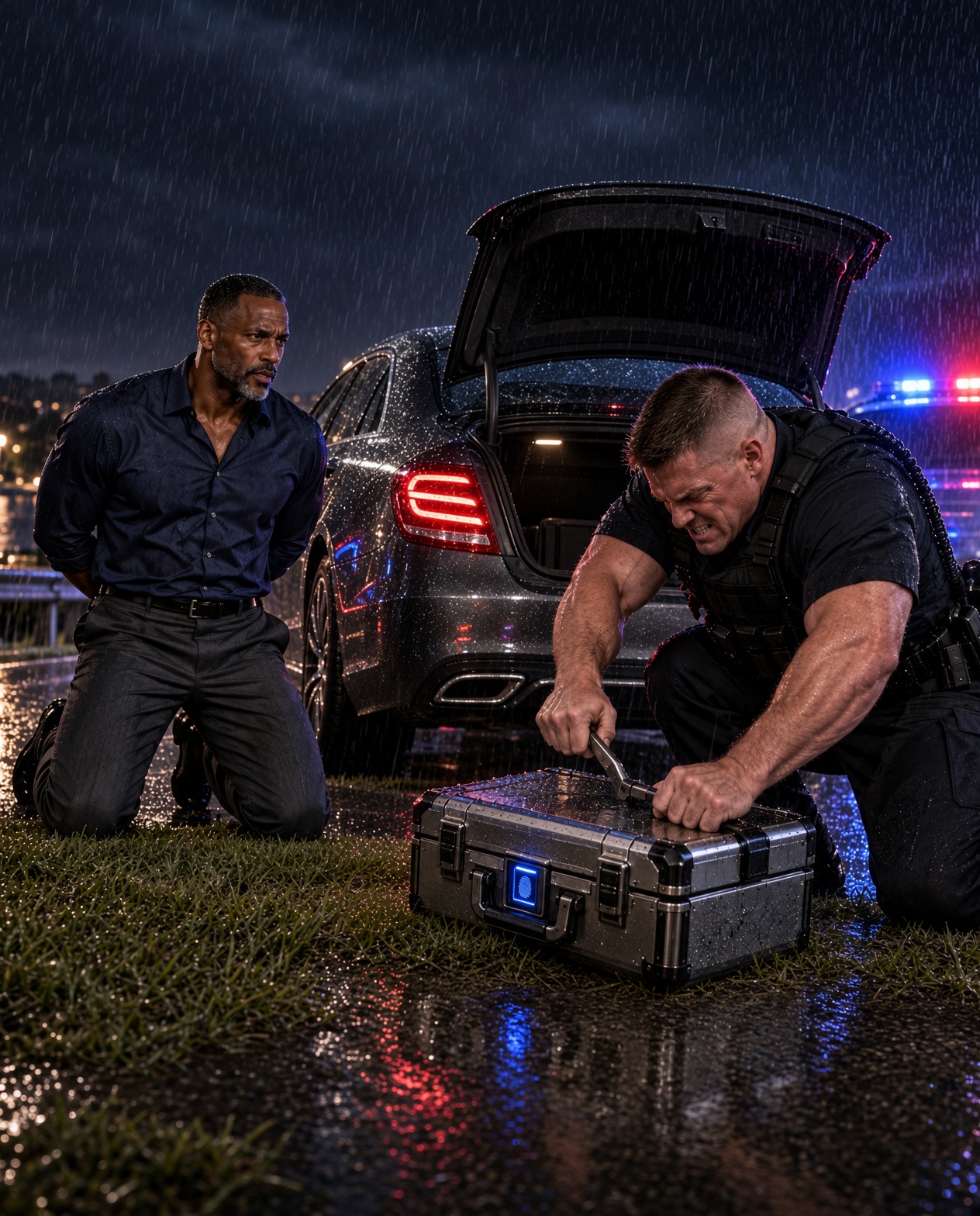
A decorated Air Force colonel sits handcuffed in the back of a police cruiser, arrested for simply driving a luxury car in the wrong neighborhood. The arrogant officer thought he’d bagged an easy target. He didn’t know the Pentagon was about to call his precinct and end his career. The rain had just begun to mist over the asphalt of Crest View, Virginia, a wealthy enclave nestled just far enough from the capital to feel untouchable.
Late at night, inside the cabin of a spotless charcoal gray MercedesBenz S-Class, the world was quiet, insulated by acoustic glass and the low hum of a jazz station. Behind the wheel sat Marcus Voss. At 48 years old, Marcus carried the quiet, unyielding posture of a man who had spent 25 years forged by military discipline.
He was an Air Force colonel, a Silver Star recipient, and currently served as a senior intelligence liaison at the Pentagon. Tonight, however, he was simply a man driving home after an exhausting 14-hour shift in the underground situation rooms. He wore civilian clothes, a crisp navy button-down, and charcoal slacks, having shed his uniform hours ago.
Marcus checked his rear view mirror. The road behind him was empty, save for a pair of headlights hanging about a/4 mile back. He tapped the turn signal, smoothly merging into the right lane to take the exit toward his subdivision. Suddenly, the headlights behind him accelerated. The unmistakable glare of red and blue strobes shattered the darkness, bouncing off the wet pavement and flooding the interior of the Mercedes.
Marcus sighed, his jaw tightening slightly. He checked his speedometer. 45 in a 45 zone. Registration current. Tail lights functional. There was no mechanical or legal reason for the stop. Still, training took over. He engaged his blinker, pulled onto the wide, well-lit shoulder of the service road, shifted the car into park, and turned off the engine.
He rolled down all four windows, a standard deescalation tactic, and placed both hands at the 10 and two positions on the steering wheel. In the side mirror, he watched the driver’s door of the police cruiser swing open. Officer Grant Vont Vaughn stepped out. Vaughn was a heavily built man in his early 30s with a high and tight haircut and a swagger that suggested he treated his badge less like a responsibility and more like a crown.
Vaughn unclipped his heavy Magite flashlight, tapping it against his thigh as he approached the vehicle. He didn’t walk to the window immediately. Instead, he lingered by the trunk, pressing his hand against the Mercedes’s trunk lid to leave a fingerprint, a standard police tactic, before finally shining the blinding beam of the flashlight directly into Marcus’ eyes.
License, registration, and proof of insurance, Vaughn demanded, his voice carrying a harsh, aggressive edge that was entirely unprovoked. Good evening, officer,” Marcus replied, his voice calm, steady, and devoid of the intimidation Vaughn clearly sought. “My license is in my wallet in my back right pocket. My registration and insurance are in the glove compartment.
How would you like me to proceed?” Van scoffed, keeping the flashlight pinned on Marcus’s face. “Just get them, and don’t make any sudden movements. Moving with deliberate slowness.” Marcus retrieved the documents and handed them through the window. Vaughn snatched them, his eyes darting between the ID and the expensive leather interior of the vehicle.
A smug, condescending smile crept onto his face. Marcus, huh? Vaughn said, purposely omitting any honorific or title. Long way from the city, aren’t you, Marcus? This is Crest View. Not exactly your usual stomping grounds. Marcus’ eyes narrowed slightly, catching the thinly veiled implication. I live three miles from here, officer, in the Oak Creek subdivision.
May I ask why I was pulled over? You crossed the double yellow line back on Route 9. Vaughn lied smoothly. And you look nervous. You acting nervous for a reason, Marcus. I am neither nervous nor did I cross the yellow line,” Marcus stated, his tone dropping an octave, ringing with the quiet authority of a commander.
“I am simply tired and trying to get to my home.” Vaughn didn’t like the tone. He didn’t like that the man in the car wasn’t trembling, wasn’t stuttering, and wasn’t shrinking under his badge. He leaned in closer, resting his hand on the butt of his service weapon. Step out of the vehicle, officer. I am respectfully declining to exit the vehicle unless you are giving me a lawful order backed by probable cause or reasonable suspicion of a crime.
Marcus replied, “I am giving you a lawful order,” Van barked, his face flushing red. “Step out of the damn car before I pull you out for resisting, knowing the legal limits, and not wanting to risk a physical altercation on a dark, wet road.” Marcus unbuckled his seat belt. “I am complying under protest,” he said, opening the door and stepping out.
He stood at his full height, 6 ft two of solid muscle. And for a fleeting second, Vaughn took a half step back, intimidated. But the badge on Van’s chest quickly bolstered his fragile ego. Vaughn spun Marcus around, shoving him roughly against the wet side of the Mercedes. He kicked Marcus’ legs apart and patted him down with unnecessary force.
What do you do for a living, Marcus? Van sneered as he searched him. “A car like this? What you pushing something?” “Or is this a rental you took out to impress somebody?” “I work for the federal government,” Marcus said evenly, staring straight ahead into the rain. “Right, government handouts,” Vaughn muttered. “Stay right here. Do not move.
Van walked around to the trunk of the Mercedes. I smell marijuana, he announced loudly to his body camera, entirely fabricating the claim to manufacture probable cause. I’m executing a search of the vehicle. I do not consent to any searches, Marcus said loudly and clearly. There is nothing illegal in this car.
If you open that trunk, you will be interfering with federal property. Van laughed. Federal property. Good one. He popped the trunk. Inside there was nothing but a gym bag and a sleek titanium reinforced briefcase locked with a biometric scanner. The briefcase contained classified briefings for a joint chief’s meeting scheduled later that morning.
Van grabbed the briefcase and yanked it out, tossing it onto the wet grass. He tried to depry the latches open, but the biometric lock held firm. Frustrated, he turned back to Marcus. “What’s in the box, Marcus? Drugs? Cash? That briefcase belongs to the United States Department of Defense?” Marcus warned, his patients wearing razor thin.
“If you tamper with it, you are committing a federal felony.” “Shut up!” Van snapped. He marched over, grabbed Marcus’ arms, and yanked them behind his back, slapping Cold Steel handcuffs around his wrists, tightening them until they bit into the skin. Marcus Voss, you are under arrest for suspicion of narcotics trafficking, resisting a police officer, and reckless driving.
You have the right to remain silent. I suggest you start using it.” Without another word, Vaughn shoved the decorated Air Force colonel into the cramped hard plastic back seat of the police cruiser. Marcus sat in the dark, the cuffs cutting off his circulation, and took a deep, steadying breath. He wasn’t afraid. He was furious.
And he knew something Vaughn didn’t. When the officer had aggressively tampered with the biometric lock on the briefcase, the systems tamper protocol had silently activated. A distress signal complete with GPS coordinates was already bouncing off a satellite and lighting up a secure terminal at the Pentagon.
The Crest View Police Department was a modernized brick-faced building that looked more like a wealthy town’s library than a precinct. The station was relatively quiet. A few night shift officers milled about the bullpen, drinking stale coffee and typing up reports. The heavy double doors swung open and Officer Vaughn marched in firmly gripping Marcus by the bicep.
He paraded his prisoner through the hallway with a triumphant smirk. “Look what the cat dragged in on a rainy night,” Vaughn announced to the room, pushing Marcus toward the booking desk. A young rookie officer, Nolan Quinn, looked up from his monitor. Quinn had only been on the force for six months and immediately noticed something off about the scene.
The man in handcuffs didn’t look like a criminal. He stood with impeccable posture. His expression a mask of stony, terrifying calm. “What do we have, Grant?” the desk sergeant asked, barely looking up from his paperwork. Big fish, Vaughn bragged, dropping the titanium briefcase heavily onto the booking counter.
Caught him swerving on Route 9, refused orders, got combative, found this little beauty locked in his trunk. He claims it’s federal property. Van made air quotes with his fingers and laughed. I’m betting it’s full of fentinel or untraceable bills. We’re going to need a warrant to crack it open. I will state this one final time for the record, Marcus said, his voice carrying clearly across the quiet precinct.
Every officer stopped typing. I am an active duty officer in the United States military. That briefcase contains classified Department of Defense materials. You are holding me unlawfully, and the longer I remain in these cuffs, the worse the consequences will be for everyone in this building. Van snorted, shaking his head.
Stolen valor, too. Add it to the list. He reached into Marcus’ pocket, pulling out the leather wallet. He flipped it open. Instead of looking at the military CAC, common access card, sitting prominently in the front window, Vaughn bypassed it entirely, yanking out the Virginia driver’s license, and tossing it to the desk sergeant. Book him.
Put him in holding cell three. Officer Vaughn. Rookie Nolan Quinn spoke up, his voice slightly hesitant. He pointed at the wallet. Um, Grant, he actually does have a DoD ID in there. Van shot the rookie a withering glare. Shut up, Quinn. Anybody can print a piece of plastic off the internet, strip his belt and shoelaces, get him in the cell.
Marcus offered no physical resistance as he was processed. He knew that the wheels of a machine far more powerful than the Crest View Police Department were already turning. He was stripped of his belt, his watch, and his phone, and was escorted into a cinder block cell. The heavy iron door clanged shut, the echo ringing through the station.
Out in the bullpen, Vaughn was loudly recounting the traffic stop, embellishing the details to make himself sound like a hero who had subdued a dangerous cartel runner. The doors to the precinct opened again. Captain Ellis walked in. Ellis was a pragmatic, exhausted veteran of law enforcement who was merely stopping by to review some administrative files before going home.
He walked past the bullpen, nodding at Vaughn, and stepped into his private office, leaving the door cracked. Inside the cell, Marcus stood quietly near the bars. He hadn’t asked for a lawyer. He hadn’t asked for a phone call. He was simply waiting. He knew the protocol. The tamper alert on a level 5 classified briefcase didn’t just trigger an email.
It triggered a localized rapid response protocol. The silence of the precinct was shattered by the sharp demanding ring of the phone on Captain Ellis’s desk. It wasn’t the general dispatch line. It was the captain’s direct private extension. Captain Ellis picked up the receiver. Captain Ellis, Crest View PD.
The voice on the other end was like grinding granite. Captain Ellis, my name is General Silas Kaine, United States Air Force, serving at the Pentagon. I am the commanding officer of the Joint Intelligence Directorate. Ellis sat up straight, instantly awake. Yes, General. What can I do for you? What you can do, Captain, is explain to me why the hell a distress beacon assigned to a highly classified Department of Defense courier briefcase is currently broadcasting from the booking desk of your precinct.
General Cain roared. The volume was so loud Ellis had to pull the receiver slightly away from his ear. And more importantly, you can explain why. Colonel Marcus Voss, a man with level 5 security clearance who is scheduled to brief the Secretary of Defense in a few hours, is currently sitting in your lockup on a fabricated traffic violation.
All the blood drained from Captain Ellis’s face. The room suddenly felt freezing cold. He looked through his office window, past the blinds, directly at the titanium briefcase sitting on the evidence counter, and then at Vaughn, who was laughing by the coffee machine. General, I am looking into this right this second, Ellis stammered, his heart hammering against his ribs.
You don’t need to look into anything, Captain. Cain cut him off, his voice dropping to a low, lethal whisper. In a few minutes, two black SUVs carrying federal agents and military police are going to pull up to the front doors of your little station. They are going to secure my officer and my classified materials.
If any of your deputies attempt to impede them, it will be considered an act of hostility against the federal government. I suggest you get out to those cells and start unlocking doors now. The line went dead. Captain Ellis slammed the phone down. He erupted from his office like a man shot out of a cannon, his face pale and contorted with absolute terror and rage.
He stormed into the bullpen, his eyes locking onto Officer Vaughn. “Vaughn!” Ellis bellowed, the sheer volume silencing the entire precinct instantly. “Where is the man you brought in? Where is he? Vaughn blinked, his smug smile faltering. He’s in cell 3, Captain. Just a local banger trying to give me the keys. Ford screamed, spit flying from his lips.
He snatched the heavy ring of keys from the desk sergeant’s hand and sprinted down the hallway toward the holding cells, leaving a bewildered and suddenly terrified Vaughn trailing behind him. Ellis reached cell 3 and jammed the key into the lock. His hands shaking so violently he almost dropped the ring. He swung the heavy door open.
Inside Colonel Marcus Voss stood exactly where they had left him. Calm, composed, and utterly terrifying in his silence. Colonel Voss. Captain Ellis breathed out, his voice trembling as he stepped aside. Sir, I am profoundly sorry. Please step out. The heavy iron door of cell 3 groaned open, revealing Colonel Marcus Voss standing exactly as he had been left, a portrait of absolute unyielding composure.
Captain Ellis’s hands were visibly shaking as he fumbled with the keys, his face slick with a cold sweat that had nothing to do with the temperature of the precinct. Colonel Voss. Captain Ellis breathed out, his voice trembling as he stepped aside, motioning toward the corridor. “Sir, I am profoundly sorry. Please step out.
” Before Marcus could take a single step, the heavy footsteps of Officer Grant Vaughn echoed down the hallway. Vaughn rounded the corner, his face contorted in a mix of confusion and arrogant indignation. “Captain, what the hell are you doing?” Vaughn demanded, his hand resting instinctively on his utility belt. That man is an arrested suspect.
He was combative. He resisted a lawful order, and he’s hauling suspected narcotics in a locked case. You can’t just let him walk out of the cell. Ellis spun around, the veins in his neck bulging against his collar. Shut your mouth, Vaughn. You have no idea what you’ve just done. Ellis roared, his voice cracking with panic.
He grabbed Vaughn by the front of his uniform shirt, slamming him backward into the cinder block wall. You didn’t arrest a drug runner, you arrogant fool. You kidnapped an active duty military intelligence officer. That briefcase you tossed on the booking desk is a level five classified Department of Defense courier case. Van’s eyes widened slightly.
A flicker of genuine doubt finally piercing his bloated ego, but pride forced him to double down. Captain, he’s lying. I checked his wallet. He had a Virginia driver’s license. The DoD card is probably a fake. And even if it isn’t, I smelled marijuana in his vehicle. I had probable cause. You manufactured probable cause.
Marcus’s voice cut through the shouting like a tempered steel blade. He stepped out of the cell, rubbing his wrists where the heavy handcuffs had bitten deeply into his skin. He didn’t yell. He didn’t need to. The sheer terrifying calm in his voice commanded the entire hallway. “You profiled me, Officer Vaughn.
You fabricated a traffic violation. You lied on your body camera regarding the scent of narcotics. And you attempted to force entry into federal property. You have violated a dozen state protocols and at least three federal statutes. Before Vaughn could formulate a defensive retort, the sound of roaring engines bled through the precincts brick walls.
Tires screeched against the wet asphalt outside. The heavy rhythmic thud of car doors slamming shut echoed in rapid succession. Out in the bullpen, rookie Nolan Quinn stared through the front reinforced glass windows, his jaw dropping. Three matte black Chevy Suburbans flanked by two United States Air Force Security Forces cruisers with their blue and red light bars flashing silently had jumped the curb and parked directly on the precinct’s front walkway.
“Captain!” Quinn shouted, his voice cracking with adolescent panic. “We have company!” The double doors of the Crest View Police Department were shoved open with such force that one of the hinges violently snapped. A tactical team spilled into the room. Four military police officers in full tactical gear carrying M4 carbines at the low ready instantly secured the perimeter of the lobby.
Behind them stroed two men in dark tailored suits. The lead man, FBI special agent William Kaine, walked with the brisk, undeniable authority of the federal government. Beside him was Air Force MP Captain Har, his eyes scanning the room like a hawk, looking for a threat. Nobody move. Keep your hands away from your duty weapons.
Captain Harland barked, his voice echoing off the tile floors. The precinct officers froze, their hands hovering in the air. Agent Cain marched direct to the booking desk. He didn’t ask for permission. He reached over the counter, grabbed the titanium briefcase, and inspected the biometric lock. He nodded to Captain Harlon.
The package is secure. Tamper seals are intact, but the digital lock registers an unauthorized physical breach attempt. Captain Ellis rushed out from the holding hallway, practically dragging Vaughn by the arm. Agents, please. I am Captain Ellis, the commanding officer of this precinct. We had a catastrophic misunderstanding here tonight.
Cain turned his cold gaze onto Ellis. A misunderstanding, Captain? My office was notified by the Pentagon that a senior intelligence liaison was taken hostage by local law enforcement while transporting classified materials. Hostage? Vaughn barked, unable to keep his mouth shut. I conducted a lawful traffic stop.
I’m a sworn police officer. You are a liability. A voice echoed from the hallway. Colonel Marcus Voss walked into the bullpen. Immediately, Captain Harlon and the military police officers snapped to rigid attention, rendering sharp salutes. “Conel Voss, sir, are you injured?” Harlon asked. “I am fine, Captain?” Marcus said, returning the salute.
He walked slowly toward the booking desk, his eyes locked onto Vaughn. Vaughn tried to stand tall, but under the crushing weight of the federal agents, the heavily armed military police, and the furious glare of his own captain, his swagger completely evaporated. Marcus stopped inches from Vaughn. “You asked me earlier what I did for a living, officer,” Marcus said quietly.
“I told you I work for the federal government.” What I didn’t tell you is that I oversee global threat assessments for the Joint Chiefs of Staff. My time is not just valuable. It is a matter of national security. And tonight, because you wanted to play a localized game of power and intimidation on a dark road, you compromised a federal mission.
Agent Cain stepped forward, pulling a pair of federal flex cuffs from his belt. Officer Grant Vaughn, you are currently under investigation for the deprivation of rights under color of law. 18 USC section 242 and the attempted tampering of classified national defense materials. Surrender your duty weapon. Van looked at Captain Ellis, his eyes pleading for salvation.
Captain, you can’t let them do this. I’m Union. I have rights. Give him your badge and your gun, Vaughn, Ellis said, his voice trembling with a mixture of an absolute terror. You are suspended indefinitely, effective immediately. And God help you because I won’t. Later, Colonel Marcus Voss was sitting in a secure subterranean briefing room beneath the Pentagon, dressed in a fresh, meticulously pressed uniform.
Across the mahogany table sat the Secretary of Defense and General Silas Kaine. The briefing on global satellite troop movements proceeded flawlessly. As if Voss had not spent the early hours of the morning locked in a suburban cinder block cell. When the briefing concluded, the secretary lingered, offering a brief, firm handshake to the colonel, silently acknowledging the ordeal without needing to explicitly state the obvious.
The Department of Defense protected its own. Back in Crest View, the atmosphere was entirely different. The precinct felt like a morg. Officer Grant Vaughn sat in an interrogation room, stripped of his badge, his service weapon, and his dignity. Across from him sat his Union representative, Cole Brennan. Brennan was usually a bulldog, a man known for getting violent, reckless officers back on the street with little more than a slap on the wrist.
But as Captain Ellis and Inspector General Hail of the Department of Justice entered the room carrying a thick manila folder and a USB drive, Brennan’s confidence evaporated. Inspector General Hail didn’t bother with pleasantries. He plugged the USB drive into a laptop on the table and turned the screen toward Vaughn and his representative.
This is the body camera footage downloaded directly from your server, Officer Vaughn, Hail said, his voice completely devoid of emotion. He hit play. The screen showed the dark, rainy stretch of Route 9. It showed the charcoal gray Mercedes driving perfectly straight. There was no swerving, no crossing the double yellow line.
The footage then captured Vaughn approaching the car, his aggressive demeanor, the immediate escalation, and his deliberate decision to bypass the military identification in Colonel Voss’s wallet. Finally, the audio clearly picked up Vaughn fabricating the smell of marijuana before attempting to violently pry open the classified briefcase.
Cole Brennan, the union rep, swallowed hard, pushing his chair slightly away from Vaughn. “Grant, what the hell is this? I was acting suspicious,” Vaughn stammered, pointing a shaking finger at the screen. “You know how it is, Cole? A guy like that in a car like that in this neighborhood? It’s basic police work.” “A guy like what, Officer Vaughn?” Inspector General Hail asked sharply, leaning over the table.
A decorated military officer, a senior Pentagon official? Or did you mean a black man driving a car you felt he couldn’t possibly afford? Van opened his mouth, but no words came out. We didn’t just stop at tonight’s footage, Captain Ellis interjected, slamming the Manila folder onto the table. Once the FBI took over the scene, I authorized a full internal audit of your dash cam logs and arrest records.
For the past 3 years, you’ve been busy. Grant Hail opened the folder, revealing dozens of printed spreadsheets and complaints. In the last 36 months, you have initiated 94 traffic stops on luxury vehicles in the Crest View area. 82 of those stops involved minorities. In 41 of those cases, you claimed to smell narcotics to initiate a search.
No narcotics were ever found. You have systematically used your badge as a tool for racial profiling and harassment. Van’s face drained of color. The walls were rapidly closing in. Those were just coincidences. I’m proactive. I keep this town safe. You’re a criminal. Hail corrected coldly.
And you made the fatal mistake of targeting a man who had the power to fight back instantly. The Department of Justice is officially taking over this investigation. We are looking at a multi-count federal indictment for civil rights violations. You are facing up to 10 years in federal prison. Vaughn turned to his union rep. Pure panic setting in.
Cole, you got to help me. We fight this. We go to the press. Cole Brennan stood up, grabbing his briefcase. He looked at Vaughn with profound disgust. I defend cops who make mistakes in the line of duty. Grant, I don’t defend racist liability hazards, who pick fights with the Pentagon, and hand the DOJ a wrapped gift. You’re on your own.
Do not call my office again. The door clicked shut behind the union rep, sealing Van’s fate. The next day, the story had violently erupted across national news networks. CNN, Fox News, and MSNBC ran wall-to-wall coverage of the Pentagon precinct raid. Helicopter footage showed federal agents boxing up files at the Crest View Police Department, executing a sweeping search warrant on the entire precinct to root out any officers who had assisted or covered up Vaughn’s previous actions.
The mayor of Crest View issued a frantic, grlinging public apology to Colonel Voss and the United States Air Force, immediately announcing the termination of Officer Vaughn and the early retirement of Captain Ellis, who failed to manage his ranks. Vaughn sat in his living room watching his face plastered across the television screen.
His phone buzzed endlessly with death threats and angry messages from former friends distancing themselves. His career was ash. His freedom was hanging by a thread. He had spent his entire adult life wielding his authority like a club against those he deemed beneath him. Now he was about to learn exactly what happened when you wielded that club against a titan.
Colonel Marcus Voss did not give interviews. He did not go on talk shows to boast. He simply woke up the next morning, put on his uniform, and drove his charcoal gray Mercedes back to the Pentagon, secure in the knowledge that justice for once had struck with the precision of a laserg guided missile. Months later, the damp chill of a Virginia autumn hung over the Albert Fee Brian United States Courthouse in Alexandria.
The plaza outside was a chaotic sea of satellite trucks, reporters, and citizens holding signs demanding police accountability. The trial of United States V Grant Vaughn had become a national spectacle. It wasn’t just a trial of a single rogue officer. It was a public autopsy of systemic corruption forced into the light by the unyielding machinery of the Department of Defense.
Inside courtroom 4B, the atmosphere was suffocatingly tense. Grant Vaughn sat at the defense table, a hollowedout shell of the arrogant man who had patrolled the streets of Crest View. Stripped of his badge, his gun, and his Union protection, Vaughn wore a poorly tailored gray suit that hung loosely on his frame. He had lost weight.
His hands, resting on the polished mahogany table, trembled slightly. Beside him sat his courtappointed attorney, a perpetually exhausted man who knew he was fighting an unwininnable war, prosecutor Sloan Mercer commanded the floor. Mercer was a razor sharp litigator who had built her career dismantling corrupt officials.
For 3 days, she had systematically destroyed every defense Vaughn’s attorney had attempted to mount. She played the body camera footage frame by frame. She brought in the internal auditors who testified to Vaughn’s staggering history of racially motivated traffic stops. She parided a dozen of Vaughn’s former victims to the stand.
Hardworking citizens whose lives had been upended by his fabricated arrests. But the absolute climax of the trial arrived on the afternoon of the fourth day. The government calls Colonel Marcus Voss to the stand, Mercer announced, her voice echoing off the high woodpanled walls. The heavy oak doors at the back of the courtroom swung open.
Colonel Voss entered. He wore his Air Force dress blues, perfectly tailored. The fabric crisp and immaculate. The rows of ribbons on his chest, including the silver star, gleamed under the fluorescent lights. The entire courtroom fell entirely silent. Even the jury members sat up straighter as he walked down the aisle with the measured, disciplined stride of a veteran commander.
He took the oath, his voice deep and resonant, and sat in the witness box. He did not look at Vaughn with anger or vengeance. He looked at him with the cold clinical assessment of a man identifying a neutralized threat. Mercer walked to the podium. Colonel Voss, could you please recount the events of that evening, starting from the moment you noticed the police cruiser behind you? For the next hour, Voss walked the jury through the night of the arrest.
His testimony was devastating precisely because of its complete lack of embellishment. He didn’t raise his voice. He didn’t employ dramatics. He simply relayed the tactical and factual breakdown of the illegal stop. He detailed Vaughn’s immediate escalation, the deliberate ignoring of his military credentials, the fabricated claim of smelling narcotics, and the violent tampering with the Department of Defense classified courier case.
“Conel,” Mercer asked, pacing slowly in front of the jury box. When officer Vaughn attempted to breach the biometric lock on your briefcase, what was going through your mind? I was evaluating the risk to national security. Voss answered evenly. The briefcase contained highly classified strategic assessments. Officer Vaughn was acting erratically, aggressively, and outside the bounds of any recognizable law enforcement protocol.
My primary objective was to ensure those documents did not fall into the hands of a compromised individual and to trigger the federal distress beacon without escalating his violence. The defense attorney attempted a weak cross-examination. Trying to suggest that Vaughn was merely following procedure for a high crime area.
With respect, counselor, Voss replied, his gaze locking onto the attorney. Crest View is not a high crime area. It is a gated, affluent suburb. The only anomaly officer Vaughn detected that night was a black man driving a luxury vehicle. He did not enforce the law. He enforced his own prejudice, and he utilized the authority of the state to do it.
The attorney had no further questions. He sat down, rubbing his temples. Van stared at the floor, his face pale and slick with a cold sweat. The jury deliberation was stunningly brief. They were out for less than 3 hours. When the four person stood to read the verdict, the courtroom held its collective breath.
On the count of deprivation of rights under color of law, we find the defendant Grant Vaughn guilty. On the count of falsifying police records, we find the defendant guilty. On the count of attempted tampering with classified national defense materials, we find the defendant guilty. Vaughn collapsed into his chair, burying his face in his hands.
A quiet, collective sigh of relief, rippled through the gallery. Judge Ellis, a stern man with zero tolerance for the abuse of power, did not wait for a separate sentencing hearing. He looked down from the bench, his expression radiating absolute contempt. Mr. Vaughn, you were given a badge and a gun to protect the public.
Judge Ellis’s voice boomed through the speakers. Instead, you used them as instruments of terror and intimidation. You targeted vulnerable citizens who did not have the resources to fight back. You operated under the cowardly assumption that your uniform made you untouchable. It took a man of Colonel Voss’s caliber and fortitude to finally expose the rot at the core of your career.
I am sentencing you to 108 months, 9 years in a federal penitentiary. You will be stripped of your pension and you will never hold a position of public trust again. Officers, take him into custody. The US marshals stepped forward. They grabbed Vaughn by the arms, pulling his hands roughly behind his back. The sharp metallic click of handcuffs echoed in the silent room.
It was the exact sound Marcus Voss had heard in the rain months prior. Colonel Voss stood up from his seat in the front row, adjusted his cover, and walked out of the courtroom. The cameras flashed blindingly as he exited the courthouse, but he didn’t stop to give a statement. He simply climbed into his waiting car and returned to work.
The system had tried to break him, but in the end, it was the corrupt system itself that had been thoroughly and permanently shattered. What an incredible ending to a story of ultimate karma. Grant Vaughn finally learned the hard way that you cannot hide behind a badge when you abuse your power.
If you loved seeing this corrupt officer get exactly what he deserved thanks to the Pentagon swift justice, please smash that like button, hit subscribe, and click the notification bell so you never miss our dramatic real life revenge stories. Share this video with everyone and leave a comment below with your favorite moment.

