Cocky Sheriff Caged a Black Woman for “Attitude” — The Pentagon Called His Office 5 Minutes Later
Cocky Sheriff Caged a Black Woman for “Attitude” — The Pentagon Called His Office 5 Minutes Later
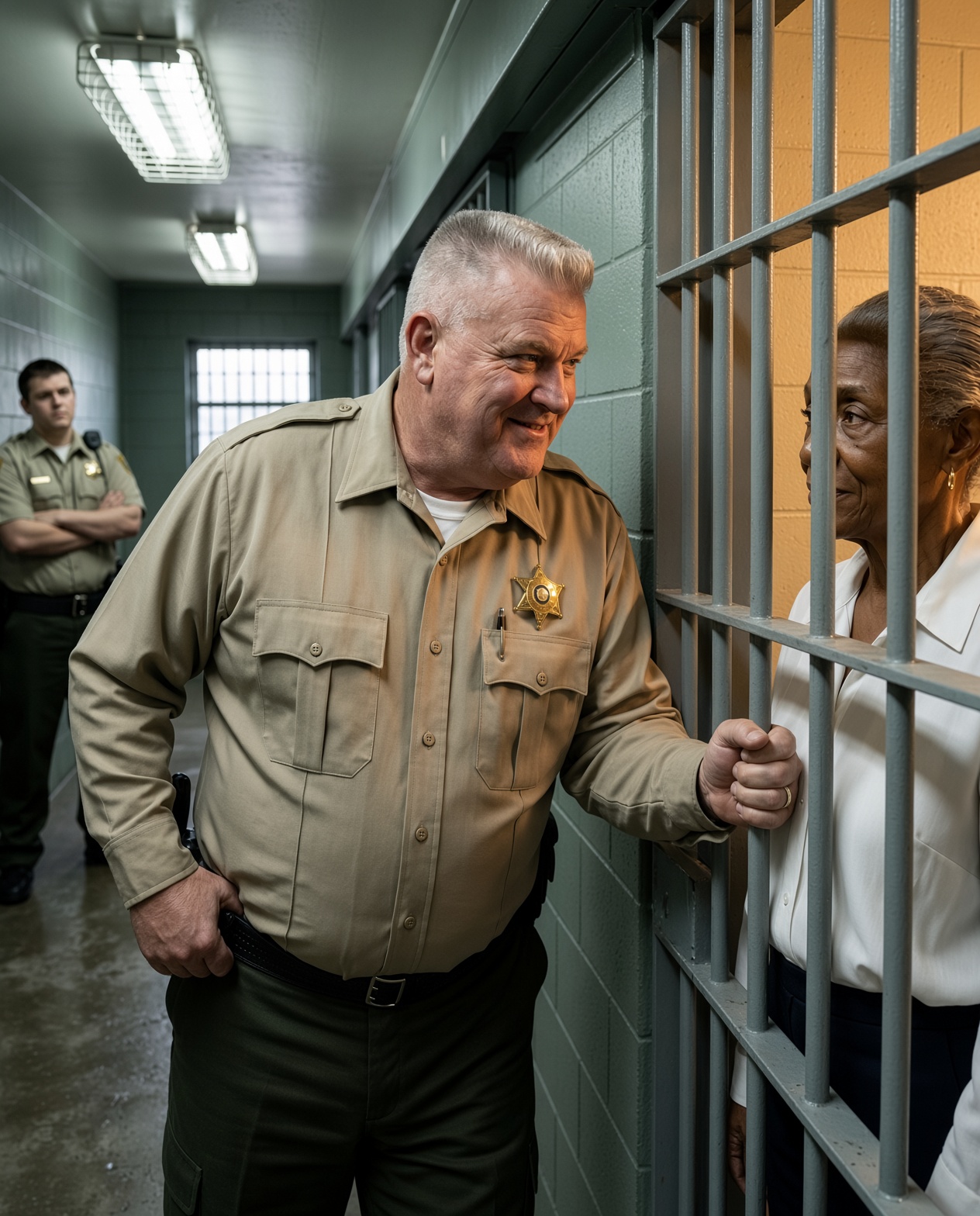
The blacktop outside the Beaufort County Substation held the heat of the afternoon long after the sun dropped behind the pines and Sheriff Dale Crawford stood in the open bay door watching a woman in handcuffs refuse to lower her eyes. He had told her to look at the floor. She looked at him instead. 68 years old, gray hair pulled back tight, a posture that did not bend, and a voice that had said only one sentence since he put the metal on her wrists.
“You are going to want to call someone before you finish this.” He had laughed. Now the phone on the front desk was ringing and the man on the other end said he was calling from the office of the Secretary of Defense and he wanted to know why a retired three-star general was sitting in a holding cell in his county.
11 hours earlier, Eleanor Booker had been on her knees in a vegetable garden behind a house she had owned for 30 years working a trowel into soil she knew better than she knew most people. The garden ran the length of the back fence, 40 ft of it. Tomatoes staked in three neat rows, collards going to seed at the end she let run wild on purpose because the bees needed something in August.
She wore a man’s chambray shirt with the sleeves cut off at the elbow and a pair of gloves so worn the left thumb had split. Her hands knew the work without her watching them. She pressed a seedling into the hole she had dug, firmed the dirt around the stem with two fingers, and moved 6 in down the row. She had transplanted 400 seedlings in her life by the same motion. Maybe more.
The radio on the porch rail played a gospel station out of Savannah, turned low mostly for company. She did not sing along. She hummed under the melody, a half step beneath the way her mother had, the way you do when you have spent a life being told your voice carries too far in rooms that did not want to hear it.
At 7:00 that morning, she had walked the perimeter of her 2 acres the way she walked it every morning, coffee in a steel cup that had crossed an ocean twice. She checked the fence line. She checked the rain gauge. She checked the mailbox at the end of the gravel drive, though the mail did not come until noon because checking it was part of how she put the day in order.
Order was the thing she had carried home from a 38-year career and never set down. A bed made tight enough to bounce a coin. Boots by the door, toes out, ready. A go bag in the hall closet that she had not needed in 9 years and would not unpack because unpacking it was a kind of surrender she was not built for.
Her neighbor on the south side was a man named Roger Whitfield who had moved down from somewhere outside Columbus 2 years back and built a house too big for the lot and complained in a voice he did not bother to lower that the area was changing. He had a way of standing at the property line with his arms crossed looking at her garden like it was a thing being done to him.
Once he had asked her across the fence how long she had worked for the family that used to own her place. She told him she was the family that used to own her place. He had smiled like she had made a joke and had gone back inside. She let it sit. She had spent a career learning which battles to fight and which to log and carry.
Whitfield went in the log. What Roger Whitfield did not know, because Eleanor Booker did not narrate her life to men who looked at her that way, was that the woman pulling weeds in the cutoff chambray shirt had commanded a sustainment command of more than 13,000 soldiers across two continents. That she had moved fuel and food and ammunition and blood across a desert under fire and never once lost a convoy she planned herself.
That the steel cup in her hand had been given to her by a colonel she pulled out of a vehicle with her own arms. And that the man had named his daughter after her. She had three stars on the uniform hanging in a garment bag in the hall closet. And a distinguished service medal in a drawer she opened maybe once a year.
And a private telephone number in an encrypted contact list that connected in four rings or fewer to people who decided things for a living. She did not think about any of that while she gardened. She thought about whether the tomatoes would beat the first frost and whether the collards needed another week. That was the gift retirement was supposed to give her.
The small war of the garden instead of the large ones. She had earned the small war. She had bled for the right to spend an entire morning thinking about nothing heavier than soil. The trouble started over a culvert. The county had cut a drainage culvert under the road 40 years before and it ran along the back of Eleanor’s property and emptied into a creek that fed the marsh.
For decades it had been nobody’s concern. But Roger Whitfield had filed a complaint that summer claiming Eleanor’s garden runoff was flooding the easement. And the county had sent a survey crew and the survey crew had found that the original culvert plat was wrong. And now there was a question suddenly urgent of whether Eleanor’s back fence sat 11 ft inside a county right of way. 11 ft.
The width of her tomato rows. She had been to the county offices twice. She had brought her deed, her plat, her 30 years of tax records in a folder organized with tabs. She had been polite the way she was always polite which was a politeness with a floor under it. A politeness that did slide into pleading. The second time a clerk had told her the matter was now with the sheriff’s office because Mr.
Whitfield had alleged she was obstructing a county survey by refusing access to her land. She had refused no one access. She had asked both times for the survey order in writing. That was all. A document, a signature. The same thing she had required of every requisition that crossed her desk for 38 years. Because a thing without a signature was a thing nobody would answer for when it went wrong.
The morning it all came apart, two trucks pulled into her gravel drive at half past nine. A county survey truck and a Beaufort County Sheriff’s cruiser. She set down her trowel, pulled off the split glove, and walked up the slope to meet them, unhurried, wiping her hands on the chambray. She had met armed men in worse driveways than this one.
Sheriff Dale Crawford got out of the cruiser like a man who enjoyed the sound the door made. He was 51, going heavy through the middle. A flat top gone silver at the sides. Mirrored sunglasses he did not take off even in the shade of the live oak. He had been sheriff for 11 years in a county where being sheriff meant something close to what being a lord meant once.
And he had stopped somewhere in those years being able to tell the difference between the authority of the office and the size of his own opinion of himself. He looked at the woman coming up the slope. Gray hair, work shirt dirt to the elbows, a steel cup left on the porch rail behind her. He had a picture in his mind of what this was.
The picture was wrong in every particular and he was too certain of it to check. “You, Eleanor Booker.” he said. “I am.” “We got a survey to conduct on the county easement you’ve been obstructing.” He had the thumbs hooked in his belt, the posture men use when they have decided a thing is going to be easy. I’ve obstructed nothing, she said.
I asked for the survey order in writing. I asked twice. No one’s produced one. You bring the assigned order and your crew can walk every foot of that line today. Crawford smiled at the survey foreman, a small smile, the kind that pulls a second man into a club of two. She wants it in writing, he said.
I do, Eleanor said. Same as you’d want a warrant in writing before you searched my house. A lawful order has a signature on it. Bring me one and we’re done here in an hour. It was the right thing to say and the worst thing to say because it was correct and Dale Crawford had not driven out to a back county garden to be corrected by a woman with dirt on her arms.
Something moved across his face behind the mirrored glasses. The foreman shifted his weight and looked at his boots. Tell you what, Crawford said. Why don’t you step back inside, let my deputies and this crew do their jobs and we’ll sort the paperwork after. After? Eleanor repeated. No, the paperwork comes first.
That’s how it works. That’s how it’s always worked. You giving me attitude? There it was. The word that does so much work in so few letters. She had heard it before in motor pools and command tents and one congressional hearing room. The word men reached for when a woman who outranked the moment declined to perform smallness for them.
She did not raise her voice. She had never needed to. 38 years of giving orders in places where panic could kill people had taught her that the lower you pitch a true thing, the harder it lands. Sheriff, she said. I am standing in my own yard asking for a piece of paper the law requires you to have. If that’s attitude, then the law has an attitude, and you should take it up with the law.
Crawford took off the sunglasses then. His eyes were small and pale and certain. “Turn around.” He said. “On what charge?” “Obstruction, failure to comply, resisting. We’ll figure out which one sticks on the ride in.” He was already pulling the cuffs. The survey foreman said quietly, “Sheriff, maybe we ought to just get the order. It’s no trouble to” “Get in your truck.
” Crawford told him, and the foreman got in his truck. Eleanor Booker turned around. She did it the way she had done difficult things her whole life, by going very still inside and letting the body do the necessary thing while the mind stepped back and began automatically to take notes. Cuffs double-locked, she noted, which meant he knew the procedure, which meant any later claim of confusion was a lie.
No Miranda, she noted. No order produced, she noted. Survey foreman witnessed it, she noted, and the foreman’s name was stenciled on his truck door. Patterson. And she filed it. The metal closed on her wrists. The radio on the porch was still playing the gospel station low, and she could hear it as he walked her to the cruiser.
A woman’s voice climbing a hymn she knew. She had been handcuffed exactly once before in her life, in a training exercise in 1981, meant to teach officers what it felt like to lose control of their own hands. And she had hated it then, and she hated it now. And the part of her that hated it was the part she kept locked down hardest because that was the part that if she let it loose, would make this worse.
“Watch your head.” Crawford said, and put his palm on the crown of her skull and pushed her into the backseat with a little more force than the geometry required. A small cruelty. She logged it. As the cruiser backed down the gravel drive, Eleanor looked through the window at her garden. 400 seedlings, 40 ft of fence, the trowel lying where she had dropped it in the dark dirt, the steel cup on the porch rail catching the morning light.
She had moved fuel through a war zone and brought her people home. And now a man who could not be bothered to find a signature was driving her to a cell over 11 ft of tomatoes. She did not let her face show anything, but somewhere under the stillness, a clock she had spent a lifetime learning to read started counting.
The Beaufort County substation sat at a crossroads between a feed store and a shuttered bank, a low brick building with a flag out front and a parking lot that baked. They brought her in through the back, past a sergeant at a desk who looked up, looked at the gray-haired woman in the gardening shirt, looked at the sheriff, and decided to look back down at his screen.
The first witness. She logged him, too. They took her watch and the contents of her pockets, which amounted to a folded seed packet and a worn leather wallet. The deputy doing the intake, a young man named Cody Pruitt, whose uniform was a half-size too big in the shoulders, asked her the booking questions in a flat voice.
And when he got to occupation, she said, “Retired.” And he wrote it down without looking up, and she let him because the moment she chose to say the rest of it was a moment she would choose, not him. She had learned that in rooms far more dangerous than this one. You do not spend your authority the instant you are challenged. You hold it.
You let the other side commit. You let them build the thing all the way up, every brick, until it is tall enough that when it comes down, it cannot be rebuilt. Dale Crawford had started building the second he pushed her head into the car. She was going to let him finish. They put her in a holding cell with a steel bench and a drain in the floor, and a fluorescent panel behind a wire cage in the ceiling.
Cody Pruitt closed the door. The lock was electric, and it made a sound when it engaged, a hard double clack, and she noted that sound the way she noted everything, because details were the only currency that held its value in a place like this. “You get a phone call,” Pruitt said through the bars. “When the sheriff says When the sheriff says,” she repeated.
“All right.” She sat on the steel bench. She put her cuffed hands in her lap because they had not removed the cuffs, and she was not going to ask. She set her spine straight against the cinder block, and she began in her head to write the after-action report, because that was the discipline that had saved her sanity in worse places.
The practice of narrating a catastrophe in the dry, clean language of a document, so that the fear had nowhere to pool. “At 09:30, two vehicles arrived at my residence.” And so on. She built it brick by brick, timestamped, sourced every claim attached to a witness or an object. By the time she reached the present moment in her own account, the fear had drained out through the discipline the way it always did, and what was left was the cold, patient, terrible competence that had once moved a fuel convoy through an ambush corridor at night with
the headlights off. Down the hall, Dale Crawford was at his desk feeling good about his morning. He had a sworn statement from Roger Whitfield, a survey crew, and a woman in a cell who had given him lip in her own driveway. He figured she would be crying inside an hour and apologizing inside, too, and signing whatever he put in front of her by supper.
He had seen it a hundred times. People talked tough in their yards. The cell took it out of them. What he did not know, because he had taken a folded leather wallet and a seed packet and dropped them in a Manila envelope without examining the wallet contents, was that tucked behind the worn cash was a laminated card the size of a business card, edges soft from handling, and on it, a seal and a name and a rank.
And below the rank, a telephone number that did not appear in any public directory anywhere on Earth. He also did not know that at the county offices, a clerk named Margaret Ellison had been growing more uneasy by the week. Margaret had worked the records desk for 19 years. She had pulled Eleanor Booker’s file when the Calvert complaint came in, and what she had found did not match the story everyone in the building seemed to have agreed on.
The deed was clean. The plat was clean. The tax records were immaculate. 30 years without a single late payment, organized when they came in like no civilian file she had ever processed. And stapled inside the deed folder, because Eleanor had filed it there herself when she bought the place, was a copy of a document Margaret had only ever seen in pictures.
A certificate of retirement from the United States Army. The rank on it had three stars. Margaret had mentioned this. She had mentioned it twice. The first time to her supervisor, who told her it was not the records office’s business who owned what. The second time, more quietly, to the county attorney’s paralegal in the break room who had gone a little pale and said she would look into it.
And then, as far as Margaret could tell, had not. Margaret had a daughter starting at the technical college in the fall and a mortgage and 11 years to go before her pension vested and she knew exactly what it cost in a county like this one to be the person who told the sheriff he was wrong. She had stayed quiet. She had hated staying quiet.
She had a posted note on her monitor that her late husband had written that said in his crooked hand, “Do the right thing, even when it’s the hard thing.” And she had taken to turning her coffee mug to cover it. When word came through the building’s grapevine around 10:00 that morning that the sheriff had actually arrested the Booker woman, Margaret Ellison sat at her desk and looked at the covered post-it for a long time.
Then she uncovered it. Then she pulled the file again, made a copy of the retirement certificate with shaking hands at the machine that always jammed, and she did not yet know what she was going to do with it. Only that she was not going to be the clerk who watched. Back in the cell, the hours moved the way they move in cells, which is not at all and then all at once.
Twice Crawford came to the bars to work her. The first time he was friendly, leaning on the door, telling her this could all go away. She just needed to sign a consent for the survey and an acknowledgement that she had been uncooperative and he would let her walk out before lunch. She said she would sign nothing without an attorney present and a written order in hand.
He stopped being friendly. The second time around, 2:00 in the afternoon, he brought Cody Pruitt with him and a clipboard. And he was harder. He told her she was looking at multiple charges. He told her a woman her age did not want a resisting charge on her record. He told her, leaning close to the bars, that out here, his word was the order, and the sooner she understood that, the better her day would go.
It was then, with the young deputy standing behind the sheriff holding a clipboard and visibly wishing he were anywhere else, that Eleanor Booker spoke the only sentence she would speak in that building of her own initiative. “Sheriff,” she said, “you are going to want to call someone before you finish this.” He laughed.
It was not a good laugh. “That right?” “Who am I going to call?” “My wallet’s in your property envelope,” she said. “There’s a card behind the cash. Read the card. Then dial the number on it. Do it before you file a single charge, because everything you file after you read that card, you file knowing what you’re doing.
” She let it land in the low register, flat, certain. “I’m trying to help you, son.” “You won’t believe that for about 10 more minutes. Read the card.” Crawford stared at her. For just a second, something flickered, the animal sense men like him have for the moment the ground shifts. Then his pride stepped on it, the way pride does.
“I’ll get to your card,” he said, and walked off, and did not get to it. And that delay was a brick, too. And she logged it, but Cody Pruitt had heard. And Cody Pruitt, 24 years old, eight months on the job, raised by a grandmother who had worked as a nurse at the Veterans Hospital in Charleston, and who had taught him what certain words on certain documents meant, went back to the property room around 2:30 on an errand that did not exist, and opened the Manila envelope, and slid out the worn leather wallet, and found
the card behind the cash. He read it. He read it again. He stood very still in the property room holding a laminated card with a four-star Department of Defense seal he recognized and a name that matched the booking sheet and a rank that did not fit anywhere in the story his boss had been telling all day. Lieutenant General United States Army retired.
And the number. Cody Pruitt was 24 and he had a choice. He could put the card back in the envelope and the envelope back on the shelf and let the day be the sheriff’s day. Or he could do the thing his grandmother’s voice in his head was telling him to do which would cost him because in Buford County you did not go around your sheriff and Dale Crawford had ended careers for less.
He stood there longer than he would later admit. Then he took out his personal phone, not the department one, photographed the card put the wallet back exactly as he had found it and walked back to the front desk on legs that did not feel like his own. He did not call the number. He did not have the nerve for that. Not yet. But he set the photograph on his phone where he could see it and he waited sick to his stomach for a chance he was not sure he would have the courage to take.
The chance came from the county offices. Margaret Ellison had spent the lunch hour she did not eat working herself up to a thing she had never done in 19 years. At a quarter to three she called the sheriff’s substation. She did not ask for the sheriff. She asked for whatever deputy was handling the Booker booking and the call landed on Cody Pruitt’s desk and a woman’s voice she did not know said “I’m a county records clerk and I need to tell somebody over there that the woman you’ve got in a cell is a retired
army general and her paperwork is clean and somebody needs to stop this before it gets worse. Cody Pruitt looked at the photograph on his phone and the two halves of the same truth arriving from two strangers who did not know each other fused into something he could no longer set down. “Ma’am.” he said quietly “Can you send me that paperwork right now to this number?” And he read her his personal cell, not the department line.
And Margaret Ellison, 19 years at the records desk, sent the retirement certificate to a deputy’s private phone and then sat back in her chair and put her hand over her mouth because she had done it the hard thing and there was no turning the coffee mug back around. It was nearly 3:30. Eleanor Booker had been in the cell since 10:00.
Cody Pruitt now had on a single device a photograph of a Department of Defense identification card and a copy of a federal retirement certificate, both naming the woman his sheriff was preparing to charge with resisting. He could have taken it to Crawford. He understood with the clarity of the genuinely frightened that taking it to Crawford would accomplish nothing except the end of his own career because Crawford had spent 11 years not being told things.
The sheriff would bury it. He would charge her anyway. He would dare anyone to make something of it. So Cody Pruitt did the only thing left that he believed might actually stop it. The thing the card itself was practically demanding. He took out his personal phone, walked out the hear him looked at the number on the card one more time and dialed it. It rang twice.
A man answered, crisp, unhurried a voice that had answered phones in serious rooms. “Operations.” Cody Pruitt’s mouth went dry. I uh My name’s Cody Pruitt. I’m a sheriff’s deputy in Beaufort County, South Carolina. I’m calling because we have a We’ve detained a woman, and I found this card in her property, and I think I think maybe somebody made a real big mistake.
And I didn’t know who else >> Slow down, Deputy. What’s the name on the card? He read it. He read the rank. He read the certificate Margaret had sent. There was a silence on the line that was not empty. The silence of a man writing quickly. >> Deputy Pruitt, the voice said, and it had changed, gone very flat and very fast.
Is she in custody right now? Physically, as we speak? >> Yes, sir. Holding cell. Since this morning. Sir, I want it on the record I’m the one who called. I didn’t Nobody told me to. I just >> I’ve got your name, son. Stay near your phone. Do not let anyone move her, transfer her, or process her out of that building.
Is that understood? >> Yes, sir. >> The line went dead. What happened in the next 5 minutes happened in places Cody Pruitt could not see, in an office two states away, where the name he had read off a laminated card was not an abstraction, but a person, a colleague, a woman half the senior leadership of an entire branch of service had worked beside or under or owed something to.
The number on that card did not connect to a switchboard. It connected to a small office that existed to know where certain people were at all times. And that office had just been told that one of those people had been sitting in a county cell since morning over a vegetable garden. The phone on the front desk of the Beaufort County substation rang at 3:36 in the afternoon. The sergeant answered it.
He listened. His face did a thing the other deputies in the room would describe differently later, but agreed on in substance, which is that the color went out of it. He said, “Yes, sir.” And, “I understand, sir.” And, “He’s the sheriff’s right here, sir. Let me” And then he held the receiver out across the room toward Dale Crawford’s office and said in a voice gone strange, “Sheriff, it’s for you.
It’s the man says he’s calling from the office of the Secretary of Defense.” Dale Crawford came out of his office with the swagger still on him because he had not yet understood because understanding had been the thing his pride protected him from all day. He took the phone the way he took everything, like it owed him something.
“This is Sheriff Dale Crawford.” The room watched him. They watched the swagger come off him in stages, the way paint comes off in heat. They watched him stop leaning. They watched him stand up straight, a thing none of them had seen the man do in years. And then they watched him reach out and put one hand flat on the desk like the floor had moved.
He said, “Yes, sir.” He said it again. He said, “No, sir. I There must have been a” And whatever came back down the line cut him off so completely that his mouth stayed open with nothing coming out of it. The voice on the other end was not loud. Cody Pruitt, who had crept back inside and was standing against the wall, could not hear the words, only the temperature of them, which was the temperature of a thing that had gone all the way to the top of a building so large that Beaufort County did not register on its maps,
and had come back down carrying the weight of every floor it passed. The man on the phone wanted to know why a retired lieutenant general of the United States Army was in a holding cell. He wanted to know the charges. He wanted to know whether she had been read her rights, whether she had been allowed counsel, whether she had been allowed her phone call.
And with each question Dale Crawford answered, the answer was worse than the last because the honest answers were no and no and no. And then the voice asked the question that ended Dale Crawford’s 11 years as the law in Beaufort County. The question he would hear in the bad hours for the rest of his life. The voice asked him to confirm his name, his full legal name, and his badge number slowly so it could be written down correctly.
And Dale Crawford, who had spent 11 years being the man who wrote other people’s names down, spelled his own name into the phone for a stranger in Washington. And as he did it, he finally understood all at once and far too late exactly how tall the thing he had built was and that it was already coming down.
He hung up the phone. The room was silent. He looked at the deputies looking at him. He looked last at Cody Pruitt against the wall and something in the young man’s face told him the rest of it, told him where the call had come from and who had let it and there was nothing he could do about that either because the thing was past him now, gone up the chain into air he could not breathe.
“Get her out of the cell,” Crawford said. His voice had no bottom in it. “Take the cuffs off now.” Cody Pruitt was already moving. The electric lock made its hard double clack. Eleanor Booker looked up from the steel bench where she had been sitting with her spine straight for five and a half hours, composing in her head a document that was by then very long and very precise.
The young deputy came in with a key for the cuffs and hands that were not steady. “General Booker,” he said, and his voice broke on it, and he did not care that it broke. “Ma’am, I’m sorry. I am so sorry.” He got the cuffs off. She brought her hands forward and turned them over, working the blood back into the wrists, unhurried, and she looked at the boy, at the half-size, too-big shoulders, and the wet eyes, and the phone clenched in his hand, and she understood most of what had happened without being told, because she
had spent a career reading exactly this, the face of the one who had decided to act. “You’re the one who read the card,” she said. >> “Yes, ma’am.” >> “You called the number.” >> “Yes, ma’am.” “I didn’t nobody told me to. I just couldn’t I couldn’t let it He stopped. “My grandmother worked at the VA in Charleston.
She told me what those words mean, on the card. I knew what it meant.” Eleanor Booker stood up off the bench. She was not a tall woman, and she did not need to be. She looked at Cody Pruitt for a moment in a way that he would try for years afterward to describe to people and never quite manage. And then, she did the thing that mattered more than any consequence that was coming for Dale Crawford.
She straightened the young man’s collar, which had gone crooked the way a person does for someone they have decided to claim, and she said, “What you did today is the hardest thing this job will ever ask of you, and you did it on your first try, alone, with everything to lose. Most men twice your age never manage it once.
Remember that you did. You hear me, son? Remember that you did. And Cody Pruitt, 24 years old, nodded and could not speak. She walked out of the cell under her own power. In the main room, Dale Crawford was standing by the front desk, and the deputies had drifted to the walls, and the air had the quality air gets when everyone in a room is waiting to see what a person will do with a power they have just realized that person holds.
Elinor Booker stopped in front of the sheriff. He could not look at her. The mirrored sunglasses were on the desk, and without them his eyes had nowhere to hide. “You took my wallet,” she said. “And you did not look in it. You took my word and you did not weigh it. You had a survey form and tell you to your face there was an easy way to do this, and you sent him to his truck.
” She was not loud. She had never once that day been loud. “I asked you for one thing. A signature. The same thing I required of every order I ever gave, because a thing with no name on it is a thing no one will answer for. You wouldn’t produce a name. So now they have yours. You spelled it into the phone yourself.
” She let that sit. “I spent 38 years,” she said, “making sure the people under me came home. I have buried more of them than you have arrested in your life. I did not survive all of that to be put in a cage over 11 ft of tomatoes by a man too proud to read a card.” She picked up her wallet from the desk and the seed packet and her watch, and she put the watch on.
You will not be sheriff much longer. That is not a threat. I don’t make threats. It’s just a thing I can already see the way I used to see weather coming across a desert. It’s already here. You just can’t feel the wind yet. She turns to go. At the door she stopped and looked back, not at Crawford but at the room, at the sergeant who had looked away when she was booked, at the deputies against the wall. All of you saw it. She said.
Some of you knew. One of you acted. She found Cody Pruitt’s eyes. Be the one who acts. It’s the only part of this job that will let you sleep. Then Lieutenant General Eleanor Booker, United States Army retired, walked out of the Beaufort County substation into the late light and the heat coming up off the blacktop and went home to her garden.
The thing she had said about weather came true faster than even she expected. By the next morning, the photograph Cody Pruitt had taken of the card and the certificate Margaret Ellison had copied with shaking hands and the booking sheet listing the charges Crawford had been so eager to file were in the hands of people whose job it was to ask hard questions of small offices.
The state law enforcement division opened an inquiry into the arrest by the end of the week. The county attorney, the same office whose paralegal had gone pale and done nothing, suddenly discovered an urgent interest in the matter and the survey complaint that had started it all evaporated because Roger Whitfield’s claim, examined by anyone with a plat and an afternoon, turned out to be wrong.
The fence sat exactly where it had always sat. There was no county right of way. There were 11 ft of tomatoes on land Eleanor Booker had owned outright for 30 years, and there always had been. The video helped. The substation had cameras, and the cameras had run all day, and the footage of a 68-year-old woman being walked into a cell in cut-off gardening clothes, kept in cuffs for 5 and 1/2 hours, denied a phone call, worked twice by a sheriff trying to make her sign away her own rights, was the kind of footage that does not stay inside a
building. It went up the chain to the state, and then because someone at the state had a cousin at a television station, it went the other way, too, out into the wide air where the public lives. Dale Crawford resigned before the recall petition his opponents were circulating could gather a tenth of the signatures it eventually gathered anyway.
He gave a statement through a lawyer about respecting the office and stepping aside to let the county heal language that fooled no one. The state inquiry did not stop at his resignation. The denial of a phone call alone was a violation with the woman’s name and rank attached to it, and that name, it turned out, came with attention that did not get bored and wander off the way attention usually did in Beaufort County.
There would be a federal civil rights review. There would be depositions. There would be, in the slow, grinding way these things move, a reckoning. And Dale Crawford’s name would be attached to all of it, spelled correctly, the way he had spelled it himself into the phone. His wife’s family had been in the county four generations.
At the church they had gone to all their lives, people got quieter when the Crawfords came in. The invitations stopped. The hunting club, where he had held court for a decade, did not renew his standing, citing a bylaw no one had ever enforced. He had built an entire life out of being the man whose word was the order, and he discovered at 51 that when the word stops being the order, the man underneath it is very small, and that he had not built anything else to stand on.
Roger Woodfield put his two big house on the market within the year, and moved, people said, somewhere outside Columbus again. The neighbors on the south side now were a young couple with a baby who brought Eleanor a pie when they moved in, and asked the first week if she could teach them to grow tomatoes. She could.
Margaret Ellison did not lose her job, though she had been ready to. The opposite happened, slowly. When the new sheriff was elected, a woman who had run on exactly the footage Margaret had helped bring to light, one of the first calls went to the records office, and Margaret Ellison found herself promoted to a position that had not existed before, overseeing how the county’s offices handled exactly the kind of file she had once been told was not her business.
She took the posted note off her old monitor and taped it to the new one, uncovered where she could see it. Her daughter started at the technical college that fall. Margaret paid the first semester in full, on time, the way she paid everything. Cody Pruitt stayed on. The new sheriff knew his name before she ever met him, because his name was in the state’s file as the deputy who made the call, and the first thing she did after being sworn in was find the young man against the wall and shake his hand.
He made sergeant inside 3 years, fast the way people do when they are the kind of person you want in the room when a thing goes wrong. He kept a photograph in his locker, not of the card, but of his grandmother, who lived long enough to hear the whole story, and who told him in the hospital in Charleston, where she had once worked, that she had never in her life been so proud.
And then told him to fix his collar. Eleanor Booker received some months later a letter on heavy paper from the office that had made the call and an apology from the state and an offer from more than one attorney to make Beaufort County pay in dollars for what it had done to her in a cell. She declined the dollars.
She had what she needed. She wrote one letter back to the office that had answered the phone in two rings and in it she did not mention herself at all. She wrote about a 24-year-old deputy who had found a card in an envelope and understood that the hard thing and the right thing were the same thing. And she asked them to make sure that fact was written down somewhere.
It would not be lost. She went back to her garden. The frost held off that year longer than the Almanac predicted and the tomatoes came in heavy and late, more than one woman could eat, more than she could give away, and she spent an afternoon in October on her knees in the dirt she knew better than she knew most people, pulling the spent plants, turning the soil, getting it ready for a spring she fully intended to see.
The radio played the gospel station out of Savannah, low for company. She hummed under the melody a half step beneath the way her mother had. A car slowed on the road. She did not tense. She had logged a lifetime of cars and knew the sound of one that meant trouble and this was not that. It was the young deputy Pruitt off duty in his own truck and he leaned out the window and lifted a hand, just a wave, just a young man checking on someone he had decided to claim the way she had once straightened his collar and claimed
him. She lifted a dirt dark hand back. The truck went on. The hymn climbed. Eleanor Booker pressed another handful of soil flat with two fingers and moved 6 in down the row, the same motion 400 times. The small war she had bled for the right to fight. She had brought her people home for 38 years. Now she grew tomatoes and that was enough.
And no one would ever put her in a cage again. What would you have done if you were the only person in that building who knew the truth and saying it out loud could have cost you everything? >> And the harder question, how many times have you stayed quiet when a quieter, safer voice inside you said, “This is wrong.
” And what would it take for you to be the one who picks up the phone? Tell me in the comments about a time you chose the hard right over the easy wrong or watched someone else do it. If this story moved you, subscribe and join us. Like it so it reaches someone who needs it.
And share it with one person who you know would do the right thing even when it cost them.

