Bride’s Father Pours Wine on Black Man at Wedding — Goes Pale When Groom Reveals Who He Is
Bride’s Father Pours Wine on Black Man at Wedding — Goes Pale When Groom Reveals Who He Is
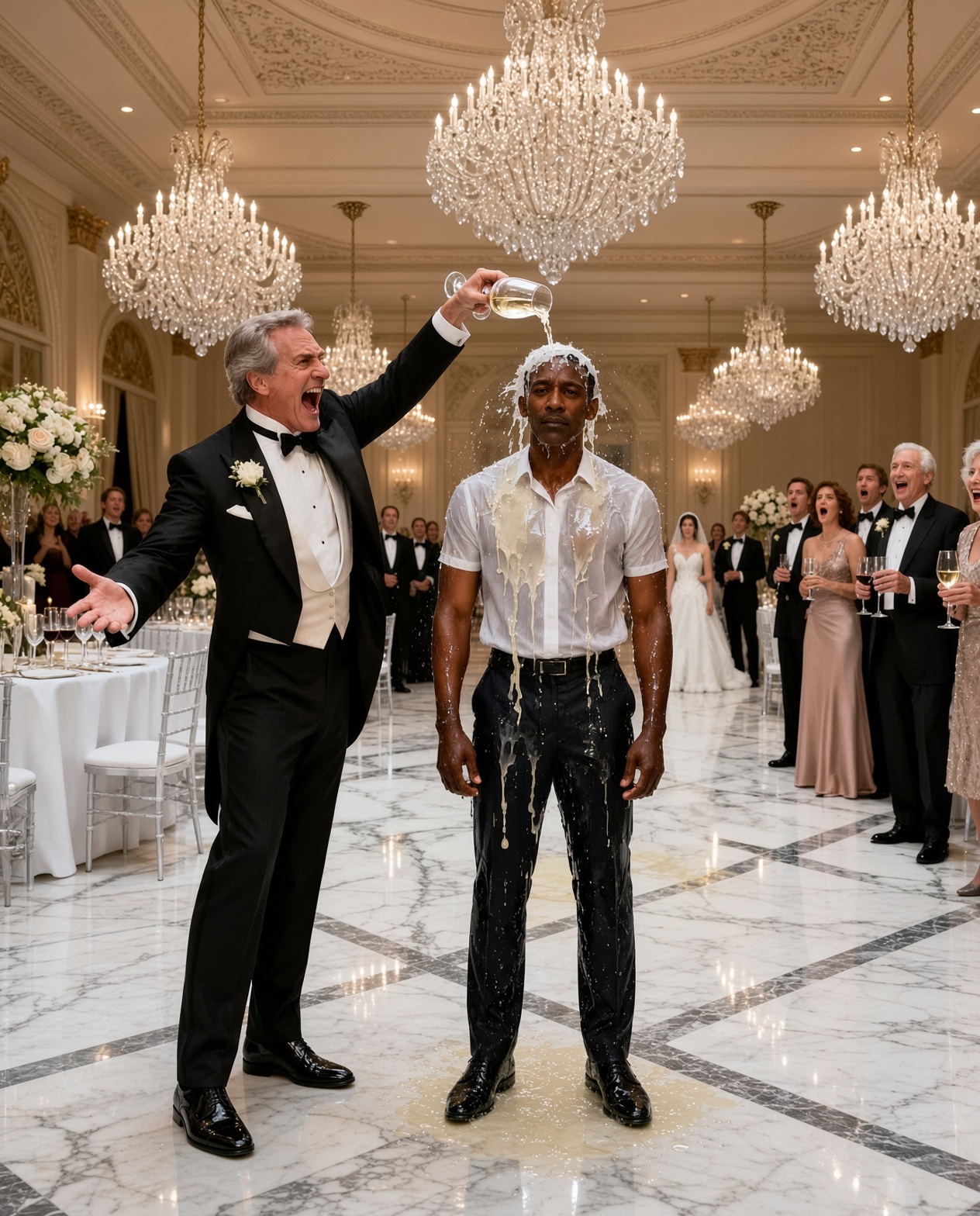
Why is there a black man here? Gerald’s voice cut through the wedding hall like a knife. Look at him. His coat is wrinkled. His shoes are cheap. Strike. He’s standing there like he’s the host. He snorted. Even his body odor is disgusting. The guests burst into laughter. No one stopped him.
The black man stood still. His face was expressionless. I’m a guest. He said softly. Gerald looked him up and down with disgust. A guest? At my daughter’s wedding? No one here knows a black man who smells as bad as you. He snapped his fingers to the staff. Get him out! Gerald continued to laugh.
His friends laughed until the groom stood up. He said the man’s name. Just two words. All the laughter died down as if someone had pressed the mute button. Let me take you back. Six hours before that moment. Room 614 at the Grand Belmont Hotel. Not the penthouse. Not a suite. Just a standard room with stiff white sheets and a window facing the parking lot.
Malcolm Taylor stood at the ironing board in his undershirt pressing a shirt collar. Steam hissed softly against the fabric. His phone sat on speaker beside him. You eating breakfast? His mother’s voice crackled through. I had coffee, Mama. Coffee is not breakfast, Malcolm. He smiled.
I’ll grab something before the dinner. And how’s that young man, Ethan? Is he nervous? Probably. Getting married is a big deal. You tell him I said congratulations and you be nice to his family. Malcolm paused mid-iron. I’m always nice, Mama. Mhm. He hung up, held the shirt to his chest, checked the mirror. Clean, simple, no flash. Here’s what you need to know about Malcolm Taylor.
He grew up in Bed-Stuy, Brooklyn, a two-bedroom apartment with peeling wallpaper and a faucet that never stopped dripping. His mother worked two jobs, morning shift at a hospital laundry, nights stocking shelves. She raised him alone, no father, no safety net, just her hands and her stubbornness. Malcolm earned a full scholarship to Wharton, graduated top of his class, worked 18-hour days at three different firms before 30.
Then he did something nobody expected, started his own, Ascend Capital Holdings, built from nothing, no family money, no connections, just a sharp mind, relentless discipline, and the kind of patience most people mistake for weakness. Today, Ascend manages 85 billion dollars in assets.
Malcolm’s personal net worth, 4.2 billion. Bloomberg lists him among the 50 most influential figures in global finance. But you’d never know by looking at him. No entourage, no bodyguards, no Rolex. He drives a 10-year-old Volvo, irons his own shirts, calls his mother every morning. His billions are invisible on purpose. Malcolm believes wealth should build things, not perform for strangers.
Eight years ago, Malcolm sat across from a 24-year-old kid in a job interview. Fresh out of Columbia Business School, no connections, no family name, mountain of student debt, and a suit that didn’t fit. But the kid was sharp, hungry, honest. Malcolm hired him on the spot, mentored him personally, promoted him three times.
That kid, Ethan Brooks, became one of the youngest senior vice presidents in Assent’s history. When Ethan called to invite Malcolm to the wedding, his voice cracked. “You changed my life, sir. It would mean the world if you came.” Malcolm canceled a board meeting in Zurich, flew 11 hours, not because he had to, because Ethan mattered. Now, the other side of tonight, the Grand Belmont Hotel, Greenwich, Connecticut.
Carpets thicker than your mattress, chandeliers worth more than a house, oil paintings on every wall, fresh orchids on every table. Gerald Crawford paid 1.2 million for this wedding. Every detail, seating chart, floral arrangements, the exact brand of champagne, he picked personally. His night, his show, his stage.
For months, Gerald bragged to every person who would listen. Dinner parties, golf outings, charity galas, “My son-in-law works at one of the biggest private equity firms on Wall Street. Huge operation, billions under management.” He loved that line. Let it hang in the air so people could be impressed. But not once did Gerald ask who ran that firm.
Not once did he ask the CEO’s name. He didn’t care about the person, only the prestige. That ignorance was about to cost him everything. Back in the ballroom, guests mingled under golden light. Ethan stood near the entrance, greeting arrivals with a warm handshake. He kept glancing toward the door. He was waiting for someone.
Caroline, the bride, stood beside him, elegant in a cream dress, but tense. She knew her father was unpredictable. Then Malcolm walked in, simple navy blazer, no tie, small gift bag in hand. Ethan’s face lit up. He crossed the room in four quick steps, gripped Malcolm’s hand, pulled him into a hug. “You made it, sir.
Thank you for being here.” Malcolm patted his back. “Wouldn’t miss it.” From across the ballroom, Gerald Crawford watched. Champagne flute in one hand, eyes narrowed. He didn’t see a billionaire, didn’t see a CEO, didn’t see the man who built his son-in-law’s entire career. He saw a black man in a cheap blazer. And that was all he needed to see.
It didn’t take long. Malcolm had barely reached the bar when Gerald appeared beside him. Not next to him, in front of him, blocking his path like a bouncer at a nightclub. Gerald didn’t introduce himself, didn’t offer a handshake. He just looked Malcolm up and down with the kind of expression you’d give a stain on your carpet.
“You with the band?” Malcolm blinked. “Excuse me?” “The band, the DJ, whatever entertainment my daughter hired.” Gerald waved his hand vaguely toward the back of the room. “Setup’s over there.” “I’m not with the band,” Malcolm said calmly. “I’m a guest. I work with Ethan.” Gerald’s eyebrows shot up.
He tilted his head, amused, like a cat watching a mouse try to explain itself. “You work with Ethan?” He repeated it slowly, tasting each word. “In what capacity? Mail room? Janitorial?” A few of Gerald’s friends nearby snickered. One nudged the other with his elbow. Malcolm didn’t take the bait. “Something like that.” he said and smiled.
Gerald stared at him for a long moment. Then he leaned in. Close enough that Malcolm could smell the scotch on his breath. “Let me give you some advice, friend. Men like you in rooms like this should know when to be invisible. Grab a plate if you want, but stay out of the way.” He turned and walked back to this circle without waiting for a response.
Over his shoulder, he muttered loud enough for half the room to hear. “Ethan’s bringing co-workers now. Next, he’ll invite the janitor. Oh, wait. Maybe he already did.” Laughter. Loud, easy laughter from men in expensive suits who thought cruelty was comedy. Malcolm stood at the bar alone. He picked up his glass of water, took a sip, set it down gently.
His face showed nothing, but if you looked closely, very closely, you’d notice his jaw tighten. Just once. Just for a second. Then it was gone. The seated dinner began 20 minutes later. Long tables draped in white linen. Candles flickering in silver holders. The smell of roasted lamb and fresh rosemary drifting from the kitchen.
Ethan had personally arranged the seating. He placed Malcolm at a prominent table near the head, a seat of honor. Close enough to the wedding party that they could talk between courses. Gerald noticed immediately. He stood at the head table scanning the room like a general surveying his troops. His eyes landed on Malcolm’s table.
His nostrils flared. “Why is he sitting there?” Gerald hissed to his wife. “That table is for important people.” His wife touched his arm. “Gerald, please, not tonight.” He shook her off. Dinner was served. Plates clinked, conversations hummed. For a few minutes, the room felt almost normal. Then Gerald raised his voice, not shouting, just loud enough to carry across the tables, the way a man does when he wants an audience.
“So, Malcolm, was it?” Malcolm looked up from his plate. “Yes.” “Tell me, Malcolm, what exactly do you do at this big fancy firm of Ethan’s?” Gerald swirled his wine glass lazily. “Accounting? Compliance?” He paused, grinning. “Diversity hire?” The table went dead silent. A woman next to Malcolm set her fork down quietly.
Malcolm’s expression didn’t change. “I oversee operations.” Gerald slapped the table. “Operations! That’s fantastic!” He turned to his friends, beaming. “He oversees operations! Means he makes sure the copier has paper and the coffee machine works.” More laughter, forced this time. Some guests looked away uncomfortably.
Gerald wasn’t done. He leaned back in his chair, loosened his tie like he was settling in for a performance. “You know, it’s funny. These big Wall Street firms, they’ll hire anyone these days. Anyone. Doesn’t matter if you’re qualified, doesn’t matter if you earned it, long as you check the right box on the application.
” He tapped the side of his nose knowingly. “You You what I mean. Quotas.” The word hung in the air like smoke. Ethan’s jaw clenched so hard the muscles in his neck twitched. He gripped the edge of the table. His knuckles turned white. He started to stand, but Malcolm caught his eye. A barely visible shake of the head.
Slow. Deliberate. Not tonight. This is your evening. Ethan sat back down. But his hands were trembling under the tablecloth. Here’s the thing that made it worse. Malcolm wasn’t just Ethan’s co-worker. He was Ethan’s boss. The founder. The CEO. The man who signed every paycheck. The man who gave Ethan his career. And Ethan had to sit there and watch his mentor get humiliated.
Because his mentor told him to. That kind of restraint doesn’t come from weakness. It comes from a man who’s been underestimated so many times that he’s learned exactly when to be silent. And exactly when silence stops being an option. After the main course, Gerald excused himself. But he didn’t go to the restroom.
He went hunting. He found Denise Holloway in the service hallway behind the kitchen. She was adjusting a floral arrangement, clipboard tucked under her arm. Professional. Focused. Gerald didn’t greet her. He just started talking. Who approved the seating chart? Denise looked up. The groom arranged the seating personally, Mr. Crawford.
I don’t care what the groom arranged. I’m paying for this wedding. Every glass, every napkin, every orchid on every table. That means I decide who sits where. Denise kept her voice steady. Sir, Ethan was very specific about move him. I’m sorry? The black guy, table four. Move him to the back with the plus ones, the coat check people, wherever.
I don’t want to see him when I look up from my plate. Denise straightened her back. Mr. Crawford, I can’t rearrange the groom’s seating without his approval. Gerald stepped closer. His shadow fell over her. The hallway was narrow and suddenly it felt much smaller. Let me make this very clear, sweetheart. His voice dropped to something low and cold.
I will pick up my phone right now and make one call. One. And you will never plan another event in this state. Not a birthday party, not a retirement dinner, nothing. Are we understanding each other? Denise didn’t flinch. But her grip tightened on the clipboard. Her knuckles pressed white against the metal clip.
The seating stays as the groom requested, she said quietly. I’m sorry, sir. Gerald stared at her for a long five seconds. Then he made a sound, half laugh, half growl, and walked away. He came back to the dining room with a fresh glass of red wine, full to the brim. The deep crimson caught the candlelight as he moved through the tables.
He walked behind Malcolm’s chair, slowly, deliberately. Then his hand tilted. Wine poured down Malcolm’s back. It soaked through the navy blazer, bled into his shirt, dripped onto the white linen chair beneath him. The splash was loud enough to make heads turn from three tables away. Oh, clumsy me. Gerald’s voice was pure theater.
He pressed a hand to his chest in mock surprise. Somebody get this man a napkin. Or a mop, whatever you use. A few gasps. A few nervous laughs. Malcolm didn’t jump. Didn’t curse. Didn’t spin around. He reached for a napkin. Dabbed his shoulder slowly. Looked up at Gerald with an expression so calm it was almost eerie.
“Accidents happen.” He said. Gerald’s smirk flickered. Just for a moment. He’d wanted a reaction. Anger, humiliation, maybe even tears. Something he could point to and say, “See? This is why people like him don’t belong here.” But Malcolm gave him nothing. Absolutely nothing. And that calm, that unshakable, immovable calm, made Gerald look smaller than any insult ever could.
Ethan pushed his chair back. His face was red. His eyes were burning. Caroline grabbed his wrist under the table. “Not here.” She whispered. “Please.” Ethan looked at Malcolm. Malcolm gave him the same quiet signal. A small shake of the head. A steady gaze that said, “I’ve survived worse than wine, son. Sit down.
” Ethan sat. But he leaned toward Caroline and whispered through clenched teeth, “I can’t take much more of this.” Neither could anyone watching. Gerald Crawford wasn’t finished. Not even close. The wine incident should have been the end of it. Any reasonable man would have stopped there. But Gerald wasn’t reasonable.
He was a man who’d spent 60 years believing the world owed him respect and anyone who didn’t look like him owed him an explanation for even being alive. So after dinner, while guests moved into the lounge for cocktails and soft piano music, Gerald went to work. He moved through the room like a poison, slow, deliberate, infecting every conversation he touched.
First, he cornered a couple near the grand piano, leaned in close, lowered his voice just enough to sound confidential, but kept it loud enough for nearby ears to catch every word. Do we actually know that guy? The one at table four? He shook his head slowly. Because I Googled him. Nothing. Not a single result.
No LinkedIn, no company profile, no social media, absolutely nothing. He raised his eyebrows dramatically. A man with no digital footprint in 2026? Doesn’t that seem suspicious to you? The couple shifted uncomfortably. The wife glanced toward Malcolm across the room. The husband said nothing. Gerald patted the man’s shoulder, a gesture that looked friendly but felt like a warning, and moved on.
He found another group near the bar, three men in tailored suits, golf buddies, his people. I’m telling you, Ethan’s too kind for his own good. Heart’s in the right place, but no common sense. Probably felt pressured by the company to bring someone like that. You know how it works these days. He rolled his eyes theatrically.
Every firm needs their token minority at the holiday party. Looks like they shipped him to the wedding, too. Nervous laughter. A few shaking heads. But nobody challenged him. Nobody said stop. Nobody ever said stop. Gerald leaned closer, dropped his voice to a stage whisper. Between us, I wouldn’t be surprised if the silverware count is off by morning.
One of the men winced. But he still laughed. Here’s the thing about Gerald’s campaign. It worked because Malcolm had designed his entire life to be invisible. Ascend Capital was a private firm. No flashy website, no press releases, no celebrity partnerships. Malcolm had turned down every Forbes interview, every magazine profile, every TV appearance for 20 straight years.
His privacy was his power. He didn’t need strangers to know his name. He didn’t need validation from people who measured worth by what you wore or what you drove. But tonight, that privacy became a weapon, and Gerald was the one swinging it. Within 30 minutes, the atmosphere in the room shifted. You could feel it in your skin.
Like the temperature had dropped 2°, and nobody wanted to admit they were cold. Guess Malcolm noticed. Of course he noticed. A black man in America doesn’t survive 52 years without learning to read a room before the room reads him. But he kept his glass of water steady. Kept his posture straight. Kept his expression perfectly neutral.
Because reacting to ignorance was exactly what ignorance wanted. And Malcolm had stopped feeding that beast a long time ago. Then Gerald escalated. Again, he found Stephen Wells, the hotel manager, standing near the front desk. Steven was a tall, thin man in a crisply pressed suit.
The kind of man who smiled with his mouth but calculated with his eyes. His job was simple. Keep the biggest spender happy. Handle problems before they became headlines. Protect the hotel’s reputation at all costs. And tonight, the biggest spender in the building was Gerald Crawford. “We have a situation,” Gerald said, planting both palms flat on the marble counter.
His voice was clipped, businesslike, the voice of a man who expected obedience, not discussion. “An uninvited guest, sir?” Steven asked carefully. “The black man, table four, navy blazer, wrinkled by the way. You can’t miss him. He’s the only one who looks like he wandered in from a Greyhound station. Steven, I’m the one writing the check.
$1.2 million. “That buys me a lot of things, Steven. One of those things is deciding who stays in my daughter’s wedding and who gets walked out.” He leaned forward. “You work for me tonight, not for the wedding planner, not for the groom, for me.” He tapped the marble counter twice, hard, like a judge dropping a gavel.
“Handle it. Now, or I’ll find someone who will.” Steven made his choice in 3 seconds. He picked up his radio and called security. Two guards appeared within minutes, both tall, both broad-shouldered, both wearing expressions that said they’d rather be anywhere else. They walked through the lounge with the kind of purpose that made nearby conversations stop mid-sentence.
They approached Malcolm’s table. “Sir, we need you to step outside with us for a moment.” Malcolm looked up from his water glass. “May I ask why?” “Just a routine verification, sir. We need to confirm your invitation status.” Malcolm studied their faces. He could see it behind the professionalism. The discomfort, the reluctance.
These men didn’t want to be doing this. They knew something was wrong about it. But they were doing it anyway. Because the man with the checkbook told them to. “Am I being asked to leave?” Malcolm asked. His voice was calm. Almost gentle. “It’s just a formality, sir. Won’t take long.” Malcolm set down his water glass.
Slowly. Precisely. The ice clinked against the crystal. A tiny, delicate sound that somehow cut through the noise of the entire room. He stood. Buttoned his wine-stained blazer. Adjusted his cuffs with the quiet precision of a man who has been underestimated a thousand times and never once lost his composure because of it.
And he walked with the guards toward the lobby. He didn’t resist, didn’t argue, didn’t raise his voice. He just walked. Spine straight, chin level, dignity radiating from him like heat from a furnace. Past dozens of guests who watched him go. And said nothing. Not one of them said a single word. Ethan saw it happen from across the room.
He watched two security guards flank his boss, his mentor, and walk him out like a criminal. The color drained from his face. He set his drink down so fast it nearly shattered on the table and pushed through the crowd. “What is happening right now?” His voice was shaking. Not with fear. With fury barely held on a leash.
Stephen Wells intercepted him. Mr. Brooks, please remain calm. Mr. Crawford raised some concerns about a potentially uninvited Uninvited? Ethan’s voice cracked through the lobby like a gunshot. Guests in the hallway flinched. I personally invited him. He is the single most important guest at this entire wedding, Stephen stammered.
I understand, sir, but Mr. Crawford was very insistent. I don’t care what Crawford insisted. And then, Gerald arrived. Strolling into the lobby slowly, champagne still in hand, jacket unbuttoned, like a king walking through his own palace. Calm down, Ethan. You’re embarrassing yourself. Gerald sipped his champagne.
If this man is really your colleague, he’ll understand. This is a private family event, and I have every right to feel safe in a room I’m paying for. He turned to Malcolm, locked eyes with him, and the smirk disappeared. What replaced it was something far worse, something raw, honest, and deeply ugly. I don’t know where you came from, Gerald said slowly, and I don’t care.
One step closer. Men like you don’t belong in rooms like this. You didn’t earn your way here. Somebody felt sorry for you, maybe even Ethan, gave you a pity invite, and now you think you deserve to sit at a place of honor with real people? With my family? Another step. Close enough to smell the scotch on his breath.
I built my empire brick by brick. Real estate. Real money. Real power. He jabbed a finger into Malcolm’s chest hard enough to push him back half a step. What did you build? What do you actually own besides that cheap stained jacket? He turned to Ethan. His voice softened. Almost fatherly now. More dangerous than any shout. I love you like a son.
But you need to learn something. This man is not your equal. He never was. He never will be. And the sooner you accept that, the better off this family will be. Back to Malcolm. Gerald leaned in close. Close enough to whisper. But he didn’t whisper. He wanted everyone to hear. Now walk out that door. And don’t you ever ever show your face around my family again.
Because next time I won’t be this polite. The lobby was packed now. 40, maybe 50 guests had filtered in from the ballroom. Some stood in doorways. Some pressed against walls. Some craned their necks from the hallway. The air was thick and absolutely still. The kind of silence that only exists when every person in a room knows they are witnessing something that will never be forgotten.
Near a marble column, Pamela Summers held her phone at waist level. The camera was angled upward. The red recording light blinked steadily. She hadn’t moved in 4 minutes. Malcolm stood perfectly still. Eyes locked on Gerald’s. Hands at his sides. Open, relaxed, steady. He didn’t tremble, didn’t sweat, didn’t look away. Then he looked at Ethan.
And for the first time all night, Malcolm gave a small nod. Not a nod of defeat, not a nod of surrender, a nod of permission. “It’s time.” The lobby held its breath. Gerald stood tall, chin raised, chest puffed, fully convinced he’d just won. He smoothed his jacket, sipped his champagne, waited for Malcolm to turn around and walk out that door like a good, obedient nobody.
But Malcolm didn’t move. And Ethan Brooks stepped forward. His footsteps echoed on the marble, slow, heavy. Each one landing like a heartbeat counting down to something inevitable. His eyes were red. His jaw locked so tight the veins in his neck bulged like cables. He stopped between Gerald and Malcolm, close enough that their chests almost touched.
His voice came out barely above a whisper, but in that dead silent lobby, every syllable carried like thunder. “Gerald.” Gerald blinked. “Ethan, listen.” “No, you listen. For once in your life, you listen.” Gerald’s smile died on his face. Ethan’s voice climbed, not screaming, not shouting, but something worse, controlled, precise, trembling with eight years of gratitude and five hours of rage finally breaking through.
“I watched you disrespect this man all night, at the bar, at the dinner table. You poured wine on him, called security on him, jabbed your finger into his chest and told him he doesn’t belong. And I stayed quiet because he asked me to. Because he didn’t want to ruin my wedding. Gerald opened his mouth. Ethan didn’t let him speak. But you crossed every line.
So now every single person in this room is going to hear what I have to say. 50 people. Absolute silence. Nobody breathing. Ethan turned to face the entire lobby. Voice rising, clear, steady, final. His name is Malcolm Taylor. Gerald squinted. The name meant nothing to him. Not yet. He is the founder and CEO of Ascend Capital Holdings.
Gerald’s champagne glass froze halfway to his lips. The company where I work. The company you’ve been bragging about at every dinner party, every golf outing, every charity gala for two straight years. Gerald’s hand began to tremble. Champagne rippled inside the glass. He is my boss. Drops spilled onto Gerald’s sleeve.
He didn’t notice. He recruited me when nobody else would. Mentored me. Promoted me three times. Every paycheck I’ve ever earned, every dollar you’ve bragged about to your golf buddies, has his signature on it. Ethan stepped closer, voice dropping, but hitting harder in the quiet. That fancy Wall Street job you love to name drop? It exists because of this man.
The man you called a pity invite. The man you told to never show his face again. The lobby erupted. Not in sound, but in movement. Hands reaching for phones, fingers tapping screens, blue glow lighting up faces as guests frantically Googled two words. Malcolm Taylor. Then the gasps began. A woman covered her mouth.
A man whispered, “Oh my god.” A louder voice cut through. “85 billion in assets.” Another, “Net worth 4.2 billion with a B.” Another, “He’s worth more than everyone here combined.” Gerald’s face drained white all at once, like someone yanked a plug beneath his skin. His lips moved, but nothing came out. His champagne glass dangled at his side, forgotten.
“That’s I didn’t You never told me.” “You never asked, Gerald. Not once. You loved the prestige. You never cared about the people.” Then Malcolm spoke. Every eye in the lobby turned toward him. His voice was quiet, unhurried, but it carried across the marble like a bell ringing in an empty cathedral. “You asked me what I built, Gerald.
” One step forward. “I built the firm that made your son-in-law’s career. A company that manages more money than your entire real estate portfolio will ever be worth.” Another step. “But I didn’t come here as a CEO. I came because Ethan, one of the finest people I’ve ever known, asked me to be here on the most important night of his life.
” Eye to eye with Gerald now, close enough to see sweat beading on his forehead. “You said men like me don’t belong in rooms like this. A long, heavy pause. But, Gerald, I own rooms like this. Silence so thick it pressed against the walls. Then Caroline stepped forward. Heels clicking sharp on marble. Tears streaming down her cheeks, but her voice steady as steel.
Dad, leave. Right now. Gerald spun. Caroline, sweetheart, I didn’t know. You humiliated the man who gave my husband his career. The man who made it possible for Ethan to buy the ring on my finger. Who flew 11 hours to be here because he cares about Ethan more than you ever have. Her voice cracked. She didn’t stop.
You don’t get to stay. Not after this. Gerald looked around the lobby. Desperately searching for one ally. One sympathetic face. One person willing to stand with him. Nothing. Cold stares. Turned backs. Phones still recording every second. Steven Wells appeared beside him. Pale. Voice barely a murmur. Sir, I need you to come with me.
And the two security guards, the same guards Gerald had summoned to remove Malcolm, stepped forward and escorted Gerald Crawford out of his own daughter’s wedding. The private room smelled like old leather and floor polish. A single lamp cast a yellow glow across the mahogany table. Gerald sat in a chair that was too small for a man his size, hands clasped on his lap, champagne gone, confidence gone, everything gone.
Malcolm stood near the door. He hadn’t wanted to come, but Ethan had asked quietly with wet eyes, and Malcolm couldn’t say no, not tonight. Gerald spoke first. His voice was smaller now, thinner, like a balloon leaking air. It was a misunderstanding. You have to understand, I didn’t know who you were. If someone had told me Malcolm let him finish, then waited three full seconds.
The silence was heavier than any words. If someone had told you what, Gerald? You would have been polite, shaken my hand, offered me a drink instead of pouring one down my back? Gerald swallowed hard. You would have smiled at me, called me sir, bragged about me to your golf buddies the way you bragged about my company.
Malcolm’s voice was calm, almost soft. That made it worse. And that’s exactly the problem. One step closer. If I weren’t a billionaire, if I were exactly what you thought, an operations clerk, a mailroom worker, a man who rides the bus, would that have made your behavior acceptable? Gerald opened his mouth. Nothing came out.
Would it have been okay to pour wine on him? Call security? Jab your finger in his chest and tell him he doesn’t belong? Gerald’s eyes dropped to the floor. Answer me. Silence. Gerald’s lower lip trembled. Not from sadness, from the realization that every eye in his world had just watched him destroy himself, and nothing could undo it.
Malcolm leaned forward, voice dropping to a whisper. “You didn’t treat me that way because you didn’t know my net worth. You treated me that way because of the color of my skin. And we both know it.” Gerald’s shoulders caved inward. He looked like a man watching his house burn with nothing left to save. He didn’t argue. He couldn’t.
Malcolm was right. And every person in that lobby knew it. Malcolm straightened up, buttoned his wine-stained jacket, and walked out without another word. The lobby was buzzing, not with celebration, with aftershock. Guests huddled in tight clusters whispering behind raised hands. Malcolm Taylor and Ascend Capital bounced off the marble walls like echoes in a canyon.
Pamela Summers was waiting near the elevators. She stepped forward, professional, direct. “Mr. Taylor, I’m Pamela Summers. I’m a journalist. I recorded the entire confrontation.” Malcolm stopped. “I’d like your comment before I publish.” He studied her face, then said five words. “The truth doesn’t need my permission.
” He walked to the elevators. Pamela looked down at her phone, the video still paused on screen, and pressed save. Back in the private room, Steven Wells stood over Gerald. His tone had changed entirely. The obedient manager who called security on Malcolm 30 minutes ago was now sweating through his pressed shirt. “Mr.
Crawford, your behavior tonight violated our guest conduct policy. We need you to vacate the premises.” Gerald looked up. “You’re kicking me out? I paid 1.2 million.” “Sir, please.” Gerald stood slowly, knees cracking. He grabbed his jacket and walked toward the service exit, the back hallway, past the kitchen where dishwashers clanked and steam rose from industrial sinks.
He left through the same door the staff used to take out the trash. Nobody walked him out. Nobody said goodbye. The next morning, the wedding went forward without Gerald. Caroline walked down the aisle on her mother’s arm, eyes red but chin high. Sunlight poured through tall windows and turned the white flowers golden.
Malcolm sat in the front row, quiet, still, hands folded. When Ethan stood at the altar and saw him, he paused mid-breath, eyes glistening. He mouthed two words across the room. “Thank you.” At the reception, Ethan gave a toast. He didn’t mention the previous night, not directly, but his words landed like stones dropped into still water.
“The people who shape your life aren’t always the ones who share your last name. Sometimes, they’re the ones who believe in you when they have no reason to and stand beside you when it costs them something.” The room understood. Every single person. Malcolm raised his glass. No speech, no nod, just a steady hand and the faintest trace of a smile.
And that was enough. But the wedding was just the beginning. Three days later, Pamela Summers published her story. The headline hit like a freight train. “Real estate mogul humiliates black billionaire at daughter’s wedding. Didn’t know he was son-in-law’s boss.” The article included everything: the bar confrontation, the dinner table insults, the wine, the security guards, Gerald’s tirade in the lobby, and most importantly, the video.
8 minutes and 43 seconds of uncut, unedited footage. Gerald’s voice, Gerald’s finger, Gerald’s words, all of it in high definition with perfect audio. The internet did what the internet always does. It turned a private moment of cruelty into a very public reckoning. Within 12 hours, the video had 4 million views.
By the end of the first day, 11 million. By the 48-hour mark, 22 million and still climbing. The clip of Gerald saying men like you don’t belong in rooms like this became a meme, a protest sign, a hashtag. #CrawfordExposed trended nationally for five consecutive days. People didn’t just watch the video. They shared it. They quoted it.
They stitched it with their own stories. Stories of being followed in stores, questioned at hotel check-ins, asked to prove they belonged in spaces they had every right to occupy. Malcolm Taylor never commented, not once. No press conference, no social media post, no interview. His silence was louder than anything Gerald could have said.
But Gerald’s world, it came apart at the seams. The phone calls started on day two. First, it was his biggest commercial tenant, a tech company leasing three floors in one of Gerald’s downtown buildings. The CEO called personally, kept it short. We won’t be renewing our lease. I’m sure you understand. Gerald understood.
Then, the second call. A luxury retail brand occupying the ground floor of his flagship property on 5th Avenue. Our board has decided to relocate effective immediately. Our legal team will be in touch about the early termination clause than the third a law firm, 12-year tenant, two full floors. Gerald, we’ve had a good relationship, but our associates are threatening to walk if we stay in a Crawford building.
I’m sorry. Three tenants gone in 72 hours. Combined annual revenue $14 million vanished like smoke. But the tenants were just the start. The Whitfield Foundation, a charitable organization Gerald had sat on the board of for 11 years, held an emergency meeting. The vote was unanimous. Gerald Crawford was removed from his seat effective immediately.
No discussion, no appeal. His country club, the Greenbrier Club, the one he’d bragged about for decades, the one where he played golf every Saturday, the one where he’d told those racist jokes to his buddies over cigars, quietly revoked his membership. The letter arrived by certified mail. Two paragraphs, no apology, just a polite suggestion that he seek membership elsewhere.
Then the deals collapsed. Gerald had two major projects in the pipeline. The first, a $300 million mixed-use development in Stamford. The development partners, a group of investors who had committed capital based on Gerald’s reputation, pulled out within a week. Their statement was one sentence. We do not associate our portfolio with individuals whose values contradict our commitment to equity and inclusion.
The second project, a luxury condominium tower in Westchester, died quieter. No public statement, just unanswered emails, unreturned phone calls, meetings that were rescheduled, and then never rescheduled again. Gerald Crawford, the man who built his empire brick by brick, watched it crack brick by brick. And then came the legal consequences.
Denise Holloway, the wedding planner Gerald had threatened to blackball, filed a formal complaint with the Connecticut Commission on Human Rights and Opportunities. Her statement was detailed, precise, and devastating. She documented every interaction, the demand to move Malcolm, the threats to end her career, the discriminatory language Gerald used when referring to both her and Malcolm.
The commission opened an investigation, not just into the wedding incident, but into Gerald’s business practices. And what they found was worse than anyone expected. Three prior complaints, all from tenants of color, two black families and one Latino couple. All had reported discriminatory treatment in Crawford Premier Properties buildings, unequal maintenance response times, hostile interactions with building management, lease terms that differed significantly from those offered to white tenants in the same buildings.
All three complaints had been settled quietly out of court with non-disclosure agreements, buried so deep that nobody knew they existed until now. The NDAs didn’t protect Gerald anymore. The pattern was public. The commission referred the case to the state attorney general’s office. Reporters started digging.
Former employees came forward, anonymously at first, then by name, describing a workplace culture where racial jokes were common, where black applicants’ resumes were routinely passed over, where Gerald himself had once said a staff meeting that certain neighborhoods weren’t worth investing in because of their demographics.
Gerald’s attorneys told him to apologize. He refused. For 2 weeks, he refused. Then his lawyer showed him the numbers, the lawsuits, the projected legal fees, the cascading property devaluations tied to the Crawford name. They laid it out on a conference table, spreadsheet after spreadsheet, and told him the truth. “You apologize now or you lose everything.
” Gerald went on television, sat in a leather chair, wore a navy suit, read from a prepared statement that his legal team had written, revised, and rehearsed with him 14 times. It lasted 90 seconds. His voice was flat. His eyes were dry. His hands never left the armrests. He used the phrase “deeply regret” twice and “moving forward” three times.
He did not say the word “sorry.” Not once. The public response was merciless. “Too late.” “Fake.” “Only sorry he got caught.” The comment section was a graveyard of sympathy. A civil lawsuit was filed on behalf of the three former tenants. The case gained national attention. Legal analysts called it one of the most clear-cut housing discrimination cases in recent Connecticut history.
Within 6 months, the damage was complete. Gerald’s net worth dropped by an estimated 40%. Properties that once bore the Crawford name were quietly rebranded. His development company, Crawford Premier Properties, was placed under a federal consent decree requiring independent civil rights monitoring for 5 years.
5 years of someone watching over his shoulder. Five years of audits. Five years of proving on paper that he could treat people equally. The empire Gerald Crawford built, brick by brick, didn’t collapse overnight. It crumbled slowly, painfully, publicly, the way all empires built on arrogance eventually do. And Malcolm Taylor, he never said a word.
Not to the press, not on social media, not in any courtroom. He didn’t have to. The truth had done all the talking for him. So, where are they now? Malcolm Taylor never made a public statement about Gerald Crawford. Not one word. No interview. No op-ed. Nothing. Instead, he did what he’s always done. He built something.
Six months after the wedding, Ascend Capital quietly launched the Ascend Forward Initiative, a $10 million program recruit, mentor, and promote employees from underrepresented backgrounds. No press conference. No cameras. Just a company-wide memo signed by Malcolm himself that said everything it needed to say. The first executive sponsor, Ethan Brooks.
Ethan was promoted to managing director within the year. Not because of sympathy. Not because of the video. Because he earned it. The same way he’d earned everything since Malcolm hired a nervous kid in a bad suit with nothing but hunger and honesty. His relationship with Malcolm changed after that night. No longer just boss and employee, something closer to family.
They have lunch every Thursday at the same diner two blocks from the office. Malcolm still calls him kid. Ethan still calls him sir. Some bonds don’t need an audience. Caroline never spoke publicly about her father. She and Ethan built their life quietly, far from Gerald’s shadow. But every Christmas, a handwritten card arrives at Malcolm’s office.
No return address needed. He knows who it’s from. He keeps every one in his desk drawer. Denise Holloway, the wedding planner Gerald threatened to destroy, launched her own firm the following spring. Her first high-profile client? Ascend Capital’s annual holiday gala. Personally referred by Malcolm. She hasn’t had an empty calendar since.
And Gerald? He sold his remaining properties at a loss, moved to a smaller home in a different state, a two-bedroom house with no gate, no columns, no oil paintings. His name still shows up on Google, but the results look very different now. His daughter rarely calls. His country club friends don’t answer his texts.
The golf buddies who laughed at his jokes that night have all suddenly developed very poor memories about ever being close to him. The empire is gone. The prestige is gone. The room is empty. And he built every bit of that silence himself. And that’s the real lesson. Gerald didn’t become wrong when he found out Malcolm was a billionaire.
He was wrong the moment he looked at a black man and decided he didn’t belong. The reveal, the name, the title, the net worth just made the consequences visible. But the injustice existed long before anyone Googled anything. The twist is that Malcolm was Ethan’s boss the whole time. That Gerald was destroying his own son-in-law’s career with every insult.
That every dollar Gerald bragged about at dinner parties came from the man he poured wine on and tried to throw out. But here’s the harder question. What about when there’s no twist, no hidden billionaire, no viral video, no dramatic reveal? Just a regular person standing in a room being told they don’t belong, and nobody says a word.
That happens every day. And the Gerald in the room just gets away with it. Unless someone stands up. Notice, it wasn’t Malcolm who ended it. It was Ethan. A man who had something to lose, who risked his relationship with his father-in-law, his wedding night, his family’s peace, and stood up anyway. That’s what real allyship looks like.
Not a repost, not a hashtag, a choice made in real time when it costs you something. So, here’s my question for you. Have you ever been in a room where someone decided you didn’t belong before you even opened your mouth? Or have you been the Ethan watching it happen, deciding whether to stay quiet or speak up? Drop your story in the comments.
I read every single one. If this story hit you somewhere deep, share it. Send it to someone who needs to hear it. Hit that like button. Subscribe if you haven’t. You know the drill. Because next time you see someone being treated like they don’t matter, maybe you can be the Ethan in the room. You don’t need to wait for the name drop.
You don’t need to know their net worth. You just need to stand up and say, “That’s enough.” You know what keeps me up at night? Belief in the world where respect has a price tag. You dress nice, people respect you. You drive a nice car, people respect you. You have a big title, people respect you.
But show up in a wrinkled jacket, suddenly you’re invisible. Suddenly you don’t matter. Suddenly you don’t belong. And that’s tell me something scary. Most people don’t respect you, they respect your stuff. Take away the suit, the watch, the job title, and watch how fast people change. That’s show you who they really are.
Not how they treat you when you’re powerful, how they treat you when they think you’re nobody. So, here’s what I want you to take from this. Stop treating people based on what you think they are, because you are always guessing, and one day you’re going to guess wrong. And it won’t just embarrass you, it’s show the whole world exactly who you are, and you can’t take that back.
Anyway, like, share, and subscribe. Real stories, realistic, every week. And remember, respect everybody, not because of what they might be, because they are human. That should be enough.

