Black Single Dad Left Court Broke—Until a Billionaire Arrived by Helicopter and Revealed His Past
Black Single Dad Left Court Broke—Until a Billionaire Arrived by Helicopter and Revealed His Past
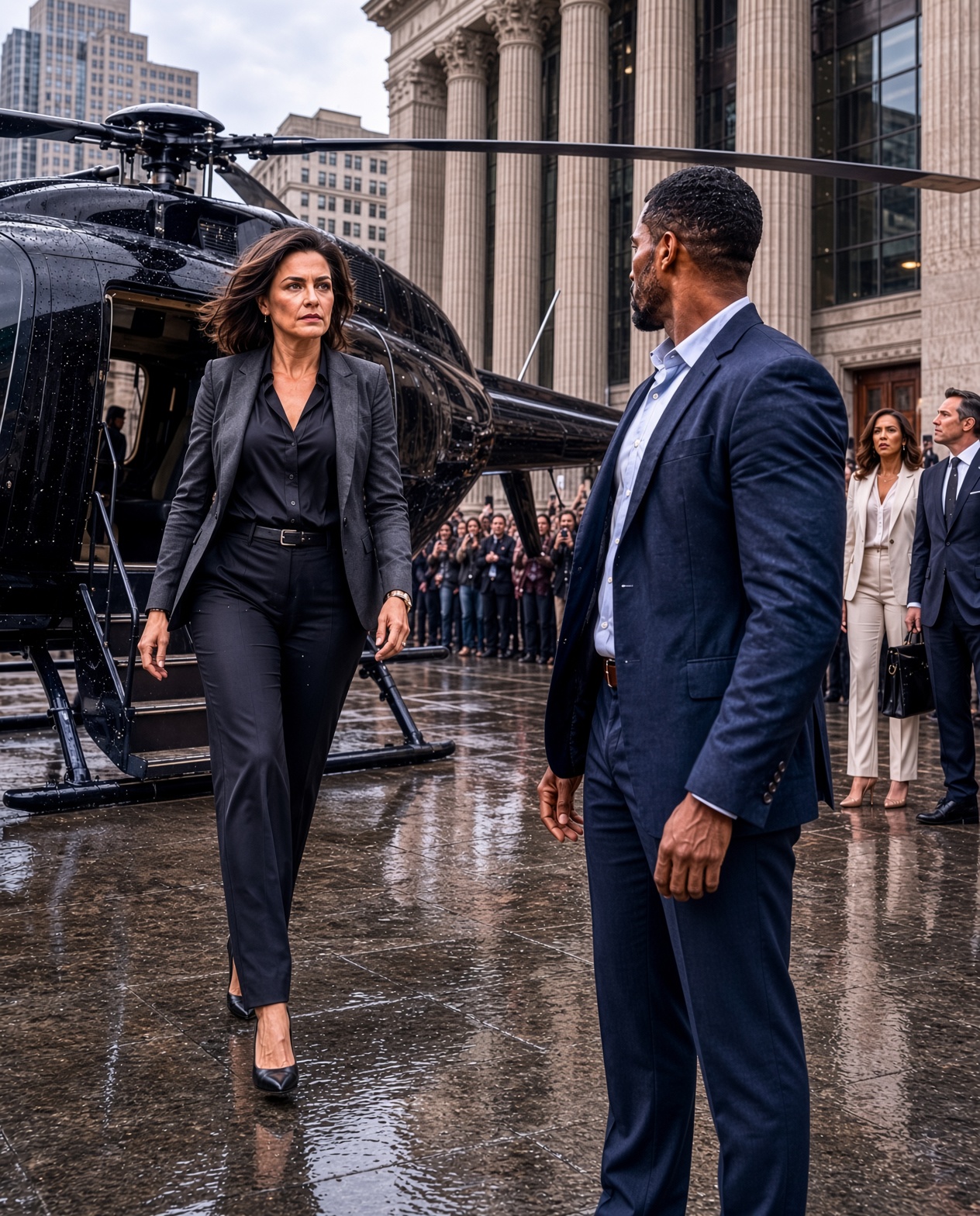
The courthouse steps were still wet from the morning rain when Isaiah Brooks walked out with nothing. No house, no truck, no savings account he’d spent six years building one overtime shift at a time. The small aviation repair shop he’d opened with his own hands, the one thing outside of his daughter that still felt like him, had been awarded to Monica Hayes by a judge who’d taken 40 minutes to dismantle eight years of marriage.
Monica stood at the bottom of the steps beside her attorney Preston Vale, smiling the way people smile when they’ve already counted the money. Preston said something low into her ear. She laughed. Isaiah didn’t look back. He just kept walking one step at a time while the crowd around the courthouse entrance parted like they were afraid whatever he had might be contagious.
He had made it exactly 12 steps from the door when he heard it. A low, steady thrum cutting through the Houston air, heavy, deliberate. He stopped. A black helicopter descended toward the courthouse plaza bearing a single logo on its side, Sterling Aerotech. And from it stepped a woman that half the country recognized.
Camille Sterling didn’t look at the crowd. She looked directly at Isaiah. “Mr. Brooks,” she said, “I need you.” If you want more stories about real people who refuse to stay down, hit subscribe. There’s a lot more where this came from. Three years before that morning, Isaiah Brooks had been the kind of man people stop noticing.
He lived in a two-bedroom rental in Pasadena, a quiet [clears throat] suburb southeast of Houston where the streets were flat and the neighbors minded their business. He drove a ’09 Ford F-150 with a cracked side mirror he kept meaning to fix. He wore the same three work jackets in rotation, dark green, navy, and a faded gray that had long since lost its original color to engine grease and time every weekday morning at 7:15.
He strapped Zoe into the passenger seat and drove her to Magnolia Elementary where she would hop out, wave once without turning around, and disappear through the double doors like she owned the place. Then, I would drive to the shop. Brooks Aviation Repair was not impressive by any standard. It it occupied a leased unit in an industrial park off Fairmont Parkway, one bay, one hydraulic lift, and a back wall covered in handwritten notes and technical diagrams that Isaiah had taped up over the years like a man building a private
language no one else could read. He fixed small private aircraft, single-engine Cessnas, aging turboprops, the occasional corporate helicopter whose owner wanted discretion over dealership service. He was good at it. He was fast, precise, and honest about what he found, which in that business [clears throat] made him unusual.
Clients came back not because he was cheap, but because he never invented problems that weren’t there. What no one in Pasadena knew was that Isaiah Brooks had once been an aerospace engineer, not a junior engineer, not a technician with an inflated title. He had designed the rotor stabilization system for a next-generation rescue helicopter at a major aviation Asian contractor called Meridian Aero Solutions.
The system was elegant, a feedback algorithm that kept the aircraft stable in wind shear conditions that would ground conventional rotorcraft. It worked in simulation. It worked in early bench tests. It worked in every controlled environment they could build. And then, during a full-scale prototype trial, something failed. The aircraft destabilized at altitude.
The prototype was destroyed. No one was killed. The test site had been cleared for exactly this contingency, but the project was shut down within a week. Isaiah was given a termination letter and a non-disclosure agreement on the same afternoon. He signed both without argument. Not because he believed he was guilty, but because he was exhausted.
And more than that, because a small persistent doubt had taken root in the back of his mind. What if it was me? He never resolved that question. He just buried it under oil changes and rotor inspections and the daily rhythm of raising a daughter alone. Some days he almost forgot it was there. Most days he didn’t.
Monica had entered his life 2 years after Meridian. She was sharp, energetic, and relentlessly forward-looking. Qualities Isaiah had admired until he understood that her vision of the future had a specific income threshold, and he was standing well below it. She had wanted a man on his way up. What she’d found by the time she understood it fully was a man who had already been up and come back down and made a kind of peace with the ground. The marriage lasted 4 years.
The last one was mostly silence and the particular exhaustion of two people who have stopped explaining themselves to each other. When she filed, Isaiah didn’t fight the asset division. He fought for Zoe. That was the only thing he walked into that courtroom prepared to lose sleep over.
Everything else, the house, the truck, the shop, was just property. Property could be rebuilt. 8 years of Zoe’s mornings couldn’t be recovered. What he had not anticipated was Preston Vale. Isaiah had seen Preston for the first time in the hallway outside the courtroom 20 minutes before the hearing began. The attorney was on his phone standing with his back partially turned speaking in a tone that was too low and too careful for a routine legal call.
Isaiah caught fragments before the filing to aid no traceable connection before Preston noticed him and shifted with without acknowledging him. It meant nothing to Isaiah in that moment. He had a hearing to survive, but he remembered it. He filed it the same way he filed a noise in an engine that hadn’t caused a problem yet something to come back to when the immediate work was done.
The judge took 40 minutes. Monica received the house, the truck, the savings account and the shop. Isaiah received primary custody of Zoe. Preston gathers his folders with the unhurried efficiency of a man accustomed to winning and then just before he turned to leave, he looked at Isaiah not with satisfaction, with something closer to confirmation.
The look of a man checking something off a list he’d been working on for longer than this morning. Isaiah filed that look away, too. He walked out into the wet morning air and started down the steps. Preston’s parting shot came at the bottom of the steps. He didn’t raise his voice. Men like Preston Vale never needed to.
He simply fell into stride beside Isaiah for exactly 3 seconds, long enough to be heard, short enough to maintain deniability, and said, “You should be grateful, Mr. Brooks. A lot of men in your position don’t even get to keep the kid.” Isaiah stopped walking. He didn’t respond. He looked at Preston the way a man looks at a structural flaw he’s already calculated the load-bearing capacity of quietly.
Without surprise and then he kept moving. Monica said nothing. She stood at the base of the steps in a cream blazer that probably cost more than Isaiah’s monthly rent. Watching him with the calm expression of someone who had already moved on before the verdict was read. Yeah, she wasn’t gloating. That would have required her to still consider him worth the energy.
Isaiah was 11 steps from the courthouse door when the sound reached him. It came from the south, low and rhythmic, cutting through the ambient noise of downtown Houston with a kind of authority that made people stop mid-conversation and look up. A helicopter, not the traffic variety. Something heavier, more deliberate.
Isaiah knew the difference by sound alone, a habit left over from a former life that had never entirely released its grip on him. He turned. The aircraft descended toward the open plaza in front of the courthouse with unhurried precision, its black fuselage catching the pale morning light. The logo on the side was simple, Sterling Aerotech in white, clean enough to be read from 200 ft.
It touched down without drama, without a crowd barrier, without any of the theatrical production that usually accompanied wealth performing itself in public. The landing was exact, professional, the kind of approach that comes from a pilot who has done this in worse conditions and on worse surfaces. The door opened.
Two staff members stepped out first, then moved aside. Camille Sterling was 51 years old and looked like someone who had stopped caring what that meant a long time ago. She wore a charcoal jacket over a plain dark shirt, no jewelry beyond a watch, and moved across the plaza with the purposeful stride of a person whose time was both extremely valuable and entirely her own.
She didn’t scan the crowd or acknowledge the people pulling out phones. She had already identified Isaiah before she landed. She walked to him and stopped at a conversational distance, not close enough to be intimate, close enough to mean business. “Mr. Brooks,” she said, “my name is Camille Sterling. I’m the CEO of Sterling Aerotech, and I’ve been trying to reach you through three intermediaries for the past 6 weeks. You don’t return calls.
“I’m not in the industry anymore,” Isaiah said. “I know what you are now,” Camille said. “I also know what you were, and I need what you were.” She paused, not for effect, but because she was precise with language and didn’t fill space with unnecessary words. “We have a rescue helicopter project in development, 14 months behind schedule.
My engineering team cannot resolve the rotor stabilization problem. I’ve read every credible paper written on the subject in the past decade, and the closest anyone ever came to solving it was in a design brief that was shelved at Meridian Aero Solutions 9 years ago.” Isaiah was quiet for a moment.
“That project failed,” he said. “The project was terminated,” Camille said. “That’s not the same thing.” She held out a business card, plain white, Sterling Aerotech logo, her direct number handwritten below the printed one. The kind of detail that meant she’d prepared this card specifically for him, not pulled it from a stack.
Then she added, “I’ve been following your work history for 3 months. I knew you had a court date this week. I didn’t come here to make a scene. I came because 6 weeks of messages through intermediaries told me you weren’t going to call back on your own, and I’m running out of time. The project is running out of time. People who need that aircraft are running out of time.
” It was the most straightforward explanation he’d ever been given for something that looked from the outside like a dramatic gesture. She hadn’t dressed it up in sympathy or spectacle. She’d given him the operational logic, clean and unadorned, and left the decision to him. He appreciated that more than she knew.
Behind her, Monica had gone very still. Preston was watching the exchange with an expression that had shifted the practiced calm, replaced by something tighter, more calculating. A man revising his assumptions in real time, Isaiah noticed. He filed it away alongside the phone call in the hallway and the look at the top of the steps.
The file was getting thicker. Isaiah looked at the card for a long moment, then he took it. He didn’t call for 4 days. He picked up Zoe from her aunt’s house that afternoon, made her grilled cheese for dinner, helped her with a worksheet on fractions that she insisted she didn’t need help with, and then sat at the kitchen table after she was asleep and stared at Camille Sterling’s business card like it was a piece of evidence he hadn’t yet classified. He turned it over twice.
He set it down. He picked it up again. On the second day, he drove to the industrial park out of habit, the muscle memory of 6 years pulling him southeast on Fairmont Parkway before his conscious mind caught up. He sat in the parking lot across from the unit that had been Brooks’ Aviation Repair and looked at it for 10 minutes, saw someone had already changed the lock. He drove home.
On the third day, Zoe asked him why he wasn’t going to work. “Taking a few days,” he said. “Are we poor now?” she asked, not with fear, with the matter-of-fact curiosity of a child who had learned early that the world had different categories and wanted to know which one they were in at any given moment. “We’re fine,” he said.
She looked at him the way 8-year-olds look at adults when they suspect they’re being managed, then went back to drawing what appeared to be a helicopter with an extremely ambitious rotor configuration. He looked at it over her shoulder for a moment before she covered it with her arm. “It’s not done,” she said.
On the fourth day, Isaiah called. Camille answered on the second ring. She didn’t say, “I’m glad you called,” or “I was beginning to wonder.” She “Can you be at the facility tomorrow at 9:00?” He said he needed to arrange care for his daughter first. She said, “Of course. Let me know if the time needs to shift.
” Then she ended the call. No pleasantries, no preamble. He found he didn’t mind. The Sterling Aerotech facility was 40 minutes north of Houston. A campus that looked from the outside more like a research university than a corporation. Low buildings, carefully maintained grounds, the kind of architecture that said, “We are serious about what happens inside here.
” Without needing to announce it on the facade. Isaiah arrived at 9:03 and was met by a project coordinator named Derek, who walked him through two security checkpoints and a hallway lined with framed patents. Dozens of them dating back 20 years before delivering him to a conference room that smelled like burnt coffee and whiteboard markers.
Camille was already there, along with four engineers who looked at Isaiah the way people look at a used car a friend has recommended, willing to believe, not yet convinced. She introduced him simply as the consultant I mentioned without elaboration or ceremony. The lead engineer was a heavy-set man named Russell, who had the specific kind of confidence that comes from being very good at something for a long time and knowing exactly where the edge of that competence is.
He slid a tablet across the table without preamble. “We’ve run 412 simulations,” Russell said. “The system destabilizes in high shear wind conditions above 60 kn. Every adjustment we make to compensate creates a secondary oscillation problem in the tail assembly. We fix one, we create the other. We’ve been going in circles for 6 months.
Isaiah looked at the model without speaking. He studied the architecture of the algorithm, the logic of how it was structured, where it pulled its inputs, what it was optimizing for. He asked to see the base code. Russell glanced at Camille. She nodded once. For the next 3 hours, Isaiah went through the code and the mechanical specs without asking for anything except occasionally more coffee.
The other engineers cycled in and out. Camille stayed working from her own laptop at the far end of the table present without hovering. At one point, she took a call and stepped outside. And when she came back, Isaiah had moved to the whiteboard and was drawing a feedback loop diagram that looked nothing like what was in their model.
Russell stood and studied it for a long moment. “You shifted the input variable,” he said. “Your system is trying to correct after the deviation occurs,” Isaiah said. “It’s reactive. You need it to anticipate the deviation based on incoming wind data. Read the conditions a half second ahead of the stress event and preposition the stabilization response.
The algorithm isn’t wrong. It’s just reacting to the wrong moment.” The room was quiet in the particular way rooms get quiet when something clarifying has been said. Russell looked at the diagram for a long time. His expression moved through skepticism, consideration, and something that was not quite agreement, but was adjacent to it.
Then he picked up a marker and started asking questions. Real questions, the kind that meant he was taking the diagram seriously and testing it from the inside. They worked until 6:00 in the evening. By the time Isaiah drove back to Pasadena to pick up Zoe, his temporary badge was in his jacket pocket and Russell had agreed to run a new simulation series overnight.
By the end of that first week, Isaiah had a dedicated workstation and the quiet grudging respect of Russell’s engineering team. The kind that doesn’t come with compliments. Only with people stopping their side conversations when you walk in and directing questions towards you that they used to take to Russell. Russell himself remained measured.
But he stopped looking at Isaiah the way he had on that first small smart thing. They developed a working shorthand, the way engineers do when they found they’re solving the same problem from compatible angles. Isaiah hadn’t agreed to anything permanent. Camille hadn’t pushed. That arrangement suited them both and both of them knew it.
On the eighth day, while cross-referencing his new simulation data against the original Meridian project files, which Camille had obtained through channels she declined to detail, Isaiah found something that had nothing to do with the current model. He found a version number. It was embedded in the metadata of a test log from the Meridian prototype trial, the one that had ended his career nine years earlier.
The log was dated three days before the failed test. But the algorithm version recorded in the log didn’t match the version Isaiah had submitted for that trial. It was a different build. An earlier iteration, one he’d moved past weeks before the final submission with a known instability in crosswind conditions above 50 knots.
Someone had swapped the files. They had replaced his final corrected algorithm with an earlier flawed version and then logged the trial as though it had run on his submitted work. Isaiah sat very still for a long time. Outside the window of his workstation, the late afternoon light had gone orange. He could hear the ventilation system and nothing else.
Then he pulled up the full test record and went through every document methodically. The way he would diagnose a fault in an engine he’d never seen before, without assumption, without conclusion, until the evidence was complete, following each thread wherever it led before allowing the pattern to form.
By the time he was done, it was past 7:00 in the evening and the building had mostly emptied out. He sat in one of the quiet of the facility and understood for the first time in 9 years that the question he’d been living with, what if it was me, had an answer. It wasn’t him. He called Camille. She came back to the facility within 30 minutes, which told him something about how seriously she took an unscheduled evening call from a temporary consultant who had been careful up to this point not to ask for anything.
He walked her through what he’d found. The version discrepancy, the metadata timestamps, the chain of custody gaps in the logged files. He was careful and precise, laying out what the evidence showed and what it didn’t. What he could claim and what remained uncertain. When he finished, she sat across from him and was quiet for a moment.
“You’re saying the test that ended your career was run on a version of your algorithm you didn’t submit.” she said. “I’m saying the metadata shows that.” Isaiah said carefully. “I don’t know who changed it or why. I just know it wasn’t the build I signed off on. I’ll have our legal team look at the chain of custody on these files.” Camille said.
“I’m not asking you to do that.” Isaiah said. “I know.” she said. “I’m doing it because it matters.” A pause. “And because if someone buried your work 9 years ago, They may have an interest in making sure it stays buried now. That’s not a small thing for either of us. Neither of them said more than that, but something had clarified in the room.
Not a conclusion, but a shared orientation. They were, without having agreed to it formally now, looking in the same direction. The news that Isaiah was consulting for Sterling Aerotech leaked within the following week. The aviation industry was smaller and more interconnected than it liked to appear. And someone at the facility mentioned it to someone who mentioned it to someone else.
By the time it reached Monica, it had already been repeated enough times that it arrived with the weight of established fact rather than rumor. She called Isaiah that same evening. He let it go to voicemail. She called again. He picked up the second time because Zoe was in the next room, and he didn’t want the phone ringing a third time at 8:00.
“I heard you’re working with Camille Sterling,” Monica said. Her voice had a quality he hadn’t heard in a long time, careful. Each word placed with more deliberation than the sentence required. “Consulting,” he said. “Temporarily.” Isaiah, a pause that carried more weight than pauses usually do. “I think we should talk.
” “In person, not about the settlement, just talk. For Zoe’s sake.” He recognized the architecture of that sentence. The way for Zoe’s sake was placed at the end where it would land with the most force, framing what came before it as something selfless. “I’ll think about it,” he said, and ended the call. He sat for a moment in the kitchen looking at nothing in particular.
Through the doorway, he could see Zoe’s bedroom light still on. She was narrating something to herself, a quiet continuous commentary she kept up when she she drawing, addressed to no audience in particular. He listened to it for a moment, then he texted Camille’s project coordinator to confirm his schedule for the following week, turned off the kitchen light, and went to check on his daughter.
Monica came to the facility the following Tuesday. Isaiah hadn’t agreed to meet her there. He’d suggested a diner near Zoe’s school, neutral ground, somewhere that didn’t carry the weight of context. But Monica arrived at the Sterling Aerotech visitor entrance with a coffee she’d brought for him, and the specific kind of composure that takes sustained effort to produce.
And the security desk called Isaiah down before he had a chance to redirect her. He met her in the lobby. She handed him the coffee with a small smile that stopped just below her eyes. He accepted it because declining would have made the conversation about the coffee instead of whatever she’d actually come to say. “I just wanted to see where you were working,” she said, taking in the lobby’s clean architecture, the framed aerospace photography arranged along the far wall. “It’s temporary,” Isaiah said.
“You keep saying that.” “Isaiah, I said things in that courtroom that weren’t entirely fair. I was scared. I made decisions I’m not proud of.” He waited. He had learned in the later years of their marriage that the sentence after that kind of opening was the one that mattered. “I’m not asking to undo anything,” she said.
“I just think Zoe needs her mother present in a real way. And I think you and I could find a way to be in the same room without it being a war.” It was a reasonable thing to say. That was what made it difficult to answer. Not because it was manipulative, but because it was packaged in the language of reasonableness while resting on a foundation he couldn’t quite trust.
“We can talk about the visitation schedule,” he said. “I’ve never tried to cut cut you out of her life. That’s not what I mean,” Monica said, and her voice shifted into something quieter, more carefully aimed. “She needs stability. You coming to work for some billionaire who found you on the worst day of your life, that’s not stability, Isaiah.
That’s someone taking advantage of a moment.” “Camille Sterling didn’t take advantage of anything,” he said. “She offered me work. I evaluated it and said yes.” “Did you?” Monica asked, “or did you say yes because someone powerful finally paid attention to you?” He set the coffee down on the lobby desk, untouched.
“I’ll have my attorney reach out about the visitation schedule,” he said. “We’ll get something structured.” He walked back to the elevator. She didn’t follow. He was three floors up, standing at his workstation, before he allowed himself to feel the full weight of what she’d said. Not because it was right, because the particular fear she’d named, being seen and used by someone with more power than you, was one he’d been carrying since Meridian, and she had found it with the precision of someone who had studied him
for 8 years. He turned back to the stabilization model and worked for the rest of the afternoon without stopping. That evening, a man named Gary Weston called him. Gary ran a small parts supply business that Isaiah had worked with during his Meridian years, a low-key meticulous man who specialized in sourcing precision tolerance components for niche aerospace applications.
Gary was nervous in the particular way of someone who had received a call that made him uncomfortable and didn’t know what to do with the information. An attorney had been contacting people in Gary’s professional network over the past 2 weeks, asking questions about Isaiah’s work history. Specifically, had Isaiah ever accessed proprietary design files outside of official project channels? Had he ever taken documentation home? Did Gary have any records of transactions that might reflect unauthorized use of company
resources? Gary described the attorney in enough detail that Isaiah didn’t need the name. He recognized Preston Vale from the description without hesitation. He thanked Gary, ended the call, and sat with that information the way he sat with technical problems, quietly letting the shape of it clarify before reacting.
Preston was laying groundwork, not for anything that had happened, but for a story he wanted available if he needed it. Isaiah had seen this kind of preparation before in the weeks before his Meridian termination and had known what he was looking at. He knew now. He called Camille and told her about Gary’s call without interpretation, just the facts of it.
She listened without interrupting, and then told him her procurement team had already flagged a discrepancy in the tail assembly supply chain, a component substitution that had been requested 6 weeks ago through a third-party channel. The replacement part met the written specification on paper, but the quality team had flagged a tolerance mismatch against the assembly’s actual operational requirements.
“When is the prototype test?” Isaiah asked. “11 days.” Camille said. “Pull the component.” Isaiah said. “Run the test with the original spec part, even if it sets you back.” A pause. “That’s a minimum 3-week delay. The board is already watching the schedule.” “I know.” Isaiah said. “Pull it anyway.
If that component is installed when the system runs at full load, we’re not going to have a 3-week problem. We’re going to have a 6-month problem. I’ll talk to procurement in the morning, she said. What neither of them knew in that moment was that the procurement order had already been locked. The substituted component had been installed 2 days earlier during a standard maintenance window.
When Camille called the procurement lead the next morning, she was told the installation was complete. The part was within documented tolerance. And reversing it would require a full disassembly that the testing timeline simply could not absorb. The procurement lead had already run it up the chain. The board, citing schedule and the upcoming investor review, approved proceeding. Camille pushed back hard.
She sent the quality team’s tolerance analysis directly to three board members. She asked for a 48-hour hold on the test date. The board declined. The test date held. The prototype test was held on a Thursday morning in Sterling Aerotech’s main evaluation hangar, a structure large enough to contain a full-scale rotor test rig with significant ceiling clearance.
Camille had arranged for three members of the board of directors to attend, along with two senior representatives from a federal emergency management agency that had been in preliminary acquisition talks with Sterling about a fleet procurement contract worth, by the most conservative estimate, 240 million.
It was, by any measure, the most consequential public demonstration in the company’s recent history. Isaiah arrived early and flagged the component concern to Russell directly before the test briefing began. Russell took it seriously. He escalated it immediately to the procurement lead, who reiterated the board’s decision to proceed and added that raising the issue further would require going to Camille who had already been overruled on this specific point.
Russell looked at Isaiah. Isaiah looked back. Neither of them had a good move left. The test began at 9:00 a.m. for the first 4 minutes. Everything performed exactly as the simulations had predicted. The rotor system held through the first and second wind shear sequences without deviation. The readouts were clean in the observation area.
The FEMA representatives were making quiet, approving comments to each other. One of the board members had uncrossed his arms. Isaiah stood at the monitoring station and watched the numbers and felt the particular tension of a man who knows something is coming and cannot stop it. He was not wrong.
At 4 minutes and 17 seconds, the tail assembly began to oscillate. The frequency was immediately recognizable, the harmonic signature of a tolerance mismatch under sustained operational load, the exact failure mode he had predicted. He called it out loud before the automated alert system triggered.
Russell was already in motion shouting to the floor. Two technicians cut power to the test rig. The prototype lurched forward, caught against the deceleration baffles, and came to a hard rest against the reinforced wall on the north end of the hangar. No fire, no structural collapse, but the main rotor assembly was bent beyond serviceability.
Two primary instrument panels were destroyed, and the aircraft would require a minimum of 6 weeks of repair before another test could be scheduled. The hangar held a long, careful silence. Then Gerald Hatch, the board member who had uncrossed his arms, turned to Camille and said, in a tone that had nothing to do with engineering and everything to do with liability, “This is the consultant’s modification.
The failure originated in the tail assembly.” Isaiah said, keeping his voice level, “I flagged a component tolerance concern last night and again this morning. The component was not replaced before the test. And who approved the algorithm changes that placed additional load demand on the tail assembly?” Hatch said the question hung in the air of the hangar.
Nobody answered it directly. Nobody needed to. By noon, a detailed account of the test failure had appeared on an aviation industry news platform accurate in its technical particulars, which meant the information had come from someone who was either in the hangar or briefed by someone who was. The piece described Isaiah Brooks as a disgraced former Meridian engineer with a history of prototype failures brought in by Camille Sterling over the objections of her senior technical staff.
By 3:00 line in the afternoon, Monica had given a brief interview to a local Houston outlet. She used measured language. She expressed concern about the influence that certain new relationships had come to exert over her ex-husband’s decision-making. She said she hoped their daughter would be shielded from whatever came next. Hatch called Camille at 4:30.
Isaiah was still at his workstation when she came to find him. He had been going back through the test data tracing the failure point, documenting what he could with the access he still had. He could read the conversation she just finished from the way she carried herself into the room. Not broken, but carrying something heavy.
“The board is requiring a formal technical review before any further algorithm modifications proceed under your guidance,” she said. “Hatch has the votes to suspend your facility access during the review period. If he calls that vote, I can’t stop it.” Isaiah looked at her for a moment.
Then he looked at the whiteboard. The stabilization diagram was still there. The one that had solved the actual problem. The one that had nothing to do with the tail assembly or the failed component or any of the things being discussed in boardrooms and news sites tonight. “I’m going to step back from the project,” he said.
“Isaiah, not because I did anything wrong,” he said. “Because I’m not going to let this become the thing that cost you what you’ve built.” She didn’t argue. He could see her processing it, could see that she had a counter-argument ready, and was choosing deliberately not to use it. He understood that decision and respected it more than he would have respected the argument.
He put on his jacket. He removed his temporary badge and set it on the corner of the workstation desk where someone would find it in the morning. He walked out of the Sterling Aerotech facility and got in his car and drove south through the last of the Houston evening traffic. He packed up the whiteboard diagrams when he got home home, not because he needed them.
He had the work memorized in the way that only comes from living with a problem for months. Turning it over until it stops being a puzzle and becomes something closer to an old argument you’ve had so many times you know both sides better than the people originally holding them. He packed the diagrams because leaving them unrolled against the kitchen wall felt like something he wasn’t ready to be.
Zoe was at the kitchen table doing homework when he came in. She watched him carry the rolled tubes to the corner without comment in the way she had learned to watch adults do things she didn’t yet understand attentively without rushing to fill the space with questions. He made dinner. Pasta because it was fast and she liked it and he wasn’t capable of anything more complicated tonight.
They ate mostly in silence, which had never been uncomfortable between them. >> [clears throat] >> She told him about a dispute at recess that had been resolved through what she described with considerable self-satisfaction as negotiation. She had agreed to let a boy named Marcus use her colored pencils for the afternoon in exchange for his lunch cookie.
Isaiah told her that sounded less like negotiation and more like a transaction. She considered this seriously and concluded that the distinction probably didn’t matter if both parties left satisfied. He laughed. It surprised him, the sound of it and the fact of it. After dinner, she went to her room. Isaiah sat at the kitchen table with a cup of coffee that went cold while he worked through it for the hundredth time, the test data.
The component Gary called the article, the look on Hatch’s face before the test had even begun. He could see the architecture of what had been built around him. The pieces were too precisely placed to be coincidence. Someone had designed this, had selected each element and positioned it for maximum effect at maximum timing. He could see the structure.
He just couldn’t yet prove it in a way that would matter. He was still sitting there when Zoe appeared in the doorway in her pajamas holding a piece of paper. She crossed the kitchen and set it on the table in front of him. It was the Sterling prototype drawn in her particular style. Oversized rotors, the fuselage rendered in careful parallel lines.
And the tail assembly depicted with a small hand-drawn X through it. And an arrow pointing to a component she had labeled in her precise block printing the right one. He looked at it for a long moment. “Where did you see the tail assembly specs?” he asked. “Your whiteboard,” she said, “the one you packed up.
” He nodded slowly. She leaned against the edge of the table and studied the drawing alongside him as if they were reviewing it together in some professional capacity. Then, without looking up, she said, “Dad, can that helicopter save people?” “If the design is right, yes,” he said, “a lot of people in places that are hard to reach.” She was quiet for a moment.
Outside, a car passed on the street. The refrigerator made its small settling sound. “So, why’d you stop?” She wasn’t being rhetorical. She was 8 years old, and she wanted an actual answer with the same blunt, genuine curiosity she’d brought to the question of whether they were poor now and the cookie for pencils negotiation versus transaction question.
She wanted to know the real thing. Isaiah looked at the X she’d drawn through the faulty component. He looked at the arrow pointing to the right one. He didn’t have a good answer, and the absence of one told him something that 3 days of sitting at this table had not been able to tell him on its own. Camille had not stopped working while Isaiah sat at his kitchen table.
She was in the Sterling Aerotech data center with her lead attorney and the company’s head of procurement going through the tail assembly supply chain documentation from the original specification all the way to the installation record. She was looking for the shape of what she already suspected.
She found it before morning. The substituted component had been sourced through a third-party procurement channel, not illegal on its face, but unusual for a part with tolerances as precise as this one required. The vendor was a small firm called Arkway Part Solutions, incorporated 18 months ago in Delaware.
It had no public presence, no listed staff, and only two active clients on record. One of those clients was a shell company after two layers of incorporation. That company connected to a holding group that had 7 years prior retained Preston Vale as outside legal to counsel for a series of patent acquisition transactions. Camille set that document down and looked at it without speaking for a long time.
Her legal team then pulled the Meridian test records that Isaiah had flagged. A forensic data analyst she kept on retainer confirmed what the metadata suggested. The algorithm version logged in the Meridian trial had been replaced after the fact. The original file had been accessed from a Meridian server that had been officially decommissioned 4 years ago.
But before it was wiped, its access logs had been backed up to a secondary archive that no one had thought to include in the decommissioning scope. The backup was still there. The access record was still in it. The timestamp and the originating account were intact. Preston Vale had served as outside legal counsel for Meridian Aero Solutions from the year before the prototype failure through the year after Isaiah’s termination.
During that period, one of his largest retaining clients had held a patent on a competing rotor stabilization. This kind of patent that Isaiah’s design had it succeeded would have rendered commercially irrelevant. Camille called Isaiah at 6:47 in the morning. He picked up on the first ring, which told her what she needed to know about his night.
She told him what she had found, precise and methodical, presenting it in the order she had assembled it without reaching conclusion before the evidence supported them. “He buried your work 9 years ago because your design would have undercut a patent worth hundreds of millions to his client. She said, “Terminating the project wasn’t sufficient.
He needed to make certain you couldn’t resurface. The NDA you signed helped, but it wasn’t enough on its own. He needed your credibility destroyed.” Isaiah was quiet. “And the component substitution?” he said. “Same logic, different timeline. If the Sterling prototype failed under your modifications, you were finished permanently.
No one in this industry would work with you again.” A pause. “He came very close to making that work.” “How did you trace the Archway connection?” Isaiah asked. “Carefully,” Camille said, “and with considerably more coffee than was advisable.” He almost smiled. “My legal team is filing with the FAA this morning and forwarding the Meridian evidence to the district attorney’s office,” she said.
“The procurement fraud touches federal contracting regulations, which gives the DA jurisdiction over both both matters.” She paused. “And I need you to come back.” “The board,” he started. “The board will receive a full briefing on what I found this morning before noon,” Camille said. “Gerald Hatch can revise his position based on the evidence, or he can explain to federal investigators why he was so insistent on removing the one person who had correctly identified the failure source before the test began.
Those are his options.” Isaiah said nothing for a moment. Through the window of the kitchen, he could see the early light coming up over the rooftops across the street, flat and gray and ordinary. The same light that had been coming up over those same rooftops every morning for the two years he’d been renting this house.
“I’ll be there at 9:00,” he said. Two days later, Monica came to the rental house. She arrived in the late afternoon, unannounced and stood on the porch without the composed precision she’d carried into the Sterling lobby. She looked like someone who had spent 48 hours running calculations and arrived at a result she hadn’t wanted.
“Preston’s under federal investigation.” she said. “I know.” Isaiah said. “I didn’t know the scope of it.” she said. “I knew he was aggressive. I knew he was effective. I didn’t know about Meridian. I didn’t know about the supply chain.” She held his gaze steadily. “I came back to you because I saw what was happening with Sterling and I thought there was something in it for me.
I need you to know that I understand that about myself.” Isaiah leaned against the door frame. “I know.” he said quietly. “I’m not asking for anything.” she said. “I just needed to say it plainly to someone who deserved to hear the plain version.” He nodded. There was nothing to add. She had told the truth about herself without wrapping it in anything that made it easier to give or more comfortable to receive.
That was its own kind of accounting and he respected it for what it was. “We’ll figure out the visitation schedule.” he said. “For Zoe, something structured that works for both of you.” Monica nodded. She left without looking back. Isaiah stood in the open doorway and watched the street for a moment.
Then he closed the door and went inside. The Brooks Sterling Rescue Aviation Center opened on a Thursday in late October. 14 months after a black helicopter had landed in front of a Houston courthouse and a woman had told a man with nothing that she needed exactly what he had. Point. 14 months was enough time to rebuild the prototype, complete the certification process, negotiate the community rescue Isaiah had made a condition of his continued involvement, and open a training facility for the rural emergency response teams that
would operate the aircraft. It was not enough time to make any of it feel entirely real to Isaiah, who had spent enough of his life watching things he’d built get taken apart that completion still carried a slight quality of surprise. Camille had declined the event planners full proposal.
No string quartet, no assigned seating, no catered reception designed to impress people who were already impressed by their own attendance. Instead, there was a gathering on the tarmac outside the main hangar. Folding chairs arranged in careful rows, a simple podium, coffee and paper cups, and the kind of crowd that had come because they had a reason to be there.
Representatives from three county emergency management offices, two hospital administrators from rural East Texas districts whose patients had in the past died waiting for aircraft that couldn’t hold steady in the wind conditions that define their geography, a wildfire response unit from New Mexico that had spent four months in the beta testing program and had opinions about every system on the aircraft, most of them positive.
Russell stood near the back with three members of his engineering team. The expression on his face was the particular satisfaction of a man who had spent 14 months solving something that hadn’t been solvable before and was now watching it prepare to fly. And Zoe in a blue dress she had selected herself and defended against two alternative suggestions sitting in the front row with her colored pencils in her jacket pocket because she had decided she might want to document the aircraft after the ceremony.
She was sitting with the focused stillness of someone who has decided to pay attention and means it. Isaiah spoke from the podium without notes. He was not a man who was comfortable performing for crowds, and he didn’t try to be. He spoke the way he worked, with clarity and without decoration.
He talked about what the aircraft was built to do. Reach a family stranded on a flooding road when conventional vehicles were stopped and conventional aircraft couldn’t hold position in the wind. Put a surgeon on the ground at a wildfire perimeter. Close the distance between the people who needed help and the people capable of giving it in the conditions where that distance had always been uncrossable before.
He did not mention Meridian. He did not mention the courthouse or Preston Vale, who was at that moment in the preliminary stages of a federal proceeding that was expected to take the better part of 2 years to resolve. He thanked Camille. He thanked Russell and the engineering team. He looked at Zoe in the front row, and she gave him a small, precise nod that was so composed and adult that the woman sitting beside her covered a laugh with her hand.
The prototype lifted off at 11:00 in the morning for its first official demonstration flight. It moved through the wind shear sequence that had been designed to replicate the conditions of a category one storm corridor, the test that had broken every previous iteration of the system, and it held, clean and steady without deviation, exactly as the algorithm had always been designed to perform.
Zoe watched with her neck craned back and her mouth slightly open. She had forgotten about the colored pencils entirely. After the crowd began to disperse, Isaiah found Camille near the far edge of the tarmac. Away from the remaining groups still talking through the demonstration, she had her jacket collar turned up against the October wind, watching the aircraft complete a second pass over the facility before beginning its approach.
They stood without talking for a while. The silence between them had become over 14 months the kind that doesn’t need filling. The kind that means you’re not managing the other person’s presence, just sharing it. “Monica was here.” Isaiah said in the back rows. Camille glanced over her shoulder briefly. “I saw her when she arrived.
” She left before the flight, he said. Camille nodded. She didn’t offer a reading of it, which was right. After a moment, she turned to look at him. “Any regrets?” she asked. Plain question asked plainly, the way she asked everything that mattered. Isaiah was quiet. He watched the aircraft complete its arc and begin its descent back to the tarmac.
The rotors tracking exactly through the crosswind. The tail assembly holding precisely where it should. The entire system doing what it had been designed to do for 9 years. While the person who designed it was fixing other people’s aging Cessnas in a parking lot in Pasadena. “Some.” he said. He let the silence sit for a moment before he continued. “Not about this.
” Camille held his gaze. That answer had told her what she needed to know. And she understood the difference between what he was saying and what he was not saying. And didn’t push past it. She looked back at the aircraft. Zoe appeared between them. Pulling at Isaiah’s sleeve with the specific urgency of a child who has been patient long enough and has reached the end of it.
She wanted to speak to the pilot. Isaiah told her she could once the rotors had fully stopped. She crossed her arms and stationed herself at the edge of the tarmac and stood there with the focused patience of someone who has made a decision and is committed to it. Camille watched her and said quietly, “She’s going to be an engineer.
She’s going to be whatever she decides.” Isaiah said. “Yes,” Camille said, “that’s exactly what I meant.” He looked at her. She was still watching Zoe, but she was smiling, not the controlled, calibrated expression she used in boardrooms and press interactions, but the real one underneath it, the one that reached her eyes and stayed there.
He didn’t say anything. He didn’t need to. The rotors slowed to a stop. Zoe was already moving. Isaiah Brooks walked out of that courthouse with nothing, no house, no truck, no savings, no shop, just a daughter who drew helicopters at the kitchen table and asked questions that cut straight through every excuse he’d built around himself.
What this story is really about isn’t the helicopter or the billionaire or the man who had spent nine years trying to keep Isaiah buried. It’s about what happens when you stop measuring your worth by what’s been taken from you and start paying attention to what’s still in your hands. Sometimes the worst day of your life is just clearing the runway, and sometimes the person who shows up when you’ve lost everything isn’t there to save you.
They’re there because they need the one thing that nobody managed to take. If this story meant something to you, subscribe. Every week there’s another one about people who held on past the point where holding on made any sense and figured out later exactly why they did. We’ll see you in the next one. >> Mhm.

