Billionaire Bet $1M Against His Maid’s Son — Then a Billion-Dollar Founder Stood Up for Him
Billionaire Bet $1M Against His Maid’s Son — Then a Billion-Dollar Founder Stood Up for Him
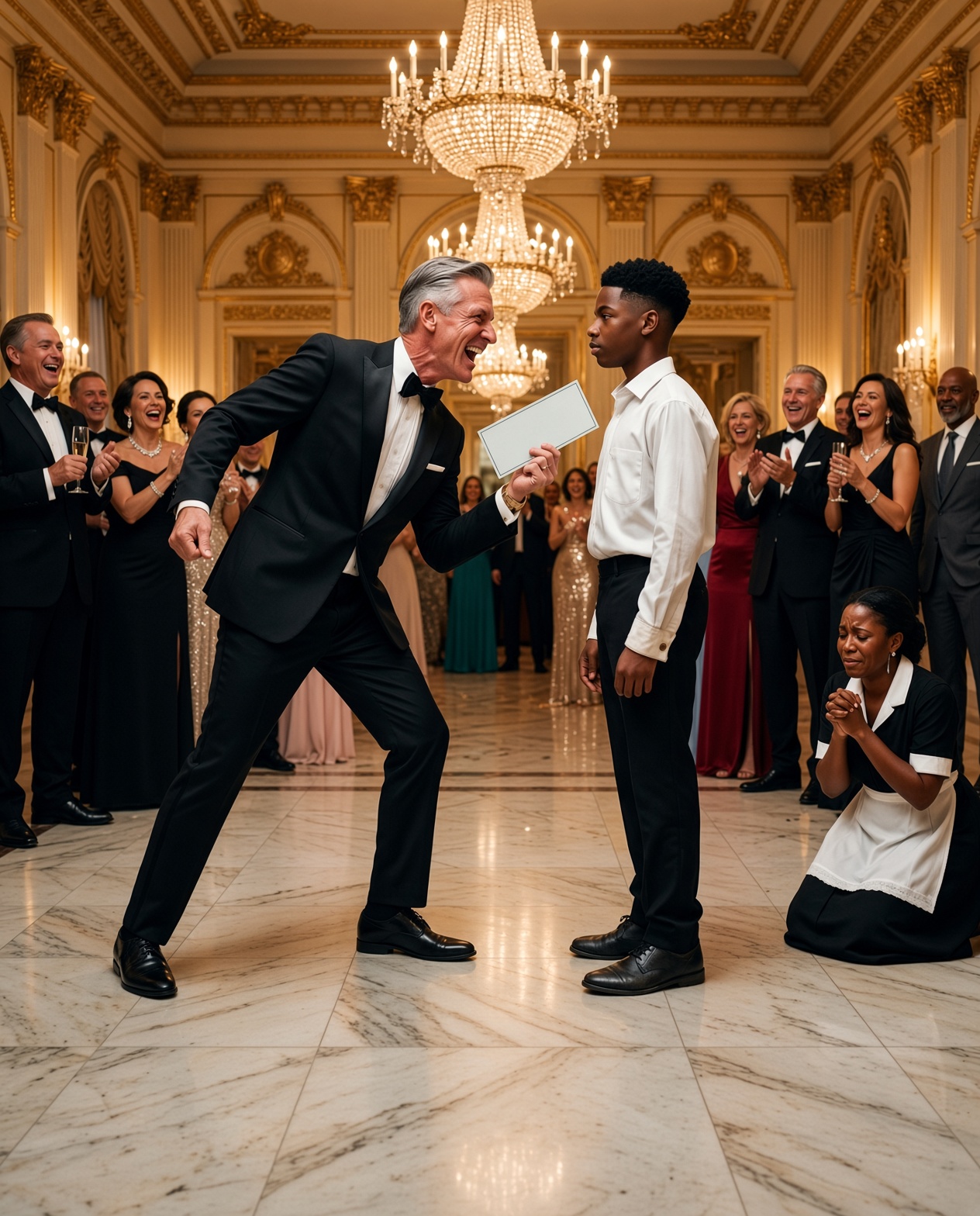
A $100 bill floated through the air and landed at the feet of a 16-year-old black boy in borrowed shoes. “Pick it up,” the billionaire said with a smile. “That’s probably more money than you’ve ever held.” The room laughed. Crystal chandeliers sparkled above them. Senators, investors, and celebrities looked on, but no one stepped forward.
Not one person defended the housekeeper’s son standing alone in the middle of a mansion he would never be invited into. His mother looked terrified. The boy didn’t bend down. He didn’t argue. He didn’t raise his voice. Instead, he kept one hand in his pocket, touching an old brass compass worn smooth by someone else’s hands long ago.
Then he looked at a priceless model airplane sitting under a spotlight and said something so quiet that the laughter almost swallowed it. Sir. The propeller is backward. The room laughed again, but in less than an hour, those same people would be standing on their feet. A forgotten name would return from the dead.
and the man who threw that $100 bill would discover that the poorest person in the room was carrying a legacy worth far more than his fortune. The lake looked black beneath the November sky, smooth as polished stone. On the far shore, the Hawthorne mansion glowed like a palace. Light spilled from every window.
Luxury cars curved up the long driveway one after another, their headlights sweeping across statues and trimmed hedges. Inside, a string quartet played beneath crystal chandeliers, while men in tailored suits and women in glittering gowns carried glasses of champagne and talked about stocks, elections, and vacation homes. 16-year-old Elijah Brooks didn’t belong in any of it.
He stood near the service entrance wearing black slacks that were a little too short and a white dress shirt borrowed from a neighbor. He balanced a tray of empty glasses against his hip and watched another limousine pull up. The cold had followed him inside. It still clung to his shoes. Stay close to the kitchen, baby, his mother had told him an hour earlier.
This shift’s running late. As soon as I’m done, we’ll catch the last train home. Angela Brooks disappeared back through the swinging doors carrying a stack of folded napkins. Elijah nodded, though she never saw. He didn’t mind waiting. Waiting had been part of life for a long time. Waiting for buses, waiting outside.
Waiting while his mother finished one cleaning job and hurried to another. He was good at waiting. He set the tray on a side table and looked around. The ballroom sparkled. Servers moved like shadows. Laughter rose and fell in soft waves. Nobody noticed the quiet black teenager standing near the wall. That was fine with him.
His eyes drifted toward an open doorway at the far end of the room, a study. Warm light spilled across the floor. Something inside caught his attention. He stepped closer. At the center of the study stood a glass display case. Inside sat a beautiful model airplane. Its silver wings gleamed beneath a spotlight.
Every tiny rivet seemed perfectly placed. Elijah stopped. Without meaning to, he smiled. He loved machines. Always had. Even when he was little, he’d taken apart broken radios just to see how they worked. His grandfather used to say that machines had their own kind of music. You just had to listen. The airplane looked familiar. very familiar.
He leaned forward slightly. The room around him seemed to disappear. Then he saw it. The propeller. It was backward. A tiny mistake, almost invisible. But once he noticed it, he couldn’t unsee it. He frowned. Whoever assembled the display had mounted the propeller in reverse. The angle was wrong.
The pitch was wrong. The whole thing looked like a sentence with one word out of place. You like it? The voice hit him from behind. Elijah turned. A tall man in a dark tuxedo stood in the doorway, a crystal glass in his hand. Richard Hawthorne. His silver hair was perfectly combed. A gold watch gleamed beneath his cuff.
His smile wasn’t friendly. It looked practiced. Elijah straightened. “Yes, sir,” he said quietly. Richard took a sip of his drink. “Expensive piece.” Elijah nodded. “It is. Do you know what it’s worth?” “No, sir.” Richard smiled wider. “More than your entire apartment building, I’d imagine.” A few guests behind him laughed.
Elijah lowered his eyes. He didn’t answer. More people drifted toward the doorway. Rich people loved a scene, especially when it wasn’t happening to them. Richard looked at the boy’s clothes, the worn shoes, the cheap shirt, the nervous hands. Then he looked back at the airplane. Something in his expression changed.
amusement then superiority. You’ve been staring at it for quite a while. I’m sorry, sir. Thinking about touching it? No, sir. Taking it maybe? The guests chuckled. Elijah felt heat creep into his face. I wasn’t going to touch it. Richard reached into his pocket. He pulled out a crisp $100 bill. Then he let it fall.
The bill drifted slowly through the air and landed near Elijah’s feet. Silence spread across the study. Richard smiled. “Pick it up.” Nobody moved. “Go ahead,” he said. “It’s probably more money than you’ve ever held.” A woman near the doorway laughed into her wine glass. Another guest looked away. Nobody said a word.
From somewhere in the ballroom came the sound of clinking silverware. Elijah stared at the bill. He could hear his mother’s voice in his head. Keep your head down. Get through the night. Go home. He slowly lifted his eyes. Richard was still smiling, waiting, enjoying himself. Elijah didn’t pick up the money.
The silence stretched. Then another voice suddenly appeared. Richard Angela. She stood frozen in the doorway, a tray in her hands. The color had drained from her face. “I’m sorry,” she said quickly. “He’s my son. He didn’t mean any trouble.” “Your son?” Richard asked. She nodded. He was just waiting for me. The guests looked at her.
then at Elijah, then back at the $100 bill. Angela stepped forward. Elijah, come on, baby. But he didn’t move. Richard’s smile grew. You should teach him gratitude. Please, Angela whispered. For one painful second, Elijah saw something in his mother’s eyes that hurt worse than the insult. Fear. Fear of losing her job, fear of losing the little they had, fear she’d carried for years.
He took a breath. Then he looked toward the airplane again, at the backward propeller, at the tiny mistake. His grandfather’s voice seemed to rise from somewhere far away. If you know something is broken, don’t be afraid to say it kindly. Elijah swallowed. Then he spoke very softly. Sir. Richard lifted an eyebrow.
The propeller is backward. Silence. Absolute silence. One woman blinked. A man nearly choked on his drink. Richard stared at him. I’m sorry. The propeller, Elijah said. It’s mounted the wrong way. Nobody moved. For a moment, even the music from the ballroom seemed to stop. Then laughter exploded. A loud rolling wave of it.
Someone slapped a friend’s shoulder. Another guest shook his head. Angela closed her eyes. Richard laughed the hardest. He laughed until tears touched the corners of his eyes. Then he looked at the boy again, and his smile slowly changed. Because Elijah wasn’t smiling. He wasn’t joking.
He was simply standing there, calm, certain, looking at the airplane as though he knew something everyone else in the room had missed. And for the first time that night, Richard Hawthorne stopped laughing. The study grew strangely quiet. A few guests still smiled, but their laughter had become uncertain. Richard turned and looked at the model airplane inside the glass case.
Then he looked back at Elijah. “You think it’s backward?” he asked. Elijah nodded once. “I know it is, sir.” Another burst of laughter rolled through the room. A man in a tuxedo shook his head. “This is getting good.” A woman lifted her phone. “Oh, don’t stop now.” Angela stepped closer to her son. “Elijah,” she whispered.
“That’s enough.” Her voice trembled. He looked at her. She looked tired. The kind of tired that came from years of standing on aching feet and pretending insults didn’t hurt. Mom, I Please. The word almost broke him. She wasn’t embarrassed. She was scared. Scared of losing this job. Scared of being sent home.
Scared because the rent was due next week. Richard noticed. The fear in her eyes seemed to amuse him. He slipped one hand into his pocket and smiled. Interesting. He walked to the display case and opened it. The guests leaned forward. Richard carefully lifted the airplane. It was nearly 3 ft long, its silver body gleaming under the lights.
He held it in both hands. You’re saying this piece has been assembled incorrectly? Yes, sir. And how exactly would you know that? Elijah hesitated. He didn’t want attention. He never had. He simply knew what he knew. The blades are facing the wrong direction, he said softly. The pitch should turn the other way. Silence. Richard stared at him.
You hear that? he said to the room. The housekeeper’s son is giving us an engineering lecture. Laughter erupted again. Someone clapped. Angela’s face burned. She wished the marble floor would open and swallow her. “Sir,” she said quickly. “He didn’t mean any disrespect.” “Oh, I don’t think he did.” Richard’s smile widened. “I think he believes it.
” more laughter. Then a voice from the back of the room spoke. What if he’s right? The room turned. An older man with silver hair stood near the bookshelves. He wore a dark suit and held a glass of sparkling water. Nobody seemed to know exactly when he had entered the study. Richard’s smile faded slightly. “Daniel,” he said.
“I didn’t see you there.” The man nodded politely, but said nothing more. His eyes remained on Elijah. Richard laughed again, louder this time. Well, I suppose we should ask our young expert a few more questions. Angela took a step forward. Mr. Hawthorne, please. He’s just a kid. Richard ignored her. He carried the airplane to the center table and set it down. Come here, son.
Elijah didn’t move. Go ahead, Richard said. You seem fascinated by it. Angela reached for his sleeve. Baby, don’t. He looked at her, then at the airplane, then back at his mother. I’ll be okay, he said quietly. She wanted to believe him, but all she could see was a room full of wealthy strangers watching her son like he was entertainment.
Elijah walked forward. The crowd parted. Someone switched on another lamp. The airplane shone under the light. Richard folded his arms. Tell us something else. Elijah looked at the model. Up close, it was even more beautiful. The paint had been carefully restored. The landing gear was polished.
The cockpit windows had been replaced. But the propeller was definitely wrong. It’s a Mercer Falcon prototype, he said. The room became still. Richard blinked. What? It was built from one of the early Falcon designs. Several guests looked at one another. A woman lowered her phone. Richard’s smile slowly returned. Did you read that online? No, sir. You just guessed.
Elijah shook his head. No. Richard laughed again. Well, now you’ve got my attention. The room laughed with him. Then his expression changed. A familiar look came over him. The look of a man who enjoyed being the center of the room. An audience, a stage, a victim. He looked at Angela, then at Elijah.
An idea had arrived, and everyone in the room could almost see it. Richard slipped the $100 bill from the floor with the tip of his shoe. He picked it up and folded it. Then he smiled. You know what? Nobody spoke. He turned toward the guests. I think we should have a little fun. [clears throat] Several people chuckled.
I host one of the biggest charity events in Chicago every year. He spread his arms. We raise money for young talent. More smiles. So perhaps tonight we should discover whether we have one standing right here. The room laughed. Angela’s face turned pale. Sir. Richard held up a hand. If this young man knows so much about airplanes, let’s test him.
He pointed toward Elijah. If he can prove he actually knows what he’s talking about, I’ll write him a check. A few people murmured. Richard paused. He loved pauses. He loved making people wait. $1 million. The room exploded. Several guests laughed in disbelief. Someone dropped a fork. A woman whispered, “A million?” Angela looked as if she had stopped breathing.
Richard grinned. “But the room grew quiet again. if he can’t answer my questions. He looked directly at Angela. You and your son leave this house tonight. No one moved. You’ll never work for me again. Silence. The words seemed to hang beneath the chandelier. Angela stared at him. “Mr. Hawthorne,” she whispered. “Fair is fair.
” She shook her head. “No, please. Please don’t do this. It’s simple. Tears filled her eyes. This job is all I have. A few guests looked uncomfortable. Others stared at the floor. Nobody spoke. Nobody stepped forward. Richard smiled. “Then perhaps your son should have stayed quiet.” Angela turned to Elijah.
“Baby, don’t answer him.” Her voice cracked. “We’ll go home. Elijah looked at her, then at the room, at the expensive suits, at the people who refused to meet his eyes, at the man who had turned his mother into a spectacle. Slowly, he slipped his hand into his pocket. His fingers touched cool metal, the old brass compass, his grandfather’s compass.
He wrapped his fingers around it. Suddenly, he could hear his grandfather’s voice. One day, somebody will think you’re nobody. Let your work answer for you. Elijah lifted his eyes. He looked at Richard Hawthorne. Then, he looked at his mother. It’s okay, Mom. No, it isn’t. Yes, he said softly. The room waited. He took a slow breath.
Then, he looked back at the billionaire. I’ll answer your questions. Silence. Even the quartet in the ballroom seemed to stop playing. Richard smiled, a broad, victorious smile. He thought he had already won. He had no idea what was sitting across from him. And near the back of the room, the silver-haired man quietly set down his glass and watched the boy with new interest.
Because when Elijah touched the compass in his pocket, he had whispered a name, and the older man had heard it. Grandpa. The word was so soft that no one else in the room seemed to notice, but the silver-haired man did. His eyes narrowed. He looked at the boy again. Really looked at him this time, and something old and distant seemed to move across his face.
Meanwhile, Richard Hawthorne clapped his hands once. “Wonderful,” he said. “Looks like our young expert is ready.” A few guests laughed again. A waiter rolled a small table into the center of the study. Someone brought another chair. Phones appeared from pockets. People loved a spectacle, especially when they believed they already knew the ending.
Angela stood frozen. Elijah,” she whispered. “You don’t have to do this.” He looked at her. The lines around her eyes seemed deeper tonight. The silver strands in her hair caught the chandelier light. She looked tired. Not just from this evening. Tired from years. Years of early mornings. Years of bus rides in the dark.
Years of saying yes to people who never learned her name. He gave her a small smile. It’ll be okay, Mom. She wanted to believe him, but she remembered another cold night years ago when believing hadn’t paid the electric bill. She remembered sitting at the kitchen table with a stack of overdue notices and a sleeping little boy in the next room.
The world had taught her not to trust miracles. Richard gestured toward the chair. “Come on, son. The whole room is waiting. Elijah walked toward the table. As he did, his fingers stayed wrapped around the brass compass in his pocket. The smooth metal felt warm now, almost alive. And suddenly, the grand ballroom disappeared.
The marble floors, the expensive suits, the laughter, all of it faded. He was somewhere else. A different Saturday, a different world. South Chicago, six years earlier. Rain tapped against the windows of a tiny apartment above a laundromat. The room smelled faintly of detergent and old books. A broken radio sat on the kitchen table.
Beside it sat Samuel Brooks. His hands were large and rough, marked by years of work. But when he touched machines, he was gentle. Very gentle. Listen, he had said. 8-year-old Elijah leaned closer. I don’t hear anything. Samuel smiled. You will. He tapped the radio lightly. Everything speaks. The radio. The radio. Elijah frowned. But it’s broken.
That’s why it’s talking so loud. The old man chuckled. He opened the back panel. Tiny wires and dusty parts lay inside. Most people look at something broken and walk away, he said. But if you slow down and listen, it’ll tell you exactly what’s wrong. He handed the screwdriver to his grandson. Go ahead. Little Elijah carefully loosened a screw.
What if I mess it up? Samuel smiled again. Then we’ll fix it together. That became their Saturdays. Not baseball, not television, machines, old clocks, fans, toasters, bicycles. Neighbors would knock on the door carrying broken things. Samuel never charged a dollar. You could make money doing this, Angela once told him.
The old man only shrugged. Some folks need help more than I need money. The neighborhood loved him. Children followed him down the street. Elderly people waved from porches. He fixed anything. And if he couldn’t fix it, he sat with you anyway. Elijah learned more than mechanics on those Saturdays. He learned patience.
He learned kindness. He learned that a person could be poor and still make other people’s lives better. One bright summer afternoon, they sat in Jackson Park with sandwiches wrapped in wax paper. An airplane crossed the sky. Samuel watched it disappear. You know, he said, I used to build things like that. Elijah’s eyes widened.
Real airplanes. Some of them. You worked at the airport? The old man laughed. No, sir. He looked away. For a moment, his smile faded. Long time ago, I worked with people who made things fly. What happened? Samuel was quiet. Then he smiled again. Oh, life happened. That was all he said. But sometimes Elijah would catch him staring at old notebooks in the closet, pages filled with sketches, measurements, engine parts, wings, ideas.
One night, he found a yellow newspaper clipping tucked inside a book. It showed a much younger Samuel standing beside an aircraft model. The headline had been folded and torn away. Grandpa Samuel looked up from his coffee. What’s that? The old man’s face changed. He took the clipping gently. Just an old memory.
Were you famous? Samuel laughed so hard he nearly spilled his drink. No, sir. Then why did they take your picture? The old man folded the newspaper. Sometimes people take pictures of the wrong person. He put it away and never mentioned it again. Years later, when his health began to fail, the Saturdays became quieter.
They spent more time talking than fixing. One snowy afternoon, Samuel handed Elijah the brass compass. Its metal was worn smooth. The glass had a tiny crack. Was this yours? Long before you were born. Why are you giving it to me? The old man looked at him carefully. Because he knew time was getting short. Because one day you’ll need to remember who you are. Elijah frowned.
I know who I am. Samuel smiled. You do now. He closed the boy’s fingers around the compass. One day, somebody’s going to think you’re nobody. The room was very quiet. Outside, snow drifted past the window. Don’t argue with them. Why not? Because people only see what they’re ready to see. He tapped the compass gently.
You let your work answer for you. like fixing radios, like everything. The old man’s eyes shown. Never let somebody else’s opinion become your truth. Elijah nodded. At the time, he didn’t fully understand, but he remembered every word. A year later, Samuel Brooks was gone. The apartment felt empty afterward.
The Saturdays felt empty. The neighborhood felt empty. But every time something broke, someone still knocked on Angela’s door. And eventually, Elijah started opening it. He fixed lamps. He repaired bicycles. He patched an old veteran’s wheelchair. He taught neighborhood kids how to replace batteries and solder wires.
Little by little, the Saturdays came back. Only now, they belonged to him. The memory faded. The ballroom returned. the crystal lights, the expensive perfume, the sound of people waiting. Elijah looked down at the table before him. The brass compass rested in his palm. He closed his fingers around it once more and slipped it back into his pocket.
Across the room, the silver-haired man watched every movement, and for reasons he couldn’t explain yet, his heart had begun to beat faster. Because the boy’s face, the way he held that compass, the way he said the word grandpa, it reminded him of someone he hadn’t seen in more than 20 years, someone he had never forgotten, [clears throat] someone named Samuel Brooks.
The silver-haired man lowered his eyes for a moment. Then he looked at the boy again. The same calm face, the same careful hands, the same way of standing still while everyone else made noise. A memory stirred somewhere deep inside him. But before he could speak, Richard Hawthorne cleared his throat.
“Well,” he said loudly, “shall we begin our little quiz?” The room laughed. The tension eased. Several guests moved closer. A woman stepped onto a chair to get a better view. Phones rose higher. The model airplane sat in the center of the table like a prize. Richard rested one hand on it.
Tell me, son, if you’re such an expert, what exactly is this? Elijah looked at the airplane. He didn’t touch it. It looks like a Falcon prototype. A few guests smiled. Richard’s expression remained amused. A Falcon prototype? Yes, sir. And how many prototypes were there? Elijah thought for only a second. Three completed models. Silence. Richard blinked.
A man near the fireplace frowned. Actually, he murmured. The billionaire glanced toward him. The man shrugged. I think that’s right. A few heads turned. Richard smiled again. Very good. Lucky guess. It wasn’t a guess. Of course it wasn’t. The sarcasm drew more laughter. Angela stood near the doorway, her hands clasped so tightly they hurt.
Every second felt dangerous. She knew rich people. She knew their smiles. Richard wasn’t curious anymore. He wanted to win. He wanted the room back. Let’s try another one. He picked up the airplane. What year was this designed? The guests exchanged looks. It sounded impossible. Elijah looked at the wings, at the cockpit, at the landing gear.
Then he answered, “1982.” The room grew quiet. Richard’s smile faded a little. And how exactly would you know that the canopy design changed after 83? Someone in the crowd whispered. Another person nodded slowly. A man holding a glass of bourbon pulled out his phone. I think he’s right. Richard’s jaw tightened. Well, he set the airplane down.
You’ve done some reading. Elijah didn’t answer. Richard circled the table slowly. Do you want to be an engineer? No, sir. That surprised him. No. Elijah shook his head. I just like understanding how things work. The answer hung in the room. Simple, honest, no arrogance, no no performance. The silver-haired man felt something tighten in his chest.
That answer. He had heard almost those exact words before, years ago, in a workshop that smelled like oil and machine parts. Richard leaned against the table. Fine, since you understand how things work, he pointed toward the propeller. Explain. Elijah looked at the model. The blades are mounted backward. We know that.
Then if you know, why ask? A few guests laughed softly. Richard didn’t explain why. Elijah nodded. The engine spins clockwise. He pointed toward the nose of the aircraft. These blades are pitched for the opposite direction. The room became still. If the plane actually tried to fly like this, the propeller wouldn’t produce the right amount of thrust.
He paused, and because of the angle, the engine would probably vibrate badly. No one laughed. Even the servers had stopped moving. A waiter stood frozen with a tray of champagne. Somewhere in the ballroom, the music had ended. Richard stared at him. The room stared at him. Elijah looked down. He suddenly became aware of all the eyes.
He wished he were back in his neighborhood, back in the tiny apartment, back at the kitchen table with his grandfather. This room was too bright, too quiet. Richard slowly folded his arms. Who taught you this? Elijah hesitated. He wasn’t ready to answer that. Not here. Not with everyone staring. The billionaire stepped closer.
Books? No, sir. Internet videos? No. School? No. A few people exchanged glances. The silver-haired man had stopped blinking. Richard smiled again. This time, the smile was thinner. “You expect us to believe you simply know these things?” Elijah didn’t answer. A woman near the window finally spoke. “Richard, maybe the kid really is gifted.
” The billionaire laughed. “Oh, come on.” But his laugh didn’t sound natural anymore. Something was changing. People had stopped looking at Elijah as entertainment. Now they were looking at him with curiosity. That made Richard uncomfortable. He looked around the room, then back at the boy. All right. He clapped his hands once.
You know aircraft history. You know propellers. Let’s make this simple. He picked up the model again and turned it slightly. Who built this prototype? Silence. Several guests smiled. Finally, a question the boy couldn’t answer. Angela held her breath. Elijah looked at the airplane, his fingers tightened around the brass compass in his pocket.
Then he answered. The Falcon program was developed by Mercer Aeronautics. Richard grinned. Everyone knows that. But the room became quiet again. But the original stabilization system wasn’t designed by Mercer. The smile disappeared. It was designed by an independent engineer. Nobody moved. The silver-haired man’s hand tightened around his glass.
Richard frowned. And what engineer would that be? Elijah looked at the airplane. He remembered old blueprints, old sketches, his grandfather’s hands moving across yellow paper. He remembered hearing stories that had never sounded important at the time. Then he looked up. I don’t know if his name was ever put on the project.
The room leaned in, but my grandfather said they used his ideas. Silence. A long, strange silence. The silver-haired man stopped breathing. Richard laughed suddenly, a loud, sharp laugh. There it is. He spread his hands. The family legend. Several guests laughed with him. My grandfather built airplanes. My grandfather invented this. My grandfather changed the world.
He shook his head. I’ve heard every version. Angela’s face burned. She knew that tone. She had heard it before. The tone that says poor people don’t get to have remarkable stories. Elijah lowered his eyes. My grandfather never said he changed the world. Of course not. He only said that sometimes people forget who helped build things.
The room became quiet again. The sentence landed differently. Richard looked around. Nobody was laughing anymore. The silver-haired man had gone completely still. A woman lowered her phone. An older investor removed his glasses. And for the first time that evening, the billionaire seemed uncertain.
He looked at the airplane, then at the boy, then at the guests. The room had changed only slightly, but enough. He could feel it. People were beginning to wonder, beginning to ask questions, beginning to look at the quiet black teenager differently. Richard couldn’t allow that. He smiled again, but now the smile looked forced. One final question, then.
The room held its breath. If your grandfather knew so much about aviation, he leaned forward. What was his name? Elijah slowly slipped his hand into his pocket. His fingers found the old brass compass. The room waited. The silver-haired man waited. And for reasons he still didn’t understand, his heart began pounding because suddenly he wasn’t looking at a poor teenager anymore. He was looking at a ghost.
The silver-haired man gripped the edge of the table beside him. His heartbeat had become loud in his ears. Across the room, Richard Hawthorne smiled impatiently. Well, he said, “We’re all waiting.” Every eye in the study turned toward Elijah. The boy slowly removed his hand from his pocket, but he didn’t take out the compass.
Not yet. He looked toward his mother first. Angela looked as if she might faint. Her hands trembled. A lock of hair had fallen across her cheek, and she looked suddenly older than 42, much older. She had spent years trying to keep her son invisible to people like these. Invisible people couldn’t become targets. Invisible people survived.
She had taught him that. Keep your head down. Work hard. Go home. Tonight, everything had gone wrong. Richard stepped closer. Your grandfather’s name, son. The room was so quiet that someone setting down a glass in the ballroom sounded like a bell. Elijah swallowed. Then he looked at the airplane again. My grandfather’s name was Samuel Brooks.
Silence. Nothing happened. At least not at first. Several guests simply stared. Others looked confused. The name meant nothing to them. But at the back of the room, the silver-haired man went completely pale. His breathing changed. One short breath, then another. Samuel Brooks. The words echoed inside him like an old song. A workshop.
The smell of machine oil. Papers spread across a table. A younger man with dark skin and kind eyes explaining why an engine kept failing. a voice saying, “You don’t solve problems by staring at them. You solve them by asking better questions.” The memory hit him so hard he had to steady himself. Richard noticed none of it. He laughed.
Samuel Brooks. He nodded dramatically. Wonderful name. A few guests laughed politely. Then he looked back at Elijah. And where is this engineering genius now? The boy’s eyes lowered. He died 5 years ago. The room softened. Even Richard’s smile faded for a second. Then it returned. That’s too bad. The words sounded empty.
A woman near the window looked away. Something about this had stopped being funny. Angela closed her eyes. The mention of Samuel always did that to her because she remembered the last winter. She remembered hospital rooms, bills, long nights. She remembered her father apologizing for dying because he couldn’t leave them money.
The memory still hurt. A waiter passed nearby. The scent of coffee drifted into the room. And suddenly, Angela wasn’t standing in a billionaire’s mansion anymore. She was back in South Chicago. Snow was falling outside her apartment. Her father sat in his old armchair beneath a blanket. The oxygen machine hummed beside him.
He looked smaller than she had ever seen him. Elijah sat on the floor fixing a broken lamp as if he could repair anything in the world. “Even this, you’re doing it wrong,” Samuel had said with a smile. The boy laughed. Then teach me. The old man had looked at his grandson for a very long time. Then at Angela, he’s got good hands.
I know, she said softly. No, Samuel had replied. I mean, really good. The room had gone quiet. The old man rarely sounded serious. He sees things. Angela remembered smiling. Every parent thinks their child is special. But Samuel had shaken his head. You don’t understand. He looked back at Elijah. The boy listens.
A tear slipped down Angela’s cheek in the memory because her father had sounded proud. Very proud. Then he had said something that frightened her. One day somebody important is going to notice him. She laughed. From this neighborhood. Samuel had smiled. You’d be surprised where greatness comes from. The memory vanished.
Angela blinked. She was back in the study, back under crystal chandeliers, back among people who had never met her father, people who would never understand the kind of man he had been. The room remained quiet. Elijah stood calmly beside the table. The silver-haired man had not taken his eyes off him.
And now another memory arrived. A rainy afternoon, 30 years earlier, a cramped workshop near an airfield. A young Daniel Mercer stood frustrated beside an engine design. He had been 24 years old, full of ambition, full of ideas, and completely stuck. Samuel Brooks had walked in carrying coffee. Looks like you’ve been losing a fight. Daniel had laughed.
I’ve been losing it for 3 weeks. Samuel studied the sketches, then sat down. [clears throat] An hour later, he had solved the problem. 2 hours later, he had redesigned half the system. 3 months later, that design helped launch Daniel’s first company, a company that would eventually become worth billions. Daniel had never forgotten because no matter how successful he became, he always remembered who had opened the first door.
Samuel Brooks, the man who never asked for credit, the man who never sent an invoice, the man who simply helped. Back in the study, Daniel’s throat tightened. He looked at the boy. The same eyes, the same quiet, the same habit of thinking before speaking. He suddenly needed to know something. He stepped forward.
The movement startled several guests. Richard turned. “Daniel,” but the older man wasn’t looking at Hyamun. He was looking only at Elijah. “What did your grandfather do?” he asked softly. The room turned. Elijah seemed surprised by the question. “He fixed things.” Daniel took another step. “No, before that,” the boy hesitated. He designed things.
What kind of things? I’m not sure. The answer sounded honest. Daniel’s heart pounded because that sounded exactly like Samuel. Never talking about himself, never boasting, never explaining. Richard chuckled. I think we’ve all entertained this fantasy long enough. No one laughed. He looked around. The silence made him uncomfortable.
He forced another smile. Come on, people. Every family has stories. Still nothing. He could feel the room changing. People weren’t watching him anymore. They were watching the boy, watching Daniel, watching something they didn’t yet understand. And for the first time that evening, Richard Hawthorne felt something dangerous. He felt left out.
Daniel took one more step toward Elijah. His voice was almost a whisper. Did your grandfather ever keep old notebooks? Elijah blinked. Yes. Sketches? Yes. Aircraft drawings? The boy’s eyes widened. How did you know that? The room seemed to stop breathing. Daniel’s hands trembled, and Angela looked from one man to the other with growing confusion because she had never told anyone about the notebooks. Nobody knew about them.
Nobody. Daniel looked at Elijah, then at Angela, then back again. His voice cracked. Do you still have them? The question hung in the air and suddenly every person in that room understood something. The game had changed. They just didn’t know how yet. The study had gone so quiet that the soft ticking of the grandfather clock in the corner suddenly seemed loud.
Daniel Mercer stood motionless. “Do you still have them?” he asked again. Elijah looked at his mother. Angela looked confused. “The notebooks?” she said softly. He nodded. “Yeah, we still have them.” Daniel closed his eyes for a moment. A long breath escaped him. When he opened them again, they looked different, shinier, as if he were looking through time.
Richard finally laughed, a sharp, uncomfortable laugh. Well, this has become dramatic. Nobody joined him. He looked around. A few people shifted their feet. Someone lowered a phone. Richard smiled again. I’m sure there are thousands of notebooks in this country. Daniel didn’t even look at him. What kind of notebooks? He asked Elijah.
They’re full of drawings. Aircraft, some engines, some numbers. lots of numbers. Daniel’s hands trembled because he knew. He knew exactly what those notebooks were. For 30 years, he had wondered where they had gone. For 30 years, he had wondered what became of the man who drew impossible ideas on yellow paper and made engineers twice his age feel slow.
He took another step toward the boy. Do you know what your grandfather did before he repaired radios? Elijah shook his head. Not really. He never told you? No, sir. A sad smile touched Daniel’s face. No, he wouldn’t. Angela frowned. Mr. Mercer, did you know my father? For the first time, Daniel looked at her and suddenly he saw it.
The same eyes, the same smile around the corners of her mouth. You must be Angela. The room went still. She blinked. I Yes, I met you once. She stared at him. You were maybe 10 years old. Silence. I brought your father coffee and spent half an afternoon listening to him explain why I was wrong. A few people smiled. Daniel laughed softly.
He did that a lot. Angela looked as though someone had opened a door to a room she didn’t know existed. You knew my father? Knew him? Daniel’s voice cracked. Your father changed my life. The room seemed to lean closer. Richard looked uncomfortable. He checked his watch, then his phone, then the door. Anything but the faces in front of him.
Daniel stepped beside the table. I was 24 years old when I met Samuel Brooks. His voice was calm, but emotion lived beneath every word. I had a small company, two employees, and more debt than sense. A few people chuckled softly. I had an idea for a flight stabilization system. He smiled. It was terrible. The room laughed gently.
One afternoon, someone told me there was a man in South Chicago who could fix anything. He looked at Elijah. I drove down there because I was desperate. His eyes became distant. And I found your grandfather sitting in a workshop with grease on his hands and jazz playing on the radio. Angela covered her mouth.
She could see it perfectly. He looked at my designs for 10 minutes. Daniel smiled. Then he said, “Son, your problem isn’t the engine. Your problem is that you’re asking the wrong question.” A few people laughed. Daniel’s eyes shown. I thought he was insulting me. The laughter grew, but then he sat down and started sketching.
He looked around the room. I watched him redesign my entire system. silence. He solved a problem I had spent eight months trying to fix. No one moved. That design became the foundation of my first company. Someone in the crowd whispered. Another person looked up Daniel Mercer on their phone. A third person’s eyes widened. Richard swallowed. Daniel continued.
I offered him money. He smiled sadly. He refused. I offered him a job. He refused. I asked him why. The room was silent. He said, “I already have work that matters.” A tear slid down Angela’s cheek that sounded exactly like her father. Daniel looked at her. I never forgot him. His voice lowered. Not for one day.
The room had become still in a different way now. Not awkward, reverent, as though everyone had suddenly walked into a church. Richard forced a smile. Well, that’s quite a story. Daniel finally looked at him. The billionaire felt the room change the moment those eyes landed on him. You’ve had this model in your study for years, Richard.
Yes. You know what aircraft it represents? Of course I do. Daniel nodded slowly. Do you know whose work made that aircraft possible? Richard’s smile disappeared. Nobody spoke. Daniel turned toward the airplane. He gently touched one wing. Samuel Brooks. Silence. He designed the stabilization concept that allowed the Falcon prototypes to succeed.
The room froze. Richard blinked. I don’t think that’s right. It is. No one has ever mentioned him. Exactly. The words hit the room like a stone dropped into water. No one had ever mentioned him. The man whose ideas changed everything had been forgotten. The silence became painful. Daniel looked at Elijah. Your grandfather was one of the most gifted engineers I have ever known.
[clears throat] He looked around the room and almost nobody knows his name. A woman near the fireplace lowered her phone and wiped at her eyes. An older investor took off his glasses. The room no longer saw a housekeeper’s son. They saw something else. Someone else. someone carrying a legacy. Richard cleared his throat.
This is all very moving, but his voice sounded smaller. We still haven’t proven anything. Nobody looked at him. People tell stories all the time. Still, no one answered. He laughed nervously. You can’t expect me to believe all this because a boy and a compass appeared at my party. The word made Daniel stop. Compass. He looked at Elijah.
The compass. The boy slipped his hand into his pocket. Slowly, carefully, he pulled it out. The brass had grown dark with age. The edges were worn smooth. The tiny crack in the glass caught the chandelier light. Daniel stared. His face lost all color because he knew that compass. He had held it once many years ago.
Samuel had carried it everywhere. He used it when thinking, when drawing, when teaching, as if it reminded him where true north was. Daniel’s voice dropped to a whisper. May I? Elijah looked at his mother. Angela nodded slowly. The boy handed him the compass. Daniel took it with both hands.
For a long moment, he simply stared. Then he opened it. Inside the lid, engraved in tiny letters, were two words. Samuel Brooks. Daniel closed his eyes. When he opened them again, they were full of tears. The room waited. Nobody breathed. Nobody moved. Then Daniel looked up at Elijah and for the first time all night his voice broke. Son, he swallowed hard.
I’ve been looking for your family for 20 years. Nobody moved. The words seemed to hang beneath the crystal chandelier. Angela stared at him. “I’m sorry,” she said softly. “What?” Daniel Mercer looked at her as though he had forgotten there was anyone else in the room. I tried to find your father after I sold my first company.
I went back to the workshop. It was gone. He looked down at the compass in his hand. I asked people. Nobody knew where he had gone. A long breath escaped him. Then life happened. Business happened. Years passed. He looked at Elijah, but I never stopped wondering. Richard finally found his voice. This is unbelievable.
No one looked at him. Daniel continued, “The last time I saw your father, he gave me something.” The room remained still. He handed me a box of papers. Angela frowned. What papers? Engineering sketches. designs, notes. The older man’s eyes glistened, and a letter. Something in the room shifted.
Even the waiters had stopped moving. Elijah looked up. A letter? Daniel nodded. I still have it. The room inhaled all at once. Richard blinked. You brought a letter to a charity gala? A few people glanced at him. His attempt at humor died immediately. Daniel slipped a hand into his jacket. From the inside pocket, he removed an old envelope. Its corners were worn.
The paper had yellowed with age. He held it carefully as if it mattered more than the expensive watch on his wrist, more than the mansion, more than anything. Angela covered her mouth. That’s my father’s handwriting. The words came out in a whisper. Daniel nodded. He mailed it to me 3 months before he died. Silence.
He never told me, Angela said. He probably didn’t want to. The room waited. Daniel looked at the envelope. He thanked me for being his friend. His voice broke slightly. He apologized for disappearing. He smiled sadly, as if he owed me an apology. A few people blinked back tears. Then Daniel looked at Elijah and he asked one thing. The room seemed to lean forward.
He opened the envelope. Inside was a single sheet of paper. The creases were deep from being unfolded so many times. Daniel read slowly. If this letter reaches you, it means I ran out of Saturdays. The room went silent. Even Richard said nothing. I never wanted credit, Daniel. You know that. Daniel stopped. He swallowed.
But I have a grandson named Elijah. He’s a good boy. He sees how things work better than I ever did. Angela began to cry quietly. Daniel looked at the boy. If life ever brings him to your door, help him build something good. The words settled over the room like snowfall. Nobody spoke. Nobody dared. The old man lowered the letter.
I’ve carried this with me for 5 years. He smiled sadly. Everywhere. A tear rolled down his cheek. I always thought one day I’d find you. Elijah stood completely still. The entire room had disappeared. There was only this man, this letter, and his grandfather’s voice somehow returning from the past. Daniel stepped toward him.
Your grandfather changed my life. He glanced around the room. He changed more lives than he ever knew. Then he looked directly at Richard Hawthorne. And tonight, his voice hardened. You threw money at his grandson. Silence. The billionaire’s face went pale. I didn’t know. No. Daniel nodded. You didn’t. The words were sharp, but you didn’t ask either. Nobody breathed.
Richard looked around. The room had changed. People who had laughed 20 minutes ago now looked at him differently. A woman near the piano folded her arms. An investor slowly shook his head. Someone’s phone camera zoomed in. Daniel stepped beside Elijah. This young man walked into your home wearing borrowed clothes.
He pointed toward the $100 bill still lying on the table. And you decided you already knew his value. The silence became painful. You saw a housekeeper’s son. He looked at Elijah. I see Samuel Brooks’s grandson. The room erupted into whispers. Several people searched Samuel’s name online. Others began recording again.
Angela looked as though she might collapse. She had spent years cleaning other people’s homes, years apologizing for things that weren’t her fault, years teaching her son to stay quiet. And now one of the most powerful men in the room was standing beside him defending him. Richard straightened his jacket. His pride fought to survive.
Daniel, let’s not get carried away. No response. It was a misunderstanding. Still nothing. I was joking. The words sounded weak. One of the investors near the fireplace frowned. A million-dollar bet is a strange joke. A few heads turned. Richard looked uncomfortable. I was simply entertaining the guests. By humiliating a child, another guest asked.
Silence. The room was slipping away from him. Daniel folded the letter carefully and returned it to his pocket. Then he faced the billionaire. Did you or did you not offer this boy $1 million if he could prove his knowledge? Richard hesitated. The phones kept recording. I said something like that. No. Daniel’s voice became firm.
What exactly did you say? The room waited. The billionaire looked around. No one was smiling anymore. He cleared his throat. I said if he could prove what he knew and I would write him a check. Daniel nodded slowly. For $1 million. Silence. Richard looked trapped. Yes. Another whisper spread through the crowd. Then Daniel turned to Elijah.
His expression softened. You already proved what you know. The boy blinked. I did. You recognized an engineering error that the owner of this model never noticed. A few guests looked toward the airplane. You identified its history. You understood its design. Daniel smiled. And you reminded me of a man the world should never have forgotten. He looked around the room.
So, as far as I’m concerned, he turned back to Richard. The bed is settled. The silence that followed seemed endless. Then a phone chimed, then another. Someone had already posted the video. A woman whispered, “This is going everywhere.” Richard heard her. And for the first time that evening, he looked afraid because he suddenly understood something.
The room no longer belonged to him. It belonged to the boy, to the dead man whose name had somehow returned from the past. To the story unfolding in front of everyone. Richard Hawthorne forced a smile. Let’s all calm down. Nobody moved. A few guests were already typing on their phones. Others had their cameras raised.
The red recording lights looked like tiny eyes staring at him. Daniel Mercer stood beside Elijah. The difference between the two men could not have been greater. One looked nervous. The other looked heartbroken. Richard cleared his throat. I think we’re turning a touching family story into something larger than it is. A woman near the piano lowered her phone.
How much larger can it get? She asked quietly. No one laughed. Richard looked at her, then away. Daniel spoke. “You want to know how large it is?” The older man looked around the room. The first stabilization system I ever patented was built on Samuel’s work. Silence. The first investor who ever believed in me did so because that system worked.
He looked toward the windows where Lake Michigan shimmerred in the darkness. everything that followed. He paused. The factories, the aircraft, the thousands of employees. He turned back toward Elijah. It all began in a workshop in South Chicago. The room was perfectly still. I owe my life to your grandfather. A sharp breath escaped Angela.
She covered her mouth. For years, she had worried that her father had died, believing he had accomplished nothing. For years, she had feared that the world had forgotten him. Now, one of the wealthiest men in America was standing beneath crystal chandeliers, telling an entire room that his company existed because of Samuel Brooks.
Her knees felt weak. A waiter quietly moved a chair behind her. She sat down without taking her eyes off Daniel. He reached into his jacket again. This time he removed a small photograph. Its edges were worn. He handed it to Elijah. The boy looked down. It showed two men standing beside an old aircraft engine.
One of them was young Daniel Mercer. The other was his grandfather. Samuel smiling, grease on his hands, a pencil behind one ear. The sight of it hit him like a wave. I’ve never seen this picture. Daniel smiled. He hated cameras. A few people laughed softly. He said photographs wasted time that could be spent fixing things.
The room smiled with him. For the first time all night, warmth entered the study. Elijah couldn’t stop staring at the photograph. His grandfather looked happy, proud, alive. I kept that picture in my office for 20 years. Daniel’s voice softened. Every time my company reached another milestone, I looked at it. He looked toward the boy to remind myself where I started.
A tear rolled down Angela’s cheek, then another. She had spent years riding buses home from cleaning houses, years clipping coupons, years wondering whether she had failed her father somehow. And now she realized she had been carrying a treasure she never understood. Daniel reached into his pocket one final time.
This time he removed a small folded paper. I never showed this to anyone. He unfolded it carefully. At the top was a sketch, an aircraft design. Beneath it in faded ink, were the words for Daniel. Build something good. The room fell silent again. Several people wiped at their eyes. One investor slowly removed his glasses. A woman near the fireplace whispered, “Oh my God.
” Daniel smiled through tears. “That sentence stayed with me my entire life.” He looked directly at Elijah. And then I found another sentence in your grandfather’s letter. He reached for the envelope, carefully unfolded the page, and read, “If my grandson ever finds his way to you, don’t give him money.” A few people looked surprised.
Daniel smiled. “Teach him how to build something useful. The world already has enough people who know how to take things apart.” A soft laugh moved through the room, then silence again. Daniel folded the letter. I’ve waited 5 years to honor that promise. He turned to Elijah. I think tonight might be the night. The boy looked up.
You really knew my grandfather? Daniel’s eyes glistened. I loved your grandfather. The room grew still. He was one of the finest men I’ve ever known. Elijah looked back at the photograph, then at the compass, then at Daniel. The whole world suddenly felt larger and smaller. At the same time, for a moment, he forgot the mansion, [clears throat] forgot the cameras, forgot the bet.
He thought only about Saturdays, about broken radios, about the old man who used to laugh whenever he tightened a screw too hard. Daniel stepped closer. Son. His voice became soft. I’ve been waiting a long time to say this. He took a breath. Your grandfather would be very proud of you.
The words broke something inside the room. Angela lowered her head and cried openly. Several guests looked away. Even some of the servers wiped their eyes. Richard Hawthorne stood alone, completely alone. The center of attention had moved away from him entirely, and he hated it. He looked at his watch, then toward the ballroom, then toward the door, but there was nowhere to go.
The phones were still recording, the investors were still watching, and Daniel Mercer still stood beside the boy. Richard forced another smile. Well, no one answered. That’s certainly a remarkable story. Silence. But stories don’t change contracts. Daniel slowly turned. What contracts? The bet. Everyone looked at him. Richard straightened his jacket.
I offered a million dollars if the boy proved he knew something. He spread his hands. I think we’ve all been carried away by emotion. The room seemed to cool. You didn’t answer my questions, he continued. You gave me memories. Nobody moved. Daniel’s eyes narrowed. I don’t think that’s what happened. Richard forced a laugh.
I think perhaps we’ve all forgotten something. What? The bet was my idea. He smiled. And I get to decide whether it’s been one. A few people stared at him in disbelief. Someone whispered, “He’s serious.” Daniel looked at him for a long moment. Then he smiled. Not warmly, not kindly. The smile of a man who suddenly understood exactly who he was dealing with.
Richard. He looked around the room. You really don’t understand what happened here tonight, do you? Silence. The billionaire’s smile faded. Daniel stepped beside Elijah, placed one hand gently on the boy’s shoulder, and said the words that changed everything. If you won’t honor your promise, he looked directly into Richard Hawthorne’s eyes.
I will. The room gasped. Phones rose higher. Someone dropped a champagne glass. It shattered softly on the marble. Daniel never looked away from the billionaire. I’ll write the check myself. Silence. $1 million. The room erupted, not with laughter, with shock, with whispers, with disbelief.
and standing in the middle of his own mansion, surrounded by people who no longer seemed impressed by him at all. Richard Hawthorne realized something even worse. He was no longer the richest man in the room. He was simply the smallest. The study exploded into whispers. What did he just say? Did Mercer offer the boy a million dollars? Oh my god, this is actually happening.
Phones rose higher. Somebody in the back started clapping. Then another person joined and another. The applause spread through the room like rain moving across a lake. Daniel Mercer didn’t move. His hand remained on Elijah’s shoulder. The boy looked stunned. Angela looked as though she had forgotten how to breathe.
Richard Hawthorne stood perfectly still. You can’t be serious. Daniel finally looked at him. I’ve never been more serious. A woman near the fireplace smiled through tears. An older investor shook his head slowly. I don’t think I’ve ever seen anything like this. Richard forced a laugh. No one gives away a million dollars because of a conversation.
Daniel’s expression never changed. No, they give it away because promises matter. Silence. The billionaire swallowed. You don’t owe this boy anything. Daniel looked at Elijah. I owe his grandfather more than I can ever repay. The room became quiet again. Then someone started clapping once more, this time louder. A few guests joined in.
then half the room. The applause filled the study. It echoed against the bookshelves and marble floors. Angela put both hands over her mouth. For years, she had been invisible in places like this. Tonight, people were applauding her son. Elijah didn’t know where to look. The cameras, the guests, Daniel, his mother.
Nothing felt real. Richard’s face reened. Enough. The applause slowly faded. This has gone far enough. No one answered. He pointed toward Daniel. You don’t get to walk into my house and make a spectacle of me. An older man near the piano frowned. I think you handled that part yourself. Several people laughed softly.
Richard looked at him in disbelief. The man didn’t look away. Another guest folded her arms. He’s right. The billionaire blinked. People had never spoken to him like this. Not in his own home. Not at his own parties. Not while cameras were recording. Daniel spoke quietly. You made a public bet. It was a joke. No, Richard.
His voice remained calm. It wasn’t. It absolutely was. You threw money on the floor. Silence. You threatened a woman with her job. Silence. You humiliated a child. No one moved. You didn’t look like you were joking. The words landed hard. Richard’s face turned pale. Someone near the doorway whispered, “He’s right.
” Another person nodded. The room was slipping farther away from him. He could feel it. Years of power had taught him how to read a room, and this room no longer belonged to him. One of the investors stepped forward, a gay-haired man named Peter Callahan. He managed one of the largest charitable foundations in Illinois.
Richard The billionaire looked at him hopefully. At last, an ally. But Peter’s expression was troubled. You should honor the bet. Richard stared. What? You gave your word. It wasn’t serious. You made it serious. The room went quiet again. Peter looked around. We’re all witnesses. Another investor spoke up. I recorded the whole thing.
A woman lifted her phone. So did I. Another hand went up and me. Soon half the room had their phones raised. Richard suddenly looked afraid. Dozens of recordings. Dozens. The reality of it began to sink in. Daniel looked at him carefully. I don’t think this disappears tomorrow. Neither did anyone else. A young reporter near the back lowered her camera.
She had been invited by one of the sponsors. She quietly sent a message. Her editor replied almost immediately, “Keep recording.” Richard saw the phone in her hand, his stomach tightened. He forced another smile. We can settle this privately. “No.” Daniel’s answer came instantly. The room looked toward him. You made this public. He gestured around the study.
So, we’ll finish it publicly. The applause started again, this time louder. Richard’s face hardened. He looked at Elijah, the quiet boy who had walked into his house wearing borrowed clothes. How had this happened? 20 minutes ago, he had been the most important person in the room. Now everyone was staring at him as though he were the villain in somebody else’s story. He hated it.
He hated every second of it. Then he looked at Elijah again and something ugly rose inside him. The need to win. The need to regain control. You know what? He said. The room quieted. I’m not impressed by stories. Nobody answered. I’m not impressed by sentiment, he pointed toward the boy. And I’m certainly not impressed by luck.
Daniel’s expression cooled. Richard straightened his jacket. You all want to believe you’ve discovered a genius tonight. Silence. But I see a kid who got lucky. A few guests frowned. He noticed a propeller. Nobody laughed. He repeated some facts. Still nothing. And suddenly we’re handing him a fortune.
His voice grew louder. That’s insane. The room looked uncomfortable. Not because they agreed, because they didn’t. Daniel looked toward Elijah. The boy remained calm, almost too calm. He reminded him so much of Samuel, it hurt. The older man smiled softly. Elijah. The teenager looked up. “Yes, sir.
What would your grandfather say right now?” The room became still. Elijah thought for a moment, then he smiled a little. He’d probably tell everybody to stop making such a fuss. Laughter filled the room. Warm laughter. Even Angela laughed through her tears. Daniel laughed, too. “Yes,” he nodded. That sounds exactly like him. The room softened. Richard stood there alone.
No one was laughing with him anymore. No one was looking to him for cues. The invisible thread that had connected him to the room had been cut. Then Daniel said something that changed everything again. If the million dollar bet stands, he looked around. I’d like to add another million. Gasps filled the study. Richard blinked.
Angela nearly dropped into her chair. Elijah stared. Daniel smiled. 1 million to Elijah. He looked at the boy and 1 million to start a foundation in Samuel Brooks’s name. The room erupted. People stood. The applause became thunder. Several guests wiped tears from their eyes. One of the waiters actually cheered.
Phones recorded everything. The reporter typed furiously. Richard felt the floor slipping beneath him. Because now it wasn’t just about a bet. It was about legacy, about generosity, about a forgotten man. And he was standing on the wrong side of all of it. The applause continued. Daniel leaned toward Elijah.
Your grandfather wanted you to build something good. The boy nodded slowly. Maybe this is where it starts. Elijah looked at the old photograph in his hand, then at the compass, then at his mother. She was crying and smiling at the same time. For the first time in years, she looked lighter, as though some invisible burden had finally been lifted.
Richard looked around the room one last time. And suddenly, he realized something even worse than losing control. People were no longer afraid of him. For 20 years, fear had been the quiet engine behind every room Richard Hawthorne entered. People laughed at his jokes because he signed checks. They agreed with his opinions because he funded projects.
They overlooked his arrogance because his money opened doors. Now standing beneath his own chandelier, he saw something he had never seen before. Disappointment. People were looking at him with disappointment. It frightened him. He straightened his jacket. I think everyone is overreacting. No one answered. I made a foolish joke. Fine.
Still silence. But let’s not pretend this is some moral tragedy. The words landed badly. A woman near the piano shook her head. The investor named Peter Callahan sighed. Daniel Mercer folded his arms. Richard forced a smile. Surely we can all move on. Nobody moved. Then the young reporter near the back stepped forward.
She held her phone in one hand. Mr. Hawthorne. He looked at her. My name is Rachel Green. Chicago Business Journal. The room turned. She swallowed. I’ve been recording. Richard’s stomach tightened. Wonderful. She looked down at her screen. The video already has 20,000 views. Silence. He laughed nervously. That’s impossible.
She turned the screen around. The number was climbing. 22,000 23 24. Every few seconds it jumped higher. A few guests checked their own phones. Someone whispered, “It’s everywhere.” Another person gasped. Oh my god. Richard’s smile vanished. Rachel looked back at him. The comments are not kind. Nobody laughed. The room was too tense now.
Another phone chimed. Then another and another. The study suddenly sounded like a room full of alarms. Investors looked at screens. Board members looked at screens. Spouses looked at screens. A man near the door frowned. I’ve got three texts asking what happened. Someone else looked up. My office just sent me the video. A woman whispered.
It’s already on social media. Richard felt something cold move through his chest. Daniel watched quietly. He had seen moments like this before. A company can spend decades building trust and 5 minutes destroying it. Richard looked at Elijah at the boy who had walked into his home carrying empty glasses.
How had this happened? The answer stood right in front of him because for one terrible evening he had mistaken humility for weakness. Peter Callahan stepped closer. Richard. The billionaire looked up. The older man sighed. I think you should end this. Richard blinked. What? Write the check. Silence. Peter, don’t be ridiculous. I’m not.
The investor looked genuinely sad. You humiliated a child. You can’t be serious. I am. Richard stared at him. This man had attended his Christmas parties, played golf with him, vacationed with him, and now he was standing with everyone else for another voice spoke. A woman from the board of one of his charities. I agree. Richard looked at her in disbelief.
Then another, and another, one by one. The room moved away from him like a tide. Daniel said nothing. He didn’t need to. The room had chosen. Richard looked around desperately. Someone had to defend him. Someone always did. Nobody did. The silence hurt more than anger. Rachel’s phone rang. She answered quietly, then looked up.
My editor wants a statement. No one moved. She looked directly at Richard. Would you like to comment? The question sounded absurd. He opened his mouth, closed it, then tried again. This is being blown out of proportion. Rachel typed. He suddenly hated the sound of her fingers on the screen. Another investor stepped forward.
an older woman named Margaret Dean. Her pension fund had invested heavily in several of Richard’s projects. May I ask you something? He nodded slowly. If a man doesn’t honor his word when it costs him $1 million, she paused. Why should anyone trust him with 100 million? Silence. The room became very still.
The question floated there. Simple. deadly. Richard had no answer. Daniel looked at him, not angrily, sadly, because he understood something. Richard didn’t realize he wasn’t losing money tonight. He was losing trust. And trust was worth far more. The phones kept chiming. A younger man near the fireplace looked pale. Richard, what? Our investors are calling.
Silence. What investors? The man swallowed. Several of them. A woman looked at her screen. And one sponsor just announced they’re withdrawing from tomorrow’s event. Another guest frowned. My office is asking if our foundation is still partnering with yours. The room began murmuring again. Richard looked around wildly.
No. No, this couldn’t be happening. Not this fast. He turned toward Daniel. This is your fault. Daniel blinked. My fault? You turned this into a circus. The older man looked genuinely surprised. I didn’t throw money on the floor. Silence. I didn’t threaten a woman’s job. Silence. I didn’t mistake dignity for weakness.
Nobody moved. The billionaire’s face reened. The room had become unbearable. Then Angela stood up slowly, quietly. Everyone turned toward her. She looked at Richard. For 6 years, she had cleaned his home. She had polished his silver, vacuumed his rugs, folded his towels, and apologized for things she never did.
Tonight, she looked different, straighter, lighter, as though some invisible chain had finally broken. Mr. Hawthorne. Her voice was soft. The room became silent. For 6 years, I worried about losing this job. He stared at her. I came to work sick. She smiled sadly. I worked holidays. A tear rolled down her cheek.
I missed birthdays. Silence. I did everything I could because I thought if I worked hard enough, maybe one day you’d see me. The room listened, but you never did. Her voice didn’t shake. You only saw the help. Richard looked away. She took a slow breath. And tonight, she looked toward Elijah. You looked at my son and saw less than he is.
The room grew very still. Then she smiled. A small, tired smile. But that’s not our shame. Silence. It’s yours. Nobody moved. Nobody breathed. A tear slid down Daniel’s cheek. Peter lowered his eyes. Even Rachel stopped typing. The words had landed deeply. Angela looked back at Richard. Then she reached for her son’s hand.
We’re done here. She turned toward the door. Elijah followed. Daniel stepped beside them. The room parted. No one wanted to stop them. At the doorway, Rachel’s phone chimed again. She looked down, then up, her eyes widened. “What?” someone asked. She swallowed. The video just passed 1 million views. Silence. The room seemed to stop.
1 million in less than an hour. She looked toward Richard. I think tomorrow is going to be very difficult. The billionaire stood alone. Phones glowed around him. People whispered. Investors looked worried. Sponsors looked uncomfortable. And for the first time in many years, Richard Hawthorne had absolutely no idea what to do next.
The study slowly emptied, not because the party was over, because nobody wanted to stay. People left in quiet groups speaking in low voices. Some shook their heads. Some avoided looking at Richard entirely. A few offered soft words to Angela as they passed. One woman stopped in front of Elijah. You should be proud of your grandfather.
Then she walked away. The house that had been filled with laughter an hour earlier now felt strangely cold. The string quartet packed away their instruments. Half the champagne remained untouched. Outside, the wind rolled across the lake. Richard stood alone beside the model airplane. He looked suddenly older.
His phone buzzed, then buzzed again, then again. He didn’t answer. A message from his chief financial officer, another from a board member, another from an investor, then one from his public relations team. Call me immediately. He put the phone back in his pocket. It vibrated again. He ignored it. Across the city, Daniel Mercer drove Angela and Elijah home.
No one spoke for the first 15 minutes. The lights of downtown Chicago slipped past the windows. Then the buildings became smaller, the streets darker, the neighborhoods quieter. Angela held the old photograph in her lap. She kept looking at it, at her father, at the smile she hadn’t seen in years. Finally, she whispered, “I can’t believe this.
” Daniel looked over, “Neither can I.” She laughed softly through her tears. “My father never talked about himself.” “I know. He never mentioned you.” Daniel smiled. That sounds like him. Silence settled in the car again. Then Elijah spoke. You really kept looking for us. Daniel nodded. For a long time. Why? The older man looked out the window because it was difficult to explain.
How do you explain a debt of the heart? How do you explain gratitude that never leaves? When I was young, he said quietly, I thought success meant becoming important. He smiled sadly. Then I met your grandfather. The boy listened. He taught me something different. What? Daniel looked at him. He taught me that the people who matter most are often the ones nobody notices.
The car became quiet again. A few minutes later, they pulled up outside Angela’s apartment building. The old brick structure looked small after the mansion. One porch light flickered. A bus passed in the distance. Everything felt familiar. Safe. Daniel parked the car. Nobody moved. Finally, he reached into his jacket.
He removed an envelope. I was going to wait. Angela looked at him. But I don’t think your father would have wanted me to. He handed the envelope to Elijah. The boy looked confused. What is this? Open it. Inside was a check. $1 million. Elijah’s eyes widened. Angela covered her mouth. No. Daniel smiled. Yes. She shook her head. We can’t.
You can. No, Daniel. It’s not charity. His voice became gentle. It’s a promise. The three of them sat in silence. The check rested in Elijah’s hands. It looked unreal, like something from television, like something that happened to other people. Daniel smiled. Your grandfather helped me build a company.
He looked at the apartment building. I think he earned a little interest. Angela laughed through her tears. Then she cried. Really cried. Years of exhaustion poured out of her. Years of fear. Years of wondering whether things would ever get easier. Daniel sat quietly. He understood. After a while, she looked up. I don’t know what to say. Say yes.
She laughed again, then nodded. Back at the mansion, Richard finally answered his phone. “Hello?” The voice on the other end sounded tense. “We have a problem. I know.” “No, Richard, a serious problem.” He closed his eyes. “What now? The video has 7 million views.” Silence. and three investors want emergency meetings tomorrow.
His heart sank. What? The board is concerned. Concerned? They’re questioning your judgment. The words felt like a slap because of a video. Because of what the video shows, silence. Then another voice came through his assistant. Sir, another sponsor just pulled out. The line went quiet. Richard looked around his empty study, at the untouched champagne, at the abandoned chairs, at the $100 bill still lying on the table.
For the first time all evening, he felt tired. Very tired. The next morning, Chicago woke up talking about one thing. The video. Television stations replayed it. Radio hosts discussed it. Social media exploded. The headline appeared everywhere. Billionaire humiliates housekeeper’s son, then learns the boy is grandson of forgotten inventor.
By noon, it had been translated into four languages. By evening, everyone seemed to know the name Samuel Brooks. At school, Elijah couldn’t even make it to first period. Students filled the hallway. Teachers smiled at him. The principal shook his hand. A janitor asked for a photograph. The whole thing felt impossible.
When he returned home, reporters waited outside the apartment building. Neighbors stood on their balconies waving. Mrs. Jenkins from downstairs hugged Angela so hard she nearly cried again. I always knew your daddy was special, she said. Angela laughed. So did he. That evening, Daniel visited. He brought dinner and a large cardboard box.
What is that? Elijah asked. The older man smiled. A surprise. Inside were books. Engineering books, aircraft manuals, old design magazines. At the bottom lay a small framed photograph of Samuel. He belonged on your shelf, Daniel said softly. Elijah picked up the photograph. For a long time, he simply stared at it.
Then Daniel looked at both of them. I’ve been thinking. Angela smiled. That’s dangerous. He laughed. It usually is. Then he grew serious. Your father wanted me to help Elijah build something good. She nodded. I remember. What if we helped a lot of kids? Silence. He looked toward the window. What if there was a place where children who love machines and ideas could learn for free? Angela blinked.
A school? Not exactly. He looked at Elijah. a workshop. The boy’s eyes widened. Daniel smiled. We could call it the Samuel Brooks Innovation Center. The room became quiet. Angela’s eyes filled. Elijah looked at the photograph, at the compass, at the old man smiling back at him from the frame.
Then he whispered, “Grandpa would like that.” Daniel nodded. I think he would. Outside, snow had begun to fall. Small white flakes drifted through the yellow glow of the street lights. For the first time in a very long time, the future looked beautiful. Winter slowly gave way to spring. The snow melted. The gray skies over Chicago turned blue again.
And the name Samuel Brooks refused to disappear. The story that began in a billionaire’s study traveled farther than anyone expected. Newspapers wrote about the forgotten inventor. Television programs replayed the video. Teachers shared it with their students. Churches talked about it on Sundays. People who had never met Samuel Brooks somehow felt they knew him because almost everyone had known someone like him.
A person who worked quietly, who gave more than they took, who changed lives and never asked for credit. Three months after the gala, a crowd gathered outside an old brick building on the south side. The building had once been an abandoned machine shop. Now its windows shone with new glass. A fresh sign hung above the door. Samuel Brooks Innovation Center.
Children stood on the sidewalk holding balloons. Parents filled the street. Reporters set up cameras. A marching band from a nearby high school played softly in the background. Inside the building, rows of workts gleamed beneath bright lights. There were toolboxes, bookshelves, computers, model airplanes hanging from the ceiling, old radios waiting to be repaired, and along one wall stood a display case.
Inside rested a worn brass compass, the compass of Samuel Brooks. Angela stood near the front door. She looked different now, lighter. The tiredness had not vanished completely. Some wounds take time, but she smiled more. She slept through the night, and for the first time in years, she no longer woke up worried about bills.
She no longer cleaned anyone’s mansion. Instead, she managed the innovation center. She organized classes, met with parents, made sandwiches for children who stayed too long after school. As Daniel once joked, she ran the place better than any executive he had ever hired. A little girl tugged on her sleeve. Miss Angela, she smiled.
Yes, sweetheart. Is it true your daddy built airplanes? Angela looked toward the display case? Then she smiled. He helped people build them. The little girl nodded as if that answer made perfect sense. A voice echoed from outside. They’re ready. Daniel Mercer stepped inside. He wore a simple navy suit. Nothing expensive, nothing flashy.
He looked at the crowd and smiled. Then he looked at the compass. Every time he saw it, he thought of a small workshop and a man with grease on his hands. “Ready?” he asked. Angela nodded. Together they stepped outside. The crowd applauded. At the center of the stage stood a bronze plaque covered by a blue cloth.
The mayor approached the microphone. We’re here today, she said, to honor a man whose ideas changed aviation and whose kindness changed lives. The applause grew. She smiled. For too long, Samuel Brooks’s contributions remained hidden. She looked toward Angela and Elijah. But today, we remember. The blue cloth fell.
The plaque gleamed in the sunlight. It read Samuel Brooks. inventor, teacher, neighbor. He believed talent belongs everywhere and dignity belongs to everyone. The crowd stood and applauded. Some people wiped tears from their eyes. Angela cried openly. Daniel clapped the longest. Then he looked toward Elijah. The boy, no, the young man, stood quietly beside the stage.
He had grown taller. His shoulders looked broader. He wore a blazer one size too big and held a small model airplane in his hands. The mayor smiled. Would you like to say something? The crowd turned. Elijah looked surprised. He wasn’t used to microphones or stages or people waiting for his words, but he stepped forward anyway.
The applause slowly faded. He looked at the plaque, at his grandfather’s name, then at the children standing in the front row. Finally, he spoke. My grandfather used to tell me that broken things can still do good things. A few people smiled. He believed everybody has something worth building. Silence.
He fixed radios, bicycles, heaters. He laughed softly. and sometimes people. The crowd laughed with him. He looked toward the innovation center. I don’t think he ever wanted to be famous. The room grew quiet. I think he just wanted people to have a chance. He paused. Then he smiled. So that’s what we’re trying to do here. Applause filled the street.
A little boy in the front row raised his hand. What if I’m not smart? Laughter rippled through the crowd. Elijah smiled. My grandfather would have said, “You just haven’t found your thing yet.” The boy grinned. Another child shouted, “Can I build airplanes here? You can build almost anything.” Cheers erupted.
Then Elijah looked toward the display case inside the building. at the compass, at the photograph, at the life his grandfather never thought anyone would remember. He took a breath. You don’t have to look important to become important. Silence. The words settled over the crowd. Then came the applause. Loud, long, beautiful. Across town, Richard Hawthorne sat alone in his study.
The mansion felt different now. too large, too quiet. The charity board had removed him. Several investors had walked away. Sponsors had disappeared. People still returned his calls, but not as quickly, not as warmly. The old certainty was gone. The model airplane was no longer in the display case. He had donated it privately, without cameras, without announcements.
Some lessons arrived late. On the wall beside his desk hung a frame. Inside it rested a single $100 bill, the same one he had thrown onto the marble floor. He looked at it every day, sometimes as punishment, sometimes as a reminder. He still wasn’t entirely sure which. Outside his window, the sun began to set.
He turned off the light in his study. For the first time in years, he sat in silence and thought about value, not money. People. Back at the innovation center, the celebration had ended. Children ran through the workshop laughing. One group gathered around an old radio. Another built paper airplanes. A little girl stood beneath the display case.
She looked up at the compass. Who did that belong to? Elijah walked over. He smiled. It belonged to my grandfather. Was he famous? He thought about it. Then he looked around the room at the children, at the tools, at the people his grandfather had somehow brought together, and he smiled. “He is now.” The little girl nodded.
That seemed like a good answer. Elijah opened the display case. He lifted the compass one last time. The brass felt warm in his hand. He remembered Saturdays, the smell of coffee, the sound of rain against old windows, the laughter, the lessons. One day somebody will think you’re nobody. Let your work answer for you.
He gently placed the compass back inside the case. Behind him, children laughed. Somewhere nearby, a radio played soft jazz, the same kind his grandfather loved. The sun poured through the windows, turning the brass compass golden. [clears throat] And for the first time in a very long time, everything felt exactly the way it was supposed to.
The man history forgot had finally been remembered. And maybe that’s the image that stays with you tonight. Elijah placing his grandfather’s worn brass compass back into that glass case while children laughed around him. Samuel Brooks never got the spotlight when he was alive, but in the end, his kindness and his work found their way home.
>> This story isn’t really about a million dollars. Is about the the invisible people who quietly view our life and never ask for applause. Sometimes the greatest debt we owe is to someone whose name the world almost forgot. So here’s something you can do today. Think of one person who have saved your life.
A teacher, a grandparent, a neighbor, someone like Samuel Brooks and tell them thank you. If you stay calm and the next time you feel unseen and remember what Ellia learned your value doesn’t disappear just because other people fail to recognize it. If this story touch your heart comment one below and tell me who is the Samuel Bruce in your life.
The person who ch you without ever asking for red. Stay with me because the next story begins with another quiet act of kindness and ends in a way no one see Mommy.

