Arrogant Cop Held a Black Woman in Lobby—Then Froze When a Judge Asked, “Where’s Judge Williams?”
Arrogant Cop Held a Black Woman in Lobby—Then Froze When a Judge Asked, “Where’s Judge Williams?”
Ma’am, your credential didn’t scan. Step aside.
I’m cooperating. Please verify my name.
You’re not walking through until I say
call your supervisor.
I am asking for verification,
not special treatment.
You’re being detained for Has Judge Williams arrived?
She came through security.
Then where is she?
East Lobby.
Officer, who did you detain?
A woman whose credentials failed.
Did she give you her name?
Maya Williams.
Has Judge Williams arrived?
Yes, your honor. Authority doesn’t permit ignoring law.
I made a mistake. Then accountability begins here. Preserve.
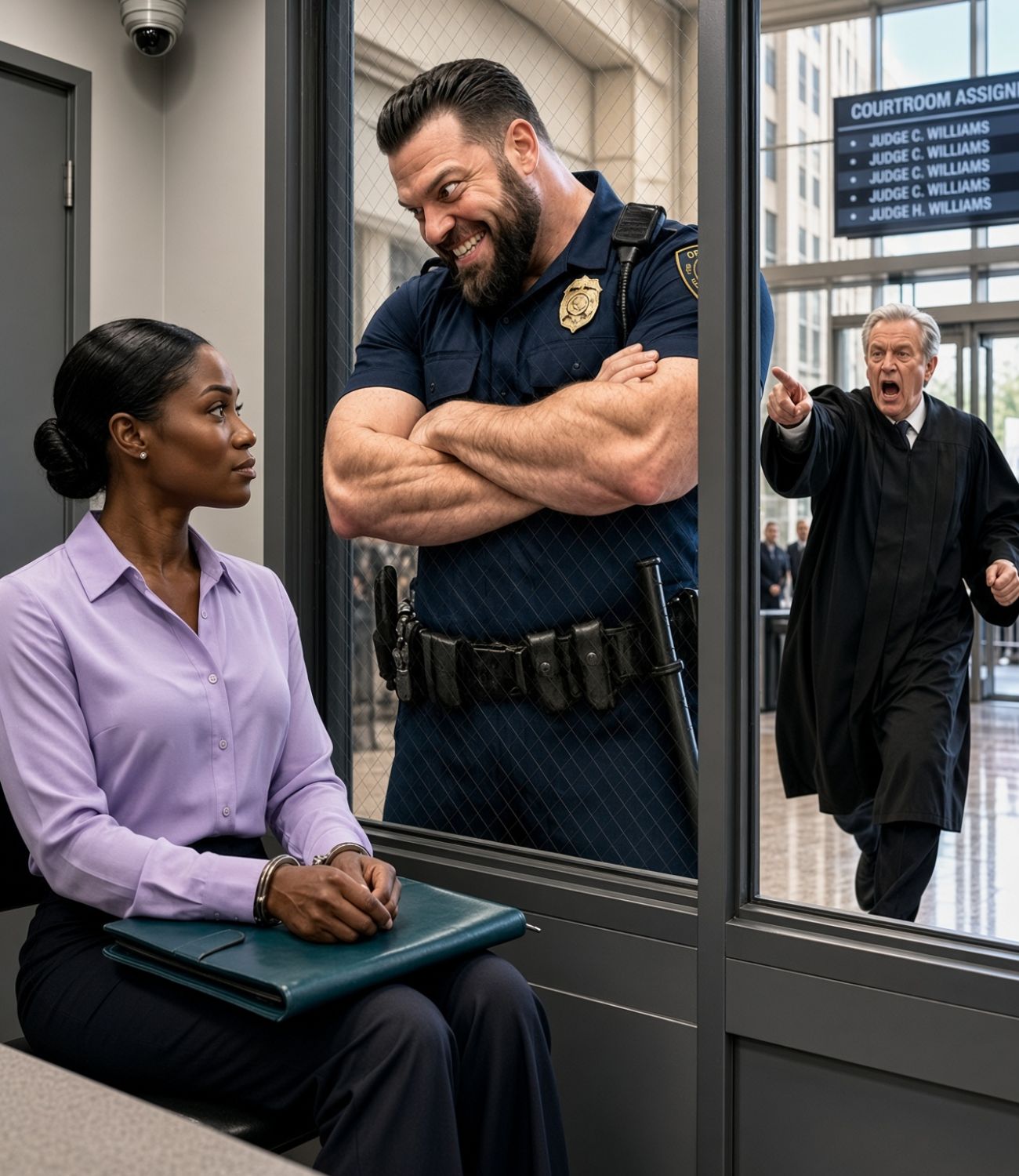
The courthouse lobby was already crowded when Officer Reed stepped directly into the path of a black woman carrying a slim folder against her chest.
Stop right there, she stopped. There was no shouting, no sudden movement, no attempt to push past him. She simply looked at the officer and waited. I’m here for a hearing, she said. Reed pointed toward the security checkpoint. Your credential didn’t scan. Step over there. She glanced at the scanner, then back at him. That’s fine.
There may be an issue with the system. You can verify my name through judicial administration. It should have taken less than a minute. That was the part that would matter later because in a courthouse, a failed scanner is supposed to create a question, not a conviction. Reed looked at her credential again. Maya Williams. Yes.
Who are you here to see? She answered calmly. You can verify that through the internal directory. Instead of reaching for his radio read, folded his arms. I asked you a question and I gave you my name. She replied, “If the credential isn’t working, please call a supervisor.” Several people in the lobby had begun looking over.
A few visitors slowed down. A court clerk behind the desk stopped typing. Read stepped closer. You don’t get to decide how this works. Mayia didn’t raise her voice. I’m not trying to decide anything. I’m asking you to verify my identity. That distinction was important. She wasn’t challenging his authority. She was giving him a lawful way to use it.
Officer Reed could have called his supervisor. He could have checked the directory. He could have asked another officer to confirm the credential. Any of those choices could have ended the encounter quietly. Instead, he reached for his baton. He didn’t swing it. He didn’t need to. He simply rested his hand near it while staring at her.
Step away from the entrance. Mayia looked at his hand, then back at his face. I’m not resisting. Then cooperate. I’m cooperating. The words were quiet, but everyone nearby could hear them. A young attorney standing several feet away pulled out his phone. Not to record video, but to check the time. Something about the encounter had changed.
What began as a security system problem was becoming something else. Maya remained still officer. She said, “Please document that I asked you to verify my name and contact a supervisor.” Reed’s expression hardened. “Are you threatening me?” No. Then stop telling me what to do. I’m asking you to follow the verification process.
The clerk behind the desk lowered her eyes. She knew that name Williams. She had seen it on court schedules, administrative notices, and judicial correspondence. But saying it out loud now could put her in the middle of a confrontation. She had no idea how to control. So she stayed silent. And that silence would become important.
Because sometimes injustice doesn’t begin with a room full of people cheering for the wrong person. Sometimes it begins with one person abusing authority and everyone else becoming afraid to interrupt. Maya looked around the lobby. She saw the visitors watching. She saw the clerk pretending not to notice. She saw the attorney writing something down.
Then she looked back at Reed. I’ll cooperate with any lawful security procedure, she said. But I want the detention documented. For the first time, Reed hesitated. He had expected anger. He had expected resistance. He had expected her to give him an excuse to escalate. Instead, she gave him something much harder to fight calmness.
A name and a request that could be independently verified. Reed motioned toward the restricted hallway. Come with me. Maya didn’t move immediately. Am I being detained? Yes. Why failure to comply? The attorney stopped writing for a moment. The clerk looked up Maya, simply nodded, then document the reason, and as officer Reeds escorted her away from the crowded courthouse lobby.
Almost everyone watching believed they had just witnessed a difficult security encounter. What they didn’t understand was that the woman being taken behind those doors wasn’t trying to escape the law. She was asking the law to recognize itself. Upstairs, the courthouse was moving through its morning routine as if nothing unusual had happened.
Judges were reviewing case files. Attorneys were speaking quietly. In the hallway, court clerks were checking calendars and arranging folders before the first hearings began. But one chair in one courtroom remained empty. Judge Maya Williams was supposed to be there. Her assistant checked the time again. Then she checked the calendar, then the hallway. Nothing.
She hasn’t arrived yet. The clerk shook her head. She was scheduled for the morning docket. The assistant reached for her phone, expecting a simple explanation. Maybe traffic may be a delayed meeting. Maybe a last minute administrative issue. But before she could make the call, another judge entered the courtroom. He placed his files on the bench, looked toward the clerk, and asked casually, “Has Judge Williams arrived?” The clerk froze.
It was only a question, a normal question. But her mind immediately returned to the woman she had seen downstairs. Maya Williams, the name was still sitting in her thoughts. She looked toward the courtroom doors. No, she said quietly. The judge frowned. Did she contact Chambers? No, that’s unusual. The clerk swallowed she had a decision to make.
She could pretend she knew nothing. She could make a phone call and quietly confirm what she already suspected or she could tell the truth about what she had witnessed downstairs before she could choose the courthouse phone rang. The assistant answered judicial administration. A pause then her expression changed. Excuse me.
She listened again where the room became noticeably quieter. The assistant covered the receiver and looked at the clerk. Security says there’s a woman being held near the east lobby. The clerk’s heart dropped. What’s her name? The assistant uncovered the phone. That’s what they’re trying to determine. The clerk knew she knew exactly who it was, but she wasn’t ready to say it because if she was wrong, she could create a serious problem.
And if she was right, something far worse had already happened. The judge noticed her expression. What is it? The clerk hesitated. There was a security issue downstairs with whom she looked toward the hallway. a woman. The judge waited. Did security identify her? The clerk’s voice became almost a whisper.
She gave them her name. What name? The clerk didn’t answer, and that silence said more than an explanation could have. Down in the security area, Maya sat quietly on a bench. Her folder remained beside her. She hadn’t yelled. She hadn’t threatened anyone. She hadn’t tried to force her way through a door. She simply waited. Officer Reed stood nearby, still convinced that the situation was under his control.
He glanced at his report then at Maya. You understand why you’re being held? Maya looked at him. I understand why you say I’m being held. Reed narrowed his eyes. Same thing. No, she said. It isn’t. There was no anger in her voice. That almost seemed to irritate him more. A uniformed officer passing through the room glanced at Mayia than at Reed. Everything good.
Reed answered quickly. She’s refusing to cooperate. Maya looked at the second officer. I have cooperated with every security instruction. I asked for verification in a supervisor. The second officer paused. Reed stepped in. I’ve got it handled. The officer nodded and continued walking.
Maya watched him disappear through the doorway. Then she looked at the wall clock. She wasn’t worried about proving she was important. She was worried about what happened. When an officer decided that a black woman didn’t deserve to be believed until she could prove herself to him, that distinction mattered because law enforcement is supposed to protect order, not manufactur suspicion, and black women should not have to become judges, attorneys, doctors, executives, or public officials before their dignity is treated as non-negotiable. Upstairs,
the judge finally stood. Take me to security. The clerk looked alarmed. Judge, maybe we should let administration handle know. His voice wasn’t loud, but it was firm. If someone is being detained inside this courthouse, I want to know why the clerk followed him. As they moved down the hallway, the assistant received another message. She stopped walking.
Judge, he turned what? She stared at the screen. The woman in security just gave them her full name. The judge waited. What name? The assistant looked at him. Mayor Williams for a moment. Neither of them spoke. Then the judge’s face changed. Not because a powerful person had been inconvenienced, but because a basic question had suddenly become impossible to ignore.
How had the courthouse managed to lose track of the very judge it was waiting for and place her behind a security door instead? The answer was waiting downstairs along with an officer who still didn’t realize that the name he had written on his report was the same name everyone upstairs had been searching for.
The security room door opened before anyone inside had time to prepare. The courthouse judge stepped in first, followed by the clerk and the judicial administrator. Officer Reed immediately straightened. Sir, we have a security issue under control. The judge didn’t answer him. His eyes went directly to the woman sitting quietly on the bench. Maya. She looked up.
Good morning. That single exchange changed the room. Reed’s confidence disappeared. His eyes moved from the judge to Mayor. Then back again, Judge Williams. Maya stood yes for several seconds. Nobody said anything. The same officer who had demanded that she explain herself now looked like a man desperately trying to replay the last 20 minutes in his head.
The administrator turned toward Reed. Did she give you her name? Reed hesitated. Yes. What name? He didn’t answer. The clerk did. Mayor Williams. The administrator’s expression hardened. And you didn’t verify it. Reed shifted his weight. The credential failed. That wasn’t my question. The room became silent again. The administrator stepped closer.
Did you contact judicial administration? No. Did you call a supervisor? No. Did she attempt to force her way through security? Reed looked toward Maya. She was refusing instructions. Maya calmly picked up her folder. I asked you to verify my identity. The judge looked at Reed. Did she become physically aggressive? No. Did she threaten you? Reed paused.
No. Then why was she detained? Reed had no answer that sounded reasonable anymore. Maya could have humiliated him. She could have reminded everyone of her position. She could have demanded an apology in front of the entire room. Instead, she said something that made the room even quieter. “You don’t have to know that I’m a judge to treat me fairly.” “Nobody moved,” she continued.
“You only needed to know that I was a person, asking you to verify my identity.” That was the real issue. The badge had not created the problem. The title had not created the problem. The problem began when an officer was given a simple opportunity to verify information and chose suspicion instead. The administrator looked at Reed’s report. Read this.
Reed’s face tightened. The report claimed Maya had failed to comply with repeated lawful instructions and attempted to bypass security. The attorney who had witnessed the encounter stepped forward from the hallway. That’s not what happened. Everyone turned. He introduced himself and explained that he had recorded the time.
the conversation and the sequence of events in his notes. Maya had asked for verification. She had asked for a supervisor. She had asked that the detention be documented, and she had never attempted to force her way through the checkpoint. The clerk finally spoke, too. I recognized her. The judge looked at her when before officer Reed took her away.
Why didn’t you say something? The clerk lowered her eyes. I was afraid that admission carried its own weight. Because misconduct does not always survive because everyone agrees with it. Sometimes it survives because ordinary people become afraid of what will happen if they speak. The administrator ordered the security footage and access records preserved immediately.
Then he looked at Reed. Your badge gave you authority to protect this courthouse. It did not give you permission to stop thinking. Reed said nothing. May I looked toward him. I hope you understand something. He finally met her eyes. A police officer’s job is not to win every encounter. It’s to keep people safe. Follow the law.
And know the difference between authority and intimidation. She paused. And when you make a mistake. The badge becomes more honorable when you admit it. Not when you hide it. No one in that room could dismiss those words as simply a judge. Defending herself. They applied to everyone. to the officer, to the clerk, to the supervisors, and to every person who had ever stood silently in a public building wondering whether speaking up would make things worse.
The review that followed did not end with a dramatic speech or an overnight miracle. There were interviews, records were compared, witness statements were taken, security procedures were examined, and Officer Reed was removed from courthouse security. While the investigation proceeded, but Maya asked for something bigger than punishment.
She asked the courthouse to change the process that had allowed the incident to happen. Supervisors would be required to review extended detentions. Security personnel would receive additional training in D. Escalation and verification. Misconduct reports would be reviewed against available evidence and employees would have protected ways to report concerns without fearing retaliation.
Weeks later, Maya walked through the same courthouse lobby. The scanner at the entrance malfunctioned again. An elderly black man stood there holding his identification. Clearly confused, a new officer approached him. Sir, looks like the scanner isn’t reading that. The man immediately looked nervous. I can leave.
The officer shook his head. No need. Let’s verify it another way. May I watch from across the lobby? The officer checked the information, called the appropriate desk, and opened the entrance. No intimidation, no accusation, number assumption, just professionalism. Maya smiled quietly and continued down the hallway because that was the change she wanted, not special treatment for judges, not special treatment for black women, just a courthouse where dignity didn’t depend on someone’s title, wealth, race, or ability to fight back. And now I want to
hear from you. If you were standing in that lobby, would you have spoken up when you realized Officer Reed was wrong? Or would you have stayed silent because you were afraid of challenging a police officer? Tell me honestly in the comments. And if this story made you think differently about what real authority should look like, share it with someone who needs to hear that message.
Subscribe to the channel because here we don’t just tell stories about power. We tell stories about what happens when power is tested. when ordinary people find the courage to speak and when accountability finally catches up with those who believe a badge puts them above the rules. And if you want the next story to be even more intense, tell me what kind of justice story you want to see next in the comments because the next story may begin with an ordinary person walking through a door, but you never know who is standing behind them. The courthouse
fell silent as Officer Reed stood there, no longer the confident man who had ordered Mayia to sit down. The same woman he had treated like a threat was now standing calmly before him, surrounded by judges, attorneys, and records that could tell the truth for themselves. May I looked at him and said quietly, “This was never about whether I was a judge.
It was about whether you believed I deserved to be treated fairly before you knew who I was.” Reed lowered his eyes for the first time that morning. He had nothing left to say. The investigation that followed uncovered the security override, the missing footage, the inaccurate report, and the witnesses who had watched the detention unfold.
Reed was removed from courthouse security, while the evidence was forwarded for further disciplinary review. The clerk, who had remained silent, also came forward, admitting that fear had stopped her from doing what she knew was right. Maya could have used her position to demand revenge. Instead, she demanded something more powerful, accountability.
She asked the court to preserve every record, protect every witness, and make sure the same thing could not happen to someone without a title influence or powerful friends. 3 months later, the courthouse had new procedures. Security overrides required review. Extended detentions required a supervisor. Misconduct could be reported without retaliation.
And then one afternoon, an elderly visitor approached the same security checkpoint. His badge failed to scan. The new officer didn’t reach for intimidation. He simply smiled and said, “No problem, sir. Let me verify your information.” From across the lobby, Maya watched quietly. That was the real victory. Not watching someone fall.
Not getting revenge, but changing a system so the next person would never have to prove their worth before receiving basic dignity. Because true power isn’t measured by how loudly you can control someone. It’s measured by how responsibly you treat the person who has no power to fight

