Widow Helped Mountain Man in Blizzard — Next Morning, He Built Her a Cabin That Changed Everything
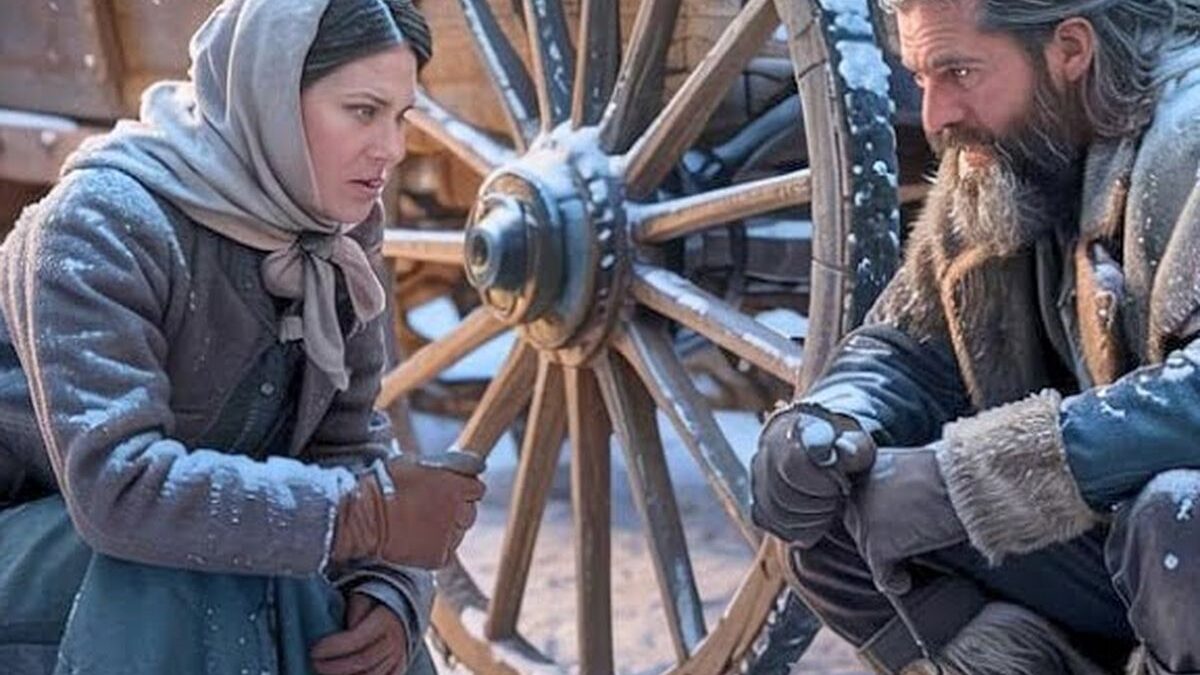
Some acts of kindness are so small, we forget them by morning, but others change the course of two lives forever. This is a story about a night when compassion met desperation in the heart of a frontier winter. A young widow named Eliza Cole sat alone in her wagon, half buried in snow, certain she wouldn’t survive until dawn.
Then a stranger appeared through the blizzard. Samuel Reed was a mountain man, rough and weathered with nothing but the clothes on his back. She gave him shelter, warmth, and her last bit of bread. By morning he was gone, but when she stepped outside, there he stood in the clearing, axe in hand, building her a cabin from nothing.
What could make a drifter who’d spent years alone suddenly decide to stay? Before we jump back in, tell us where you’re tuning in from, and if this story touches you, make sure you’re subscribed because tomorrow I’ve saved something extra special for you. Eliza Cole had not expected to die alone in the mountains, but then again, she had not expected much of anything these past two years.
Life had a way of stripping expectations down to bare survival, and survival had become a cold, relentless companion since the day they brought Thomas home from the mine. She remembered that day with the clarity of recent wounds, though it had been 23 months now. The foreman’s hat in his hands, the way he couldn’t meet her eyes, the carefully practiced words that meant her husband was gone.
Crushed in a tunnel collapse, they said. Didn’t suffer, they said. She had nodded and thanked them and closed the door. And then she had stood in the kitchen of their little homestead near Carson Ridge and realized that the life she had built was as collapsed as that mine shaft. Thomas Cole had been a gentle man, patient and kind with hands that could coax life from stubborn soil and a laugh that made the hardest days bearable.
They had married young, both of them barely 20, and spent five years carving out a life in the foothills. It wasn’t much, a small cabin, a vegetable garden, a few chickens, dreams of expanding when they could afford more land, but it had been theirs and it had been enough. After Thomas died, Eliza had tried to keep the homestead going.
She tended the garden, fed the chickens, repaired what she could, but the land required a strength she no longer possessed, and the silence of the cabin pressed against her like a physical weight. Every corner held a memory. The chair where Thomas sat to pull off his boots, the bed where they had whispered plans for the future, the doorway where he had kissed her goodbye that last morning, smelling of soap and coffee, promising to be home by supper. She lasted a year and a half.
Then she sold everything, the land, the cabin, the chickens, even Thomas’s tools, and bought a wagon and a horse. She would go west, she decided. To the new settlement past the mountains, where no one knew her as Thomas Cole’s widow, where she could start fresh without ghosts in every room.
It was a foolish plan, she realized now. Foolish to travel alone. Foolish to attempt a mountain crossing so late in the season. Foolish to think that geography could outrun grief. The snow had started three days into her journey through the pass. Light flurries at first, the kind that dusted the pine branches and made the world look clean and new.
She had pushed on, hoping to reach the trading post on the western slope before the weather turned serious. But the storms in these mountains did not give warnings. They simply arrived, sudden and absolute. By the second day of snow, her horse was laboring through drifts that reached its chest.
The wagon wheels caught and stuck, caught and stuck. Eliza climbed down to push, her hands numb inside her gloves, her breath coming in frozen gasps. The wind howled through the pass like something alive and angry, tearing at her coat, stealing the warmth from her body. When the wagon axle cracked with a sound like a gunshot, she knew she was going to die.
She sat in the tilted wagon as the light faded, wrapped in every blanket she owned, and took inventory of her situation with the practical assessment that frontier life had taught her. No one knew where she was. The trading post was still two days ahead, and she had seen no other travelers. Her horse stood with its head down, snow accumulating on its back, too exhausted to do anything but wait.
She had food, a bit of dried meat, half a loaf of bread, some beans, but no way to make a fire in this wind. The cold would take her long before the hunger did. She found Thomas’s pocket watch in her coat, the one thing she had kept when she sold everything else. The metal was ice cold against her palm.
She opened it, but it was too dark to see the photograph inside. Thomas on their wedding day, young and smiling, full of hope for the life ahead. “I’m sorry,” she whispered to the image she could not see. “I tried.” She must have dozed, or perhaps the cold was already taking her because she did not hear him approach. One moment she was alone with the wind and the darkness, and the next, there was a shape outside the wagon, a dark figure that materialized from the storm like something conjured from desperation.
Her first thought was that death had come for her in physical form. Her second thought, when the figure knocked on the wagon side and called out in a rough, hoarse voice, was that this might be worse than death. “Anyone alive in there?” Eliza’s hand found the small knife she kept in her coat pocket. “Who are you?” “Someone as half frozen as you, I’d wager.” A pause.
“I saw your wagon from the ridge. Didn’t expect to find anyone still breathing.” She made herself move, though her body protested the effort. She pushed aside the canvas flap and looked out into the storm. The man was tall, or perhaps he only seemed tall because he was standing while she was sitting.
He was bundled in furs and heavy wool. His face mostly hidden by a beard and the shadow of his hat. Snow clung to him like he had been walking through the blizzard for hours. “I’m not going to hurt you,” he said, and something in his voice, the weariness, the resignation made her believe him. “Are you lost, too?” she asked. “No, ma’am.
I know these mountains, but I need shelter from this wind, and you’ve got the only cover for miles.” He gestured at the wagon. “I’m asking permission to wait out the storm with you. I’ll stay on the other side, keep my distance. Come morning, if we’re both still alive, I’ll help you with that axle.” Eliza looked at him. This stranger who had appeared from nowhere.
Every sensible instinct told her to refuse, to protect herself, to die alone rather than risk whatever threat he might pose. But Thomas had always said she had a soft heart, and maybe he was right because what came out of her mouth was, “All right, but I have a knife.” “Fair enough.” He climbed into the wagon, moving carefully, keeping to the far side as promised.
In the enclosed space, she could see him better. He was older than she had first thought, perhaps 40, with gray threading through the brown of his beard. His eyes were cautious but not cruel. He looked like a man who had been cold for a very long time. They sat in silence while the storm raged outside. Eliza’s fingers would not stop shaking, and she tucked them under her arms, trying to hold on to what little warmth remained.
The stranger noticed. He pulled off his outer coat and held it out to her. “I can’t take your coat,” she protested. “I’ve got layers.” “You’re shaking hard enough to rattle the wagon.” When she hesitated, he added, “Please. A woman froze to death once because of me. I don’t aim to repeat that.” There was such pain in those words that Eliza took the coat without further argument.
It smelled of wood smoke and pine, and it was blessedly warm. She wrapped it around herself and felt the shaking ease slightly. “Thank you,” she said. He nodded and turned his attention to the wagon’s contents, professional and detached. “You got any food?” “A little. We should eat. Keep our strength up.” She retrieved the half loaf of bread and broke it in two, offering him the larger piece.
He stared at it for a moment, then took it with gentle care as if she had offered him something precious. They ate in silence, and when Eliza pulled out a canteen of water, he drank sparingly before handing it back. “What’s your name?” she asked finally. “Samuel. Samuel Reed.” “I’m Eliza Cole.” “Where were you headed, Mrs. Cole?” “West, to the new settlement.
” She paused. “And it’s just Cole now. I’m a widow.” “I’m sorry for your loss.” The words were simple, but they carried a weight of understanding that surprised her. She looked at him more closely. “You’ve lost someone, too.” It was not a question, and he did not answer it directly. He only said, “We should try to rest. Storm might break by morning.
” They settled into their respective corners of the wagon. Eliza kept the knife within reach, but as the hours passed and Samuel Reed did nothing but sleep quietly on his side, she felt her grip on it loosen. The wind howled and the wagon creaked, but inside their small shelter, there was a fragile warmth.
Just before she drifted into an exhausted sleep, Eliza heard Samuel speak softly as if to himself, “Thank you for the bread.” When she woke, he was gone and the storm had passed. The morning light was bright and cold, and for a terrible moment, Eliza thought she had dreamed him. Then she looked outside and saw him standing in the clearing axe in hand and understood that the night in the blizzard had been only the beginning.
The dawn was impossibly clear, the kind of crystalline morning that follows a storm and makes the world seem newly made. The sky stretched pale blue above the mountains and the snow sparkled like scattered diamonds across the valley. Eliza stood in the tilted doorway of her wagon blinking against the brightness trying to understand what she was seeing.
Samuel Reed stood 50 yards away in a clearing. He must have spent the pre-dawn hours preparing. Trees had been felled. She could see three massive pines laid out in parallel lines, their branches already stripped away. He was working on a fourth, his axe rising and falling with a rhythm that spoke of decades of practice. Each strike was precise, powerful and the sound echoed across the frozen landscape like a heartbeat.
She watched him for several minutes trying to make sense of it. He had not run. He had not taken her supplies and disappeared into the wilderness. He was building something. Eliza pulled on her boots and coat, his coat she realized, the one he had given her in the night and made her way through the snow toward him. Her legs were unsteady and the cold air burned her lungs, but she pushed forward.
Samuel saw her coming and paused resting the axe against his shoulder. Up close in the full light of morning she could see the lines of exhaustion on his face. He had not slept. His breath came in white clouds and sweat dampened his shirt despite the freezing temperature. “What are you doing?” she asked.
He looked at her for a long moment then gestured at the clearing with his free hand. “Building you a cabin.” The words were so matter-of-fact that Eliza thought she had misheard. “A cabin?” “Yes, ma’am.” “I don’t understand.” Samuel set the axe down and moved to the logs he had already prepared. He had marked out a foundation in the snow, a rectangle roughly 20 ft by 15.
The logs were positioned at the corners ready to be notched and stacked. It was the beginning of something solid, something permanent. “You saved my life last night,” he said not looking at her. “You gave me shelter when you had every reason to turn me away. You shared your food when you barely had enough for yourself.
” He picked up a length of rope and began measuring. “I pay my debts.” “You don’t owe me a cabin,” Eliza protested. “You don’t owe me anything. I would have done the same for anyone.” “I know. That’s why I’m doing this.” She stared at him. This strange man who spoke in short declarative sentences and seemed to think that building an entire structure was a reasonable response to sharing a loaf of bread.
“I can’t pay you.” “I’m not asking for payment.” “Then why?” Samuel stopped working and turned to face her fully. In the morning light his eyes were a deep brown and they held a sadness that seemed to have no bottom. “Because seven years ago my wife and daughter were caught in a winter storm. They were trying to reach the next town and their wagon broke down. No one came. No one helped them.
By the time I found them they had been dead for two days.” The words fell between them like stones into still water. Eliza felt her throat tighten. “I’m sorry,” she whispered. “So am I.” He picked up the rope again, but his hands were not quite steady. “I’ve spent seven years in these mountains, Mrs. Cole, alone, hiding from people, from memories, from everything.
Last night when I saw your wagon in the storm, I thought about walking past, thought about leaving you to your fate because getting involved with people again meant feeling things I didn’t want to feel.” He tied off a measurement and moved to the next log. “But I couldn’t do it. I couldn’t leave you.
And when you let me in, when you gave me that bread and your coat and treated me like a human being instead of the ghost I’ve become, something in me remembered what it felt like to be alive.” He looked up at her again and his voice was rough with emotion. “You’re alive because you’re strong and because you’re kind. You deserve better than dying alone in a broken wagon. You deserve a home.
So I’m going to build you one.” “It’s not charity. It’s not pity. It’s gratitude and it’s the only thing I know how to give.” Eliza felt tears freezing on her cheeks. She had not realized she was crying. “I don’t know what to say.” “You don’t have [clears throat] to say anything. But if you want to help, I could use another pair of hands.
” She looked at the logs, the clearing, the enormity of what he was proposing. “I don’t know how to build a cabin.” “I do. I’ll teach you.” And so it began. Samuel showed her how to strip bark from the logs, how to notch the ends so they would fit together, how to judge which trees were straight enough to use.
The work was hard, harder than anything Eliza had done since Thomas died and her hands blistered within the first hour, but there was something deeply satisfying about it. The physical effort, the visible progress, the sense of creating something real. Samuel was a patient teacher. He demonstrated each task first then watched as she attempted it offering corrections without criticism.
He did not hover or condescend. He simply showed her what needed to be done and trusted her to do it. They worked through the morning and into the afternoon stopping only briefly to eat the dried meat from her supplies. The sun climbed higher and the temperature rose just enough to make the work bearable.
By the time shadows began to lengthen across the snow, they had four logs notched and positioned the beginning of the cabin’s walls. Eliza stood back and looked at what they had accomplished. It was not much yet, just the corners of a foundation, but it was more than she had thought possible when she woke that morning expecting to die.
“It’s real.” she said quietly. Samuel wiped sweat from his forehead with the back of his hand. “Yes, ma’am.” “How long will it take?” “If the weather holds, a week, maybe less. I’ve built faster when I had to.” “You’ve done this before, many times.” “I was a soldier once. We built forts and shelters everywhere we went.” He paused.
“That was a long time ago.” There was a story there, Eliza sensed, but she did not press. They had time if what he said about a week was true. Time to learn each other’s histories. Time to understand this strange bond that had formed between them in the space of a single night and a single day. That evening they made camp near the wagon.
Samuel [clears throat] built a fire with the same efficiency he brought to everything else and they sat on opposite sides of it eating beans heated in a tin pot. The flames cast dancing shadows on his face highlighting the sharp angles of his cheekbones, the gray in his beard. “Why did you leave the army?” Eliza asked.
Samuel was quiet for so long that she thought he would not answer. Then he said, “Because I killed a man I wasn’t supposed to kill and I ran before they could hang me for it.” Eliza’s breath caught. “You’re a wanted man?” “I expect I am, though it’s been seven years and no one’s come looking. Most people think Samuel Reed died in these mountains a long time ago.
” He looked at her across the fire. “If that changes your mind about the cabin, I understand. I can leave tonight.” She thought about it. Thought about the gentleness in his hands when he showed her how to notch a log. Thought about the way he had given her his coat without hesitation. Thought about the grief in his voice when he spoke of his wife and daughter.
“No,” she said finally. “Don’t leave. Whatever you did, whoever you were, that’s not who I met last night. The man I met was kind and honorable. That’s the man I’m choosing to trust.” Samuel looked down at his hands and when he spoke his voice was barely audible over the crackling fire. “Thank you.” They sat in silence after that, but it was not an uncomfortable silence.
It was the silence of two people who had found something unexpected in each other. Not romance, not yet, but the possibility of it. The promise that maybe, just maybe, broken things could still be made whole. When Eliza finally retreated to the wagon to sleep, she looked back and saw Samuel sitting by the fire staring into the flames.
In his lap was something she had not noticed before, his axe, and he was running his thumb along the handle with absent affection as if it were an old friend. She understood then that the axe was more than a tool to him. It was the thing that had kept him alive, kept him useful, kept him human through seven years of isolation.
And now he was using it to build her a home. As she drifted toward sleep wrapped in his coat that still smelled of wood smoke and pine, Eliza Cole realized that she had not thought about Thomas’s pocket watch all day. It was still in her pocket, still cold and heavy against her heart, but for the first time in two years it did not feel like the only thing anchoring her to the world.
There was something else now, something being built one log at a time in the clearing outside her broken wagon, something that looked impossibly like a future. By the third day, the cabin walls had risen to waist height and a rhythm had established itself between them. Samuel woke before dawn to work while the air was still and cold, his breath forming clouds in the darkness.
Eliza rose with the sun to prepare their breakfast, oatmeal when they had it, beans when they did not, and then joined him at the building site. They worked mostly in companionable silence, the kind that comes when words are less necessary than shared purpose. Samuel would occasionally pause to explain a technique or point out a flaw in her work, but he did so with such gentle matter-of-factness that Eliza never felt criticized.
She was learning to read the logs, to see which side was stronger, which grain would hold weight better. Her hands, which had been soft from 2 years of grief and inactivity, were developing calluses. It was good to feel useful again. On the afternoon of the third day, as they were positioning a particularly heavy log, Eliza’s foot slipped on a patch of ice.
She stumbled backward, arms windmilling, and would have fallen hard if Samuel had not caught her. His hands closed around her arms, steadying her, and for a moment they stood very close, his face inches from hers. She could see the flecks of gold in his brown eyes, could smell the pine sap on his clothes, could feel the warmth radiating from his body despite the cold.
“Careful,” he said, his voice rough. “Thank you.” He released her immediately and stepped back, putting a careful distance between them. “Ice is dangerous. Should have cleared that earlier.” But they both knew the ice was not what made that moment dangerous. That evening, as they sat by the fire eating a sparse dinner of beans and the last of the dried meat, Eliza found herself watching Samuel more carefully than she had before.
The way his hands moved when he worked, capable and sure. The way he listened when she spoke, giving her his full attention, as if what she said mattered. The way he sometimes stared into the fire with an expression of such profound loneliness that it hurt to see. “Tell me about your wife,” she said softly. Samuel looked up, surprised.
“Why?” “Because you loved her, and because carrying grief alone makes it heavier.” He was quiet for a long time, and Eliza thought he would refuse. Then he said, “Her name was Catherine. We met when I was stationed at Fort Laramie after the war. She was a school teacher’s daughter, educated, probably too good for a soldier with no prospects.
But she said yes when I asked, and we had seven good years together. You had a daughter.” “Emma.” He “She was five when” He stopped, swallowed hard. “She had Catherine’s eyes, green as spring grass. She used to follow me everywhere, asking questions about everything. ‘Why is the sky blue? Where do birds go in winter? What makes thunder?’ A ghost of a smile crossed his face.
“I didn’t know the answers to half of what she asked, but I tried.” Eliza felt her own eyes burning. “What happened to them?” “I was away, escorting a supply wagon to the next fort. It was supposed to be a 3-day trip. Catherine decided to visit her sister in the next town over. The weather turned bad, and their wagon broke down.
” His voice went flat, emotionless in the way that meant the emotion was too large to express. “I found them 4 days later. They had frozen in each other’s arms, trying to keep warm.” “Samuel.” “The worst part,” he continued as if he had not heard her, “was that they were only 2 miles from help. 2 miles. If someone had been riding that road, if anyone had seen them, they would have lived.
But no one came. No one stopped. And I spent the next month wondering if things would have been different if I had been there, if I had insisted they wait for me, if I had been the husband and father they deserved instead of the soldier who was always gone.” “It wasn’t your fault.” “I know that. In my head, I know that.
But knowing something and believing it are different things.” He looked at her across the fire. “That’s why I left. I couldn’t stay in that fort, couldn’t see the other families, couldn’t bear the sympathy in everyone’s eyes. So I walked into these mountains, and I’ve been here ever since.
” Eliza pulled her coat, his coat, tighter around herself. “7 years is a long time to be alone.” “It felt appropriate. Punishment for failing them.” “Catherine wouldn’t have wanted that.” “No,” Samuel admitted. “She would have told me I was being foolish and stubborn, which I am.” He poked at the fire with a stick, sending sparks spiraling into the darkness.
“But it was easier to be alone than to risk caring about someone again, and failing them, too.” The words hung in the air between them, heavy with implication. Eliza understood what he was really saying, that building this cabin was dangerous for him, that being here with her was dangerous, that everything about this situation threatened the walls he had built around his heart.
She wanted to tell him that she understood, that she felt the same fear, that every moment she spent with him made her more aware of the space Thomas had left behind, and that the guilt of that awareness was almost unbearable. But before she could find the words, Samuel stood abruptly. “We’re running low on supplies,” he said, his tone deliberately practical.
“I should make a trip into town. Carson Ridge is the closest. I can get nails, more rope, maybe some glass for a window.” “How far is Carson Ridge?” “Half a day’s walk. I’ll leave at dawn, be back by evening.” Eliza felt a sudden, sharp fear at the thought of being alone again. “Will you” She stopped, hating how needy she sounded.
“Will you come back?” Samuel looked at her, and something in his expression softened. “Yes, Mrs. Cole, I’ll come back. I don’t break promises, and I promised to finish your cabin.” That night, Eliza could not sleep. She lay in the wagon, listening to the wind in the pines, and thinking about Samuel sitting alone by the fire just a few yards away.
She thought about Catherine and Emma, frozen together in a broken wagon not unlike her own. She thought about Thomas, crushed in the darkness of a collapsed mine. She thought about all the ways people could lose each other, all the ways love could end in grief, and she thought about her mother’s recipe book, tucked in the bottom of her trunk beneath two changes of clothes and a woolen blanket.
She had not opened it since leaving Carson Ridge, could not bear to see her mother’s handwriting, the little notes and adjustments written in the margins. “Add more salt. Papa’s favorite. Good for cold days.” But now she pulled it out and held it in her hands, feeling the weight of it, the history.
Her mother had died when Eliza was 16, and this book was all she had left of those years of learning to cook at her mother’s side, of flour-dusted aprons and warm kitchens, and the kind of love that expressed itself through food. If Samuel was going to town, she could ask him to bring back proper ingredients. She could cook something real for him, something that wasn’t just survival.
She could begin to repay him in the only way she knew how. The thought made her feel lighter somehow, less like a burden and more like a partner. When dawn came and Samuel prepared to leave, Eliza emerged from the wagon with a short list written in careful script: flour, salt, sugar if he could find it, dried herbs. She handed it to him along with coins from her dwindling funds.
“For dinner,” she explained, “when you get back.” Samuel looked at the list, then at her, and something warm flickered in his eyes. “You don’t have to do this.” “I know, but you don’t have to build me a cabin, either, and yet here we are.” He smiled then, a real smile that transformed his entire face and made him look years younger. “Here we are,” he agreed.
She watched him walk into the forest, following a trail only he could see until he disappeared among the trees. Then she turned back to the half-built cabin and understood that she was alone again, truly alone, for the first time since the night of the blizzard. But it felt different now. The solitude was not abandonment.
It was simply absence, and absence implied return. Eliza spent the day working on what she could manage alone, clearing debris, organizing tools, sweeping snow from the foundation. The cabin walls stood solid around her, testimony to Samuel’s skill and determination. She ran her hands over the logs, feeling where he had smoothed and shaped them, where his axe had left its mark. Each cut was precise.
Each joint fit perfectly. There was artistry in this structure, not just utility. Samuel Reed was building her more than shelter. He was building her a home. By the time the sun began to set and shadows stretched long across the snow, Eliza found herself watching the forest, waiting. And when she finally saw him emerge from the trees, a pack slung over his shoulder, she felt something in her chest that she had not felt in 2 years: relief, joy, the simple happiness of seeing someone return.
Samuel raised a hand in greeting, and Eliza waved back, and neither of them acknowledged that this moment meant more than it should have, that something between them had shifted while they were apart. He had come back, just as he promised, and Eliza realized she had never doubted that he would. The cabin took shape over the following days, like something growing rather than being built.
The walls reached shoulder height, then above their heads, until they stood enclosed by solid logs that blocked the wind and held the warmth of their fire. Samuel framed in spaces for the windows and the door, measuring twice before cutting, his movements precise and unhurried. Eliza learned to anticipate what he needed before he asked.
She would hand him a tool or steady a board while he secured it, their partnership seamless and practiced. They had developed their own language of nods and gestures, comfortable enough with each other now that words were often unnecessary. But there were things that remained unspoken between them, important things. On the sixth day, as they worked together to lift a roof beam into place, their hands brushed and then tangled together around the rough wood.
The beam was in position, secured, but neither of them let go immediately. Samuel looked down at their joined hands, at the way her smaller fingers fit between his larger ones, and something in his chest ached. “Eliza,” he said quietly. She looked up at him, and he saw his own confusion and longing reflected in her eyes. “I should go,” he said.
“When the cabin’s done, I should go.” “Why?” “Because staying is dangerous, for both of us.” “Dangerous how?” He released her hand and stepped back, running his fingers through his hair in frustration. “Because I’m starting to feel things I have no right to feel. Because every day I stay, it gets harder to imagine leaving.
Because you deserve better than a man who’s running from his past.” “You don’t get to decide what I deserve,” Eliza said, her voice steady despite the emotion in it. “I’m a grown woman who survived the worst loss of my life. I think I can determine for myself what’s good for me. Can you?” Samuel turned to face her fully.
“Because what I see is a woman still wearing her wedding ring, still carrying her husband’s watch, still so deep in grief that she tried to die in a blizzard rather than face another day. I won’t be a substitute for what you lost. Eliza, I won’t be the convenient replacement who happened to be there when you were vulnerable.” The words were harsh, harsher than he intended, and he saw them land like blows.
Eliza’s face flushed and her hands clenched at her sides. “How dare you?” she said, her voice low and furious. “How dare you assume you know what I feel or what I need? Yes, I love Thomas. Yes, I still grieve him. But that doesn’t mean I’m incapable of moving forward. It doesn’t mean that what I feel when I look at you is just loneliness or desperation.
” “Then what is it?” “I don’t know yet.” The admission burst from her like a confession. “I don’t know what this is between us because it’s too new and too frightening and too fast, but I know it’s real, Samuel. I know that when you left for town, I spent the whole day waiting for you to come back. I know that when you look at me, I feel seen in a way I haven’t felt in 2 years.
I know that you make me want to be alive again instead of just surviving.” Samuel stared at her, his heart hammering against his ribs. “Eliza.” “And maybe you’re right,” she continued, tears streaming down her face now. “Maybe I’m not ready for this. Maybe you’re not ready either. Maybe we’re both too broken to build anything real.
But you don’t get to make that choice for me. You don’t get to decide that I’m better off alone.” The silence that followed was broken only by the wind in the pines and their own ragged breathing. Samuel wanted to close the distance between them, wanted to pull her into his arms and promise that everything would be all right.
But he had learned the hard way that promises could not protect people from the cruelties of the world. “I killed a man, Eliza,” he said finally. “His name was Colonel Marcus Brennan, and I put a bullet through his chest 8 years ago.” She went still, her tears drying on her cheeks as she listened. “He was my commanding officer at Fort Rawlings after the war ended.
I thought the fighting was over, thought I could finally settle down with Catherine and Emma. But Brennan was running guns to the tribes, selling army rifles for profit. Good men were dying because of weapons he provided. I confronted him, told him I was going to report him to the territorial command.
” Samuel’s voice went flat, distant, as if he were narrating someone else’s story. “He pulled his pistol, said I was a traitor, a liar, that no one would believe a broken-down cavalry captain over a decorated colonel. He was probably right, but I was faster. I shot him before he could shoot me, and then I ran because I knew they would hang me for it regardless of the truth.
” “But it was self-defense,” Eliza said. “You were protecting yourself and exposing corruption.” “The army doesn’t care about nuance. They care about order and chain of command. I killed a superior officer. That’s desertion and murder in their eyes, and the penalty is death.” He looked at her intently. “Do you understand what I’m telling you? I’m a wanted man.
If anyone finds me, if anyone makes the connection between the hermit in the mountains and Captain Samuel Reed, they’ll arrest me. And if they arrest me, they’ll hang me.” “Then we’ll make sure no one finds you.” “It’s not that simple.” “Yes, it is.” Eliza stepped toward him, her chin raised defiantly. “You saved my life, Samuel.
You built me a home. You showed me that I could feel something other than grief. I’m not going to abandon you now just because there’s risk involved.” “You should. You should tell me to leave and never come back.” “Is that what you want?” “Do you want to leave?” The question hung between them, demanding honesty.
Samuel thought about the mountains, the solitude, the 7 years of self-imposed exile. Then he thought about the last 6 days, the sound of Eliza’s laughter when he made an awkward joke, the way she hummed while cooking, the quiet companionship of working side by side, the simple miracle of not being alone. “No,” he admitted.
“I don’t want to leave. But wanting something doesn’t make it right.” “Maybe not, but maybe it’s not wrong, either.” She reached out and took his hand, her fingers warm against his calloused palm. “I’m not asking you to marry me, Samuel. I’m not asking for promises of forever. I’m just asking you to stay long enough to finish the cabin.
Stay long enough for us to figure out what this is. Can you do that?” He looked down at their joined hands and thought about Catherine, about the guilt he carried, about whether he deserved a second chance at happiness. He thought about Emma’s green eyes and her endless questions and the way she used to fall asleep on his lap after dinner.
He thought about all the reasons he should say no. “All right,” he said. “I’ll stay.” That evening, as they sat by the fire after a quiet dinner, Samuel found himself carving again, a habit from his years alone when his hands needed something to do. The wood was a piece of pine, soft enough to work easily, and he was shaping it into a door latch, something functional but beautiful.
Eliza watched him work, her expression thoughtful. “You have artist’s hands.” “Soldier’s hands. But I learned carpentry from my father before the war. He said a man who could build was never without purpose. He was right.” Samuel turned the latch over, checking the curve, the smoothness. “This is for your door. When the cabin’s finished, this will be the first thing you touch every time you come home.
” “Our door,” Eliza corrected softly. “Our home.” He looked up at her, startled, and saw the determination in her eyes. She had made a choice, he realized. Despite everything he had told her, despite the danger and the uncertainty, she had chosen to see this through, and maybe, just maybe, he could choose the same.
In his pack, forgotten until this moment, was an old tin photograph frame he had carried for years. The photograph inside, Catherine and Emma frozen in time, had been lost long ago, left behind in his flight from Fort Rawlings. But he had kept the frame out of sentiment, out of the superstitious belief that losing it would be a final betrayal.
He pulled it out now and looked at it in the firelight. It was tarnished and bent, empty except for memories. “What is that?” Eliza asked. “Something I’ve been carrying too long.” He ran his thumb over the frame’s surface. “I think it’s time to let it go.” He did not throw it away or bury it. Instead, he set it carefully on the ground beside the fire, a monument to what was and an acknowledgement that he was ready, finally, to move forward.
Eliza understood without him having to explain. She reached into her coat and pulled out Thomas’s pocket watch, opened it to show the photograph inside, a young man with kind eyes and a hopeful smile. “I’m not forgetting him,” she said. “I’ll never forget him. But I think he would want me to live. I’m sure he would.
” They sat together in the firelight, two broken people holding onto the last remnants of their past, and something shifted between them. Not closure, exactly, but acceptance. The acknowledgement that loving someone new did not erase who they had loved before. It simply meant they had survived long enough to love again. The sound of horses came at dawn, three sets of hooves crunching through snow and dead leaves.
Samuel heard them first and was on his feet instantly, his body remembering military alertness even after years of civilian life. He moved to the cabin and looked out through one of the glassless window frames, his heart already sinking as he counted riders. Three men. One wore a badge that caught the early morning light. “Eliza,” he called quietly, his voice tight.
“We have visitors.” She emerged from the wagon, still wrapped in blankets, her hair unbound and falling around her shoulders. When she saw his expression, fear flickered across her face. “What’s wrong?” “Law, stay behind me. The riders approach slowly, deliberately, and stopped about 20 yards from the cabin. The man with the badge was older, maybe 50, with a weathered face and sharp eyes that took in the scene with professional assessment.
The two deputies flanking him were younger, hands resting casually on their holsters. “Morning,” the sheriff called. “I’m looking for a man named Samuel Reed.” Samuel stepped out from the cabin, moving away from Eliza, drawing the attention to himself. “I’m Samuel Reed.” The sheriff studied him for a long moment.
“I’m Sheriff Clayton Morse from Carson Ridge. These are my deputies, Collins and Turner. We need to have a conversation with you.” “About what?” “I think you know about what, Captain Reed.” The use of his military rank sent ice through Samuel’s veins. After 7 years, they had found him. Somehow, impossibly, his past had caught up to him.
Eliza stepped forward, her voice sharp with protective anger. “What is this about?” Sheriff Morse’s expression softened slightly as he looked at her. “You must be Mrs. Cole, the widow who was stranded in the pass. How are you faring?” “I’m well, thank you. Mr. Reed has been helping me.” “I can see that.” Morse gestured at the cabin. “Fine work.
Reed always was good with his hands.” He returned his attention to Samuel. “But that doesn’t change the fact that I’ve got a warrant for your arrest.” “On what charges?” Eliza demanded. “Desertion from the United States Army, murder of a superior officer.” Morse pulled a folded paper from his coat and held it up.
“The warrant’s 8 years old, but it’s still valid.” Samuel felt the weight of those words settle over him like a sentence already passed. He had known this day would come eventually, had accepted it years ago, but standing here, with the cabin behind him and Eliza at his side, he realized how much he had allowed himself to hope that maybe, just maybe, he could escape his past.
“Samuel didn’t murder anyone,” Eliza said, her voice fierce. “He told me what happened. It was self-defense.” “That may be, ma’am, but it’s not for me to decide. My job is to bring him in. Let the territorial courts sort out the truth.” Morse’s tone was apologetic but firm. “I’m sorry, Reed. I truly am, but I have a duty.” “I understand.
” Samuel’s voice was calm, resigned. “Can I have a moment to gather my things?” “Reed,” one of the deputies started, his hand moving to his pistol. “Let him,” Morse interrupted. “He’s not going to run. Are you, Reed?” “No, sir.” “I’m done running.” The admission seemed to surprise the sheriff, but he nodded. “Take your time, but don’t test my patience.
” Samuel turned to find Eliza staring at him, her face pale with shock and anger. “No, no, you can’t just surrender. We’ll fight this. We’ll prove it was self-defense. Eliza, don’t you dare give up.” She grabbed his arm, her fingers digging in with desperate strength. “Not after everything. Not after” her voice broke. “You can’t leave me now.
” Samuel took her shoulders gently, making her look at him. “I’m not giving up, but I can’t run anymore. I’m tired, Eliza. I’m tired of hiding, tired of looking over my shoulder, tired of being afraid. If there’s any chance of clearing my name, it starts with facing what I did.” “They’ll hang you.” “Maybe, but maybe they won’t.
Maybe the truth will matter.” He managed a small smile. “You told me that hope isn’t foolish. I’m choosing to hope.” Tears streamed down her face. “This isn’t fair.” “No, but very little in life is fair. We both know that.” He wiped her tears with his thumb, the gesture achingly tender. “Listen to me. The cabin is yours. Everything I brought, everything I built, it’s yours.
You finish the interior, you make it a home, and you live. You hear me? You live.” “Not without you.” If I can come back, I will. I promise.” Morse’s voice drifted over from where the lawmen waited. “Reed, time’s up.” Samuel pressed a kiss to Eliza’s forehead, quick and desperate, and then stepped back. He walked to the cabin and emerged with his pack, lighter than it had been in years.
He had left everything behind, his tools, his supplies, even the carved door latch he had finished the night before. As he approached the sheriff, Morse’s expression was troubled. “For what it’s worth, Reed, I asked around town about you. The folks who remember you from before say you were a good man, fair, honorable, never caused trouble.
” “I appreciate that. And I’ve been asking questions about Colonel Brennan. Man had a reputation for being crooked, though no one could ever prove it.” Morse shifted in his saddle. “I’m not saying you’re innocent, but I’m not convinced you’re guilty, either. Does that change anything?” “Not today, but maybe it will when we get to trial.
” Morse gestured to his deputies. “Collins, give him your horse. We’ll walk alongside.” Samuel mounted the horse, his hands unbound, and allowed himself one last look at the cabin. Eliza stood in front of it, her arms wrapped around herself, watching him with heartbreak written across her face.
The morning sun caught in her hair and made her seem like something out of a dream, beautiful and impossible and already slipping away. “Sheriff,” she called suddenly. “How long until there’s a trial?” “Hard to say. Could be weeks, could be months. Depends on the territorial judge’s schedule.” “Then I’m coming with you.
” “Ma’am, that’s not” “I’m a witness to his character. I have a right to testify on his behalf.” Her chin came up, defiant. “And I’m not staying here alone while he faces this. So either I ride with you or I follow behind. Your choice.” Morse looked at Samuel, who shrugged helplessly. “She’s stubborn, I noticed,” the sheriff sighed. “All right, Mrs.
Cole, pack what you need, but we leave in 10 minutes, and I won’t slow the pace for you.” Eliza disappeared into the wagon and emerged with a small bundle and Thomas’s rifle. She also carried something else, a leather portfolio that Samuel recognized as the one containing her mother’s recipes. “What are you bringing that for?” Samuel asked as she approached.
“Because I’m going to write down everything that happened. Every detail, every conversation, every moment from the night we met until now. And I’m going to make sure everyone knows exactly who you are and what you did for me.” Her eyes blazed with determination. “They want to judge you for one moment 8 years ago, fine, but they’re going to hear about all the moments since then, too.
” Samuel felt something loosen in his chest, some knot of fear and resignation that he had been carrying since he heard the horses approaching. He was not alone. Whatever came next, he would not face it alone. Turner brought a horse for Eliza, helping her mount with professional courtesy. She settled into the saddle with practiced ease, and Samuel remembered that she was a frontier woman, capable and strong despite her grief.
They began the journey to Carson Ridge with Samuel flanked by the deputies and Eliza riding beside the sheriff. As they left the clearing, Samuel looked back one more time at the cabin. The walls stood solid and true, the windows framed and waiting for glass, the door opening onto a life that might never be lived, but it was there. It was real.
He had built something that would last beyond himself, and that mattered. Morse noticed him looking. “It’s good work, Reed. Maybe the best cabin I’ve seen in these mountains.” “It was supposed to be her home. Maybe it still will be.” Samuel did not answer. Hope was a fragile thing, and he had learned not to trust it too deeply.
But as they rode down the mountain trail with Eliza strong and determined beside him, he allowed himself to believe that maybe, just maybe, this story was not over yet. The morning sun climbed higher, burning away the last traces of mist, and the mountains stretched out around them, beautiful, indifferent, eternal, and somewhere in the distance, justice waited to be served in whatever form it might take.
The ride to Carson Ridge took most of the day, and by the time they arrived, the sun was setting behind the western peaks. Samuel was placed in a cell at the sheriff’s office, a small room with iron bars and a narrow cot, clean but spartan. Morse allowed Eliza to speak with him briefly before he locked the door.
“I’m staying at the boarding house,” she told Samuel through the bars. “Mrs. Henderson has a room available. I’ll be here every day. You don’t have to do this.” “Yes, I do.” She reached through the bars and took his hand. “Tomorrow I’m going to start gathering evidence. I’ll talk to everyone who knew you before, find anyone who knew Brennan, document everything.
We’re going to fight this, Samuel. We’re going to win.” “Eliza, don’t tell me it’s hopeless. Don’t tell me to give up. I didn’t survive a blizzard and rebuild my life just to lose you now.” Her grip tightened. “Promise me you’ll hold on. Promise me you won’t surrender.” Samuel looked at her fierce, beautiful face and felt something in him shift from resignation to determination. I promise.
After she left, Samuel lay on the cot and stared at the ceiling, trying to organize his thoughts. Eight years ago, he had run because he believed the truth would not matter. But Eliza believed differently, and her faith was becoming his own. The next morning, Eliza arrived at the sheriff’s office carrying her leather portfolio, now filled with paper and writing supplies.
Morse, who had developed a grudging respect for her determination, allowed her to use a corner of his office as a makeshift workspace. “What exactly are you planning to do, Mrs. Cole?” he asked as she organized her materials. “I’m going to build a defense, starting with character witnesses.” She looked up at him.
“You said people in town remember Samuel. I want to talk to them, all of them.” Morse leaned against his desk considering. “I can’t let you interfere with my investigation. I’m not interfering. I’m conducting my own.” She met his eyes steadily. “Unless you’re saying I don’t have that right.” “You’ve got the right. Just don’t expect everyone to be cooperative.
” “I don’t need everyone. I just need the truth.” She spent the first day tracking down the people who had known Samuel before he disappeared into the mountains. Henderson, the general store owner, was first. He sat across from her in the store’s back room, uncomfortable but willing to talk. “Samuel Reed,” Henderson said thoughtfully.
“Yeah, I remember him. He used to come through town regular back when he was at Fort Rawlings. Always paid his bills on time, never caused trouble, polite to everyone, even when some folks weren’t so polite back.” “Why weren’t they polite?” Eliza asked, writing quickly. “Well, he was a Yankee, wasn’t he? And some folks around here didn’t take kindly to Union soldiers after the war.
But Reed never pushed it, just did his business and left.” Henderson paused. “I remember him buying supplies for his wife and daughter. Always got them little treats, peppermint sticks, ribbons, things like that. You could tell he loved them.” “Did you ever hear anything about Colonel Brennan?” Henderson’s expression darkened.
“Brennan. Now, there was a piece of work. Came through here a few times throwing his weight around, expecting special treatment. Heard rumors about him, too.” “What kind of rumors?” “The kind you don’t repeat without proof, but people talked. Said supplies went missing from the fort. Said weapons ended up in the wrong hands.
Nothing anyone could prove, mind you, but smoke usually means fire.” Eliza wrote it all down, then had Henderson sign his statement. Over the next 2 days, she interviewed six more townspeople, building a picture of Samuel as a decent, honorable man, and Brennan as a corrupt officer who inspired distrust. On the third day, she found something more valuable.
A retired army chaplain named Father Michael O’Brien who had served at Fort Rawlings during Samuel’s time there. The old priest lived in a small house on the edge of town, tending a garden that was buried under snow. He welcomed Eliza inside, offering tea and settling into a worn armchair with the air of a man who had been waiting to tell this story for a long time.
“Samuel Reed,” O’Brien said when Eliza explained her purpose. “I wondered what became of him. After his family died and he disappeared, I prayed he had found peace.” “He found the mountains,” Eliza said. “He’s been living alone for 7 years. That sounds like Samuel.” O’Brien sipped his tea. heavily.” O’Brien sipped his tea. “But he was one of the finest men I ever knew in my 40 years as a chaplain.
After his wife and daughter died, he could have become bitter, angry at God. Instead, he became quieter, more careful, as if he were trying to protect everyone else from the same loss.” “Tell me about Colonel Brennan.” O’Brien’s expression grew somber. “Brennan was the kind of man who made you question whether evil was learned or inherent.
He was cruel to the men under him, took bribes, and I strongly suspected him of far worse. I went to the post commander twice with my concerns, but Brennan had connections, political connections. Nothing ever came of my reports.” “Do you believe Samuel killed him in self-defense?” “I believe Samuel Reed would never murder anyone, but I also believe he would not hesitate to protect innocent lives from a man like Brennan.” O’Brien leaned forward.
“If Samuel killed Brennan, it was because Brennan forced his hand. Of that, I am absolutely certain.” Eliza’s hands trembled as she wrote down his testimony. “Father, would you be willing to testify on Samuel’s behalf, officially at a trial?” “I’m 83 years old, my dear, but if I have to crawl to the courthouse, I’ll be there.
” Meanwhile, Samuel was conducting his own preparation from his cell. Morse had provided him with paper and pen, and Samuel spent hours writing out a detailed account of everything that had happened 8 years ago, the names of soldiers who had served under him, the dates of suspicious supply transfers, the location of the warehouse where Brennan had stored the stolen weapons, everything he could remember.
On the fourth evening, Morse came to Samuel’s cell with news. “Telegraph the territorial court. Judge Morrison is willing to hear your case, but he can’t get here for 3 weeks. He’s finishing up a circuit in the Eastern District.” “3 weeks?” Samuel repeated. It felt like both an eternity and no time at all. “In the meantime, your lady friend is building quite a case for you.
Got half the town lined up to testify to your character, and Father O’Brien’s practically leading a crusade on your behalf.” Morse pulled up a chair and sat outside the cell. “Reed, I need to ask you something straight. All right, did you do it? Did you kill Brennan?” Samuel met the sheriff’s eyes. “Yes, I put a bullet through his chest at 10 ft.
He drew first, but I was faster. I killed him, and then I ran because I knew the truth wouldn’t matter.” “Why wouldn’t it matter?” “Because he was a colonel with political connections, and I was a broken-down captain whose family had just died. Because the army needed someone to blame, and I was convenient. Because justice and truth aren’t always the same thing.
” Samuel gripped the bars. “But I’m done running, Sheriff. Whatever happens, I’m done.” Morse was quiet for a long moment. “For what it’s worth, I believe you. Does that change anything?” “Not legally, but it matters to me.” Morse stood. “I’ve been sheriff for 20 years, Reed. I’ve seen a lot of men pass through this cell.
Most of them are guilty of exactly what they’re accused of, but some of them some of them got caught in circumstances beyond their control. I think you’re one of the latter.” After Morse left, Samuel returned to his writing. He was documenting more than just the incident with Brennan now. He was writing about the 7 years that followed, about the mountains, and the solitude, and the slow erosion of his humanity.
About the night a blizzard brought Eliza into his life. About building the cabin and learning to hope again. He wrote because he needed to, because putting words on paper made the chaos of his thoughts into something concrete and manageable. And because if the worst happened, if they hanged him, he wanted there to be a record of what these last weeks had meant.
On the fifth day, Eliza came to his cell with news that made his heart race. “I found two of the soldiers who served under you at Fort Rawlings,” she said, her eyes bright with excitement. “They’re working at a ranch about 20 miles south of here. I sent a messenger with a letter, and they responded. Samuel, they’re willing to testify.
They remember the weapons going missing, remember Brennan’s cruelty, remember you trying to stop it.” Samuel stood and gripped the bars. “Eliza, that’s There’s more. Sheriff Morse telegraphed the army archives in Washington. He requested the official investigation files from Brennan’s death. They should arrive by next week.” She reached through the bars and took his hands.
“We’re going to prove this, Samuel. We’re going to clear your name, or we’re going to give them more evidence to hang me with.” “Don’t think like that. We have testimonies. We have witnesses. We have documentation. The truth is on our side.” Samuel wanted to believe her. God, how he wanted to believe that truth and justice would prevail, that the system would work as it was supposed to.
But he had seen too much corruption, too much cruelty dressed up as duty. Still, looking at Eliza’s determined face, he found himself nodding. “All right, we fight.” That night, alone in his cell, Samuel pulled out the last piece of paper Morse had given him and began to write a letter. Not to the judge or the army or anyone official.
This letter was for Eliza, in case things went wrong. “My dear Eliza,” he wrote, “if you’re reading this, it means I did not survive the trial. I want you to know that these last weeks with you have been the happiest I’ve known since Catherine and Emma died. You gave me back my humanity. You taught me that it’s possible to love again without betraying the memory of those we’ve lost. The cabin is yours.
Build your life there. Fill it with love and laughter and all the things I wish we could have had together. Don’t grieve for me too long. I’ve already had more than I deserved. A second chance. A glimpse of happiness and the privilege of knowing you. That’s enough. That’s more than enough. Live well, my dear.
Live fully. And remember that somewhere in whatever comes after this life, I’ll be watching over you with gratitude and love. Samuel. He folded the letter and gave it to Morse the next morning with instructions to deliver it to Eliza only if the verdict went against him. Let’s hope I never have to give her this, Morse said, tucking it into his desk.
Let’s hope, Samuel agreed, but hope, he was learning, was not the same as certainty. And as the days counted down toward the trial, Samuel found himself suspended between two futures. One where he walked free with Eliza by his side, and one where he walked to the gallows alone. All he could do was wait and trust that the woman who had saved him from freezing to death could somehow save him from this, too.
Judge Morrison arrived on a Tuesday, 3 weeks to the day after Samuel’s arrest. He was a lean man in his 60s with silver hair and the sharp eyes of someone who had spent a lifetime evaluating truth from lies. He set up court in the town hall, the largest building in Carson Ridge, and word spread quickly that the trial would begin the following morning.
Eliza spent the night before at the boarding house, unable to sleep, reviewing her notes and testimonies by candlelight. She had organized everything into a leather portfolio, statements from townspeople, Father O’Brien’s testimony, letters from the two soldiers who had served under Samuel.
Samuel’s own detailed account of the incident. It was comprehensive, thorough, and she prayed it would be enough. At dawn, she dressed carefully in her best clothes, a dark blue dress that had been Thomas’s favorite, and made her way to the town hall. Already a crowd was gathering. News of a murder trial had drawn people from surrounding settlements, curious and hungry for drama.
Samuel was brought from the jail in shackles, flanked by Morse and his deputies. He wore clean clothes that Eliza had brought him, and he had trimmed his beard, making him look more like the soldier he had been and less like the mountain hermit he had become. When his eyes found hers in the crowd, she saw fear there, but also determination.
The courtroom, really just the town hall with benches arranged in rows, filled quickly. Judge Morrison took his position at the front behind a makeshift bench and called the proceedings to order with a sharp rap of his gavel. This is a military matter, he began, his voice carrying across the room.
Captain Samuel Reed stands accused of desertion and murder of a superior officer, Colonel Marcus Brennan. These are capital offenses. However, because Captain Reed was not apprehended by military authorities, and because this court has jurisdiction over crimes committed in the territory, we will proceed under territorial law with military consultation.
He looked at Samuel. Captain Reed, how do you plead? Samuel stood, his shackles rattling. Not guilty, your honor. I killed Colonel Brennan in self-defense after discovering his criminal activities. A murmur ran through the crowd. Morrison banged his gavel. Order. Mr. Prosecutor, present your case. The territorial prosecutor, a young man named Davies, who had traveled with the judge, stood and laid out the charges with clinical precision.
Samuel had abandoned his post. He had killed a superior officer. He had fled justice for 8 years. These facts, Davies argued, were not in dispute. Captain Reed admits to the killing, Davies said. The question is not whether he did it, but whether he had justification. The burden of proof lies with the defense to demonstrate that justification existed.
Morrison nodded. Defense? Eliza stood, her heart pounding. She had no legal training, no courtroom experience, but Morse had helped her organize the case, and Father O’Brien had coached her on how to present testimony. She was all Samuel had. Your honor, she began, her voice steadier than she felt. The defense will demonstrate that Colonel Brennan was engaged in criminal activity, specifically, the theft and sale of military weapons to hostile parties.
We will show that Captain Reed discovered this activity and confronted Brennan, who then attempted to murder Captain Reed to silence him. The killing was justified self-defense, and Captain Reed’s subsequent flight was not cowardice, but a reasonable response to a corrupt system that would not have given him a fair hearing. Bold claims, Mrs.
Cole, Morrison said. Can you support them? Yes, your honor. I have sworn testimonies, military records obtained from the archives, and multiple witnesses prepared to testify. Morrison leaned back in his chair. Very well. Let’s hear them. Eliza called her first witness, Henderson from the general store.
He testified to Samuel’s character, his reputation for honesty, his obvious love for his family. Then came three other townspeople, each painting a similar picture. Next was Father O’Brien, who walked to the witness chair with the aid of a cane, but spoke with the clarity and authority of a man who had spent decades in service to truth.
Captain Reed was one of the finest officers I encountered in my 40 years as an army chaplain, O’Brien testified. He was fair, compassionate, and deeply committed to protecting his men. Colonel Brennan, on the other hand, was cruel and corrupt. I reported my concerns about Brennan’s activities to the post commander on two separate occasions, but nothing was done.
Why not? Morrison asked. Because Colonel Brennan had political connections. His uncle was a senator. His brother-in-law was a general. Men like that are protected by the system regardless of their crimes. Davies cross-examined aggressively, trying to paint O’Brien as a bitter old man with a grudge, but the chaplain remained unshakable.
I have no personal grudge, sir, O’Brien said calmly. I have only the truth as I witnessed it. And the truth is that Marcus Brennan was a disgrace to the uniform he wore. The testimony continued through the morning. Eliza presented the military records that Morse had obtained, supply manifests that showed discrepancies, weapons inventories that did not match distribution records, complaints from other officers about Brennan’s conduct.
Then came the two soldiers who had served under Samuel, Corporal James Mitchell and Private Robert Hayes, both now working as ranch hands, but still carrying the bearing of military men. Mitchell testified first. Captain Reed was the best officer I served under. He took care of his men, never asked us to do anything he wouldn’t do himself.
When supplies started going missing, when we started hearing about army rifles showing up in tribal raids, Captain Reed investigated. He kept detailed records, tried to report it through proper channels. And what happened when he reported it? Eliza asked. Nothing. The reports disappeared. Brennan had friends in high places.
It was clear that the system wasn’t going to touch him. Mitchell’s jaw tightened. The day Brennan died, I was on patrol near the supply warehouse. I heard the confrontation, heard Brennan threaten the captain, heard him say he’d see Captain Reed hang before he let him ruin his reputation. Then I heard the shot.
Did you see the shooting? No, ma’am, but I got there seconds after. Saw Brennan on the ground. Saw Captain Reed standing there with his pistol, looking like a man who just had his whole world end. And I saw Brennan’s pistol on the ground already drawn. Davies jumped up. Objection.
The witness is speculating about the state of the weapon. Sustained, Morrison said. Stick to what you saw, Corporal. I saw two pistols, Mitchell said carefully. Both had been fired. Both men were armed. That’s not murder, your honor. That’s a gunfight. Hayes corroborated Mitchell’s testimony, adding details about Brennan’s cruelty and the atmosphere of fear he created among the enlisted men.
By early afternoon, Morrison called a recess. Eliza found Samuel in a small holding room adjacent to the courtroom, still shackled, but allowed to sit. You’re doing well, he told her. Better than any lawyer I could have hired. It’s not over yet. Davies hasn’t presented his case. He doesn’t need much of a case. I confessed to the killing, but the context matters.
The judge is listening, Samuel. Really listening? She sat beside him, as close as the chains would allow. When I testify, I’m going to tell them about the cabin, about who you’ve been these last few weeks. They need to see all of you, not just the moment you pulled the trigger. When court reconvened, Davies called his witnesses. They were few, but impactful.
Brennan’s widow, who wept as she described her husband’s death. A major from Fort Rawlings, who testified that Samuel had abandoned his post without permission. An army investigator who confirmed that Samuel was listed as a deserter and fugitive. But under Eliza’s cross-examination, cracks appeared in their testimony.
Brennan’s widow admitted she had not seen her husband in the 6 months before his death, that he kept his military life separate from his home. The major acknowledged that complaints had been filed about Brennan’s conduct, though he could not recall specific details. The investigator conceded that the original investigation had been cursory at best, conducted in just 3 days.
then Eliza called Samuel to the stand. He walked forward with dignity despite the shackles, took the oath, and sat facing the judge and the assembled crowd. Eliza approached him gently, aware that every eye in the room was watching. “Captain Reed, tell us what happened on the day Colonel Brennan died.” Samuel’s voice was steady as he recounted the events.
The discovery of the discrepancies in the weapons inventory, the weeks of investigation, the evidence he had gathered, the decision to confront Brennan directly when his official reports were ignored. “I went to the supply warehouse where Brennan conducted his illegal transactions.” Samuel said. “I told him I knew what he was doing, that I had proof, that I was going to take it to the territorial governor since the army wouldn’t act.
He laughed at me, said no one would believe a grieving widower over a decorated colonel. Said my family had died because God was punishing me for being a weak soldier.” Eliza saw Samuel’s hands clench. “What happened next?” “He drew his pistol, told me I wouldn’t leave that warehouse alive. I drew faster. I shot him in the chest.
He died within minutes.” Samuel’s voice was flat now, reciting facts. “I could have stayed, could have tried to explain, but I knew how it would look. An enlisted man dead, a captain holding a smoking gun, no witnesses except me. So I ran. I’ve been running ever since.” “Until you met me.” Eliza said softly. “Until I met you.
” She held his gaze for a long moment, then turned to the judge. “Your honor, I’d like to testify now about who Captain Reed has become in the years since that day.” Morrison nodded. “Proceed.” Eliza took the stand and told her story. The blizzard, the broken wagon, the certainty that she would die alone, Samuel’s appearance and his kindness, the cabin he built with his own hands, the patience he showed as he taught her carpentry, the grief they shared and the hope they discovered.
“He saved my life.” She said, her voice ringing clear. “Not just by giving me shelter that night, but by giving me a reason to keep living. He built me a home when he could have walked away. He stayed when he could have run. He chose to face his past instead of hiding from it. That’s not the action of a murderer.
Your honor, that’s the action of a man who has spent 8 years trying to atone for something he shouldn’t have to atone for in the first place.” Davies cross-examined her aggressively, trying to paint her as biased, as emotionally compromised, as someone who would say anything to save the man she loved. “Isn’t it true, Mrs.
Cole, that you’ve developed romantic feelings for the accused?” He pressed. “Yes.” Eliza said without hesitation. “I love him, but that doesn’t make my testimony less true. Everything I’ve told you happened. The cabin exists, the kindness exists, the man you’re trying to condemn is the same man who took a grieving widow and gave her hope.
You can verify every word I’ve said.” Morrison called for a brief recess and retired to consider the evidence. The waiting was agony. Eliza sat beside Samuel, their hands clasped through the bars of the holding area, neither speaking because there were no words left. After 2 hours, Morrison returned. The courtroom fell silent as he took his seat and arranged his notes.
“I’ve reviewed the testimony and evidence presented by both sides.” He began. “This is a complicated case involving events that occurred 8 years ago with limited physical evidence and conflicting accounts. However, certain facts are clear. Colonel Marcus Brennan was engaged in criminal activity. Multiple witnesses have testified to this and the military records support it.
Captain Reed did attempt to report this activity through proper channels and was ignored. When he confronted Brennan directly, Brennan drew a weapon first. While we have only Captain Reed’s word for this, it is corroborated by the testimony of Corporal Mitchell, who arrived immediately after the shooting and observed both men’s weapons drawn and discharged.
” Morrison paused, looking directly at Samuel. “Captain Reed, you killed a man. That is not in dispute, but the circumstances suggest you acted in self-defense against a corrupt officer who had threatened your life. The subsequent desertion, while technically a military offense, was a reasonable response to a situation where you had no faith in receiving justice through official channels.” He picked up his gavel.
“On the charge of murder, I find the defendant not guilty. The killing was justified self-defense. On the charge of desertion, I find extenuating circumstances. The sentence is time served, 8 years as a fugitive plus 5 years probation during which you must report quarterly to the territorial authorities and may not leave the territory without permission.
You are free to go, Captain Reed, but you are not free to run anymore.” The gavel fell and the courtroom erupted. The shackles came off in the holding room and Samuel stood rubbing his wrists, still not quite believing it was over. Eliza threw herself into his arms and he caught her, holding her tight enough that he could feel her heartbeat against his chest.
“You did it.” He whispered into her hair. “You saved me.” “We saved each other.” She corrected. Morse appeared in the doorway smiling. “Congratulations, Reed. Looks like you’re a free man.” “Not entirely free. 5 years probation.” “It’s a hell of a lot better than hanging.” Morse extended his hand and Samuel shook it.
“For what it’s worth, I’m glad it turned out this way. You’re a good man who got caught in bad circumstances.” “Thank you, Sheriff, for everything.” They stayed in Carson Ridge for 2 more days tying up loose ends. Samuel reported to the territorial clerk as required, establishing his probationary status. Eliza purchased supplies for the journey back to the cabin, more than they had started with now that they had a future to plan for.
On the third morning, they loaded a wagon Samuel bought from Henderson and began the journey back through the mountains. Spring was coming early, the snow melting in patches, revealing brown earth and the first brave shoots of green. The air smelled of pine and mud and possibility. When they reached the clearing where the cabin stood, Samuel stopped the wagon and just looked.
3 weeks had passed, but the structure seemed unchanged, solid, patient, waiting for them. “It’s still here.” He said, as if he had doubted it would be. “Of course it is. You built it to last.” Eliza climbed down from the wagon and walked to the cabin door, running her hand over the wood. “This is home, Samuel. This is where we start.
” Over the following days, they finished the interior together. Samuel installed the windows, filling the space with light. Eliza made curtains from the blue fabric he had bought, hanging them with pride. They built a bed frame from the salvaged wagon wood, a table and two chairs, shelves along the walls.
Samuel carved their names into the doorframe, Samuel Reed and Eliza Cole in letters that would outlast them both. A month after their return, on a warm spring morning, they were married. Father O’Brien made the journey from Carson Ridge to perform the ceremony along with Sheriff Morse and a handful of towns people who had testified at the trial.
It was a simple ceremony held in front of the cabin with the mountains as witnesses. Eliza wore her blue dress and wildflowers in her hair. Samuel wore clean clothes and the closest thing to nervousness she had ever seen on his face. When O’Brien pronounced them husband and wife, Samuel kissed her with the tenderness of a man who had never expected to be given a second chance at love.
The small gathering stayed for dinner, venison stew that Eliza had cooked using her mother’s recipe, fresh bread, coffee strong enough to strip paint. There was laughter and storytelling and for a few hours, the cabin was filled with warmth and community. When everyone had left and the sun was setting, Samuel and Eliza stood in their doorway looking out at the land they would build their life on.
“I have something for you.” Samuel said. He disappeared inside and emerged with a carved wooden sign. The letters were beautifully rendered, each one perfect. “Reed and Cole. It’s for above the door.” He explained. “So everyone knows this is our home, together.” Eliza traced the letters with her finger, tears in her eyes. “It’s perfect.
” He hung it that evening and when it was in place, they stood back and admired it. The cabin that had started as an act of gratitude had become something more, a symbol of survival, of healing, of two broken people finding wholeness in each other. That night, lying in their bed with Samuel’s arm around her, Eliza thought about the journey that had brought them here.
The blizzard that should have killed her, the stranger who appeared from the storm, the cabin that rose from nothing, the trial that could have ended in tragedy. All of it had led to this moment, safe, warm, loved. “What are you thinking about?” Samuel asked quietly. “How lucky we are. How easily this could have gone differently.
I think about that, too. If I had walked past your wagon that night, if Morse had decided to hang me first and ask questions later, if the judge had ruled differently.” He pulled her closer, “but none of that happened. We’re here. That’s what matters.” “Samuel?” “Yes. I’m happy. For the first time in years, I’m genuinely happy.
” She felt him smile against her hair. “So am I.” The weeks turned to months, and spring gave way to summer. They planted the garden Samuel had bought seeds for, watching as tomatoes and beans and squash pushed through the soil. Samuel built a barn, then a chicken coop. Eliza established relationships with the townsfolk, trading eggs and vegetables for supplies they could not produce themselves.
The cabin expanded, a lean-to for storage, a covered porch where they could sit in the evenings, a small workshop where Samuel could pursue his carpentry. Each addition was built with care, with the same attention to detail he had brought to that first cabin wall. Sometimes, Samuel still woke in the night, troubled by memories of Brennan, of Catherine and Emma, of the years he spent alone in the mountains.
But Eliza was always there, solid and real, to pull him back to the present. And sometimes, Eliza would catch herself reaching for Thomas’s pocket watch before remembering it was no longer there. The grief never completely disappeared, but it had transformed into something gentler, a bittersweet memory of love rather than a crushing weight.
One evening in late summer, as they sat on their porch watching the sunset paint the mountains gold and pink, Eliza rested her hand on her stomach, feeling the first flutter of the life growing there. “Samuel,” she said softly, “I have something to tell you.” He turned to her, and she saw the immediate understanding in his eyes, followed by joy so pure it took her breath away. “A baby.” “A baby.
” He pulled her into his arms, holding her as if she were made of something precious and fragile. “Thank you,” he whispered. “Thank you for this, for everything.” They sat together as darkness fell, thinking about the child who would be born in this cabin, who would grow up surrounded by mountains and love and the story of how their parents found each other in a blizzard.
Samuel looked up at the sign above their door, Read and Cole, and thought about how much those words meant. Not just two names joined by an ampersand, but two lives that had been shattered and rebuilt into something new, something stronger for having been broken. The cabin stood solid around them, testament to what could be built from kindness and determination.
And in the distance, the mountains watched over it all, eternal and patient, as they had watched over countless other stories of survival and love. “Some acts of kindness,” Eliza had said on that first day, “change the course of two lives forever.” She had been right. One night in a blizzard, one loaf of bread shared, one stranger who refused to walk away, and from that, an entire life had grown.
Not perfect, not without scars, but real and solid and theirs. As the stars emerged overhead and the night sounds of the forest began their symphony, Samuel and Eliza sat together in the home they had built and knew they had found something rare, a second chance, hard-won and deeply cherished. And that, they both understood, was worth every struggle it had taken to get here.

