We wrote off his daily 3:00 PM ritual as deep emotional trauma, but when we finally pried up the gorilla’s favorite bench, what was hidden in the dirt beneath completely shattered our understanding of his past!
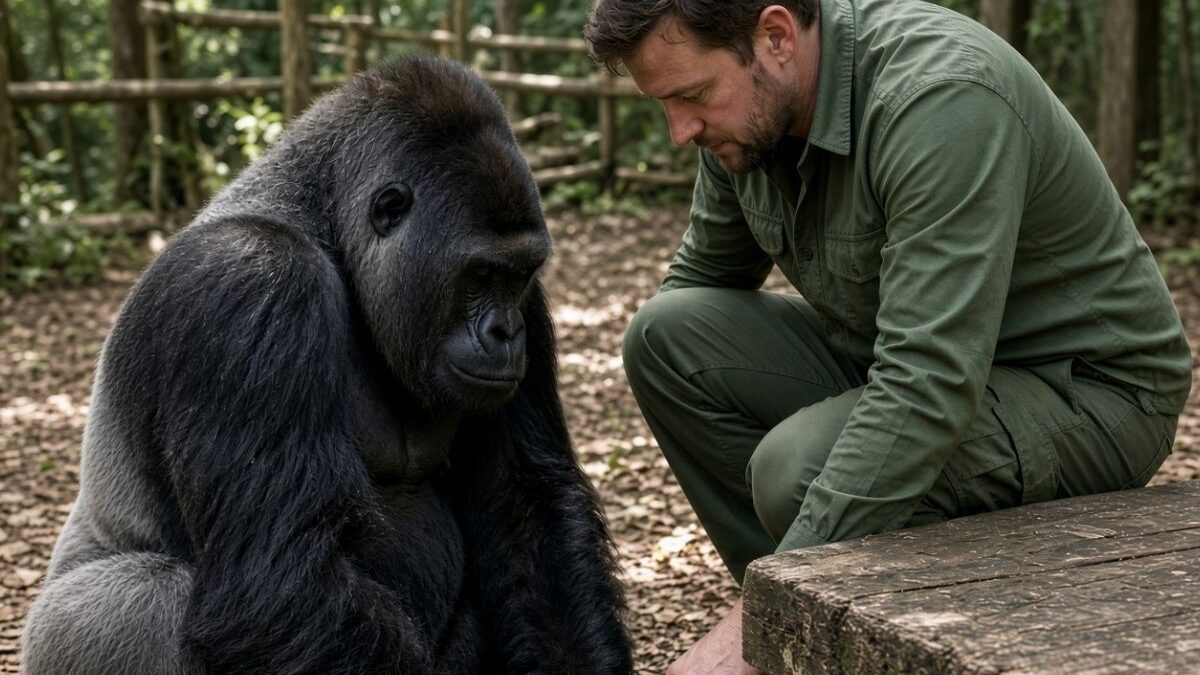
The first time Milo stared at the empty bench, I assumed he was watching visitors.
The second time, I assumed he was nervous.
By the seventh afternoon, he had stopped eating his favorite grapes, carried a white feather across his enclosure, placed it directly beneath that bench, and sat twenty feet away waiting for me to notice.
That was when I realized the gorilla wasn’t watching people.
He was trying to show me something.
My name is Aaron Hayes, and I worked as a senior animal-care specialist at Blue Ridge Primate Rescue outside Knoxville, Tennessee.
Milo had arrived three months earlier.
He was young, undersized, cautious, and recovering from the kind of early life that teaches an animal to observe before trusting anything.
He wasn’t aggressive.
That would have been easier to understand.
Instead, Milo watched.
Every sound.
Every gate.
Every hand that moved near him.
And one weathered wooden bench on the public side of his habitat.
Especially that bench.
His enclosure had a transition door leading into a larger rehabilitation yard.
Every gorilla moved through it eventually.
Milo wouldn’t.
We would open the passage.
Set food beyond it.
Step away.
He would approach—
then stop.
But he never looked at the doorway.
He looked beyond it.
At the bench.
One Tuesday, I saw him pick up a small white feather.
He carried it carefully across the habitat.
Stopped at an invisible line several feet from the fence.
Then placed the feather down.
Directly opposite the bench.
Afterward, he backed away.
“What was that?” my coworker Jenna asked.
“No idea.”
The next day it was a smooth stone.
The day after that, a yellow leaf.
Then an acorn.
Always one object.
Never two.
Always nearly the same place.
And almost always around three o’clock.
We started logging the behavior.
2:57.
3:04.
3:01.
2:59.
Too consistent to ignore.
But three o’clock meant nothing in our schedule.
No feeding.
No medication.
No keeper change.
No regular delivery.
I reviewed visitor records.
Nothing.
Security footage.
Nothing.
Then one afternoon, a little boy dropped a red baseball cap near the fence.
Milo walked over.
Picked it up.
Brushed leaves from it.
Carried it toward the boy.
And set it down where staff could retrieve it.
Everyone laughed.
The boy waved.
Milo barely looked at him.
His eyes shifted immediately back toward the bench.
That bothered me.
Because it meant Milo understood the difference between an object that belonged to somebody—
and the objects he was deliberately placing near that spot.
A few days later, our maintenance supervisor left an orange work glove on the path.
Milo picked it up.
Carried it toward the bench.
I thought we’d found the pattern.
Then he placed the glove on the bench itself.
Stared at it.
Picked it back up.
And returned it toward the maintenance worker.
Jenna looked at me.
“So the bench isn’t a collection point.”
“No.”
“Then what is it?”
I didn’t know.
Management became concerned when Milo started ignoring new enrichment.
He wasn’t playing.
Wasn’t exploring.
He spent too much time monitoring the same corner.
A larger rehabilitation habitat had recently become available.
More climbing structures.
More trees.
Better long-term space.
The decision was reasonable.
Move him.
Break the fixation.
Start fresh.
I signed the paperwork.
And immediately regretted it.
The transfer was scheduled for Friday morning.
On Thursday evening, I stayed late.
The visitor path emptied.
Rain clouds darkened the mountains.
At 3:02, Milo came down from his climbing platform.
He walked toward the bench.
No feather.
No stone.
Nothing in his hands.
He stopped.
Then walked several feet to the left.
He touched the ground.
Walked back toward the bench.
Touched the ground again.
Two different locations.
I watched him repeat it.
Then it hit me.
The bench had recently been shifted about thirty feet because maintenance was repairing cracked concrete.
But Milo kept checking the old spot.
Not the bench.
The location.
I pulled archived maintenance maps.
The current bench wasn’t original.
Years earlier, another bench had stood almost exactly where Milo kept stopping.
It had been damaged during a storm and replaced slightly farther away.
I went outside with a flashlight.
The old concrete looked ordinary.
Dust.
Gravel.
Leaves.
Then I found four tiny drill holes forming a rectangle.
Old anchor points.
My pulse started climbing.
I knelt.
Brushed debris aside.
Something metallic rolled against my finger.
A tiny brass screw.
Old.
Weathered.
The maintenance records confirmed it matched the original bench hardware.
Jenna crouched beside me.
“Aaron…”
I pushed my fingers into a narrow gap beside the old concrete foundation.
At first, nothing.
Then plastic.
Smooth.
I pulled slowly.
A small weatherproof pouch came free from beneath years of dirt.
Inside was a faded photograph.
An old identification badge.
And a folded handwritten note.
The photograph showed a woman sitting on the original bench.
Behind her was the same habitat—
years before Milo had ever been born.
The badge belonged to a former rescue-center volunteer named Margaret Ellis.
The date was almost twelve years old.
Milo could never have known her.
I unfolded the note.
Only part of the writing remained readable.
Then Jenna pointed at one line.
I read it aloud.
“This is the place where he finally stopped being afraid of me.”
We both went silent.
Behind us came three quiet taps.
Metal against metal.
I turned.
Milo was sitting beside the enclosure gate.
One hand resting near the latch.
His eyes weren’t on the pouch.
They were on me.
And for the first time, I understood something chilling.
He hadn’t spent weeks waiting for someone to return to the bench.
He had spent weeks waiting for us to look underneath it.
I walked toward the fence with the pouch in my hand.
Milo didn’t move.
I stopped several feet away.
For weeks, I had been trying to understand his behavior by asking the wrong question.
Why does he care about the bench?
But he hadn’t.
When maintenance moved it, he still returned to the original location.
When visitors sat there, he watched both them and the ground.
When objects appeared that belonged to people, he returned them.
The feather.
The leaf.
The stone.
The acorn.
Those hadn’t been gifts to an imaginary person.
They had been markers.
Ways of directing attention toward a place.
I sat down.
“Milo.”
He looked at me.
I held the pouch where he could see it.
Nothing dramatic happened.
No excited vocalization.
No celebration.
He simply watched.
Then his shoulders relaxed.
A small physical change.
But I had learned to notice small changes.
Jenna joined me.
“You think he smelled it?”
“That makes more sense than anything else.”
The pouch had been wedged close to the old foundation.
Years of dust had covered it, but the protective plastic remained mostly intact.
Gorillas experience the world through senses humans routinely underestimate.
Maybe traces of scent lingered beneath the concrete.
Maybe Milo had noticed something we couldn’t.
We could not prove exactly what he detected.
But suddenly every repeated behavior had a physical explanation.
The invisible line.
The old location.
The objects.
The way he brushed dust away.
The three taps at the gate.
He wasn’t telling us a story.
He didn’t know Margaret Ellis.
The badge predated his arrival by years.
He had discovered something unusual beneath a place humans walked past every day.
And because he couldn’t point and say, Look here, he repeated behavior until somebody finally did.
The transfer was suspended.
Not because we wanted to reward fixation.
Because moving Milo hours after learning we’d misunderstood the behavior would have been terrible animal care.
We needed more observation.
The next morning, something changed.
Milo woke before sunrise as usual.
Climbed halfway up his oak tree.
Watched staff arrive.
At 2:50, I caught myself staring at the clock.
Jenna noticed.
“You’re waiting.”
“So are you.”
At three o’clock, Milo did not go to the bench.
He stayed beneath the oak.
At 3:10, he climbed onto a platform.
At 3:20, he lay down.
Jenna opened her notebook.
Then stopped.
Finally she wrote one sentence:
Today was the first afternoon Milo chose to rest before three.
That line affected me more than I expected.
The behavior hadn’t disappeared completely.
But the urgency had.
The constant watchfulness softened.
Milo started exploring again.
He worked through enrichment puzzles he’d ignored for weeks.
He investigated new ropes.
He shared pieces of fruit through protected mesh with two younger primates in the neighboring habitat.
Most importantly, he began approaching me differently.
Before, every interaction felt transactional.
Food.
Medical training.
Cleaning.
Doors.
Now, sometimes I would sit outside his habitat without asking anything.
Eventually, he started coming closer.
Three days after we found the pouch, I entered the protected keeper section while Milo remained separated by the internal safety barrier.
I sat on the floor.
He approached.
Slowly.
Then pressed his forehead against the mesh opposite my shoulder.
I didn’t reach toward him.
I just stayed.
Trust doesn’t always need touching.
Sometimes remaining still is enough.
We began researching Margaret Ellis.
The old badge identified her as a volunteer, but our current database contained almost nothing.
Records from that era were incomplete.
Eventually, archived paper files gave us more.
Margaret had volunteered at Blue Ridge for several years.
She specialized in helping newly rescued primates acclimate to the presence of people.
Not training tricks.
Not making them tame.
Simply teaching frightened animals that humans entering nearby spaces did not always mean danger.
The photograph in the pouch showed her sitting on the bench.
The note appeared to reference one of those animals.
Not Milo.
Another rescued gorilla housed there many years earlier.
That explained the sentence:
This is the place where he finally stopped being afraid of me.
The bench had been part of someone else’s recovery long before Milo arrived.
Then, somehow, an identification pouch slipped beneath it and remained hidden when the bench was replaced.
Margaret’s family still lived in Tennessee.
The sanctuary contacted them through the proper channels.
Her daughter, Emily, came to retrieve the pouch.
Margaret had died several years earlier.
Emily held the old photograph for a long time.
“I thought this was gone.”
She turned it over.
On the back was another faded note in her mother’s handwriting.
It read:
Patience first. Everything else after.
Emily laughed through tears.
“That sounds exactly like Mom.”
I looked toward Milo’s habitat.
It sounded like a lesson he had accidentally forced us to relearn.
We had interpreted his behavior as fixation.
Then anxiety.
Then unhealthy dependence on one object.
We designed solutions before understanding the problem.
Move him.
Distract him.
Increase enrichment.
Remove the bench.
All reasonable ideas.
All wrong.
Because we had observed the behavior without asking what changed when we changed the environment.
The day maintenance relocated the bench should have told us everything.
Milo kept returning to the old location.
I had seen it.
I simply hadn’t understood what I was seeing.
After Emily left, we returned the bench to its original position.
Not because Milo needed it.
Because construction no longer required it to remain elsewhere and the old anchor location was safe.
I measured carefully.
Maintenance secured it.
Nobody called Milo over.
No cue.
No food.
No expectation.
Eventually he wandered toward the area.
He stopped beside the bench.
Sat down.
Leaned his back against it.
And looked toward the trees.
No searching.
No digging.
No object beneath it.
He simply rested.
That ordinary behavior felt enormous.
The permanent transfer to the neighboring habitat was canceled for the time being.
Not because Milo would never move.
He eventually would.
Growing gorillas need changing social and physical environments.
But relocation would happen when it served his development—not because we’d mistaken communication for pathology.
Weeks passed.
Autumn arrived.
One afternoon, a yellow leaf floated onto the visitor path.
I saw Milo notice it.
My entire body went still.
He walked over.
Picked it up.
Studied it.
For a second, I expected him to carry it toward the bench.
Instead, he released it.
The wind took it.
Milo watched the leaf tumble away and continued walking.
I laughed.
Jenna heard me.
“What?”
“Nothing.”
But it wasn’t nothing.
A habit had disappeared because it was no longer needed.
Winter followed.
Then spring.
The rescue center filled with visitors again.
Children stopped near the enclosure.
Milo sometimes watched them.
Sometimes ignored them completely.
That indifference made me ridiculously happy.
Animals recovering from uncertainty don’t owe us constant connection.
Ordinary life is often the better ending.
One spring afternoon, an elementary-school class visited.
Before leaving, students sat at picnic tables and drew their favorite animals.
Hours later, while cleaning the visitor path, I found a piece of paper tucked beneath the bench.
For half a second, my heart jumped.
Then I unfolded it.
Crayon covered most of the page.
A large smiling gorilla sat beneath a tree.
A stick-figure man stood outside the fence.
In uneven handwriting, a child had written:
HE LOOKS PEACEFUL NOW.
I sat on the bench.
That one sentence said more than any behavioral report I’d written.
I kept the picture.
Not in the exhibit.
Not framed publicly.
I placed it in my desk drawer beside the old brass screw from the original bench.
Two objects with almost no monetary value.
One represented everything we’d failed to notice.
The other represented what changed after we finally did.
Years of animal care had taught me how dangerous it is to give human explanations to animal behavior.
Milo did not uncover Margaret’s pouch because he knew a grieving family had lost it.
He wasn’t solving a mystery.
He wasn’t performing a memorial ritual.
The evidence didn’t support any of that.
What we knew was simpler.
Something beneath that location caught his attention.
He repeatedly directed behavior toward it.
We kept misunderstanding.
He kept repeating.
Eventually, we looked.
And once we found what had been there, the behavior faded.
That was extraordinary enough.
One evening, months later, I made my usual walk past the enclosure before going home.
Milo was high in the oak.
He barely acknowledged me.
“Goodnight, buddy.”
Nothing.
I smiled.
Then I walked past the bench.
The wood had darkened slightly from rain.
Leaves gathered beneath it.
Families used it every day.
Most had no idea anything important had ever happened there.
We never installed a plaque.
I didn’t want to turn that quiet corner into another attraction.
Sometimes a place is allowed to remain ordinary.
I was nearly at the staff gate when I heard movement.
Milo had climbed down.
He came toward the fence.
Stopped a few feet away.
Placed one hand against the mesh.
Months earlier, I might have reached toward him.
Tried to answer.
Tried to give the gesture meaning.
This time I simply stood there.
After several seconds, Milo removed his hand.
Turned.
And walked back toward the trees.
I understood then that trust isn’t proven because an animal needs you forever.
Sometimes the clearest proof is the opposite.
They stop watching.
Stop waiting.
Stop searching.
They begin living when you’re not the center of their attention.
For weeks, Milo had watched one empty patch beside a wooden bench as though something unfinished existed there.
We almost moved him because we thought he couldn’t let go.
But Milo wasn’t the one refusing to move forward.
We were the ones who hadn’t stopped long enough to see what was directly beneath our feet.
The last time I checked beneath the bench, there was nothing there.
No feather.
No stone.
No acorn.
No forgotten pouch.
Only fallen leaves and ordinary dust.
And Milo?
He was on the far side of the enclosure, climbing toward the highest platform while afternoon sunlight filtered through the trees.
Not looking backward.
Not waiting for three o’clock.
Not trying to show us anything.
Just living.
And after everything we’d misunderstood about him.

