This Warm Current Has Been Hiding Megalodon for Millions of Years | Real Megalodon Encounter
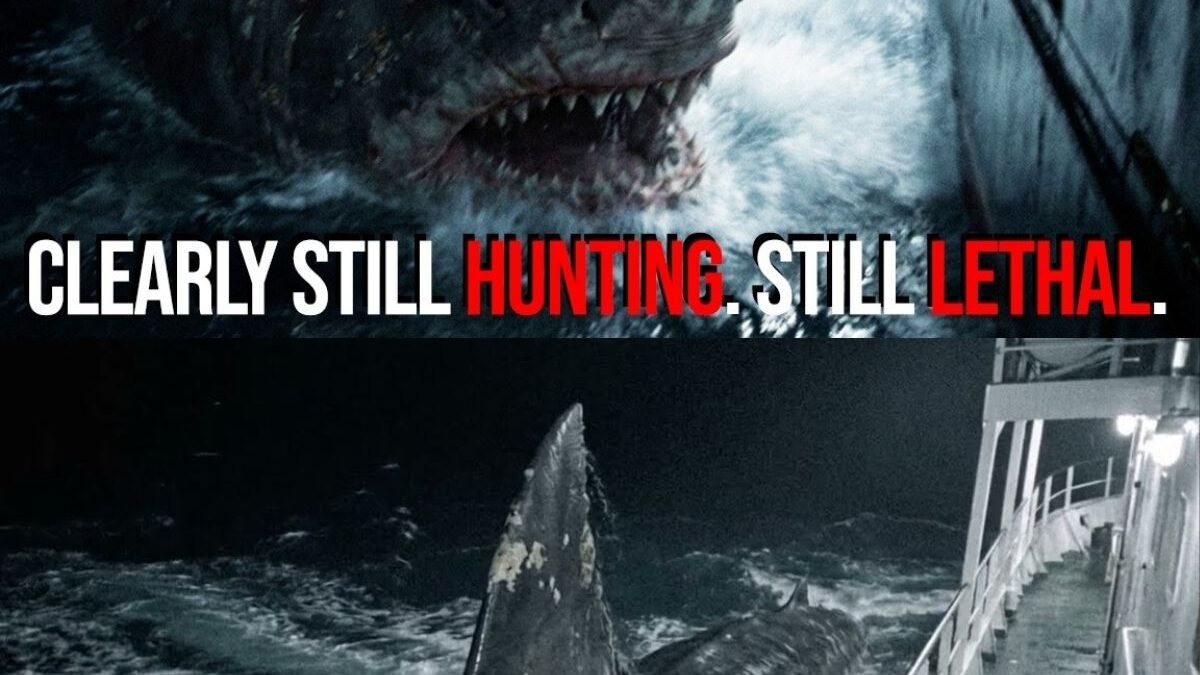
In March of 1995, the Icelandic Coast Guard received an emergency distress transmission from the research vessel Ran operating approximately 300 miles southwest of Reykjavik in some of the most remote waters of the North Atlantic. The vessel was taking on water in two compartments. A 6-ft section of whole plating on the port side had buckled inward with enough force to fracture the welds on both ends of the affected panel.
The structural damage report filed after the vessel’s recovery would describe the failure as consistent with a large rigid object striking the whole at considerable velocity from below. What the report would not explain, what no official document has ever explained, is why the scraping pattern on the deformed plating showed individual ridges evenly spaced in a texture that the surveying engineer described in his margin notes as resembling the surface of a rasp.
Not smooth like rock. Not random like ice. Ridged texture. The pattern of something alive. The sonar data that might have explained the damage, 14 hours of continuous deep tow recordings captured in the days before the impact, was transferred from Iceland’s Marine Research Institute to NATO’s Saclant Undersea Research Centre in La Spezia, Italy within 72 hours of the vessel’s return to port.
It has not been released. What follows is a reconstruction of the incident assembled from the evidence that remains. The vessel’s bridge audio recorder, the structural damage survey, seismic data from the Icelandic Meteorological Office, and the personal correspondence of the expedition’s co-lead, a woman who, according to those letters, had spent two years preparing to find exactly what the sonar recorded.
The Ran was a 92-m Norwegian built research vessel, white-hulled, heavy for her class, registered to the University of Iceland’s Marine Research Institute, and jointly funded by the Norwegian and Icelandic governments for a 6-week mapping survey of hydrothermal vent distribution along the Reykjanes Ridge. The Reykjanes Ridge is the northernmost section of the Mid-Atlantic Ridge, the volcanic seam that splits the Atlantic Ocean floor from the Arctic Circle to the southern tip of Africa.
It is one of the most tectonically active stretches of seafloor on Earth. Along its length, hydrothermal vents discharge superheated, mineral-rich water from deep within the Earth’s crust into the surrounding ocean, creating localized pockets of warm water, sometimes exceeding 20° C, surrounded on all sides by North Atlantic deep water that hovers just above freezing.
These vent fields support entire ecosystems independent of sunlight. Chemosynthetic bacteria, tube worms, vent shrimp, deep-water crabs, and fish species found nowhere else. They are, in effect, oasis of heat and life on the floor of a frozen ocean. In 1995, the international scientific community was mapping these vent fields for the first time.
The Reykjanes expedition was one of the earliest comprehensive surveys of the Reykjanes system, and her colleague was a 37-year-old Icelandic marine geophysicist named Katrín Sigurðardóttir. Dr. Sigurðardóttir was, by all accounts, meticulous. She had trained at the University of Bergen under some of the leading figures in North Atlantic oceanography, had published extensively on mid-ocean ridge volcanism, and had designed the Reykjanes deep-tow acoustic array configuration herself.
But what her colleagues did not know, what would only become clear years later through letters obtained under Iceland’s freedom of information statutes, was that Sigur had calibrated the Ran’s deep tow hydrophones to detect a very specific frequency. A frequency below 8 Hz. A frequency that, according to an unpublished scientific paper, she had obtained through informal channels in the marine biology community, corresponded to the body displacement of an animal in the 50 to 60-ft range moving through deep water.
The paper had been written 14 years earlier by a marine biologist working in a different ocean entirely. It had never been published. The institution that funded the research had made certain of that. But it had circulated quietly through departments and between colleagues. And Sigur had read it as a graduate student in 1990.
She had written to its author in 1993. By 1995, she had designed an entire expedition around the possibility that his theory was correct. The Ran departed Reykjavik on the 9th of March, 1995, under overcast skies and a northwest swell running at 12 ft. The ship’s log records a routine transit to the survey area with the deep tow array deployed on the morning of March 11th at the northern edge of the target zone.
The first two days of survey were unremarkable. The array recorded the expected ambient noise of the ridge system. The low groaning of tectonic stress, the hiss and rumble of active vents, and the biological chatter of the vent field ecosystems below. Standard data. Standard expedition. The bridge log for the evening of March 13th contains a single entry that, in retrospect, marks the point where this expedition became something else entirely.
At 2147 hours, the deep tow sonar operator logged an anomalous contact at 1800 ft. The contact was inside the thermal plume of an active vent field, a column of 19° water rising from fissures in the basalt, surrounded by Atlantic deep water at 2°. The operator’s initial classification was geological, possible vent debris in current.
But vent debris does not move against the current. And vent debris does not produce a rhythmic, low-frequency displacement pulse that registers below 8 hertz on the hydrophone array. Dr. Sigurðardóttir was called to the sonar room 17 minutes after the initial contact. According to the bridge audio recorder, which captured conversations in the wheelhouse and the adjacent operations room throughout the expedition, she listened to the acoustic feed for approximately 4 minutes before speaking. What she said, recorded on the
bridge audio, was “That is not geological.” She then asked the sonar operator to isolate the low-frequency component and compare its amplitude to a set of reference values she had brought aboard in a sealed notebook. The operator complied. The frequency matched. Sigurðardóttir ordered the survey pattern altered to maintain the Ran’s position directly above the vent field.
She extended the deep tow deployment window from the planned 6 hours to continuous recording. And she instructed the bridge watch to log the contact’s position, bearing, and estimated dimensions every 15 minutes. The watch log entries, which survive because they were recorded in the bridge’s paper logbook, rather than in the digital system that NATO would later seize, tell the story of the next 3 hours in sparse, clinical language.
At 2215, contact holding station inside thermal plume. Estimated depth 1,800 ft. Bearing 047 from ship’s position. Moving in a slow counterclockwise circuit. At 2230, contact dimensions consistent with solid biological mass, approximately 55 ft in length, based on acoustic shadow and displacement calculation.
At 2245, contact maintaining circuit, speed approximately three knots, depth unchanged. Every 15 minutes, the same basic picture. Something very large was circling inside the warm water of the thermal plume, 1,800 ft below the Ran, >> [clears throat] >> and it had been doing so for as long as the array had been recording.
The question that the watch log does not address, but that the bridge audio captures Sigur Rós Gorter discussing with the expedition’s chief scientist at 2300 hours, is what a 55-ft biological entity was doing inside a hydrothermal vent field in the North Atlantic. The chief scientist, a Norwegian named Erik Lindquist, suggested a whale.
Sperm whales are known to dive to similar depths. Sigur Rós Gorter, according to the bridge audio, rejected this. The acoustic signature was wrong. Sperm whales produce echolocation clicks in the 15 to 30 kHz range, sharp, rhythmic pulses that are among the most distinctive sounds in the ocean. This contact was producing nothing above 200 Hz.
The dominant signal was the displacement pulse, sub-8 Hz, rhythmic, consistent with the passage of a very large body through water at low speed. A sound so low that it was below the threshold of human hearing. A sound that registered not as noise, but as pressure. A slow repeating compression of the water column produced by something enormous moving through it.
And the contact was holding station inside a thermal plume at a depth where the ambient water temperature outside the plume was 2° C. No whale species maintains a stationary position at that depth. Whales dive to feed. They descend, they hunt, and they return to the surface to breathe. Their deep water time is measured in minutes, occasionally in hours for the deepest diving species.
They do not circle. They do not hold station. Whatever this was, it was not passing through. It was not feeding and returning. It was living there. It had been living there, inside that thermal plume, for at least as long as the Rance array had been listening. And possibly for far longer. There was no way to know how long the creature had occupied the vent field before the survey began.
The hydrophones could only record what they were deployed to hear. For all the data could prove, the contact had been circling inside that column of warm water for days or months or years. To understand why that detail matters, why Sigurðardóttir recognized it as critical, requires a brief examination of a theory that was, in 1995, known to fewer than two dozen marine biologists worldwide.
Hydrothermal vent fields are geologically permanent on time scales of millions of years. The Reykjanes Ridge has been volcanically active for at least 50 million years. And individual vent fields, while they shift and reorganize, maintain thermal output continuously across spans that dwarf the entire history of human civilization.
The ecosystems they support have evolved in complete isolation from the surface. Chemosynthetic bacteria converting mineral-rich vent discharge into energy, tube worms and shrimp feeding on the bacteria, fish feeding on the shrimp, and all of it sustained by the heat of the Earth itself, rather than the light of the sun.
These are self-contained survival systems. They require nothing from the world above, and they produce within their thermal plumes stable water temperatures between 15 and 25° C. Warm enough for any tropical species to survive, surrounded on all sides by water that would kill that same species in minutes.
This is the detail that matters. The deep ocean is not uniformly cold. It is cold everywhere except where the Earth itself is bleeding heat through the seafloor. And in those places, the water is as warm as the Caribbean, as warm as the Gulf of Mexico, as warm as the shallow coastal seas where the largest predatory shark in the history of the planet once hunted.
The fossil record states that Otodus megalodon, a shark estimated at 50 to 65 ft in length with jaws wide enough to engulf a small automobile and teeth the size of a man’s hand, disappeared from the Earth’s coastal waters approximately 3.6 million years ago. The conventional explanation is extinction, driven by Pliocene ocean cooling and the collapse of the whale populations that constituted its primary food source.
The fossil record supports this. Megalodon teeth, once abundant in shallow coastal sediments worldwide, vanished from the geological record after the mid-Pliocene. But the fossil record has a blind spot. It documents what dies in shallow water, where sediment preserves remains. It documents nothing about what lives in deep water, where the ocean floor is a recycling system, where biological material is consumed, dissolved by the water chemistry, or buried in sediment.
It is eventually subducted back into the Earth’s mantle at tectonic plate boundaries. If a population of megalodon retreated from cooling surface waters into deep warm water systems, following the heat downward as the world above grew cold, the fossil record would show exactly what it shows, a sudden disappearance, an apparent extinction, not because the animal died, but because it moved to a habitat where preservation is impossible.
The paper Sigurðardóttir had read in 1990, the one that had never been published, the one that had circulated hand-to-hand through marine biology departments for a decade, had proposed that these vent fields were not just geological curiosities. They were refugia, permanent, stable, warm water habitats embedded in the deep ocean, capable of sustaining a creature that the surface world believed had gone extinct millions of years ago.
And the vent fields offered more than just warmth. The chemosynthetic ecosystems surrounding the vents, the tube worms, the vent shrimp, the deep water crabs, the specialized fish species that cluster around the thermal plumes represent a concentrated food web that attracts mesopelagic prey species from the surrounding deep water.
Squid, deep water fish, small sharks, all drawn to the warmth and the biological activity of the vent system. For an apex predator living inside the thermal plume, the vent field is not merely a heater. It is a hunting ground, a self-sustaining system of warmth and prey that has been operating continuously for longer than the human species has existed.
The paper’s author had captured acoustic evidence to support this claim. His data had been confiscated by the company that employed him. But his theory had survived, and Sigurðardóttir had designed the Rance expedition to test it. At 0023 hours on March 14th, the deep tow array recorded a change. The contact’s circuit pattern, which had been consistent for over 3 hours, tightened.
The radius of its turn decreased. Its speed increased from 3 knots to approximately 7. The sonar operator noted the change in the watch log and called Sigurðardóttir, who had retired to her cabin 30 minutes earlier. She reached the operations room within 4 minutes. What happened next is documented in the seismic record of the Icelandic Meteorological Office, which confirms that at 0031 hours on March 14th, 1995, a magnitude 4.
1 seismic event occurred on the Reykjanes Ridge at coordinates consistent with the Rance survey position. A magnitude 4.1 event is, by geological standards, minor. It is not the kind of event that makes international news or endangers surface vessels. But it is precisely the kind of event that disrupts hydrothermal vent fields. The vents are fed by pathways through fractured rock.
When the rock shifts, the [snorts] pathways rearrange. Thermal output drops, surges, or redirects. For an organism depending on the thermal plume as its heat source, an organism whose physiology requires warm water to maintain core body temperature, a vent disruption is not a minor event. It is a sudden, potentially lethal change in the only thing keeping it alive at that depth.
The bridge audio captures the sequence in real time. At 0031, the sonar operator reports a seismic tremor on the array. At 0032, Sigurðardóttir asks for the contact’s position. The operator reports that the contact has broken its circuit pattern. It is ascending. Depth 1,500 ft, speed increasing. At 0033, the contact passes through 1,200 ft.
The operator’s voice, audible on the bridge recording, has shifted from professional calm to something considerably less composed. The contact is not ascending slowly, as a whale would. It is rising at what the operator estimates as 15 to 20 knots, the speed of a vessel at full ahead. At 0034, depth 800 ft. The chief scientist asks whether the deep tow array can determine the contact’s lateral position relative to the ship.
The operator reports that the contact is converging on the Ram’s position. It is not simply rising. It is rising toward them. At 0035, depth 500 ft. The bridge audio captures the captain’s voice for the first time. He had been monitoring from the chart table, and in the span of 4 minutes, he had heard his sonar operator go from routine reporting to something very close to controlled fear.
He orders the helmsman to come to full ahead and alter course 30° to starboard. The Ram’s engine note rises on the recording, but a 92-m research vessel running full survey gear does not accelerate like a patrol boat. The ship began to turn. The contact continued to rise. At 0036, depth 300 ft. The sonar operator says two words that are almost unintelligible on the recording, spoken under his breath, not into the intercom.
The maritime historian who recovered the tape in 2011 has spent hours cleaning the audio and believes the words were, “It’s here.” The contact passes directly beneath the vessel. What follows on the bridge audio is a sound that the structural engineer who reviewed the recording described as comparable to a heavy steel beam being dragged across a concrete floor at high speed.
A grinding, resonant vibration that transmits through the hull and into every compartment of the ship simultaneously. The deck shuddered. The flooding alarm activated 4 seconds later. Two compartments on the port side reported water ingress through the buckled hull plating. The crew’s response, documented in the damage control log, was immediate and professional.
Watertight doors were sealed. Portable pumps were deployed. The chief engineer reported to the bridge within 3 minutes, confirming that the ingress rate was manageable, but that the affected plating had deformed beyond field repair. The flooding was contained within 11 minutes, but the Ran was 300 mi from the nearest port in heavy March swell, with a compromised hull and no certainty that whatever had struck her was not still beneath the vessel.
The bridge audio captures the next 20 minutes in fragments, a captain coordinating damage control, the chief scientist asking Sigurdardottir whether the sonar showed the contact’s current position, and Sigurdardottir’s response, which is barely audible on the recording. It’s gone back down.
The deep tow array, still deployed, showed the contact descending rapidly after the impact. It passed through 500 ft then 800 and 1,200 and then the array lost it. Either the contact moved out of range or it returned to the disrupted vent field or it found another thermal source deeper on the ridge. It did not return to the surface.
The captain transmitted a distress call on channel 16 at 0042 hours. The Icelandic Coast Guard dispatched a patrol vessel that reached the Reykjanes by midmorning. The transit back to Reykjavik under escort took 19 hours. 19 hours in which the crew watched the sonar and said very little according to the bridge audio which continued recording for the entire return journey.
Sigridur spent the transit in the operations room listening to the playback of the deep tow recordings through headphones. The bridge audio picks up her voice once during the return trip speaking to Lindquist. She said, “It matched.” “Eric, it matched exactly.” He asked her what matched.
She did not answer on the recording. A structural damage survey conducted at the Reykjavik shipyard over the following week documented the deformation in detail. A 6-ft section of hull plating port side approximately 8 ft below the waterline buckled inward with a maximum deformation of 4 in at the center of the affected area. The welds at both ends of the panel had fractured.
And across the surface of the deformed plate running in the direction of the contact’s travel from bow to stern was a pattern of parallel scraping marks. The surveying engineer measured 23 individual ridges across the width of the scrape pattern. Each ridge was approximately 1/4 in wide separated by grooves of similar width. The pattern was consistent across the entire 6-ft length of the deformation.
It was not random. It was not geological. It was biological. The engineers’ margin notes, which survived because they were written in pencil on the paper survey form, rather than entered into the digital report, include a single sentence of personal observation. Surface texture resembles large-scale dermal denticles, similar in structure to shark skin, but individual elements are approximately 50 times the size of those found on any known species.
Those margin notes were never included in the official survey. The official report attributed the damage to impact with submerged volcanic debris dislodged by the seismic event. Within 3 days of the Ran’s return to port, two officials from NATO’s SACLANT Undersea Research Center arrived at the Marine Research Institute in Reykjavik. They carried documentation authorizing the transfer of all deep-tow sonar recordings, all acoustic analysis data, and all digital records from the expedition to SACLANT’s facility in La Spezia, Italy, under a security
classification that has not been downgraded in the 30 years since. The speed of the response is itself a piece of evidence. SACLANT, the Supreme Allied Commander Atlantic’s Undersea Research Center, is a NATO facility whose primary mission is anti-submarine warfare research and deep ocean acoustic analysis.
Its interest in the Ran’s data was not scientific. It was strategic. During the Cold War, SACLANT had maintained the most sophisticated underwater listening network on Earth. The SOSUS array, a chain of hydrophones spanning the Atlantic from Iceland to the Azores, designed to track Soviet submarines by their acoustic signatures.
By 1995, the Cold War was over, but the infrastructure remained, and SACLANT’s analysts were intimately familiar with every acoustic signature that the deep Atlantic produced. If the Ran’s recordings contained a biological signature that SACLANT could not identify, a signature large enough and fast enough to be mistaken for a submarine, that was not a scientific matter.
That was a matter of Atlantic defense infrastructure. The classification was not about protecting a species. It was about protecting the fact that something was moving through NATO’s underwater surveillance network that NATO could not explain. Dr. Sigurðardóttir’s personal research files, including the sealed notebook containing the reference frequency values she had brought aboard the Ran, were included in the transfer.
Her subsequent requests for the return of her data, filed through the University of Iceland’s legal office over the next 4 years, were denied without explanation. She filed nine formal requests between 1995 and 1999. Each was returned with the same form response. The data was held under security classification and could not be released, transferred, or discussed through civilian channels.
In 2001, she submitted a freedom of information request through Iceland’s Information Committee, arguing that the data had been collected under a civilian research mandate and should not be subject to military classification. The request was partially granted. She received the expedition’s administrative records, weather logs, and navigation data, everything that was routine.
Everything that mattered, the acoustic recordings, the frequency analysis, the comparison data, remained classified. The bridge audio recorder, which was a separate analog system hardwired [snorts] into the vessel’s electrical infrastructure, was not included in the NATO transfer, apparently because the Sigurðardóttir officials were unaware of its existence.
It remained in the Ran’s wheelhouse until the vessel was decommissioned in 2011, when it was recovered by a maritime historian cataloging the ship’s equipment. The tape has been in private hands since. The watch log, the paper logbook in which the bridge officer recorded the contact’s position every 15 minutes for 3 hours, was similarly overlooked.
It was filed with the Marine Research Institute’s expedition archives, where it remains. Two pieces of evidence preserved by accident because they were analog in a digital seizure. Sigurðardóttir continued to work in marine geophysics. She published papers on mid-ocean ridge volcanism, on vent field thermal modeling, on the geological dynamics of the Reykjanes system.
She never published a word about what the Ran recorded on the night of March 13th. Not because she chose silence, but because every piece of data that could support the claim was locked inside a NATO facility in Italy. She had the bridge audio. She had the watch log. But without the acoustic recordings, without the frequency analysis that proved the match, she had a story, not evidence.
And Katrin Sigurðardóttir understood the difference. What the surviving evidence demonstrates is this. For over 3 hours on the night of March 13th to 14th, 1995, a biological entity approximately 55 ft in length held station inside a hydrothermal vent field on the Reykjanes Ridge, circling within a column of 19° water at a depth of 1,800 ft.
When a seismic event disrupted the thermal plume, the entity ascended at speed, passed beneath the 92-m research vessel, and struck the hull with enough force to buckle 6 ft of steel plating. The scraping pattern on the hull showed a texture consistent with dermal denticles, the tooth-like skin structures found exclusively in sharks and rays, at a scale approximately 50 times larger than those of any living species.
The entity’s behavior, holding station in warm water, ascending when the heat source failed, is consistent with an animal that depends on external thermal sources to supplement its own body heat. An animal that has adapted over geological time to exploit the only permanent warm water habitats in the deep ocean.
An animal that surfaces not by choice, but when the geology beneath it shifts and the heat it depends on disappears. This may explain why encounters are so vanishingly rare. The creature is not hiding. It is simply living at a depth a human technology has barely begun to reach, in a habitat that human science is only recently discovered exists.
It surfaces only when forced, when the Earth itself pushes it upward. And when it does surface, the encounters are violent, brief, and immediately classified. And the low-frequency displacement pulse produced by the entity’s movement through the water column matched to within 1/10 of a hertz, a frequency value that Dr.
Katrine Segurðardóttir had brought aboard in a sealed notebook, a value she had obtained from an unpublished scientific paper written 14 years earlier on the other side of the Atlantic Ocean by a man who had spent 22 years trying to tell the world what he had found. That paper was written in 1982. Its author was a marine biologist who had been contracted for an environmental survey aboard an oil exploration vessel in the deep Gulf of Mexico.
What he recorded on that vessel’s hydrophone array and what he saw with his own eyes on the night of August 14th, 1981, from a distance of 40 ft, would become the foundation for the only scientific theory that explains how an apex predator, officially extinct for 3.6 million years, has been surviving in the deep ocean undetected.
The theory begins with a simple principle. An animal that large does not need warm water. It carries its own heat, but it does need to be near heat, near deep currents, near volcanic vents, near the places where the ocean is not uniformly cold. And the man who proved it had his evidence taken from him by an oil company that did not want anyone asking what lived at the bottom of its drilling sites.
The oil company that employed him ensured the paper was never published, but the evidence he gathered and the theory he built from it survived. It reached Sigurðardóttir and in 1995, on a volcanic ridge in the North Atlantic, inside a chimney of heat on the floor of a frozen ocean, she found what he had told her she would find. The acoustic signature was identical.
The displacement pulse was identical. 14 years apart. 4,000 miles apart. Two different oceans. The same animal. Or the same kind of animal. A species that the fossil record says disappeared from the Earth’s coastal waters 3.6 million years ago during a period of catastrophic ocean cooling and that has not been seen since.
Has not been seen, that is, by anyone whose report was allowed to stand. The man who wrote the paper that Katrine Sigurdardottir carried aboard the Ran was named Paul Egan. He was a marine biologist. He specialized in the thermoregulation of large pelagic sharks, the biological systems that allow certain species to maintain body temperatures above the surrounding water.
In 1977, he had published a paper on the countercurrent heat exchange systems found in lamnid sharks, great whites, makos, porbeagles, arguing that these systems were not evolutionary innovations, but evolutionary remnants, diminished echoes of a far more efficient ancestral architecture that had once belonged to something much larger.
The paper was well-regarded in a small circle. It changed nothing. Four years later, in the summer of 1981, Egan was contracted by an oil exploration company called Meridian Deepwater Limited to conduct a legally mandated environmental assessment of a deepwater survey zone in the Gulf of Mexico, approximately 200 mi south of the Mississippi River Delta.
The assessment was a formality. Everyone aboard the survey vessel MV Dorado understood this. Egan was there to catalog fish species, file a compliance report, and stay out of the way of the seismic mapping operation that was the actual purpose of the voyage. What he was not expected to do was discover that Meridian’s instruments were being deployed into the living space of something that should not have existed.
The Gulf of Mexico is not a single body of water. It is a layered system, stratified by temperature, salinity, and density, and running through its deepest layers is one of the most powerful oceanographic features in the western Atlantic. The Loop Current. It enters the Gulf through the Yucatan Channel, curves northward and then eastward, and exits through the Florida Straits to become the Gulf Stream.
At the surface, it is a warm river, 84° turquoise, the current that makes Florida’s beaches swimmable in winter. But the Loop Current is not a surface phenomenon. It extends to depths exceeding 2,500 ft, and at those depths, it maintains temperatures of 18 to 22° C. Water as warm as a swimming pool, more than 1,000 ft below the point where sunlight ceases to penetrate.
It carries with it the entire food web of the mesopelagic zone. Squid, lantern fish, deep-water shrimp, mid-water predators that have never been cataloged because no one has ever looked. In 1981, the oil industry was just beginning to push exploration into these deep zones. Meridian seismic mapping operation was among the first to lower instruments below 2,000 ft in the central Gulf.
They were entering a part of the ocean that no human technology had previously reached. The Dorado was a 280-ft converted supply vessel, white superstructure over a dark blue hull, fitted with cable drums, winch systems, and a survey lab that occupied most of the main deck. She was not a graceful ship.
She was a working platform built to hold station in open water and lower expensive equipment into the deep. The crew was a mix of Meridian survey technicians, merchant marine officers, and a handful of contract scientists, Egan among them, who occupied the lower rungs of the vessel’s informal hierarchy. Late August in the deep Gulf is a particular kind of miserable.
The air temperature hovers in the mid-90s. Its humidity is so complete that the distinction between air and water becomes philosophical. The sea surface is flat, metallic, the color of gunmetal under a haze that blurs the horizon into a single white band where the sky and the ocean merge and neither has an edge.
At night, the deck floods turn on and the world contracts to a circle of halogen light surrounded by absolute darkness. The ocean beyond the rail block and still and close as if the water is a floor. It extends in every direction and drops away without warning into depths that the human mind is not equipped to picture.
Beneath the Dorado, invisible and immense, the loop current moves south to north at three knots carrying warm water and everything that lived in it through the deep gulf. And in the third week of the survey, something in that part of the ocean noticed. The first instrument failure occurred on August 9th. A deep tow magnetometer cable deployed at 2,400 ft inside the loop current stopped transmitting at 14:23 hours.
The cable was recovered over the following 6 hours. When the severed end reached the surface, the survey technicians examined it under the afterdeck work lights and called the survey chief. The cable had not frayed. It had not corroded or fatigued at its stress point. The cut was clean, or rather, it was compressed.
The cross-section deformed into an oval rather than a circle as though the cable had been gripped and crushed by something that closed around it from two sides. And across the compressed surface, running perpendicular to the cable’s length, were serration marks. Not the marks of a mechanical shear. Not the marks of abrasion against rock.
Curved serration marks following the arc of something that had closed around the cable the way a jaw closes around prey. Dr. Egan examined the cable end under magnification. He measured the compression pattern and calculated a bite radius of approximately 4 ft. He photographed the cable from six angles under halogen light.
And he requested formally and in writing that the Dorado’s deep-tow hydrophone array be activated for continuous monitoring of the survey zone. His survey chief agreed, not because he believed Egan’s assessment, but because the lost cable represented a significant equipment cost and sonar monitoring might identify whatever was damaging the gear.
The hydrophone array was deployed that evening. Within 4 hours, it recorded [clears throat] the first instance of the signal. A rhythmic low-frequency displacement pulse registering below 8 Hz on the acoustic spectrum. Consistent, repeating, biological. The signature of a very large body moving through the deep water column at low speed.
The contact was at 2,400 ft. The same depth where the cable had been severed. Egan requested extended recording. Over the next 3 days, the pattern escalated. On August 10th, a second towed cable, a bathythermograph array measuring water temperature at depth, went silent. When recovered, the probe housing at the end of the cable was crushed.
Not bent, not dented. Crushed inward from all sides as though something had closed around it and squeezed. The housing was rated for pressures exceeding those found at 3,000 ft. Whatever had crushed it had applied more force than the deep ocean itself. >> [snorts] >> On August 11th, the deep tow hydrophone recorded the contact at 1,600 ft.
It had ascended 800 ft from its initial depth. On August 12th, the contact appeared at 800 ft. It was rising. And the acoustic data showed that each day the contact spent more time in the upper water column as though it was investigating the source of the instruments that kept descending into its territory. Tracing the cables upward toward the thing that was lowering them.
Egan documented all of this. He noted the ascending depth profile. He noted the correlation between instrument deployment and contact proximity. And he noted in his personal log a single observation that would become the foundation of everything he wrote afterward. The behavior pattern is not predatory. It is investigative.
The animal is not hunting our equipment. It is assessing it. Each day it comes closer to the surface, closer to the ship. It is determining what we are. On the night of August 14th, 5 days after the first cable was severed, Egan could not sleep. The gulf was flat calm. The air thick with humidity that turned every surface on the vessel slick with condensation.
The Dorados deck floods were on, casting a pool of halogen light across approximately 60 ft of black water off the port quarter. Beyond the reach of the light, the ocean was a wall, featureless, dark, and still. Egan went to the after deck rail at approximately 0200 hours. He stood there for several minutes looking at the water.
What happened next is documented in his written account, which he composed the following day while the details were still precise, and which he repeated without material variation in every retelling over the next 22 years, including the recorded interview he gave in 1996 to a marine science journalist.
He saw the water move before anything broke the surface. A mound of displacement, he described it. The surface deforming from below. A rising dome of water, it spread outward in a ring, flattening the surrounding calm in a way that reminded him of the pressure wave that precedes an underwater detonation. Then, the dorsal fin surfaced.
In the 1996 interview, Egan paused for 11 seconds before describing it. The tape is silent except for the hum of the recorder. When he spoke again, his voice was precise and controlled. The voice of a scientist delivering findings, but slower than before. He said, “The fin stood higher than the railing I was holding.
I am 5 ft 11. The railing is approximately 42 in. The fin cleared it by at least a foot. It was not the fin of any species I have seen in 30 years of studying sharks. It was thick, rigid, darker than the water around it, and the surface was rough, textured like wetstone. There were pale patches on it, lighter gray, almost white, that caught the deck light like calcium deposits on rock.
And there were growths along the leading edge, articles or something similar, clustered in a way that suggested they had been there for a very long time. Water was streaming off the trailing edge in heavy sheets. The fin alone was larger than any living shark I have ever measured. The animal surfaced behind the fin.
What Egan describes next, in the same measured tone, is a body that kept coming. A back breaking the surface that extended 30, then 40, then 50 ft behind the fin, a continuous ridge of dark gray hide that displaced enough water to rock the Dorado hard enough that Egan seized the railing with both hands.
The hide was not smooth. In the interview, he described it as ridged individual raised structures covering the surface. Like the skin of a shark magnified 50 times. Each denticle the size of a thumbnail rather than the microscopic scale found on modern species. There were pale patches across the back and flanks.
Lighter areas that Egan described as calcified, mineral stained, the coloring of something that had spent its life at depths where the water chemistry deposits minerals on any surface that remains stationary long enough. The gill slits were visible. Oversized, heavy, like vents cut into armor plating.
And then the head cleared the surface disturbance and Egan saw it. A skull broader and blunter than any modern shark. Not the sleek, hydrodynamic profile of a great white. A battering ram. A skull built for an era when the ocean’s largest predator did not need to be fast because nothing could challenge it. Deep-set eyes, black, the size of a man’s fist set behind ridged tissue on either side of the skull.
They absorbed the halogen floodlight without reflecting it. Every modern shark eye Egan had ever observed reflected light, a trait called the tapetum lucidum, a mirror-like layer behind the retina that enhances low-light vision. These eyes had none of that. They were pits. They took in light and returned nothing. The animal held at the surface for approximately 15 seconds. It did not thrash.
It did not turn. It simply floated there. 50-some feet of animal at the surface 40 ft from the vessel. The displacement wave rocking the Dorado in a slow, heavy roll. Then it sank. Straight down. Without turning, without a splash, without any lateral movement. The surface closed over it like a door. The displaced water flattened back to calm.
The halogen light showed nothing but black water where seconds earlier the largest living predator on Earth had been floating. Egan gripped the railing until his hands ached. He did not call the bridge. He did not wake anyone. He stood at the rail for the next 2 hours watching the water and the animal did not return.
He would later say in the 1996 interview that during those 2 hours he understood for the first time why the great whites heat exchange system had always struck him as incomplete. As a diminished version of something that had once been more. He had spent his career studying the thermoregulation of modern laminates, mapping their blood vessel networks, calculating their heat retention efficiencies.
And he had always been troubled by the gap between what the system could theoretically achieve and what it actually achieved in a 16-ft great white. The system was overbuilt for the animal that carried it. The vascular architecture was more complex than it needed to be. The efficiency ceiling was higher than any modern species ever reached.
Standing at the rail of the Dorado at 3:00 in the morning, 40-ft from where a 50-ft shark had just submerged without a sound, Egan understood why. The system was not designed for a 16-ft animal. It was a remnant, a diminished echo of a thermoregulatory architecture that had evolved in something five times larger, something that needed to maintain core body temperature in water far colder and far deeper than any great white would ever reach.
The great white had inherited the blueprints and Megalodon had built the machine. At 0400 hours, he went to his cabin and began writing. The paper he produced over the next 6 months is titled Thermal Refugia and the persistence of megatooth sharks in deep warm current systems. Evidence from acoustic and physical data, Gulf of Mexico, 1981.
It was completed in February 1982 and submitted to the Journal of Marine Biology. It was never published. Meridian Deepwater’s legal department intervened before peer review citing proprietary survey data, contractual confidentiality, and a clause in Egan’s consulting agreement that gave the company ownership of all findings derived from the survey.
What the legal filings did not say, what became clear only through the internal company memoranda that surfaced during a 2004 wrongful termination lawsuit brought by a Meridian employee in an unrelated matter, was that the company’s primary concern was not confidentiality. It was regulatory exposure. The presence of an unidentified apex predator in the deep Gulf would trigger environmental review of every deepwater drilling site in the loop current system.
Meridian had 17 active lease applications pending with the Bureau of Land Management for sites along the loop current corridor. The applications were worth, in aggregate, an estimated $400 million in projected extraction revenue over 20 years. A single environmental review could delay those applications by years. A formal species discovery claim could halt them entirely.
Meridian did not merely suppress Egan’s paper. They confiscated the cable and photographs. They removed the crushed bathythermograph housing from the vessel before the Dorado returned to port. They wiped the digital recordings from the ship’s hydrophone system. The physical evidence was gone within a week of the vessel’s return.
But Egan had made copies of the acoustic data. He had transferred the critical segments, including the 96 hours of continuous hydrophone recordings, showing the contact ascending from 2,400 ft to 800 ft over 4 days, onto magnetic tape using a personal recorder he kept in his cabin. And he had the paper. The paper circulated.
It moved through marine biology departments in Manila envelopes and as photocopied stapled bundles, hand-to-hand, desk-to-desk, the way suppressed research traveled before the internet made such things easier. It reached the University of Bergen. It reached a graduate student named Katrin Sigurdardottir, who read it in 1990 and understood immediately what it meant. She wrote to Egan in 1993.
The surviving correspondence between them, seven letters over two years, obtained through Sigurdardottir’s Freedom of Information request in 2001, documents the planning of what would become the Ran Expedition. In those letters, Egan laid out the full theoretical framework. Modern lamnid sharks, great whites, makos, porbeagles, possess a system called the rete mirabile, a network of blood vessels in which warm arterial blood, flowing from the muscles, passes alongside cold venous blood returning from the gills.
The warm blood heats the cold blood before it reaches the core. The result is that the animal retains metabolic heat in its muscle tissue, maintaining a body temperature significantly above the surrounding water. This is why great whites can hunt in the frigid waters off Cape Cod in South Africa. Their bodies are warmer than the ocean around them.
But the system in modern lamnids is, in Egan’s analysis, a diminished version of an ancestral architecture. The rete mirabile of a great white raises its body temperature by approximately 5 to 14° C above ambient water. Egan’s model, based on the allometric scaling of the system to a 50 to 60-ft animal, predicted that a megalodon’s rete mirabile would be vastly more efficient.
The sheer volume of muscle tissue would generate enormous metabolic heat. The scaled-up vascular network would retain that heat with minimal loss. Core body temperature would remain 15 to 20° above ambient water. Warm enough to survive at any depth in any ocean, provided the animal had access to a prey base.
This is the principle of gigantothermy. A 50-ft animal is its own furnace. Its body mass generates heat faster than the surrounding water can absorb it. Like the leatherback sea turtle, a cold-blooded reptile that thrives in subarctic waters because its enormous body simply cannot cool down fast enough. A megalodon would carry a thermal envelope with it wherever it swam.
The deep ocean is not a barrier to such an animal. It is a refuge. The loop current, the Gulf Stream, the Kuroshio Current off Japan, the Agulhas Current off South Africa, every major ocean basin contains deep warm water current systems that maintain elevated temperatures at 1,000 to 3,000 ft, carrying concentrated prey biomass from the mesopelagic zone.
And hydrothermal vent fields, a permanent, geologically stable heat sources that Sigurðardóttir would find the creature living inside 14 years later, represent the ultimate expression of the survival strategy. The animal does not need tropical latitudes. It does not need shallow water. It does not need sunlight.
It needs heat, and the Earth provides heat from below in a network of thermal vents and warm currents that spans every ocean on the planet. The Mid-Atlantic Ridge alone runs 10,000 miles from the Arctic to the Antarctic. The East Pacific Rise, the Central Indian Ridge, the Mariana system, the Scotia Arc, all of them are potential habitat.
The two incidents documented in this report, one in the tropical Gulf of Mexico, one in the subarctic Atlantic, are not anomalies. They are two data points on a global map that no one has been allowed to draw. Egan’s final letter to Sigurðardóttir, dated two weeks before the Ran departed Reykjavik, contains a passage that the recorded interview he gave the following year would echo nearly word for word.
He wrote, “If the theory is correct, the vents are where you will find it. The current systems are highways. The vents are where it lives. But be aware that a creature adapted to geothermal environments will be sensitive to seismic disruption. If the vent field destabilizes while the animal is present, it will rise.
And when it rises, it will be disoriented, and it will be fast.” 14 days later, a magnitude 4.1 seismic event disrupted a vent field on the Reykjanes Ridge, and a 55-ft biological contact ascended from 1,800 ft and buckled the hull of the research vessel Ran. Egan learned of the rate chains incident through a phone call from Sigur Our daughter placed from Reykjavik 3 days after the vessels return.
The call was not recorded, but Egan described it in the 1996 interview. He said she told him the displacement pulse matched his data to within 1/10 of a hertz. He said she told him the contact dimensions were consistent with a 55 foot animal. He said she told him NATO had taken the recordings. He said his first reaction was not vindication, but grief.
In the interview, his voice breaks at this point. He says, “14 years I spent trying to get that data released. 14 years telling anyone who would listen that there was something in the deep gulf that the fossil record said couldn’t be there. And when someone finally finds it again on the other side of the ocean in water that’s supposed to be too cold inside a thermal vent on a volcanic ridge in the North Atlantic, they take her data the same way they took mine.” He pauses.
“She proved it and they buried it again.” Dr. Paul Egan died in 2003 at the age of 66 of pancreatic cancer. He never saw his paper published. He never saw the Ran’s acoustic data released. He never learned whether NATO’s analysts listening to his students recordings in their facility in La Spezia recognized the same displacement pulse that he had captured on a personal tape recorder in a cabin on the MV Dorado 22 years earlier.
But his theory survived. The acoustic evidence from two separate incidents 14 years and 4,000 miles apart describes the same animal or the same kind of animal. A creature approximately 50 to 60 feet in length producing a sub 8 hertz displacement pulse consistent with a body mass exceeding any known living marine species.
A creature that occupies deep warm water systems, current corridors, and hydrothermal vent fields, and ascends to the surface only when geological disruption forces it upward or when something invades its territory from above. A creature whose skin bears dermal denticles at a scale 50 times larger than those of any modern shark.
A creature with a skull built like a battering ram, with eyes that absorb light and return nothing, with a dorsal fin that stands taller than a man. A creature that the fossil record says went extinct 3.6 million years ago when the oceans cooled and the coastal waters where it hunted grew cold. The fossil record is not wrong.
The coastal waters did grow cold. The creature did disappear from those waters, but it did not die. It went deeper. It followed the heat down through the water column into the deep current systems, into the volcanic vent fields where the Earth itself keeps the water warm. And it has been there ever since. Not hiding, not trapped.
Simply living in a part of the ocean that human beings have only just begun to reach. In habitats that human science has only recently discovered exist, producing evidence that human institutions have twice now ensured the public never sees. Consider the scale of what that means. The Mid-Atlantic Ridge, where Sigurðardóttir found the acoustic signature inside a thermal vent, runs 10,000 mi from the Arctic to the Antarctic.
It is the longest mountain range on Earth, and it is almost entirely underwater. Its hydrothermal vent fields number in the thousands and the vast majority have never been surveyed. The East Pacific Rise adds another 6,000 miles. The Central Indian Ridge, the Southeast Indian Ridge, the Chile Rise, the Scotia Arc, each one a volcanic seam in the ocean floor.
Each one producing thermal plumes, they create warm water habitats in the deep. And the current systems, the Loop Current, the Gulf Stream, the Kuroshio, the Agulhas, the Brazil Current, the Humboldt, are warm water highways connecting these thermal refugia across every ocean basin. A creature adapted to this network does not live in one place.
It moves through a global infrastructure of heat that human cartography has barely begun to map. The two incidents in this report, one in the Gulf of Mexico, one on the Reykjanes Ridge, are separated by 4,000 miles and 14 years. They share an acoustic fingerprint. They share a displacement profile. They describe a creature of the same approximate dimensions.
They are not two sightings of two different animals in two different places. They are two encounters with a species that moves through the deep thermal systems of the Atlantic Ocean the way a wolf moves through a forest, following the warmth, following the prey, occupying a territory so vast and so deep that the entire human effort to explore the ocean has mapped less than 5% of it.
We have better maps of the surface of Mars than we have of the ocean floor where this animal lives. The acoustic data from the Gulf of Mexico in 1981 is in the possession of Meridian Deepwater Ltd which merged with a larger energy conglomerate in 1998 and has not acknowledged the data’s existence in any public filing, legal proceeding, or environmental disclosure in the 44 years since it was recorded.
The acoustic data from the Reykjanes Ridge in 1995 is in the possession of NATO’s SACLANT Undersea Research Centre, since renamed the Centre for Maritime Research and Experimentation, which has classified the recordings under a designation that has not been reviewed or downgraded in 30 years. The bridge audio from the Ran is in private hands, recovered from the vessel during decommissioning by a maritime historian who did not know what he had until he played the tape.
The watch log is in an archive in Reykjavik, cataloged as routine expedition paperwork, unexamined since it was filed. The cable and photographs taken by Dr. Egan aboard the Dorado were confiscated by Meridian’s Houston office within a week of the vessel’s return and have not been seen since. The crushed bathythermograph housing, physical evidence of a closing force exceeding deep ocean pressure ratings, was removed from the vessel before it reached port.
Dr. Egan’s personal tape recordings, the magnetic copies of the hydrophone data that he made in his cabin aboard the Dorado, the only surviving copies of the original acoustic evidence, have not been located since his death in 2003. His estate was not contacted by any research institution, any government agency, or any investigative body.
No one looked. Two incidents, two oceans, two institutions, one corporate, one military, that independently, without coordination, without communication, arrived at the same conclusion. This evidence cannot be made public. The question is not whether the evidence exists. It does. The question is whether it will ever be allowed to speak for itself.

