The Only Woman Executed in Louisiana’s Electric Chair — Toni Jo Henry’s Final Words: “I Think Not”
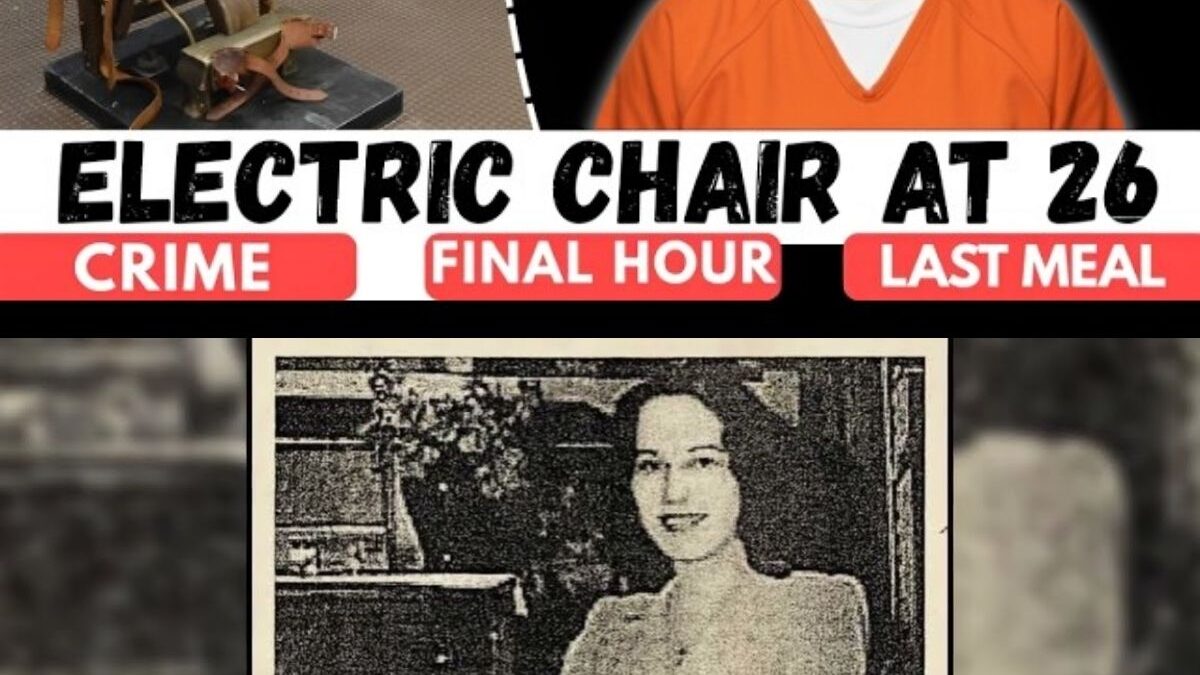
In the damp chill of an autumn morning on November 28, 1942, nearly three hundred spectators gathered outside the Calcasieu Parish Courthouse in Lake Charles, Louisiana. They stood shivering in the mist, their eyes fixed on the basement windows. Inside, resting on the concrete floor, sat a fearsome contraption of oak timbers, straps, and heavy electrical wiring known grimly as “Gruesome Gertie.” It was Louisiana’s portable electric chair, brought down just hours earlier from the state penitentiary at Angola.
Strapped into that wooden seat sat a petite twenty-six-year-old woman wearing a simple black dress, low-heeled shoes, and a neatly tied headscarf concealing her freshly shaved scalp. Her name was Toni Jo Henry. When the deputy sheriff read her the death warrant and asked if she wished to speak any final words to the witnesses, she looked up with steady, dark eyes and uttered just four calm words: “I think not. No.” Minutes later, thousands of volts surged through her frame, making her the first—and to this day, the only—woman ever executed in Louisiana’s electric chair.
Her journey to that desolate basement was not born of professional criminality or cold greed. Instead, it was an explosive tragedy ignited by an obsessive, all-consuming devotion—a desperate scheme to break her husband out of a maximum-security prison that culminated in the senseless, cold-blooded murder of an innocent stranger who had done nothing more than stop his car to offer a helping hand.
The Good Samaritan on Valentine’s Day
The tragic catalyst of this American gothic drama unfolded two years earlier, on February 14, 1940. Joseph P. Callaway, a quiet, well-regarded 43-year-old traveling salesman from Houston, Texas, was driving east across the state line into Louisiana. Callaway was a dependable man who lived without enemies or legal trouble. That day, he was doing an unpaid favor for a friend: delivering a brand-new, gleaming Ford V8 coupe to a dealership contact in Jennings, Louisiana.
As dusk began to settle over the open road near Orange, Texas, Callaway spotted two figures standing on the shoulder, their thumbs outstretched in the biting wind. One was a slight, attractive young woman; the other was a scruffy young man. In the early 1940s, giving a lift to roadside travelers was a routine gesture of Southern hospitality. Callaway tapped the brakes, pulled his coupe over to the gravel shoulder, and opened the door.
He had no way of knowing that the two passengers climbing into his pristine car were armed with stolen revolvers, driven by desperation, and entirely indifferent to the life of a stranger. By extending a simple act of human kindness, Joseph Callaway unknowingly signed his own death warrant.
From Abandoned Child to the Red-Light District
To understand the ferocious recklessness that led to that roadside encounter, one must look into the broken beginnings of Toni Jo Henry. Born Annie Beatrice McQuiston on January 3, 1916, in Shreveport, Louisiana, she was the third of five children in an impoverished household. Tragedies began early: when Annie was just six years old, her mother died of tuberculosis.
For a brief period, she found solace and warmth under the care of her maternal grandmother—the only time in her youth she recalled feeling safe, loved, and protected. But that sanctuary was short-lived. She was eventually returned to the custody of her father and an abusive stepmother. Neglected and desperate for independence, Annie found work at age thirteen packing boxes at a local macaroni factory. When her employer discovered her mother had died of tuberculosis, she was summarily fired out of irrational fear of contagion.
When the young girl returned home empty-handed, her father beat her mercilessly. That brutal night shattered whatever remained of her childhood. Annie packed her meager belongings, walked out into the streets of Shreveport, and never returned.
Adopting the alias Toni Jo Hood, she threw herself into the city’s underbelly to survive. Over the next decade, she worked as a dance hall hustler and a prostitute in Shreveport’s notorious red-light district. Her life spiraled further into darkness through a heavy addiction to cocaine and multiple misdemeanor arrests. In an era with few social safety nets, no one stepped in to pull the battered teenager from the precipice.
The Fighter and the Impossible Plan
Everything changed in the spring of 1939 when a swaggering, handsome customer walked into the brothel where she worked. His name was Claude Henry, known on the circuit as “Cowboy.” Claude was a former professional prizefighter with a chiseled jaw, a violent temper, and a dark shadow hanging over his head: he was out on bail, facing murder charges for the shooting death of a former police officer named Arthur Sinclair.
Despite the looming danger, the two fell deeply, almost pathologically in love. To Toni Jo, Claude represented protection, validation, and a fierce devotion she had never experienced. To Claude, she was a fiercely loyal partner who saw him as more than a brawler. They married on November 25, 1939, and spent a whirlwind honeymoon along the beaches of Southern California, living as though time had stopped.
The fantasy evaporated in January 1940. A Texas jury found Claude Henry guilty of murder and sentenced him to fifty years of hard labor inside the Texas State Penitentiary at Huntsville.
For the 24-year-old bride, a fifty-year sentence meant her husband would likely never walk free in her lifetime. Shattered by grief, Toni Jo relocated immediately to Beaumont, Texas, to be as close to the prison walls as possible. But regular visiting hours were not enough. Consumed by the single-minded goal of reuniting with Claude, she began gathering intelligence on Huntsville’s security, searching relentlessly for a blind spot.
She soon crossed paths with Harold “Arkie” Burks, an army deserter and ex-convict who claimed he had served time inside Huntsville and knew the layout of the prison farm. Together, they devised a reckless, half-baked scheme: they would rob a small rural bank in Camden, Arkansas—a target Claude had once casually mentioned—to secure cash for their getaway. With the money in hand, they would stage an armed breakout at Huntsville, bust Claude out, and vanish into Mexico.
To acquire weapons, Toni Jo manipulated two local teenagers into burglarizing a Beaumont hardware store, obtaining .32-caliber revolvers and boxes of ammunition. But they still lacked the most critical component of any getaway: an untraceable, reliable vehicle. Their solution was simple, crude, and ruthless: they would hitchhike on the highway, ambush the first driver who stopped, and take the automobile by force.
The Execution in the Rice Field
When Joseph Callaway innocently offered the hitchhikers a seat in his Ford coupe on Valentine’s Day, the trap snapped shut. For nearly two hours, the trio rode together through the deepening night, exchanging mundane pleasantries as the car crossed over the Sabine River into Louisiana and passed through the quiet streets of Lake Charles.
Just east of the city limits, as the highway dissolved into desolate countryside, Toni Jo suddenly drew her loaded .32 revolver from beneath her coat and pressed the cold muzzle against Callaway’s temple. She ordered him to swerve off the highway and drive down a rutted dirt track cutting through vast, dark rice fields.
Terrified and completely unarmed, Callaway obeyed. Once the vehicle stopped in the middle of nowhere, Toni Jo and Burks forced him out at gunpoint. They stripped Callaway of his watch, roughly fifteen dollars in cash, and every stitch of his clothing—Toni Jo intended to give the garments to Claude so he would have civilian clothes waiting after the prison escape. They then shoved the shivering salesman into the trunk of his own vehicle, locked the lid, and drove deeper into the marshland until civilization was miles behind them.
In an isolated, muddy clearing bordered by drainage canals, Burks stopped the car. The trunk opened, and Callaway was dragged barefoot into the freezing mud. According to court records and subsequent confessions, Toni Jo ordered the defenseless salesman to drop to his knees in the marsh water and “say your prayers.”
As Callaway knelt in the dark, begging for his life, a single gunshot pierced the Louisiana night. The bullet struck Callaway directly behind the ear, killing him instantly. His lifeless body was abandoned face-down in the freezing mud.
Flight, Fear, and the Confession
Toni Jo Henry and Harold Burks climbed back into the blood-stained coupe and sped northward through the night toward Arkansas, intending to proceed with the bank robbery. But the reality of what had just happened began tearing the partnership apart.
Arriving in Camden, Arkansas, the pair checked into a cheap, roadside motel. Exhausted by adrenaline and lack of sleep, Toni Jo collapsed onto the bed and fell fast asleep. Burks, however, could not close his eyes. Paralyzed by the sheer cold-bloodedness of the execution he had just witnessed in that rice field, he realized he was in over his head. While Toni Jo slept, Burks gathered Callaway’s clothes, slipped quietly out the door, climbed into the stolen Ford coupe, and sped away into the darkness, leaving his accomplice behind.
When Toni Jo woke up the next morning, her partner, the car, and the grand plan were gone. She found only a handful of loose coins and dollar bills left behind on the nightstand. It was just enough money to purchase a one-way bus ticket back to Shreveport.
Penniless, physically exhausted, and weighed down by the magnitude of her crime, she arrived at the doorstep of her aunt, Emma McQuiston. Seeing her niece trembling and unkempt, Aunt Emma immediately pressed for answers. Overcome by emotion, Toni Jo broke down and wept, confessing that she had done something terrible—that she had shot and killed a man outside Lake Charles.
Aunt Emma did not hesitate. Refusing to harbor a fugitive or conceal a homicide, she walked to the telephone and dialed the Shreveport Police Department.
When Sergeant Dave Walker arrived at the house, no missing persons report or homicide investigation had even reached his desk. Yet sitting across from him in the living room, the twenty-four-year-old woman calmly confessed to everything. She pulled the .32-caliber revolver from her coat pocket and placed it on the table; one chamber was spent, five remained loaded.
Deputies rushed Toni Jo down to Calcasieu Parish, where she led investigators directly to the isolated rice field. There, lying exactly where she had described, was the barefoot, frozen corpse of Joseph Callaway. The fatal bullet recovered from the victim’s skull was ballistically matched to her revolver without dispute.
A few days later, Arkansas police located the abandoned Ford coupe. Inside the vehicle, forensic teams identified fingerprints matching Harold Burks, alongside discarded cigarette butts stained with Toni Jo’s lipstick. Burks was apprehended shortly thereafter. While admitting he had driven the car, Burks pointed an accusing finger straight at Toni Jo, swearing under oath that she alone had ordered Callaway to kneel and pulled the trigger.
The “Tiger Woman” and the Courtroom Circus
The sensational details of the case transformed Toni Jo Henry into a national media spectacle overnight. Tabloid journalists, captivated by her striking features, youth, and violent actions, christened her “The Tiger Woman.” Sensational headlines painted her as a venomous, heartless siren who lured innocent men to their graves, turning the upcoming judicial proceedings into a high-stakes public spectacle.
Her legal saga would span nearly three years and three separate, grueling trials.
Her first trial opened at the Calcasieu Parish Courthouse in March 1940. Toni Jo took the stand and attempted to shift blame, claiming that Burks had fired the fatal shot in a sudden panic. But with Burks refusing to testify at this initial trial, the jury weighed her contradictory statements against her initial full confession. After six hours of deliberation, the jury returned a verdict of guilty of first-degree murder, carrying a sentence of death by hanging.
Her defense attorneys immediately appealed, arguing that the overwhelming sensationalism of the local and national press had poisoned the jury pool, making an impartial trial impossible. The Louisiana Supreme Court agreed, overturning the conviction and ordering a new trial.
The second trial, held in February 1941, proved even more dramatic. This time, Harold Burks took the stand as a state witness. Looking directly across the courtroom at Toni Jo, he detailed every agonizing moment in the rice field, testifying that she had forced Callaway to pray before coldly pulling the trigger. The jury took less than an hour to return a second guilty verdict, once again condemning her to death.
Refusing to concede, her legal team uncovered procedural errors in the jury selection process, securing a third trial in January 1942. But the evidence was insurmountable. For the third consecutive time, Toni Jo Henry was found guilty of first-degree murder. This time, the state supreme court firmly rejected further appeals, and Louisiana Governor Sam H. Jones denied her petition for executive clemency.
Her lawyers launched one final constitutional challenge: during her protracted appeals, Louisiana had officially abolished hanging, replacing it with the electric chair. Her defense argued that executing her via electrocution was an unconstitutional, retroactive punishment for a crime committed when the gallows were the law of the land. The courts rejected the motion. Her date with the electric chair was set.
A Quiet Transformation and the Last Goodbye
Throughout her nearly three years of solitary confinement in the Lake Charles parish jail, a quiet, profound change took place behind the iron bars. Because Louisiana’s state penitentiary at Angola was an all-male facility, Toni Jo remained housed locally. During this extended confinement, she received regular visits from Father Wayne Richard, a compassionate young Catholic priest from a nearby parish.
Over hundreds of hours of theological discussions and spiritual counseling, the hardened, cynical street hustler began to soften. Father Richard baptized her into the Catholic Church, offering her a sense of redemption and dignity that had eluded her since childhood. The sensationalized, sneering “Tiger Woman” of the tabloids was replaced by a quiet, reflective young woman who spent her days reading scripture and clutching a simple wooden rosary.
Meanwhile, back in Texas, Claude Henry learned of his wife’s impending execution. On November 24, 1942—just four days before she was scheduled to die—Claude launched a desperate, frantic escape from his Texas prison farm, hoping against hope to see his wife one last time. But the law caught up with him quickly; he was cornered and recaptured in Beaumont, Texas, before he could cross the state border.
On the evening of November 27, prison authorities granted Toni Jo a final telephone call with Claude. The prizefighter wept uncontrollably on the other end of the receiver, devastated by his helplessness. In a striking reversal of roles, it was Toni Jo who remained calm, comforting her broken husband. She urged him to accept his punishment, serve out his sentence with honor, and build an honest, decent life upon his eventual release.
The Switch Is Thrown
The following morning, November 28, 1942, the executioners prepared Toni Jo for her final walk. A prison matron shaved the crown of her head to allow the electrode to make direct contact with her skin. Rather than leaving her scalp exposed, Father Richard provided a dark silk scarf to cover it. She dressed in a modest black dress and held a small crucifix firmly in her left hand.
At 12:05 PM, flanked by sheriff’s deputies and Father Richard, who murmured prayers of absolution, Toni Jo entered the courthouse basement. The portable wooden chair, equipped with heavy leather straps and thick copper cables, waited under the glare of bare incandescent bulbs.
She offered no physical resistance and shed no tears as the guards cinched the heavy leather restraints across her chest, arms, and legs. When Deputy Sheriff Henry Reed Jr. leaned in to ask if she wished to make a final public statement, she replied softly, “I think not. No.”
The leather death mask was fastened over her face. At 12:11 PM, the executioner threw the master switch. A violent surge of 2,200 volts tore through the chair, filling the room with the mechanical drone of the generator. The current was applied twice more to ensure the sentence had been carried out. At 12:12 PM, parish physicians stepped forward, checked for a pulse, and pronounced Toni Jo Henry dead at the age of twenty-six.
The Cruel Irony of Fate
In March 1943, four months after Toni Jo was laid to rest, Harold Burks was strapped into the exact same portable electric chair and executed for his role in the murder. Unlike Toni Jo, whose funeral was attended by Father Richard and a handful of mourners, Burks died completely alone; no family member ever came forward to claim his body from the state morgue.
Toni Jo was buried at Orange Grove Cemetery in Lake Charles, with the small wooden crucifix interred in her left hand exactly as she had requested.
The ultimate tragedy of the story, however, lay in its bitter, hollow aftermath. Claude Henry, the man for whom Toni Jo had sacrificed her freedom, her morals, and ultimately her life, was granted an early medical parole from the Texas State Penitentiary in 1945 due to failing health.
Less than three years after his wife went to the electric chair to save him, Claude was drinking at a crowded tavern in Dallas, Texas. An argument erupted over a trivial matter, escalating into a violent brawl. Claude was stabbed and beaten to death on the barroom floor, dying precisely as he had lived—violently, senselessly, and in the gutter.
In the end, the reckless grand plan that destroyed so many lives accomplished nothing. It left Joseph Callaway, an innocent salesman whose only offense was having a kind heart, dead in a freezing rice field. It left Toni Jo Henry in an unmarked grave as a footnote of penal history. And it left behind an enduring, cautionary chronicle of how unchecked desperation and blinding love can spiral into an inescapable nightmare of destruction.

