The Elephant Was Too Weak To Give Birth… Then Her Baby Arrived And Everyone Realized Something Was Impossible
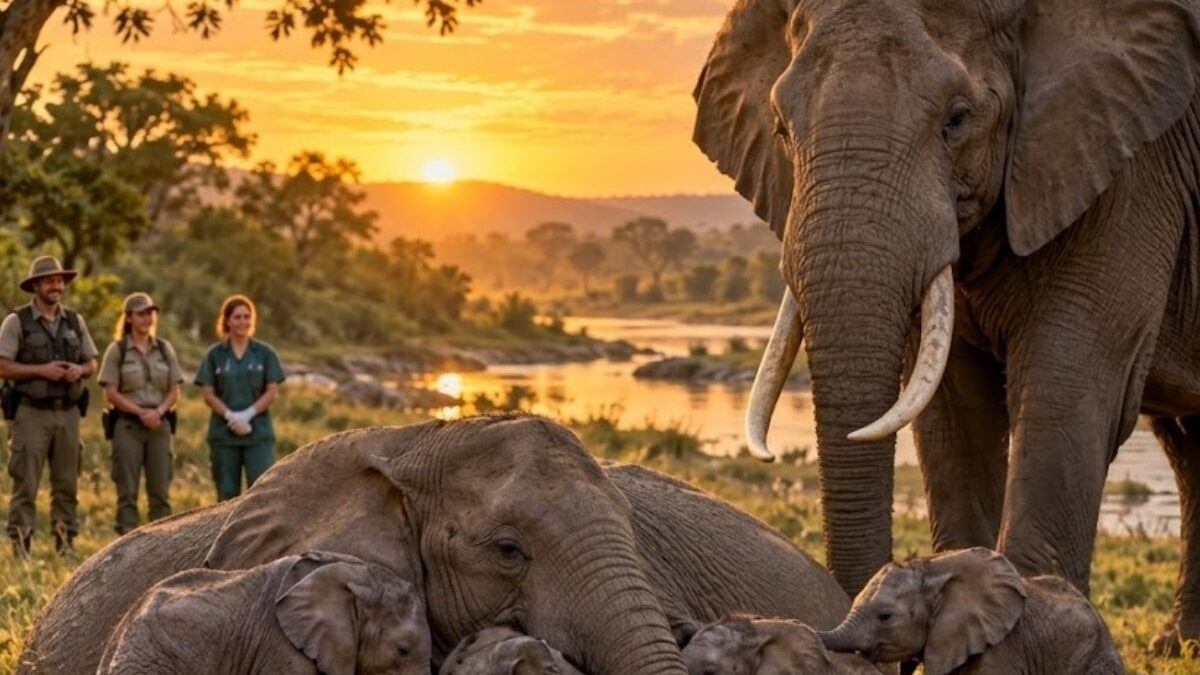
For nearly twenty years, I believed the wilderness had already shown me everything it could.
I had watched newborn antelope struggle onto trembling legs while their mothers stood guard. I had seen injured birds return to the sky after months of rehabilitation. I had watched elephants mourn, protect one another, celebrate reunions, and somehow recognize people they had not seen for years.
But one morning beneath an old acacia tree, I learned how wrong I was.
A heavily pregnant elephant was lying in the dry grass, too exhausted to stand for more than a few minutes at a time. Beside her stood an enormous bull whose attention never left her.
Before that day was over, something would happen that none of us had expected.
My name is Michael Anderson.
For almost two decades, I worked in wildlife conservation, including several years at Red Valley Wildlife Preserve, a large managed reserve where our team cared for animals living in spacious protected habitats designed to resemble the environments their species needed.
People who visited Red Valley often thought we had the perfect job.
They saw photographs of elephants at sunrise, rangers driving across beautiful valleys, and veterinarians standing beside animals most people would only ever see behind a barrier.
What they rarely saw were the difficult days.
They didn’t see us spending nights beside a sick animal, wondering whether morning would bring improvement or loss. They didn’t see the difficult decisions that came with intervening in nature. And they certainly didn’t see how attached you could become to an animal without ever touching it.
Luna was one of those animals.
She was an adult African elephant with a broad forehead, unusually gentle eyes, and a small notch near the edge of her right ear that made her easy to recognize from a distance.
There was nothing physically small about Luna.
But compared with some of the other elephants, she seemed almost quiet.
She rarely pushed her way toward food.
She didn’t challenge other females unnecessarily.
When younger elephants became excited and started running around her, Luna usually stood patiently until the chaos passed.
She possessed the kind of calm that made people lower their voices around her without realizing they were doing it.
The first person to notice the change in her behavior was David Wilson.
David had worked beside me for almost eight years.
He was the kind of ranger who could recognize individual animals from a silhouette hundreds of yards away.
One morning, he stopped our vehicle near an observation ridge and pointed toward the elephants below.
“Look at Luna.”
I lifted my binoculars.
She was standing beneath a tree while several other elephants moved toward a watering area.
“What about her?”
“She isn’t following them.”
“Maybe she’s tired.”
David shook his head.
“She’s been tired for three days.”
That got my attention.
We began reviewing our observation records.
David was right.
Luna had slowed considerably.
She spent longer periods resting, walked shorter distances, and seemed less interested in following the herd.
There was another detail.
Atlas was almost constantly beside her.
Atlas was an enormous adult bull with long curved tusks and a presence that made inexperienced visitors nervous.
He looked intimidating even when he was completely relaxed.
But the people who worked around him knew another side of his personality.
Atlas was observant.
He rarely reacted without warning.
And although we never treated any wild or semi-wild elephant as harmless, Atlas had shown remarkable tolerance toward familiar vehicles and staff.
Around Luna, however, his behavior had changed.
If she stopped, he stopped.
If she moved toward water, he followed.
If another elephant approached too quickly, Atlas quietly positioned himself between Luna and the newcomer.
At first, we wondered whether Luna was ill.
Then our veterinary team examined the observation records and confirmed something much more ordinary, although no less important.
Luna was pregnant.
She wasn’t simply pregnant, either.
She was far along.
Very far.
Elephant pregnancies are extraordinarily long compared with those of most mammals, lasting roughly twenty-two months.
That meant Luna had been carrying her calf for nearly two years.
Pregnancy in elephants is not unusual, of course.
But every pregnancy matters.
Elephants invest an enormous amount of time and energy in raising a calf, and the survival of each newborn can be important for a managed conservation population.
So we began watching Luna more closely.
For several weeks, everything appeared normal.
She ate.
She drank.
She rested.
Then her abdomen seemed to become unusually large.
At first, nobody wanted to make too much of it.
Individual pregnancies vary.
Body shape varies.
Positioning of the fetus can also affect how large a pregnant elephant appears from certain angles.
But eventually even the veterinarians became curious.
One afternoon, David and I parked on a ridge overlooking a narrow valley.
Luna stood below us beside Atlas.
David studied her through binoculars for almost a minute.
Then he lowered them.
“Tell me I’m imagining it.”
“Imagining what?”
“You know exactly what.”
I looked again.
Luna’s abdomen was enormous.
“I don’t think you’re imagining it.”
David leaned against the steering wheel.
“Have you ever seen one that size?”
“Not this close to delivery.”
“Could there be two?”
I didn’t answer immediately.
Twin births in elephants can occur, but they are rare and potentially dangerous because of the enormous physical demands placed on the mother.
Still, appearance alone couldn’t tell us that.
“Let’s not guess.”
David smiled faintly.
“That’s your way of saying you’ve wondered the same thing.”
“That’s my way of saying we’re not veterinarians.”
The following morning, Dr. Sarah Bennett joined us.
Sarah had spent years working with large mammals and had the remarkable ability to remain calm when everyone around her was beginning to panic.
She watched Luna for nearly an hour.
Finally, she closed her notebook.
“I want closer monitoring.”
David looked at her.
“Because?”
“Because she’s carrying a lot of weight.”
“One calf?”
Sarah gave him a look.
“I’m not making that prediction from the side of a hill.”
“But you’re thinking about it.”
“I’m thinking about keeping Luna healthy. That’s enough for now.”
Over the following days, Luna separated gradually from the main group.
That concerned us.
Female elephants are highly social, and mothers often benefit from the presence of experienced females around the time of birth.
But Luna didn’t wander completely alone.
Atlas followed.
The two moved toward a quieter section of the reserve where a shallow river curved through an open valley.
There were trees for shade, water nearby, and fewer animals passing through.
We increased our observation schedule.
Nobody wanted to crowd them.
Elephants can become stressed when people interfere unnecessarily, and Atlas’s size alone gave us an excellent reason to maintain distance.
So we watched.
Morning after morning, Luna moved less.
She would walk to the river, drink, feed slowly, and then rest beneath the trees.
Atlas remained close enough that he could reach her within seconds.
One evening, I watched him gather dust with his trunk and throw it across his back.
Luna stood a few yards away.
When she began moving, Atlas stopped what he was doing and followed immediately.
David noticed it too.
“He knows.”
“Knows what?”
“That she’s close.”
“Probably.”
“No. Look at him. He knows something.”
I laughed quietly.
“You’ve been watching too many documentaries.”
“And you’ve been doing this job too long.”
Maybe he was right.
There are times when people who work around animals become tempted to assign human motives to every behavior.
We tried not to do that.
Atlas wasn’t Luna’s husband.
He wasn’t a nervous father waiting outside a delivery room.
Elephant social relationships are far more complicated than those comparisons suggest.
But it was impossible to deny that he was attentive to her.
And Luna appeared comfortable with his presence.
Three days later, the situation changed.
Luna had difficulty getting back onto her feet after resting.
The first time it happened, she managed after two attempts.
The second time, she remained down much longer.
We contacted Sarah.
She arrived with another veterinarian, Dr. Elena Ruiz, and the two watched from a safe distance.
Luna eventually stood.
But Sarah’s expression told me she wasn’t satisfied.
“She’s tired.”
“How worried should we be?”
Sarah continued watching Luna.
“Enough to prepare.”
That single sentence changed the atmosphere.
Our emergency veterinary equipment was checked.
Vehicles were fueled.
Additional staff were placed on standby.
Nobody wanted to intervene unless necessary.
But if Luna went into labor and became too weak, waiting too long could endanger both her and the calf.
That evening, I stayed at the observation station.
David brought coffee around midnight.
He handed me a cup and sat beside me.
For a while, neither of us spoke.
The valley below was almost completely dark.
“You ever get used to this?” he finally asked.
“To what?”
“Waiting.”
“No.”
“I thought you were going to say yes.”
“I’ve been waiting twenty years. I’m still terrible at it.”
David laughed.
Then his expression became serious.
“You think she’ll be okay?”
I stared into the darkness.
“I think she’s strong.”
“That’s not what I asked.”
“No.”
He nodded.
Neither of us needed to say more.
At sunrise, Luna was standing.
That felt like a victory.
She drank for several minutes and spent part of the morning feeding.
Atlas remained nearby.
By midday, however, she became restless.
She walked several yards.
Stopped.
Shifted her weight.
Walked again.
Then stopped once more.
Sarah arrived shortly after two in the afternoon.
She watched Luna’s movements.
“Something is starting.”
My stomach tightened.
“Labor?”
“Possibly early labor.”
David radioed the rest of the team.
By late afternoon, we had several people positioned at a safe distance.
Nobody spoke loudly.
Nobody approached.
Luna continued moving around the valley.
Then, just before sunset, she stopped beneath an old acacia.
Her trunk lowered.
Her entire body seemed to tense.
Atlas immediately turned toward her.
A few seconds later, Luna took several slow steps and stopped again.
Sarah lifted her binoculars.
“That’s a contraction.”
There was suddenly no doubt.
The birth had begun.
We expected things to progress naturally.
For a while, they did.
Luna remained standing through several contractions.
She shifted position repeatedly.
Atlas moved around her but didn’t crowd her.
Every time she became restless, he seemed to become restless too.
Darkness approached.
We activated low-intensity observation equipment.
Hours passed.
Progress was slow.
Too slow.
Around nine that evening, Sarah became concerned.
“She’s tiring.”
Elena nodded.
“Contractions aren’t strong enough.”
I looked toward Luna.
She stood with her head lowered.
Even from a distance, she looked exhausted.
“What do we do?”
Sarah didn’t answer immediately.
“We give her a little more time.”
That is one of the hardest parts of wildlife medicine.
Doing something feels useful.
Waiting feels irresponsible.
But intervention itself can create danger.
Sedating or physically assisting an elephant is not a simple procedure.
Every decision has consequences.
So we waited.
Another hour passed.
Luna lay down.
Atlas approached her.
He touched her gently with his trunk and remained beside her.
Then he turned toward us.
His ears moved outward.
Nobody needed instructions.
We kept our distance.
Luna struggled back to her feet.
Another contraction passed through her.
She swayed.
David whispered beside me.
“Come on, Luna.”
I found myself doing the same thing.
“Come on, girl.”
Sarah checked the time.
“This has gone on long enough.”
She turned toward Elena.
“We need to assess her more closely.”
The team began preparing.
That created another problem.
Atlas.
He had tolerated our presence from a distance.
Approaching Luna during labor was different.
When the first vehicle moved forward, Atlas immediately turned toward it.
His head rose.
His ears widened.
The vehicle stopped.
Sarah spoke quietly into the radio.
“Nobody move.”
Atlas stood between us and Luna.
He didn’t charge.
He didn’t trumpet.
He simply stood there.
And somehow that was more intimidating.
David glanced at me.
“He’s not letting us through.”
“We don’t force it.”
Behind Atlas, Luna lowered herself again.
Sarah’s voice became urgent.
“We may not have much time.”
I had known Atlas for years.
That didn’t mean he trusted me in the way a domestic animal might.
It certainly didn’t mean I could walk casually toward him.
But he recognized our vehicles, our voices, and our routines.
I stepped out.
David immediately grabbed my arm.
“What are you doing?”
“Nothing stupid.”
“Those are usually the words people say before doing something stupid.”
I stayed behind the vehicle, maintaining distance.
Atlas watched me.
I spoke softly.
“Easy, Atlas.”
His trunk lifted.
“We’re not here for you.”
He took one step.
My heart pounded.
“We’re trying to help Luna.”
Of course, I had no illusion that he understood the sentence the way a person would.
Tone and body language mattered more than words.
So I kept speaking calmly.
“Luna needs help.”
Atlas remained still.
Then Luna produced a deep, low rumble behind him.
Atlas turned his head.
He looked toward her.
Then back toward us.
For several seconds, nothing happened.
Finally, he moved sideways.
Not far.
Only several yards.
But the path was open.
Sarah stared at me.
“Move slowly.”
The veterinary team approached with extreme caution.
Atlas never stopped watching.
We kept the number of people near Luna as small as possible.
Sarah and Elena assessed her.
Luna was exhausted, but she was still responsive.
Then Sarah looked at Elena.
“The calf is positioned.”
“Can she deliver?”
“She has to.”
Another contraction came.
Luna strained.
Nothing.
Atlas rumbled.
The sound seemed to travel through the ground.
Another contraction followed.
This one was stronger.
Sarah stepped backward.
“Good. Again.”
Minutes passed.
Then Elena suddenly pointed.
“I see it.”
David leaned forward.
“The calf?”
“Yes.”
Everyone became silent.
Luna strained again.
The process felt painfully slow.
Then, after another powerful contraction, the calf finally emerged.
For one terrifying moment, it lay completely still.
Nobody celebrated.
Nobody even breathed normally.
Sarah watched.
“Come on.”
The calf moved.
Just slightly.
A leg shifted.
Then its trunk twitched.
David exhaled loudly.
“It’s alive.”
Luna turned toward the newborn.
Exhausted as she was, she reached toward it with her trunk.
The calf moved again.
Atlas lifted his trunk and released a deep, resonant call.
Across the valley, distant elephants answered.
I felt a pressure behind my eyes.
After all those hours, the calf was here.
Alive.
We began backing away to give Luna room.
The newborn needed time.
Its mother needed quiet.
For a few seconds, everyone believed the emergency was ending.
Then Luna’s abdomen tightened.
Sarah stopped.
I nearly walked into her.
“What?”
She didn’t answer.
Another contraction moved through Luna’s body.
Elena stared.
“That’s not normal postpartum movement.”
Sarah turned immediately.
“Wait.”
Luna strained.
David looked confused.
“What’s happening?”
Sarah moved closer again.
Her expression changed.
I had known her long enough to recognize that look.
It was the expression she wore when the facts in front of her didn’t match what she expected.
She placed a hand against Luna’s abdomen and waited.
Then she looked at Elena.
“No.”
Elena’s eyes widened.
“What?”
Sarah checked again.
A few seconds later, she turned toward us.
“There’s another calf.”
Nobody spoke.
David was the first to react.
“Another what?”
“Calf.”
“You mean twins?”
Sarah didn’t answer the obvious question.
She was already focused on Luna.
The first newborn was alive on the ground.
But Luna was still in labor.
Twin elephant births are exceptionally uncommon.
And because an elephant calf can weigh well over two hundred pounds at birth, carrying and delivering two places extraordinary demands on the mother.
Suddenly Luna’s unusual size made sense.
Her exhaustion made sense.
The difficult labor made sense.
But understanding the situation didn’t make it safer.
It made it more dangerous.
Sarah looked at us.
“We are not finished.”
The atmosphere changed instantly.
The relief disappeared.
Luna had barely managed to deliver the first calf.
Now she needed enough strength to deliver another.
David stared at her.
“Can she do it?”
Sarah answered quietly.
“I don’t know.”
The words frightened me more than anything else she could have said.
Luna was breathing heavily.
Her first calf moved weakly beside her.
She reached toward it.
Then another contraction came.
Her legs trembled.
Atlas moved closer.
We withdrew several steps.
He touched Luna’s shoulder with his trunk.
Then he touched the newborn.
For a brief moment, the three elephants formed a small circle beneath the tree.
It would have been beautiful if we weren’t terrified.
Another contraction came.
Luna strained.
Nothing happened.
Sarah checked her watch.
“We can’t let her exhaust herself completely.”
Elena nodded.
“If the second calf is positioned badly, we’re in trouble.”
“Can you determine position?”
“Not safely from here.”
Luna suddenly shifted.
Her back legs nearly gave way.
Atlas reacted immediately, stepping toward her.
David whispered.
“She’s going down.”
Luna lowered herself.
This time she didn’t try to stand again.
Sarah made a decision.
“We need to assist.”
The veterinary team prepared.
Everything became controlled movement.
Equipment was brought forward.
Staff communicated quietly.
Nobody rushed unless necessary.
The first calf remained near Luna.
That complicated everything.
We didn’t want to separate them unless absolutely required.
Atlas complicated it further.
He paced several yards away, increasingly agitated.
Sarah looked toward me.
“Keep everyone unnecessary out.”
I nodded.
Only essential staff remained near Luna.
I moved back with David.
He rubbed both hands over his face.
“I’ve never seen twins.”
“Neither have I.”
“You think the second one is alive?”
I looked at him.
“I don’t know.”
We waited.
Five minutes.
Ten.
Fifteen.
Every minute felt longer.
Then Sarah called for additional equipment.
Something was wrong.
I approached only far enough to hear.
“The position isn’t ideal.”
Elena was speaking.
“We may need to help correct it.”
Sarah nodded.
“Carefully.”
Luna released a low rumble.
Atlas answered immediately.
The first calf attempted to move.
Its legs pushed against the ground.
For a second, it lifted part of its body before collapsing again.
David pointed.
“Look.”
The calf tried again.
Newborn elephants normally require time to coordinate their enormous legs.
Watching one learn to stand is awkward, beautiful, and sometimes unintentionally funny.
But nobody laughed that night.
Every movement mattered.
The calf pushed.
Slipped.
Rested.
Then tried again.
Meanwhile, Luna continued laboring.
The contrast was extraordinary.
One new life was learning to stand while another was still fighting to enter the world.
Eventually Sarah looked toward us.
“Michael.”
I stepped forward.
“What do you need?”
“Keep the vehicle ready. If we need additional supplies, I want them immediately.”
“Understood.”
I returned to the truck.
Another contraction came.
Luna strained.
Sarah and Elena worked carefully.
Then Elena called out.
“Position is improving.”
That was the first good news in nearly half an hour.
Luna’s breathing remained heavy.
Atlas stood almost motionless.
Then something remarkable happened.
The first calf finally stood.
Not gracefully.
Its legs spread too far apart.
Its body swayed.
Its trunk seemed to have no idea what it was supposed to do.
But it was standing.
David laughed softly.
“Look at that.”
The calf took one uncertain step toward Luna.
Then another.
It stumbled against her side.
Luna touched it with her trunk.
For a moment, she seemed to gather herself.
Sarah noticed.
“Come on, Luna.”
Another contraction.
Stronger.
Luna strained.
Elena moved.
“I can see the second calf.”
Every person in the area froze.
The second birth had begun.
But it wasn’t progressing smoothly.
Luna was exhausted.
Sarah spoke quietly.
“She needs one more strong push.”
Another contraction came.
Luna tried.
Progress.
Then she rested.
Atlas moved closer again.
His trunk reached toward her face.
Luna responded with a faint rumble.
I had spent years telling visitors not to humanize animals.
But standing there, I couldn’t prevent my mind from interpreting the scene emotionally.
It looked like encouragement.
Maybe it wasn’t.
Maybe Atlas was simply responding to distress.
But whatever the biological explanation, Luna reacted.
She shifted her body.
Another contraction began.
Sarah raised her voice.
“Now.”
Luna pushed.
The second calf emerged.
It landed in the grass.
And didn’t move.
Silence.
Complete silence.
The first calf stood beside Luna.
Atlas froze.
Sarah immediately approached the newborn.
Elena followed.
I couldn’t see exactly what they were doing.
Seconds passed.
Then more seconds.
David whispered.
“Please.”
Nobody answered.
Sarah checked the calf.
Elena worked beside her.
The newborn remained still.
I felt the celebration from the first birth disappearing from my memory.
Twins didn’t matter if we lost one.
Then Elena shouted.
“Movement.”
The calf’s trunk twitched.
Sarah continued working.
A leg moved.
Then the newborn took a sudden breath.
It was weak.
But unmistakable.
David grabbed my shoulder.
“It’s breathing.”
I nodded.
I couldn’t speak.
The second calf moved again.
Luna reached toward it.
Her trunk touched the newborn’s body.
The calf responded.
Atlas released another deep call.
This time, from somewhere beyond the valley, several elephants answered almost immediately.
The sound traveled through the darkness.
One call.
Then another.
Then another.
It felt as if the entire landscape had awakened.
Sarah sat back on her heels.
For the first time all night, she smiled.
“Two.”
Elena laughed from exhaustion.
“Two.”
David looked at me.
“Tell me we’re actually seeing this.”
“We’re seeing it.”
“I thought twins were almost impossible.”
“Almost isn’t impossible.”
That became the sentence I remembered most from that night.
Almost isn’t impossible.
The second calf was smaller and weaker than the first.
That worried us.
Twin pregnancies place enormous demands on elephant mothers, and the calves may face greater risks than a single newborn.
So although the immediate crisis had passed, nobody considered the situation safe.
Our team withdrew as much as possible.
Luna needed peace.
Atlas needed space.
And the calves needed their mother.
We maintained observation through the night.
The first calf remained stronger.
It repeatedly attempted to stand and stay upright.
The second struggled.
Several times, it lifted its head and moved its legs but couldn’t rise.
Each failure made the waiting more difficult.
Around three in the morning, David and I sat inside the observation vehicle.
Neither of us had slept.
“Which one is older?” he asked.
“The one on Luna’s left.”
“By about an hour?”
“Something like that.”
David watched through binoculars.
“We need names.”
I shook my head.
“They’ve been alive for a few hours.”
“Exactly. They’ve waited long enough.”
“You don’t get naming rights.”
“Why not?”
“Because the last animal you named was a tortoise you called Speed.”
“It was funny.”
“It wasn’t.”
“It was objectively funny.”
Despite everything, I laughed.
It was the first normal moment of the night.
At 4:17 in the morning, according to my notes, the second calf made its most determined attempt to stand.
It pushed its front legs beneath its body.
Its back legs slipped.
It fell.
Luna touched it.
The calf tried again.
This time, its front half rose.
Its hindquarters followed slowly.
Then, somehow, all four feet were beneath it.
The calf stood.
David whispered.
“Yes.”
The newborn swayed dangerously.
I expected it to fall.
Instead, it leaned against Luna.
She remained still.
After several seconds, the calf adjusted its feet.
Then it took a tiny step.
That was when I finally allowed myself to believe both calves might survive the night.
Sunrise came slowly.
The valley changed from black to gray, then from gray to gold.
Luna looked exhausted.
But she was standing.
One calf was beneath her.
The other remained close.
Atlas stood several yards away.
The sight stopped everyone.
Two calves.
One mother.
And a bull keeping watch over all of them.
Sarah arrived beside our vehicle.
She looked worse than any of us.
“How long have you been awake?”
I asked.
She ignored the question.
“Both calves have stood?”
“Yes.”
“Both?”
“Both.”
She closed her eyes briefly.
“Good.”
“Is Luna okay?”
“She’s exhausted. That’s expected after what happened. We need to monitor her closely.”
“And the calves?”
“The second is weaker.”
“But?”
Sarah knew what I wanted.
“But it’s standing, responsive, and staying near Luna. Those are encouraging signs.”
David leaned out of the vehicle.
“So we’re celebrating?”
Sarah looked at him.
“We’re cautiously breathing.”
“I’ll take that.”
For the next several days, the valley became the center of our lives.
Staff rotated observation shifts.
Veterinarians monitored Luna and the calves while minimizing disturbance.
We watched for nursing.
We watched for weakness.
We watched Luna’s appetite.
We watched almost everything.
The stronger calf developed quickly.
It was curious from the beginning.
Within a day, it was already attempting to investigate Atlas’s trunk.
The smaller calf remained quieter.
But it continued improving.
By the second morning, both calves were moving around Luna.
By the third, they were noticeably steadier.
Then something happened that surprised us again.
Members of Luna’s herd began appearing near the edge of the valley.
At first, there were two females.
They stood at a distance.
Later, several more arrived.
They communicated with low-frequency calls we could sometimes feel more than hear.
Luna responded.
Atlas remained between the herd and the newborns for a while.
Eventually, however, the distance narrowed.
An older female approached.
Luna didn’t move away.
The older elephant reached her trunk toward one calf.
Then the other.
David was beside me.
“Grandmother inspection?”
“Don’t start.”
“You know that’s what it looks like.”
“It looks like an adult female investigating newborn calves.”
“So grandmother inspection.”
I smiled.
“Fine.”
Within hours, the social group began gathering around Luna.
That was another moment I will never forget.
The calves disappeared between enormous gray legs.
Trunks reached toward them.
The younger elephants seemed fascinated.
One juvenile repeatedly attempted to get close before being gently redirected by an older female.
The valley, which had felt frighteningly empty during Luna’s labor, was suddenly full of elephants.
Atlas moved to the edge of the group.
His role appeared to change once the herd returned.
He no longer stayed directly beside Luna every second.
But he remained nearby.
The twins became an immediate fascination for everyone at Red Valley.
We did not turn them into a public spectacle.
Their welfare came first.
But among the staff, people constantly asked for updates.
“Did both nurse?”
“Is the smaller one walking better?”
“How is Luna eating?”
“Did they stay with the herd?”
For the first week, Sarah refused to become optimistic.
Whenever somebody called the births a miracle, she reminded us that the difficult period wasn’t over.
“Newborns are vulnerable.”
She repeated that sentence so often that David eventually started finishing it for her.
One afternoon, Sarah walked into the field station.
David looked up.
“Newborns are vulnerable.”
Sarah stopped.
“I didn’t say anything.”
“You were going to.”
“I was going to ask where Michael is.”
David pointed at me.
“I’m literally standing here.”
None of us were functioning normally by then.
Sleep deprivation does strange things to people.
But underneath the exhaustion was something else.
Hope.
The smaller twin gained strength.
Its walking improved.
It began following Luna more confidently.
It became more curious.
By the end of the second week, it was difficult for an untrained observer to identify which calf had struggled more after birth.
David finally persuaded the staff to use temporary names.
He wanted to call the first calf Dawn because it had survived through the night.
For the second, he suggested Hope.
Sarah rejected both immediately.
“Too sentimental.”
David looked offended.
“You just watched twin elephants survive a difficult birth. You’re allowed to be sentimental.”
“I’m a veterinarian.”
“Veterinarians have feelings.”
“Not during naming meetings.”
Eventually, the reserve’s animal-care committee selected names through its normal process.
The first calf became Nia.
The second became Zuri.
I liked them.
David claimed his suggestions were better.
He complained for approximately three months.
Luna recovered gradually.
Her appetite returned.
Her movements became stronger.
The hollow exhaustion we had seen during labor disappeared.
Within several weeks, she was moving normally with the group.
Watching her with two calves was remarkable.
One newborn elephant can be demanding.
Two created constant activity.
If Nia moved in one direction, Zuri often moved in another.
Other females in the herd frequently remained close, forming a protective social network around the calves.
This support mattered.
Elephant calves learn constantly from the adults around them.
They learn what to eat.
Where to walk.
How to use their trunks.
How to respond to social signals.
And perhaps most importantly, they learn what it means to belong to an elephant family.
One morning, I watched Nia attempt to drink water with her trunk.
She lowered it into the shallow river.
Raised it.
Then appeared completely confused about what to do next.
Water spilled everywhere.
Zuri stood beside her.
Nia tried again.
More water spilled.
David laughed.
“Twenty years from now, she’ll pretend this never happened.”
“Good thing elephants don’t have social media.”
Nia eventually abandoned the trunk strategy and put her mouth directly near the water.
Problem solved.
Those ordinary moments were almost more meaningful than the dramatic birth.
During the emergency, every second had felt historic.
But survival is built from ordinary days.
Eating.
Walking.
Sleeping.
Learning.
Growing.
Weeks became months.
The twins gained weight.
Their personalities became more distinct.
Nia was adventurous.
She was often the first to approach something unfamiliar.
Zuri was more cautious.
She watched.
Waited.
Then followed.
Whenever something startled them, both moved toward Luna.
And Luna, who had once seemed too exhausted to take another step, stood over them like a wall.
Atlas continued appearing around the group.
He was not constantly present, and we were careful not to create a sentimental story that ignored normal elephant behavior.
But whenever he was nearby, I remembered that night.
I remembered him standing between us and Luna.
I remembered speaking to an animal large enough to overturn our vehicle.
I remembered the moment he moved aside.
People later asked whether Atlas understood we were trying to help.
I always gave the same answer.
“I don’t know.”
Some people were disappointed by that.
They wanted certainty.
They wanted me to say he consciously decided to trust us.
Maybe he did.
Maybe he simply recognized familiar people and chose not to escalate.
Maybe Luna’s behavior influenced him.
Maybe several factors combined.
Wild animals don’t owe us explanations.
Sometimes respecting them means accepting that we cannot translate every action into a human story.
But I know what happened.
He blocked us.
Luna vocalized.
He observed us.
And then he moved.
Without that opportunity, our response would have been much more difficult.
Months after the twins were born, I returned alone to the observation ridge.
The rainy season had changed the valley.
Grass covered areas that had been dry during Luna’s labor.
The river was fuller.
Birds moved through the trees.
Below me, Luna walked with the herd.
Nia and Zuri were beside her.
They were much larger than they had been on that first night.
But compared with the adults, they still looked tiny.
Nia ran forward.
Zuri followed.
An older female redirected them toward the group.
Luna continued walking.
Everything looked ordinary.
And that was exactly what made it extraordinary.
On the night they were born, I had wondered whether any of them would survive.
Now they were simply elephants living their lives.
I sat on the ridge for almost an hour.
Eventually, David arrived.
He stepped out of the vehicle and handed me coffee.
“You always disappear to the dramatic places.”
“This is an observation point.”
“It’s where you come when you’re thinking.”
“You make me sound predictable.”
“You are predictable.”
He sat beside me.
For several minutes, we watched the elephants.
Then he pointed.
“That’s Zuri on the right.”
“Nia.”
“No, Zuri.”
“Nia has the notch in the hairline near her tail.”
David raised his binoculars.
A pause.
“Nia.”
I smiled.
“Twenty years of field experience.”
“I was testing you.”
“Of course.”
He lowered the binoculars.
“Do you ever think about that night?”
“All the time.”
“I still can’t believe there were two.”
“Neither could Sarah.”
“You should have seen her face.”
“I did.”
David became quiet.
“Do you remember what I said?”
“You said many things.”
“When the second one arrived.”
I thought for a moment.
Then I remembered.
He had asked whether what we were seeing was real.
I nodded.
“You wanted me to tell you we were actually seeing it.”
“Yeah.”
He looked down at the herd.
“I’ve thought about that a lot.”
“Why?”
“Because that’s the strange thing about this job. You spend years preparing for emergencies. You read studies. You learn protocols. You think experience means fewer surprises.”
“And then?”
“And then an elephant gives birth to twins in front of you.”
I laughed.
“That’s one way to summarize a career.”
The truth was more complicated.
The extraordinary thing wasn’t simply that Luna delivered twins.
Rare events happen in nature.
What stayed with me was the sequence of fragile moments that had to go right.
Luna had to remain strong enough to continue labor.
The first calf had to survive.
The second calf had to be repositioned successfully.
It had to begin breathing.
Luna had to recover.
Both calves had to nurse and gain strength.
Any one of those moments could have changed the ending.
That is why I became uncomfortable when people described the twins as “impossible.”
They weren’t impossible.
If they had truly been impossible, Nia and Zuri would not have been standing below us.
They were rare.
They were unexpected.
Their birth was dangerous.
But nature does not care about the boundaries of our expectations.
Sometimes the event we call impossible is simply the event we had never personally witnessed before.
That distinction matters.
Over the following year, the twins continued developing.
Visitors occasionally caught glimpses of them from approved viewing areas.
Staff members who had been present during the birth became embarrassingly protective.
David was the worst.
Whenever someone described one twin as smaller, he immediately corrected them.
“She’s not small. She’s compact.”
One afternoon, I heard him telling a new ranger about the birth.
He had reached the part where Atlas blocked our approach.
“And then Michael walked toward him.”
I interrupted.
“I did not walk toward him.”
David ignored me.
“Completely fearless.”
“I was behind a vehicle.”
“He stared directly into the eyes of a giant bull elephant.”
“From a safe distance.”
“And said, ‘Atlas, you have to trust me.'”
“I absolutely did not say that.”
The new ranger looked between us.
“Which version is true?”
“Mine,” I said.
David smiled.
“Mine is better.”
That is how stories change.
A real event happens.
People retell it.
Details become sharper.
Dialogue becomes more dramatic.
Coincidences become destiny.
Before long, the truth can disappear beneath the version people prefer.
I never wanted that to happen to Luna’s story.
The real story was powerful enough.
There was no need to invent anything.
Luna did not understand English.
Atlas did not magically communicate with us.
Nobody knew with supernatural certainty that the twins would survive.
Our veterinarians did not perform an impossible rescue in thirty seconds.
It was slow.
Messy.
Uncertain.
It required training, patience, careful intervention, and a great deal of luck.
That is what made it real.
And reality, when you spend enough time around wildlife, is often more astonishing than fiction.
Nearly two years after the twins were born, I watched them cross the same valley where Luna had collapsed during labor.
They were no longer tiny.
Nia walked ahead.
Zuri followed Luna.
The herd moved slowly toward the river.
Atlas was visible in the distance.
For a moment, the scene aligned perfectly with my memory of that night.
Same valley.
Same river.
Same acacia tree.
Different animals.
Or perhaps not different.
Older.
Stronger.
Changed.
I remembered Luna lying beneath that tree.
I remembered the first calf hitting the ground.
I remembered the shock on Sarah’s face when she realized another calf was coming.
And I remembered the silence when that second newborn didn’t move.
There are silences you forget.
And there are silences that stay inside you forever.
That one stayed.
So did the sound that followed it.
A breath.
Small.
Weak.
Almost insignificant against the enormous landscape.
But it was enough.
Life doesn’t always arrive dramatically.
Sometimes it announces itself with one tiny movement.
One twitch of a trunk.
One uncertain breath.
One newborn trying to stand.
That was the lesson Luna’s twins left with me.
Not that nature creates miracles specifically for us.
Not that every dangerous situation ends happily.
I had worked in conservation too long to believe that.
Many stories do not end the way we want.
Sometimes we do everything correctly and still lose an animal.
Sometimes nature gives no second chance.
That reality makes the successful moments more meaningful, not less.
Luna’s story could have ended differently at several points.
Instead, morning arrived with three elephants standing beneath an acacia tree where, hours earlier, we had feared we might lose all of them.
The mother was exhausted.
The calves were unsteady.
Atlas was covered in dust.
Our team looked as though none of us had slept in a week.
Nothing about the scene was polished or cinematic.
It was better than that.
It was real.
Years later, after I had stepped away from full-time field work, people still asked me which wildlife encounter I remembered most.
They expected stories about danger.
A charging elephant.
A close encounter with a predator.
A dramatic rescue.
I had plenty of those stories.
But I always returned to Luna.
I would tell them about the valley.
About the long night.
About the first calf.
Then I would tell them about Sarah suddenly stopping when Luna began contracting again.
People usually reacted the same way.
“Twins?”
“Twins.”
“I thought elephants almost never had twins.”
“They rarely do.”
“And both survived?”
“They did.”
Then came the question I liked least.
“Was it a miracle?”
I never knew exactly how to answer.
The scientist in me wanted precision.
Twin elephant births are rare, not supernatural.
Veterinary intervention can improve outcomes.
Experienced staff can recognize complications.
Animal behavior can be observed without inventing human motivations.
All of that is true.
But there was another truth.
Standing in that valley at sunrise, watching two newborn elephants press themselves against their exhausted mother, I did not feel like a man looking at statistics.
I felt small.
Grateful.
Humbled.
Maybe that is what people mean when they use the word miracle.
Not an event that violates nature.
An event that makes you realize how little of nature you truly understand.
One evening, years after the birth, David called me.
We hadn’t spoken for several months.
I answered.
“What’s wrong?”
“Why does something have to be wrong?”
“You only call without texting when something is wrong.”
“That’s insulting.”
“Is something wrong?”
“No.”
“Then what?”
He paused.
“I saw them today.”
I knew immediately who he meant.
“Both?”
“Both.”
“How do they look?”
“Big.”
I smiled.
“Elephants tend to do that.”
“No, I mean really big. You remember when Zuri couldn’t stand?”
“Of course.”
“She pushed a branch off the path today.”
“That’s your big update?”
“It was a large branch.”
I laughed.
David became quiet.
Then he said something I still remember.
“You wouldn’t know she was the weak one.”
I looked out the window of my house.
“No.”
“You really wouldn’t.”
After we hung up, I thought about that sentence.
The weak one.
That was how we had described Zuri for weeks.
The smaller twin.
The vulnerable calf.
The one we watched more closely.
The one we worried might not make it.
But animals don’t live inside the labels we give them.
Zuri didn’t know she had once been the weak twin.
She didn’t know her first breath had made a group of exhausted humans nearly cry.
She didn’t know people had called her survival extraordinary.
She simply grew.
Day after day.
Meal after meal.
Step after step.
Eventually, the fragile newborn became an elephant strong enough to push branches aside.
Perhaps that was the final lesson.
Survival rarely looks heroic while it is happening.
Most of the time, it looks repetitive.
Another breath.
Another step.
Another day.
Luna had done the same thing.
During pregnancy, she had carried more weight than we initially understood.
During labor, she had reached the edge of exhaustion.
Afterward, she still had to feed and protect two calves.
There was no celebration from her perspective.
No headlines.
No dramatic music.
Only the work of staying alive and keeping her calves alive.
That is the wilderness I came to respect.
Not the romantic version people see in photographs.
The real wilderness.
Beautiful and unforgiving.
Tender and brutal.
Predictable one moment and astonishing the next.
It does not promise happy endings.
It does not explain itself.
And it certainly does not organize events according to what human beings think should be possible.
I began my career believing experience would eventually remove uncertainty.
I thought twenty years in conservation would teach me what to expect.
Instead, twenty years taught me the opposite.
Experience does not eliminate wonder.
If anything, it deepens it.
Because once you understand how many things must go right for a newborn animal to survive, seeing one stand becomes extraordinary.
Seeing two stand feels unforgettable.
The last time I visited that section of Red Valley, the old acacia tree was still there.
Part of one branch had broken during a storm.
The trunk was scarred.
The ground beneath it looked completely ordinary.
No marker identified the place.
No sign told visitors what had happened there.
I was glad.
The wilderness does not need monuments for every important event.
Sometimes the landscape itself is enough.
I stood beneath the tree for several minutes.
I could almost reconstruct the night from memory.
Sarah kneeling near Luna.
Elena calling out that she could see the second calf.
David beside the vehicle.
Atlas standing in the darkness.
Luna’s low rumble.
Then the newborn.
Still.
Silent.
And finally breathing.
I closed my eyes.
For a second, I could hear Atlas’s deep call again.
Then I opened them.
The valley was quiet.
Somewhere beyond the trees, an elephant rumbled.
Another answered.
I smiled.
For most of my career, people asked me what working with wildlife had taught me about animals.
My answer changed over the years.
At first, I talked about intelligence.
Later, I talked about social behavior.
Then conservation.
But after Luna, I started giving a different answer.
Wildlife taught me humility.
We measure.
We observe.
We study.
We build models and record behavior.
Those things matter enormously.
Good conservation depends on evidence, not fantasy.
But evidence also teaches us that rare does not mean impossible.
It teaches us that animals are more complex than the stories we place on them.
And it teaches us that sometimes the most responsible thing a human being can do is watch carefully, intervene only when necessary, and respect what we do not fully understand.
That night beneath the acacia tree, Luna was dangerously tired.
For a while, we feared she might not have enough strength to complete the birth.
Then her first calf arrived.
We believed the hardest moment had passed.
We were wrong.
Her body tightened again.
A second calf was still inside her.
That discovery changed everything.
The second birth was harder.
The newborn was weaker.
For several terrible seconds, it didn’t move.
And then it breathed.
One small breath.
That was all it took to change the night.
By sunrise, Luna was standing with two calves beside her.
Atlas remained nearby.
And a group of people who had spent years working around wildlife stood at a distance without much to say.
There are moments when words make an experience smaller.
That was one of them.
So we watched.
Nia leaned against her mother.
Zuri struggled to keep her balance.
Luna lowered her trunk toward them.
The morning sun reached the valley.
And suddenly, what had seemed almost impossible only hours earlier was simply there in front of us.
Alive.
Breathing.
Standing.
Years have passed, but whenever someone tells me that nature has become predictable, I think about Luna.
I think about the enormous elephant who looked too tired to continue.
I think about the calf we believed was the end of the story.
Then I remember the second contraction.
The confusion.
Sarah’s expression.
And the words that changed everything.
“There’s another calf.”
That was the moment our assumptions collapsed.
And perhaps that is why I still tell Luna’s story.
Not because twins are magical.
Not because Atlas was a human hero trapped inside an elephant’s body.
Not because our team performed some impossible feat.
I tell it because every part of that night was real enough without exaggeration.
A mother struggled.
A team waited.
A rare complication emerged.
People intervened when intervention became necessary.
Two calves survived.
And the following morning, life continued.
That may sound simple.
It wasn’t.
Nothing about survival is simple.
But sometimes the most extraordinary stories are not the ones where nature breaks its own rules.
They are the ones where nature reminds us that we never understood all the rules in the first place.
And whenever I picture that sunrise, I still see Luna standing beneath the acacia tree.
Nia beside one leg.
Zuri beside the other.
Atlas watching from a short distance away.
Three lives where, hours earlier, we had feared there might be none.
I had entered wildlife conservation believing my job was to protect animals.
Luna taught me that the job was also to witness them.
To pay attention.
To know when to act.
To know when to wait.
And, occasionally, to stand quietly before something so rare and fragile that all your years of experience suddenly feel very small.
That morning, nobody cheered.
Nobody needed to.
The two calves were standing.
Luna was alive.
The valley was waking around them.
And for once, that was more than enough.

