The Billionaire Was Declared Brain Dead—But His Maid’s Crying Toddler Refused to Leave His Side.
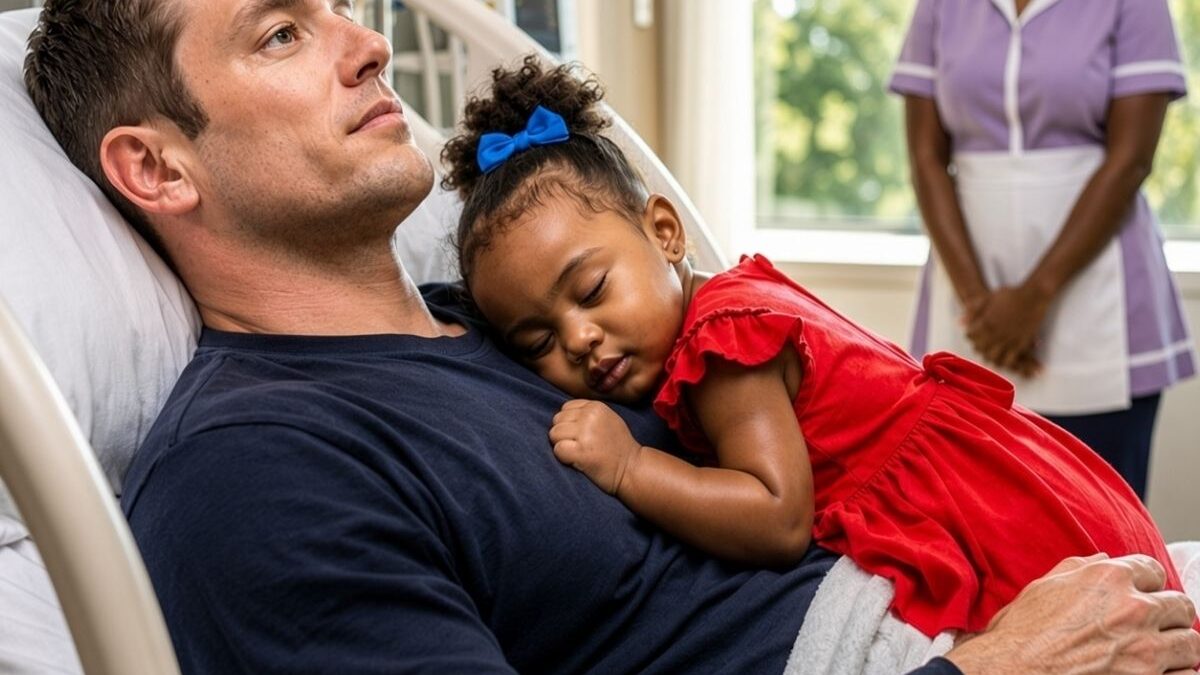
A machine can measure a heartbeat. It can count the seconds between one breath and the next. But there’s one thing no machine on earth has ever been able to measure. And on a rainy Tuesday in a Boston hospital, a 2-year-old girl proved it with nothing but a whispered, “I love you,” and a small hand pressed flat against a dying man’s chest.
His name was Nathaniel Hail, 36 years old, worth more money than most people could count in a lifetime. And by 4:00 that afternoon, doctors were already using the word nobody wants to hear about someone they love, brain dead. But nobody in that hospital, not the surgeons, not the specialists, not even his own brother standing in the hallway with a folder of legal paperwork, understood what was about to happen next.
Because love doesn’t check a chart before it decides to fight. And sometimes it takes the smallest person in the room to remind the rest of us what we forgot to believe in. Stay with me because where this story ends is not where you think. Let’s go back to the beginning to a version of Nathaniel Hail that the business magazines never wrote about. He wasn’t born into wealth.
He built it brick by brick, contract by contract through 18-hour days in a kind of relentless focus that made him brilliant and if you ask the people who worked for him, more than a little terrifying employees didn’t linger in his office. They delivered their reports, answered his questions, and left.
Nobody stayed longer than they had to. Nobody except a three-year-old named Lily. Her mother, Ranata Vasquez, had cleaned Nathaniel’s Beacon Hill townhouse for almost two years. Ranata was the kind of woman who showed up early and left late, who never complained, even when her knees ache from scrubbing marble floors in a house too enormous for a man who barely used half the rooms in it.
She was a single mother. Lily’s father had left before Lily could form her first memory of him. and there was no family nearby, no safety net, nothing but Ranata’s own two hands standing between her daughter and [clears throat] hardship. So, when her babysitter’s car broke down on a Thursday morning and there was nowhere else for Lily to go, Ranata did something she’d promised herself she’d never do.
She brought her daughter to work. She stood outside Nathaniel’s study, Lily’s small fingers wrapped around hers, rehearsing an apology in her head. She’d barely gotten out the first sentence before he looked up from his laptop. “She can stay,” he said. And that was it. No lecture, no irritation. Just three words that changed everything, though neither of them knew it yet.
What happened over the following months surprised everyone who thought they understood Nathaniel Hail. Lily began wandering into his study with a fistful of crayons. She built block towers under his desk while he took calls with investors worth more than some small countries. And somehow this man who intimidated boardrooms full of grown adults would stop mid-sentence on a phone call just to admire a lopsided drawing of a purple elephant.
She started calling him Nate Nate. He never asked her to stop. By the time the leaves turned gold that autumn, Lily had her own blanket folded in the corner of his office and a shelf of well-worn picture books. Ranata told herself it meant nothing, that a busy man tolerating a child during work hours was simply kindness, nothing more.
She didn’t let herself examine why her own chest achd with warmth every time she heard Nathaniel laugh at something Lily said. A real laugh unguarded, the kind she suspected very few people in his life had ever heard. She had a daughter to protect and a life that couldn’t afford daydreams. So, she didn’t let herself hope.
But hope doesn’t usually ask permission. And on an ordinary Tuesday morning, everything Ranata had tried so hard not to feel was about to collide headon with the worst day of her life. For nearly two weeks, Nathaniel had been getting headaches. He waved them off as stressed, the cost of running a company that never slept. Ranata noticed the color draining slowly from his face.
The way his coffee sat forgotten and cold on his desk more mornings than not. She asked if he was all right. He always said the same thing, “Fine, just tired.” That Tuesday, Lily was building a tower of wooden blocks on the rug when Ranata heard something that stopped her heart. The scrape of a chair pushed back too fast, followed by silence.
She turned just in time to see him collapse. Nate, Nate. Lily scream tore through the room before Ranata could even move. The little girl scrambled across the carpet on hands and knees, reaching him before her own mother could stop her, patting his still face with small, frantic hands. Wake up. Please wake up.
The next several minutes blurred into chaos. Ranata shaking hands on the phone. The operator’s calm voice asking questions she could barely answer. Lily’s crying rising and falling like a siren of her own. When the paramedics finally arrived, they found a girl who wouldn’t let go of a man’s sleeve, no matter how gently they tried to move her aside.
At the hospital, the word came quickly and mercilessly. A massive brain aneurysm, the kind that gives almost no warning at all. Ranata sat in the waiting room for 6 hours with Lily asleep against her shoulder, calling everyone she could think of, though there was almost no one to call. Nathaniel had no wife, no children of his own, only a younger brother, Gregory, who finally answered his phone with the tone of a man being mildly inconvenienced.
When the surgeon finally emerged, his face said everything before he opened his mouth. “We’ve stopped the bleeding,” he said quietly, but the damage was extensive. There’s no brain activity. “I’m so sorry.” Ranata felt her legs give way beneath her. “She wasn’t his wife. She wasn’t his family. She was his housekeeper.
and she had no right to the tears that wouldn’t stop falling, but she couldn’t make them stop either. Gregory arrived hours later, dressed for a dinner he’d clearly been pulled from, smelling of cologne and impatience. He looked at Ranata and Lily with open confusion. “And you are? I work for your brother,” Ranata said.
“I clean his house.” Something shifted behind Gregory’s eyes. Not grief, but calculation. Within an hour, Ranata overheard him in the hallway on the phone with a lawyer, discussing his brother’s estate as though Nathaniel’s body weren’t still warm in the room behind them. That was the night Ranata decided she wasn’t leaving.
Not because it was her job, because somebody in that hospital needed to remember Nathaniel Hail was more than a net worth on a spreadsheet. And that somebody, as it turned out, was about to be a 3-year-old girl who simply refused to say goodbye. The days that followed felt like watching a countdown nobody wanted to acknowledge.
The doctors ran every test available to Modern Medicine and every result came back the same. No activity, no response. Legally, medically, Nathaniel Hail was gone. Gregory treated the ICU like a boardroom, arranging meetings with company executives, signing transition documents, rarely glancing at his brother’s face for more than a few seconds at a time.
Ranata, meanwhile, had nowhere else to be. She used every hour of unpaid leave she had, sneaking Lily in during visiting hours, watching the heart monitor rise and fall in its indifferent rhythm, and Lily refused to leave his side. The nurses tried gently to distract her, crayons, snacks, a tablet loaded with cartoons.
Nothing worked. She climbed carefully onto the edge of the hospital bed, avoiding the tubes and wires with an instinct that startled even the staff, and pressed her small body against his arm. “Wake up, Nate. Nate,” she whispered night after night. “I made you a picture.” She told him about her stuffed rabbit, about a dog she’d seen in the parking lot, about the blue crayon that snapped in half.
She hummed the songs he used to hum along to when he thought no one was listening. She refused to sleep anywhere but curled against his chest, one small hand resting directly over his heart. On the third night, a nurse named Deja froze in the doorway. The heart monitor had spiked. small, sudden, unmistakable. The exact moment Lily pressed her cheek to his chest and murmured, “I love you, Nate. Nate.
” Deja had spent 9 years in that ICU. She’d never seen anything quite like it. She found the attending physician and said only, “I know how this sounds, but you need to come see this.” For the next 20 minutes, the doctor watched in silence as Lily continued talking, unaware she had an audience. Every time her hand pressed against his chest, the monitor shifted, faint, but real.
It could be a reflex, the doctor said carefully. The nervous system can be unpredictable even now. Or Deja said it could be something we don’t have a machine sensitive enough to catch. They didn’t tell Ranatada that night. They didn’t want to offer false hope over something that might be nothing at all. But they kept watching. Two nights later, Gregory arrived at the nurse’s station with a folder, the final authorization to remove life support.
Deja stepped in front of him before he reached the room. Mr. Hail, she said. Before you sign anything, there’s something you need to see. He stood in the doorway, arms crossed. A man with a board meeting in 2 hours and very little patience left. Lily was there again, as she had been every night, murmuring softly about a butterfly she’d seen that morning outside the window.
The monitor blipped. Gregory rolled his eyes. That’s a glitch. This is exactly the kind of false hope that destroys families. It’s not a glitch, Deja said firmly. We’ve seen this pattern three times now and it correlates with her presence specifically with physical contact. I’ve already brought in Dr. Okafor from neurology.
He wants to run an expanded EEG and if that shows anything, an fMRI after. There’s a condition called covert consciousness where brain activity exists but standard testing misses it entirely. It’s rare but it happens. You’re telling me my brother might be aware in there? Gregory said slowly trapped. I’m telling you that signing this form today would be premature.
I’m telling you, a three-year-old with no medical training might be noticing something our equipment almost missed. For the first time since walking into that hospital, Gregory actually looked at his brother’s face. Not at the paperwork in his hands, but at the small crease between Nathaniel’s eyebrows that had always appeared when he concentrated, “Still there even now.
Run the test,” he said quietly. “Run whatever you need.” The EG results came back the next afternoon, and Dr. Okapor walked out of that room with tears he didn’t bother hiding. He’s aware. He said he hears everything. It’s called locked in syndrome. The body can’t respond, but the mind is fully intact. It’s rare, and it’s the kind of thing standard brain death protocols can miss in the early days after an injury like this.
Ranata’s knees nearly buckled with relief. Will he? It’s a long road, Dr. Okafor said gently. But he’s alive in every way that matters. He’s alive. And somehow that little girl found the one thing our machines nearly didn’t. Recovery was neither fast nor guaranteed. The doctors warned. Some patients with lockedin syndrome regain movement in weeks. Others took years.
Nathaniel’s case sat somewhere in the uncertain middle. And Ranata found herself at the hospital nearly every single day, telling herself it was only because Lily refused to be anywhere else. But in the quiet of night, she knew it was more than that. She talked to him constantly, even with no way of knowing if he understood.
She told him about her own mother, who had cleaned houses just like she did now. About the fear that kept her awake some nights, wondering if she was giving Lily enough of a life. About the small joys, Lily calling broccoli tiny trees, the crayon drawings taking over their refrigerator door one magnet at a time.
By the second week, Nathaniel could blink once for yes, twice for no. By the third, a single finger began to move. Gregory started visiting more, sitting awkwardly at first, unsure how to speak to a brother who could hear everything and answer nothing. One evening, not realizing Ranata stood in the doorway, he quietly apologized for an old argument neither of them had ever resolved.
I was already picking out which office would be mine, Gregory admitted. I should have been picking out Getwell cards instead. Nathaniel’s finger twitched. What might have meant nothing? Gregory chose to believe it meant everything. Three months after the aneurysm, Nathaniel spoke his first full sentence. It wasn’t about the company.
It wasn’t about the empire he’d spent his life building. It was one word, forced out with everything his exhausted body had left to give. Lily. She shrieked so loudly the nurses came running. Say it again, Nate. Nate, say it again. You did. And then, through tears sliding sideways into his pillow, he added one more word. Hi.
The recovery that followed was slow and grinding. Months of physical therapy, of relearning how to sit, how to stand, how to walk. But something in that hospital room had shifted permanently, something no scan could measure. And when the story eventually made its way into local news, not because Ranata or Nathaniel wanted the attention, but because Deja mentioned it at a hospital fundraiser and a reporter couldn’t resist, the world learned what that ICU already knew.
A toddler’s love had done what machines nearly missed. Nathaniel came home 4 months after the aneurysm, still in a wheelchair, still working twice weekly with a speech therapist. Gregory, once cold and calculating, had begun quietly stepping in to run the company, not to seize control, but because his brother finally trusted him to. The distance between them, built over a lifetime of competition, had begun closing for the first time.
One evening, on the back patio, where Nathaniel was slowly relearning to walk between a set of parallel bars, he asked Ranata to sit with him. I need to ask you something, he said, his words still slower than before. And I need the truth, even if it’s not what I’m hoping for. Her heart pounded. Okay.
These past 2 years, was I imagining something between us? Something we were both too careful to say out loud. Tears rose before she could stop them. You’re my employer. I never let myself think. I’m asking you to think about it now, he said, reaching for her hand, his finger still not quite steady, but warm. Because lying in that bed, unable to move or speak.
Do you know what kept me holding on? It wasn’t the company. It was you walking through that door every morning with your daughter’s hand in yours. I heard every word you ever said to me, Ranatada. Every single one. I was scared, she admitted. Scared of losing my job. Scared of losing the only stability Lily and I had.
Nothing about this is about what’s allowed anymore, he said softly. I got a second chance because a 3-year-old refused to give up on me. I don’t intend to waste it being afraid of my own feelings. Life didn’t turn into a fairy tale overnight. And Ranata was grateful for that. Real love, she learned, wasn’t built in hospital rooms or headlines.
It was built slowly in shared dinners at the kitchen table she used to scrub. In Nathaniel relearning to walk while Lily cheered from the sidelines like he was running a marathon. In ordinary Sunday mornings that became something neither of them had ever quite dared to hope for. A year after the aneurysm, standing fully and steadily on his own two feet, Nathaniel proposed to Ranata in that same backyard with Lily standing beside him holding a small ring box she’d guarded like state secrets for two whole weeks.
Their wedding was small under string lights, surrounded by the hospital staff who had become family. Deja crying through the entire ceremony, Gregory standing as best man and somehow keeping his jokes for after the vows. Lily, insisting on being both flower girl and ring bearer, abandoned the rings halfway down the aisle to launch herself into Nathaniel’s arms, announcing to the whole yard, “I did it, Nate.
Nate.” 6 months later, on an unremarkable Tuesday morning at the county courthouse, Nathaniel formally adopted Lily. He cried in the courtroom, unashamed, when the judge made official what had been true in his heart since the day a toddler crawled under his desk with a box of crayons and simply never left.
Two years after the aneurysm, Nathaniel gave his first public interview. Not for the company, not for headlines, but because a hospital foundation asked him to help raise awareness for lockedin syndrome so that other families wouldn’t give up too soon simply because no one thought to look closer. He started a foundation in Lily’s name dedicated to funding advanced neurological screening in ICUs nationwide.
“My daughter isn’t a doctor,” he told the room of reporters. Lily perched on his hip despite insisting most days she was much too big for that. She doesn’t have a medical degree. What she had was love and the refusal to believe love couldn’t reach me, even after everyone else had given up. I think that’s a lesson every hospital in this country still needs to learn.
That night, tucking Lily into bed, Ranata brushed the hair back from her daughter’s forehead. “You saved him, you know,” she whispered. “You saved all of us.” Lily, already half asleep, murmured back the only explanation she’d ever needed. “I know, Mommy. I just didn’t want him to be alone. If this story moved you even a little, carry its simplest lesson with you.
Never underestimate what it means to simply show up for someone, especially when the world has already decided to give up. Sometimes the smallest hands are the ones holding on the tightest. If you enjoyed this one, give it a like. It genuinely helps this channel reach more people who need to hear stories like this.
Subscribe if you’d like to walk through more of them with me. And if someone in your life could use a reminder that love doesn’t know how to quit, send this their way today. Thank you for staying until the very end.

