She Refused to Bow to the Prince… Then He Fell in Love With Her
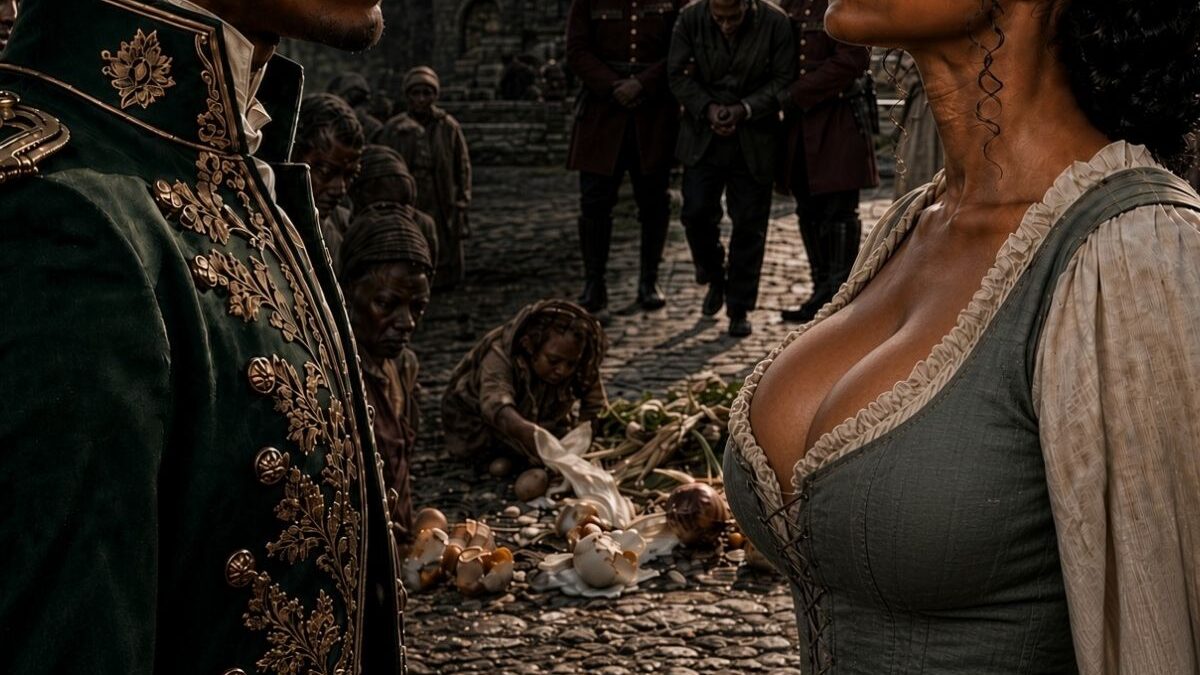
Kneel before your future king, girl, or I will see your entire family stripped of their land by nightfall!”—She looked into the prince’s furious eyes, wiped the road dust from her face, and smiled: The complete chronicle of Eleanor Ashkam and the arrogant heir who traded his crown for love.
Part I: The Rot in the Marble Halls
“Please, Your Highness! My wife is burning with the lung-rot. My grandchildren won’t survive the winter without my wages. It was a single drop of wine on the carpet! I beg your mercy!”
Old Kenneth was seventy if he was a day, his knees grinding into the freezing marble floor of the Great Gallery, his trembling fingers clutching at the hem of Prince Alistair Ravenscroft’s riding cloak. The velvet fabric was dark as clotted blood, tailored to perfection over shoulders that had never hauled timber, never pushed a plow, and never bowed to any living soul.
Alistair didn’t even look down. He adjusted the cuff of his kidskin riding glove, his silver eyes cold as river ice.
“If carelessness were a disease, Kenneth, half this palace would already be dead,” the Prince said, his voice flat, razor-sharp, devoid of even the effort of cruelty. “Take him away. Try harder at your next post, or find a gutter to sleep in. Did I ask for another word?”
“Alistair!”
The roar didn’t come from Kenneth. It detonated from the arched doorway leading to the inner royal chambers.
King Edmund Ravenscroft stood there, broad-shouldered, gray-bearded, his crown sitting heavy on a brow etched with the scars of two border wars. Behind him, Queen Catherine looked on, her face pale, her hands gripped so tightly around her prayer beads that the knuckles shone white.
The King stepped forward, boots slamming against the marble, echoing like rifle cracks. The guards dragging the sobbing old man halted instantly, terrified.
“Leave us,” Edmund commanded, his voice shaking with a fury that made the chandeliers tremble. “Every guard. Every servant. Clear this hall.”
The great oak doors groaned shut. Father and son stood in the center of the gilded room. Between them lay an old man’s spilled bucket and Kenneth’s ragged cap, abandoned on the tiles.
“You discard twenty years of faithful service over a stained runner?” Edmund’s chest heaved. He closed the distance until he was inches from his son’s nose. “A man who dried your mother’s tears when your brother was buried? A man who carried you on his back through these very halls?”
Alistair didn’t flinch. He raised his chin, his jaw clenched with that stubborn, lethal pride that the entire kingdom had learned to dread. “He grew clumsy, Father. The crown cannot afford weakness or pity in the domestic staff, let alone on the throne. Standards must be upheld.”
“Standards?” Edmund snatched a heavy crystal decanter from a side table and smashed it onto the marble floor. Red wine splashed like arterial blood across Alistair’s polished riding boots. “You speak of standards while acting like an undisciplined dog with a title! Speed impresses foolish boys, Alistair. Wisdom impresses kings!”
“Fortunately,” Alistair whispered, his eyes flashing with icy defiance, “I intend to become both.”
“No!” Edmund jabbed a calloused finger straight into Alistair’s breastplate. “You are becoming the very monster I spent twenty years fighting to eradicate. You believe the blood in your veins excuses a rot in your heart. Let me give you a truth you will choke on: the crown already belongs to you by birth, but respect—true, enduring respect—must still be earned. The people of Ravenshire will remember victories, yes, but they remember character far longer.”
“Then today,” Alistair spat, turning toward the stables, “they shall witness both.”
As the Prince’s footsteps faded down the gallery, Queen Catherine stepped beside her husband, resting a gentle hand against his trembling arm. “He is so much like you, Edmund.”
The old King closed his eyes, his voice cracking with pure exhaustion. “No, Catherine. He is like the man I was before life took an iron hammer to my pride and taught me humility. And God help this kingdom if he does not learn that lesson before I put a golden crown upon his head.”
Part II: Mud, Eggs, and an Unbent Spine
The morning mist still hung low over the Eastern District when Eleanor Ashkam stepped out onto the rutted village road. She balanced a woven wicker basket under each arm, her boots caked with the dark, fertile mud of her father’s farm.
“You’re carrying half the farm again, El,” Samuel Ashkam called from the barn door, wiping grease from a wagon axle. His hair was iron-gray, his back curved from twenty-three years of breaking crown soil for a harvest that barely kept their larders stocked through March.
“Someone has to,” Eleanor countered, smiling over her shoulder. “You refuse to admit your knees give out whenever the wind shifts north.”
“Older, perhaps,” Samuel grumbled, though his eyes were warm. “Slower? Never.”
“That’s exactly what every stubborn old man says before he drops an apple crate on his foot,” she laughed. “I’m heading into the village square. Mrs. Whitmore needs the cream, and I’ve got four dozen eggs for the baker.”
“Mind Mr. Harper at the corner,” Samuel shouted after her. “Don’t let him tell you his russets are sweeter than ours.”
“He tries that every Tuesday, Father, and every Tuesday he goes home looking foolish.”
Eleanor took a deep breath of the cold autumn air. She loved the market road. She loved the familiar greetings—Mrs. Turner calling out from her flower stall, the baker waving a flour-dusted paddle, the distant, rhythmic clang of Thomas Hale’s hammer striking iron at the village forge. It was a life carved out of blistered hands and raw determination. They had no nobility, no crest on their gate, but Samuel Ashkam had raised his daughter to believe that honest sweat was cleaner than any perfume poured in a palace.
Then the earth began to rumble.
Hoofbeats. Heavy, furious, galloping at a pace that had no business being on a narrow commercial lane lined with market carts and wandering children.
“Your Highness, please slow down! The road ahead narrows near the bridge!”
“Then ride faster, Captain!”
Eleanor barely had time to turn.
Rounding the bend came a monstrous black stallion, its coat gleaming like polished obsidian, frothing at the bit. In the saddle sat Prince Alistair, riding with reckless, arrogant abandon, his royal guards trailing behind in a plume of dry dust.
“Move!” a guard screamed.
Eleanor froze, trapped between a stone wall and an overturned cabbage crate. The stallion’s flank clipped her shoulder. The sheer momentum sent her sprawling into the dirt. Her baskets went flying. Glass bottles shattered against the cobbles, milk pooling into the ditch, and four dozen eggs smashed into a yellow, sticky ruin across her skirt and boots.
The stallion reared, snorting violently, its steel-shod hooves coming down inches from Eleanor’s face before Alistair wrestled the beast under control.
A heavy silence descended upon the lane. Traders froze. Children darted behind their mothers’ skirts. Every head bowed toward the dirt. Every knee bent.
Except one.
Eleanor stood up.
She didn’t brush the raw egg from her apron. She didn’t wipe the dirt from her palms. She stood straight, her chin raised, her hazel eyes blazing into the face of the man on horseback.
“How dare you stand in the Prince’s path?” the Captain of the Guard barked, drawing his blade halfway from its sheath. “Apologize at once!”
Eleanor didn’t even look at the guard. Her eyes stayed locked on Alistair. “Apologize? For walking on a public road?”
Alistair leaned forward over the pommel of his saddle, his eyebrows lifting in cold disbelief. He had spent his entire life in rooms where people dropped their gaze if he so much as coughed.
“You seem unfamiliar with royal custom,” the Prince said, his tone icy.
“I’m familiar with it, Your Highness.”
“Then perhaps you haven’t noticed everyone around you.”
Eleanor looked around the lane. The blacksmith had dropped his hammer. The baker was on his knees. Old women were trembling in the gutters.
“I noticed,” she said quietly.
“And yet you remain standing.”
“Yes.”
Alistair’s jaw hardened. “When the future King of Ravenshire stands before you, girl, you kneel.”
“Even when the future King is the one who nearly ran me down like an animal?”
“Careful,” Alistair warned, his voice dropping an octave, carrying the lethal weight of an executioner’s bell.
“I am being careful, Your Highness,” Eleanor fired back, taking a single step toward the horse. “That’s why I’m still standing here. Those eggs were for our food. That milk took my father two hours to draw with his arthritic hands before the sun even rose. That bread was meant for our table. One careless ride from an idle man destroyed all of it. A crown is supposed to teach responsibility, sir. Not arrogance.”
The guards drew their swords in unison.
“Silence!” the Captain roared. “Kneel before His Royal Highness!”
“Then perhaps,” Eleanor said, her voice clear, bell-like, cutting through the frosty air so that every soul in the market heard it, “His Royal Highness should first learn to control his horse.”
A collective gasp went up from fifty throats.
Alistair sat frozen. His pale eyes searched her face for fear, for hesitation, for the inevitable flinch of a peasant realizing she had overstepped the boundary between life and death. He found nothing. Only an unyielding wall of moral clarity.
“Your Highness,” the Captain hissed, “what shall we do with her? The dungeons—”
“No,” Alistair murmured, never breaking eye contact. For the first time in his life, someone had looked through the golden thread, through the silver armor, through the dynastic title, and judged the raw flesh-and-blood man beneath. And the judgment had been absolute condemnation. “Leave her.”
He wrenched his reins, wheeling the stallion around with a violent jerk of his wrists. “Captain! Back to the palace!”
Eleanor watched the cloud of dust swallow the royal retinue. Her hands began to shake, the adrenaline finally washing out of her blood.
“Child,” Mrs. Turner whispered from behind a barrel, her voice trembling. “Do you realize what you’ve done? You just spat in the face of the dragon.”
Eleanor knelt, picking up a single intact egg from the mud. “I told the truth. If the truth is a crime, Mrs. Turner, then Ravenshire has already burned to ash.”
Part III: The Tyrant’s Ledger
“Find her,” Alistair said the moment he reached the palace courtyard, tossing his riding whip to a groom without looking back. “Find her name, find her family, and find out where they sleep.”
By dusk, the decree was written.
When the royal bailiff rode up to the Ashkam farmstead, the sun was sinking behind the western hills, painting the fields in bruises of purple and copper. Samuel was in the kitchen, carefully spooning thin barley soup into Eleanor’s bowl while she rubbed salve into her bruised shoulder.
The heavy thump of an iron pommel against their wooden door shattered the quiet.
“Samuel Ashkam! Tenant farmer of parcel thirty-four!”
Samuel opened the door, his heart dropping into his stomach at the sight of the royal seal emblazoned on the parchment in the bailiff’s hand.
“Read it,” the bailiff sneered. “By order of His Royal Highness, Prince Alistair Ravenscroft. Beginning tomorrow morning, the Ashkam farm shall furnish the royal kitchens with fresh supplies every single week. Six baskets of seasonal vegetables. Four crates of prime apples. Thirty loaves of hearth-baked bread. Twenty-four bottles of whole milk. Four dozen fresh eggs.”
Samuel went white. His hand gripped the doorframe until his knuckles cracked. “Sir… this is impossible. We farm barely twenty acres of rocky crown soil. We don’t produce that much in a month, let alone a week!”
“Then I suggest you begin,” the bailiff said, thrusting the parchment into Samuel’s chest. “Failure to fulfill a royal supply order constitutes a material breach of your lease agreement. Penalty: immediate termination of tenancy and forfeiture of all personal goods.”
The door slammed shut. The bailiff rode away.
Samuel collapsed onto the bench, his head in his hands. “It’s over. Twenty-three years. He’s taking the farm.”
Eleanor snatched the decree off the table, her fingernails digging through the parchment. “This isn’t an order, Father. It’s revenge. He couldn’t force me to bow on the road, so he’s trying to break our spines through debt.”
“I told you,” Samuel whispered, tears shining in his aged eyes. “There is a difference between being right and being safe, El. Powerful men don’t always strike the person who defies them. They strike everyone standing behind them.”
“No,” Eleanor said, her jaw setting into that familiar, unmovable iron line. “He wants me frightened. He wants me to come crawling into his court on my knees, weeping for mercy so he can feel like a king again. I will not give that spoiled boy the satisfaction.”
The following morning, before the palace bells struck nine, a solitary handcart rattled across the drawbridge of Ravenshire Castle.
Eleanor hauled the traces herself. Her sleeves were rolled up to her elbows, her boots dusty, her brow beaded with sweat. Inside the cart were six baskets of winter cabbage and carrots, four crates of apples, and every scrap of grain and dairy their small holding could muster.
Alistair was waiting in the outer courtyard. He wore a doublet of midnight silk, a heavy gold chain resting against his collar. A dozen courtiers and guards stood behind him, smirking in anticipation of the spectacle.
“Miss Ashkam,” Alistair called down from the terrace steps. “You’re late.”
“The road was long, Your Highness,” Eleanor replied, setting down the wooden traces with a sharp thud that echoed across the stones. “And I don’t possess a warhorse to trample people out of my path.”
A flicker of annoyance touched the corner of Alistair’s mouth. He descended the stairs slowly, stopping before the first crate. He picked up an apple, turning it over in his manicured hand.
“These are small.”
“They are apples, sir.”
“I am aware of what an apple looks like, Miss Ashkam.”
“Then we agree on something. That’s progress.”
A courtier gasped behind him. Alistair’s silver eyes narrowed. “Take them to the West Kitchen.”
Eleanor looked at the sprawling fortress. “Surely your palace employs scullions to haul provisions?”
“You brought them,” Alistair said smoothly. “You may carry them.”
Eleanor didn’t say a word. She lifted the first heavy wooden crate, her muscles straining, and marched toward the West Kitchen entrance. When she returned for the second crate, Alistair was leaning against a stone balustrade, watching her with folded arms.
“Leave that crate here,” he commanded.
She set it down.
“Actually,” he said, tapping his lip with a finger, “the West Kitchen does not require them. Take them to the East Pantry.”
The East Pantry was across two courtyards and up a flight of twenty stone steps.
Eleanor picked up the crate and walked.
An hour later, her shirt was damp with sweat, her breath coming in ragged gasps, her arms burning with exhaustion. She brought the final basket of cabbages to the terrace where Alistair stood.
“East Pantry is full,” he said, taking a sip of spiced cider from a silver goblet. “Take them down to the lower cellar.”
Eleanor dropped the basket. It hit the cobbles with a heavy thud, an inch from his polished boots.
“You don’t seem angry, Miss Ashkam,” Alistair remarked, stepping closer, his voice dropping so only she could hear.
“Would you like me to be?” she asked, looking up into his face, completely unbothered by his height, his wealth, or his guards.
“I would like you to understand your place.”
Eleanor let out a short, sharp laugh. “I know exactly where my place is, Your Highness. Do you?”
“Careful.”
“I am carrying cabbages through a palace because a grown prince’s feelings were hurt by a farmer’s daughter on a dirt road,” she whispered, her eyes dancing with cold mockery. “I think I’m being remarkably careful.”
Alistair’s hand tightened on his goblet until his knuckles went pale. “Cellar. Now.”
“As you command, Your Highness.”
She picked up the basket and marched into the shadows. Behind her, standing on the balcony overlooking the court, Lord Cedric—the Captain of the King’s Guard—stood beside King Edmund.
“She carried every single basket without a whisper of complaint,” Cedric murmured.
Edmund didn’t look pleased. He looked troubled. “She isn’t obeying him, Cedric. She’s enduring him. And my son is too arrogant to see that every basket she lifts makes her stronger, and makes him look pathetic.”
Part IV: The Scales of Ravenshire
For three weeks, the war of wills escalated.
Alistair invented tasks with the petty cruelty of a bored monarch. When the produce was delivered, he sent Eleanor to the royal library to sort three thousand dusty manuscripts by author. When she finished that without error, he commanded her to count the linen stores in the south barracks: ninety-seven, ninety-eight, ninety-nine blankets, counted under the smirking watch of his guards. When she folded the last blanket, he made her scrub the floor of the private chapel.
“What is amusing?” Alistair demanded one afternoon, coming upon her on her knees with a bucket of lye water, a slight smirk playing on her lips.
Eleanor wrung out her rag into the bucket. “Forgive me, Your Highness. I was simply imagining the mighty heir to Ravenshire waking up this morning, staring out over his vast domain, and thinking: ‘How shall I defeat Eleanor Ashkam today?’ And apparently… scrubbing stones was the grandest strategy you could muster.”
Alistair looked down at her, his voice tight. “Your family remains on crown land because I allow it. Do not mistake my patience for weakness.”
“And do not mistake fear for respect,” she countered, rising to her feet, bucket in hand. “These servants bow because they must. They go quiet when you enter because they’re terrified of losing their bread. You mistake obedience for honor, Prince Alistair. And the day you lose your crown, you will realize you have never had a single friend in this entire world.”
“Get out!” he shouted, the composure slipping completely from his face. “Get out of my sight!”
She dipped her head in a mockery of a curtsy. “A pleasure, as always.”
The turning point came four days later, wrapped in the cold ink of an administrative report.
Alistair was in the King’s solar, reviewing tenancy ledgers alongside Duke Roland Ashford, a wealthy, sharp-featured lord whose daughter, Lady Vivien, had been Alistair’s betrothed in the whispering corridors of court since they were children.
A palace scribe hurried into the room, bowing low.
“Your Highness… forgive the intrusion. There is a serious discrepancy in the Eastern District deliveries. The tenant Samuel Ashkam.”
Alistair looked up, his chest tightening unexpectedly. “What discrepancy?”
“His delivery this morning was recorded as short. Three baskets of produce underweight, two bottles of milk missing, and an entire crate of apples unaccounted for. Under royal statute, repeated under-delivery by a tenant constitutes theft from the crown.”
Duke Roland leaned back in his velvet chair, a cold, predatory smile curling his lips. “Theft of crown property by a tenant is punishable by eviction, seizure of chattels, and the stocks. Shall I have the bailiff dispatch the eviction writ, Prince Alistair?”
Alistair felt a sudden, sickening jolt in his gut. This wasn’t a game of wounded pride anymore. This was destruction.
“Send for Eleanor Ashkam,” Alistair said, his voice flat. “Immediately.”
When Eleanor was ushered into the royal chamber twenty minutes later, her face was like granite. Her father had not accompanied her; he had been too terrified to stand.
“You accused my father of stealing from the crown,” she said before the doors had even fully closed behind her.
“The records indicate the delivery was underweight,” Alistair said, keeping his voice carefully neutral.
“My father has worked those rocky fields since before you drew breath!” she yelled, ignoring Duke Roland’s shocked gasp. “He has never stolen a bruised apple from another man’s orchard, let alone from a King! You fabricated this to finish what you started!”
“I fabricated nothing,” Alistair snapped, standing up from behind the heavy oak desk. “His name is on the ledger. Explain the difference!”
“Gladly,” she said, storming forward and slamming her palms onto the King’s desk. “Bring me the collection ledgers. Bring them here!”
Alistair gestured to the trembling scribe. “Give them to her.”
Eleanor dragged the massive leather-bound book toward her, her finger tracing down the ink columns with furious precision. “Who weighed the goods at our farm?”
“The collection officer,” the scribe squeaked.
“And who weighed them when they arrived at the palace gates?”
“The kitchen steward.”
“On the same scales?”
The scribe blinked. “No. The farm scales are brass; the gate scales are hanging iron.”
“Then you don’t even know which instrument is calibrated,” Eleanor said, her voice dropping into a cold, lethal calm. She flipped a page back. “Look here. Line forty-two. ‘Two bottles of milk diverted to the east wing infirmary by order of the matron.’ And here, line forty-six: ‘One crate of russet apples transferred directly to the bakery for the evening banquet.’ You didn’t lose the food. Your own officers redirected it, and your incompetent clerk failed to balance the internal manifest!”
The scribe turned gray. He leaned over the book, squinting, then sank down onto one knee. “Mercy, Your Highness… she is correct. The items were transferred internally. The Ashkam delivery was fulfilled in full.”
Silence descended upon the solar, heavy and suffocating.
Duke Roland cleared his throat. “A simple administrative error. The girl may go.”
“No,” Eleanor said.
Alistair looked at her. “The matter is resolved, Miss Ashkam. Your father is cleared.”
“No,” she repeated, stepping directly in front of Alistair, her hazel eyes daring him to flinch. “You cleared the numbers on a scrap of paper, Your Highness. Now clear his name. Write an official order stating Samuel Ashkam fulfilled his obligations in full. Sign it with your royal seal. Send copies to the bailiff, the estate office, and the village square. My father will not walk through his village with his neighbors whispering that he is a thief because your clerks cannot read their own ledgers.”
Duke Roland scoffed. “A peasant demanding a prince’s seal?”
“Do it,” Alistair commanded the scribe.
“Your Highness?” Duke Roland blurted, bewildered.
“I said do it,” Alistair repeated, his eyes never leaving Eleanor’s face. “Issue the correction. Under my seal. Immediately.”
The scribe scribbled frantically, pressed the royal wax, and handed the sealed document to Eleanor. She took it, blew gently on the warm wax, and stepped back.
“Was there something else, Your Highness?” she asked quietly.
Alistair opened his mouth. A hundred words fought for dominance in his throat—an apology, an excuse, a defense of his dignity. None came out.
“No,” he said softly. “Nothing else.”
“Then good day, sir.”
She walked out, the heavy oak doors swinging shut behind her.
Alistair stood alone by the tall stained-glass window, looking down at the courtyard. He watched her small, proud silhouette cross the cobblestones, the parchment clutched securely in her hand. For the first time in his twenty-four years of life, Prince Alistair Ravenscroft felt small.
Part V: Green-Eyed Specters
The village market was bustling two days later when Alistair rode into the square without his royal retinue, dressed in an unadorned wool riding coat of dark hunter green. Only Cedric followed at a discreet distance.
He had told his father he was inspecting municipal administration. He had told his mother he was studying local commerce. He had lied to both.
He found Eleanor by the blacksmith’s forge.
She was laughing.
It was a sound Alistair had never heard from her—rich, musical, unburdened by tension or defiance. She was leaning against the stone doorframe of the smithy, holding an iron horseshoe while Thomas Hale, the young village blacksmith, hammered red-hot metal against the anvil. Thomas was broad-shouldered, soot-stained, with easy blue eyes and a wide, easy grin that showed white against his grime-streaked face.
“You’re a terrible businesswoman, El,” Thomas was teasing, quenching the iron in a trough of water with a furious hiss of white steam. “Giving Mrs. Turner extra apples because her knee hurts? You’ll run Samuel into the poorhouse.”
“Her knee really does hurt, Thomas,” Eleanor laughed, tossing a small pebble at his leather apron. “And besides, your horseshoes are getting uglier every month, yet we still pay you for them.”
“That’s friendship, is it?” Thomas grinned, wiping his brow with a forearm. “I fix your father’s wagon for free, and this is my reward.”
Alistair felt a sudden, inexplicable tightness wrap around his ribs, so sharp and suffocating it took his breath away. In the palace, men bowed, courtiers flattered, and highborn ladies fluttered their fans with practiced smiles. But no one had ever laughed with him like that. No one looked at him with that easy, unguarded warmth.
Suddenly, a commotion erupted near the produce stalls.
“I paid my stall fee on Monday, Mr. Briggs!” an elderly woman cried out. It was Mrs. Whitmore, her basket of wool yarn knocked to the dirt. “You took the three silver pennies yourself!”
A stout man in a royal baliff’s livery sneered down at her. “There is no record of payment in my book, old woman. Pay again, or pack your rags and clear the square!”
“That isn’t fair!” Eleanor’s voice rang out, instantly cutting through the noise. She had already left the forge, marching across the lane with her fists clenched. “I was standing right beside her on Monday when she handed you the coin!”
Briggs rounded on her, his face flushing red. “Mind your business, farm girl! This is crown revenue! Peasants lie; the ledger doesn’t!”
“Take your hands off her cart,” Thomas Hale said, stepping up beside Eleanor, a heavy iron tongs still gripped in his leather-gloved hand.
“Are you threatening a royal officer?” Briggs bellowed, drawing his baton. “I’ll have the garrison hang you from the bridge—”
“Captain,” Alistair’s voice was quiet, but it dropped like an iron portcullis over the square.
The crowd parted instantly. Villagers dropped to their knees in the mud like scythed wheat. Only Eleanor and Thomas remained standing, their shoulders touching.
Briggs turned, his arrogance instantly melting into greasy panic. “Your Highness! Forgive the disturbance! This peasant girl and the blacksmith were interfering with royal tax collection!”
Alistair walked slowly toward the bailiff. He glanced at Eleanor, who was staring at him with watchful, guarded eyes, then looked down at Briggs.
“Where is your ledger?” Alistair asked.
Briggs fumbled with the leather pouch at his hip, holding out a grease-stained register. “Right here, my Lord! See? Whitmore… no entry!”
“Bring it to me,” Alistair commanded. He flipped the pages with swift, sharp turns. He looked up at Mrs. Turner. “You have a stall here?”
“Yes… Your Highness,” the old woman stammered from the dirt.
“Did you pay your fee on Monday?”
“Yes, my Lord. Two pennies.”
Alistair looked at the book. “There is no entry under Turner.” He closed the ledger with a snap that sounded like a pistol shot. He looked directly into Briggs’ terrified eyes. “How long have you been pocketing the village stall fees, Briggs?”
“Your Highness! I swear on my mother’s grave—I have served the crown for eleven years—”
“And you should have known better than to steal in its name,” Alistair said coldly. “Cedric!”
“Sire!”
“Take him into custody. Audit every market ledger from the past five years. Every penny stolen from these traders will be repaid from Briggs’ personal property, and he will spend the next two years breaking stone in the northern quarries.”
The guards dragged the screaming bailiff away. The market stood in stunned, breathless silence.
Alistair looked at the villagers still kneeling in the mud. “Stand up,” he said, an unfamiliar gentleness in his tone. “You do not need to kneel for justice.”
He turned to leave, but Eleanor stepped into his path.
“Well?” he asked, trying to summon his usual defensive mask. “You usually have something to say, Miss Ashkam. Would you like to criticize my administrative procedure?”
Eleanor looked at him, her hazel eyes searching his face, seeing the subtle change beneath the aristocratic armor. A faint, genuine smile softened her lips.
“He was stealing from them,” she said softly. “You did the right thing.”
Alistair stared at her, feeling his ears grow warm. “Was that a compliment?”
“Don’t get used to it, Your Highness.”
“You really do enjoy trouble, don’t you?”
“Trouble usually finds me first,” she replied, her eyes sparkling. “Particularly royal trouble, it seems.”
Later that evening, after the sun had fully set, the sound of hooves echoed down the narrow lane leading to the Ashkam farm.
Eleanor was by the well, drawing a bucket of night water, when a solitary rider emerged from the shadows. The black warhorse was unmistakable.
“You’ve got to be joking,” she muttered, letting the wooden bucket clunk against the stone rim. “Your Highness. Where are your guards?”
Alistair dismounted, his riding cloak swirling around his boots. He looked restless, agitated, his silver eyes dark under the moonlight.
“Is Thomas Hale courting you?” he demanded without preamble.
Eleanor blinked. She stared at him as if he had grown two heads. “What?”
“I asked if the blacksmith is courting you.”
“I heard the words,” she said, crossing her arms. “What I don’t understand is why you think that is any of your business.”
“It isn’t.”
“Good. Then you can ride back to your palace.”
“Wait!” Alistair took two strides toward her, closing the space between them until she could smell the cold night wind, the leather of his gloves, and the cedar scent of his doublet.
Eleanor looked up into his face. In the silver moonlight, the furious tension in his jaw was obvious, but beneath it was something entirely raw and vulnerable.
“Are you jealous?” she asked, her voice hushed with sudden, astonishing realization. “Prince Alistair Ravenscroft… are you jealous of the village blacksmith?”
Alistair looked away, his jaw working furiously. “I am merely curious.”
“Curious people ask about the weather,” Eleanor said, a tremor of emotion running through her voice. “Curious people don’t ride two miles through the dark without an escort to interrogate a farmer’s daughter about who she speaks to at a forge.”
“I tried to punish you!” Alistair exploded, turning back to her, the words pouring out like water bursting through a shattered dam. “I tried to make you afraid of me! I told myself you were arrogant, troublesome, impossible! And then… then I found myself waking up wondering if you would come to the palace. Wondering what cutting remark you would make. Wondering whether you would approve of a decision I made in council. When you were angry with me, it mattered more than the praise of fifty dukes! And when I saw that man laughing with you today… I hated the thought that someone else might become the person you trust. The person you choose.”
Eleanor stared at him, her heart hammering against her ribs like a trapped bird. “Alistair…”
“I don’t know when it happened,” he whispered, his voice cracking, stepping closer until his boots brushed her skirt. “I don’t know when wanting to defeat you became wanting to understand you. Or when wanting your respect became wanting… you. I love you, Eleanor.”
The silence that followed was terrifying.
Eleanor slowly shook her head, tears shining in the corners of her eyes. “No.”
Alistair’s expression shattered. “No?”
“You don’t get to decide that,” she said, stepping back from him into the shadow of the well. “And you don’t get to call something love simply because, for once in your life, you cannot have it.”
Part VI: The Machinery of Nobles
“You think that’s what this is?” Alistair’s voice was desperate now, stripped of all royal veneer. “A spoiled prince chasing a toy he was denied?”
“I think neither of us knows!” Eleanor cried, wiping a stray tear from her cheek. “You return to a palace tonight, Alistair! Your father is a King! Your mother is a Queen! Your entire life has been built upon dynastic alliances, armies, and land! I return to a drafty cottage where my father coughs blood into his sleeve every winter! Answer me one thing—honestly. If I had bowed to you on that road… if I had apologized for your horse crushing my eggs… if I had wept and scraped and obeyed every order you threw at me… would you even remember my name?”
Alistair stood frozen under the cold stars. The truth hung between them like a blade: he wouldn’t have.
“That is what terrifies me,” Eleanor whispered. “I won’t become an obsession born of wounded pride. I won’t let you drag my family into the fire of your court simply because you find my defiance novel. Tonight, my answer is no.”
Alistair closed his eyes. When he opened them, the cold determination of his lineage was back, but it was tempered by something new: humility.
“Then watch me,” he said softly. “I won’t ask you to trust my words. I will give you reason to trust the man saying them.”
He mounted his stallion and vanished into the night.
While Alistair rode through the dark, another meeting was taking place in the eastern wing of Ravenshire Castle.
Duke Roland Ashford stood before his daughter, Lady Vivien. Vivien was twenty-two, graceful as an egret, with pale blonde hair and sharp blue eyes that missed nothing. She sat by the fireplace, an embroidered handkerchief resting forgotten in her lap.
“He was seen riding east again,” Roland said, his voice dripping with venom. “To the Ashkam holding. The palace servants are already whispering. They call her ‘the girl who stood against the Prince.’ And now they say he is courting her.”
Vivien stared into the flames. “He told her he loves her, Father.”
Roland stiffened. “How do you know that?”
“Because I know Alistair,” she said quietly. “I have known him since we were seven years old. For ten years, I watched him look through every noblewoman presented to him as if they were made of painted glass. He was bored of obedience before he was even a man. Now he has found someone who treats him like flesh and blood.”
“She is a tenant farmer’s brat!” Roland hissed, slamming his fist onto the mantelpiece. “The Ashford alliance represents four thousand northern spears, three seaports, and the grain reserves of the entire valley! Edmund and I discussed this betrothal before you could walk!”
“An expectation is not a promise, Father,” Vivien said, her voice hollow. “I loved him. I thought… I thought one day he would see me. But I will not beg for scraps from a man whose heart belongs to another woman.”
“Sentimentality is for peasants!” Roland snapped. “This is statecraft! If Alistair rejects our house for a commoner, the entire nobility will fracture! We do not need cruelty; cruelty creates martyrs and makes Alistair stubborn. We need pressure. King Edmund will send Alistair to the Northern Estates for ten days to oversee the border levies. While the Prince is away… the Ashkam farm will receive an official notice.”
Vivien turned, her eyes wide with alarm. “You promised me she would not be harmed!”
“A tenancy review is not harm, Vivien,” Roland sneered. “It is merely a reminder of who owns the ground beneath their feet.”
Two days later, while Alistair was riding north with sixty royal cavalrymen, a messenger delivered the dreaded red-wax seal to Samuel Ashkam.
Notice of Immediate Tenancy Termination and Land Resumption.
When Eleanor read the words, the world tilted on its axis.
“He lied,” she whispered, her hands shaking violently. “He looked me in the eye, told me he had changed… and the moment he rode north, he sent his hounds to drive us into the dirt.”
She didn’t weep. She didn’t pack. She hitched their old mule to the delivery cart, ignored her father’s frantic pleas, and drove straight to the provincial administrative offices in the capital.
She marched past two sentries, kicked open the heavy oak door of the Crown Tenancy Bureau, and slammed the eviction notice down on the Chief Magistrate’s desk.
“Where is the Prince?” she demanded.
The door behind her opened.
Alistair stood there, his riding cloak covered in northern dust, his hair disheveled, his eyes dark with exhaustion. He had ridden fifty miles through the night upon receiving a frantic dispatch from Cedric.
“Eleanor,” he breathed.
“You told me to judge the man you were becoming!” she shouted, tears of pure rage spilling down her cheeks. “Is this who you are? A coward who sends paper threats while he hides in the north?”
Alistair looked at the eviction notice. His face went gray, then terrifyingly, murderously dark. He snatched the parchment, reading Duke Roland’s signature at the bottom.
“I didn’t order this,” he said, his voice shaking with restrained violence.
“Then prove it!”
Alistair turned to the trembling magistrate. “Who authorized this resumption?”
“The… the Royal Council, Your Highness! On the grounds of crown restructuring!”
“Cancel it.”
“Sire, only the King or a unanimous council vote can cancel a tenancy review—”
“How many active tenancy evictions are currently pending across Ravenshire?” Alistair interrupted, his voice dropping into that chilling, absolute command that made men check their scabbards.
The clerk swallowed hard. “Thirty-seven, Your Highness. Widows, injured veterans, struggling holdings—”
“Suspend them all,” Alistair ordered.
Eleanor gasped. The magistrate dropped his quill. “All thirty-seven? Your Highness, the noble landlords will riot! The lost revenue—”
“I said suspend them all!” Alistair roared, slamming his palm onto the desk with enough force to splinter the polished oak. “If I use the power of this crown to protect Samuel Ashkam because I care for his daughter, I am nothing more than a corrupt despot practicing favoritism! But if I use it to ensure that every tenant in this kingdom receives the fair hearing and justice they are owed by their sovereign, then I am finally doing the work of a King! Suspend every eviction in Ravenshire for sixty days pending an independent royal review. If Samuel Ashkam’s tenancy is legally flawed, it stands. If it is corrupt, it burns! Now draw the orders!”
Eleanor stood frozen, watching him sign thirty-seven individual suspension orders, his jaw set, his hand steady, not caring that he was declaring war on half the landed nobility of the realm.
When the magistrate scurried out with the papers, Alistair turned to Eleanor. He looked battered, exhausted, but his eyes were completely clear.
“Your father’s land is safe,” he said quietly. “Not because he is your father. But because he is a man who deserves justice.”
Eleanor looked at him, the wall around her heart crumbling stone by stone. “You rode all night from the north?”
“I promised you,” Alistair said softly, stepping closer, “that time would expose what kind of man I was becoming. I don’t intend to let anyone rewrite that truth.”
Part VII: The Price of a Heart
The rumors struck like a summer storm four days later.
The Ravenshire Chronicle, funded and distributed by Duke Roland’s allies, carried a bold proclamation across its front page:
ROYAL UNION IMMINENT: PRINCE ALISTAIR AND LADY VIVIEN ASHFORD SEEN TOGETHER AT NORTHERN BANQUET. BETROTHAL TO BE ANNOUNCED AT MIDSUMMER.
When Eleanor saw the printed sheet pinned to the tavern board in the village square, a cold, sickening numbness spread through her limbs.
“Don’t read it, El,” Thomas said gently, appearing beside her, reaching out to tear the paper down.
“Leave it,” she whispered.
“It’s political noise,” Thomas insisted. “The nobles are trying to force his hand.”
“Look at them, Thomas,” Eleanor said, gesturing toward the woodcut illustration of Alistair and Vivien standing together on the terrace of Ashford Castle. Vivien looked ethereal, regal, born for velvet and diamonds. Alistair stood beside her, handsome and unreadable. “They look right together. The whole kingdom understands why she belongs there. And they look at me and see a peasant girl who forgot her station.”
She walked back to the farm in silence, sitting on the bench beneath the old oak tree in the lower orchard. She held an unpeeled potato in her hand, staring at it for twenty minutes without moving.
“That’s a very interesting potato,” Samuel said, stepping out of the kitchen with a cup of hot chamomile tea.
“Father, don’t.”
“I haven’t said a word.”
“Your face is talking.”
Samuel sat beside her on the rough wood. “Saying no to a man because you’re frightened of what his world will do to you isn’t the same as feeling nothing for him, Eleanor.”
Before she could answer, the thud of hooves sounded on the road.
Alistair didn’t bring a horse. He had left his mount a mile back and walked the rest of the way, his riding cloak spattered with mud, his chest heaving as if he had run the entire distance.
Samuel looked at the Prince, stood up, patted Eleanor’s shoulder, and walked inside, closing the door behind him.
Alistair stopped at the edge of the orchard. “The newspaper is a lie.”
“You don’t owe me an explanation, Your Highness.”
“Stop calling me that!” Alistair walked toward her, his voice raw with frustration. “I left the northern council three days early because I knew what Roland was printing! Vivien and I are not betrothed. We will never be betrothed.”
“She is beautiful, Alistair,” Eleanor said, her voice trembling despite her best efforts. “She is educated, noble, and she knows how to navigate the snakes in your court. She wouldn’t cost you your kingdom.”
“I am not in love with Vivien!” Alistair knelt directly in front of her in the grass, not caring about the damp earth seeping into his fine trousers. He took her cold hands in his. “I don’t love her, Eleanor. I love you.”
“Alistair, you keep saying those words as if choosing each other is the simple part!” she cried, tears finally breaking free. “What happens the next time Duke Roland strikes? What happens to my father when the King decides I am a poison in your ear?”
“I will protect you—”
“You cannot fight an entire realm alone!”
“Then let me show you who I am without it!” Alistair pulled her hands against his chest, right over his pounding heart. “Look at me, Eleanor. Tell me you felt nothing when you read that paper. Tell me you want me to leave, and I will walk away forever. But look me in the eye and say it.”
Eleanor looked down into his silver eyes. She saw the boy who had nearly run her down, the prince who had forced her to carry cabbages, the man who had suspended thirty-seven evictions, and the lover who was kneeling in the mud just to breathe the same air as her.
“I hated you,” she whispered, her voice breaking. “I hated you for making me care. I saw that picture… and it felt like someone had driven a dagger through my ribs. I realized… against every scrap of common sense my father ever gave me… I have fallen in love with you.”
Alistair’s breath hitched. A slow, breathtaking smile broke across his face—the first completely unguarded smile she had ever seen on him.
“I had prepared several brilliant, articulate responses to that,” he whispered, leaning up.
“And?”
“I appear to have forgotten every single one of them.”
He reached up, his leather-gloved hand cupping her cheek, and pulled her down into a kiss.
It was soft at first, hesitant with the weight of everything that stood between them, and then it deepened—desperate, fierce, tasting of autumn wind and salt tears. For three precious, stolen minutes under the autumn leaves, there were no crowns, no tenant leases, no noble alliances. There was only Eleanor and Alistair.
“Alistair!”
The shout shattered the twilight like a cannon blast.
At the edge of the orchard stood King Edmund, flanked by six royal guards with drawn swords. Beside him stood Queen Catherine, her face pale with dread.
The King’s face was dark with fury. “Step away from the girl.”
Alistair stood up slowly, putting himself directly between his father and Eleanor. “Father—”
“Silence!” Edmund roared. “You abandon your northern post, you insult the Ashford family, you throw the Council into chaos with these unauthorized tenancy suspensions, and I find you wallowing in an orchard with a tenant’s daughter!”
“I love her,” Alistair said, his voice ringing with absolute certainty.
“Do not reduce statecraft to romance!” Edmund stepped forward, his eyes burning into his son’s. “Three noble houses have already threatened to withdraw their grain levies! The army is divided! The stability of this realm rests upon the succession! You will end this farce tonight. I am not asking you as your father, Alistair. I am commanding you as your King.”
“And if I refuse?” Alistair asked, his voice deathly quiet.
Edmund’s jaw tightened until the bone showed white through his skin. “Then perhaps Ravenshire requires another heir.”
“Edmund, no!” Catherine gasped, grasping her husband’s arm.
Alistair looked at his father. A strange, serene calm settled over his features. “So that is the price of the crown? To govern men, I must first surrender my humanity? To protect the realm, I must live a lie with a woman I do not love, while the woman who taught me honor is discarded like trash?”
“Tradition keeps this kingdom whole, boy!”
“Then your tradition is rotten to the core,” Alistair said. He reached up to his neck, unhooked the heavy gold chain bearing the royal crest of Ravenscroft, and let it drop into the mud at his father’s feet. “I renounce my claim to the throne of Ravenshire.”
Part VIII: The Waters and the Crown
“Alistair, stop!” Eleanor screamed, lunging forward to grab his arm as the King and Queen stood in paralyzed shock. “No! That is the very thing I begged you not to do! You cannot give up your birthright for me!”
“I didn’t give it up for you, Eleanor,” Alistair turned to her, his eyes blazing with an unearthly clarity. “I gave it up because my father asked me to become the monster I spent the last three months fighting to escape. A crown that demands cruelty as the price of admission is a crown not worth wearing.”
Before another word could be spoken, a frantic horseman galloped down the road, his mount lathered in white sweat, collapsing as it reached the orchard gate.
“Your Majesty! Your Highness!” the courier screamed, covered head to toe in silt and black water. “The Eastern Dam has burst! The heavy rains in the mountains—the river has broken its banks! Three villages are already underwater! The flood is racing toward the Ashkam valley!”
Samuel ran out of the cottage, terror on his face. “The lower bridge! If the bridge collapses, five hundred families in the bottomlands will be trapped against the gorge!”
King Edmund turned to his guards. “Sound the retreat to the high fortress! We must secure the palace stores—”
“No!” Alistair shouted.
Edmund glared at him. “You have renounced your authority, Alistair! You have no command here!”
“I renounced the throne, Father,” Alistair snarled, stripping off his heavy velvet riding coat and tossing it aside. “I didn’t renounce the people!”
He vaulted onto the courier’s spent horse, wrenched its head around toward the raging roar of the distant river, and kicked it into a gallop.
“Alistair!” Eleanor cried, leaping onto her father’s wagon mule, bareback, racing into the dark behind him.
The scene at the Eastern Bridge was hell on earth.
The river was a swollen, churning monster of black water, foam, and uprooted pine trees, roaring like an angry god. The wooden pylons of the great bridge were already groaning under the weight of the debris. Hundreds of terrified villagers—mothers clutching babies, old men dragging sheep, children screaming in the rain—were jammed at the northern approach, paralyzed with fear as the water began sweeping over the timber deck.
A royal garrison stood on the northern bank, their captain hesitating. “The timbers are cracking! We cannot risk the men without orders from the War Council!”
“Captain!” Alistair’s voice cut through the hurricane roar of the flood.
He arrived on foot, his horse having collapsed a quarter-mile back. He was soaked to the bone, covered in river mud, his hair plastered to his forehead.
“Your Highness!” the captain gasped. “The bridge is going! We must fall back!”
“Get those ropes around the main pylon!” Alistair roared, snatching a coil of heavy hemp rope from a supply wagon. “Form a human chain across the center span! If that bridge goes before these people cross, they drown in the gorge!”
“Sir, without royal authority—”
Alistair seized the captain by his breastplate, hauling him forward into the spray. “Don’t follow me because I am a prince! Follow me because people are dying! Move!”
The captain looked into Alistair’s eyes, saw the naked, ferocious courage burning there, and saluted. “Company! Anchor the ropes! Help the prince!”
For four harrowing hours, Alistair fought the river.
He didn’t stand on the bank giving orders. He was waist-deep in the freezing torrent, his bare hands shredded by splinters and sharp rocks as he hauled debris away from the bridge supports. When a wagon carrying an injured miller and his three children began sliding off the slick deck into the roaring abyss, Alistair threw himself across the chassis, his boots finding purchase against an iron bolt, holding the wagon with his bare muscles until Thomas Hale and Samuel Ashkam could throw a towline around the axle.
Eleanor was everywhere—dragging children from the rising water, carrying sacks of flour into the high church on the hill, wrapping shivering elders in dry blankets.
Suddenly, a massive oak log, swept down from the logging camps, smashed into the central piling with the force of a battering ram. The bridge shuddered violently. A young girl, separated from her mother, lost her footing on the slick planks and tumbled into the churning black water.
“Molly!” a woman shrieked from the bank.
Alistair didn’t hesitate. He didn’t look for a rope. He dove straight into the raging flood.
“Alistair!” Eleanor screamed, running along the collapsing riverbank.
The current dragged him under. For five agonizing seconds, there was only the foam and the black roar of the river. Then his head broke the surface fifty yards downstream. He had one arm locked around the little girl’s waist, fighting with superhuman ferocity against the undertow that was dragging them toward the jagged rocks of the gorge.
“Here!” Thomas Hale bellowed, wading chest-deep into the shallows with an iron chain looped around an ancient willow tree. “Take my hand!”
Alistair surged forward with his last ounce of strength, throwing the girl into Thomas’s massive arms before the current sucked him back out into the deep channel.
His fingers slipped. His head went under again.
“Alistair!”
A hand caught his wrist.
It wasn’t a soldier’s gauntlet. It was small, rough, calloused from hauling cabbages and milking cows.
Eleanor had tied a lead rope around her own waist, anchored to her father’s mule, and had thrown herself into the freezing shallows. Her fingers bit into Alistair’s skin with desperate, unbreakable strength.
“I’ve got you!” she cried, the rain lashing her face. “Hold on! Don’t you dare let go of me!”
Samuel and three village women pulled the rope from the bank, hauling them both inch by agonizing inch out of the jaws of the river onto the muddy grass.
Alistair collapsed onto his back, coughing up water, his chest heaving. Eleanor fell onto his chest, sobbing, her arms wrapped around his neck, burying her face into his soaked shoulder.
“You idiot,” she wept, hitting his chest with a weak fist. “You absolute, reckless idiot…”
Alistair let out a ragged, trembling laugh, his cold hands coming up to cradle her face. “I told you… I’m trying… to become a better man.”
“You already are,” she whispered, kissing his cold, wet lips before the entire gathered village.
Around them, a roar went up from five hundred throats—cheering, weeping, shouting his name. Not ‘Prince Alistair.’ Not ‘Your Highness.’
“Alistair! Alistair of Ravenshire!”
On the high road overlooking the valley, King Edmund and Queen Catherine sat on their warhorses, watching the scene below. Beside them, Lady Vivien stood in a carriage, tears streaming down her cheeks.
“Look at them, Edmund,” Catherine said softly, her voice thick with emotion. “You spent twenty-four years trying to teach him how to command men. She taught him how to love them. And look who they follow.”
Part IX: Where Kings Stand Equal
The Great Council Hall of Ravenshire was packed to the rafters two days later.
The mud had dried, the floodwaters had receded, and the air was thick with tension. Every duke, baron, and magistrate in the kingdom sat in the tiered gallery.
At the center of the hall stood Duke Roland Ashford, his chin held high, holding an administrative scroll.
“Your Majesty,” Roland boomed, bowing toward the throne. “Prince Alistair’s reckless abdication in the presence of witnesses leaves this council with no choice. We must convene the High Tribunal to establish the succession—”
“Father,” a clear, ringing voice interrupted.
Lady Vivien walked down the center aisle. She wore no jewels, no elaborate court gown, only a simple dress of Ashford blue.
“Vivien,” Roland hissed, his eyes narrowing. “Sit down. This is council business.”
“No, Father,” Vivien said, stepping before the King’s dais. She turned to face the assembly of nobles. “There is something this court must hear. I loved Alistair Ravenscroft. For most of my life, I believed I would become his Queen. But there was never an engagement. There was only your ambition, Father, and the expectations of families who treat human lives like trade routes.”
The hall erupted into murmurs. Roland turned scarlet. “Silence her!”
“I will not be silent!” Vivien continued, her voice steady as iron. “Alistair did not betray me by loving Eleanor Ashkam. And I will not spend the rest of my life watching my father use forged administrative errors and illegal tenancy evictions to destroy an honest family just to force a prince into my bed!”
She unrolled a sheaf of papers, holding them up to King Edmund. “My father’s private ledgers, Sire. Detailing the illegal manipulation of the Ashkam tenancy and twenty other holdings.”
Edmund took the papers. His eyes scanned the ink, his face darkening with a fury that promised execution or exile. He looked up at Roland.
“You used the power of my crown to wage a personal vendetta against a tenant farmer,” Edmund said, his voice cold as a tomb. “Effective immediately, Roland Ashford, you are stripped of your seat on the Council, your estates are placed under royal stewardship, and you are banished from the capital.”
Roland was dragged from the hall by the King’s guards, his protests echoing down the stone corridor until the heavy doors slammed shut.
Vivien turned toward the gallery entrance, where Eleanor stood quietly beside her father, dressed in her best woolen Sunday gown. Vivien walked up to her, took Eleanor’s rough, work-worn hands in hers, and smiled gently.
“Make all this trouble worth it, Eleanor,” Vivien whispered.
“I will,” Eleanor replied softly. “Thank you, my Lady.”
The hall fell dead silent as the inner doors opened, and Alistair walked in.
He wore no crown. He wore a simple white linen shirt and a dark velvet doublet, his arm bandaged from the river rocks. He walked to the foot of the throne, looked his father in the eye, and bowed his head—a bow of genuine, filial respect, not forced subservience.
“Father.”
King Edmund rose from the throne. He walked down the marble steps, holding the golden crown of Ravenscroft in his hands.
“All your life, Alistair,” Edmund said, his voice thick with unshed tears, “I taught you how to command. I taught you how to negotiate treaties. I taught you how to win wars. But I forgot to teach you that a throne is not an altar where people worship you; it is a servant’s bench where you bear their burdens.”
The King held the crown toward his son. “Three days ago, you surrendered this because you believed wearing it would make you a tyrant. Yesterday, without a single title to your name, the people of this kingdom followed you into a raging river because they trusted your character. I will not command you to take it back, my son. But I would be the proudest father in the world if you did.”
Alistair looked at the crown. Then he turned, walked across the marble floor, and stopped before Eleanor.
He extended his hand. “Will you stand beside me, Eleanor? Not as a subject. Not as an adornment to my name. But as my equal, my conscience, and my Queen?”
Eleanor looked at Samuel, who gave her a tearful, nod of encouragement. She placed her small, calloused hand into Alistair’s.
“I told you once,” she said, her voice carrying to every corner of the great hall, “that respect must be earned, not demanded. You earned mine, Alistair. I choose you.”
Epilogue: The Seed Beneath the Snow
The morning sun of their wedding day broke clear and bright over the Eastern District.
In the small stone church where generations of Ashkams had been baptized and buried, the ceremony was simple. There were no foreign ambassadors, no hundred-gun salutes, no trumpets of state. There were only fifty village traders, three dozen palace servants who had cheered for the ‘girl who stood against the prince,’ King Edmund, Queen Catherine, and Samuel Ashkam.
“You nearly ran her over the first time you met, Your Highness,” Samuel whispered, handing his daughter’s arm to Alistair at the altar.
“I remember, Samuel,” Alistair said, a soft, self-deprecating smile on his face.
“Good,” Samuel grumbled, though his eyes were wet with joy. “Don’t make me regret not hitting you with a shovel that morning.”
“Your father terrifies me,” Alistair whispered to Eleanor as they turned to face the priest.
“Good,” she whispered back, her veil fluttering against his shoulder. “He keeps you honest.”
When they spoke their vows, Alistair looked down into her eyes, his voice steady: “When I first met you, Eleanor, I thought being obeyed was the same as being respected. You taught me the difference. I once demanded that you bow to me. Today, I vow to spend the rest of my days standing beside you.”
And Eleanor smiled, her fingers tightening around his: “When I first met you, I thought you were the most insufferable man in Ravenshire. But I watched you listen when no one could force you to. I do not choose your crown, Alistair. I choose the man who jumped into the black water.”
Six years later, the Eastern District was unrecognizable.
The tenancy reforms that had begun with thirty-seven suspended evictions had transformed into the Ashkam Land Charter, granting tenant farmers hereditary ownership of the soil they tilled after ten years of labor. The markets were honest, audited by independent village magistrates chosen by the traders themselves.
On a warm spring afternoon, King Alistair walked through the village market without a guard in sight. A five-year-old boy, with unruly dark hair and his mother’s sharp hazel eyes, sat perched upon his shoulders, giggling as he snatched an apple from a wooden cart.
“Edmund,” Alistair laughed, catching the apple before it fell into the dust. “What did your mother teach you about taking fruit without paying?”
“Apples climb into hands, Papa!” the little prince declared triumphantly.
From the nearby forge, Eleanor walked out, wiping charcoal from her sleeve after inspecting the new iron plows Thomas Hale had designed for the southern farms. She was laughing, her crown of simple wild laurel sitting slightly askew on her dark hair.
“You’re a terrible father, Alistair,” she teased, taking the apple from him and biting into it with a satisfying crunch. “Spoiling him before noon.”
Alistair wrapped his arm around her waist, pulling her close, resting his forehead against hers while their son giggled from his shoulders.
“Do you remember,” he whispered against her lips, “when you stood in this very lane and told me to learn how to control my horse?”
“I do,” she smiled, her hazel eyes dancing with that same fierce, unyielding light that had conquered an empire. “And have you learned?”
Alistair looked out over the thriving village, over the free people who waved to them with love rather than fear, and then looked back into the face of the farmer’s daughter who had saved his soul.
“Still learning, my love,” he whispered, kissing her in the warm sunlight. “Still learning.”

