She Picked Up A Gila Monster Two Miles From The Car. She Never Walked Out.
The Illusion of Safety in an Unforgiving Landscape
There is a fundamental misunderstanding about the word “harmless” when we step out of our climate-controlled cities and into the raw, ancient expanse of the wild. We tend to view harmlessness as an absolute, a fixed trait assigned to an animal based on its size, its speed, or its temperament. But in the blistering vastness of the Sonoran Desert, harmless is not a biological fact about a creature. It is a geographic condition. It depends entirely on where you are standing, what the temperature is, and how far you have to walk to get back to safety.
This is the story of a catastrophic miscalculation. It is the story of a woman who looked at a slow, shy, beautiful reptile, correctly identified it as an animal that did not want to hurt her, and then made a fatal decision based on a lifetime of trusting her instincts. She was absolutely right about the animal. She was just tragically, completely wrong about the desert.
The Bold and the Cautious
On a brutal June morning, with the temperature already climbing toward a merciless 110 degrees Fahrenheit, two friends in their thirties arrived at a trailhead in the Sonoran Desert. For the sake of this account, we will call them Renee and Kim. They were not novices. They were fit, capable, and outdoorsy women who hiked frequently.
There was a distinct dynamic between the two. Kim was the careful one, the hiker who read the trailhead signs, understood the terrain, and carried the first aid kit that everyone hoped they would never have to use. Renee, on the other hand, was the bold adventurer. She was the type to scramble up the rocks, push the pace, and, most importantly, she possessed a deep, lifelong affinity for animals. Renee had the specific, quiet confidence of someone who had always been loved by dogs, horses, and neighborhood wildlife. She trusted her ability to read animals, believing she would intuitively sense if a creature meant her harm.
Before they set out, a park ranger gave them the standard, yet critical, briefing. The ranger emphasized the oppressive heat—the true ruler of the desert—the absolute lack of water or shade on the trail, and the unyielding distance back to civilization. Then came the wildlife warning: look, but do not touch. The ranger specifically mentioned rattlesnakes and Gila monsters, noting that while both are incredibly beautiful and naturally avoid confrontation, a Gila monster is famous for one terrifying trait. When it bites, it refuses to let go.
Renee smiled the warm, knowing smile of an animal lover. She assured the ranger she respected wildlife and was great with animals. The tragedy is that she likely believed every word she said. But the instincts we build alongside domesticated animals do not translate to ancient reptiles that communicate on an entirely different frequency.
The Encounter on the Trail
For the first two miles, the hike was undoubtedly beautiful. The sweeping vistas of saguaro and creosote baking under a massive sky offer a stark, haunting kind of majesty. But two miles out, the environment is deeply unforgiving. There is no cover, no reprieve from the climbing sun, and no immediate rescue.
It was here that Renee spotted the Gila monster.
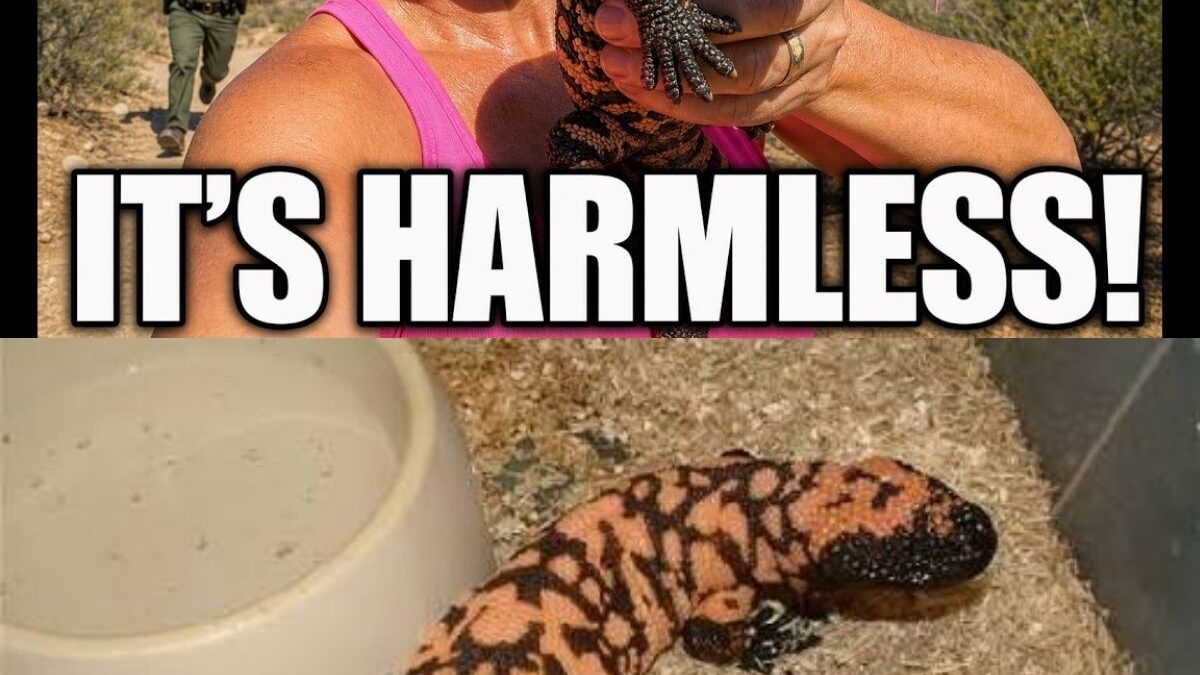
To see a Gila monster in the wild is exceedingly rare. They spend the vast majority of their lives underground, escaping the extreme temperatures, emerging only a few days out of the entire year. It is a stunning creature—heavy, beaded in black and orange, looking like a relic from a forgotten era. It was sitting in the open, doing absolutely nothing, bothering no one.
The only correct response in this scenario is to pause, appreciate the immense luck of witnessing such a rare sight, take a photograph from a respectful distance, and keep walking.
Instead, Renee wanted a closer connection. Driven by a misplaced affection and the urge to interact, she crouched down over the ancient reptile.
Kim, reading the situation with clear-headed caution, spoke the words that should have been the end of the story: “Leave it alone.”
Renee looked at the slow-moving lizard, processed her lifelong success with animals, and replied, “It is harmless.”
Then, she reached down and picked it up.
The Mechanism of a Nightmare
In a fraction of a second, the narrative shifted from a pleasant morning hike to a desperate fight for survival. The Gila monster, a wild creature suddenly grabbed by a giant predator, utilized its only defense mechanism. It clamped its jaws onto Renee’s hand.
Unlike a rattlesnake, which strikes with lightning speed and immediately retreats, a Gila monster’s bite is a sustained process. Its jaws lock shut with incredible force. It does not inject venom through hollow fangs; rather, the venom seeps in through grooves in its teeth as the animal continuously grinds its jaws. The longer the lizard is attached, the more venom enters the bloodstream.
Panic sets in instantly when a wild animal locks onto your flesh. Without access to deep water to submerge the lizard, or the specific tools and presence of mind needed to pry its jaws open, humans resort to their most basic instinct: they pull. Tearing the animal away only rips the flesh further, working the venom deeper into the wound and multiplying the damage.
By the time the lizard finally released its grip, the physical trauma was done, but the true horror was just beginning.
The Physiological Dismantling
Here is the most critical fact about Gila monster venom: it is almost never fatal to a healthy adult. If Renee had been bitten in her backyard or a suburban parking lot, she would have endured an agonizing afternoon in an emergency room, but she would be alive today. The venom itself was never going to end her life.
What the venom does, however, is systematically dismantle the human body’s ability to function. The effects are immediate and devastating:
-
Agonizing Pain: A deep, ferocious burning sensation that rapidly climbs the limb, severe enough to bring a person to their knees.
-
Rapid Swelling: The affected limb becomes a heavy, useless weight.
-
Plummeting Blood Pressure: The victim experiences severe dizziness, making standing nearly impossible as the world tilts and grays out.
-
Nausea and Vomiting: The body aggressively expels its contents.
In an air-conditioned room, these symptoms are a medical emergency. In a 110-degree desert, two miles from the nearest road, they constitute a death sentence.
Renee was suddenly trapped in a hostile environment, violently vomiting the precious water her body desperately needed to survive the heat. Every time she attempted to stand, her plummeting blood pressure forced her back down into the scorching dust.
The True Killer Revealed
The Gila monster did not kill Renee. The desert killed her, and the venom merely served the desert by taking away the only tool she had to survive: her legs.
In the remote wilderness, your legs are your primary life support system. Every piece of gear, every drop of water, and every ounce of preparation is designed to keep your legs moving until you reach safety. Two miles is a brief, 40-minute stroll on a normal day. But when you are incapacitated by excruciating pain, severely dehydrated, and unable to stand under a blinding sun, two miles might as well be the distance to the moon.
Kim did everything a human being could possibly do. Realizing she could not carry a grown woman across two miles of rugged, sun-blasted terrain without perishing herself, she dragged Renee into whatever meager shadow she could find. She left her friend with the last drops of their water and took off running.
Kim gambled her own life, sprinting two miles through deadly heat to find a cell signal and call for help. She pushed her body to the absolute brink, arriving at the trailhead to trigger a swift, highly professional rescue response.
But distance and time do not bend for courage. By the time rescue teams crossed those two miles to reach Renee, her body had been entirely emptied by the heat, the vomiting, and the shock. She could not recover. The official medical ruling cited heat-related death, with the bite acting as the catalyst that prevented her escape.
Redefining Respect for the Wild
There is a profound lesson buried in this tragedy, one that challenges how many of us view our relationship with nature. There is a version of respect that masquerades as love—the desire to touch, to hold, and to physically connect with beautiful things to prove our closeness to them.
Renee operated under this version of love, and it came from a genuinely good place. But in the wild, true respect looks entirely different. True respect looks like distance.
The people who most deeply understand and cherish the wild are the ones who touch it the least. Leaving an animal alone is not an act of coldness; it is the ultimate expression of care. It ensures that both the human and the animal get to walk away and continue their lives.
That Gila monster was exactly what Renee claimed it was: harmless. It did not hunt her, it did not chase her, and it did not want anything to do with her. It simply wanted to be left alone to exist in its ancient, slow, and quiet way. It bit her only because it was terrified, speaking the only language it had to plead for its release.
As you venture into wild spaces, remember that “harmless” is an incomplete sentence. An animal might be harmless, but the environment rarely is. Keep your hands to yourself, take the photograph, and ensure that you always retain the ability to walk yourself back to safety. Because in the end, there has never been a photograph worth the life you lose to get it.

