RECOVERED FOOTAGE: Megalodon Attacks Divers on a Rig | Real Megalodon Encounter
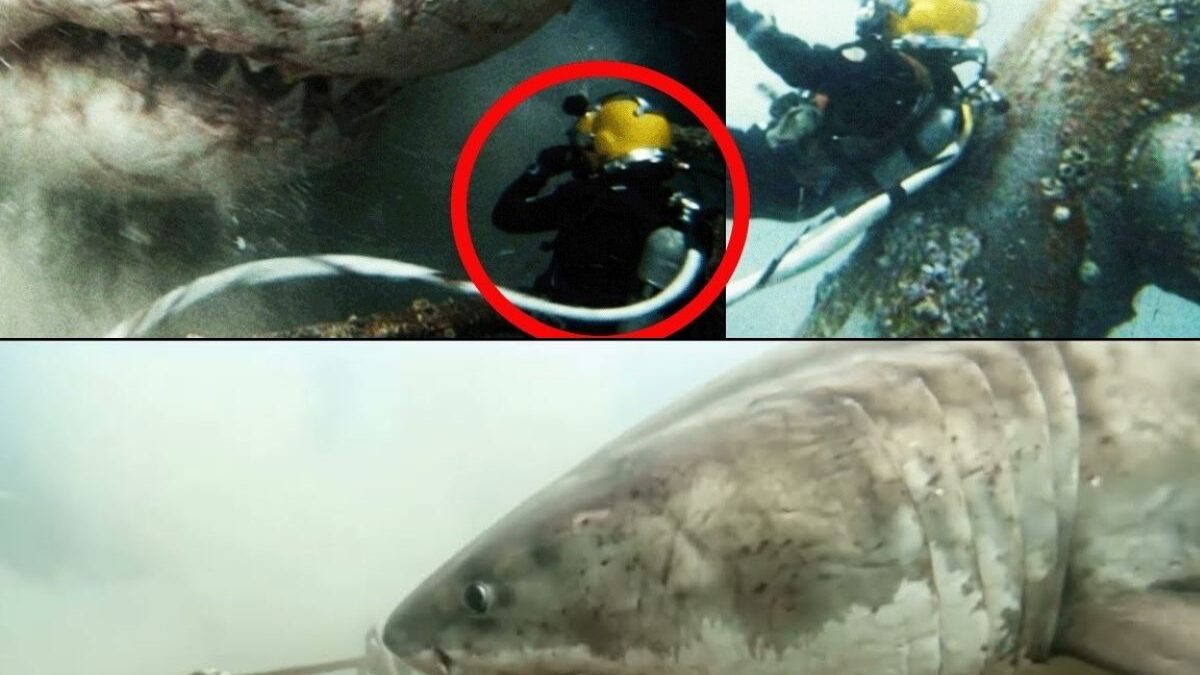
The recording is 9 minutes and four seconds long. And for the first six of those minutes, it is the most boring thing you have ever heard. It is a panel recording from a diving control van on a support vessel working a gas platform in Bass Strait in the autumn of 2019. Every dive we ran was recorded like that on every channel all the way through because that is simply how it is done.
Nobody ever listens to them. At the point where it starts, we were 60% through the cut list and 2 days ahead of program, which for a decommissioning job is close to a miracle. Seastate was slight. The vessel was on dynamic positioning and holding within a meter. Two divers were out of the bell and working at a depth of 88 m on the inner face of the structure and they had been out for 3 hours and 10 minutes.
The first thing that happens on that recording is a number changing. The hot water flow to the number two diver drops from 41 L a minute to 29. That is not an emergency. That is a kink in a hose or a pump lagging. And it corrects itself about twice a shift. I said what I always said, which was to check his loop and give me a reading.
11 seconds later, it drops to 9. At 9 L a minute, a man at 88 m in a helium atmosphere starts losing heat faster than his body can make it, and the clock on his life becomes a short one. Both comm’s channels go loud at the same moment. Not words, just the sound a helmet makes when a body inside it moves violently, which is a sound like a sheet of tin being shaken in another room.
The bell depth trace which had been flat all afternoon moves 2.4 m and comes back. That is the bell. That is a steel sphere with a clump weight under it hanging on a wire and something has moved it sideways and let it go. Then the number one divers’s channel opens and stays open and for 19 seconds there is nothing on it but breathing.
Then this >> suck. He is off the frame. He is off the frame. He is out in the open. I have got nothing on him. I told him to hold position and I told the bellman to stand by the door. I want to be exact about this because I have been over it more times than I can tell you. I did not order a recovery. I ordered him to hold position.
He held position for 4 minutes and 1 second alone on a brace at 88 m in the dark. Everything that follows in this film is an attempt to explain what happened in those 19 seconds using nothing but the things that were written down by machines that were not watching for it. I sent them back down the next morning.
That is the sentence I have to start with because everything else I say will be read through it and it should be. My name will not help you and I am not going to give it. What matters is the job title because the job title is what makes me the wrong person to be telling you this. I was the diving supervisor.
That means I sat in the control van for every hour of every shift of that campaign with the panel in front of me, the gauges, the gas, the depth traces, the hot water, and a monitor carrying the helmet camera from each man in the water. It means the divers do not open the bell door until I say so, and they do not come back in until I say so.
It means that on the morning after the recording I have just described and on nine mornings after that I looked at the weather looked at the program and cleared the dive. People who have heard parts of this before tend to want me to be a witness. I am not a witness. I am the reason there was anything to witness.
So before we go any further, I want to ask you something and I would genuinely like an answer. Have you ever signed off on something going ahead when you were not certain? Not reckless, just not certain. You had a reason for every part of it and you still had a feeling. Tell me in the comments because I need to know whether that is a thing people do or a thing I do.
I read them. All of them, as it turns out. Now, before I show you a single piece of evidence, I need you to understand two things about the men on that structure. Because if you do not understand them, you will spend this entire film reaching for the wrong explanation. The first is that they could not leave. not did not want to could not.
Those three men were saturation divers and for 28 days they lived inside a pressure chamber welded to the deck of that vessel at a pressure equal to 90 m of seawater. Their blood and their tissue were fully loaded with helium at that pressure. That is what saturation means and it is the entire trick of the job.
Once you are fully loaded, you can stay down for a month and it costs you nothing extra because you can only get so saturated and then you are done. To go to work, they transferred under pressure into a diving bell. The bell was lowered down the wire. At depth they opened the bottom door because the pressure inside and the pressure outside were the same.
And two of them swam out on umbilicals while the third stayed in the bell as bellmen. At the end of the shift they came back in, closed the door and the bell came up to the deck where they transferred back into the chamber and stayed at 90 m of pressure until the next day. They never surfaced. Not once in 28 days. And to surface at the end took 4 days of continuous slow decompression running day and night in a steel tube on a deck breathing gas mixed for them by a man at a panel.
4 days. You cannot shorten that. There is no version of it that is faster. If you take a man saturated at 90 m and bring him up quickly, the helium comes out of his tissue as gas in his joints and his spinal cord and his brain, and it will him or kill him. So, when I tell you that something was in the water with them, I need you to hold on to what that actually meant.
It did not mean they were in danger and could get out. It meant they were in danger and the door was 4 days away. The second thing I need you to understand is why you cannot dismiss what they said. And I am going to get this out of the way early because it is the first thing everyone reaches for. The obvious answer is that they were confused.
Deep water, dark adrenaline. three men in a small volume for a month telling each other’s stories. It is a completely reasonable thing to think and it is the explanation I would reach for too. It has also killed a lot of diving testimony and rightly but it does not work here and the reason is the gas. Below about 30 m a diver breathing air gets nitrogen narcosis.
Nitrogen behaves like an anesthetic under pressure. It is the reason recreational divers at 40 meters do stupid things and remember them wrong. Saturation divers do not breathe air. They breathe helios which is helium and oxygen. And helium does not do that. That is precisely why it is used. At 90 meters on helios, a diver is cold and he sounds ridiculous and he is working. He is not impaired.
These men were not on a 2-minute adrenaline dive. They were 3 hours into a normal working shift doing a job they had done for years on an open channel with me listening. Whatever else you want to say about this story, you cannot make it go away by saying they were confused and the gas is the reason. So we have to look for something else.
Here is the something else that everybody starts with and I want to give it its full strength because I believed it for a long time and so did every engineer who looked at this. I have one frame from that campaign that I could put in front of you right now. It is 400 milliseconds long and it is the only thing in this entire story that looks like what you came here for.
I am not going to show it to you yet. And I want to tell you why. Because it is not a trick. It is because you would decide. You would look at 400 milliseconds of a dark shape with no edges in it. And you would decide in about a second and a half whether this whole thing is real. And after that nothing I said would reach you.
So we are going to do the boring part first. We are going to do the gas and the survey and the drawing and the corrosion system. And when all of that is standing up on its own, you can look at the frame and it will not matter very much either way. That is the deal I am offering. Now, let me give the other side its best shot because it deserves one.
Base straight is white shark water. That is not a rumor. It is one of the better places in the world to encounter a large white shark. They are there. They are resident. They move through. And people who work on the water down there see them. Large whites also investigate structures. That is documented behavior.
They approach, they circle, they bump, they leave. They are curious animals with a mouth for a hand. And a big one is not a small thing. A white shark is a serious animal capable of removing a man from the world in one movement. And if you put one alongside a diver at 88 m, you have all the fear you could ever need.
So when the first reports of something on the structure went in, the answer was, “It is a white shark. They are common here. Hold the divers in the bell until it clears and get on with the job.” That answer is correct in every particular except one. Hold on to it. I am going to come back to it with a number and the number is the only reason I am able to say anything at all.
But first, there is a question nobody on that vessel could answer for me at the time. And it is the question that actually starts this. Why would anything that large be at a gas platform in the first place? The answer turns out to be the least mysterious part of the whole story. And it is a thing that everybody in the offshore industry knows and almost nobody outside it does.
A platform jacket is the best fish habitat in the ocean. The jacket is the steel part, the legs and the braces that stand on the seabed and hold the deck up in the air. Ours stood in 95 m of water. And it was a lattice, four legs and hundreds of tubular braces running diagonally between them in bays, level after level, all the way from the mud to the surface.
Every square cm of that steel is covered in marine growth, muscles, anemmones, hydroids, weed, a crust of living things, sometimes a hand deep. That crust feeds small fish. The small fish bring bigger fish. The bigger fish stand in the current on the downtide side of the legs and pick things off all day, every day for 40 years.
There is no rock like it anywhere near. It is a vertical wall of food standing in open water and it is entirely artificial. In America, they know this so well that when they take a platform out, they leave the bottom part on the seabed on purpose and call it a reef. There is a whole program for it. Australia does not do that.
Here the law says it all comes out. Remember that because it is where this ends. I should tell you where this is because it matters to the story and because people assume offshore means the North Sea. Bass Strait is the stretch of water between the Australian mainland and Tasmania. It is shallow by offshore standards. It is cold and it has a reputation among people who work on it that it has thoroughly earned.
[clears throat] There has been an oil and gas industry out there since the 1960s. Dozens of platforms went in across those decades and they are now old. A steel jacket has a design life and when it is reached the field is finished and the structure has to come out. That is what we were doing. We were not producing anything.
We were taking a platform apart from the top down. And the diving was the part of that work which happens below the water line and cannot be done by a crane. Which meant a fixed program, a fixed vessel, a fixed structure, and the same three men in a chamber for 28 days. If we had been drilling, we would have moved.
If we had been surveying, we would have moved. Decommissioning does not move. You are on one structure until it is gone. I have thought about that a lot. Every other kind of offshore job would have taken us somewhere else within a week, and none of this would have happened. and I would have gone my whole career without a story. So there is nothing strange about a large animal being at that structure.
Everything else was there for the same reason. The strange part came on the fourth shift and it arrived in the most ordinary way imaginable. The number two diver was working the inner face at a depth of about 70 m, cutting lugs off a brace, and he stopped and said there was something in the frame with him.
I asked him what he could see. He said nothing. He could not see anything. He said the water had moved. I want to be careful here because this is the part people want me to make more dramatic than it was. He did not shout. There was no crash. He said in an ordinary voice that the water had pushed him and he did not know why. Then about 40 seconds later on his helmet camera at the outside limit of what that camera could show something crossed the gap between two braces and was gone.
I have that frame. It is 400 milliseconds of a shape that is darker than the water and it has no edges because the edges are outside the picture on both sides. You could tell me it is silt. you could tell me it is nothing on its own. I would agree with you and at the time I did agree with them and I said so on the channel and we finished the shift.
What we found the next day is the reason this film exists. They found a band on the inner face of the structure at a depth of about 64 m. The marine growth had been stripped off two separate braces right down to bare steel in a strip a little under a meter wide. Torn, not cut. The edges of the growth stood up on both sides of it like the edge of a carpet where something has dragged across it.
Now, before I tell you what that band eventually turned out to mean, I want you to do something for me. Look at it and tell me what you think took the growth off that steel. Say it in the comments now before you know and remember what you said. I will tell you what the engineers wrote down and then I will tell you what the drawing says and you can see which of us was closer.
I want to be fair and say that at the time my own answer was I have no idea and it is not my department because here is the thing that took me 2 years to understand about my own story. The most important instrument in this entire film is not a camera. It is a maintenance survey and it was being carried out that same month by people who were not looking for an animal, who did not care about an animal and who to this day will not discuss one.
It is called a marine growth survey and every offshore steel structure in the world gets one. The reason for it has nothing to do with biology. It is about weight and drag. That crust of muscles and weed I described is heavy and it makes every brace effectively thicker. A thicker brace catches more force from every wave and every current that goes past it for 40 years.
The structural engineers who decide whether that platform is still safe and what it will take to lift it apart have to know how thick the growth is. So it is measured on a schedule at set elevations on set members with a gauge and photographed and filed. It is one of the dullst data sets in the industry.
It exists to keep steel standing up. And that is exactly why I trust it. Nobody built it to measure an animal. Nobody involved in it believed there was an animal. The man who ran the survey campaign on that structure has been asked about this twice and both times he has said politely that he measures growth thickness and the rest is not his business.
He is right and his refusal is worth more to me than a hundred people agreeing with me because the numbers in that survey do not care what I think happened. They were taken for a fatigue calculation and they will say what they say. What they say is the whole film and I am going to get there. I want to spend one more minute on the man who ran that survey because he is the most important person in this film and he would be horrified to hear it.
He is a structural inspection contractor. He has been doing marine growth and corrosion surveys on offshore steel for over 20 years and he is very good at it and it is a career of almost total obscurity. I have contacted him twice. The first time he answered every technical question I asked in detail and without hesitation.
He confirmed the elevations. He confirmed the gauge readings. He confirmed which members were surveyed on which cycle and he confirmed the tolerances he works to and he explained the difference between a scraped reading and a photographic one. Then I asked him what he thought had made the band. And he said politely that he measures growth thickness for fatigue assessment and that what removes growth is not something he is qualified to comment on and that he would rather not be quoted on anything outside his scope.
The second time, four years later, he said the same thing again in slightly fewer words. I want to be extremely clear that I do not think he is hiding anything. I think he is doing his job properly and that his refusal is the single most credible thing in this entire story because it means the numbers I am going to give you were not produced by anybody who wanted them to mean what I think they mean.
The measurement does not need the animal. It stands on its own. It was taken for a fatigue calculation by a man who thinks the question I am asking is faintly embarrassing and it will say exactly the same thing whether I am right or completely deluded. That is worth more than a hundred people agreeing with me and it is why I keep going back to the survey instead of to the footage.
But the engineers had already answered the question and their answer was good. There is one thing about that band that is not in the survey and it is the only piece of this I have from a person rather than a file. The diver who found it went quiet on the comms for a while, which is unusual. And then he asked me a question I did not have an answer for.
He wanted to know how something takes a crust of muscles off steel without leaving a mark on the steel. He had his glove on it while he was asking. He said the growth was standing up on both sides of the strip like it had been combed and that when he put his hand flat in the middle of it, the bare metal was smooth. Not scoured.
Smooth. I told him it was probably a chain and to photograph it and carry on. And he said, “All right.” And photographed it and carried on. That is the last completely ordinary conversation I had on that job. They wrote down vessel contact. An anchor chain or a wire sweeping against the structure. It is one of the most common damage mechanisms there is offshore.
Boats work around these platforms constantly. Chains sweep, wires drag, and they scour growth off steel exactly like that. There is a form for it. There is a whole literature on it. Everyone who has worked offshore for 10 years has seen it. It was the sensible entry. It was made in good faith by a competent person, and I have never once blamed them for it.
It is also the second thing in this story that turns out to be wrong and it comes apart on two details that are in the survey itself. The first is where the band is. It is on the inner face inside the frame between the legs 64 m down and surrounded on all sides by steel. You cannot get a chain in there.
There is no geometry that allows it. A chain sweeps the outside of a structure because that is the only part of it a chain can reach. The second detail is what the band does not have. Chain contact is steel on steel. It scores. It leaves bright metal and gouges and it transfers paint and rust from the chain onto the member and from the member onto the chain.
The survey photographed that band close enough to read a gauge against it. There is no scoring. There is no paint transfer. There is no bright metal at all. The growth is gone. And the steel underneath it is untouched. Whatever took that crust off did it without being harder than the steel, which rules out every man-made thing that could physically get in there.
And that is where it sat for a while as an oddity in a maintenance file because the job continued because the job always continues. The job continued for five more days and then the animal came to the bell. The bell is the one place a saturation diver is supposed to be safe. It is a steel sphere about 2 and 1/2 m across with a hatch in the bottom.
hanging on a wire from the vessel with a clump weight below it to keep it steady. It carries the gas, the hot water, the coms, and the third man. If anything goes wrong in the water, the bell is where you go. It is the door. It is the only door because up is 4 days away. On the ninth shift, the bellman was sitting on the bench inside it with the door open below him, watching two umbilicals run out into the dark, and something hit the sphere.
He did not see at first, he felt it. He described it afterwards as the feeling of a vehicle being nudged by another vehicle in a car park, which is a very unglamorous description and is exactly why I believe it. The bell depth trace shows 2.1 m of lateral movement and a return. On the fixed camera clamped to the bell frame, there are 11 frames of hide passing across the lens.
Close enough that there is no edge to it anywhere in the picture and a single gill slit crossing the whole width of the shot. Then it is gone and the picture is silt. I called both divers back to the bell and I closed the door and we sat and after 19 minutes I brought them up. That was the correct decision. I want to say clearly that I do not think I got that one wrong.
The next morning I cleared the dive and that is the one I think about. What happened over the next few days was not a decision anybody made in an office. The men in the water worked something out between themselves on the comms and they started doing it before anybody wrote it down and before I told them to.
They stopped using the outside of the structure. Every route they took from that point on went through the frame, through the bays, between the braces, in the lattice, even where it was slower, and even where it meant crawling with a bag of tools through steel they were about to cut apart. I did not order that.
I noticed it on the third day afterwards from the helmet cameras because the picture had changed. There was always steel in the shot now. Always. When I asked about it, the number one diver said something I have never forgotten. And he said it in that ridiculous helium voice which makes everything sound like a joke. If we can get through it and it cannot then it is a fail.
That is the entire safety case for the back half of that job and it was invented by a man [clears throat] at 88 m who had worked it out from the shape of the thing. It also tells you what they believed by then more clearly than any statement any of them ever gave. Nobody speaks like that about a shark. You do not build a rule around what a shark can fit through.
They had stopped arguing about what it was. They had started measuring it with their bodies, which is the only instrument they had. I need to tell you about the chamber now because otherwise none of the rest of this will land properly. When those men came up off the bell at the end of a shift, they did not go home or to a cabin or outside.
They transferred under pressure into a welded steel tube on the deck about the size of the inside of a shipping container, and that is where they lived. Three bunks, a toilet at one end behind a curtain, a small round window in the side about the diameter of a dinner plate. Everything they ate went in through a lock, a little pressure door the size of a bread bin, and everything came out the same way.
The atmosphere in there is mostly helium, so it is thin and cold, and it steals heat off a man constantly. And it makes every voice sound ridiculous. You get used to it. There is a machine on the outside called an unscrambler that makes them intelligible on the comms, more or less. I talk to them every day through that window.
I want you to sit with one detail about that door. It does not open. Not for an argument, not for a change of heart, and not for a casualty. If a man in that chamber has a heart attack, he has it at 90 m of pressure and the doctor talks to him through the glass and he stays there. That is not negligence. It is physics.
Opening it kills everyone inside. So the men in the water each day knew precisely that whatever happened to them out there, the fastest route to the surface of the planet was 96 hours long. They went back anyway because that is the job and because I told them to. The other thing you have to understand is the umbilical because two of the three contacts in this story are about a hose and not about teeth.
A divers’s umbilical is a bundle of hoses and cables strapped together every meter running from the bell to the man. 40 meters of it, sometimes more. Inside that bundle is his breathing gas, his hot water, which is pumped down from the vessel at about 40° and flushed through his suit continuously because at 88 m in helium, a man without hot water is in serious trouble within minutes.
his communications, his video, and a small open tube called a numo, which is how we measure his depth from the panel. Everything that keeps him alive is in that bundle. All of it. There is no spare out there. I asked them once through the window what they thought it was. This was in the second week after the bell before the umbilical.
The number one diver said he did not think about it in those terms, which I did not believe at the time and do now. The number two said something I wrote down that evening, word for word, because it seemed important, and I did not know why. He said that when it came past, you did not see it arrive and you did not see it leave.
And what you got instead was the water changing shape around you. And that [clears throat] by the time your light found anything, there was nothing to find. Then he asked me whether the program had slipped. That is what living with it looked like from inside a steel tube. It was not terror. It was a thing at work.
and they were a thing at work and there was a schedule. I want to tell you what the hot water actually is because people hear the phrase and think of comfort. It is not comfort. Helium conducts heat about six times better than air does. A man breathing helium at 90 m is losing heat out of his lungs with every breath he takes, faster than his body can possibly replace it.
And that is before you account for the water he is swimming in which in Bass Strait in autumn sits at about 12° without hot water flushing through his suit. He does not get gradually chilly. He goes from working to clumsy in about 10 minutes, from clumsy to confused not long after that, and then he stops being able to help himself.
The men on the panel watch that number the way you would watch a heartbeat because it is one. So when I tell you the flow went from 41 to 29 to 9, I am not describing an equipment fault. I am describing a man’s remaining working life being counted down in liters per minute on a gauge in front of me while I sat in a chair and read it out loud.
It is also, and this matters more than anything else I am going to tell you, a tether. He is physically tied to the bell. The bell is physically tied to the ship. Which brings me to the 12th shift. The recording from the 12th shift is the one I described at the very start of this film.
And now I can tell you what is actually on it. The number two diver was on the inner face working a brace and his umbilical was running back through the frame behind him which is normal. Something came into the frame and took hold of the line. Not the man, the line. You can hear the exact moment on the panel because the hot water flow does what I described. 41 to 29 to 9.
And it does that because 40 m of umbilical is being pulled out straight and the hose is being crushed somewhere along its length. Then it took him off his feet and it took him about 11 m along the structure and then the umbilical came tight and when the umbilical came tight it stopped. I have watched that helmet footage more times than is good for a person.
He goes sideways at the speed of a man jogging, one hand still scraping a furrow through the growth on a brace as he passes it. And then there is a jolt and everything stops and he is hanging in the water on a line that is bar taught and vibrating and it let go. That is the part nobody wants to hear because it does not fit the story people arrive with. It let go.
He was not bitten. He was not torn. There is no blood anywhere in 9 minutes and 4 seconds of that recording. He had bruising across his ribs and a badly wrenched shoulder. And he was hypothermic by the time we had him in the bell. and he was back at work in a week because he was in a chamber and there was nowhere else on earth for him to be.
Now I am going to tell you the thing that changed how I think about all of this and it is not a story about an animal at all. It is a story about the platform. Every steel structure in the sea is dissolving. Salt water and steel make a battery and the steel loses. Left alone, a jacket like ours would corrode away in a fraction of its design life.
So we cheat. And the way we cheat is called cathodic protection. On a structure like that one, it is done with a system that drives a low voltage direct current out through a nodes into the seawater and back through the steel continuously. It holds the whole structure electrically negative relative to the water around it and corrosion effectively stops.
It is called impressed current cathotic protection. It is on structures all over the world and nobody thinks about it twice because it has no moving parts and it simply runs. What it means physically is that the water inside and around that jacket is not ordinary water. It is an electrically live volume deliberately every hour of every day for 40 years for reasons that have nothing whatsoever to do with anything alive.
Now hold that next to a fact about sharks that has been known for over 60 years. Sharks have the most sensitive electro reception of any animal we know of. They have organs in the snout called the ampolet of Laureni, jellyfilled canals that detect electric fields, and they are sensitive enough to pick up the tiny voltage that a fish’s own muscles leak into the water.
It is how a shark finds something buried in sand in complete darkness. At close range, it is barely using its eyes at all. It is using that. There is an entire product category built on this. The electric shark deterrence people strapped to their leg work by producing a field strong enough to be unbearable in an organ that evolved to detect almost nothing.
So, put those two real things side by side. An animal whose close-range sense is electrical, swimming into a structure that has been deliberately turned into an electrical object. I am not going to claim I know what that felt like from the inside. Nobody can. But it explains the thing that never made sense to me, which is not why it came and not why it kept coming back.
It is why it was so bad at this. Because if you take everything on those recordings and lay it end to end, what you have is not a predator hunting. It is a very large animal arriving somewhere full of food and then behaving like something that has walked into a room where the lights have been switched off. It shoved a bell.
It took hold of a hose. It scraped along a brace hard enough to strip 40 years of growth off it without leaving a mark on the steel. Not one of those is a hunting action. Every one of them is what a shark does when it is investigating an object it cannot identify, which is to make contact with it and find out.
Large sharks do this constantly. It is the reason people survive white shark encounters at all. The animal makes contact, evaluates, and rejects. A man in a rubber suit tethered to a steel structure roaring helium out of an exhaust valve is not shaped like food, does not move like food, and does not read as food.
And that finally is why I have three men to talk to and not none. There are three reasons those contacts were survivable and they are all boring and they are all made of steel and physics. The first is that the jacket is a cage it could not get into. The bays between those braces are a few meters across. Whatever was outside them was not.
A diver inside the frame is inside a box and the crew worked that out fast and the standing instruction within two weeks was to get inside the structure and stay there. There is something bitter in that which I did not see for years. The only thing keeping those men alive was the structure and they were down there to cut it apart.
Every single day of that job made their shelter smaller. The second is the tether. A drag ends when the line comes tight. And it did. And the third is the field. It came in blind or close to blind into a volume that had been electrically shouting for 40 years. None of that is comfort. It is not a protective spell.
It is three pieces of luck made out of engineering. On the 15th shift, one man had none of them. His name was not on the incident report in the way you would expect a name to be on a report, and I am not going to put it here either for his family. He had been in saturation 11 times. He had a daughter who was seven. On the 15th shift, he and the number two diver were moving between the bell and a work site on the far leg.
That is a transit. It is the most ordinary 5 minutes of a saturation shift and nobody thinks about it. You leave the structure at one level. You swim across open water and you come back onto the structure somewhere else because going around the outside is shorter than crawling through the frame. He was 31 m from the nearest steel when it happened.
Now put that against the three things I just told you. He was not inside the frame, so there was no cage. His umbilical was running free in open water rather than led along a brace. So when it came tight, it did not come tight against anything. It came tight against him. and he was as far from the enodess as a man on that job ever got, which is where that field is weakest.
Every single thing that had saved the others was a property of the structure, and he was not on it. The recording of the 15th shift is 11 seconds long in the part that matters. The other divers’s helmet camera is pointing the wrong way because he was swimming and a swimming man looks where he is going. At second four, the picture swings hard right.
At second six, there is a shape occupying the entire frame with no edge to it in any direction. At second seven, the picture is silt and nothing else. At second 9, you can hear him say a word that is not a word. And at second 11, the light on his helmet is pointing at open black water, and it stays pointing at open black water for 4 minutes.
That is it. That is the whole of it. We recovered his helmet on the 22nd of that month from a snag on the outer face 40 m from where he went off the line. We did not recover him. The chamber door had 96 hours on it and two men behind it who had just watched that happen. I want to be very careful about how I describe the next four days because it is the part of this that I am least able to be objective about and it is also the part that has nothing to do with an animal.
They could not come out. There is no compassionate release from a decompression schedule. The gas in their bodies did not care what had happened. So for 4 days, two men sat in a steel tube on the deck of a ship, 16 m above the water that had just taken the third one, and decompressed at the rate a table says you decompress.
They ate through the lock. They slept. The chamber ran its schedule. And on the other side of a piece of glass about the size of a dinner plate, I sat on a stool and talked to them because there was nothing else I could do and because they asked me to. I was there when the second one said the only thing anybody said in 4 days that I have never been able to put down.
You could not have got him. There was nothing to get. You know that. >> I have thought about that sentence for 6 years and I still do not know whether he was consoling me or asking me a question. Some of you answered me at the start of this film. I asked whether you had ever cleared something you were not certain about.
I have read those. I read them for a long time actually. And what I have taken from them is that it is a thing people do constantly and that almost every one of you got away with it and that is the only difference between you and me. There is something I have skipped and it is not fair to skip it. There were more than three men on that job.
There was a whole dive spread on that deck. life support technicians running the chamber gas around the clock. A gas man, winch operators, a superintendent, deck crew who did nothing all day but tend umbilicals and never once got wet. Every one of them heard the panel because the comm’s feed to the dive shack and every one of them read the incident reports because they have to sign the toolbox talk that follows.
Nobody on that deck thought a chain had done it. I want to be careful because I am not offering you 20 witnesses. Most of them never saw a frame of the footage and would not claim to know anything. What I am telling you is something smaller and I think more useful for the back half of that campaign on a working vessel with a schedule and a client and a day rate.
Nobody argued with the divers. Nobody told them to stop going the long way round through the frame, even though it costs time. And time on a decommissioning job is the only thing anybody counts. That is not belief. That is a whole crew of practical people quietly deciding it was not worth the argument.
and it is the closest thing to a consensus that this story has ever had. Now I have to do the part I have been putting off for the whole film, which is to tell you how big it was. And I want to be honest about why I have put it off. It is because the moment I say a number, you will decide whether to believe me. And once you have decided that you will stop listening to how the number was arrived at.
So please stay with the method because the method is the only thing here worth anything. The number does not come from a camera. No camera in this story ever saw the whole animal. Not once, not in any frame, not on any shift. It comes from that band, the strip of cleared growth that the engineers wrote up as vessel contact.
Here is what the survey actually recorded, and none of it was recorded by anyone who thought it mattered. The band crosses two braces. Those two braces are not in the same plane. One is nearer the outside of the frame and one is deeper in and they run at different angles because that is what diagonal bracing does.
They are two separate pieces of steel at two separate distances leaning two separate ways and the cleared strip holds exactly the same elevation on both of them. I need you to see why that is the whole thing. If an animal had swam along one of those braces and scraped it, the strip on that brace would climb or fall with the brace because the brace is leaning.
It would be a diagonal mark on a diagonal member. That is what a rub looks like. The strip on both of those members is level. It sits at one height on two members that are not [clears throat] at one height and it carries straight across the open water between them. There is only one thing that makes a level line across two members that are themselves not level and that is a single rigid body long enough to be touching both of them at the same moment.
Not repeated passes, not a rub, one contact, one instant, one body. And the clear horizontal distance between those two braces is not a matter of opinion. It is dimensioned on the asbuilt drawing of that structure, which is the legal record of how the thing was actually built. And it is good to within a few cm over that span.
That distance is 12.6 m. Now the obvious objection and it is a good one is that I have just described two marks and called them one event. Why could that not be two separate contacts on two separate days that happen to sit at the same height? Three reasons and none of them are mine. They are all in the survey.
The first is the elevation itself. Those strips match to within the tolerance of the survey, which over that span is a few cm. Two independent events would have to land at the same height twice by chance on two members at different distances in three-dimensional water with no reference plane in it.
Once is a coincidence I would have to accept. To the cime is not. The second is the growth. Marine growth starts closing over bare steel immediately and it does it at a rate that is well characterized because the whole industry needs to know it. The two strips have the same amount of regrowth on them.
They were cleared at the same time, give or take a very short window. And the third is the edges. The torn edge of the growth on both members leans the same way. Whatever went through there was traveling in one direction and both marks record the same direction. One body, one moment, one direction of travel. So I will say the number properly now with everything it does and does not mean attached to it.
That is the number 12.6 6 m and it is not an estimate. It is a floor. I want to be exact about why it is a floor because this is the one place where I could make this story bigger and I am not going to. The band does not stop at the outboard end of the second brace. It runs off the end of it and continues onto steel that was outside the survey scope, which means nobody measured where it stops.
So, the animal was at least as long as the gap. How much longer? I cannot tell you, and neither can anyone else, and I would rather have a small number I can defend than a big one I cannot. 12.6 m as a minimum. Some of you told me at the start what you thought took that growth off the steel.
I asked you to say it and remember it. The engineers said an anchor chain on the inner face 64 m down with no scoring and no paint transfer. And the answer everybody else gives including me for the better part of a year was a white shark. So, let us do that properly because it deserves to be done properly. The largest white shark that has ever been reliably measured by people who put a tape on it rather than a guess is a little over 6 m.
There are bigger ones claimed. There are always bigger ones claimed. The reliable ones stop at about 6.1. 12.6 six is not a large white shark. It is more than two of them laid nose totail. And it is not a matter of one exceptional animal either because that is where people go next. It is not a record-breaker at the far end of a distribution.
It is double the far end of the distribution. The white shark answer was the right answer to reach for. It was the honest answer in the right water from people who knew what lies there. It just does not fit through a gap of 12.6 m. Which leaves the question I get asked more than any other and it is a fair one.
And it very nearly stopped me from ever talking about this. If it was there, why is there no footage of it? Not a partial frame, actual footage. That platform stood for 40 years. It has been inspected by remotely operated vehicles hundreds of times. There are thousands of hours of survey video of that structure. Why is it not on any of it? I could not answer that for a long time.
And then somebody who did not care about the animal at all handed me the answer without meaning to. Every one of those inspections is scheduled. It is in a campaign. It is in a report and the reports are all dated. So I did the only useful thing I have ever done with this story on my own. I laid the inspection log against the shift log.
Remotely operated vehicle inspections happen in daylight working windows in workable weather with a full crew on deck. A vessel sitting over the site with thrusters running and flood lights on. They are noisy, bright, scheduled daytime events. Every contact we had was at depth on a dive shift on a structure with two men on it and nothing else running.
I did that at a kitchen table on my own about 3 years after the job finished. I had a print out of the inspection history on one side and the dive log on the other and a ruler because I did not trust myself with a spreadsheet on something I wanted this badly to come out a particular way. I want to be honest about that.
I was not testing a hypothesis. I was looking for a reason to stop feeling the way I felt and a person in that state will find whatever they are looking for. Which is why I did the comparison in the direction that could have ended it. If a single remotely operated vehicle inspection had overlapped a single contact, I would have had my answer.
And the answer would have been that a camera was running and saw nothing. And I would have let this go. I wanted that. I genuinely wanted that. Cross the two logs and they do not overlap. Not once in 40 years. The instrument that never saw it is the instrument that was never running when it came. That is not proof of anything.
I want to say that plainly. An absence is not evidence. But it is the difference between a thing that should have been filmed and was not and a thing that was never once in the same place as a camera that was switched on. And there is one more instrument and I did not know it existed until an engineer mentioned it in passing while telling me about something else.
I told you about the cathodic protection system. The current that [clears throat] runs through the water to stop the steel corroding. That system is monitored. It has to be because the way you find out an anode has failed is that the current demand changes. So the demand is logged continuously and filed by people whose entire interest is corrosion.
A large conductive body entering a protected volume changes that demand. It is not subtle physics. It is a lump of salt water and muscle moving through a field. There are nine anomalies in the current demand log for that structure across those 28 days. Eight of them are within 4 minutes of a contact recorded on the dive panel.
I am not going to tell you that a corrosion log can measure an animal because it cannot and anybody who tells you otherwise is selling something. It gives presence and it gives timing. It does not give a length. The length comes from the band and the drawing and only from the band and the drawing. But it means two completely unrelated systems installed by different people for different reasons.
Neither of which has any interest in biology. Both wrote something down on the same night. Now I have to tell you what happened to all of this. And it is the part that people find hardest to believe. And it is also the part I am most certain about because I did it. Nothing was covered up.
I need to say that clearly because I know what this format usually promises. There was no conspiracy. Nobody leaned on anybody. No file went missing. No one was paid off. The opposite happened. Everything was reported. Offshore safety is genuinely one of the best systems of its kind in the world. And I say that as someone it has failed. Every incident gets reported.
Every incident gets investigated. Any worker can stop the job at any time and nobody may punish them for it. So it all went in the bell contact, the umbilical, the loss of a diver in transit. And here is the mechanism. And it is not villain. It is a filing system. Offshore work runs on a hazard register. Every hazard that has been identified has a control attached to it and the whole apparatus exists so that a known hazard is a managed hazard.
Hazardous marine life is on that register. It has been for decades. It is carried in dive project risk assessments as a matter of routine and it has a control. The control is recover the divers to the bell. Wait resume when it is cleared. That is what the contacts were logged under. That is the control that was applied and the control was correct.
It is what I would tell anybody to do today. Do you see it? Once a hazard has a control, it has been dealt with. That is what a control is for. A hazard with a control on it is not a discovery. It is a line item. and line items do not travel. I filed a report saying that divers had been recovered to the bell following marine life interaction and that the procedure had been followed.
Every word of that was true. I have never written a truer sentence in my life and it is the sentence that made all of this ordinary. Nobody lied. Nobody was negligent. The system worked exactly as designed and the system is a good one. It just does not have a box for an animal that is twice as long as the largest one anybody has ever measured.
So, it put it in the box it had. That is not a cover up. It is worse than a coverup because there is nobody to be angry with. There is one more thing in that survey and I found it 18 months after the job ended and it is the reason I am not able to leave this alone. The growth survey runs on a cycle. Every couple of years somebody goes back and measures the same members at the same elevations because you need the rate of growth not just the amount.
So there is a previous cycle. There are photographs of those same two braces from 2 years before we ever mobilized. The band is in them. Same elevation, same two members, thinner and partly grown over in the way marine growth closes back over bare steel at a rate you can actually calculate. Which means it was not there because we were there.
It was not drawn in by the cutting or the lights or the noise or the men. It was working that structure before any of us arrived on a schedule nobody was keeping. And the only reason anyone ever noticed is that we happened to be standing on it when it came back and nobody had looked. That is not an accusation.
There was no reason to look. The photographs were taken to measure how thick the muscles were. There is one more thing I want to say about the number because I have watched people do this with it and it makes me tired. 12.6 m is not a species. I have not told you what it was and I am not going to because I do not know and neither does anybody else.
I have a length and a behavior and an absence of teeth marks and that is not an identification. People want me to say a word. There is a word people want and it has been in the title of things written about this and I understand exactly why. What I will say is this. Whatever produced that line was long enough that every animal anybody can name in that water is ruled out by simple arithmetic.
And it behaved in a way that is completely consistent with a very large shark that could not see properly. And it did that repeatedly over a period of years at one structure and left a record of it in a maintenance file. You can do what you like with that. I have stopped trying to make it into a name. What I cannot stop doing is thinking about the shape of the thing that happened to us, which is not really about an animal at all.
Three men went into a steel tube for 28 days. Something they could not identify came to the structure they were working on repeatedly and the only thing that kept them alive was the structure itself which they were there to remove. It was reported every time in full by me and the reporting system did what it is supposed to do which is to take a hazard, attach a control to it, confirm the control was applied and close the item.
It is a good system. It has saved an enormous number of lives and I will not have a word set against it. It just has no category for something that does not fit through a bay of steel. So, it filed the thing it could see, which was a diver being recovered to a bell in accordance with procedure. That is what an anomaly looks like from the inside.
It does not look like a coverup. It looks like paperwork being completed correctly by people doing their jobs. The platform is coming out. I said earlier that in America they leave the bottom section of a platform on the seabed and call it a reef and there is a whole program for it and the fish do very well.
Australia does not do that. The default here is that it all comes out, every leg, every brace down to the mud and back to shore to be cut into pieces. So that lattice, the cage that kept two men alive because it was too small to let anything else in, is going to be removed from the ocean entirely. The growth survey will run one more time before it goes because the engineers need to know what the members weigh before they lift them.
Somebody will photograph those two braces again. They will write down a thickness. They will file it and then the structure will be gone and the animal will still be there because the structure was never the reason. It was only ever the reason we could see it. What I have is not a photograph. I want to be honest about that all the way to the end.
I never saw it. Not once. Not on any monitor in a year of watching. What I have is a level line across two members that are not level and a distance on a drawing and a man who is not here. 12.6 6 m. That is the floor. And I sent them back down.

