Racist Cop Tries to Tow a Black Man’s Car — Quickly Realizes He Just Messed With a Federal Judge
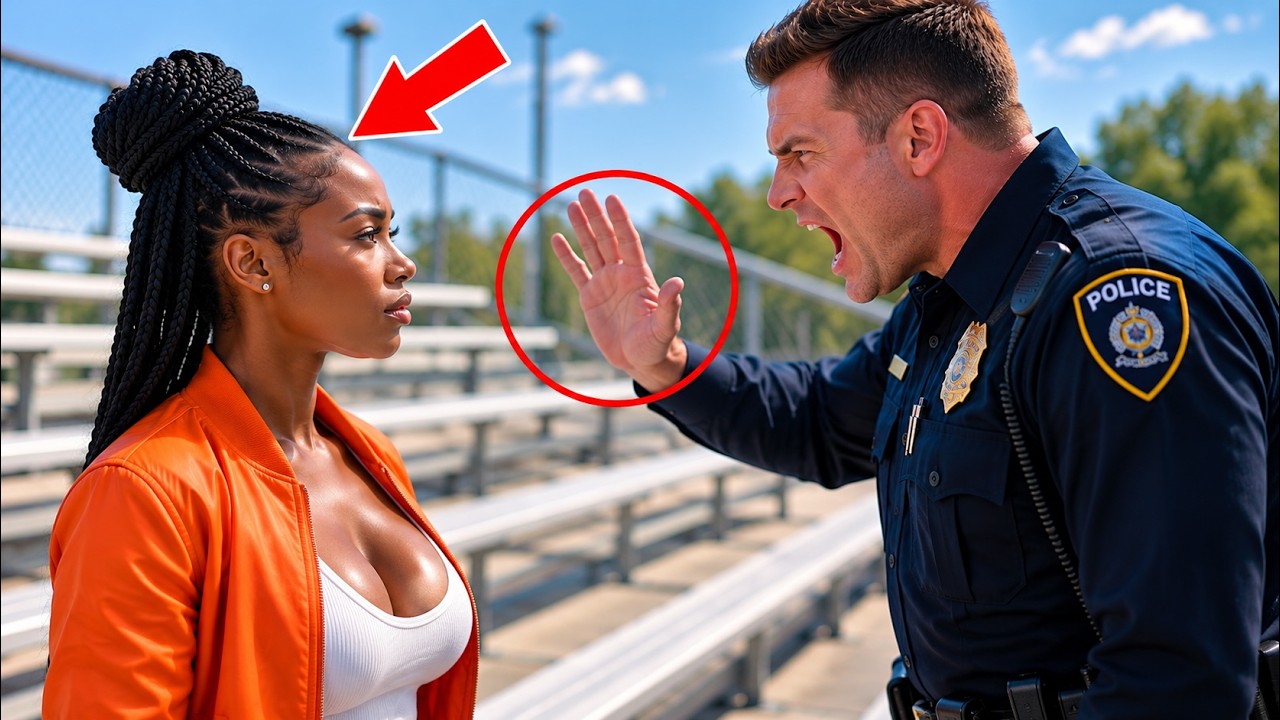
Shut your mouth. Who do you think you are? The officer snarled, swinging his arm and slapping the woman in the coach’s shirt hard across the face right in the middle of the soccer field before the horrified eyes of the children. He pressed his knee into her back, the cuffs biting deep, a sneering arrogant grin on his face, believing he had just taught a lesson to a low life.
The absolute power of a man with a gun and a badge in a small town. But what he didn’t know was that the woman whose face was being pressed into the grass was no ordinary gym teacher. This was Maya Rivers, an undercover CIA operative embedded in a simulation program, a master assassin forced to suppress her killer instincts to protect her cover identity.
When he dragged her into a camera blind spot, pulled a knife, threatening her, and unwittingly let slip a secret about her missing sister, all boundaries shattered. In a deadly flash in the dark warehouse, the hunter became the hunted and the lethal blade was turned back on him, transforming the arrest into a shocking murder scene. Will the shaky video secretly filmed from the stands be enough to save her from a death sentence? Or was the officer’s death just the prelude to a terrifying conspiracy known as Project Rise? If the person slapped to the
ground and humiliated in front of a crowd was your sister or mother, would you choose silence or stand up and fight? Comment below and watch this entire video to understand why justice cannot be delayed another second. Magnolia Creek looks calm, like an old postcard with white Magnolia trees blooming in season and wooden houses repainted every year to stay pleasing for tourists.
But anyone who has lived here long enough knows that beauty only covers something else, something more persistent, like a thin layer of dust on a table that’s never truly clean. On Main Street, when a person of color walks into the grocery store, the cashier at the counter becomes instantly more alert. Eyes dart and then tracking every step.
At the gas station down the road, the owner often shakes his head whenever a dark-skinned stranger asks to use the bathroom. His expression painting clear suspicion without needing a word. The elders in South Creek still tell the kids that if they see a patrol car passing by, they should stand up straight, look down, don’t rush, and don’t do anything that might seem like a problem.
Magnolia Creek doesn’t hang signs separating anyone, but the way people look at you says it all. To the north of town lies North Ridge, where the lawns are neatly trimmed and SUVs line up in rows like in a commercial. Most people here are white. They speak to the police with a casual tone like old friends, like we’re on the same side.
Just make a call and an officer shows up with a friendly smile and a familiar joke. To the south is South Creek, where rusty metal roofs cover old homes, where kids play ball on the sidewalks, and grandparents sit on porches staring at the sky with tired eyes. When they see the flash of police lights sweep by, they set down their teacups.
Stay quiet for a few seconds, then go on with their unfinished stories. No one has to say it out loud, but everyone knows North Ridge is considered safe, and South Creek is seen as a place that needs watching. If a white person speeds, they’re gently reminded to be careful. But if a young man of color is just walking too late, he’s asked, “What are you doing here?” Magnolia Creek’s rules aren’t written in law, but everyone knows them by heart.
Dela’s Cafe sits in the heart of town, the gathering place for every kind of story, old and new. The walls display portraits of former police officers, all white men with stiff smiles and polished badges. Every morning, a few elderly folks sit there sipping strong black coffee, stirring slowly and looking out the glass windows.
A seasoned black man speaks softly, just loud enough for the next table to hear, saying, “In this town, what the police say is the law.” The man beside him nods, sighed like it’s something he’s heard too many times before, and adds a story about his grandson being pulled over just for wearing a hoodie while walking toward North Ridge.
Every time a patrol car passes, the engine roars, the cafe windows rattle slightly, and the conversation pauses for a beat. Delas is always busy, but there’s something quiet in the air that makes everyone watch their words, especially those who’ve lived long enough to see Magnolia Creek change without really changing at all. That afternoon, as Micheline walked down Main Street in her bright orange workout clothes, the kids rushed after her, calling out Coach Mike like they were greeting an older sister they adored.
She smiled, knelt down to tie a little boy’s shoelace, and reminded the group to slow down so they wouldn’t fall. The kids genuinely loved her because she was patient, funny, and never once raised her voice at them. Adults weren’t as easy. A white woman standing outside the grocery store looked her up and down before asking, “Which school do you teach?” at her tone was calm, but her eyes were full of judgment.
Another man followed with, “Which part of town are you from?” As if everyone needed to know where Micheline stood on the town’s invisible ladder. The black residents watched her with a cautious kind of hope. They saw someone warm and familiar. But Magnolia Creek had let them down too many times for trust to come quickly.
Micheline Stone had only been in town for a few weeks. She brought a gentleness that longtime residents of Magnolia Creek no longer carried. To the kids, she was the person helping them run faster, throw farther, and believe in themselves under the golden afternoon sun. But to the grown-ups, Micheline was an outsider, a newcomer, someone who didn’t belong in the town’s ongoing story.
She could feel the scrutiny every time she led the kids across the ball field or stopped into a store. Even when she smiled, Magnolia Creek didn’t smile back. Here, a black woman who stood out too much would always be noticed, and her orange clothes were too bright for anyone to ignore. In her early days in Magnolia Creek, Micheline had thought the town was just a little standoffish.
That time would smooth things out. But the longer she stayed, the more she felt the heavy quiet that wrapped around those peaceful streets. A clerk at the pharmacy once asked if she was sure she wanted to live in South Creek. His tone more surprised than welcoming. An older black woman had whispered a warning as she saw Michael waiting by the school bus stop.
Be careful with the police here, baby. They’re not like other places. The comments came one by one, but they stayed with her reminders that Magnolia Creek was not a place where you could let your guard down. She didn’t react. She just listened and remembered. Magnolia Creek had the beauty of a peaceful place, but that beauty was like a shop window wiped clean every day to keep people from seeing what was behind it.
For black folks, it was a place where every step had to be careful, every word measured, and even the smallest mistake could cause trouble. Michael didn’t fully understand that yet, but she had started to feel it. The caution in people’s eyes, the division between North Ridge and South Creek, the quiet, unconscious stairs. It all felt like soft knocks on the door, warning of a storm that hadn’t yet arrived.
And when the kids ran circles around her, calling her name with joy, Micheline didn’t know that in just a few days, the color of her shirt would become the reason Magnolia Creek finally showed its true face. Michaelen Stone came to Magnolia Creek for a reason no one in town could have imagined. To them, she was just the new coach teaching the kids how to run and stretch.
But behind that image was a federal program so obscure that only a handful of people within the CIA had ever heard of it. Deep field simulation was designed to test endurance, the ability to survive within a real community to gauge reflexes and situational reading skills without leaning on any authority or power. A program lasting from 14 to 21 days.
long enough to immerse participants in the rhythm of local life, but short enough to keep them on the constant edge. Everyone who entered the program had to agree to strict terms. No acting like an agent, no interference, no action, no investigation, and absolutely no revealing their true identity. They had to live like an ordinary person, fully blending into the place they were sent.
Micheline once argued with her handler that she wasn’t right for this kind of test. She was good at analysis, at orientation, at reading behavior, but living for nearly 2 weeks without reacting to injustice that she believed would be too hard for her. Her handler just smiled and said that was the test because in real life there are times when you know something is wrong, but you’re not allowed to intervene.
She accepted the assignment, nodded as protocol demanded, and brought along a training kit and a small chip key the size of a fingertip to activate the simulation data. From the moment she stepped into Magnolia Creek, she became the new local someone with no authority, someone no one knew. In the early weeks, everything unfolded just as intended.
She lived simply coached the kids on base, running, chatted with the elderly, mentally recorded the tones of speech, the rhythm of daily life, and the subtle differences in how white people spoke compared to people of color in each part of town. She watched how the police addressed North Ridge with a smile, but spoke to South Creek in an interrogative tone.
She memorized the small moments outsiders would miss, like the black woman at the pharmacy who lowered her eyes when Officer Rick walked in, or the little boy who froze at the sound of a siren, his face tense like someone who had seen this too many times. This was the kind of data the CIA wanted, the feeling of how the lower levels of society operated when there were no city cameras or journalists jumping in to explain it.
And Michaeline did her part well, at least in the beginning. Then everything shifted quickly without clear warning. Government crackdowns on cyber security and data leaks triggered a full review of the program systems from top to bottom. At first, Micheline just noticed her wrist device transmitting more slowly, as if the data had to pass through a new filter.
She sent a brief message to the monitoring system asking if there was a technical issue but received no reply. She tried again twice. Once using a low priority code, then an urgent one, still nothing. 3 days later, the device disconnected completely. No more location logging, no more signal lights. When she opened the backup communication kit, all it displayed was a cold gray message connection temporarily locked.
She still thought it might be a system glitch due to upgrades, but when she used the chip key, the one issued when entering the program to send a signal confirming she was safe, the screen flashed just one short phrase, figure it out yourself. It wasn’t the kind of message used in drills. Normally, there would be a verification code attached.
This felt like someone on the other end had cut the conversation short before she could ask anything else. After that, the system shut down completely. A blank screen. No error, no disconnection notice, just gone from the network. Micholene stared at that message for several minutes. Her chest tightening in a way she hadn’t expected.
She knew the program always had unpredictable elements, but never had a participant been left in a town like Magnolia Creek without a handler. No one contacted her. No confirmation, no signal of safety, no trail, no fall back. She stood at the window of her small rental in South Creek, watching the lights of North Ridge glow like a separate world, and realized she had been dropped into the gap between the two.
Magnolia Creek had never been easy for people of color. But now, with her cover intact and the system cut off, she didn’t even have the safety net the program promised would always be there. She didn’t panic, but the silence from headquarters stretched long enough to feel like the calm before a storm.
She kept telling herself it was only a few more days that the program was nearly over, that maybe tomorrow her handler would send a message and say the glitch had been fixed. But each day passed and the signal stayed dead. The silence felt deliberate, like someone had turned everything off without leaving a way back. She sat on the edge of the bed, gripping the chip key in her hand.
The only thing reminding her she belonged to something bigger than this town. Still, the phrase, “Figure it out yourself,” lingered like a warning that she was now completely alone. What she didn’t yet know was that Magnolia Creek was about to test her in a way no training manual had ever prepared her for. Rick Torver was the kind of man whose name alone made people in Magnolia Creek know to take a step back.
He was nearly 40, had lived in the town his entire life. His face always freshly shaven his uniform, crisp, his shoes polished like mirrors. To outsiders, he looked like the model of a cleancut, respectful police officer, someone who cared about appearances. But the folks in South Creek knew better. He had a way of walking that made people tense their shoulders, a way of looking that made you want to stay still just to get it over with.
The black residents in town used to say Rick didn’t need to raise his voice. Just the sound of his patrol car door opening was enough to quiet the whole block. Rick’s reputation didn’t come from solving cases, but from being rough with black people. There had been a few incidents. A young black boy stopped just for biking through North Ridge, or an elderly woman questioned for nearly 20 minutes because she forgot her wallet and couldn’t show ID right away.
Everyone in town knew about these stories, but nobody said them out loud. White folks said Rick was just keeping order, while black folks looked at each other, sighed, and reminded one another to stay out of his way. Anything involving Rick spread through South Creek faster than any other news. Longtime residents often said he thinks he’s the king of this town.
And judging by how he acted, they were probably right. Rick constantly repeated the kind of phrases that sounded like they came straight out of another era. These people are always causing trouble. Back in the day, things were more orderly. Kids these days don’t know what fear is. He said them in a calm, steady tone, as if there was nothing wrong with what he said, like it was something passed down through generations.
Many white folks would nod or give a light chuckle, while black listeners would glance away and let it pass. To Rick, Magnolia Creek was his town, and anyone living in it had to follow the unspoken rules he made up. He rarely pulled a gun, but used his tone and presence like weapons, making people feel like they needed to shrink in front of him.
In the black community, there was a story few dared to say aloud, but it still traveled in its own quiet way. 10 years earlier, a young black girl named Zara went missing after walking home from school. The police said she got lost, maybe ran away, and closed the case after only a few days. But the people of South Creek didn’t buy it. They remembered Zara as sweet, polite, and never one to wander far alone.
They also remembered one more thing. Rick was the last person seen near her that day on the empty stretch of road between the school and her house. The rumor started softly, then settled deep. No one could ever prove anything, but the story never left people’s minds. And every time Rick passed through South Creek, people looked at him differently, like looking at someone carrying an unspoken secret.
Micheline first saw Rick when she was out on the ball field with the kids. He stepped out of his patrol car, calmly scanned the group quickly, but let his eyes rest on her longer than necessary. His stare was strange part, probing part blunt. It wasn’t curiosity, it was judgment. She could feel it instantly.
the way someone measures where you land on the invisible ladder of Magnolia Creek. She greeted him politely, but Rick looked at her like someone who didn’t belong. He gave her a quick nod, just enough to acknowledge her, then turned away, leaving behind the sense that he had already filed her into some mental category.
The next few times she saw him at the grocery store or on Main Street, that same look returned. He didn’t need to say anything. His stare carried the message, “You’d better remember where you stand.” He saw her presence as something that threw off the familiar balance of the town. He looked at her the same way he looked at young black men he’d stopped in the street like she was trouble, just for being different from the rest of Magnolia Creek.
Some of the older black residents noticed it before she did. One day, an old man beside her at the checkout line quietly told her that Rick didn’t like anyone from South Creek crossing into North Ridge. When she asked why he just shook his head and said it was best not to cross paths with Rick when Rick was paying attention, his voice wasn’t fearful.
It was the voice of someone who had spent years learning to live with what he couldn’t change. In Magnolia Creek, Rick didn’t need to cause a scene for people to know what he was thinking. One glance or a short comment was enough to remind folks where they stood in the world Rick imagined for himself. And from the way he looked at Mike Leen, the people in South Creek started to feel like something was coming.
Maybe not right away, but that kind of look had always been a warning. Michael didn’t know all of this yet, but her instincts felt the pressure starting to build around her piece by piece. And it all began with the way Rick looked at her every time they met. Noon in Magnolia Creek was often so hot, the ground seemed to trap the sun’s breath, and the baseball field in front of the high school was the place that felt it the most.
The kids ran in every direction under Michael Stone’s commands. One pitching, one catching the others, shouting and competing to see who could round the bases fastest. Sweat beated on their foreheads and dropped onto the dry grass, but every one of them was smiling. It was the kind of peaceful practice everyone wished would last a little longer.
Michael stood at the center of the field, her orange shirt glowing under the sun, reaching up to catch a missthrown ball, she reminded the kids to lower their shoulders, rotate their hips harder, and keep their eyes on the ball. Her voice patient, the kind they loved hearing. She had just stepped over to adjust Stanley’s stance when the familiar engine sound of a patrol car cut through the heat.
A few kids turned toward the noise, which was sharper than most cars. Michael recognized the feeling, an instant hush, like someone had dimmed the sunlight and replaced it with a heavy sense of waiting. She followed the sound and saw the blue and white vehicle rolling slowly into the red dirt parking lot, dust rising behind the tires.
The door opened and Rick Torver stepped out, arms relaxed at his sides like he had no real purpose. But the way his eyes swept the field, said otherwise, he looked at every child, every parent, and then landed on Michael Lean, his face hard and deliberate cold in a way meant to pressure. She recognized him from afar.
The whole town did just from his build and his polished shoes. She reminded herself to stay calm, to focus on the kids, but somehow the atmosphere shifted the moment he arrived. Stanley stopped mid-motion and little Mia hugged the ball to her chest, eyes worried. The parents, standing in the shade, gradually quieted, and a few younger ones subtly pulled their kids aside as if putting space between their children and whatever trouble might unfold.
Rick noticed all of it and exhaled through his nose, satisfied that people were reacting just as they should to his presence. He took a few steps toward the field, and his voice rang out so clearly it made the kids jump. Received a suspicious report, a strange woman leading children around. His tone was louder than necessary, just enough for the parents to hear and to emphasize he had a reason to be there.
He glanced over the kids like he was waiting for one of them to speak up. just so he could take things further. Micheline stood up straight, wiped her hands on her workout pants, and took a step forward. Officer Torver, there’s no report. I’m coaching the kids under the school’s assignment. Her voice was steady.
Not confrontational, but not submissive either. Rick raised an eyebrow, his face settling into that familiar half smile, the kind that wasn’t warm, wasn’t amused, more like he’d heard something stupid and didn’t feel like wasting energy correcting it. Report came from North Ridge. You don’t need the details, he said, turning to the parents like he was gathering witnesses.
Someone saw a strange woman leading this bunch around. The way he emphasized the word strange made it clear what he was implying. A man near the fence cleared his throat and muttered to his wife, “There’s no report. He’s just messing with a person of color.” The woman gently tugged his arm, urging him to be quiet eyes, flicking nervously toward Rick in case he heard.
The kids stayed still a few, stepping behind Michael without thinking. She felt the hairs on her neck rise despite the heat that left the air almost windless. She looked at Rick and saw in his eyes a sharpness, a kind of scrutiny that didn’t match the situation. She spoke again, softer this time, so the children wouldn’t be frightened. I have the school’s roster.
If needed, I can call the principal to confirm. Rick let out a short laugh, one that held no amusement, only something sharper. You think an explanation ends this? I got a report. I’m here to check it out. You should know how things work here. He stepped closer and a few parents gripped their children’s hands tighter.
Micheline held her ground, though her chest grew heavier, not from fear, but because she knew this was no routine check. To Rick, this was a performance of power, a way to show that he could show up anywhere, any time, and turn something small into something serious if he felt like it. She looked around the field and saw the unease spreading like water on dry earth.
Magnolia Creek had always carried a tense kind of silence, and the moment Rick stepped in, it surfaced clearer than ever. A few kids whispered, “Coach Mike, what’s going on?” And she replied softly, “It’s okay.” Though she didn’t fully believe it herself. Rick stood there under the burning sun, his shadow stretching across the grass, and the whole field felt like it had shifted into a heavier shade of heat.
Looking into his eyes, Micheline understood this was only the beginning of something much bigger. Rick took a few more steps, close enough that his shadow fell over Micholen’s shoes. He stood straight, one hand resting on his belt, like he was preparing for something far more serious than the situation required.
His voice came out sharp and loud, not caring who was listening. Show me your ID now. The kids flinched. A few of them grabbed each other’s hands. Parents looked around, but no one stepped forward. Micheline took a breath, trying to stay calm, and reached into her pocket for her coaching badge. Here, it’s school issued.
If you’d like, I can call the principal to confirm. She spoke evenly, though her heart had started pounding under the weight of being cornered. Rick didn’t even look at the badge for more than a second. His eyes snapped back up, narrowed, and he cut through her words like slicing the air with a blade. That’s not what I asked for. He pronounced each word with the force of someone used to shouting down people with less power.
He jerked his chin up as if her following proper steps only made him more annoyed. The kids behind Michael exchanged worried glances, sensing that this was no ordinary ID check. Micheline held the badge in her hand, speaking more slowly to avoid escalating things. I’m following your request, officer Torver. Rick let out a cold laugh, a sound with no humor in it, just the bitterness of someone who enjoyed stepping on others.
His eyes dropped to her bright orange shirt full of mockery. That’s a bit much, huh? Someone like you never belongs in a place like this. He said it like a stone thrown into still water. The whole field seemed to pause. A few white parents looked at each other then away, wearing the expression of people who knew something was wrong but didn’t want to get involved.
A black mother farther back gripped her son’s hand tightly and pulled him closer pure reflex. Rick’s words carried a kind of insult that everyone understood, even if he hadn’t said it outright. The bright orange shirt in the sunlight standing out in a town unaccustomed to black newcomers made Rick’s remark feel like a deliberate sting.
Michael felt the heat spread in her chest, but she stood straight, didn’t shrug, didn’t step back. She knew any strong reaction would give Rick an excuse to push things further. And Magnolia Creek was not the kind of place where a black woman could argue with a cop in front of a crowd. A white man near the fence, probably in his 40s, tried to speak up his voice a little shaky, but clearly meant to defuse things. Rick, I know her.
She’s the kid’s coach. The school assigned her. He gestured toward the children, huddled behind Michael. Rick turned to him in a flash, so fast the man flinched a step back. “You want to go with her, too?” The words dropped like a stone, sealing a door. The man froze, eyes wide, and his wife tugged at his sleeve, whispering, “Just loud enough, “Don’t get involved.
” He gave Michael a guilty look, then lowered his head and stepped all the way back to the fence. The kids began to panic. A little girl whispered, “Coach, what’s going on?” Micheline steadied her breath and answered as calmly as she could, “It’s okay, sweetie. Just stay close to each other.” But Rick didn’t take his eyes off her. He stepped forward again as if to declare that the conversation now belonged completely to him.
I asked for a valid ID, not some paper from a school, he said, lifting his hand like he was ready to reach for his radio or his cuffs at any second. If you need to verify my background, I can call the school right now. This is the kid’s practice field. My name is on the staff list. There’s no reason to escalate this.
Michaeline spoke slowly, making sure every word was clear so the children wouldn’t grow more frightened. Rick laughed again, a flat sound without the slightest kindness. Are you here to teach me how things work in Magnolia? You think you know this place better than I do? Micheline could feel the hot air rising off the dry ground, but it wasn’t the weather that tightened her chest.
It was the space between them shrinking by the second. The onlookers kept backing away as if distance alone would keep the moment from touching them. Rick stared at her longer than he needed to, as if testing whether she’d crack under pressure. His eyes held something ugly in them, part anger, part need to prove something in front of the silent crowd.
Then he leaned in slightly, his voice dropping low, but sharp. Where are you from, Micheline Stone? I’ve never seen you in Magnolia, and I want to know why you’re here. The last part came out softer, but it wasn’t gentle. It was a warning. If she didn’t give the answer he wanted, he’d make one up himself.
Micheline gripped the badge tighter in her hand. She knew this had gone far beyond checking ID. Rick was treating her like someone he needed to put in her place right here, right now, in front of everyone. With the kids watching every move, she couldn’t show fear, and she couldn’t give him a single excuse to push this further.
But with the way Rick looked at her, the way he stood ready for something, the air between them had turned into something sharp, heavy, dangerous. She could feel it more clearly with every passing minute. Magnolia Creek had always been waiting for a moment to reveal its true face, and Rick was dragging that moment closer than ever.
The midday sun poured down on the field like a sheet of heat. The light so sharp it made everything look harsher, more defined than usual. Micheline stood in the middle of the dirt facing Rick, her hand still gripping her Coach ID. The kids clustered behind her, their eyes locked on her, waiting to hear her speak so they’d know whether things were okay.
She swallowed the tension rising in her throat and tried to soften her voice. “Officer, I just” Her sentence had barely left her mouth when Rick exploded. “Shut your mouth!” He screamed, not just with anger, but with the voice of someone used to dominating, used to seeing people lower their heads when he raised his voice.
The sound dropped like a hammer in the middle of the field, slicing through air, already thick with unease. Several parents flinched. A few clutched their chest like they needed to hold their hearts in place. Before Michael could react, Rick’s hand came at her like a shadow strike. He slapped her across the face so hard, her head snapped to the side, her hair lifting in the sun and fallen back to her shoulders like it had been struck by wind.
Her vision darkened for a beat from the sheer force of the blow. The slap echoed sharp and dry, so loud it felt like the whole field was trapped inside a sealed room where sound had nowhere to go. The kids went silent. All laughter, the sound of balls hidden, gloves, the patter of sneakers gone in an instant.
A little girl covered her mouth, eyes welling up. A smaller boy started crying on the spot, sobbing out Coach Mike in a voice cracked by fear. The rest of them didn’t dare move as if even the smallest twitch might draw Rick’s attention. The parents looked at each other, stunned, helpless, like they wanted to rush to Michael, but couldn’t get their feet to move.
One mother shielded her son’s eyes, turning him into her arms so he wouldn’t have to watch anymore. A young father muttered a curse under his breath, but didn’t dare say it aloud. Everyone saw it. The slap was too much, too brutal, too public. But instinct pinned them in place, afraid to get caught up in whatever Rick was escalating.
Magnolia Creek had seen this before, and the first reaction in this town was always silence. Just then, from near the wooden fence, an elderly black man in his 70s stood up straight. He had been watching the practice since the beginning, his hand resting on the old wood rail. When the slap rang out, his eyes narrowed like he’d seen something deeply familiar enough to make his back tremble.
Through clenched teeth, he whispered, “It’s happening again.” No one turned to look at him, but the words landed in the ears of those nearby, making their shoulders sink, as if they’d just heard a prophecy they didn’t want to believe. Micheline felt her cheek burn in her eyes, stinging like someone had pressed fire to them, but she didn’t say a word.
She stood there, swaying slightly, reaching out to the air for balance. The slap had left her ears ringing. Rick’s voice still echoed like thunder, hitting too close to the walls. She stared at him, unable to understand how this man could use such violence right in front of children.
But in his eyes was something beyond anger. It was power. The kind is rooted deep in this town. The kind that made him absolutely sure he could do whatever he wanted. Rick showed no sign of regret. Instead, he stepped closer, lowering his face toward hers like the slap hadn’t satisfied him yet. You do what I say. understand me.
His voice wasn’t loud anymore, but the control in it hit harder than a scream. He said it loud enough for every adult nearby to hear pressing the moment into memory like a warning to anyone who might ever think about speaking up. Behind Michael, the kids began sniffling louder. One little boy, the closest to her, whispered, “Why did he do that to her?” It was a simple question, but everyone who heard it felt it in their throat.
A parent placed a hand on the boy’s shoulder, signaling him to stay quiet, eyes glued to Rick to make sure the boy hadn’t drawn his attention. Michaelen’s cheek swelled more with every minute. But what hurt more was the helplessness spreading from her chest down to her stomach.
She wanted to stay in character as the coach, not the woman, being turned into an example of who holds power in Magnolia Creek. She could feel her blood pulsing faster, her face hot, while her heart sank like she had just stepped into a tunnel with no end in sight. She opened her mouth slowly like someone trying to breathe after a hit. Officer Torver, she began, but before her words could take shape, Rick cut her off again. I told you already.
He spat out each word like her very presence annoyed him. The air thickened so much that everyone could hear the crunch of Rick’s boots on the dirt and gravel. Each step landed like a hammer on the earth, and no one dared speak. The baseball field, just minutes ago full of laughter, now held only the sound of wind brushing the fence and the shaky breaths of children trying not to cry.
In those few seconds, Magnolia Creek showed its real face. A face the elders had spoken of for years. A face the children had now seen for the first time. And a face Micheline had to confront head on. The slap wasn’t just violence. It was the town’s mark. A scar no sunshine or quaint houses could hide. And as Rick stood over her, looking down, Michael understood what had just happened was only the beginning of a spiral. she was about to be pulled into.
The sting from the slap was still burning on Micheline’s cheek when Rick stepped forward, grabbed her arm, and shoved her hard enough to make her stagger. The kids screamed, but not one of them dared run to her. Rick twisted her down to the ground so fast she didn’t have time to brace herself. His knee pressed directly into her back, heavy, unrelenting, like he meant to crush her into the grass.
You like disobeying orders, huh?” he said low and threatening right by her ear, close enough that those standing nearby felt a chill run down their spines. His breath hit the back of her neck as hot as the sunbaked earth beneath her, thick and suffocating. She had to force herself to breathe one measured inhale at a time.
Micheline tried to push herself up with one hand, but Rick drove his knee in harder, her spine bowing under the pressure. The grass scraped her cheek and dirt clung to her lips and nose. She forced out a sentence. Her voice choked but clear. You’re doing this wrong. He leaned in even closer. She could hear his teeth clench. I am the law.
The words hit like a slam door full of arrogance from someone who believed that in Magnolia Creek he could do whatever he wanted and no one would dare stop him. He pushed down harder, making it nearly impossible for her to breathe. By the fence, the kids huddled close together in fear. One little girl whimpered, clutching her friend’s hand so she wouldn’t cry out louder.
A little boy held his ball against his chest like it could shield him from what he was seeing. The adults looked at each other with trembling hands. Some stepped forward half a pace, only to stop cold when Rick’s eyes flicked toward them. That glance was a warning. If anyone interfered, he’d drag them into it, too. No one wanted to be the next person face down on the ground in front of the whole field.
A white woman standing near the back of the fence finally couldn’t take it anymore. She stepped forward slightly and said, “Rick, stop it. This has gone too far.” Her voice shook, but she tried to stay composed. Rick turned his head sharply, his eyes narrowing as her words had insulted him. “Stay out of it. This is men’s business.
” The field went dead silent again. The woman froze her face, going pale. Her husband gently tugged her sleeve, urging her back. She looked at Michael with sympathy, but couldn’t bring herself to take another step forward. Rick had made everyone retreat, even though it was clear this had gone past any acceptable line.
Meline felt his knee on her back like a slab of concrete on her chest. Every breath hurt, not just because of the weight, but because of the shame of being pinned face down in front of the kids. she taught every day. She could hear some of them calling out Coach Mike in shaky voices and those cries cut deeper than the slap.
She turned her face slightly trying to catch a breath. The smell of dirt, dry grass, and Rick’s shoes mixed together, thick and choking, pressing in on her from all sides. Rick’s voice dropped, but the fury burned in every word. Who do you think you are? He yanked one of her arms behind her back, sending a bolt of pain through her shoulder.
She replied, her voice weak but steady. I’m doing my job. You’re abusing your power. Rick drove his knee down harder, and the rest of her sentence was swallowed by the earth. The parents watching turned pale. No one had imagined their child’s practice would end with their coach pinned to the ground like a dangerous criminal. At the edge of the old fence, a 72-year-old black man who had been standing there the whole time gripped a wooden post with a trembling hand.
When he saw Rick press Michael into the ground, his hand shook noticeably. He had lived in Magnolia Creek long enough to recognize this scene it had played out before again and again without anyone ever daring to speak of it. He looked around and saw no one stepping forward. He knew it wasn’t because they didn’t want to, but because they understood that in this town, history always punished those who dared to stand up.
Slowly, he pulled an old phone from his shirt pocket. The screen was small and cracked at the corner, but still good enough to record. His hands trembled, but he raised them anyway, adjusting the angle to capture both Rick and Mike in the frame. He didn’t say a word. He didn’t shout, didn’t call anyone’s name. He just held up the phone, his eyes wide with the pain of someone who had seen this happen too many times.
He stared through the camera like he was trying to preserve the moment that the whole town was trying to ignore. One parent saw what he was doing and moved to stop him out of fear, but the old man shook his head slow and firm. In that look was the quiet strength of someone who knew chances to capture truth didn’t come often and had to be taken when they did.
Micheline lay on the grass, her face turned to the side, breathing in short, shallow bursts. Rick’s knee was still on her back, as if he had something left to prove. She could hear whispers from the kids, broken sobs, the dry rustle of wind through the fence, and the faint buzz of the old man’s phone as it started recording.
Those soft sounds wo together into a silence heavy with pressure. The silence of a town that had grown used to standing still while black people were brought to their knees. Rick didn’t stop, but the moment the old man raised his phone, something shifted. No one said it aloud, but everyone felt it. One small action, a trembling, determined hand had thickened the air.
And in that tension, Magnolia Creek was about to cross a line it would never be able to return from. Rick tightened his grip on Micheline’s arm, yanking hard enough to throw her off balance and force her to stand with the pull of his strength. He didn’t care about the grass still stuck to her face or the sound of children sobbing behind them.
He dragged her along the fence line across the corner of the field where sunlight couldn’t reach heading straight for the isolated equipment shed at the far end of the lot. The metal door was old, its paint flaking off in patches, and the inside was so dark you had to squint to make out the shapes of anything. Rick shoved the door open and pulled her inside, letting it slam shut behind them with a clang of metal that rang out like a period at the end of any sentence someone might have wanted to say.
This place is sealed up taut, perfect for a conversation, he said, voice low and heavy like he meant to bury her under the shadows. The air in the shed was stifling, thick with dust and old engine oil. A narrow slit in the roof led in a single shaft of light, enough to cast a beam across the hanging tools on the walls.
Micheline hadn’t even caught her breath from the shove when Rick yanked her bag off her shoulder hard enough that the strap scraped her skin. He threw it to the floor, the thud echoing dry and loud. “What are you trying to hide in here?” he said, bending down and yanking the zipper open with a rough motion. The zipper screamed across the silence like an animal being dragged.
Micheline watched his hands tear through everything. workout clothes, towel, notebook, water bottle, all tossed aside like trash. Stop. You have no right to do this, she said her voice weak but steady. Rick didn’t even look up. I have the right when I say I do. He shot back each word clipped and deliberate.
When he reached the innermost pocket, something small, hard, and metallic hit the concrete floor with a sharp ting like a nail striking stone. The sound was tiny, but piercing enough to draw both of their eyes to the ground by reflex. The object rolled half a turn, then stopped dead center in the narrow strip of light from the roof lit up like someone had placed it there on purpose.
It was the CIA chip key, a small device the size of a fingertip, its metallic shell catching the light and glowing against the gray cement floor. Micheline felt her heart drop straight through her body like the air had been sucked out of her lungs. From the start of the program, she had kept it hidden, never letting it show, never given away the slightest clue.
But now it lay right in front of Rick, shining like a footprint left in fresh snow. He squinted, frowned, then crouched to pick it up. Holding it between two fingers, he rotated it slowly like trying to figure out what exactly he was holding. What the hell kind of woman carries around tech like this? He asked his voice full of suspicion and something more heated.
Michaeline stared at him, her throat dry. She couldn’t admit anything. She couldn’t tell the truth. She couldn’t explain a single thing without putting herself in far more danger. That device wasn’t just a key. It contained her identification code, simulation data, and markers tied directly to the CIA’s program.
If Rick called for backup, if he sent it out for analysis, she wouldn’t just be mistaken for a criminal. She’d be treated as an infiltrator, maybe even a spy. And with her program cut off, no one was out there to protect her. Rick held the chip closer to his eye, the light glinting off the metal making it look even more foreign, more suspicious.
What is this? A bug, a tracker, or are you planning something with those kids? He was tossing out guesses, but his tone said he believed at least half of them. Michaelen took a step forward, but Rick threw his arm out to block her, forcing her to stay put. Don’t touch it. I didn’t give you permission. She took a deep breath, trying to steady her voice.
It’s a personal device. It has nothing to do with the school or the kids. Rick laughed a short, bitter sound with no humor in it. Personal. This thing doesn’t look like something you buy at a gas station. Don’t treat me like I’m stupid. His stare cut into her sharp and searching like he was peeling her open to find whatever secrets she was hiding.
Who the hell do you think you are bringing gear like this into Magnolia Creek? Micheline felt her head spin for a few seconds. She was trapped between three layers of danger. Rick, a man with the power to twist any of her actions into a crime. The CIA device had been exposed, leaving her identity hanging between suspicion and the threat of serious charges.
And more importantly, the deep field simulation program had been disconnected earlier, which meant that if this situation exploded, no rescue signal would be sent. She was standing alone in a dark storage room facing the man who held absolute authority in this town. Rick looked at the key one last time, then stepped in close his face near enough that she could feel his breath.
I’ll ask one last time. Who are you? Michael swallowed the words she wanted to say. She had to choose. Carefully avoid provoking him further and protect the secret even in the worst situation. I’m a hired coach. That’s it. She replied, voice steady. Rick didn’t believe her. His expression shifted from suspicion to anger.
You’re lying, he said. Someone like you showing up from nowhere carrying gear like this. I see the problem now. He held the key up like evidence. You think you can fool me? He continued his voice lowering but heavy with threat. You don’t know how Magnolia Creek works. Micheline felt her chest tighten.
This was what she had feared during those nights without a signal from the CIA. She had been left behind in this town. No communication, no backup, and now the only piece of equipment proving she was part of a government program was in the hands of the man everyone in town feared. One wrong move in this dark room could turn her from a test subject into a federal criminal.
She realized that more clearly than ever. Rick stepped closer, his eyes burning with the kind of fury that could turn doubt into evidence. And in that moment, Micheline understood that if she let him keep the key for even a few more seconds, her life would veer down a path with no way back. A thin sliver of light hit the concrete floor, casting a faint glow onto Rick’s face, and for a brief second, she saw it.
She was standing at the edge of a line that could erase everything she had fought to protect. Rick turned the chip key in his hand for a moment, then suddenly leaned in close. So close his breath touched Michael’s ear. The distance made her instinctively try to back away, but her back was pressed against the tool rack and she couldn’t move.
He tilted his head, voice dropping into a low, malicious whisper. You remind me of Zara, that girl. I was the last one to see her. Each word dropped heavy onto the cement floor clear and deliberate, far too clear to be dismissed as a careless remark. In that moment, the air inside the shed felt vacuumed out, leaving behind a chill that ran down Michaelen’s spine.
Her heart jolted hard. The name Zara wasn’t one people said lightly in Magnolia Creek. Folks in South Creek spoke it in hushed tones at dinner tables, like a story they wanted to forget, but couldn’t. The girl had vanished 10 years earlier, gone missing one afternoon while walking home from school.
The case had been closed unusually fast with police claiming she had run away an explanation that outraged South Creek residents. But none dared challenge openly, knowing life here didn’t treat everyone equally. And Michael remembered one thing clearly. The rumors year after year always circled one name, Rick Torver. Now inside this dark shed, Rick was saying it himself.
Saying it like he no longer cared who knew, like that the past didn’t trouble him at all. Micheline went still. He leaned in so close she could see the flicker of pleasure beneath his anger, a twisted kind of satisfaction only men used to unchecked power ever wore. Rick dropped his voice even lower, digging the words straight into her mind.
You think you’re special in this town? someone like you could disappear real easy. The words weren’t loud, but the weight of them pressed on Micheline’s chest like a stone. She looked into his eyes and for the first time that day saw another layer beneath the face of authority, not impulse, not momentary rage, but something solid calculated a secret held not out of duty, but for his own protection, and perhaps for the protection of this town’s darkest corners.
The way he emphasized disappear told her he knew more than a small town cop should. Micheline swallowed down the heavy breath caught in her throat, and suddenly it was like she wasn’t looking at the shed anymore. Instead, she was seeing the foggy outlines of stories she’d heard whispered in black households across South Creek.
She remembered an elderly woman at the pharmacy saying, “Zara would never have gone off on her own. She was only 13 and afraid of the dark. An old man once mentioned the girl was last seen near a stretch of road Rick regularly patrolled. All whispers, all half statements, no evidence. No one is willing to confront the Magnolia Creek police.
She’d never fully believed it until now. Now with Rick’s voice as cold and casual as if he were stating a fact, the rumors started to fit together into something terrifyingly real. She looked down at the cement floor, trying to keep her voice steady. “What are you talking about?” Rick smirked, not with joy, but with the kind of smile meant to poke at someone’s fear.
“I’m telling you what I know,” he said. “You think I’m just some patrol cop?” He tilted his head and stared at her as if weighing how much to say, like someone holding too much information and enjoying watching others try to guess. Michael understood what he was really saying. He wasn’t just abusing his power out of arrogance. He was using it to hide something.
A network, a shield, a secret that the people of South Creek had long suspected, but never dared to speak aloud. Magnolia Creek looked peaceful on the outside. But beneath that calm were deep pits. Pits men like Rick could walk through without fear. The way he spoke of Zara wasn’t mourning. It was a test to see how she’d react, knowing he held part of that buried truth.
The air in the shed thickened, and Micheline felt her feet grow cold, even though the cement still held the son’s heat. She looked at the chip key in his hand. Her own secret now exposed, and listened to him speak of the town’s secret in the same daring tone. The two dangers layered on top of each other, and she felt like she was standing on thin ice, even as the heat from outside still filtered through the cracks in the door.
“You’re threatening me,” she said, her voice low but unbroken. Rick tilted his head, his crooked smile tightening. “No,” he replied. “I’m reminding you.” He lowered the key, his fingers curling around it like he meant to crush it. Magnolia Creek doesn’t like outsiders poking around. You understand? Michael saw the bigger picture.
This wasn’t just the outburst of an angry officer. It was a warning from someone standing between two layers, the official police and the underground. He spoke about Magnolia Creek like he knew the town’s true nature better than anyone. He mentioned Zara as someone holding knowledge. Either he had it or he had been involved.
He talked about people disappearing like it was something natural. And worst of all, he held her device like someone who understood it mattered, even if he didn’t fully know what it was, and he would act in a way that served him, not the law. She took half a step back, but Rick grabbed her wrist. The contact made her turn and look him directly in the eye.
And in that moment, she saw something she hadn’t seen clearly the entire time she’d been in Magnolia Creek. Rick wasn’t just a bully. He was a man protecting something he believed belonged to the town’s power. Not the law, not duty, but the hidden network that swallowed anyone who dared touch it, just like it had swallowed Zara.
Michaeline felt every muscle in her body tense. Not just from the threat, but because the final piece had clicked into place. She had thought this was about personal violence, an officer overstepping his role. Now she understood. Rick knew more than he was supposed to. He wasn’t just abusing power.
He was guarding the secret of this town, the secret that had already consumed a child. And if he saw her the same way he saw Zara, then that shadow was already closing in around her. The moment Rick tightened his grip on Micheline’s wrist, she felt the air in the shed shift thicker, hotter, like pressure rising in a sealed room. He stared at the heart.
He had just made up his mind about something. Then he loosened his hold slightly and stepped back half a step. His eyes never left hers, not even for a second. “You should know your place,” he said his voice low and warped like someone who had long used intimidation to overpower others. His other hand moved to his belt, where a black leather sheath was strapped to his hip.
Meline followed the movement, her chest tightening as he pulled out a tactical knife. The blade was thin and long steel glinting in the narrow beam of light coming from the crack in the roof. He opened it with a practiced flick, running a finger along the edge like someone stroking something they’d owned for years.
She stepped back, but her heel hit a metal bin behind her, cutting off any path to retreat. Rick stepped forward, raising the knife to chest level, then turned the blade toward her. His eyes no longer held any trace of law enforcement, only the look of someone ready to prove he had the power to end anyone who dared oppose him.
“You think you’re special?” he continued his voice, no longer explosive, like out on the field, but cold and lethal. “You show up here, teach these kids, talk to the ridge folks like you’re on their level, and think you stand on the same ground as me. You don’t.” Micheline kept her breathing steady, her mind moving faster than her pulse.
She knew that knife was more dangerous than any punch he could throw. She also knew if she made one wrong move, she’d be charged with assaulting an officer, an accusation no one in the system would help her fight, but she couldn’t touch him first. She couldn’t be seen as the one who started the violence. Her fingers curled tight, her palms damp with sweat.
Rick stepped in closer. the knife hovering near her face like he was gauging distance before a strike. I told you to leave Magnolia Creek on day one. You didn’t listen. Now it’s too late. His voice carried a hint of satisfaction like he was savoring the fear he believed she must be feeling. But Meline wasn’t panicking.
Her eyes dropped by training to his feet scanning the floor. That’s when she saw it. An old oil streak on the concrete, dark and angled just in front of Rick’s shoe. She understood in that second her chance of surviving lay exactly there. Rick lunged forward the knife pointed straight at her.
His movement fast and heavy like a man convinced the other person wouldn’t dare fight back. But as soon as his foot hit the oil streak, his ankle twisted at an angle and his whole body lost balance for a split second. He slid sideways like someone slipping on ice too fast to adjust. The knife stayed in his hand, but the blade tilted with the momentum of his fall.
He had time for only half a curse. God damn. Before the weight of his own body pitched him forward, Micheline moved on instinct, trained not to injure in defensive situations. She turned her body right, dodging his fall, then raised her hand to deflect his wrist just enough to avoid being slashed. It was pure reflex, not an attack, just an attempt to steer the blade away.
But the deflection shifted his wrist, and the knife, instead of stabbing toward her, spun back and drove straight into his neck. It all happened in less than a second. The blade pierced Rick’s neck with a soft slicing sound like metal breaking through skin. His eyes went wide, not in pain, but in surprise. His breath halted.
Then blood surged in a long arc across Micheline’s orange shirt. She stood, frozen eyes wide as the heat of it landed on her hand. Rick dropped the knife, his hand flying to his throat by instinct, but the wound was too perfectly placed. Blood poured faster than he could stop it. He staggered, foot slipping again and collapsed onto the cement floor.
His body hit with a heavy hollow thud that echoed through the shed like a final punctuation mark. Micholene stared at him, stunned, unable to believe what had just happened. Her heart pounded inside her chest, not from a fight, but from the shock of watching the man who had just threatened her life now lying motionless on the ground.
Rick tried to take a breath, but it came out as a short choking gulp. Blood continued to pour through his fingers. He looked up at her, his eyes no longer angry, no longer filled with power, but stunned like someone who couldn’t believe his own actions had just cost him his life. She dropped to her knees out of instinct, not to help, but because her legs couldn’t hold her up anymore.
She backed up slightly, her back hidden the tool rack, the cold metal pressing through her shirt and making her shiver. Inside the storage room, there was only the sound of Rick’s ragged breathing, the drip of blood onto the floor, and the pounding of her own heart in her chest. She brought her hand to her mouth, eyes locked on his body.
Everything had happened too fast, too forcefully, too real. Rick hadn’t died because she attacked him. Rick died because he slipped, because he was aggressive, because the knife he carried to threaten others had turned on him when he lost control. A cold thought crossed Micheline’s mind. If someone walked in at this exact moment, the story would change. She knew that.
But the truth was clear on the concrete floor. She hadn’t touched him in an act of violence. He lunged, he slipped, and he created the end himself. She took a deep breath, pulling together what little clarity she had. Clarity she needed now more than ever. Her hand trembled, but she still pressed her palm against her pocket, searching for her phone. She had to call for help.
She had to report this. No matter how big the situation was, she had to be the one to make the call because that was the only way to prove she wasn’t running. Her hand found the phone. The screen lit up. She dialed. Her voice was hoarse but steady. I need an ambulance. An officer is badly injured.
She swallowed the tremor in her throat, her eyes still on Rick as his breath became more fractured. Hurry, she said then looked down at the blood spreading across the floor. Please. That was the moment she understood. The experiment she was part of was no longer a simulation, and Magnolia Creek had just changed her life in a way no training could have ever prepared her for.
The phone nearly slipped from Micheline’s hand as she raised it. Her fingers trembled so much she had to grip it tightly to keep from dropping it. When the dispatcher answered, she tried to steady her voice, but her broken breathing made the words rush out. Officer down. Please hurry. She repeated, “This time clearer. An officer is badly hurt.
I’m at the high school field. Please.” She glanced down at Rick, lying motionless on the floor, blood pooling around him, soaking into the cement and spreading to the edge of her shoe. Every passing second felt like another weight pressing down on her chest. She didn’t take her eyes off Rick, afraid that if she did, she would lose the last bit of control she had in the situation.
She stepped back half a pace. Her back hitting the storage room wall, her free hand gripping the edge of a shelf to keep her balance. The space was utterly silent except for Rick’s labored breathing, which was fading fast. She wanted to do something, but her body was frozen between panic and logic, between the instinct to save him and the fear of being blamed if she touched him again.
The first sound she heard was the soft screech of tires on dry pavement. Then came the static of a radio and the thud of heavy hurried footsteps. The door to the storage room flew open so forcefully that the light from outside burst in like a white slash. In the dim room, the sudden brightness made Michael squint and before she could make out who it was, a figure blocked the doorway and shouted, “Don’t move.
” A second later, a flashlight beam swept over her, stopping on the blood all over her orange shirt, streaking down her arm and smeared across her face. Three officers stormed in like they were entering a crime scene. They didn’t ask her a single question before pulling their guns. All of them pointed straight at her. Hands up, step away from the wall.
Micheline raised her hands on Instinct, palms open, but her pulse pounded so hard her throat felt raw. He slipped, she said, her voice shaking from the stress and fear. I didn’t stab him. He slipped into the knife. One officer stepped forward, gun still raised, eyes sharp and full of suspicion like he was staring down a suspect on the run.
Be quiet, we’ll check. Two others rushed to Rick, kneeling beside him to check for breathing. Too much blood, one of them murmured. Call for an ambulance again. Michaelen was pulled from the wall, her hand still raised. I called 911, she said, her breath hitching. I called right away. One officer stepped in front of her, his face stone cold. Step back.
Before she could respond, he grabbed her wrist and twisted it behind her. She cried out from the pain shooting through her shoulder. He didn’t let her find her footing, spinning her roughly like he had something to prove. He slipped, Michael repeated. He slipped. I didn’t. He pulled the cuffs from behind his back and snapped them around her wrists.
The metal bit down hard echoing sharply in the small room. “I don’t care,” he said. “You left our officer bleeding out and that’s enough.” Michael turned her face toward Rick, her eyes wide, filled with panic and pain. “I didn’t do anything. He lost his balance. He, another officer, cut her off bluntly.
These ones are always causing trouble. The words came out too easily, like something they said every day, like a phrase they’d repeated too often to think about anymore. It wasn’t about her actions. It was about her, about her skin, about a judgment made before they’d even walked into the room.
It landed on her like a sentence already signed before the trial began. Michael felt her knees weaken, but she stayed upright, refusing to collapse in front of them. Reality hit her square in the chest. She was the one who called for help, the one trying to explain the one who had been attacked first.
And yet, she was the one being treated like a criminal. The officers around her didn’t need evidence or even an attempt to hear her out. All they saw was a black woman covered in blood standing next to a critically injured cop. And they believed what they wanted to believe. A tall officer grabbed her roughly by the shoulder and shoved her out of the storage room.
The sunlight outside burned her eyes, but the scene that met her was worse than the glare. The kids had gathered in a group, many of them crying as they saw her in handcuffs. A little girl covered her face, while the small boy she’d coached in running bases kept shaking his head, telling his mother she didn’t do anything wrong, but his voice quickly faded as the adults pulled him close, trying to shield him from the worst scene unfolding.
Michael was pushed toward the patrol car. the cuffs digging into her wrists, making every step hurt. One officer walking beside her leaned in and said quietly, just loud enough for her to hear, “You brought this on yourself.” There was no sympathy in his tone, only judgment. She wanted to turn and argue, but she knew it was pointless.
They had made up their minds before she ever opened her mouth. Behind her, the sound of the ambulance siren rose in the distance, signaling they were finally coming for Rick. But to Michael, it sounded far away, like it belonged to another world. A world where justice didn’t always skip over the ones who needed protecting.
She called 911 to save him. But instead, she was being taken away like a killer. Magnolia Creek had always been a place that buried truth beneath its calm surface. And as the patrol car door opened in front of her, Micheline knew she had just stepped into the deepest part of that silence, the part where people like her were always the first to be pushed when things went wrong.
News that Michael had been handcuffed and taken from the field spread so fast that many people in town knew about it before the ambulance carrying Rick had even left the lot. But what no one knew was that in the moment Rick forced Micheline to the ground, a phone was trembling in the hands of an elderly black man standing behind the fence.
His name was Luther Saunders, 72 years old, one of the longest living residents of South Creek. His hands had been shaken all morning, partly from age, partly from fear. But when he saw Rick press his knee into Michaelen’s back in front of the kids, he knew he couldn’t just stand by and pretend it wasn’t happening as he had done in the past. He murmured, “It’s time.
” And with a trembling finger, hit the button to record. Luther didn’t know much about the internet, but his grandson did. A 16-year-old boy, quick and sharp, raised on Instagram and Tik Tok, and aware that recording something was only half the action. The other half was making sure people saw it.
When Luther handed him the phone with the words, “Hold on to this, but don’t tell the police.” The boy watched the less than 2inut clip and his eyes went wide. “Oh my god, Grandpa,” he said. “If this stays quiet, nobody’s going to believe it.” He didn’t need another second to decide. He uploaded the video to a Facebook group called Elders of Magnolia.
Watchful Eyes, a space where older black residents of the town shared news warnings and old stories. When he posted the video, he didn’t write anything except a short line. Something big just happened. Watch this. That was enough. Within 10 minutes, the group’s notifications were going off nonstop. The elders watched first.
They clicked on the video and saw Rick shouting in Michael’s face. Saw him grab her wrist. saw him slap her so hard her head snapped to the side. Many couldn’t watch past that point, their throats closed up. One elderly woman wrote, “I thought this died in 1960, and her comment got hundreds of sad reactions.
” Another old man who had lived through the Jim Crow era said, “He acts just like his father used to.” The elders understood the scene better than anyone because they had seen it before back when police in Magnolia Creek didn’t need a reason to drag a black person into the street. The video spread beyond the group quickly.
One daughter sent it to her mother living in Atlanta. A cousin forwarded it to his niece studying in Washington. Another member took a screenshot and posted it to their personal page where friends from other states could see it. And just like that, the clip began flowing out of Magnolia Creek in a matter of hours, like water rushing from a broken pipe.
Inside the town, the split happened immediately. People in North Ridge, who instinctively sided with the police, started leaving comments like, “Rick was right. She must have done something wrong.” Cops don’t use force unless they have to. They watch the video with selective eyes skipping over the part where Rick slapped Michael.
Rewinding to earlier moments and trying to guess what set him off. Someone said, “Look at her dressed like that with that attitude. She was asking for it. A ridiculous comment, but still met with nods of agreement. South Creek was a different story. No, he’s crazy for real.” Someone wrote, “He did the same thing to Zara 10 years ago.
Now he’s doing it again.” These weren’t accusations. They were memories resurfacing. memories of what the black community had been enduring for decades. They watched the video and saw the past overlapping with the present two layers merging. An older man wrote, “My two grandkids were standing right there. They cried thinking their teacher got killed and thousands of people had read that line by the end of the morning.
” Not just the elderly or South Creek residents teachers at the school also watched the video and were shocked. A PE teacher messaged the internal group. This has crossed the line, and several others replied with frightened exclamations. Even a few white staff members, usually silent, agreed that what Rick did was too much.
But the string of comments didn’t last long because everyone knew that in Magnolia Creek, speaking against the police was like putting a target on your back. By early evening, the clip had completely escaped the borders of Magnolia Creek. A major Twitter account in Georgia reposted it with the caption, “Black coach assaulted on the field in front of children.
Who’s going to be held accountable for this?” From there, the video broke out of the small town bubble and shot straight into the parts of social media where violence doesn’t go unpunished. People from Atlanta, Birmingham, and Jacksonville watched and said, “Can’t believe this is still happening.” People in New York and Chicago shared it asking, “Where the hell is Magnolia Creek?” And when a local news account in Washington reposted it, the video crossed state lines.
The algorithm pushed it to the trending section. People were talking, sharing, and asking questions. One person wrote, “I saw this scene in 1984, and now I’m seeing it again.” Another said, “Who still dares to claim racism is over in America?” The phrase coach Mike started popping up in the comments. Then it became a common reference.
Then it became a keyword. The sight of the kids crying as they saw her being dragged away hit many viewers hard. One person commented, “She just teaches Jim. Why should she have to go through this?” Not long after Coach Mike was trending on Twitter, pulling in dozens of posts, reaction videos, and breakdowns. Magnolia Creek had never seen this kind of attention.
And while the video kept spreading from South Creek to Washington, from Old Luther’s phone to millions of screens, people in town realized the story they tried to bury was no longer in their hands. And with Micheline handcuffed in the back of the patrol car, she didn’t know the world outside was on fire because of her. But the fire had started and it wasn’t going out anytime soon.
Inside a federal building deep within the Langley complex, the monitoring system for the deep field simulation program ran its routine scans as usual. It was a task few paid attention to since simulations typically ran smoothly, but today the status screen for Micheline Stone’s equipment displayed a thin red line signal lost 48 hours.
A young technician thought it was a system glitch and restarted the scan. The result was the same. The number jumped to 72 hours within minutes, confirming that her chip key device had been completely offline for that duration. The technician frowned. A device being offline for more than 2 days was not normal. simulation participants could drop a device or accidentally turn it off, but the system was designed to autoreactivate through internal signal fields.
The failure to do so, combined with the long duration, told him it was time to escalate. He sent an automated report, but the system responded with the command code flagged pending clearance, a warning he had rarely seen. On the floor above, a CIA supervisor received the alert in her internal inbox.
She stared at it for a moment, then reopened Michael’s file from the beginning. The file didn’t contain much as the Deep Field Simulation program operated under strict secrecy. But one detail stood out. Micheline was one of the few selected for a test run combining community analysis with neural response reflex. She recalled a meeting two weeks earlier where it was mentioned that due to national security concerns, the program’s intake had been reduced and no new support lines were being added.
She pressed the trace request button to track the last signal from the chip key. The system displayed only a short message, access denied, along with a highle clearance code. She tried again using a backdoor access, but this time didn’t get a simple rejection. Instead, a strange line appeared. Report previously submitted.
Locked by level four. She leaned back in her chair, a chill running from her spine to the base of her neck. A trace report had already been submitted before hers, but locked by a clearance level even she couldn’t access. That made one thing clear. Someone had known about Michael’s lost signal early on and had chosen not to reopen the report.
She immediately called the FBI’s monitoring division, which by new protocol was required to receive support data from the simulation program. An investigator picked up, listened to her explanation, then paused for a few seconds as if studying the screen. You’re saying the signal’s been down for more than 48 hours.
His tone sharpened. Why are we only hearing about this now? She replied. I just saw it. There was a previous report that got locked. He exhaled heavily, then said more clearly. The deep field simulation program is not allowed to lose contact for more than 24 hours unless there’s a special reason.
If the signal has been down for 72 hours, and no one has said anything, that means something is being covered up. They held a small emergency meeting, informal, but enough for those with experience to recognize how serious the matter was. The FBI investigator opened a screen displaying data from the chip key. A series of details appeared.
Activation date, last known location, initial supervisor code, and the final line, status updated, Blackwing protocol flagged. The room went silent for a few seconds. They looked at each other. No one speaking. Blackwing wasn’t a simulation program code. It belonged to an old project that had been shut down nearly a decade ago, banned from mention in any public reports.
It was tied to a series of covert missions that ended with so many complications that the office had purged all records from the central system. No one in that room had expected to see that label resurface in a simple simulation run from a small town. Someone in the group asked who activated Blackwing. No one had an answer.
The files listed no operator name. All related information had been masked by level four clearance codes and there weren’t many level four clearances in the CIA. Even fewer among those who still remembered the project tied to the name Blackwing. The FBI investigator dragged his chair closer to the table, annunciating every word.
Something has happened to your personnel. This is not a technical glitch. Someone locked the trace route. Someone knew she went dark and someone doesn’t want us to find her. Another person pulled up Michaelen’s file, rereading the final entry in last week’s report. Everything was normal. No alerts, no signs of instability.
She was in Magnolia Creek, a small town not flagged as a danger zone. Someone quietly asked, “Why is a low tier simulation program linked to a project code that’s already been decommissioned?” No one had an answer. The CIA supervisor rested a hand lightly on the table and spoke slowly. “We need to locate the last position before the signal went dark.
” An investigator nodded and opened the map. A red circle appeared over Magnolia Creek. a town neither large nor remarkable, but now at the center of something buried very deep. A younger agent in the room said quietly, “She might be held outside protocol, or worse.” No one disagreed. That thought was completely valid, especially with locked entries and the Blackwing Code showing up where it didn’t belong.
The supervisor concluded voice hardening. “We have to step in. Magnolia Creek is hiding something it doesn’t want outsiders to find. And if someone tampered with Stone’s report, this isn’t just a missing signal case anymore. In the corner of the screen, the Blackwing symbol remained like an old ink stain on paper, scrubbed many times, but never gone.
It was tied to two other words that anyone who had read top secret documents would never forget. Project Rise. And with Micheline’s signal vanishing at the exact moment a clip of her spread across the United States, no one in the room still believed this was a coincidence. Magnolia Creek had just entered the watch list of the two largest federal agencies.
And the strange silence over the past 72 hours only made everyone more certain that this wasn’t a technical failure. This was an old warning reactivated in a way no one expected. News of Rick attacking Micheline spread through Magnolia Creek faster than a patrol car down Main Street. The next morning, before the sun had fully risen above the row of old brick houses, the elders of South Creek were already gathered on porches, hands wrapped around hot coffee cups, eyes fixed far away.
They spoke in low tones, every sentence heavy, like it had been pulled up from the bottom of memory. An elderly woman with silver hair wrapped in a headscarf said, “I remember what happened to Zara like it was yesterday.” A man standing beside her nodded and added, “Last person to see that girl was Rick. Everyone around here knows that.
” They didn’t speak loudly. Magnolia Creek had never been a safe place to talk openly about the police. But the existence of the video meant they could no longer keep it all buried. An old man recalled voice slow and a bit shaky. Zara ran into Rick at the corner by the old school. That day, the sky was about to break and she was walking alone.
Someone saw Rick pull over and say something to her. He paused, glancing up at the people listening. And after that, no one ever saw her again. No one argued, and no one added anything. They all knew the story. The only difference was that they had never dared to speak it fully out loud. But now, after watching Rick slap Micheline, force her to the ground, and drag her into the storage room, those buried memories clawed their way back up, unstoppable.
An older woman sighed and said, “I told y’all that mess was never clean.” At the Magnolia Creek Police Department, the atmosphere wasn’t much better. The station, usually full of the buzz of paperwork and radio chatter, now sat under the weight of uneasy silence. Two younger officers just a few years into the job sat watching the video again on their phones.
Every time Rick shouted, “Shut up!” or slapped Michael, they flinched like they’d been punched in the gut. One muttered, “Damn Rick really lost it.” The other shook his head. “No, this isn’t him losing it. This is who Rick is.” They had never dared to say that before, but the video made it impossible to deny. A female officer walking by overheard shot a quick glance at their screen and said, “I saw him yell at Mrs.
Jones in South Creek the same way. Nobody said a thing.” She hesitated, then added, “But that time, nobody filmed it.” One of the older officers, someone who had worked with Rick for over 10 years, shook his head after watching the clip for the first time. What the hell was he doing? He murmured and in front of kids, too. He wasn’t necessarily better than Rick, but he was old enough to know that some things couldn’t be defended, even with a bias toward fellow cops.
The footage was so clear, it didn’t feel like law enforcement anymore. It looked like Rick was trying to assert power, not restore order. Stories that had been shoved into dark corners started coming up and turning into words. One staffer at the station recalled hearing Rick threaten a black teenager just for riding his bike through North Ridge.
Another remembered how Rick lost part of the file on a young man who had been beaten during a chase and the shift supervisor had said, “Let it go. It’s nothing.” Someone else mentioned Rick once bringing a tactical knife on patrol even though it was against protocol. People had shaken their heads back then and moved on. But now that the same kind of knife had been involved in his death, every detail came rushing back.
Words that had been scattered just a minute earlier now formed a clear picture, one everyone realized had been there for a long time. Rick wasn’t an exception. He was the tip of something bigger. And everything he had done over the years had been allowed to stay buried because of fear habit and a history the people of this town didn’t want to confront.
Even the police chief, who always presented himself as standing with his officers, sat in silence before the screen. He watched the video for the third time without changing expression, but his fingers tapped rapidly on the edge of the desk as if calculating something far beyond a single incident of police violence.
He had known Rick had a complicated record, had heard the complaints about his aggression, but had always assumed they were exaggerated reactions from the people of South Creek. Now, with the entire country watching, Rick slapped a coach in front of children. He couldn’t ignore it any longer.
A young officer turned and said, “What if the Zara story is true?” The room fell silent. The name Zara hadn’t appeared in any official document for the past 10 years, but everyone knew the story. An uncomfortable stillness settled over the room as if the past had finally come to collect its debt. And then things got worse when the people of Magnolia Creek started speaking openly.
At the grocery store, someone said flat out, “Rick should have been fired a long time ago.” In the church parking lot, a group of men gathered, and one of them said sharply, “He’s been stirring up trouble for years. Everyone knows it, but no one says a word.” In small conversations like these, the long-held silences began to crack piece by piece, like old mortar left too long in the sun.
The town’s police officers knew it, and they sensed something even more unsettling this time. They couldn’t patch the wall of silence as they had in years past. Outside, eyes were now watching Magnolia Creek. Federal agencies were asking questions. The video was spreading wider by the hour. What had once been buried beneath the surface was being pulled into the light, no longer contained within a small town police department.
And it all began the moment Rick laid hands on Micheline right in the middle of a field full of children. Magnolia Creek had grown used to hiding its past, but this time the wall had cracked, and no one knew when it would finally collapse. Justice in Magnolia Creek had long felt like a cold furnace, something no one believed could still burn.
But when the video of Rick slapping Mike spread across the state, then the entire country, the temperature in the legal system started rising as if someone had pumped hot air straight into it. At the district attorney’s office, normally stacked with petty case files about fender benders and property disputes, a young assistant rushed in pale-faced phone in hand.
“You have to see this,” he said, nearly out of breath. The district attorney, a man used to handling cases with predictable outcomes, frowned at the interruption, but his expression changed within 5 seconds of seeing the screen. The video opened with Rick shouting, “Shut up!” followed by a hard slap that turned Mikeen’s head completely to one side.
The DA shot upright like a pin had been driven into his chair. He rewound watched every frame in close detail. When Rick drove his knee into her back on the ball field in front of the children, the DA muttered, “Jesus Christ,” and hit pause like the bitterness of what he’d just seen was too much to keep watching.
He stood, paced a few steps around the room, palms sweating despite the strong AC. Everyone knew Rick had a temper, but he had never imagined it ran this deep. The desk phone rang off schedule. He picked up barely needing to introduce himself. A state senator voice, tight as a piano wire, said flatly, “Why is a victim being detained?” No greeting, no soft entry, just that question dropped like a knife onto the desk.
The DA inhaled deeply, trying to keep his tone steady, but he knew he was cornered. We’re still reviewing the scene he began. Officer Torver was critically injured with a voice on the other end cut through like a cleaver. Don’t feed me empty lines. We have the video. We have witnesses. She called 911.
So why is she the one in handcuffs like the offender? The DA stood still for several seconds after the call ended, listening to the long dial tone before setting the phone down slowly. He knew the situation had grown beyond Magnolia Creek. When a state senator calls directly, it means the press is already outside the building or will be there within the hour.
He watched the video again, this time without trying to distance himself emotionally. The image of Michael being slapped so hard her head snapped, being pinned to the ground, being dragged into a shed. It made it clear that handling this case the old town way would be political suicide. Just as he was weighing his next move, his internal inbox pinged with a new priority message.
He opened it and read a short cold line that made his heart skip. Micheline Stone is part of a federal program. Cease all non-essential actions. The message was from the CIA unsigned, marked only with a department code. Another line appeared immediately below. We request original detainment files. Do not destroy, alter, or delay. He read it three times to be sure he wasn’t mistaken.
A person who had been handcuffed and treated as a suspect was now confirmed to be part of a federal program. That flipped everything. Her detainment wasn’t just improper. It could pull Magnolia Creek into a federal scandal the DA had no desire to touch. He called the police chief immediately. The voice on the other end broke with disbelief. She’s federal.
The question came out in fear. The chief wasn’t one to panic, but the idea that he had cuffed a federal asset clearly shook him. His voice dropped as if trying to make sense of how fast everything had spun out of control. The DA responded, “Pull Rick’s file. All of it. I want every complaint, every reprimand, every case where documentation went missing.
When the files opened, the room sank into a silence so heavy it pressed on their ears. One page after another appeared on screen. Rick assaulting someone while on duty. Rick was accused of threatening a black teenager. Rick was reprimanded for inappropriate conduct. Rick is carrying a tactical knife on patrol despite the ban.
Three missing reports were marked with red stars, two closed due to insufficient evidence, and one with an entire paragraph redacted. Zara’s name appeared in the middle of the erased lines. The DA felt his stomach knot. These pages had existed for over 10 years untouched because the complaints came from South Creek.
He read each report, every line slapping him in the face with the reality that Rick had survived this long in silence. Now justice was returning, not because the town wanted it, but because bigger names were watching, the police chief exhaled heavily. “What do we do now?” the district attorney answered with more certainty than he had ever shown in his Magnolia Creek career.
“We do what’s right. There’s no other choice.” Everyone in that room knew. This time the wind was blowing from Washington. And now that justice had started to breathe again, Magnolia Creek would have to face the truth it had buried beneath polite smiles for far too many years. Rick’s file was brought into the back meeting room behind the evidence storage warehouse.
A place so steeped in the smell of old paper and dried ink that just stepping inside told you it was where Magnolia Creek buried the things it didn’t want anyone to see. The district attorney, the police chief, and two federal investigators sat around the long table, each with a yellowing case file in hand.
As they flipped through the pages, the air grew colder, even with the air conditioning running steadily. The very first page contained a report showing Rick had once been reprimanded for bringing a tactical knife on duty. The police chief stared down at the table, his shirt wrinkling at the shoulders as he folded his hands together.
I thought that had already been dealt with, he said quietly. The district attorney replied, dealt with how? by ignoring it or by addressing it. The question made the chief freeze. He knew the answer. That report had been filed under minor warning, and no one had brought it up again. But the federal investigator tapped the nylon wrapped blade on the table in front of him and said, “If he had done the right thing, Ms.
Stone wouldn’t have needed to call 911.” The next page showed Rick had been accused of assaulting a black teenager near a convenience store. The report noted no witnesses confirmed the event, even though the name of the complainant appeared right below. The federal investigator frowned. “This person, why wasn’t their statement fully recorded?” The police chief looked down, avoiding everyone’s gaze.
“The kid was from South Creek,” he said softly. No one wanted to drag it out. The district attorney sighed, so Rick was left alone and turned the page. A thicker folder sat at the bottom of the stack, its staple barely holding after being opened too many times, but never fully reviewed. This one contained reports on disappearances around town.
Three reports in a row, each listing Rick as the first responding officer, an 8-year-old boy who vanished for two hours before being found in the woods, lightly injured and too scared to speak. A young woman who went missing for one night, then reappeared the next morning with a conflicting story and was too afraid to press charges.
A teenage boy who disappeared while skating in a parking lot only to be found hours later near the highway. Each report included the same line, “No signs of criminal activity.” But the federal investigator said plainly, “This many coincidences aren’t just a coincidence.” Then they reached Zara’s file.
Her name sat neatly in the top left corner of the first page written in the shaky hand of an old records clerk. Age 13. Status missing after school hours. First responding officer, Rick Torver. The district attorney flipped quickly to the last page, then stopped. A corner of the paper had been torn away. It wasn’t frayed with age.
It had been ripped by hand, the tear sharp and clean. “Who did this?” he asked, eyes fixed on the jagged edge. The police chief said, “I’ve never seen that page damaged before, but the federal investigator didn’t believe it.” “Not damaged,” he said. “Erased.” They handed the sheet to the fingerprint analysis unit. It took half an hour to get the preliminary results.
When the technician returned, he placed the print out on the table, the red markings highlighting matching fingerprint points. “These are Rick’s fingerprints,” he said, pointing to the first row. “A lot of them.” But here, he slid his finger to the line below. “These belong to someone else, not in any of the department’s records, and it only shows up once in the entire file.
” The federal investigator frowned. A third person interfered with the records and then disappeared from the system. Someone in the room said aloud what everyone else was thinking. Who was Rick covering for? The question didn’t need an immediate answer. The air in the room shifted like someone had flipped a switch and the light now showed another angle of the truth.
Rick wasn’t the only one involved. Someone had altered Zara’s file with him or ordered him to do it. Otherwise, why would that fingerprint appear on only one page and that page be the one torn out? The prosecutor spoke slowly. If Rick was hiding something, it means someone was above him, someone he feared.
The chief shook his head, unwilling to believe it. Rick’s not the type to be scared of anyone he objected. The federal investigator responded instantly. The ones who act tough are often afraid of something bigger. The way he behaved in that clip, it looked like a man trying to protect a secret, not just his ego. That says a lot. A long silence followed.
Everyone stared at Zara’s file under the harsh white light. The torn page corner looked like a wound that would never heal, a reminder that this secret had existed far longer than anyone wanted to admit. The FBI investigator opened his laptop, pulling up the recently decrypted archive. There’s something else, he said, tapping on a file.
A black emblem appeared. No words, just a sharp cut symbol like a bird’s wing split in half. The prosecutor asked, “What is that?” He replied, “A mark linked to Blackwing.” And Blackwing connects to Project Rise. The chief looked from the file to Rick’s ID photo hanging on the wall. “He was just a patrol officer,” he said.
The investigator answered, “It’s not about who he was. It’s about what he got too close to. The room felt like the moment before a storm. What Rick left behind wasn’t just violence or a temper. Every small trace led to a bigger branch, a shadow that had hung over Magnolia Creek longer than his entire career.
And as they looked again at Zara’s file with the missing corner, they all knew what Rick had been hiding wasn’t in the blows he threw, but in the secrets he took with him to the end. Micheline sat in the temporary interrogation room of the police station wrists, still marked with the imprint of handcuffs.
The skin reddened from how tightly they had been fastened. The past 3 hours had dragged by like being submerged in thick liquid, each minute harder to breathe than the last. She hadn’t been allowed to make a phone call, hadn’t been given water, and had only heard the same two phrases repeated over and over, waiting on orders from above.
Everyone treated her like a suspect, even though she was the one who had called 911. The only thing keeping her grounded in that cold, airless room was the truth she knew about what had happened. Rick had destroyed himself with his own aggression, and she had been left behind as the culprit for a wound she didn’t inflict.
When the door finally opened, she expected another officer with cold eyes. But this time, it was a tall black man in a deep navy suit, a name badge clipped to the pocket on his chest. He stood upright, looking at her for a second as if to confirm the face in the headlines matched the woman sitting in front of him. Then he spoke, voice steady, no lengthy introduction needed.
Ms. Stone, I’m a civil rights attorney. We’re here to protect you. His voice wasn’t loud, but carried weight. The kind of voice that had said those same words to many who had been mistreated by the system. Michael looked at him and exhaled a long breath she hadn’t realized she’d been holding. He placed a file on the table, opened it, and spoke immediately.
The first thing you need to know is you’re no longer alone. Second, you will not speak another word to Magnolia Creek police. All communication goes through me. Michael nodded, eyes burning slightly. She didn’t cry, but the feeling of finally having someone on her side after almost a full day of being treated like a criminal lifted a weight from her chest.
Meanwhile, outside the interrogation room, the Magnolia Creek Police Department had lost its usual composed atmosphere. Officers were beginning to split into factions. Some of the younger cops whispered among themselves that cuffing Michaeline had gone too far, that the video made things too clear to deny. One said, “If we keep holding her, we’re going down with Rick.
” Another replied, “The whole country is watching now. Who’s going to take the fall?” Three officers called in sick that morning. One said his wife had cried all night, terrified that his name would be pulled into the Rick scandal. Another feared that reporters would follow his son at school. What had once been a united department was now cracking.
Every whose side are you on? whispered in the breakroom turned the air heavy in the South Creek neighborhood. As the video kept spreading, some decided to speak out more quietly. An unmarked envelope was slid under the door of Micheline’s holding room. A young officer picked it up and handed it to her attorney, hesitant and unwilling to open it.
The lawyer unfolded the envelope and found a single piece of paper folded in half. One sentence was written in shaky but deliberate handwriting. Zara found something. No further detail, no name, no return address, but the weight of those words outweighed any physical evidence. It confirmed what Michael had felt in the storage room when Rick had mentioned Zara.
The lawyer placed the note in front of her. “Do you know who might have sent this?” he asked. Michaeline shook her head. The sentence sent a shiver through her, not from fear, but because it made everything click into place. Rick had played power like someone used to dominating others. But what he said in the shed hadn’t just been a threat.
He had mentioned Zara with a strange obsession, like her name wasn’t part of the past, but something unresolved. And now someone had confirmed Zara had discovered something. That meant Rick wasn’t hiding a secret, only from himself. Someone else had been behind it all. While the lawyer spoke to her, Micheline remembered the way Rick lowered his voice when he said, “Someone like you can disappear real easy.
” It wasn’t just a threat from a violent man. It sounded like something said by someone who had seen it happen. She remembered the oil streak on the warehouse floor remembered how Rick pulled the knife like he’d done it before. And now thinking about the third fingerprint in Zara’s file, one she’d never known about the chill along her spine, deepened.
The lawyer clasped his hands and spoke clearly. Mim Stone, I’ve reviewed Rick’s file briefly. The assaults, the threats, the Zara case. He didn’t act alone. No one in a small town carries a secret that heavy for 10 years by themselves. Micheline looked down at her hands. Rick’s dried blood still clung beneath her fingernails thin red lines like a reminder that his death didn’t close anything.
It opened much more. The interrogation room door swung open again. A young officer stood there face pale. There’s an update. He told the lawyer. Federal agencies are reviewing the police department. They’re requesting Rick’s entire file. He glanced at Mike Leen, his eyes holding an apology she hadn’t seen from anyone in the department until now.
And you may be released later today. The news didn’t bring the wave of relief Michael expected. It only made her more aware that this had moved beyond her being attacked or Rick being dead. The lines in the town were vibrating because outsiders were getting close to the truth and she was at the center of it all.
As the lawyer gathered his papers and got ready to leave the room to speak with the prosecutor, Micheline looked up toward the small window near the ceiling. Light pushed through the slit, casting a narrow beam onto the table. She took a deep breath, feeling her lungs open for the first time in 2 days. Justice was getting closer, even if slowly, and she knew ever since Rick mentioned Zara since the anonymous note appeared that his story was just the surface.
Rick was the front man, the enforcer of an old order, but the one who controlled him, the one he feared, the one he kept secrets for, until the moment he died, was still in the dark. Michael was no longer the one being pushed into the ground. She was starting to rise. Not just because the lawyer had shown up, not just because the feds had stepped in, but because the story had gone beyond Rick, beyond the storage room, beyond Magnolia Creek, and she knew she had to see it through to the end.
Because if Zara had once uncovered something, now it was her turn. Michael was temporarily released from holding and brought to a private waiting room where her attorney had spread out a series of notes across the table. He pulled his chair, closer voice, low but firm, the tone of someone who had prepared for hundreds of cases like this one. Tomorrow we begin jury selection.
Before we stand in front of them, you need to tell everything exactly as it happened, but you must not reveal any details about the program you’re part of.” Micholene nodded, sitting upright, even though her body still felt worn out. He added, “We don’t mention the CIA. We don’t mention the chip key. We don’t mention the lost connection.
The only thing you need to do is tell the truth from the point of view of a coach protecting her kids. He scribbled a few lines on a sheet of paper and pushed it toward her. Remember three things he said. One, you did not strike first. Two, you stayed still when told to. Three, you called 911 immediately. Michael read each word, holding back the unease inside her.
She understood why he had to be this specific. One wrong sentence could make the jury think she was hiding something and she was just not out of guilt. It was national security standing behind her like a shadow that the courtroom must never touch. Meanwhile, in another room inside the county courthouse, the elderly Luther Saunders was brought in to give his testimony first.
He walked with a cane each step, slow and long, as he made his way to the chair in the center of the room. The legal team asked him to recount everything from that morning. Luther sat down, his face turned slightly upward, as if the sunlight from that day were still shining on him. I was standing behind the fence. He began his voice lightly shaken from age, but clear in every word.
The kids were playing ball. Michaelen was out there in the middle. Then Rick showed up. He closed his eyes for a second, then opened them again. He shouted at her like he’d lost his mind. Everyone heard it. I heard every word, and when he slapped her, “I’ve never seen a hit like that come from a police officer.” The stenographer in the room paused for a few seconds, then continued typing.
Luther pointed to his chest. “I’m 72 years old. I lived through the time when police use their hands before their mouths. Rick’s slap wasn’t a mistake. It was something I saw back in 1968. I recognized it the moment it happened. He recalled every moment in detail. The silence that fell over the children, the panic in the parents’ voices, the way the sunlight hit Rick’s badge as he knelt on Michael’s back.
He described how she struggled to breathe but still tried to speak, and how Rick ignored her. His words cut through the room like a thin blade tearing apart the image the town’s police department had been trying to construct over the past few days. Because just as the old man was testifying in that room in a conference room at Magnolia Creek Police Department, a group of officers and legal representatives were trying to shape Rick’s image as a fallen hero.
The internal communications officer read from a prepared statement that described Rick as someone who had protected the community from an unidentified threat. An older officer added, “Rick was always passionate. Maybe he was stressed, but he meant well.” A younger one said, “We need to show the public Rick wasn’t the monster the video makes him look like.
” But they all knew no words could blur the video. The PR team tried to argue that the footage lacked full context, but everyone knew that wouldn’t convince a jury or the public. An officer sitting in the corner opened his laptop and said heavily, “We’ve got another problem. This is Rick’s file.
” He flipped the first page, assault report. Next page, threats. Next, altered missing person’s report. Information they had ignored before. They could not ignore it now. When the district attorney saw the full file, he knew the town police’s defense had died before it even started. Michaelen’s lawyer wouldn’t need to say much because two things were more than enough to shake apart any story the department tried to tell the video and Rick’s record.
The video shows the action. The records show the history. No one can fight those two things, no matter how many times they say Rick was a good man. The afternoon before the trial, Micheline sat with her lawyer in a small conference room. He asked her one last time. “Are you ready to speak the truth under oath?” Micholene nodded her hands, still trembling, but her eyes steady.
“I’ll say exactly what I saw,” she answered. “But I won’t speak on things I’m not allowed to talk about.” The lawyer gave a small smile. “That’s enough. Justice doesn’t need every detail. It just needs light at the right time. Old Luther was brought to court in a support van for elderly witnesses. People walked slowly, helping him stay steady because his testimony was the missing piece the video didn’t catch.
He wasn’t afraid of Rick anymore or the town’s police. He said, “I’ve lived long enough to know. If I stay silent, I’m no different than the ones who let Rick do what he did.” While the town’s police tried to paint Rick as a good man, the evidence in front of the lawyer and the prosecutor stripped away every layer of that defense.
There was no way to turn Rick into a victim when he was the one who slapped a woman and dragged her into a storage room. No way to erase the truth when his file was full of marks people had tried to hide for years. Michael looked out the courthouse conference room window and saw that Magnolia Creek sky was grayer than usual.
People moved outside, many holding signs. Some read, “We stand with Coach Mike.” Others said, “Justice for Zara.” She knew this trial wasn’t just about whether she would be found innocent. It was about forcing the town to face the truth it had swallowed for a decade. And when she walked into that courtroom, she would no longer be pinned to the ground like the day Rick drove his knee into her back.
She would stand tall with the truth with the ones who finally chose to stand too. The Magnolia Creek County courtroom was packed early. Town’s people crowded between the two rows of old wooden benches. Some pressed against the walls for lack of space. The air was so heavy that many fan themselves with newspapers. When the judge entered, the dry thud of the gavl rang out, but even that sound wasn’t as heavy as what everyone knew.
They were about to hear again the slap from Rick Torver. Micholen’s lawyer requested that the video be played. The prosecutor didn’t object and the large screen at the center of the room lit up. The footage showed the school field harsh sunlight and the kids in a circle. Then Rick appeared. The word shut up rang out startling a few people even though they had already heard it dozens of times online.
But in the next moment, the sharp dry crack of the slap cut through the room, echoing as if amplified. It wasn’t just a sound. It felt like a punch to the gut for everyone there. A woman in the middle row raised her hand to her mouth. An older man shook his head, fingers gripping the brim of his hat. Even the jury, trained to remain composed, couldn’t hide their reactions.
Some furrowed their brows, others looked down, and there was Michael, seated in the center of the room, her eyes silent, but so deep that anyone who looked could see how many times she had replayed that moment in her mind. When the video showed Rick kneeling on her back, a voice from the back row whispered full of anger, “Good God!” The judge motioned for silence, but even he stared at the screen a second longer than necessary before nodding to have the video stopped. The attorney stepped forward.
Ladies and gentlemen of the jury, what you have just seen is undeniable, but we must now prove something critical. That Ms. Stone’s actions inside that storage room were instinctive, a matter of survival. He turned to Michael. Ms. Stone, tell us what happened in the shed in your own truth.
Micheline stood her hand tightening slightly on the edge of the table, but her voice was steady. I was pulled inside before I had a chance to explain anything to anyone. I saw him lock the door behind us. He got aggressive, rifled through my things, and held a knife. I tried to back away, but there was nowhere to go. When he lunged, I thought I was going to die in there. The courtroom was silent.
Not the forced silence of order, but the stillness that comes when a truth is too heavy to interrupt. The attorney moved closer. Did you initiate any attack on Officer Torver? No. Michael answered her voice tight. He slipped. I turned to avoid the blade. My hand moved by reflex. All I did was try to stay alive. The lawyer nodded, then directed the jury to a defense maneuver illustration board.
A martial arts instructor had been brought in to demonstrate the instinctive movement to deflect a knife attack happens within a fraction of a second. It is not an act of aggression. It is not premeditated. The prosecutor tried to counter by asking whether Micheline had the physical strength to overpower Rick. The instructor gave a faint smile.
No one can overpower a man swinging a knife while also losing his balance. That’s his own momentum, his own force. The jurors took notes constantly. Some looked at Michael, then back at the demonstration as if piecing it all together. The lawyer went on to present Rick’s record, past assaults that were brushed aside, altered reports, the covered up Zara case, and the image of the tactical knife Rick had illegally carried.
No one in the courtroom believed Rick was innocent anymore. They saw his history of violence. Each page of his file was a blow to the heroic image some of the town’s officers had tried to build. And then came the most important witness. The side door opened and Luther Saunders, 72 years old, stepped slowly but steadily to the witness stand.
He leaned on his cane, standing straight. Sunlight from the back window fell on his shoulders like a soft beam. The attorney asked Mr. Luther, what did you witness that afternoon? Luther glanced at the jury, then looked straight at the judge. His voice was slow, steady, but every word landed like a stone.
I saw this in 1968. A child was slapped because of their skin color. I thought those days were over. But today, I saw it again right here in Magnolia Creek. The room fell completely silent. He continued, “Rick didn’t lose control. He did exactly what he meant to do. Ms. Stone did nothing wrong. If there was any mistake, it was believing that a town like this would protect her.
Many people bowed their heads. An elderly woman wept, dabbing her eyes with a handkerchief. The judge set down the pen, listening to every word. The lawyer asked the final question. Do you have any doubt about Ms. Stone’s actions? Luther shook his head. No. I saw someone trying to stay alive against a man used to using power to do whatever he wanted as he stepped down the entire room.
Rose instinctively not to applaud, but because they were moved, the judge called the jury into deliberation. 15 minutes later, they returned too short a time for there to be any real doubt about the outcome. The four person stood paper in hand, trembling slightly. We find the room held its breath. Micheline stone not guilty.
A loud exhale swept through the room followed by a few tears. Then scattered claps building into steady applause. Micholene bowed her head. A single tear hitten the table. The lawyer placed a hand on her shoulder and whispered, “We did it.” Rick Torver was no longer alive to hear the verdict, but the truth about him had come into the light.
Magnolia Creek, for the first time in many years, had to face what it had tried to bury. And Michine, once pinned to the ground beneath Rick’s knee, now stood before the whole town, backed by the truth. As Michine stepped out of the courthouse, the noise of the crowd seemed to drift away, leaving behind a space that felt light and strange.
The glass doors closed behind her. And in that brief moment, she felt as if she was breathing for the first time in days. Her attorney shook her hand and said quietly, “You’re free now.” But she knew freedom was only half the story. The other half lived where the darkness began. A man in a gray blue shirt approached.
He wore no badge, gave no name, but his eyes weren’t those of a reporter or a local cop. He spoke just loud enough for her to hear Miss Stone. I was instructed to deliver this. He handed her a thin envelope, then stepped back as if he didn’t want to stand too close to someone fresh out of the storm. Meline opened the envelope right there on the courthouse steps.
Inside was an old photograph, slightly blurred as if touched too many times by too many hands. Zara stood next to a strange woman in a long black coat, her face partially obscured by shadow. Zara’s eyes in the photo didn’t look like those of a typical 13-year-old. They were alert, wary, like someone who had seen something they weren’t supposed to.
Michaelen touched the edge of the photo with trembling fingers, then flipped it over. On the back was a symbol drawn in dark black ink. A curved line split by a sharp slash shaped like a torn wing. The black wing symbol. She had seen it in the sealed documents from the Deep Field Simulation program, part of a larger initiative that had once been terminated, Project Rise.
If Black Wing was connected to Zara’s file, then her disappearance hadn’t been an accident. And Rick wasn’t the only one involved. She stood still for a long time, eyes narrowing the way they always did when she tried to piece scattered fragments into a full picture. The agent had already walked away, disappearing into the crowd.
But just a minute later, as she opened her car door to leave the courthouse, a second envelope slipped down from the side mirror as if someone had placed it there ahead of time. She looked around, but the sidewalk was empty except for a few passers by. She picked it up. No name, no seal, just brown paper folded neatly. She opened it and inside was a single handwritten sentence slanted but sharp.
Zara saw the truth. Now you must. Meline clenched the paper in her hand, her breath catching. She looked out toward the dark stretch of road at the end of the parking lot. The street lights flickered down onto the asphalt, but the light didn’t reach the deeper shadows between the rows of cars.
A familiar sensation ran down her spine. The same one she used to feel in the simulation program. The feeling of being watched, not by local police, not by the media, but by someone with a reason to keep her silent the way Zara had been. A breeze passed by, carrying the metallic scent from a nearby street sign.
She walked a slow circle around the car, eyes, scanning every pocket of shadow. No one. But she knew absence didn’t mean safety. Rick was dead. But the person who had locked her signal traced the one in the photo with Zara, the one who left an envelope on her car. None of them had shown their face. She opened the door and placed both envelopes on the passenger seat.
Before shutting it, she took one last look at the parking lot. A dark car turned quickly at the corner and vanished. No front plate, no signal, just a shadow passing by. Micheline inhaled deeply and sat upright. Magnolia Creek had closed Rick’s chapter, but Project Rise had just opened its door. And from this moment on, every step she took would lead her toward whatever it was Zara had seen just before she disappeared.

