Racist Cop Tries to Tow a Black Man’s Car — Quickly Realizes He Just Messed With a Federal Judge
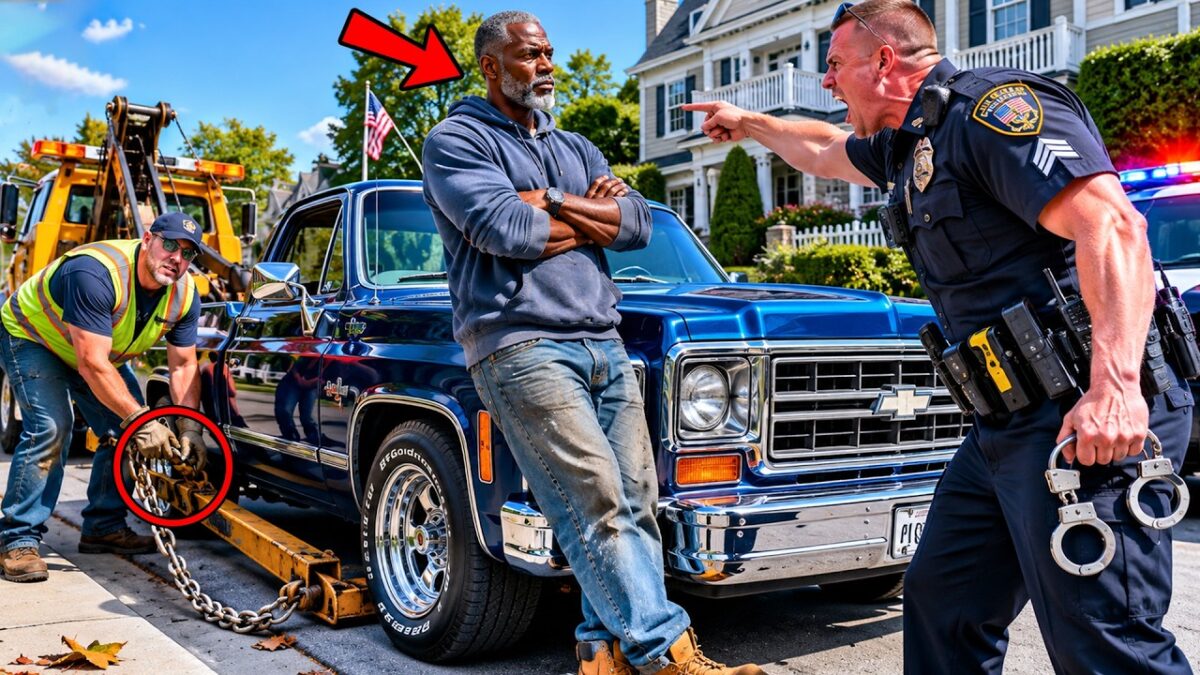
Power is a funny thing. Those who actually wield it rarely need to show it, and those who lack it will do absolutely anything to prove they possess it. When a patrol officer with a chip on his shoulder decided to illegally tow a vintage truck belonging to a black man in an upscale neighborhood, he thought he was just asserting dominance over an easy target.
He had no idea the man standing quietly on the curb wasn’t just an ordinary citizen. He was a federal district court judge, and court was about to be in session. The autumn wind off the harbor carried a sharp biting chill, but Harrison Caldwell didn’t mind. At 58 years old, Harrison was a man who appreciated the quiet, simple moments of life, mostly because his day job afforded him so few of them.
He was a federal district judge for the United States courts, a man who spent his weeks draped in black robes presiding over high-stakes corporate litigation, federal criminal syndicates, and constitutional rights violations. But on this particular Saturday morning, Harrison wasn’t a judge. He was just a father trying to help his daughter.
He was dressed in a faded, paint-splattered Georgetown University sweatshirt, well-worn denim jeans, and heavy work boots. He had spent the early hours of the morning at a local Home Depot loading the bed of his pride and joy, a meticulously restored 1978 Chevrolet C10 pickup truck painted a deep glossy midnight blue.
The truck had belonged to his late father, a mechanic who had worked three jobs to put Harrison through law school. To Harrison, that truck was worth more than any luxury sedan on the market. Harrison’s destination was Kensington Heights, an affluent, tightly manicured suburb known for its sprawling colonial homes, pristine lawns, and residents who valued exclusivity above all else.
His daughter, Maya, had just closed on a modest fixer-upper on the edge of the neighborhood. Harrison had parked his Chevrolet legally on the street right in front of Maya’s new property, ensuring he was a full 15 ft from the nearest fire hydrant and perfectly aligned with the curb. He hopped out of the truck, grabbed a clipboard from the passenger seat, and walked up the driveway to inspect the exterior brickwork.
Two streets over, Officer Derek Miller was sipping lukewarm coffee in the driver’s seat of his patrol cruiser. Miller was a 5-year veteran of the force, a man whose career had been marked by a series of excessive force complaints that had miraculously always been swept under the rug by his union rep.
Miller fancied himself the guardian of Kensington Heights. He liked the wealthy neighborhood. The residents usually treated him with a deferential, almost fawning respect, thanking him for keeping the riffraff out. As Miller turned his cruiser onto Oakwood Lane, his eyes locked onto the midnight blue Chevrolet C10. In a neighborhood dominated by pristine Range Rovers, Teslas, and imported German sedans, the vintage working-class truck stuck out like a sore thumb.
Miller slowed his cruiser to a crawl. His gaze drifted from the truck to the property where he spotted Harrison, a tall, broad-shouldered black man in a faded hoodie standing on the porch of a vacant house writing on a clipboard. In Miller’s mind, the calculus was immediate, rigid, and entirely prejudiced.
The truck didn’t belong here. Therefore, the man didn’t belong here. Miller flipped on his flashing overhead lights, not the siren, just the blinding red and blues, and pulled his cruiser at a sharp angle, effectively blocking the Chevrolet from pulling out into the street. He unclipped his radio, called in the license plate with a heavy sigh, and stepped out of the vehicle.
He rested his right hand casually over his utility belt, puffing out his chest as he strutted up the driveway. Hey, you there. Miller barked, his voice echoing in the quiet, crisp morning air. Harrison paused, lowering his clipboard. He turned slowly, his expression calm and unreadable. Decades on the bench had taught him how to read a room, and more importantly, how to read a man.
He saw the aggressive posture, the hand hovering near the taser, the rigid set of the officer’s jaw. Harrison knew exactly what this was. Can I help you, officer? Harrison asked, his voice a deep, resonant baritone that naturally commanded attention. What are you doing here? Miller demanded, stopping a few feet shy of the porch steps.
He didn’t offer a greeting. He didn’t ask how Harrison’s day was going. It was an interrogation from the first syllable. I’m inspecting the brickwork on this property, Harrison replied evenly, gesturing to the house. Is this your house? Miller asked, his eyes narrowing as he looked Harrison up and down, clearly taking in the paint-stained clothes.
It belongs to my daughter. She just closed on it on Thursday, Harrison said. He made a deliberate effort to keep his hands visible, resting them gently on the clipboard. Miller let out a short, harsh scoff. Right. Your daughter just bought a house in Kensington Heights, and I’m the King of England. Step down off the porch and show me some ID. Harrison didn’t move immediately.
Officer, I’m on private property conducting lawful business. Am I suspected of committing a crime? Miller’s face flushed. He wasn’t used to being questioned, especially not by someone he had already mentally categorized as a subordinate. You’re suspected of trespassing on a vacant property. Now, get down here and give me your ID before I decide to put you in bracelets.
Harrison took a slow, deliberate breath. He could have ended it right there. He could have told the officer exactly who he was. But a part of Harrison, the part that had spent his entire life fighting for civil rights, the part that remembered what it was like to be a young man harassed on the street before he had a law degree to protect him, wanted to see exactly how far Officer Miller was willing to take this.
He wanted to see how this officer treated an ordinary citizen who didn’t have the shield of a federal judgeship. Harrison walked slowly down the steps. My identification is in my wallet, which is locked in the glove compartment of my truck. I can retrieve it for you if you’d like. You aren’t getting in that truck, Miller snapped, stepping into Harrison’s path.
Turn around and put your hands on the hood of my cruiser. Officer, Harrison said, his voice dropping an octave, carrying the same stern weight he used when a hostile witness was acting out of line in his courtroom. I am perfectly willing to cooperate with a lawful order, but I am not going to submit to an unlawful search or seizure.
I have not committed a crime. >> [clears throat] >> You have no reasonable articulable suspicion that a crime has been committed. I have explained my presence here. Miller laughed, a cruel grating sound. Oh, we got a roadside lawyer here. Let me tell you how this works, pal. You look like you’re casing a house.
And that piece of junk truck you drove in here with, it’s parked illegally. Harrison glanced over his shoulder at his Chevrolet. It is legally parked. I am 15 ft from the hydrant exactly as the municipal code requires. And my tires are within 6 in of the curb. It’s an eyesore, and it’s violating the homeowner association street parking ordinance.
Miller lied smoothly, taking a step closer, trying to use his physical presence to intimidate the older man. Which gives me the right to cite it. And since I suspect it’s being used in the commission of a burglary, I’m impounding it. Harrison’s eyes narrowed slightly. You are going to impound my vehicle for a fabricated HOA violation.
I’m towing it. Miller smirked. He reached up to the radio mic on his shoulder. Dispatch this as unit 42. I need a tow at 400 Oakwood Lane. Priority. Suspect vehicle involved in a potential B and E. Harrison watched the officer make the call. The sheer audacity of the lie was breathtaking. Miller hadn’t investigated anything.
He hadn’t checked the property records. He had simply looked at Harrison, looked at the truck, and made a unilateral decision to ruin a man’s day. Officer Miller, Harrison said, reading the man’s nameplate. I strongly advise you to cancel that tow truck. You are stepping far outside the bounds of your authority, and you are violating my Fourth Amendment rights.
If you proceed with this, you will face severe consequences. Are you threatening a police officer? Miller’s hand dropped instantly to his service weapon. I am stating a legal fact, Harrison replied unflinching. You are acting under color of law to deprive me of my property without due process. It is a federal offense.
Miller sneered. Federal offense? You watch too much TV, old man. Miller grabbed Harrison by the shoulder and shoved him roughly toward the rear of the Chevrolet. Hands on the tailgate. Now, Harrison allowed himself to be moved, not resisting, knowing that physical resistance was exactly the excuse Miller was praying for.
Harrison placed his hands flat on the cold metal of his truck’s tailgate. Miller kicked Harrison’s legs apart, patting him down aggressively. Where are the keys? Miller barked. In my right front pocket. Harrison answered calmly. Miller reached in, yanking the keys out. He walked over to the driver’s side door, unlocked it, and popped the glove box.
He rummaged through the meticulously organized compartment, tossing registration papers and maintenance receipts onto the passenger seat until he found Harrison’s leather wallet. Miller flipped the wallet open. The first thing visible was Harrison’s standard state driver’s license. Miller barely glanced at the name. He certainly didn’t bother to flip the leather divider to see the heavy gold shield and the federal identification card tucked securely behind it.
Harrison, huh? Miller muttered, pocketing the wallet and walking back over. Well, Harry, since you want to be uncooperative, you can sit on the curb while we wait for the tow. Cross your legs and interlock your fingers behind your head. Harrison did not sit. He turned around locking eyes with Miller. I am not sitting on the curb, Officer Miller.
I am not under arrest. If you are going to arrest me, you will need to tell me exactly what statute I have violated. Resisting an officer, Miller yelled stepping into Harrison’s personal space. I have complied with every physical command you have given me, Harrison stated smoothly. I am simply declining to humiliate myself for your amusement.
Now, I want you to call your shift supervisor to this scene immediately. I don’t need a supervisor to deal with you. Miller spat, there was a flicker of annoyance crossed his face. This wasn’t going the way it usually did. Usually when he raised his voice, people cowered. They apologized. They begged for a break. This man was staring at him with the cold, detached scrutiny of a predator observing a particularly loud, incompetent prey.
The rumble of a heavy diesel engine interrupted the tense silence. A massive flatbed tow truck swung onto Oakwood Lane. The words Ironclad Towing and Recovery emblazoned on the side in bright yellow letters. The truck backed up toward Harrison’s Chevrolet, the air brakes hissing loudly.
The driver, a heavy-set man in a high-visibility vest named Pete, hopped out of the cab. He walked over to Miller completely ignoring Harrison. Got a live one, Miller? Pete asked chewing on a toothpick. Yeah. Hook it up, Pete. Miller said crossing his arms. Pete walked over to the Chevy. He looked at it, then looked at where it was parked. He scratched his head.
Hey, uh, Miller. Not to tell you how to do your job, but this thing is legally parked and it’s a beauty. I hook this up wrong and bend the frame, my boss is going to skin me alive. What’s the charge here? I said hook it up, Pete. It’s evidence, Miller snapped. Pete looked nervously at Harrison. Harrison caught the driver’s eye.
Son, Harrison said, his voice cutting through the noise of the idling diesel engine. >> [clears throat] >> If you attach those chains to my vehicle, you will be named as a co-defendant in the civil rights lawsuit that I will be filing first thing Monday morning. I strongly suggest you wait until this officer’s supervisor arrives.
Pete froze. He looked from Harrison to Miller. Uh, Derek, maybe we should wait for a sergeant. Guy sounds serious. He’s a nobody, Miller shouted, losing his temper. Hook up the damn truck or I’ll have Ironclad removed from the precinct’s vendor rotation. Intimidated by the threat to his livelihood, Pete sighed, pulled on his heavy leather gloves, and went to the winch controls.
Harrison watched as the chains were dragged out. The anger which he had kept tightly coiled in his chest finally began to seep into his voice. Officer Miller, Harrison said, you have detained me without cause. You have seized my wallet without a warrant. You are now illegally seizing my vehicle. I’m going to ask you one final time to look at my identification.
Look behind the driver’s license. I don’t care if you’ve got a Costco gold card back there, Harry, Miller sneered, pulling out his handcuffs. In fact, since you won’t sit down, you can wear these. Miller grabbed Harrison’s left wrist, twisting it behind his back, and clamped the cold steel of the handcuff onto his wrist.
Before Miller could secure the right hand, the screech of tires echoed down the street. A white Ford Explorer with police decals slammed into park behind the tow truck. The door flew open, and Sergeant Greg Hayes stepped out. Hayes was a 20-year veteran, a man who looked perpetually exhausted, mostly from cleaning up the messes left by hot-headed rookies like Miller.
Hayes took in the scene, the tow truck driver hooking up a pristine classic truck, Miller struggling to cuff a remarkably calm older man, and the total lack of any visible crime scene. “Miller, what the hell is going on here?” Sergeant Hayes barked as he marched up the driveway. “Suspect is being uncooperative, Sergeant.
” Miller said, breathing heavily. “Refused to follow commands, interfering with an impound.” “Impound for what?” Hayes demanded. “Is the vehicle stolen?” “Suspected burglary, Sarge. He was casing the house.” Miller said proudly. Sergeant Hayes looked at Harrison. He looked at the Georgetown sweatshirt, the expensive but well-worn boots, the clipboard resting on the hood of the police cruiser where Harrison had gently set it.
“Sir, are you okay?” Hayes asked Harrison. “I have been better, Sergeant.” Harrison said evenly, his left arm still awkwardly twisted behind him by the single handcuff. “Your officer has my wallet in his right front pocket. I would greatly appreciate it if you retrieved it and examined my credentials.” Hayes glared at Miller. “Give me the wallet, Derek.
” “Sarge, this guy is playing you.” “Give me the damn wallet, Miller.” Hayes roared, his voice echoing off the nearby houses. Startled, Miller reached into his pocket and handed the leather wallet to his sergeant. Hayes opened it. He saw the state ID. Then, following Harrison’s previous instructions, he slipped his thumb behind the leather flap and flipped it open.
Sergeant Hayes stopped breathing. He stared at the solid gold shield. He stared at the federal identification card complete with the Department of Justice seal and the words Harrison Caldwell. Judge, United States District Court. Hayes felt the blood completely drain from his face. His stomach plummeted into his boots.
He looked up slowly, his eyes wide with absolute unadulterated horror, meeting Harrison’s calm, unyielding gaze. Judge Caldwell, Hayes whispered, his voice trembling. Yes, Sergeant Hayes, Harrison replied quietly. Hayes spun around and delivered a brutal open-handed shove to Miller’s chest, sending the younger officer stumbling backward.
Take the cuff off him, Hayes screamed, his voice cracking with panic. Take it off him right now. Miller, confused and defensive, held his ground. Sarge, what are you doing? He’s a suspect. He’s a federal judge, you absolute idiot, Hayes roared, grabbing the keys from Miller’s belt himself and rushing over to Harrison to unlock the metal bracelet.
Judge Caldwell, I Your Honor, I am so profoundly sorry. I Miller, tell the tow driver to drop the truck. Miller froze. The smug, arrogant grin that had been plastered on his face for the last 20 minutes vanished, replaced by a pale, sickening realization. He looked at the man in the paint-stained sweatshirt. A a judge.
Miller stammered. Harrison rubbed his freed wrist, adjusting his sleeves. He didn’t yell. He didn’t scream. He just looked at Miller with a gaze so cold it could have frozen the harbor. Officer Miller. Harrison said, his voice echoing with the absolute authority of a federal bench, “You are about to have a very, very long day.
” The silence that descended upon Oakwood Lane was sudden, total, and entirely suffocating. The only sounds remaining in the crisp autumn air were the aggressive, rhythmic hissing of the tow truck’s air brakes and the ragged, shallow breathing of Officer Derek Miller. The suburban idle of Kensington Heights, with its manicured hedges and pristine sidewalks, suddenly felt like the most hostile environment on Earth for the young patrolman.
Pete, the burly tow truck driver, was the first to break the physical stasis upon hearing the words “federal judge.” Pete let out a low, terrified whistle. He didn’t ask for permission. He didn’t wait for Miller to give him an order. Pete practically dove toward the hydraulic levers on the side of his flatbed.
With frantic, uncoordinated movements, he slammed the release valves, dropping the midnight blue Chevrolet C10 back onto the asphalt with a heavy, metallic thud. He scrambled to unhook the thick steel chains from the front axle, his hands shaking violently inside his heavy leather work gloves. Sergeant Greg Hayes remained frozen in place, his face a pale, ashen mask of pure administrative terror.
In his 20 years on the force, Hayes had seen his fair share of colossal blunders. He had dealt with rookies crashing cruisers into donut shops, veterans sleeping off hangovers in alleyways and plainclothes, detectives arresting undercover state troopers. But this this was a nightmare of an entirely different magnitude.
This was the kind of career-ending catastrophe that didn’t just get an officer fired. It got police departments placed under federal oversight. Judge Harrison Caldwell stood calmly near the rear quarter panel of his truck. He slowly and deliberately rolled down the left sleeve of his faded Georgetown University sweatshirt, covering the slight red indentation where the handcuff had bitten into his wrist.
He did not look angry. He looked profoundly, devastatingly disappointed. Judge Caldwell Hayes stammered, stepping forward with his hands raised in a supplicating gesture, his voice trembling so badly it sounded like he was standing in a freezing blizzard. Your honor I cannot begin to express how utterly out of line this is.
This is a catastrophic misunderstanding. Please let me get you your keys. Let me It is not a misunderstanding. Sergeant Hayes Harrison interrupted, his voice dropping to a smooth, resonant timbre that cut through the panic like a scalpel. He extended his hand and Hayes immediately scrambled to place the wallet and keys into the judge’s palm.
A misunderstanding implies a mutual breakdown of communication. I communicated quite clearly. I stated my purpose, my legal standing and my rights. Your officer simply chose to ignore them because he had already convicted me in his mind the moment he saw the color of my skin and the age of my vehicle. Miller, whose face had transitioned from a sickly pale to a deep defensive crimson, finally found his voice.
It was a desperate cracking sound. I I was doing my job. You were acting suspiciously. You didn’t look like a judge. How was I supposed to know? Harrison turned his gaze to Miller. The absolute stillness of the older man was terrifying. And what exactly does a federal judge look like, Officer Miller? Should I have worn my robes to inspect my daughter’s masonry? Should I have carried my gavel instead of a clipboard? Harrison took a slow, measured step toward the younger officer.
Miller instinctively shrank backward, hitting the side of his own patrol cruiser. You did not detain me because I looked suspicious. Harrison continued his tone, clinical and devastatingly precise. You detained me because I didn’t fit your deeply flawed, prejudiced narrative of who belongs in this neighborhood.
You initiated an investigative stop without reasonable articulable suspicion, thereby violating Terry versus Ohio. You seized my personal property without a warrant or probable cause, violating the Fourth Amendment. You attempted to physically assault me and you were operating entirely under the color of law to deprive me of my civil rights, which is a direct violation of Title 18, United States Code, Section 242.
Every statute Harrison cited felt like a physical blow landing on Miller’s chest. Hayes winced with every word, recognizing the legal jargon not as a threat but as the drafting of an inescapable federal indictment. “Sarge, he was refusing to identify himself.” Miller pleaded, looking wildly at Hayes for any lifeline.
“You know the statutes on obstruction. He wouldn’t give me his ID.” “I told you exactly where my identification was.” Harrison corrected him smoothly. “And I informed you that I would happily provide it if you allowed me to retrieve it. You chose to illegally search my vehicle instead.
Furthermore, in this state, there is no stop and identify statute unless the officer has reasonable suspicion that a crime has been, is being, or is about to be committed. You fabricated a homeowners association violation, which you have no jurisdiction to enforce as a pretext for a search.” Before Miller could formulate another desperate excuse, the front door of the house next door swung violently open.
Out marched Mrs. Abigail Preston, a woman in her late 60s wearing a cashmere cardigan and a fiercely scowling expression. She was the self-appointed president of the Kensington Heights Homeowners Association, and she had clearly been watching the entire interaction through her plantation shutters. “Officer Miller!” Abigail called out, marching down her driveway with a bizarre sense of righteous indignation.
“Officer Miller, I am so glad you’re here. I was just about to call the precinct myself.” Hayes closed his eyes silently, praying for the earth to open up and swallow him whole. “Mom, please go back inside. This is an active police matter.” “Nonsense.” Abigail huffed, stopping at the edge of her property line and glaring directly at Harrison.
“I want to commend this young officer. He is the only one who actually patrols our streets properly. We pay exorbitant property taxes to keep this neighborhood safe, and lately there have been far too many undesirable elements wandering around. Just last week, Officer Miller chased away those landscapers who were parked too close to my mailbox.
He knows how to keep our community standards high. The silence returned heavier and darker than before. Abigail Preston, entirely oblivious to the nuclear bomb that had just detonated on her street, had just provided the final damning piece of evidence. She had publicly confirmed a pattern and practice of discriminatory harassment actively encouraged by the neighborhood and executed by Officer Miller.
Harrison slowly turned his head to look at Sergeant Hayes. The judge’s eyebrows raised a fraction of an inch. Well, it appears we have a witness to your officer’s established pattern of selective enforcement, Sergeant. Hayes looked at Abigail Preston with an expression of pure, unadulterated loathing. Ma’am, go inside your house.
Now. Abigail blinked, taken aback by the sheer venom in the sergeant’s voice. I beg your pardon. I am simply trying to support our local law enforcement. If you do not go back inside your house and close your door this instant, Hayes roared, completely losing his professional composure. I will arrest you for interfering with a federal investigation. Move.
Shocked and deeply offended, Abigail let out a dramatic gasp, spun on her heel, and practically sprinted back to her front door, slamming it shut behind her. Harrison looked back at Miller, who was now visibly trembling, his hands shaking as they rested on his utility belt. The bravado was entirely gone, replaced by the crushing realization that his career was not just over, but that his freedom was in serious jeopardy.
Sergeant Hayes, Harrison said softly, you will contact your dispatch. You will request the chief of police, the head of your internal affairs division, and the shift commander. You will have them respond to this location immediately. Not the precinct. Here. Yes, your honor. Immediately. Hayes said, frantically keying his shoulder mic.
Pete, the tow truck driver, having successfully detached the Chevrolet, began slowly creeping backward toward his cab, hoping to vanish into the crisp autumn morning. And son, Harrison called out without looking back. Pete froze mid-step. Yes, sir. You can leave. But expect a subpoena for your testimony regarding the requested impoundment.
Do not delete your dispatch logs, Harrison instructed. Pete nodded vigorously, practically diving into the cab of his massive yellow truck, and speeding away down Oakwood Lane faster than a vehicle that size had any right to move. Harrison leaned back against the tailgate of his Chevy, crossed his arms over his chest, and settled in to wait.
The storm had passed. Now came the reckoning. The flashing blue and red strobes painted the manicured lawns of Kensington Heights in a frantic, chaotic light. Within 20 minutes, the quiet suburban street had been transformed into a staging ground for the upper echelons of the city’s law enforcement apparatus.
Three unmarked black SUVs had arrived, tires screeching, boxing in Miller’s patrol car. Chief of Police Robert Mitchell practically fell out of the lead SUV. Mitchell was a man who had spent the last decade carefully managing his political image, desperately angling for a mayoral run. He was dressed in a tailored suit, having been pulled away from a Saturday morning fundraising brunch.
His face was slick with a cold, terrified sweat. Following closely behind him were two grim-faced detectives from Internal Affairs, carrying heavy black binders. Chief Mitchell knew exactly who Judge Harrison Caldwell was. Just 6 months prior, Caldwell had presided over a massive, highly publicized civil rights lawsuit involving the neighboring county’s sheriff’s department.
Caldwell had systematically dismantled the department’s corrupt union practices, issuing a sweeping consent decree that forced the resignation of dozens of officers. The judge was known in legal circles as brilliant, uncompromising, and absolutely terrifying when his patience was tested. Mitchell sprinted up the driveway, bypassing Miller and Hayes entirely, and stopped 3 ft from where Harrison was still leaning casually against the tailgate of his truck.
Judge Caldwell. Chief Mitchell gasped, trying to catch his breath, his hands trembling as he smoothed his silk tie. Your honor, I I was briefed by dispatch. I came as quickly as I could. I cannot apologize profoundly enough for this appalling, inexcusable breach of protocol. Harrison did not extend his hand.
He merely looked at the chief with a steady, unblinking gaze. Protocol, Chief Mitchell. Protocol is failing to file paperwork on time. Protocol is wearing the wrong uniform tie. What happened here this morning was not a breach of protocol. It was an assault under the color of law driven by explicit racial profiling and a complete disregard for the constitution your officers are sworn to uphold.
Mitchell swallowed hard looking physically ill. Yes, your honor. You are absolutely correct. I assure you swift and decisive action will be taken. This does not represent the values of this department. Really? Harrison asked his voice dripping with polite razor-sharp skepticism. He gestured toward the frightened patrolman standing by the cruiser.
Because officer Miller seemed remarkably confident that his actions were standard operating procedure. He seemed entirely comfortable fabricating municipal code violations. He seemed quite accustomed to weaponizing his badge to intimidate citizens he deemed unworthy of this neighborhood. And based on the glowing endorsement he just received from the neighbor across the street, this is a heavily reinforced behavior.
Chief Mitchell whipped his head around to glare at Miller. If looks could incinerate Derek, Miller would have been reduced to a pile of ash on the pavement. Miller! Mitchell snapped his voice vibrating with barely contained fury. Step forward. Miller shuffled forward his eyes cast downward refusing to make eye contact with his superior.
Chief, I I thought he was a suspect. I was protecting the neighborhood. Shut your mouth, Mitchell roared the polished political veneer shattering entirely. You do not speak unless spoken to. You detained a federal judge. You illegally attempted to tow a legally parked vehicle. You placed handcuffs on a sitting member of the United States judiciary.
“He wouldn’t give me his ID.” Miller whispered pathetically, a final desperate grasp at justification. “Because he was exercising his constitutional rights, you absolute moron.” Mitchell screamed, stepping so close to Miller that the brims of their hats nearly touched. “The rights you swore an oath to protect you have humiliated this department.
You have disgraced that badge and you have personally handed the federal government a platinum-plated excuse to audit my entire command.” Chief Mitchell took a deep, shuddering breath, trying to regain a sliver of composure. He turned to the two Internal Affairs detectives waiting silently by the SUVs. “Detective Carson, Detective Blake.
” Mitchell ordered, his voice echoing loudly across the silent street. “Take his weapon. Take his badge. Take his radio. Officer Miller is suspended immediately without pay pending a full criminal and administrative review. Place him in the back of your vehicle. He is not to drive a city asset.” Miller let out a choked, wet sob.
“Chief, please. My pension. My family.” “You should have thought about your family before you decided to play tyrant on a Saturday morning.” Mitchell said coldly. The two IA detectives moved in. They were not gentle. They stripped Miller of his duty belt, the heavy Glock firearm, his taser, and the silver badge pinned to his chest.
They guided the weeping former officer to the back of the unmarked SUV, pressing his head down as he climbed into the back seat. The door slammed shut with a heavy final thud. Chief Mitchell turned back to Harrison, clasping his hands together in a posture of total submission. Your honor, he is stripped of his police powers.
We will fully cooperate with any formal complaint you wish to file. If you want him charged, I will personally walk the paperwork to the district attorney’s office this afternoon. Harrison slowly pushed himself off the tailgate of the Chevrolet. He reached into the cab and pulled out the clipboard he had been holding when the incident began.
Chief Mitchell, Harrison said softly. Do you know what I was doing on this porch? I I believe you were inspecting the property, your honor. Mitchell said nervously. I was, Harrison agreed. My daughter Maya closed on this property on Thursday. But Maya is not moving in here, Chief. Maya is a civil rights attorney who specializes in police misconduct and wrongful convictions.
This property is being zoned and renovated to serve as the new headquarters for her non-profit legal defense clinic. Mitchell’s jaw actually dropped. All the color that had rushed to his face drained away, leaving him looking like a ghost in a tailored suit. A civil rights legal clinic? Directly in the heart of the most affluent, aggressively policed neighborhood in the city? She wanted a location that was deeply ingrained in the community.
Harrison continued calmly. I was inspecting the brickwork to see if the structure could support the heavy steel signage she plans to install on the front lawn. It will be quite prominent. A A clinic, your honor? Mitchell managed to squeak out. Yes. Harrison smiled, though it was a smile entirely devoid of warmth.
And I believe, based on the events of this morning, Maya is going to have a very robust, very active clientele in this particular district. I will not be filing a complaint with your internal affairs division, Chief. I have zero faith in an institution policing itself. I will be referring this matter directly to the Civil Rights Division of the Department of Justice for a federal inquiry into the patterns and practices of this precinct.
Mitchell closed his eyes, physically swaying as the full weight of the judge’s words hit him. A DOJ investigation. It was the death knell for his career, his mayoral aspirations, and his department’s autonomy. Harrison walked around to the driver’s side of his beautifully restored 1978 Chevrolet C10. He opened the heavy metal door, the hinges gliding silently on fresh grease.
He paused, looking back at the Chief of Police and the terrified Sergeant Hayes. “Tell your officers to learn the Constitution, Chief Mitchell.” Harrison said, his voice ringing with absolute, unyielding authority, “Because the next time they violate a citizen’s rights on this street, that citizen will have a team of federal litigators waiting for them right inside that house.
” Harrison climbed into the cab, turned the key, and the heavy, powerful rumble of the classic engine roared to life, shattering the quiet anxiety of Kensington Heights. He shifted the truck into drive and pulled away from the curb, leaving the highest-ranking police officials in the city standing frozen in his rearview mirror.
Follow-up question: How would you like to see the fallout of the DOJ investigation handled in the next part? Should we focus on the legal battles Maya faces as she opens her clinic or explore the precinct’s internal crumbling as Chief Mitchell tries to save his own skin. The transformation of 400 Oakwood Lane didn’t happen quietly. Over the next 6 weeks, the modest fixer-upper became the epicenter of a suburban earthquake.
The manicured, serene bubble of Kensington Heights was punctured daily by the rumble of contractor vans, the rhythmic pounding of hammers, and the steady arrival of heavy steel fixtures. Maya Caldwell, a 32-year-old civil rights attorney with her father’s unyielding posture and her late mother’s fierce intellect, supervised every detail of the renovation.
She possessed a brilliant legal mind honed at Yale and sharpened in the unforgiving trenches of public defense. When she had purchased the property through an obscure commercial LLC, she had intentionally navigated the city’s complex zoning board to secure a mixed-use variance long before anyone in the affluent neighborhood caught wind of her true intentions.
On a brisk Tuesday morning, the final piece of the puzzle arrived. A massive flatbed truck, ironically the same make and model that Pete had driven, pulled up to the freshly paved driveway. Two workers carefully unloaded a heavy solid bronze plaque, mounting it directly onto the reinforced brickwork Harrison had been inspecting weeks prior.
The polished lettering gleamed in the autumn sun. The Caldwell Center for Civil Rights and Equal Justice. Maya Caldwell, Esquire, Executive Director. 30 minutes after the workers departed, the neighborhood’s self-appointed guardian struck. Abigail Preston, wearing a tailored tweed suit and clutching a thick leather-bound folder, marched across the street.
Trailing nervously behind her was the homeowners association’s retained counsel, a balding, perpetually sweating attorney named Peter Lawson. Myra stood on the porch, a steaming mug of coffee in her hand, watching the pair approach. She wore a sharp, charcoal gray suit, her demeanor radiating absolute, unbothered confidence.
“Excuse me,” Abigail barked, stopping at the edge of the freshly laid stone walkway. “You must be the new owner. I am Abigail Preston, president of the Kensington Heights HOA. I am here to serve you with an immediate cease and desist order regarding this this commercial monstrosity.” Myra took a slow sip of her coffee. “Good morning, Mrs. Preston.
I am Myra Caldwell, and you can hand whatever paperwork you have to my paralegal inside, though I suggest you save the paper.” Peter Lawson cleared his throat, stepping forward and adjusting his glasses. “Ms. Caldwell, as I’m sure a fellow attorney understands, Kensington Heights maintains strict residential zoning covenants.
The operation of a commercial legal clinic, complete with high-visibility signage and anticipated foot traffic, is a direct violation of section 4 of the HOA charter. We are prepared to file an injunction by noon.” Myra set her coffee mug down on the porch railing. She didn’t look angry. She looked amused. “Mr.
Lawson, before you file anything and embarrass yourself in front of a chancery judge, I recommend you check the city’s municipal registry. Specifically, look at the variance granted to Oakwood Holdings, LLC, last October. This property rests on a legacy boundary line that predates your HOA by 40 years. It was legally rezoned for mixed commercial residential use, a designation the city council unanimously approved.
Lawson blinked, his face flushing. The HOA was never notified because the HOA has no legal jurisdiction over this specific parcel of land. Mr. Lawson, Maya corrected smoothly. My title insurance company spent 3 weeks verifying it. Furthermore, any attempt to harass, intimidate, or financially burden a civil rights organization operating legally within this district will be met with an immediate federal lawsuit alleging violations of the Fair Housing Act and unlawful retaliation.
I will depose every single member of your board audit, your personal finances to determine liability, and drag this neighborhood through a public relations nightmare so severe property values will plummet by 20% before Christmas. Abigail Preston gasped, clutching her leather folder to her chest. You cannot threaten us.
We are simply trying to maintain the character of our neighborhood. The character of your neighborhood, Maya said, her voice dropping to a frigid slicing tone, was perfectly demonstrated when a patrol officer illegally handcuffed a federal judge on this very driveway while you cheered him on from your living room window.
That era is over, Mrs. Preston. The Caldwell Center is open for business, and our first major class action lawsuit is officially accepting plaintiffs. Abigail opened her mouth to argue, but Lawson grabbed her elbow, violently pulling her back. We’re leaving, Abigail. The lawyer hissed, realizing they were severely outmatched.
Do not say another word. While the battle lines were being drawn in Kensington Heights, a far more devastating war was breaking out inside the downtown headquarters of the city’s police department. Chief Robert Mitchell sat behind his massive mahogany desk sweating profusely despite the aggressive air conditioning.
The plush corner office that he had meticulously decorated to project power now felt like a very expensive tomb. Across from him sat Jonathan Pierce, the lead prosecutor for the Department of Justice’s Civil Rights Division. Pierce was a man who moved with the predatory stillness of a shark surrounded by towering stacks of subpoenaed documents. Chief Mitchell.
Pierce began not bothering to look up as he flipped through a heavily redacted Internal Affairs file. In the 3 weeks since the incident involving Judge Caldwell, we have seized your department’s dispatch logs, digital communications, and body camera footage for the last 48 months. Mitchell swallowed hard, his collar suddenly feeling suffocating.
Mr. Pierce, as I stated, Officer Miller was a rogue element. A bad apple. We acted immediately to remove him from the force. Please don’t insult my intelligence, Robert. Pierce sighed, finally lifting his gaze. Derek Miller wasn’t a rogue element. He was your golden boy. We have recovered emails from your personal server, which you foolishly attempted to delete, instructing precinct commanders to artificially inflate trespass and loitering citations in high-income tax brackets.
You implemented an unwritten quota system that specifically targeted minorities in neighborhoods like Kensington Heights. That is a gross mischaracterization of community oriented policing. Mitchell protested, his voice cracking. Pierce slid a tablet across the desk. On the screen was paused body cam footage from six different officers spanning over a dozen separate incidents.
We have identified over 40 individuals who were illegally detained, harassed, or had their property seized under the exact same fabricated pretenses Miller used on Judge Caldwell. Pierce said coldly. The only difference is those 40 people didn’t have federal judicial credentials in their wallets.
They were landscapers, delivery drivers, tutors, and teenagers. You didn’t build a police department, Mitchell. You built a taxpayer-funded private security firm for wealthy donors, and you weaponized the color of law to enforce segregation. Mitchell buried his face in his hands, his political ambitions, his pension, his entire legacy evaporating into thin air.
What do you want, Pierce? Your immediate irrevocable resignation effective at 5:00 today. Pierce stated evenly. You will surrender your pension. You will fully cooperate with our ongoing grand jury investigation into your precinct commanders. If you refuse, I will have federal marshals drag you out of this building in handcuffs before the evening news cycle.
Mitchell slowly lifted his head, his eyes hollow. The power he had wielded so arrogantly had met a force it could not negotiate with, could not intimidate, and could not corrupt. He reached for the heavy gold pen sitting on his desk and pulled a blank piece of departmental letterhead toward him. Across town in a cramped, dimly lit apartment, Derek Miller sat on a stained sofa staring blankly at a muted television.
He was unkempt, smelling of cheap beer and stale sweat. The police union had abandoned him the moment the letters D O J had appeared on the precinct bulletin board. His calls to Sergeant Hayes went straight to voicemail. He had no badge, no gun, and no authority. He was just a man alone with the crushing weight of his own hubris waiting for the inevitable knock on the door.
The federal courthouse downtown was an imposing structure of white marble and soaring Roman columns, a monument to the enduring, unyielding nature of the law. 4 months after the incident on Oakwood Lane, the grand courtroom of the Honorable William Bradley was packed to absolute capacity. Derek Miller, stripped of his uniform and wearing a cheap, ill-fitting gray suit, sat at the defense table.
He looked small, fragile, and utterly terrified. His hands, which had so eagerly slapped cuffs on innocent citizens, now trembled as they rested on the polished oak table. Sitting in the first row of the gallery, completely devoid of his judicial robes, was Harrison Caldwell. He wore a simple, tailored navy suit, looking every bit the quiet, dignified father he was.
He was not there to preside. He was there to bear witness. Standing at the plaintiff’s podium was Maya Caldwell. The Caldwell Center for Civil Rights had not just opened its doors, it had kicked them off the hinges. In the wake of the DOJ investigation, Maya had consolidated the cases of 32 separate victims of the Kensington Heights precinct into a massive civil rights lawsuit.
But today was not about the civil suit. Today was Miller’s criminal sentencing. Miller had plead guilty to one count of deprivation of rights under color of law, a desperate plea deal designed to avoid a drawn-out trial. He had absolutely no hope of winning. Judge Bradley, a stern man with white hair and zero tolerance for police corruption, looked down from the bench.
Mr. Miller, you have entered a plea of guilty. Before I hand down my sentence, does the legal representative for the victims wish to make a statement? I do, your honor. Maya said, her voice projecting clearly and powerfully through the cavernous room. She stepped out from behind the podium, making direct eye contact with Miller.
The disgraced officer couldn’t meet her gaze, staring firmly at the floor. Your honor, for years the citizens of this city were told that the badge Derek Miller wore was a symbol of safety. Maya began, her tone measured but vibrating with righteous anger. But safety is subjective. For the wealthy residents of Kensington Heights, Derek Miller was a shield.
But for the men and women I represent, working-class citizens, minorities, people simply trying to exist in spaces where they were deemed undesirable, Derek Miller was a weapon. Maya gestured to the rows behind her, filled with the very people Miller had terrorized. He stripped them of their dignity. He illegally seized their vehicles, bankrupting families who couldn’t afford impound fees.
He placed them in handcuffs for the crime of standing on a sidewalk while having the wrong skin color. He operated with total impunity, believing that his badge insulated him from consequence. He only faced justice because he accidentally targeted a man with the power to fight back. But justice cannot be a luxury reserved for federal judges.
It must be the baseline for every citizen. Maya paused, letting the silence hang heavy in the courtroom. We are not asking for vengeance, Your Honor. We are asking for a precedent. A precedent that declares that no one, absolutely no one, is above the law. She returned to her seat, sitting down next to her father.
Harrison reached over gently, placing a hand on his daughter’s shoulder. It was a subtle gesture, but it conveyed a lifetime of pride. Judge Bradley adjusted his reading glasses, glaring down at Miller. Mr. Miller, do you have anything to say for yourself? Miller stood up on shaky legs. Tears streamed down his pale face. Your Honor, I am sorry.
I was following the culture of my precinct. I thought I was doing what my superiors wanted. I lost my career. My wife left me. I have nothing. Please, I am asking for mercy. Judge Bradley’s expression remained entirely unmoved. Mr. Miller, you swore an oath to the Constitution, not to the corrupt culture of a precinct.
You were entrusted with the power to take away a citizen’s liberty, and you treated that sacred responsibility as a tool for personal bullying and racial intimidation. The fact that you are sorry now that you have been caught carries very little weight in this courtroom. The judge raised his gavel. Derek Miller, it is the judgment of this court that you be remanded to the custody of the Federal Bureau of Prisons for a period of 48 months to be followed by 3 years of supervised release.
You are permanently barred from serving in any law enforcement capacity for the remainder of your natural life. The gavel slammed down with a sharp echoing crack. Two federal marshals immediately stepped forward grabbing Miller by the arms. They did not twist his wrists. They did not shove him. They simply professionally secured his hands behind his back with heavy steel cuffs and led him out of the courtroom through a side door.
The gallery erupted into quiet murmurs of relief. Years of systemic harassment had finally found an end point. Outside the courthouse, the afternoon sun was bright and warm. Harrison and Maya walked down the wide marble steps together. Reporters were waiting at the bottom shouting questions.
But Maya simply offered a polite smile and stated they would hold a press conference at the Caldwell Center later that afternoon. They walked two blocks down the street away from the chaos until they reached a parking garage. Sitting perfectly in the corner spot, gleaming under the fluorescent lights, was the midnight blue 1978 Chevrolet C10.
Harrison unlocked the doors and the two of them climbed in. The cab smelled of old leather and gasoline, the smell of hard work, of history, and of resilience. Harrison turned the key and the heavy engine roared to life, a deep, powerful sound that echoed through the concrete structure. “You did good today, Maya.
” Harrison said softly, putting the truck into gear. “Your grandfather would have been proud.” “We did good, Dad.” Maya smiled, looking out the window as they pulled out into the city streets. The city was not perfect. There would be other battles to fight, other abuses of power to correct. But as the classic Chevrolet cruised down the avenue, passing the pristine lawns of Kensington Heights toward the fortress of justice Maya had built, the balance of power had irrevocably shifted.
The gavel had fallen and for once the right people were listening. Power abused is power lost and justice always finds a way to balance the scales. Thank you for listening to this incredible story of resilience and holding the corrupt accountable. If you enjoyed this dramatic dive into the realities of power, civil rights and a daughter fighting for her community please hit that like button, share this story with your friends to spread the message and subscribe to our channel for more thrilling real-life narratives where the underdog fights back and wins. Leave a comment below with your favorite moment.

