OKLAHOMA 1999 Cold Case Solved After 19 Years — Justice for the Freeman Family & Lauria Bible
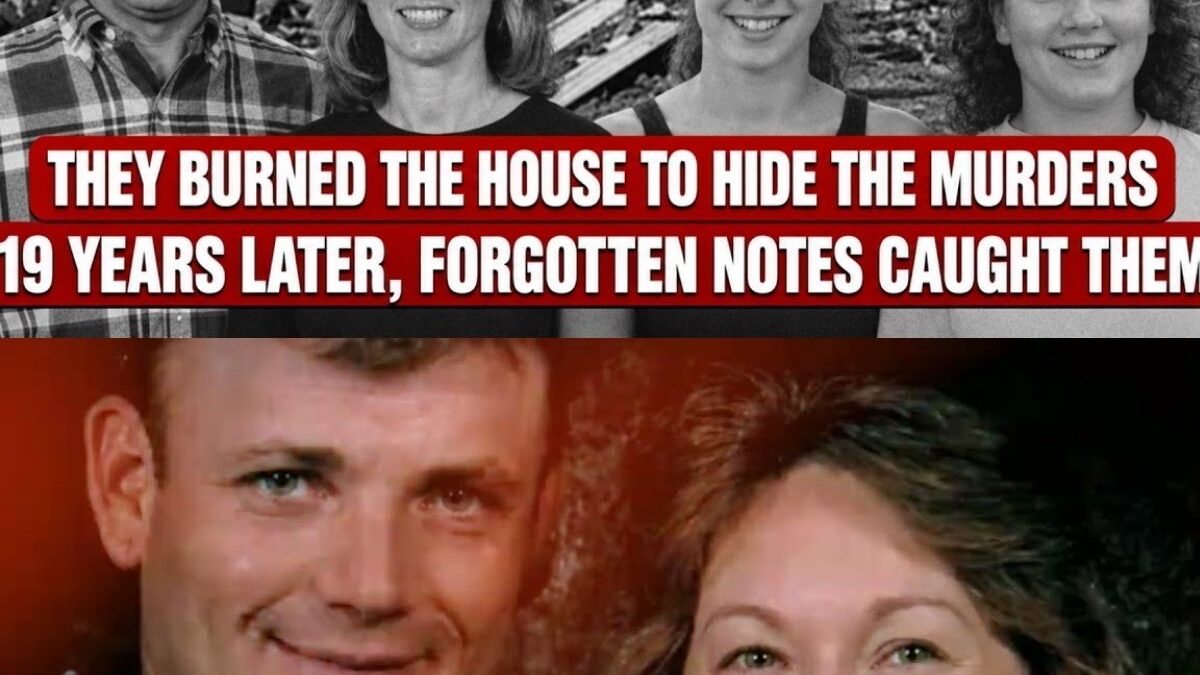
On the freezing winter evening of December 29, 1999, sixteen-year-old Lauria Bible asked her father for permission to spend the night at the home of her childhood best friend, Ashley Freeman. The girls had known each other since kindergarten, growing up so close that locals often mistook their bond for that of twin sisters. Ashley was celebrating her sixteenth birthday, and the evening had been filled with ordinary teenage joys: sharing a pizza dinner in nearby Vinita, shopping, and laughing about school. Before Lauria walked out the door, her father, Jay Bible, gave her a simple instruction: “Be home before noon.” It was the last sentence he would ever speak to his daughter.
Hours later, at dawn on December 30, the Freeman family’s mobile home on a quiet country road outside Welch, Oklahoma, was completely engulfed in violent flames. When firefighters and deputies arrived at the remote Craig County property, the structure was reduced to a blackened skeleton. Amid the smoldering ash, emergency responders made a grim discovery: the body of Ashley’s mother, Kathy Freeman. She had not died from smoke or fire. A bullet had ripped through the back of her skull at point-blank range.
What followed became an enduring stain on local law enforcement. Believing they had recovered the lone occupant, investigators cleared and released the crime scene later that morning. Overwhelmed by frantic worry for their missing daughter, Jay and Lorene Bible rushed to the charred rubble themselves. While walking through the debris, the grief-stricken parents made an appalling discovery that trained detectives had overlooked: the body of Danny Freeman, lying execution-style in the master bedroom threshold with a bullet hole through his head.
Yet, there was no trace of Ashley or Lauria. No clothing, no dental fragments, and no remains of the two teenagers existed in the ruins. Outside, bloodhounds tracked their scent from the mobile home across the gravel yard to the edge of an adjacent dirt road, where the trail abruptly vanished. Someone had arrived in the dead of night, executed the parents, set the trailer ablaze, forced the two terrified sixteen-year-olds into a vehicle, and vanished into the darkness.
Welch was a sparsely populated farming community in northeastern Oklahoma, nestled in a region where poverty ran deep, law enforcement resources were razor-thin, and the methamphetamine trade operated with ruthless authority. Just miles away lay Picher, an abandoned lead and zinc mining town turned toxic wasteland, scarred by cracked foundations, contaminated water, and hundreds of deep, uncovered mine shafts. For years, rumors had circulated that Danny Freeman had small-scale dealings with drugs, but another cloud hung over the family. Less than a year earlier, Danny’s seventeen-year-old son, Shane Freeman, had been shot and killed by Craig County Deputy David Hayes following a stolen vehicle confrontation. Danny had adamantly claimed his son was murdered, threatening a wrongful death lawsuit against the sheriff’s office. When Deputy Hayes himself arrived as one of the first responders at the burning Freeman home, town gossip exploded into explosive theories of a police cover-up.
While federal and state agencies chased false leads—including a bogus confession from serial killer Tommy Lynn Sells and a ten-year delay in verifying a witness sighting of a dark sedan fleeing the fire—the official investigation ground to a complete standstill.
Faced with official inertia, Lorene Bible took matters into her own hands. She became an investigator driven by pure maternal love. Alongside her family, she printed hundreds of thousands of missing-person flyers, traveling countless miles across the United States, Mexico, and Canada to paste her daughter’s face onto truck stops, diner windows, and roadside boards. In her living room, the family Christmas tree remained fully decorated for seven consecutive years, slowly drying and decaying until it collapsed in 2006. Lorene refused to take it down because she had promised herself that Lauria would be the one to pack away the ornaments.
Nearly eighteen years passed in agonizing silence. Then, late in 2017, newly elected Craig County Sheriff Heath Winfrey opened an unmarked cardboard box left behind in his office by a previous administration. Inside lay forgotten notes, interview summaries, and handwritten leads that had never been entered into the official case file or shared with state investigators.
Those dusty pages contained three names that many locals had whispered in fear for two decades: Warren Philip “Phil” Welch II, David A. Pennington, and Ronnie Dean Busick.
Phil Welch was a notorious, heavily feared methamphetamine kingpin operating out of Picher, backed by his enforcer, Pennington, and an associate, Busick. According to newly gathered witness testimony and an official probable cause affidavit, the three men drove to the Freeman residence that night over an unpaid debt of just one or two ounces of methamphetamine. After gunning down Danny and Kathy Freeman, the intruders discovered Lauria and Ashley hiding in the home. Realizing the teenagers were eyewitnesses, the men bound them, threw them into Busick’s vehicle, and took them to Welch’s trailer in Picher.
For roughly two weeks, the two high school girls were held captive, subjected to horrific physical abuse, forced drug ingestion, and torture before they were strangled to death. Their bodies were reportedly dumped into one of the region’s bottomless, waterlogged mine shafts or sealed beneath concrete in an abandoned root cellar.
Justice, however, had arrived far too late for the ringleaders. Phil Welch had died of illness in 2007. David Pennington died in 2015. Only Ronnie Dean Busick, sixty-six years old and living quietly in Oklahoma, remained alive to face charges. In April 2018, Busick was arrested and charged with four counts of first-degree murder, two counts of kidnapping, and one count of arson.
Yet the courtroom offered little closure. In July 2020, Busick entered into a plea agreement, pleading guilty to a reduced charge of accessory to first-degree murder. In exchange, he promised to lead law enforcement to the girls’ bodies for a reduced sentence of five years; failure to produce the remains would result in a ten-year prison term. Extensive searches of root cellars yielded nothing. Busick repeatedly claimed his memory was hazy, while failing polygraph examinations.
On August 31, 2020, Busick appeared in a Vinita courtroom for sentencing. Walking with a cane and dressed in bright orange, he had to face Lorene Bible. Standing mere feet away, Lorene delivered a searing, breathless victim impact statement, reminding Busick that he was a coward who watched innocent children suffer and chose silence. The judge sentenced Busick to ten years in prison, credited with time served since his 2018 arrest.
The ultimate betrayal of the justice system struck less than three years later. In May 2023, seventy-one-year-old Ronnie Busick was quietly released from prison after serving just over two years of his formal sentence. Under Oklahoma law at the time, accessory to murder was not classified as an 85-percent violent crime requirement, making him eligible for massive sentence reductions through good conduct and personal hygiene credits. Adding insult to injury, prison officials escorted Busick out through a secluded back door at dawn to catch a municipal bus, deliberately evading Lorene Bible, who had stood vigil outside the front gate all night to confront him.
Outrage over Busick’s early release sparked an immediate push for legal reform. State Representative Steve Bashure and State Senator Kristen Thompson rallied behind the Bible family to author House Bill 1001, officially named “Lauria and Ashley’s Law.” The legislation mandated that individuals convicted of accessory to first- or second-degree murder must serve at least 85 percent of their prison terms without eligibility for good-behavior deductions. Supported by Lorene’s tireless advocacy, the bill passed both chambers overwhelmingly and was signed into law by Governor Kevin Stitt in May 2025, taking effect on November 1, 2025.
Even with the law reformed, the central tragedy remains unsolved: Ashley and Lauria have never come home. Specialized teams from the FBI, OSBI, tribal nations, and local sheriff’s offices continue to descend upon the treacherous landscape of Picher. Massive recovery efforts, including an extensive excavation of a deep mine shaft near Treece, Kansas, in March 2026, have sifted through tons of earth, finding only debris and animal bones.
More than twenty-six years after that fateful December night, Lorene Bible continues to keep her promise. Through scholarships funded by her local thrift store and regular search operations among the forgotten ruins of Oklahoma’s mining country, she refuses to let her daughter become a forgotten statistic. The fire destroyed a home and shattered two families, but it could never consume the unbreakable resolve of a mother searching for the truth.

