Megalodon Attacked The Venue And The Witnesses Were Silenced | Real Megalodon Encounter
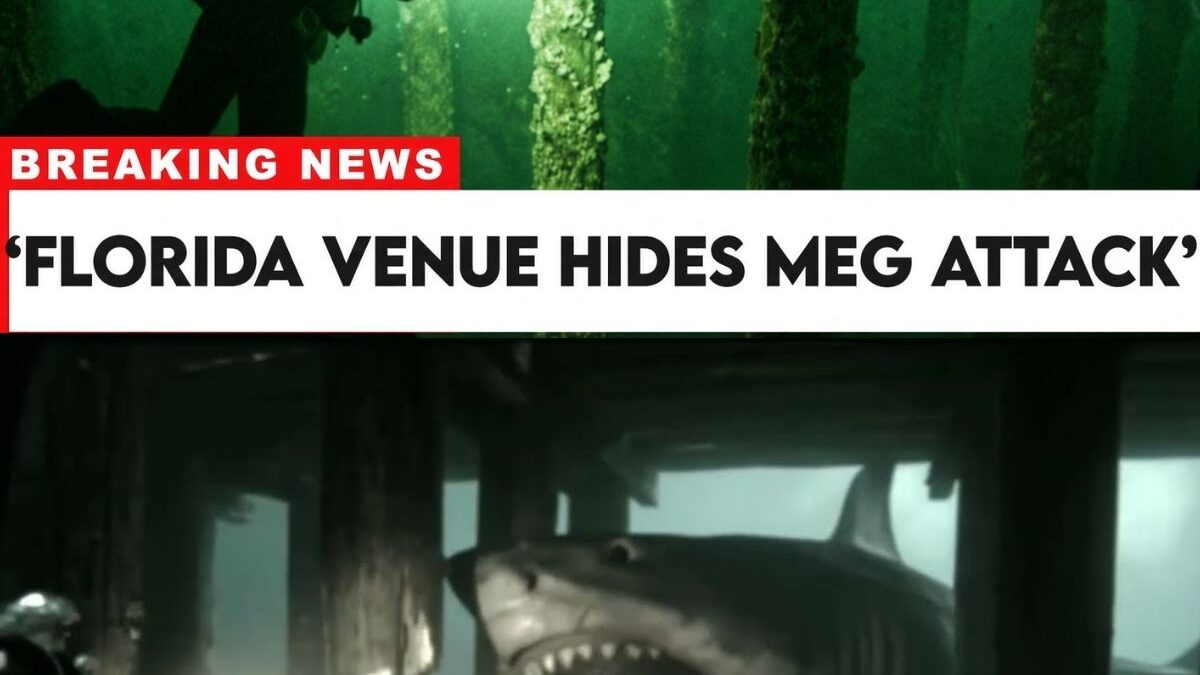
In the summer of 2003, a retired Marine Patrol officer in Broward County, Florida, mailed a package to the Miami Herald’s investigative desk. Inside was a single roll of Super 8 film, undeveloped, still sealed in its original Kodak canister. And a handwritten note that read, “I was told to destroy this in 1979.
I didn’t. Someone should see what’s on it.” The Herald declined to publish. The film was returned to the officer, who died in 2007. His daughter found the canister in a shoe box, had it developed, and uploaded 47 seconds of footage to a Marine research forum. What those 47 seconds show has never been addressed by Broward County, the Florida Department of Environmental Protection, or any agency with jurisdiction over the waters of the Southeast Florida coast.
But to understand what the footage captures, we need to go back 24 years to a Friday night in August 1979 and a wooden pier restaurant called the Sandbar Terrace. The Sandbar Terrace sat at the end of a 900-ft fishing pier on the coast between Fort Lauderdale and Boca Raton in a stretch of Southeast Florida where the continental shelf is narrower than almost anywhere else on the American Atlantic seaboard.
This is a geological detail that matters. In most of the eastern United States, the continental shelf extends 50, 70, sometimes 100 miles before the ocean floor drops into deep water. Along this section of the Florida coast, the shelf drops within a mile. The Gulf Stream, one of the most powerful ocean currents on Earth, passes closer to shore here than at any other point on the eastern seaboard, flowing [snorts] north at 4 to 5 knots just 3 miles out.
Marine biologists have documented deep-water pelagic species at recreational diving depth along the shelf break, species that anywhere else on the coast would require a submersible to reach. The reef line runs close to shore, and beyond it, the bottom falls away in terraces, 200 ft, 400 ft, 1,000 within minutes of leaving shallow water.
Whatever lives in the deep Atlantic off Florida does not need to cross 50 miles of continental shelf to reach the coast. It is already there. The Sandbar Terrace was built in 1971 by a Broward County businessman named Gerald Lyndon, who held interests in three other waterfront properties and sat on the county’s tourism development board.
The pier itself was a standard wood piling fishing pier, 900 ft of treated southern yellow pine, 14-in pilings driven into the sandy bottom in rows, the deck standing roughly 25 ft above the waterline at the far end. What made the Sandbar different was the restaurant. Lyndon had built an open-air cocktail bar and dining deck at the pier’s terminus, a wooden terrace with seating for 60, a full bar, string lights along the railings, and live music on Friday and Saturday nights.
Harbor records from 1979 show the Sandbar held a class A liquor license, a maximum occupancy permit for 75 persons, and a structural inspection certificate signed in March of that year. On the evening of August 17th, 1979, the Sandbar Terrace was at capacity. The band was a local three-piece called the Gulf Tones, booked for an 8:00 to midnight set. The bar was fully staffed.
The water below the pier was dark, warm, and calm, late summer conditions on the Southeast Florida coast with surface temperatures in the mid-80s and visibility of 50 ft or more during the day, though at night, the water beneath the pier was near black, except where the string lights and bar glow reached it in broken patches.
By the account of every surviving witness, the evening was unremarkable until 9:22 p.m. The first indication that something was wrong came not from the water, but from the structure itself. According to the testimony of Ray Tyndall, a Pompano Beach charter captain who was seated at the bar with his wife, the entire pier jolted as though it had been struck by a truck. Glasses slid off tables.
The band stopped mid-song. Tyndall, who had spent 31 years on the water and was familiar with the way structures respond to wave action, stated in a recorded interview conducted in 1994 that what he felt was not wave loading, not wind stress, and not the kind of settling motion that old pilings produce.
It was, in his words, “a lateral impact, something hit us from the side.” A second impact followed within 15 seconds, harder than the first. A deck planking at the far end of the terrace dropped approximately 6 in as a piling beneath it gave way, and several patrons later described the sound of wood cracking from beneath the deck, not the groan of a structure settling, but a sharp, violent splintering, like timber being broken by force.
Through the gaps in the deck planking and over the railing where the string lights illuminated the water 25 ft below, people began to see something in the water. The county engineering report would attribute the structural failure to substandard materials used during a 1976 renovation. But what the engineering report does not mention, and what at least 14 witnesses described independently, is what was in the water beneath them.
Ray Tyndall reached the railing within seconds of the second impact and looked straight down, 25 ft to the dark water below. The terrace’s string lights cast broken patches of warm light on the water surface beneath the pier. In that light, between the rows of pilings descending from the deck, Tyndall described a shape, a dark form, wider than the pier itself, sliding between the piling rows with what he called a slow, deliberate motion that had nothing to do with current or tide.
He said it moved the way a large vessel moves through a harbor, displacing water, pushing a visible bow wave ahead of it, the surface folding around something massive just beneath. He watched for approximately 10 seconds before a third impact sent him stumbling backward from the railing. When he looked again, the shape had moved further along the pier toward shore, and a second piling had failed.
The deck section above it was listing. In the 1994 interview, Tyndall paused here for nearly 20 seconds before he said what he said next. He told the interviewer that between the second and third impacts, while looking down from the railing into the broken light on the water, he saw a dorsal fin surface beside the pier, and that the fin stood taller than the bar counter behind him.
The Sandbar Terrace’s bar counter, per the original construction permits filed with Broward County, was 42 in tall. Tyndall said the fin was thick, rigid, and dark, not the curved, flexible fin of any shark he had ever seen, but something heavier, more solid, like a piece of the animal had been turned to stone.
He described pale patches on its surface that caught the string light and what looked like barnacle growth along the leading edge. He said, “It looked like it had been down there for a long time. A very long time.” What makes Tyndall’s account hard to dismiss is not just his 31 years of experience on the water.
It is the fact that for 15 of those years, he had held a federal observer certification and logged commercial catch data for NOAA’s Southeast Fisheries Science Center in Miami. He had identified, measured, cataloged, and recorded every large pelagic species in the western Atlantic. Blue marlin, swordfish, mako, hammerhead, bull shark, tiger shark, and great white.
Ray Tyndall had personally recorded 17 great white sightings off the Florida coast for NOAA’s database. When he described the dorsal fin he saw beside the Sandbar Terrace, he was not speaking as a frightened tourist who might mistake a dolphin for a shark. He was speaking as a man who had spent 15 years measuring fins exactly like the one he was looking at, and who was telling the interviewer that this one was larger than any fin in the NOAA record by a factor he said that he did not feel comfortable estimating.
He said it twice. “I don’t want to say a number because the number doesn’t make sense.” When pressed, he said only that in 17 recorded great white encounters, the largest dorsal he had ever measured was 22 in. What he saw at the Sandbar was not twice that. It was not three times that. He would not give a number.
The testimony of Dennis Kovac, a 26-year-old bartender working the Sandbar that night, provides a different angle on what happened next. And it is Kovac’s account that describes the creature’s behavior in the most clinical detail. Kovac stated that after the second impact, he moved to the railing on the ocean-facing side of the terrace and looked down, expecting to see a barge or a large boat that had drifted into the pier.
What he saw instead was the back of an animal surfacing alongside the pier. A long continuous ridge of dark hide breaking the water, mottled gray with rough pale patches, moving slowly in the same direction as the pier’s length. He described the texture as looking like old concrete, not the smooth hydrodynamic skin of a shark he recognized, but something armored, ridged, as though the hide had thickened and calcified over a span of time he could not make sense of.
The back extended alongside the pier for a distance that Kovac, in his statement, could not initially bring himself to quantify. When the interviewer pressed him, he said, “I could see the railing posts. I counted them. The back went past seven of them before it went into the dark.” The Sandbar Terrace’s railing posts were spaced 6 ft apart.
Seven posts is 42 ft of visible whole body, with the head and tail beyond the reach of the light. Kovac then described something that no other witness reported, because no other witness was positioned to see it. From his vantage point above and slightly behind the creature’s head, he watched it approach an intact piling, one of the structural supports that had not yet been struck.
He said the creature’s head rose slightly above the waterline as it neared the post, and that he could see the underside of the jaw, a massive pale crescent and rows of teeth that he described as being each the size of his hand. The jaw opened. The creature drove its skull into the piling. The 14-in treated pine post, he said, disappeared inside the mouth.
The wood cracked on impact, and the deck above that piling lurched. He said the creature shook its head twice, sharp violent lateral movements, and when it pulled away, the piling was visibly narrower, gouged in a deep crescent on both sides where the teeth had scored the wood. The creature moved to the next piling and repeated the action.
This, Kovac said, was what the engineering report called termite damage. This was what the insurance company paid out for. “It was chewing through us,” Kovac told the interviewer, “one post at a time.” Kovac described watching the creature work its way through three pilings in what he estimated was 90 seconds.
Each time the sequence was the same. The head would rise, the jaw would open, the mouth would close around the post, and the animal would shake twice hard with enough lateral force to shift the deck above. After each piling, the creature would drift forward to the next one in the row, the massive body barely moving, the dark back and dorsal fin sliding through the water with what Kovac described as a kind of industrial patience, the way a machine works, not the way an animal hunts.
The deck sagged in stages. Each failed piling dropped its section another few inches, and the cumulative effect was a terrace deck that was now tilting visibly toward the water on its ocean-facing side. The string lights along the railing hanging at an angle, drinks sliding off tables, chairs scraping across the planking as gravity shifted.
Kovac said the worst part was not the creature itself. It was the sound. Not the cracking of the wood, which was sharp and loud, but the groaning of the cross bracing between the pilings, the deep structural complaint of a building that was losing its skeleton one bone at a time. He said you could feel it in your teeth. What no official account has ever addressed is the question of why an animal of this apparent size would attack a wooden pier.
The answer may lie in research published in 1994 by Dr. Samuel Gruber of the University of Miami’s Rosenstiel School of Marine Science, research that was not available in 1979, but which offers a possible framework. Gruber’s work on elasmobranch sensory biology demonstrated that sharks detect bioelectric fields generated by organisms through specialized organs called ampullae of Lorenzini, and that these organs are sensitive enough to detect the electrical fields generated by corroding metal in seawater.
A wooden pier with metal bolt hardware, steel reinforcement plates, and galvanic corrosion between dissimilar metals in a warm saltwater environment produces exactly the kind of low-level electrical signature that large sharks have been documented investigating and, in some cases, biting. What Gruber’s research does not account for is an animal large enough to break a 14-in treated pine piling with a single bite.
The largest recorded great white shark has a bite force estimated at approximately 4,000 lb per square inch. The force required to crack a 14-in treated southern yellow pine piling, the calculations were done by a structural engineer retained by Patricia Langford’s family during the wrongful death suit, is between 12 and 15,000 lb per square inch, three to four times the capacity of the largest known living shark.
The fossil record contains only one species whose estimated bite force exceeds that threshold. Otodus megalodon, a shark formerly classified from the Miocene and Pliocene epochs with an estimated bite force exceeding 40,000 lb per square inch, has been declared extinct for approximately 3.6 million years. The coelacanth was also declared extinct for 66 million years until a fisherman pulled one from the deep water off South Africa in 1938.
What happened in the 4 minutes between the first impact at 9:22 p.m. and the arrival of the marine patrol at 9:31 p.m. has been reconstructed from 11 witness testimonies, the Super 8 footage, and the incident report. The reconstruction is imperfect. Accounts conflict on timing and sequence, the film is nearly illegible, and the incident report was written under circumstances that merit scrutiny, but the broad arc is consistent.
The creature moves systematically along the pier’s piling rows, striking supports in sequence. At least five pilings failed during the 4-minute video. A 12-ft section of the deck near the terrace viewing point collapsed entirely, opening a gap in the walkway that separated the terrace from the shore side pier. Three people fell through that gap into the water 25 ft below.
A couple from Coral Springs, Michael and Janik Reese, were pulled from the water within minutes by the crew of a recreational boat that had motored to the pier from a nearby marina after hearing the structural noise. Both sustained injuries consistent with a 25-ft fall into water, a broken wrist, two cracked ribs, deep bruising, but both survived.
Janik Reese gave a statement to investigators the following day that was not included in the incident report. She described hitting the water and going under, and when she surfaced, seeing the pilings around her from water level, barnacle-encrusted posts standing in the dark water like the columns of a flooded building. She said the water was moving, not from waves or current, but from displacement, as though something very large was pushing through it nearby.
She described a wake that came from between the pilings and rolled over her. Warm water that smelled like low tide and something else, something mineral and unfamiliar. She said she could hear the pilings cracking above the waterline, a series of reports like gunshots, and that between two of those cracks, she felt something pass beneath her in the water.
She did not see it. She said the water pressure changed around her legs as though a large volume had moved past at depth, and then was gone. Her husband pulled her toward the rescue boat. She did not look down. The third person who fell through the collapsed section was Patricia Langford, 34, of Columbus, Ohio, who was visiting Florida with her husband, Daniel, and their two children, ages 7 and 4.
The children had been at a table closer to the shore end of the terrace and were evacuated by other patrons before the gap opened. Daniel Langford’s statement to the marine patrol, given that night at Broward General Medical Center, where he was being treated for lacerations on both hands, describes losing his wife’s grip as the decking gave way beneath them.
He stated that they had been moving toward shore when the planking dropped, that he had her right hand in his left, and that the wood opened between them like a trap door. He fell forward onto the intact section. She fell through. He stated that the water below was churning, a heavy dark turbulence that he said looked like the wake of a large boat, and that he heard his wife call his name once before the sound of the water covered it.
Daniel Langford went into the water after her. He was pulled out by the rescue boat crew 4 minutes later alone, with defensive lacerations on his palms consistent with gripping broken wood. Patricia Langford’s body was never recovered. A search conducted by the marine patrol and the Broward County Sheriff’s dive team over the following 48 hours produced no remains, no clothing, and no personal effects.
The medical examiner classified her death as drowning secondary to structural collapse. No marine animal involvement was noted in the report. The Langford children were placed in the care of Patricia’s sister, who flew in from Ohio the following morning. The Super 8 footage, the 47 seconds that would remain undeveloped for 24 years, was shot by a patron standing at the beach end of the pier as the crowd evacuated.
The camera was a consumer model, a Kodak Ektasound, loaded with standard Ektachrome 160 cartridge film. A stock designed for birthday parties and family vacations, not for shooting in near total darkness 900 ft from shore. The footage it produced is barely legible, extreme grain obliterating fine detail, heavy motion blur from the shaking hands of a person standing on a vibrating structure, and the warm amber color shift that Ektachrome produces when overwhelmed by low light.
The image is dark. Most of the frame is near black water and night sky. The pier structure is visible primarily through its string lights, a sagging line of warm dots stretching toward the damaged terrace at the far end. Some of the lights now hanging at angles where the deck has dropped. People are visible as dark shapes moving along the walkway toward shore, silhouetted against the remaining lights.
But in two separate frames, frame 312 and frame 331, identified and numbered during the digitization process, separated by approximately 8/10 of a second, a shape is visible in the water beside the pier that extends above the waterline. The shape is in the right third of the frame, partially obscured by a railing post in the foreground, backlit by the reflection of the string lights on the water surface.
It is vertical, dark, and rigid. Using the pier railing height of 42 in as a reference, the same railing documented in the lie construction permits, the shape in those frames has been measured by three independent analysts at the request of the Marine Research Forum where the footage was posted. Their estimates converge between 48 and 62 in above the waterline.
A dorsal fin between 4 and 5 ft tall. No living shark species produces a dorsal fin of that height. The largest documented great white dorsal fin measured approximately 23 in. What is visible in frames 312 and 331 of the Sandbar footage is more than double that, and the fin is not the largest feature visible. Behind it, partially submerged but catching the string light reflections, is the suggestion of a body so wide that it fills the space between the piling rows.
One of the three analysts, a retired Woods Hole Oceanographic researcher who reviewed the footage on the condition of anonymity, noted that the wake displacement pattern visible around the shape was consistent with a body mass significantly exceeding that of any documented living marine animal in the Atlantic.
He declined to estimate a size. He said only that the displacement pattern did not match any whale species known to frequent the Florida coast, and that the dorsal profile was inconsistent with any cetacean in the NOAA catalog. His conclusion, stated in a single line at the end of his written analysis, reads, “What is visible in this footage is not identifiable as any known species.
” Marine Patrol arrived at 9:31 p.m. and cleared the pier. The patron with the Super 8 camera was identified, and his film, still in the camera, unexposed to any processing, was confiscated as evidence. According to the incident report filed by Sergeant Keith Novak, the pier had experienced a structural failure consistent with piling deterioration and was being evacuated as a precaution.
The report does not mention a marine animal of any kind. The 14 witness accounts describing a massive creature in the water are absent from the filing. So is any reference to the dorsal fin. So is any mention of the systematic nature of the piling damage. The sequential failures moving in a line along the pier, consistent not with material fatigue, but with an external force progressing through the structure.
What emerged in the weeks following August 17th follows a pattern familiar to anyone who has studied the suppression of inconvenient evidence in communities that depend on a single industry. Broward County’s tourism economy in 1979 generated an estimated $600 million annually. 4 million visitors came to the county’s beaches each year.
Gerald Lyndon, who owned the destroyed pier, sat on the County Tourism Development Board alongside officials from the Chamber of Commerce, the Hotel Association, and the County Manager’s Office. Within 72 hours, the pier was condemned. Lyndon’s insurance carrier paid out for structural failure, the only cause listed in the engineering report.
That engineering report was signed by a licensed structural engineer named Howard Breck. Howard Breck was Gerald Lyndon’s brother-in-law. The report attributes the failures to termite damage and substandard piling replacement during the 1976 renovation. It makes no mention of the curved gouges on the failed pilings.
It makes no mention of bite geometry. It makes no reference to the lateral impact pattern described by every witness who testified. The Sandbar Terrace’s liquor license was revoked, and Lyndon never rebuilt. The Super 8 film sat in the County Evidence Archive, undeveloped, can unviewed for 24 years. Patricia Langford’s family filed a wrongful death suit against Lyndon’s construction contractor.
The suit settled out of court for an undisclosed amount. The settlement included a non-disclosure agreement. The 14 witnesses who described the creature, most of them Broward County residents whose livelihoods depended directly or indirectly on 4 million tourists visiting their beaches, did not organize, did not contact the press, and did not file independent reports.
Ray Tyndall relocated to the Gulf Coast within a year. In the 1994 interview, the only time he ever spoke about the incident on the record, he said that certain people had made it clear his charter license renewal might encounter difficulties if he continued discussing what he saw. He did not name names. Dennis Kobuk left the restaurant industry, took a job with a roofing company in Pembroke Pines, and when contacted by a journalist in 2001, declined to comment and asked not to be called again.
The official record of the Sandbar Terrace incident reads as follows. A wooden pier experienced structural failure during business hours, resulting in one drowning death and two injuries. Cause, substandard materials and termite damage. No creature. No footage. No fin standing taller than the bar counter.
No animal that could chew through a 14-in piling with a single bite. But the pilings, the treated southern yellow pine pilings that Gerald Lyndon drove into the seabed in 1971, were never removed. Broward County condemned the structure above the waterline, but the pilings beneath the surface were left standing. They stood in 15 ft of warm Atlantic water, encrusted with barnacles and marine growth.
The treated wood preserved by the chemicals that had been pressure injected at the mill and by the anaerobic conditions of the sandy seabed. They stood through the 1980s. They stood through Hurricane Andrew in 1992. They stood for 17 years. The evidence of what had really happened at the Sandbar Terrace, embedded in the wood, waiting in the dark water for someone to look.
And in 1996, when Broward County finally contracted a marine construction firm to remove those pilings as part of a beach restoration project, someone did look. What the construction diver found on those pilings would force the first scientific examination of the Sandbar incident, and would produce evidence that the county’s engineering report, the insurance filing, and the official record had all been designed to bury.
The pilings that Gerald Lyndon drove into the seabed in 1971 were never meant to last forever, but they were built to last longer than most people expected. Treated southern yellow pine pressure injected with chromated copper arsenate at the mill in Georgia is among the most durable structural timbers ever used in marine construction.
The chemical treatment poisons the organisms that would otherwise consume the wood, marine borers, fungi, bacteria. In the anaerobic conditions of a sandy seabed where oxygen levels are low and biological activity is minimal, treated pine pilings have been documented surviving 70, 80, even 100 years with their structural integrity largely intact.
The pilings beneath the Sandbar Terrace had been in the water for 25 years when, in the spring of 1996, Broward County contracted a marine construction firm called Gulf Atlantic Marine Services to remove them as part of a federal beach restoration project. The contract was straightforward. Survey the remaining piling field, extract the pilings from the seabed using a vibratory hammer mounted on a work barge, dispose of the material, and certify the site clear for new construction.
It was expected to take 3 weeks. What the lead diver found on his first survey dive would extend that timeline by 4 months and produce a body of physical evidence that Broward County, the state of Florida, and a major research university would each, in their own way, attempt to make disappear. Gulf Atlantic Marine Services operated out of a yard in Dania Beach, 6 miles south of the old Sandbar Terrace site.
The company’s lead diver was a man named Carlos Reyes, 41, a former Navy diver who had spent 12 years in commercial marine construction after his discharge. Bridge footings, dock pilings, pipeline inspections, the unglamorous subsurface work that keeps coastal infrastructure standing. Reyes had pulled pilings out of the ocean floor in six states.
He knew what damaged wood looked like. He knew the signature of marine borers, the pinhole tunnels of Teredo navalis and shallow surface grooves of Limnoria. He knew what rot looked like, what storm damage looked like, what a boat strike looked like. He knew what a shark bite looked like on a crab pot line and on a kayak hull.
The crescent, the tooth scoring, the compression of material around the point of contact. He had seen great white damage on a research buoy off Cape Canaveral in 1991. A single bite had a punctured a foam float and left an impression roughly 8 inches across. What he would find on the Sandbar pilings were the same geometry at a scale that, in his words, broke the math.
On the morning of April 3rd, 1996, Reyes descended from the work barge into 15 feet of warm Atlantic water, dropped to the sandy bottom, and swam to the first cluster of pilings in the survey grid. The water beneath the old pier site was dim. The shadow of the work barge overhead blocked much of the sunlight, and the pilings themselves, still standing in their original rows after 25 years, created a forest of vertical columns that cut the remaining light into broken shafts.
Marine growth covered every surface. Barnacles, algae, small corals, sea fans. But where a patch of growth had broken away or been scraped off by tidal debris, the treated wood beneath was visible. And on that wood, clearly and unmistakably, were the marks. Reyes surfaced 11 minutes later. According to the dive log maintained by the barge foreman, a man named Walt Prescott, Reyes surfaced, removed his regulator, and said, “I need the project camera.
You need to see what’s down there.” He did not describe what he had found. Prescott would later tell investigators that Reyes’s face in that moment was not frightened. It was confused. The expression of a man looking at something he had seen a thousand times and recognizing none of it. What the project camera recorded over the next 40 minutes of survey diving is the primary physical evidence in what would become an unofficial file that Broward County has never acknowledged.
Reyes documented 14 pilings in the central cluster. 11 of them showed damage. Not marine borers. Not rot. Not storm impact. Massive curved gouges. Paired crescents scored deeply into the treated wood. Upper and lower impressions mirroring each other. >> [snorts] >> The geometry unmistakable to anyone who has ever seen a jaw close around an object.
Individual tooth drag marks were visible within the crescents. Parallel scoring where each tooth had bitten and then pulled, tearing the grain of the wood along its length. On the most heavily damaged piling, the bite spanned the full 14-in diameter of the post and continued past it on both sides. The jaw had been wider than the piling itself.
The wood was torn and compressed at the deepest contact points. The fibers crushed inward in a pattern that a material scientist would later describe as consistent with a closing force applied simultaneously from two opposing directions. The mechanical signature of a bite, not a collision. Reyes held his hand beside one of the bite impressions for scale.
His fingers, spread wide, did not reach from one edge of the crescent to the other. When the footage reached Walt Prescott on the barge, he shut down dive operations for the day and called the company’s owner in Dania Beach. The owner called the county project manager. The county project manager called the Department of Environmental Protection.
And somewhere in that chain of phone calls, someone called Dr. Elena Vasquez at the Department of Marine Science at Florida Atlantic University in Boca Raton. Vasquez was a forensic marine biologist, one of a small number of specialists in the state qualified to assess biological damage to marine structures.
She had consulted on pier damage cases, boat hull assessments, and one notable case involving a whale carcass that had been struck by a cargo vessel off Port Everglades. She arrived at the Gulf Atlantic barge 2 days after Reyes’s initial dive and descended to the piling field with her own measurement equipment.
Calipers, a flexible curve ruler, a scale bar for photography, and a waterproof notebook. What she documented over the next 3 days would end her career at Florida Atlantic University. Vasquez measured the bite geometry on all 11 damaged pilings. The crescent curvatures were consistent across all of them. The same jaw had made these marks, or if not the same individual, then the same species with the same jaw architecture.
She calculated the bite radius from the curvature. The jaw width implied by the geometry was between 7 and 9 feet. The tooth spacing, measured from the parallel scoring within the crescents, indicated individual teeth between 4 and 6 inches in width at the base, triangular in cross-section with serrated edges that had left a distinctive micro scoring pattern in the compressed wood grain.
She ran the tooth dimensions against the identification database maintained by the Florida Museum of Natural History’s Ichthyology Collection. No match among living species. The closest morphological match in the entire database was a fossil species, a tooth from the upper jaw of Otodus megalodon, recovered from a phosphate mine in Polk County, Florida, and dated to the late Miocene epoch.
The tooth spacing, the serration pattern, the triangular cross-section, and the bite radius were, in Vasquez’s notes, consistent within measurement error. The only discrepancy was that the fossil record indicates Otodus megalodon has been extinct for approximately 3.6 million years. It was during this measurement work that Vasquez pulled the county’s file on the Sandbar Terrace incident of August 1979.
What she read was the engineering report signed by Howard Brick. Substandard pilings, termite damage, structural failure. She read it twice. Then she went back underwater and photographed the bite marks on the pilings that Howard Brick’s report described as termite damaged. The termites, apparently, had jaws 7 feet wide and teeth the size of a man’s hand.
Vasquez filed a records request with Broward County for any additional materials related to the 1979 incident, specifically, any confiscated evidence or physical materials logged in connection with the structural failure. The request took 4 months to process. When the response came, it included a notation that one item of physical evidence remained in the county archive.
A single cartridge of Super 8 film, undeveloped, logged into evidence on August 17th, 1979, and never retrieved. Vasquez requested the film. It took another 3 weeks. When the canister arrived at her lab, still sealed, still undeveloped after 17 years, she sent it to a film processing facility in Miami that specialized in degraded and expired stock.
The results were poor, but partially viewable. What the developed footage showed, 47 seconds of badly degraded Ektachrome, shot at night by a consumer camera on a collapsing pier, was enough. Vasquez identified the pier railing visible in the footage and cross-referenced its height against the original construction permits.
42 inches. She identified the shape in frames 312 and 331. The vertical, rigid form extending above the waterline beside the pier. Using the railing as a calibrated reference, she calculated the visible height of the shape above the waterline at between 48 and 62 inches, depending on the frame and the assumed angle of the camera.
She then applied standard lamnid sharkmorphometrics. The established ratios between dorsal fin height and total body length in species of the family Lamnidae, which includes great whites, makos, and their evolutionary relatives. The ratios are well documented in the literature. For a dorsal fin height of 48 to 62 in, the the implied total body length falls between 45 and 55 ft.
The largest confirmed great white shark in the historical record measured just over 20 ft. What the 1979 footage implies is an animal more than twice that length, a size consistent with the mid-range estimates for adult Otodus megalodon derived from the fossil record. The jaw geometry from the pilings and the dorsal measurement from the footage were pointing at the same animal.
But it was what Reyes’ underwater survey footage captured that Vasquez did not see until 3 days after her initial review because she had been looking at the pilings, not the background. A graduate student in her lab, reviewing the footage frame by frame to catalog the damage, flagged a sequence at time code 0 hours 27 minutes and 14 seconds.
In the background of a shot focused on a damaged piling between two posts at the far edge of the piling field where the structure meets open water, a massive dark shape is visible passing from left to right. The shape is indistinct. The water is murky, the visibility is limited, and the camera’s focus is on the foreground, but it is clearly solid, clearly enormous, and clearly moving with the slow, deliberate motion of a large animal.
The graduate student ran the footage through image enhancement software available at the university. The enhanced frames show a dark form spanning multiple piling gaps in width backlit by the brighter open water beyond the structure’s edge. The silhouette suggesting a broad body with a dorsal profile consistent with a large shark.
The shape is visible for approximately 6 seconds before it passes out of frame. Reyes, when shown the footage, confirmed that he had not seen anything in the water during the dive. His camera had been aimed at the pilings. His back had been to the open water. Whatever passed behind him passed within an estimated 30 to 40 ft of his position. He was inside the piling grid.
The shape was outside it, cruising the perimeter of the structure, moving along the outer row of pilings where the pier meets open water. The pilings between them were the only barrier. And they were the same pilings the creature had been systematically destroying. When Reyes was shown the enhanced footage, he was quiet for a long time.
Prescott, who was present, later described Reyes’ reaction as the only time in 12 years of working together that he had seen the man visibly shaken. Reyes asked to see the time code again. 0 hours 27 minutes and 14 seconds, and cross-referenced it against his dive log. At that timestamp, he had been approximately 4 minutes into his second survey pass, facing northeast, filming the bike damage on piling number seven.
The shape had passed behind him heading north between piling rows 12 and 13 at the outer edge of the grid. Reyes had been between the creature and the beach. The creature had been between him and the open ocean. If it had entered the piling grid, if the gaps between the 14-in posts had been wide enough for something that size to pass through, there would have been nowhere for Reyes to go.
He told Prescott he would complete the piling removal contract, but he would not dive the site alone again. For the remaining weeks of the project, a second diver was always in the water. The surface evidence arrived 2 weeks into the piling removal work. On the morning of April 19th, a crew member on the barge named Hector Reyes looked up from a splice he was working and saw something at the edge of the work zone approximately 300 yd out along the line where the ocean color shifts from the pale green of the shallow shelf to the deep blue of the Gulf Stream corridor.
He grabbed the crew’s camcorder, a consumer Hi8, kept on the barge for documenting work progress, and recorded approximately 90 seconds of footage. The footage shows a dorsal fin above the water surface moving slowly from south to north along the shelf break. At 300 yd, the fin appears small, a dark vertical shape against the bright glare of the ocean, but the wake behind it is wrong.
The V-shaped wake spreads disproportionately wide for the visible fin, dozens of yards to either side, flattening the ocean surface in a pattern that indicates a body mass far exceeding what the visible fin would suggest. The fin is visible for approximately 70 seconds before it gradually sinks below the surface. The wake continues for another 12 seconds with no visible source, spreading from nothing, before it flattens and disappears.
Reyes showed the footage to Prescott. Prescott checked the barge’s survey sonar log. At the same timestamp, 10:47 a.m. on April 19th, the sonar showed a large solid return at the outer edge of its range positioned along the shelf break. The return was consistent with a biological target. It moved, it held a steady course, and its acoustic signature did not match the hard echo of a vessel or debris.
Prescott logged it as possible whale, unconfirmed. But over the next 11 minutes, the contact did not behave like a whale. It maintained a constant depth of approximately 80 ft, too deep for a surface-breathing cetacean to hold for that duration without surfacing. Then, at 10:58 a.m., the contact began to descend.
The sonar tracked it dropping past 100 ft, past 150, past 200. Prescott called Reyes to the sonar cabin to watch. Both men stood in the dim cabin watching the green sweep refresh, watching the blips sink. At 240 ft, the survey sonar’s maximum depth range, the contact passed below the instrument’s floor and disappeared. It did not surface.
It did not move laterally out of range. It went down, straight down, along the shelf break into water that drops to over 1,000 ft within a quarter mile of that position. Prescott logged it as a possible whale. But whales breathe air. Whales surface. Whatever the sonar was tracking had held a depth of 80 ft for 11 minutes without surfacing and then descended into the abyss without returning.
No cetacean in the western Atlantic behaves that way. The behavioral profile was consistent with a deep-water pelagic predator, an animal that visits the shelf break to feed and retreats to depth when it is finished. Prescott added a note to the log entry that he did not include in the official project documentation. Contact descended past max range, not whale.
No ID. Vasquez compiled her findings over the following months. The piling forensics, jaw geometry, tooth morphology, light force calculations. The 1979 footage analysis, dorsal height measurement, body length estimation using lamnid morphometrics. The 1996 survey footage, the background shape in the piling field, the enhanced frames.
The surface sighting, Reyes’ Hi8 footage, the disproportionate wake. The [snorts] sonar record, the contact at the shelf break that descended past the instrument’s depth floor. She prepared a paper for submission to the Bulletin of Marine Science, a peer-reviewed journal published by the University of Miami’s Rosenstiel School. The paper was titled Anomalous Bite Damage on Structural Marine Pilings, Forensic Evidence Consistent with Otodus megalodon.
It was rejected without peer review. The rejection letter, which Vasquez retained, contains a single sentence of explanation. The editorial board does not consider the subject matter appropriate for this publication. Within a week of the rejection, Vasquez’s department chair at Florida Atlantic University, a man who had not previously shown interest in the piling work, requested a meeting.
The content of that meeting has never been made public. Vasquez told a colleague afterward that she had been advised to redirect her research toward what the chair called more productive areas of inquiry. She was not threatened. She was not fired. She was simply made to understand that her career at FAU would be more comfortable if the sandbar evidence stayed in her filing cabinet.
Vasquez had been a faculty member for 9 years. She had published 14 peer-reviewed papers. Shared two thesis committees. And brought in over $300,000 in grant funding. None of that mattered. In the academic hierarchy of a state university that depends on state funding, which depends on a tourism economy, which depends on people not being afraid to go to the beach, a paper titled Forensic Evidence Consistent with Otodus megalodon was not a career move.
It was a career-ending document. Vasquez did not publish the paper. She did not give interviews. She did not contact the press. She continued teaching, continued her other research, and kept the Sandbar data in a locked filing cabinet in her office. Meanwhile, the piling removal proceeded.
Gulf Atlantic Marine Services completed the extraction of all remaining pilings from the site over the following 2 months. The pilings, including the 11 with bite damage, were disposed of per the terms of the contract. Cut into sections, loaded onto trucks, and transported to a construction waste facility in western Broward County. The scored wood that contained 17 years of preserved forensic evidence was destroyed.
The chain of custody ends at the waste facility gate. But Vasquez had anticipated this. Before the pilings were removed, she had taken her own precautions. She had her measurements, every crescent, every tooth mark, every radius calculation documented and photographed with scale bars. She had her photographs, hundreds of underwater images shot on her own camera with her own film.
She had a 40-lb cross-section of the most heavily damaged piling cut with a reciprocating saw and sealed in a clear plastic evidence bag in her lab. She had the digitized 1979 footage. She had Ruiz’s Hi8 tape, which Prescott had given her after the project ended. And she had the sonar log printout from April 19th, the 11-minute contact that went below the shelf break and did not come back. The paper was dead.
The pilings were destroyed. The university had made its position clear. But the data was intact. In 2003, 7 years after the piling removal and 24 years after the Sandbar Terrace collapsed, Vasquez’s raw data surfaced on a marine biology research forum. She has never confirmed whether she uploaded it herself. The data includes the piling measurements, the jaw geometry overlays, the fossil comparison, the enhanced frames from Reyes’s underwater footage, the dorsal fin analysis from the 1979 film, and the sonar log from April 19th,
- It remains on the forum. It has never been retracted. No institution has challenged the measurements. No researcher has published a rebuttal. The data simply sits there, comprehensive, methodical, and unanswered. What the combined evidence of the Sandbar Terrace incident and the 1996 piling survey describes is this, that in August 1979, a marine animal of sufficient size and bite force to destroy treated structural pilings attacked the wooden pier on the southeast Florida coast, killing one person and causing the collapse of an
occupied restaurant. That the physical evidence of this attack was preserved in the treated wood of those pilings for 17 years. That when a forensic marine biologist examined that evidence in 1996, the jaw geometry, tooth morphology, and bite force calculations were consistent within measurement error with Otodus megalodon, a species the fossil record declares extinct for 3.6 million years.
That during the same investigation, underwater footage captured a massive unidentified shape in the water at the same site. A dorsal fin was documented on the surface near the shelf break, and a sonar contact of biological origin descended into deep water and did not return. That the 1979 footage, when analyzed against known structural references, implies an animal between 45 and 55 ft in length.
That every institution that encountered this evidence, Broward County, the state engineering board, the University of Miami’s journal, Florida Atlantic University, either buried it, rejected it, or advised the researcher to stop pursuing it. That the physical evidence was destroyed per contract. And that the only reason any of this is known is because a retired marine patrol officer kept a film canister he was ordered to destroy, and a marine biologist kept copies of data her university told her to forget.
Whether what attacked the Sandbar Terrace in 1979 was a surviving specimen of a species the fossil record has declared extinct for over 3 million years or something else entirely, something the deep water along the narrowest continental shelf on the American coast has kept hidden from the taxonomy that claims to catalog every living thing in the ocean, remains, officially, undetermined.
The pilings are gone. The pier is gone. The official record says it was termites. The 47 seconds of footage and the teeth marks in the wood say otherwise. If you have seen something in the waters off the southeast Florida coast that you could not explain, or if you have information about the Sandbar Terrace incident that has not been made public, share it in the comments below.
Subscribe to Maritime Incident Files for more accounts from the deep.

