Marine Biologist Reacts to Whalefall: Can a Whale Swallow a Human Whole?
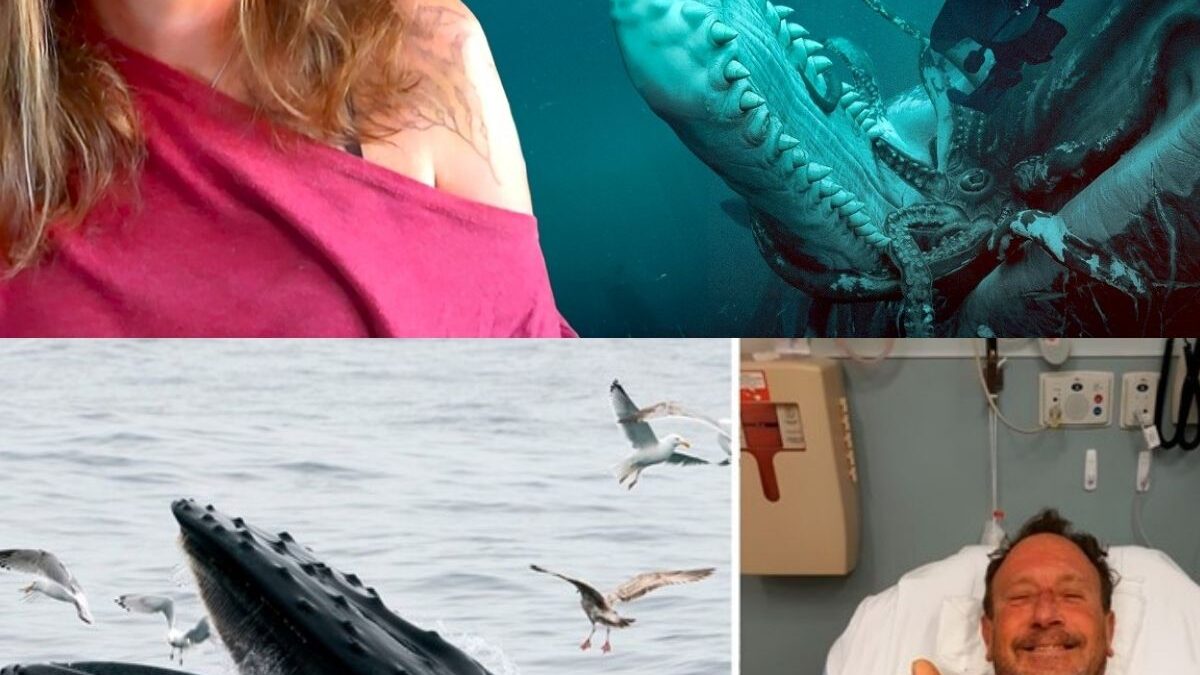
The morning tide carried a quiet chill that seeped straight through Jay’s neoprene suit. Standing on the rocking deck of his small skiff, he adjusted his dive mask and stared into the dark Atlantic waters. Somewhere down there, along the rocky ridges of the underwater canyon, rested the remains of his father.
He checked his pressure gauge one last time, verifying the twin tanks strapped securely across his back. His father had been a veteran commercial diver, lost two years earlier during an unexpected deep salvage job. Jay had spent months gathering coordinates, obsessing over sonar maps to bring closure to an empty grave.
“Just a routine sweep along the ridge,” Jay muttered aloud to the empty boat. He bit down on his rubber regulator mouthpiece, tasted the dry, metallic compressed air, and fell backward into the open sea.
The surface world vanished instantly behind a veil of frothing turquoise bubbles. He equalized the pressure in his ears, kicking smoothly downward into the dimming blue haze. Thirty feet, then forty-five feet—the sunlight broke into shimmering, fragile ribbons that failed to touch the seabed.
The silence of the ocean was deceptive, broken only by the rhythmic rumble of his exhaust valve. In this cold expanse, Jay searched for familiar landmarks on the jagged topography below him. A diver in the open sea is a speck of fragile biology surrounded by endless miles of untamed wilderness.
A sudden vibration resonated through the water, pressing against Jay’s chest like a low bass drum. He paused his descent, hovering forty feet below the surface, his eyes scanning the open water. To his left, the deep blue suddenly shifted, twisting into a furious churn of violent motion.
Emerging from the gloom was a creature out of an ancient maritime nightmare. A colossal tentacle, thick as an oak trunk and covered in serrated suckers, whipped violently across the reef. Behind it trailed the battered mantle of a giant squid, fleeing toward the shallows with shuddering urgency.
The animal was severely mangled, oozing thick dark fluids from fresh gouges along its rubbery flesh. Jay froze, his heart pounding a frantic rhythm against his ribs as he recognized the predator’s prey. Giant squids belonged thousands of feet below, in the bathypelagic abyss where sunlight never reached.
Before Jay could even think to inflate his vest and ascend, the ambient light disappeared entirely. A shadow swept overhead, blotting out the water column with a bulk that defied ordinary comprehension. It was a mature bull sperm whale, easily eighty feet long and weighing sixty tons, hurtling upward with tremendous momentum.
The ocean groaned under the sheer displacement of the charging behemoth. The whale opened its narrow, elongated lower jaw, exposing rows of ivory cone teeth set in pale white gums. It struck the fleeing squid with the force of a locomotive, sending shockwaves through Jay’s entire body.
In the blinding chaos of ink, thrashing tentacles, and churning water, Jay was pulled into the vortex. One of the dying squid’s feeding tentacles lashed backward, whipping tightly around Jay’s waist and dive harness. The suction cups bit viciously into his wetsuit, locking him to the flailing, doomed cephalopod.
“No, let go!” Jay gasped around his mouthpiece, kicking desperately against the crushing grip. The dying squid contracted with its final reflex, pulling itself directly toward the whale’s open maw. Jay was dragged headfirst behind it into the cavernous, pitch-black chasm of the leviathan’s throat.
A wall of muscular tissue closed behind him with the finality of a steel vault door. Water surged with violent force, flushing squid, debris, and diver into a narrow, suffocating canal. The elastic walls of the whale’s esophagus contracted in powerful waves of peristalsis, squeezing down hard.
Jay screamed into his mouthpiece as the muscular contractions compressed his ribcage and bruised his shoulders. The scuba tanks scraped loudly against the slick, fleshy tunnel, barely squeezing through the tight opening. He was being swallowed alive, forced downward along a path meant only for flesh and bone.
The downward slide ended with a violent plunge into a warm, sloshing chamber of absolute darkness. Jay hit the bottom, his knees slamming into a thick, heaving floor of corrugated muscle. The air outside his regulator was foul, thick with the stench of decaying flesh and rotten fish.
Reaching blindly to his chest strap, Jay located his dive torch and flicked the switch forward. A beam of white light cut through the foul gloom, illuminating the interior of a biological dungeon. He was kneeling in a vast, ribbed cavern that contracted and relaxed with rhythmic, terrifying power.
“Keep breathing,” Jay whispered aloud, his voice muffled by the rubber mouthpiece. “Check the gauge. Check the air.” He tapped the glowing display on his wrist: sixty minutes of air remaining in his twin tanks.
One hour to escape an eighty-foot sperm whale before his lungs ran out of breathable air. Outside of his sealed scuba system, the ambient atmosphere was lethal, completely devoid of oxygen. The chamber was flooded with gaseous methane and carbon dioxide emitted from bacterial fermentation.
Jay took a cautious breath of his compressed air, fighting down the panic rising in his chest. In the amber beam of his flashlight, he saw the dying giant squid lying beside him. Its tentacles twitched weakly against the muscular walls of what was unmistakably the whale’s first stomach chamber.
A whale’s stomach was not a simple hollow sack like that of a human or a dog. As descendants of ancient artiodactyls, whales share evolutionary ancestry with hippos and ruminants. This first chamber—the rumen-like forestomach—was designed purely for mechanical destruction.
With a sudden heave, the muscular walls of the forestomach contracted inward like a massive hydraulic press. The fleshy ridges ground together with astonishing strength, churning the squid into pulpy remnants. Jay was knocked off his feet, thrown against the floor as the ceiling bore down directly on him.
He curled into a tight ball, using his metal scuba tanks as a makeshift shield against the pressure. The heavy aluminum cylinders groaned under the immense crushing force of the grinding muscular walls. If that living millstone caught his bare limbs directly, it would shatter his bones without slowing down.
“Get up, you idiot, move!” Jay shouted to himself, scrambling across the slick, convulsive floor. His gloved hands slipped against a mountain of hard, sharp debris piled along the lower perimeter. Shining his torch downward, Jay gasped as thousands of dark, horn-like objects caught the light.
They were squid beaks—thousands of them, accumulated from years of deep-sea hunts. Made of cross-linked proteins and chitin, these beaks resisted even the most punishing stomach churn. Jay grabbed one of the largest beaks, its curved tip razor-sharp, testing the heavy edge with his thumb.
The floor beneath him tilted sharply, sending him sliding toward a narrow aperture at the far end. A rush of dark, foul fluid cascaded through the opening, carrying parts of the shredded squid along. That passage led directly into the second stomach chamber: the glandular site of chemical digestion.
As the aperture yawned open, a waft of searing, corrosive gas drifted into the first compartment. Jay’s eyes stung beneath the edges of his mask; his exposed neck skin began to burn furiously. The pH of the acid chamber was nearly identical to battery acid, designed to dissolve muscle and cartilage entirely.
Jay backed away frantically, digging his boots into the folds of the muscular forestomach floor. If he were swept into that chemical bath, his exposure suit would melt within minutes. The acid would eat through his regulator hoses, blinding him and searing his respiratory tract to ash.
Suddenly, a terrifying physical sensation gripped Jay’s ears, sinuses, and chest simultaneously. His eardrums pulsed with intense agony as the air spaces in his head began to shrink. The leviathan was diving, heading down from the shallows into the freezing darkness of the deep canyon.
To endure dives thousands of feet deep, the sperm whale possesses extraordinary evolutionary adaptations. Its ribs are hinged and flexible, its lungs collapsible to prevent catastrophic damage from water pressure. Its internal organs adjust hydrostatically, equalizing pressure with the surrounding sea to avoid being crushed.
Inside the stomach, that meant the ambient pressure rose rapidly, matching the brutal depths outside. Jay reached up to his dive computer, watching the depth indicator spike past one hundred and fifty feet. Three hundred feet. Six hundred feet. The air in his tanks was being consumed at an alarming rate.
Every breath at high pressure burned through four times as much gas as it did at the surface. His sixty-minute reserve was vanishing rapidly, shrinking to twenty, then fifteen minutes of real dive time. If the whale descended to the squid’s native hunting grounds at three thousand feet, the pressure would crush Jay flat.
“I have to get out now,” Jay said, his voice trembling inside the confines of his regulator. “If it hits a thousand feet, my tanks will implode.” He looked at the razor-sharp squid beak in his hand, then up at the thick esophagus ceiling above.
Trying to cut his way out through feet of blubber, muscle, and hide was impossible madness. The hide of an eighty-foot sperm whale was several inches thick, backed by dense fibrous blubber. Even if he could pierce the inner lining, he would drown in blood and bile before reaching the sea.
The only way out was the way he had entered: backward through the esophagus and the mouth. But the muscular sphincter of the esophagus was clenched tight, held shut by tons of pressure. Jay knew he had to trigger a gag reflex, forcing the animal to violently regurgitate its stomach contents.
He scrambled back toward the esophageal opening, slipping repeatedly on the heaving, slimy floor. Reaching up with his arm, Jay jammed the sharp point of the squid beak into the sensitive entrance tissue. The flesh was slick and tough, requiring every ounce of his adrenaline-fueled strength to penetrate.
The beast shuddered. A deep, seismic tremor reverberated through the living walls around him. Jay drove the beak deeper, twisting the sharp edge against the nerve-rich lining of the upper tract. The whale let out a groaning vibration that shook the teeth inside Jay’s skull with thunderous intensity.
A sudden, violent wave of reverse peristalsis slammed into Jay with the power of an ocean wave. The floor bucked beneath him, tossing him upward as the esophagus contracted in rapid succession. Gallons of gastric juices, seawater, and shredded squid flesh surged backward toward the animal’s throat.
Jay kept his teeth clamped hard onto the regulator mouthpiece, wrapping his arms around his head. He was catapulted up the narrow canal, his tanks slamming violently against the fleshy walls. The friction pulled at his fins and mask, threatening to strip away the only life support keeping him alive.
With a final explosive contraction, the esophageal sphincter yielded, spitting Jay into the whale’s mouth. The mouth was a cavernous hall of white tissue, bounded by the long, tooth-studded lower jaw. Through the partially open lips of the leviathan, Jay saw the faint glimmer of green surface water above.
The whale had surfaced to blow, its massive head breaking the waves after the sudden stomach distress. Jay kicked with all his might, propelling himself toward the gap between the whale’s parted jaws. As he tumbled free of the great jaws, the whale slapped the surface, sending him spinning into the foam.
Jay breached the ocean surface, coughing violently as he spat his regulator from his mouth. Cold, sweet sea breeze hit his face, filling his burning lungs with real, life-giving air. Fifty yards away, the immense back of the sperm whale arched smoothly against the sky before disappearing into the deep.
Treading water in the rolling Atlantic swell, Jay floated on his back and stared up at the clouds. His skin burned from traces of stomach acid, and his muscles throbbed with deep, bruising exhaustion. He was alive, floating in the open sea, having survived the impossible belly of the deep.

