LEAKED FOOTAGE: Unbelievable Moment Terrified Jogger Fights For His Life And Bare-Handedly Suffocates A Bloodthirsty Mountain Lion In A Horrifying, Heart-Pounding Wilderness Nightmare!
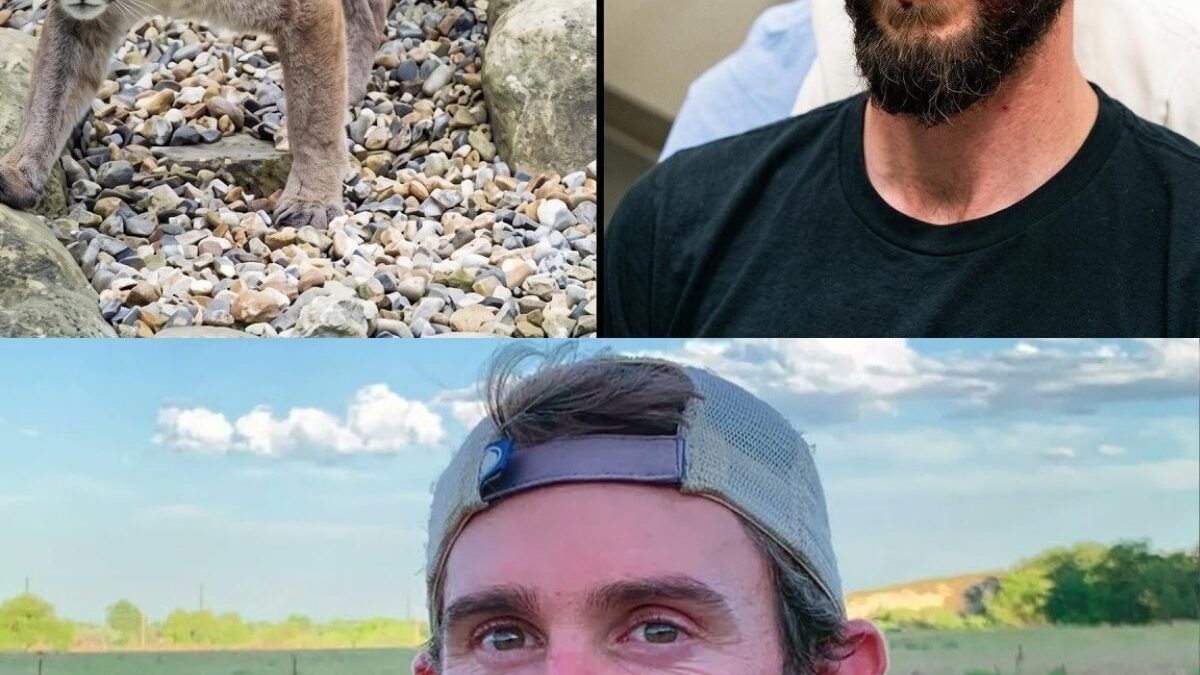
The late winter wind swept down from the crest of the foothills, carrying the dry, resinous scent of ponderosa pine and brittle mountain grasses. It was the early afternoon of February 4, 2019, inside the rugged expanse of Horsetooth Mountain Open Space, just west of Fort Collins, Colorado. The dirt paths cut a solitary ribbon through more than 2,700 acres of high plains terrain, where steep ravines met red sandstone bluffs under a pale winter sky.
Travis Kauffman was thirty-one years old, a seasoned trail runner who possessed the wiry, lean conditioning typical of long-distance endurance athletes. At five feet ten inches tall and roughly one hundred and fifty pounds, he carried zero excess bulk and was neither a trained fighter nor a wilderness survival specialist. He was simply an everyday professional who found clarity, discipline, and solace in pushing his cardiovascular threshold along the demanding elevation gains of Larimer County.
On this particular Monday, Travis had planned an ambitious twelve-mile route across the upper ridges, taking full advantage of the clear, unseasonably mild afternoon. Before setting foot on the trail, he intentionally removed his wireless earbuds and tucked them deep inside his pocket, choosing instead to run entirely in acoustic tune with his surroundings. He knew from experience that high-altitude trails demanded situational awareness, where a runner needed to hear approaching mountain bikes, shifting rocks, and the sudden movements of indigenous wildlife.
For the first few miles, his steady cadence carried him upward through the foothill topography, his breath keeping time with the crunch of gravel beneath his running shoes. The sun hung lower toward the mountain crest, casting long, stark shadows across the mountain slopes and obscuring the dense brush that crowded the trail shoulders. Colorado’s Front Range is an ecological corridor where human settlements abruptly brush against raw wilderness, serving as vital hunting grounds for North America’s most secretive ambush predator: the mountain lion.
Also known colloquially as the cougar, puma, or panther, Puma concolor holds the world record for the highest number of common monikers of any mammal. Historically roaming from the Canadian Yukon across the plains to South America, they remain master stalkers that rely entirely on stealth, camouflage, and explosive pouncing power. Adult males easily surpass one hundred and fifty pounds, capable of leaping forty feet forward in a single stride to shatter the cervical spine of adult mule deer.
Yet the predator that had fixed its gaze upon Travis Kauffman that afternoon was not a mature, calculated patriarch of the sandstone hills. It was an independent juvenile, estimated to weigh between thirty-five and forty pounds, struggling through the most dangerous and unforgiving chapter of a young cougar’s life. Young cats typically remain under maternal guidance for up to twenty-four months, relying on their mother’s seasoned expertise to teach them the delicate, patience-heavy mechanics of hunting.
When juvenile mountain lions are abruptly driven off to carve out their own territories, they often face starvation, intense physical displacement, and profound predatory desperation. Lacking refined judgment and possessing erratic, hunger-driven impulses, inexperienced juveniles will occasionally stalk creatures they are not yet fully equipped to overcome. To a starving, juvenile carnivore crouched motionless within the dense mahogany brush, a lone human running briskly down the trail looked like fleeing, catchable prey.
Travis had just crested a steady rise along the West Ridge Trail when a sudden, dry snap broke the unbroken silence of the hillside behind him. He slowed his stride instantly, pivoted his shoulders, and scanned the brush, expecting perhaps to see a stray domestic dog, a startled mule deer, or a fellow hiker. Instead, less than ten feet away, staring straight through him with wide, predatory focus, was the crouched, muscular form of a wild cougar.
There was no preliminary growl, no arched warning posture, and no theatrical display of defensive territorial aggression. The young cat locked its unblinking amber eyes onto Travis’s face, coiled its muscular hind legs in the dry dirt, and prepared to strike. Travis felt an immediate, icy shock flood his central nervous system as his mind registered the impossible reality standing mere paces in front of him.
He knew standard wilderness protocols: make yourself look large, do not run, maintain eye contact, and project an overwhelming aura of violent resistance. He immediately raised both arms overhead, broadened his stance across the narrow single-track trail, and shouted with every decibel of power his lungs could muster:
“Get the hell back!”
The aggressive verbal shout echoed sharply off the rock formations, but the juvenile predator did not retreat or hesitate in the slightest. Instead, the sudden human movement and sound triggered the cat’s final explosive reflex, launching its body through the brisk mountain air straight at Travis’s throat. Within less than two seconds, the peaceful mountain solitude vanished, replaced by a life-or-death struggle between a bare-handed human and an instinctive killer.
Travis threw his forearms up defensively in front of his neck, bracing for the bone-shattering kinetic impact of the airborne animal. The cat collided squarely with his chest, its gaping jaws clamping down hard on his right wrist and forearm with crushing, unrelenting pressure. The sheer momentum of the running tackle knocked Travis entirely off his feet, sending both man and cougar tumbling over the lip of the trail into a steep ravine.
They tumbled twenty feet down a rocky slope, violently colliding against loose boulders, sharp gravel, and fractured pine debris until they slammed to a halt. As they crashed, the animal’s razor-sharp claws hooked deeply through Travis’s technical running shirt, digging directly into the muscle of his upper back and ribs. Unlike a dog, which bites and thrashes to tear flesh before releasing, a felid uses its teeth and claws as anchoring grappling hooks designed to immobilize.
Travis could feel the cat’s sharp canine teeth puncturing the skin and grinding down hard against the small bones of his dominant right wrist. Blood immediately pooled across his arm, dripping through his fingers and soaking into the frozen pine needles beneath his pinned body. The young cougar instinctively began kicking its powerful hind legs in rapid succession, attempting to disembowel Travis across his thighs, hips, and lower abdomen.
“No, you don’t!”
Travis yelled through clenched teeth, desperately twisting his lower torso away from the relentless shredding motions of the animal’s rear paws. The cat lashed out with its free forepaw, hooking its claws across Travis’s cheek and forehead, ripping open deep lacerations that missed his right eye by millimeters. Warm, crimson blood sheeted instantly across Travis’s face, partially blinding him in one eye as the smell of fresh iron and feral breath filled the air.
His mind screamed against the rising tide of primal panic, recognizing that if he succumbed to hysterical shock, he would die on the cold earth. He understood with absolute lucidity that if the cougar shifted its jaws from his wrist to his carotid artery, the struggle would terminate in seconds. With his dominant right hand locked helplessly inside the animal’s jaws, Travis knew his survival rested entirely on the resourcefulness of his free left hand.
Reaching blindly across the dirt without breaking his focus, Travis’s fingers brushed against a thick, fallen branch lying among the dead leaves. He gripped the piece of wood firmly in his left hand, raised it, and brought it down against the mountain lion’s skull with all his strength. The dried, weathered wood snapped cleanly on impact, crumbling into useless splinters and dust across the animal’s forehead without causing any noticeable damage.
The cougar didn’t even flinch at the blow; instead, the physical resistance seemed to make it clamp down harder, grinding its canines further into his wrist. Travis dropped the splintered remains and swept his left hand violently through the loose rock debris surrounding his pinned shoulders. His palm hit the jagged, cold contour of a heavy sandstone rock roughly the size of a fist, half-buried in the packed, icy dirt.
He wrenched the heavy stone free, lifted it high above his shoulder, and slammed the sharpest edge directly into the base of the cougar’s skull. A dull, hollow thud resonated through the ravine, but the mountain lion merely growled through its locked jaws, its unyielding grip unbroken. Travis struck the cat a second and third time with the stone, putting every ounce of his adrenaline-fueled strength into the concussive blows.
Though the heavy rock strikes bruised and stunned the predator, the animal’s primal bite reflex remained completely fused to his wrist. It was at that desperate juncture that Travis reached an unsettling realization: blunt force trauma was not going to deter or frighten this animal away. This was not an encounter where a predator could be dissuaded; the young cat had committed fully to the kill, and only one of them would leave the gully alive.
“If I stay under this thing,” he thought with chilling clarity, “it’s going to tear me apart piece by piece.”
Travis knew he had to pivot immediately from purely reactive defense to calculated, overwhelming physical offense. Shifting his entire center of gravity, Travis rolled violently to his left, using his core and legs to flip the struggle and force himself on top of the cat. His sudden leverage pressed the thrashing animal into the dirt, temporarily restricting the cougar’s ability to swipe with its deadly forepaws.
With a coordinated sweep of his lower body, Travis managed to throw his left leg across the animal’s thrashing rear flanks, pinning its hind legs flat against the earth. By neutralizing the cougar’s rear claws, he finally eliminated the deadly bicycle-kick motion that had been shredding through his legs and running shorts. Yet his right wrist was still thoroughly impaled inside the creature’s jaws, anchoring his upper body directly over the snarling, frantic animal.
Hovering over the pinned cougar, Travis brought his right knee and foot over the animal’s upper chest, maneuvering his running shoe into position. He aligned the hard heel of his trail shoe directly over the center of the mountain lion’s windpipe, shifting the totality of his body weight down. He leaned forward, transferring all one hundred and fifty pounds of his weight onto the creature’s throat, intentionally cutting off its respiratory tract.
The cougar began to convulse violently beneath his boot, its amber eyes widening in distress as it desperately clawed at the air to fill its lungs. Travis kept his heel firmly planted against the animal’s neck, gritting his teeth against the searing, throb of his punctured wrist and slashed face. Minutes ticked by in agonized slow motion; the absolute silence of the mountain canyon was broken only by Travis’s ragged breathing and the animal’s muffled choking.
He knew that if he eased the pressure for even a fraction of a second, the animal would regain oxygen, thrash loose, and re-engage with renewed fury. He kept his gaze fixed downward on the creature, refusing to relent even as his leg muscles burned from the sustained, high-intensity isometric contraction. Slowly, the frantic thrashing of the cougar’s limbs began to lose its explosive force, shifting from violent combat into sluggish, involuntary twitches.
The animal’s locked jaw finally slackened, releasing Travis’s bloody wrist from the puncture wounds that had anchored him to the beast for over ten minutes. Travis carefully pulled his mangled hand away, but he did not lift his foot from the cougar’s neck, maintaining the suffocating pressure without pause. Only after the animal went completely limp beneath his shoe, its chest falling entirely still against the cold dirt, did Travis slowly step back.
He stood up shakily on trembling legs, his chest heaving, his heart hammering against his ribs like a captive bird inside a cage. Blood streamed freely down his face, dripping off his chin and mixing with the mud on his bruised, lacerated arms and torn running shorts. Looking down at the motionless predator in the dirt, the surreal terror of what had just transpired hit him with the force of an avalanche.
“Is there another one?” he whispered into the frozen silence, suddenly remembering that cougar siblings often travel together after leaving the den.
He spun around in circles, clutching his mangled right wrist to his chest, scanning the thick brush line for any sign of a second charging shadow. The steep, rocky ravine was eerily quiet; the winter wind whispered through the dry ponderosa needles as if nothing extraordinary had taken place. Travis knew that his survival was only half-won; he was bleeding profusely, miles from the trailhead, alone, with no cell reception in the deep ravine.
Shock and hypothermia were now his most immediate, lethal threats as the chilly Colorado mountain air began cooling the sweat and blood on his skin. He scrambled frantically up the loose shale embankment, using his uninjured left arm to haul himself back onto the established West Ridge Trail. Once back on the hard-packed dirt, he didn’t stop to rest; he began running down the trail, propelled purely by a surge of post-traumatic adrenaline.
Every rustling leaf and swaying pine branch caused his heart to leap, his eyes darting frantically across the wooded slopes on either side of the path. After running more than a mile down the descending grade, Travis finally encountered another trail runner, who stared at him in wide-eyed horror. Travis was covered from head to toe in drying blood, his face carved with deep, ragged claw marks and his right forearm bruised and mangled.
“Are you okay?” the runner asked, freezing in place on the trail. “What happened to you?”
“I was attacked by a mountain lion,” Travis managed to gasp between ragged breaths. “I had to choke it out. I need help.”
The runner immediately accompanied Travis toward the trailhead parking lot, while another concerned hiker quickly called local emergency dispatch. Park rangers from Larimer County Natural Resources and wildlife officers from Colorado Parks and Wildlife were on scene within minutes of the notification. Travis was stabilized by paramedics, wrapped in shock blankets, and immediately transported by ambulance to Poudre Valley Hospital in Fort Collins.
At the hospital, trauma surgeons cleaned and sutured the extensive lacerations across his face, neck, and arms, administering a crucial series of rabies vaccinations. Travis required dozens of facial stitches to close the gaping wounds that had narrowly missed his cheekbone, jawline, and right eye socket. Remarkably, despite the intense crushing pressure of the cougar’s bite, none of the bones in his right wrist or hand were fractured.
Meanwhile, Colorado Parks and Wildlife officers hiked back up into the West Ridge Trail area to verify the runner’s extraordinary account. In the gully at the bottom of the embankment, wildlife biologists located the dead juvenile mountain lion exactly where Travis had described. The carcass was collected and transported directly to the CPW wildlife health laboratory in Fort Collins for a full forensic necropsy.
The necropsy report conclusively validated every single detail of Travis Kauffman’s harrowing, bare-handed struggle against the predatory cat. The cougar was confirmed to be a young male, between four and five months old, weighing roughly thirty-five to forty pounds, suffering from acute hunger. The pathologist confirmed the cause of death was asphyxiation due to blunt external compression of the trachea, consistent with being choked out by a foot.
Examiners also noted blunt force trauma to the rear of the skull, matching the rocks Travis had used in his desperate attempt to free his wrist. Testing on the animal came back entirely negative for rabies, bubonic plague, or other neurological diseases that might trigger unprovoked aggression. The attack was purely predatory, born of an inexperienced, malnourished young cougar making a fatal mistake against an adult human whose will to live proved unbreakable.
When Colorado Parks and Wildlife held a formal press conference a few days later, Travis walked in calmly, his facial wounds still fresh and heavily stitched. Journalists and wildlife experts from across the globe had descended on Fort Collins, eager to hear from the man who had accomplished the nearly unthinkable. Despite the media frenzy framing him as a mythic wilderness superhero, Travis remained extraordinarily grounded, self-effacing, and honest about his experience.
“I’m an everyday guy,” Travis told the room of reporters, adjusting the bandage on his right wrist. “I was just out for a run.”
“When the cat lunged,” he explained, “fear was there, but adrenaline just takes over. You don’t have time to think about dying. You just think about surviving.”
He explained to the public that he bore no hatred toward mountain lions or the natural ecosystem of Horsetooth Mountain Open Space. He acknowledged that humans are visitors in wild territory, where apex predators play an indispensable ecological role in maintaining environmental balance. Travis stated clearly that he intended to return to trail running as soon as his wounds healed, emphasizing that nature should be respected, not feared.
The story of Travis Kauffman remains one of the most remarkable documented human-wildlife encounters in modern North American history. It serves as a stark reminder of the fragile boundary that separates modern civilization from the ancient laws of the wild. When stripped of tools, technology, and shelter, a human being still possesses an indomitable, deeply buried survival instinct capable of defying the odds.

