JUST IN: The Last Woman Alabama Ever Sent to the Electric Chair — Lynda Lyon Block Execution
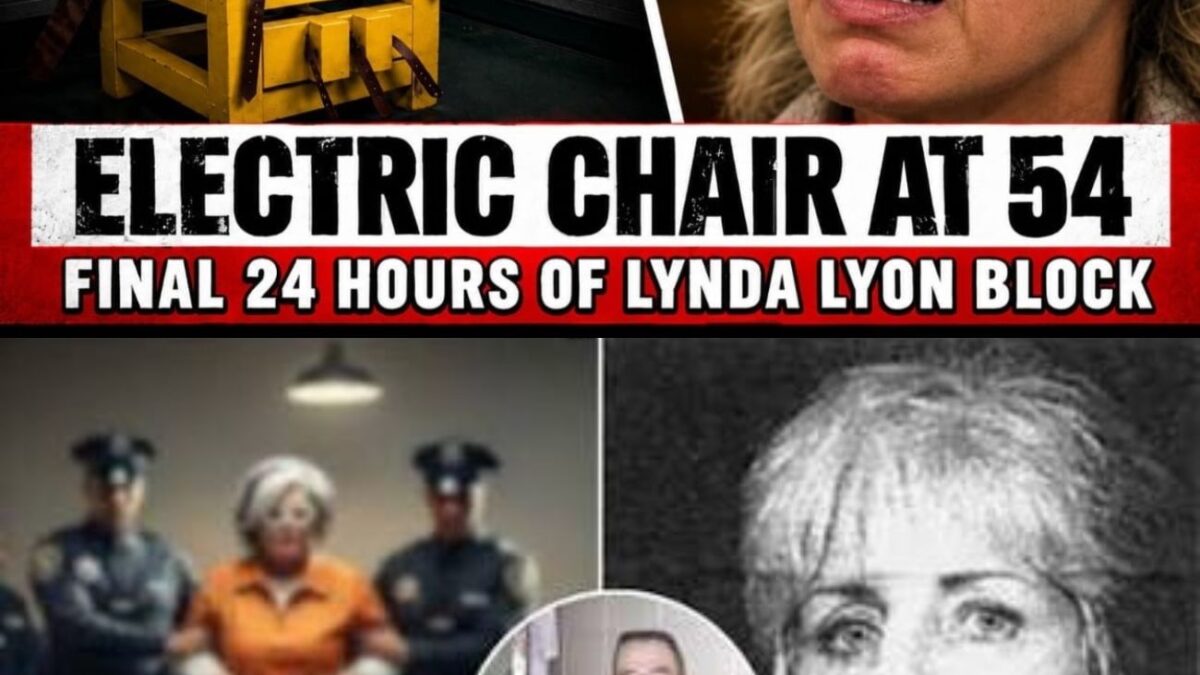
Life on death row is not living; it is merely existing. On May 10, 2002, just moments past midnight, Lynda Lyon Block was led into Alabama’s execution chamber. She was fifty-four years old, a mother, and a grandmother.
Awaiting her inside the room was a notorious wooden electric chair painted in bright yellow, nicknamed “Yellow Mama.” Block had spent over seven years on death row anticipating this exact outcome. Her execution marked the first time Alabama had executed a woman in forty-five years.
It also made her the final inmate to be put to death in that historic electric chair. Yet nine years earlier, none of this tragic conclusion was foretold. To understand how Lynda Lyon Block ended up in that chamber, one must look back at her life and the fatal encounter that shattered multiple families.
Born in Orlando, Florida, in 1948, Lynda spent decades attempting to navigate a conventional life. By her mid-forties, she was divorced and raising a young nine-year-old son. She eventually entered into a relationship with George Sibley, a man who shared her deep anti-government philosophies.
Together, the pair rejected the legal authority of state and federal institutions. Their radical beliefs soon brought them into direct conflict with law enforcement in Florida. Following an altercation involving Lynda’s former husband, both Block and Sibley were arrested and subsequently entered no-contest pleas.
When the time arrived for their formal court sentencing, they refused to appear. The judge issued warrants for their immediate arrest. Fleeing the jurisdiction instead of surrendering, Block and Sibley took her young son and disappeared onto the open highway.
On October 4, 1993, the fugitives drove into Opelika, Alabama. They pulled into a busy Walmart shopping center parking lot to use the amenities. Lynda stepped out to place a call at a public payphone nearby.
Meanwhile, Sibley remained inside the parked car with her nine-year-old son. A passerby named Ramona Robertson walked past the vehicle and heard the boy calling out for assistance. Disturbed by what she witnessed, Robertson kept a close eye on the vehicle as it relocated toward the store entrance.
Moments later, Opelika Police Sergeant Roger Lamar Motley Jr. exited a nearby shop in full uniform. He was there purchasing routine supplies for the department. Robertson flagged down the officer, explained her concerns, and provided him with the car’s license plate number.
Sergeant Motley decided to perform a welfare check on the child inside the vehicle. He tracked down the car and approached the driver’s side. Sibley immediately stepped out of the vehicle to confront him.
When Sergeant Motley requested to see his driver’s license, Sibley refused.
“I do not recognize the authority of the state,” Sibley declared. “I have no need for identification.”
The tone of the interaction instantly soured into hostility. Sibley reached back into the car, drew a semi-automatic handgun, and opened fire on the officer. Sergeant Motley immediately returned fire and scrambled behind his cruiser for cover.
Hearing the gunfire from across the parking lot, Lynda dropped the payphone receiver and sprinted toward the confrontation. She carried a handgun inside her purse and drew it as she closed in on the scene. Believing Sibley was in mortal danger, she pointed her weapon at the officer and pulled the trigger.
Sergeant Motley found himself caught in a deadly crossfire from both assailants. Though severely wounded, he managed to scramble into his patrol car and radio for help. The vehicle drifted across the lot, colliding with several parked cars before coming to a stop near a store front.
Sergeant Motley sustained multiple gunshot wounds, including a fatal entry wound to his chest. Because the fatal bullet passed entirely through his body and was never recovered, forensic investigators could not determine which firearm inflicted the mortal strike. Lynda later admitted to firing three shots at the officer, and prosecutors maintained that her actions contributed directly to his murder.
Following the shooting, Block and Sibley retrieved the boy and fled the parking lot. Police units engaged in a brief pursuit that culminated in a roadblock on Wire Road in Auburn, Alabama. The officers successfully negotiated the release of the nine-year-old child from the vehicle.
A tense standoff ensued, lasting several hours while police negotiated with the pair inside the barricaded vehicle. Block and Sibley eventually surrendered without further bloodshed. Upon searching the car, investigators seized multiple firearms and large caches of ammunition.
Sergeant Roger Motley died of his injuries shortly after arriving at the hospital. He left behind a family and a law enforcement community devastated by the sudden violence.
“He went to the shopping center for routine supplies,” a colleague remarked during the investigation. “He was killed simply because he tried to check on a child.”
Block and Sibley were formally charged with capital murder. Throughout the legal proceedings, both defendants refused to acknowledge the legitimacy of the judicial system.
During court proceedings, Block and Sibley maintained that they had acted in self-defense against unlawful state aggression.
“The officer posed a threat to our lives,” Block asserted during questioning. “I fired because I believed my family was in immediate danger.”
The prosecution argued that Sibley initiated the gunfight and that Block willingly joined the assault. Prosecutors presented her admission of firing at the officer as definitive evidence of capital murder.
In December 1994, the jury found Lynda Lyon Block guilty of capital murder and recommended the death penalty. On December 21, 1994, the trial judge formally sentenced her to die. She was remanded to the Julia Tutweiler Prison for Women in Wetumpka, Alabama.
Over the next seven years on death row, Block’s anti-government conviction remained unwavering. She dismissed her court-appointed appellate attorneys and chose to represent herself.
“This court has no jurisdiction over me,” she repeatedly argued in handwritten filings. “Alabama has no legal right to try or sentence me.”
Despite her refusal to participate in standard appeals, Alabama law mandated an automatic review of all death sentences. The Alabama Court of Criminal Appeals subsequently affirmed her conviction and sentence. Meanwhile, George Sibley was also convicted of capital murder and sentenced to death in a separate trial.
As the years passed, the state prepared to carry out her execution. By 2002, Alabama had not executed a female prisoner since Rhoda Belle Martin in 1957.
Furthermore, Alabama was transitioning its primary execution method from electrocution to lethal injection. This transition meant Block’s scheduled execution would likely be the final time Yellow Mama was ever used.
Refusing to file standard legal stays, Block sent a handwritten request for clemency directly to Alabama Governor Don Siegelman.
“I request an independent panel to review the legal jurisdiction and claims of self-defense,” she wrote.
Governor Siegelman thoroughly reviewed the petition and ultimately denied the request for clemency. With no remaining legal appeals or stays in place, the execution order was finalized for May 10, 2002.
On the evening of May 9, 2002, Block spent her final hours visiting with personal friends and a spiritual adviser inside Holman Correctional Facility. She remained calm as midnight approached, offering no final appeals or legal challenges.
Shortly after midnight, prison guards escorted her into the execution chamber and strapped her into Yellow Mama.
When asked if she had any last words, Block remained silent.
At 12:01 a.m., the electric current was applied. Medical personnel examined her a few minutes later and officially pronounced her dead at 12:10 a.m. at the age of fifty-four.
Lynda Lyon Block became the last person in Alabama history to be executed via the electric chair . Following her execution, Alabama officially adopted lethal injection as its primary execution method .
What began as a routine welfare check on a child in a shopping center parking lot ended a tragic decade later, leaving a police officer dead and marking the final chapter for Alabama’s historic electric chair .

