Inside The Final 24 Hours of John Allen Muhammad + Last Meal + Last Words | D.C. Sniper….
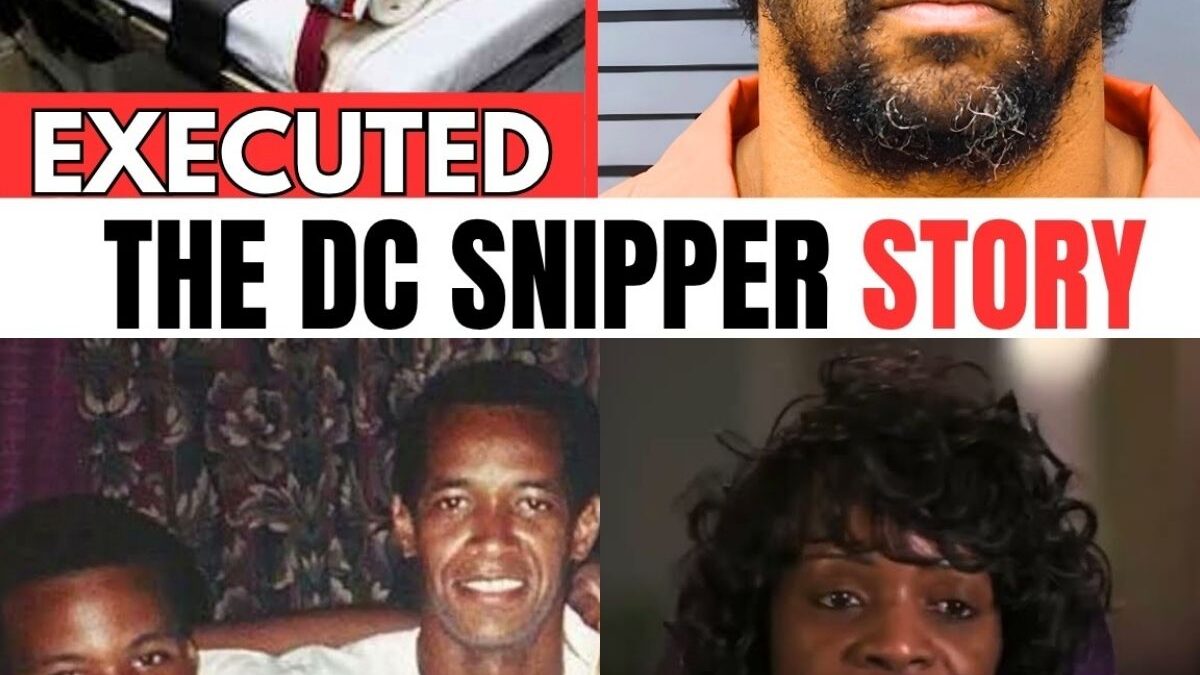
The man who would one day hold an entire metropolitan region hostage in the crosshairs of a modified rifle began life under the quietest of circumstances. He was born on the final day of December in 1960, inside the cold, utilitarian walls of a public charity hospital in Baton Rouge, Louisiana. His mother named him John Allen Williams, presenting the newborn into an America still deeply fractured by color lines, systemic neglect, and immediate economic hardship.
There were no elaborate celebrations greeting his arrival into the world, no proud father pacing the corridors distributing cigars to visiting relatives. His mother, Eva, shouldered the crushing weight of keeping the household upright, doing so with the fierce, unyielding endurance expected of poor Black women in the Jim Crow South. His father, Ernest Williams, was a fleeting, ghostly figure whose physical presence barely registered before he slipped entirely into the margins, leaving barely a signature behind.
The modest stability Eva managed to forge did not endure long against the realities of poverty and encroaching physical illness. While John was still a toddler, the family relocated from Baton Rouge down into New Orleans, a humid, turbulent city vibrating with jazz, industrial grime, and segregation. The move was an act of quiet desperation tied directly to Eva’s declining health, an effort to find family shelter as a malignant illness took root.
Doctors eventually diagnosed Eva with advanced breast cancer during an era when medical care for poor, working-class Black patients was woefully deficient. She endured the disease without the benefit of cutting-edge therapies, specialized oncologists, or palliative care, withering away before the uncomprehending eyes of her young toddler. Eva Williams died when her son was only three years old, leaving him stranded before his memories of her could even solidify into permanent form.
Ernest Williams did not step forward to fill the void left by his dead wife, choosing instead to vanish from his child’s life entirely. He walked out the door, leaving behind no forwarding address, no child support, and no explanation that history ever recorded for his absolute abandonment. At three years of age, John Allen Williams had been rendered an orphan of fate and neglect, cast adrift in a city that offered very little mercy.
Rescue came not from institutions or social agencies, but through the frayed safety net of Southern kinship, where poverty was managed collectively. His maternal grandfather stepped into the void alongside an aunt, opening their cramped doors to take in the silent, motherless toddler. They provided him with the essentials of survival—a shared bed, plain meals, strict boundaries, and whatever strained affection remained after exhausting days of labor.
It was not an upbringing characterized by the dramatic, cinematic abuse that attracts child welfare workers or makes newspaper headlines later in life. Nobody starved him, nobody locked him away in dark cupboards, and nobody beat him to within an inch of his young life on the back porch. It was, rather, an existence forged atop an enormous, completely unacknowledged reservoir of profound grief, unfolding in a world that had zero patience for tears.
John grew up quiet, observant, and exceptionally careful, moving through home and neighborhood with the cautious calculation of someone who understood his precarious status. Teachers remembered him years later as a child who caused no disturbances and provoked no discipline, blending entirely into the faded background of his classrooms. To an adult eye, an obedient child is often mistaken for a happy child, masking the reality of an orphan learning never to draw attention to himself.
New Orleans in the mid-1960s was an unforgiving landscape for an impoverished, parentless Black boy walking the narrow streets of the Ninth Ward. Public amenities were rigidly segregated, neighborhood schools were chronically underfunded, and opportunities were rationed according to unyielding racial hierarchies. Survival demanded discipline and compliance, keeping one’s head lowered and following whatever arbitrary instructions were handed down from above to avoid trouble.
Such informal adoptions were commonplace across Southern Black communities during that era, where aunts and grandmothers quietly absorbed abandoned children without fanfare. Yet the widespread nature of the arrangement did not alleviate the quiet, biting trauma of knowing that one’s parents were simply gone forever. No school psychologist ever pulled John aside to unpack his grief, and no professional ever evaluated the silent, watchful boy for post-traumatic distress.
He learned instead the hard, practical lessons of abandonment: that the people who brought you into the world can vanish without warning, leaving you defenseless. He internalized the belief that the only true security lay in rigorous self-control, strict adherence to rules, and relying on no one else. As he grew into a lanky, athletic teenager, he cast about for a path that could deliver him from the dead-end prospects of his neighborhood.
In August 1978, at the age of seventeen, John Williams found the traditional refuge for young men who possessed neither capital nor family connections. He walked into an armed forces recruiting office and enlisted in the Louisiana Army National Guard, taking an oath to follow lawful military orders. He was assigned to the combat engineers, a branch that traded in brute physical labor, precise technical construction, and the mechanics of tactical destruction.
Combat engineers build the bridges, roads, and defensive fortifications that allow armies to advance, and they blow apart the terrain to deny enemy passage. It was meticulous, exhausting work, demanding obedience to complex instructions, absolute physical discipline, and an ability to tolerate unending, grinding physical repetition. For seven years, Williams performed his part-time duties reliably, earning standard promotions and proving himself an effective, dependable soldier within his unit.
His domestic life during this initial period reflected the search for normalcy and family stability that had eluded his own chaotic childhood. He met and married his first wife, Carol, and together they welcomed a son named Lindbergh, bringing a new sense of purpose to his routine. Yet the quiet life in Baton Rouge could not hold his ambition, and he increasingly viewed the armed forces as his true home.
On November 6, 1985, Williams made the leap from part-time guardsman to full-time active duty, committing himself entirely to the regular United States Army. The military gave him a structured reality where expectations were clearly posted, hierarchy was explicit, and personal history was erased beneath a standard olive-drab uniform. Over the next decade, the Army trained him across multiple technical specialties, molding him into a competent mechanic, truck driver, and metalworker.
He spent years rotating through typical Cold War and post-Cold War postings, assigned to engineer battalions stationed across the Pacific Northwest and California. He was stationed at Fort Lewis, Washington, with the 15th Engineer Battalion, then transferred to Fort Ord, California, before eventually cycling back to Fort Lewis. He turned wrenches on massive diesel engines, welded structural components, and moved heavy transport convoys along highway grids without disciplinary incident.
Nothing in his official personnel file suggested a future monster; he was simply Sergeant Williams, a capable non-commissioned officer who handled assigned tasks. Yet woven through his otherwise ordinary service records was a particular military qualification that stood out sharply against his mundane logistics and engineering background. Every soldier is mandated to qualify regularly with the standard-issue service rifle, with most settling for the baseline passing scores required to maintain rank.
Williams, however, demonstrated a natural, cold-eyed aptitude behind the sights of a rifle, consistently shooting at the very highest thresholds of military marksmanship. He earned the Expert Marksmanship Badge, mastering target acquisition, breathing control, trigger discipline, and ballistic compensation at extended ranges up to three hundred meters. It was not an elite sniper qualification, nor was it a classified black-ops assignment; it was merely an administrative fact recorded in his personnel file.
His first marriage broke down under the strain of military relocations, ending in divorce while he remained stationed in the damp forests of Washington State. In 1985, while running routine errands at a department store near Fort Lewis, Williams crossed paths with a young woman named Mildred Green. She would later recall his broad, captivating smile, his immaculate grooming, and the confident, polished charm that distinguished him from typical young recruits.
They courted, fell deeply in love, and married in 1988, embarking on what initially appeared to be a prosperous, harmonious military marriage. Over the coming years, their family grew to include three children—a son and two daughters—filling their home with juvenile energy and domestic ambition. By all external measures, John Allen Williams had successfully rewritten the grim script handed to him in that impoverished Baton Rouge charity hospital.
He was a respected non-commissioned officer earning a reliable federal paycheck, a devoted husband, and an extraordinarily attentive father to his young children. Those who knew him during this golden hour observed a man who took pride in orchestrating family games and providing absolute material security. His son would later remember that his father made them feel cherished and protected, showering them with equal love and continuous personal engagement.
Then, in August 1990, the geopolitical landscape fractured when the Iraqi armed forces under Saddam Hussein invaded and occupied the oil-rich nation of Kuwait. The United States assembled a vast international coalition, mobilizing hundreds of thousands of active-duty troops and reserve units for Operation Desert Shield. Williams was among the soldiers issued combat gear, packed into transport aircraft, and deployed to the arid expanse of Saudi Arabia.
When the aerial bombardment transitioned to the ground campaign of Operation Desert Storm in early 1991, Williams moved forward into the combat theater. His specific unit was tasked with a dangerous, nerve-wracking mission: clearing supply lanes and locating and demolishing abandoned Iraqi chemical weapon caches in the desert. It lacked the theatrical glamour of armored breakthroughs, but it required handling volatile munitions where a single error meant catastrophic, horrific chemical contamination.
He returned home bearing the Southwest Asia Service Medal with two bronze service stars, alongside the Kuwait Liberation Medals issued by Saudi Arabia and Kuwait. To the external eye, he was a decorated veteran who had served his country honorably in a lightning war that rallied widespread public pride. Yet the man who stepped off the military transport at Fort Lewis was fundamentally and irrevocably altered from the one who had deployed.
Friends, comrades, and his wife observed a chilling transformation, noting that the warm, approachable demeanor of the pre-war sergeant had hardened into something brittle and menacing. The military medical infrastructure of 1991 possessed neither the diagnostic sophistication nor the institutional will to address subtle manifestations of post-traumatic stress. He had survived the chemical pits and oil fires of Iraq, but the psychological fabric binding his discipline together had begun to rapidly fray.
Mildred would later describe him as returning with a profound, simmering fury that lacked any rational target, coupled with disorienting bouts of paranoia and detachment. He grew intensely controlling within the domestic sphere, obsessing over household details, isolating his wife, and demanding complete, unquestioning submission from everyone around him. He engaged in brazen extramarital affairs, shedding his moral discipline while reacting with explosive fury whenever Mildred confronted him about his deteriorating conduct.
Williams served out the remainder of his military commitment in a state of quiet internal estrangement, his domestic life slowly sliding toward catastrophe. On April 26, 1994, he was honorably discharged from the United States Army at the rank of sergeant, concluding sixteen years of military service. His discharge papers, form DD-214, recorded an honorable exit and a solid list of administrative awards, masking the simmering instability within his mind.
Seeking an anchor in the aftermath of his military discharge, Williams leaned deeper into an ideological transformation that had begun several years earlier. In 1987, while still on active duty, he had formally joined the Nation of Islam, a Black nationalist and religious movement founded in America. For a man who felt alienated by mainstream institutions, the movement’s emphasis on strict discipline, male authority, and racial solidarity held immense psychological appeal.
He eventually embraced the faith so completely that he shed his ancestral surname, Williams, which he viewed as a slave-master label imposed on his lineage. He replaced it with Muhammad, claiming an identity grounded in chosen religious brotherhood, though he would not formally legally file the paperwork until late 2001. In October 1995, he traveled to Washington, D.C., proudly serving as a volunteer security guard during Louis Farrakhan’s historic Million Man March.
He patrolled the National Mall in crisp formal attire, providing order within the capital city he would return to terrorize precisely seven years later. It must be noted, however, that the Nation of Islam as an institution never sanctioned, preached, or encouraged the murderous violence he later unleashed. When his identity was revealed in 2002, Nation of Islam leadership immediately and unequivocally condemned his actions, repudiating him as an apostate and criminal.
Whatever poisonous radicalization consumed John Allen Muhammad, it emerged from his personal grievances, warped ego, and internal breakdown rather than any organized theology. His conversion provided him with a solemn new identity and a temporary fraternity, but it proved utterly incapable of stabilizing his collapsing personal life. Back in Tacoma, Washington, his marriage to Mildred deteriorated into a nightmare of threats, psychological terror, and volatile domestic confrontation.
Mildred finally reached her breaking point, packing his belongings, changing the locks on their residence, and demanding that he leave her life for good. Muhammad did not accept the rejection with remorse or maturity; instead, he confronted her with a cold, terrifying promise that chilled her blood.
“You are not my wife anymore,” he told her during an argument. “You have become my enemy, and I am going to kill you.”
Recognizing that her husband’s military precision made him uniquely dangerous, Mildred took immediate, decisive action to safeguard herself and the three children. She changed their unlisted telephone numbers, secured safe locations, and obtained a formal restraining order against him through the local municipal court system. Under federal domestic violence laws, that restraining order should have legally prohibited Muhammad from purchasing, owning, or possessing any firearms whatsoever.
In practice, the legal restraining order proved to be little more than a worthless scrap of paper against a determined, militarized stalker. He tracked her movements across the city, appearing unannounced in parking lots, sitting outside her house at odd hours, and violating every boundary she attempted to establish. The couple’s formal divorce was finalized in 1999, but the legal decree merely shifted their ongoing combat into the volatile arena of family court.
The dispute centered entirely on the legal and physical custody of their three young children, whose lives became pawns in Muhammad’s escalating campaign of vengeance. Because the protective order explicitly covered Mildred but omitted the children, the family court judge granted Muhammad alternating, unsupervised weekend visitation rights pending the final custody trial. The family court was operating on the naive legal fiction that a man who openly promised to murder his wife was somehow a safe parent.
In the spring of 2000, while the formal custody determination was still pending, Muhammad engineered an audacious, devastating blow against his former wife. Exercising his standard weekend visitation, he packed the three children into a car, severed all communication with their mother, and vanished into thin air. He fled the United States entirely, boarding flights that carried him and the three bewildered children to the Caribbean island of Antigua.
For eighteen agonizing months, Mildred Muhammad lived in a bottomless abyss of terror, having no idea where her children were or if they were alive. She visited empty playgrounds, stared at their abandoned bedrooms, and pleaded with local law enforcement agencies that treated the international kidnapping as a civil dispute. She fell to her knees daily in private prayer, powerless against the knowledge that her militarized ex-husband held absolute dominion over their offspring.
Down in Antigua, Muhammad operated completely off the grid, surviving through fraudulent credit card schemes, stolen identities, and black-market immigration documentation. He enrolled the children in local schools under false pretenses, posing as a dedicated single father seeking a peaceful tropical life away from American corruption. Yet beneath his self-righteous exterior, his financial resources were dwindling, and his ability to maintain the elaborate charade was breaking down under scrutiny.
It was during this period of Caribbean exile that Muhammad encountered a destitute, alienated Jamaican teenager named Lee Boyd Malvo. Malvo’s life had been a tragic procession of abandonment, shifted between relatives in Kingston while his mother chased unstable employment opportunities across the Caribbean. He was an adolescent starving for guidance, structure, and emotional validation, wandering the margins of Antigua with no reliable father figure to anchor his existence.
Muhammad recognized the boy’s deep vulnerability and swiftly moved to fill the emotional vacuum, providing him with food, clothing, and calculated personal attention. He looked the neglected teenager in the eye, praised his intelligence, and made him feel seen, valued, and important for the first time in his life. Muhammad possessed a manipulative, magnetic charisma with vulnerable youths, presenting himself as a wise, combat-tested patriarch capable of teaching them how to master the world.
Malvo succumbed completely to Muhammad’s hypnotic influence, adopting his surname, calling him father, and looking upon him with near-religious devotion and blind obedience. Investigators who later studied their relationship recognized it as a textbook case of severe psychological grooming and deliberate coercive control. Muhammad methodically severed Malvo’s ties with his mother, filled his mind with anti-American propaganda and apocalyptic ideology, and reshaped him into a weapon.
Malvo would later tell investigators that Muhammad had systematically dismantled his conscience, taking a gentle boy and deliberately reconstructing him into a cold-blooded monster. The dynamic was chillingly symmetrical: a man abandoned by his own father at age three had found an abandoned teenager and groomed him into an instrument of murder. While Muhammad was molding Malvo into a loyal soldier, American federal authorities were finally closing in on the international parental kidnapping in Antigua.
In August 2001, local Antiguan authorities, alerted by American law enforcement, detained Muhammad and returned him and the three children to the United States. A harrowing custody trial immediately convened before a family court judge in Tacoma, Washington, laying bare Muhammad’s instability, deceptions, and criminal conduct. On September 4, 2001, the court issued its final, devastating ruling: Mildred Muhammad was awarded sole, permanent legal and physical custody of all three children.
Muhammad was stripped of all visitation rights, denied access, and cast out of the courtroom with nothing left of the family he had tried to control. It was an absolute, humiliating defeat, shattering his fragile self-image as the omnipotent family patriarch who dictated terms to everyone in his orbit. Seven days later, on September 11, 2001, commercial airliners hijacked by Al-Qaeda terrorists slammed into the World Trade Center towers and the Pentagon.
The juxtaposition of those two events in the calendar of September 2001 acted as a catastrophic accelerant upon Muhammad’s already destabilized, rage-filled psyche. While the rest of the nation recoiled in horror, Muhammad openly praised the devastating attacks, expressing awe and deep admiration for Osama bin Laden. Acquaintances would later testify that he viewed the mass destruction of 9/11 not as an atrocity, but as an operational blueprint for asymmetric terror.
Whether his subsequent actions were driven by radicalized political fanaticism or by the wounded fury of an abusive husband remains a central debate of the case. In all probability, the two motivations fused into a single, toxic psychosis; an abandoned man consumed by hatred for the society that had thwarted him. Stripped of his children, his military stature, and his domestic dominion, John Allen Muhammad decided to declare his own private, asymmetric war upon the United States.
What followed throughout late 2001 and early 2002 was a descent into nomadic, parasitic drifting across the periphery of American society. Muhammad summoned Malvo from the Caribbean to join him in Washington State, entering the United States illegally through the porous borders of the Pacific Northwest. Together, the middle-aged veteran and the impressionable teenager lived out of squalid homeless shelters, including the Lighthouse Mission in Bellingham, Washington.
Malvo dropped out of school entirely, spending his days listening to Muhammad’s ideological lectures and training rigorously under his instruction in local parks. Muhammad drilled the boy in physical conditioning, dietary restrictions, covert surveillance, and basic infantry tactics, demanding absolute adherence to his strict operational routines. From that homeless shelter in Bellingham, the pair embarked upon a violent, cross-country odyssey that would leave a trail of unsolved bloodstains across the continent.
Operating beneath the radar of law enforcement, Muhammad acquired an illegal Bushmaster XM-15 semi-automatic rifle from a gun store in Tacoma. The weapon, a civilian variant of the military M16 rifle he had mastered in the service, was stolen directly off the showroom racks. Armed with the high-powered rifle and thousands of rounds of .223 ammunition, the duo began moving across the southern and western United States, killing without warning.
Retrospective ballistic analysis and subsequent confessions would eventually tie the pair to homicides and armed robberies spanning at least ten different states. In Arizona, Louisiana, Alabama, and Georgia, unsuspecting individuals were ambushed and executed in broad daylight outside convenience stores, package shops, and golf courses. In Montgomery, Alabama, during a robbery at a local liquor store, two women were gunned down at close range, leaving one dead and another critically wounded.
Local police departments investigated each shooting as an isolated incident of regional street violence, never imagining that the disparate crimes were connected by a single vehicle. Then, on September 11, 2002—exactly one year after the attacks on the Twin Towers—Muhammad executed the next phase of his operational plan. In Trenton, New Jersey, he purchased a used 1990 blue Chevrolet Caprice sedan, an old commercial fleet vehicle that blended invisibly into highway traffic.
The massive sedan was immediately driven to a secluded location where Muhammad employed his military metalworking and engineering skills to modify the chassis. He cut a circular hole through the steel trunk lid, just above the license plate frame, concealed behind a magnetic decal and dark tinting. He removed the rear passenger seats, constructing a reinforced, carpeted platform that allowed a shooter to lie prone completely concealed within the trunk cavity.
A sniper lying inside the dark trunk could peer through the opening, rest the heavy rifle on a rubberized mount, and acquire targets silently. The victim would fall hundreds of feet away, the muzzle flash and blast muffled inside the steel vehicle body, while external observers saw only a parked car. It was an exceptionally lethal, completely mobile urban sniper platform, designed to operate in plain sight in crowded commercial parking plazas and busy transit corridors.
By late September 2002, Muhammad and Malvo had navigated the modified Chevrolet Caprice down into the sprawling suburbs surrounding Washington, D.C. They parked at transit centers, scouted highway entry ramps, and selected commercial strip malls situated near interstate freeways to facilitate instant, undetected escapes. On the crisp evening of Wednesday, October 2, 2002, their coordinated campaign of terror against the National Capital Region began in earnest in Montgomery County, Maryland.
At 5:20 p.m., a high-velocity .223 bullet tore through the front plate-glass window of a Michaels craft store in Aspen Hill, narrowly missing a cashier. Nobody was injured, and local police initially treated the shooting as random vandalism, unaware that the snipers were merely zeroing their rifle optics. The true horror erupted less than an hour later, at 6:04 p.m., across the county line in Wheaton, Maryland.
Fifty-five-year-old James Martin, a program analyst for the National Oceanic and Atmospheric Administration, was crossing the parking lot of a Shoppers Food Warehouse. A single bullet struck him in the back, tearing through his internal organs and dropping him dead onto the asphalt before anyone could react. No shooter was visible, no vehicle accelerated away in panic, and the single, thunderous gunshot echo left bystanders looking wildly in every direction.
The following morning, Thursday, October 3, brought a slaughter that shattered the complacency of suburban Maryland and gripped the region with unprecedented fear. Within the span of two hours and fifteen minutes, four human beings were murdered in separate commercial parking lots across Montgomery County. At 7:41 a.m., James L. Buchanan, a landscaper, was shot dead while mowing the grass lawn outside a car dealership on Rockville Pike.
At 8:12 a.m., Premkumar Walekar, a sixty-year-old taxi driver, was killed instantly while pumping gasoline into his vehicle at an Aspen Hill service station. Thirty-nine minutes later, at 8:51 a.m., Sarah Ramos was shot in the head while reading a book on a bench outside a Glenmont shopping center. At 9:58 a.m., Lori Ann Lewis-Rivera was gunned down while vacuuming her van at a Shell station in Kensington, dying beside her quarters.
Later that same evening, at 9:20 p.m., the killers struck again along Georgia Avenue in Washington, D.C., fatally shooting Pascal Charlot as he crossed the street. Five dead in a single morning, followed by a sixth that night, all executed by single, highly accurate, high-velocity rounds fired from invisible distances. The realization washed over law enforcement: an elusive, highly skilled serial sniper was stalking the civilian population of the nation’s capital.
Over the next three weeks, the Baltimore-Washington metropolitan area devolved into an absolute state of psychological siege and civilian paralysis. The sniper did not discriminate by age, race, gender, or profession, striking individuals engaged in the most mundane, defenseless rituals of everyday suburban life. People were shot pumping fuel at Sunoco stations, carrying purchases to their cars, and boarding public transit buses along tree-lined parkways.
Daily routines that millions had taken for granted for decades transformed overnight into calculations of mortal danger and agonizing anxiety. Motorists crouched behind open car doors while fueling, ducking low to present smaller silhouettes, or ran in zig-zag patterns across open parking lots. Gas stations hung massive blue tarps and canvas sheets across their pump islands to block the sightlines of unseen shooters lurking in surrounding woods.
School systems across Virginia, Maryland, and the District of Columbia canceled all outdoor recesses, athletic events, field trips, and after-school sports competitions. Children were held inside shuttered classrooms with drawn blinds, walking between school buses and heavy steel entrance doors under the guard of armed police officers. The sniper had stripped away the fundamental premise of safety, making every citizen feel that a rifle crosshair was hovering over their chest.
On the morning of October 7, the killers violated an implicit social boundary that escalated the public’s terror to near-hysterical proportions. In Bowie, Maryland, thirteen-year-old Iran Brown was arriving for classes at Benjamin Tasker Middle School, accompanied by his aunt who had driven him. As the young boy stepped out of the vehicle and walked toward the school entrance, a single .223 round struck him directly in the chest.
The bullet shattered several ribs, lacerated his diaphragm, spleen, and pancreas, and left him bleeding profusely on the sidewalk before teachers dragged him inside. Miraculously, trauma surgeons at Children’s National Medical Center saved the boy’s life, but the psychological message to the public was catastrophic. The invisible predator was willing to murder children on school grounds, confirming the terrifying fear that no sanctuary existed anywhere in the region.
Searching the wooded buffer zone near the middle school, investigators discovered a cleared firing position that yielded the first direct communication from the killers. Pressed into the mud was a tarot card—the Death card—bearing handwritten inscriptions across its surface in erratic, block lettering. On the front, the sniper had written a chilling operational boast:
“Call me God.”
On the back of the card, the message contained a demand for law enforcement:
“For police, meme code: Do not release this to the press.”
The discovery confirmed that the shooters were closely monitoring news broadcasts, taunting the multidisciplinary task force assembled to track them down. Law enforcement, led by Montgomery County Police Chief Charles Moose, found themselves navigating a crushing media circus while coordinating thousands of federal, state, and local agents. Yet their investigations were severely hampered by a catastrophic investigative red herring that dominated the early weeks of the search.
Multiple traumatized witnesses at various crime scenes reported catching glimpses of a white box truck or a light-colored delivery van fleeing the areas. Law enforcement latched onto this detail, broadcasting alerts across regional highway message signs urging motorists to report suspicious white cargo vans. Thousands of white commercial vans were pulled over at gunpoint, creating massive traffic gridlocks across Interstate 95 while the killers slipped through unnoticed.
Muhammad and Malvo were not driving a white delivery truck; they were cruising through police cordons in a dark blue, low-profile passenger sedan. Police officers actually stopped the Chevrolet Caprice multiple times during the three-week siege for minor traffic inquiries or during sweeping highway checkpoints. Because the vehicle description did not match the broadcasted white van, and because the trunk modifications were invisible, the officers checked IDs and sent them on.
On October 14, forty-seven-year-old Linda Franklin, a respected FBI intelligence analyst, was loading purchases into her vehicle outside a Home Depot in Falls Church, Virginia. She stood beside her husband in the bright lighting of the covered parking garage, carrying rolls of plywood and household hardware. A single round struck her in the head, killing her instantly in front of her spouse and sending hundreds of shoppers screaming into the aisles.
Five days later, on October 19, thirty-seven-year-old Jeffrey Hopper was shot in the stomach as he walked to his car outside a Ponderosa Steakhouse in Ashland, Virginia. In the woods behind the restaurant, search teams recovered an empty shell casing and a plastic bag tacked to a tree containing a three-page handwritten letter. The letter demanded ten million dollars, to be transferred to an unlinked debit card, threatening continuous slaughter if demands were ignored.
The letter closed with a line that sent shockwaves through the command post:
“Your children are not safe anywhere, at any time.”
The extortion demand introduced a bizarre, calculated dimension to what had appeared to be purely ideological or thrill-seeking serial violence. Phone calls placed to police dispatch centers and negotiations hotlines featured an agitated male caller demanding immediate wire transfers to offshore accounts. Federal audio analysts would later examine those recorded calls and definitively match the cadence, timbre, and vocal profile to John Allen Muhammad.
Yet Mildred Muhammad remained convinced that the money, the tarot cards, and the sniper terror were all designed to mask an intensely personal goal. In memoirs, lectures, and interviews following the tragedy, she detailed her terrifying conviction that she was the ultimate, intended target of the campaign. She had gone into hiding in Clinton, Maryland, living in quiet terror, constantly checking windows and praying her ex-husband would not locate her address.
Her theory posited that Muhammad planned to gun her down in a local parking lot, allowing her murder to blend invisibly into the sniper crisis. With Mildred dead, he could step forward as an innocent, grieving father, reclaiming the three children he had been denied by the family court. Multiple sniper attacks occurred within short driving distances of retail stores she frequented, a chilling geography she refused to dismiss as mere coincidence.
While state courts never formally affirmed this domestic-murder theory as the exclusive motive, prosecutors acknowledged that multiple psychological motivations likely fueled his actions. Muhammad was a broken, controlling patriarch seeking to avenge his domestic defeat, humiliate the government that stripped his rank, and extort wealth through asymmetric warfare. The financial blackmail, the ideological posturing, and the murderous vendetta existed together within a fractured mind that saw society as an enemy.
The sniper’s hubris ultimately provided the crucial breakthrough that cracked the investigation wide open. During one of the recorded phone calls to the task force, the caller grew frustrated with technical failures and shouted at the police operator to check their files.
“Check with the police in Montgomery, Alabama!” the voice commanded. “They know who we are!”
Investigators immediately contacted the Montgomery Police Department, pulling files on recent, unsolved violent crimes that might contain clues. They focused on the September 21 shooting outside a local ABC liquor store, where a robbery had turned deadly, leaving two women gunned down. Responding detectives in Alabama had recovered a discarded gun catalog and a spent magazine dropped near the scene by a fleeing suspect.
Technicians had lifted a pristine, latent fingerprint from the surface of that magazine, running it through state databases at the time without finding a match. Armed with the new lead, federal examiners ran the print through national databases maintained by the Immigration and Naturalization Service. The print belonged to Lee Boyd Malvo, who had been fingerprinted months earlier during immigration detention proceedings in Washington State.
Federal agents pulled Malvo’s complete alien file, discovering that the Jamaican youth was consistently linked to an older American guardian: John Allen Muhammad. Agents immediately obtained Muhammad’s military records, uncovering his expert marksmanship qualifications and his prior domestic violence protective orders in Washington State. Within hours, the narrative shifted from an amorphous, phantom sniper in a white truck to two specific individuals with names and faces.
Investigators executed a search warrant at a home in Tacoma, Washington, where Muhammad had recently stayed, searching the backyard for ballistic evidence. In the damp soil beneath a cedar tree, agents recovered spent .223 caliber shell casings and dug fragments of lead out of a tree stump used for target practice. Ballistic microscopes confirmed the horrifying match: the striations on those bullets were identical to the rounds that had slaughtered civilians in Maryland and Virginia.
On October 23, law enforcement identified the vehicle registered to John Allen Muhammad: a 1990 blue Chevrolet Caprice bearing New Jersey license plates. Chief Moose held a nationwide press conference, announcing that Muhammad and Malvo were wanted for questioning and issuing a regional alert for the blue Caprice. The invisible killers had been stripped of their operational camouflage; their descriptions and vehicle data were broadcast to millions of television screens.
The end came swiftly, quietly, and without a single shot fired, mere hours after the public alert was transmitted across the eastern seaboard. In the early morning hours of October 24, a truck driver named Ron Lantz pulled his rig into an Interstate 70 rest stop near Myersville, Maryland. Glancing across the parking lot, Lantz spotted a blue 1990 Chevrolet Caprice parked quietly beneath the trees, its windows fogged with condensation.
Recognizing the license plate from the emergency broadcasts, Lantz and another driver blocked the rest stop exit with their tractor-trailers and called 911. Tactical units from the Maryland State Police, the FBI, and the ATF converged on the rest stop, surrounding the sedan in the dark. At 3:19 a.m., federal SWAT operators smashed through the windows, deploying flashbang grenades and dragging the two occupants out into the gravel.
Muhammad and Malvo had been fast asleep inside the vehicle, completely unaware that their reign of terror had run its course. Inside the Caprice, investigators discovered the grim instruments of their trade: the modified trunk with its concealed shooting port, a Bushmaster .223 rifle, and thousands of ammunition rounds. They also recovered a laptop computer containing digital mapping software marked with GPS coordinates of past shooting locations and prospective future targets.
The three-week siege that had claimed ten innocent lives and critically wounded three others in the Washington area was finally over. When combined with their prior interstate cross-country attacks, the body count linked to the pair rose to at least seventeen dead. The nation breathed an enormous sigh of collective relief, but the criminal justice system now faced the task of holding the killers legally accountable.
Although the majority of the capital-area homicides occurred within Maryland, federal authorities intervened to direct the prosecutorial venue. United States Attorney General John Ashcroft ordered that Muhammad and Malvo be prosecuted first within the Commonwealth of Virginia, specifically Prince William County. The strategic calculation was clear: Virginia law possessed robust capital murder statutes and a proven record of carrying out death sentences swiftly compared to Maryland’s appeals system.
Muhammad was formally indicted for the October 9 murder of Dean Harold Meyers, who had been shot through the heart while pumping gas in Manassas, Virginia. To ensure a fair trial unpolluted by local trauma, the proceedings were moved three hundred miles south to the coastal city of Virginia Beach. When the trial commenced in October 2003, Muhammad stunned the courtroom by dismissing his court-appointed defense attorneys and announcing he would represent himself.
Wearing a sharp business suit, he stood before the jury box and delivered an awkward, rambling opening statement, attempting to project professional legal authority.
“I had nothing to do with these shootings,” he insisted to the jurors. “You will see that the evidence does not show what the prosecution claims.”
Realizing his profound out-of-depth limitations against experienced capital prosecutors, he abandoned his self-representation after just two days, reinstating his legal team for the trial’s remainder. Prosecutors called over 130 witnesses and introduced more than 400 separate physical exhibits, laying out a devastating web of forensic and circumstantial evidence. They demonstrated how the Bushmaster rifle matched the fatal bullets, presented the modified shooting platform inside the Caprice, and played the authenticated extortion phone calls.
The defense team mounted an argument based on a narrow technical reading of Virginia’s capital murder statute, which required proof that the defendant was the triggerman. They pointed out that Malvo’s fingerprints were all over the rifle and that no witness could prove Muhammad pulled the trigger on Meyers. They argued that while Muhammad may have directed the conspiracy, Virginia law restricted the death penalty solely to the person who fired the fatal shot.
The jury rejected the argument, recognizing that Muhammad’s operational mastery and psychological dominance made him equally culpable under Virginia’s anti-terrorism statutes. On November 17, 2003, the jury found John Allen Muhammad guilty of all four capital charges, including murder with the intent to terrorize the public. Following five hours of deliberation during the penalty phase, the jury unanimously recommended that he be sentenced to death.
On March 9, 2004, the presiding judge formally affirmed the jury’s verdict, sentencing Muhammad to die by lethal injection for his crimes. In April 2005, the Supreme Court of Virginia upheld the death sentence, with Justice Donald Lemons writing that Muhammad acted with calculations of extreme cruelty. Justice Lemons noted that the defendant demonstrated total contempt for human life, transforming ordinary public spaces into hunting preserves for innocent civilians.
In 2006, Muhammad was extradited to Montgomery County, Maryland, to stand trial for six additional homicides committed during the initial October 2002 spree. The Maryland trial provided a dramatic stage for the complete, public collapse of the bond between the former mentor and his adolescent protege. Lee Boyd Malvo, having undergone intensive psychological counseling and renounced his loyalty to Muhammad, took the witness stand to testify for the state.
Under oath, Malvo described the terrifying operational realities of their partnership, retracting his earlier claims that he had acted as the sole shooter. He explained that he had initially lied during his own trial to protect Muhammad from execution, believing his own status as a minor would save him. Now, looking directly across the courtroom at the stone-faced veteran, Malvo laid out the full, unvarnished horror of their multi-phase terror plan.
Malvo testified that Muhammad had envisioned a systematic, three-stage campaign designed to destabilize the social order of the United States. Phase one was the sniper campaign in Washington, where Muhammad had set an operational quota of murdering six white people per day for thirty days. Phase two was to take place in Baltimore, targeting a pregnant woman, then executing a responding police officer with a sniper shot.
At the officer’s public funeral, Muhammad planned to detonate multiple improvised explosive devices packed with shrapnel, slaughtering hundreds of mourning police officers and civilian officials. Phase three involved using the ten-million-dollar extortion ransom to finance a covert compound in Canada, recruiting isolated, fatherless young boys from group homes. Muhammad planned to train this private juvenile army in weapons handling, deploying them across American cities to unleash coordinated mass casualty attacks.
Whether this apocalyptic scenario was a concrete plan or the grandiose delusions of a malignant narcissist, it mirrored Muhammad’s militarized methods. The Maryland jury deliberated briefly before convicting him of six counts of first-degree premeditated murder, resulting in six consecutive life sentences without parole. The additional life sentences were largely symbolic, as Virginia held prior legal jurisdiction to carry out its capital judgment.
Over the final three years of his life, housed in a solitary cell on Virginia’s death row, Muhammad’s stoic exterior began to crack under pressure. In May 2008, he sent a handwritten letter to federal prosecutors, demanding that the state halt his appeals and execute him without delay.
“Help me stop these appeals,” he wrote in the letter. “Just let them murder this innocent Black man and be done with it.”
His attorneys continued to file appeals on his behalf, arguing that Muhammad suffered from severe brain damage, combat-related trauma, and psychotic delusions. They presented medical records showing neurocognitive deficits, claiming he had been mentally incompetent to waive counsel and represent himself during his Virginia capital trial. Every state and federal appellate court rejected the petitions, concluding that Muhammad possessed full rational comprehension of his crimes and punishment.
On September 16, 2009, a Prince William County judge signed the final death warrant, scheduling Muhammad’s execution for November 10, 2009. The final legal hurdle evaporated on November 9, when the Supreme Court of the United States denied his last petition for a stay of execution. Justices John Paul Stevens, Ruth Bader Ginsburg, and Sonia Sotomayor issued a statement regarding procedural timelines, but concurred that his claims lacked legal merit.
Virginia Governor Tim Kaine denied a final petition for executive clemency on the afternoon of November 10, sealing the prisoner’s fate. Under Virginia law at the time, condemned inmates were offered a choice between the electric chair and lethal injection; Muhammad refused to choose, defaulting to injection. He requested and received his final meal: steamed chicken with red sauce, assorted vegetables, and several slices of cake, consuming it quietly in his holding cell.
Shortly before 9:00 p.m. on November 10, 2009, Muhammad was escorted into the execution chamber at the Greensville Correctional Center near Jarratt, Virginia. He was strapped securely to the padded gurney, with intravenous catheter lines inserted into both arms by the medical execution team. When Warden Gene Johnson asked the condemned man if he wished to make any final statement, Muhammad stared straight up at the ceiling and said nothing.
He maintained absolute silence, his jaw muscles clenched tight, refusing to acknowledge the victims’ family members watching through the one-way glass observation window. Witnesses noted that his eyes remained wide and impassive, his left foot twitching slightly as the lethal cocktail of chemical drugs began flowing into his veins. The state’s lethal injection protocol commenced precisely at 9:06 p.m., inducing unconsciousness before arresting his respiratory and cardiac functions.
John Allen Muhammad was pronounced dead at 9:11 p.m. on November 10, 2009, at the age of forty-eight. His body was cremated, and his ashes were returned to his son in Louisiana, the state where his troubled journey had begun nearly a half-century before. Behind him lay a trail of shattered families, orphaned children, and a nation whose sense of public safety had been permanently altered.
Decades after his execution, the legacy of John Allen Muhammad continues to defy simplistic psychological categorization or convenient ideological labeling. He was a decorated military veteran who served his country honorably for sixteen years, mastering marksmanship skills that he later turned against civilian neighbors. He was a doting father who coached Little League teams, yet later kidnapped his children and engaged in domestic terror against their mother.
He was a religious convert whose destructive crusade was utterly rejected by the faith community whose name he had proudly adopted. He was an extortionist demanding millions through crude letters, yet also an ideological extremist who modeled his suburban terror campaign on international terrorist strikes. None of those contradictory facets cancel out the others; rather, they illustrate the complex, compartmentalized psychology of a real-world monster.
The true horror of John Allen Muhammad lies in the ordinary domestic spaces where he orchestrated his extraordinary crimes. He was not a creature of foreign shadows, but a product of American institutions: its military bases, its family courts, and its interstate highways. He transformed an ordinary used passenger sedan into an engine of death, lying prone in the darkness of a steel trunk, peering through a scope, waiting for a stranger to walk into his crosshairs.

