Homeless at 24, She Bought a Rusted $1 Tiny Cabin — What She Found Inside Shocked the Entire Town
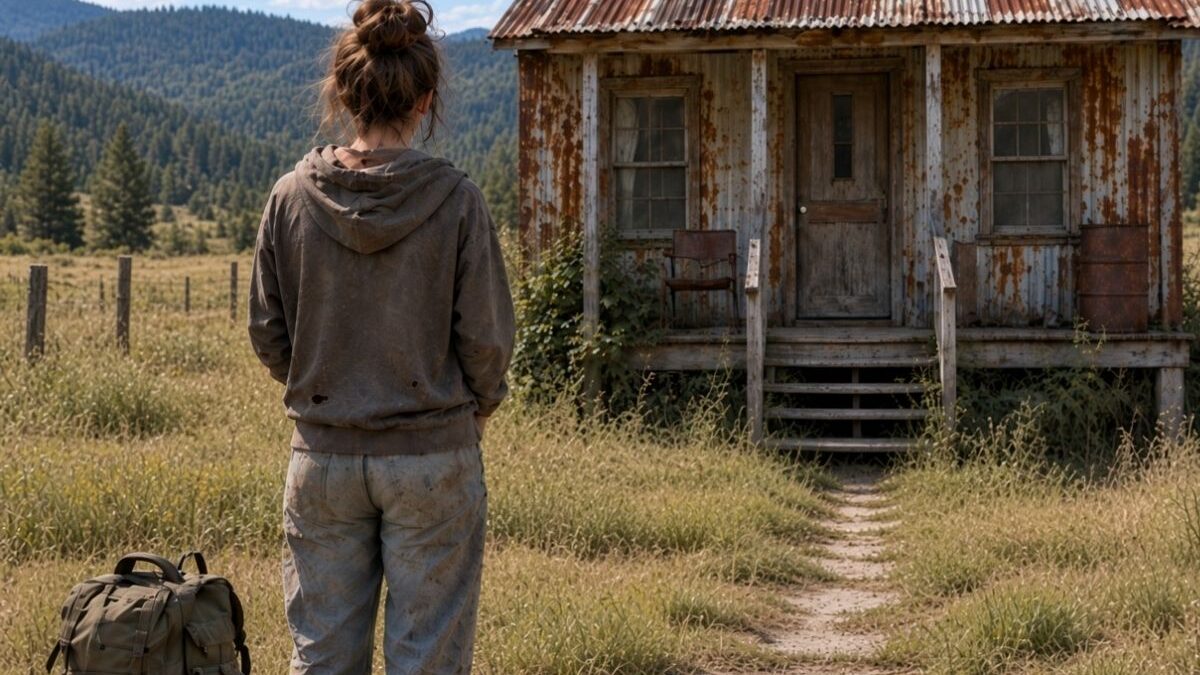
You have five minutes to drag your garbage off my porch before I call the cops,” her stepmother sneered, slamming the front door while her father watched from the window. Homeless at twenty-four, Maya bought a rusted $1 cabin—unearthing a hidden secret under the floorboards that stunned the entire county.
Part 1: The Cold Front
The sleet was turning the driveway into black glass the night Brenda threw Elena’s sewing machine into the mud.
It hit the gravel with the hollow, metallic crunch of cracked cast iron—the vintage Singer that Maya’s mother had kept running with sewing machine oil and stubbornness through three rounds of chemotherapy. Before Maya could even scream, the rest followed: four contractor-grade garbage bags stuffed with Elena’s winter coats, a shoe box of yellowed recipes written on index cards, and the chipped ceramic jewelry tray that had sat on her mother’s nightstand for twenty years.
“Don’t you look at me like that, Maya,” Brenda snapped. She stood framed in the warm doorway of the Modesto ranch-style house, wearing Elena’s favorite boiled-wool cardigan, her breath pluming in the damp California chill. “Your mother’s been dead twelve months. This isn’t a museum for a ghost. Me and your dad are building a life here, and we need the guest bedroom for my grandson when he visits. You’re twenty-four years old. You should have been out on your own three years ago instead of mooching off his grief.”
Maya stood in the freezing rain, her sneakers already soaked through. Her chest felt constricted, like steel bands were tightening around her ribs. “Mooching? I worked thirty hours a week at the lumber yard to pay for Mom’s hospice nurse so Dad wouldn’t lose his pension. She left this house to both of you—not to you!”
Brenda’s mouth twisted into a thin, triumphant smirk. She reached into the pocket of the cardigan, pulled out a folded packet of legal stationery, and tapped it against the doorframe.
“You might want to check the probate filing from Tuesday, sweetie. Your father quitclaimed his entire interest into our joint marital trust last week. The house is ours. The accounts are ours. And as of midnight tonight, your name isn’t on the homeowner’s policy.” Brenda stepped back and angled the door shut just enough to expose the living room behind her.
Sitting on the recliner, bathed in the blue glow of a cable news broadcast, was Maya’s father, David. He had his reading glasses perched on the tip of his nose, his coffee mug cradled in both hands. He didn’t turn around. He didn’t flinch when the screen door rattled. He simply stared ahead at the television, letting the woman he’d married seven months after his wife took her last breath erase every trace of the life they had built together.
“Dad?” Maya’s voice cracked, raw and desperate. “Dad, look at me! You’re letting her throw Mom’s things into the dirt!”
David’s shoulders hunched slightly, but he stayed rooted in that brown leather chair. He took a slow sip from his mug. He had always been a man who took the path of least friction, a man who treated peace like something you bought by surrendering an inch at a time until you woke up with nothing left to trade.
“He’s tired, Maya,” Brenda said quietly, her voice dropping into that sweet, poisonous register she reserved for cruelties. “And frankly, so am I. You have five minutes to drag your garbage off my porch before I call the cops for criminal trespass. If that rusty Honda Civic of yours is still parked on this curb when the clock hits nine, I’m calling a tow truck.”
The deadbolt turned with a heavy, final clack.
Maya stood alone under the sodium-vapor streetlamp. Rain dripped from her eyelashes, running salt-sour into her mouth. She didn’t cry. Crying was a luxury for people who had a warm bed to crawl into afterward. She bent down, grabbed the split handles of the soaked trash bags, hauled them into the backseat of her 2004 Honda Civic, and wrestled the shattered Singer sewing machine onto the floorboards. When she turned the key, the starter ground for four sickening seconds before the four-cylinder engine rattled to life, shuddering as the serpentine belt squealed against the damp.
She backed out of the driveway without touching the horn. As she shifted into drive, she caught a glimpse of Brenda standing in the kitchen window, already carrying a trash bin toward the hall closet.
Maya drove into the dark with fifty-eight dollars in her checking account, a cracked windshield, and the realization that the people who share your blood can leave you colder than the winter air.
Part 2: Asphalt and Cracked Glass
For the next four months, the Honda Civic was her bedroom, her kitchen, and her vault.
Living in a sedan teaches you the geometry of survival fast. You learn that parking under halogen supermarket lights keeps away the smash-and-grab prowlers, but it ruins whatever sleep you might manage between two and five in the morning. You learn to crack the rear passenger window exactly half an inch—enough to let out the condensation from your breath so the upholstery doesn’t mold, but not wide enough for a coat hanger or an arm to reach inside. You learn which fast-food bathrooms have single-stall locks, which gas station attendants don’t look at you funny when you buy a ninety-nine-cent tea just to fill a thermos with boiling tap water, and which parks allow you to sit on a bench with a notebook without the local cruisers slowing down to run your tags.
Maya found work where she could: a three-week stint stocking dry goods on the graveyard shift at a distribution center, two weeks washing prep trays at a commercial bakery until the night manager’s nephew needed the hours, and day-labor gigs hauling drywall scrap for independent remodelers. She managed to scrape together enough for a deposit on a tiny studio apartment behind a dry cleaner in Modesto—a narrow concrete box where the hot plate shared a breaker with the bathroom exhaust fan.
She thought she was climbing out. She budgeted every dollar: twenty-five for gas, forty for groceries, four hundred and fifty for rent.
Then the transmission in the Civic began slipping between second and third gear with a sound like grinding river rocks. Two weeks later, the dry-cleaning business folded, and a commercial developer bought the parcel. The new landlord served a thirty-day notice along with a three-hundred-dollar rent hike. When Maya went to the property office to plead for an extension until her next paycheck, the woman behind the desk didn’t even look up from her screen.
“Market rate adjustments are non-negotiable,” the clerk said, stamping a red slip. “The unit has to be vacant by the thirty-first. Anything left behind will be hauled to the county transfer station at the tenant’s expense.”
On the twenty-ninth, Maya came home from an eight-hour shift clearing brush along the irrigation canals to find the brass deadbolt replaced and her three plastic bins sitting on the curb next to the dumpster.
She loaded them back into the Civic. Her hands were blistered and black with dirt. She sat behind the steering wheel, resting her forehead against the worn plastic, listening to the radiator hiss. Her savings account stood at one hundred and twelve dollars. Her checking account held twelve dollars and forty cents.
She was twenty-four years old, utterly alone, and the city of Modesto had officially run out of room for her.
That night, parked in the gravel lot of a twenty-four-hour truck stop outside Salida, Maya connected to the complimentary Wi-Fi and opened the county surplus auction portal. She had been browsing the site for weeks, looking for cheap surplus tools—a circular saw, maybe an old drill press she could fix and flip for cash.
She scrolled past five rusted utility trailers, an abandoned commercial refrigeration unit, and a parcel of swampy drainage land in the delta. Then her thumb stopped.
ITEM #4088-H: UNINCORPORATED HARLOW COUNTY.
Structure on 0.40 Acres. Sold As-Is, Where-Is. No Utilities Verified. Tax Forfeiture / Surplus Transfer. Minimum Bid: $1.00.
The thumbnail photo looked like something pulled from a post-apocalyptic film. It showed a rectangular metal shell—corrugated steel panels, mismatched and oxidized into patches of rust-orange and barn red—slumped at the edge of an overgrown clearing. Blackberry briars grew up the sides like barbed wire. A chimney pipe jutted through the roof at a crooked angle. The single window visible in the frame was boarded over with rotted oriented strand board.
It was an eyesore. A discarded tin box sitting on a scrap of rock and scrub pine forty miles from anywhere.
Maya looked at her bank balance: $12.40.
She clicked Place Bid. The minimum was one dollar. She typed in seven dollars. Seven felt deliberate. Seven meant she wasn’t just throwing a coin into a fountain; it felt like an actual decision. She entered her debit card number, clicked submit, and leaned back against the headrest, closing her eyes as eighteen-wheelers rumbled past on Highway 99.
Three days later, an automated email landed in her inbox:
CONGRATULATIONS. You are the winning bidder for Item #4088-H. Deed processing fee waived under the Rural Homestead Relinquishment Act. Total due: $7.00. Report to the Harlow County Clerk’s Office within forty-eight hours to claim deed.
Part 3: The Edge of Nowhere
The drive took her deep into the foothills of Harlow County, where the sprawling orchards of the Central Valley gave way to dry scrub oak, buckeye trees, and winding two-lane roads cracked by drought. Harlow itself was barely a town—a crossroads with a flashing yellow signal, a feed and grain supply store with a porch lined with mineral blocks, a shuttered general store, and a small white Baptist church whose marquee read: God answers knee mail.
The county clerk’s office was located in a single-story brick annex behind the sheriff’s sub-station. The clerk, a woman named Clara with gray hair pinned up with a yellow pencil and reading glasses resting on her collarbones, squinted at the paperwork Maya slid across the counter.
“You’re Maya Sandoval?” Clara asked, her voice dry as parchment.
“Yes, ma’am.”
Clara took off her glasses, looked Maya up and down—taking in the faded flannel shirt, the work boots tied with paracord, and the dark circles under her brown eyes—and sighed. “Sweetheart, you know what you bought, right? You didn’t buy a home. You bought four-tenths of an acre of goat pasture and a rusted hunting shack that’s been sitting empty since before the pandemic. The county took it for non-payment of a six-hundred-dollar back-tax lien that nobody in the Purcell family cared to settle. There’s no power out there. No water meter. Road hasn’t been graded in five years.”
“Does the deed give me clear title?” Maya asked, keeping her voice level.
“Clear as pond water,” Clara said, stamping the parchment with an embossed county seal. “It’s yours. Nobody can run you off it. But if you freeze to death out there come November, don’t say the county didn’t give you fair warning.”
“Nobody’s running me off,” Maya said, taking the paper. “That’s all I care about.”
The directions on the tax map led her three miles past Harlow onto County Road 9, which shifted from cracked asphalt to gravel, and then from gravel to two dirt ruts with tall wild oats brushing against the undercarriage of the Civic. Twice, the muffler dragged against hardpan clay with a hollow scraping sound that made Maya wince.
She reached the end of the line where the ruts terminated at an overgrown turnaround.
The cabin sat fifty yards back, nearly swallowed by a tangled wall of wild Himalayan blackberry vines. In person, it was smaller and rougher than the auction photo had shown. It was roughly twelve feet wide by twenty feet long—built out of corrugated barn tin, salvaged timber headers, and sheets of mismatched corrugated iron held together with roofing screws and heavy-gauge galvanized nails. The roof sagged slightly near the front eve, and the cedar-plank front door hung askew on a single rusted strap hinge.
Maya stepped out of the car. The sudden silence was so complete it made her ears ring. There was no highway rumble, no sirens, no shouting neighbors, no footsteps on the floor above her head. Just the sound of wind moving through dry grass, the chirping of crickets down by an unseen gully, and the steady tick-tick-tick of the Honda’s cooling manifold.
She picked up a heavy oak branch from the ground to clear a path through the briars, swinging at the thorny runners until she reached the entrance. She set her boots on the single cinder block that served as a porch step and pushed the timber door open.
Inside, something dark and quick skittered across the warped plywood floorboards toward the far wall. Maya leapt backward, her heart hammering in her throat, almost tripping over the cinder block.
She stood there in the weeds for five minutes, chest heaving, clutching the branch like a club.
“It’s yours,” she whispered aloud to the empty hills. “Whatever’s in there, it’s yours now.”
She waited for the dust to settle, then stepped across the threshold.
The air inside smelled of dry cedar, old woodsmoke, and iron rust. The cabin consisted of a single room. In the far corner stood an old cast-iron woodstove, its vent pipe rising through a crude flashing collar cut into the tin ceiling. Against the left wall was a rough-cut fir workbench with a dry-rotted zinc basin set into the center, though there were no faucets or pipes attached. Sunlight slanted through the gaps in the wallboards, illuminating dancing motes of dust.
It was crude. It was dirty. It was completely disconnected from the modern world.
That first night, Maya couldn’t bring herself to lay her sleeping bag on the floor. She locked herself back inside the Honda Civic parked in the weed-choked turnabout, pulling Elena’s old wool coats over her legs. Frost formed on the inside of the glass around three in the morning, etching cold white feathers across the windshield. But when she woke at dawn and looked out at the rusted tin box sitting under the pink California sky, a strange feeling washed over her.
For the first time in five years, she didn’t owe anyone a single dime for breathing on that piece of earth.
Part 4: The Marbled Notebook
Progress started with an old broom Maya fashioned from dry pine boughs tied to an oak branch with wire she found near the fence line.
She swept five years of dried leaves, dead beetles, and mouse droppings through the open doorway. She dragged her plastic bins inside, setting them along the north wall. In the back right corner of the cabin, behind a warped sheet of three-quarter-inch plywood that had been propped up like a makeshift partition, she found a rough pine shelf secured to the wall studs with angle brackets.
Sitting on the shelf was a rectangular plastic food storage container, its lid snapped down tight.
Maya pried the yellowed plastic tabs open, half expecting to find rat poison or rotted seeds. Instead, lying inside, perfectly dry and smelling faintly of cedar shavings, was a standard black-and-white marbled composition notebook.
She opened the cover. Written on the inside flyleaf in faded blue ballpoint ink, in a tight, disciplined cursive that reminded Maya of an engineer’s drafting notes, were three sentences:
If you are reading this, you bought my place.
I’m sorry, and you’re welcome.
Here is everything I learned so you don’t have to freeze.
The notebook belonged to a man named Dale Purcell.
Maya sat down on an overturned drywall bucket, pulled her knees up to her chest, and began turning the pages. The journal wasn’t a diary of self-pity; it was an operator’s manual for staying alive on four-tenths of an acre of neglected hill country.
The first six pages were dedicated entirely to water.
“Forget about digging a well,” Dale had written. “Drill rig will charge you $12,000 before they hit granite, and you won’t find water until 350 feet. Look behind the cabin. Walk 210 paces directly north toward the twin live oaks. There is a fracture spring in the limestone shelf. I built a catch basin out of dry-stacked river rock and half a fifty-five-gallon food-grade drum. If the line is dry, it’s not the spring—it’s silt in the intake screen. Clean it with a stiff brush. Gravity gives you 14 pounds of pressure at the cabin sink. That’s enough to wash your face and fill a stockpot.”
Maya closed the notebook, stood up, and walked out the back door. She counted her paces across the dry grass, ducking under low-hanging oak boughs, her boots sinking into the spongy leaf litter near the ravine. At two hundred and eight paces, she heard it: a low, rhythmic trickling sound, cold and steady.
Beneath the limestone outcropping, half-buried under moss and fallen oak leaves, was Dale’s catch basin. The black poly pipe leading out of it had cracked near the collar from winter freezing, its split seam spilling pure, cold mountain water over the rocks.
The spring was alive.
She hiked back down, grabbed the notebook, and read on. Dale had documented every inch of the cabin:
“The stove is a 1974 Fisher Baby Bear. The cast iron is thick, but the door gasket is fiberglass rope—don’t burn green pine or you’ll foul the flue in three weeks. Crumple three sheets of newsprint, lay dry manzanita twigs in a teepee, open the draft wheel two full turns until the pipe sings, then choke it down halfway. If you hear a rumble like a freight train, close the damper immediately—you’ve got a chimney fire.”
He wrote about food: the wild blackberries on the east fence line yielded four gallons of fruit every July if you trimmed the dead canes in February. The soil on the southern slope had too much clay, but if you dug trenches and filled them with composted oak leaves and chicken manure, russet potatoes and Lacinato kale would grow through November.
And then, halfway through the book, between a schematic for an exterior wood shed and a recipe for salt-curing pork belly, Dale had written about why he was there:
“Twenty-two years teaching industrial arts at Benson Polytechnic in Portland. Twenty-two years showing kids how to run a lathe and square up a mortise joint. Then Sarah packed her bags on a Tuesday while I was at an in-service meeting, the state restructured the vocational budget, and I decided forty-proof bourbon was an acceptable substitute for dinner.
I lost the house in the divorce. Lost the retirement to lawyers and back taxes. By the time I ended up at the Harlow County auction in 2014, I wasn’t looking for an investment. I was looking for a hole to crawl into where nobody could watch me fail.
Turns out, when you have to split five cords of wood before the first snow just to keep your fingers from turning blue, you don’t have much spare time to feel sorry for yourself. This place didn’t fix me. But it gave me work to do. And work is the only medicine that doesn’t leave a bad taste in your mouth.”
Maya sat by the cold iron stove as the sun dipped behind the western ridge, painting the interior tin walls in shades of burnished copper. She read until the twilight failed, her fingers tracing the neat blue lines of ink.
She didn’t know Dale Purcell. But for the first time since her mother had closed her eyes in that sterile hospice room in Modesto, Maya felt like she wasn’t walking through the dark alone.
Part 5: Splinters and Steel
The next morning, Maya took sixty dollars from her remaining cash and drove into Harlow.
The feed store smelled of sweet molasses feed, leather saddles, and creosote. Behind the long pine counter stood a woman with graying hair cropped close to her ears, forearms corded with muscle from tossing fifty-pound sacks of alfalfa, and a pencil tucked behind her ear. A brass name tag pinned to her denim apron read: Greta.
“You’re the girl who bought the old Purcell place,” Greta said before Maya even reached the counter. It wasn’t an accusation; it was just small-town fact.
“Word travels fast,” Maya said.
“Town has four hundred people, sweetheart. A stray dog walking down Main Street is front-page news. Clara told me you looked determined.” Greta leaned her hands on the counter. “What do you need?”
“Twenty feet of half-inch poly pipe, four brass hose barbs, two hose clamps, and a tube of high-temp silicone sealant.”
Greta raised an eyebrow. “Fixing Dale’s gravity line?”
“The intake collar cracked,” Maya said. “Water’s running, but it’s spilling out at the rock face.”
Greta nodded slowly, an approving glint in her sharp gray eyes. “Dale spent two weeks trying to engineer that line with garden hoses before he figured out poly pipe was the only thing that could handle the winter expansion. He was a stubborn old goat, but he knew his way around tools.” She reached behind the counter, grabbed a clipboard, and tapped it with her pen. “I need someone three mornings a week to unload the feed truck and sweep the warehouse. Pay is fifteen an hour, cash on Fridays. You interested?”
Maya let out a breath she felt like she’d been holding since Brenda threw her mother’s sewing machine into the mud. “I can start tomorrow.”
“Start today,” Greta said, tossing a pair of heavy leather work gloves across the counter. “Truck gets here in twenty minutes. Tools are on the house for your first week’s advance.”
For the next four weeks, Maya lived in a rhythm of blisters and cold timber.
Mornings were spent at Greta’s feed store, stacking fifty-pound sacks of cracked corn and sweet feed until her shoulders burned with a clean, exhausting ache. Afternoons were spent on County Road 9.
She repaired the waterline at the limestone spring. When she turned the brass shut-off valve she had spliced into the pipe inside the cabin and watched crystal-clear water gush into the zinc basin, she dropped her head into her hands and let the tears come. It was the first time she had cried in five months. It wasn’t grief; it was the sheer, overwhelming relief of water running under her own roof.
She followed Dale’s notebook to the letter. She cleaned the chimney flue with a wire brush tied to a length of nylon rope. She went to the county transfer station on free-dump Saturdays and salvaged discarded sheets of closed-cell foam insulation, cutting them to fit between the cabin’s timber studs and paneling over them with cedar fence pickets she pulled from an old collapsed corral on the edge of the property.
By the fourth week, the cabin was holding fifty-five degrees inside when the outdoor temperature dropped into the thirties.
Then came the Tuesday she decided to address the soft spot in the floorboards.
Near the back wall, directly beneath where Dale had kept his woodpile, two of the three-quarter-inch tongue-and-groove pine planks had rotted from moisture. Maya brought home a rusty flat bar and a crosscut saw she had sharpened with a triangular file.
She wedged the tip of the flat bar beneath the edge of the first rotted board and pried upward. The rusty nails shrieked as they pulled free from the joist. She pulled away the second plank, tossing the decayed wood into a kindling pile.
She reached down with a whisk broom to clear out the accumulation of dried pine needles and sawdust between the floor joists. Her fingers struck something cold, square, and unyielding.
Maya stopped.
She brushed away the debris. Resting in the dirt pocket between two Douglas fir joists, supported by a flat river stone to keep it off the bare ground, was a dark green steel box.
It was a Sentry fireproof security safe, about the size of a large breadbox. It had a heavy brass latch, but the key cylinder had been removed; it was held closed only by a strip of weathered black electrical tape wrapped around the perimeter.
Maya knelt in the dirt. Her hands were shaking. She peeled the electrical tape away with her utility knife and lifted the heavy steel lid.
Inside lay three items:
First was a sealed manila envelope addressed in that familiar, disciplined blue handwriting:
To Whoever Owns This Place Now.
Second was a 4×6 photograph in a simple pine frame. It showed a man in his late fifties with a graying beard, laugh lines around his eyes, and a blue chambray shirt, standing on the very cinder block step where Maya had stood four weeks earlier. But the cabin behind him was painted a bright, clean slate blue, with white trim around the window and wooden planter boxes filled with blooming red geraniums. A red hen pecked at the dirt near his work boots. He was holding a tin coffee mug toward the camera, smiling with the quiet contentment of someone who had survived a storm.
Third was a blue vinyl passbook from the Columbia River Federal Credit Union in Portland, Oregon.
Maya opened the passbook with numb fingers.
The entries began in November 2014, with small deposits—fifty dollars, seventy-five dollars, money from small carpentry jobs and egg sales. Then came an entry dated April 14, 2021: a lump-sum deposit representing the liquidation of a state pension rollover that had cleared after six years of bureaucratic freeze.
The bottom line, stamped by an automated credit union teller in downtown Portland and dated September 28, 2021, read:
BALANCE FORWARD: $43,812.64.
Part 6: Ghosts and Legacies in Portland
Maya sat on the unvarnished floor of the cabin for nearly an hour, listening to the wind rattle the corrugated roof.
She pulled open the manila envelope. Inside were two pages of lined legal paper:
“Dear Stranger,
If you’re reading this, the cough finally caught up with me. The doctor at the clinic in Modesto said it was stage four adenocarcinoma in my left lung. They told me I needed to go up to the VA hospital in Portland for palliative radiation. I’m packing my truck today. I don’t think I’m coming back to Harlow County.
I bought this scrap of land when I was broken into pieces, and this dirt put me back together. It gave me seven years of peace I didn’t deserve. I didn’t have any kids. Sarah remarried twenty years ago, and my brother died in the Gulf War. I have no heirs, no creditors, and no debts.
The money in the Columbia River account was my share of the PERS pension they finally released after the district audit. I never spent it because I learned out here that a man doesn’t need much beyond dry firewood, clean spring water, and work to keep his hands busy.
I’m leaving the passbook here. I left a power of attorney and a testamentary transfer letter with Diane Chen, an attorney on SE Hawthorne Boulevard in Portland. If you’re living in this cabin, you’re either running from something or you’re trying to build something from scratch. Either way, you need this more than the state of Oregon needs another unclaimed property escrow.
Fix the front roof eve. She leaks when the wind comes out of the south.
Yours in craft,
Dale Purcell.”
The next morning, Maya showed the letter and the passbook to Greta at the feed store.
Greta read the letter twice without speaking. Then she took off her glasses, wiped the corners of her eyes with her denim apron, and set her keys on the counter.
“My truck has new tires and a full tank of diesel,” Greta said. “Your Civic won’t make the Siskiyou Pass without blowing that transmission. Go to Portland. Settle this with his lawyer.”
The drive north on Interstate 5 was a blur of gray asphalt, pine forests, and driving rain. Maya arrived in Southeast Portland on a drizzling Thursday afternoon.
Diane Chen’s office was situated on the second floor of a converted Victorian house on Hawthorne Boulevard, smelling of old paper and Earl Grey tea. A large, one-eared orange cat slept soundly atop a four-drawer oak filing cabinet. Diane, a woman in her sixties with silver-streaked hair and thick spectacles on a beaded chain, listened in silence as Maya laid out Dale’s composition notebook, the framed photograph, the passbook, and the certified deed from Harlow County.
“Dale came to see me in October of 2021,” Diane said quietly, opening a gray legal folder pulled from the bottom drawer. “He was very weak by then. He stayed at a hospice facility on Division Street until he passed away in June of 2022.”
Diane adjusted her glasses, turning over the county deed.
“He instructed me not to probate his estate immediately. He knew the county would eventually seize the parcel for the delinquent parcel assessment. Under Oregon and California reciprocal estate agreements, Dale executed a deed-attached pour-over transfer: whoever acquired legitimate legal title to the real property at Item #4088-H, provided they occupied the premises and presented his original instrument of intent, would become the designated beneficiary of his residual estate trust.”
Diane looked up over her spectacles, her eyes softening. “There were no other claims, Maya. The state attempted an escheatment search last year, but because the trust was registered with this office, the funds were held in escrow pending the conveyance of the land. The money is yours. After state excise taxes and our filing fees, the balance comes to forty-one thousand, two hundred and eighteen dollars.”
Maya sat frozen in the leather armchair.
Forty-one thousand dollars.
In Modesto, forty-one thousand dollars was what her father had allowed Brenda to take when they liquidated her mother’s savings. It was the price of a mid-sized SUV. It was a year of rent in a sterile complex where the locks could be changed if your shift was cut.
To Maya, sitting in that quiet Portland office with calloused, dirt-stained hands, it wasn’t just money.
It was freedom. It was a fortress nobody could ever breach.
Part 7: Sandoval Restoration
When Maya returned to Harlow County, she did not buy a new car. She did not buy expensive clothes or spend a single dollar on luxuries.
She took Dale’s advice.
She spent seven hundred dollars on architectural asphalt shingles, drip edges, and exterior-grade plywood to rebuild the sagging roof eve over the cabin’s front door. She bought four gallons of exterior latex paint—the exact slate blue from Dale’s photograph—and two gallons of semi-gloss white for the window casing. She spent twelve hundred dollars on a modest 400-watt solar panel system with two lithium-iron-phosphate batteries, giving her enough quiet, off-grid electricity to power three warm LED overhead lamps, a compact chest refrigerator, and a laptop.
On the south wall, she installed a composting toilet in a small timber enclosure she framed herself, venting it through the roof just as Dale had drawn in his notebook diagrams.
She rebuilt the chicken coop using salvaged redwood lumber and bought six Rhode Island Red hens from Greta’s store. Within three weeks, fresh brown eggs were sitting in a bowl on the zinc counter every morning.
Then, she bought tools.
Not cheap, throwaway power tools from big-box stores, but commercial-grade equipment: an 8-amp worm-drive circular saw, a cast-iron 10-inch table saw, a heavy-duty router, pneumatic framing nailers, and hand planes she restored herself using water stones and kerosene.
Her business didn’t start with an advertisement; it started with a porch.
Old Man Henderson, who owned an eighty-acre cattle spread two miles down County Road 9, had been struggling with a sagging, dry-rotted front porch for three seasons. Two general contractors from Modesto had driven out, looked at the cracked timber footings, and quoted him nine thousand dollars—more than the cattle had brought in that spring.
Maya drove her Civic over one Tuesday evening, carrying a flashlight and Dale’s notebook. She crawled under the porch, inspected the joists, and found that the main 6×6 support beam had settled because of improper drainage from a downspout.
“I can sister two treated 2×10 beams to the existing framing, jack the center back up to level with a hydraulic bottle jack, pour two concrete pier footings, and replace the decking with Douglas fir for fourteen hundred dollars, materials included,” Maya told Henderson.
The old rancher squinted at her. “You know how to jack a porch without cracking my living room drywall, girl?”
“Dale Purcell taught me how to read load lines,” Maya said evenly. “If I crack your drywall, you don’t pay me for the labor.”
It took her four days. She worked from dawn until the cicadas started buzzing at sunset, leveling the porch until Henderson’s front door swung shut without catching on the sill for the first time in ten years.
Henderson handed her fourteen crisp hundred-dollar bills, shook her hand with a grip like cured leather, and called his brother-in-law in town who needed a barn roof patched.
Within six months, the cracked Civic was parked behind the cabin, replaced by a reliable 2012 Ford F-250 with a lumber rack and toolboxes. Maya had business cards printed at the library in town:
SANDOVAL RESTORATION
Traditional Carpentry, Structural Repair & Neglected Buildings Made Right.
Maya didn’t build sterile McMansions or install cheap laminate flooring in corporate subdivisions. She specialized in the work nobody else wanted: ancient timber-frame barns that were leaning five degrees out of plumb, homestead cabins with rotted sills, and historic farmhouses whose owners couldn’t afford corporate commercial contractors.
She hired two local young men from Harlow who had dropped out of community college and were drifting into trouble, teaching them the exact methods Dale had written in his marbled notebook: how to sharpen a chisel until it shaved hair, how to read the grain of a Douglas fir board, and why you never drive a sixteen-penny nail into dry oak without drilling a pilot hole first.
By the time Maya turned twenty-six, Sandoval Restoration had a three-month waiting list across two counties.
Part 8: What the Silence Keeps
The second summer after she bought the cabin, the annual Harlow Fourth of July picnic was held behind the white church with the “knee mail” sign.
The entire county gathered under the shade of the black walnut trees: folding tables lined with potato salad, smoked pork ribs, and pies. Maya arrived in her clean work boots and an ironed chambray shirt, carrying two deep-dish blackberry pies she had baked herself using fruit picked from the brambles along her fence line.
Greta caught her by the elbow as soon as she walked past the gazebo.
“Mayor’s looking for you,” Greta whispered, grinning. “They’re presenting the County Heritage Preservation award for what your crew did restoring the 1890 Grange Hall roof.”
Before Maya could answer, a voice cut through the hum of the crowd from behind the lemonade stand—a voice that sent a cold, familiar chill down the back of her neck.
“Maya?”
She turned around slowly.
Standing ten feet away was her father, David.
He looked smaller than she remembered. His hair was completely white now, his posture stooped, wearing a cheap polo shirt that hung loosely on his shrinking frame. Standing next to him was Brenda.
Brenda hadn’t aged well. The sharp, smug arrogance that had defined her face the night she threw Elena’s sewing machine into the mud was frayed around the edges. She was holding a plastic plate of ribs, her eyes darting nervously from Maya’s clean leather work belt to the polished F-250 pickup truck parked near the church steps with Sandoval Restoration painted in gold leaf on the door.
“Maya… my god, it really is you,” David said, taking a tentative step forward, his hands trembling slightly. “We heard… people in Modesto were talking about a Sandoval girl doing big restoration projects up in the foothills. I didn’t believe it was you until I saw the truck.”
Maya stood still. Her heart didn’t race. The suffocating tightness that used to seize her chest whenever she thought about that night in the driveway was completely gone. In its place was a quiet, unshakeable calm.
“Hello, David,” Maya said.
Not Dad. Just David.
Brenda cleared her throat, forcing a wide, synthetic smile that didn’t touch her small eyes. “Maya, honey! Look at you! We’ve been so worried about you, haven’t we, Dave? When you left Modesto so suddenly, we didn’t know where you went! We tried calling, but your number was disconnected.”
“My number wasn’t disconnected,” Maya said, her voice steady and clear enough that a few nearby neighbors paused their conversations to listen. “You changed the locks, threw my mother’s dead mother’s possessions into the mud, and told me you’d call the police if I wasn’t off your curb in five minutes.”
Brenda’s face flushed a blotchy, violent crimson. Several church elders turned to look directly at them.
David looked down at his shoes, his shoulders slumping under the weight of the stares. “Maya, please… things were hard back then. We were under a lot of stress with the estate taxes. Brenda and I… we made mistakes. But family is family. You can’t hold a grudge forever.”
“The bank is foreclosing on the Modesto house, Maya,” Brenda blurted out, her voice dropping all pretense of maternal affection, revealing the raw panic beneath. “The variable interest rate spiked, and your father’s pension got reassessed. We need twenty thousand dollars to stop the auction next month. We heard about the money you found out here. We heard about your business. You wouldn’t let your own father end up on the street, would you?”
Maya looked at Brenda. Then she looked at the father who had stared at a television screen while his dead wife’s life was shoveled into garbage bags.
“When I was sleeping in the back of my car with frost on the inside of the windshield,” Maya said softly, “I thought about you two every single night. I wondered what kind of people could lock a child out into the cold and go to sleep in a warm bed.”
She stepped forward until she was inches away from Brenda.
“I didn’t find money out here,” Maya whispered. “I found a life that I built with my own two hands, guided by a stranger who had more honor in his rotted bones than the two of you will have in a lifetime. I don’t owe you twenty thousand dollars. I don’t owe you twenty cents. If your house goes to auction, I suggest you check the county surplus listings. You might find a metal box for seven dollars.”
Maya turned her back on them. She walked toward the long picnic tables where Greta was waiting with a cold glass of sweet tea, never looking back once.
Epilogue: The Second Book
That night, after the fireworks had faded over the dry foothills and the crickets reclaimed the darkness, Maya sat on the front step of the cabin.
The building behind her was painted a bright, steady slate blue. The white window boxes overflowed with red geraniums. A gray tiger-striped barn cat named Wrench lay curled on the cedar bench near the door, purring with deep, rhythmic contentment.
Inside, the Fisher woodstove radiated a low, gentle heat from two seasoned almond logs.
Maya held a black-and-white marbled composition notebook in her lap.
Next to it sat Dale’s original book, its corners worn round and soft from two years of daily reference.
She opened her notebook to page seventy-two. With a ballpoint pen, she added the final entry of the summer under the header: Foundation Repair on Sloped Clay.
When she finished the sketch, she turned back to the first page of her book. Right beneath Dale’s photograph—the picture of him holding his coffee mug, smiling into the morning sun—Maya had written her own inscription:
“If you are reading this, you found our place.
I got it from a man named Dale, who got it from the earth, who left enough grace behind to save a life he never saw.
None of us plan on losing everything.
None of us plan on ending up at the end of a dirt road.
But if you’re here, don’t be afraid of the quiet.
Pick up a hammer. Turn on the spring.
The work will put you back together.”
The night wind blew down from the limestone ridge, carrying the scent of wild blackberries, pine resin, and cold mountain water. Maya closed the book, set it on the shelf next to Dale’s, turned out the solar lamp, and went to sleep inside the home that nobody could ever take away.

