Great White Shark Mauls 6 Police Divers at Crime Scene on May 13th, 2025
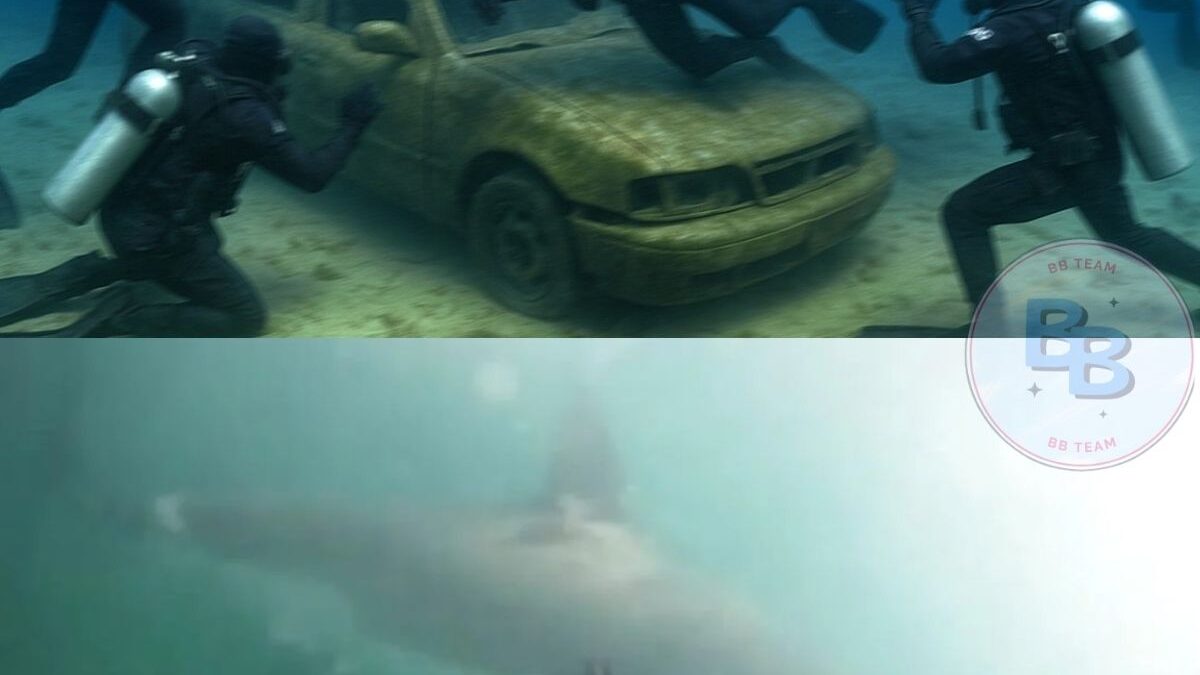
Beneath the waves, where visibility fades and instincts rule, apex predators don’t ask questions, they strike. In these six harrowing stories, humans enter their domain for work, thrill, or art, and meet Jaws instead. From a crime scene dive gone bloody off Gansbai’s sharkinfested coast to a leopard seals ambush beneath Antarctic ice, the ocean and its fringe zones reveal how little control we truly have.
These aren’t freak accidents. They’re raw collisions between human presence and primal hunger, where survival depends on seconds, luck, and the mercy of nature’s most efficient killers. The coastal town of Gansbai, South Africa, had long been known as the great white shark capital of the world. On May 13th, 2025, what began as a routine criminal investigation would become a harrowing testament to nature’s unpredictable ferocity.
Detective Sergeant Thulani and Kosy had been tracking a double homicide case for weeks. The breakthrough came when an anonymous tip revealed that crucial evidence had been disposed of in a vehicle deliberately sunk in an inlet known locally as Shark Alley, a channel between Dyer Island and Geyser Rock, infamous for its dense great white shark population.
The decision to send divers was not made lightly, but the evidence was critical to prosecuting the prime suspect, local businessman Peter Vorster. The specialized maritime crime unit assembled at dawn. The team consisted of six experienced police divers, Detective Sergeant Liel Embatha, who led the underwater operations, Constable Zanel Kumalo, the unit’s most experienced diver.
Officer Cipho Radbe, a former Navy specialist. Senior Detective William Pritorius, a veteran of over 300 forensic dives. Constable Taran Goender, the unit’s newest but most technically proficient member, and Sergeant Jabu Damini, who specialized in underwater evidence collection. The morning was overcast with a light mist hovering over choppy waters.
Marine biologist Dr. Astred Johnson, who consulted for the police department, noted that conditions were less than ideal. Recent storm activity had stirred the waters, reducing visibility to less than 3 m. More concerning, local fishermen had reported increased great white activity following a seal popping season that had drawn numerous sharks to the area. At around 8:43 a.m.
, the team deployed from their vessel, descending methodically toward the submerged vehicle that sat 30 m below on a sandy shelf. They carried specialized equipment for underwater forensics and maintained constant communication with the surface team. The operation was expected to take no more than 40 minutes.
22 minutes into the dive, Officer Ratbeet spotted the sunken vehicle, a black sedan partially buried in silt. As the team approached, Constable Governor noticed something disturbing. Traces of what appeared to be dried blood had seeped from the trunk, creating a faint but detectable scent trail in the water. At around 9:08 a.m.
, the surface team heard a burst of garbled communication. What followed were chaotic transmissions and emergency signals. A massive female great white shark, later estimated to be nearly six meters long, had emerged suddenly from the deeper waters beyond the shelf. Marine biologists would later speculate that the shark had been drawn by the combination of the divers’s movements, the metallic sounds of their equipment, and the lingering blood traces from the vehicle’s grim contents.
The shark struck without warning, first targeting Constable Kumalo. The Great White’s powerful jaws clamped onto her left arm. the pressure nearly severing it at the elbow. The water immediately clouded with blood as Sergeant Embatha activated his shark repellent device and moved to assist his colleague.
Before the team could regroup, the shark circled back with startling speed. This time it rammed Detective Ptorius in the chest with such force that three of his ribs fractured on impact, causing his regulator to dislodge momentarily. Officer Redebe pulled him back as he began to panic, struggling for air. Sergeant Lammeni deployed an acoustic deterrent device, but the shark, now in what experts would later describe as an investigative feeding pattern, made another pass through the scattered team.
Constable Governor suffered lacerations to her leg as the shark’s rough skin brushed against her during its charge toward Sergeant Embatha, who narrowly avoided a direct bite by pushing his evidence collection case between himself and the predator’s open jaws. Following protocol for shark emergencies, the team initiated emergency ascent procedures.
Officer Rataby and Detective Ptorius ascended first with Ptorius requiring assistance due to his injuries. Sergeant Lamini and Sergeant Embatha formed a protective barrier around Constable Kumalo whose blood loss was becoming critical. Constable Governor maintained a position slightly below, keeping the acoustic device active and monitoring for further approaches.
The surface team, alerted by the emergency signals, had already called for air medical evacuation. As the divers broke the surface, crew members rushed to pull them aboard and applied immediate first aid. The shark circled the boat for 17 minutes before disappearing into deeper waters. All six divers survived the attack, though three remained in critical condition as they were airlifted to a hospital in Cape Town.
Constable Kumalo underwent 12 hours of micro surgery to save her arm, though she would never regain full mobility. Detective Ptorius required extensive chest surgery to repair his shattered ribs, one of which had punctured his left lung. Constable Governor’s leg wounds while less life-threatening, needed over 100 stitches, and left permanent scarring.
For the six officers, the physical and psychological recovery would prove lengthy. all received commendations for bravery and their experience led to revised protocols for underwater crime scene investigation in marine predator habitats worldwide. Detective Sergeant Enosy, who had authorized the dive, later reflected that in pursuing human justice, they had momentarily forgotten that they were entering a domain where humans were neither apex nor native, merely visitors in an ancient hunting ground where different rules applied.
Ponta Doouro, a small coastal town in southern Mozambique, had long been revered for its pristine beaches and vibrant marine life. The region straddled the border with South Africa, attracting adventure seekers worldwide with its renowned diving spots and untamed coastal beauty. In 2019, the area was designated as part of the Ponttouro partial marine reserve, a testament to its ecological significance, where freshwater systems dramatically merged with the Indian Ocean.
In July 2022, what should have been an exhilarating adventure for a group of international travelers transformed into a horrific nightmare that would forever change how locals and visitors viewed these seemingly idyllic waters. 23-year-old Nikolai Petro, a Russian backpacker with an Instagram following dedicated to his extreme adventures, had learned of a secret spot from locals.
It was a remote inlet approximately 12 km north of the main tourist area, where a freshwater stream cascaded into the ocean, creating a stunning natural phenomenon. What made this location particularly appealing to thrillsekers was a 15 m cliff overlooking a deep pool where the fresh and salt waters mixed. Nikolai arrived with four companions.
Astred Johansson, a Swedish marine biology student, Matteo Rodriguez, a Chilean photographer documenting their journey. Leila Becky, a South African tour guide who had reluctantly agreed to show them the spot, and Teeshi Yamamoto, a Japanese free diving enthusiast who had met the group just days earlier at a beachside hostel.
The day had started with unusual weather. Heavy rainfall inland had caused the freshwater stream to swell, pushing a torrent of murky water into the ocean. The typically clear blue waters had transformed into a brownish swirl. Ila had expressed concerns about the conditions, noting that local fishermen avoided such areas after heavy rains.
The freshwater runoff attracted bait fish, which in turn drew predators. However, her warnings were dismissed by the excited group, particularly Nikolai, who was eager to capture footage for his social media channels. At approximately 2:47 p.m., after hiking 40 minutes through dense coastal vegetation, the group reached the cliff.
Below them, the water churned with sediment and organic matter from the inland floods. The group spent nearly an hour on the cliff’s edge, photographing and preparing for the jump. Leila maintained that conditions were unsafe, but Nikolai insisted the murky water only added to the adventures mystique. Nikolai was the first to leap.
He executed a perfect dive, disappearing into the brown waters below. When he surfaced seconds later, his triumphant expression quickly transformed into agony. The water around him began to churn as he thrashed, screaming that something had bitten him. Blood rapidly spread across the surface. The others, initially frozen in shock, reacted with varying levels of comprehension.
Teeshi was the first to understand what was happening. Shouting that it was a shark attack, he scrambled down a narrow path toward the water’s edge rather than jumping in. Not immediately processing the danger, Matteo had already leapt in to help his friend. Astrid screamed from above as he swam toward Nikolai, having spotted a large shadow circling back toward the two men.
None of them realized that they had entered the hunting ground of a 3 m bull shark, a species notorious for its aggressive behavior and unique ability to tolerate fresh water. Marine biologists later explained that the flooding had created perfect conditions for the predator. Reduced visibility, increased prey fish, and the disorientation of salt freshwater boundaries that bull sharks were evolutionarily adapted to exploit.
The shark struck Nikolai a second time, its powerful jaws clamping onto his thigh and groin. The force of the bite nearly pulled him underwater permanently. Now just meters away, Matteo froze in horror as the water around his friend turned crimson. Ila had already sprinted back toward a cluster of fishing huts they had passed earlier, screaming for help in Portuguese.
Within minutes, local fisherman Emanuel Dos Santos and his son Thiago launched their small boat, grabbing gaffs and a makeshift first aid kit. By the time they reached the inlet, Matteo had somehow managed to drag Nikolai to a rocky outcropping at the water’s edge. The shark had circled back repeatedly, but hadn’t attacked again.
Teeshi had tied his shirt around Nikolai’s upper thigh, creating an improvised tourniquet that likely saved his life. The fisherman pulled both men into their boat just as the bull shark made another pass, its dorsal fin cutting through the bloodied water mere meters away. Thiago later reported that the shark was one of the largest bull sharks he had seen in the region, estimating it at close to 300 kg.
The journey to medical help was excruciating. The nearest hospital was 90 minutes away in Maputo, but the local clinic in Pontto Deuro had a traumatraed nurse who stabilized Nikolai before the ambulance arrived. The Russian had lost nearly 40% of his blood volume. The shark’s teeth had severed his femoral artery and torn through muscle and connective tissue in his groin and lower abdomen.
Emergency surgery in Maputo repaired the arterial damage, but Nikolai would require six subsequent operations and extensive physical therapy to regain partial mobility. Leila Becky became an advocate for shark safety awareness, conducting educational programs for tourists throughout Mosmbique’s coastal regions. The group’s footage of the incident captured on Matteo’s waterproof camera was later used in marine conservation, educational materials, showing how human recreation and predator behavior can intersect with devastating consequences. As for the
rock where Nikolai had been dragged ashore, locals began calling it Pedra Desi, blood rock. Despite official attempts to discourage cliff jumping at the site, adventure tourism slowly resumed months later. Yet every visitor on that cliff now pauses to read the weathered warning sign that bears Nikolai Petro’s name and the date of his encounter with one of nature’s most perfectly evolved predators.
The Seyell’s archipelago was long considered nature’s masterpiece in the Indian Ocean. Mahay, the largest island was renowned for its breathtaking beaches and crystallin waters. Ladig Bay on the eastern coast of Mahay had gained popularity among photographers for its unique combination of granite boulders, turquoise shallows, and dramatic mountain backdrops.
Most visitors didn’t realize that the picturesque bay was also situated near a rivermouth that during heavy rainfall created the perfect conditions for one of the ocean’s most feared predators. On September 18th, 2018, the islands were experiencing the tail end of an unseasonal tropical depression. The intermittent showers were an inconvenience for most tourists, but for acclaimed fashion photographer Xavier Bowmont, they represented a rare creative opportunity.
Bumont, a 42-year-old French national who had made his name shooting for elite fashion magazines, had arrived in the Sey Shells 3 days earlier for a sustainable swimwear campaign. His reputation had been built on capturing models in dramatic natural settings, desert sandstorms, arctic snowscapes, and now he hoped the ethereal beauty of models posed in a tropical rainstorm with lightning illuminated waters.
The shoot that morning consisted of Bowmont, his assistant Lucenne Maro, three models, Amara Okapor from Nigeria, Eliz Chen from Taiwan, and Sophia Petrov from Russia, along with makeup artist Danielle Rouso and local fixer Olivier Leaport. The latter had expressed reservations about the shooting location that morning, noting that recent rains had caused significant runoff from the nearby Rivier on glaze, turning sections of the normally clear bay into a murky turquoise.
Leaport had mentioned to Bowmont that local fishermen avoided such conditions as the freshwater runoff attracted bait fish and created poor visibility, a dangerous combination. However, the dramatic skies enchanted the photographer and the approaching storm clouds created a moody backdrop against the tropical paradise. He insisted the shoot proceed as planned.
By 11:30 a.m., the team had set up along the shoreline. Bumont waited into the waistdeep water approximately 20 m from shore, positioning himself to capture the models against the dramatic skyline. The water where he stood had a distinct brownish tinge from the river outflow, but the photographer declared it created a sublime contrast with the model’s colorful swimwear.
The rain began falling in earnest as the models entered the water, making the dreamlike scene Bowmont had envisioned. Thunder rumbled in the distance, and the photographer called for the models to spread out for a wide-angle shot. Assistant Lucien Maro noticed something concerning, splashing about 50 meters beyond their position that didn’t match the rainfall pattern.
He called out to Bowmont, but his voice was lost in a crack of thunder. What happened next occurred with horrifying speed. Witnesses later described seeing a massive dark shape surge through the water toward Bowmont. The tiger shark, later estimated by marine biologists to be nearly four meters long, struck the photographer from below and behind.
The initial impact knocked Bowmont forward, his camera flying from his hands. Before he could regain his footing, the shark bit into his thigh and abdomen in a single devastating motion. The water around him instantly turned crimson. Standing closest to Bowmont. Model Amara Okafor later reported that he had been pulled under for several seconds before the shark released him.
The photographer surfaced once, gasping before disappearing again beneath the bloodied water. Fixer Olivier Leaport and assistant Lucian Maro rushed into the shallows, dragging Bowmont’s limp form toward shore while shouting for the models to get out of the water immediately. By the time they reached the beach, Bumont had lost consciousness.
Despite Rouso’s frantic attempts at first aid and Leaport’s immediate call for emergency services, the photographer had lost too much blood. He was pronounced dead before the medical helicopter arrived 27 minutes later. Marine biologist Dr. Elena Soalof, who investigated the incident, determined that the tiger shark had likely been drawn to the bay by the unusual conditions.
The rainwater runoff had created a murky, nutrient-rich environment that attracted smaller fish, which drew the predator closer to shore than usual. The splashing of the photo shoot participants, combined with the low visibility and the shark’s opportunistic feeding nature had created what she termed a perfect storm scenario.
Bowmont’s waterproof camera was recovered the following day by Coast Guard divers searching for evidence. Remarkably, it had continued recording for nearly 7 minutes after being dropped, capturing blurry footage of the attack’s aftermath as it lay on the sandy bottom. This footage would later prove valuable to shark researchers studying predator behavior, though it was sealed from public release out of respect for Bumont’s family.
Models Okafor, Chen, and Petrov all received trauma counseling following the incident. Okafor later advocated for ocean safety awareness, partnering with marine conservation groups to educate the public about shark behavior and risk factors. Lucien Maro, devastated by his inability to save his mentor and friend, established the Bowmont Foundation, which funded research into shark detection technologies for popular swimming areas worldwide.
The foundation’s work led to the developing of an AIdriven monitoring system first deployed in the Sey Shells in 2020 which has since prevented several potential encounters for the local community of Mahay. The tragedy served as a sobering reminder that beneath the postcard perfect surface of their island paradise lurked ancient predators whose behavior could be influenced by seemingly minor environmental changes.
Though tourist numbers recovered within a year, the beaches near rivermouths would never again be viewed with the same carefree innocence, particularly when rainclouds gathered on the horizon and the turquoise waters began to darken with the earth’s runoff. Mossel Bay, situated along South Africa’s famed garden route, has earned its reputation as one of its premier coastal destinations.
The horseshoe-shaped bay combined spectacular mountain scenery with warm waters that attracted tourists and marine life in equal measure. While the area was known for its great white shark population, attacks on humans remained exceedingly rare. A statistical anomaly that offered little comfort to Darren Thaboni and Malcolm Zay Vermoan on the afternoon of February 17th, 2023.
The two childhood friends, both 28, had grown up in nearby George and considered themselves veterans of these waters. Darren, a mechanical engineer for a Cape Town firm, was visiting his hometown for the weekend. Malcolm, who operated a local adventure tourism company, had suggested an afternoon jet ski excursion to celebrate their 15-year friendship.
Both were experienced watermen with profound respect for the ocean, but familiarity had bred a certain complacency about the dangers lurking beneath the surface. The day had been perfect for water sports. Slight offshore winds, moderate swells, and clear visibility to the horizon. The friends had spent nearly 2 hours criss-crossing the bay, racing each other in jumping swells before exploring the bay’s eastern edge, where rocky formations created fascinating kelp forests that swayed hypnotically beneath the surface. At approximately 4:45 p.m.,
they slowed their jet ski near a rocky outcrop known locally as Seal Corner due to its popularity with Cape Fur seals. The location sat adjacent to Seal Island, a renowned hunting ground for great white sharks. Marine biologists had documented countless predation events in these waters where sharks would strike from below with such force that both predator and prey would momentarily become airborne.
A technique researchers called breaching. Malcolm controlling the jet ski with Darren seated behind him had cut the engine to idle, allowing them to drift peacefully beside the kelp beds. Neither man noticed the behavioral changes around them. The sudden disappearance of seals from the surface. the abrupt silencing of seabirds circling minutes earlier.
These were subtle warning signs that experienced local fishermen might have recognized. The attack occurred with the explosive violence characteristic of great white hunting behavior, a 5 m female shark, later identified by researchers from its distinctive dorsal fin markings breached from below, striking the underside of the jet ski with such force that the 320 kg watercraft was lifted partially out of the water.
The impact threw both men into the sea, separating them by several meters. Darren surfaced first, momentarily disoriented but unharmed. His initial confusion quickly turned to horror as he spotted the jet skis hull, now sporting a massive bite mark approximately 70 cm across. His shout to Malcolm was cut short as he watched the water around his friend erupt in white foam.
The shark had targeted Malcolm, perhaps mistaking his black wets suit and erratic swimming movements for a wounded seal. With clinical precision, the predator clamped onto Malcolm’s right leg from knee to ankle. Witnesses on a nearby tour boat described how the shark shook him violently before dragging him under for approximately 7 seconds, an eternity to Darren, who was already swimming desperately toward his friend.
In what marine safety experts would later describe as an extraordinary act of courage, Darren reached Malcolm just as the shark released him. After its test bite, the predator likely determined that Malcolm was not its preferred prey. Shark researchers had documented this behavioral characteristic where great whites release human victims after an initial bite rather than consuming them.
But it provided little comfort to the bleeding victim. Malcolm’s right leg had suffered catastrophic damage. The shark’s serrated teeth had shredded through wets suit skin, muscle, and tendons, leaving his tibia exposed in several places. Remarkably, the major arteries had narrowly escaped severing, a factor that ultimately saved his life.
Darren managed to heave his semi-conscious friend onto the damaged but still floating jet ski. The effort was complicated by Malcolm’s injuries, the blood sllicked surfaces, and the knowledge that the shark remained in the vicinity, drawn by the expanding cloud of blood in the water. Tourboat Captain Hendrickk Vander Mewway, having witnessed the attack through binoculars, was already speeding toward them, radioing for emergency medical services to meet them at the harbor.
The following 20 minutes became a desperate race against blood loss and the possible return of the predator. Darren applied pressure to the wound using his rashgard shirt as Vander Murwy’s boat escorted them back to shore. Paramedics Zinland Dovu and Thomas Backer were waiting at the marina and immediately began emergency treatment for hypoalmic shock as Malcolm slipped in and out of consciousness.
The victim underwent 7 hours of micro surgery at a general hospital in Moscel Bay where orthopedic surgeon Dr. Prianiker led a team that reattached severed tendons and reconstructed damaged muscle tissue. While Malcolm would retain his leg, complete recovery would require 18 months of intensive physical therapy, leaving him with a permanent limp and approximately 60% functionality in his right ankle. Marine biologist Dr.
Johan Wessles, who investigated the incident, confirmed through bite radius measurements and tooth patterns that the attacker had been a mature female great white, likely hunting in the area due to the seasonal movement of seal populations. Analysis of the jet ski revealed tooth fragments embedded in the fiberglass hull, providing valuable genetic material for ongoing white shark population studies.
The psychological impact on both men proved nearly as profound as the physical trauma. Darren, though physically unscathed, developed severe post-traumatic stress disorder, characterized by recurring nightmares and panic attacks at the sight or sound of ocean waves. Malcolm’s operation of his adventure tourism business was permanently altered.
He never offered jet ski tours again. He advocated for shark conservation and education, frequently reminding listeners that he had entered the sharks domain, not the reverse. Perhaps most remarkably, both men returned to the attack site exactly one year later. Malcolm on the tour boat rather than in the water to participate in a research tagging operation with Dr.
Wessles. Their experience contributed valuable data to shark behavior studies and helped develop safety protocols for recreational watercraft in known shark territories. The incident remains one of the few documented cases where both victims of a great white attack survived to provide detailed accounts of their experience.
Their story has since been incorporated into marine safety briefings along South Africa’s coast. A sobering reminder that even in familiar waters, humans remain visitors in an ecosystem that is neither apex nor well adapted. The Tempisk River winding through Costa Rica’s northwestern Guanaste province had long served as an ecological treasure and a vital resource for local communities.
The muddy waterway supported diverse wildlife and provided cooling relief for riverside towns like Philadelphia, where temperatures routinely soared above 35° C during the dry season. For generations, locals had swam in these waters without incident. Their greatest concerns being occasional crocodile sightings in more remote sections.
Few residents realized that the river harbored another more unusual predator capable of navigating between salt and fresh water. A fact that would forever change the community’s relationship with their river on April 9th, 2016. That Saturday afternoon was particularly scorching even by local standards. Midday, the temperature had reached 38° and humidity hung heavy in the still air.
For the teenagers of Philadelphia, the wooden dock behind Dona Carmela’s Riverside restaurant had become an unofficial gathering spot, offering a convenient launch point for swimming and respit from the oppressive heat. 16-year-old Estabban Rodriguez Menddees, a popular soccer player from the local secondary school, arrived at the dock around 2:30 p.m.
with his friends Miguel Anel Gutierrez and Valeria Sanchez Rojus. Others soon joined them. 14-year-old twins Catalina and Karolina Mendoza, 17-year-old Javier Aruro Campos, and several younger children who remained on the dock under the watchful eye of Valyria’s grandmother, Lucia Roas. The teens noticed the water appeared murkier than usual.
Heavy rains had fallen in the highlands 3 days earlier, and the river carried more sediment than normal. None of them knew that the same rainfall had also temporarily raised oxygen levels and lowered salinity much farther downstream than usual, creating ideal conditions for a predator rarely encountered this far inland. Around 3:15 p.m.
, as the afternoon heat intensified, Estabbon performed an elaborate backflip from the dock, drawing cheers from his friends. Moments after he surfaced, his expression changed from exhilaration to confusion, then terror. Witnesses later reported that he had time to shout only once before being pulled under by an unseen force.
When he resurfaced seconds later, the water around him had already turned crimson. Not comprehending what was happening, Miguel immediately jumped in to help his friend. As he reached Estabbon, something massive struck his leg, opening a deep gash from knee to ankle. Both boys began thrashing in the bloodied water as realization dawned on those watching from the dock.
Javier Campos, who had been swimming nearby, later reported seeing a large gray brown shape circling back toward his friends. With remarkable presence of mind for his age, he shouted warnings to the others still in the water while swimming rapidly toward the two injured boys. On shore, Lucia Roas had already begun screaming for help.
Her cries alerted Francisco Paco Jimenez, a local fisherman who had been repairing nets behind his nearby home. Grabbing a wooden pole and shouting for his son Diego to bring their small aluminum boat, Paco raced toward the dock where chaos was unfolding. By this time, Javier had reached his injured friends and attempted to pull Estabban toward the shoreline.
The effort was complicated by the current Estabbun’s injuries and the ongoing threat of the predator which continued circling at a distance of approximately 5 m. Despite his injuries, Miguel was attempting to swim independently toward shore. Paco and Diego reached the scene in their boat less than 2 minutes later, using the pole to ward off what he immediately recognized as a bull shark.
Paco managed to pull Estabbon into the ship while Diego helped Miguel aboard. Javier climbed in unassisted and they sped to the concrete boat ramp 50 m downstream where neighbors had already gathered. Alerted by the commotion, Estabbon had suffered catastrophic injuries. The bull shark’s initial attack had torn through his abdominal wall and left thigh, causing massive blood loss and shock.
Miguel’s injuries, while severe, were limited to his left calf, where the shark’s teeth had sliced through muscle but missed major arteries. An impromptu convoy of pickup trucks transported the boys to the regional clinic in Santa Cruz, 20 minutes away. Despite the efforts of Dr. Gabriella Sto and her medical team, Estabbon died from blood loss and organ damage shortly after arrival.
Miguel underwent emergency surgery followed by transfer to a hospital in the capital, San Jose, where specialized micro surgeons worked to repair the extensive damage to his leg. After months of rehabilitation, Miguel regained partial mobility, but was left with permanent nerve damage and muscle loss that ended his dreams of following his father into construction work.
The psychological trauma proved equally devastating. He developed a severe phobia of water and required extensive therapy to overcome intrusive flashbacks of the attack. Marine biologist Dr. Raphael Montero investigated the attack in the days following it. Based on bite patterns, witness descriptions, and the unusual location, he confirmed the attacker had been a bull shark.
Carter Highinus Lucas, one of the few species capable of regulating its body chemistry to survive in freshwater environments. Dr. Montero determined that several environmental factors had created a perfect storm scenario. The recent heavy rains flushed farm waste and fish processing byproducts from downstream facilities into the river system.
These organic materials combined with altered salinity levels and higher oxygen content had likely attracted the shark far up river from its usual estuarian habitat. Local authorities responded by implementing a river monitoring program and installing warning systems along popular swimming areas.
Buoys with flags were placed at key points, green indicating safe conditions, yellow for caution, and red signaling potential danger based on water conditions and recent reports. The relationship with their river was permanently altered for the Philadelphia community. Older residents recalled stories their grandparents had told of similar incidents in the 1940s.
Tales that had faded into local legend rather than been preserved as cautionary history. One elderly fisherman poetically but grimly remarked to a visiting journalist. The river tasted blood that day for the first time in decades. And now it remembers what we foolishly forgot. A simple concrete memorial now stands near the dock where Estabban took his final swim.
Each year on the anniversary of the attack, local students release biodegradable paper boats with candles downstream, both in remembrance of their lost friend and as a symbolic acknowledgement that humans share the waters with creatures far older and more perfectly adapted to river life than themselves. McMurdo Sound, Antarctica, has long been considered one of the most extreme environments for scientific research on Earth.
In February 2020, this remote paradise became the setting for one of the most harrowing encounters between humans and predators documented in polar waters. Dr. Amelia Riordan, a 34year-old marine biologist specializing in polar plankton blooms, had spent three Antarctic summers at the McMurdo Research Station.
The Australian scientist had earned a reputation for meticulous work documenting how climate change affected microscopic marine life cycles in the Southern Ocean. Her current research focused on how declining sea ice could trigger earlier plankton blooms with cascading effects throughout the food web. On February 12th, 2020, Riordan and her dive partner, Norwegian oceanographer Dr.
Christian Bergman, prepared for a routine collection dive beneath the ice shelf, approximately 3 km from the main research station. Both were experienced polar divers with over 40 combined Antarctic expeditions between them. The morning began with standard safety briefings and equipment checks. Their dive supervisor, Canadian researcher Dr.
Isabel Tremble, verified their thermal protection suits, emergency signaling devices, and backup air supplies. The team had followed this exact protocol dozens of times before. Support technicians Xavier Quintana and Whan Chen crewed the surface station, constantly communicating with the divers. At 9:17 a.m.
, Riordan and Bergman descended through a meticulously cut icehole 1.5 m in diameter. The opening had been created the previous day using specialized ice drills and kept clear overnight. Surface temperatures hovered around -15° C. In comparison, the water beneath the 2 m thick ice shelf maintained a relatively constant minus 1.
8° C, just above the freezing point of seawater. The dive plan called for the scientists to collect plankton samples at varying depths with a maximum descent to 30 m and a total bottom time not exceeding 40 minutes. Both divers carried specialized cameras to document the underwater conditions and any notable marine life. 23 minutes into the dive, Rearen was photographing a particularly rich plankton concentration at 25 m when she noticed a dark shadow moving at the periphery of her vision.
Before she could alert Bergman, who was collecting samples several meters away, an enormous leopard seal, later estimated to be 3 m long and weighing approximately 500 kg, charged her with explosive speed. Leopard seals, known for their spotted coats and fearsome predatory nature, were among Antarctica’s apex predators.
Their powerful jaws, designed for hunting penguins and filtering krill, could exert tremendous pressure. What made them particularly dangerous, was their curious and sometimes aggressive behavior toward unfamiliar objects in their territory. The seal’s initial pass seemed investigatory rather than predatory.
It circled Reordan once, then disappeared into the gloom. The biologist immediately signaled to Bergman that they had company. Using the predetermined hand signal for a potential predator encounter, they began a controlled movement toward their exit point. Maintaining visual contact. 30 seconds later, the seal returned with startling aggression.
It charged directly at Rearen, grabbing her right fin in its powerful jaws and yanking with such force that the fin was completely torn from her foot. The sudden jolt sent her spiraling in the near zero visibility stirred up by the attack as she struggled to regain her orientation. The seal circled back. This time it clamped onto her right arm, which held her expensive underwater camera housing.
The leopard seal bit down with crushing force. Whether attracted by the camera’s reflective surface or simply targeting the outstretched limb, the reinforced housing initially protected Reardan’s arm from complete severing, but the pressure fractured both her radius and ulna. Using her left hand, she struck at the seal’s sensitive snout with the camera housing.
A desperate move that likely saved her life as the animal momentarily released its grip. Bergman, witnessing the attack, activated his emergency strobe light, creating rapid pulses of intense light that disoriented the predator just long enough for him to reach his colleague. The water around them had already begun to cloud with blood from Rearen’s injuries.
Using his powerful legs, Bergman kicked toward the icehole, pulling Reirdon alongside him. The leopard seal circled beneath them, making several more passes, but not attacking again. Behavior that marine mammal experts would later attribute to the confusion caused by the strobe light and the unfamiliar taste of the neoprene and equipment.
The pair ascended through their entry hole at 9:43 a.m. with Bergman pushing Reardon ahead of him while maintaining vigilant watch below. Support technicians Chen and Quintana immediately pulled them from the water onto the ice shelf where the stark white surface was quickly stained crimson with Riordan’s blood. Emergency protocols were immediately initiated.
Tremble applied a pressure bandage to Rearon’s mangled arm while Chen radioed for emergency transport. A specially equipped cold weather medical transport arrived from the main station within 12 minutes. Dr. Dr. Yasmin Kapoor, the station’s senior medical officer, stabilized Rearen in the field before transferring her to the research station’s medical facility.
Initial assessment revealed multiple deep puncture wounds to Rearen’s right arm, a compound fracture of both forearm bones, and significant soft tissue damage to her right foot, where the fin had been forcibly removed, while no major arteries had been severed. The collective blood loss and the onset of hypothermia placed her in critical condition.
The remote location complicated medical evacuation efforts. Weather conditions prohibited immediate airlift to Christ Church, New Zealand. For 68 hours, Dr. Kapoor and the station’s medical team worked to stabilize Rearen’s condition, performing two emergency surgeries to clean and close her wounds and set her broken bones with external fixators.
When conditions finally allowed evacuation on February 15th, Reirden was transported to a hospital in Christ Church where she underwent an additional four surgeries over 2 weeks. While surgeons saved her arm, she would never regain full mobility in her right wrist and hand. A devastating outcome for a scientist who performed delicate microscope work.
The incident prompted a comprehensive review of polar diving protocols across all international research stations in Antarctica. The investigation concluded that while the attack could not have been reasonably predicted, additional predator deterrent devices should be mandatory for all science divers working in leopard seal territories.
The International Polar Research Consortium subsequently mandated using acoustic seal deterrence and enhanced predator awareness training for all permitted diving operations. Dr. Bergman, who had pulled his colleague to safety despite the ongoing danger, received the Polar Medal for his actions.
In his acceptance speech, he deflected praise, noting that Reirdan’s quick thinking and striking the seal’s sensitive nose had been the true life-saving moment, a testament to proper predator response training. For Rearen, the physical and psychological recovery proved lengthy but ultimately transformative.
After 6 months of intensive rehabilitation, she returned to academic work, though she never again dove beneath Antarctic ice. Instead, she redirected her research focus to analyze the samples collected during that fateful dive, which had, ironically, captured evidence of significant changes in the plankton community structure that would prove crucial to understanding climate impacts on the Antarctic food web.
The leopard seal responsible for the attack was identified through distinctive facial scarring documented in Rearen’s camera footage recovered after the incident. Marine mammal researchers noted it was an unusually large female that had been previously observed displaying territorial behavior toward other seals. The animal was not destroyed, but was tagged with a tracking device during the following research season, providing valuable data on leopard seal movement patterns and hunting territories.
When interviewed a year later for a scientific journal, Rearen expressed no animosity toward the animal or the environment that had nearly claimed her life. She emphasized that entering such remote and primal ecosystems always carried inherent risks that no preparation could eliminate. Her paper on the physiological responses of researchers to traumatic wildlife encounters became required reading at polar training centers worldwide.
The bloodstained ice at the dive site melted away with the coming of the Antarctic summer, leaving no trace of the encounter. Yet for the tight-knit community of polar researchers, the incident served as a humbling reminder that Antarctica’s beauty concealed ancient untamed dangers. Predators perfected by evolution for an environment where humans remain temporary visitors, tolerated rather than welcomed by the true masters of the polar depths.

