Great White Shark Kills Family Inside Cage on October 17th, 2025
The world beneath the waves has always exerted an irresistible pull on human curiosity. For centuries, explorers, scientists, and thrill-seekers have plunged into the ocean’s blue expanses to witness firsthand the majestic creatures that rule this liquid wilderness. Yet beneath the serene turquoise shallows and the sun-dappled surface lies an environment governed by ruthless survival, where humans are never in control. We construct reinforced steel enclosures, wear specialized thermal gear, and carry cutting-edge tracking instruments, convincing ourselves that modern technology grants us safe passage into the wild. But when curiosity crosses an unseen boundary, the ocean’s apex predators strike back with speed and ferocity that shatter every illusion of human dominance. From the rugged cliffs of South Africa to the icy fjords of Alaska, six remarkable real-life encounters reveal what happens when ordinary people and seasoned professionals come face to face with the planet’s most formidable hunters.
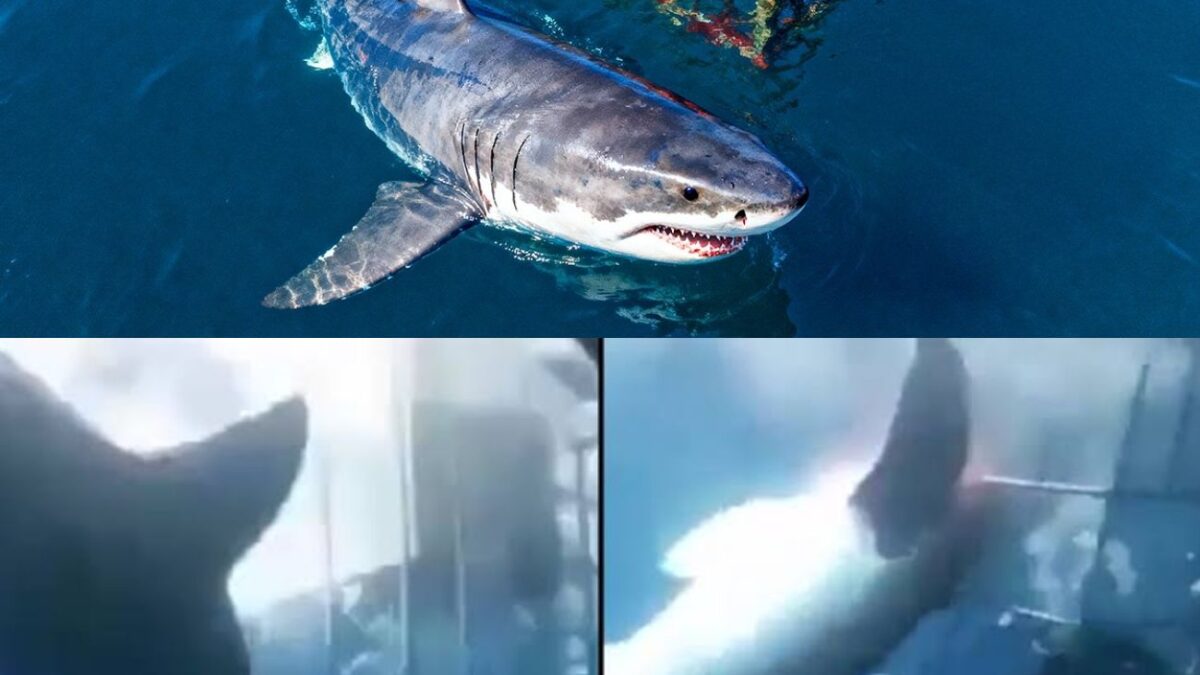
The ocean offers no greater symbol of primal dread than the great white shark. On October 17, 2025, that dread manifested in an unprecedented catastrophe off the coast of South Africa. Alex Collins, a thirty-something marine biologist who had dedicated his career to studying apex predators, joined his wife, Mara, an accomplished wildlife photographer, aboard a specialized research vessel. Their plan was straightforward and supposedly routine: descend into the Atlantic in a reinforced steel shark cage, designed and repeatedly tested to withstand the hardest blows the sea could deliver. The morning waters were choppy and cold, but both Alex and Mara possessed extensive field experience. When a massive seventeen-foot great white emerged from the gloom, its sheer scale surpassed anything the couple had ever witnessed.
Initial curiosity turned to terror within moments. Without warning, the shark slammed into the cage like a high-speed battering ram. The impact echoed violently beneath the surface, throwing Alex into the bars and knocking the mask from Mara’s face. The predator did not retreat; instead, it initiated a sustained assault, repeatedly ramming the enclosure and snapping at its structural welds. Outside, frantic crew members pounded the water with poles and shouted warnings, but the beast was relentless. Metal groaned, chains warped under extreme tension, and seams split open. By the time the crew managed to hoist the mangled cage back onto the deck, both Alex and Mara had suffered catastrophic, unsurvivable injuries. The tragedy prompted an immediate overhaul of cage-diving safety regulations across South Africa, leaving behind a sobering reminder that even the most formidable human-made fortress is fragile before the sheer muscle of an ocean giant.
Thousands of miles away, on August 12, 2023, along the sunny shores of Oahu, Hawaii, another encounter tested the absolute limits of human survival. Dylan Reeves, a twenty-eight-year-old surfer with more than a decade of experience navigating Pacific swells, paddled past the crowded reefs in search of quiet, glassy waves. Drifting alone under the morning sun, he suddenly caught sight of an unnatural shadow darting through the turquoise water. Before he could react, a massive tiger shark exploded toward him, its razor-sharp jaws clamping onto the nose of his surfboard and snapping the fiberglass in half like a dry branch.
Hurled into the churning water, Dylan found himself in an immediate struggle for his life. The predator lunged repeatedly, snapping at his arms and shredding neoprene and flesh. As crimson clouds spread in the water, an even more terrifying development occurred: a second tiger shark materialized from the depths, drawn by the commotion and the scent of blood. Refusing to surrender, Dylan grabbed the severed half of his board, using it as an improvised shield to deflect lunges while kicking and striking back with every ounce of remaining energy. Fighting off exhaustion and severe blood loss, he paddled frantically toward the shore. A rescue boat, alerted by observant beachgoers, intercepted him just in time. Dylan survived the ordeal after extensive surgeries, his scars serving as a permanent testament to the power of human will in the presence of relentless ambush hunters.
Extreme cold offers no sanctuary from predatory power, as proven by an expedition on February 19, 2024, along the frozen rim of the Antarctic Peninsula. Dr. Elena Marquez, a thirty-four-year-old polar researcher, slipped beneath the fractured sea ice in a thermal drysuit to gather scientific samples near an Adélie penguin colony. The subzero water was crystal clear, but beneath an overhanging ice shelf, an enormous shape appeared. It was an apex leopard seal, sleek, heavily muscled, and notoriously territorial.
Moving with explosive velocity, the creature clamped its jaws onto Elena’s leg and thrashed violently, attempting to drag her deeper beneath the ice. Fighting through searing pain, disorientation, and freezing water, Elena pulled her dive knife and struck back, driving the blade against the animal’s thick hide while bracing her boots against the floe. The furious resistance startled the seal just long enough for it to loosen its grip. Elena surged upward toward an opening in the ice, where watchful colleagues hauled her aboard a zodiac boat. Though she suffered deep puncture wounds and required emergency treatment for trauma and hypothermia, her rapid presence of mind saved her from becoming another statistic in the unforgiving Antarctic abyss.
While giants command headlines, the sea’s most lethal dangers can also come in miniature packages. On May 16, 2007, twenty-nine-year-old tourist Thomas Caldwell was snorkeling among the vibrant coral formations of Komodo, Indonesia. Captivated by an arrangement of shells tucked inside a rocky crevice, Thomas reached in with his gloved fingers. Hidden in the dark recess was a creature no larger than a human fist: a blue-ringed octopus. Disturbed by the intrusion, the tiny cephalopod flashed its iridescent blue warning rings and bit down on the tip of Thomas’s index finger.
The bite was so minor it felt like a tiny pinprick, but the venom it carried—tetrodotoxin—is among the most potent natural neurotoxins known to science. Within minutes, numbness spread through Thomas’s hand, creeping into his limbs and shutting down his neuromuscular system. Rescuers noticed his distress and rushed him toward shore while performing continuous CPR, but the venom had already paralyzed his respiratory muscles. Despite rapid transport to a medical clinic, Thomas succumbed to respiratory failure before his system could recover. The incident highlighted a crucial biological truth: in the marine kingdom, beauty is often the ultimate warning sign, and small size never equates to harmlessness.
Predator encounters are not confined to open oceans and exotic coral reefs. On September 14, 2025, Marcus LeBlanc waded waist-deep into a murky southern Louisiana bayou to hunt for blue crabs. It was a familiar ritual he had performed for years under the cover of night. However, heavy rains in preceding weeks had caused severe flooding, drawing bull sharks miles inland through swollen freshwater tributaries.
As Marcus felt along submerged roots, an eight-foot bull shark burst from the black water, locking onto his right calf. The creature thrashed with bone-crushing force, turning the silty current red. Marcus fought back in blind panic, throwing punches and kicks at the predator’s sensitive snout until it suddenly released its grip and disappeared into the gloom. Bleeding profusely, Marcus dragged his mangled leg up the muddy bank, pulled out his phone, and dialed emergency dispatch. Paramedics and surgeons stabilized the severe lacerations, preserving both his leg and his life. Marcus’s harrowing survival became a powerful community lesson on the physiological adaptability of bull sharks, which can thrive in low-salinity waters and strike without warning in familiar, everyday shallows.
Even when an animal harbors no predatory intent toward humans, sheer curiosity combined with massive size can be devastating. On July 28, 2022, wildlife photographer Samantha Hayes was paddling her orange kayak through the misty fjords of southeastern Alaska, hoping to photograph transient orcas. As she steadied her camera, an enormous bull orca surfaced alongside her vessel and bumped it with immense force, instantly capsizing the craft. Plunged into the frigid fjord, Samantha found herself floating inches from the apex predator.
The killer whale did not bite; instead, it systematically tested her, nudging her legs with its snout and pushing the overturned hull in circles. Recognizing that panic would trigger an aggressive reaction, Samantha kept the kayak positioned between herself and the animal, kicking outward whenever it pressed too close. After several agonizing minutes of calculated investigation, the orca lost interest and vanished beneath the deep fjord. Shivering violently, Samantha managed to right her kayak and paddle back to safety, bearing a profound respect for the intelligence and physical dominance of the animal kingdom.
These six stories, differing in geography, species, and outcome, share an undeniable moral. The ocean is not a controlled aquarium built for human recreation; it is an ancient, untamed realm governed by biological rules written over millions of years. Whether confronting a seventeen-foot great white in South Africa or a palm-sized octopus in Indonesia, human safety depends not on our perceived dominance, but on our humility. Stepping into the water means entering a world where curiosity can turn into catastrophe in a heartbeat, reminding us that nature’s wild power must always be met with unwavering caution and deep respect.

