Cops Detained a Black Marine for “Looking Suspicious” — Then a 4-Star General Saluted Him
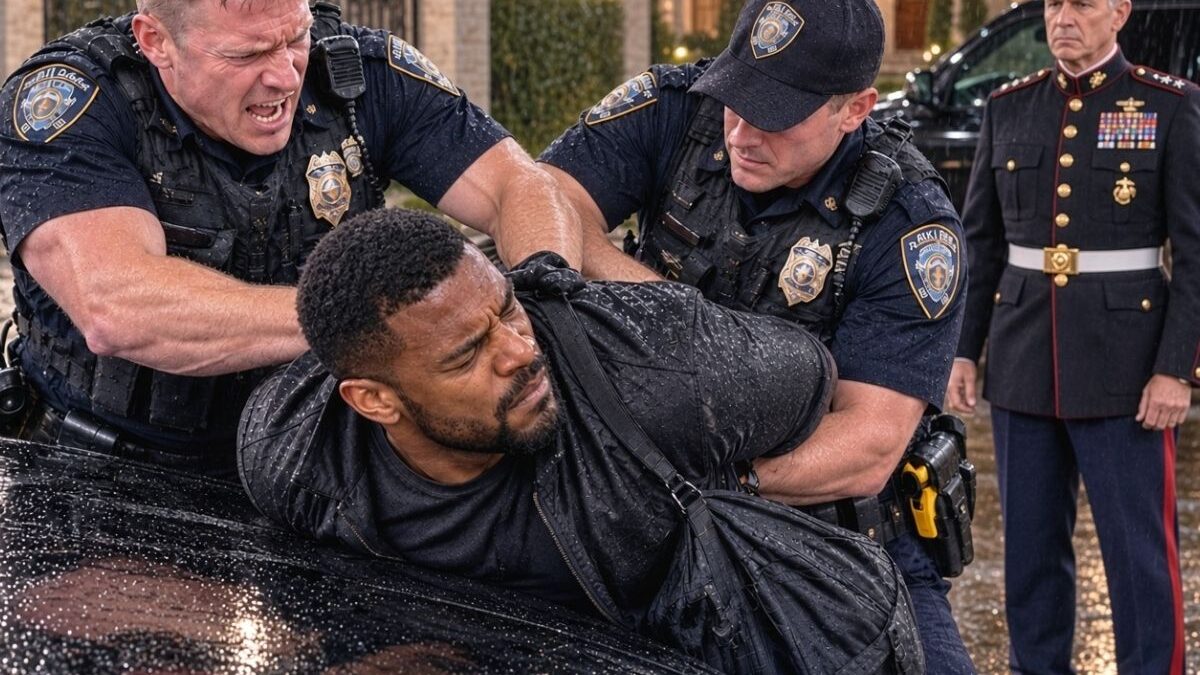
The biting December sleet hammered relentlessly against the cracked asphalt of Route 1, turning the narrow shoulder into a slurry of freezing mud. Inside the shivering cabin of his 1998 Ford F-150, Staff Sergeant Destin Miller stared grimly at the battery gauge resting hopelessly at zero. The alternator had whined its dying breath before cutting the engine dead, leaving him marooned in the freezing dark three miles short of his destination.
Destin stepped out into the stinging rain and pulled the hood of his tactical fleece over his close-cropped hair to shield his face from the wind. He had survived two brutal combat deployments in Helmand Province and walked away from the scorching ruins of Fallujah with shrapnel still lodged in his shoulder. An unexpected three-mile march in the Virginia winter was barely an inconvenience for a Force Recon Marine, but timing was an unforgiving enemy tonight.
He opened the passenger door and reached for the heavy, weather-resistant garment bag lying across the worn bench seat with practiced care. Inside hung his pristine dress blues, pressed with razor-sharp discipline and adorned with medals he seldom spoke about in civilian company. Tonight was the retirement gala of Colonel Richard Lewis, the commanding officer who had guided him through the fire and watched him earn his stripes.
Securing the heavy bag over his broad right shoulder, Destin locked the rusted truck and began his steady march down the edge of the dark highway. His combat boots struck the wet pavement in a rhythmic, measured cadence that kept his core temperature stable against the rising windchill. He navigated the winding transition from the commercial corridor toward the secluded, towering brick gates of Oakridge Estates with focused intent.
Oakridge Estates existed in an entirely different world, where multi-million-dollar mansions sat behind sweeping lawns and ancient oak trees. There were no sidewalks here, only wide ribbon roads designed exclusively for luxury sedans and shielded from the pedestrian world outside. Destin kept to the grass verge, keeping his head down and his breathing controlled as freezing rain ran in rivulets down his neck.
Behind him, two hundred yards down the winding lane, a pair of headlights sliced through the freezing downpour with predatory slowness. Destin did not need to break stride or look over his shoulder to identify the low, distinct rumble of an idling police cruiser engine. He knew the rules of engagement on domestic soil just as intimately as he understood patrol procedures through foreign combat zones.
Inside the patrol unit, Officer Thomas Jenkins peered through the windshield wipers, his hands tightening around the steering wheel with immediate suspicion. Beside him sat Officer Gregory Hayes, a younger patrolman who was quietly scrolling through property incident reports on the mobile data terminal. Jenkins tapped the brakes, slowing the cruiser until it crept alongside the tall, athletic figure marching steadily through the dark.
“Look at this guy out here,” Jenkins muttered, his voice dripping with immediate distrust.
“Maybe he lives around here, Tom, or his car broke down nearby,” Hayes suggested softly, glancing up from the dashboard screen.
“Nobody walks through Oakridge in the freezing rain at night unless they are up to no good,” Jenkins replied, clicking off his seatbelt.
The patrol car accelerated suddenly, cutting across Destin’s path and braking at a sharp angle that trapped him against an estate wall. Bright red and blue strobe lights erupted into life, painting the falling sleet and glistening trees in violent flashes of emergency color. Destin halted immediately, planting his feet firmly while keeping both hands completely visible and extended slightly away from his sides.
Jenkins stepped out into the freezing storm, leaving the cruiser door open as he placed his right hand instinctively on his service weapon. His uniform jacket was unzipped against the cold, revealing a posture stiff with aggressive intent and unyielding authority. Hayes followed from the passenger side, lingering slightly behind the cruiser’s fender with an uncomfortable, hesitant expression on his face.
“Hold it right there, buddy,” Jenkins shouted over the howling wind. “Where do you think you’re going tonight?”
“Good evening, officer,” Destin answered calmly, his deep baritone modulated with deliberate military courtesy. “I am walking to a residence nearby.”
“Walking to a residence in this weather?” Jenkins sneered, taking two heavy steps forward to close the distance between them.
“My truck broke down on Route 1,” Destin explained, remaining motionless under the harsh glare of the cruiser’s high beams. “I am attending a dinner.”
“Whose dinner?” Jenkins demanded, flashing a high-powered tactical light directly into Destin’s eyes to disorient him.
“Colonel Richard Lewis,” Destin said, squinting through the blinding beam. “At 4420 Oakridge Drive, just a few blocks up the road.”
Jenkins paused for a fraction of a second, recognizing the prominent address of the retired Marine officer whose estate dominated the cul-de-sac. Yet his confirmation bias rejected the truth instantly, choosing instead to see an intruder caught with potential loot in an affluent enclave. The thick, heavy garment bag slung over Destin’s shoulder looked entirely too suspicious for a man walking on foot through the sleet.
“Take that bag off your shoulder and set it flat on the hood of this car right now,” Jenkins commanded sharply.
“Officer, that bag contains my formal uniform for the ceremony,” Destin replied respectfully, his voice steady. “I would prefer not to lay it on the wet hood.”
“I didn’t ask for your personal preference,” Jenkins snapped, closing the gap until he stood barely two feet away. “Put it on the hood before I cuff you.”
Destin felt the familiar knot of discipline tighten in his stomach as he slowly unslung the garment bag with smooth, telegraphed movements. He laid the waterproof canvas gently across the wet metal, ensuring the brass zippers did not drag against the cruiser’s paint. Jenkins watched him like a hawk, his jaw clenched as if daring the unarmed man to make a sudden or aggressive gesture.
“What kind of uniform?” Hayes asked from behind the hood, his tone noticeably more cautious than his senior partner’s.
“United States Marine Corps dress blues,” Destin stated clearly, keeping his eyes fixed on the center of the windshield ahead.
“A Marine, huh?” Jenkins scoffed loudly, stepping around the front fender. “Got any identification to back that fairy tale up, hero?”
“Yes, sir,” Destin answered without hesitation. “My military identification card and state driver’s license are inside my rear wallet.”
“Get them out,” Jenkins ordered, his hand hovering over his holster. “Two fingers only, and move real slow.”
Destin reached back carefully, extracted his worn leather wallet, and slid his military Common Access Card and driver’s license free. Jenkins snatched the cards aggressively, shining the flashlight beam across Destin’s face before handing the plastic over to Hayes. He did not bother inspecting the military seal or the rank stamped in bold letters across the front of the credential.
“Run these through the terminal, Greg,” Jenkins instructed without looking back. “See what comes up on local warrants or recent property thefts.”
Hayes retreated into the patrol car, closing the door against the rain while the terminal glowed against his furrowed brow inside. Jenkins remained inches from Destin, letting the cold rain pour off the brim of his duty hat onto Destin’s shoulder. The officer’s eyes flicked between the man’s athletic frame and the garment bag resting quietly on the cruiser’s hood.
“You really expect me to believe you’re an invited guest at the Lewis estate?” Jenkins taunted, crossing his arms over his vest.
“You can call the residence right now, officer,” Destin said evenly. “Colonel Lewis will personally confirm my presence on his guest list.”
“Oh, I’m sure the colonel has nothing better to do than vouch for every vagrant wandering through his neighborhood,” Jenkins dismissed coldly.
Inside the cruiser, Hayes tapped the dashboard computer, watching the state database return an immediate, spotless confirmation across the screen. There were no warrants, no prior arrests, and no disciplinary flags attached to the active-duty Staff Sergeant standing outside in the cold. Hayes leaned out the driver’s window, raising his voice to cut through the rain that was now turning to heavy sleet.
“Tom, his credentials check out completely,” Hayes called out, holding the cards near the open frame. “He is active-duty military, zero records.”
“Doesn’t prove where he got that bag tonight,” Jenkins barked back over his shoulder, refusing to concede an inch of his authority.
Destin kept his posture rigid, though the bitter sting of the officer’s disrespect cut far deeper than the freezing winter air. He had endured artillery fire and pulled brother Marines from burning vehicles, only to be branded a criminal on a quiet suburban street. Yet he knew that any flare of righteous indignation would be twisted into charges of obstruction, disorderly conduct, or violent resistance.
“Turn around and put your hands behind your back,” Jenkins commanded suddenly, reaching for the steel handcuffs resting in his utility pouch.
“On what grounds am I being placed in handcuffs?” Destin asked, his deep voice carrying a sharp edge of command authority.
“Suspicion of burglary and failure to cooperate with an investigation,” Jenkins snarled, stepping forward with the cuffs raised in his grip.
“Tom, wait a second,” Hayes called out, opening his car door again. “The dispatch terminal didn’t flag any recent residential calls tonight.”
“I run this stop, Hayes!” Jenkins shouted back furiously. “Turn around, Miller, or you will find yourself face down on this pavement!”
Destin took a slow, deep breath, feeling the icy burn in his chest as he made the calculated decision to protect his life. He turned his back to the officer, bringing his forearms together behind his spine with slow, deliberate precision under the flashing lights. Jenkins grabbed his wrists roughly, wrenching his arms upward before slamming the steel ratchets shut with excessive, brutal force.
The metal bit deeply into Destin’s skin, cinching down far past the safety notch until the steel ground against bone. Jenkins pushed him forward aggressively, forcing Destin’s chest against the wet, freezing metal of the cruiser’s rear quarter panel. Destin gritted his teeth, refusing to give the officer the satisfaction of a groan as the cold metal chilled him to the core.
“Spread your legs,” Jenkins ordered, kicking Destin’s boots wide apart before conducting a heavy, invasive pat-down across his denim trousers.
“I am completely unarmed, officer,” Destin said through clenched teeth, his cheek pressed flat against the dripping paint of the car.
“Keep your mouth shut until you’re spoken to,” Jenkins snapped, stepping away and walking deliberately toward the hood of the cruiser.
The officer grabbed the heavy brass zipper of the garment bag, preparing to yank it open in the middle of the downpour. Destin lifted his head from the cold metal, his eyes widening as he realized what the officer was about to do to his uniform. That uniform had been meticulously dry-cleaned, brushed, and prepared for weeks to honor the man who had saved his military career.
“Officer, I am respectfully requesting that you do not open that bag in this downpour,” Destin stated with ringing clarity.
“I don’t need your permission to conduct an inventory search of detained property,” Jenkins retorted with a harsh, mocking laugh.
“You have no search warrant, and my identification has already been verified by your partner,” Destin projected his voice over the wind.
Jenkins pulled the heavy zipper down the center of the bag with a violent tug, peeling the protective canvas flaps wide open. The cruiser’s headlights illuminated the immaculate midnight-blue tunic, the sky-blue trousers, and the distinctive scarlet blood stripe running down the legs. Pinned proudly to the left breast hung a gleaming rack of combat ribbons, capped by the Bronze Star with Combat ‘V’ and the Purple Heart.
Hayes stepped up to the edge of the hood, his mouth hanging slightly open as he took in the sight of the medals. His older brother had served in the infantry, and Hayes understood the staggering personal sacrifice required to earn the decorations pinned before him. The younger officer looked from the pristine ribbons back to the handcuffed man whose face remained stoic despite the freezing sleet.
“Jesus, Tom,” Hayes whispered, his voice trembling slightly with genuine alarm. “Look at those medals. He wasn’t lying to us.”
“Anybody can buy ribbons at a surplus store,” Jenkins dismissed defensively, his knuckles white as he clutched the wet fabric.
“That’s a Bronze Star with Valor, Tom,” Hayes insisted, stepping closer. “People don’t just carry dress blues around like this for fun.”
“It’s stolen valor until I verify where he stole it from,” Jenkins snarled, digging his bare fingers directly into the fine wool tunic.
Destin watched from the side of the car as the officer’s wet, oily hands smeared rain across the polished gold buttons of the jacket. Inside his chest, a roaring fire of rage threatened to shatter his iron discipline, but he forced his breath to remain slow and even. He had survived insurgent ambushes by staying icy calm under pressure, and he refused to surrender his dignity to a petty tyrant.
“Officer Hayes,” Destin called out, directing his words entirely to the younger patrolman standing beside the cruiser.
“What is it, Miller?” Hayes answered, his voice laced with growing apprehension over his partner’s erratic behavior.
“Look inside the breast pocket lining,” Destin directed calmly. “The name tag is stitched into the fabric: D. Miller, USMC.”
Hayes reached forward hesitantly, but Jenkins shoved his partner’s hand aside and grabbed the inner lining of the coat himself. He pulled the wool backward, shining his flashlight directly onto the white tailor’s label stitched neatly inside the interior pocket. There, embroidered in bold, permanent black thread, were the exact words the Marine had spoken: D. MILLER – USMC.
Jenkins stared at the stitching, the cold silence of the residential street settling heavily around the flashing lights of the car. The evidence was absolute, irrefutable, and completely incompatible with the narrative he had fabricated to justify his aggressive stop. Yet instead of unlocking the cuffs and offering an apology, the officer stood frozen, trapped by his own towering, fragile ego.
Before Jenkins could formulate another excuse, a deep, rhythmic rumble vibrated through the wet pavement beneath their boots. Two large, pristine black Chevrolet Suburbans rounded the corner through the freezing sleet, their heavy engines humming with immense, disciplined power. The lead vehicle’s headlights illuminated the patrol car parked diagonally across the road, blocking the narrow lane from curb to curb.
The heavy SUV came to a gentle halt barely fifteen feet from the cruiser’s rear bumper, its dark-tinted windows reflecting the strobe lights. Behind it, the second Suburban stopped in seamless coordination, both vehicles displaying discrete government plates framed in heavy stainless steel. Hayes squinted through the downpour, his stomach dropping through the soles of his boots as he recognized the federal escort markings.
“Tom, we need to clear the roadway right now,” Hayes whispered urgently, tugging on the sleeve of his partner’s rain jacket.
“They can wait like everybody else,” Jenkins grumbled stubbornly, though his eyes widened slightly as the SUV’s doors remained closed.
The rear passenger window of the lead Suburban rolled down smoothly, revealing the darkened interior of an insulated, leather-lined cabin. A man leaned forward into the soft interior light, his close-cropped iron-gray hair and chiseled jaw radiating decades of command authority. He wore an immaculate wool overcoat that parted slightly at the throat, revealing the crisp khaki collar of a general officer’s service uniform.
Four polished silver stars caught the reflections of the streetlights, gleaming with unmistakable, terrifying prominence in the dark. General Arthur Covington, the Commandant of the Marine Corps, did not blink as his piercing gray eyes took in the entire scene. He saw the flashing light bar, the exposed dress blues soaked on the hood, and the decorated Staff Sergeant pinned in steel handcuffs.
The front passenger door of the Suburban flew open, and a sharp-eyed Marine captain stepped out into the freezing downpour without hesitation. Captain Mercer moved with swift, athletic grace, his dress overcoat snapping in the wind as he marched directly toward the cruiser. His face was carved from granite, his eyes locked onto the soaking uniform that lay sprawled across the wet metal hood.
“Officers!” Captain Mercer’s voice rang out like a rifle shot across the quiet estate lane. “What is the meaning of this stop?”
“Back off, pal!” Jenkins barked back, attempting to project an authority he was rapidly losing. “This is an active police investigation!”
“Captain Mercer, sir,” Destin spoke from the side of the cruiser, his voice steady despite the numbness creeping into his hands.
Mercer’s eyes snapped from the uniform to Destin’s face, instantly recognizing the decorated non-commissioned officer from the official gala briefing. The captain stepped directly into Jenkins’s personal space, his posture radiating a lethal intensity that caused the patrolman to recoil half a step. Mercer looked down at the soaked dress blues, noting the Purple Heart and the Bronze Star now glistening under the falling sleet.
“You have an active-duty Force Recon Marine in restraints,” Mercer said, his voice dropping into a deadly, trembling quiet.
“I don’t care if he’s the President!” Jenkins shouted, his voice cracking under the sudden pressure. “He’s a suspect until I clear him!”
The heavy rear door of the Suburban clicked open, the heavy steel frame swinging wide into the darkness of the stormy night. General Arthur Covington stepped down onto the wet asphalt, ignoring the freezing sleet that immediately battered against his uncovered head. He did not rush, walking with the slow, terrifying inevitability of an armored column advancing across an open battlefield toward an outmatched target.
Hayes felt his legs turn to water, his breath hitching in his throat as the four silver stars caught the cruiser’s headlights. His brother had kept a framed photograph of General Covington on the mantle throughout his entire four-year deployment in the Middle East. Hayes violently shoved his partner’s elbow, his voice rising in an octave of pure, unadulterated terror.
“Tom, shut up,” Hayes hissed frantically, his face pale as a ghost. “Shut your mouth right now and look who’s coming.”
Jenkins turned his head slowly, watching as the towering general stopped barely three feet away from the open door of the patrol car. Covington was sixty-eight years old, but his frame was broad, unyielding, and carried the weight of a man who commanded hundreds of thousands. He looked down at Jenkins with an expression of icy contempt that seemed to lower the ambient temperature on the wet pavement.
“I am General Arthur Covington,” the older man said, his voice quiet, resonant, and loaded with catastrophic weight.
“Sir, we were conducting a field interview—” Jenkins stammered, his earlier arrogance dissolving into a pool of stuttering panic.
“You are about to have the shortest and most miserable professional career in the Commonwealth of Virginia,” Covington interrupted without raising his voice.
“He matched a burglary profile, General,” Jenkins attempted to justify, pointing a trembling finger toward the dark street behind them.
“The only profile this man matches is that of a combat veteran who has bled for this nation while you slept safely in your bed,” Covington said.
The general stepped past the frozen officer, his gaze shifting to the soaking uniform resting on the wet hood of the cruiser. He reached out with a gloved hand and gently lifted the corner of the midnight-blue tunic, his eyes resting on the Bronze Star. The sleet continued to pelt the fine wool, but Covington’s expression remained frozen in an agonizing mixture of fury and heartbreak.
“Captain Mercer,” Covington commanded quietly, without turning his head from the soaked garments on the hood.
“Sir!” the captain answered instantly, standing at rigid attention beside the patrol car’s front fender.
“Secure Staff Sergeant Miller’s uniform immediately,” Covington ordered. “Ensure it is dried, inspected, and prepped for tonight’s assembly.”
“Understood, General,” Mercer said, carefully gathering the heavy garment bag into his arms with the solemn reverence of a man carrying a sacred standard.
Covington turned his piercing gaze toward Hayes, who was trembling so violently his duty belt was rattling against his holster. The younger officer looked as though he wished the wet asphalt would open up and swallow him whole before the general spoke again. Covington did not raise his voice, but every syllable struck with the force of an unexploded artillery shell on the quiet pavement.
“Officer Hayes, is it?” Covington asked, reading the silver nameplate pinned to the young patrolman’s soaking rain jacket.
“Yes, sir,” Hayes whispered, his throat completely dry as he stared into the general’s unyielding eyes.
“Remove those steel cuffs from my Marine right now,” Covington commanded, pointing a single finger toward Destin’s bruised wrists.
“Hey, hold on!” Jenkins protested, making a desperate, doomed attempt to assert his municipal jurisdiction. “You can’t give orders to local police!”
“Officer Jenkins, you have two choices tonight,” Covington said, turning his head slowly to fix the senior patrolman with a gaze of pure tungsten.
“I am calling my watch commander,” Jenkins said, reaching with a trembling hand toward the radio microphone clipped to his epaulet.
“That will not be necessary,” Captain Mercer interrupted, stepping forward while holding a sleek, illuminated smartphone in his free hand.
“Who is that?” Jenkins demanded, pulling his hand away from the microphone as if the plastic had suddenly become red hot.
“That was Police Chief William Braddock,” Mercer announced clearly. “He is currently seated at the dinner table with Colonel Lewis three blocks away.”
Jenkins felt all the blood drain from his face, leaving his skin the color of dirty ash under the flashing blue cruiser lights. Chief Braddock was a legendary hardliner who had run the department for fifteen years and tolerated zero political embarrassment from his subordinates. The captain lowered the phone, his eyes boring into Jenkins with the cold satisfaction of an artillery officer confirming a direct hit.
“The Chief instructed me to tell you that if those handcuffs are not removed within five seconds, he will drive down here himself,” Mercer said.
“And when he arrives,” Covington added softly, “he will personally strip your badge and sidearm from your person on this wet street.”
Jenkins swallowed hard, his Adam’s apple bobbing against his tight collar as his entire career flashed before his terrified eyes. He looked at Destin, then at the four silver stars gleaming on the general’s shoulders, and finally down at his own trembling hands. The towering wall of arrogance he had built over a decade of patrol duty had collapsed completely into a pile of ruined pride.
“Greg,” Jenkins muttered, his voice barely audible over the hissing tires of the idling SUV. “Take the damn cuffs off him.”
Hayes did not hesitate for a microsecond, practically throwing himself across the wet pavement toward the rear of the patrol car. His hands shook so badly that the brass handcuff key clattered against the steel chain twice before finally sliding into the lock mechanism. Destin remained completely still, his jaw set in stone as the heavy ratchets clicked open and released their agonizing pressure.
“I am so sorry, Sergeant,” Hayes whispered frantically under his breath, his eyes wide with genuine remorse. “I tried to tell him.”
Destin brought his hands forward slowly, wincing as the warm blood rushed violently back into his numb, deeply bruised fingers. Thick, purple indentations circled both wrists, the skin broken and raw where the steel had ground against the bone during the search. He did not massage the wounds or show the slightest hint of physical pain, rolling his broad shoulders back to restore his natural posture.
General Covington stepped directly in front of Destin, the lethal anger in his eyes vanishing entirely, replaced by deep, fatherly concern. The old commander reached out and placed a firm, leather-gloved hand on the young Marine’s shoulder, anchoring him on the dark road. Destin instantly snapped to the position of attention, his heels clicking together sharply despite the slippery coating of road ice beneath them.
“Staff Sergeant Miller,” Covington said, his voice dropping into a register of profound, quiet warmth. “Report, son. Are you injured?”
“No, sir,” Destin answered without a flicker of hesitation. “Just a little cold, General.”
“Stand at ease, Marine,” Covington said softly, his hand remaining steady on Destin’s broad shoulder. “You’re safe now.”
“Thank you, sir,” Destin replied, shifting his boots into a balanced, respectful stance while keeping his eyes level with the general’s brow.
“You ride with me,” Covington instructed, gesturing toward the warm, brightly lit interior of the armored Suburban idling nearby.
“Sir, my fleece is soaking wet,” Destin said hesitantly, glancing at the plush leather seats visible through the open doorway.
“The Marine Corps paid for that leather, Sergeant,” Covington smiled faintly, the first sign of warmth breaking across his weathered face. “Get inside.”
Destin climbed into the spacious cabin of the vehicle, the sudden wall of dry, luxurious heat washing over his shivering frame like a blanket. Captain Mercer carefully laid the garment bag across the front passenger console, ensuring the wet exterior did not touch the dress blues inside. General Covington turned back toward the two officers standing in the rain, his expression hardening once more into unyielding stone.
“Officer Jenkins,” Covington called out, his voice carrying clearly across the quiet, affluent neighborhood.
“Yes, General?” Jenkins answered meekly, pulling his jacket tightly around his chest against the driving wind.
“Do not leave this scene until your watch commander arrives,” Covington ordered with terrifying calm. “Chief Braddock has already dispatched an inspection unit.”
The general stepped into the Suburban, and the heavy door closed with a solid, airtight thud that shut out the storm completely. The driver shifted the heavy transmission into gear, smoothly steering the massive vehicle around the cruiser and up the dark, winding lane. Behind them, Jenkins and Hayes remained standing beneath the flashing strobe lights, two small, miserable figures stranded in the freezing Virginia rain.
Inside the quiet sanctuary of the vehicle, the soft hum of the climate control filled the air alongside the subtle scent of expensive cedar. Destin sat on the edge of the leather seat, staring down at his bruised wrists as the feeling slowly returned to his fingertips. The physical pain was nothing compared to the corrosive, suffocating humiliation that still burned like acid in the pit of his stomach.
“I served with your father in the Gulf, you know,” Covington broke the silence, his voice gentle and reflective in the dim interior light.
Destin looked up, surprised by the sudden revelation. “You served with Master Gunnery Sergeant Miller, sir?”
“I was a young major with First Battalion,” Covington nodded, looking out into the passing trees. “He was my senior enlisted advisor.”
“He never talked much about his service stateside,” Destin said quietly, his voice dropping as memories of his late father surfaced.
“He told me once that surviving the desert was easy,” Covington remarked, his gray eyes locking onto Destin’s bruised hands. “The hardest part was coming home.”
“Coming home to be treated like a trespasser,” Destin added, the bitterness leaking through his disciplined facade despite his best efforts.
“What happened tonight was a complete disgrace,” Covington said firmly, leaning forward to look Destin directly in the eyes. “A failure of our society.”
“I was just walking to the dinner, General,” Destin whispered, looking out the tinted window. “My truck died, and I didn’t want to fail the Colonel.”
“You didn’t fail anyone, Destin,” Covington said with fierce conviction. “You held your ground, maintained your military bearing, and de-escalated a lethal encounter.”
“It felt like I was back in an interrogation cell, sir,” Destin admitted, clenching his bruised fists until the knuckles turned white.
“That officer possessed a badge, but you possess honor,” Covington stated with absolute finality. “And honor cannot be handcuffed on the side of a road.”
The Suburban crested the hill and turned smoothly through the massive wrought-iron gates of the Lewis estate, crunching across pristine crushed gravel. Ahead loomed the grand Georgian mansion, its three-story brick facade brilliantly illuminated by warm architectural spotlights that cut through the sleet. Through the tall arched windows of the ballroom, dozens of guests in formal civilian attire and sparkling mess dress uniforms could be seen mingling.
Parked prominently beneath the stone portico was a sleek black police interceptor bearing the distinctive gold seal of the Alexandria Chief of Police. The driver brought the Suburban to a gentle halt beside the chief’s vehicle, shielded completely from the freezing weather by the grand awning. Captain Mercer stepped out first, opening the door for the General while holding the heavy garment bag securely under his arm.
“Sergeant Miller,” Covington said, pausing before stepping out into the dry air beneath the portico. “Listen to me very carefully.”
“Sir,” Destin answered, sitting up with his spine locked straight.
“Captain Mercer will escort you to the private guest suite on the second floor,” Covington instructed, his tone brisk and operational. “Take a hot shower.”
“Understood, General,” Destin acknowledged, nodding firmly.
“Put on those dress blues,” Covington continued, his eyes drilling into Destin’s soul. “Inspect every ribbon. Polish every button until it blinds this room.”
“Yes, sir,” Destin said, a renewed spark of pride igniting behind his stoic expression.
“When you walk down those stairs tonight,” Covington concluded, “you walk down as a combat hero, an invited guest, and a United States Marine.”
The grand foyer of the Lewis mansion was a masterclass in classic Virginia elegance, featuring soaring ceilings, mahogany paneling, and an immense crystal chandelier. A roaring fire crackled within the massive carved limestone fireplace, warming the dozens of dignitaries, retired flag officers, and politicians gathered in conversation. Silver trays laden with champagne flutes and delicate hors d’oeuvres circulated smoothly among the impeccably dressed crowd as laughter echoed through the hall.
General Covington bypassed the receiving line entirely, handing his wet overcoat to an attentive butler without breaking his rapid, purposeful stride. His piercing eyes scanned the crowded parlor until they locked onto two men standing near the tall French doors overlooking the terrace. One was Colonel Richard Lewis, the guest of honor, holding a tumbler of bourbon while greeting a retired Navy rear admiral with a broad smile.
Beside him stood Police Chief William Braddock, an imposing figure with silver hair, impeccably tailored in a dark tuxedo that belied his law enforcement roots. As Covington approached, the ambient chatter in the immediate vicinity dropped instantly, the sheer gravity of four silver stars demanding immediate silence. Colonel Lewis turned, his weathered face breaking into a wide, welcoming grin as he reached out a hand toward his longtime friend and comrade.
“Arthur!” Lewis boomed warmly. “I was beginning to think the weather had grounded the Commandant of the Marine Corps himself.”
“Richard,” Covington said, taking his hand with a brief, firm grip before turning his cold gaze directly upon the Chief of Police. “Chief Braddock.”
“General Covington,” Braddock greeted him, sensing immediately that something was catastrophically amiss. “It is an absolute honor to have you here tonight.”
“I wish the circumstances of my arrival were honorable, William,” Covington replied, his voice dropping into a lethal, low register that silenced the entire circle.
Lewis’s smile vanished instantly, recognizing the tone of voice his old commander used only when disaster had struck an operational theater. The retired colonel set his glass down on a passing silver tray, his shoulders squaring as thirty years of combat instinct took over. He glanced between Covington’s rigid jaw and Braddock’s suddenly nervous expression, sensing the immense storm about to break over the gathering.
“My study,” Lewis said quietly, gesturing toward a set of heavy, soundproof oak doors located just off the main hallway. “Now.”
The three men stepped inside the private library, and Lewis pulled the thick door shut with a heavy click that silenced the party outside completely. The room was lined with floor-to-ceiling bookshelves, antique military maps, and shadow boxes displaying Lewis’s distinguished awards from three foreign wars. Covington did not wait to be offered a chair, standing squarely in the center of the Persian rug with his arms crossed behind his back.
“William,” Covington began, his voice slicing through the warm air like a sharpened blade. “One of my Marines was just assaulted on your watch.”
Chief Braddock blinked, recoiling slightly as if struck across the face by an invisible blow. “Assaulted? General, what are you talking about?”
“Staff Sergeant Destin Miller,” Covington stated with brutal, surgical clarity. “One of Richard’s honored guests, invited personally to this home tonight.”
“Destin?” Lewis interrupted, his voice rising in sudden, ferocious disbelief. “Destin was attacked in this neighborhood?”
“Not by criminals, Richard,” Covington turned his gaze to the stunned host. “By two of Chief Braddock’s uniformed patrol officers.”
Braddock’s face went pale, his mind racing to connect the phone call he had received minutes earlier with the horrifying scenario unfolding before him. He had known Jenkins was an aggressive officer, but he had never imagined the man would be reckless enough to ignite an inter-agency disaster. The Chief reached into his tuxedo pocket, pulling out his personal phone with hands that were visibly unsteady under the chandelier light.
“General, I assure you, there must have been an incredible misunderstanding—” Braddock started, attempting to maintain his composure.
“Do not insult my intelligence by defending criminal misconduct before you have even reviewed the body camera footage,” Covington commanded coldly.
“Tell me what happened, Arthur,” Lewis demanded, his knuckles white as he leaned heavily against the edge of his mahogany desk.
“His truck broke down on Route 1,” Covington explained, his voice trembling with tightly suppressed rage. “He walked the remaining three miles through the sleet.”
“Carrying his dress blues,” Lewis whispered, his heart sinking as the picture assembled in his mind.
“Officer Jenkins stopped him for the high crime of walking while Black through Oakridge Estates,” Covington continued, his words landing like heavy hammer blows.
“They ran his identification,” Covington continued relentlessly. “It came back completely clean: active duty, zero criminal history, spotless service record.”
“And then?” Braddock asked, dreading the answer he already knew was coming.
“Jenkins handcuffed him with excessive force, bruised his wrists to the bone, and threw his dress blues onto the wet hood of the cruiser,” Covington stated.
Lewis let out a low, guttural growl that sounded like a wounded predator, his eyes blazing with the fury that had earned him legendary status in Fallujah. Destin Miller had pulled two young lance corporals from a burning vehicle under relentless sniper fire in Helmand while Lewis watched through binoculars. To hear that this warrior had been treated like a street thief on the very road leading to his home was an intolerable, unforgivable outrage.
“He called his medals stolen valor,” Covington added, driving the final nail into the coffin. “He ransacked the uniform until I personally intervened.”
“Dear God,” Braddock breathed, closing his eyes as the full catastrophic weight of the incident settled upon his shoulders.
“William, let me be unequivocally clear about what happens next,” Covington said, taking a single step closer to the trembling police chief.
“I am listening, General,” Braddock replied, opening his eyes and bracing himself for the terms of surrender.
“You will suspend Officer Jenkins immediately, pending an exhaustive Internal Affairs investigation for civil rights violations,” Covington demanded.
“Consider it done,” Braddock said without hesitation. “He will be relieved of duty the moment he returns to the precinct tonight.”
“And you will personally pull the dashcam and bodycam footage for the Department of Justice by eight o’clock tomorrow morning,” Covington added.
“I will personally hand-deliver the files to the federal prosecutor’s office myself,” Braddock agreed, his voice hollow with shame.
“And tonight,” Lewis stepped forward, his eyes boring into the police chief with absolute fury. “You will make this right to Destin Miller.”
“I will,” Braddock promised, nodding solemnly. “I will apologize to that young man in front of every guest in this house if that is what it takes.”
“That is precisely what it will take,” Covington said, checking the gold watch on his wrist. “He is upstairs dressing now. We assemble in ten minutes.”
Upstairs in the quiet guest suite, the atmosphere was a profound contrast to the brewing storm in the study below. The bathroom was filled with thick, warm steam that smelled of cedar soap and eucalyptus, slowly melting the chill from Destin’s aching joints. He stood in front of the expansive vanity mirror, wrapped in a plush white towel, staring at the dark purple bruises encircling both wrists.
The marks were vivid, jagged bands of broken capillaries where the heavy steel ratchets had crushed the sensitive tissue against the radius bone. They throbbed with a dull, persistent ache that reminded him of the cold metal hood and the sneering laughter of Officer Jenkins in the rain. Yet as he looked into his own reflection, Destin saw no shame, no defeat, and no broken spirit in his dark, focused eyes.
Captain Mercer stood quietly near the doorway of the bedroom, having placed the immaculate uniform components across the tailored duvet. He had used a specialized garment steamer from the estate’s staff to remove every trace of moisture from the fine wool tunic and trousers. The brass buttons, polished to a mirror finish, caught the soft bedroom lamplight and glowed like beacons of quiet defiance.
“Staff Sergeant,” Mercer said softly, stepping forward with a small medical kit he had retrieved from the executive vehicle. “Let me wrap those wrists.”
“Negative, Captain,” Destin replied calmly, reaching for the crisp, starched white dress shirt hanging from the wardrobe door. “Thank you, sir.”
“The cuffs of the tunic will rub against that raw skin, Sergeant,” Mercer noted with genuine concern for the non-commissioned officer.
“Let them rub, sir,” Destin said, sliding his arms into the stiff sleeves. “A Marine does not hide his scars beneath bandages.”
He buttoned the high wrist cuffs securely, the stiff white cotton sliding over the purple bruises and concealing them completely from the world. He stepped into the sky-blue trousers, running his thumbs down the seams to ensure the scarlet blood stripe fell in a flawless, unbroken line. The blood stripe was a sacred symbol, commemorating the NCOs who had fallen at Chapultepec, a reminder that honor was purchased through sacrifice.
Next, Destin lifted the heavy midnight-blue tunic, sliding his broad shoulders into the tailored garment that fit him like custom-forged armor. He fastened the high, stiff collar around his neck, a design that naturally forced his chin upward and locked his spine into perfect posture. Finally, he picked up the heavy rack of ribbons and medals, aligning the mounting pins with absolute, microscopic precision over his heart.
The Bronze Star with Valor rested at the pinnacle, its bronze luster reflecting the deep, hard-won pride of a warrior who had never broken faith. Beside it hung the Purple Heart, its purple ribbon and golden profile of George Washington telling the silent story of his wounded flesh. He buckled the gleaming white waist belt, adjusted the polished brass plate, and stood before the full-length mirror as a complete transformation.
The man who had been pushed against a rain-slicked police car an hour earlier was gone, erased completely by the power of his true identity. Standing in the mirror was Staff Sergeant Destin Miller, Force Reconnaissance Marine, decorated combat veteran, and embodiment of the Corps. Captain Mercer snapped to attention instinctively, his hand twitching toward a salute before he caught himself and smiled with immense respect.
“You look magnificent, Staff Sergeant,” Mercer said, his voice thick with unfeigned admiration.
“Thank you, Captain,” Destin replied, rolling his shoulders back until his posture was indistinguishable from an iron monument. “I am ready.”
Downstairs, the grand dining hall was filled to capacity as more than one hundred distinguished guests took their seats at linen-draped tables. Governors, senators, admirals, and generals conversed quietly beneath the glow of crystalline chandeliers that illuminated the vast room. Colonel Richard Lewis stood at the head table alongside General Arthur Covington, their expressions grim and unyielding despite the festive surroundings.
Suddenly, the heavy double doors at the top of the grand sweeping staircase swung open, the latch clicking with crisp, distinct authority. Staff Sergeant Destin Miller stepped out onto the wide landing, pausing for a single beat under the direct radiance of the overhead chandelier. The ambient chatter in the vast room did not cease all at once; it rolled backward from the front of the room like a receding tide.
One by one, conversation died in mid-sentence as heads turned toward the imposing figure standing at the apex of the grand staircase. The midnight-blue tunic fit Destin with breathtaking perfection, the scarlet piping and blinding brass buttons demanding immediate, visual reverence. Above his left pocket, the heavy medals caught the light in brilliant flashes of bronze, gold, and purple that spoke louder than any words.
Behind Destin, Captain Mercer walked one pace to the rear and slightly to the left, occupying the traditional escort position of a junior aide. Destin began his descent down the carpeted stairs, his combat boots landing on each step with the quiet, devastating rhythm of a battle march. His eyes were fixed straight ahead, burning with an unbreakable discipline that seemed to command the very air within the grand ballroom.
By the time Destin’s boot touched the polished mahogany floor of the grand hall, the silence in the room was absolute, total, and deafening. Not a fork clattered against china; not a glass moved; even the gentle crackle of the great fireplace seemed to quiet beneath the moment. Every active-duty officer in the room stood instinctively, their spines straightening as they recognized the decorations of an extraordinary warrior.
Colonel Richard Lewis broke away from the head table, walking deliberately across the open floor until he stood three feet from Destin. Destin snapped to the position of attention, his heels coming together with an audible crack that echoed off the high plaster ceilings. He brought his right hand up to his brow in a razor-sharp salute that cut through the silence with the precision of a bayonet.
“Staff Sergeant Miller reporting as ordered, Colonel,” Destin announced, his deep baritone carrying clearly to every corner of the room.
Lewis returned the salute with trembling intensity, holding his hand at his brow for five agonizing seconds before dropping it to his side. Instead of maintaining traditional military distance, the old commander stepped forward and pulled Destin into a fierce, crushing embrace. The entire ballroom watched in stunned silence as the hardened combat veteran held his former sergeant like a beloved, returning son.
“It is the greatest honor of my thirty-year career to welcome you to my home tonight, Destin,” Lewis said, his voice cracking with emotion.
“Thank you, Colonel,” Destin replied softly, stepping back into a perfect position of attention. “Congratulations on your honorable retirement, sir.”
Before the applause could begin, Police Chief William Braddock stepped out from the head table and walked into the center of the floor. The Chief was stripped of his customary political swagger, his face pale and his hands clasped tightly before his formal tuxedo vest. The crowd murmured in confusion, wondering why the city’s top law enforcement official was interjecting himself into a military reunion.
Braddock stopped directly in front of Destin, looking up into the stoic, unreadable face of the young Staff Sergeant who stood before him. The Chief cleared his throat, his voice projecting across the silent hall with a raw, painful honesty that commanded complete attention. He made no excuses, offered no bureaucratic defenses, and made zero attempt to sanitize the ugly truth that had unfolded in the storm.
“Staff Sergeant Miller,” Chief Braddock began, his voice echoing off the mahogany walls. “I stand before you tonight in profound shame.”
A ripple of shock passed through the civilian guests, while the flag officers in attendance narrowed their eyes, understanding what was coming.
“Earlier this evening, two officers under my direct command intercepted you on Oakridge Drive,” Braddock stated with unflinching directness.
“They did not see a decorated Marine,” Braddock continued, his voice heavy with remorse. “They did not see an honorable citizen.”
“They saw only the color of your skin, and in doing so, they disgraced their badges, their department, and this entire community,” he confessed.
Destin remained at parade rest, his chin high, his jaw locked like granite, his eyes staring straight through the apologetic police official.
“Those officers have been stripped of their authority and suspended from duty tonight,” Braddock announced, ensuring every dignitary heard every word.
“An exhaustive Internal Affairs investigation has begun, and the federal authorities have already been requested to audit the incident,” the Chief added.
“But procedural discipline cannot undo the indignity you suffered at the hands of men who took an oath to protect you,” Braddock admitted.
The Chief bowed his head slightly, taking a deep, shuddering breath before looking directly into Destin’s uncompromising brown eyes once more.
“On behalf of the Alexandria Police Department, and on behalf of every citizen in this Commonwealth, I offer you my absolute apology,” Braddock said.
“You deserved our utmost protection and respect, Staff Sergeant,” the Chief concluded softly. “Instead, we failed you miserably. I am deeply sorry.”
The silence that followed was heavy, pregnant with the agonizing weight of a systemic failure laid bare in the heart of elite society. Destin did not smile, nor did he nod in easy forgiveness; he simply held the Chief’s gaze with the steady, piercing dignity of a warrior. He had not asked for the apology, but he accepted it with the grace of a man whose worth was beyond the reach of municipal redemption.
“Apology accepted, Chief,” Destin responded, his voice deep, measured, and completely devoid of any lingering bitterness or performative anger.
Before Braddock could step away, General Arthur Covington walked into the center of the hall, the four stars on his shoulders gleaming brightly. The Commandant of the Marine Corps looked out across the assembled dignitaries, his iron gaze sweeping over senators, judges, and foreign attaches. When he spoke, his voice possessed the thunderous, undeniable authority that had directed combat divisions across hostile continents for four decades.
“We train our Marines to confront the deadliest adversaries on the most violent battlefields on earth,” Covington began, his words ringing out like steel.
“We ask them to bleed for liberty in corners of the world where the very concept of human freedom is an alien dream,” he continued.
“Staff Sergeant Miller has answered that call without hesitation, earning the Bronze Star for pulling comrades from burning wreckage under fire,” Covington proclaimed.
“Yet tonight, upon returning to the soil he defended with his blood, he was forced to justify his mere presence on a public street,” the General thundered.
Several prominent civilian guests lowered their heads in visible discomfort as the General’s indictment stripped away the comfortable veneer of their privilege.
“A petty man attempted to degrade this Marine with steel handcuffs and false accusations,” Covington said, turning his body toward Destin.
“That officer thought he could strip Staff Sergeant Miller of his honor,” Covington stated, his voice dropping into an intense, vibrating crescendo.
“He failed,” the General declared proudly. “Because honor does not come from a badge, and honor cannot be stolen by steel cuffs.”
“Honor is forged in the fire of character, and tonight, Staff Sergeant Miller proved that his character is an impenetrable fortress,” Covington announced.
The General took two deliberate steps backward, creating a wide, formal space between himself and the young non-commissioned officer standing before him. The entire ballroom held its breath, sensing an extraordinary breach of sacred military hierarchy about to unfold before their very eyes. Generals do not salute staff sergeants; protocol dictated that enlisted personnel initiated all salutes to superior commissioned officers without exception.
General Arthur Covington snapped to the rigid position of attention, his heels striking the hardwood floor with the resonance of a hammer. He raised his right hand, his fingers perfectly aligned, bringing the edge of his palm precisely to the corner of his brow in a commanding salute. It was an act of extraordinary humility and supreme justice, an acknowledgment from the highest authority that true honor knows no rank.
Colonel Richard Lewis immediately snapped to attention beside him, raising his hand in a fierce, trembling salute to his former squad leader. Across the expansive dining hall, every active-duty and retired military officer present rose as a single, unified, magnificent wave of discipline. Captains, majors, colonels, rear admirals, and generals brought their hands to their brows, their collective salute forming an impenetrable wall of honor.
The hall was filled with an overwhelming, breathless silence, broken only by the crackle of the hearth and the sheer weight of total respect. Beneath the crisp white cuffs of his uniform shirt, Destin’s bruised wrists ached, but the dark sting of the night’s humiliation had vanished forever. He was surrounded by the warrior family that truly knew him, a brotherhood that recognized the blood he had spilled and the character he possessed.
Slowly, with absolute, surgical precision, Staff Sergeant Destin Miller brought his bruised right hand up to his brow and returned the Commandant’s salute. He stood tall, unbroken, and fiercely proud beneath the brilliant light of the chandeliers, a living testament to an honor that could never be broken. The freezing storm still raged against the mansion’s windows outside, but within those walls, true justice had claimed its absolute, unconditional victory.

